Category: News

  • Obamacare ‘Kills’ Says Michelle Bachmann

    Michele Bachmann, the U.S. congressional representative from Minnesota’s 6th district, is well-known for saying things that strike Americans in the middle or on the left of the U.S. political spectrum as inflammatory and pandering. Though her posturing rings true with the most conservative Americans, it has also made her the subject of many a joke.

    This week, Bachmann continued her Don Quixote-like campaign against the Patient Protection and Affordable Care Act – known derisively by conservatives as “Obamacare.”

    The day after the 113th U.S. Conogress was sworn in, Bachmann proudly announced that she had introduced the first bill of the session, titled “To repeal the Patient Protection and Affordable Care Act and health care-related provisions in the Health Care and Education Reconciliation Act of 2010.″

    This week, Bachmann took to the house floor to rail against the president’s health care reform once again. She claimed that Americans, specifically women, children, and the elderly, are now paying more for less health coverage. She goes on to press her point with some hyperbole, saying,”Let’s repeal this failure before it literally kills women, kills children, kills senior citizens. Let’s not do that. Let’s love people. Let’s care about people. Let’s repeal it now while we can.”

    Presumably, someone has convinced Bachmann that the “Obamacare” legislation contains a provision that spares non-elderly men from the legislation’s secret death mandate.

  • Twitter Archive Now Supports 12 New Languages

    Twitter has just announced that they’ve made Twitter archive available for a bunch of new languages: Danish, Filipino, Indonesian, Italian, Japanese, Portuguese, Russian, Simplified Chinese, Swedish, Thai, Turkish, Urdu. Now, Twitter users using the service in those languages can access and download a complete archive of every tweet they ever sent.

    As you may remember, Twitter opened up their archive service to English-speaking users back in December of 2012, after promising the service for a few months. With the Twitter archive, users get to look at every single tweet they ever made – including retweets. It’s a nice trip down memory lane, but beware: it’s pretty painful to see how much of a Twitter-noob you were when you first began.

    If you want to obtain your Twitter archive, simply go to your settings (desktop). Scroll all the way to the bottom and you’ll see a link the says request your archive.” Once you click it, Twitter will let you know that it may take a few minutes to prepare. When it’s ready, Twitter will email you a link.

    Twitter has been busy adding language support for Twitter archive. Earlier this month, they added support for another 12 languages: Dutch, Farsi, Finnish, French, German, Hebrew, Hindi, Hungarian, Malay, Norwegian, Polish, & Spanish. That brings the total up to 25 languages supported by Twitter’s archive feature.

  • Four Ways to Market Like a Startup

    The culture of “big” — big budgets, big campaigns, big reports — has driven marketing decisions and budgets for decades. But “big” is often cumbersome and slow. In an age when consumers decide within seconds whether or not to abandon a web site, big marketers need to act more like agile startups, maneuvering and adapting in real-time. We’ve seen large companies adopt a startup mindset and cut campaign development times by 50%.

    Here are four ways to pick up the pace.

    1. Get serious about “test and learn”

    Too often, marketers set well-defined financial goals for a campaign’s impact but fail to define clear objectives for learning about their customers. In contrast, high-performing startups constantly seek new customer insights and adjust their approach as they learn more.

    A learning agenda is the first step in getting more bang for your buck with every campaign. Start with a catalog of learnings already captured and of specific learning goals for upcoming marketing programs (for example, “how can we influence 18 to 25 year olds to do X?”). Before launching a campaign, check to see which hypotheses on your learning agenda will be put to the test.

    Before investing in new services, Barbara Messing, CMO of travel site TripAdvisor, puts concepts to the test by using a “dummy banner” to advertise whatever feature the company is considering. If a user clicks on the banner, she is taken to a 404 / “Not Found” message; if enough users click on the banner, the product will go into development. In contrast to the “traditional” marketer’s solution — focus groups, for example, which can cost $10,000 per session — this approach costs nothing and gives TripAdvisor a fast, accurate read on the features users want.

    2. Embrace experimentation and “good enough”

    Mistakes are not mistakes if you learn from them. Olga Vidisheva, founder of Y Combinator fashion startup Shoptiques, encourages her team to take risks by giving every employee a $1,000 discretionary budget to spend on any creative marketing idea. “And it’s absolutely ok to fail” she says. “The only requirement is that you spend time to analyze the data afterwards, and share what you’ve learned from your campaign.” The startup has already reaped rewards from this program and mindset; one employee discovered that Pinterest was a valuable source of traffic, and Shoptiques now considers Pinterest a key channel for engaging with its community.

    Companies that want to encourage employees to take risks must also embrace the concept of “good enough.” We often see marketers spend weeks chasing after the “perfect” solution when a “good enough” solution already exists. And remember, those extra weeks have a cost. At flash sales site Fab.com, for example, 70% of revenue is generated by email; each extra day spent perfecting an email campaign rather than actually sending the email could mean up to $700K of lost revenue.

    3. Simplify your metrics

    A 25-page report on campaign performance is only useful if you can answer the question: “What will I do differently next time?” We’ve seen companies get bogged down by numbers, reviewing campaigns for weeks without reaching any action-oriented decision. Rather than reporting dozens of metrics, focus on the handful that tell you whether your campaign is working and what you might change in the future.

    Pushpins — a mobile grocery startup recently acquired by Ebates parent company Performance Marketing Brands — concentrates on two pieces of data: 1) the number of times its mobileapp is actually used, and 2) minutes spent per user. CEO Jason Gurwin recalls the early days of the startup: “Instead of getting distracted by vanity metrics — like number of app downloads — we focused on time spent per user, which told us if the new features we were building actually drove more activity.”

    In another example, a Fortune 500 consumer tech company recently overhauled its campaign review process to cut through the clutter. The CMO now reviews a standard dashboard of five metrics — down from over 25 — during weekly meetings. To force discussion about the metrics that matter, meetings end with a “juice or kill” call for each campaign — “juice” the promising projects with more resources, “kill” the unpromising ones.

    4. Work faster, not harder

    Many campaigns should take days, not months, to roll out. In large organizations, cumbersome processes— such as too many approval requirements — can lead to lengthy lead times. In these cases, no matter how well-designed your campaign is, you’ll never be able to iterate quickly enough to learn at the speed of a startup.

    Small changes can lead to lots of time saved, which ultimately means faster learning. Another consumer tech company is currently redesigning its campaign process, aiming to reduce time from idea generation to campaign launch from six weeks to three. The company first mapped out every step in its campaign development and execution process. It then focused on easy ways to simplify and speed up processes for example by introducing a one-page strategy brief that marketers must complete before kicking off a campaign. The simple template ensures that marketers are clear about their objectives from the outset and reduces the temptation to develop overly long strategic compendiums. By cutting its campaign development cycle to 3 weeks, the organization is able to learn twice as fast and estimates that agency costs will be cut by 50% by reducing rework of creative assets.

    Marketers need to become ever more agile and flexible to succeed. The solution isn’t to work harder to achieve perfection, but to think like a startup and be ready to learn.

  • Apollo Will Acquire FinanMadrid

    Apollo will acquire FinanMadrid, the auto and consumer loan unit of Bankia, the firm announced Friday. Terms of the deal were not disclosed. Apollo invested out of its Apollo European Principal Finance Fund II.

    PRESS RELEASE
    Apollo European Principal Finance Fund II (“Apollo EPF II”), a fund affiliated with Apollo Global Management, LLC (NYSE: APO) (collectively with its subsidiaries “Apollo”), today announced a definitive agreement to acquire FinanMadrid, the auto and consumer loan unit of Bankia, which includes more than 188,000 customer accounts in Spain with a balance of more than €873 million of receivables (the “Portfolio”). The accounts will continue to be managed by the approximately 125 person operating platform based in Madrid, Spain, which is also being acquired by Apollo EPF II. The transaction, the terms of which were not disclosed, is subject to regulatory approval and other customary closing conditions. The transaction is expected to close within four months.

    This transaction follows the acquisitions by Apollo EPF II and its predecessor fund, Apollo European Principal Finance Fund (“Apollo EPF I”), of numerous assets including Bank of America’s Spanish consumer credit card portfolio and operations in August 2011, Bank of America’s Irish consumer credit card unit in May 2012, and a portfolio of €265 million performing and €280 million non-performing consumer loans held by Citibank in Spain in September 2012. Upon completion of the acquisition of the Portfolio, Apollo EPF I and Apollo EPF II will have acquired approximately €2.7 billion of credit card and consumer loan receivables in Ireland and Spain, which are serviced by a staff of approximately 675 persons in total. Apollo EPF I and Apollo EPF II have been significant investors in European non-performing loan portfolios and other illiquid assets divested by financial institutions, having completed more than 30 transactions comprised of more than 1 million loans with outstanding claims of more than €10 billion.

    “This transaction underscores Apollo’s ability to leverage its integrated platform to provide differentiated solutions to European financial institutions as they restructure their balance sheets. In addition, this transaction will bring our invested capital in Spain since 2011 to more than €1 billion, underscoring our commitment to Spain as a core market for our activities. We have further solidified our relationship with Bankia, one of the leading Spanish financial institutions, and we look forward to growing this relationship in the future,” said Andrés Rubio, EPF Partner and Head of Apollo EPF’s Spanish franchise.

    The post Apollo Will Acquire FinanMadrid appeared first on peHUB.

  • Android Smart Watch In The Works [Report]

    In recent months the rumors have been picking up that both Google and Apple are working on smart watches. A new report from the Financial Times indicates that Google is indeed working on one, and it has its Android unit developing it.

    To be clear, this is still in going to have to be filed in the rumors department, and the report is careful to make note of that, but it does say:

    While Glass is being created in its X Lab, home to experimental “moonshot” projects such as the self-driving car, Google’s smart watch is being developed by its Android unit, according to a person briefed on the project, to act as an extension to the smartphones using that operating system. The project is separate from Samsung’s efforts, the source said, although there is no indication of when it might launch.

    Google has been going to great lengths to build buzz for its “moonshot” Glass concept, but if the Android team is working on a smart watch, such a device getting into consumers’ hands (or on their wrists, rather) in the near future seems like a real possibility – particularly with Apple (allegedly) and Samsung getting into the space. It looks like Sundar Pichai has quite a bit on his plate.

    Two months ago, reports came out that Google was “actively exploring the idea of making its own smart watch,” and “looking at ways it might be able to market” it.

    Google secured a patent for such a device last fall.

    A smart watch would be one more device Google could sell in a retail store should it ever decide to open a chain.

  • Sponsored post: Delivering Hadoop for humans with big data as a service (BDaaS)

    Business leaders need insights to remain competitive, which is driving them to prospect for big data “gold.” But they need help filtering the signal from the noise and don’t want to waste time on standing up the hardware, configuring the software and manually coding point-to-point solutions. They want to get data in and out of Hadoop, or any other big data target, as fast as possible without needing a complement of data science experts on staff.

    Snaplogic is an enterprise cloud integration platform that enables users to efficiently build, deploy and manage multiple high-volume, data-intensive integration projects. For enterprises dealing with massive amounts of data, SnapLogic’s Big Data-as-a-Service (BDaaS) solution provides data ingress, egress and data logging for Hadoop to help them get from big interactions to big insights quickly and easily.

    This new solution offers regular Joes and data architects alike an easy way to integrate Hadoop data with several other data sources, including leading business intelligence (BI) apps, for better information flow and decision making. It removes the complexity of deploying big data solutions by enabling rapid access to big data sources and targets six times more productively than legacy integration solutions.

    SnapLogic also offers pre-built connectivity (called Snaps) to over 150 different data sources, including on-premises applications like traditional ERP and finance systems, as well as social media, mobile and machine data. With Snaps, IT and application owners connect data anywhere (cloud or on-premises), of any type (big, mobile or real-time), to any application (SaaS, enterprise or hybrid).

  • Watch out, big CDNs: OnApp and its federation are coming for your resellers

    OnApp is quietly amassing extensive cloud resources around the world, and without having to build out its own infrastructure. OnApp’s game involves federating the resources of hosting providers and telcos who want to get into the cloud, and right now it’s making a particular push on the content delivery network (CDN) front, having recently launched its own CDN.net brand in order to sell capacity to web businesses.

    Now, CDN.net can’t quite rival the likes of Akamai, Limelight or Level3 in terms of points of presence (PoPs): OnApp’s federation includes just over 150 PoPs, whereas Akamai, for example, has around 1,200 (also, CDN.net itself has launched with just 30 PoPs, although it says more can be added according to demand). However, its services are flexible and available on a pay-per-use basis, allowing it to target smaller businesses rather than blue-chip customers.

    And now London-based OnApp is taking on the big CDN players by gunning for their resellers.

    Business-in-a-box

    It’s doing so by essentially giving those resellers a CDN business-in-a-box. OnApp has “open-sourced” the tools used to build CDN.net, so now service providers – whether or not they are currently in OnApp’s federation – can roll out their own rival. The package contains a customer portal, configuration and reporting tools and billing functionality, and it will be available to providers for a usage-derived monthly fee with no long-term contract and no minimum bandwidth commitments.

    According to OnApp Federation MD Stuart Simms, flexibility is again the key here, as service providers can use the ready-made storefront to sell specialized CDN services. What’s more, he promised, OnApp is promising greater profitability than the Akamais and Level3s of this world can offer:

    “The OnApp federation is a diverse community of service providers, and now there’s an easy way to tap into that rich resource, and create unique CDN services based on whatever attributes are important to you and your customers — location, speed, quality and more. You can build CDNs across a handful of locations, or across the world; offer more attractive pricing for end users; and still get more margin than you would from legacy vendors, who have to recoup the cost of the entire network.”

    Remember that CDN is only part of OnApp’s strategy: storage is another big piece, and compute capacity is coming up too. So this “instant CDN” package, as OnApp calls it, is a model for other virtual service provider packages that will come out later this year.

    New entrants

    The key here is that these packages are no longer restricted to those service providers who were already offering up their data center resources to be sliced and diced in OnApp’s federation. Now those resources can be exploited by entirely virtual service providers who have no physical infrastructure of their own to offer, but who are willing to pay those fees to OnApp and, in turn, the real infrastructure owners who are making this all possible.

    Back to Simms:

    “Opening up the federation is the next phase in its growth. It’s great news for our customers, because it’ll drive more traffic for the companies supplying the federation. It’s great news for other service providers, who can take advantage of our CDN service alongside their existing services.

    “We’ll see other companies using the network too — technology companies who have struggled with the capital expense of building their own network, who can now focus on innovation. We’ve created a launch pad and channel for business applications, games, social media apps, app stores and all kinds of innovative new services that need global performance and reach, out of the box.”

    OnApp said this week that it has almost 600 service provider customers in 68 countries, who are all running clouds based on the company’s orchestration software (which was how OnApp first created its federation). The firm claims this makes it “the most widely used public cloud platform on the market today”.

    Of course, this scale doesn’t translate directly into PoPs, and those contemplating reselling OnApp’s CDN are still going to get more reach from Akamai, Limelight et al. However, for a lot of providers – both real and wannabe virtual – OnApp’s terms may prove mightily tempting.

    Related research and analysis from GigaOM Pro:
    Subscriber content. Sign up for a free trial.

  • Google+ Adds a New Search Filter for Photos

    Google+ search has just gotten a little more useful.

    Now, when searching anything within the social network, you can filter the results to only show photos. Just search for whatever you’re looking for, and hit the drop-down menu at the top of the results.

    The option to filter by photos joins the other filtering options: everything, people and pages, communities, Google+ posts, Hangouts, and events.

    Adding a search filtering option for photos makes sense for Google+, who can boast an enthusiastic photography-oriented demographic. It’s actually one of the more popular things to do with Google+. Nearly every day of the week there’s a new photography-related trend, whether it be #LongExposureThursday, #FloralFriday, or #MountainMonday.

    Dave Cohen

    Filter Google+ search results to only show photo posts

    You can now filter your Google+ search results to only show photo posts. Just type in what you’re looking for, and select “Photos” from the filter dropdown.

    You can find any photo post that’s shared with you — from items shared only with you, to public photos shared by some of the great photographers on Google+. Here are some searches that I enjoy:

    – Long exposure: https://plus.google.com/s/long%20exposure/photos
    – Steel wool: https://plus.google.com/s/steel%20wool/photos
    – Cartoons: https://plus.google.com/s/cartoons/photos

    We hope you enjoy using this feature. Keep the feedback coming!

    #googleplusupdate   #googleplusphotos

    Google+ isn’t the only major social network that’s making it easier to find and group photos together. You may remember that Facebook recently announced a huge news feed redesign that, among other things, brings new content-specific feeds to the mix. These specific feed options include music, games, pages, groups, and yes, photos.

    The new photo search filter should be available to all users.

  • The wait is finally over: BlackBerry Z10 now available in the U.S.

    BlackBerry Z10 Release Date AT&T
    The wait for a fresh new BlackBerry (BBRY) smartphone to launch in the United States has been absolutely grueling for diehard fans, but it’s finally over. Beginning Friday, BlackBerry’s first next-generation BlackBerry 10 smartphone is available from AT&T (T) online and in stores for $199.99 with a new two-year agreement. BGR reviewed the BlackBerry Z10 in January and called it a huge improvement over the stale BlackBerry 7 OS in many ways, but BlackBerry still has a long way to go to catch up with market leaders. Following Friday’s launch at AT&T, the BlackBerry Z10 will be available from T-Mobile beginning March 27th and from Verizon (VZ) starting March 28th.

  • Foursquare video reveals the twin pulses of New York City and Tokyo

    Millions of people around the world use Foursquare to check into places they visit. The company has taken a year’s worth of these check-ins at two of the planet’s largest cities — New York and Tokyo — and plotted them on a map.

    The result is a video that runs from 4AM right round the clock and up to 2AM, showing the cities pulsing as they come to life and then die back down again.

    Dots represent single check-ins, and straight lines link sequential ones. Each check-in is color coded and a key on the left hand side of the video shows you what each one represents. Red is residence, green is food, cyan is arts & entertainment, and so on. You’ll need to view the video full screen to really discern the difference.

    The result is an attractive almost mesmerizing look at life in two great cities. As Jon Parker comments under the video, it also provides an insight into just how many people feel obliged to check-in on bridges.

    Photo Credit: andrea michele piacquadio/Shutterstock

  • Why is Data Storage Such an Exciting Space?

    Srivibhavan (Vibhav) Balaram is the Founder and CEO of CloudByte Inc. He is a General Manager with more than 25 years of industry experience. He has spent 5 years working in the United States with companies like Hewlett Packard, IBM and AT&T Bell Labs.

    vibhav-photo-smVIBHAV BALARAM
    CloudByte

    For a while, the storage industry appeared to be fairly stable (read: little technology innovation), with consolidation around a few large players. Several smaller companies were bought out by larger players – 3PAR by HP, Isilon by EMC, Compellent by Dell. However, in the last year, we’ve seen a renewed action in the space with promising new start-ups, dedicated to solving the storage problems in the new-age data centers. So, what exactly is the problem with legacy storage solutions in new-age data centers?

    Evolution of Storage Technology

    For better perspective, let’s start with a quick recap of data storage technology evolution. In the late 1990s and early 2000s, storage was first separated from the server to remove bottlenecks on data scalability and throughput. NAS (Network Attached Storage) and SAN (Storage Area Networks) came into existence, Fibre Channel (FC) protocols were developed and large scale deployments followed. With a dedicated external controller (SAN) and a dedicated network (based on FC protocols), the new storage solutions provided data scalability, high-availability, higher throughput for applications and centralized storage management.

    Server Virtualization and the Inadequacy of Legacy Solutions

    Legacy SAN/NAS based storage solutions scaled well and proved adequate, until the advent of server virtualization. With server virtualization, the number of applications grew rapidly and external storage was now being shared among multiple applications to manage costs. Here, the monolithic controller architecture of legacy solutions proved a misfit as it resulted in noisy neighbor issues within shared storage. For example, if a back-up operation was initiated for a particular application, other applications received lower storage access and eventually, timed out. Further, storage could no longer be tuned for a particular workload as applications with disparate workloads shared the storage platform.

    Rising Costs and Nightmarish Management

    Legacy vendors attacked the above issues through several workarounds – including faster controller CPUs and recommending additional memory with fancy acronyms. Though these workarounds helped to an extent, the brute way to guarantee storage quality of service (QoS) was to either ridiculously over-provision storage controllers (with utilization below 30-40 percent) or dedicate physical storage for performance-sensitive applications. Obviously, these negated the very purpose of sharing storage and containing storage costs in virtualized environments. Subsequently, storage costs relative to overall data center costs increased dramatically. Being hardware-based, legacy vendors didn’t see any reason to change this situation. With dedicated storage for different workloads, there were several storage islands in a data center which were chronically un-utilized. Soon, “LUN” management became a hot new skill and also a nightmare for storage administrators.

    The New-Age Storage Solutions

    With the advent of the cloud, today’s data centers typically have 100s of VMs which require guaranteed storage access/performance/QoS. Given the limitation of legacy solutions to scale in these virtualized environments, it was inevitable that a new breed of storage start-ups cropped up. Many of these start-ups chose to simplify the “nightmarish” management either by providing tools to observe and manage “hot LUNs” (a term to denote LUNs that serve demanding VMs) or by providing granular storage analytics on a per-VM basis. However, the management approach does not really cure the “noisy neighbor” issues, leaving a lot of other symptoms unresolved.

    Multi-tenant Storage Controllers

    There is a desperate need for solutions which attack the noisy neighbor problem at its root cause i.e., by making storage controllers truly multi-tenant. These controllers should be able to isolate and dedicate storage resources for every application based on its performance demands. Here, storage endpoints (LUNs) will be defined in terms of both capacity and performance (IOPS, throughput and latency). These multi-tenant controllers will then be able to guarantee storage QoS for every application right from a shared storage platform.

    Industry Perspectives is a content channel at Data Center Knowledge highlighting thought leadership in the data center arena. See our guidelines and submission process for information on participating. View previously published Industry Perspectives in our Knowledge Library.

  • Makeover Windows 7 with Modern UI

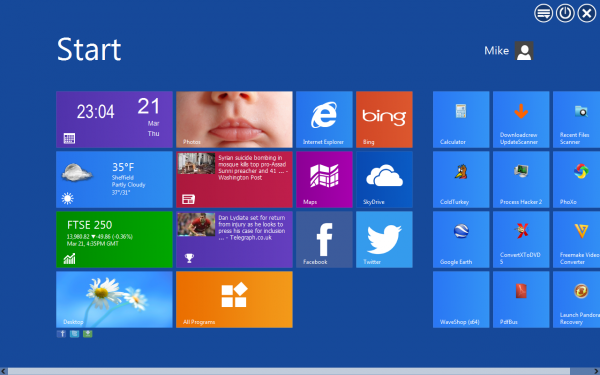
    Windows X has released updates for its skinning tools, Windows 8 UX Pack 7.0 (for Windows 7) and Windows 8 Transformation Pack 7.0 (for Windows XP, Vista and 7). The programs bring much of the look and feel of Windows 8 to earlier desktops.

    One notable change this time around is the inclusion of WinMetro as an alternative Start Screen for both packs. Windows X says the program is stable and not resource hungry, which perhaps is why they’ve made it the “Immersive UI” alternative, but if you prefer the older Newgen, just the charms bar, or nothing at all, then all those options are still available.

    Both packs also gain an updated Glass UI theme, and an updated Windows 8 visual style for Windows 7.

    Enhanced audio features include improved sounds scheme files handling in Windows 8 Transformation Pack 7.0., and new sounds scheme media files in Windows 8 UX Pack 7.0

    And Windows 8 Transformation Pack 7.0 benefits from updated font installation code.

    This isn’t the most essential of updates, perhaps. If you’re not interested in WinMetro then the updated theme and visual style are the real highlights.

    Both the Windows 8 UX Pack 7.0 and Windows 8 Transformation Pack 7.0 remain very comprehensive, though, with logon screens, wallpapers, themes, a Start Screen which automatically configures itself to suit your needs, along with a Windows 8 Start orb,user tile, Aero auto-colorization, and more. In our experience both packs can be installed and removed easily, and they’re a good choice for anyone who would like the look of Windows 8, without the hassle of upgrading.

  • Overhauling a home network, part 5 — Back to the future

    With last week’s installment, this little series largely came to an end for now, but it doesn’t mean that I am not actively planning for future improvements to the digital lifestyle in our home. In fact, my list of ideas for improvements is a rather lengthy one, though the expenses are enough for now and I have no desire to incur the wrath of my wife with more deliveries showing up on our doorstep.

    But, where exactly do I want to go from here? The ideas are endless, but for the sake of brevity I will list only a few here. These are the ones I have prioritized at the top of that future list. The ones I consider most important to make everything work quicker and more smoothly.

    The Network

    My office, which resides way up on the third floor of this old Victorian, contains the cable modem and router. The router is a new Netgear model, only a couple of months old, and there is no need for change here — it has wireless N as well as gigabit ethernet. The cables running from it to the desktop PC and home server are Cat 6 and capable of handling that speed. The cable running into the wall, and down a chase to the basement where the switch resides is also Cat 6.

    The switch, in this case, is the choke point. It is a couple of years old and I went cheap when I purchased it — 10/100, not 10/100/1000. That is one place for improvement.

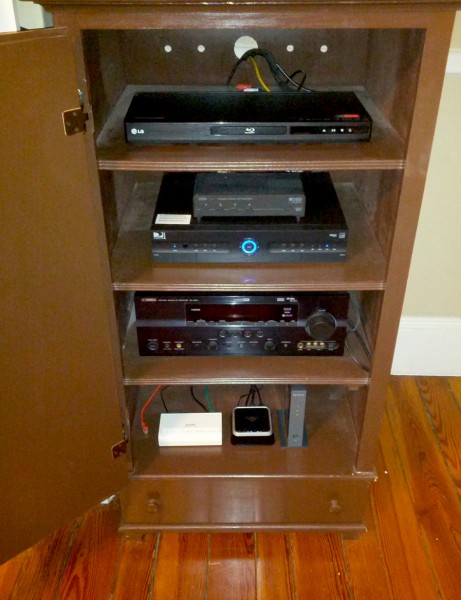
    Wires from that D-Link switch run up behind the entertainment cabinet, and again are Cat 6, which is good. They hook to various items in the cabinet — a DirecTV HD DVR, Blu-Ray player, a Google TV and another switch. That switch is also not gigabit capable — another spot that needs improvement. The second switch is simply for future expansion, like that Roku 3 I am eyeing.

    That cabinet also contains a Netgear wireless extender, which is “N” capable, so there is no need for an upgrade in that department, meaning that this area of the network only requires two new switches — a minor expense.

    The Server

    The FreeNAS box has adequate storage at the moment, but I have filled all bays with drives, and even added a modest 320 GB external one as well. It is only a matter of time before I run out.

    With that in mind I am looking at external multi-bay drive enclosures. Four bay units can be had for under $100 and internal SATA drives in the 2 TB range are cheap. Even better, they can be added on an as-needed basis, meaning it’s an expense spread out over time, which is a wife-friendly way of doing these things.

    Computers

    A few months ago I would have put HTPC in this section, but feel I have owned my last one now. I never used it to its full potential because I love my DirecTV — actually I love NFL Sunday Ticket — so it was more a media jukebox and never a DVR. The addition of the Google TV added all of the Media Center functionality I was using, saved shelf space and was much cheaper than building a new HTPC.

    My laptop is slightly over a year old, my daughter’s is from Christmas, the older one is a candidate for Linux and the desktop and server are just fine.

    No expenses coming here. I say that knowing it is a jinx. The old server was fine until smoke suddenly started coming out of it one morning.

    Home Theater

    And now we reach my weakness — not because it needs improvement, but because I simply love playing with this stuff. Our home theater works great. We have a 7.1 channel Yamaha A/V receiver (using only 5.1), Blu-Ray, DVR and Google TV. What’s not to like?

    I have been coveting a new receiver. As much as I have loved Yamaha over the years, I must confess that I have a mistress named Harman Kardon. The new line is sleek and beautiful. Plus, most new receivers come with ethernet — I have no idea exactly why I need that in a receiver, other than as a toy to play with. Yes, I know it plays Pandora and the like, but so does Google TV, and it feeds into those 5.1 speakers as well.

    I also like to play with set top boxes and both the new Roku 3 and WD TV Live intrigue me. The new Roku 3, with its ability to play audio from a headphone jack on the remote, is especially fascinating, but these are far down the list, given that I just purchased the Google TV and do not feel like being questioned about why we need another device with similar functionality.

    In the End

    …The love you take is equal to the love you make. No, seriously. There is not really that much on the above expense report. Network switches are cheap and the set top boxes I mentioned are not necessary. The receiver is pricey, but not needed now. The big thing is expanded storage for the home server, and I expect that to be in the $200 range for starters — the enclosure and one 2 TB drive.

    However, I seem to find new toys on an almost daily basis, so I expect this list to continue to expand. For now though, I must say I am happy with how things have turned out.

  • Why the South Will Lead in the Global Tilt

    When news broke recently that Brazilian investment firm 3G Capital was teaming with Berkshire Hathaway to buy Heinz for $28 billion, some people noted that the deal marked a resurgence in M&A activity. Maybe so, but I see it as part of a bigger, more formidable trend that has vast implications for the future of almost every business: what I call the global tilt.

    The global tilt is an irreversible shift of economic power from North to South: from the U.S., Europe, and Japan in the Northern hemisphere to China, India, Brazil, Indonesia, Malaysia and other countries mostly in the Southern hemisphere. The center of gravity for jobs, wealth, and market opportunities is moving, disrupting the world economic order as we have known it.

    Fluid capital, mobile communications, and an expanding global middle class all contribute to the global tilt, but the human factor is also a powerful driver. Along with a newly enriched investment class, business leaders in the South are on the move, tapping into the readily available funding and expertise they need to grow, and scaling up fast to grab once-in-a-lifetime opportunities. The empires they are building could rival those created in the nineteenth-century by the likes of Cornelius Vanderbilt, J. P. Morgan, Andrew Carnegie, and John D. Rockefeller.

    It’s easy for leaders in the North to underestimate their counterparts in the South, attributing their success to government support or low-cost labor, but such a viewpoint is narrow and risky. Successful leaders of the South have enormous energy, ambition, and business savvy, and they are aiming to compete everywhere on the planet.

    In some ways business leaders in the South have an edge:

    They are a product of scarcity. Many have grown up under conditions of hardship. Improvising and working on very tight margins is second nature. They are fiercely focused on operations, because they know that’s how money is made or lost. Sunil Mittal, founder and CEO of Bharti Airtel, the fourth largest telecom company in the world, began his work life doing the grunt work of sales and distribution as he tried to make a living selling crankshafts to bicycle manufacturers in Ludhiana, India. His customers always overpowered him and controlled the pricing, and his meager budget relegated him to riding in the backs of trucks and crowded trains. The discipline of tight margins never left him.

    They think large-scale. South-based leaders are living through huge changes in their home countries, and suddenly see opportunities they never even dreamed of right in their own backyards. An American company might think 4 percent revenue growth is acceptable; a Southern company thinks 20 percent is normal. Right from the start, CEO Zhang Ruimin of China’s Haier Group set his sights beyond China. “The objective of most Chinese enterprises is to export products and earn foreign currency,” he told Harvard Business School researchers in the 1980s. “This is their only purpose. Our purpose in exporting is to establish a brand reputation.”

    By innovating, operating efficiently, and exploiting market niches, Zhang has confronted well-established manufacturers of the North on their own territory and used his success there as leverage to win in the global game. In 2011, for the third year in a row, the Euromonitor International market research firm ranked Haier as the top appliance brand in the world, calculated its retail volume share as 7.8 percent, and named it a global leader in consumer electronics.

    They learn fast. These leaders tap the advice of investment bankers and consultants, many from the North, to identify the best opportunities, and they use partnerships, joint ventures, licensing deals, and acquisitions—whatever it takes— to establish themselves in a market or industry and scale up quickly. Indian infrastructure company GMR, which built the Indira Gandhi International Airport in Delhi, knew virtually nothing about building or running airports when it made a successful venture into that business. Its leaders studied the business intently and met with service providers, cargo companies, duty-free operators, vendors, and architects worldwide to learn what they could. Kiran Kumar Grandhi, son of the founder who oversees the airports business, says he learned to learn from his father, GMR founder G. M. Rao: “All through my childhood I observed him interacting with other people in this way. He was constantly gathering information.”

    They move fast. These leaders are energized by the opportunities they see before them, and they are decisive. As head of Brazilian beer company AmBev, Carlos Brito had a voracious appetite for growth. He went on a tear of expansion in Latin America, then in 2004 undertook a merger with Belgium-based Interbrew. Although the European company was bigger, the Brazilian leader ran the combined company. In 2008 he was ready to take yet another big bite, making a surprise purchase of Anheuser-Busch, to create AB Inbev, the world’s largest brewer. Now he is trying for 100% ownership of Mexican beer company Grupo Modela, though the outcome of that deal is uncertain because of antitrust concerns.

    Don’t get me wrong; I’m not saying that the tilted world belongs exclusively to the South. The challenge is to understand the competition and adapt how you run your business — your mindset, your approach to strategy, your resource allocation, and your organization’s social system. In 2012 Procter & Gamble moved its headquarters for personal care from Cincinnati to Singapore, and GE posted a vice chairman in Hong Kong for the first time ever. As Keith Sherin, GE’s chief financial officer, explained, “This is where the growth is. We are shifting our center of gravity to emerging markets.” Winning in the global tilt starts with seeing its reality.

  • Apple Hits 100% Renewable Energy in its Data Centers

    apple-maiden-aerial-solar-4

    An aerial view of one of Apple’s two major solar panel arrays in Maiden, North Carolina, which supply electricity to help support the power requirements for a nearby Apple data center. (Photo: Apple)

    In the wake of pressure from the environmental group Greenpeace, Apple said Thursday that it has achieved 100 percent renewable energy at all of its data centers, including facilities in North Carolina, Oregon, California and Nevada. The company also is using renewables to support office facilities in Austin, Elk Grove, Cork, and Munich, and its Infinite Loop campus at Cupertino.

    The road to renewable was a formidable one. Apple doubled the size of an already huge solar array in North Carolina, buying another 100 acres of land to support the expansion.  The two separate 100-acre solar arrays in Maiden, N.C. each produce 42 million kilowatt-hours (kWh) of energy annually. Apple also uses biogas from nearby landfills to power Bloom Energy Server fuel cells at its Maiden site.

    Although it’s been secretive about the project, the company has been vocal in its plans to use renewable power exclusively for its new data center in Prineville, Oregon. That energy will come from a mix of sources, such as wind, hydro, solar and geothermal power.

    Facebook also has data center nearby in Prineville that uses an evaporative cooling system in combination with the natural moderate climate to save on energy costs. Facebook initially faced heat from Greenpeace over using energy from PacifiCorp, which is derived largely from coal.

    Gary Cook, senior IT analyst at Greenpeace called Apple out at an Uptime Symposium saying that it and Facebook should  “wield (its) power to alter the energy paradigm.” Apple has since stepped up in a big way. Since 2010, it has achieved a 114 percent increase in the usage of renewable energy at corporate facilities worldwide, up to 70 percent overall from 35 percent.

    “Apple’s announcement shows that it has made real progress in its commitment to lead the way to a clean energy future,” Cook said in a statement Thursday. “Apple’s increased level of disclosure about its energy sources helps customers know that their iCloud will be powered by clean energy sources, not coal.”

    Cook insisted that Apple “still has major roadblocks” to meeting its 100 % clean energy commitment in North Carolina, where he said electric utility Duke Energy “is intent on blocking wind and solar energy from entering the grid.” Greenpeace called on Apple to disclose more details on its plans for using renewable resources in all its data centers.

    See Apple’s environmental impact statement for details of its announcement.

    apple-bloom-servers-470

    Apple has also deployed a 10 megawatt installation of fuel cells in Maiden. The Bloom Energy Servers use biogas from a nearby landfill to generate electricity to support Apple’s data center operations. (Photo: Apple)

  • Big data needs people, leaders and real-time analytics: A Structure:Data 2013 recap

    In the afterglow of GigaOM’s Structure:Data conference this week, a few big-picture trends and surprising quotes stuck with us.

    Data needs people, my friend

    Despite the much-discussed power of data, there are roles for people to play in big data projects. Data increasingly influences companies’ decision making processes, but several speakers hit on the notion that people should be involved in big data storage and analysis.

    It all starts with a human question. Before machines generate answers, employees from many departments should feel empowered to ask good questions of data, said John Sotham, vice president of finance at BuildDirect.

    Beyond questions, humans need to decide which algorithms to employ and which data to use to answer questions, said Scott Brave, founder and chief technology officer of Baynote.

    In data science, machine use algorithms to make decisions with clean data for the sake of prediction and optimization, said Sean Gurley, chief technology officer of Quid. But in “data intelligence,” humans “create, change and shape the world we’re in” using small sets of messy data, he explained.

    Sometimes algorithms don’t bring the best results as well as people can. One website crowdsources identification of the top news to people, as my colleague Kevin Tofel wrote. And at times, it’s wise to throw lots of people at big data challenges. With TopCoder, there are competitions to discover the best software architecture, algorithms and analytics, said the company’s chief technology officer, Mike Lydon.

    There was an exception to the man-and-machine rule. The software BeyondCore’s software makes machines crunch all available variables to isolate the biggest profit generators. It displays charts and audibly tells you its findings.

    It takes leadership

    Becoming a data-driven company requires a human push, said Paul Maritz, chief strategist at EMC. “Change requires leadership,” he said. “It requires people to understand what is happening and really get behind it and drive organizations to transform, because none of us really like to change,” he said. Only then can companies discover better ways to make money.

    Meanwhile, Amaya Souarez, director of data center services at Microsoft, said that lots of internal data doesn’t automatically affect changes in strategy. “The data will help you in your discussions, but it’s not everything,” she said. “It really does take a lot of personal interaction and commitment to that relationship,” she said.

    We want analytics and we want it now

    Whether in Hadoop or in specialized databases, our speakers showed why they want to see big data analytics to happen in real time.

    Muddu Sudhakar, vice president and general manager of the Pivotal Initiative’s Cetas cloud and big data analytics platform, called for “Hadoop high throughput, low latency.” And SQLstream CEO Damian Black said that 2013 “seems to be the year where it’s all happening now. All Hadoop distributions are talking about streaming technology.”

    Ashok Srivastava, chief data scientist at Verizon, talked about what machines could do if they process data in real time: go through millions of new pictures users make on their cell phones and predict the health of a person or a machine based on changes over time. Similarly, Maritz identified an opportunity telecommunications companies have yet to take advantage of: texting customers to apologize for a dropped call. “They can’t even do that today, let alone do more ambitious things on top of that,” Maritz said.

    Big data words to the wise

    Executives, IT administrators and others will likely discuss these themes in the coming months. A few statements from speakers also stand out:

    “…What’s really most intriguing is that you can be 100 percent guaranteed to be identified by simply your gait — how you walk.” — Ira “Gus” Hunt, chief technology officer of the CIA, in a statement on the capabilities of a three-axis accelerometer

    “Hadoop is hard — let’s make no bones about it. It’s damn hard to use. It’s low-level infrastructure software, and most people out there are not used to using low-level infrastructure software.” — Todd Papaioannou, founder and CEO of Continuuity, in a statement on his lessons from Yahoo, where he was chief cloud architect

    – “I get asked all the time to explain, How is Riak better than Hadoop?” — Justin Sheehy, chief technology officer of Basho Technologies, in a statement about how hype surrounding Hadoop and big data gets in the way of real discussion about solving data problems

    – “What if you could send your sperm over email to somebody else and print the sperm on the other end?” — Naveen Jain, founder and CEO of Inome, in a statement about disruptions in big data from other industries

    Related research and analysis from GigaOM Pro:
    Subscriber content. Sign up for a free trial.

  • LIFX Smart Bulb Opens Up Second Batch Of 100K Pre-Orders, Demos Gesture-Based Dimming

    lifx-bulb

    Australian hardware startup and Kickstarter success story LIFX has good news for people who missed out on backing the initial project: it’s opening up a second round of pre-orders, with a new production run of 100,000 units, sold directly through its website. LIFX sold out its pre-order allotment on Kickstarter in just six days, blowing past $1M, which is 10 times its original funding target.

    LIFX’s original ship date was slated for March of 2013, but as of today co-founder Andrew Birt says the first 500 units should be rolling off the line in about four weeks time with a May/June Kickstarter shipping timeframe in mind, which isn’t that much of a delay in Kickstarter time. That’s why the company has now released the video above, which shows the production prototype in action, connecting to Wi-Fi, being controlled by the remote app with light color changing features and a demo of gesture-based dimming in action.

    The new second batch of LIFX bulbs is set for a September 2013 delivery date, so they’ll come after the startup fulfills its Kickstarter pledge pre-orders. All bulb types, including Edison screw, Bayonet and Downlight mounts, start at $79 (just $10 more than the original Kickstarter single-bulb price), and all have price breaks for bulk orders.

    Unlike Philips Hue, LIFX bulbs don’t require a base to connect to your network, and the Edison screw and Bayonet types are rated at 900 lumens on the LIFX (around 80w), while max brightness on the Hue is just 600 lumens (roughly 50w). Philips Hue bulbs cost $20 less per unit, but you also have to buy the starter kit which includes the base to get up and running, a $199 initial investment. Of course, the ultimate test will be in performance, so we’ll have to see how LIFX compares to the generally very positive reviews the Philips Hue is garnering.


  • Google reportedly planning its own Android smartwatch

    Google Smartwatch Android
    Samsung (005930) already confirmed that it is working on a smartwatch to take on Apple’s (AAPL) still mythical “iWatch,” and now a new report suggests that Google (GOOG) is also hard at work on its own wearable Android device. The Financial Times on Thursday evening cited a single unnamed source in claiming that Google has a smartwatch in development. The company’s Android team is reported spearheading the project, which will apparently yield a smartphone companion similar to Samsung and Apple’s efforts rather than a connected device. No launch timing or additional details about the device were reported.

  • iStreamPlanet Raises Series A Round

    iStreamPlanet, a maker of live streaming video technology, has raised an undisclosed amount of Series A financing led by Intel Capital. Juniper Networks has also completed a strategic investment as part of the round. The money will be used for development.

    PRESS RELEASE

    iStreamPlanet, the leader in live streaming video solutions, announced today that Juniper Networks has completed a strategic investment in iStreamPlanet’s Series A funding, which was led by Intel(R) Capital. The investment will be funded by Juniper Networks’ Junos(R) Innovation Fund. iStreamPlanet plans to use the proceeds from its Series A financing to accelerate the development of its live video streaming solutions, including Aventus(R), a cloud-based, live video workflow platform designed to address the challenges of streaming live events and live linear channels online to multiple platforms and devices. One of the key advantages of Aventus is its ability to move the live video workflow from today’s hardware-dependent infrastructure to a software- and cloud-based infrastructure.

    The relationship combines iStreamPlanet’s innovations and experience in providing scalable and cost-effective live video workflow solutions with Juniper’s industry-leading networking and caching technology to provide a reliable, secure, and high-performance platform for content providers. The two companies have worked closely in the past to deliver complex, live video workflows for major live events, including the 2012 London Games.

    “We are developing and bringing to market a next-generation automated video workflow platform, which will help content holders and distributors keep pace with the growing demand for live streaming video and accelerate new business opportunities for broadcasters of all sizes,” said Mio Babic, CEO of iStreamPlanet. “Juniper Networks’ commitment to innovation in networking and caching in the cloud closely aligns with our vision and customer demand, and we are excited to be working with them and leveraging their expertise in this area.”

    “Live streaming media is one of the most demanding networking and caching scenarios, and one of the fastest areas of growth and opportunity,” said Robert Krohn, vice president and general manager, Edge Software Business Unit, Juniper Networks. “Keeping up with customer demand will require solutions with new levels of scalability and automation, and iStreamPlanet and Juniper Networks are now on a fast track to bring this type of solution to market.”

    The Junos Innovation Fund is a venture capital fund, launched in 2010 and backed solely by Juniper Networks, that invests in leading early- and growth-stage technology companies that expand and enhance the Junos ecosystem.

    About iStreamPlanet iStreamPlanet is a premier, multiplatform video-workflow solutions provider committed to bringing high-quality streaming video experiences to connected audiences around the world. With more than a decade of live streaming video experience, iStreamPlanet has built a comprehensive offering of cloud-based video-workflow products and services for live event and live linear streaming channels. iStreamPlanet’s innovative approach has been chosen by the world’s leading sports, entertainment, and technology brands including NBC, Turner Broadcasting, Notre Dame Athletics, AT&T, Pac-12 and Microsoft. Founded in 2000, the privately held company is headquartered in Las Vegas with offices in Redmond, Wash., and London.

    The post iStreamPlanet Raises Series A Round appeared first on peHUB.

  • Carlyle Announced IPO of Broadleaf Co.

    The Carlyle Group announced that its majority-owned portfolio company Broadleaf Co. went public on the Tokyo stock exchange. Carlyle Japan Partners II acquired Broadleaf in November 2009. The Japanese company is an auto after-market software provider.

    PRESS RELEASE
    Global alternative asset manager The Carlyle Group (Japan co-representatives: Tamotsu Adachi/Kazuhiro Yamada; headquarters: Washington, D.C.; hereinafter Carlyle) today announced that its majority-owned company, Broadleaf Co. Ltd. (Tokyo Stock Exchange First Section, stock code 3673, headquarters Tokyo, Japan; President and CEO: Kenji Oyama) has gone public on March 22, 2013, with its shares trading on the first section of the Tokyo Stock Exchange.

    Carlyle sold 16,480,000 (73% of the total number of shares outstanding) of its holdings in Broadleaf and allocated the remaining 2,813,000 shares (13% of the total outstanding) for an over-allotment. Including the over-allotment portion, Carlyle will sell all of its shareholdings. Carlyle Japan Partners II acquired Broadleaf in November 2009.

    Broadleaf is one of the largest auto after-market software providers in Japan, providing IT solutions and services to maintenance and repair shops, body shops, dismantlers and parts distributors. With its proprietary IT systems, auto-part databases and network technologies, Broadleaf provides business applications for streamlining operations to 30,000 clients, helping them improve their operational efficiency and support their business development activities.

    Since its establishment, Broadleaf has expanded its business as a subsidiary of the publicly traded company, ITX. Broadleaf became independent in November 2009 through a management buyout (“MBO“) supported by Carlyle. The purpose of MBO was to focus on the long-term growth strategy of the company, including business model transformation and overseas expansion, in order to cope with the drastic changes in the automotive industry following the global financial crisis. During the MBO period, Broadleaf worked closely with Carlyle to maximize the company’s business value by focusing on network-based transaction fee to drive revenue growth, strengthening its management and sales teams, introducing strategic products, and expanding into overseas markets. Having accomplished the goals of the MBO, Broadleaf has decided to go public and is well-positioned for the next stage of growth.

    Kenji Oyama, President of Broadleaf, said, “Today, I am honored to announce the listing of Broadleaf on the first section of the Tokyo Stock Exchange. Since the MBO in November 2009, Broadleaf has received tremendous support from Carlyle. As a strategic partner with a long-term commitment, Carlyle has helped improve the company’s business structure and develop a sustainable growth strategy. Over the years, we have successfully implemented fundamental strategic initiatives that are instrumental to the growth of the company such as business model changes, organizational reform and overseas expansion. We will continue to accelerate our business growth to meet the expectations of all stakeholders by providing unique IT services that contribute to IT-industrialization of the automobile-related industries.”

    Comment on the initial public offering, Tamotsu Adachi, managing director and Japan co-representative of Carlyle Japan LLC, said, “Since our investment in 2009, Carlyle has worked closely with Broadleaf to enhance its business model and expand its overseas operations. The mutual trust between Carlyle and Broadleaf, coupled with President Kenji Oyama’s strong leadership, and the efforts of its management team and all employees, have contributed to the successful transformation of the company. With quality products and solid industry position, Broadleaf is positioned for continued growth and will make substantial contribution to the society as a public company. ”

    About The Carlyle Group
    The Carlyle Group (NASDAQ: CG) is a global alternative asset manager with $170 billion of assets under management across 113 funds and 67 fund of funds vehicles as of December 31, 2012. Carlyle’s purpose is to invest wisely and create value on behalf of our investors, many of whom are public pensions. Carlyle invests across four segments – Corporate Private Equity, Real Assets, Global Market Strategies and Solutions – in Africa, Asia, Australia, Europe, the Middle East, North America and South America. Carlyle has expertise in various industries, including: aerospace, defense & government services, consumer & retail, energy, financial services, healthcare, industrial, technology & business services, telecommunications & media and transportation. The Carlyle Group employs 1,400 people in 33 offices across six continents.

    The post Carlyle Announced IPO of Broadleaf Co. appeared first on peHUB.