Now we’ve seen some pretty impressive PS3 mods before but this one definitely takes the cake. Take a look at flasheur’s nifty PS3 Slim mod after the jump.
Category: News
-
Check out this over cool PS3 slim mod
-
PlayStation 3 is Castlevania: Lords of Shadow’s Lead Platform
Identifying a game’s ‘lead platform’ has gained importance this generation, as games like Bayonetta have turned out to be markedly inferior on one platform on another. But while the PS3 will be the lead platform for the upcoming Castlevania: Lords of Shadow, it seems that fans can rest easy.
“PS3 is the lead platform but the game is identical on both formats,” producer David Cox wrote via Twitter.
Cox also confirmed that the camera will be fixed in Lords of Shadow. Sounds like it will have a bit in common with God of War, which should lend the action a more cinematic feel.
Buy This Item: [Click here to buy this item]
-
Yammer Founder David Sacks Joins Scribd Board Of Directors
Scribd, a site that lets users and publishers upload and share documents, has a new board member. David Sacks, the founder of Geni and Yammer (and former COO of PayPal), joins the company as a director as of today.
Scribd had 8.1 million unique worldwide visitors in November 2009 (Comscore). They’ve raised $12.8 million in three funding rounds. Sacks is already an investor in the company.
Buy This Item: [Click here to buy this item]
-
Top Five Trends in the Future of Work
Brent Frei wrote:
We are increasingly a knowledge-based economy in the U.S., and work can be delivered digitally from anywhere. Take NightHawk Radiology in Coeur d’Alene, ID, for example—they are providing radiologists to any hospital that needs real-time availability and lower costs. They work online from Switzerland and Australia, but it could just as easily be Wenatchee or Usk, WA. These are often the jobs that create other jobs. An Amazon, Microsoft, or RealNetworks software technician for example, creates two to four other jobs within the communities they live.
This has all been made possible by the following 5 trends/innovations of the past decade:
1. Expansion of broadband throughout the U.S. and abroad.
2. Maturing of Web development tools and standards.
3. Usable Web access via handheld devices.
4. General acceptance of financial transactions over the Web as being safe and secure.
5. Emergence of online work and worker marketplaces.
I believe that a huge portion of the highest paying jobs in the next 10 years will be served across the wire, with less and less dependence on physical location. [Disclosure: The author is the co-founder of Smartsheet, an online collaboration and work management firm—Eds.] Small towns across the Northwest are currently growing with telecommuting professionals moving toward lower costs, higher quality of life, and less city hubbub.
The past decade’s innovations coupled with the increasing base of knowledge workers leads to my predictions for the coming decade:
1. Migration of professional people from high tax & regulation states to low tax & low regulation states.
2. Explosive expansion of work marketplaces and paid crowdsourcing for all kinds of jobs.
3. More productive people will work for themselves by shopping their considerable talents around the world via work marketplaces.
4. Job performance and work quality will become transparent as people’s work is reviewed online much as products are today.
5. Average earnings for high performers will be more than double the average earnings in their category.
Virtual assistants, a job category that is growing 50 percent a year, is already demonstrating these trends. More and more people are timesharing executive administrators. Most are home-based women (98 percent of V.A.s are women) who are now picking up extra income, or building full businesses.
I expect that we’ll look back in 10 years and wonder why we spent over $4.2 billion to move a relatively small amount of Washington state’s population less than 10 miles through a new tunnel [to replace the Alaskan Way Viaduct in Seattle—Eds.]. Had we spent half that much on schools, high-speed Internet access, and infrastructure across the whole state, it would have been a much bigger boon for the state’s economy.
Ten years from now, where you live will be a matter of lifestyle choice, not proximity to work.
-
Kiva’s Robots Go to Work Sorting Medical Devices at Boston Scientific

Wade Roush wrote:Robotics startup Kiva Systems of Woburn, MA, and medical device giant Boston Scientific (NYSE: BSX) said today that Kiva’s robots will be used to automate order fulfillment in two Boston Scientific warehouses, one in New England and one in the Netherlands.
It’s a big win for Kiva, whose shelf-toting robots are increasingly common in the warehouses of consumer goods distributors like Zappos, Staples, and Diapers.com, but which has never before landed a customer in the health or medical sectors, where there’s less room for error.
“Accuracy in order fulfillment is important if you’re doing office supplies or T-shirts, but if you are supplying medical devices to operating rooms, it’s an imperative,” says Mick Mountz, Kiva’s CEO and founder. In Boston Scientific’s existing warehouses—as in most traditional distribution centers—human pickers roam the aisles, grabbing products from bins. Making sure that each outgoing shipment contains exactly the right products involves time-consuming double and triple checking, steps that aren’t needed in Kiva’s largely automated system. “Kiva naturally provides a more efficient way to achieve that super-high accuracy,” says Mountz.
In a Kiva-equipped warehouse, central command software sends orders wirelessly to a fleet of squat, wheeled robots. A robot’s job is to navigate to the mobile shelving unit that contains the requested product, lift up the whole shelf, and transport it to a picking station, where a human operator grabs the product and transfers it to a box for shipping. (The process, which is quite beautiful to watch, is described in more detail in this April 2008 profile.)
Such a computerized system has a special advantage when it comes to handling highly regulated products such as the stents, catheters, and myriad other medical devices that Boston Scientific manufactures by the thousands. “The FDA sends out notifications quite frequently about [devices] that need to be double-checked or put on hold, and that is very disruptive to a manual operation,” says Mountz. “What we can do, just before we present something to the operator, is ask the host system, ‘Is this still okay?’” That way, products that have been flagged for regulatory reasons never make their way into boxes for shipping.
Kiva’s robots are also adept at carrying a large assortment of product packages, from very small to very large, which, according to Mountz, makes them more flexible than the competition: “automated storage and retrieval systems” in which transportation is typically provided by a bucket sliding along a conveyor. Ken Pucel, executive vice president of operations at Boston Scientific, backs up that point. “Other material handling approaches would have required us to integrate different technologies to handle units, cases, and pallets, as well as a wide range of product sizes,” Pucel said in today’s announcement. “Kiva is able to provide us a proven solution with the flexibility and ease-of-use of a single technology for our needs.”
Kiva will be installing its system as part of a multi-year “rolling upgrade” to existing Boston Scientific warehouses in Boston and Kerkrade, the Netherlands, according to Mountz, who says the deal represents an important foothold for Kiva in the medical-device market.
“We think the message is already out there that this is the highest-fidelity way you can do order fulfillment,” says Mountz. “What we excited about now is bringing that message that we have FIFO-style [first-in, first-out] workflow and inventory management to the medical device industry, the pharmaceuticals market, and other device suppliers. That is a big and growing opportunity for us.”
-
Homemade Bouillon and Kitchen Wallpaper Delicious links for 1.19.2010
 Brilliant! Homemade bouillon paste; what a good idea! This plus great wallpaper for the kitchen and rather springlike measuring spoons in today’s Delicious Links.
-
Super-Budget Lens-Mounted Ring Flash for DSLRs [Dealzmodo]
 Lens-mounted LED flash rings are a great resource for properly lit macro shots, but they’re usually pretty expensive (think $150). Enter Brando’s budget version.
It’s almost certainly crappier than the full-priced models, as is Brando’s wont, but hey, at $58 I’m perfectly willing to accept a few deficiencies. It can light up in either the full circle or a semicircle on either side, and is powered by 2 AA batteries. Pretty solid deal for something that usually seems unnecessarily pricey. [Brando via Crunchgear]
-
IR-1 Estimates Revisited [9]
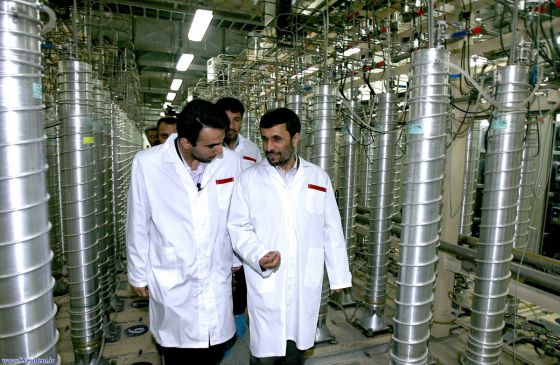
Note: Two previously overlooked estimates have been added to the data table, and the “observations” section updated accordingly.
Last week, at an event sponsored by AAAS (depicted above*), I had the privilege of giving a presentation on “Expert Opinion on Iran’s IR-1 Centrifuge.” The session was off the record, but I can share with you, Dear Reader, a data table assembled for the occasion, along with a few observations.
This table is an amended version of the data previously assembled by the Federation of American Scientists (see Table 1 in this report). I’ve tinkered with this dataset before (see: Estimating SWU with Expert Opinion, December 6, 2009). The amended table covers every published estimate of the separative power of the IR-1 centrifuge that I could find, running from March 2003 to December 2009. Explicit repetitions of previous estimates [or estimates explictly derived from earlier estimates] are not included.
(N.B. “Actual” indicates the mean performance of actual devices. “Nominal” indicates the maximum power of the device on paper. Despite some ambiguities, it’s usually apparent from context which type of estimate is intended, when not stated directly. For example, I’ve tagged as “nominal” those estimates that relate to the machines believed by different experts at various points to be ancestors of the IR-1.)
There are
2931 estimates, although some of the “nominal” estimates from ISIS appear to be repetitions. (More on this point in a few moments.) Here it is: the whole megillah.Note: Thanks to Scott Kemp for the clarification on his 5/27/08 estimate, which was actually two estimates. Thanks also to Andreas Persbo for the similar observation about his estimate of 2/27/09. I’ve corrected the table to reflect both of these inputs. I’ve also corrected a few minor errors and inconsistencies.
Author(s) Data source(s) kg SWU/yr Estimate of Date Hibbs Official sources 7 to 15 Actual 3/13/03 Hibbs IAEA sources 12 to 14 Actual 5/12/03 Hibbs AEOI data 6 to 7 Actual 5/12/03 Albright & Hinderstein (ISIS) Senior Western officials 2 Actual 9/1/03 Albright & Hinderstein (ISIS) Senior IAEA officials (stated subsequently) 3 Nominal (based on 4M) 3/1/04 Gilinsky, Miller, & Hubbard Unclassified sources (and educated guesses) 1 to 3 Actual 10/22/04 Hibbs IAEA and Western governments 2 Nominal (based on SNOR & CNOR) 1/31/05 Glaser (not stated) 2 Nominal (estimate of P-1) 6/14/05 Lewis Rademaker (USDOS) statement 2 < and < 3, closer to 2 Actual 4/15/06 Lewis Aghazadeh (AEOI) statement 2.3 Actual 4/18/06 “Feynman” via Lewis Aghazadeh (AEOI) statement 1.46 Actual 5/12/06 “Feynman” via Lewis Aghazadeh (AEOI) statement 2.3 Nominal 5/12/06 Albright (ISIS) Aghazadeh (AEOI) statement 1.4 to 2.7 Actual 5/17/06 Albright (ISIS) (not stated) 2.5 to 3 “the high end of the possible” 7/1/06 Albright & Shire (ISIS) Level Pakistan is said to have achieved 2 Actual of P-1 11/1/07 Garwin Aghazadeh (AEOI) statement 1.362 Actual 1/17/08 Glaser (not stated) 2.5 Nominal (hypothetical max. of P-1) 4/16/08 Kemp via Lewis Observed efficiency of 42% 1 Actual 5/27/08 Kemp via Lewis (not stated) 2.5 Nominal 5/27/08 ISIS NuclearIran FAQ (not stated) 1 to 2 Actual ~9/1/08 (n.d.) ISIS NuclearIran FAQ (not stated) 3 Nominal ~9/1/08 (n.d.) Persbo Cascades operating between 27 and 36% of total capacity 0.59 to 0.79 Actual 2/27/09 Persbo (not stated) 2.2 Nominal (based on SNOR) 2/27/09 Salehi (AEOI) (not stated) 2.1 Unclear; nominal? 9/22/09 Oelrich & Barzashka (FAS) IAEA reports 0.5 Actual 9/25/09; see also 11/23/09 Wisconsin Project IAEA reports 0.5 Actual 11/16/09 Albright & Brannan (ISIS) IAEA reports 1.0 to 1.5 Actual 11/30/09 Albright & Brannan (ISIS) (not stated) 3 Nominal 11/30/09 Oelrich & Barzashka (FAS) IAEA reports 0.44 to 0.88 (0.88 is highly unlikely) Actual 12/1/09 Kemp IAEA reports 0.6 to 0.9 Actual 12/1/09 Wood via Kemp Max. of P-1 based on validated hydrodynamic codes from the U.S. program 2.1 to 2.2 Nominal (max. of P-1) 12/1/09 Four Observations
First, as noted previously, the trend of the estimates declines with time. This effect only becomes more pronounced with the inclusion of the estimates reported by Mark Hibbs in NuclearFuel and Nucleonics Week in early 2003: now the trend of the decline
isfollows an exponential curve. These reports appeared when IAEA inspectors had just put eyes on the IR-1 (then called the P-1 in IAEA reports) for the first time. Their initial frame of reference presumably involved more up-to-date machines, rather than centrifuges whose design heritage extends back to the 1960s.[Update | 22:54. See Mark Hibbs’ account in the comments below.]
Second, the decline comes in bursts, coinciding with the availability of new information. This effect is loosely similar to the influence of news on stock prices, as documented in event studies. The effect tends to be prompt in finance; a bit less so here.
- From mid-2003 into 2005, which covers the first period of centrifuge operations at PFEP in Natanz, we see the gradual sorting-out of the design heritage of the IR-1.
- The next wave comes in mid-2006, right after AEOI chief Gholamreza Aghazadeh gave some detailed figures during an interview with Iranian TV. Here we start to see some divergence between “actual” and “nominal” estimates, with “actual” figures falling below 2 kg SWU/yr.
- Next come the estimates of late 2007 to
early 20092008, after the commencement of enrichment work at the FEP in Natanz, whose results were periodically documented in IAEA reports.
- A final burst of estimates, explicitly derived from the ever-accumulating IAEA reports, takes place in
late2009. Here, “actual” estimates fall below 1 kg SWU/yr.
Third, in most cases, a “new entrant” tends to lead the way in pushing “actual” estimates down. That is, someone who wasn’t previously in the game seems to take hold of the new information and bring it to light, with the rest shortly catching up. In 2003 and 2004, it was David Albright and Corey Hinderstein of ISIS. In 2006, it was Jeffrey Lewis and a pseudonymous correspondent here at ACW. In 2009, it was Ivan Oelrich and Ivanka Barzashka of FAS.
[Update | 23:51. In hindsight, Andreas Persbo was the first to present an “actual” estimate below 1, using recent IAEA reports. This contribution may have been overlooked because it was couched as a range of percentages of a nominal figure.]
Fourth, there are lingering differences between experts in both “actual” and “nominal” figures. Much of the basis of the “actual” differences was laid bare in the FAS–ISIS debate of late 2009. The “nominal” differences seem to originate with early reports about the design heritage of the IR-1. In March 2004, ISIS related that the IR-1 was copied from URENCO’s 4M centrifuge; both designs have four aluminum tube rotor segments. In January 2005, Hibbs reported that the IR-1 was derived from URENCO’s SNOR and CNOR machines.
Both 4M and CNOR are said to have been capable of about 3 kg SWU/yr. The CNOR had six segments, each responsible for about 0.5 kg SWU/yr, according to Hibbs. Since the Pakistani P-1 and the Iranian IR-1 have four segments, their nominal output, if they are understood to be CNOR derivatives, is about 2 — or, according to some recent figures, 2.1 or 2.2. Most experts seem to agree with Hibbs, or wind up close to his figure. But Albright and colleagues persist in viewing 3 as the real ceiling.
Should you, Dear Reader, notice any other subtle patterns in the data, well, that’s what the comments feature is for!
*Actually, the picture at the top of this post does not show me giving a presentation.
-
Growing an indoor vegetable garden
Obviously you’re not going to grow watermelons and large pumpkins in an indoor window box garden, but you can grow many edible crops beyond herbs.
Considerations for an indoor garden…
Sunlight is the key ingredient for a successful indoor garden of edibles. If you’ve got it, lucky you. Here in the Pacific Northwest, we get some sunlight shining though our windows during the winter, but not tons. If you want to try and grow root crops and leaf crops you can get away with some shade time, but veggies that produce fruit of some sort usually need at least 5-6 hours of sunlight per day, and that’s a minimum. Your veggies will be better off with 9-10 hours of sunlight per day.
Plus, you have to consider window placement. Right now my largest windows are shaded by a ton of trees so getting direct sunlight to any plants I grow there is tough, even in summer. You can consider grow lights though if you get very little indoor sunlight. If you have some sunlight you can increase the effect a little with light reflective materials around the plants such as white rocks, foil, or a white, not dark table or window surface.
When getting your containers ready to plant, you’ll need a good soil mix that’s lightweight and not from your yard, suitable containers, and trays unless you want water everywhere. See some tips on how to plant a window box garden for more tips on choosing containers and soil.
To increase the humidity around your veggies try filling the container trays with rocks – either around the container or if the rocks are level enough, set the containers directly on them.
Unless you have a large garden window and huge planting containers, you’ll need to grow smaller plants indoors. That doesn’t mean you choices are totally limited though. You can still grow edibles like bush beans, peppers, endive, carrots, radishes, various lettuce varieties tomatoes and more. Especially look for miniature or dwarf varieties of plants and seeds.
Some indoor container veggie ideas include:


- Tomato Tomatoberry Garden Hybrid
- Eggplant Fairy Tale
- Lettuce Little Gem
- Little Finger Carrots
- Pepper Red Popper
- Bush Bean Bush Blue Lake 47
For more tips read: Guide to container gardening.
Post from: Blisstree
-
Sài gòn ít nhà cao tầng nhỉ
Hiện tại thấy Hà Nội có rất nhiều tòa nhà xây cao 60-70 tầng(200-300m) mà SG không thấy dự án xây như vậy.Nghe nói nền đất ở Sài Gòn không thể xây dựng đc nhà cao tầng như vậy phải không?
Cám ơn mọi người -
Mother to newly diagnosed 11 year old
My daughter was just diagnosed with Type 1 diabetes in November. It has been a whirlwind in education, fear, and learning as we go. I have been through many stages of grief. I was very angry at first and I still am at times, but things are getting better. Now I am accepting of her diagnosis and want to ensure that she can live a happy and full life despite needing to be on insulin.I joined this forum in the hopes of learning more and learning from individuals who actually have the condition.
-
NEW YORK TIMES: Kraft Turns the Corner in Its Bid for Cadbury
It would have been astonishing if Kraft Foods’ hostile bid for Cadbury had gone to the bitter end. Like most contested takeover battles, this one looks to be edging toward a last-minute rapprochement. Cadbury will most likely squeeze more out of Kraft without an auction — an impressive feat.
Kraft is expected to pay about 840 pence ($13.70) in cash and stock, and let Cadbury shareholders keep a final dividend worth 12 pence a share. That takes Kraft’s offer to about 850 pence ($13.86). Kraft is also expected to raise the cash component to around 500 pence, more than half the consideration.
That would be a 50 percent premium to Cadbury’s pre-bid share price, but it’s not hard for Kraft to justify. The market rise during the course of the battle accounts for 12 percent. Upgrades to sleepy analysts’ estimates provide perhaps another 10 percent, implying a reasonable 28 percent premium for control.
Alternatively, put Cadbury’s forward earnings on a multiple of 15.5 times — a justifiable premium to the market given Cadbury’s double-digit compound earnings growth ahead — and it’s worth 682 pence on its own. With Cadbury’s help, Kraft should be able to lift the cost savings to 7.5 percent of Cadbury’s annual £6 billion in sales. That would imply synergies with a present value of more than £3 billion. On this math, Kraft might have justified a bid close to 900 pence a share.
The re-jiggering of the cash and shares mix means Kraft can lower the amount of stock it puts into the offer, pleasing a big shareholder, Warren E. Buffett. As for Cadbury, it has delivered value for shareholders in an increasingly vulnerable situation.
With hedge funds holding 20 percent and many American investors happy to take Kraft paper, Cadbury’s independence was threatened. Cadbury flirted with a bid from Hershey, which surely helped scare Irene Rosenfeld, Kraft’s chief executive, into raising her offer. Peter Mandelson, the British politician who appealed to shareholders not to sell on the cheap, also lent a hand.
It looks as if Ms. Rosenfeld will get her deal. At some points during the battle it looked as if the Cadbury endeavor might sink her career. Now, as long as she can hold to her promises, she will look like the conquering hero of Candyland.
Funds Lose Allure
Giant private equity funds won’t be back for a while. New research shows many investors have lost interest in multibillion-dollar funds. That will make it tougher for big buyout shops like Blackstone and Kohlberg Kravis Roberts to raise money in the amounts they have become accustomed to. Some may even have to relearn smaller-scale methods of investing.
The best-regarded firms can still raise plenty of money. BC Partners, a private equity fund based in Europe, is aiming to start a 6 billion euro fund. And Blackstone has gathered about $9 billion for its next fund.
But firms may not be able to harvest as much money as they have in the past. Even if Blackstone’s total rises further, it will probably raise only about half the $21.7 billion that the firm raised in 2007 for a fund.
Most big buyout firms will have to set their sights lower still. According to a recent survey by the data provider Preqin, 37 percent of buyout investors who had previously invested in large funds said that they would now avoid funds with more than $4.5 billion. Just 5 percent of investors said they would avoid small and midmarket funds.
Investors are shying away from giant funds partly because, with less accommodating debt markets, the big deals these funds need are tough to pull off. For some of the same reasons, private equity managers are having trouble exiting larger investments profitably. Partly as a result, large funds are posting lower returns than midmarket funds, according to Preqin. That gives investors another reason to look elsewhere.
Even if they can still raise billions, most private equity firms will have to revert to preboom types of deals. Rather than undertaking giant leveraged buyouts of public companies, the more typical investment used to be buying smaller private businesses and units from public companies.
Going back to that kind of business may require more work by the buyout barons for deals with smaller fees and potential rewards. That means that as their funds shrink, big firms could find their profits — and payouts to their people — deflating, too.
For more independent financial commentary and analysis, visit www.breakingviews.com.
Share Investor Blog – Stockmarket & Business commentary
Share Investor New Zealand Business News– Get more business news
Discuss this topic @ Share Investor Forum – Register free
Share Investor’s Daily Forex UpdatesRecommended Amazon Reading

Warren Buffett and the Interpretation of Financial Statements: The Search for the Company with a Durable Competitive Advantage by Mary Buffett
Buy new: $16.47 / Used from: $15.70
Usually ships in 24 hours
The Essays of Warren Buffett: Lessons for Corporate America, Second Edition by Warren E. Buffett
Buy new: $26.10 / Used from: $33.05
Usually ships in 24 hours
From Amazon – Apple iPod touch 32 GB (3rd Generation) NEWEST MODEL
-
Herbal Hair Loss Treatments: Help From Mother Nature
Most people do not pay any attention to the wide number of available hair loss treatments until they begin to notice a bit of scalp showing through. And then they can’t educate themselves quickly enough on their options for both keeping the hair they still have and re-growing that which they’ve lost.
They may find themselves awake during the wee hours when infomercials dominate the airwaves, searching for the latest miracle hair tonic. Hair loss treatments in the 21st century are big business.
If you’re one of those people just discovering the wide world of hair loss treatments, you may have already discovered that most of those available contain chemicals which might have adverse effects on your health. If you’re someone who prefers to go natural whenever you can, don’t despair for your hair. Herbal hair loss treatments are out there.
Popular Herbal Hair Loss Treatments
If you are willing to accept that there is no miracle remedy for hair loss, chemical, herbal, or otherwise, and be patient enough with your herbal hair loss treatment to let it do its work, there are a few herbs which deserve your attention.
You may, if you’re into herbal supplements, already have gingko biloba on your kitchen in you kitchen. Gingko has been shown to stimulate blood circulation, and may improve hair growth by increasing nutrient-rich blood flow to the hair follicles.
Another of the better-known herbal hair loss treatments is green tea, which you may also have sitting in you kitchen. Green tea has some compounds believed to inhibit an enzyme which transforms ordinary testosterone into dihydroxytestosterone, or DHT. DHT, in turn, has been linked to hair loss, and by keeping the DHT at bay, the incidences of male pattern baldness may be reduced. The great thing about this is that green tea tastes great, but even if you’re not a tea drinker, you can take green tea extract as a capsule. For more info see http://www.hairlosstreatmentshelp.com/Natural_Hair_Loss_Treatments/ on Natural Hair Loss Treatments.
Pygeum, taken from evergreen bark, functions like green tea as an herbal hair loss treatment, as do stinging nettle and saw palmetto. Saw palmetto is the main ingredient in many herbal hair loss treatments, and combined with pygeum and nettle, will offer extra strength in fighting DHT production.
Mix and Match
The above herbal hair loss treatments are all available in pill or capsule form, but some people also use shampoos or topical ointments and creams which contain herbal hair loss treatment ingredients. You can feel free to try them all in whichever combinations please you, as long as you do not exceed the recommended daily dosage for any one of the individual ingredients.
You should discontinue their use and consult a physician if you notice any negative reactions from using herbal hair loss treatments.
You can also find more info on Hair Loss Treatment and Hair Loss Treatment Shampoo. Hairlosstreatmentshelp.com is a comprehensive resource to know about Hair loss.Possibly related posts: (automatically generated)
- Related posts on from
- Genting Singapore downgraded to 'hold' from 'buy' at AmResearch …
- Guide Dog Services to benefit from A & P Auction
-
Teaching Process Skills with Children’s Literature: The Science Book of Water

Introduction and Summary
The Science Book of Water by Neil Ardley is a book of experiments that help students understand some of the different properties of water, such as buoyancy, density, displacement, surface tension, evaporation, etc. The experiments can be easily done in the classroom or at home because most households will have the supplies needed. Also, most of the experiments can be done in four to six simple steps. One experiment called “Floating and Sinking” shows how objects, such as marbles and modeling clay, will sink to the bottom of a bucket. However, if the modeling clay is shaped in the form of a boat, it will float because of the water it displaces. There are twelve other experiments in this book.Curriculum Connections
This would be an excellent book to teach students how a method is devised to test the validity of predictions and inferences (SOL 6.1.e). Also, for each experiment, “a question is developed and predictions are made from one or more observations (SOL K.1.g).”Additional Resources
- Properties of Water
- The Water Cycle This site provides other activities that teachers can do in order to teach their students about the properties of water.
- Other Great Teacher Activities
General Information
Book: The Science Book of Water
Author: Neil Ardley
Photographer: Clive Streeter
Publisher: Harcourt Brace & Company
Publication Date: 1991
Pages: 1-29
Grade Range: 1st & 2nd
ISBN: 0-15-200575-7 -
Bellevue, WA USA
Bellevue is a rapidly growing city in King County, Washington, United States, across Lake Washington from Seattle. Long known as a suburb or satellite city of Seattle It is now categorized as an edge city or a boomburb.The population in 2008 had grown to an estimated 123,771.Here is my photos that I took today on January 18th
Please forgive me for the quality!
I hope you will enjoy.


-
Donors receive | Cosmic Variance
With the arrival of a certain book (selling like hotcakes on Amazon!), Sean has generously sent out thank you gifts to all deserving participants of the DonorsChoose challenge.
The final tally was 36 donors contributing $12,125, reaching a total of 3,112 students across the nation. These are incredible numbers! We can all feel proud that we have had a tangible impact on so many lives. And who knows, maybe one of the kids we have reached will now be inspired to become the next Einstein?
 As promised, we’re doling out loot. 13 people gave over $100, and 4 gave over $500 (with 2 giving over $1k each!). Here is the list of recipients:
>$100: copy of Sean’s book
Raymundo in College Station, TX
James in New York, NY
Pete in St. Paul, MN
Paul in Dearborn, MI>$500: copy of Sean’s lectures
Kitty’s Coffee in Cincinnati, OH
Sili in Odense, DenmarkThere are many people that “qualified”, but haven’t sent me their addresses (of special note were Meghan in Melbourne, FL and Herbert in Bahama, NC, who were especially generous). If you would like to receive a token of our appreciation, please contact me.
Thank you again to everyone for participating!
-
Conociendo la Provincia de Cordoba
Estuve unos dias de vacaciones en esta hermosa provincia y no pare de sorprenderme con la cantidad de maravillas y atractivos que posee. Es en mi opinion la provincia mejor preparada para el turismo, y creo todavia no ha sido descubierta por el turismo internacional en gran escala.Posee una ciudad capital muy atractiva y desarrollada, y una serie de pueblitos y pequeñas ciudades con sierras, rios, arroyos y embalses ideales para conectarse con la naturaleza, sin dejar de lado las comodidades que cualquier turista puede pedir.
Empiezo mostrando fotos de Cordoba Capital, una ciudad muy subestimada en el imaginario colectivo argentino, y lo digo por experiencia propia, me lleve una increible sorpresa con esta ciudad. Me la imaginaba menos brillante, menos atractiva y tiene zonas muy desarrolladas, que dan imagen de primer mundo. Se la ve muy organizada, sin estar invadida por villas o asentamientos ilegales como otras grandes ciudades del pais.
Entrando a la ciudad en auto

Amplias y arboladas avenidas te reciben y te guian hacia el barrio mas lindo de la ciudad: Nueva Cordoba

Algo que me llamo la atencion, es que en este barrio, todos los edificios son nuevos y con buenos diseños.. no hay mezcla de fechas de construccion y estilos como pasa en Bs As

El espacio publico y mobiliario urbano, asi como la limpieza son impecables, al nivel de ciudades europeas

El Palacio Ferreyra es una joya de edificio


El barrio me recuerda a algunas ciudades españolas, especialmente esta avenida

Esta iglesia es hermosa y esta muy bien conservada


Enfrente esta el Paseo del Buen Pastor, un lindisimo lugar de encuentro entre amigos o familia

Un edificio nuevo que me gusto mucho en frente del paseo

A unas pocas cuadras de nueva Cordoba encontramos la plaza principal, muy bien mantenida y rodeada de espectaculares edificios historicos, como la Catedral


y el Cabildo

Un paseo comercial peatonal muy elegante


Anochece en Cordoba y de vuelta a la modernidad del barrio mas lindo de la ciudad. Esta torre me encanta

y por ultimo, la decoración navideña le sienta muy bien al paisaje urbano

Espero que les gusten las fotos y se sorprendan tanto como yo, con esta linda ciudad que tenemos a unas pocas horas de Buenos Aires. Si me equivoque en algun dato, que algun forista cordobes me corrija. La idea es mostrar otras ciudades de la provincia el proximo posteo
-
Small Space Solution: Refrigerator Side Shelf
 Small kitchens have to make good use of every scrap of space, and the side of the refrigerator is often wide open and begging to be used. What about taking down the magnets and pizza menus and putting up one of these side shelves instead?
-
AT&T Fixes Mobile Facebook Problems [Facebook]
AT&T has fixed several problems that caused some AT&T customers to log into the wrong Facebook account when using their mobile phones, an AT&T spokesman said on Monday: “In a limited number of instances, a server software connectivity error resulted in some AT&T wireless customers being logged in to the wrong Facebook account when they accessed Facebook through their mobile phones.”
AT&T added new security measures to prevent the problem from happening again and worked with Facebook to disable subscriber identification information as an option for automatic log-on, Coe said. The subscriber identification is the session identification number that gets added to the URL, he said.
AT&T also fixed a separate problem in which a customer in Atlanta was able to log into the wrong Facebook account on a mobile phone. In that “isolated” case, the problem was due to a misdirected cookie on the customer’s phone, Coe said.
“We worked with the customer to resolve the issue,” he said. “It is unclear how this cookie was set on the phone.”
Asked for comment, a Facebook spokesman said: “We don’t have anything more than what AT&T is saying.”
The Associated press first reported on the problems this weekend.
 This story originally appeared on CNET
-
Nurse Practitioner Ahead Of The Game In Treatment Of MRSA
Nasal carriers of S aureus infection have a high risk for healthcare-associated infection 3 to 6 times that of noncarriers, and more than 80% of healthcare-associated S aureus infections are endogenous. Although intranasal application of mupirocin ointment has been shown to prevent invasive infection in patients receiving dialysis, the results with surgical patients have been controversial. The authors proposed that adding skin cleansing with chlorhexidine gluconate soap would improve outcomes of S aureus infection in hospitalized patients.
The above study was conducted recently and printed January 7, 2010, issue of the New England Journal of Medicine. Ask my patients what I’ve been doing for the last two years in my office. I learned that regimen from the hospital where I worked as a floor nurse from the surgical group. This is not something that most providers know by now.
The area that I work here in North Florida is a hotbed of MRSA and almost daily I get patients in with complaints of chronic boils and spider bites. I still have to shake my head over the continued misunderstanding of the process of bacterial resistance. This is the main reason that I stress to all of my patients the need to finish an antibiotic and to only take one if it’s indicated. Too many want instant results and ask for an additional antibiotic before the first one has had time to take effect.
The regimen that I have used for the last two years is Hibaclens body wash daily x 10 days while on antibiotics and Mupricion ointment to nares twice daily x 7-10 days. Usually the MRSA is reactive to Septra DS or Cipro. In some rare cases, Rifampin or Tetracycline is used for resistant strains. Hand washing is so important and teaching patients to wipe off grocery carts. The first place people often go after discharge from a hospital is to Walmart. We all know that insurance companies are requiring much shorter stays and people are still contagious.
Protect yourself through education and proper use of antibiotics out there!


