Category: News

  • Globalstar to spend $1.3B on second-generation satellite phone network

    globalstarIf spending money to build a satellite phone network reminds you of a few recent financial debacles, you’re not alone.

    But regardless of its past foibles, Globalstar has created a real business and is announcing today that it is taking the first steps to deploying its $1.29 billion second-generation satellite phone network.

    While satellite phones seem quaint at a time of growing cell phone coverage, Tony Navarra, president of global operations at the Milpitas, Calif., company, said that many of Globalstar’s 375,000 customers are in remote regions of the U.S. and Canada. The phones used to be the size of bricks, but they’re now about twice the size of typical cell phones, with a little antenna nub sticking out of them.

    In an interview, Navarra said that this new network could prove far more cost effective than the last one. For $1.29 billion, Globalstar will be able to launch 24 satellites into orbit and build another 24 for the future. These satellites should last for 15 years, until 2025 and beyond, compared to just 7.5 years for the company’s first-generation satellites.

    It’s last network cost $4.5 billion to complete and the debt load was so heavy that it drove Globalstar, founded in 1994, into bankruptcy in 2004. It restructured its debt and then went public in 2006. In the summer of last year, it did a debt financing of $738 million. Competition includes Inmarsat, Iidium Satellite, SkyTerra Communicaitons and Orbcomm. Globalstar needs to get the satellites deployed because service quality is starting to diminish.

    Navarra said the satellites in the first network are becoming weaker. The low-earth orbiting satellites circle the globe about 850 miles in the sky. As they age, Globalstar takes them up about 1,000 miles above the earth and then replaces them with new satellites.

    Since the technology has improved, the second-generation network will be able to handle duplex voice and data at a rate of 256 kilobits per second, compared to just 9.6 kilobits per second earlier. It has high quality, and the data transfer speed will now be better.

    To further finance its new generation, Globalstar has raised $505 million in loans from a consortium of French banks and another $71 million from satellite maker Thales Alenia and rocket maker Arianespace.

    The company generates about $76 to $80 per subscriber per month for voice service and $10 per subscriber per month for data service. The company also makes money from engineering services. And its Spot division recently announced a satellite communicator to go with Delorme’s navigation handheld.

    Navarra said the company will launch one or two rockets this year, using Arainespace. Each rocket will carry six satellites. Today, the company said it has begun to install upgrades at its gateway ground stations around the world to get ready to deploy the second-generation satellite constellation.

    In the third quarter ended Sept. 30, Globalstar lost $5.5 million on revenue of $17.5 million. That compared to a loss of $26 million on revenue of $22.5 million a year earlier.


    Buy This Item: [Click here to buy this item]

    Read Original Article

  • Via debuts M’Serv 2100 server with 64-bit Nano CPU

    If you’re a small business customer or very serious about your reality TV habit, you just might want to take a look at Via’s newest. The M’Serv S2100 mini server is the first to rock Via’s new 64-bit Nano CPU (in this case the 1.3+GHz at 1.6GHz) — but that ain’t all! The case measures only 10.2- by 4.7-inches but includes two 3.5-inch SATA II drive bays (for up to 4TB storage), an integrated and bootable CF card slot, two gigabit Ethernet ports, three USB 2.0 ports, VGA output, and VT virtualization support for network video recording and virtual server applications. OS support includes Windows 7, XP, Vista, Server 2008 Foundation, and various Linux distributions (such as Ubuntu, SuSE Linux Enterprise Desktop 10 Service Pack 2, and FreeBSD). Sales are reserved for OEMs and sysadmins for the time being, but who knows? Maybe if you turn up the charm you can get in on the ground floor here. Hit the source link to get started.

    Via debuts M’Serv 2100 server with 64-bit Nano CPU originally appeared on Engadget on Thu, 14 Jan 2010 16:22:00 EST. Please see our terms for use of feeds.

    Permalink Akihabara  |  sourceVia  | Email this | Comments

    Buy This Item: [Click here to buy this item]

    Article

  • RED ONE getting Mysterium-X sensor upgrade next week

    RED may be busy talking up and showing off its new EPIC-X and Scarlet cameras these days, but it’s not about to leave its loyal RED ONE users behind, with it now announcing that they’ll be able to upgrade their camera to the new Mysterium-X sensor starting January 22nd.. That’s the same sensor that will come standard on the EPIC-X, and promises a range of improvements for the $5,750 it’ll cost you — not the least of which is improved low-light performance (one of the few knocks against the original sensor). Along with it, you’ll also get a new version of REDCINE-X to handle the improved video, and those interested in stepping up to the EPIC-X beta program can expect to get a $1,250 credit if they qualify and join at the first or second stage.

    RED ONE getting Mysterium-X sensor upgrade next week originally appeared on Engadget on Thu, 14 Jan 2010 15:51:00 EST. Please see our terms for use of feeds.

    Permalink   |  sourceElectronista  | Email this | Comments

    Buy This Item: [Click here to buy this item]

    Article

  • Paul Smith Men’s Shoes – Assam Brogue

    paul-smith-assam-brogue

    The Paul Smith online shop is now carrying their Assam model. The shoes are a suede or a leather brogue and are crafted on a classic Oxford brogue pattern. The silhouette is very slim and are detailed with a very distinct look. They are available in two colors blue for suede and brown for Avila leather. Available now at Paul Smith.

    Continue reading for more images.


  • Inaba: Toyota learned lessons the hard way in 2009, confirms entry-level hybrid for Prius lineup

    Toyota FT-CH Concept

    Toyota has shown that they know how to retain customers. At Tuesday’s Automotive News World Congress, Toyota received four wards for customer loyalty, and Yoshimi Inaba, president of Toyota Motor North America Inc. has said that Toyota has no intention of stopping there.

    “Our quality and safety were severely questioned,” he said, referring to Toyota’s recalls in 2009. “We learned lessons the hard way, but with the support of our dealers we will do everything to let our customers know how much we care for them and how committed we are that they drive the safest cars on the road.”

    Inaba also mentioned Toyota’s commitment to leadership in environmentally friendly auto manufacturing, including the expansion of the Prius label, and the implementation of ToMoCo’s three-phase plan to gradually introduce a plug-in hybrid in two years, a battery electric vehicle by 2012, and a fuel-cell hybrid by 2015.

    The recently ignored Scion label will also receive two new products geared to rejuvenate its youth-appeal. Inaba also said that he is hopeful that FT-CH concept showed in Detroit will become a full-production entry-level hybrid as part of the Prius family. He estimates a sales increase of about 10% this year with sales of about 11.5 million units, and even greater growth in 2011 and 2012.

    2010 Detroit: Toyota FT-CH Concept:

    All Photos Copyright © 2009 Stephen Calogera – egmCarTech.

    – By: Stephen Calogera

    Source: Automotive News (Subscription Required)


  • Environmental Capital is No More

    WSJ.com’s Environmental Capital has posted its last post.

    Lead writer Keith Johnson blogs:

    After more than two years and over 2,000 posts, Environmental Capital is closing its virtual doors.

    It’s been, in equal measure, a fun, grueling, and educational ride.

    Special thanks are owed to the folks who got it all started and kept it going—Mark Gongloff, Jeff Ball, and Russell Gold—not to mention all the Dow Jones and Wall Street Journal folks who fed the beast so well all this time.

    Of course, the biggest thanks of all goes to our readers—both of you. You’re what got us out of bed in the wee hours every morning. Well, that–and the paycheck.

    We didn’t have any warning about the blog’s demise and Johnson declined comment on it, though his quip about “our readers – both of you”  suggests that the central brains weren’t sufficiently impressed with the traffic.

    Too bad, it was our first read in the morning. Not sure if NYTimes.com’s Green, Inc., is going the way of the Dodo too. A mass extinction of green energy, policy and finance blogs.

  • Ke$ha Performs “Tik Tok” On “The Wendy Williams Show”

    In case you aren’t sick of hearing it yet, Ke$ha stopped by The Wiggy Wendy Williams Show for a live performance of her breakout hit “Tik Tok” on Thursday. The grungy party girl showed up with her signature bedhead. and frailed around the stage for five minutes to the delight of Wendy’s studio audience.


  • Kodak Sues Apple, RIM Over Digital Imaging Technology Patents


    Kodak EasyShare camera

    Why buy a digital camera when an iPhone or BlackBerry can take relatively decent pics? It’s likely a question that many smartphone owners—aside from pro and amateur photographers—have asked themselves at least once. For Eastman Kodak, the increased use of camera-enabled smartphones could have been a major problem in terms of lost revenue. But the company was proactive—cutting tech licensing deals with many of the big handset manufacturers— so that it could at least make money from their use of its digital imaging technology in their new phones.

    Problem is, Kodak has never managed to get Apple (NSDQ: AAPL) or RIM (NSDQ: RIMM) to agree to any licensing deals—meaning it’s not getting a cut of the billions of dollars worth of sales of two of the most popular camera-enabled smartphones. So it’s suing both companies for patent infringement.

    Kodak first filed suit with the U.S. International Trade Commission (ITC), claiming that Apple’s iPhones and RIM’s camera-enabled BlackBerry devices infringe on a tech patent it holds for image previews. Separately, it filed two other suits against Apple in a New York District Court over digital camera and computing technology patents overall.

    In the ITC case (ZDNet has the pdf), Kodak is seeking a “limited exclusion order” preventing the importation of infringing iPhones and BlackBerry devices; in the District Court cases, it’s seeking damages from Apple, and hoping to “permanently enjoin” the company from further infringement.

    The company says it has been trying to negotiate licensing deals with both Apple and RIM “for years,” and that it’s been forced to file the suits “to protect the interest of our shareholders and the existing licensees of our technology.” Kodak has deals with 30 other electronics companies, including LG (SEO: 066570), Motorola (NYSE: MOT), Nokia (NYSE: NOK) and Samsung. Release.


  • Q&A With Former NYT Climate Reporter Andrew Revkin On Covering COP15

    Green Energy Reporter caught up with Dot Earth blogger Andrew Revkin to talk about Copenhagen and the future of the climate.

    Read the whole thing at GreenEnergyReporter.com>>

    Join the conversation about this story »


  • Hidden complexity in Highrise recordings

    We’re exploring some very cool ideas to clarify the stream of notes and emails in Highrise. We want to make it easier to scan the streams and differentiate notes from emails from comments. Along the way we’re also cleaning up a lot of complex, overly-DRY code. It’s a great project, but it’s not quite as simple as it sounded at first.

    Our initial plan sounded simple:

    “Redesign the recording streams.”

    “Recording” is an abstraction for the things that appear in streams: notes, comments, emails and more. They’re just notes that appear in a stream, like a blog index. How hard can it be?

    When I started working on the new design and touching the code, I realized that recordings have a ton of dependencies. I made a quick and dirty graffle to keep them all in my head:

    Sketch of recording dependencies

    Recordings appear in multiple places: “aggregated streams” like cases and the dashboard, and “non-aggregated streams” like the stream for a particular person. Recordings include comments, and comments are mixed in with all other recordings but also appear in dedicated “comment streams” on recording perma pages. Recordings can be filed, they show privacy status, they have special states if you move them out of the current stream, and on and on. None of these things are obvious at first glance.

    And none of this is a problem. We can even use this new design iteration to reduce the complexity. But it’s a good reminder that things often look simpler on the surface. When you dig into an established feature there may be a lot of dependencies and factors that only the source code and some careful spelunking will reveal.

  • Rhapsody for Android Beta goes live

    9

    If you’re an Android handset owner who happens to double as a Rhapsody customer, you might have spent the last few months feeling like you’ve been left out in the cold; more specifically, you might be a bit chuffed that the iPhone has a Rhapsody application while Android phones don’t.

    We’d heard tales that Rhapsody was all set to launch for Android by the end of 2009, but, as anyone with a calendar could tell you, that just didn’t happen. It may be a bit later than we expected, but Rhapsody took their first big step into the Android-waters just minutes ago by launching the Rhapsody for Android Beta program.

    They’re not making it available on the Android Market just yet — but beyond that, it looks like they’re only limiting testing to those who: A) Are Rhapsody-to-go members (there’s a free 7 day trial – don’t forget to cancel!), and B) know the proper URL. Speaking of which, you can find the Rhapsody for Android Beta download at: http://www.rhapsody.com/android/download. The Android app appears to give you access to Rhapsody’s 8-million-plus catalog of on-demand music, along with features like Rhapsody Radio.

    Remember, of course: this is beta software, so it’s not without its flaws. Amongst the known bugs so far: folks rocking HTC Heros or Nexus Ones might see a few freezes here and there, tracks may end a bit abruptly while streaming over a 3G connection, and there’s an issue with purchasing MP3s while the handset is connected to a computer via USB. If sketchy bugs freak you out, stay away for a while; otherwise, dive on in.

    Crunch Network: TechCrunch obsessively profiling and reviewing new Internet products and companies


  • 20 Battery Startups Hitting the Road With Lithium-ion TNR.v, CZX.v, WLC.v, LI.v, RM.v, LMR.v, CLQ.v, SQM, FMC, ROC, HEV, AONE, BYDDY, NSANY, F, RNO,

    Everybody would like to be part of this picture above – you have plenty to chose from the list below, but who will make money and who will make…batteries?

    Lithium and REE

    “Investment opportunities here will be connected to your ability to identify the technological winners in the end in function price/performance for the battery. Lithium batteries has became an industry choice, but particular chemistry and technological process of manufacturing will separate winners from losers. Pike Research expecting this market to grow exponentially from 800 million in sales to 8 billion by 2015. This is the place where money will be made, but who will make it? A123 or EnerDell? NEC or Panasonic after buying Sanyo? BYD or Sony? You got it right – we are at the mercy of technology here: who will be the Google of Lithium Batteries. For our game winner we need something new to make it big, not Sony where profit from batteries will be spread all over the revenues. But who will be able to compete with Nissan and NEC collaboration with 5.5 billion invested in developing Electric cars and 17 years spent on refining lithium technology? Who will take on Panasonic or Chinese BYD with low cost base and potential scale just in its location? But who will confirm that BYD will be safe and durable …and who can do it today?”

    earth2tech:

    By Josie Garthwaite
    Posted January 14th, 2010 at 12:01 am in Energy Storage
    When we first put out our list of 13 startups working on lithium-ion batteries for vehicles, the market was waiting for billions of stimulus dollars for advanced batteries to be doled out, and hoping to gear up for its biggest ever plug-in vehicle push in 2010. That was a half a year ago, and subsequent DOE funds and major supply deals have made winners and losers out of contenders.
    One of the startups on our original list — A123Systems — went on to have the biggest public offering of 2009 (now that it’s publicly traded, we’re still tracking ‘em but cut the company from our startup watch list). At the other end of the spectrum, a once promising company called Imara called it quits after being unable to raise new financing. So uh, they won’t be hitting the road any time soon.
    Here’s our updated list, now with 20 battery startups (working on battery cells, materials, management systems and other tech) you should know about:
    ActaCell: Having raised $5.8 million in a Series A round led by DFJ Mercury and joined by Google.org in 2008, ActaCell has been working toward a 2010 commercial launch. ActaCell’s devices, which it expects to have a longer cycle life at lower costs than the competition, are based on technology developed at the University of Texas at Austin.
    The company joined the National Alliance for Advanced Transportation Battery Cell Manufacture, a group of 50 U.S. companies that plans to invest more than $600 million in a battery R&D center in Kentucky, if DOE funds come through. In the meantime, the Texas Emerging Technology Fund has awarded the startup up to $1 million in funding that commits ActaCell to locating in Texas a “substantial percentage” of the work covered by the award.
    Amprius: Amprius, founded in May 2008 in Menlo Park, Calif., is working on materials for advanced batteries. Backed by VantagePoint Venture Partners and Trident Capital, Amprius also snagged funding under the National Institute of Standards and Technology’s Technology Innovation Program (TIP) last month.
    The TIP funds, which require Amprius to come up with a matching amount for the project from private sources, will support development of a continuous manufacturing process for a silicon-based anode material for lithium-ion batteries (Amprius currently cranks out small batches of silicon nanowires — if successful, the TIP project will enable production of these nanowires “by the mile”). The idea is to build a battery with higher energy density using nanostructured silicon instead of graphite for the anode material.
    Atieva: Founded in 2007 by former Tesla Motors VP Bernard Tse and Astoria Networks founder Sam Weng, Atieva is working on software for monitoring individual battery cells, mechanical packaging and controls for vehicle battery packs. Using commodity cells, Atieva aims to produce customized packs primarily for smaller, independent car companies. The startup secured just over $7 million in financing last month, and its backers no include Beijing’s China Environment Fund III and Venrock Associates.
    Boston-Power: Founded in 2005, Boston-Power supplies upgrade batteries for Hewlett-Packard laptops. But nearly a year ago CEO Christina Lampe-Onnerud told us the company was working on a battery for plug-in vehicles. In May, the startup unveiled a battery for plug-in vehicles and said it was in discussions with range of potential transportation customers.
    Near the end of 2009, Boston-Power joined a new coalition of companies funded by the Swedish government to develop electric vehicles — the first real evidence the startup had made headway with an automotive customer. But whether and how that project will go forward remains uncertain (the company has declined to answer our questions on this topic), since the automaker involved in the group is Saab, the loss-making Swedish division of General Motors that’s on the verge of a wind-down.
    CFX Battery: Co-founded in 2007 by Rachid Yazami, research director of France’s National Center for Scientific Research, Caltech professor Robert H. Grubbs and French chemist Andrew Hamwi, CFX Battery is working with technology developed at Caltech to produce prismatic (flat), cylindrical, thin-film and coin lithium-ion cells.
    The Azusa, Calif.-based startup raised $15 million in its first round of financing, with investors including CMEA Ventures, Harris & Harris Group and U.S. Venture Partners. In August 2009 the company secured $5 million of a planned $27 million Series B round, according to an SEC filing (CFX has not announced additional equity financing since then). Over the next three years the startup plans to focus initially on lithium batteries, and later expand into components and materials for the devices, CFX chief executive Joseph Fisher told Think Equity.
    Electrovaya: Mississauga, Ontario-based Electrovaya makes battery systems (cells, modules and interfaces) for hybrid and electric vehicles — including some of its own, such as the low-speed electric Maya 300 that rolled last year in a small ExxonMobil-backed car-sharing program. Working with nanostructured lithium-ion polymer technology, Electrovaya snagged three deals with Chinese manufacturers in late 2008.
    The firm also has agreements with India’s Tata Motors and Norway’s Miljø Innovasjon for highway-speed electric cars, and it announced plans to form a joint venture with India’s Hero Electric last month to build lithium-ion batteries for the Indian market as well as exports. The company was founded in 1996 and began trading on the Toronto Stock Exchange four years later.
    Enax: Founded more than a decade ago as a battery consulting service in Tokyo, Enax is now working on “lithium-ion cells especially for future hybrid and electric drives in automobiles” with battery giant Continental, which bought a 16 percent stake in the company in 2008, among other partners.
    Enax claims the new batteries will be safer and have a longer service life than today’s offerings, as AutoblogGreen reports. The company, which aims to provide batteries for “electric vehicles, submarines, fuel cell system, etc.,” also supplies electrodes to other companies.
    Envia Systems: Based in Hayward, Calif., early-stage Envia Systems raised a $3.2 million first round of financing late last year from Bay Partners and Redpoint Ventures to help with development of low-cost cathode materials for vehicle batteries. The startup entered an elite group last fall: the 1 percent of applicants awarded a first-round grant under the Department of Energy’s high-risk energy tech fund, ARPA-E (Advanced Research Projects Agency-Energy).
    With its $4 million award, Envia co-founder Michael Sinkula has told us the company will expand its focus to include anode (or negative electrode) technology. Working in collaboration with the Argonne National Laboratory on the DOE-backed research, Envia aims to develop a prototype of a non-graphite anode for vehicle batteries.
    ETV Motors: Founded in 2008, Herzliya, Israel-based ETV Motors is working on propulsion technology for extended-range electric vehicles, encompassing advanced batteries and a microturbine for power generation. The startup raised a “milestone-driven” $12 million investment from 21 Ventures and David Gelbaum’s Quercus Trust in the second half of 2008, and it says its main research focus right now is demonstrating that it can overcome oxidation and other challenges associated with high-voltage spinel cathodes.
    Farasis Energy: Farasis Energy is betting that a combination of low manufacturing costs in China and advanced tech expertise in the U.S. will lead to lithium-ion cells that can compete on a global mass market. CEO Yu Wang told us in an interview at IBM’s Almaden Institute in San Jose, Calif. last summer that the Hayward, Calif.-based startup was close to having a factory ready in China for pilot-scale production of its lithium-ion cells.
    Founded in 2003 by Wang and Keith Kepler, President and CTO (both directed research at now-defunct battery maker Polystor), Farasis has raised venture capital from Chinese investors and at least $750,000 under the DOE’s small business innovation research program.
    Flux Power: Based in Vista, Calif. and headed up by Chris Anthony (co-founder of three-wheeled electric vehicle developer Aptera), Flux Power plans to market modular systems for a range of energy storage applications, including electric vehicles and backup power supplies. It’s starting with a charger and a lithium ion battery module, unveiled in November. The company has explained to us that it hopes to compete on cost, using lithium cells from a variety of manufacturers and packaging them into a battery with the Flux management system that can then be tweaked for different applications.
    K2 Energy Solutions: Quietly working on rechargeable battery systems since 2006, K2 Energy made the ambitious projection back in 2008 that it would see revenue grow to $30 million in 2010, up from just $2 million that year. We’re not sure if the company is on track to reach that target this year, but recently signed on a large partner — Universal Power Group, or UPG, that could help it grow. UPG plans to market, distribute and sell the startup’s full line of lithium iron phosphate products.
    Leyden Energy: Based in Fremont, Calif., Leyden Energy (formerly known as Mobius Power) aims to produce lithium-ion batteries with high energy density for mobile phones, notebook computers, backup power for the grid, and hybrid vehicles. Founded in 2007 with a reported $4.5 million investment from Walden International, Lightspeed Venture Partners and Sigma Partners (and a patent for uniform cell heat distribution acquired from chemical giant Dupont), the company is working on a battery that it says can handle high temperatures without degrading.
    Nexeon Limited: Spun out of London’s Imperial College in 2006, Nexeon is working on silicon-based anodes for lithium-ion batteries. The startup raised 10 million pounds (about $14.2 million) early last year and 4.25 million pounds (about $6.9 million) in July 2007.
    Sakti3: Sakti3’s technology stems from research led by CEO Ann Marie Sastry, who heads up University of Michigan’s energy systems engineering program. The Khosla Ventures-backed startup has won significant support from the state of Michigan and partnered with General Motors, a vote of confidence in the startup’s cell tech. In a separate deal, Sastry is helping to retrain 50 GM engineers at the University of Michigan.
    To reach commercial-scale manufacturing within three years, Sakti3 requested $15 million from the Department of Energy’s battery grant program, but those funds have not come through so far. In November Sastry told CNN she expects Sakti3 to commercialize its technology by late 2010.
    Seeo: Seeo has developed a nano-structured solid-state battery based on a solid polymer electrolyte that founders worked on at Lawrence Berkeley National Labs and began licensing from the lab in 2007. Founder and technology director Mohit Singh says the batteries can deliver 300 watt-hours per kilogram (compared with less than 200 watt-hours per kilogram for a traditional lithium-ion battery) and can operate at a much higher temperature than the competition. The company has raised more than $10.6 million, with investors including Khosla Ventures.
    Planar Energy Devices: Planar has told us it plans to pursue opportunities in micro, mid-sized and large batteries — starting with military applications and smart cards. The company’s thin-film batteries, designed with a “laminated safety separator” that Planar says protects cells from thermal and overcharge abuse, are supposed to charge in seconds, have a high energy density, last 400-500 life cycles and be safer than traditional lithium-ion batteries.
    Founded in 2007 as a spin-out from the National Renewable Energy Laboratory, Planar is working on solid-state, high-capacity batteries. Backed by Battele Ventures and Innovation Valley Partners, the startup requested $56 million in DOE stimulus funds last year to support a Gainseville, Fl. manufacturing facility. But Planar has not been among the stimulus winners.
    Porous Power Technologies: Colorado-based Porous Power is working on a coating for lithium-ion battery cells that can be used instead of a film insert “to keep various elements in contact with each other but apart,” Greentech Media explains. According to the company’s web site, the high porosity of its so-called Symmetrix separators “reduces resistance within the battery, allowing for faster cell charge and discharge.” The startup has raised $3.5 million and GTM reports that it hopes to raise another $2 million.
    Prieto Battery: The brainchild of Amy Prieto (pictured) an assistant chemistry professor at Colorado State, Prieto is the first startup launched out of the business arm of the university’s Cenergy program for commercializing clean energy research. Prieto Battery aims to produce lower cost, higher power density lithium ion batteries using a nanowire-based anode, with prototype No. 1 targeted for early 2010.
    Quallion: Although Quallion has been around since 1998, making lithium-ion cells and batteries at high volume for medical and military applications, and in custom designs for aerospace and other applications, the company is a relative newcomer to the plug-in vehicle battery market. It requested $220 million in stimulus funds from the DOE to build a factory in Palmdale, Calif., with capacity to produce 20,000 lithium-ion batteries a year for hybrid cars and trucks by 2012.
    Those funds did not come through, but Quallion told Green Car Congress last month that it’s still building the factory, remains on track to develop lithium-ion tech to reduce idling emissions from heavy duty trucks, and is supplying battery “packs for small electric vehicles for evaluation” by companies in the U.S., EU and Japan.
    Related GigaOM Pro reports (sub. req’d): “How to Break Into the Energy Storage Market” and “How EV Battery Startups Can Cross the Valley of Death
  • Mayor Of Chicago vs. Harrison Ford

    Harrison Ford is in hot water with Chicago’s Mayor Daley…..


  • Turns Out, Pfizer Was Also Questioned in EU On Generic Deals

    pillPatent deals between generic and branded drug makers have been getting lot of attention lately on both sides of the Atlantic. Today, Pfizer took a turn in the spotlight.


    The world’s largest pharma company said it was among those asked Tuesday by European regulators to disclose their patent agreements with generic makers. Pfizer said that its record is clean and that it’s cooperating with European Union officials, Dow Jones Newswires reported.

    The EU’s regulatory arm has been upset that cheaper generic drugs aren’t getting to consumers faster as they come off patent and it wants to know if branded makers are making payments to generic rivals to delay the competition. As we noted yesterday, the EU also sent requests for information to AstraZeneca, GlaxoSmithKline, Roche, Novartis and Sanofi-Aventis.

    U.S. regulators are stoking the pay-for-delay issue as well. The FTC said this week that payments in patent settlements typically delay generic competition by 17 extra months, compared with deals when there are no payments. Here is more on what the FTC found.

    Image: iStockphoto


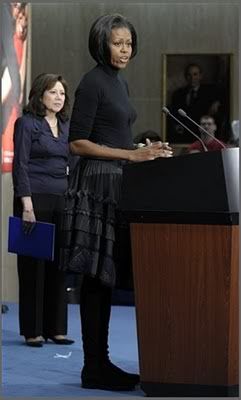
  • PHOTOS & REMARKS: First Lady Visits Department of Labor

    First Lady Michelle Obama resumed her visits to federal agencies to thank employees this morning when she stopped by the Department of Labor. She even made time to stop by a day care center to read Dr Seuss’ Green Eggs & Ham.


    Oh, and she has a new haircut too…


    Here are the First Lady’s remarks courtesy of WhiteHouse.gov

    REMARKS BY THE FIRST LADY

    DURING VISIT TO THE DEPARMTENT OF LABOR

    U.S. Department of Labor

    Washington, D.C.

     11:09 A.M. EST

    MRS. OBAMA: Thanks, everybody. (Applause.) Now, remember, you weren’t supposed to get out of your seats — (laughter) — until the program was over. And you all agreed. I heard it. (Laughter.) But that’s okay. (Laughter.)

    Good morning, everyone. I am as thrilled to be here as you all seem to be. (Laughter.) But before we begin, I do want to take a moment just to express my profound heartbreak and our nation’s deepest support for the people of Haiti in the wake of this just devastating disaster that they have suffered.

    The destruction and the suffering that we see, the images that are coming out of that country are just overwhelming, and it is important for the people of Haiti to know that we are keeping the victims of this tragedy and their loved ones in our thoughts and our prayers. And that also includes prayers going out to all of the Haitian Americans who have families and friends there, and they’re worried about them back home. It’s difficult to get word. People don’t know where folks are. This is a tough time for Haitian American citizens here, as well. And we also want to send our thoughts and prayers out to the American citizens who are working and living in Haiti, as well.

    Right now my husband and the administration are focused on moving as many resources as possible into Haiti as quickly as possible so that we can save as many lives as we can. And later today I’ll be taping a public service announcement for the Red Cross, which is providing on-the-ground support — food, water, medicine — that’s desperately needed right now, particularly in this short period of 48, 72 hours after the disaster.

    So for those Americans who are watching this, who are listening, who want to help — and everyone’s help and resources and energy at this time are critically important — you can go to the White House Web site at www.whitehouse.gov to see what you can do to support our friends in Haiti in this time of urgent need.

    And as you know, it’s not just in the weeks and months ahead. This is going to be something that we’re going to have to put our attention to for many years to come. So again, our thoughts and prayers go out to the country of Haiti.

    But I’d like to start by first thanking your wonderful Secretary, Secretary Solis, not just for that very kind introduction but for all of her work that she’s doing in this department. She is doing a fabulous job in so many areas. And all of you know — (applause) — and she’s not just working here, but she has taken the time to travel with me on my special projects. We’ve spent a wonderful day in Denver, participating in a mentorship and leadership program there for young girls. And Secretary Solis was right there, the first one to sign up to go, as a busy Secretary, still never too busy to give back to an amazing group of girls — and I will be grateful to her for a very long time for her outstanding work and willingness to step up and outside of her role. So we are grateful to you.

    I also want to thank all of you here today and all your colleagues here in Washington who may not be in this room or across the country for all of your work. As you all know, I have spent a lot of time in the first year — yes, it’s been a year — (laughter) — since we’ve arrived in Washington, visiting agencies. And it’s been wonderful for me to use these visits — it’s a way to learn more about the work that you do, to listen, to observe, to hear your concerns, and then to bring that information back to the White House so that my husband is getting even more feedback on how things are going.

    So these visits have been so very important to me getting to better understand how this place works, and getting to know all of you.

     And I know that some of you have been working in these departments for a very long time, for decades. And we have some of those long-term workers standing behind me. We have some of the longest-serving employees here at the department right behind me.

    But something that the Secretary chose to do uniquely is to also recognize the many folks here who are just beginning their careers. And we can’t forget those — a lot of young people who are stepping into new roles and a lot of not-so-young people stepping into roles. (Laughter.) So also on the stage with us today are some of the very newest employees here at the Department, as well.

     But I know that whether you all have worked here for decades or for days, you’ve been working very hard for the American people, and one of my primary reasons for being here is to express on behalf of not just myself and my family and the President, but the entire nation, our gratitude for the service that you have put in. We often forget about the work that you do to make things happen for this nation. And it’s important that we shed this light on each and every one of you over the course of this year.

    I am also looking forward to visiting some little people here. (Laughter.) After I speak here I’m going to go down to the childcare center, and as you know, I’m a sucker for kids. (Laughter.) I told the Secretary if I can come to the childcare center, I’ll be here every week. (Laughter and applause.)

    But I’m going to get to read one of my favorite books, “Green Eggs and Ham” — (laughter) — Dr. Seuss. And I’m also going to get to meet — although I see some of you here — some of the culinary students, young people who are working in the training program. (Applause.)

    And I’ve heard that you have prepared a delicious and, hopefully, healthy snack for our children. (Laughter.) But we’re grateful for you, and I’m looking forward to meeting you all.

    I was pleased to hear that there was a childcare center here at the Department of Labor that not just serves the employees of the department, but working families throughout the area. And, as a parent, I know centers like this one create a great deal of peace of mind, so that people know that their kids are being taken care of. And that means that you can focus on your work and not worry about whether your kids are doing okay.

    And that’s actually what I’d like to just spend a few brief moments talking about today, an issue that I’ve talked a lot about, and that’s the issue of work-life balance. You know it: the constant struggle to meet our responsibilities both as employees, but also as breadwinners, and mothers and fathers. It’s one of those issues that we, as a society, still haven’t quite figured out yet. We’re still working on it. And as the mother of two young girls — who are doing just fine, by the way — (laughter) — it’s an issue that is particularly near and dear to my heart, as I have spoken about.

    In my current life as the First Lady of the United States, I am incredibly blessed and I know that, because I have more support than I could have ever asked for and ever imagined, including my mother, who has moved here to help us sort through all the challenges.

    But I didn’t always live in the White House, as you know. For many years — just a few years ago, we came to Washington, I was a part of that work-family struggle to balance that full-time job, plus being an around-the-clock role — that role you play as mom, particularly when you have a spouse who is traveling a lot.

    And I’ve said this before, but probably like many of you, I consider myself one of those 120-percenters, which essentially means that if you are not doing everything at 120 percent, you think you’re failing. I suffer from that malady. So when I was at work during these times, I always felt like I was shortchanging my girls. But then when I was at home, I was worried that I was letting people at work down. And with that kind of anxiety, comes a lot of additional stress and a whole lot of guilt. So I know all of us are walking around with a whole lot of guilt, just carrying it around. (Laughter.)

    And I was lucky even back then, because I had understanding bosses, people like Secretary Solis, who shared my same values for the importance of doing a good job but also raising a good family. And I was also fortunate to work in jobs that were reasonably accommodating, with people who understood that if you left a little early for — to get in the car line, that that wasn’t some huge definition of your dedication to your job.

    And while there’s certainly plenty of employers out there who recognize the value of good work-life policies, many people in this country just aren’t as fortunate to work with those employers. And with the job market the way it is right now, many folks can’t afford to be picky. You just can’t. When you have a job, you keep it; and you settle for the terms that you have because you know you’re blessed to even have a job. And many don’t have access, as a result, to good family leave policies or any kind of flexibility in the workplace at all. It’s just not possible. So they struggle to find affordable childcare and emergency childcare when their usual arrangements fall through, which they always do — right?

    And believe it or not, today roughly 40 percent of private-sector employees work at companies that don’t offer a single day of paid sick leave. Not a single day. And I think that reflects a larger problem, that for too long we as a society have viewed policies that help people balance work and family as somehow a special benefit maybe to women who shoulder that, rather than an essential part of a workplace that can benefit everyone in the workplace.

    To this day there’s still the perception that workers who need time off to care for a sick parent, or who want a more flexible schedule so they can go to the potluck or the play or the parent-teacher conference, are somehow less committed or less desirable. There’s this idea that workplaces that accommodate these needs are destined to be less profitable, less productive somehow.

    But we now know that that’s just simply not the case. There’s a lot of evidence out there from companies who’ve implemented really innovative processes to help families. We now know that these kind of policies can actually make employees more productive. We all know this, right? Because instead of spending all day at work worrying about what’s happening at home, they have the support that they need to concentrate on their jobs. And it makes a huge difference in terms of productivity. Just mental health comfort and stability helps workers be better. We know that.

    And that’s why we need to change the way we look at these issues so that our workplaces can catch up to the realities of our lives. It’s time we viewed family-friendly policies as not just niceties for women but as necessities for every single working American — men and women — because more and more men are shouldering that same kind of burden. And that’s good, but that’s new. (Laughter and applause.)

    Staying home to care for a sick child or taking an elderly parent to a doctor’s appointment shouldn’t mean risking one’s job. That shouldn’t be the tradeoff. People shouldn’t have to choose between taking the time they need after giving birth, for example, or adopting a child, and keeping that job that they need to support the child they just had. That shouldn’t be the choice.

    Things like paid family leave and sick days and affordable childcare should be the norm, not the exception. That’s why we think it’s important to highlight companies that are embracing these policies, ones that are experimenting with things like flex time and telecommuting and focusing on performance and output rather than face time. That’s why the President and Secretary Solis have spoken out in favor of the Healthy Families Act, which would let millions more working Americans earn up to seven days a year of paid sick time to care for themselves and their families. That would be innovative and new. But we are happy that we have a President and a Secretary of the Department of Labor who had the vision and the foresight to see that this now needs to happen. (Applause.)

    But the administration also knows that we essentially have to put our money where our mouths are, so the administration is working to practice what we preach and make the federal government a model of what we’re asking others to do. From expanding telework options to providing emergency childcare and affordable day care, we need to be implementing all of those ideas throughout the federal government. I was particularly pleased to learn that the childcare center here at the Department of Labor actually provides financial aid to help employees afford excellent care regardless of the size of their paychecks, and those are the kind of things that we need to be doing all across the government. (Applause.)

    So these are just a few examples of the kind of concrete steps that we can take to restore some semblance of balance and sanity into the lives of people that you all know, because it’s probably you. (Laughter.) And this is just the beginning. And there’s a lot of work to do — as we all know, as the President has said. He said it before he took the oath of office — change is important, change is hard, and change takes time. I remember him saying that. (Laughter.) So we all know that we have a long way to go, again, and it won’t be easy. But as one of Secretary Solis’s predecessors, President Roosevelt’s Labor Secretary Frances Perkins once pointed out that most of our problems — and this is a quote — “have been met and solved either partially or as a whole by experiment based on common sense and carried out with courage.”

    That’s what we need today as well. We need all of you to take the lead — or continue to take the lead in this effort. And all of us, in both government and the private sector, will need to come up with new ideas, try out new approaches, and rely on our courage and our common sense to guide us along the way.

    But as I say in all my visits, we’re going to need all of you maintaining some level of energy and optimism through the tough days, because we know you all are working hard — many people staying late, putting in overtime, going the extra mile to make sure that the Department of Labor is strong and it continues to be a source of pride, not just for the administration but for the entire country. And we are grateful to all of you for that, and oftentimes you don’t hear it, but we are grateful. We are a grateful First Family, and we are a grateful nation for the work that you do. We couldn’t do it without you.

    So hang in there. If we have all of you continuing to work as you do, I am confident that we will meet these challenges. So thank you all so much. And with that, I’m going to shake some hands and then read “Green Eggs and Ham.” (Applause.)

     END 11:28 A.M. EST

    Post to Twitter Post to Plurk Post to Yahoo Buzz Post to Delicious Post to Digg Post to Facebook Post to MySpace Post to Ping.fm Post to Reddit Post to StumbleUpon

  • Economists React: Tax On Banks “Not All Political”

    Economists, analysts and others weigh in on the Obama administration’s proposed tax on big banks:

    • This is not all political. There are valid policy reasons as well for a moderate tax, spread out over a number of years. First, the Emergency Economic Stabilization Act, which authorized the TARP, requires the Administration to eventually propose specific means to recoup any taxpayer losses from the financial industry. The surprisingly swift recovery by the banks makes it reasonable to accelerate that decision. Second, there is a need to show taxpayers that the TARP not only helped them by averting a potential mini-depression that could have resulted from a further financial meltdown, but will have done so at no net cost. This cost issue is an important policy goal in its own right and also increases the probability that Congress and the public might support any remaining actions that need to be taken to deal with the tail end of this financial crisis. – Douglas Elliott, Brookings Institution
    • We have mixed feelings about the newly proposed levy on the liabilities of the biggest 50 US banks. As well as being very popular with voters, President Obama’s plan to tax banks makes some sense from an economics perspective; it will recoup some of the taxpayers’ money spent on the financial bailout and, at the margin at least, it will dissuade banks from becoming too big too fail. However, to the extent that it discourages banks from making loans in the future and increases the incentives for banks to use off-balance sheet vehicles, the tax is a bad thing. – Paul Ashworth, Capital Economics
    • We are somewhat skeptical that Congress will pass such a tax and if they do, it could be several months before Congress does so. While we think it is tough to predict whether this idea passes or not, we think this adds to the political risk that we have already expected for larger banks for the coming weeks and months. – Brian Gardner, Keefe, Bruyette & Woods
    • How Will the Country Survive a Hike in Bank Fees Equal to 0.06 Percent of GDP? That’s the nightmare scenario raised by the big banks in response to President Obama’s proposal to impose a tax on the largest banks equal to 9.0 billion a year. The banks argued that this would be really bad news for the economy since they would pass on the fee to their customers. … It is also worth noting the implication of this claim for the nature of competition in the banking industry. The proposed fee would only apply to banks with assets of more than $50 billion, a relatively small number of banks. If these banks really can pass on higher costs to consumers, then it implies an extraordinary level of monopoly power in the industry, with the large number of small and mid-size banks not providing effective competition to the largest banks. – Dean Baker, Center for Economic and Policy Research
    • I’m in favor of the bank tax; what’s not to like about extracting $117 billion from large banks to pay for the net costs of TARP? But it’s by no means enough. … Why $117 billion? Because that’s the current projected cost of TARP. But everyone realizes that TARP was only a small part of the government response to the financial crisis, and the main budgetary impact of the crisis is not TARP, but the collapse in tax revenues that created our current and projected deficits. So why not raise a lot more? – James Kwak, Baseline Scenario
    • Maybe President Obama is coming around to the realization that the TARP has indeed been a loser for the taxpayer. He appears, however, to be missing the critical reason why: the bailouts of the auto companies and AIG, all non-banks. This is to say nothing of the bailout of Fannie Mae and Freddie Mac, whose losses will far exceed those from the TARP. Where is the plan to re-coup losses from Fannie and Freddie? Or a plan to re-coup our rescue of the autos? … Econ 101 tells us (maybe the President can ask Larry Summers for some tutoring) corporations do not bear the incidence of taxes, their consumers and shareholders do.   So the real outcome of this proposed tax would be to increase consumer banking costs while reducing the value of bank equity, all at a time when banks are already under-capitalized. – Mark Calabria, Cato Institute


  • ARTICLE: HTC myTouch 3G Fender Edition landing January 20th

    myTouch 3G Fender

    Music lovers, your device is here.  Featuring a customized battery back, a 3.5mm headphone jack, 16 GB microSD card slot, and new media sync software.  What’s more, the unit offers preloaded content from Eric Clapton, Avril Lavigne, Brad Paisley, and Wyclef Jean.  The myTouch 3G Fender Edition will launch with Android 1.6, but will be eligible for Android 2.1 later in the year.  Sporting a $180 price tag with a new two-year agreement, the limited edition device will be available on January 20th at select T-Mobile stores.

    Another myTouch 3G, another color – though I will admit, there are some neat features.  Keep in mind that the phone is a limited edition device, so when they’re gone, they’re gone for good.  Anyone planning to ditch their existing myTouch 3G (or any other device, for that matter) to get their hands on the Fender Edition?

    Via PhoneScoop, Fender


  • Obesity rates level, but battle isn’t over

    A new report from the Centers for Disease Control and Prevention shows that obesity rates have remained steady, but health experts say it’s not time to declare victory against the epidemic just yet.

    34 percent of adults obese

    According to the figures, nearly 34 percent of American adults are obese. That’s double the percentage who were obese 30 years ago, but it’s a number that’s held pretty steady for the last 10 years.

    Among children, the rate has tripled, to 17 percent, but that figure also seems to be holding. In fact, the obesity rates among women and children have been on a plateau for nearly a decade, the figures say.

    The numbers, reported in the Journal of the American Medical Association, came from two different studies among adults and kids. The adult study looked at a sample of 5,555 people and compared the obesity rate — which was 33.8 percent — to similar studies done from 1999 to 2006.

    The study involving children included 3,281 kids ages 2 to 19 and 719 infants and toddlers. About 10 percent of infants and toddlers were found to be obese, as well as 17 percent of older kids.

    News isn’t all rosy

    The one exception to the holding steady of obesity rates is among the heaviest boys ages 6 to 19, whose weight is still growing. It’s thought that boys who were already heavy live in an environment full of unhealthy food and a lack of physical activity that is keeping them heavy and making them gain even more weight.

    Beyond environmental differences, there are also racial disparities when it comes to the obesity rate. African Americans have the highest rates of obesity, at 37 percent of men and almost half of women. Forty-three percent of Hispanic women are obese.

    Hispanic and black children both have higher obesity rates than white children.

    And when obesity and overweight are looked at together, a staggering 68 percent of adults fit in one of those categories.

    More understanding could have led to halt

    Experts say more people these days — particularly moms, who tend to control the food coming into their homes — are more aware of the problems associated with obesity and are doing more to help stem the tide, which could account for part of the stalling of obesity rates.

    Dr. David Ludwig, director of the Optimal Weight for Life Program at Children’s Hospital Boston, suggested to the New York Times that we may have reached the biological limit of obesity, meaning that all the people who are susceptible — genetically or because of their behavior — may already be obese.

    Not exactly something to celebrate.

    (By Sarah E. White for CalorieLab Calorie Counter News)

    From the RSS feed of CalorieLab News (REF3076322B7)

    Obesity rates level, but battle isn’t over