How much would it take for you to get a Netflix tattoo? Would you do it for a free year’s worth of the service?
If you think you love Netflix and their selection of streaming offerings, you don’t. Unless you’ve permanently inked the name “Netflix” on your body, you don’t really love Netflix. Yes, I know you watched all of House of Cards in three days. You still don’t really love Netflix.
Twitter user @TheRealMyron does. He loves Netflix a lot. TheRealMyron got a Netflix tattoo, and for his troubles received a free year of Netflix.
In case you were wondering, Netflix didn’t ask this guy to get a tatto in order to receive a free year. He just did it to show his love, tweeted the photo @Netflix and they responded with the offer. Social media done right? I guess?
@netflix thank you so much for the free year!!!! If you ever need me to do an ad I’m ready I’m a college student ready to work hard
Netflix’s streaming-only plan is $7.99 a month – so that means that TheRealMyron was awarded a prize worth $95.88 for his troubles. If Netflix decided to throw in unlimited DVDs too, that’s $191.76. And if they bumped him up to the Blu-Ray option, it means that his tattoo netted him $215.76
Does the world really want a “Facebook (FB) Phone?” Probably not, but that apparently isn’t going to stop HTC (2498) from delivering one. UnwiredView’s evleaks has posted a set of specifications that are purportedly for the HTC Myst, a yet-to-be-announced smartphone that is centered around Facebook. In case you don’t remember, HTC has tried something like this back in 2011 with the ill-fated HTC Status smartphone that had a dedicated Facebook button and that looked like a rejected BlackBerry (BBRY) design concept from around 2006. The HTC Myst will reportedly be somewhat more like a modern smartphone, however, with a 4.3-inch touch display with a resolution of 320 pixels per inch, a MSM8960 dual-core 1.5GHz processor, 1GB of RAM and a 5 megapixel rear-facing camera. While these aren’t exactly high-end specs, it’s unlikely that HTC is going to push the Myst as a premium device, especially since it sold the HTC Status for a mere $50 with a two-year agreement from AT&T (T).
A deadly new virus has been making its way around the world, and the Centers for Disease Control and Prevention has issued a warning on the novel infection.
It’s being reported that a novel coronavirus, belonging to the same family as the common cold and the much deadlier SARS, has infected 14 people and killed eight. Most of those infected are from the Middle East – Arabia, Qatar and Jordan – but World Health officials have confirmed three cases of the new virus in Britain.
Symptoms brought on by the virus include acute respiratory illness, fever, a cough and shortness of breath. The virus can also be spread from person to person instead of other viruses that are spread from animals to people.
Fortunately, there have been no confirmed cases of infection in the U.S. yet. The threat it poses must not be that bad either as the WHO has yet to issue any travel restrictions.
Nevertheless, the CDC is following this new virus and providing regular updates on its whereabouts. You can check out all the details here.
This week, TEDx took a break from posting talks as the team recovered from TED2013. However, their blog kept rolling with some wonderfully unique spins on the conference and more. Here, find some great pieces from the TEDx Blog.
Just now, session 1 of TED2013 ended, but not without first introducing the TED audience to a whole mess of neat robot inventions — from a robot butler to a smartphone pet that makes the Tamagotchi seem ancient.
One of the highlights was this clip from Bruno Maisonnier’s TEDxConcorde talk, during which he had his tiny humanoid robots — called Nao — do a synchronized dance routine even the coolest b-boys would envy. Here, we GIF the best moments from the tiny Naos breaking it down on stage. See more dancing robots »
When you hear the word “java,” you might think of the pesky window that pops up on your computer desktop every few months, begging you to close all browser windows so you can install vital security updates. Or maybe you think of your morning coffee, expertly brewed by your favorite neighborhood barista. Or maybe you see an image even more lovely — the lush greens of Indonesia’s third largest island.
Whatever it is you’re thinking of — we’ve got a talk for you. So pour your cup of joe, save all tabs, and take a break from your vacation planning to watch these 5 TEDx talks in honor of the word java. Watch the playlist »
At the end of February, TED2013 went live far beyond the city limits of Long Beach, California. In 60 countries worldwide — excited TED’xers became TEDsters for a day (or night!) — experiencing “The Young. The Wise. The Undiscovered.” in the heart of their communities: inside theaters, schools, local haunts, and cultural centers. These were TEDxLive events — TEDx events centered around a live simulcast of TED2013 in Long Beach.
In Sidney, British Columbia, Canadian TEDx’ers gathered together to watch day three of TED2013 in a local secondary school for the TEDxSaanichPeninsulaLive event. Organizer Sherry Moir said a moving moment of the day came after 16-year-old Jack Andraka spoke about the new method of detecting pancreatic cancer that he developed when he was only 15. Once he finished speaking, Sherry overheard one of the school’s students say, “He might have saved my dad if he’d only done this at age 12!” Read the full story here »
It’s that time again — time for another TEDx intern playlist. Today, one of our screening interns provides a glimpse into the vast variety of ideas circling the TEDx community — ideas that confront, surprise, and astound — even when you watch dozens of talks daily. Watch the playlist »
Mars flooding seems about as likely as finding extraterrestrial life on the planet, but new evidence suggests the red planet really was subject to intense flooding during its lifetime.
NASA announced today the results of a study conducted by its Mars Reconnaissance Orbiter satellite. The study sought to recreate “ancient water channels below the Martian surface” in full 3D. Mapping out these channels helped scientists realize that Mars was home to massive floods in the last 500 million years.
The floods that created these channels are comparable to the floods that created the Channeled Scablands in Washington State during ancient times.
“Our findings show the scale of erosion that created the channels previously was underestimated and the channel depth was at least twice that of previous approximations,” said Gareth Morgan, a geologist at the National Air and Space Museum’s Center for Earth and Planetary Studies in Washington and lead author on the paper. “This work demonstrates the importance of orbital sounding radar in understanding how water has shaped the surface of Mars.”
NASA found the flood channels in the Elysium Planitia, an area along the Martian equator. The existence of the flood channels were covered up when much of the area was subjected to intense and frequent volcanic activity. NASA says that there are other water channels on Mars’ surface that were covered up in a similar fashion.
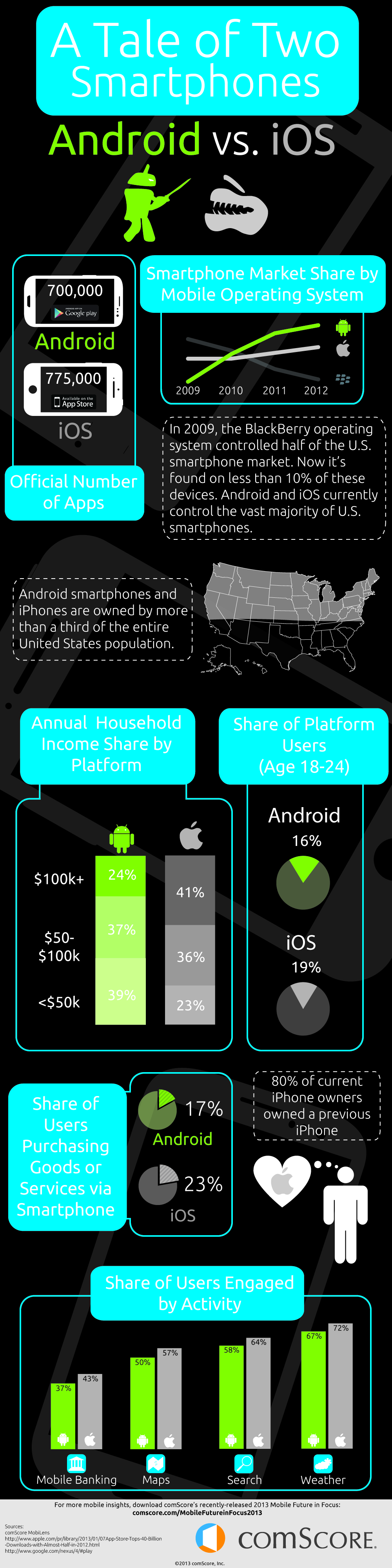
Developers must make hard choices when choosing what platforms to support. In mobile, popular convention is iPhone first. But does that approach, in the real world of smartphone ownership, really make sense in 2013? Let us take a look at the hard numbers that were recently published by comScore and see what they can tell us.
This may be a self-perpetuating problem for Apple; according to ComScore, the Google platform simply offers more opportunity because of its larger user base, though that is far from the only consideration for developers. Granted, both mobile operating systems are wildly popular, despite the best efforts of Microsoft to get Windows Phone OS into contention (OK, maybe “best efforts” is going a bit far) — Android and Apple combine for nearly 90 percent of the smartphone market — 53 and 36 percent respectively.
But that is only half of the puzzle — While Android holds a commanding lead in share, it retains only 48 percent of those users, while Apple holds onto 62 percent. That means that just over 25 out of 100 users stick with Google, while a bit more than 22 look at the world through Apple goggles. Sounds good, but if the trend were to continue then the sides would eventually change. Except that is not the case. You see, while 8 out of 10 current iPhone customers are returning buyers, that current 62 percent number means shrinking to only 6 of 10.
Benjamin Travis says that “iOS is popular among a slightly younger demographic than Android users, with 18-24 year olds representing 19 percent of all iPhone owners compared to 16 percent of Android owners”. While that may initially sound promising, the news for Apple is not all good here, plus the gap just is not that big and likely could be shrinking.
The two smartphone bases engage differently with mobile content as well. First of all, comScore finds that the Android platform has a greater number of media users in each category. While iPhone users tend to be generally more engaged with their devices and apps, market share becomes important — shear audience size is hard to beat.
Travis goes on to point out that “iPhone users show a greater propensity to engage in [M-Commerce] behavior with 23 percent having done so versus 17 percent of Android owners. iPhone owners are also more likely to make purchases on their phones on a regular basis”. This is also an important consideration for those looking to monetize by means other than in-app ads, but that is less than half of the apps on the market.
comScore also points out that iPhone owners tend to think very highly of their devices and, as a result, they are likely to remain loyal users over time. This is perhaps the red herring. Sixty-two percent of iPhone users would stick with the device versus forty-eight percent for Android.
There are other considerations not mentioned. The biggest one is a users’ library of purchased apps — once you are invested in a platform it becomes increasingly harder to move on. Regardless of income level nobody wants to purchase the same apps twice. Again, the larger share is likely more important to Android now.
In the end, while comScore tries to play fair with both sides and avoid controversy, when you read between the lines, the direction is clear. Android’s ever-increasing market share means more potential downloads and, with M-Commerce numbers that are not that far apart, more potential revenue. Google also runs a more open platform, making it easier to gets apps into the market — something Apple developers have sometimes struggled with.
The Associated Press is reporting that the North American Aerospace Defense Command (NORAD) headquarters near Colorado Springs was evacuated for around four and a half hours on Thursday. The evacuation of around 1,500 people took place because of five “suspicious” or “out of place” packages that were found at the site.
Personnel were called in to examine the packages and determined they were not filled with any potentially harmful substances. UPI later reported that military dogs were brought in to stiff the packages, which were subsequently moved to another location.
According to UPI, when officials finally opened the package they found only “office supplies.” NORAD stated that its essential operations were not disrupted by the event, and that the control room team was able to operate at a nearby backup location.
NORAD is a joint organization that provides aerospace defense for the U.S. and Canada. The Royal Canadian Air Force and the U.S. Air Force use the facility to coordinate aerospace warning systems and air sovereignty throughout North America.
Arkansas has some of the lowest energy prices in the country. It has the 7th lowest electricity prices, almost 25 percent lower than the nation’s average electricity price. Its gasoline price is the 12th lowest among the states. …
With the appearance of each new device, the experts have weighed in on what it will mean for the future of advertising. In the late 1930s, industry commentators worried about whether advertising could ever succeed on television screens. A letter to the editor of The New York Times asserted, “It will prove difficult to prepare and present a television advertising message”, while the author of Television: A Struggle for Power claimed “there is considerable doubt that advertising will be successful when presented to the eye as well as the ear.” So, there are always skeptics. And that’s not a bad thing: they motivate the dreamers among us to prove them wrong.
But the truth is we won’t build the future of advertising device by device. We need to learn to look at these devices as a way of understanding the context in which consumers are looking for information. Real people use these newest devices — phones, tablets, “phablets”, touch-screen laptops and Web-enabled TVs — to connect with each other, shop, navigate the world, watch videos, play games, and take pictures. It’s how, when, and why people use their devices we should be paying attention to and less so the devices themselves.
Part of the reason for this is that we can no longer deduce a customer’s context purely by the device she is using. We used to assume that your mobile meant you were on the go, your tablet meant you were at home on the sofa, and your desktop meant you were at work, but this is no longer accurate. These devices are now bleeding into new realms and your behavior is very different depending on the context in which you’re using the device. Think about your own life. You might email on your laptop in front of the TV and simultaneously use your tablet to look up a takeout menu, or listen to music. Don’t believe me? Spend time with a 16 year old!
Today, most people constantly switch between devices in order to stay connected. And despite advertisers’ initial concerns, consumer eyeballs are not necessarily being “lost” from one screen to another. Rather than splitting a finite number of hours across a greater number of screens, consumers are often using multiple screens simultaneously. This is the new multiscreen world.
And we’re starting to see remarkable data suggesting just how quickly the multiscreen world is taking hold with consumers. For example, let’s look at the Holy Grail of traditional TV advertising, the Super Bowl. Traditional Super Bowl campaigns focused a huge amount of brand energy on one, expensive slot of air time. Now, even if people leave the living room to grab chips and soda from the kitchen during the breaks, it doesn’t mean they’ll miss your ad. Super Bowl advertisers can bank on an extended online audience to justify and add value to their TV buys. This year, Super Bowl ads on YouTube were watched more than 76 million times before game day and we saw a total of 200 million views on 100 video ads and teasers tied to the Super Bowl.
The multiscreen world creates opportunities for marketers by helping them reach people in the right context with the right message on any device. For example, a pizza restaurant wants to show one ad to someone searching for pizza at noon downtown on their smartphone (click-to-call and restaurant locator), and a different ad to someone searching for pizza at 9pm on their laptop or tablet at home (link to online order form or menu). Context-aware ads like this are more likely to get a positive response because they help people achieve something quickly and simply so they can get on with life.
Advertisers should focus their investments on the contexts they care about. For example, our pizza restaurant may be having a slow day and want to attract more walk-in customers for lunch. Their ad could show lunchtime discount offers, directions and a click to call function to people searching mid-day for pizza within a 5 mile radius of the restaurant location. Or, if someone’s searching for your retail housewares store on a mobile device during business hours, your ad can direct them to call you or provide a map of your location, whereas if they search for you when you’re closed, you can direct them to your website to research and make purchases online.
Context-aware ads create a connection, they entertain, inspire and influence. They don’t feel like an intrusion because they provide a great experience that’s based on the user’s context. So rather than focus solely on the device as the centerpiece of your next campaign, go a level or two deeper to examine the context. That’s where the opportunities lie in today’s multiscreen world.
Lenovo appears to be working on a pair of mid-range devices to compete for buyers looking for more affordable devices. Although projected to be a middle tier device, the Lenovo S920 will reportedly come with a 5.3-inch screen in a case with narrow bezels, a quad-core processor, dual-SIM support, a decent battery clocking in at 2,250 mAh all running Android 4.2.1 Jelly Bean when launched.
Joining the S920 will be the Lenovo S820, another quad-core cpu powered device. Images of the S820 show a handset clad in a bright red case. Chinese website MyDrivers.com indicates the S820 will be targeted at female shoppers. It is unclear what exactly would make the device more appropriate or appealing to women.
No other details about these two devices are available at present, so we will have to keep our eyes open for news about them, especially if they will end up available in markets outside China. In the meantime, check out the images below and ponder the idea that a quad-core, 5.3-inch device is now considered “mid-range.”
A large part of why BlackBerry (BBRY) has survived over the past two years is because of the success it has achieved in emerging markets such as India and Indonesia. Chief executive Thorsten Heins confirmed that the company is readying less expensive devices for those markets and will look to continue to build its market share, however it has no plans of competing with any bargain-bin Asian rivals.
While it’s easy for advertisers to track people across different websites, the trail goes cold when a person turns off the computer and resumes surfing on a phone or tablet instead. That’s starting to change, however, as brands deploy technology that matches identities across devices.
One example is New York ad company Tapad, which claims its “Device Graph” uses 2 billion data points to find people on whatever screen they’re using. This means, for example, that a shoe company can identify a potential customer and hit them with a succession of ads — one on their work computer, another on their phone as they walk home and yet another as they look at a tablet on their couch.
In a recent interview, CEO Are Traasdahl said about 100 clients are using Tapad’s technology, including Dell and major electronics and finance firms. The appeal, he says, is that ad campaigns are more efficient if marketers know that an ad viewer on a computer and a smartphone is the same person.
Tapad’s technology may provide a boon to marketers but it also raises some obvious questions. First, how do we know it works? Mobile marketing is tricky in the first place because smartphones and tablets generate fewer cookies (the bits of computer code that indicate you’ve visited a given website); for example, Apple limits cookie collection by its Safari iPhone browser and by third party apps. This makes it difficult for brands to use so-called “retargeting” (showing an ad to someone based on what they done in the past) on a mobile device; identifying that same person across multiple devices would seem even more difficult.
According to Traasdahl, Tapad uses a sliding scale to guess whether a computer and phone user is the same person. Like all advertising, he says, there is an inherent degree of uncertainty. But he adds that, for brands, the proof is the pudding — they can look at whether multidevice targeting produced a lift in response or sales.
There is also the question of just how Tapad is tracking people. Like other companies in the mobile marketing space, such as Google Ventures-backed Adelphic, Tapad is tight-lipped about its techniques. Traasdahl did, however, say the company uses data sources like publishers’ log-in information, Wi-Fi locations and zip codes as some of the sources for its billions of data points. This is an example of what a recent MIT Technology Review article described as “reverse-engineering” our online identities.
Finally, in addition to the technology dimensions, there is the creepy factor. While companies like Tapad may provide more efficient advertising, some are going to bristle at its efforts to track them wherever they go. Tapad, like others in the advertising industry, protects “PII” — personally identifiable information — which means the “identity” that marketers see is just a random number, not your name or address. Still, there is growing concern in the media about tracking (see this week’s “Technology Turns to Tracking People Offline” in the New York Times) and in Congress where there are regular mutterings about Do Not Track legislation.
For now, the likes of Tapad and its investors (who include FirstMark Capital and Avalon) are counting on a light regulatory hand as they fine tune the online marketing machine.
With the storm still swirling over Marissa Mayer’s decision to end telecommuting at Yahoo, Best Buy CEO Hubert Joly now takes center stage as the latest corporate leader to ax flexible work.
While Mayer’s announcement raised eyebrows, Joly’s decision is actually much more momentous. Why? Because Best Buy’s flexible work program is not just any flex policy, but the groundbreaking Results Only Work Environment (ROWE), one of the most innovative and celebrated examples of a company redesigning work to focus on results and boost performance through motivation-enhancing trust and autonomy. Under ROWE, corporate (non-store) employees had the freedom to work when and where they wanted as long as they got their work done.
Developed by Cali Ressler and Jody Thompson (who have since written a book and launched a firm, CultureRX, to disseminate the program), ROWE yielded impressive results. Ressler and Thompson’s case studies as well as independent scholarly research find that ROWE increases productivity, employee well-being, and work-life balance while decreasing turnover. At Best Buy, these results produced $2.2 million in savings over three years, according to the CultureRX website.
The ROWE method has since been implemented in more than 40 companies. In addition to extensive media attention, it has also been featured in scores of management textbooks and teaching cases on topics including human resource management, strategy, and innovation.
Why such notoriety among management thinkers and educators? Because ROWE systematically implements what decades of research studies have shown to be the keys to motivating and engaging a workforce for maximum performance, commitment, and satisfaction. In short: help understand employees what needs to be done, give them the autonomy, trust and support to accomplish objectives in the ways that work best for them, and provide feedback and recognition to let them know how well they’re doing and reinforce good performance. When implemented effectively by well-trained leaders, this is a recipe not only for promoting work-life balance, but also for maximizing the value and contribution of a firm’s human capital over the long term.
Why on earth, then, would Joly cut this program? What killed ROWE at Best Buy was the same phenomenon that occurs frequently when a cost-cutting leader is appointed to turn around a struggling company: a short-term “get tough” mindset that favors rapid shocks over the slower, more difficult — but ultimately much more powerful — work of developing and communicating a strategy and harnessing the talent and creativity of committed, engaged employees to implement it. While Al Dunlap-style management can boost stock price in the short term, it lays waste to human capital value — the very resource that is most critical in firms like Best Buy, whose fortunes depend on providing excellent customer service.
Research including my own has shown that the culture of work-life support in a company is the most powerful predictor of employee work-life balance as well as a key element in job performance, organizational commitment, and intention to remain with the company. But top management exerts the strongest influence on culture, and nothing undermines a supportive work-life culture more quickly than a leader who believes and communicates that flexible work and work-life initiatives are nothing but frills that serve to coddle employees.
Joly made a very revealing comment following an investors’ meeting in November. “In a turnaround transformation,” he said, “you need to feel disposable as opposed to indispensable.” He is far from the only “Theory X” leader who believes that stressing employees makes them perform better, while boosting their satisfaction makes them lazy. This underlying belief persists despite enormous research evidence to the contrary because, quite frankly, it is simpler to comprehend and less behaviorally demanding of managers.
The prevalence of this mindset combined with less corporate investment in the leadership development needed to implement flexible work — and a weak job market that erodes employees’ power to demand alternative work arrangements — makes this a precarious moment for flexible work. Now is the time for leaders who understand the value and potency of well-designed flexible work programs to step forward and help others see the light.
Data analysis didn’t start with Hadoop. Companies have been working with data to get insights for decades. While technology has changed, some of the rules from the past still apply, or ought to, as data gets bigger and bigger.
Jack Rivkin, an occasional blogger with deep investment experience, recently shared some of the best practices he was exposed to early in his career working on economic forecasts. He shared some sage suggestions for enterprises to bear in mind as they consider and implement big data strategies. Among his insights:
Forecasting models can only be as good as the data inputs.
Be skeptical and hedge when sharing the models by noting factors that could lead to different results.
The less time it takes to process data, the more valuable it is.
Constantly improve models and inputs.
Of course, big data isn’t wholly evolutionary — it does bring its own all-new opporunities and risks. Some of the world’s leading data scientists, IT executives and business users will address them at GigaOM’s Structure:Data conference in New York on March 20-21.
Google had to make serious cuts at Motorola Mobility in an effort to become profitable again, and has laid off 1,200 workers or 10 percent of its workforce. An email sent to employees earlier this week, hinted at layoffs with “while we’re very optimistic about the new products in our pipeline, we still face challenges” and “our costs are too high, we’re operating in markets where we’re not competitive and we’re losing money.” Workers will be affected in the U.S., China and India.
From a Motorola spokesman:
“These cuts are a continuation of the reductions we announced last summer. It’s obviously very hard for the employees concerned, and we are committed to helping them through this difficult transition.”
Back in August 2012, Google laid off 20 percent of Motorola’s workforce or 4,000 employees. With now a 30 percent reduction in employees, the tech giant is waiting for Motorola’s existing product pipeline to come to an end so it can start focusing on “actually building the next wave of innovation and product lines.”
Just a few weeks ago we saw a wireless Qi charging pad pass through the FCC for Samsung devices, and according to some sources, we may see that Qi charging adopted in the Galaxy S IV. It won’t be embedded into the device, but Samsung may offer an extra back plate to support the inductive charging technology.
Samsung hasn’t been a pioneer in wireless charging the way they’ve tried to innovate other hardware aspects of their mobile devices, but they are a part of the Alliance for Wireless Power, so they’re certainly committed to keeping the latest, greatest tech in their devices. Although the A4WP doesn’t promote Qi charging, I can definitely see why Samsung wants to keep their options open. With how popular the S IV will undoubtedly be, if Samsung does choose to support Qi charging, it’s definitely more likely to get mainstream attention than some other inductive charging methods.
Yesterday, at an event at their Menlo Park headquarters, Facebook unveiled a radical redesign of their core product: the news feed. Unlike Graph Search or Gifts (two of the last big products that Facebook’s unveiled), the news feed is not an “extra,” if you will, in the film of Facebook. The news feed is the star of the Facebook experience. Sure, whenever Facebook announces a brand new product it’s a big deal, but when Facebook announces changes to the most vital part of the user experience, it’s a massive deal.
“Our mission is to make the world more open and connected,” said CEO Mark Zuckerberg at Thursday’s event. “[And] news feed is one of the most important services that we build.”
“Our goal…is give everyone in the world the best personalized newspaper.”
The new Facebook news feed is “designed to reduce clutter and focus more on stories from the people you care about,” says Facebook. “We’ve completely rebuilt each story to be much more vibrant and colorful and highlight the content that your friends are sharing. Photos, news articles, maps and events all look brighter and more beautiful.”
And that’s one of the main things that this news feed refresh is all about: an enhanced visual experience. Along with content-specific feeds that give users more freedom and mobile consistency, that makes up the three key points about the new news feed that Facebook hammered home on Thursday. Here’s what you need to know about what’s changing.
A More Visual User Experience
So, what’s going to change for the average user? Quite a bit, actually – both in how it looks and how you actually navigate around the network.
First, the desktop look. It’s cleaner, more visually stunning, and yes, it feels a bit more mobile-inspired. Everything is more photo-oriented, and those photos are given much more prominence inside the news feed. Photos that your friends post are huge, spanning all the way across the feed. Photo albums are also larger. Facebook says that they want to be able to make the story, as it appears in the news feed, more visually indicative of the experience. For instance, this story about a friend going to China gives a big, bold, photo-oriented snapshot of the trip:
And it’s not just photos from friends that are more visual. It’s shared articles, which feature larger images and more information like snippets and author & publication info:
And events:
And links that your friends share, which now feature profile cards on the left-hand side that show you exactly who has shared the same link. You can hover over each friend to see what they said about the link when they shared it:
Stories about your friends making new friends now feature snippets from Timelines:
Check-ins are also more visual with large map images, as is content from third-party sites like Pinterest. Overall, you’re going to see a news feed that doesn’t just highlight images, but is inundated with them. At Thursday’s event, Zuckerberg said that nearly half of the news feed already consists of photos and other visual content – so this redesign is simply an expression of the evolving face of the feed.
New Ways to Navigate
As expected, the new Facebook news feed will also sport content-specific news feeds. You’ll still have the classic news feed as the default, which will combine recent activity with “top posts.” You’ll also still have the opportunity to filter the feed by “most recent,” which will show you everything from both friends and pages in chronological order.
Facebook’s new, hyper-specific news feed options include “all friends,” which shows a stream of all activity from friends (nothing from pages or people that are simply “followed”). There are also specific feeds for photos, music, games, groups, and more.
The old “pages feed” has a new name: “Following.” It will unearth all the posts from pages and people that you follow (no friends).
In other words, Facebook is giving you more options for customizing your news feed experience.
Long story short, Facebook has given users a lot more choice in how they browse content on the site. And the prominent placement of the specific news feeds on the homepage nearly ensures that users are at least tempted to spend more time on the site. By delving into a specific content feeds like “music” or “photos,” users can unearth posts from the deep, dark, cavernous void of Facebook content that’s been cast aside by their ranking algorithms. When there’s more to explore, people typically choose to explore it – at least that’s Facebook’s hope. And more people spending more time on the site means more chances to serve ads.
The third tenet of Facebook’s news feed redesign is mobile consistency – meaning that your experience on the desktop, web, and apps across all platforms should feel fluid. As I mentioned before, the new Facebook desktop experience feels more mobile – at least more streamlined.
All of your Facebook extras, your events, messages, gifts, apps, and more, are now housed on the left-hand side inside cute little icons. Like mobile, this is accessible from anywhere you go on the desktop version. In fact, Facebook made a point at Thursday’s event to say that “now you can get to any page on Facebook to any other page on Facebook without going to your homepage.”
Facebook chat has also been resigned to the left in the new news feed. Facebook said that the reason for this is to get more people to see it. Some desktop users simply didn’t have the screen capabilities to see the chat information on the right-hand side.
Facebook’s mobile experience for the new news feed is going to look and feel just like the desktop experience. That’s the bottom line. With this refresh, Facebook is no longer allowing any light between the two. Your Facebook news feed is your Facebook news feed – it doesn’t matter how you access it.
It seems that this is what Facebook means when they say “goodbye clutter,” and that they want to get Facebook “out of the way” of the Facebook experience.
The Business of Business
So you know that with the new news feed, photos are both bigger and more prominent. You couldn’t have thought that ads were going to stay the same, right?
Yes, ads in your news feed will be getting bigger.
“We’re taking all the content you see in the feed and making it more immersive. So that goes across the board for everything, including ads,” said Facebook’s Julie Zhuo.
As a marketer, this presents plenty of new opportunities. Promoted Posts, Sponsored Stories, and Page promotion ads almost have to be visually impressive in order to flow with the rest of the news feed. If marketers didn’t see the advantage of developing striking, image-based ads before, this must surely be a wakeup call – that’s the future of ads on Facebook.
If you operate a Facebook Page, there are both good and bad aspects of Facebook’s news feed redesign. The good is that there’s a new “following”-only news feed option, so users have the opportunity to browse an unadulterated stream of content from business and interest pages. And the option to browse this specific feed is given prime placement on the homepage. In light of the recent hullabaloo of page owners accusing Facebook of decreasing post visibility to promote their Promoted Posts product, this feed option should be welcomed with open arms.
But it’s still just an option. And whether or not users choose to utilize that option remains to be seen.
Now for the bad: to compliment the “following” feed, there’s also an “all friends” feed that weeds out all page posts. Bummer.
Overall, the more visual news feed can only help business pages. Remember the aforementioned Timeline snippets that pop up when a user’s friend makes friends with another user? Well, that concept also applies to pages. When a user likes a new page, a visual snippet of that page’s Timeline will appear in the news feed. This gives pages a chance to make a bold first impression, increasing the likelihood that a user will choose to visit or like the page on the spot.
Facebook is suggesting that developers begin to optimize for high-res feed stories (on both desktop and mobile):
In the new design, the things people share through apps are larger and more engaging in News Feed. We’re also making it easier for people to access their game and music feeds, now accessible from the top right area. To take advantage of this new design, we encourage you to optimize for high-resolution feed stories on both web and mobile by providing 600X600 pixel images (minimum 200X200 px).
These images will be really important to game developers as Bookmarks will become more important in the news feed. Bookmarks are images that accompany a shared story about a game. The larger image size means may just be what it takes to convince new and returning players to check out your game.
“These ever-present bookmarks will also display the notification counter from the most recent game requests to help drive re-engagement with players,” says Facebook.
So, there you go. Facebook has just unveiled the most dramatic redesign of its most important product in years. All that’s left to know is the “when?”
Not soon, probably. At least for most of you. Facebook has said that this will be a slow, careful rollout so that they can get their ducks in a row. It’s a big change to a big product, and they want to make sure it’s right before handing it over to everyone in the world. This shouldn’t really surprise anyone, considering they’re currently doing the same sort of slow rollout with Graph Search.
We’d recently reported that Apple’s brand seems to be growing at a steady rate and it seems to have a direct impact on the enterprise market out here in the States. According to customer data from enterprise file sharing and hybrid cloud storage company Egnyte, of all the enterprise devices out there using its service in Q3/Q4 of 2011 to date, Apple iPhones and iPads account for nearly 70% of all enterprise-based devices out in the corporate world, compared to a paltry 30% for Android-based smartphones and tablets. More over, preliminary results for 2013 indicates that iPhone and iPad enterprise market share accounts for nearly 80%, while Android smartphones and tablets dipped to 22% total. Here’s a full statement from Egnyte on its thoughts of the fascinating study:
“While initially iPads dominated our use, iPhones have taken over. 2011 use showed the iPad accounting for 40 percent of our usage, in 2012 iPhones are now 42 percent of usage, and Android has remained constant at about 30 percent of use. There are two interesting points here, first, Apple seems to have at least temporarily won the hearts and minds of business users with its products accounting for about 70 percent of our traffic. This is important because it’s a flip-flop from the days of old, where Apple products were rarely seen in the corporate landscape. It’s also an indication that when BYOD wrested control over what devices consumers used from IT, they overwhelmingly chose an easy to use product that focused on UI and usability, perhaps even at times over depth.
The second interesting point is that while tablets are certainly hot, iPhones are driving most of the traffic. This may be due to the fact that the iPad doesn’t replace a laptop yet as the corporate device of choice, but try and take a business person’s smartphone away from them, and you may not have a hand left. Smartphones are a must have, and we suspect that since people are already checking email on such a phone while they are working remotely, it’s an extra step to get out and bootup your tablet, so if you have a great phone app that does the same thing, just use it to view your files. Most editing we think still happens on the laptop/desktop. This ‘on the go’ access is further confirmed by the fact that only 31 percent of iPhone sessions occurred over Wi-Fi, that means over three-quarters of access happens via cellular services”.
Looks like the Android platform is going to have some work cut out for it if it wants to get in the good graces of corporate users. Then again, special designs and arrangements from manufacturing giants would probably be a good way to start trying to get in the good graces of corporate folk.
What’s next for Venezuela’s economy, in the post-Chavez era?
To find out, I called Francisco Monaldi, Robert F. Kennedy Visiting Professor of Latin American Studies at the Harvard Kennedy School, and Professor at Instituto de Estudios Superiores de Administracion (IESA) in Caracas, Venezuela. He’s a leading authority on the politics and economics of the oil industry in Latin America and developing countries.
What can you tell us about the leadership transition underway?
We are facing elections probably in April or May, and the candidate from the government will be the interim president being sworn in today, Nicolás Maduro. That will give him a great advantage.
The campaign will be very uphill for the opposition, Henrique Capriles. The only advantages he might have is, first, that Maduro is not Chavez and is much less charismatic and less well known by the public, and second, that the public perception that the economy is doing well, which was up around 60 percent last year, is now down to the mid-40s. That’s a big change, and may indicate that the popularity of the president will go down.
How much do you expect the change in leadership to change the Venezuelan economy in the near term?
In the case of Maduro, he is a guy who comes from the left wing of the chavismo, very close to the position of Chavez. He is known to be a negotiator and a relatively pragmatic guy inside that wing. He was instrumental in negotiating the new relationship with Colombia, which was a major accomplishment. But we know very little about him otherwise. It’s difficult to know if he will become more pragmatic as the economic situation becomes more complex.
The problem is that, even though it makes sense for Maduro to move into a more moderate position, he will be a weak president in the sense that he’s not a military guy, he doesn’t have the leadership Chavez had, and he might not move to a moderate position because that would create problems with him controlling the radical faction. He can only pull that off if he has leadership skills we don’t know about yet.
In one of your papers, you write, “Venezuela is the textbook case of a resource-rich country,” but that such natural wealth may not be a good thing. Tell me about that “resource curse.”
Venezuela has huge potential. It has some of the largest oil reserves in the world, up there with Canada, Saudi Arabia. And it has the potential to be a powerhouse in oil production, but only if things are well managed.
The resource curse mostly is the way you manage your oil wealth. On that, Venezuela has a dismal record. It was one of the worst in the 1970s oil boom. It had a terrible record from ’78-’98. In fact, that was one of the reasons Chavez came into power. Then with Chavez, Venezuela was making all the big mistakes — increasing debt in the middle of a boom; investing a lot in military equipment and things that are not going to generate economic growth; not investing enough in the oil sector itself; overvaluing the exchange rate and destroying the tradable sector. Venezuela is the textbook case of the worst economic policies if you want to avoid the resource curse.
So do you see a way for Venezuela to escape that curse? Are there examples of resource rich countries that have worked out better?
Venezuela is an interesting outlier compared to other oil countries that seemed to have learned the lessons from past oil booms in the 70s and 80s. Most of those countries are not running big deficits [like Venezuela]. For instance, Venezuela could go the way of Chile, who have also had a resource boom but are creating a national stabilization fund by not putting all the money back into the economy at once, a counter cyclical policy almost unheard of in Latin America.
Venezuela is also losing about 15 to 20 billion dollars a year in revenues because oil is domestically sold at a price of zero. Basically, gasoline is free. The government could be selling a barrel at $110 [overseas] and they’re selling it domestically at less than a dollar. That’s a big loss. And that’s regressive because it’s mostly benefitting the wealthy, the people who have cars and buy that gas. By contrast, the Iranians changed their policy — they changed the domestic price to close to the international price and then distributed the revenues to the general population. That gave legitimacy and support to increasing the price of domestic gas. That’s the type of thing that Venezuela should be thinking about doing. Improving macroeconomic management like Chile, eliminate domestic subsidies like Iran, and think about other ways to create incentives so citizens make government more accountable in use of oil revenues to create a healthy oil industry and a better managed economy.
OK, so… how likely is that to happen?
If the opposition wins, there is a significant likelihood. However, if Madura wins it is less likely. I think they will do some things to improve the economy, but I think it’s very unlikely they can make a turnaround. The chavista coalition is very authoritarian; they believe this is a revolution that should not be put in the position of losing these elections. Many believe there shouldn’t even be elections.
In the case of the opposition, there is a lot of chance [for reform], but it will be a tough uphill situation. Venezuela has a very corrupt public sector. Moreover, the potential for political instability is very high in any case. Unless the price of oil keeps going up, it will be very hard to sustain this fiscal expenditure path that has happened in the last few years.
The Economist had a useful chart showing how much the poverty rate across all of Latin America has declined in the last ten years, which they predict will drain much of the support for Chavez-like leaders. Do you agree?
The whole region has received a very significant windfall from commodities. Most of these countries are net resource exporters and during the last decade, almost all commodities have risen. Most countries have benefited very significantly. Poverty reduction has happened almost in every single country in the region.
However, the oil windfall has had different impacts on different countries. In Venezuela, it’s 330 percent of GDP according to the IMF. It’s 10 times less in some other countries in the region. Still, this has implied a significant wave of support for almost any politician ruling in these countries. There are very few cases of presidents who were not popular in this period. Most incumbents were reelected with huge margins, an average of 25 points.
Is this going to last? I’m afraid if the commodity boom — as usually happens — dissipates, many of the countries will suffer significantly. Only Chile and Peru have done it very by the book. The others have tended to increase expenditure too much.
Particularly after the financial crisis in the US, Latin America performed very well. Usually when the US caught a cold, we got pneumonia. Not this time. But that gave even the orthodox governments like Chile the license to spend money now, counter-cyclically. But those expenditures are not sustainable.
The history of commodities has been highly volatile. The combination of the resource boom with very high liquidity, especially in the last few years all this liquidity coming from the US, searching for a return, has created a very favorable external environment. But as we know these patterns… well, some things come to a sudden stop. That could create a lot of trouble for these countries.
Now that another major lay-off wave is about to hit Motorola, it’s perhaps time to contemplate how the dominant company in a major industry sometimes misreads the most important consumer trends. This typically happens when a long and well-established trend suddenly reverses. People inside companies like Motorola build their entire careers around one decade-long design goal — and when the wind shifts, the company culture is often impossible to change. The handset industry spent the years 1992-2002 in a race to cut the weight of mobile phones from about 500 grams to 80 grams. After that trend crested and reversed in 2002, miniaturization leaders like Motorola were simply never able to fully adjust. The power inside the company belonged to people who specialized in shaving off another millimeter from the phone thickness.

 This week, TEDx took a break from posting talks as the team recovered from