Category: News

  • Japan’s Retro Car Kings

    Japan's Retro Car Kings

    Let me start by saying that at 43-minutes and 22-seconds, this is probably the longest video we’ve ever posted on RL.com. “Japan’s Retro Car Kings – Saving Classic Japanese Automotive Culture”, showcases the people responsible for not only preserving Japan’s automotive history, but setting the trends that future generations of car enthusiasts will follow. Be it wrenching on classic Japanese cars, American or German, their talent is limited only by their imagination.

    Source: AutomotiveAddicts.com

  • Google lays off another 1,200 Motorola workers

    Google Motorla Layoffs
    The good news for Motorola is that Google (GOOG) has plans for it other than selling it off for parts. The bad news is that these plans entail even more layoffs. The Wall Street Journal reports that Google has started laying off another 1,200 employees from its Motorola Mobility unit, or 10% of its current workforce, in an effort to slash costs and become profitable again. Google explained in an email sent to employees this week that the unit’s “costs are too high, we’re operating in markets where we’re not competitive and we’re losing money,” all of which seem like legitimate reasons to reduce staff. The latest round of layoffs at Motorola comes after Google laid off 20% of Motorola’s workforce last summer, thus bringing the total number of layoffs over the past year to 5,200.

  • 6 ways to watch your own videos from your iPhone or Mac on your TV

    Things were simpler when you would have a stack of VHS tapes that you recorded yourself next to your VCR.  There was no YouTube or Facebook and the internet was far away from your television set. Fast forward 10 years and not only are there no longer any tapes, but almost every viewing solution out there just assumes that you want to share all of your video files on the internet for the whole world to see.  So what if you just want to view them in your own house on your own HDTV?  The following is a guide to some of the techniques you can use when you just want to watch one of your home movies in the privacy of your own home using the Apple TV, a Mac or an iOS device.

    Using your Apple TV

    If your home is fully equipped with Apple products, the easiest way to watch home movies privately is by using an Apple TV.  There are several options to display your home movies on your Apple TV, it just depends on which Apple device you happen to have your movies on.

    From your iOS device: With point and shoot cameras dropping in sales by 30 percent in recent months, more people are using their iPhones to capture all of their personal moments on video.  Provided you are running iOS 4.3 or greater, when the video files are still on your iPhone, you can view them directly on the AppleTV using AirPlay. Simply turn on your Apple TV, tap on the AirPlay icon and select which AppleTV you want to view your videos on.

    AirPlay from iPhone

    Directly from your Mac: If you do not have an iPhone, and you have been off loading your video files from your digital camera directly to your Mac, you can still use AirPlay from your Mac to watch your videos on your Apple TV.  Macs running OS X 10.8 Mountain Lion can also stream their entire screens directly to an Apple TV using AirPlay Mirroring.

    AirPlay Mirroring

    If you do not have a newer generation AirPlay-capable Mac (mid-2011 or newer), you still have two choices.  The first is an app in the Mac App Store called HUDTube ($4.99, Mac).  This is the only video player app in the Mac App Store that supports streaming to an Apple TV using AirPlay.  With HudTube, you simply drag and drop the video file you want to view, and select the Apple TV you wish to stream to.

    HUDTube

    The second solution for your Mac is to use a product called Air Parrot ($9.99, Mac).  This product brings the same AirPlay streaming capabilities to older Macs.  One nice feature that Air Parrot has that Apple’s own AirPlay Mirroring does not is the ability to select just one app window.  This feature is called “App Mirroring.”  As an example, with App Mirroring you can display just the QuickTime Player rather then your entire desktop.

    Home Sharing from iTunes: You can also use iTunes on your Mac to stream your home movies to your Apple TV.  Beginning with version 10.1 of iTunes, you have been able to share your video files alongside your photos with Home Sharing.  Home Sharing is a way to share your entire iTunes Library on your local network to all of your Apple devices.  It is easy to enable, but does require that you have an iTunes account.  Keep in mind that all Home Sharing will be limited to devices that are configured with that account.

    Home Share Videos

    Once you have Home Sharing enabled in iTunes, from iTune’s File menu go back to Home Sharing menu item and click on “Choose Photos to Share with AppleTV.”  Here you can select either an iPhoto Library, an Aperture Library, or any other folder on your Mac containing photos and videos you want to share.  Just be sure to check “Include Videos” when you first set this up.

    AppleTV

    To watch your shared movies, you must also enable Home Sharing on your Apple TV.  Now you will be able to select any one of the movies you shared by accessing them from the “Computer” icon on the home menu of your Apple TV.  Even thought they are videos, they will be listed under “Photos” of your computer’s Home Sharing library.  Keep in mind that this Home Sharing solution is limited to your devices connected to your home network.

    Direct connection with cables

    If you do not have an Apple TV connected to your HDTV, the next best thing is to use a cable to connect your Apple device directly to your HDTV.  How you connect to the HDTV will depend on which Apple product you have and the type of connectors your television supports.  For the most recent Macs that come equipped with either a mini display port or Thunderbolt, there is the Belkin Mini DisplayPort to HDMI Adapter for $34.95 which will allow you to connect your Mac to an HDTV using an HDMI connection.

    Cables

    For your iPhone, iPod touch and iPad that still has the older 30-pin connector, you can use the Apple Composite AV Cable for $39.  While this is not an HDMI solution, it does connect to a wider variety of home theater equipment.  There are also the Lightning Digital AV Adapter for $49 that works with the iPhone 5 and latest version of the iPad that come with the new Lightning connector.  Each of these solutions will allow you to play back your movies from your Apple device directly to your HDTV.

    Copy files to USB thumb drive

    If your Mac is not near your home theater equipment, or you just don’t want to mess with cables every time you want to watch a home movie, you may be able to watch your video files from a USB thumb drive.  Many of todays home theater appliances come equipped with a USB port.  The challenge here is getting your home videos into a format that your device can display.  To convert mine, I have always used Handbrake (Free, Mac).  Handbrake is capable of reading in a wide variety of video formats and can export to the industry standard H.264.

    Video Conversion Utilities

    If you are looking for a solution that works just as well, but is available through the Mac App Store, then try Smart Converter Pro ($4.99, Mac).  Like Handbrake, Smart Converter Pro can convert all of your home movies in a batch process.  Unlike Handbrake, it can also encode your home movies to DivX, a popular video format that a lot of older home theater equipment still supports.  Once you have your home movies in the format that you need, simply copy them over to your USB thumb drive and plug it into your home theater equipment.

    Host your own UPnP/DLNA media server

    Another option is to host your own Universal Plug and Play (UPnP) or Digital Living Network Alliance (DLNA) media server from your Mac.  Most smart HDTVs, Blu-ray Disc players, Roku and popular game consoles like the XBox and Playstation all can play videos served up by a UPnP/DLNA server.  The problem with this solution historically has been finding a media server solution that your home theater appliance works well with.  This sounds complicated but it really is not.  It is basically the same thing that iTunes does via AirPlay to the Apple TV outlined above.  Just think of UPnP/DLNA as AirPlay for the rest of the home theater market.

    Media Servers

    For the Mac, there are two popular media server solutions that are UPnP/DLNA compliant.  The first is Plex Media Server (Free, Mac).  Plex has been around for a while now and has done a great job of ensuring that its solution works well on a wide variety of devices.  Once installed, there are tutorials and instructions to help publish your local video files over your home network.

    The second solution that does not have nearly all of the features the Plex has — but does a great job at serving up a folder full of home movies — is Serviio (Free, Mac).  Both solutions are easy to set up and will provide access to your home movies to almost any UPnP/DLNA compliant device attached to your home network.

    There are several options available to you when it comes to watching home movies at home.  Not every solution requires that you use only Apple products to record and watch your home movies.  Each one offers its own benefits, from being able to play back your recently recorded videos directly from your iPhone, to storing years of home movies on your Mac and being able to bring them up any time you want to view them.

    Related research and analysis from GigaOM Pro:
    Subscriber content. Sign up for a free trial.

  • 3-D Printed Urbee Car – Future of Automotive?

    The buzz lately in the tech world is about 3-D printing. And now, an automotive engineer has developed an automobile using this printing technology. From car parts to entire cars, is the future of automotive in a printer?

    3-D Printed Cars - Urbee Interior

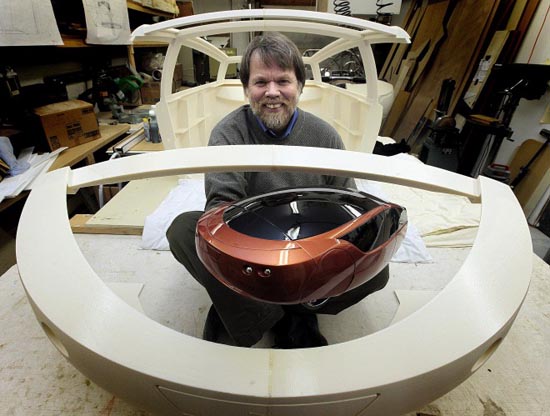
    Engineer Jim Kor inside his design for the Urbee 2 – very efficient.
    Photo from Wired.com and Sara Payne.

    If you haven’t heard this story yet, Jim Kor has engineered what he calls the Urbee. It is essentially 3-D printed car with a hybrid engine. The process is a bit involved as you might imagine. By using the equipment at RedEye, an on-demand 3-D printing shop, the printers use ABS plastic that sprays molten polymer to build the chassic layer in microscopic increments to build the car. Essentially, Kor uploads a design, presses a button and the automated machine does its thing. When he comes back to it, hundred hours later or so, he has a bumper. The entire 3-wheeled two-passenger car takes about 2,500 hours to build according to Wired.com.

    While the car isn’t by any means a race car, it does have several advantages including a curb weight of just 1,200 pounds. This combined with a 36-volt electric motor and a diesel engine, the prototype produces a maximum of 10 horsepower. While slow, it doesn’t use much gas though and the plan is to drive from San Francisco to New York on 10 gallons of pure ethanol.

    3-D Printed Cars - Urbee Exterior

    This photo really shows how small the Urbee is. However, it could be quite practical for some drivers.
    Photo from Wired.com and Sara Payne.

    One of the big questions is safety. The printer helps with that a bit since it can be set to add thickness and rigidity to specific sections like say the bumper. Essentially, the bumper could be as resilient as say the Prius while being much lighter. Plus, Kor is focused on what he calls “race car safety. We want the car to pass the tech inspection required at Le Mans.”

    This is largely accomplished through design which includes a tubular cage around the driver (think Nascar). To overcome Gov’t regulations on safety, the Urbee will be registered as a motorcycle, which is really is.

    Kor says they already have orders for 14 and they estimate the cost to be around $50,000.

    Much like most protypes of things, we don’t see this as being really that useful. However, it is definitely a precursor of what could be. Someday, we might live in a world, where if you need to replace your water pump for example, you print out a new one. Incredible.

    For more information on the future of 3-D printable car parts, check out 3DCarParts.org.

    Search terms people used to find this page:

    • 2013 ram 1500 production delays
    • 2014 toyota sequoia
    • diesel urbee car

    The post 3-D Printed Urbee Car – Future of Automotive? appeared first on Tundra Headquarters Blog.

  • Taxpayers Helped Apple, but Apple Won’t Help Them

    Over the years. U.S. taxpayers have been very good to Apple.

    Many of the revolutionary technologies that make the iPhone and other products and services “smart” were funded by the U.S. government. Take, for instance, the Internet, GPS, touchscreen display, as well as the latest voice-activated personal assistant, Siri. And Apple did not just benefit from government-funded research activities. It also received its early stage finance from the U.S. government’s Small Business Investment Company program. Venture capitalists entered only after government funding had gotten the company to the critical proof of concept.

    Other Silicon Valley companies, like Google, have profited in a similarly immense fashion: Google’s algorithm was funded by the National Science Foundation. Many of the “new economy” companies that like to portray themselves as the heart of U.S. “entrepreneurship” have very successfully surfed the wave of U.S. government-funded investments. Hence, one secret to Silicon Valley’s success has been its active and visible hand, in stark contrast to the Ayn Rand/Adam Smith folklore often bandied about.

    This also stands in stark contrast to the steps that Apple, Google, and other technology companies take to avoid paying taxes. Apple set up a subsidiary in Reno, Nevada, a state without a corporate income or capital gains tax, and channeled a portion of its U.S. sales there, reportedly saving $2.5 billion in taxes. And Apple and Google have both made use of a convoluted tax structure known as the Double Irish With a Dutch Sandwich to avoid paying taxes on overseas earnings. Google chairman Eric Schmidt is reportedly “very proud” of this. “It’s called capitalism,” he said last year.

    Yet it’s a capitalism impossible to conceive of without the U.S. government, which through DARPA and other initiatives stands out worldwide for its astoundingly positive track record in funding true innovation. This includes the government’s most recent claim to fame, its steadfast financial support of (controversial) shale gas and fracking technologies, begun over three decades ago during the otherwise much-maligned Carter Administration.

    Indeed, as the clean-tech sector demonstrates, the venture capital industry is proving itself more risk-averse than U.S. government agencies. The latter are the ones funding the capital-intensive and highest-risk projects. Even development banks in emerging economies, like China and Brazil, are doing more than Silicon Valley-type “entrepreneurs.”

    In a business context, the U.S. government is often portrayed as providing a safeguard against market failure. But that traditional understanding must be widened to include the active and often catalytic role which the U.S. government’s risky investments have had for technology-based corporations. Elsewhere, I have called this role, which entails creating and shaping markets more than “fixing” them, “the entrepreneurial state.”

    These technology activities do require a vision, a mission and a plan — and lots of money spent from upstream research to downstream commercialization. It is not by accident that the National Institutes of Health spends $31 billion a year on supporting innovation in biotechnology and pharmacology. Academic predilections and conventions notwithstanding, such an investment can hardly be considered as just “nudging” a sector.

    A crucial question to be answered is not just whether the present system is geared toward the government showing a lot of the entrepreneurial courage, but why it is systematically badmouthed, despite its many successes.

    An even bigger question for the American taxpayer is whether such support leads to a “parasitic” innovation eco-system. Consider Apple. Despite benefitting directly from taxpayer-funded technologies, it has strategically “underfunded” the tax purse on which it has in the past directly depended.

    What to do to make the field of technology funding less parasitic? Closing tax loopholes would help, but part of the solution must entail the government getting a reward for the high-risk areas it funds directly. Wherever technological breakthroughs have occurred as a result of targeted public sector interventions, there is potential for the government, over time, to reap some of the financial windfall. This can occur through retaining a “golden share” of the royalties from patents, retaining a portion of equity, or also administering so-called income-contingent loans, similar to those now offered to students.

    Clearly, the role of government is not to run commercial enterprises, but to spark innovation in strategic areas. But given ever-tighter public budgets, unless an innovation fund can be regularly replenished with some returns from the successes, innovation itself is under threat.

    Government should never have an exclusive license or hold a large enough portion of the value of an innovation so that its commercial use would be deterred in any form or fashion. But at the same time, it is self-defeating even for private-sector innovation if private firms are the only ones to gain all the reward. Indeed, the same criticism made about banks — socialization of risk, privatization of reward — holds for the innovation economy.

    If the United States wants to continue on the successful arc as a leading technology nation providing a good quality of life to all its citizens, then it must urgently redress the current grave imbalance in the risk-reward ratio governing the technology sector.

  • Hadoop through the years: A GigaOM retrospective

    A few years before we had a Structure:Data conference dedicated to big data — and, by proxy, Hadoop — GigaOM spotted Hadoop’s promise and began trying to spread the word about and advance the discussion around this groundbreaking technology. Now that Hadoop is 10 years old (give or take), we thought now would be a good time to look back on how Hadoop has influenced our events and editorial over years. This is the final installment in our four-part Hadoop anthology that has already covered its birth, present and future.

    Think about this like Hadoop’s greatest hits, but know that there will be more to come. Although the big data discussion is moving away from Hadoop somewhat, it’s still an integral — if not the integral — part of the discussion around data infrastructure. We have two great panels on Hadoop at our Structure:Data conference March 20-21 in New York (which include participants from Facebook, Platfora, Continuuity and EMC’s Pivotal Initiative (whose leader Paul Maritz will also be speaking), among others) and will keep up with all things Hadoop and data for the next 10 years.

    The biggest news

    1. Hadoop-focused startup Cloudera raises $5 million (March 15, 2009)
    2. Friends on the move: Hadoop, AOL & PayPal  (Aug. 10, 2009)
    3. Survey: Hadoop is great, but challenges remain (Sept. 29, 2010)
    4. Yahoo suggests MapReduce overhaul to improve Hadoop performance (March 17, 2011)
    5. Meet MapR, a competitor to Hadoop leader Cloudera (March 24, 2011)
    6. EMC makes a big bet on Hadoop (May 9, 2011)
    7. Exclusive: Yahoo launching Hadoop spinoff this week (June 27, 2011)
    8. Microsoft’s Hadoop play is shaping up, and it includes Excel (Feb. 28, 2012)
    9. VMware aims for Hadoop on VMs with ‘Serengeti’ project (June 13, 2012)
    10. Cloudera makes SQL a first-class citizen in Hadoop (Oct. 24, 2012)

    The best analysis

    1. The data mining renaissance (April 10, 2009)
    2. Is Hadoop champion Cloudera the next Red Hat? (Oct. 2, 2009)
    3. Meet the big data equivalent of the LAMP stack (Aug. 1, 2010)
    4. As big data takes off, the Hadoop wars begin (March 25, 2011)
    5. Hadoop’s civil war: Does it matter who contributes the most? (Oct. 7, 2011)
    6. 5 low-profile startups that could change the face of big data (Jan. 28, 2012)
    7. What it really means when someone says Hadoop (Feb. 6, 2012)
    8. Hadoop jumps through hoops, becomes mainstream (March 3, 2012)
    9. Why the days are numbered for Hadoop as we know it (July 7, 2012)
    10. A few stats, rumors and stories on Hadoop’s rapid growth (Nov. 9, 2012)

    The coolest users … aside from Yahoo

    Facebook

    Netflix

    Etsy

    eBay

    The smart grid world

    Obama for America

    Yelp BloomReach Ancestry.com
    LinkedIn Quantcast Disney
    Orbitz Klout Twitter
    The medical world Climate Corporation Skybox Imaging
    Tumblr Intuit @Walmartlabs
    Zions Bancorporation LivePerson The enterprise security world

    Taking Hadoop to the stage

    The Hadoop Meetup (May 1, 2008)

    Cutting (center) flanked by Baldeschwieler and Om Malik at GigaOM’s Hadoop Meetup in 2008.

    Cutting (center) flanked by Baldeschwieler and Om Malik at GigaOM’s Hadoop Meetup in 2008.

    Next-generation data stores (Structure 2008; start at 57:00)

    Hadoop, NoSQL and webscale data (Structure 2009)

    The big data tsunami (Structure 2010)

    Hadoop and beyond (Structure: Data 2011)

    What’s next for Hadoop? (Structure: Data 2012)

    Mike Olson on Hadoop (Structure: Data 2012)

    Analyzing data with HBase (Structure: Data 2012)


    Related research and analysis from GigaOM Pro:
    Subscriber content. Sign up for a free trial.

  • Motorola Droid Razr and Maxx, you’re getting Android 4.1.2 Jelly Bean!

    Almost a year and a half ago, Motorola introduced the skinny Droid Razr smartphone which was followed shortly by its Droid Razr Maxx younger brother, thicker but with a beefed-up battery onboard. Originally the two devices came with Android 2.3 Gingerbread but Google’s subsidiary upgraded both to Ice Cream Sandwich in mid-2012.

    And, now, Motorola has another surprise in store for Droid Razr and Droid Razr Maxx owners — Android 4.1.2 is coming. The Verizon-branded handsets will be able to take advantage of a plethora of new features and improvements courtesy of the first Jelly Bean iteration. There are also a number of bug fixes and less branded apps included alongside the coveted software upgrade, which bears the “98.72.16.XT912.Verizon.en.US” moniker.

    On the Droid Razr and Droid Razr Maxx, Android 4.1.2 Jelly Bean delivers the Google Now personal assistant with enhanced voice search capabilities, revamped camera with better picture quality, more accurate dictionaries for the keyboard with word predictions, new Gallery app, revised notification panel with expandable notifications, support for Wi-Fi hotspot and Chrome as the default browser.

    Motorola has also fixed a number of bugs for 3G and 4G connectivity (improved voice and data connection and coverage quality), audio settings (easier to find and edit Audio Effects), contacts (sync will occur more often), global roaming (improved GSM roaming connectivity), Google Maps (faster GPS lock-in times), music playlists (playlists are easier to create), Outlook sync (faster updates for email and calendar) and Quick Office (fixed random closing when displaying documents).

    The software upgrade also removes a number of apps (Alarm and Timer, MOTOACTV, MOTOCAST 2.0, MOTOPRINT, My Gallery, My Music, Social Location and Verizon Video on Demand) and widgets (My Gallary, My MOTOCAST, My Music, Picture Slideshow, Social Location, Sticky Note and Weather & World Clock).

    Motorola advises Droid Razr and Droid Razr Maxx users to only install the update using Wi-Fi and when the battery has more than 50 percent charge left.

  • Nokia still on the hook for $650 million in Windows Phone license fees

    Nokia Windows Phone Licensing
    Even though Windows Phone has shown little signs of momentum in recent months, that doesn’t mean Nokia (NOK) isn’t still obligated to pay Microsoft (MSFT) hundreds of millions of dollars in licensing fees. Per ZDNet, Nokia disclosed on Thursday that the fees it pays to Microsoft over the remainder of its licensing agreement will be €500 million — or roughly $650 million — more than the platform support payments that it’s slated to receive from Microsoft. The good news for Nokia is that the total platform support fees that it has either already received or is due to receive from Microsoft are still projected to exceed the licensing fees over the course of the entire deal, so Windows Phone won’t likely be a net money loser for the company.

  • Podcast: Facebook’s feedin’, Lean In‘s meanin’, and everyone’s Hadoop-in’

    Facebook unveiled a new look for its News Feed yesterday, and as Eliza Kern reports, it’s big on bigger photos. Facebook’s COO, Sheryl Sandberg, is making news of her own this week, kicking off a national discussion on women in the work place. Stacey Higginbotham and Laura Owen read the book and share their thoughts on the topic. And finally, Hadoop isn’t just a fun word to say, as Derrick Harris explains, it’s an open source tool you’ll be hearing a lot about in the coming years.

    (download this episode)

    Subscribe to RSS

    iTunes

    Stitcher Radio

    SHOW NOTES:
    Hosts: Chris Albrecht and Tom Krazit
    Guests: Eliza Kern, Stacey Higginbotham, Laura Owen and Derrick Harris.

    We’re recording this week’s episode in-studio at the offices of Stitcher! We appreciate they’re making us sound so much better.

    Facebook’s new News Feed concentrates on photos and spotlights content

    A discussion of Sheryl Sandberg’s Lean In

    The scoop on Hadoop

    SELECT PREVIOUS EPISODES:
    IoT: When devices can talk, will they conspire against you?

    Call-in show: Why the “I’m leaving iPhone” trend?

    Internet of things Podcast – Almond+’s nutty idea: Making sensor connectivity a snap

    Yahoo’s WFH Boo-Boo

    PlayStation Snore?

    Podcast: Why the internet of things is cool and how Mobiplug is helping make it happen

    Related research and analysis from GigaOM Pro:
    Subscriber content. Sign up for a free trial.

  • Thermodo Smartphone Thermometer Doubles Its Kickstarter Goal In 24 Hours, Now Offers Stretch Rewards

    stretchgoals

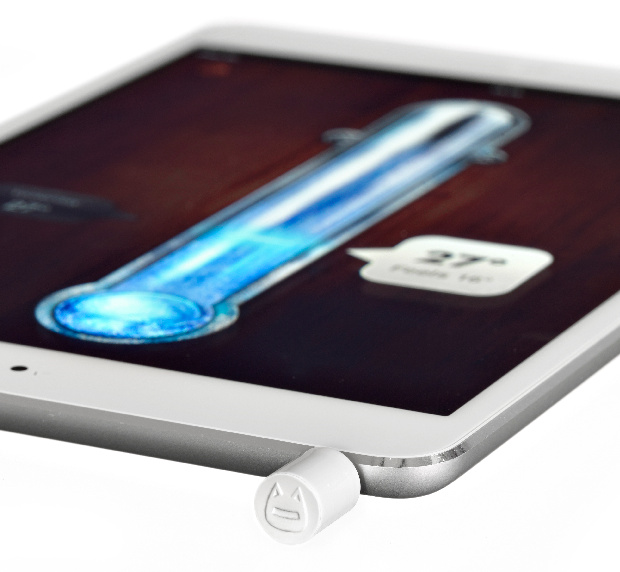
    For a company making a difficult switch from creating software to building hardware, Robocat is making very good early progress. The Danish startup’s Thermodo smartphone thermometer accessory hit its original Kickstarter goal of $35,000 in just seven hours yesterday, and is now at over twice that amount, with pledges still flowing in. Robocat accordingly announced some stretch goals this AM, in a manner that makes me think this is one of the best-engineered Kickstarter projects ever.

    The stretch goals for the Thermodo include a $125,000 level, where Robocat will turn their affection more squarely to Android. The thermometer was always going to be compatible with Android devices through third-party developers, but the team will make the official Thermodo companion app Android-compatible if funding hits that level, and will ensure that Thermo, the startup’s existing app, will also work with Thermodo on Android.

    At $250,000, a new colorway comes into the mix, with a red option available for all backers who pledged $25 or above. And finally, should the project exceed $500,000 in funding, everyone will get an aluminum Thermodo. Robocat is currently offering an anodized aluminum level, but that will remain special as the other levels will have only black, white and red as color options.

    The stretch goals look artfully planned to have been ready to go based on Thermodo’s early success, and that’s why I applaud the project’s design. Robocat went into it knowing exactly how much they needed to get the production line rolling, and asked for only that, but then were ready with upgrades designed to capitalize on the fact that it might be a hit with backers. Individual pledge levels are low, and the overall target looks very achievable, so backers are naturally less skittish about putting down their money since there appears to be little risk.

    Expect Thermodo to reach most, if not all of those tiers in its stretch goals. Which will add up to a huge amount of actual devices to ship when it comes time to deliver. That may be the most interesting part of the whole project: watching how a software company handles mass production of a hardware accessory.

  • Perella Weinberg Partners Launches New Fund

    Perella Weinberg Partners announced it will launch PWP Growth Equity, a lower middle market fund. David Ferguson and Chip Baird, both Western Presidio veterans, will join the firm as partners, and will be based in New York.

    PRESS RELEASE:

    New York, March 7, 2013 – Perella Weinberg Partners, a leading, independent financial services firm providing advisory and asset management services to clients globally, today announced that it will launch PWP Growth Equity, a new private equity strategy focused on investing in growth companies in the lower middle market. The new strategy will be led by David Ferguson and Chip Baird, investment veterans who have joined the Firm as Partners in its Asset Management business. They will be based in New York.

    Mr. Ferguson and Mr. Baird join Perella Weinberg Partners from Weston Presidio, a lower middle market private equity firm, where they were both Partners. Mr. Ferguson and Mr. Baird have 40 years of experience in private equity and investing, collectively.

    The PWP Growth Equity strategy will invest primarily in lower middle market companies across the consumer, services and industrials sectors. The strategy will focus on investments in businesses with strong management leadership, large addressable markets, compelling margins and cash flow conversion, differentiated products or services, and strong growth prospects.

    Terry Meguid, Founding Partner and head of the Firm’s Asset Management business, stated, “Identifying proven and experienced professionals to lead new strategies and further diversify our offering of alternative investment solutions continues to be a primary focus for the Firm. Dave and Chip have a demonstrated track record of successfully sourcing, overseeing and exiting compelling investments and delivering attractive returns for investors.”

    Sandy Haas, Deputy Head of Asset Management, added, “With the welcome addition of Dave and Chip, our Growth Equity activity becomes Perella Weinberg Partners’ eighth investment strategy and third private capital strategy, and we are excited to be offering this new opportunity to investors.”

    David Ferguson stated, “Perella Weinberg Partners is a leading global diversified alternative asset manager that is highly regarded for offering quality alternative investment products. Its reputation, coupled with its institutional infrastructure, made them the ideal partner for our new venture. We are excited to be launching this new strategy under the Perella Weinberg Partners franchise.”

    Chip Baird said, “Dave and I have significant experience investing in the consumer, services and industrials sectors. We look to build supportive relationships with management teams to help them achieve long-term value. We assist our partners’ value creation efforts and we look forward to continuing this work as part of the Perella Weinberg Partners team.”

    Trench Plate Acquisition
    The Growth Equity team led the acquisition of Trench Plate Rental Company (“Trench Plate”) in partnership with its management team in August of 2012. Trench Plate is one of the largest providers of government-mandated trench safety equipment to the underground construction industry in the Western U.S. The company operates 11 branches in Southern California, Northern California, Las Vegas, Reno, and Houston. The company has a strong, established market position and significant asset base that allows it to capitalize on the industry and macroeconomic tailwinds.

    Fashion to Figure Investment
    In February of 2013, the Growth Equity team completed its second investment in Fashion to Figure, the only fast-fashion retail chain dedicated solely to plus-size women’s fashion. Fashion to Figure provides up-to-the-minute fashion trends at value prices. The company has 11 locations across the United States and it operates an online retail business. Fashion to Figure was founded, and is currently led, by the great-grandsons of Lena H. Bryant, the revolutionary businesswoman and visionary dressmaker who invented full-fashion over 100 years ago.

    Perella Weinberg Partners Asset Management Business
    PWP Growth Equity is the third strategy to be launched by Perella Weinberg Partners in the last year. In March of 2012, the Firm introduced PWP Diversified Equities, a fundamental long/short equity and event-driven strategy led by Partner and Portfolio Manager, David Baker. In August of 2012, the Firm launched PWP Alpha Europe, a European long/short equity strategy led by Partner and Portfolio Manager Andrew Dickson. Perella Weinberg Partners Asset Management business is comprised of eight strategies with more than $8.6 billion in assets under management and capital commitments.

    Biographies

    David Ferguson – PWP Growth Equity
    Mr. Ferguson is a Partner at Perella Weinberg Partners. He has been in the private equity industry for 25 years, during which time he has invested in a variety of industries and has served on the boards of directors of over 30 former portfolio companies. Mr. Ferguson was a Partner at JPMorgan Partners (and its predecessor organizations, Chase Capital Partners and Chemical Venture Partners) and, most recently, a Partner at Weston Presidio. Previously, Mr. Ferguson worked in the Mergers and Acquisitions Groups of Bankers Trust and Prudential Securities. He is a Certified Public Accountant and worked in the Audit Departments of Deloitte & Touche and KPMG.

    Mr. Ferguson received a Bachelor of Arts in Accounting from Loyola University Maryland and a Masters in Business Administration from the Wharton School of Business at the University of Pennsylvania.

    Chip Baird – PWP Growth Equity
    Mr. Baird is a Partner at Perella Weinberg Partners. He began his investing career over 15 years ago and has extensive experience across a wide range of industries, having served on the board of directors of numerous portfolio companies.

    Prior to joining Perella Weinberg Partners, Mr. Baird was a Partner at Weston Presidio. Previously, Mr. Baird was a private equity investor with The Beacon Group, where he focused on business and industrial services, energy, and general manufacturing companies. Mr. Baird began his career in the Investment Banking Division at Merrill Lynch, working on mergers and acquisitions, high-yield financings and public equity offerings.

    Mr. Baird received a Bachelor of Science in Finance and International Business from the Pennsylvania State University and a Masters in Business Administration from Harvard Business School.

    About Perella Weinberg Partners
    Perella Weinberg Partners is a leading independent, client-focused financial services firm providing advisory and asset management services to a broad, global client base, including corporations, institutions and governments. The Advisory business advises clients on mergers, acquisitions, defense advisory, financial restructuring, private capital raising, and pension matters. The Asset Management business includes a suite of hedge fund strategies, private investment funds (including real estate) and outsourced CIO solutions. Together with its affiliates, the Asset Management business has capital commitments and managed assets of approximately $8.6 billion. With more than 400 employees, Perella Weinberg Partners maintains offices in New York, London, Abu Dhabi, Austin, Beijing, Denver, Dubai, and San Francisco. For more information on Perella Weinberg Partners, please visithttp://www.pwpartners.com.

    The post Perella Weinberg Partners Launches New Fund appeared first on peHUB.

  • Capricor Tacks on CTO

    Capricor, a privately-held biotechnology company treating cardiac patients, is adding Anthony Davies as its newly-minted CTO. The company is based in Los Angeles.

    PRESS RELEASE:

    Capricor, Inc., a privately held biotechnology company whose cardiac-derived stem cells (CDCs) are being studied as a potentially novel treatment to repair the heart following large heart attacks, announced today that it has appointed Anthony Davies, Ph.D., to the newly created position of Chief Technology Officer. Dr. Davies will be responsible for manufacturing, development and expansion of Capricor’s cell-based therapeutic portfolio and will report to Linda Marbán, Ph.D., Chief Executive Officer of Capricor.
    Dr. Marbán said, “Dr. Davies is a 20-year veteran of the biotech industry, 15 years of which have been in cell and gene therapy. He brings with him an impressive track record in manufacturing, operational management and commercial development, most recently as Vice President, Product Development for Geron Corporation’s cell therapy programs. He is an important addition to Capricor’s management team as Capricor proceeds with the ongoing enrollment of ALLSTAR, the Phase I/II study of our lead product candidate, cardiac-stem cell derived CAP-1002.”
    Prior to joining Geron Corporation, Dr. Davies had a successful career in process development and manufacturing at notable companies such as Serologicals Corporation, Velico Medical, Inc. (formerly ZymeQuest, Inc.) and Onyx Pharmaceuticals, Inc. While at Onyx, Dr. Davies was part of the development team for Nexavar®, a kinase inhibitor with nearly a billion dollars in worldwide sales.

    Commenting on his appointment, Dr. Davies said, “Having spent a significant part of my career in cell therapy, I view Capricor as the most exciting company in the arena. Capricor’s cardiac stem cell therapy is highly differentiated and addresses the huge unmet need of heart disease. I look forward to working with Dr. Marbán and the Capricor team to bring CAP-1002 to patients.”
    Dr. Davies received a MA in Biochemistry from the University of Cambridge and a Ph.D. from the University of Birmingham. He conducted postdoctoral research at the Institute of Virology at Oxford and the University of California, San Francisco.
    About CAP-1002
    CAP-1002, Capricor’s lead product candidate, is a proprietary allogeneic adult stem cell therapy for the treatment of cardiac damage resulting from a heart attack. The product is derived from donor heart tissue. The cells are expanded in the laboratory using a specialized process and then introduced directly into a patient’s heart via infusion into a coronary artery using standard cardiac catheterization techniques.
    CAP-1002 is currently not an approved product and is strictly for investigational purposes.
    About Capricor, Inc.
    Los Angeles-based Capricor is a privately held biotechnology company that aims to create powerful, yet easy-to-administer cardiac stem cell treatments to regenerate damaged heart muscle and improve heart function for patients having suffered a heart attack. Using proprietary technology, Capricor is working to develop and commercialize therapies that utilize stem cells that are indigenous to the heart itself. Where most other organizations derive stem cells from a range of pre-cursor and non-cardiac tissues and then attempt to differentiate those cells to become and support heart tissue, Capricor’s work begins and ends with the heart.
    Phase II of Capricor’s ALLSTAR clinical trial is funded in part through the support of the California Institute for Regenerative Medicine.

    The post Capricor Tacks on CTO appeared first on peHUB.

  • Why Employers Aren’t Filling Their Open Jobs

    There are many signs that the US economy is improving, but the most important one, the unemployment rate, remains stubbornly rooted in recession territory. We had jobless recoveries coming out of the last recessions in 2001 and 1992, but this one put the budget squeeze on recruiting and has gone on for a very long time. Does it mean there is something really different this time?

    One way to answer this question is to see whether the level of hiring now is different than one would expect given unemployment rates this high. This ratio of job openings to unemployment when calculated over time is known in economics as the Beveridge Curve, named after the British economist William Beveridge. Several studies during this recession seemed to indicate that the situation was similar to previous recessions, but a recent study points to one big anomaly: Job openings are not being filled nearly at the rate they have been in previous recoveries. In other words, vacancies are staying vacant for a very long time.

    If so, then the next question is, why? Why aren’t employers filling those jobs? The popular explanation that there is something wrong with the applicants has no support. There is no “mismatch” between the industries and occupations where people were laid off and where hiring is taking place, for example. Jobs have not changed over the last couple of years in any way that changed skill requirements substantially. The “failing schools” notion, even if it was true, couldn’t explain the continued unemployment of the majority of job seekers, who graduated years ago and had jobs just before the recession.

    The better answer comes from the ways in which contemporary practices have made hiring more difficult. Companies regained profitability during the recession with a relentless squeeze on costs, and most of that squeeze was associated with labor. We know, for example, that employers are spending far less to recruit and hire a candidate than before the recession, which may make it harder to find the right person.

    Line managers with profit-and-loss responsibility also have a big financial incentive to avoid adding new employees and the associated costs, so the pressure to hire often comes from overworked employees who demand more help when business and the workload picks up. But even when managers give permission to hire, they may drag their feet about actually bringing someone on. With all those people looking for jobs, why not be picky? Candidates routinely report that companies now take months to make hiring decisions, putting the candidates through round-after-round of interviews with long pauses in between, as the employer picks through the many worthy candidates.

    Some of the cost-cutting took out recruiters. They used to be the people pushing back on hiring managers, asking “do you really need someone with a graduate degree to do this job?” or telling them, “you aren’t going to find someone with 10 years of experience at that salary.” Outside recruiters report that they often have to bring in many candidates who turn down a client company’s job offers before the client is persuaded to raise its pay. And some of the cost-cutting also took out training and development capabilities, so that hiring managers have no choice but to wait for candidates who already have all the skills needed to do the job.

    Finally, part of the explanation may also be that this recession has gone on for so long that it changed what hiring managers think they can find in the labor market. Early on in the recession, when literally millions of people were being laid-off, it was easy to find someone fresh out of a job with the experience and skills needed to step right into your vacancy. Now in the fifth year of the downturn, unemployed candidates have often been out of work for quite a while. The candidates with current work experience that hiring managers want are working for someone else, and they aren’t desperate to take a new job.

    So where does this leave employers — and the unemployed? The reason markets adjust is because the participants, in this case the employers, eventually learn that they either have to raise their pay or lower their expectations in order to get the workers they need. That process of learning and adjustment slows down a lot, though, once companies have cut the recruiters, who used to do the learning for them, and the trainers, who could turn imperfect candidates into credible workers.

  • Dexmet Gets Avante Mezzanine Backing

    Avante Mezzanine Partners is providing debt and equity to support Sverica International’s acquisition of Dexmet Corp. Dexmet is based in Connecticut and develops metals and polymeric materials.

    PRESS RELEASE:
    Los Angeles, California – Avante Mezzanine Partners announced today that it has provided subordinated debt and an equity co-invest to support the acquisition of Dexmet Corporation by Sverica International Investment Fund III. Headquartered in Wallingford, Connecticut, Dexmet is the leading developer and manufacturer of highly engineered, expanded metals and polymeric materials. Dexmet’s products function as mission-critical components on aircraft to protect against lightning strikes, on high-performance batteries to support conductivity and structure, and on a variety of other niche applications.

    “Avante proved to be an excellent mezzanine partner as they showed flexibility in pricing and structuring, conducted efficient diligence, and delivered on what they promised,” said Dave Finley, a Managing Director at Sverica International. “This was our first deal with Avante and we were impressed with their ability to provide a seamless, one-stop financing solution alongside Abacus Finance.”

    “We are thrilled to support Sverica and its acquisition of Dexmet,” said Jeri Harman, Founder and Partner of Avante. “We pride ourselves in building relationships with quality sponsors such as Sverica. Additionally, Dexmet’s dominant market position, defensible niche and attractive growth drivers made it an ideal fit with Avante. We are excited to witness Dexmet’s next stage of growth under Sverica’s experienced guidance and look forward to supporting the company in its future endeavors.”

    The post Dexmet Gets Avante Mezzanine Backing appeared first on peHUB.
  • Average UK adult spends 3.9 years of their entire life using a mobile phone. At a guess

    There are surveys covering all manner of topics, many of which have been commissioned purely by companies hoping to grab some headlines for their products and services. Take this new survey from MobileInsurance, some UK mobile phone insurer I’ve never heard of (since I’ve never insured a phone in my life — that’s partly what my home contents insurance is for).

    The firm apparently asked 2,314 mobile phone users aged 18 or over from around the UK just how long they spend on their phones every day. That’s phoning people, sending texts, using apps and playing games. And they received an answer of 90 minutes a day, which works out to 32,850 minutes a year, or 22.8 days, or — if you want the ultimate figure — 3.9 years of your entire average adult lifespan. That’s a lot of time spent playing with your phone. And all complete rubbish of course.

    For starters, do you know how long you spend on your phone? No. You could guess a figure, which I suspect is what pretty much all of the responders have done. I personally have no idea, at all, how long I spend on my phone on average. Since I also use an iPod touch for notifications, and an iPad for other tasks, it makes it very hard to say exactly how much time I spend looking at all the different screens combined, let alone what the figure is broken down by device. So that estimate of 90 minutes a day might be right, it could be entirely wrong. You don’t need to survey over 2,000 people to get that figure, you could just make it up yourself.

    It depends on the day, on your situation, on your age, on your device — even on your provider. I once spent over an hour just trying to access a website from a place with hardly any signal. I know it’s an average figure they’re claiming, but I’m not sure I could actually even begin to guess that with any degree of accuracy. It could be anything. 90 minutes, 180 minutes, 30 minutes. No clue.

    Jason Brockman, Director of MobileInsurance.co.uk, said: “I was amazed to see how much we use our mobile phones over the course of a year and even our whole adult lifetime. To see that we text, call, browse the net, use apps, take pictures and more for almost 4 years in our lifetime is astounding”.

    No it isn’t Jason. You do anything for any length of time — like eating, sleeping, having sex, watching TV — it all adds up. If you spend five minutes a week looking for lost car keys that alone totals 11 days of your life wasted.

    The survey did bring up some marginally more interesting results though. When asked what they most used their phones for, the recipients stated the following:

    • Browsing the internet — 24%
    • Sending texts — 21%
    • Making phone calls — 17%
    • Using apps — 15%
    • Emails — 13%
    • Taking pictures — 6%
    • Other — 4%

    If anything I’m surprised that making phone calls rated so highly. I’d have thought apps would be higher too, but it depends on what type of phones the people surveyed actually own.

    Do you know how long you spend on your phone on a daily basis, and what do you mostly use it for?

    Photo Credit: Adam Radosavljevic/

  • Replace the Windows clock with a talking alternative

    The standard Windows taskbar clock is small, simple and efficient, but also a little dull. And there are no significant options to change how it looks or behaves, either, so if you’d like to customize this part of your desktop then you’ll need a little assistance from the Talking Desktop Clock.
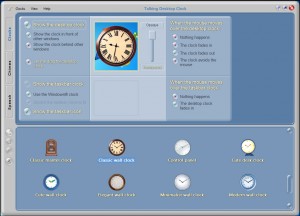
    We were initially a little suspicious of the program, as it has a fairly small installer, but then downloads several additional files as setup progresses. Was this going to be adware? Fortunately the answer was no, the program really is free with no catches, and on first launch it immediately displayed an attractive analogue clock in the bottom right corner of our desktop.

    And while this probably won’t be precisely what you want, don’t worry — the strength of this program comes in its extreme configurability, and just about everything can be changed.

    To get started, right-click the Talking Desktop Clock system tray icon, and select Options > Clocks. Here you can change the clock style to another analogue option, perhaps a simple digital clock, maybe with or without the time. If you don’t like the position of the clock then it can be dragged and dropped wherever you like. And while by default it’s displayed in front of other windows, you can set it to stay behind them, or make it partly transparent.

    Many people won’t like having this size of clock on their desktop at all, of course, but that’s not a problem. The program can alternatively replace the standard Windows clock, so you might have a tiny analogue clock displayed in the bottom right of the taskbar. This won’t display the date (unless you’ve chosen a clock style which includes that), but just hover your mouse cursor over the clock and it’ll display the current date, the local time, and even the time for any other Windows clocks you might have set up.

    As you might guess from the name, Talking Desktop Clock can also say the time (or play a custom sound) every 15, 30 or 60 minutes, or at some other preferred interval. Conveniently, you can restrict this to a particular time of day only, perhaps 8:00am to 6:00pm. The program would then remind you of the time during the working day, when you most needed it, but be quiet at other times.

    Just in case this versatility isn’t enough, clicking View > Settings reveals even more options. There are configurable hotkeys you can use to say the time, or show and hide the clock, for example, as well as several useful mouse settings (double-clicking the taskbar clock can open the Options window).

    And all of this comes in a surprisingly compact package, which can require less than 3MB RAM when running in the background (although this does depend on your settings).

    There are a few small issues here. Some settings are displayed inconsistently, for instance, while others require a little thought before you’ll get the program behaving as you expect.

    For the most part, though, Talking Desktop Clock works very well: it’s fun, lightweight and highly configurable, and an excellent replacement for the standard Windows clock.

    Photo credit: xc/Shutterstock

  • JDSU picks up Arieso for $85M to help carriers serve heavy mobile data users

    Optical equipment and network testing firm JDSU has bought the British location-aware software outfit Arieso, which helps carriers precisely site their small cells so they can better offload heavy users’ mobile data.

    Mobile networks are based on cells, which can only support so many local users at once before performance starts to head south. A really heavy user will speed up this process, so operators are increasingly looking at ways to pinpoint problem locations. The idea here is to deploy cheap equipment (such as femtocells, small cells or even Wi-Fi hotspots) exactly where it is needed, so someone with high data requirements doesn’t spoil the mobile internet experience for other customers in their vicinity.

    Arieso’s software does this by analyzing vast amounts of mobile connection events in a geolocated fashion, right down to building-level resolution. The firm is also, along with the likes of Intucell, one of the companies leading the emerging self-optimizing network (SON) trend, which will see radio access networks (RANs) dynamically adapt on a geographical basis so each cell is optimized for the levels of usage found at its location.

    The Arieso purchase, worth $85 million in cash, brings Milpitas, CA.-based JDSU new engineering expertise and technology based on proprietary algorithms, such as the AriesoGEO network monitoring and optimization package and the AriesoACP network-planning product. JDSU said in a statement that it would integrate these with its own portfolio, notably with PacketPortal – a cloud-based data-capture tool that can be embedded in carriers’ networks.

    Here’s what JDSU communications test and measurement chief David Heard had to say:

    “Arieso’s mobility expertise, market leadership and culture of innovation are directly in line with our strategy to deliver unmatched network visibility and intelligence to our customers. They are a recognized mobility leader and, as part of JDSU, create new, unique opportunities for innovation in one of the fastest-growing segments of the market.”

    According to JDSU, the RAN optimization and SON markets are worth around $700 million today, and will be worth over $1 billion by 2015.

    Related research and analysis from GigaOM Pro:
    Subscriber content. Sign up for a free trial.

  • International Women’s Day: breaking the silence on gender-based violence

    This blog comes directly from a UK aid-supported project on the frontlines. The Ni Nyampinga project is a magazine and radio show for teenage girls in Rwanda that focuses on empowering young women. It reports on issues and stories that matter to them and enables women to become journalists themselves. It is now one of Rwanda’s largest media organisations. This report comes from a Ni Nyampinga journalist.

    KIGALI, RWANDA A thin woman hunches over in a marshland near the river in Kigali, the capital of Rwanda. One by one, she washes a pile of clothing and blankets.

    The 28-year-old woman, who requested anonymity for fear of her safety, says she suffered many years of harassment and violence at the hands of her husband. Money problems were usually the trigger.

    “Every time I asked him for money to buy foods for our kids, he responded by beating me up and hurling insults at me,” she says.

    She says she decided to find employment so she wouldn’t have to rely on her husband for money.

    “I maintained a wise silence and decided not to ask him for anything so that our kids sometimes spent a day without food,” she says.

    Today, she works as a casual laborer washing clothes. She earns 3,000 francs per day ($5) to buy food and clothing for her children.

    Women say they accepted domestic abuse by their husbands as gender-based violence was long considered the norm here. But now, community members are breaking this cultural silence as government-trained mediators resolve domestic disputes as part of a multipronged initiative. Up to 93 percent of victims of physical and psychological abuse in Rwanda are women, according to 2011 statistics from the Isange One Stop Centre, a government centre that provides free services to survivors of domestic abuse.

    “I am old, but I will never forget the violence I experienced when I was living with my husband,” Therese Nkirankima, 96, says.

    She became the victim of violence for the simple reason that she had given birth to all daughters in a culture that favored sons.

    Nkirankima says it used to be that a woman couldn’t report domestic violence. “A woman was treated as an object or a slave,” Nkirankima says. “She had no say in her life and was deprived of her rights.”

    But this culture of acceptance and silence toward gender-based violence is changing.

    Antoinette Nyirasafari, 41, is a member of one of the anti-gender-based violence committees set up by the government, called Abahuza, which means “mediators” in Kinyarwanda. Nyirasafari says that violence against women was rampant some years ago, but it is declining each year. Most of the cases reported to the committee involve physical violence, with drunkenness as a routine culprit.

    In Rwanda, anti-gender-based violence committees are helping women discuss and overcome their problems.

    Claudine Iribagiza, a 32-year-old mother from Kicukiro, says that her husband used to physically abuse her and her daughters. “He returned home whilst drunk and attempted to beat up our first-born child, so that I personally intervened to prevent him from doing it,” she says, “and he broke my arm.” Iribagiza says a Abahuza committee member in her area intervened and helped her to reconcile with her husband. “I am on good terms with him now,” she says, “There are no issues with him.”

    In 2010, the Ministry of Gender and Family Promotion established a team to develop a national policy against gender-based violence, says Christiane Umuhire, a gender mainstreaming officer with the ministry. “Gender-based violence and child-protection committees have been put in place from grass roots to the national levels,” Umuhire says. Police throughout the country have also received training on domestic violence prevention and response.

    The Girls’ Voices blogs series is a platform for young women to voice their opinions about issues girls face in their country. All the young women have been trained by the Global Press Institute. The series is produced by DFID and Girl Hub. Girl Hub is a collaboration between UK aid and the Nike Foundation to help transform the lives of adolescent girls living in poverty by engaging girls themselves to be part of leading that change. You can learn more about how UK aid works with women and girls here.


  • International Women’s Day: Vida’s story

    My name is Vida W. I am 19 years old. I am the middle of 8 children. I should be in form 3 but at the moment we don’t have the fees for me to continue secondary school. I have been helped by Family Health Options Kenya (FHOK) to build the strength to tell my story. I was first approached by their community mobiliser and received counselling because of what happened.

    My father is a drunkard. He comes home drunk and will beat our mother. He chases us out of the house. This is how it was and has been for a while. But then one morning, after breakfast, mum went to town. Her entire body was swollen from the beatings. She said she would be back soon but after 3 days we found out that she needed space and healing from this last beating she’d had.

    While mum was gone my father became a terrible monster. One morning I was unwell so I stayed home from school. I was watching cartoons and he was in his bedroom. He angrily called me. When I went in he told me there is something he wanted us to do but I have to promise never to tell anyone else about it.

    I was scared. He told me to undress. I refused but then I was naked on the bed with him on top of me. He covered my face with an orange cloth. Afterwards I was bleeding so badly. He went away leaving me in great pain.

    Vida’s story happens everywhere.

    I cried myself to sleep and woke up at night. My sister was waiting for me to have dinner. I couldn’t stop crying and she asked me why. I told her that I was crying because I missed mum but it was really because of the pain. I will never forget that day in 2002. I was 7 years old. A week passed and dad started doing it again, anytime he would feel like doing it. Then one day my sister peeped inside the room and saw my dad on top of me. She came with me to tell grandmother what happened. But she said her son would never do such a thing.

    Mum came home a few weeks later and I was happy. But I never told her what happened. I was scared she would also defend my father like grandmother had done. I just loved her so much and I didn’t want to do or say anything that might make her leave. So I said nothing.

    Eventually my sister told my mother what happened. She was so upset and she asked my dad if it was true. He said I was only his step-daughter so there was nothing wrong with what he’d done to me. That night he beat me until I was unconscious.

    We reported it to the police and my father was arrested but then he was freed and our lives were hell. My mother got depressed because my dad and grandmother bribed the police officer. We never got any help. I went to a nearby hospital where I found out I was HIV positive.

    Our family started discriminating against us. We lived on our own. Mum struggled to send us to school because she didn’t have the fees for me or my siblings. My father refused to pay my final exam fee in primary school. He said it would make no difference because I was a dead person.

    I had no friends. They all ran away from me. I felt like nobody in the world loved me. But I was introduced to a support group and they introduced me to Family Health Options Kenya, the organization has really helped me and my mum. I have overcome the stigma through continuous counselling, acceptance by the youths at the centre despite of my status and treatment. This has enabled me live positively.

    So I speak about my life twice a week for 40 minutes. Coming out of stigma is not an easy thing. You have to do it over and over again. I’m trying to show them the positive side of being positive – that you can smile every day.

    Most women are scared of speaking once they are violated because of the stigma associated with it. The UN women should educate the women about Gender Based Violence.

    The advice that I would give to women who are in similar situation is that everything happens for a reason. They should also be strong for their children as my mother stood by me and that’s why I came to accept everything that happened to me. I have my mother as my role model having the heart to forgive her husband despite what she and I have gone through.

    I have moved on with my life, I have forgiven my dad and forget what he did to me. I have friends again – a lot of friends. The counselling I’ve had has helped a lot.

    DFID is backing a campaign to call on the UN to take action on violence against women and girls. You can add your voice by taking the pledge here. UK aid supports the International Planned Parenthood Federation (IPPF), which funds Vida’s support group, Family Options Kenya. IPPF is the second biggest NGO in the world and provided sexual and reproductive health services to 33 million people in 2011 alone. You can learn more about DFID’s work on women and girls here.

  • Morning Advantage: Same-Day Delivery Is Overrated

    I think my dream online-shopping scenario would go something like this: I need a new pair of jeans. Search. Click. Buy. Wait a few hours. Answer the doorbell: my jeans.

    In an effort to gain a competitive advantage, writes Marcus Wohlson at Wired, big online retailers — Amazon, Walmart, eBay — are experimenting with making our La-Z-Boy dreams a reality. But are most of us willing to throw down extra cash for instant gratification? Probably not. According to a new survey by Boston Consulting Group, which Wohlson cites, less than 10% of 1,500 respondents said they don’t give a second thought to same-day delivery when online shopping. The one exception, though, is “affluent millennials” who live in big cities, and their enthusiasm could be enough to keep same-day shipping profitable.

    So what do most of us value above all else? Free shipping.

    MORE RESEARCH NEEDED

    The Problem of Reproducibility in the Social Sciences (Pacific + Standard)

    One could argue that we’re in a Golden Age of research. Top academic journals, especially in psychology, seem to be publishing new discoveries all the time. But since there’s a publishing bias for new research, writes Kayt Sukel, too few scientists are trying to replicate past studies. In other words, everyone’s chasing the next big thing and more checks and balances are needed. That’s why Brian Nosek, a psychologist at the University of Virginia, launched the Reproducibility Project. Since its launch last year, he’s recruited more than 100 colleagues to try to reproduce a study published in a high-profile journal.

    WINNING!

    Researchers Use Internet to Find New Drug Side Effects (New York Times)

    We know that prescription drugs can cause a long list of side effects, but the Food and Drug Administration doesn’t always catch all of them. There is a system in place to find and record previously unknown side effects, but it’s limited in scope. Good news: a team of researchers from Microsoft, Stanford and Columbia found a cool workaround to the problem: they created an automated data-bot that mined millions of web searches (think about how often you type your symptoms into Google) and they discovered new side effects that were unreported in the F.D.A’s warning system.

    BONUS BITS:

    Bigger is Better

    Big Data in the Big Apple (Slate)
    The Best Reason to Raise the Minimum Wage (The New Republic)
    Stop Calling Student Loans a Bubble! (Time)