Category: News

  • Apple Announces 3 Billion App Store Downloads

    Apple today announced that users have now downloaded over three billion iPhone and iPod touch applications from the company’s App Store since its July 2008 launch.

    “Three billion applications downloaded in less than 18 months — this is like nothing we’ve ever seen before,” said Steve Jobs, Apple’s CEO. “The revolutionary App Store offers iPhone and iPod touch users an experience unlike anything else available on other mobile devices, and we see no signs of the competition catching up anytime soon.”

    With the App Store having reached two billion downloads just over three months ago, the new milestone represents continued acceleration of growth for the store as Apple’s handheld devices continue to attract significant numbers of customers. The App Store continues to be available to customers in 77 countries, offering applications in 20 categories.

    Read more from MacRumors

  • Pollan on ‘The Daily Show’

    by Tom Philpott

    As health care, finance, and climate bills lurch through Congress, buffeted and compromised by the very industries they seek to rein in, the question of whether our political system is actually capable of real reform arises. Could it be that corporate lobbies are so powerful that current dysfunctions are entrenched? Are we doomed to be a society that lets its sick suffer and its bankers create the effective equivalent of Ponzi schemes, while fossil fuel industries pump greenhouse gases into a warming atmosphere?

    These questions are critically relevant to the food system. True, the next farm bill doesn’t fall until 2013; but early this year, Congress and the President will have to reauthorize the school-lunch program. Will they continue to fund it at current miserly levels, dooming public school children to consume stuff like hamburgers adulterated with an ammonia-laced filler known in some industry quarters as “pink slime”? If the past year’s legislative battles have taught us anything, it’s that true school-lunch reform, under current conditions, will be difficult to achieve.

    Michael Pollan has for a while now been pointing to a way out of the reform stalemate caused by the power of lobbies: that space for reform opens when powerful lobbies turn against one another. Pollan appeared last night on the Daily Show, promoting his new book Food Rules. He made a point he has made before: if even a modicum of health care reform passes, one that bars insurers from denying coverage to sick people or purging them when they get sick, than the interests of the mighty insurance industry will turn against those of the mighty agribusiness/processed-food industry. The insurance industry, forced at least on some level to deal with the chronic illnesses caused by the U.S. diet, will join the food-reform movement, Pollan predicts. Backed by a well-heeled industry lobby, the movement will be empowered to create real change.

    It’s a path to reform that owes more to the ideas of Machiavelli than to those of Thomas Paine, but if it works …

    Related Links:

    Russ Parsons on launching a civil, inclusive food-system debate

    Lessons on the food system from the ammonia-hamburger fiasco

    Ask Umbra on judging greenness


  • NASA chief Bolden talks NASA, astronomy | Bad Astronomy

    bolden_AASI’m at the annual winter American Astronomical Society meeting, and just left an interesting address by the new NASA Administrator Charlie Bolden. He’s a former astronaut (he was on the initial Hubble Shuttle mission back in 1990) and Marine corps pilot, but now he’s the top guy at NASA.

    It’s a tradition for the NASA head to speak at the AAS meetings. I’ve heard talks from ex-Admins Dan Goldin, Sean O’Keefe, and Mike Griffin, and this one was very different. NASA is at a very tumultuous point in its history, with the Shuttle winding down, the future of the Constellation rocket program uncertain and under fire, and even the direction of the agency itself unclear. Because of this, and because President Obama has not made a public policy statement about these issues yet, Bolden could not give a nuts-and-bolts speech, which is understandable. For those of you who weren’t following my live comments on Twitter during the talk, here are some of the highlights.

    He was very clear that we all need to do what we can to inspire kids about science. In a remarkable turn, he literally choked up on stage while talking about putting together a telescope with his granddaughter, and saying we need to get more kids to look through eyepieces. “Look at this!” he said, “This is what we do!” That resonates with me, of course; I’ve made that exact comment on this blog dozens of times.

    NASA logoHe also said that manned space flight would not be paid off the back of science. This generated applause from the audience. However, I’ve heard that before, just a few years ago from Mike Griffin… and then saw science missions’ funding cut back to pay for the lunar exploration program. So while I agree with Bolden’s sentiment, I don’t know if he can pull that particular feat off. I sure hope he can.

    When asked about the issues with delays in the Shuttle replacement, he stated that “This President won’t be the one who presides over the demise of the manned space program.” (quoting from my memory of what he said). He also stated how strongly Obama supports science; something we already know but it’s damn good to hear it again.

    He also said, “If you had told me 20 years ago that we wouldn’t be back on the Moon by now, I’d have said you were smoking dope.” That was great to hear! I know a lot of us outside of NASA have been saying that for years, but it was refreshing and wonderful to hear the head of NASA saying it, and saying it so frankly. He even repeated the statement to make sure we got it. Very cool indeed.

    Overall, Bolden reinforced how committed NASA is to science — something that needs to be said when addressing 1000+ astronomers, who traditionally and by large majority tend to support unmanned robotic exploration over the much more expensive and usually less-scientifically oriented manned flight. He stressed that we all need to be teachers, and we all need to be the inspiration for the next generation. I agree in general, and certainly in specifics about inspiration.

    So this first date with the NASA chief went as a lot of first dates go. Hopeful, with some reservations on promises made based on the delivery of further evidence, but… hopeful.

    [During the talk I sat next to my dear friend and woman-full-of-awesome Pamela Gay, who has posted her thoughts on this as well.]


  • Tibau do Sul e Praia da Pipa, parte do paraíso chamado Rio Grando Norte

    Tibau do Sul é um município no estado do Rio Grande do Norte (Brasil), localizado na microrregião do Litoral Sul, na Mesorregião do Leste Potiguar e no Pólo Costa das Dunas. Fica a 80 km de Natal, capital do estado. Segundo o IBGE tem uma população de 11.347 habitantes. Recebe muitos turistas devido a Praia de Pipa.

    Mais informações: http://www.pipa.com.br/

    -Fotos minhas e do panoramio

    Chegando a Tibau do Sul

    1-

    2-

    A cidade
    3-

    4-

    5-

    6-

    7-

    8-

    9-

    10-

    Balsa da Lagoa de guaraíras

    11-

    Lagoa de Guaraíras

    12-

    13-

    14-

    15-

    16-

    17-

    18-

    19- A famosa creperia

    20-

    21-

    22-

    23-

    24-

    Praia de Malembar

    25-

    26-

    Praia do Giz

    27- Nascer do sol

    28-

    29-

    Ponta do Pirambu

    30-

    31-

    32-

    33-

    34-

    35-

    Praia de Cacimbinha

    36-

    37-

    38-

    39-

    Praia da Pipa

    40-

    41-

    42-

    43-

    44-

    45-

    46-

    47-

    48-

    49-

    50-

    51-

    52-

    53-

    54-

    55-

    Praia do Amor

    56-

    57-

  • The Google Phone Won’t Open Up the Wireless Industry

    I had hoped that today’s announcement of Google’s phone would be another iPhone-like bomb set to disrupt wireless carriers and bring a future of affordable, open and ubiquitous mobile connectivity to pass. Apple pried open the carrier ecosystem with the iPhone, and its decisions to open up geolocation information and create an app store hurt the business model the carriers rely on even more than the incredible data use it ushered in.

    I’d anticipated that given Google’s focus on opening up the 700 MHz auction, pushing white spaces broadband and investment in WiMAX, the Nexus One also would be a hardware-based crowbar. It isn’t, and Google so far seems to be working with the carriers even as it offers its own web store for Android devices. But if Google wants to bring about affordable and open wireless to everyone, as well as encourage more competition in the wireless industry, here are a few steps it should take to bring that about.

    Build a phone that can roam: Right now, cell phones are using different wireless technologies and are tuned to various spectrum bands, so unlike choosing say, a WiFi-enabled device, one has to know what type of cell technology you want to operate the device on, such as a CDMA or HSPA network, and you have to know which spectrum you need the signals to travel over.

    Without being able to buy a cellular phone or device with the right radios that are tuned to the correct swaths of spectrum, manufacturers still have to choose which carriers they want to build for. This means costs for components can’t drop as rapidly as possible and that some carriers might have a hard time convincing folks to build devices for them.

    A software-defined radio could be the key for such a universal handset. Google could contribute dollars or talent to making SDRs  faster, cheaper and more power-efficient so they work inside mobile phones.

    Get carriers to ditch SIM cards: The SIM card is the key to the cellular kingdom. Unlike access to a Wi-Fi network or even a corporate LAN, which requires a password and a user name to access, cellular networks only open up to devices that contain the right SIM card. Carriers say they need SIM cards because they’re more secure than a user name and password combo.

    But if a consumer wants to put his device on a different network, he has to swap out the SIM or even the gadget itself. This is a barrier to consumers switching networks. If Google can convince a carrier to let a SIM-free device (perhaps biometric access to a network would be secure enough for carriers) onto its network, then we could see the beginning of a world where it’s easy for a device to use the best, lowest-cost network available and pricing for mobile broadband comes way down.

    If Google can help build devices that can roam anywhere, across a variety of networks, including Wi-Fi, and can push carriers to find another way to authenticate people on their networks without sacrificing security, then they could release a device that could be just as disruptive as the iPhone.

    Related Research: Google’s Mobile Strategy
    Google’s mobile strategy is about more than just capturing new ad revenue — its about enabling innovation and boosting access.

    Thumbnail image courtesy of Flickr user dahlstroms.

  • CourseSmart Looks Ahead at eTextbooks on Apple’s Tablet

    The Wall Street Journal reports on eTextbook publisher CourseSmart, which is looking ahead to the release of Apples much-rumored tablet and is using this weeks CES conference in Las Vegas to show off its thoughts on how its content could be offered on the new device. In order to promote its vision, CourseSmart has developed a preview video demonstrating eTextbook usage on a concept Apple tablet. While the company has no inside knowledge of the device, it has clearly paired its ideas of how the tablet might function with Apples existing software design aesthetics.

    via Mac Rumors

  • From iPhone users to Google: Thank you for the Nexus One

    I love you Google. Thank you for the Nexus One Phone.

    Sold unlocked even when subsidized. Google Voice baked in. Navigation. Location sharing. Speech recognition text entry. Speech UI. OLED. Removable battery. Memory on Micro SD card (to 32GB). Noise cancellation. Ogg Vorbis.
    I’ve got six months left on my iPhone AT&T contract. I’m in no hurry to get a new contract now. You can buy this phone without a data plan, stick in a pay-per-use voice/data cash card, and, once Google announces their Google VOIP service, use it largely free with home and office WiFi.
    Apple and AT&T will need to be very sweet to keep me.
    Update: Arrington review online. The battery life is very short, but even with the iPhone I’m always near a charger. It’s life.
    Update b: As I read reviews on the Nexus One I’m a bit surprised by admissions of how weak yesterday’s crop of Android phones truly are. If I’d bought one I’d have been b*tching big time. Sadly, most geek bloggers are too committed to defending their purchases. In my blogs, I savagely attack the things I own :-).
    Update c: The very best sort of competition. Reminds me of the golden age before Microsoft crushed all competition on the PC platform.
    Update d: The Nexus is up to 50% cheaper than the iPhone. I think this comparison overstates the gap, but it’s technically correct. My bet is the Nexus is closer to 30% cheaper for most users.
    Update 1/6/10: Pogue is not amused. I think he missed out on the advantage of using WiFi for data and a very cheap minimal voice plan for voice.
  • Maria Mitchell Association

    Massachusetts, US | Museums and Collections

    Nantucket is usually known for it’s historic whaling voyages, the intricate craft of scrimshaw, and as a popular vacation spot. In the 19th century, however, one scientist added a curious wrinkle to the small island’s rich history. Born to a Quaker family in 1818, Maria Mitchell nurtured a love for astronomy whilst growing up on the island. She turned her interests into an illustrious career that eventually culminated in the founding of Nantucket’s first and only scientific institution, the Maria Mitchell Association.

    Under the supervision of her schoolteacher father, Mitchell developed her observing skills early in life. As a teenager, Maria assisted sailors in navigating the seas by making complicated calculations. On land, the young astronomer spent nights looking through a telescope on her rooftop. Her hobby soon became a career and in 1847 she gained recognition for her discovery of a telescopic comet (a comet that is invisible to the naked eye). This achievement even earned her a gold medal from the King of Denmark.

    In 1865, following Mitchell’s recent fame, the newly-found Vassar College hired the astronomer as its first professor. Mitchell spent the rest of her career educating and conducting research at the New York women’s college. After her death in 1889, Mitchell’s friends, family, and students founded the Maria Mitchell Association, dedicated to educating the public about science in her hometown of Nantucket. For over a century the association has grown and today it includes two observatories, an aquarium, a natural science museum, an historic house, and a research library.

    The two observatories include the main Maria Mitchell Observatory near downtown, and the Loines Observatory about one kilometer away. The Astronomy Department houses a collection of over 8,000 glass photographic plates of the sky, constituting observations made between 1913 and 1995. Researchers still use the plates today as a reference to newer images. By comparing photographs of the same patch of sky taken decades apart, astronomers may study changes in celestial objects. Realizing the plates’ usefulness, the scientists at MMO became the first to digitize their entire glass plate collection and make their data available to astronomers worldwide. The Loines location features an antique 8-inch Clarke telescope used for public education as well as a 24-inch research-grade telescope.

    The association also runs its own seasonal aquarium. Each year, a variety of local marine life is collected from the shores for a temporary stay at the aquarium before being released back into the ocean. More exotic life can be found at the aquarium too, as the Gulf Stream will occasionally carry tropical fish north into Nantucket waters. In addition to maintaining the aquarium, the staff lead Marine Ecology Walks where participants can observe the feeding habits of nocturnal sea creatures or assist in the collection, identification, sorting, and counting of specimens. In the winter, marine scientists also lead excursions to Muskeget Island where the birthing of hundreds of Gray Seal pups can be witnessed.

    Similarly, the Natural Science department operates a museum that features local flora and fauna. There you can learn about the research done on the island, including the tracking of a male Osprey through the use of a solar-powered GPS transmitter placed on the bird. Using information relayed by the device about the bird’s location, altitude, flight speed and direction, scientists monitored its progress on a flight to South America. In one month, the bird covered 4000 miles, about one eighth of the Earth’s circumference. The department also leads Nature and Bird Walks and hands-on workshops in which participants can take part in the scientific research of the association staff at various remote sites around the island.

    A historical look at the island and its culture is provided at the Mitchell House and the Mitchell Schoolhouse, both operated by the association. The former was built in 1790 and documents Nantucket life in the 19th century, featuring family artifacts including Maria’s original Dolland telescope. The schoolhouse, where Maria’s father taught, is located next door and houses the association’s Archives and Special Collections. Here visitors can peruse Maria’s manuscripts, 19th century scientific books and journals, and original documents pertaining to the family and association.

    A complete Mitchell-family experience of Nantucket must also include a visit to the Meridian Stones. These two stones, located downtown, long perplexed the island’s inhabitants. However, the MMA’s research uncovered the mysterious stones’ origin and purpose. Using astronomical calculations, Maria’s father erected the stones to represent the true geographic meridian, or north-south line. The stones were used to monitor variations of a quantity called “magnetic declination,” defined as the angle between the lines pointing to the true North pole and magnetic North pole. Since surveyors of the time used compasses (which measure direction relative to the magnetic poles), accurate determinations of the magnetic declination were necessary to create geographically correct maps.

    The so-called “Mitchell Meridian Line” was one of the first of its kind in the country, preceding the court-mandated construction of similar instruments by three decades.

  • Belo Horizonte – centro e região

    Olá, sou novo aquí no SSC e esse é meu primeiro thread. Aproveitei minhas férias escolares e fui até o centro para tirar algumas fotos.

    1- Arredores do shopping cidade
    [IMG][/IMG]
    2-

    3-

    4-

    5-

    6-

    7-

    8-

    9-

    10-

    11-

    12-

    13-

    14-

    15-

    16-

    17-

    18-

    19-

    20-

    21-

    22-

    23-

    24-

    25-

    26-

    27-

    28-

    29-

    30-

    31- Praça 7

    32-

    33-

    34-

    35-

    36-

    37-

    38-

    39-

    40-

    41-

    42-

    43-

    44-

    45-

    46- subindo em direção ao Lourdes

    47- Entrada do diamond Mall

    48-

    49-

    50-

  • Kim & Khloe Kardashian Quick Trim Commercial

    Socialite sisters Kim and Khloe Kardashian slap their stamp of approval on Quick Trim for a new commercial advertisement promoting the weight loss system.

    “SEXY! U can see our QuickTrim commercial on QTdiet.com FIRST before it airs on TV!” Kim Tweeted just an hour ago.

    Kim and Khloe are showing off their svelte new figures in the super-sexy new spot. Kim, 29, and Khloe, 25, appear on screen wearing buttoned-down white collared shirts before ending up poolside in bikinis.

    “You can change the way you look…create the body you deserve,” a tantilizing Kim tells the audience.


  • Klipsch LightSpeakers Screw Into Light Bulb Sockets, Play Music Wirelessly [Home Audio]

    These Klipsch LightSpeakers may be ugly as sin, but the idea of having speakers and LED lights in the same light bulb unit should appeal to haters of wires and unnecessary gadgetry.

    The LED light bulb fits 5 and 6-inch light fixtures and is completely dimmable, meaning you can replace the usual bulbs you use with a set of these Klipsch ones, which will last for 40,000 hours apparently. Pipe music wirelessly through to the lights, which contain a 2.5-inch wide dispersion driver and uses up 20 watts. The LightSpeaker kit comes with a transmitter, which connects to a PC, CD player or iPod and sends the audio to up to eight of the light bulbs with two separate zones.

    The two LightSpeakers, transmitter, remote and cables cost $599, with individual LightSpeakers on sale for $249 at the end of the month. [Klipsch via BusinessWire]


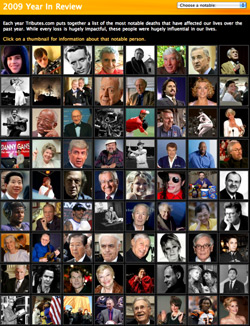
  • Tributes Posts Their “2009 Year in Review”

    Tributes.com has just posted their 2009 Year in Review, Known for their Celebrity obituaries, as well as those for the Tributes 2009 Year in Reviewlesser-known folks, Tributes does a great job of reminding us of those who’ve passed on.

    In looking through the many prominent people who died during 2009, I note that many of these folks were my contemporaries, if not my “heroes” at some point in my life.

    Yes… Life is a fleeting thing.

    Check out Tributes’ 2009 Year in Review.

  • Google’s Mobile Chief Andy Rubin on the Google Phone & the Androidification of Everything

    Andy Rubin’s business card identifies him as the Vice President of Engineering at Google. In reality, he’s the Mountain View, Calif.-based search engine’s mobile chief. From the time Google snapped up his tiny startup, Android, to today, when it officially launched the first Google Phone, Rubin (and his partner Rich Miner) have been behind virtually every mobile move made by the company.

    And until very recently, Rubin had maintained that Google wasn’t going to make a Google Phone. So when news of the Nexus One first broke, I was flabbergasted that after all the denials it was actually doing so. To that end, I asked him: How is Google suddenly in the hardware business?

    “Google isn’t building hardware,” Rubin said. He noted how Apple’s iPhone typically carries the tag “Designed in California,” which explicitly points to that company’s hardware roots. Not so with Google. “We are not designers and there are no hardware or industrial designers on my team,” said Rubin. Instead they leave it to companies such as HTC, which has made the Nexus One.

    More Google Phones to Come

    “For the first time, we’re issuing purchasing orders to the manufacturers so we are now their customers,” he added, “which means we can now have more influence on the device.” That influence is quite visible in the Nexus One, as I point out in my review. And Rubin said Google is working with manufacturers in addition to HTC that also want to benefit from the sales push on Google’s web site.

    Andy Rubin with Motorola CEO Sanjay Jha at Mobilize 09

    Those words won’t placate some of the company’s partners, which according to my sources are livid at Google’s decision to promote the HTC-built device, which works with T-Mobile USA’s 3G network. Motorola and Verizon , which have collectively spent close to $100 million promoting the Android-based Droid, are said to be particularly miffed at this decision to launch the Google Phone. One look at the Nexus One and no one in their right mind would even consider the Droid. More importantly, imagine competing with the company that makes the OS itself.

    Get this report with a $79 subscription to GigaOM Pro!

    “People shouldn’t focus too much on the device (Nexus One),” said Rubin. “What’s more important is the strategy behind the devices.” Instead of spending hundreds of millions of dollars on marketing, Google is simply “going straight to the Google customers,” he said. He believes that such a strategy could fundamentally change the way people buy cell phones — in other words, over the web. Already, as he pointed out, people are buying devices (and gadgets) online.

    The way I see it, Google has a couple of major problems: It’s facing a splintering of the Android experience, thanks to the growing number of user experience efforts such as HTC’s Sense. And in order to quickly get traction in the marketplace, Google needs to attract more developers. To overcome these challenges, the company needs to seed the market with what it feels is the device that best showcases Android’s capabilities.

    150,000 True Fans

    Rubin hopes his company can sell, at the very least, 150,000 Nexus One devices. Why? “Because if there are that many devices out there, you are likely to run into someone with a device somewhere,” he reasoned. To be clear, that number is only applicable to the U.S., even though the device will be available in the UK, Singapore and Hong Kong.

    Google won’t have any trouble selling that many devices. There are more than enough fanatical users of the company’s services, such as Gmail and Google Maps, to make that happen. The Nexus One and subsequent Google Phones will continue to be tightly integrated with Google’s services.

    Cell Phone As a Platform

    When I asked Rubin about some of the shortcomings of the Nexus One and of the Android platform in general, he was candid in admitting that there was still work to be done. “We could have easily seeded the developers with this new device with a higher-resolution screen, but we decided to wait till the announcement was made,” he said. Now that the device has been launched, Google, he said, was looking to aggressively woo developers. Expect it to make some major announcements on that front soon.

    The world has changed, Rubin argued. Up until now, the software inside the phone and the web were two different entities living in two different worlds. What Android represents is the ethos of the web brought to the cell phone world. “As a company we iterate a lot and now you have a cell-phone platform that you can quickly iterate upon,” said Rubin. “When were you able to do that on Symbian?” Ouch! (Related: Symbian Executive Rips Into Google’s Android.)

    I think that’s what makes Android such as interesting platform, as I explained in my essay, The Androidification of Everything. When I asked Rubin where Android could show up next, he said it could be anywhere — from set-top boxes to large-screen devices, even desktop PCs.

    Related Research: Google’s Mobile Strategy

  • Matthew Doyle Named Photo Director for Playboy Magazine

    Olivia Munn, Photo by Matt DoylePlayboy Enterprises, Inc. (PEI) ( PLA, PLAA) today announced that it named Matthew Doyle Playboy’s photo director.

    Doyle will be responsible for the acquisition of photography for Playboy magazine as well as oversight for acquisition and quality judgment on all still photography for the corporation.

    His position reports to Playboy founder, Editor-in-Chief and Chief Creative Officer Hugh M. Hefner and Playboy magazine’s Art Director Rob Wilson. He will be based at the company’s headquarters in Chicago.

    “In our increasingly visual world, Matt understands the significance of exceptional photography and imagery for print media,” said Wilson.

    “His experience with still life, advertising, celebrity, and documentary photography has developed his keen eye for compelling images.”

    Doyle, 37, joins Playboy from Complex magazine, which he helped launch in 2001 and where he was photo director and chief photographer.

    Prior to that, Doyle was engaged in freelance photography. He has worked creatively with many of the hottest stars of music, film, and fashion, and his photography has been featured in national magazines and advertising campaigns. He has over ten years of experience as a professional photographer.

    “The pages of Playboy bring a modern visual style to readers that expect the highest quality images and editorial content,” said Jimmy Jellinek, editorial director of Playboy magazine and Playboy.com and chief content officer for PEI.

    “Matt’s ardent sense of composition and style will complement Playboy’s aesthetic.”

    “As a photographer and photo director, I have long admired the visual quality of Playboy,” said Doyle. “Under Hef’s guidance and with the creativity of Rob and Jimmy, Playboy has extraordinary visual appeal. I’ve been given a unique and wonderful opportunity to work with them and Playboy’s creative team to continue a long tradition of excellence.”

    Doyle is a graduate of Bernard Baruch College with a degree in journalism.

    About Playboy Enterprises, Inc.

    Playboy is one of the most recognized and popular consumer brands in the world. Playboy Enterprises, Inc. is a media and lifestyle company that markets the brand through a wide range of media properties and licensing initiatives.

    The company publishes Playboy magazine in the United States and abroad and creates content for distribution via television networks, websites, mobile platforms and radio.

    Through licensing agreements, the Playboy brand appears on a wide range of consumer products in more than 150 countries as well as retail stores and entertainment venues.


  • Atlus trademarks "Gungnir"

    Gungnir. Odin’s legendary spear and stuff of so many video games that have anything to do with a spear…or not. That’s exactly the name of the latest trademark spotted, filed by Atlus.


  • Marvell Plug Computer 3.0: The Tiny Linux Brick [Ces2010]

    If I had $1,000,000 I would buy 10,000 of these Marvell Plug Computer 3.0, with a 2GHz Armada 300 CPU, Wi-Fi, and Linux 2.6, and build myself a supercomputer. It’s either that or cocktails.

    Sadly, it’s not oriented to consumers, but to the integration and development of new devices. So that’s it, fate has chosen for me. Cocktails it is.

    Marvell Unveils Plug Computer 3.0 With Integrated Wireless and Built-in Hard Drive

    Powerful Microserver is bolstered with 2 GHz ARMADA Processor to drive the “Always-On Lifestyle”

    LAS VEGAS, Jan. 5 /PRNewswire-FirstCall/ — CES — Marvell (Nasdaq: MRVL), a worldwide leader in integrated silicon solutions, today unveiled Plug Computer 3.0 – a new always-on, always connected turnkey platform designed to power the next generation intelligent applications and services for the home and office. The new embedded Wi-Fi, Bluetooth and built-in hard drive extend the use of Plug Computer into new applications including management of medical and financial records as well as a command post for the smart home – allowing for remote management of lights, thermostat and irrigation systems.

    Equipped with the recently announced Marvell® ARMADA(TM) 300 processor, Plug Computer 3.0 offers 2 GHz of processing performance yet maintains a very low-power footprint – making Plug Computers more powerful, eco-friendly and efficient to enable development of plug ‘n’ play next generation consumer devices with zero configuration. From streaming the latest winter vacation video to a connected TV in the bedroom, to enjoying favorite music on a Wi-Fi enabled receiver in the living room, Plug Computer 3.0 makes enjoying media on intelligent devices throughout the home easier and on-the-go more enjoyable than before.

    “With unprecedented integration and very low power design, Plug Computer 3.0 offers a powerful, yet compact, and green development platform to accelerate the development and availability of innovative software and services in the home,” said Dr. Simon Milner, Vice President and General Manager, Enterprise Business Unit, Communications and Consumer Group at Marvell. “Following the shipment of more than 10,000 SheevaPlug(TM) development kits to date, we’re confident that this will be a transformational year, where innovative concepts organically fuel a new generation of rich applications to go hand-in-hand with the always-on lifestyle.”
    The release of Plug Computer 3.0 opens up additional applications and usage in key new markets:

    • Smart Grid
    • Home Automation
    • Medical Monitoring
    • Multimedia Content Sharing
    • Security and Access Control
    • Industrial Automation
    • Agricultural
    • Mesh and Grid Computing

    The Plug Computer 3.0 development kits will be available through Plug Computer vendors such as Globalscale Technologies Inc, Ionics EMS, and Universal Scientific Industries Co.
    For more information on the products, please visit www.plugcomputer.org or visit the Plug Computer Pavilion at the Consumer Electronics Show (CES) in Las Vegas this week (South Hall 30344).
    About the Plug Computer 3.0 Development Platform

    The award-winning Plug Computer 3.0 is designed to make high-performance, always-on, always connected, and green computing readily available for developers and end-users. Plug Computer 3.0 uses a 2 GHz Marvell ARMADA 300 processor, a built-in hard-disk drive and embedded Marvell Wi-Fi and Bluetooth technologies. Additional peripherals such as Direct Attached Storage (DAS) can be connected using a USB 2.0 port. Multiple standard Linux 2.6 kernel distributions are supported on the Plug Computer 3.0 development platform enabling rapid application development. The enclosure is designed to plug directly into a standard wall socket and is designed to draw less than one tenth of the power of a typical PC being used as a home server.

    [PR Newswire]


  • Kia UVO details released, like SYNC circa 2008

    Filed under: , ,

    The Consumer Electronics Show (CES) in Las Vegas kicks off this week and the first major announcement from the automotive world comes from Kia in the form of its UVO (short for “your voice”) infotainment system.

    Co-developed by Microsoft and based on the Windows Embedded Auto software, UVO is similar to Ford’s beloved SYNC system, offering users the ability to rip music from CDs and integrate an MP3 player, with a heavy focus on voice commands. Utilizing Microsoft’s next generation voice technology, two distinct profiles are stored in the system allowing users to access different elements of the UVO system through voice commands or through the 4.3-inch color touch screen. A back-up camera is also included in the setup, however, it appears that UVO won’t be available without the screen, unlike Ford’s system.

    Although pricing has yet to be announced, UVO is set to launch on the 2011 Kia Sorento this summer and is expected to filter throughout Kia’s line-up over the coming year. Make the jump for the official release.

    Continue reading Kia UVO details released, like SYNC circa 2008

    Kia UVO details released, like SYNC circa 2008 originally appeared on Autoblog on Tue, 05 Jan 2010 13:59:00 EST. Please see our terms for use of feeds.

    Permalink | Email this | Comments

  • One-of-a-Kind Triple Creme: Cowgirl Creamery Red Hawk The Cheesemonger

    2010_01_06-redhawk2.jpgI tasted this cheese two days ago at a dinner party with former cheese colleagues and it stopped us all short. It’s always killer, but this time was different.

    No better excuse than this week’s column, I thought, to investigate why.

    Read Full Post


  • Google Opens an Online Storefront For Android Phones [Android]

    Since launch, Android has descended into a confusing soup of hardware manufacturers, carriers and software versions, while Google has watched, helplessly. Starting today, they’re taking Android back: Google’s selling Android phones through a unified store, starting with the Nexus One.

    Aside from the best-in-class hardware, the potential for newness with the Nexus One (hands-on here) was centered around how they’d sell it. And they have taken a fresh approach with the Nexus One, to an extent: This is the first Android phone sold directly by Google. They’ve opened a new store, from which they plan to sell Android phones from a variety of carriers and manufacturers—Verizon is up next, presumably with the Droid—and which will serve as a single, unified storefront for basically every Android phone on the market. It’ll be a way for people who want to buy one of those “google phones” they’ve heard about—by which they mean an Android phone—from a storefront that lets them compare not just hardware, but carrier and pricing options.

    On its own, Google.com/phone isn’t a game-changer, but its a sign that Google’s aware of how fragmentation—not just in software, but in brand identity—could pull Android down, and that they’re willing to do something about it. [Google]


  • MARKET WATCH VIDEO: Buffett slams the brakes on Kraft

    By MarketWatch

    Jan. 5, 2010, 1:46 p.m. EST

    READ BUFFETT’S PRESS RELEASE ON KRAFT SHARE ISSUE

    SAN FRANCISCO (MarketWatch) — Kraft Foods CEO Irene Rosenfeld got an earful Tuesday, when she was told that her costly pursuit of Cadbury Plc amounts to biting off more than her company can chew.

    This blunt criticism comes from none other than billionaire Warren Buffett, the usually reserved head of Berkshire Hathaway which, with a 9.4% stake, is Kraft’s biggest shareholder.

    Buffett warns Kraft

    In an unusual move, Warren Buffett issues a public warning to Kraft, which is trying to take over Cadbury. The News Hub analyzes Buffett’s atypical action.

    Buffett said “no” to Kraft’s request to issue new shares to finance its hostile bid for the London-based chocolate maker. It’s a rare public rebellion by Buffett, whose call for fiscal accountability counters Rosenfeld’s request for what Buffett labeled a “blank check” for the Cadbury pursuit. See Buffett’s “no” vote.

    The timing is perfect. Kraft has just raised its bid for Cadbury, which in turn wasted no time rejecting it, just as it has rejected every overture from Rosenfeld since this trans-Atlantic food fight started back in September.

    Sensing Buffett’s move could torpedo a deal, investors playing the takeover arbitrage sent Cadbury’s stock down 3.5%, while Kraft shares jumped 3.5%. It’s tempting to assume Kraft shares are rallying on relief that management might see the folly of pursuing Cadbury at the risk of watering down shareholder value still further.

    But does it mean the deal’s dead? Hardly.

    Kraft has two more weeks to submit another offer. While Cadbury has spurned all of Kraft’s bids as unworthy, its share price has spiked 33%. And let’s face it: All that unsolicited attention can make one giddy.

    But Nestle has already said it’s not interested in mounting a rival bid for Cadbury, and the other key contenders, Hershey and Italy’s Ferrero, have been sitting quietly in the wings. So if Buffett blocks the deal, Cadbury risks going back to Square 1. So do its investors.

    The same goes for Kraft. In the three years Rosenfeld has led the company, her rounds of job cuts, asset sales and restructuring have yielded little growth.

    Which means Buffett’s rebellion can really have it both ways: If it shuts down Kraft’s effort to take over Cadbury, it could force the company to refocus on building the business from within rather than pay top dollar for growth via acquisitions. And, at the same time, Cadbury shareholders could see Buffett’s move as a signal that Kraft’s hands are tied — that it simply can’t keep raising its offer. And if that’s the case, maybe it’s time to take what’s on the table.

    Either way, Buffett can take credit for calling everyone’s bluff.

    — Jim Jelter

    Share Investor Links

    Share Investor Blog – Stockmarket & Business commentary
    Share Investor New Zealand Business News– Get more business news
    Discuss this topic @ Share Investor ForumRegister free
    Share Investor’s Daily Forex Updates

    Recommended Amazon Reading

    Warren Buffett and the Interpretation of Financial Statements: The Search for the Company with a Durable Competitive Advantage Warren Buffett and the Interpretation of Financial Statements: The Search for the Company with a Durable Competitive Advantage by Mary Buffett
    Buy new: $16.47 / Used from: $15.70
    Usually ships in 24 hours
    The Essays of Warren Buffett: Lessons for Corporate America, Second Edition The Essays of Warren Buffett: Lessons for Corporate America, Second Edition by Warren E. Buffett
    Buy new: $26.10 / Used from: $33.05
    Usually ships in 24 hours


    From Amazon – Apple iPod touch 32 GB (3rd Generation) NEWEST MODEL

    Bookmark and Share