
Category: News
-
Citi: ‘Softer demand for iPhone 5′ and iPad mini cannibalization hurting Apple growth
-
Despite major growth, SolarCity shares drop on Q4 loss
In SolarCity’s first earnings statement since it held its IPO in December 2012, the company showed major growth in 2012, but posted a larger loss than expected for the fourth quarter of 2012, causing its stock to drop sharply in after hours trading. SolarCity’s shares dropped as much as 10 percent in after-hours trading.
SolarCity said for the fourth quarter of 2012, it had a net loss attributed to shareholders of $3.04 million, while it had a positive net income attributed to shareholders of $14.07 million for the same period a year earlier. Per share, that was a loss excluding items of $1.10 for the fourth quarter of 2012, compared to a positive gain in net income of $0.24 for the same period a year earlier. Revenue for the quarter was up slightly at $25.27 million.
For the full year 2012, total revenues were $128.66 million, which was double the revenues in 2011 of $59.55 million. SolarCity CEO Lyndon Rive said the company is signing up a new customer every five minutes. There were 157 MW deployed in 2012, which was an increase of 118 percent over 2011.
SolarCity now has over 50,000 customers and has deployed close to 300 MW worth of solar panel projects over its lifetime. They also have close to 200 MW of backlog orders to deploy. Rive said on the earnings call on Wednesday that for 2012 “we could not have asked for a better year.”
Unfortunately now that the company is public, it’s a quarterly numbers game to Wall Street and analysts.

Related research and analysis from GigaOM Pro:
Subscriber content. Sign up for a free trial.- The opportunities for the Internet and clean power
- A 2011 Green IT Forecast
- The fourth quarter of 2012 in cleantech


-
Russell Crowe UFO Video Leaves Twitter Fans Baffled
Russel Crowe may be scheduled to play Superman’s father, Jor-El, in the upcoming Superman movie reboot Man of Steel, but it wasn’t a flying Kryptonian that Crowe spotted outside his Sydney offices this week.
The actor posted a YouTube video to his Twitter account this week, showing what he claims in a genuine UFO. Crowe stated that he and a friend set up a Cannon 5D outside his office in Sydney to capture images of fruit bats “rising from Botanic Gardens. Instead, three photos taken over 4.5 seconds show something brightly lit passing over the scenery very quickly.
UFO? Time Lapse Photos Outside RC’s Woolloomooloo Office (THESE ARE REAL!): http://t.co/BhTyoyBKql via @youtube
Crowe is technically accurate in that the object in the photos is unidentified and appears to be flying. However, dressing the video up with sinister music and weird editing to imply an alien presence implies that the actor is simply trolling his Twitter followers.
I will grant you at the time the music wasn’t playing, also, yes, we have pushed in on the frame..this is 3 photo’s in order, nothing added
The stunt has gained Crowe some attention on Twitter, though. The star has retweeted various stories about his video and has replied to several fan theories with his own explanations. He even showed that he’s in on the joke by retweeting what is clearly the best explanation for the phenomenon:
@russellcrowe I think that this will provide a good explanation as to what the U.F.O is: http://t.co/nX08C0ZLEL
-
Deadpool: The Game Might Just Be The Funniest Game Of The Year
I’m not a huge Marvel Comics fan, but I have a soft spot in my heart for Deadpool. The Marvel anti-hero has enjoyed a massive surge in popularity over the past few years, and it’s surprising that he hasn’t gotten his own game yet. That all changes this year with High Moon Studio’s Deadpool: The Game.
We got our first look at the Deadpool game at last year’s San Diego Comic Con, but we haven’t seen much from it since. The veil was lifted somewhat today in the form of a new trailer that shows more gameplay and even more of the lunacy that we can expect from what may be the craziest super hero game ever made.
There are certainly going to be better games released this year, but I have hard time thinking of any game that could be funnier than Deadpool: The Game. The only thing I can think of is a scenario where BioShock Infinite turns out to be a buddy cop comedy set in a whacky sky city instead of the critique on religious fanaticism and American exceptionalism it appears to be. Even then, Deadpool may be the funnier game.
There’s no word yet on when Deadpool: The Game will be released, but it’s coming to the PS3, Xbox 360 and PC sometime in 2013.
-
BlackBerry Z10 sell-through may already be slumping

-
Facebook Adds UCSF Chancellor Susan Desmond-Hellmann to Its Board
Facebook has just announced that University of California, San Francisco (UCSF) Chancellor Susan Desmond-Hellmann has joined its board of directors.
Desmond-Hellmann is the second woman to join the board in the past year, after Facebook COO Sheryl Sandberg became the first woman to join back in June 2012.
According to Facebook, Desmond-Hellmann “oversees all aspects of the university and medical center’s strategy and operations. She previously served as president, product development at the biotechnology pioneer, Genentech. In this role, she was responsible for Genentech’s pre-clinical and clinical development, process research and development, business development and product portfolio management. During her 14 years with the company, Desmond-Hellmann brought numerous cutting-edge cancer medicines to market to help people battle the disease.”
Desmond Hellman, and M.D., also has a Masters in public health. She also serves on Procter & Gamble’s board.
“I’ve always been drawn to organizations that do ground-breaking work,” said Desmond-Hellmann. “Facebook has an ambitious mission and long-term vision of innovation that is transforming how people connect with one another. I’m proud to be part of a company that is serving such an important purpose in the world.”
Before Facebook added Sheryl Sandberg to the board, the company faced pressure from activists who said that Facebook’s all-male board was unacceptable in this day and age.
-
We’re looking for a reporter who can tell great stories about emerging technology
At GigaOM, we’re all about emerging technology — particularly emerging technology that’s disruptive. We believe there are certain technology shifts, like big data or the cloud, or advances in mobile networks or the spread of digital media, that aren’t mere trends: They are part of fundamental changes in how businesses run and in how we live.
But these big ideas weren’t always big ideas. They may have first popped up in a research paper somewhere, or surfaced when a couple of no-name startups began offering a new product or service. Over time, they’ve become powerful movements. We like to think we were ahead of the pack in spotting some of them before they became truly disruptive.
We’re looking for a reporter who can build on that tradition: We want someone who has a deep interest in technology and science, and business and innovation — and who has a knack for finding interesting and important stories before other reporters.
This person would be a sort of roving emerging-technology reporter, schmoozing with researchers and engineers and technologists to learn about cool projects in the works and ideas that are bubbling up. Who’s doing the most interesting research on 3D printing? What are scientists buzzing about in the world of robotics? What’s coming down the road in materials science? This reporter will tell us.
The ideal candidate will be able to take complex ideas and turn them into clear and compelling stories. He or she will be able to write news stories about research and technologies, and also come up with memorable features about the people and companies and challenges behind these projects. This person should be comforable writing a range of different types of posts — shorter, longer, newsier, bloggier, graphical and so on.
We’re looking for a reporter who is curious, plugged in, and, of course, a great colleague.
If this describes you, please drop us a email at [email protected]

Related research and analysis from GigaOM Pro:
Subscriber content. Sign up for a free trial.- GigaOM Research highs and lows from CES 2013
- How HR can make the case for workforce analytics
- The 2013 task management tools market

-
Zoe Lofgren Tries For ECPA Reform Once Again
Alongside the much needed Aaron’s Law, Internet superhero Rep. Zoe Lofgren has reintroduced her ECPA amendment into the House for consideration. The new bill keeps many of the protections from last year’s ECPA 2.0 Act, but features a few important additions.
Lofgren announced today that she has introduced the Online Communications and Geolocation Protection Act in the House. As its name implies, this new bill goes beyond what the original ECPA 2.0 Act hoped to accomplish. For one, the fight is no longer restricted to law enforcement snooping through your emails without a warrant as Lofgren is also targeting law enforcement’s ability to obtain smartphone location data without a warrant as well.
“Fourth Amendment protections don’t stop at the Internet. Americans expect Constitutional protections to extend to their online communications and location data,” Rep. Lofgren said. “Establishing a warrant standard for government access to cloud and geolocation provides Americans with the privacy protections they expect, and would enable service providers to foster greater trust with their users and international trading partners.”
Here’s a breakdown of the core tenets of this new bill:
- Require the government to obtain a warrant to access to wire or electronic communications content;
- Require the government to obtain a warrant to intercept or force service providers to disclose geolocation data;
- Preserve exceptions for emergency situations, foreign intelligence surveillance, individual consent, public information, and emergency assistance;
- Prohibit service providers from disclosing a user’s geolocation information to the government in the absence of a warrant or exception;
- Prohibit the use of unlawfully obtained geolocation information as evidence;
- Provide for administrative discipline and a civil cause of action if geolocation information is unlawfully intercepted or disclosed.
One of the things keeping the ECPA 2.0 Act from getting anywhere was that Lofgren didn’t have any co-sponsors. That all changes with this bill as she has managed to rope in Texas Rep. Ted Poe and Washington Rep. Suzan DelBene as co-sponsors. Both seem genuinely excited to be supporting the bill as well:
“In the past decade, advances in technology and the Internet have dramatically changed the way we communicate, live and work – and in this constantly evolving world, Congress must be a good steward of policy to ensure our laws keep up,” said Rep. DelBene. “When current law affords more protections for a letter in a filing cabinet than an email on a server, it’s clear our policies are outdated. This bill will update privacy protections for consumers while resolving competing interests between innovation, international competitiveness, and public safety.”
Poe wins the best statement of the day award, however, for rightly pointing out that the Constitution does not change in the face of new technology:
“As technology continues to evolve and improve, Congress must ensure that the Fourth Amendment rights of our citizens are protected. We live in a much different world than 1986. It’s time for Washington to modernize this outdated legislation to catch up with the times. Technology may change, but the Constitution does not.”
The addition of geolocation protection should also help Lofgren get a few friends in the Senate. Sen. Al Franken is probably going to introduce his twice defeated Location Privacy Protection Act into the Senate again, and most of Lofgren’s bill would fit snugly with Franken’s legislation. As for the email protections in Lofgren’s bill, it might be able to buddy up with Rep. Bob Goodlatte’s proposed legislation that seeks to modernize the ECPA.
I wouldn’t suggest you get too excited though. Law enforcement agencies have fought against any and all ECPA reform over the past few years claiming that it would make their jobs harder. It may very well do that, but Americans have an expectation of privacy the extends into the digital realm. The law needs to be updated to keep up with this expectation.
-
Petition to Make R. Kelly’s ‘Ignition (Remix)’ the National Anthem Is the Most Important Petition
In the past, I’ve been critical of some of the more frivolous petitions to hit the White House’s “We the People” online petition site. A petition to build a functioning Death Star becoming so popular that it receives an official response? Not that exciting.
Then you have the totally batsh*t petitions like the ones from states that asked to secede from the Union or to deport Piers Morgan for expressing a view about gun control. What a waste of the platform, even if the platform is shallow and patronizing.
This petition does not qualify as frivolous. This is important.
A new petition with just over 5,300 signatures wants to change the U.S. National Anthem from the tired old Star Spangled Banner to R. Kelly’s 2003 hit “Ignition (Remix).
And they make a compelling argument:
We, the undersigned, would like the Obama administration to recognize the need for a new national anthem, one that even a decade after its creation, is still hot and fresh out the kitchen. America has changed since Francis Scott Key penned our current anthem in 1814. Since then, we have realized that after the show, it’s the afterparty, and that after the party, it’s the hotel lobby, and–perhaps most importantly–that ’round about four, you’ve got to clear the lobby, at which point it’s strongly recommended that you take it to the room and freak somebody. President Obama: we ask you to recognize the evolution of this beautiful country and give us an anthem that better suits the glorious nation we have become.
Since the White House recently raised the signature threshold to 100,000, we’re going to have to do some hard work to make this a success. I know we can do it guys.
-
How can Microsoft’s smartphone market share be shrinking in America?

-
Sunrise: a smart way to access Google Calendar on your iPhone (video)
Sunrise Calendar was released a few weeks ago, and I covered the launch then. But after using it for a few weeks I can say that it’s become a go-to app for me. And during that same time period, the team behind Sunrise also added a new feature based on initial user feedback: the option to sign in via Google instead of just Facebook.
Sunrise was initially launched as an email newsletter by a duo of former Foursquare user interface designers last year. But they decided to take the same idea — an overview of your day created by aggregating all the various calendars you have, whether from Google, LinkedIN or Facebook — and make it into an app that users can go back to throughout the day to check on their upcoming schedule and appointments.
Below is a video where I walk through how the app works and why I think it’s a good app for those hunting for a mobile calendar app that’s slightly more sophisticated than the default app that comes standard on the iPhone.

Related research and analysis from GigaOM Pro:
Subscriber content. Sign up for a free trial.- Podcast: Mobile winners and losers in 2012 and what to expect in 2013
- Analyzing the wearable computing market
- How do developers ride the Siri wave?

-
Stern to Replace Fallon? Late Night Rumors Heat Up
With NBC’s primetime lineup tanking and Jay Leno set to retire from The Tonight Show in 2014, NBC execs must be scrambling to find someone popular to put on TV. Jimmy Fallon is the odds-on favorite to take the Tonight Show reins, but the latest late night NBC programming rumors about who could take Fallon’s place might surprise some.
The New York Post is now reporting that “shock jock” Howard Stern could be taking Fallon’s Place on Late Night. The Post cites an unnamed source “who knows [Stern] well” as saying NBC executives have warmed up to Stern, who is currently a judge on the NBC show America’s Got Talent.
Also, Stern’s wife, Beth Ostrosky Stern, told the newspaper that she would support a move by her husband to late night TV.
Since the retirement of Johnny Carson in 1992, the politics surrounding late night hosting duties at NBC has been fraught with scandal. David Letterman, the host of Late Night with David Letterman at the time, was passed over in favor of Jay Leno. When Jay Leno gave up The Tonight Show in 2009, Conan O’Brien briefly hosted the show before being ousted in favor of Leno taking back control of the show.
(Image via Howard Stern’s Twitter page)
-
Want a map of the internet? There’s an app for that.
The folks at Peer1, the hosting provider, have my number. They just released a map of the Internet that combines my love of cartography and connectivity in one beautiful mash up of pixels. The app is pretty simple, and shows the connections between bandwidth providers around the world.
It’s an update to the a physical map Peer1 did in 2011, that was also awesome, but thanks to the Android and iOS apps you can now play around with the map in a global view or a network view. The global view is like one of those satellite images of city lights at night with glowing dots representing connections. The network view is a bit more esoteric, clustering those with the most connections at one end.

The network view.
It’s pretty basic, focusing mostly on the names of the players and how many connections they have to others on the net. For example it shows Hurricane Electric and Level 3 with more than a thousand connections to other peers while Google has 59. Apple and Facebook have 32 and 17 respectively. The app also allows you to perform a traceroute to measure how long it takes packets to traverse the networks, but that function wasn’t working on the iOS version I downloaded.

A global view with provider info.
There’s also a little timeline where you can watch how the internet spreads with more providers and connection points popping up. As for why Peer1 did an app instead of a poster or even a web site, Rajan Sodhi of PEER 1 said via email:
“We decided to go with a mobile app for phones and tablets because we wanted to take advantage of the human gesturing – tapping, pinching, swiping, panning, rotating, etc – to make a more interactive and immersive experience for the user. The internet is complex, as the user can see, and we want to simplify or humanize it to make it more understandable.”
I can’t wait to show my daughter as just one more way to explain how we’re all connected using the internet. This isn’t an app you’d use every day, but it is a beautiful way to show someone what the internet looks like.

Related research and analysis from GigaOM Pro:
Subscriber content. Sign up for a free trial.- Connected world: the consumer technology revolution
- What Amazon’s new Kindle line means for Apple, Netflix and online media
- Bluetooth to Feel Blue as Personal Area Network Battles Loom

-
eBay’s DSE: One Dashboard to Rule Them All?

Has eBay developed one dashboard to rule them all? The company took a big step closer to the holy grail of a unified data center productivity metric, unveiling a methodology called Digital Service Efficiency (DSE) at The Green Grid Forum 2013 in Santa Clara, Calif.
In the conference keynote, eBay’s Dean Nelson outlined a system of metrics to tie data center performance to business and transactional metrics. DSE enables balance within the technology ecosystem by exposing how turning knobs in one dimension affects the others, providing a “miles per gallon” measurement for technical infrastructure. In drawing direct connections between data center performance and cost, the dashboard provides eBay with insights that go directly to its bottom line.
“We’re making $337 million per megawatt,” said Nelson, the Vice President, Global Foundation Services at eBay. “That’s the productivity of our infrastructure, not the cost overhead. Through the DSE Dashboard, these numbers are laid out in simple terms that are understandable across business roles. This starts conversations at every level about how we achieve goals. It’s that bridge that’s been missing for so long.”
That data point provides a vivid example of the productivity of data center infrastructure, which typically has construction costs of $5 million to $10 million per megawatt for large users like eBay.
How To Measure Productivity?
The Green Grid has spent several years evaluating various metrics that could be used to measure data center productivity. The industry group popularized the use of Power Usage Effectiveness (PUE) as the leading metric for data center energy efficiency. But PUE was primarily a measure of facilities infrastructure, and didn’t address the effectiveness of IT systems within the data center. Various gauges have been proposed to measure productivity, but none has addressed all the objectives for an industry-level metric.
With Digital Service Efficiency, eBay has developed a methodology it believed can bring these diverse puzzle pieces together. It’s based on eBay’s e-commerce operations, but the company says its approach can be adapted by other data center operators, who can substitute their own business metrics. “While the actual services and variables are specific to eBay, the methodology can be used by any company to make better business decisions,” eBay writes in an overview of its process. “Just as ‘your mileage will vary’ from any MPG rating, DSE provides an introspective view of how well a company has optimized its technical infrastructure.”
Most importantly, eBay believes it has sorted out a way to integrate the many variables that a data center must serve.
“Think about this as a Rubik’s cube,” explains Nelson. ”On one side it’s performance.You have cost on the other side. You’re going to know cost per transaction. The third dimension is environmental impact. The fourth dimension is revenue; how much revenue is generated per transaction. There’s a balance needed – you can solve one side fairly easily, but solving all four sides is the goal and the true value.”
During his presentation, Nelson shared some key metrics on eBay’s data center operations. The auction giant has 52,075 servers consuming 18 megawatts of power to support 112.3 million active users. That equates to revenue of $54 per user, and $117,000 per server.
The development of DSE began three years ago, when the company was looking to unify the view of the business, the infrastructure, and assess it’s impact in terms of energy, cost and environment. DSE is a dashboard for the company’s technical ecosystem – the data centers, compute equipment and software that combine to deliver its digital services to consumers.
An MPG Rating for Data Centers
“Much like a dashboard in a car, DSE offers a straightforward approach to measuring the overall performance of technical infrastructure across four key business priorities: performance, cost, environmental impact, and revenue,” said Nelson. Drawing a parallel to the Miles Per Gallon (MPG) measurement for cars, Nelson argues that DSE enables a view into how a company’s “engine” performed with real customer consumption, how the car performed as it was being driven, or in eBay’s case, how the eBay.com engine ran while its users drove it.
“This is what is being consumed, this is how our customers are driving our car,” he said.
-
Quora keeps searching for growth, this time with user-generated product reviews
In searching for a way to connect with users, some companies gear up for infrequent but splashy updates, hoping that dramatic shifts will catch people’s attention. With Quora, the company is clearly trying a different tactic: roll out new features or products every month, and see what sticks.
This month, the company is announcing a feature that will allow users to leave structured reviews (with a one star to five star rating), adding structure to the traditional feedback people leave on the Q&A site for products like books, TV shows, cars, or tech hardware.
In the past eight months we’ve seen the company launch embeddable threads, an Android app, designated power user status, an “online now” feature, a blogging platform, and a rich text editor for mobile, to name a few. The company took an significant $50 million in venture funding last May, and is clearly under a good deal of pressure to prove traction and adoption (landing it in hot water last month as a result). So embracing a product-driven approach to growth is understandable.
As with all of the company’s updates, the new review features attempts to highlight the quality the company is known for generating in its question and answer pages. Reviews would certainly make the site more even more SEO-friendly by surfacing reviews for popular shows like House of Cards when someone is Googling for information about the show. So it’s a natural progression for the company, although a review feature certainly isn’t unique to Quora.
“I think the biggest benefit is that it provides structure and categorization to this type of knowledge,” said Quora’s Marc Bodnick, who handles marketing for the company. He emphasized that Quora is not as interested in encouraging reviews of local businesses or restaurants, as sites like Yelp have a strong hold on that type of content. “The big reason why we’re excited to launch his product is to signal to readers and writers that there’s one place to write this type of question. So we’re hoping that if users think to themselves that if they want to write something about House of Cards, there will be a place to do that.”


Related research and analysis from GigaOM Pro:
Subscriber content. Sign up for a free trial.- How social discovery is transforming entertainment
- Pinterest: signs of staying power
- NewNet Q1: Content Farms and Niche Networks on the Rise

-
Box updates Windows 8, WP8 cloud apps with new features
 Cloud is one of today’s biggest keywords and Box is one of the top services in the game. Now the company has rolled out a series of updates to its apps for both Windows 8 and Windows Phone 8 and added some rather cool new features for its customers on both platforms. Given that Box claims more than half a million downloads of its Windows 8 app, there is certainly a market for the service.
First off, there is a new Preview mode for documents that works without even opening the document — a feature that was already included in the company’s Android app, where Box’s Simon Tan claims the service has an “average [of] more than 100,000 previews per day”. The preview mode works with more than 75 file types, including Word, PowerPoint, AutoCAD, Adobe Illustrator and a lot more. This feature is coming to both platforms.
There are also some platform specific updates for your computer, tablet and mobile handset. The updated Windows 8 app now sports a navigation bar for a quick way to get to your All Files home, Updates and more. Users can access this by swiping down from the top of the screen in the Metro app. Box also promises improved spacing and utility for the semantic zoom functionality.
As for Windows Phone 8 customers, they can expect added support for Office documents and PDFs to open directly in Microsoft Office, as well as a new design for the Box live tile and the ability to pin it to the start screen.
According to Tan “all of these new features and enhancements add up to a packed release across both Box for Windows Phone and Box for Windows 8. Version 1.5 of both apps are available now on your devices”. Box needed the updates and new features in order to stay competitive in a growing market — especially where it must compete directly with SkyDrive built-in functionality.
Photo Credits: zzoplanet/Shutterstock
-
Why Marissa Mayer’s decision to pull Yahoo employees back to the office was likely the right call

-
FCC To Hold First Gigabit Workshop This Month
In late January, the FCC announced the Gigabit City Challenge. The campaign aims to get at least one gigabit network in all 50 states by 2015. To do that, the Commission will be holding a number of workshops to help community and industry leaders get started.
Telecompetitor reports that the first FCC-hosted gigabit workshop will take place in Washington D.C. on March 27. The Commission isn’t saying what will happen at the workshop, but it revealed a rough idea of what the workshops will accomplish in the release:
The goal of this workshop is to explore how current gigabit communities deployed their networks, the economic and social benefits that accrue to gigabit communities, ways communities can aggregate demand in order to make a gigabit network deployment more economically appealing, and how communities can leverage their assets to incent an ultra-fast network.
Here’s hoping not all the workshops take place in D.C. It would be more advantageous for everyone if the FCC were to host a number of workshops in regions around the country so that every state can get in on the action.
Even with these workshops, it will be a daunting task to get a gigabit network in every state. The incumbent ISPs will lobby against any serious competition brought against them while arguing that nobody wants gigabit speeds in the first place. These workshops will hopefully prove once and for all that the majority wants gigabit speeds, and will do anything to get it.
If you want to check out the first workshop, it will be held in the Commission Meeting Room at the FCC headquarters.
-
Stardock ModernMix makes apps as usable as desktop programs on Windows 8 [Preview]
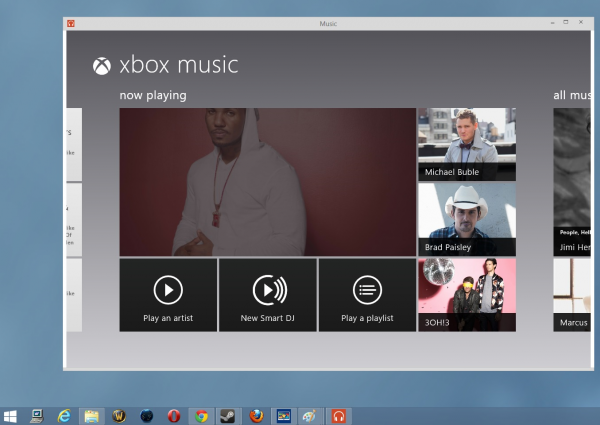
Windows apps that you run on Windows 8 are limited to the Start screen environment by default. Here you can run them in full screen, or attached to a side of the screen so that they use 1/3 or 2/3 of the screen. What you cannot do is run them in windowed mode on the desktop.
Attempts have been made in the past to bring that extra functionality to Windows 8 in the form of third-party applications. One of them, RetroUI Pro does so, but the implementation is fairly limited.
Stardock’s ModernMix for Windows 8 is the first program — to my knowledge — that makes Windows apps as usable as desktop programs that run on the system. The application has been designed so that you can run one or multiple Windows apps that you have downloaded and installed from the built-in store on the desktop just like any other program you may have installed on the system — side-by-side with desktop programs or other apps.
Even better is the fact that it does so in an unobtrusive way. Once you have installed the program on your system you are presented with an options menu where you can select how apps should be opened on the system.
You can modify settings for apps that you launch from the Start screen, and settings for apps that you launch from the desktop. This works in sync with Start menu programs that you may have installed already on your system, which is probably the easiest way to run apps from the desktop.
Your options are to launch apps in full screen like before, in full screen but with window controls, or in windowed mode on the desktop. The latter enables you to manage the app windows like any other program window that is currently open on the desktop. You can resize the window, minimize it to the taskbar or close it easily using the window controls that you used to work with in previous versions of Windows.
The applications retain all of their functionality when you run them on the desktop. You will notice that many become better to work with when you do so. The mail application, for instance, benefits from this greatly. You can now easily copy and paste multiple items into mails, fire up a browser without losing focus of the mail window, or watch a video on YouTube while you are composing an email.
All apps that you launch that way on the desktop get their icon on the taskbar so that you can easily switch between them. App switching was never that easy on Windows 8 before.
The developers have integrated a shortcut — F10 — in to the program that you can use to switch between app states easily. A tap on F10 switches between windowed mode and full screen mode. If you prefer to use the mouse, you can alternatively use the controls at the top right of every full-screen app window to do so. Both options can be disabled in the settings if you prefer so.
The program has one small issue that I encountered during tests. If you try to add an attachment to an email, you are taken to a full screen file browser regardless of app state. That’s not a big issue but I thought I mention it anyway.
If you’d ask me an hour ago which program I’d consider essential for Windows 8, I’d replied with the name of a start menu application for that operating system. This has changed with the release of ModernMix. The program improves the Windows 8 experience significantly by making apps as usable on the desktop as standard desktop programs.
Stardock’s ModernMix is available as a 30 day free trial version. The full program is available as of now for $4.99. It is only compatible with Windows 8 and Windows 8 Pro, but not Windows RT.
-
Interxion Uses Sea Water to Cool Stockholm Data Centers

A cold aisle containment in an Interxion data center, viewed from above. (Photo: Interxion)
European data center provider Interxion is no stranger to innovation. Over the years, the company has been a pioneer in modular design and cold aisle containment, and is now using seawater to cool a Stockholm data center, generating some serious efficiency benefits. Energy costs have been reduced by 80 percent, the company said, slashing enough IT load to allow additional customers to colocate in the facility.
Interxion says the Power usage Effectiveness (PUE) for its Stockholm facility has dropped to 1.09, making it one of the most efficient data centers in Europe. The type of efficiency Interxion is experiencing in Stockholm is most commonly associated with facilities using air economization (free cooling) to leverage the cool environment in cool servers.
“We don’t use outside air. We use chilled water, and we achieve 1.2 from this,” said Lex Coors, VP data center technology for Interxion. “With the sea water we can achieve a PUE of 1.1 because we do not have to cool it over time. With sea water, you can take it in and push it out easily.”
Mother Nature as Your Chiller
Seawater cooling systems pump deep, cold seawater through a data center’s HVAC system. As a result, the air circulating within a facility is cooled, which has the effect of lowering the inside temperature. Although the mechanics of this process are similar to chiller systems, seawater cooling completely eliminates the need to cool water down, which requires high levels of energy.
Interxion’s seawater cooling system is particularly notable because it runs water through multiple data centers multiple times, instead of the conventional strategy to run water through just one facility. This method also reduces operational and environmental costs, as it requires half the amount of water to cool each of the data centers. Interxion also doubles the use of seawater by reusing the warm water to heat local offices and residential buildings before returning it to the sea.
There are a number of techniques to tap external sources of cold water, effectively using Mother Earth as your chiller. But some work better than others, Coors said. He noted the challenges of using deep lake cooling systems versus seawater and aquifers.
“With deep lake and aquifers there is basically a push back on using water,” said Coors. “People are so afraid of legionella that they don’t use water power. We have to look for alternatives. There’s drilling into the ground, but that’s not allowed often. We can use sea water and salt aquifers.”
Coors mentions there are advantages to working in Europe. “In Europe, we do not have to focus on the smart grid pipes, because basically if you are connected to a power grid in Europe, you’re connected to the national and international grid,” he said. “It’s a matter of paying a little bit more and telling them ‘I want this kind of green power.”
So will seawater cooling, and its benefits, become a trend in the US? “Depending on the area, it should be a design trend,” said Coors. “It really helps with the environment. If you have to run a pipe a mile, it’s still very beneficial. The Gulf is a bit hot, but in California there are enough opportunities.”
A Track Record of Innovation
Interxion has a history of innovating; in addition to seawater cooling, the company has been pioneers in phased design and cold aisle containment. The company has been practicing phased construction in its data centers since 1999, a time when most data centers were being built as “barns” with large open floor plans being built in their entirety.
“We had to build data centers in 11 countries and only had a limited amount of capital available,” said Coors. “I can from a ship company and took that idea of shipping containers back to the data centers. I didn’t want to build a bunch of data centers I’d have to upgrade in three to four ears. I did not install the whole infrastructure, nor did I build out the whole data center. Instead, we chopped the building into 4 phases of 10,000 square feet and installed infrastructure to support a limited capacity and over time, adding additional infrastructure to not interrupt operation.”


