Category: News

  • Reuters – Nasdaq, SharesPost to Set Up Exchange for Unlisted Stock

    Nasdaq OMX Group Inc. said it will form a marketplace for trading in shares in unlisted companies in a joint venture with SharesPost Inc, whose private trading platform has run into regulatory trouble, Reuters reported. The stock exchange operator will own a majority of the venture, Nasdaq Private Market. Specific terms were not disclosed. The new market, to be based in San Francisco, will launch later this year, pending regulatory approvals, and will be led by SharesPost founder Greg Brogger. SharesPost’s online trading platform, which matched buyers and sellers of unlisted shares, was charged by the Securities and Exchange Commission last March for failing to register as a broker-dealer before offering securities.

    (Reuters) – Nasdaq OMX Group Inc said it will form a marketplace for trading in shares in unlisted companies in a joint venture with SharesPost Inc, whose private trading platform has run into regulatory trouble.

    The stock exchange operator will own a majority of the venture, Nasdaq Private Market. Specific terms were not disclosed.

    The new market, to be based in San Francisco, will launch later this year, pending regulatory approvals, and will be led by SharesPost founder Greg Brogger.

    SharesPost’s online trading platform, which matched buyers and sellers of unlisted shares, was charged by the Securities and Exchange Commission last March for failing to register as a broker-dealer before offering securities.

    SharesPost’s broker dealer and investment advisory business will continue to operate separately from the joint venture, the companies said in a statement.

    SharesPost began in 2009 and its fortunes rose in step with technology startups such as Facebook Inc and LinkedIn , which traded on the market before they went public.

    Recent legislation, the Jumpstart Our Business Startups Act, has boosted opportunities for trading of unlisted companies. Under the act, an unlisted company can have 2,000 shareholders, up from 500.

    The post Reuters – Nasdaq, SharesPost to Set Up Exchange for Unlisted Stock appeared first on peHUB.

  • Never Enough Alfa: Petrolicious

    Alfa Romeo

    In certain ways cars are like cigarettes. They’re addictive, enjoyable and at days end everyone has their favorite brand. Manuel Leon Minassian is an Alfa Romeo nut, so much so that he’s not actually sure how many he owns. Collecting for almost 22 years, Manuel has mostly Alfa’s with a few Mercedes, Audi’s and Ford’s mixed in for good measure. His favorite though? His 1972 Alfa Romeo Berlina that he custom tailored to his taste.

    Source: Petrolicious.com

  • Peterson Partners Raises $140M

    Peterson Partners has raised $140 million for its eighth fund, the firm announced. The Salt Lake City, Utah, private equity firm makes investments of between $2 million and $15 million in companies, and has backed companies including JetBlue Airways and Azul Airlines.

    PRESS RELEASE
    Peterson Partners today announced that it has raised its eighth fund, in the
    amount of $140 million, with participation from prominent U.S. business and
    investment leaders.

    “This new fund enables us to continue to serve as reliable capital partners to
    our current and future portfolio companies,” said Dan Peterson, managing partner
    of Peterson Partners. “We look forward to continuing to help outstanding
    entrepreneurs build great businesses in the years ahead. We are gratified that
    our limited partners have trusted us to find and nurture the kinds of leaders
    and companies that have provided thousands of jobs at home and abroad.”

    The current Peterson Partners portfolio includes an extensive collection of
    innovative, high-value companies across various industries, including JetBlue
    Airways and Azul Airlines in the travel industry, Ladder Capital in financial
    services, QMC in communications infrastructure, CLEO in software, Integra in
    healthcare services, and Packsize in the supply chain management industry.

    Peterson Partners is led by Founder Joel Peterson, and Partners Brandon Cope and
    Dan Peterson. Joel Peterson, former managing partner at Trammell Crow Company,
    currently serves as chairman of JetBlue Airways, is a professor at Stanford`s
    Graduate School of Business, and sits on the Board of Overseers at the Hoover
    Institution. Dan Peterson, with deep experience investing in a variety of
    industries, including automotive, financial services and high tech, has served
    as managing director at Z Capital and partner at Trammell Crow. Brandon Cope,
    previously with Peterson Ventures and McKinsey & Company, has led several
    investments in a variety of industries and serves on a number of boards of
    directors.

    Peterson Partners will use the proceeds of its Fund VII to make private equity
    investments of between $2 million and $15 million. The firm provides growth and
    buyout capital for companies with revenue between $10 million and $50 million.

    About Peterson Partners
    Peterson Partners, based in Salt Lake City, Utah, is one of the Intermountain
    West`s most successful private equity firms. Specializing in small to mid-sized
    companies, Peterson Partners has a track record of successful investments
    including JetBlue, Vivint, EnergySolutions, 3form, Access CIG and Diamond
    Rental. Founded in 1995, Peterson Partners has managed over $350 million in
    committed capital through seven funds.

    The post Peterson Partners Raises $140M appeared first on peHUB.

  • Samsung To Continue Its Innovation Push With Head Tracking Auto-Scroll On The GSIV

    gs4ssmartscroll

    If these leaked screenshots are the real deal, the upcoming Samsung Galaxy S IV will feature a rather innovative way to scroll. Called “Smart scroll” the phone can apparently scroll based on a user’s head angle. This will work in browsers and emails. Novelty? Probably. Innovation? Absolutely.

    Auto-tracking is the next frontier in user interaction. Intelligent eye-tracking would result in a revolutionary paradigm shift. Contrary to earlier rumors, Samsung’s Smart scroll doesn’t seem to track eye movement, but the leaked screenshots seem to indicate a similar result.

    Sammobile notes that these screenshots were taken from a leaked Android 4.2.1 build intended for the Galaxy S III but insists the Galaxy S IV will have the features as well.

    There’s no word on how this interaction takes place. Chances are it uses the front-facing camera in some way rather than including new tracking hardware. But, if true, Samsung is again pushing forward the smartphone.

    Samsung is now a global leader in smartphones. It’s not following anymore. The company is charging forward ahead of other vendors and innovation is leading the way. The Galaxy S III is loaded with clever features not found in other smartphones: Direct Call, S Beam, Pop up play.

    Apple won the early smartphone wars thanks to similar clever functions. Apple’s innovation turned to iteration. But not at Samsung. And consumers are reacting in kind, making Samsung the largest smartphone vendor.

    It’s likely that the next Galaxy S will feature other novel functions along with head tracking. All secrets will be revealed on March 16th when Samsung unveils it at a massive NYC event.

  • Let’s Save Great Ideas from the Ideas Industry

    What was your favorite TED talk this year? I found both Amanda Palmer’s and Nilofer’s spectacular. Yet, this year, TED made me wonder about Great Ideas, and our relationship with them. And I began to ask myself: even if we enjoy a great TED talk, should the rise of “TED thinking” concern us just a tiny bit?

    Let me be very clear: I use that phrase not to refer to the extravaganza that is TED, and though I use TED as an example, this post isn’t really just about TED — but let the phrase “TED thinking” serve as a shorthand for the way we’ve come to think about ideas and how we share them, whether it’s through an 18-minute talk, an 800-word blog post, or the latest business “best-seller.” Hence, this post isn’t really about TED (so please don’t leave me raging comments saying “But my favorite TED talk!!!”). “TED thinking” is just a symptom: and the underlying syndrome is our broken relationship with Great Ideas. Herewith, my tiny argument:

    TED thinking assumes complex social problems are essentially engineering challenges, and that short nuggets of Technology, Edutainment, and Design can fix everything, fast and cheap. TED thinking’s got a hard determinism to it; a kind of technological hyperrationalism. It ignores institutions and society almost completely. We’ve come to look at these quick, easy “solutions” as the very point of “ideas worth spreading.”

    But this seems to me to miss the point and power of ideas entirely. Einstein’s great equation is not a “solution”; it is a theory — whose explanations unravel only greater mysteries and questions. It offers no immediate easy, quick “application” in the “real world,” but challenges us to reimagine what the “real world” is; it is a Great Idea because it offers us something bigger, more lasting, and more vital than a painless, disposable “solution.”

    Yet in the eyes of TED thinking, it is of limited, perhaps little, value. One can imagine Einstein being invited to give a TED talk on E=MC2 — and the audience wondering “Well, what’s the point of this? What can we use it to do? How can we make megabucks from this, next year?” When ideas are reduced to engineering challenges, the focus naturally becomes near-term utility in the so-called real world. We focus on implementation without ever stopping to question our assumptions. But Great Ideas don’t resound because they have “utility” in the real world — they are Great for the very reason that they challenge us to redefine the reality of our worlds; and hence, the “utility” of our lives.

    So Great Ideas aren’t just “solutions”. Indeed, many of the Greatest Ideas are problems. Guernica doesn’t offer any solutions to the problem of human suffering: it asks us to do something more vital, and more worthy: to reflect on, consider, and perhaps so gain a truer intimacy with the problem of war, violence, atrocity, and its permanence throughout history. Picasso would never have been invited to deliver a TED talk about Guernica because it offers no quick, easy, palatable solution (“Human Violence: Let’s End It!!” #fivewordTEDtalks). Instead, it offers the precise opposite: a hard, unflinching, uncompromising portrait of grief. TED talks get rapturous standing ovations — but stand in front of Guernica for 18 minutes and exactly the opposite will happen: you will, and should, cry.

    Great Ideas, then, don’t merely easily please us with their immediate utility — often, they break our hearts with desperate futility; with both the aching impossibility and sure inevitability of the trials and tests of human life. But that’s precisely what makes them Great.

    Now: Yes, there was recently a TEDx in Pakistan — and there, beset by fundamentalism and violence, I believe it’s a tremendous force for good. But that’s the lowest of bars. You and I must aim higher.

    The idea of our age is that Great Ideas can be simplified, reduced, made into convenient, disposable nuggets of infotainment — be they 18-minute talks, 800-word blog posts, or 140 character bursts. But can they — really? Could Aristotle really deliver the resounding, history-redefining message of the Nicomachean Ethics in…eighteen minutes? Or a series of “thought leader” blog posts on LinkedIn? Or would that, in a very real sense, cheat you and I of the power and purpose, the meaning and message, the very import and impact of the larger body of work?

    Imagine I invented an Orgasm Machine. Press the button, and poof!! Effortless, instantaneous climax. Sounds great, right? But my machine would also rob you. Perhaps not of pleasure; but of the tension of love, the challenge of desire, and the drama of sex. TED is like an Orgasm Machine for the human mind. It gives us the climax of epiphany, without the challenge and tension of thought.

    And in that way, I think TED thinking cheats us. Not just the “audience,” but all of us. By putting climactic epiphany before experience, education, and elevation. Sure, we can spend our lives, in this digital age, getting quick hits of epiphany from our pundit overlords. In that sense, TED thinking is like a one-night stand with ideas. One night stands can be fun, and may sometimes even lead to something more — but they’re not the great, worthy love affairs that change our lives. So I worry: TED thinking encourages something like an obsession with trivia — when it’s the searing, painful, transformative experience of Big Love you and I should be aiming at.

    The TED-ification of ideas turns them into something like superficial commodities. Yet, Big Love is never just skin-deep: it involves mind, heart, body, and soul. And so while “turning complex ideas into plain English” is surely important, critical thinking asks all of us to get not just comfortable with “communication”, but uncomfortable with all the complexity, ambiguity, and nuance of a great relationship.

    “Ideas conferences” like TED present us with something like an ethical vacuum. There are no sources of evil in TED world — apart from a “lack.” Insufficient Technology, Edutainment, and Design (or “innovation”, “growth”, “insights”): these are the only shortcomings the human world faces. There is no venality; no selfishness; no cruelty; no human weakness that is not readily amenable to the cure-all of Perfect Technology, Edutainment, and Design.

    Hence, in TED world, there are heroes, but no villains. There are self-reliant supermen; but no rent-seekers, no criminals, no charlatans, no mountebanks, no fraudsters, schemers, or…just plain humans. There is good, but no evil. No ethics is possible given this calculus. It is an anti-ethics that perfectly describes the vacuity of our age. In this sense, TED thinking is a kind of Nietzschean enterprise: one beyond good and evil, where Supermen save the world. Yet, the real world asks us to have an ethical calculus precisely because the human heart is capable of great cruelty; of evil, of indescribable atrocity.

    To me, this is the greatest and truest failure of today’s idea industry: it is a mind without a heart. TED thinking cheats us of the better angels of our nature; of ethos itself, the highest, truest, and noblest of all the arts of human thought.

    Great ideas, then, demand something from us — something more than pleasure. They demand more than just our “attention” — and far more than our standing ovations. They demand not just our eyes, wallets, and hands, but our hearts, minds, and souls. They demand our heartbreak, our hurt. They demand our minds don’t just “accept” — but, as critical thinkers, object, protest, question.

    In this way, Great Ideas demand precisely the opposite of TED thinking. They demand our lasting engagement, dedication and commitment; our time and energy; our frustration and infuriation; our suffering, passion, and pain — not merely our easy wonder and wide-eyed astonishment. They demand not just our rapture, but something more human: every bit of our fuller, truer, better selves.

    That is precisely how Great Ideas change us: not merely by pleasing us, but by challenging us. That is precisely how they elevate us: not merely by pandering to us, or by provoking us, but by enlightening the whole of us. That is precisely what makes Great Ideas truly worthy — not just easily palatable, and commercially profitable.

    Let me be clear: once again, this isn’t just about TED — but the ideas industry, and how, ironically, it oft seems hell-bent on turning each and every human on planet Earth into either a breathless “pundit” or a zombified “consumer”. But we are better — each and every one of us — than that. We are pilgrims on a hard journey; searching for the timeless, simple truths of lives well-lived. The pundits shout to our caravans from the bazaars, touting their potions and tonics. But it is only Great Ideas, waystones shimmering faintly in the distance, which have pointed and will point generations of voyagers before us and after us, that will guide us towards the waters of life itself. That is why they matter.

    “TED thinking” is shorthand for the ideas industry’s obsessive, infantilizing, and creepily weird fixation with “innovation”, with “growth”, with “change”, with “value”, “utility”, and “marketability.” It is the epiphany industry. But epiphany should never be an industry. Why? Not just because such a casual approach to human thought reduces and simplifies, stripping and emptying us. But because it promises to spoil the timeless beauty of The Real Thing: The very idea of Great Ideas. The notion that ideas are worthy not merely because they “solve our problems” — but because they challenge us with problems to which our lives are the truest answers.

  • Google Joins Board of Directors at NFC Forum

    NFC-logo-forum

    The Near Field Communications Forum (NFCF) was established in 2004 as a non-profit industry body designed to encourage advancements in NFC technologies. We have seen this technology slowly making its way into mainstream smartphones from all major manufactures (except Apple) over the past few years.

    Google joined the NFCF in March 2011 as a “principal” member, and has not advanced up the board structure…until now. Google has upgraded its status on the Forum to “top-tier sponsor level“. This basically means that Google now has a say in the running of the consortium. Google has a vested interest in advancing NFC technology. After all, their Wallet app for Android would be useless without it. Google Wallet allows consumers to tap their phone to an NFC enabled reader and wirelessly transfer funds straight to the vendor, making transactions quick and painless (on select handsets).

    Google joins the likes of big players like Broadcom, Intel, MasterCard, Visa, Sony, Qualcomm, and Samsung at the sponsor level. (Next scheduled consortium will be held in Seoul, Korea, 18-22 March 2013).

    Source: The Next Web

    Come comment on this article: Google Joins Board of Directors at NFC Forum

  • Chrysler Workers Deliberately Sabotage Ram Production – Quality Issues?

    In what could be the most surprising news of the year, it seems Chrysler-Fiat employees are deliberately sabotaging production on the 2013 Ram 1500 pickup over “poor morale.”

    Chrysler Workers Deliberately Sabotage Ram Production

    Warren Truck Assembly workers have reportedly sabotaged the 2013 Ram 1500 production to spite management over shift schedule changes.

    Sadly, this story is true and, probably the most shocking aspect of it is, the UAW isn’t involved. It seems the Warren Truck Assembly plant recently switched the employees shift schedules around according to Autoblog.com. The new shift plan calls for four, 10-hour days for workers with some working evenings and weekends. The workers apparently weren’t happy with this “flexible” work schedule and decided to protest without UAW support.

    As part of their protest, they decided to intentionally sabotage the Ram 1500 production. The Detroit News said, “only 16 of the 58 trucks built at the Warren Truck Assembly Plant during the model’s first hour passed final inspection. While quality eventually improved over the course of the day, just over half of the units built on Thursday were approved for shipment. Even with workers ordered to stay late to fix their mistakes, some 1,078 units remained outside the facility with defects.”

    What makes this even more shocking is that the UAW supports Chrysler and thinks the new schedule could actually create more jobs.

    The UAW told the Detroit News:

    “The international union, including myself and staff from the UAW-Chrysler Department, met with workers from Chrysler’s Warren Stamping Plant at a town hall meeting recently to explain (the alternative work schedule) first approved by UAW Chrysler members in 2003,” said Holiefield, head of the union’s Chrysler Department, in an email to The Detroit News on Wednesday.

    “The Flexible Operating Pattern has been effective at several other plants and has created thousands of jobs in communities surrounding these plants,” he added. “(I)t’s proven to be successful, allowing the company to operate at maximum capacity to meet customer demand, and in the process, creating jobs, and in general, employees understand the reasons for the schedule.”

    Chrysler spokeswoman Jodi Tinson said that Chrysler is “aware of their complaints, and we understand that change is difficult.”

    Apparently, the protests pissed Chrysler off and they have recently suspended without pay one of the protesters.

    Seems like if the workers REALLY understood the plan, they wouldn’t intentionally sabotage the Ram truck production. But, hey what do we know.

    Are things so bad for Chrysler-Fiat that their own workers don’t even like them? And what is up with Chrysler workers being in the news? Remember not that long ago an arbitor gave the Chrysler employees that smoked pot and drank on their lunch break their jobs back.

    This news comes at a bad time for Chrysler-Fiat as they try to shake decades worth of quality issues, drum up business with their new Ram 1500 and are trying to convince new buyers that diesel in the way to go (see: Jeep Grand Cherokee diesel, Ram 1500 diesel and just announced Jeep Wrangler diesel).

    Our fearless leader Jason has the following insight: Toyota has a much better relationship with workers, lower labor costs, and Toyota workers would NEVER, ever, ever, EVER dream of turning out a defective truck to send a message to management. Every 2013 Ram-Fiat buyer had better ask for a big discount, as they could be buying a lemon. What’s more, Ford and GM are going to face similar problems once the moratorium on UAW strikes is over.

    Initially, I planned on going on a rant about Chrysler quality and leadership issues. However, I think this story speaks for itself. Sound off your thoughts below.

    Related Posts:

    Search terms people used to find this page:

    • chrysler warren truck assembly plant
    • chrysler workers being suspended
    • time to build a ram truck
    • ram truck production problems
    • chrysler workers protest work schedule
    • ram truck backlog at warren
    • ram truck backlog
    • ram sabotage
    • warren truck assembly plant alternate work schedule shift hours
    • new shift schedules at chrysler

    The post Chrysler Workers Deliberately Sabotage Ram Production – Quality Issues? appeared first on Tundra Headquarters Blog.

  • Microsoft fined $731m after a ‘technical error’ led to it breaking its EU antitrust promise

    Wow. You don’t mess with the EU antitrust regulators. This is something Microsoft has discovered to its cost after being landed with a 561 million euros ($731 million) fine for failing to promote a range of other browsers to Windows users in the European Union (EU).

    As part of a settlement that followed an EU antitrust investigation back in 2009, Microsoft agreed to offer a Browser Choice Screen pop-up to European customers which would allow them to choose which browser they wanted to use — rather than simply just forcing Internet Explorer on them. This followed an investigation triggered when Norwegian browser maker Opera complained that by bundling IE with Windows Microsoft was effectively killing the competition.

    The screen, which first appeared in March 2010, provided logos and links for Firefox, Maxthon, Opera, Chrome, and Internet Explorer (presented in a random order). It was supposed to run until at least 2014, but the Windows 7 Service Pack 1 release in February 2011 removed the feature. It has since been reinstated, 14 months later, but that’s not good enough for the EU watchdog.

    “Legally binding commitments reached in antitrust decisions play a very important role in our enforcement policy because they allow for rapid solutions to competition problems,” Joaquin Almunia, the Competition Commissioner said. “Of course, such decisions require strict compliance. A failure to comply is a very serious infringement that must be sanctioned accordingly”.

    As huge as the fine is, it could have been much, much worse for Microsoft. The EU antitrust regulators could theoretically have fined the Redmond, Wash.-based technology giant up to 10 percent of its global annual revenue. Which would have amounted to a staggering $7.4bn.

    Of course the watchdog would never have actually done that — it’s not in anyone’s interests to level that degree of fine on a major corporation — but it’s sobering to know the EU regulators actually have that degree of power.

    The $731m figure was arrived at because Microsoft fully co-operated with the watchdog at every stage of the second investigation set up to determine what had happened.

    “I hope this will make companies think twice before they ever think of breaching their international obligations,” commissioner Almunia said in a statement. Or rather an understatement.

    While Microsoft blames a “technical error” on the reason for the Browser Choice screen’s disappearance, it’s the fact that it remained MIA for 14 months that was the company’s ultimate undoing.

    In a statement released this morning, Microsoft said: “We take full responsibility for the technical error that caused this problem and have apologized for it. We provided the Commission with a complete and candid assessment of the situation, and we have taken steps to strengthen our software development and other processes to help avoid this mistake — or anything similar — in the future”.

    Photo Credit: zimmytws/Shutterstock

  • Apple reportedly held talks with Beats over streaming music partnership

    Apple Beats Streaming Music Service
    Apple’s (AAPL) has reportedly had difficulties negotiating with major music labels over royalties tied to a streaming music service currently in development. One option the company seemingly explored in its efforts to bring a new service to market was a cooperative effort with Beats Electronics. According to Reuters, Apple executives held talks with Beats boss Jimmy Iovine to discuss partnering on a subscription-based streaming music service. Beats recently announced its Project Daisy music subscription service, but did not provide many details so it may be possible that discussions are ongoing. According to the report, the meeting between Apple CEO Tim Cook and Iovine was “informational” and covered a wide range of topics.

  • Bloomfire nets $8M, adds features to its SaaS for sharing knowledge

    Bloomfire, a company based in Austin, Texas, has received $8 million in Series A funding from existing investors to continue to get enterprises to sign up for the Bloomfire’s web-based Software-as-a-Service (SaaS) for sharing internal videos, quick answers, files and other information among a given company’s employees.

    The new investment, from Austin Ventures and Redpoint Ventures, brings the total venture funding to $18 million. The company counts more than 200 companies as customers.

    Along with the funding news, Bloomfire is announcing new features for its SaaS product, including the ability for multiple users to produce a single item, such as a post, and drag-and-drop functionality to quickly add content from outside the site.

    The competitor question for Bloomfire, which identifies itself as a knowledge-sharing tool, is an interesting one. Because the site can do so many things, different kinds of companies can compete with different parts of the site, said the company’s CEO, Craig Malloy. Socialcast (see disclosure), Yammer and others let users maintain their own social pages and share information internally. With Jive Software, users can collaborate on products and projects and post updates. Quora-like companies for the enterprise, such as AnswerHub and Quandora, specialize in the internal Q-and-A component. And enterprises can share and store documents on Box, Dropbox and other sites.

    Malloy looks forward to seeing how all the various technologies shake out in the next couple of years. It could be, he said, that even more blending will occur, with companies pulling in web conferencing. In any case, it’s worth wondering if it’s wiser to support a long of technologies or go big on just one.

    Disclosure: SocialCast was backed by True Ventures, a venture capital firm that is an investor in the parent company of this blog, Giga Omni Media. Om Malik, founder of Giga Omni Media, is also a venture partner at True.

    Related research and analysis from GigaOM Pro:
    Subscriber content. Sign up for a free trial.

  • Call-in show: Why the “I’m leaving iPhone” trend?

    It’s another edition of the weekly call-in show where we answer your tech questions. We start off the show with some commentary on phone unlocking and then move on to listener questions about OTT services, Android switchers and Samsung’s influence on Android.

    To be a part of the show, just call in and leave a voicemail at 262-KCTOFEL. If you do, we’ll play back the question on the show and answer it. Or you can tweet me at @kevinctofel on Twitter. Each week, I’ll answer as many questions as I can while keeping the podcast to a manageable amount of time: 20 to 30 minutes at most.

    (download)

    Subscribe to RSS

    iTunes

    Stitcher Radio

    Show notes:
    Hosts: Chris Albrecht and Kevin C. Tofel

    • Why are a few big name iPhone users switching to Android; is the start of a trend?
    • What are your favorite over the top services?
    • Does the Pebble smart watch monitor distance, pace and heart rate while exercising?
    • Should Google be worried about Samsung’s dominance in the Android device market?

    SELECT PREVIOUS EPISODES:
    PlayStation snore? Google Pixel and Tesla earnings

    Podcast: Why the internet of things is cool and how Mobiplug is helping make it happen

    Podcast: Ballmer’s in the Dell, do tweets ruin TV? And how ISPs are not like gas pumps

    Podcast Q&A: MotoACTV smartwatch now or wait? Lumia 822 in India? Best running apps?

    Podcast: Kabam founder on scaling globally and designing for different platforms

    Podcast: RoadMap Re-Run: Kickstarter’s Perry Chen on creativity and crowdsourcing

    Podcast: The Sporkful’s Dan Pashman on web and food culture (and how bacon is over)

    Related research and analysis from GigaOM Pro:
    Subscriber content. Sign up for a free trial.

  • News Corp’s Education Tablet May Be The Bureaucratic Fit Schools Need To Adopt Tech

    3006632-poster-amplifytabletorangecase

    Public school systems are cheerfully decorated dictatorships: discipline, standards, and testing are the driving concepts of modern k-12 education. The very reason why districts purchase bundles of the same textbooks is so they can keep classrooms in lockstep alignment as teachers meticulous meet timely instructional goals. Amplify, NewsCorp’s new education division, finally revealed its long-awaited flagship product: a sophisticated tablet designed specifically for schools, which many finally be the perfect bureaucratic blend of classroom management, assessment, and monitoring that schools need to adopt technology en mass.

    But what in the sam hill is News Corp. doing messing around in education? Well, it’s true that Rupert Murdoch is one of the more well-known (and polarizing) figures in the media landscape; his reputation precedes him, and it’s not one that’s typically been associated with education reform. While the News Corp. founder’s sudden transformation into an education reform advocate may seem a head-scratcher, the motivation becomes clear when, in Murdoch’s terms, one considers that K-12 education is a $500 billion sector in the U.S. alone — and one that remains relatively untouched by corporations like News Corp.

    A little over two years ago, Murdoch set out leverage the News Corp. brand to help fix a public education system that, in his words, has “lower standards than American Idol,” hiring one of the more prominent figures in American education, former chancellor of New York schools, Joel Klein, to pursue opportunities in EdTech. With Klein as his new education guru, the pair quickly made their first big strategic move, acquiring New York-based software, assessment and data services startup, Wireless Generation, for a whopping $360 million.

    However, News Corp.’s plans for education were quickly derailed by the infamous phone-hacking scandal that forced Klein leave his position to lead the company’s internal investigation. After two years of investigations, trials and more, News Corp. rebranded its education unit last summer as “Amplify,” revealing some of the basic tenets that would shape its digital strategy, which include “assessment via mobile tools, curriculum design and the online distribution of resources via AT&T-powered tablets,” as Greg wrote at the time.

    Klein and company are convinced that, for public education reform to be successful, the private sector needs to get more involved — as does the role of technology in the classroom to help both teachers teach more effectively and help students learn. Amplify attempts to put those ideas into practice, by allowing the company to not only sell its curriculum on any tablet makes its way into schools, but by betting that schools will be willing to fork over a pretty penny to access blended learning tools (and an infrastructure to store learning data) all through a custom tablet.

    Of course, Ammplify isn’t the first to offer these types of learning tools on mobile devices, as many startups (and even bigs like Pearson) already have similar cross-platform, web-based tools on the market. However, no particular device or platform has emerged as the clear leader, and by offering classroom management tools and features that one would expect from News Corp, like a kill switch that allows teachers to limit students’ access to apps on the tablet, Amplify hopes to get a leg up.


    As to those features: Amplify’s Android-based 10″ tablet comes preloaded with all the basic learning software that teachers need to dole out information on any given subject: textbooks, multimedia lessons, Encyclopedia Britannica, and a graphing calculator. It even includes the widely popular Khan Academy suite of YouTube-based lectures, which were recently converted to an off-line textbook-style format.

    More importantly, Amplify’s tablet suite is a managerial dream: teachers can carefully monitor students behavior, administrators can deploy content across an entire grade-level, and districts can evaluate schools with custom standardized tests.

    Amplify gives teachers, as both disciplinarian and educator, impressive control. They can selectively enable or disable apps to direct student learning; distracted students get an “eyes on teacher” alert if their usage behavior indicates an inattentive mind. Impromptu polls and tests individually evaluates each student and gives them customized refreshers.

    The very cost-structure of the tablet system is designed for administration. Even with a two-year subscription at $99 per year, the wifi-enabled tablet is still a pricey $299 (a 4G version is $349 with a $179/year contract). But, it’s meant to be purchased by whole schools, districts or states, and comes with 24-hour live technical support to ensure students are meeting goals in a timely fashion. If schools could replace some of their textbooks and IT overhead, the cost appears less daunting. But, it’s still high.

    Just as important, Amplify has been built around the Common Core, a new national curriculum guideline emphasizing career and college readiness. Yet, since the federal government can’t set national standards, schools have been left to fend for themselves and develop their own tests. Amplify’s evaluation wing aims to ease the confusion and develop a reliable set of measures that can easily be distributed school-wide with the click of a button.

    During Greg’s interview with Amplify CEO Joel Klein at Techcrunch’s Disrupt San Francisco, he made it clear that all of the wonderful hardware in the world won’t make a difference unless it’s built for the schools and teachers. There’s already a crowded market of education technology, from classroom management software ClassDojo, to tablet software from textbook giants McGraw-Hill and Pearson.

    Successful players in the education space knew that schools need scale, structure, and support. When Google entered the market, they got buy-in from state-level officials and now have over 20 million users.

    Klein, knows that education is a game of Monopoly: provide a school everything and ye shall receive everything. The result, in this case, may be the push that the education system needs to enter the 21st century.

  • Verizon announces Jelly Bean update for Samsung Galaxy Stellar smartphone

    Samsung_Galaxy_Stellar_JB_Update


    If you own a Samsung Galaxy Stellar, you’re about to be in for some exciting news. Verizon has announced owners of the device are about to get an OTA notification indicating an extensive update is at hand. The update comes in at a hefty 400MB in size and not only brings items like network improvements, but it (finally) brings Jelly Bean (Android 4.1) and all the standard Jelly Bean goodies like Google Now and an improved UI. Naturally the update is being rolled out in phases, so if you own the device and don’t see it right away just sit tight— it’s on the way and will be there sooner than later.

    source: Verizon

    Come comment on this article: Verizon announces Jelly Bean update for Samsung Galaxy Stellar smartphone

  • Europe hits Microsoft with $730M fine over browser choice ‘error’

    This story was updated at 4.55am PT with a quote from Microsoft.

    Well whaddya know. When you’ve been the subject of a lengthy antitrust investigation and you settle with the authorities by promising to clean up your act, then “accidentally” go back to doing what you were doing in the first place and you get caught, you might find yourself in expensive trouble.

    That’s what happened with Microsoft and its bundling of Internet Explorer (IE) with Windows in Europe, and now we see the result: a €561 million ($732 million) fine, handed down on Wednesday by Competition Commissioner Joaquin Almunia.

    That’s a lot of money. What happened?

    Last decade, Opera complained to the European Commission about the fact that Microsoft bundled IE with Windows, to the detriment of third-party rivals such as Opera, Mozilla Firefox, Apple Safari and Google Chrome. The resulting antitrust case was dropped in 2009 when Microsoft promised to introduce a browser choice or “browser ballot” screen, so when users fire up a copy of Windows for the first time and open IE, it will ask them which of the various browsers on the market they’d like to go with.

    CEO Steve BallmerAs part of the deal, Microsoft agreed to submit an annual compliance report to the European Commission. For a couple years, everything went according to plan, right up until Microsoft’s December 2011 compliance report, which assured Almunia’s office that everything was hunky-dory. Only it wasn’t: the browser choice screen (BCS) had somehow been left out of Windows 7 Service Pack 1, which came out in February 2011, and Microsoft’s report was false.

    When the Commission found out in mid-2012 and opened a fresh investigation into Microsoft and its bundled browser, the company immediately confessed, blaming the BCS’s omission on a “technical error” that somehow went unnoticed for more than a year. Microsoft said it had pushed out the BCS software to the 15 million affected users as soon as it realized its error, but Almunia nonetheless put the company on notice that it could face a fine of up to 10 percent of its global annual turnover: around $7 billion.

    So it could have been much worse. Why not the full amount?

    According to Almunia, “such a breach is of course very serious, irrespective of when it was intentional or not, and it calls for sanctions”.

    However, he said on Wednesday that he set the figure at the level he did — around one percent of turnover — because “once the breach was discovered Microsoft cooperated with us and provided information which helped the investigation”.

    And that’s why this isn’t even a record for Microsoft in terms of EU antitrust fines.

    Incidentally, Microsoft says it won’t appeal this time round:

    “We take full responsibility for the technical error that caused this problem and have apologized for it. We provided the Commission with a complete and candid assessment of the situation, and we have taken steps to strengthen our software development and other processes to help avoid this mistake — or anything similar — in the future.”

    Could Microsoft be in a similar situation again?

    Tough question. The reason the European Commission came down so hard on Microsoft in the first place was that Windows was so utterly dominant in personal computing -– it really mattered if IE was bundled and the ordinary user may have been left unaware than rivals existed.

    Browser ballotWe can see the results for ourselves. Chrome is now the world’s leading web browser, ahead of IE and Firefox (which also benefited greatly from the decision). And if you play around with IE10, the most recent version, you will see an iteration of the browser that reflects Microsoft’s need to keep up with those rivals: the company was forced to be competitive, which is surely one of the key points of antitrust law.

    However, times change. While Windows still dominates the personal computing market by installed base, the PC sector – by which I mean the hardware, distinct from the concept of personal computing – is unarguably in decline as the world shifts to mobile. So, while in the 2000s Microsoft was the titan stomping all over OS X and Linux (by market share), today we find Windows 8 battling it out against iOS and Android across several hardware form factors.

    This matters because the core concept of competition law is what is known as “significant market power” – the European Commission felt it had to crack down on Microsoft because it had such power in the established personal computing market. Now it’s losing its grip on that power, and quickly.

    We are unlikely to see antitrust regulators crack down on Microsoft, or indeed Apple or Google, in the same way again – at least the way the market is shaping up now.

    Windows 8 is still an unknown quantity. Someone out there may want to complain that the iPad comes with Safari preinstalled and doesn’t prompt the user to install Chrome or Opera, but, while the iPad is the dominant tablet, it isn’t so dominant that it requires that kind of regulatory intervention. Also, the tablet market is in itself immature, so early regulation could be seen as distorting the market rather than protecting the consumer.

    Related research and analysis from GigaOM Pro:
    Subscriber content. Sign up for a free trial.

  • Clean, optimize and protect your PC with WinOptimizer 10

    Berlin software developer Ashampoo GmbH has released Ashampoo WinOptimizer 10.1.0, the latest version of its Windows system optimization tool. WinOptimizer 10, which provides one-click tools for privacy, cleaning and optimizing PCs, debuts four new modules, plus a brand new user interface.
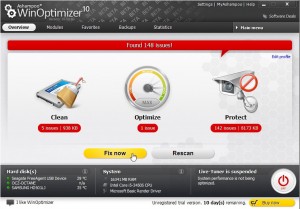
    The tool, which is available as a 10-day trial by default (users can extend this by a further 30 days by registering for a free key), also comes with four updates for existing modules, enhanced Windows 8 support and user-definable favorites.

    The most striking thing about WinOptimizer 10 is its brand new interface. The overtly blue appearance of version 9 is replaced by a steel grey look. The main screen provides a summary of the three key areas WinOptimizer addresses: cleaning, optimizing and protection. Users can then go for a one-click scan, with options for easily reviewing and “hiding” (ignore) individual issues, or letting Ashampoo fix the problems automatically.

    Alternatively, users can opt to optimize manually via the program’s Modules section. Four new modules have been added to version 10 to take the grand total to 32 — these are a duplicate file finder, obsolete shortcuts checker, fonts manager and System Restore manager, the latter allowing users to review and delete individual Restore points.

    In addition to these new modules, four existing tools have also been enhanced. The File Wiper adds an option for wiping free disk space to prevent recovery of previously deleted files, while the Internet Cleaner and Drive Cleaner promise faster performance. The Drive Cleaner — along with the Registry Optimizer module — has also been improved by providing more accurate detection rates for better results.

    While WinOptimizer 9 came with support for Windows 8, version 10 promises enhancements for users of Microsoft’s latest operating system. There’s a revised task scheduler, and Windows 8-tailored tweaks to go with compatibility improvements.

    Other user interface tweaks include redesigned overview and statistics pages for better clarity, and user-definable favorites. The Favorites screen has always displayed the most frequently accessed modules in WinOptimizer, but from version 10 users can now pin up to four of their favorite modules to this screen for permanent access: from the Modules page, roll the mouse over an individual tool and click the star icon that appears next to it to add (or subsequently) remove that module from the Favorites screen.

    Ashampoo WinOptimizer 10.1.0 is available now as a free trial download for PCs running Windows XP or later. The full version comes with a MSRP of $39.99, although upgrades and discounts are available for existing and trial users.

    Photo Credit: Amy Walters /Shutterstock

  • Treasuries threat to emerging markets

    Emerging market issuers have been busy this year, but investors aren’t getting much of a return, as rising Treasury yields steal their lunch.

    Joyce Chang, head of emerging markets research at JP Morgan, told the Emerging Market Traders’ Association yesterday that:

    Returns are lacklustre, barely breaking positive territory.

    This despite the fact that there has been $62 billion in emerging market issuance in the first two months of the year, compared with last year’s record totals of $333 billion.

    The problem is that improving U.S. growth prospects and expectations that the Federal Reserve will take the brake off the money-printing pedal have improved the investment and yield appeal of developed world assets.

    As Chang said:

    It seems the Ben Bernanke plan is working.

    Ten-year Treasury yields have risen as much as 40 basis points this year, breaching 2 percent last month. Emerging sovereign debt spreads have widened 30 bps in that time. High-yield issuers have been out in force as result, with emerging market high yield issuance of $26 billion this year already close to full-2012 levels, according to Chang.

    Unfortunately I couldn’t stay long at EMTA – sorry about the coughing fit, everyone – but Maarten-Jan Bakkum, emerging markets strategist at ING Investment Management, also said U.S. Treasuries were a worry. Emerging equities too have disappointed this year, with returns barely in the black.

    On a visit to the Reuters building yesterday, Bakkum, who is neutral on emerging markets, said:

     Rising U.S. yields are potentially a big problem for flows to emerging markets. They reflect the better growth environment and increase the chances that the Fed will take liquidity off the table. You can expect more nervousness in emerging markets.

  • Spoiler alert: Microsoft says that piracy is bad and dangerous for you!

    We all know the dangers of living on the darker side (or the wrong side) of the InterWebs — malware is waiting at every corner to ruin the “joy” that some may have by saving some money through pirated software. We know that. The real question is whether that is brainwashing caused by large software corporations or a real threat to our safety that people knowingly ignore?

    Microsoft, one of the most popular companies around when it comes to having its software pirated shortly after or even before a product is released, has commissioned a new study to inform consumers and businesses of the dangers involved in using pirated software. The study is conducted by IDC which has analyzed 270 websites, P2P (Peer-to-Peer) networks, 108 software downloads and 155 CDs or DVDs, and interviewed 268 IT managers or CIOs (Chief Information Officer) and 2,077 respondents (1,104 consumers and 973 businesses) from various locations around the globe.

    Those various locations around the globe involve some high-profile countries including Brazil, China, Germany, India, Mexico, Poland, Russia, Thailand, United Kingdom and United States.

    So what’s the damage? The study says that consumers will practically waste 1.5 billion hours and shell out $22 billion to identify, repair and recover from the side-effects of pirated software with malware onboard. The same study also says that enterprises around the globe pay $114 billion just to deal with the aftermath of a malware-induced cyberattack. It all sounds very scary so far.

    The chances of malware infection via pirated software are way less imposing than the sheer numbers mentioned above. Businesses are the most safe, with a three in ten chance of being infected, while consumers are the most likely to be affected with a one in three chance. The distinction is small between the two categories, but exists nonetheless.

    On the remaining businesses and consumers that are unaffected, IDC’s chief researcher John Gantz says: “Our research is unequivocal: Inherent dangers lurk for consumers and businesses that take a chance on counterfeit software. Some people choose counterfeit to save money, but this ‘ride-along’ malware ends up putting a financial and emotional strain on both the enterprise and casual computer users alike”.

    There are some numbers that back up Gantz’s statement. According to the study 64 percent of the consumer respondents know that pirated software involves security threats. In 45 percent of the cases the pirated software involved slowdowns of PCs and uninstalling of the software because of it. Data loss is of the greatest concern for 48 percent of respondents, while only 29 percent are most concerned with having their identity stolen.

    So where does all the malware come from? Well, 45 percent of the pirated software comes from the InterWebs. Not a big surprise, as you may have expected that. A significant part of the respective pirated software, 78 percent according to the study, comes from websites or P2P networks and sports spyware while a smaller part, 36 percent, comes with Trojans and adware.

    On the matter of software piracy and the dangers lurking behind it, Microsoft Cybercrime Center associate general counsel David Finn says: “The cybercrime reality is that counterfeiters are tampering with the software code and lacing it with malware. Some of this malware records a person’s every keystroke — allowing cybercriminals to steal a victim’s personal and financial information — or remotely switches on an infected computer’s microphone and video camera, giving cybercriminals eyes and ears in boardrooms and living rooms. The best way to secure yourself and your property from these malware threats when you buy a computer is to demand genuine software.”

    Photo Credit: Mila Atkovska/Shutterstock

  • Making an Impact may be new good

    If the pure pursuit of greed is no longer good in the post-crisis world, what defines the new “good”?

    That’s when you start to consider “Impact Investing”, a type of investment that pursues measurable social and environmental impacts alongside a financial return.  According to a report prepared for the Rockefeller Foundation, approximately 2,200 impact investments worth $4.4 billion were made in 2011.

    But those who may be ideally placed to pursue Impact Investing are still largely absent from the exercise — sovereign wealth funds from the Persian Gulf, according to a recent paper published by academics at the Fletcher School at Tufts University.

    Authors Asim Ali and Shatha Al-Aswad at Tufts’ Sovereign Wealth Fund Initiative argue that Persian Gulf states can deploy their SWFs in impact investing, via Islamic finance, to help develop their economies.

    Islamic finance, with its focus on moral and social objectives, and specifically Sovereign Wealth Funds, as long-term investors, are ideally positioned to pursue impact investing… to foster social impact and economic development in the broader economy.

    At a time when there has been much questioning of the values underpinning the conventional financial system, Islamic finance presents an alternative to traditional finance by offering both financial return, as well as a theoretical foundation for ethical investing, which, we argue, extends logically to investments that directly impact social and economic development.

    Governments’ role is key in promoting impact investing, the Rockefeller report says.

    Governments can encourage impact investing through appropriate investment rules, targeted co-investment, taxation, subsidies and procurement, as well as corporate legislation and capacity development that enable the efforts of investors, intermediaries and enterprises in this space.


  • Morning Advantage: 50% of People Don’t Feel Valued at Work

    A new American Psychological Association survey outlines this stat among many other findings about stress in the U.S. workforce. The total picture, as reported by Lauren Weber and Sue Shellenbarger in the Wall Street Journal, is concerning. Fifty-four percent of workers say they’re not paid enough for their efforts, and 61% say they don’t have sufficient opportunities to advance. These and other factors, including long workweeks and answering email at all hours of the night, contribute to one-third of U.S. workers reporting chronic stress.

    The biggest shifts from last year (the ASA’s survey is annual) are on the topics of work-life balance and gender. While the number of workers feeling chronic stress has actually decreased from 41% in 2012, fewer people reported feeling satisfied with how their jobs mesh with the rest of their lives. And when it comes to gender, women and men respond to workplace stress differently, with women more likely to internalize stress — a “tend and befriend” response — while men are more prone to a “fight or flight” reaction. And women, more so than men, say their employer doesn’t appreciate their contributions.

    THIS MEANS WAR

    How Economics Can Help You Lose Weight (New York Times Magazine)

    Planet Money’s Adam Davidson wanted to get healthy. But like many people, he kept stumbling, largely because his brain was always able to find a third option that would derail his efforts. So instead of permanently changing his eating and exercise habits, he would buy a diet book or some protein bars. Companies that market these products, he found, base their businesses on this magical third option that often doesn’t work for the consumer. So he turned to a mutually-assured-destruction strategy, which explains how war combatants strengthen their position by limiting choices. Through NYU, he started a diet plan that had one option and one option only — an effective shake that’s only marketed to select clinics. So far he’s lost 60 pounds, and gleaned new insight into the shake-maker’s unique and profitable business model.

    A TALE OF TWO TIRE PLANTS

    It Was the Best of Factories, It Was the Worst of Factories (Reuters)

    The CEO of U.S.-based tire maker Titan International, Maurice Taylor, had considered buying a plant in northern France, but gave up on the idea and then proceeded to infuriate the French by complaining that the workers at the plant spent as much time talking as working. But, according to Reuters, he might have formed a different impression of France had he gone across the street and visited a Dunlop factory where unions have accepted tough labor conditions. Oddly, both plants are units of Goodyear Dunlop. France’s auto industry is struggling with shrinking European demand. — Andy O’Connell

    BONUS BITS:

    Labor Pains

    How Bad Credit Reports Keep People Unemployed (Huffington Post)
    Inside Major League Baseball’s Dominican Sweatshop System (Mother Jones)
    Corporate Profits Are Eating the Economy (The Atlantic)

  • Raspberry Pi’s Eye Landing In April, Call For Testers To Put Camera Through Its Paces

    raspberry pi camera

    The Raspberry Pi mini computer won’t be blind for much longer: a video camera unit shown off last month that will allow Pi owners to build video applications is expected to go on sale in April, according to the Pi Foundation’s Liz Upton.

    “We’ve sent the first camera boards to production, and we’re expecting to be able to start selling them some time in April,” she writes on the Foundation blog.

    In the meanwhile, in a Google Glass style contest (but without the extortionate $1,500 price-tag — an entirely free giveaway in fact), the Foundation has 10 camera boards to gift to testers who will put the Pi’s Eye through its paces.

    The boards will go to folk who “have a magnificent, imaginative, computationally interesting thing you’d like to do with a Raspberry Pi camera board”, as Upton puts it, to help the Foundation do “extra-hard testing”.

    She writes:

    The reason we’re giving these cameras away is that we want you to help us to do extra-hard testing. We want the people we send these boards to to do something computationally difficult and imaginative with them, so that the cameras are pushed hard in the sort of bonkers scheme that we’ve seen so many of you come up with here before with your Pis, and so that we can learn how they perform (and make adjustments if necessary)… We want you to try to get the camera doing something imaginative. Think about playing around with facial recognition; or hooking two of them up together and modging the images together to create some 3d output; or getting the camera to recognise when something enters the frame that shouldn’t be there and doing something to the image as a result. We are not looking for entries from people who just want to take pictures, however pretty they are. (Dave Akerman: we’ve got one bagged up for you anyway, because the stuff you’re taking pictures of is cool enough to earn an exemption here. Everybody else, see Dave’s latest Pi in Space here. He’s put it in a tiny TARDIS.)

    Pi owners hankering to have an eye to play with should email [email protected] and explain exactly what they want to do with the board, backing up their application with example of prior project work (with or without cameras) and GitHub code or the like, says Upton.

    The Foundation also needs your postal address should you win. The competition is open worldwide until March 12.