Category: News

  • Remotely access your PC with Splashtop 2 for Windows Phone 8

    Remote control apps are increasingly versatile, allowing smartphone and tablet users to access and manage computers from the workplace, a holiday resort or the couch in my case. For Windows Phone 8 users the most popular choice is PC Remote but, late-yesterday, another app hit the Store.

    “Many Windows Phone users have asked for Splashtop”, says Splashtop CEO Mark Lee. “We are excited to partner with Nokia and Microsoft to optimize and deliver the best-in-class Splashtop experience for Windows Phone 8”. The app allows folks to remotely access Linux, OS X and Windows-based computers straight from the tiled operating system. Let’s take a look at the features.

    With Splashtop 2 for Windows Phone 8 users can remotely access and edit files, open applications (and play games), watch videos, stream music, move the mouse cursor and control various functions of the operating system. For instance, accessing a Windows 8 PC gives users the ability to trigger the Charms and Start menus or switch between multiple monitors.

    The app, unlike PC Remote, automatically matches the resolution of the Windows Phone 8 device to the connected computer screens. That’s a tad annoying as the former is restricted to 1280 by 768 whereas even basic laptops come with larger resolution displays (like 1366 by 768, 1600 by 900 or 1920 by 1080).

    Splashtop 2 requires users to install a server application on computers (multiple ones can be controlled) and log in with a Splashtop account on each device. The latter makes the app easy to use in different scenarios, as folks no longer have to know and type in IP addresses and ports in order to enable a connection.

    Splashtop 2, “in coordination with Nokia and Microsoft”, is free for Windows Phone 8 users until August 31. There is no word on pricing afterwards.

    Splashtop 2 is available to download from the Windows Phone Store.

  • What Was Anonymity?

    In the name of science, 2,500 people have participated in Harvard’s Personal Genome Project, anonymously sharing DNA data along with such information as histories of depression and sexually transmitted disease. But Harvard Privacy Lab director Latanya Sweeney demonstrates what “anonymous” really means. Of 579 participants who listed their birth dates, ZIP codes, and genders, her team was able to identify 42% by name using public records. Previously she was able to identify up to 87% of the U.S. population with just ZIP code, birth date, and gender.

  • The Fairphone, World’s First Ethically Sourced Smartphone, Opens Pre-Sales To General Public

    Screen Shot 2013-05-24 at 8.12.51 AM

    Netherlands-based hardware initiative Fairphone began around three years ago as a project designed to highlight the use of conflict minerals in the construction of consumer electronics, and then evolved three years later into a full-fledged hardware startup, with the aim of turning its knowledge into action with the building of an ethically sourced, built and distributed smartphone. Now, it’s opening up pre-orders to the general public, beginning with customers in Europe.

    The Fairphone needs 5,000 pre-orders in order to begin production, and retails for a total of €325 ($436). That price included taxes, however and what you get for that is an unlocked, 4.3-inch smartphone running Android 4.2, powered by a quad core processor. It has an 8 megapixel rear camera, and a 1.3 megapixel front facing shooter, with dual-SIM trays for easy carrier switching and international travel.

    As a smartphone, the Fairphone seems capable enough, but it’s the manufacturing process that’s really core to the concept of the device. The phone itself is made using materials from a completely transparent supply chain – Fairphone is looking at the provenance of each mineral used to make each component, the people who build each part and the processes evolved and their social and ecological impact, and will make all of that information available to buyers and the general public. The idea is to flag stuff that’s being done poorly, highlight ways to make changes, in both the short and long term, and also build a collection of best practices that can be shared with the rest of the industry.

    Fairphone initially had opened sales only to the over 16,000 people who signed up to express interest when it initially announced the project, giving them first crack at the initial pre-order run. It seems like the percentage of those that were actually willing to put their money down on a device and contribute to the initial fund was much lower, however, which has prompted the expansion of sales to anyone in Europe who might want to contribute.

    The Fairphone is being transparent about the sales process, too; thus far, it has managed to sell 2,333 phones through pre-orders, with 20 days left in its campaign. Hopefully broadening the buyer pool will spark more interest, because the project stands to be able to shed a lot of light on what for many is a completely invisible or poorly understood process.

  • DOD Cloud Adoption Helps U.S. Troops Stay Connected

    army-webmail

    Soldiers at the Fort Stewart, Ga. Education Center work on class material and catch up on their e-mail. The adoption of the cloud by U.S. Department of Defense has helped soliders in the United States and deployed abroad to stay connected with their families. (Photo: U.S. Army)

    As the U.S. Department of Defense (DOD) adopts new types of globally distributed technologies, it is working to improve communications for servicemembers, both on the battlefield and with family at home.

    While those of us in the corporate world may take for granted the ability to clearly relay a message between multiple parties, communications in the military’s IT world can be critically important.

    The military’s shift in technology is happening at all levels and the DOD is fully embracing the new infrastructure push. Just two years after its inception, the Department of Defense Enterprise Email system has reached its one millionth user. This milestone means that the DOD Enterprise Email (DEE) is now one of the largest independent email systems in the world.

    “For the war fighters, using DEE means wherever they are, they can use their email, whenever they need it. It is not necessary to start a new email account when you move or deploy. It is as mobile as the servicemember,” said Air Force Lt. Gen. Ronnie Hawkins, Director of the Defense Information Systems Agency (DISA).

    With so many important users at any given time, the DOD and DISA are working to ensure optimal performance and maximum communication capabilities for U.S. troops. The landscape for the typical soldier or sailor has changed quite a bit. Just a few years ago, communicating with home meant a long wait and a short chat. Now, with better WAN connectivity and solid infrastructure, U.S. soldiers based all over the world can connect with friends and family via everyday connection means. This could mean that a soldier at Bagram Airbase can communicate with his or her loved ones via Skype, Facebook and even Gmail.

    These are truly common tools that civilians use every day. Now, because of the advancement in global distributed infrastructure designs, these same platforms can be used to bring home a little closer to the people defending the national interests abroad.

    Here’s a look at some of the behind the scenes infrastructure projects which are helping to bolster all cloud, Internet and WAN-based communications for the military.

    Data Center Consolidation

    The data center is changing to support more cloud, more data and a lot more users. The DOD quickly realized that it needed need to jump on this evolution bandwagon and update its data center infrastructure. With almost 1,200 data centers, there was a direct need to consolidate and deploy better, more efficient technologies. In fact, the same press release indicates that in using DEE, the DOD is doing just that.

    DEE saves millions of dollars for the department by leveraging the buying power of the entire department. Enterprise services reduce costs by consolidating system hardware requirements and maintenance, eliminating unnecessary and inefficient administration and resource allocation. That means the military services and defense organizations using enterprise services can save money in IT services to preserve more resources for their primary mission.

    Unified computing systems, converged infrastructures and intelligent hardware components are finding their way into the DOD’s data center environment. These high-density environments are capable of being locked down, diversified and given the opportunity to support numerous different services. These technologies are capable of virtualization and even logical segmentation of workloads. This means that administrators are able to granularly control how communications and data enter and leave their data centers.

    Improved Global Infrastructure

    Directly related to these consolidation and efficiency efforts has been the direct improvement within the global data center and communications infrastructure. What can be achieved now with intelligent switching technologies is truly amazing. One logical switch controller is able to deliver hundreds – even thousands – of virtual connections. These connections are able to be controlled and can cross-communicate when necessary. Virtual appliances can be deployed within various points in an environment creating a highly agile system. Software-defined networking has helped the DOD create more redundancy on a global scale. Furthermore, the increase in bandwidth and direct communication links has improved the type of information that can be passed point-to-point. Plus, the speed at which such data travels has greatly increased as well.

  • Google reportedly eyes $1 billion-plus Waze buy, but Facebook may be blocking bids

    Google Waze Acquisition
    Interest in social mapping and navigation provider Waze is reportedly heating up, with Google and several other “large tech companies” currently holding talks with the Israel-based company. Bloomberg on Friday reported that Google is considering a bid that exceeds Facebook’s earlier offer, which reportedly fell between $800 million and $1 billion. Earlier rumors suggested Facebook and Waze’s negotiations had stalled due to a disagreement over whether or not Waze’s Israeli research and development center would remain open. According to a follow-up from Israel-based newspaper Calcalist, which first broke the story that Facebook was in talks to acquire Waze, Google may face some trouble if it’s serious about a possible deal — Facebook and Waze have reportedly just signed an agreement that prevents Waze from negotiating with other companies for the time being.

  • Find Out if You’re a Scale-Up Entrepreneur with This Two-Minute Test

    Cool ideas for new businesses are a dime a dozen. That — plus all the new tech enablers such as instant websites and e-commerce platforms — makes it deceptively easy to start up a new venture. The bigger challenge is to start up a big venture that just happens to be small at first.

    Fortunately, real entrepreneurs are growth-obsessed: they cringe when you call them “small.” In fact, I don’t think you can call something entrepreneurship unless it is driven by big vision, big aspiration, and a burning desire and ability to grow — that is a key message in my new book, Worthless, Impossible and Stupid (due out in July). In the book, I tell the stories of scale-up entrepreneurs from around the world, and how they beat the odds to make a mark on their markets.

    Here’s a quick test to help you figure out whether you are cut out to be a scale-up entrepreneur. Just answer each question as honestly as you can, Agree or Disagree.

    1. Something inside compels me to make something that will impact the marketplace.
    2. I am great at selling things to people that they may not know they want, nor think they have the money to buy.
    3. I have people on my team who are better than me in several areas of knowledge or practice.
    4. My venture already has the procedures, policies, and processes in place to be ten times the size we are today.
    5. When I don’t know what my next step is, I have experienced people I can turn to for ideas.
    6. There is money out there to fuel a venture that is growing fast; I just have to find it when I am ready.
    7. When I achieve my objectives I keep raising the bar higher and higher.
    8. I am one of the best sales people I know.
    9. Think big; thinking small is a crime.
    10. I know entrepreneurs just like me who have grown big, fast.
    11. The sales process is just starting when the customer first says no.
    12. If my venture stands in one place too long, it runs the risk of perishing. We have to keep moving forward.
    13. I know how to find great people to hire.
    14. Nothing gives me a bigger rush than closing a big sale.
    15. It is more important to know of a big problem that customers have and then look for a solution, than it is to have a solution that is looking for important problems to solve.
    16. I used to think our great technology would take us to leadership in our market — now I realize it is our team, our organization, our marketing and our ambition to sell.
    17. Even though I am a startup, I think more like a market leader than a small business.
    18. (extra credit) If Isenberg were smart, he would make millions from this test and retire.

    If you scored 16 or more, the sky is the limit. Go for it.

    Why the emphasis on sales? I recently met the head of a startup accelerator who said that entrepreneurs should not be concerned about selling; they can always go out and hire a vice president of sales when they are market ready. Indeed, many would-be entrepreneurs who are drawn by the romantic vision of developing a snazzy new app or product pooh-pooh selling as beneath their dignity.

    I don’t think so. I learned a lasting lesson when I was in charge of the Japan market at Voltaire, the Israeli pioneer in the lab and field proven Infiniband open standard technology that makes super computers out of huge racks of commodity computers. Voltaire got the technology down pat but struggled with selling a product that enterprise customers were leery of. It was the CEO’s incredible persistence (and experience) in all aspects of selling — sales organization, compensation, pipeline management, and selling skills — that not only saved Voltaire from oblivion, but eventually propelled it to a NASDAQ IPO. Sale is a big part of scale.

    Why the emphasis on attitude? I have found that ambition, which seems to have become a dirty word in some cultures, is a continental divide between self-employment and entrepreneurship. Without it, you will always be a mom-and-pop operation. In Denmark, they call this the “BMW Syndrome” — make enough to buy my BMW, and I have made it. Nothing wrong with that, it just isn’t entrepreneurship. As Apax founder Sir Ronald Cohen puts it, “Your business will grow to the size of your vision .”

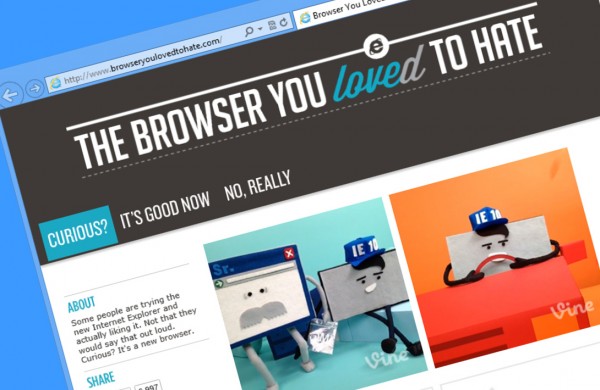
  • Internet Explorer Q&A: The ‘browser you loved to hate’ is making a comeback

    Internet Explorer’s tight integration into Windows 8, coupled with the fact that IE10 is actually pretty good, means the veteran browser is enjoying something of a resurgence these days. Humorous advertising poking fun at the browser’s past (while distancing itself from it) has also encouraged many ex-users to take a fresh look.

    I chatted with Internet Explorer’s Marketing Manager Rebecca Wolff about the “Browser you loved to hate” campaign, asked her what major changes we can expect to see in IE11, and found out why embracing web standards is now a major priority for Microsoft.

    BN: Has the “Browser you loved to hate” campaign changed public opinion of Internet Explorer?

    RW: We’ve seen some great feedback from the community on the campaign and our videos like “Do you know this guy?” and “Child of the 90s.” In a little over a year since we launched the campaign, we’ve had over 35 million total video views worldwide, so we know we’re reaching some new users and reconnecting with some old ones, hopefully piquing their interest about the entirely new Internet Explorer. IE has been posting some of its highest share numbers in years the past few months, so that’s pretty encouraging too.

    BN: Are there any areas where you know you can be doing better?

    RW: When it comes to the web, it can never be fast enough and safe enough, so even where we’re leading in performance like hardware accelerated graphics and malware protection with SmartScreen, we know we’ll just keep investing. We see touch performance as the new measuring stick for fast, so we hold the bar very high for what great touch performance for the real web means — pages that pan and zoom with buttery smoothness and a user experience that really embraces the great capabilities of new mobile touch devices like Surface.

    BN: Any major changes to look forward to IE11?

    RW: We don’t have any additional information on future versions of IE or Windows to share today, but suffice it to say it’s going to build on a lot of the great work we did with IE10. Of course, if you want just a little hint, there’s always this Vine

    BN: Do you have any idea of how the browser is being used in Windows 8 — by which I mean, what percentage are using the Modern UI version vs. desktop.

    RW: We’re getting great feedback from our customers on both experiences, and the immersive experience in the Windows 8 UI is getting particularly high marks from people for things like gaming, watching movies or reading web content. People also tell us how much they like multi-tasking with it — snapping a web page alongside another app, for example. We don’t typically provide percentage breakouts for usage, but our internal telemetry from millions of Windows 8 users through the opt-in customer experience program shows that tablet users spend the majority of their browsing time in the Windows 8 UI, which is great since we built the modern IE10 experience to be perfect for touch on a tablet.

    BN: What are the challenges of developing two versions of the same browser?

    RW: IE is one browser — one HTML5 engine, one JavaScript engine, one networking stack — with user experiences that are optimized for both the immersive, touch-first Windows 8 UI and the Windows desktop. We have a point of view that your experience of the web shouldn’t be compromised on modern touch devices. Getting the touch experience right, with great touch performance for the real web, with pages that pan and zoom, a really fluid feel and a user experience that fully respects the needs of new mobile touch devices; that’s a challenge. The team wrote a blog on that recently that’s worth a read since it talks about some of the things we did to make sure the touch experience was really great.

    BN: What kind of innovations will we see in future versions of Internet Explorer?

    RW: We don’t have any specific information on future versions of IE to share, but touch will continue to be a big area of focus for us. As more and more touch devices come to market, we want to keep raising the bar on responsiveness and the best ways to experience web browsing on modern, touch devices.

    BN: Will we get to see the Chrome and Windows 8 style login and sync feature added to IE?

    RW: Again, we can’t speak to any new features coming to future versions of IE just yet, but I think our customers are going to like what they see. We do currently sync your IE Favorites (or bookmarks), Pinned Sites, and browser history across Windows 8 PCs that are connected to your Microsoft Account.

    BN: Why can’t newer versions of IE run on Windows XP?

    RW: Starting with IE9, we started to really take advantage of both a modern OS like Windows 7 and modern PC hardware — tapping into things like the GPU with hardware acceleration. With both IE9 and IE10, we want to ensure users have the best possible experience, which means being on modern hardware with a modern OS — so that we can offer features like hardware accelerated HTML5.

    BN: Why the sudden interest in HTML5 and other assorted open web standards?

    RW: We know all too well about the issues of a single browser ecosystem and the barriers that creates for innovation. We don’t want to go down that road again and so we really started to change things up with IE9. That was a significant release for us in terms of showing our commitment to supporting web standards, and we continued that with IE10, which has a 60 percent increase in supported modern web standards. We’ve also doing more to help developers write cross-browser and cross-platform with tools and resources like modern.IE, and providing examples — including code samples — of what can be done on the web through experiences like the The Hunger Games Explorer and Contre Jour. This will continue to be a huge focus for us moving forward too.

    BN: Any features you admire in other browsers?

    RW: We’ve been pushing support for modern web standards and interoperability across all browsers for some time now. It’s great to see the continued development to these standards and the specs that come out from standards bodies like the W3C from the folks at Google, Mozilla, Apple and Opera. You may have seen this recently with the cross-platform pointer events work. With this common goal of having the same markup run across all browsers, web developers can spend less time worrying about coding to a particular browser and instead spend more time building great web sites and web experiences. I’d also give a shout out to Mozilla’s efforts around privacy and how there are trying to better protect users online with privacy protections in Firefox.

  • Steel Joins Ares Private Equity Group

    Ares Management said Friday that Charles Steel has joined the Ares Private Equity Group as a Managing Director and will be based in London. Steel previously worked at The Carlyle Group from 2001 to 2010 in European leveraged buyouts.

    PRESS RELEASE

    LOS ANGELES & LONDON–(BUSINESS WIRE)–Ares Management LLC announced today that Charles Steel has joined the Ares Private Equity Group as a Managing Director, based in London.

    “We are pleased to welcome Charles to Ares Management,” said David Kaplan and Bennett Rosenthal, Senior Partners of Ares and co-Heads of the firm’s global Private Equity activities. “Charles’ extensive experience investing across a range of transaction types in Europe will be of great value as we invest a portion of our latest $4.7 billion corporate opportunities fund outside of the United States.”
    “I am excited to be joining Ares Management at this time,” said Mr. Steel. “The firm has established significant resources across its five European offices and has demonstrated a multi-year track record in this region’s corporate credit marketplace. I look forward to working with my new colleagues to source and structure compelling private equity investments.”
    Charles Steel previously worked at The Carlyle Group from 2001 to 2010 in European leveraged buyouts, and played a leading role in a number of significant investments for the firm. Prior to that, Mr. Steel was a member of the Investment Banking Division of Goldman Sachs since 1998. Most recently, he served as an adviser to Tony Blair on Finance & Business Development at the Office of the Quartet Representative in Jerusalem. He holds a B.A. in History with Honors from Cambridge University.
    About Ares Management LLC
    Ares Management LLC is a global alternative asset manager and SEC registered investment adviser, which had approximately $59 billion of committed capital under management and approximately 560 employees as of March 31, 2013. Ares is headquartered in Los Angeles with professionals located across the United States, Europe and Asia and invests across the capital structure – from senior debt to common equity. Ares’ investment activities are managed by dedicated teams in its Capital Markets, Private Debt, Private Equity and Real Estate investment platforms. Ares Management was built upon the fundamental principle that each platform benefits from being part of the greater whole. This multi-asset class synergy provides its professionals with insights into industry trends, access to significant deal flow and the ability to assess relative value.
    For additional information, visit www.aresmgmt.com.
    About Ares Private Equity
    The Ares Private Equity Group manages approximately $9 billion of committed capital as of March 31, 2013 through five private equity funds: Ares Corporate Opportunities Fund, L.P. (2003), Ares Corporate Opportunities Fund II, L.P. (2006), Ares Corporate Opportunities Fund III, L.P. (2008), Ares Corporate Opportunities Fund IV, L.P. (2012) and Ares Corporate Opportunities Fund Asia, L.P. (2011). Unlike many traditional private equity funds that are principally focused on control buyouts and may be restricted by charter or a lack of experience, the Ares Private Equity Group pursues a range of creative transaction structures in an effort to maximize the risk/reward profile of our capital. The combination of our flexible capital approach with the broad resources of Ares Management widens our universe of potential investment opportunities and allows us not only to remain active, but highly selective in making investments in all market environments.

    The post Steel Joins Ares Private Equity Group appeared first on peHUB.

  • Invitation to provide feedback on UCL Museums and Public Engagement


    UCL Museums and Public Engagement (including the Grant Museum, Petrie Museum and Art Museum) are inviting your input to help them improve the ways in which they promote their museums and public engagement activities and communicate with their existing and potential audiences and visitors. Please note that you do not have to have visited any of the museums to take part. On completion of the survey you will be entered into a prize draw with £50 worth of vouchers of the winner’s choice as the prize. The deadline is 4 June.
    Complete the survey:
    http://bit.ly/132y26y

  • The GigaOM Show: Yahoo’s big moves, Xbox’s big One, HTC’s big problem

    Phew! Is this week over yet? Yahoo dominated the headlines with a $1.1 billion Tumblr purchase, a Flickr relaunch and a new New York office. But Microsoft made a doozy of an announcement with the unveiling of its new (and gigantic) Xbox One TV/game console. Given all this news, the departure of some high-level HTC execs was well timed for that company.

    This week’s GigaOM Show covers it all, and even features a guest appearance by AllThingsD‘s Peter Kafka.

    (Download this episode)

    The GigaOM Show podcast feed

    iTunes

    Stitcher Radio

    SHOW NOTES:
    Hosts: Chris Albrecht, Tom Krazit
    Guests: Peter Kafka, Janko Roettgers and Kevin Tofel

    Yahoo buys Tumblr and what it all means!

    Microsoft’s TV dreams inside the Xbox One and what it all means!

    HTC’s size problem, Android, and what it all means!

    Related research and analysis from GigaOM Pro:
    Subscriber content. Sign up for a free trial.


  • Toshiba, KKR to Bid for Panasonic Healthcare Unit: Sources

    Toshiba Corp and U.S. private equity firm Kohlberg Kravis Roberts & Co (KKR) are among those expected to bid for Panasonic Corp’s healthcare business, sources told Reuters.

    (Reuters) – Toshiba Corp and U.S. private equity firm Kohlberg Kravis Roberts & Co (KKR) are among those expected to bid for Panasonic Corp’s healthcare business, financial sources with knowledge of the matter said.
    Panasonic is looking to raise as much as $1 billion by selling shares in the healthcare unit, whose products include blood sugar monitoring equipment, hearing aids and electronic medical record-keeping systems.

    The company, which is being advised by Bank of America Merrill Lynch on the sale, has set a deadline of Monday for first-round bids, according to the sources who spoke on condition of anonymity because the bidding is not public.

    Panasonic declined to comment on the sale process.

    About 10 investment funds, including KKR, Bain Capital, Carlyle Group, TPG Capital Management, CVC Capital Partners and Unison Capital are expected to enter bids, the sources said.

    Japanese electronics conglomerate Toshiba and a handful of manufacturers are also planning to bid, they said.
    Representatives of Toshiba and KKR declined to comment.

    Panasonic President Kazuhiro Tsuga said in March that he would seek a partner “with medical knowledge and skills and capital for future growth” to invest in the healthcare unit as part of a wider company revamp to bolster profitability.

    Tsuga did not say how much of the unit he planned to sell. The business generated a profit of 8.7 billion yen ($85.77 million) on 134.3 billion yen in sales in the previous business year ended in March.

    Investment funds are eyeing the growth potential of its blood sugar monitoring devices in markets such as China and India, while Toshiba sees the deal as a way to bolster its medical equipment operations, the sources said.

    The company is aiming to narrow the field to two or three bidders in June, conduct a second round of bidding in July and enter exclusive talks with one firm around August.

    The post Toshiba, KKR to Bid for Panasonic Healthcare Unit: Sources appeared first on peHUB.

  • 3i says to Buy Barclays Infrastructure Funds Management

    3i Group PLC is taking over the European infrastructure fund management business run by Barclays as part of a plan to boost fee income from public-private partnerships and energy investment projects, Reuters is reporting.

    (Reuters) – 3i Group PLC is taking over the European infrastructure fund management business run by Barclays as part of a plan to boost fee income from public-private partnerships and energy investment projects.

    The private equity firm, which is aiming to become one of Europe’s biggest investors in infrastructure, said the deal announced on Friday would complement its existing business at 3i Infrastructure and help it to raise new funds and source new investment opportunities.

    Barclays Infrastructure Funds Management Limited (BIFM) has around 780 million pounds ($1.2 billion) of assets under management and is run by an investment team based in London and Paris. Since its launch in 1996, the business has invested 1.7 billion pounds across six funds.

    Financial terms of the proposed transaction were not disclosed but the annual asset management fees earned by BIFM are expected to cover its operating costs, 3i said.

    The post 3i says to Buy Barclays Infrastructure Funds Management appeared first on peHUB.

  • Hulu Video Site Auction Attracts Four Bidders: Sources

    Former News Corp president Peter Chernin and private equity fund Guggenheim Digital Media have placed bids for Hulu, sources told Reuters, triggering a tug-of-war for the online video service.

    (Reuters) – Former News Corp president Peter Chernin and private equity fund Guggenheim Digital Media have placed bids for Hulu, two people with knowledge of the matter told Reuters, triggering a tug-of-war for the online video service.

    Satellite operator DirecTV and cable operator Time Warner Cable Inc also put in bids, one of the people told Reuters.

    Hulu was put on the auction block this year for the second time after disagreement between owners News Corp and Walt Disney Co on how best to operate a Web service that streams TV programs and other videos, Reuters previously reported.

    In April, Chernin placed a bid for $500 million, plus an unspecified additional sum to cover Hulu’s debt and programming commitments.

    Representatives of Guggenheim, Time Warner Cable and DirecTV had no comment. A spokesman for Chernin could not be reached.

    Hulu says on its website that it has more than 3 million subscribers paying $7.99 a month for its premium service and that it generated revenues of around $700 million last year. It sells advertising for its free service.

    It is being advised in the sale by Guggenheim Partners, a separately funded group from the digital media unit that placed the bid.

    The Los Angeles Times initially reported the bids On Thursday.

    The post Hulu Video Site Auction Attracts Four Bidders: Sources appeared first on peHUB.

  • Google, Like Facebook, in Talks to Buy Waze for About $1 Billion: Report

    Google Inc is considering buying Israeli mobile satellite navigation start-up Waze Inc, which may lead to a bidding war with Facebook Inc, Bloomberg news reported.

    (Reuters) – Google Inc is considering buying Israeli mobile satellite navigation start-up Waze Inc, which may lead to a bidding war with Facebook Inc, Bloomberg news reported, citing people familiar with the matter.

    Waze is seeking more than $1 billion and is fielding expressions of interest from multiple parties, said Bloomberg, citing a source.

    Other media have reported that Facebook Inc has held talks to buy Waze for as much as $1 billion.

    Google and other parties approached Waze after the Facebook talks became public but none of the bidders are close to clinching a deal, Bloomberg said, adding that the start-up might decide to remain independent.

    Waze could not immediately be reached for comment. Google did not immediately respond to requests for comment.

    Waze uses satellite signals from members’ smartphones to generate maps and traffic data, which it then shares with other users, offering real-time traffic info.

    The post Google, Like Facebook, in Talks to Buy Waze for About $1 Billion: Report appeared first on peHUB.

  • Android users rejoice! BBC iPlayer 1.7 brings support for your 10-incher

    A week ago BBC iPlayer finally made its debut on Windows Phone 8, but the existing Android version has been far from forgotten about. BBC iPlayer 1.7 has hit Google Play and now boasts support for 10 inch tablets.

    While owners of larger tablets previously had to pay a visit to the iPlayer website, UK viewers can now enjoy their favorite programmes directly in the app. If you’re nursing a smaller 7-incher, there’s no need to feel left out. The UI for more diminutive tablet and phones has been updated with a few tweaks as well.

    Anyone holding out for the video downloads that are already enjoyed by users of the iOS version of the app may take heart in the update description. Developers state that “work continues” on this feature, although no timeframe is suggested.

    The app can be downloaded free of charge from Google Play.

  • Amanda Bynes Arrested For Weed, Taken to Hospital

    Former child actress and Nickelodeon star Amanda Bynes has been arrested on marijuana-related charges.

    According to an Associated Press report, Bynes was arrested in her Manhattan apartment on Thursday evening on charges of reckless endangerment, tampering with evidence, and possession of marijuana. The actress was reportedly smoking marijuana in the lobby of her building when the doorman called police. Bynes retreated to her apartment when police arrived, where she allegedly threw a bong out of a window.

    New York’s NBC 4 is also reporting that police took Bynes to Roosevelt Hospital to undergo psychiatric evaluation before taking her in for processing. She is expected to appear in court on Friday. Bynes is currently on probation for driving on a suspended license.

    Since last year, Bynes has been exhibiting bizarre behavior, starting with a string of driving-related arrests that included a hit-and-run incident involving a police officer’s car. After losing her driver’s license, the actress moved to New York City and began using her Twitter account to chronicle strange experiments with makeup and nudity. Just this week, Bynes threatened to sue InTouch magazine for publishing photos of her with what appears to be drugs in her apartment.

  • The radio that knows where you live

    We’re used to the somewhat spooky way that websites track our every move. Notice how the adverts on various sites reflect the products you’ve been viewing elsewhere? You only have to look at a CD on Play and Amazon will be trying to sell it to you within hours. We’re used to the GPS tracker on our smartphones monitoring where we are all the time and pointing us towards local attractions too.
    Well now this technology is starting to spread to other devices too. The BBC has used the Thinking Digital conference to trial a perceptive radio. Developed by the BBC’s Future Media North Laboratory, the radio uses information about where you live to change the listening experience by referencing local places or weather conditions. It also monitors the background noise at your location so it can decide whether to boost certain sounds to enhance the listening experience. The idea is to provide an “immersive” broadcast that can reconfigure the content for each listener.

    It’s either a great idea or a creepy one depending on your viewpoint. And if it only broadcasts the things it thinks you want to hear how will you ever discover anything new?

    Another worrying aspect is, once your radio thinks it has your best interests at heart, how long will it be before your other domestic appliances start getting in on the act? Will your fridge reject anything that isn’t compatible with your diet, or insist on only local produce? Maybe your alarm clock will refuse to process the snooze button on work days. Or your TV will insist on you watching a set number of mind improving documentaries before it lets you tune into a soap.

    When your radio knows where you live it’s only a short step to other gadgets knowing where you are and what you’re doing all the time and trying to “improve” your life accordingly. What was all that stuff about Big Brother…?

    Photo Credit: Everett Collection/Shutterstock

  • Internship in Oxford at the Online Egyptological Bibliography (1 month)

    For those people who have had trouble finding the information about the internship on the Griffith Institute Facebook page, I have copied and pasted the information here.  I have no more details than those copied here, so please ask any questions via the contact details below.

    The Mellon Foundation grant award for the Online Egyptological Bibliography (OEB) includes provision for an annual internship of one month to be held in Oxford.

    Accordingly, we are seeking a person with an interest in bibliography & the development of databases in Egyptology to join the team for this period, during which they will gain experience of building an online bibliographic resource while contributing to the enhancement of the OEB database.

    They will be able to devote some time to their own research, using the unrivalled facilities of the Sackler Library as well as other resources in Oxford.

    We envisage that this person will be a graduate student of Egyptology (or a closely related subject) who will be willing to live & work in Oxford for a period of one month between July & September 2013. The precise period to be spent in Oxford need not coincide with a calendar month. Knowledge of Egyptological publications is essential, as is a concern for accuracy & consistency. The person must have a reading knowledge of French & German.

    The intern will be reimbursed reasonable travel costs within the UK & will be helped with finding & paying for accommodation in Oxford, up to a total of £1000.
     

    Those who are interested should write to R. Gareth Roberts (gareth.roberts [at] orinst.ox.ac.uk) with a letter, CV & the name of a referee (preferably their current graduate supervisor). We should like to receive expressions of interest as soon as possible, and no later than Friday 14 June, 2013.

  • By taking on Apple, Microsoft marketing finally nails it

    I recently wrote about some strange but awesome Windows 8 ads geared towards the Japanese market. It appeared that people across the internet were pretty down on them as the ads didn’t say anything about the OS. My point in the article was to show that there are different types of advertising and sometimes companies need to get our attention in some pretty unusual ways.

    I’ve been very critical of Microsoft’s advertising approach with Windows 8 and especially Surface. Although the company has increased the frequency of its advertising and is advertising more of its products, there was one area in particular where it was lacking: a strong focus on features against competitor products. None of this was more apparent than its approach with Windows 8 and Windows tablets. I previously wrote,

    I’d still like to see Microsoft focus more specifically on features of these products that make them better than the competition. Take the Surface commercials for example. I absolutely loved the way Microsoft first introduced us to the product: remember the commercial with the dancing school girls? Loved it. And now the company is running a slightly different twist on that with dancing business users to introduce the Surface Pro. Almost six months on the market and all we know about the Surface is that it clicks…and you can dance with it.

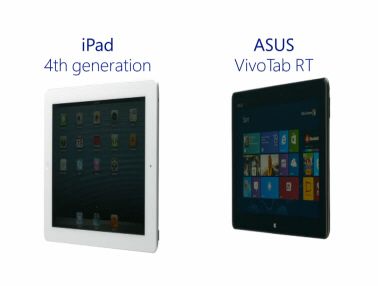
    Microsoft wasn’t saying much about why the typical consumer should choose the Surface or any Windows 8 mobile device above the iPad. Until now. This week two commercials were uploaded to YouTube. Both completely focus on features and clearly explain why consumers should choose Windows devices over an iPad. One of the ads, which my colleague Wayne Williams looked at yesterday, is quite funny as it uses Siri to take shots at iPad weaknesses, and the other, embedded below, simply pits the iPad against the ASUS VivoTab RT and compares thickness, weight, suitability for work use, multi-tasking, external connections, and the ability to print. Naturally the VivoTab wins hands down.

    For those of you who don’t like the fact that Microsoft is taking a dig at Apple, I remind you that this is precisely the approach that Apple took to get attention for Mac OS. Remember the “I’m a Mac” switcher campaign? I thought so.

    So what do you think? Is Microsoft on track with these? Will these convince consumers to go out and buy Windows devices?

  • KillEmAll helps you stamp out stubborn malware

    Removing malware used to be fairly easy, at least in principle. Detect the infection, kill any running processes and files, and that’s it — finished.
    These days, unfortunately, life can be more difficult. Some malware will actively try to block any attempts to remove it, perhaps preventing you from running antivirus tools, locking its files, maybe restarting itself if necessary. This can be frustratingly effective, too, but there are ways to fight back. And KillEmAll is a great place to start.

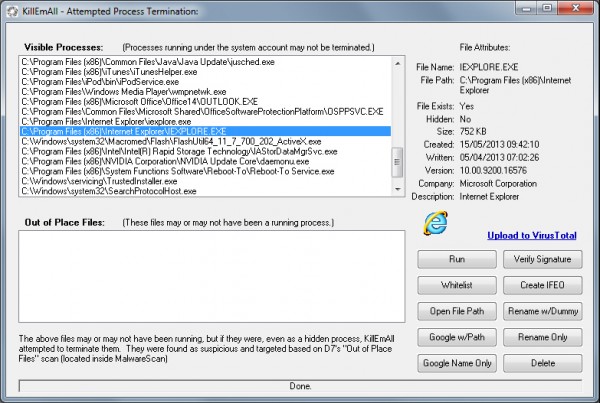
    As you might guess from the name, the program’s approach isn’t exactly subtle. Launch KillEmAll and it will immediately try to close everything but non-essential system processes. There’s no warning about this, either, so beware — if you’ve unsaved work in a document somewhere then it’ll almost certainly be lost. Otherwise, though, if there is malware running then hopefully it will closed down with everything else. And once this is done, an antivirus scan may stand a better chance of detecting and removing the threat.

    There are no guarantees, of course. The malware may prevent KillEmAll from running. It might prevent itself from being closed down, or have another component which restarts it whenever necessary. But if you’re manually malware-hunting then the program is a good first step, and if it doesn’t work immediately then there are other things you can try.

    Hold down Shift as you launch KillEmAll, for instance, and the program elevates itself to the system account. This gives it more rights and a better chance of closing down any malware, plus it’ll restart itself if malware tries to close the program down.

    If the program seems to work, but your regular antivirus tool can’t find anything, then there are various options which might be able to help. There’s a button to launch a Google search on a process name, for instance. You can upload a file to VirusTotal to try and identify malware. If you’re absolutely sure the file is dangerous, you can try to delete it, or there are a couple of “Rename” options if you’re more cautious (you can always restore the file later, if it turns out to be innocent).

    And if you find KillEmAll keeps closing some vital processes, then you’re able to add them to a whitelist, and they’ll be left alone.

    On balance, this isn’t a program you should take lightly. Closing multiple processes is dangerous, and there’s no way of telling what might happen. Again, you get no warning of this — just launch KillEmAll and it leaps into action. And using the other tools to rename or delete executables can also cause plenty of problems; it’s not something to try unless you’re entirely sure what you’re doing (and probably not even then).

    But if you really are at the last resort — the regular antivirus tools have let you down, and a manual cleanup is the only option left — then KillEmAll is a very useful tool to have in your armory. Go grab a copy for yourself (just don’t run the program until it’s needed).

    Photo Credit: lolloj/