
Category: News

  • Google Creates TV White Space Map, Starts Public Spectrum Trial

    There’s a lot of wireless spectrum out there, but mobile devices can’t take advantage of some of it as it goes towards other uses. There is a lot of unused spectrum though, and Google wants to free it up.

    Google.org, the company’s philanthropic arm, is working with other tech companies to create a database of unused TV white space. This database would allow future devices to tap into spectrum that’s not being used by someone else. The practice is called spectrum sharing, and it would allow mobile devices to share the air waves with other devices and services on this particular band.

    Here’s how Google explains it:

    Spectrum is a globally finite resource, which makes it crucial that it be allocated and shared as effectively as possible. The demand for spectrum is growing, and more people and devices need spectrum in the same place. Having a place where people can see what spectrum is available allows people to share, which enables more technology and devices to connect using an increasingly busy medium. This helps avoid conflict between devices using the same band.

    As part of its bid to become a database administrator of this TV white space, Google has partnered with the FCC to create a map of all the available TV White Space in the U.S. The company is inviting multiple stakeholders to “test and provide feedback on the database.”

    You can start exploring the spectrum map here.

  • Microsoft’s ‘Scroogled’ Campaign Is On The Way Out

    Bing’s “Scroogled” campaign, the one that not-so-subtly claims that you’re getting screwed by Google on a everyday basis (Bing says that it’s not Screw-gled, but Scrooge-led, like Ebenezer). is on the way out.

    According to KQED, the TV, newspaper, and social media ad campaign is about to cease.

    “That part is about finished,” said Stefan Weitz, Microsoft senior director of online services.

    The Scroogled website is still up and running, and there’s no word on whether Bing will abandon the campaign entirely. But it looks like the actual advertisements are about to be phased out.

    Originally targeted at Google Shopping results, Bing eventually morphed the Scroogled campaign into an attack on Google for purported Gmail privacy violations.

    “Think Google respects your privacy? Think again. Google goes through every Gmail that’s sent or received, looking for keywords so they can target Gmail users with paid ads. And there’s no way to opt out of this invasion of your privacy,” says the Scroogled site.

    That claim, which correctly points out the Google does (algorithmically) scan message content to serve ads, is a bit misleading (in-depth on that here).

    Check here for more coverage of Microsoft’s Scroogled campaign.

  • Ann Romney Blames Media For Election Loss

    Though blaming the media and labeling it “liberal” is a common refrain for conservatives in the U.S., hearing the accusation come from a woman who could have been First Lady shows just how divisive political media in the country has become.

    During a Fox News interview with Chris Wallace this weekend, Ann Romney, wife of former presidential candidate Mitt Romney, stated that she is “happy to blame the media” for not portraying her husband accurately.

    “Anytime you’re running for office you always think that you’re being portrayed unfairly,” said Ann Romney. “We, of course on our side believe that there is more bias in favor of the other side. I think…that’s a pretty universally felt opinion.”

    It’s an odd accusation, given that much of the media reported on the 2012 presidential election, right up until the end, as if it were a close race. Many Republicans who believed Romney had a shot at the White House were blindsided by President Obama’s solid victory on election night. In hindsight, the most accurate predictions of the election, such as Nate Silver‘s 538 blog, showed that Romney never had much of a chance.

    Ann Romney also accused both the media and her husband’s campaign for concealing her husband’s true personality.

    “He really is a selfless person that really truly cared about the American people,” said Ann Romney. “He truly cares about making a difference and about helping others. And for him to be portrayed in a very negative light…was very hard,”

    (Image via Mitt Romney’s Facebook Page)

  • Podcast: Why we need the LED industry

    Though it’s grown tremendously in the recent past, the light-emitting diode (LED) industry continues to face challenges on its road to greater adoption. For this GigaOM Research podcast, we sit down with Ucilia Wang and Katie Fehrenbacher to discuss the state of the market, challenges it faces, areas for more growth, and which companies the world needs to watch.

    (download)

    iTunes

    Stitcher Radio

    SHOW NOTES
    Host: Adam Lesser
    Speakers: Ucilia Wang and Katie Fehrenbacher

    • LEDs versus compact-fluorescent lamps (CFLs)
    • LEDs as semiconductors and networked lighting
    • The state of the LED market
    • LED-as-a-service business models
    • LED startups to watch
    PREVIOUS GIGAOM PODCAST EPISODES:

    Instgram’s Twit-storm, Netflix nabs Disney, GMail’s Pretty iPad App

    RoadMap re-run, our talk with Instagram’s Kevin Systrom

    iTunes 11, When Things Connect, Sun Volt

    What Aspiring New Media Stars Should Know About Agents and Managers

    Holiday Gadget Gift Guide

    War Tweets, Google TV and Nexus 4

    Director Jay Duplass on low-fi movies through high-tech

    Election Dissection, Ditching DSL and Dumping the iPad

    Sandy’s Social, Infrastructure Impact and Forstall

    Windows 8 Surfaces, and disruption eruption

    iPad Mini, iMac gets skinny

    Boxee Cloud DVR, Apple Rumors and Chromebook

    Commutist interview: Joy of X author Steven Strogatz

    Commutist podcast: Patent trolls, Costco ban and Passbook’s home run

    Commutist, meet Nerdist, and interview with Chris Hardwick

    T-Metro, Broadband Caps, Remembering Steve Jobs

    Apple’s iO-Mess, Dirty Data Centers and Tesla

    News from the Mobilize Conference

    Paul Tough: How Children Succeed and what you can learn from them

    The iPhone 5 Event

    Come on, Kindle, Light My 4G Fire

    Related research and analysis from GigaOM Pro:
    Subscriber content. Sign up for a free trial.

  • Wikihouse’s Alastair Parvin on the bright potential of community-led development

    Alastair Parvin

    Photo: James Duncan Davidson

    One of the things we’re interested in exploring here at TED is … what happens after a talk? Most often, a speaker is telling us a story without an ending — a tale that’s just beginning rather than coming to an end. That’s certainly the case with TED2013 speaker Alastair Parvin, whose project, Wikihouse, is really just getting started. Parvin has created an open-source construction set for a house, and I caught up with him in a break at the conference to get more details about some of the projects that are underway to build on it.

    One application for this cookie-cutter build-your-own-house system is disaster relief. At least, if done responsibly. “Actually, the last thing you want to do after a disaster is build,” Parvin points out. But those caught up in the aftermath of an event such as an earthquake can find themselves stuck in grim emergency housing for long periods of time. Parvin describes a Wikihouse-enabled project in Christchurch, New Zealand, an area that experienced a huge earthquake in February 2011, and where citizens are still trying to rebuild.

    Might Wikihouse help empower them? Parvin hopes so. “They’re looking at coming up with a construction model for sustainable housing rebuilding, led by communities there,” he explains. It’s that last phrase that’s crucial. “It’s an interesting flip from disaster relief housing to community-led development.”

    Then there’s Wikihouse/Rio, which is using the system in a rather different way — as an “open-source maker lab in the heart of the favela.”

    “There, they said not to worry about making a structure,” Parvin says. “Kids and teenagers can start experimenting, maybe creating furniture. Maybe that will lead to building, but it’s not about us defining what happens from the outset. It’s about being open. We’re giving people amazing tools and saying this could be a serious form of community development, but it’s led by them. If they get to the point where they want to build, that’s great.”

    This diversity of applications is central to the promise and potential of Wikihouse. “It’s great to do a TED Talk,” says Parvin, for whom Wikihouse is a passion project he works on alongside the others he undertakes as part of the Zero Zero architecture collective in London. “But this is an open-source project. It’s not about me standing up on stage and showing everyone what we’ve done. It’s more about issuing an invitation to others. Frankly the less control we have, the happier we get.”

  • 2013 Subaru WRX Special Edition: Motor Trend

    2013 Subaru WRX

    Over the last 13 years the Subaru Impreza WRX has amassed a dedicated and loyal following. It’s been featured in endless magazine comparisons and for a long time was the benchmark in the category of cheap performance. Motor Trend’s Carlos Lago recently got a hold of the new 2013 Subaru WRX Special Edition to see if there was in fact, any magic left in Subaru’s little AWD rally-inspired hot-rod, or if the flame has fizzled and died. Check it out after the jump.

    Source: MotorTrend.com

  • Google Rapper Welcomes You to the Googleplex

    25-year-old Baltimore native Andrew Fink works for Google at their offices in NYC. He is also an aspiring rapper.

    Given those two facts, it makes perfect sense that he would release a rap about Google.

    “Welcome to google, this is the googleplex / The home of where the futures kept.” Fink lets us know that Google is more than search, maps or earth, Google+, Gmail, and Google Wallet. And that they never settle, even when they’re in first.

    [via Gizmodo]

  • Assassin’s Creed IV: Black Flag Gets Debut Trailer

    Despite being one of the best genres in fiction, pirates are woefully underutilized in games. Last year’s Risen 2: Dark Waters was a fantastic, and somewhat broken, stab at pirate fiction, but we haven’t seen anything quite like Sid Meier’s Pirates! in a long time. Ubisoft may be fixing that with its latest Assassin’s Creed title.

    After having announced it last week, and its trailer leaked over the weekend; Ubisoft has now officially released the debut trailer for the latest game in the Assassin’s Creed franchise. Like all other debut trailers for Assassin’s Creed games, it’s CG without any gameplay footage.

    Despite having one hell of a trailer, Ubisoft has its work cut out for it. Many gamers were displeased with last year’s Assassin’s Creed III, favoring the Ezio trilogy over new protagonist Connor’s exploits during the Revolutionary War. Black Flag stars Connor’s grandfather in an entirely new setting that will hopefully correct the wrongs players found with the third game, and bring back the quality they expect.

    There’s no release date for Assassin’s Creed IV: Black Flag just yet, but the game will be out across every major console and PC, including the PS4 and whatever Microsoft ends up calling the next Xbox.

  • From BP to Boeing, Supplier Safety Is the CEO’s Problem

    The current front-page sub-contractor controversies surrounding BP’s liability for the gulf explosion and Boeing’s grounding of its 787 Dreamliner should not obscure an ultimate take-away for corporate leaders: companies must take operational responsibility for ensuring that products and services provided to them by third party suppliers are safe, effective and of high quality.

    In this era of complex supply chains and the hiring of expert sub-contractors, taking such responsibility is crucial for preventing events with the potential to adversely affect the corporation and its reputation. Business leaders must establish robust processes not just for qualifying third party vendors, but for making sure that there is integration of those suppliers in a strong safety culture with close company oversight of safety management and processes. This fundamental lesson may be lost on business leaders amidst the high profile excavation of past supplier controversies currently besetting BP and Boeing.

    BP is, of course, currently in the eye of a media and legal hurricane as the Justice Department and other plaintiffs begin the trial on penalties under the Clean Water Act. These penalties can be as high as $17-$18 billion if BP is found grossly negligent (legally defined as egregious conduct beyond reasonable care with foreseeable adverse consequences) or to have engaged in willful misconduct (defined as intentional acts with adverse consequences). There are myriad legal issues in the BP case as it seeks to show that it was merely negligent and that its key contractors, Transocean (rig owner) and Haliburton (well cementer), were also responsible.

    Boeing has been a huge business story this year due to the grounding of its new 787 Dreamliner for fires in ion-lithium batteries made by the Japanese company, GS Yuasa. For Boeing, the questions at the moment are urgent but primarily technical: what caused the fires and how (and how soon) can the new plane become airworthy again. Backed up orders, lost revenue, angry customers, reputational injury and the success of the innovative 787 all turn on resolution of this dramatic problem.

    In structuring relationships with third party suppliers, there can often be complex negotiations, and complexly worded documents, apportioning legal and economic risk. BP, for example, has itself sued Transocean and Haliburton seeking to spread the huge costs of the explosion at the Deepwater Horizon rig and the oil spill in the Gulf. But the judge in the current case last year ruled that BP had agreed to a clause indemnifying both sub-contractors for compensatory damages, while leaving open whether BP could collect from Transocean or Haliburton for fines, penalties or punitive damages imposed on BP.

    But for all the effort to structure legal and economic issues after a disaster occurs, it is far, far better to address critical operational issues — relating to safety culture, process and management — to prevent one. BP, or any other primary operator, must treat subs as if they were virtually part of the parent company and must take operational responsibility. Doing this right helps to avoid the endless, expensive, time-consuming and debilitating after-the-fact fights about who was at fault.

    BP has admitted as much in its now long-forgotten report on the Gulf explosion. As to events and causes, the report was, of course, one sided, admitting some fault but spreading the blame to others. In a little-noticed section on recommendations, BP effectively admitted, however, that it had not supervised key contractors properly. In this section (at p.181), BP said it should be responsible for:

    • Developing better, clearer standards and processes for a range of activities in deep-sea drilling from cementing, to testing for leakages, to well control and general risk management.
    • Significantly improving education and training of BP personnel to enhance capability and competency.
    • Implementing much greater oversight of contractors’ current practices relating to cementing, well control, rig process safety and blow-out preventer design and safety.
    • Requiring contractors to develop and implement audit-able safety processes, including identification of key indicators — processes which BP can review.

    This point was underscored by Exxon Mobile CEO Rex Tillerson in his testimony before the National Commission on the BP Deepwater Horizon Oil Spill. Following its issues with the Exxon-Valdez tanker spill, Exxon Mobile has the reputation for developing the best safety culture relating to oil and gas operations through what it calls the Operations Integrity Management System (OIMS). Said Tillerson:

    And I want to stress that the contractors that we work with are embedded within our OIMS processes as well. We expect our contractors to be as knowledgeable and conversant with our OIMS processes as our own employees. Not every company has this expectation, but we have found that when everyone in the workplace speaks the same language of safety — employees and contractors alike — everyone can work collaboratively, safely and effectively.

    Boeing is, of course, a far different situation — with efforts directed now at understanding and remedying the technical problems. But the Boeing case raises similar important questions about quality and safety, even if many, many facts are not yet known. Boeing itself has said that it made a mistake in outsourcing so much of the 787 because it caused coordination issues and delay. But clearly such fragmented outsourcing can also cause unintended and unseen safety and quality issues, despite the high standards to which air frame manufacturers are held.

    Moreover, much of this outsourcing relates to suppliers in different nations with large airlines who may purchase the new plane. Although new aircraft have initial bugs which need to be worked out, the question raised by the battery fires is whether Boeing involved the Japanese manufacturer deeply enough in Boeings own safety culture, processes and management, and whether it devoted enough time for proper oversight. Certainly, just the simple fact of the problem, which will cause a multi-month grounding of the plane, suggests that something was amiss in Boeing’s contractor oversight somewhere in the design, manufacturing, assembling and testing processes.

    It is unclear at this point what the resolution of the riveting, high visibility BP and Boeing controversies will be. But business leaders should nonetheless act on a core lesson from both examples: they must ensure that their corporations take full operational responsibility and accountability for the safety and quality of the goods and services provided not just by them, but also by third party suppliers.

  • Fly Or Die: Smart Watch Edition

    Screen Shot 2013-03-03 at 9.21.25 PM

    As the race toward mainstream wearable computing heats up, watches are hot and smart watches are hotter.

    In fact, word on the street is that Apple is working on a new smart watch that would integrate with its iCloud and iOS devices. But as it stands now, the majority of great “smart watches” available are coming from smaller companies.

    We took a look at the Pebble, the Metawatch, and the Basis smart watches for an episode of Fly Or Die, to help you get a handle on which is best for you, if any at all.

    To start, John and I both believe that the whole idea of a smart watch isn’t everything it’s cracked up to be. Sure, it’s nice to have a second channel for incoming information like texts and calls, but unfortunately the watch isn’t all that conducive to action (replies, answering calls, etc.).

    Plus, watches are meant to be every day devices, and with the battery requirements of a smart watch (even a whole week, which is promised from the Pebble), remembering to plug in your wrist watch on a regular basis can grow tiring.

    However, it’s hard to argue with the cool factor brought along with a smart watch. If, to you, that outweighs being not-quite-satisfied with the end-product, then we should move on to the compare and contrast section of this smart watch PSA.

    The Pebble was a Kickstarter phenomena, thanks to its E-Paper display which gives the watch face a crisp, readable look at all times, even in direct sunlight. The Pebble also hooks into iOS and Android for email, text, and call notifications, and has customizable watch faces. If you find yourself focusing on the design aspect of a smart watch, you’re probably looking for the $150 Pebble.

    The Metawatch comes out of Fossil, so it looks much more like a standard watch than either of the other options. It’s got a leather band and a metal/glass face. It feels heavier than the Pebble, but doesn’t have as crisp of a display. However, the Metawatch has an API that will let you send almost anything to the watch. This one’s for someone ready to get into the smart watch world but not ready to let go of the solid, classic build of a watch.

    The Basis can’t really compete with the Pebble or the Metawatch, as it’s more of a quantified self device with a built-in clock. It measures motion, skin temperature, heart rate, calories burned, sleep patterns, and other physiological indicators, and connects to your phone via Bluetooth and dedicated apps. All in all, it’s a fine looking $200 device that’s much more suited to the fitness guru than the timepiece snob or the tech geek.

    As for smart watches in general, John and I both believe they will have their time. We’re just not sure that time is today.

  • Dwight Gooden Threats Lead to Restraining Order

    TMZ is reporting that former MLB pitcher Dwight Gooden has had a restraining order filed against him by his estranged wife. Monique Gooden had called police on March 1, claiming Gooden had made “terroristic threats.”

    A temporary restraining order has been granted against Gooden. Though he had been living with Monique while a divorce is in progress, Gooden has now left the premises. The order also prevents Gooden from visiting his children until a court hearing on March 11, where a judge will evaluate the restraining order and consider whether it should be permanent.

    Unnamed documents quoted by TMZ stated that Monique claims Gooden said, “All bets are off an I will hurt you and your family. You’ll see, just wait.”

    Gooden was arrested in 2005 for allegedly hitting Monique, whom he accused of throwing a phone at him. He was later released on a misdemeanor battery charge.

    Gooden has a history of substance abuse dating back to 1987, when he tested positive for cocaine during spring training. He is currently on probation related to DWI and child endangerment charges.

    (Image courtesy Jeff Marquis via Wikimedia Commons)

  • Australian Miners Fired for Harlem Shake Video [REPORT]

    According to one Australian mining outfit, doing the Harlem Shake on the job is a fireable offense.

    ABC News is reporting that at least 15 miners at the Agnew Gold mine in Western Australia were canned after posting their own version of the Harlem Shake to YouTube. The 15 fired miners include participants in the video as well as those who simply watched it take place.

    According to Barminco, the company that runs the mine, the Harlem Shake constituted at safety hazard and did not represent the company’s “core values of safety, integrity and excellence.”

    You can watch the totally innocuous underground Harlem Shake below and decide if you think it deserved this kind of response:

    Not only were the miners fired from their current gig, but Barminco also banned the workers from being “subcontracted by Barminco at any site domestically and globally.”

    All of this for 30 seconds of (admittedly ridiculous) fun.

    If you think that the firing was a little over the top, you can express your support for the miners on the Reinstate the sacked WA Harlem Shake Miners Facebook page.

  • Hit the slopes! Burton app is exclusive to Nokia Lumia

    Last week at Mobile World Congress in Barcelona, Spain, Nokia unveiled an upcoming mobile app that teams the handset maker with snowboard legend Burton. The app comes exclusively to Lumia devices. A brief hands-on was shown off by the folks over at Windows Phone Central, but today Nokia released a full-blown teaser video, complete with some spectacular filming of the extreme winter sport.

    While some of the functionality here is similar to what Google Now can do for Android — weather, information and maps — the Burton app also contains a video sequencer that allows the user to shoot short bursts of video and then edit and chop them on the fly. It also comes with a feature called “Tune up” that provides playlists that customers can enjoy on the way down the slopes. Finally, users can watch Burton Open Events on their Lumia handsets.

    The app is free and available now in the Windows Phone store. If you are not a snowboarder then you may still find some use for this Burton app, because of the video sequencer feature. If you do plan to hit the slopes, then you can expect to get the latest snow forecast for more than 2,600 resorts around the world.

    The Burton app becomes another part of the Nokia Collection, which was recently joined by NFC Writer — a group of apps that are exclusively for Lumia customers.

  • Finally: IBM drops the other OpenStack shoe

    IBM joined the OpenStack Foundation as a big-time Platinum sponsor last April. Since that time many have wondered when it would talk up its own plans to put its public and private cloud projects on the OpenStack open-source cloud platform. Well, that time has come at this week’s IBM Pulse conference on Monday.

    IBM LOGOWhile it’s hardly surprising that IBM woud make use of all these open source goodies it’s been working with, the news is, as All Things Digital reports, a big deal. In theory this means big cloud buyers will be able ot mix and match cloud workloads among and between various OpenStack providers including IBM competitor Hewlett-Packard, Rackspace, Red Hat and others.

    All of these players have a strong vested interest in keeping those business workloads from going to either Amazon Web Services the leader in public cloud or to VMware which is trying to parlay its in-house server virtualization dominance in the cloud.

    Details about timing and delivery are scant but I’ll update this post as I’m able later today.

    Related research and analysis from GigaOM Pro:
    Subscriber content. Sign up for a free trial.

  • Apple’s ‘iWatch’ Could Be Out As Soon As This Year

    Apple is known to launch several products throughout the year, but this year may be the first time that Apple will launch two iPhones in the same year. To compliment these devices, Apple may be launching its oft-rumored iWatch later this year as well.

    Bloomberg reports that Apple is planning to launch its iWatch at some point later in the year. It’s unknown if the device will be shown off alongside the iPhone 5S’ rumored August reveal, or if Apple would wait to show it off at its own event. I’m more inclined to the latter as Apple likes to give completely new products, like last year’s iPad Mini, their own press event.

    As for the iWatch itself, a few more details on the device have leaked out. According to a course close to Apple, the team of 100 product designers working on the iWatch are considering a number of features to be implemented into the device. Some of the features include the ability to make calls, caller ID for incoming calls, checking map coordinates and a pedometer. The latter would obviously be used in conjunction with fitness apps on the iOS.

    Speaking of iOS, some speculate that the iWatch would run a slimmed down version of Apple’s mobile operating system. The smaller screen ensures that the iWatch wouldn’t be able to take on all of the duties of the iPhone, but the integration of iOS would mean that it could at least work with iPhones to provide a complimentary experience that could extend far beyond simple functions like incoming calls. For example, an iOS game could use the iWatch as a secondary input for when players can’t take their iPhone out.

    With both the iWatch and Google Glass reportedly launching later this year, we may see the first wave of market fights in wearable computing. The iWatch would obviously be cheaper than the $1,499 Google Glass, but it remains to be seen if consumers would pay upwards of $200 for a watch to go along with their iPhone. It worked for Pebble (pictured above), so it’s safe to assume that Apple will at least have some success with it.

  • Smartphone shipments surge ahead of lesser mobiles — Brazil, China and India lead the way

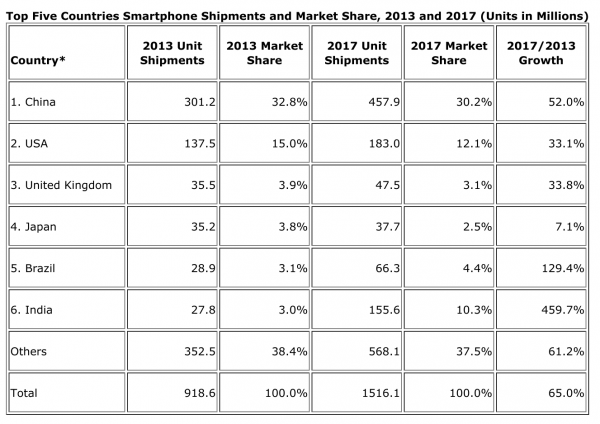
    Last month after analyzing Gartner’s Q4 handset sales data, I quipped: “At this pace, smartphone sales should surpass feature phones within a couple quarters”. Today, IDC released a real forecast, claiming that smartphone shipments would do just that. While not exactly sales, the change would mark a significant shift in the mobile phone market, with China charging ahead of all other countries.

    The analyst firm expects smartphone shipments to nudge past 50 percent for the year, a forecast I consider to be overly conservative. Based on sales, the category already has 44 percent share, according to Gartner. The smartphone market is so fast-changing, few analysts get anything right. As I explained in December, IDC repeatedly underforecast smartphone shipments throughout 2012. The general view is likely right, but with feature phones falling at brisker pace.

    IDC estimates manufacturers will ship 918.6 million smartphones this year, rising to 1.7 billion in 2017, for about two-thirds of global handset shipments. The changing dynamic creates and closes opportunities, depending on markets. The United States and parts of Europe rapidly reach saturation levels, where adoption of more sophisticated handsets slows and early leaders Android and iOS lock out competitors. Elsewhere, low smartphone adoption makes more opportunities for all.

    Falling prices and 4G network expansion are two trends driving smartphone adoption. Samsung and Chinese manufacturers like Lenovo and LTE rapidly bring compelling, lower-cost handsets to market, which contributes to smartphone gains against feature phones.

    The trends make sense of last week’s Mobile World Congress announcements, such as Firefox OS phones or new Nokia Lumias with fewer smartphone features for lower selling prices going to emerging markets first.

    IDC singles out three of the four BRIC countries — Brazil, China and India — as huge growth markets, but for different reasons. During 2012, China passed the United States as the largest market for smartphones, which account for about two-thirds of shipments there.

    “While we don’t expect China’s smartphone growth to maintain the pace of a runaway train as it has over the last two years, there continue to be big drivers to keep the market growing as it leads the way to ever-lower smartphone prices and the country’s transition to 4G networks is only just beginning”, Melissa Chau, IDC senior research manager, says.

    As I explained last month, cheap-selling smartphones and Android’s rapid rise in China — among buyers and manufacturers — weakens iPhone’s position in Apple’s second-largest market. “China is a massive growth prospect, but Apple is not making the market share impact there that it is in other markets”, Nicole Peng, Canalys China research director, says.
    “Smartphone shipments surged +64-percent annually in China during the fourth quarter of 2012”, Neil Mawston, Strategy Analytics research director, says. “Android and Android forks together accounted for a record volume of all smartphones shipped in China last year”.

    But, of course, there are limits to how far and fast smartphone shipments can go in the country. “Even as China starts to mature, there remains enormous untapped potential in other emerging markets like India, where we expect less than half of all phones shipped there to be smartphones by 2017, and yet it will weigh in as the world’s third largest market”, Chau says.

    Brazil and India are two other markets to watch. “Brazilians have yet to turn in their feature phones for smartphones on a wholesale basis”, Bruno Freitas, IDC consumer devices research manager, says. “The smartphone tide is turning in Brazil though, as wireless service providers and the government have laid the groundwork for a strong smartphone foundation that mobile phone manufacturers can build upon”.

    Through 2017, IDC predicts that India smartphone shipments will outpace other countries by enormous margins, rising 459.7 percent compounded annually.

    IDC’s analysis jives with a study Pew Internet released last week about mobile phone habits. The organization finds that, combined, 65 percent of Brazilian adults 16 or older have feature or multimedia phones. In India, 80 percent of adults use feature phones.

    Photo Credit: Massimo Cavallo/Shutterstock

  • Is Sprint’s Business Shared Data a Sign for Consumers?

    Verizon and AT&T think you want to share a pool of data with your friends and family. Sprint and T-Mobile think that’s a silly notion. We all want our own data pool, right? While the latter two might be correct for the moment, market forces might be moving against them. After all, Verizon and AT&T call the shots with their 200 million-plus combined subscribers.

    Late last week Sprint announced a plan that, on the surface, might seem innocent. They’re offering businesses a chance to share data pools, the size of which depend on how many lines the account contains. FOr 10-line accounts busnesses can share 20GB; for 20 devices they can share 40GB, and for 30 devices they get 60GB combined.The system works in essentially the same was as Verizon and AT&T. Customers pay for each device connected to the account, plus the data pool.

    According to Sprint, this is merely a trial. It runs through June 13th, and is an option, not a requirement, for business lines. In that way it might seem innocent enough. After all, business accounts are handeled differently than consumer ones. If the trial is a success Sprint might migrate its business customers there. But why would that affect consumers?

    The answer is LTE. As Sprint expands its LTE network, it is likely coming to the realization that unlimited data isn’t feasible. Yes, LTE networks transfer data more efficiently than 3G networks, but LTE users consume more data, a lot more data, than 3G users. That will continue to be the case as mobile data gets faster and more efficient. People will start to treat them more like cable lines, consuming huge gulps of data where they used to consume sips.

    sprint_unlimited

    All of this is highly speculative. Sprint might have nothing of the sort in mind for consumers. After all, unlimited data remains one of their strongest selling points in the face of crushing competition from AT&T and Verizon. If they give that up they’ll be just another player in an increasingly duopolistic industry.

    What happens when reality crushes the possibilies for that differentiation? We could soon find out. Sprint continues to build out its LTE network — even offering it up to its prepaid brands Virgin Mobile and Boost Mobile — and so could be feeling the crunch already. If it’s begun for business, chances are it will extend to consumers eventually.

    Via All Things D.

    The post Is Sprint’s Business Shared Data a Sign for Consumers? appeared first on MobileMoo.

  • Catholic Deacon Arrested for Child Porn After Verizon Finds It on the Cloud

    A deacon at the St. Joseph’s Catholic Church in Fullerton, a suburb of Baltimore, has been arrested and charged with multiple child pornography counts after Verizon tipped authorities to materials stored on the company’s online cloud backup system.

    67-year-old William Albaugh was arrested and released on $75,000 bond after police found underage porn images and videos on his Verizon cloud backup as well as on numerous thumb drives in his home. Police confiscated two storage units, a laptop, and an iPad as well.

    According to police, there is no evidence that any children at St. Joseph’s church were victims.

    Albaugh reportedly told police that he has been viewing child pornography since the 1970s, but was in no way involved with any of the porn’s creation.

    Albaugh had been a deacon at the church since 1996, but the archdiocese has confirmed that he has been suspended.

    The police were first tipped to Albaugh’s child pornography collection when Verizon notified the National Center for Missing and Exploited Children. Verizon said that they had detected the images and videos stored on his Verizon Online Backup and Sharing account.

    [Baltimore Sun via Ars Technica]

  • How to enable BlackBerry Z10 Rotation Lock

    (Originally posted on the Inside BlackBerry Help Blog)

    Depending on how you are holding your BlackBerry Z10 device, you may want to lock the screen into portrait mode. To do this quickly, complete the following steps:

    1. While viewing the BlackBerry Z10 Home screen, swipe down from the top of screen
    2. Tap the Rotation Lock icon

    After tapping the Rotation Lock icon, you’ll notice that the icon turns blue when you access the Settings menu, which indicates that it’s turned on. To turn off Rotation Lock so your BlackBerry Z10 can switch between portrait and landscape views, repeat the steps above.

    To learn about a feature on your BlackBerry 10 smartphone or troubleshoot an issue, there are several great options available to help. Visit www.blackberry.com/support for access to product manuals, how-to demos, tips and tricks, YouTube videos, support forums, knowledge base articles, Twitter support, and contact information for your region.

  • Casey Anthony Bankruptcy Hearing Being Held Today

    Casey Anthony, the woman famously acquitted of the murder of her daughter, Caylee Anthony, is back in a Florida courtroom, this time to face a bankruptcy case. Anthony has been in hiding since the end of the trial, appearing only occasionally in videos posted online.

    Anthony’s debts stem from the 2011 murder trial and fines levied against her for lying to police about the whereabouts of her daughter. She recently filed for Chapter 7 bankruptcy, claiming she is almost $800,000 in debt.

    The Orlando Sentinel is reporting that during today’s bankruptcy hearing Anthony will answer questions from a bankruptcy trustee and her creditors about her finances.

    Anthony has been unemployed since the end of the murder trial in July 2011. Part of today’s questioning will concern who has been supporting her since that time. Also, rumors of a book deal for Anthony’s story could play into the hearing, an if true could prevent her from being declared bankrupt.

    Cameras will not be allowed in the Federal Courthouse where the bankruptcy hearing is being held.