Category: News

  • Are we getting more intelligent? Jim Flynn at TED2013


    Photo: James Duncan Davidson

    Photo: James Duncan Davidson

    Jim Flynn is an expert in intelligence famous for his research on the Flynn effect, the phenomenon that humanity’s IQ has been dramatically increasing since the 1930s. He opens Session 11 today on the last day of TED2013 to help answer the question, “Who are we?”

    During the 21st century, our minds have altered, he begins. At the beginning of the century, people were confronted with a concrete world, and their primary interest in dealing with it was to analyze how much it would benefit them. In today’s world we confront a complex world with new habits of mind: classification and abstraction. We clothe the concrete world, trying to make it logical and consistent. We ask not just about the concrete but the hypothetical: what might be, and not just what is.

    Today the line for giftedness is an IQ of 130. If you scored people a century ago against modern norms, they would have an IQ of 70. That is the line for mental retardation today. What can account for this?

    Imagine a Martian came down to Earth and found a ruined civilization. Imagine it found target scores from the past century: In the 1865 the target had one bullet in the bullseye; in 1898 it had five bullets in the bullseye; in 1918 100 bullets in the bullseye. The extraterrestrial archaeologist would be baffled. The tests were supposed to measure the keenness of eyesight and whether the shooter has control over their weapon, and so on; how could human skill have advanced so quickly in such a short amount of time? But of course we know the answer: We had muskets at the time of the Civil War, repeating rifles by the Spanish-American War and machine guns by World War I. It was the equipment in the hands of the average soldier that was responsible, not better eyes or steadiness of hand.

    So what mental artillery have we picked up over the last 100 years? Alexander Luria studied neuropsychology in the early half of the century, and he found that people were resistent to classification, to deducing the hypothetical. His subjects simply couldn’t think about anything abstract. Consider this exchange:

    Luria: What do crows and fish have in common?
    Subject: Absolutely nothing. A fish swims, and a crow flies.
    Luria: Are they not both animals?
    Subject: Of course not, a fish is a fish, and a crow is a bird.

    The man could only think of the objects as how he might use them, not as abstract objects part of a classification system.

    Luria told another subject: “There are no camels in Germany. Hamburg is in Germany. Are there camels in Hamburg?” The subject replied, “If it’s big enough, perhaps it has camels.” Luria prompted him again to listen to the conditions, and again he replied that perhaps Hamburg had camels. He was used to camels, and he was unable to imagine that there weren’t any in Hamburg.

    How have we come to solve things that aren’t real problems? For one thing, education has changed dramatically. These days the majority of Americans get a high school degree. We’ve gone from four to eight years of formal education to twelve. Fifty-two percent of Americans get some tertiary education. In 1910 a state examination in Ohio given to 14-year-olds asked socially-valued concrete questions, like “What are the capitals of the 45 American states?” In 1990 such a state examination was about abstractions, asking instead: “Why is the largest city of the state rarely a capital?” And the student is supposed to reason that the state legislature is rural controlled and they hated Big City, and so on. Today we educate people to use abstractions and link them logically.

    Another shift in the past century has been in employment. In the early 1900s, three percent of the population had cognitively demanding professions; today, it’s 35 percent. And not just professions like lawyer and doctor, sub-professions like technician and computer programmer are also cognitively demanding. Compare the banker in 1900, who really just needed a good accountant and to know who was trustworthy for paying back their mortgage. Today’s bankers, like the ones involved in the mortgage crisis, have jobs that demand much more from their cognitive faculties. It’s not just the spread of more cognitively demanding jobs but the upgrading of old professions.

    Moral intelligence has escalated in the past century because we now take the universal seriously and are able to look for logical connections. In the 1950s and ’60s, people were coming home and talking to their parents about Martin Luther King, Jr. When they asked the generation before them, “How would you feel if you woke up tomorrow and you were black?” their parents responded, “That is the dumbest thing I’ve ever heard. Who have you known who has ever woken up black?” They were fixed in the concrete mores they had inherited, and they were unable to take the hypothetical seriously. As Flynn says, “Without the hypothetical, it’s very difficult to get moral argument off the ground.”

    Looking at the evolution of IQ tests, it’s evident that gains have been greatest in certain areas, like classification and analogies. Consider the analogies in the Raven’s Progressive Matrices test:

    In 1900 people could do simple analogies: Cat is to wildcat as dog is to … ? People answered wolf.
    In 1960, two squares followed by a triangle is to two circles followed by a … ? People answered semi-circle.
    And in 2010, two circles followed by a semi-circle is to two 16s followed by … ? An eight. People were even able to see beyond the symbol to abstract the concept of halving.

    It’s not all good news, says Flynn. Our political intelligence is not improving. Studies show that American young people read less history and literature and less material about foreign places. It’s as if they are ahistoric, living in the present. How different might life be if Americans were more aware of their history, such as the fact that we have been lied to the past 4 out of 6 wars we’ve fought in? Lusitania was not an innocent ship with explosives on it, the North Vietnamese did not attack the Seventh Fleet, and Sadaam Husein hated Al Qaeda. Flynn remarks, “You can have humane moral principals, but if you’re ignorant of history and other cultures, you can’t do politics.”

    But the 21st century has undoubtedly shown there are enormous cognitive reserves in orginary people, and they’re finally being tapped into. The aristocracy once was convinced that the average person would never make it, that they wouldn’t develop their cognitive abilities. But we know today that the average human is capable of much, much more.

  • AT&T launches all-out attack on T-Mobile in new ad

    AT&T T-Mobile Attack Ad
    AT&T’s (T) bid to acquire No.4 wireless carrier T-Mobile USA failed spectacularly in late 2011 after the Justice Department sued to block the merger. There is clearly no love lost between AT&T and its former acquisition target, as the carrier on Thursday took out a full-page ad in several large newspapers slamming T-Mobile’s network. “The truth about T-Mobile’s network compared to AT&T,” the ad reads. “2x more dropped calls, 2x more failed calls, 50% slower download speeds.” The ad, pictured below, ran in The New York Times, The Wall Street Journal and in USA Today on Thursday.

    Continue reading…

  • HitBliss lets users ‘pay’ for streaming movies and TV shows by watching ads

    A new streaming video service called HitBliss, launching in beta Friday after being in development for about five years, aims at users with more time than money: Users who sit through targeted ads receive funds that they can redeem for new streaming movies and TV shows. The company is launching with content from The CW, Universal, Paramount, Starz Media and the Weinstein Company. It will offer access to movies four months after they leave theaters, and access to TV episodes they day after they air.

    For now, HitBliss is available only on the web and on desktops, not on mobile devices — though the company plans to expand to other platforms soon. Among the available content at launch are new movies like ArgoMagic Mike and The Bourne Legacy and new episodes of shows like Real Housewives and The Walking Dead.

    hitbliss 2Users are served a “playlist” of ads that are delivered to them based on information that they include in a profile. When they watch the ads, they earn virtual cash that can eventually be redeemed for content. Users can specify how much information they’re willing to make available to advertisers; the more information they share, the faster they earn.

    Other companies have dabbled with virtual currency in exchange for video. Yidio, for instance, gives users points for completing various tasks, and the points can then be redeemed for Amazon Video on Demand credits. HitBliss is different, however, in that both earning and viewing are done through the same platform.

    As HitBliss users watch ads — which they can do at any time, not just right before they want to watch a movie or TV show — cash accumulates in their accounts, and they can redeem it when they wish. HitBliss charges $3.99 for a new movie rental, $1.99 for an older movie rental and $1.99 per TV episode. (Movie rentals last 24 hours, while users will own the TV episodes.) In general, about 8 to 10 minutes of ad viewing (roughly four ads) can be redeemed for one new movie.

    The system includes a lot of checks to make sure that users are actually watching ads. “Advertisers are only paying when users are paying attention,” HitBliss cofounder and CMO Sharon Peyer told me. If a user plays an ad and then navigates away or mutes the sound, the ad pauses. An “attention assurance meter” — with a patent pending — occasionally requires users to click it to ensure that they’re paying attention; if they are not, “it gets very angry,” Peyer said, referring to a smily-face icon that turns to a frown the longer it is ignored, before ultimately resetting the ad and requiring the user to watch it again. Over time, users earn “trust points” that decrease the frequency of prompts to make sure they’re paying attention.

    Peyer said the platform’s store will eventually expand to include other types of digital content, like apps and virtual goods. HitBliss is based in Lexington, Mass., and is backed by Andy Marcuvitz’s Alpond Capital. Peyer and her husband, CEO Andrew Prihodko, founded the company in mid-2008 after selling a video- and picture-sharing site called Pixamo.

    Related research and analysis from GigaOM Pro:
    Subscriber content. Sign up for a free trial.

  • Google may be winning battles with publishers, but it is losing the war

    Google is clearly trying hard to portray a new German law involving the republishing of news as a victory, and some observers seem to agree, saying the company “defeated” publishers who wanted it to pay for the right to publish excerpts. But if you look more closely, this is not an obvious win for the search giant — just as recent deals with French publishers and Belgian publishers were a lot closer to being a saw-off for both sides than an outright win.

    And with every deal it strikes, Google makes it harder to argue that paying publishers for excerpts is unnecessary and even counter-productive — or that there is something to be gained by allowing even large companies to engage in the “fair use” of content for the larger good.

    As my colleague David Meyer has reported, Germany’s lower level of government, the Bundestag, passed a bill on Friday known colloquially as the “Google Law.” It doesn’t officially become legislation until it is approved by the second chamber, the Bundesrat, but it has already caused a firestorm of criticism — much of that stoked by Google and its “Defend Your Internet” campaign. The law was promoted by most of Germany’s major media companies, who believe Google News is stealing their content by including excerpts of news stories.

    Is it a victory for Google? Not really

    Google

    In its original form, the bill would have required Google and others who use even a single word of a publisher’s copyrighted content to pay for the privilege. After what appears to have much lobbying and late-night pressure from the search company, the German legislature tweaked the bill so that the use of a single word or a “small snippet” by services such as Google News would not require licensing or payment — which Google says ius a victory.

    As David notes, however, on closer inspection this doesn’t really look like much of a victory at all: it’s not clear that Google News has been absolved of anything, in fact, since the wording of the bill doesn’t specify what a “small snippet” consists of. The legislation also clearly gives publishers the right to control what a third-party site or service does with their content, and in effect it leaves it up to them to determine what constitutes unfair use.

    In a similar way, Google tried to argue that its deal with French publishers — which involved the payment of $82 million to set up a “digital innovation fund,” as well as a commitment by Google to help publishers with their digital advertising — was a victory, when what it really looks like is hush money or an extortion payment. As in Germany, the search giant might protest that it could have been much worse, but to other publishers and media players in Europe it looks a lot like Google is willing to cave in on its core beliefs if you push hard enough.

    Has Google lost the will to fight?

    Some publishers — even those in the United States — would probably argue that this is a good trend rather than a bad one, and that Google should be paying publishers for their content, even short excerpts (I happen to believe that they are wrong). And Google has obvious corporate reasons for being expedient and cutting deals, even if that involves backing down on its principles, because it needs to do business in these countries.

    Despite all that, however, it still feels as though something has been lost, or is in the process of being lost. In the past, Google’s argument in cases like these — or other cases on similar issues, such as the Google Books lawsuits launched by publishers and authors — has always been that a) the principle of “fair use” should allow it to use short excerpts of both books and news articles, and b) that there is an exchange of value involving the users that Google News drives to a publisher’s content that many media companies fail to appreciate.

    Of course, the U.S. principle of “fair use” doesn’t exist in the same way in most European countries. And perhaps it’s unfair to expect Google to try and somehow force other jurisdictions to see the value of such a principle. But if Google doesn’t do it, then who will? So much of its success has been based on it that it seems a little churlish to just cut a deal with whoever comes along, regardless of the long-term effects that might have on the open web.

    Post and thumbnail images courtesy of Shutterstock / Alexander Santander and Flickr user Pew Center

    Related research and analysis from GigaOM Pro:
    Subscriber content. Sign up for a free trial.

  • Hugo Chávez Near Death, According To Reports

    There have been rumors going around that Venezuela President Hugo Chávez had died, but reports have come out to the contrary.

    The country’s vice president reportedly said on Thursday that he is “still fighting for his life,” and according to the AP, the majority of Venezuelans polled believe he’ll actually return to power.

    According to VP, Nicolás Maduro, Chávez “is battling there for his health,” and “for his life”.

    On Friday, senior aides and relatives of Chávez also spoke out to counter the rumors of his death. Reuters quotes some of them:

    “There he is, continuing his fight, his battle, and we are sure of victory!” his brother Adan Chavez, the governor of Barinas state, told cheering supporters during an event.

    “The launching of absurd and bizarre rumors by the right wing simply discredits them and isolates them further from the people,” Chavez’s son-in-law Jorge Arreaza, who is also Venezuela’s science minister, said via Twitter.

    Chávez reportedly underwent his fourth surgery for cancer in December, and has not been seen in public since, though he is said to have gone to a military hospital in Caracas last week.

  • Data, makers and MOOCs: 6 ed tech trends to watch at SXSWedu

    If SXSW Interactive is “spring break for geeks,” SXSWedu is spring break for geeks who want to help the country turn out even more geeks.

    sxsweduKicking off Monday in Austin, Tex., the conference attracts entrepreneurs, investors, school leaders, policy makers and others trying to use technology to improve and remake education. Last year, it drew about 2,000 participants and, this year enrollment has more than doubled, organizers say.

    That’s still just a fraction of the more than 24,000 people who head to Austin for the celebrity-saturated consumer tech event a few days later. But the growth of SXSWedu, which is in its third year, underscores the boom-time vibe in the ed tech industry in general, which last year soaked up $1.1 billion in venture capital and spawned no less than four ed tech accelerators in the last month.

    Ahead of the event, I chatted with a few SXSWedu and ed tech veterans about the topics and themes likely to inspire chatter in Austin and beyond.  Whether you plan to attend or follow it from afar, here are six trends to watch.

    Unlocking and mastering data

    Data and analytics startups and organizations are quickly becoming darlings of ed tech. They aim to uncover new insights and support personalized classroom learning by helping educators integrate and analyze often historically disparate datasets. “We’re just getting to the point where data gets interesting,” said Heather Gilchrist, founder of the New York-based ed tech accelerator Socratic Labs. At the conference, InBloom, the new nonprofit focused on helping educators aggregate data, will provide the first demos of its platform, host codeathons and share insights from its first pilot programs with school districts. Also expect to hear about the role of big data from startups Clever and LearnSprout, the U.S. Department of Education’s Office of Technology, the Gates Foundation and LinkedIn . (If you’re interested in general trends in big data and the future of the field, check out the line-up at GigaOM’s upcoming Structure:Data conference.)

    Supporting the lifelong learner

    In the last year, massive open online courses (MOOCs) captured the attention of the public and the media. And they’re sure to spark a good amount of buzz next week.  Coursera co-founder Andrew Ng and edX president Anant Agarwal will participate in a keynote conversation. But during the week, others, including professors and administrators, will bring their perspectives to the debate. Still others will talk about the wider world of online education beyond MOOCs and how learners can track their experiences and use it for career advancement.

    Encouraging the maker mindset

    The maker movement will also take center stage at SXSWedu this year with a dedicated Makerspace to show off hands-on approaches to learning, as well as several DIY workshops and panels throughout the week. For example, MAKE Magazine’s editor and founder will talk about tools for bringing the maker mindset into the classroom, Khan Academy will demo universal remote-controlled robots made from everyday objects and the Digital Harbor Foundation will share their experience in helping to build maker programs aligned to Common Core standards in Baltimore.

    Bridging industry and philanthropy

    It’s not just startups driving innovation in ed tech. Nonprofits and philanthropic organizations, from the Gates Foundation to InBloom to open-content non-profit CK-12, are playing key roles in using technology effectively in education. Bill Gates himself will give a keynote speech on his foundation’s work in education. And Matt Greenfield, a partner at Rethink Education, said the industry is seeing more “creative alliances between foundations and philanthropy and for-profits.” At the event, companies like skills-focused startup Everfi and University Ventures will also share how their models blend public and private sector players.

    Making way for mobile

    Just like in the consumer tech world, mobile technology is top of mind. “Mobile penetration in the K-12 classroom is happening a faster clip than we thought,” said Jennifer Carolan, who leads the NewSchools Venture Fund’s Seed Fund.  Tablets like the iPad and the Galaxy Note are spawning new learning apps and, at SXSWedu, educators will talk about how mobile devices could narrow the digital divide, empower students in Hispanic communities, boost in-class engagement, and more.

    The maturing ecosystem

    Some might look at the recent surge in ed tech accelerators and say it’s a sign of a bubble, while others argue that it’s more evidence that the nascent industry is growing up.  Thanks to the rise of emerging technology, policy changes and the successful exits of a few ed tech startups, more talent and investors are giving the space an unprecedented amount of attention. “There’s an increased number of the most talented and smart people becoming attracted to this space … it’s not the way it’s always been,” said Mark Miller, a co-founder of new Boston accelerator LearnLaunchX.  In addition to accelerators that give ed tech startups the infrastructure for success, more teachers-turned-entrepreneurs are bringing their experience and networks to bear in ed tech.  “The rise of the teacher-preneur is a meme I’m hearing more about,” added Carolan. “They have an idea that’s effective in the classroom and are scaling [them].”

    Related research and analysis from GigaOM Pro:
    Subscriber content. Sign up for a free trial.

  • In Press Conference, President Obama Talks About Moving Forward Despite Sequester

    President Obama held a press conference this morning after meeting with Congressional leaders to talk about his plans to move the country forward in light of the severe budget cuts that will start to take effect today.

    These cuts, which are known as the sequester, will hurt our economy and cost us jobs, the President said. And as Americans all across the country work hard to keep our economic recovery going, arbitrary cuts to services and investments that businesses and workers depend on makes that far more difficult. 

    But none of this is necessary, President Obama said. These cuts are "happening because of a choice that Republicans in Congress have made." 

    They’ve allowed these cuts to happen because they refuse to budge on closing a single wasteful loophole to help reduce the deficit. As recently as yesterday, they decided to protect special interest tax breaks for the well-off and well-connected, and they think that that’s apparently more important than protecting our military or middle-class families from the pain of these cuts. 

    I do believe that we can and must replace these cuts with a more balanced approach that asks something from everybody: Smart spending cuts; entitlement reform; tax reform that makes the tax code more fair for families and businesses without raising tax rates —  all so that we can responsibly lower the deficit without laying off workers, or forcing parents to scramble for childcare, or slashing financial aid for college students.

    read more

  • Microsoft Photosynth finally reaches Windows Phone 8

    By now most of you have likely heard of Photosynth, the Microsoft Labs project that made the mainstream, first as a web app and then on mobile. Now the mobile version has finally been ported to Windows Phone 8 devices as version 1.5 lands in the Windows Phone store today.

    Photosynth is a panorama app that can take multiple high resolution images and stitch them together into a fantastic picture that users can pan around — you can see some great examples on the website (it requires Silverlight).

    Microsoft’s Michael Stroh made the announcement earlier today, saying that “I know many shutterbugs have been waiting eagerly for this free app—and it appears patience has paid off. The Windows Phone 8 release contains several handy new features”.

    Among those new features is Lens Integration, which allows the user to launch Photosynth right from within the camera app. There are also new sharing features built in, allowing other Windows 8 users to view your shared panoramas — users can still share via Facebook, Twitter and Email. Finally, Microsoft claims better camera controls, especially in the area of lighting.

    Users can, as always, publish their images to the Photosynth website to share with the world. This makes the panorama visible directly from Bing Maps and Bing search results.

    I really like Photosynth, and I am very happy that Windows Phone 8 customers finally have access to the service. However, WP8 has been available since October 2012. Microsoft’s slow support helps to explain part of the problem the mobile OS has gaining traction.

  • Apple institutes stock-holding rule for CEO, directors, executives

    There’s a new rule at Apple: if you’re an executive or board member, you’re not allowed to let your holdings of Apple shares get below a certain threshold. The company recently instituted new requirements that CEO Tim Cook to hold stock work 10 times his base salary, that other executives hold three times their base salary, and that members of the board of directors who are not Apple employees keep Apple stock worth five times their annual retainer, according to new company stock ownership guidelines published in February.

    Cook’s annual base salary is $1.4 million; which means he’ll be required to keep a minimum of $14 million in stock as long as he’s chief executive. Apple’s proxy statement identifies the following as “executive officers”: SVP of Internet Software and Services Eddy Cue, SVP of Software Engineering Craig Federighi, SVP of Technologies Bob Mansfield,  CFO Peter Oppenheimer, SVP of Hardware Engineering Dan Riccio, SVP of Marketing Phil Schiller, General Counsel Bruce Sewell and SVP of Operations Jeffrey Williams.

    The timing of the rule change is interesting because it came right before Apple shareholders voted down a broader proposal earlier this week that would have required Apple senior executives — as opposed to executive officers — to keep a certain amount of company stock on hand. And it comes in the midst of a six-month-long stock slide from just above $700 to around $430.

    Apple’s stock has been slipping, and while he never comments on the stock price, Cook actually told investors at the annual meeting that he “didn’t like” Apple’s falling share price.

    The new rule’s insinuation is that Apple must prove its executives are as invested in Apple’s stock value — and by extension the future of the company — as the rest of the investors who own stock in the company. Which seems unnecessary and odd. If anything, Cook’s been remarkably sensitive to shareholders’ concerns — far more than his predecessor, between reinstating Apple’s dividend last year, to public promises to consider schemes cooked up by publicity-hungry hedge fund managers. But it’s extremely unlikely that being personally sensitive to the stock price is going to somehow change what Apple executives are doing on a regular basis right now.

    Related research and analysis from GigaOM Pro:
    Subscriber content. Sign up for a free trial.

  • Training the brains of psychopaths: Daniel Reisel at TED2013


    Photos: James Duncan Davidson

    Photos: James Duncan Davidson

    Daniel Reisel is here to talk about our brains. In particular, how we might change them–and how this kind of thinking might just change the tenor of society as a whole.

    He introduces us to Joe, who’s 32, and a murderer. Reisel met Joe in Wormwood Scrubs, a high-security prison that houses England’s most dangerous prisoners. On a grant from the UK Department of Health, Reisel visited the jail to study inmates’ brains and try to find out what lay at the root of their behavior. “Was there a neurological cause for their condition?” he asks. “And if there was a neurological cause, could we find a cure?”

    Initial research showed that psychopaths like Joe indeed had a different physiological response to emotions such as distress or sadness. “They failed to show the emotions required; they failed to show the physical response. It was as though they knew the words but not the music of empathy,” Reisel describes. MRI scans (yes, transporting psychopaths across London in rush hour to place them in a scanner, unadorned by metal objects such as, say, shackles, was a nightmare) showed an interesting phenomenon and a tentative answer: “Our population of inmates had a deficient amygdala, which likely led to their lack of empathy and their immoral behavior.”

    Acquiring moral behavior is a part of growing up, like learning to speak. By 6 months, we can discriminate between animate and inanimate objects. By 10 months, we can imitate actions. By the time we’re 4, most of us are able to understand the intentions of others, a prerequisite for empathy. But that’s not to say that it’s not possible to learn such behaviors in later life.

    TED2013_0069684_D41_4164Reisel wants to talk neurogenesis. This is the birth of new neurons in the adult brain, and Reisel is fascinated by its promise. He left his work with psychopaths to work on mice, whose brains he studied in very different environments. Some were kept in a shoebox devoid of entertainment (similar to, say, a prison cell); others lived in an “enriched environment.” Mice in the former condition lost their ability to bond with their fellow mouse; those in the latter showed the growth of new brain cells and connections. “They also perform better on a range of learning and memory tasks,” says Reisel. “Of course, these mice do not develop morality to the point of carrying the shopping bags of little old mice across the street. But their improved environment results in healthy, sociable behavior.”

    Could this research influence the design of our prison systems? “When you think about it, it is ironic that our current solution for people with dysfunctional amygdalas is to place them in an environment that actually inhibits any chance of further growth,” he says. He’s not suggesting that we should pack up all our prisons. Instead, perhaps we might think of rehabilitation through programs such as Restorative Justice, which encourages perpetrators to take responsibility for their actions. “This stimulates the amygdala and may be a more effective rehabilitative practice than simple incarceration,” says Reisel. It’s a fascinating proposition. “Such programs won’t work for everyone. But for many, they could be a way to break the frozen sea within.”

    It’s a charming, chilling, thought-provoking talk. Reisel leaves us with three lessons from his work over the past fifteen years. We need to change our mindset, he says. “The moment we speak about prisons, it’s like we’re back in Dickensian — if not medieval — times. For too long we’ve allowed ourselves to be persuaded of the false notion that human beings can’t change, and, as a society, it’s costing us dearly.” Next, we need to prompt and promote cross-disciplinary collaboration. “We need people from different disciplines, lab-based scientists, clinicians, social workers and policy makers, to work together.”

    Finally, we need to use our own brains, our own amygdalas, and we need to rethink our view of prisoners such as Joe. After all, if we see psychopaths as irredeemable, how are they ever going to see themselves as any different? Wouldn’t it be better for Joe to spend his time in jail by training his amygdala and generating new brain cells? Reisel concludes: “Surely that would be in the interest of all of us.”

  • Want some 4k video with your broadband cap? Good luck with that

    Do you have broadband cap anxiety? Then better don’t buy a PS4 when it comes out later this year. Sony’s next generation gaming console will reportedly offer support for 4K video, and the company is looking to launch a 4K video download service to give consumers access to popular fare in the ultra-high-definition video format. There’s just one caveat: 4K downloads will weigh in at a whopping 100 GB a piece, according to a report from the Verge.

    Granted, many details of Sony’s plans for 4K aren’t set in stone, in part because the company hasn’t exactly been forthcoming with details about the PS4. But Sony Electronics President and COO Phil Molyneux told the Verge’s Nilay Patel that a typical 4K movie will be “100 gigabytes and plus.”

    Just a quick reminder for everyone about to bust out their calculators at home: Comcast’s current cap for most of its customers is 300 GB per month, which would get you just three 4K movies, and nothing else. AT&T’s Uverse cap is 250 GB per month. Both companies charge consumers that use more bandwidth $10 per 50 GB, which would bring the bandwidth costs of a single 4K movie after you’ve exhausted your cap to $20.

    Of course, Sony may be able to somewhat reduce the size of its 4K movie downloads with advanced compression technologies — but you can only compress a video so much if your goal is to make it look great in 4K on a huge TV set. Throw in something like 3D, and you’re quickly going to hit the cap, no matter what.

    Consider this, for example: Streaming a 1080p 3D movie from Netflix currently consumes 4.7 GB per hour. That’s a little more than 7 GB for a 90 minute flick. Now consider that 4K comes with four times as many pixels as 1080p, and some very basic back-of-the-envelope math would suggest that streaming 4K with a Netflix-like compression would lead to at least 28 GB of bandwidth consumption per movie.

    So no matter how you look at it: 4K downloads and streams are going to push the envelope on broadband consumption — and could lead to many more consumers running afoul of their caps.

    Related research and analysis from GigaOM Pro:
    Subscriber content. Sign up for a free trial.

  • BlackBerry Z10 gets first software update, with 5 improvements

    BlackBerry’s new platform and phone are getting the first software update since launching. Customers with a Z10 handset either have, or will soon have, a 150 MB over-the-air software package that betters five different functions of the newest BlackBerry handset. The company says that some carriers are already delivering the new software and that it’s working with others to make the update available soon.

    I’d consider these to be core feature updates, some of which should improve the overall experience in areas that I find slightly lacking:

    • Third-party application performance. I don’t find that many third-party apps run slow on the BlackBerry Z10, but this is still welcome news. The bigger issue in my opinion is a lack of top-tier software titles. BlackBerry says WhatsApp Messenger will join the platform this month.
    • Phone, calendar and contacts. BlackBerry says there are fixes for Gmail accounts. I’m looking forward to this as I need Gmail for both work and personal uses; the experience could be improved on the Z10. The BlackBerry Hub is also better for call logging after this software update and it is easier to import contacts from online sources.
    • Camera. The update reportedly improves photos in low-light conditions, something that many noted was an issue with the Z10.
    • Video playback in the browser is improved.
    • Battery life. BlackBerry says that 60 battery optimizations are implemented in the software update so “heavy users especially should see a longer average usage per charge cycle.”

    I haven’t installed the update on the Z10 that BlackBerry provided me at the launch event yet, although I’ll check for it later today.

    While I’m happy to see software improvements, I don’t see anything here that would alter my perception of BlackBerry’s challenge. The Z10 and BlackBerry platform look good and yet I can’t find a reason for most people to switch away from either an iPhone or Android handset at this point.

    Related research and analysis from GigaOM Pro:
    Subscriber content. Sign up for a free trial.

  • RSI Obtains Bond to Purchase Onex’s Equity Stake

    Anaheim, California-based RSI Home Products Inc. has completed a bond transaction that raised US$525 million in 5-year senior secured second lien notes. Funds generated by the transaction will be used in part to purchase the 50 percent equity stake held by Canadian buyout firm Onex Corp. Onex announced it has received proceeds totaling US$471 million, which accounts for the company buyback and prior distributions, from its original investment in RSI.

    PRESS RELEASE:

    RSI Home Products, Inc., the largest manufacturer, in terms of units sold, of kitchen cabinets, bathroom vanities, medicine cabinets and cultured marble countertop products in the U.S. and Canada, announced today that it has completed the transaction for a bond offering which raised $525 million in 5-Year Senior Secured Second Lien Notes. The announcement comes on the heels of Onex Corporation’s (CA:OCX) public announcement to sell its 50 percent interest in RSI Home Products, Inc. to the company for proceeds of approximately $323 million. The funds from the bond transaction will be used to purchase Onex’s equity stake and repay existing bank loans.

    “The new financial structure is beneficial to the company,” said Founding Chairman Ronald M. Simon of RSI Holding LLC, parent company of RSI Home Products, Inc. and RSI Development. “It will allow us to leverage the financial benefits of the bond market, while maximizing our ability to remain flexible and support company growth.”

    RSI Home Products, Inc. sells kitchen, bath and home organization products in the U.S. and Canada to national retailers such as Home Depot and Lowes, as well as through a dealer network. The company consistently exhibits stand-out performance, despite market conditions. RSI’s unique manufacturing processes allows the company to produce high-quality, low-cost, value-rich products while offering a superior level of customer service.

    “We are pleased with the outcome of our partnership with Onex,” said Simon. “When their investment was made in 2008, the economy was falling into a recession and the cabinet industry was rapidly declining. Despite the challenging market conditions, RSI Home Products, Inc. outperformed the competition and demonstrated recession resistance delivering a significant return to its investor.”

    About RSI Home Products, Inc.:

    Since RSI Home Products, Inc. was founded in 1989 it has been a customer-focused, quality-driven manufacturer of bath, kitchen and home organization products throughout the U.S. and Canada. The company has outpaced its competition and continues to offer high-quality, low-cost, value-rich products. RSI Home Products employs more than 3,500 people and has manufacturing and distribution facilities in California, North Carolina, Texas, and Mexico. For more information, visit www.rsiholdingcorp.com

    Contact:.
    Media
    Kim Sherman
    (714) 573-0899 ext. 222
    [email protected]

    Photo courtesy of Shutterstock.

    The post RSI Obtains Bond to Purchase Onex’s Equity Stake appeared first on peHUB.

  • Former Apple marketing guru brought in to save Motorola as Google’s panic grows

    Google Motorola Analysis
    There is no end to the humiliation the old Motorola guard is being forced to endure. Google’s (GOOG) top executives keep making disparaging comments about Motorola handsets. Many Motorola leaders have effectively been hounded out of the company via insulting contract negotiations. And now a legendary Apple (AAPL) star, Guy Kawasaki, is being brought in to teach the grandmother of the cell phone industry how to dance the Harlem Shuffle. Kawasaki is mostly known for his contribution in developing some of Apple’s most successful computer marketing campaigns, notably for Macintosh back in the Eighties.

    Continue reading…

  • Telefonica’s Tu Go shows that, finally, a telco has figured out the value of the app

    Reblogged from GigaOM:

    Mobile carriers have been fighting against so-called over-the-top (OTT) communications apps for quite some time now. These are generally third-party apps we’re talking about here, that are called “OTT” because they run on top of the carriers’ data services.

    The carriers hate OTT apps because – they claim – they don’t make any money off them. This is nonsense, of course: when they’re not being blocked or throttled by the operators, the use of these apps drives the sales of new devices, and of the data services themselves.

    Read more… 399 more words

    Test

    Related research and analysis from GigaOM Pro:
    Subscriber content. Sign up for a free trial.

    • Radiation Belt Around Earth Discovered by NASA

      NASA this week revealed that its Van Allen Probes have discovered a third radiation belt around the Earth. Before now, the Earth’s Van Allen belts were thought to be two belts of radiation surrounding the planet.

      The newly discovered belt of radiation was observed for four weeks before a shockwave from the sun blew it apart. The new belt could improve researchers’ understanding of how the belts react to space weather, and in particular solar winds. The research was published this week in the journal Science.

      “Even 55 years after their discovery, the Earth’s radiation belts still are capable of surprising us and still have mysteries to discover and explain,” said Nicky Fox, Van Allen Probes deputy project scientist at the Johns Hopkins University Applied Physics Laboratory. “We thought we knew the radiation belts, but we don’t. The advances in technology and detection made by NASA in this mission already have had an almost immediate impact on basic science.”

      The new belt was detected by the Relativistic Electron Proton Telescope (REPT) on-board the Van Allen Probes. The probes discovered that a region thought to be two belts had actually become two distinct belts with space in between.

      “This is the first time we have had such high-resolution instruments look at time, space and energy together in the outer belt,” said Daniel Baker, lead author of the study and REPT instrument lead at the Laboratory for Atmospheric and Space Physics at the University of Colorado. “Previous observations of the outer radiation belt only resolved it as a single blurry element. When we turned REPT on just two days after launch, a powerful electron acceleration event was already in progress, and we clearly saw the new belt and new slot between it and the outer belt.”

      The Van Allen Probes were launched back in August with the mission of studying the Van Allen belts and how space weather can affect them. By December of last year data from the probes was already revealing to scientists just how much influence the sun has over the Earth’s magnetosphere.

      “The fantastic new capabilities and advances in technology in the Van Allen Probes have allowed scientists to see in unprecedented detail how the radiation belts are populated with charged particles and will provide insight on what causes them to change, and how these processes affect the upper reaches of Earth’s atmosphere,” said John Grunsfeld, NASA’s associate administrator for science.

    • Facebook to Unveil New News Feed at March 7th Event

      Facebook has just sent out press invites for an event to take place on Thursday, March 7th, at 10am PST.

      The event invitation, no surprises here, is pretty vague. All that it says is “Come see a new look for News Feed.”

      Although Facebook is constantly tweaking their products, the last time that the News Feed went through a major change was back in September of 2011 when they reconfigured the feed to include top news and most recent – plus they added the ticker to the right-hand side.

      The most recent Facebook event took place in mid-January when the company unveiled Graph Search.

      As always, we’ll be covering the event.

    • Turn Printable Files into Industry-Standard PDFs

      Turning documents and other type of printable files into PDFs is not a tough job and it is basically a matter of choosing the right application to do it with. However, some programs are more versatile than others and offer more than just a standard set of features.
      PrimoPDF from Nitro PDF is a simple yet powerful tool that can convert any printable file to PDF forma… (read more)

    • Kickstarter for iOS Gets First Update Since Launch

      Kickstarter has just updated their iOS app for the first time since launching it two weeks ago, and according to the crowdfunding company v1.1 is “better, faster, and stronger.”

      First off, users now have a new “messages view” which sorts messages in the app by inbox and sent.

      Next, creator now have “better” push notifications. The Kickstarter app provides basic project analytics for creators, and they are notified on activity concerning each and every pledge they receive.

      Also, video loading performance has received an update. Kickstart says that some people were having trouble with full-screen video (especially international users), and that problem has been fixed.

      Here’s the full list of what’s new in v1.1:

      • New Messages View: Messages in the app are now sorted by inbox and sent
      • Better Notifications: Creators get better push notifications
      • App Banner Fix: App now opens to just the right spot when you click Open from the website banner.
      • Facebook + Signup Fixes: Some Facebook logins were failing and some new user signups saying “Name is required” even though you entered a name. It’s all fixed, it wasn’t you, it was us.
      • Faster Video + Fixes: Some people were having problems with full screen video, you are now in the clear! International users should see much better performance loading a video.

      “The app is a whole new way to experience Kickstarter. We took things we’ve learned from the past three years of building the site, and applied them to a total redesign for the iPhone. We redesigned the project page, browse pages, and others. And we focused on making three things really useful and fun: finding new projects, keeping up to date with projects you’ve backed, and offering great tools for creators,” said Kickstarter when they first launched the app a couple of weeks ago.

      You can grab the update in the App Store today.

    • Apple’s mini is more popular than iPad, and that’s not a good thing

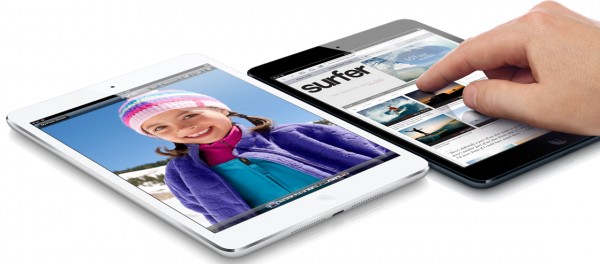
      Nearly two months ago, when forecasting that tablets would outsell laptops this year, NPD DisplaySearch dropped dirty data bomb: shipments of slates with 7-7.9-inch screens will eclipse larger ones. Now the analyst firm puts real numbers behind the prediction, and they are grim for Apple. Talk about mixed blessings. iPad mini sizzles, while iPad fizzles. The problem: Higher sales of one takes away from the other, rather than expands demand. As such, margins are lower for the important category, likely biting Macs, too.

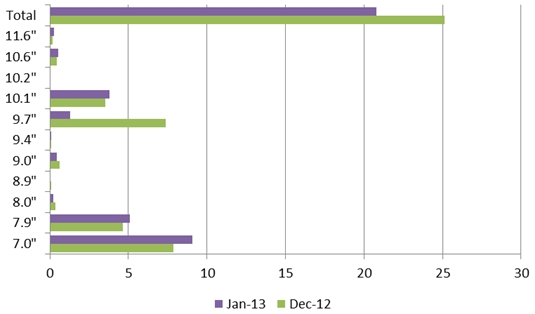
      Panel shipments reveal the trend, and it is dramatic in just one month. “Shipments of 9.7-inch tablet PC panels collapsed, falling from 7.4 to 1.3 million, while 7-inch and 7.9-inch panel shipments grew rapidly, from 12 to 14 million”, David Hsieh, NPD vice president, says. “Shipments of 10.1-inch panels grew only slightly” from December to January. Apple and Sony are the major manufacturers selling 9.7-inch tablets, the overwhelming majority iPad. Starting today, Sony sells the Xperia Tablet Z, in a move to 10.1 inches, but 9.7-inch volumes aren’t high enough to account for such a dramatic shift in panel orders.

      “Apple had planned to sell 40 million iPad minis (7.9 inches) and 60 million iPads (9.7 inches) in 2013”, Hsieh says. “However, the reality seems to be the reverse, as the iPad mini has been more popular than the iPad. We now understand that Apple may be planning to sell 55 million iPad minis and 33 million iPads in 2013. At the same time, Samsung, Amazon, Google, ASUS and Acer are all eyeing the 7-9-inch segment to grab tablet PC market share, while many white box makers in China are also emphasizing the smaller size tablet PC”.

      So Apple’s problem is two-fold: iPad mini saps margins, while competitors bring lower-cost models to market — and we saw plenty of those introduced at Mobile World Congress this week, including a $169 tablet from HP.

      Margin Math

      By my calculations, during calendar Q4, iPad average selling prices fell 12.3 percent quarter on quarter — from $535 to $467. But there’s more! During Apple’s earnings call in January, the CFO acknowledged: “We saw a reduction in our iPad ASPs of about $101 year-over-year in the December quarter — and you can see that, our iPad units grew faster than our iPad revenue in the December quarter”. He later added: “iPad mini gross margin is significantly below the corporate average”.

      As mini goes up, iPad goes down and overall margins with them. Combined, the two tablets make up Apple’s second-largest category by revenue, accounting for 18.9 percent during calendar Q4. Revenues rise with higher volumes, but margins decline in a critical segment that affects others.

      DisplaySearch predicts global tablet shipments will reach 240 million this year. Assuming Apple does 88 million, that’s 36.7 percent. But most of the growth is mini. During 2012, Apple shipped 65 million tablets, but, according to Hsieh, expects to move 55 million iPad minis this year. Do the math.

      Indications are strong that iPad mini cannibalizes the larger tablet’s sales, but the problem is much larger. During Q4, Mac sales fell about 1 million units short of Wall Street consensus. Apple’s excuse about late-delivery of the new iMac rings false, given how much higher are mobile volumes overall. More likely, iPad mini also robs Mac sales.

      Think about it. A family with three kids shops Apple Store looking for a new computer, as the old one, while still functioning, has lost its zip. For less than the cost of the lowest-selling iMac ($1,299), the parents can buy three iPad minis ($987) and three Logitech keyboard covers ($299.85) — $1,286.85. Each student now has a mini-computer and ebook reader usable individually and personalized to taste, rather than fighting over the main Mac, which can still be used on those occasions only a big screen will do.

      Cannibals Attack

      Apple CEO Tim Cook has repeatedly dismissed this scenario. January’s conference call:

      I see cannibalization as a huge opportunity for us. One, our base philosophy is to never fear cannibalization. If we do, somebody else will just cannibalize it and so we never fear it. We know that iPhone has cannibalized some iPod business. It doesn’t worry us, but it’s done that. We know that iPad will cannibalize some Macs that doesn’t worry us. On iPad in particular, we have the mother of all opportunities here, because the Windows market is much, much larger than the Mac market is.

      That’s a lovely misdirection. Apple sells Macs, not Windows PCs. While iPad and mini sales might hurt PC sales more, the market is larger. Meanwhile, mini takes money directly from Apple’s pocket, shifting sales from higher- to lower-margin products.

      Then there is DisplaySearch’s chilling forecast. Apple’s dominance in larger tablets is indisputable. But smaller slates nip overall market share. For example, Android tablet share surged past 50 percent during third quarter, according to IDC, largely because of smaller, lower-cost slates.

      DisplaySearch forecasts that tablets with 7-7.9-inch displays will account for 45 percent of shipments this year, while 9.7-inch slate share falls to just 17 percent. Selling price — $329 to $659 — compared to, say, $199 to $299 for Nexus 7 is iPad’s disadvantage. If Apple cuts prices to gain, or just keep, market share, more margins bleed out.

      I expect Cook to stand firm and use iPad mini sales’ success to benefit the broader iOS ecosystem, particularly based on past comments about cannibalization. Meanwhile, other areas of cannibalization work for Apple.

      “As the smart phone moves to larger sizes such as 5-6 inches, phablets — converged smart phone and tablet PC devices — could cannibalize the 7-inch tablet PC market”, Hsieh says. For those people complaining iPhone 5’s display (4 inches) is too small and iPad mini’s too large, perhaps there is sense to Apple’s approach. The separation should prevent the kind of cannibalization Hsieh warns about.