Category: News

  • Responding to Facebook’s lions: Stop friends using the apps

    Facebook has made changes to their privacy settings that have two major consequences. The first is that the default settings now share much more information. The second is that users can no longer protect their social network from Facebook’s “Applications”.

    Most of the media attention has been on how information is exposed to search engines such as Bing and Google. This is important, but there are complex workarounds. It’s not the most interesting or important consequence anyway.

    The more important consequence is that Facebook’s shady App vendors (see: Scamville Furor, Facebook and the eBay disease) can no longer be blocked from accessing a player’s social network. So every App vendor has access to all player “friends” and all of the information they in turn make available in their public profiles. Remember that most of those public profiles now contain a great deal of personal data.

    The Facebook Apps are “free”, but these vendors are not charities. They earn money by selling game goods, marketing extra-game services and products (some fraudulent), and by selling information. They will sell the social network information they harvest. They will also use that social network to find new “players” (aka “victims”).

    To understand this it helps to think of Facebook as the African plains. In this metaphor Facebook users are rhinos and zebras and Facebook App vendors are lions.

    Both rhinos and zebras graze on Facebook grass (photo sharing, social stories, contact information). They get along. So how are they different?

    The rhinos don’t do Apps and they restrict access to their personal information. They’re tough and nasty; they don’t directly feed lions. The zebras, however, do Apps, and they travel in herds. They’re sleek, soft and vulnerable. Find one, you can find more. Lions eat zebras.

    It’s messy for the zebras, but that’s how the market works. The Facebook ecosystem is a rich feeding ground, and lions have to eat.

    Of course the Facebook ecosystem is more complex. Facebook rhinos and zebras are often friends and family. Even though lions don’t eat rhinos, FB lions find rhinos through their zebra friends. They then sell Rhino locations (information) to big game hunters (banks?) who sell Rhino horns for fertility potions (risk profiles).

    The market world is different because rhinos and zebras can fight back. Not every vendor scores a 10 on Gordon’s scale of corporate evil; Google’s a mere 3 at the moment. There’s more than one way to make money – though the alternatives may mean a smaller IPO. On the other hand, Facebook’s current strategy runs the risk that IPO buyers will remember eBay.

    It’s not clear that there’s anything to be done about Facebook. The corporate culture there is probably too much like 1990s Microsoft or 2010 Goldman Sachs for them to find another road. I’ve stopped encouraging my friends to join up with Facebook.

    If you want to continue grazing Facebook’s grasslands however, and you don’t want to be lion fodder, there’s now only one possible response.

    Convert your zebra friends to rhinos. Get them to stop using Apps. If they persist in using Apps, unfriend them. They’re leading the lions to you.

    As of today, Facebook apps are the enemy.

    Update: Great comment from Nettie. She refers us to Brad Stone’s announcement of the EFF’s complaint to the FTC – cosigned by ten other privacy organizations …

    … Ten other privacy organizations signed the complaint, including the Privacy Rights Clearinghouse, the American Library Association and the Consumer Federation of America. The Office of the Privacy Commissioner in Canada has also been looking into Facebook’s privacy guidelines…

    I think it’s fair to say that the fan has been hit. Like Nettie, I’ve noticed people drifting away from FB …

  • Bulls: The World Is Coming Unglued, And We’re Down Less Than 1%

    spain-bullfighting.jpg

    We have to agree.

    In light of the numerous troubles we can identify today (Citi, the dollar, Greece, etc.) a decline of 1% or less in the market, after the huge move we’ve had this week, would definitely constitute a win.

    We’ve already heard it once on CNBC, and we expect to hear a lot of that today.

    Of course, if the wheels come off, then it doesn’t matter.

    Join the conversation about this story »

    See Also:

  • Konami announces new Yu-Gi-Oh game for DS


    Konami today announced another Yu-Gi-Oh game for the Nintendo DS: Yu-Gi-Oh! 5D’s World Championship 2010: Reverse of Arcadia. The game follows a story arc from the animated series involving the reprise of the Dark Signers and their

  • Amazon Associates Now Available for Google Blogger

    Google and Amazon have just announced a joint program which should come in handy for bloggers wanting to earn some money from their posts. Earlier this year the Google-owned Blogger introduced a Monetize tab to enable its users to easily add AdSense ads to their blogs. Now, it’s taking it one step further by partnering with Amazon to integrate the company’s Amazon Associates program with Blogger. This will allow users to easily ad links to products as well as earn a referral fee if any purchases are made from those links.

    “Today we launched a third option: direct integration with Amazon Associates to search Amazon’s product catalog and add links to products that earn you commissions when your readers buy products you recommend,” Blogger’s Rick Klau wrote. “[Y]ou can search the Amazon product catalog without leaving the Blogger interface and insert links to the products you find into your posts. Not only is the process of linking to products more efficient, but Amazon makes it easy for you to earn money whenever your readers actually buy the products you write about.”

    Blogger users interested in the new option will find it in the Monetization section which already features AdSense advertising options, as well as AdSense for Feeds. There is now a third tab, Amazon Associate… (read more)

  • Need some positive thoughts

    I don’t know if anybody can ooze some positive thoughts my way. I see them every day here, and it really helps. Sooo many of you put smiles on my face day after day after day. But I’m also involved with other local diabetics. I make friends with any I meet, and I lead a local support group. It’s a very small group, and it’s so very hard to get people to come. It’s even harder to get people to listen and to get them to do the things they need to do. People are so set in their ways.

    A couple of friends of mine are slipping, and it’s hard to watch. Dan is my age, has 1/2 a kidney left, weighs 412lbs, and shoots 40u of novarapid a meal. He’s a very talented musician – I’ll post a toob at the end. A couple of months ago he got told outright by his doc to lose 100lbs or else, so he finally decided to low-carb. He’s done well except for those oreo cookies he has to have. He calls me every few days, and we talk a lot. But he hasn’t called in almost 2 weeks now. I don’t have a good feeling about his chances.

    Wayne, a coworker, has had T2 for many years and is now insulin dependant. He’s probably a 1.5. He’s been fighting retinal hemms for the past three years. He had his second vitrectomy last week. It didn’t go well. As they sucked out the blood vessels, they pulled on the retina and caused more bleeding. It was such a mess in there. He’s scheduled to go back next month for a second cleanout if they settle down. He loves the outdoors. He hunts and fishes and drives his monstor pickup everywhere, even though he’s nearly blind. I’ve told him many times he needs to get his sugars down and to get off the fast carbs, but he can’t stand it when his sugars get below 11 mmol/l (200). He can’t give up his morning cereal, toast, oranges, apples, or his orange juice. It’s not an option. He’s as skinny as a rake and a great guy to be around. He’s had one heart attack already. I kind of hope he has another so he doesn’t have to go through what he’s going to go through with his eyes.

    No, I’m not a fan of diabetes.

    This video really doesn’t help YouTube – Tribute to Brian but there it is.

  • Stocking Stuffer for the Nut Lover: The Walnut Key

    2009_12_17-walnutkey.jpgThis is truly the trinket for the person who has everything (or maybe just that lucky someone with a big batch of red walnuts from the farmers’ market). But when we saw it, we thought it was an oh-so-lovely stocking stuffer that’s practical, too. There’s only one problem with the one pictured above.

    Read Full Post


  • The healing power of oatmeal, milk chocolate

    Guest contributor: Karen Collins, M.S., R.D., C.D.N.
    Karen Collins holds a B.S. degree from Purdue and an M.S. degree from Cornell, both in nutrition. When she’s not writing or speaking, she conducts a private nutrition practice in Jamestown, New York.

    Q: How much cholesterol-lowering power can I expect from one bowl of oatmeal a day?

    The best research linking oatmeal consumption and cholesterol levels shows drops of about 10 mg/dl in LDL (“bad”) cholesterol with a daily serving of three-quarters of a cup of quick or old-fashioned oats as measured before cooking. A standard serving, according to the label, starts with a half cup of oats, so the three-quarter cup would be one and a half servings.

    This amount of oats — equivalent to three packets of instant oatmeal — provides three grams of soluble fiber. Although oats’ fiber (beta-glucan) is established as effective in lowering cholesterol, research also supports aiming for soluble fiber from a variety of sources, such as barley, legumes and many fruits.

    According to the National Cholesterol Education Program, increasing consumption of soluble fiber by 5 to 10 grams a day can decrease LDL cholesterol about 5 percent. The program’s guidelines recommend aiming for a total of at least 5 to 10 grams of soluble fiber daily, and preferably 10 to 25 grams a day.

    So if two or three bowls of oatmeal is unrealistic for you, you could reach the overall target by combining options. For example, you get 2 grams of soluble fiber from each half cup of oats (measured before cooking), 2 or 3 grams from each half cup of kidney beans or other legumes, and 1 or 2 grams from each piece of fruit or each half cup of broccoli, carrots or some other vegetables.

    The amount your cholesterol drops will likely also depend on what foods oatmeal replaces: if it means you’re omitting some unhealthy foods like bacon and sausage or doughnuts, it may lead to a bigger change in blood cholesterol than if it replaces a generally healthy choice like a bowl of shredded wheat.

    Q: I hear so much about antioxidants in dark chocolate providing health benefits. Does milk chocolate really offer nothing?

    In equal size portions with equal calories, dark chocolate provides nearly three times the total antioxidant power that you get from milk chocolate, according to United States Department of Agriculture data. Studies show that the higher the nonfat cocoa solids, the higher the antioxidant compounds chocolate contains.

    But milk chocolate’s antioxidants are also significant. In fact, the ORAC score (a measure of antioxidant power) of milk chocolate is higher than that of red grapes, blueberries, nuts or almonds if you compare equal weights of all foods.

    But that’s not a fair comparison, since you’d get many times more calories getting those antioxidants from chocolate (whether milk or dark chocolate) than from fruit. Furthermore, although nuts are concentrated in calories, they provide additional benefits beyond their antioxidants, such as fiber, protein and other nutrients.

    To maintain a healthy weight most people should limit chocolate to small amounts daily so it will only provide a fraction of a day’s antioxidant total compared to antioxidants from vegetables, fruits, whole grain, beans, nuts and other selections such as tea or coffee. Bottom line: You get more antioxidants from dark chocolate, but if milk chocolate is your preference, enjoy it and keep your focus on a balanced diet for the health benefits.

    Q: Are tonic and club soda good low-sugar alternatives to regular soft drinks and sweetened mixers?

    A: Club soda is a zero-calorie, zero-sugar beverage. However, tonic is not. Even though it does not taste very sweet, 12 ounces of tonic — with 124 calories and 32 grams of sugar (8 teaspoons) — is only slightly lower in sugar’s empty calories than regular soft drinks, which may contain from 135 to 150 calories in the same portion.

    And choosing tonic saves nothing compared to sweet mixers like Collins mix. The big calorie savings with these drinks would be drinking your tonic with just a squirt of lime or lemon and omitting the alcohol. If you’re really trying to avoid concentrated sugar and calories, stick with club soda, unsweetened seltzer and sparkling water options.

    (This article was provided by the American Institute for Cancer Research in Washington, D.C. A registered dietician is available to respond to questions about diet, nutrition, and cancer at the free AICR Hotline at 1 (800) 843-8114 during business hours.)

    From the RSS feed of CalorieLab News (REF3076322B7)

    The healing power of oatmeal, milk chocolate

  • Citi Underwriters Step In To Prevent Stock From Falling Below $3

    Citi Blind

    Interesting footnote to the disastrous Citi offering (which Bob Pisani reminds us is the biggest equity offering in US history, so that’s awesome!): the underwriters had to step in and snap up shares to prevent the stock from going below $3.

    CNBC’s David Faber reported the news just now, and it may continue to spook the markets.

    If the stock does fall below $3 — and it certainly may, perhaps even today — it will signal that the decision to let Citi repay TARP was either woefully early or woefully late.

    Join the conversation about this story »

    See Also:

  • Financial Stocks Have Been Warning Of Trouble For Months

    Don’t be surprised by the surging dollar, and the absence of appetite for Citigroup (C) shares.

    Financial stocks have been acting ominously for a couple months.

    As a refresher, here’s a 3-month comparison of Goldman Sachs (GS) and the S&P 500.

    goldmanvsspchart

    Join the conversation about this story »

    See Also:

  • REPORT: Suzuki CEO indicates joint projects with VW to start in January

    Filed under: , , , ,

    Volkswagen and Suzuki won’t waste anytime at all in getting started on their assorted joint projects. Well, unless you count the holidays, which we’ll let slide. At the launch of the new Suzuki Alto, CEO Osama Suzuki told reporters that the newly tied-at-the-hip automakers will begin “Actual, detailed execution – with our people going there and their people coming here… after January.”

    That first project will be a new small car that will be sold in developing countries, which may or may not be outsourced from Suzuki’s Indian Maruti operations and is rumored to cost between $4,300 and $5,400.

    Volkswagen has much less experience in building small cars than Suzuki, which is a leader in Japan’s tiny Kei car class, and in making money with such low prices.

    [Source: Automotive News – Sub. Req’d]

    REPORT: Suzuki CEO indicates joint projects with VW to start in January originally appeared on Autoblog on Thu, 17 Dec 2009 09:00:00 EST. Please see our terms for use of feeds.

    Read | Permalink | Email this | Comments

  • Integrity: Without It Nothing Works

    Published: December 17, 2009
    Paper Released: November 2009
    Author: Michael C. Jensen

    Executive Summary:

    “An individual is whole and complete when their word is whole and complete, and their word is whole and complete when they honour their word,” says HBS professor Michael C. Jensen in this interview that appeared in Rotman: The Magazine of the Rotman School of Management, Fall 2009. Jensen (and his coauthors, Werner Erhard and Steve Zaffron) define and discuss integrity (“a state or condition of being whole, complete, unbroken, unimpaired, sound, in perfect condition”); the workability that integrity creates for individuals, groups, organizations, and society; and its translation into organizational performance. He also discusses the costs of lacking integrity and the fallacy of using a cost/benefit analysis when deciding whether to honor your word. Key concepts include:

    • The personal and organizational benefits of honoring one’s word are huge—both for individuals and for organizations—and generally unappreciated.
    • We can honor our word in one of two ways: by keeping it on time and as promised, or if that becomes impossible, by owning up to the parties counting on us to keep our word in advance and cleaning up the mess our failure to keep our word creates in their lives.
    • By failing to honor our word to ourselves, we undermine ourselves as persons of integrity, and create “unworkability” in our lives.
    • Integrity is a necessary but not sufficient condition for maximum performance.
    • There are unrecognized but significant costs to associating with people and organizations that lack integrity.

    Abstract

    There is confusion between integrity, morality and ethics. In our much longer paper on the topic—see “Integrity: A Positive Model that Incorporates the Normative Phenomena of Morality, Ethics and Legality” (available at http://ssrn.com/abstract=920625)—my co-authors and I distinguish integrity from morality and ethics in the following way. Integrity in our model is honoring your word. As such integrity is a purely positive phenomenon. It has nothing to do with good vs. bad, right vs. wrong behavior. Like the law of gravity the law of integrity just is, and if you violate the law of integrity as we define it you get hurt just as if you try to violate the law of gravity with no safety device. The personal and organizational benefits of honoring one’s word are huge—both for individuals and for organizations—and generally unappreciated.
    6 pages.

    Paper Information

  • Copenhagen Climate Conference: Day 10

    dec16-copenhagen Copenhagen Climate Conference: Day 10


    The possibility of agreement in Copenhagen is all but lost. As world leaders arrived at the UN Climate Change Conference, there ultimately may be nothing for them to vote on.


    As protestors outside the Bella Convention Centre were doused in pepper spray beaten with batons and 230 of them arrested and detained, inside negotiators still dealing with core issues debated until just before dawn, without setting new goals for reducing greenhouse gas emissions or for financing poorer countries efforts to cope with climate change, which are viewed as the two key elements if any deal is to be reached.


    “We are extremely disappointed” said Ian Fry, from the tiny Pacific nation of Tuvalu. “I have the feeling of dread, we are on the Titanic and sinking fast. Its time to launch the lifeboats” he added.


    After nine days of largely unproductive talks, the lower-level delegates are wrapping up the first phase of the two week conference and handing off the disputes to environment ministers in a critical second phase.


    While there are reports of a new proposal on its way to the conference, any deal is going to be subject to China agreeing to one key point – third party confirmation. Something they are not willing to consider.


    It may sound very obtuse to suggest that this conference, billed as the most important the world has ever seen, all the hype and fanfare under which it started will come to one single point. Unless China, the worlds largest polluter comes on board, then what is the point?


    And as of early this morning, China is not changing its position, stating they no longer see a possibility of achieving an operational accord to tackle global warming. Suggesting “a short political declaration of some sort”. It would appear that China has left the building, at least mentally, if not physically.


    The U.S. has put its position on the table – 17% cut from 2005 levels by 2020 – a far cry from the 34% cut developing countries are looking for. The US also signalled a willingness to pay their “fair share” into a 10 billion US dollar fund to help developing countries. They also stressed that President Barack Obama won’t be bringing anything to the talks beyond what has been promised. “We don’t want to promise something we don’t have” said Todd Stern, chief of the US delegation.


    The US, the worlds second largest polluter, has the loudest voice when it comes to calling on China to allow inspectors in to verify that reductions are being made. The US does not believe they would be able to get any change through the House and Senate without China agreeing to inspectors.


    With less than 48 hours to go, unless these two countries can find some common ground, the possibility of any substantial deal is looking very grim indeed.

    share:

    E-mail this story to a friend!
    Digg
    del.icio.us
    Facebook
    Mixx
    Google
    StumbleUpon
    Technorati

    related.posts:

    1. Copenhagen Climate Change Conference: Day 8 Recap
    2. Copenhagen Climate Conference: Day 4
    3. Copenhagen Climate Change Conference: Week 1 Round-Up


  • Amateur Artist Wants To Ban All Sales Of Old Baltimore Ravens Game Films Over Logo Copyright

    Copycense points us to an ongoing lawsuit by a guy seeking to bar the Baltimore Ravens and the NFL from making use commercially of any game involving the Ravens from 1996 to 1998. At issue was that this guy claimed his logo design was copied by the team. A few years back, William Patry detailed the ridiculousness behind the original lawsuit and how it had resulted in many more ridiculous lawsuits:


    Bouchat, a security guard in Baltimore, believed that the Baltimore Ravens had infringed a design he claims to have created for the team’s logo. He sued the team and the NFL’s licensing arm. In my opinion, there was no evidence of access and the thus the case should have been summarily dismissed. In my opinion, the case was a shakedown. But, applying the fatally flawed theory of striking similarity, the case went to a jury. The jury found liability, and the Fourth Circuit affirmed in an awful decision that drew an excellent dissent by Judge King, 228 F.3d 489 (4th Cir. 2000), amended by and pet. for reh’g en banc denied. 241 F.3d 350. Judge King’s dissent is the best thing yet written on why striking similarity is inherently inconsistent with basic copyright principles, and as to the facts in Bouchat, devastating to the plaintiff’s claim and the majority opinion.

    While Bouchat “won,” he wasn’t given any money, because he had failed to register his design before it was put into use. But he’s since sued various other companies, and this latest lawsuit is an attempt to say that no one can show those old films because they use “his” logo, despite the lack of evidence of actual copying (which, if copyright were actually about copyright would be necessary). The lower court turned him down, noting that the use of the logo was incidental and fair use, but Bouchat is (of course) appealing. This is, again, in line with Patry’s analysis that this is nothing more than a shakedown. He’s not really interested in stopping the sale of these videos. He wants the team to pay him a big chunk of money so that it can keep selling the videos. This is not what copyright is intended to do, but it’s what happens when copyright law gets out of control.

    Permalink | Comments | Email This Story


  • DIY Recipe: Peppermint Schnapps

    121709-cocoa.jpg Though we’ve already tickled your taste buds with a peppermint mocha, some might like their peppermint without a side of coffee. Instead, make your own peppermint schnapps, a perfect addition to some hot cocoa enjoyed by a warm fire this holiday season.

    Read Full Post


  • London: Solidarity with the arrested, against police violence! Demo @ Danish embassy 4pm onwards, 17 December 2009

    from various sources, 17 December 2009: “There will be a mass demonstration outside the Danish Embassy in London in solidarity with those unlawfully arrested and detained in Copenhagen during the Climate Summit protests. Today on Thursday the 17 December from 4pm onwards. The address of the embassy is: 5 Sloane Street, London SW1X 9SR. Nearest tube Knightsbridge.

    As many people as possible need to turn up to protest at the Danish state’s appallling treatment of climate protesters and its denial of free speach. Spread the word far and wide!” more

  • Russia's DST Now Owns 5 Percent of Facebook

    With 350 million users worldwide, an estimated $500 million in revenue this year and positive cash flow, Facebook is looking pretty good at this point to any investor. The company though isn’t really looking for new capital and an IPO is still quite a way off. For a determined investor though, these problems can be overcome, and Russian investment company Digital Sky Technologies seems to be one. It bought a small stake in Facebook last summer, 1.96 percent, and then continued to acquire common stock from employees or other shareholders to the point that DST is now said to own more than 5 percent in the social network.
    Russian business newspaper Kommersant cites [translated] an unnamed inside source which claims that, not only DST now has a more than 5 percent stake, it is looking to increase it further with additional purchases. This means that DST’s stake is now three times larger than Microsoft’s, which owns just 1.6 percent purchased at a whooping $15 billion valuation.

    DST paid $200 million for its initial stake in a deal which valued Facebook at $10 billion. At the time, it had the option to purchase an additional $100 million-worth of common stock at a lower $6.5 billion valuation, coming in at $14.77 per share. It quickly gobbled up the new shares, which meant it owned a further 1.53 percent in Face… (read more)

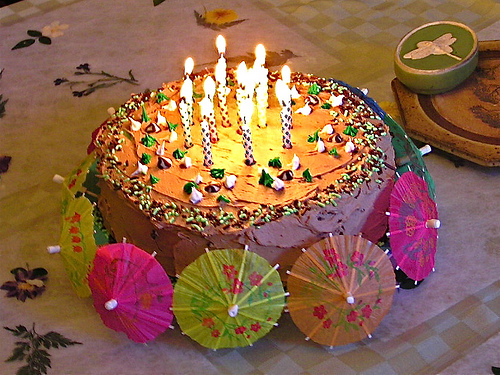
  • Why Do We Put Candles On A Birthday Cake?

    In ancient times there was a prevalent belief that birthdays were a time of potential danger.  This originated within Greek culture, where both birth and birthdays were regarded as a time when the Gods may take your soul.  

    Consequently, when a Greek child had a birthday, s/he was given a little cake with a candle.  The gods were asked for protection and the candle was then blown out.  The Greeks believed that the smoke from the candle would carry the message to the gods and the child would be spared to continue living.

    This tradition has survived to present day culture, where candles are still placed on a birthday cake.

    Not all cultures embrace this tradition and some religious people feel that the act of ‘making a wish’ before the candles are blown out, is in fact an act of sacrilege and so they do not participate in this aspect of birthdays.

  • The 15 Blown Tech Deals Of The Decade (MSFT, YHOO, GOOG, AOL)

    jerry yang steve ballmer steve case aol time warner photoshopThe decade is littered with huge deals that could have changed the business world, but for whatever reason, never materialized.

    Consider…

    • What would have happened if Google bought Friendster?
    • …if Verizon hadn't shunned Apple for the first iPhone?
    • …if Comcast bought Disney for $54 billion instead of later buying NBC?

    Of course, the king of all could've, should've during the decade was Yahoo.

    Yahoo almost bought Google and Facebook. Then it spent all of 2008 rejecting an acquisition offer from  Microsoft.

    After Yahoo, the decade's next biggest waffler was Viacom.

    Viacom flirted with Facebook and MySpace, hoping either would recharge its flagging MTV brand on the web. It didn't happen. MySpace was bought by News Corp. who may have killed it by forcing the social network to focus on revenue not user experience.

    Take a look at 15 big tech deals that fell apart this past decade →

    Join the conversation about this story »

    See Also:

  • Jobless Claims Jump to 480,000 Come In Worse Than Expected

    pinkslip tbi

    Jobless claims jumped 7,000 to 480,000, coming in a bit worse than expected.

    This number isn’t wildly telling one way or another, except that we’re still clearly lacking signs of solid, continued improvement.

    It doesn’t seem to be affecting the market much. The market is tanking, but the surging dollar and the weak Citi offerings are likely the main culprits.

    Join the conversation about this story »

    See Also:

  • The Carry Trade: Now New-And-Improved!

    Yen Dollar

    Researchers at the University of California have found that the carry-trade, whereby money is borrowed in low-yielding currencies in order to buy high-yielding ones, has actually been a pretty effective source of stable returns for those willing to do it.

    Which is peculiar given that, if it’s such a good deal, one would expect the market to arbitrage away these returns as more and more investors piled in.

    Yet beyond these researchers’ conclusion that the carry trade has been relatively successful, they also took their analysis a step further. They claim to have a model whereby the carry trade yields even more stable returns over time — by simply avoiding the large losses that can happen from time to time.

    Even if you aren’t convinced that this research could play out as well in the real world, which is usually the case, such thinking shows how the carry trade won’t go away any time soon. So don’t fight it, ride it.

    The Economist: The authors first examine returns to a simple carry trade for a set of ten rich-country currencies between 1986 and 2008. Buying the highest yielder of any currency pair produced an average return of 26 basis points (hundredths of a percentage point) per month. That would be fine, except that the standard deviation of returns, a gauge of how variable profits are, was almost 300 basis points. The monthly Sharpe ratio that measures returns against risk was a “truly awful” 0.1 (the higher the ratio, the better the risk-adjusted performance). Worse still, the distribution of monthly profits was negatively skewed: big losses were more likely to occur than windfall gains.

    No sane trader would follow a rule with such poor results. So the authors put together a far richer model to help decide which side of a currency trade to be on. It included things that are most likely to influence short-term movements in currencies, such as the change in the exchange rate over the previous month, as well as the size of the interest-rate and inflation gap between each currency. They found that all three factors mattered. Currencies that rose in one month tended to rise in the next month. Those with the highest interest rates went up most, as did currencies with high inflation (which drives expectations of further rate rises).

    These impulses can drive exchange rates a long way from their fair or “equilibrium” values. That creates the risk of a sudden reversion that could wipe out earlier profits. To guard against this, the authors added to their model a measure of how far the exchange rate has shifted from its fair value. They found that this alarm bell can sometimes turn a “buy” signal into a “sell”.

    Read more here.

    Join the conversation about this story »

    See Also: