Category: News

  • SoloPower looking more and more like Solyndra

    It’s an easy comparison to make. Solar startup SoloPower is developing a solar material similar to the now defunct infamous Solyndra, and like Solyndra its also got federal and state incentives as well as venture capital funding. But now SoloPower is beginning to struggle like Solyndra, too, and according to the Oregonian has done layoffs, is restructuring, and even renegotiated its loan with the Department of Energy. SoloPower confirmed the layoffs.

    SoloPower said in late September 2012 that it had started up its large factory in Portland, Oregon. SoloPower CEO Tim Harris told us at the time that he expected the company to produce 20 MW – maybe 30 MW — of solar panels per year by the end of 2012 and ship 2 to 5MW of solar panels during the fourth quarter. In SoloPower’s confirmation of the layoffs this week, the company says it “will begin commercial shipments to customers this month.”

    But according to The Oregonian, SoloPower is looking to sell millions of equipment from its headquarters in San Jose, Calif., it’s seen the departure of high-level executives like the CTO in recent weeks, and the managing director of SoloPower’s lead investor Hudson Clean Energy Partners recently resigned. These are all worrisome signs for a startup that has raised over $200 million in funding. The factory originally was supposed to be 400 MW factory and cost $350 million.

    SoloPower was awarded a $197 million federal loan guarantee to help it build out the factory. That’s the same program that funded Solyndra.

    Related research and analysis from GigaOM Pro:
    Subscriber content. Sign up for a free trial.

  • Kaiser Permanente Ventures and CHV Capital Back Health Catalyst

    Health Catalyst, a Salt Lake City-based data warehousing company that’s focused on healthcare, has added $8 million to its Series B round, care of Kaiser Permanente Ventures and CHV Capital. Previously, the company had raised $33 million for its Series B, from investors that include Norwest Venture Partners, Sequoia Capital and Sorenson Capital.

    PRESS RELEASE:

    Health Catalyst, the leader in healthcare data warehousing, announced it has increased its Series B round by $8 million, with participation from Kaiser Permanente Ventures and CHV Capital, a venture capital fund guided by the strategic objectives of Indiana University Health, Indiana’s largest health care system.

    The Health Catalyst platform represents a paradigm shift in the rapidly growing market for healthcare performance improvement. The company’s agile, healthcare-specific data warehousing platform enables hospitals and health systems of any size to respond to the evolving shift from fee-for-service to value-based reimbursement, and more easily manage patient populations under new care models.

    Coming on the heels of a $33 million investment in December by Norwest Venture Partners, Sequoia Capital and Sorenson Capital, this latest financing bolsters Health Catalyst’s ability to invest in development, services, and people to support its clients as well as strengthen its ties to industry-leading health systems.

    “Kaiser Permanente Ventures’ mission to partner with entrepreneurial companies to advance clinical quality, service and affordability closely matches Health Catalyst’s own goals to help hospitals standardize around the safest, most effective care practices while also reducing inefficiencies,” said Dan Burton, Chief Executive Officer of Health Catalyst. “Like Kaiser Permanente Ventures, CHV Capital represents an ideal partner for Health Catalyst — a strategic investor with direct ties to one of the country’s most innovative, data-driven health systems. In addition to gaining a financial partner in CHV Capital, our commercial and development relationship with Indiana University Health will enable both organizations to accelerate our shared goal of being leaders in delivering patients the highest quality of care through the most cost efficient means possible. We are excited to welcome both investors and look forward to leveraging their organizational expertise and resources to help take Health Catalyst to the next level.”

    Todd Cozzens, a Partner at Sequoia Capital and a Health Catalyst board member, said, “These strategic relationships with Kaiser Permanente Ventures and CHV Capital will lead the way to major innovations for the US healthcare system. Every hospital and health system is coming to understand that having an electronic health record is not enough. They need a fast, agile, healthcare-specific data warehouse to organize, visualize and utilize all of the data at their fingertips and address the shift to risk-based contracting and quality performance. Health Catalyst has proven with several leading health systems that its technology and management team will deliver every time.”

    Kyle Salyers, Managing Director at CHV Capital, said, “Healthcare data warehousing and analytics is a necessity in order to succeed in the future of healthcare. It will bring actionable information to the point of care and to administrative leadership. We and our colleagues at IU Health see Health Catalyst as the market leader in delivering a data warehousing platform and analytic accelerators with scale, flexibility, speed to deployment, and ultimately a tangible return on investment.”

    Health Catalyst’s technology platform can be implemented in a matter of months and enables hospitals of all sizes to better leverage their investments in electronic health records (EHRs) to more effectively measure quality outcomes, meet regulatory and financial incentive reporting requirements, and eliminate waste.

    Health Catalyst technology is utilized in the care of more than 20 million patients, including at Allina Health, Indiana University Health, MultiCare Health System, North Memorial Health Care, Providence Health & Services, Stanford Hospital and Clinics, and Texas Children’s Hospital.

    About Kaiser Permanente Ventures Kaiser Permanente Ventures, the corporate venture capital arm of Kaiser Permanente, makes investments in medical device, diagnostics, healthcare services and information technology companies that advance the quality and affordability of health care. Since its inception in 1997, Kaiser Permanente Ventures has invested in more than 40 venture-capital backed companies at all stages of development, and contributed organizational expertise, time and resources to the success of these companies. For additional information please visit www.kpventures.com.

    About CHV Capital A return-driven venture capital fund, CHV Capital, Inc. (CHV) is guided by the strategic objectives and mission of Indiana University Health, Indiana’s largest health care system. These objectives include fostering economic development and the life sciences in Indiana. CHV Capital, Inc. actively seeks syndication investment opportunities, particularly with Midwest institutional investors. We engage only in investment opportunities where CHV management, boards and partners are uniquely positioned to add value.

    About Health Catalyst Based in Salt Lake City, Health Catalyst (formerly Healthcare Quality Catalyst) delivers a proven, agile data warehouse platform that actually works in today’s transforming healthcare environment. Currently over 20 million patients utilize Health Catalyst’s Adaptive Data Warehousing platform and solutions. Founded by healthcare veterans who developed their solution after struggling for years to try to make non-healthcare data warehousing solutions work, the Health Catalyst data warehouse utilizes an adaptive approach designed specifically to address the complex nature of healthcare data. Health Catalyst’s platform combines technology solutions and clinical expertise borne out of repeated successful implementations that significantly improved quality of care and reduced healthcare costs. Health Catalyst’s proven solutions are deployed at leading health systems including Allina Health, Indiana University Health, MultiCare Health System, North Memorial Health Care, Providence Health & Services, Stanford Hospital and Clinics, and Texas Children’s Hospital. Visit www.healthcatalyst.com, and follow us on Twitter.

    The post Kaiser Permanente Ventures and CHV Capital Back Health Catalyst appeared first on peHUB.

  • avast! 8 is available — get it NOW!

    AVAST Software has announced the public availability of avast! 8, which now comes in four main flavors: avast! Free Antivirusavast! Pro Antivirus (from $39)avast! Internet Security (from $49) andavast! Premier (from $69).

    The suites all have a new touch-optimized, Windows 8-style interface. And they also include Software Updater, a tool which automatically checks for updates of the most commonly-exploited apps (Adobe Reader, Adobe AIR, Flash, Java, browsers and so on), as well as a simple Browser Cleanup app to help you review your browser add-ons, and remove or disable any you don’t want.

    Improvements behind the scenes see avast! 8 better able to detect and block not just one the one particular sample you’ve encountered, but also many similar files, and even entire malware families.

    AVAST’s Ondrej Vlcek claims this new technology “helps create much more efficient definitions, which can often protect against vast sets of malware, including unknown ‘zero-day’ malware, without the risk of generating false positives.”

    Avast! 8 also introduces a new detection engine which monitors suspect files in an isolated environment before you’re able to execute them, is better able to monitor what they’re doing, and, avast! says, will “help users make more intelligent decisions, whether files running in the sandbox are malicious or not”.

    And also new this time is the avast! Premium suite, which has all the regular avast! Internet Security features (antivirus, browsing protection, firewall, antispam) and adds additional tools of its own. So your money gets you extras like the automatic installation of any Software Updater upgrades; AccessAnywhere (remotely control your PC from across the internet); an ad blocker, and a Data Shredder to securely wipe confidential files.

    Will these features really be enticing enough to tempt the masses? We’re not quite sure, but even if you’re sticking to avast! Free Antivirus 8, there’s plenty to explore. We like the new interface, the Software Updater is useful, Browser Cleanup is helpful for beginners, and it’s still one of the best free antivirus tools around.

    Photo Credit: Andrea Danti/Shutterstock

  • 4.5-inch polycarbonate iPhone rumored for 2014 launch

    iPhone 6 Release Date
    Apple (AAPL) reportedly has a completely redesigned low-end iPhone in the works set to launch some time next year. Japanese blog Macotakara, which has reported accurate details surrounding unannounced Apple products in the past, claims that this new iPhone will feature a polycarbonate body similar to the material used on Apple’s discontinued base-model MacBook laptop. The new handset will supposedly feature a larger 4.5-inch display and will be slightly thicker than current iPhone models as well. Apple reportedly hopes to hit a retail price point of $330, which is significantly lower than the $650 unsubsidized price of the current iPhone 5.

  • Court: Google Can’t Be Forced To Filter Every Uploaded Video

    Back in 2006, a video was uploaded to YouTube featuring a group of school kids bullying an autistic child. Three Google executives – David Drummond, Peter Fleischer and George Reyes – were convicted in 2010 by a judge in Milan on grounds of “failure to comply with the Italian privacy code,” though Google said it removed the video after being notified, and worked with Italian authorities to help ID he person responsible for uploading it.

    “In essence this ruling means that employees of hosting platforms like Google Video are criminally responsible for content that users upload,” wrote Matt Sucherman, Google VP and Deputy General Counsel – Europe, Middle East and Africa at the time. “We will appeal this astonishing decision because the Google employees on trial had nothing to do with the video in question.”

    Fast forward to this past December when the decision was overturned, and the execs were acquitted. Details of the ruling have now been made public, as Reuters reports, saying that the court ruled “Internet platforms like Google cannot be forced to filter every video uploaded by users without endangering freedom of thought and their own functionality.”

    Had the decision gone the other way, it could have had huge ramifications for the web, social media and user-generated sites. How many executives want to risk going to prison because of something a total stranger uploaded to their site? How many executives of such services would already be in danger of facing such action?

    So, yeah, we’ll chalk this one up as a win for the Internet.

  • Barnes & Noble Took A Hit During The Holidays, Nook Suffered The Most

    After the holidays, Barnes & Noble said that sales of its Nook hardware and eBook business were both starting to fall. In fact, Nook revenues reportedly dropped 12 percent in the time leading up to the holidays. Now the company’s third quarter results are out, and it’s not pretty.

    Reuters reports that Barnes & Noble posted a net loss for its third quarter, which includes the holiday shopping season. Its retail business posted a 2.2 percent loss. That was nothing compared to its Nook business, however, as it took a massive $190.4 million, or 25.9 percent, loss.

    Barnes & Noble founder and Chairman Leonard Riggio wants to buy the retail bookstore business, but he would leave the company’s Nook and textbook business to fend for itself. After splitting off the Nook business from its retail business, it received a few substantial investments from companies like Microsoft. It may need more of that to stay afloat until it can get its groove back.

    Analysts are saying that will be difficult though. They call Nook’s ability to compete with Google, Amazon and Apple into question as its tablets lack many of the apps that make tablets from the former more popular. Morningstar analyst Peter Wahlstrom seemingly suggests that the Nook business should be sold, but says that “the window of opportunity” to do so is closing.

    Despite all this, Barnes & Nobile CEO William Lynch says the company is still committed to its Nook business. What that means for the future of Nook, especially if Riggio is able to buy back the retail business, remains to be seen.

    The most likely scenario to emerge from all this is Nook abandoning or selling off its hardware business, and focusing exclusively on its software/eBook business. Even then, the subsidiary could be bought up by somebody else for its massive selection of eBook titles. My money is on Microsoft as it needs to better equip Windows 8 in the fight against Apple, Google and Amazon. A collection of exclusive eBooks could be just the thing Windows 8 needs.

  • Sketchers Controversy: “Daddy’$ Money” Design Offends

    Sketchers has come up with some new shoe designs aimed at teen girls, and parents aren’t happy with the way they’re being marketed.

    “Daddy’$ Money” is the name of the line, and the whole premise of the idea seems to be that Sketchers wants their teen fans to run to Daddy with their hand out. Some of the design names are questionable, too, such as a floral sequined pair called “Gimme“.

    “It’s so bad that if it were a Saturday Night Live sketch — it would be hilarious. But it’s not. It’s real. And I had to watch it all the way through twice before it started to sink in that people were seriously trying to sell this garbage to my daughter,” a blogger who goes by the name of Lydia wrote.

    Indeed, the ad for the shoes is receiving quite a bit of backlash as parents question what the company is trying to accomplish. The fact that the shoes feature a built-in “secret” wedge is not lost on consumers, either, who say that trying to give sex appeal to footwear for teen girls is not okay.

    “Are we teaching them that they need to be taller? So that what? They appear to be thinner? Because whatever their size or height or body type, it’s wrong,” Lydia says.

    Parenting coach Tammy Gold agrees. “The whole aspect of self-worth is off in this because you want to motivate children, especially in this day and age, to do for themselves, to be independent, to get things for themselves, to earn [money] one day,” she said. “All of this is saying the opposite.”

    Twitter had quite a bit to say about the ad, as well. As for Sketchers, they insist that no harm was meant in the concept of the shoes.

    “The Daddy’s Money name and the collection’s advertising are designed to be fun and lighthearted,” the company said. “We regret that some people have been offended by the name.”

    Image: Sketchers

  • Michelle Obama: The Business Case for Healthier Food Options

    Ed. note: This op-ed by First Lady Michelle Obama was first published by the Wall Street Journal

    For years, America's childhood obesity crisis was viewed as an insurmountable problem, one that was too complicated and too entrenched to ever really solve. According to the conventional wisdom, healthy food simply didn't sell—the demand wasn't there and higher profits were found elsewhere—so it just wasn't worth the investment.

    But thanks to businesses across the country, today we are proving the conventional wisdom wrong. Every day, great American companies are achieving greater and greater success by creating and selling healthy products. In doing so, they are showing that what's good for kids and good for family budgets can also be good for business.

    Take the example of Wal-Mart. In just the past two years, the company reports that it has cut the costs to its consumers of fruits and vegetables by $2.3 billion and reduced the amount of sugar in its products by 10%. Wal-Mart has also opened 86 new stores in underserved communities and launched a labeling program that helps customers spot healthy items on the shelf. And today, the company is not only seeing increased sales of fresh produce, but also building better relationships with its customers and stronger connections to the communities it serves.

    read more

  • Google CFO admits Motorola’s phones haven’t had a ‘wow’ factor

    Google Motorola Phonea
    A Google (GOOG) executive revealed that Motorola’s current and upcoming line of devices don’t include anything that would “wow” consumers. Speaking at the Morgan Stanley Technology Conference on Thursday, Google’s chief financial officer Patrick Pichette said the company inherited a pipeline of unimpressive products, at least by Google’s standards.

    Continue reading…

  • Facebook Promotes Graph Search to the Less Than 0.1% of Users with Graph Search

    Let’s just say that Facebook has 1 billion MAUs. Yes, they announced that milestone a little while back so they most definitely have a few more than that, but for the purposes of this calculation just indulge me. Ok, 1 billion active users.

    In a blog post today, Facebook says that hundreds of thousands of people are currently using the beta of Graph Search, Facebook’s new in-site search product that the company unveiled in the middle of January.

    So, hundreds of thousands – no more specific that that. That could mean 200,000 or 900,000. Since we know that about 100,000 were given Graph Search at the onset – well that tells us nothing really. We don’t know exactly how fast Facebook is rolling it out. But I think we’re safe in saying that the current number of Graph Search users is probably closer to 200,000 than 900,000.

    But even if we go for the highest possible number, that still means that only 0.09% of Facebook users have been given Graph Search.

    Facebook said that the rollout would be slow. Very slow. So you really shouldn’t be surprised if you haven’t been called up to participate in the beta quite yet. But Facebook is pushing the new feature pretty hard considering a microscopic portion of the Facebook population even knows what the hell they’re talking about.

    Today, the company shared some of its favorite searches from the roughly 6 weeks that Graph Search has existed. Not the most popular, mind you. Just some of the favorites.

    Facebook says that people are using Graph Search to find out stuff about their friends, as such:

    And people are using it to find photos, like this:

    Facebook also highlights Graph Searches related to trip planning like “Ski resorts my friends have visited,” and interest discovery searches like “TV shows liked by my friends.”

    Strangely, they don’t get into any of the more adventurous ways that people are using the new product. I know, there are just too many lingering privacy concerns for that sort of tomfoolery. Although, Facebook has attempted to mitigate those worries by taking steps to protect minors when it comes to creepy old dudes searching for their info on Graph Search.

    But what Facebook is highlighting is beside the point. It’s why – considering that pretty much nobody has Graph Search right now.

    I haven’t found myself using Graph Search all that much (yes, I have it), except in researching stories and/or the occasional oddity query. I was helped by its cross-matching abilities once, with a “people who are friends with both me and John Smith.” That particular search helped me remember the name of a person I talked to a bar one night then drunkenly forgot their name. So that was cool. Graph Search has its uses, and some kinks. But that’s to be expected, as it’s a beta.

    Plus, I’m just one guy with one experience. Sure, writing about Facebook all the time means that I’m probably more likely to use Graph Search than the average person (at least right now). But even still, it’s really really early in the game to try and pick a winner or a loser.

    But with all this promotion to a very limited subset of users, is Facebook just trying to create buzz? Are they not seeing the early adoption they were looking for? Are they trying to kickstart usage for a project that went too far off the rails of what most Facebook users really care about (the news feed, photos, the news feed, photos, and the news feed)?

    Anyway, it’ll be nice to hear from Facebook on how users are taking advantage of Graph Search when more than 0.02% have had the chance to look at it.

  • Giant Planet Formation May Have Been Spotted

    Astronomers have found what could be the first-ever sighting of a planet forming while still in the midst of a dust cloud surrounding a star.

    The object, which orbits the star HD 100546, is only 335 light-years from Earth and appears to be a gas giant. If the findings, published this week in Astrophysical Journal Letters, are confirmed, they could provide evidence for hypotheses about how planets form.

    “So far, planet formation has mostly been a topic tackled by computer simulations,” says Sascha Quanz, lead researcher on the project and a scientist at ETH Zurich. “If our discovery is indeed a forming planet, then for the first time scientists will be able to study the planet formation process and the interaction of a forming planet and its natal environment empirically at a very early stage.”

    For now, the planet has only been detected by the European Southern Observatory’s (ESO) Very Large Telescope as a blob orbiting within the star’s accretion disc. The research team also detected “structures” in the dust cloud near the object as well as an increased temperature that could be caused by planet formation. Current planet-formation hypotheses hold that planets form from the gas and dust that are left over after a star forms.

    “Exoplanet research is one of the most exciting new frontiers in astronomy, and direct imaging of planets is still a new field, greatly benefiting from recent improvements in instruments and data analysis methods,” said Adam Amare, a member of the research team. “In this research we used data analysis techniques developed for cosmological research, showing that cross-fertilisation of ideas between fields can lead to extraordinary progress.”

    (Image courtesy ESA)

  • CNIL: Google Will Be Called Upon In ‘Coming Weeks’ For Privacy Action

    Earlier this month, French privacy watchdog CNIL was pressing Google on privacy changes again, putting out a statement saying it was determined to act and pursue investigations.

    At the time, Google shared the following statement (via TechCrunch):

    “Our privacy policy respects European law and allows us to create simpler, more effective services. We have engaged fully with the CNIL throughout this process, and we’ll continue to do so going forward.”

    Now, The Telegraph is reporting that CNIL said Google will be called to appear in “the coming weeks” and could face “repressive action” if failing to give “precise and effective” responses to its privacy recommendations.

    This is all related to the big privacy policy consolidation that Google implemented last year, which makes it possible for the company to use data from one of its services to improve the experience of its other services. I’m sure you recall the story.

    In October, CNIL announced recommendations for clearer information for people regarding the policy, and for Google to give users more control over the combination of data from its various services.

    Friday will mark one year since the new policy went into pace.

  • BlackBerry Winning Customers Abroad, But Will US Follow?

    If your company had gone from industry titan to afterthought in a few short years, you’d be eager to brag about any positive development. So it’s understandable that BlackBerry would want to talk about any BlackBerry 10 success this week while at Mobile World Congress. While they didn’t provide any specific sales numbers — we’ll have to wait for the next quarterly report for that — they did provide what appears to be a significant data point.

    According to VP of global sales Rick Costanzo — via FierceWireless — about a third of people purchasing the BlackBerry Z10 in its 50 current markets have switched from other platforms. That is quite encouraging indeed. After hemorrhaging customers to other platforms for years, BlackBerry absolutely needs to win back some previous customers. According to Costanzo, that’s exactly what’s happening. That has to be a somewhat encouraging sign for BlackBerry, especially so early in its campaign.

    While Costanzo cites returning customers as one area of growth, his other reason seems a bit flimsier. According to the FierceWireless report, Costanzo believe that people are tired of the Android and iOS interfaces. This makes little sense. If that were try, people would be flocking to Windows Phone 8. They might have given WebOS a longer look.

    lseries_black_eng_front_4glte1

    Of course, this is just Costanzo staying on messages and inflating the new BlackBerry interface. In reality it’s not that revolutionary. Other mobile operating systems, including the dead WebOS, have utilized many of the features that BlackBerry 10 does. Gestures might be its thing, but it’s not a game-changing feature. In fact, many users might find it easier to perform those tasks with virtual and physical buttons on Android devices.

    BlackBerry 10 will face a steeper climb when it reaches US shores in March. Many corporations that previously used BlackBerry devices have switched to Android or iOS, or at least have given their employees the option to switch. There seems to be no reason for any company these days to carry only BlackBerry devices. In the consumer market BlackBerry was never a big player, and by 2008 it was railroaded by iOS, which has only improved since.

    Even for those who don’t like Apple products, it is hard to imagine many consumers opting for BlackBerry when there are so many superb Android devices out there. Shortly after the BlackBerry 10 hits US soil (and perhaps right around the same time), Samsung will announce the Galaxy S IV. That will certainly take some of the wind out of BlackBerry’s sails.

    As someone who used BlackBerry for years before experimenting with iOS and Android, I can say that a lot of BlackBerry’s problems were overstated. If your primary purposes for using a smartphone involve messaging, it wasn’t all that bad a platform. But we know smartphones can do so much more these days. Why choose a platform that is limited, over a platform that is clearly growing?

    The post BlackBerry Winning Customers Abroad, But Will US Follow? appeared first on MobileMoo.

  • The New Dyson AM05 Is The Darth Vader Of Space Heaters

    AM05 Black Hero

    Beautiful design and utility are, in many ways, paramount when it comes to home electronics. That’s why I was really impressed by the the new AM05 space heater/cooler from Dyson. It’s a completely quiet, blade-less system that comes in a black and nickel color scheme that looks like it fell off of Boba Fett’s Slave 1.

    The AM05 is the successor to the AM04 and is 33% more powerful. It has a stock simple remote control, a nice front temperature readout, and a tilting head. In short, it’s a Dyson product – a little expensive ($399 for a fan is wild), a little weird, and a lot high tech.

    I tested the device a bit over the past few days and it works a treat. Setting the heater in my cold attic filled the room up with hot air immediately and it looks and feels far safer than similar heaters. This is a fan I’d trust, say, in the kids’ room.

    Why is this on TechCrunch? There are a few companies with both design and technology chops. Sonos comes to mind as does Apple. Bang & Olufsen are also in that category. But I think what’s most important about a company like Dyson is that they took commodity hardware and made it alluring. Who hasn’t gone to Target and looked at some off-brand vacuum and stacked it up against the surprisingly expensive yet strangely beautiful Dyson. I like when Dyson makes new stuff because it proves that there are people out there still thinking about the future of things that suck and blow.

  • From ink to batteries, startup Vorbeck gets creative with the next silicon: graphene

    Graphene has been called tomorrow’s silicon because of its conductive properties, cheap price and attractive traits like being strong and thin. But one of the problems is that because using graphene in electronics is so new –- it was first made less than a decade ago by University of Manchester researchers – there’s not a ton of ways to make the stuff commercially at scale yet.

    But a startup out of Jessup, Maryland, called Vorbeck Materials, is one of the leaders in both producing graphene, and also dreaming up products, from batteries to wearables, that can be made using the so-called miracle material. Vorbeck was founded in 2006 to commercialize a proprietary graphene material developed by Princeton chemical engineers Ilhan Aksay and Robert Prud’homme, and the company has a ton-scale factory churning out graphene in Jessup.

    There’s a bit of a graphene gold rush happening right now, with a flurry of patents being filed, and Lux Research estimates that graphene will grow from a paultry 9 million market in 2012 to a $126 million in 2020 — that’s a compound annual growth rate of 40 percent. At the Department of Energy’s ARPA-E Summit this week, I got a chance to check out four novel products that Vorbeck worked on in conjunction with partners.

    Graphene ink

    Vorbeck.ink2

    In 2009 Vorbeck commercialized its graphene ink, called Vor-ink, which the company says was the world’s first commercial graphene-based product. In the photo above the paper has been printed with the ink, and can conduct an electrical charge. Vorbeck’s Director of Development Christy Martin told me that the paper is really durable and demonstrated by crumpling it up into a little ball.

    Graphene-based battery

    Vorbeck battery

    Graphene can also be used as an additive in batteries to make them have a higher energy density (amount of energy they can store), boost the charge rate, and increase the cycle life. In conjunction with Princeton and the Pacific Northwest National Laboratory, Vorbeck has been working on graphene-based battery technology. The ARPA-E awarded Vorbeck a $1.5 million grant to develop a lithium sulfur battery for hybrid vehicles.

    Graphene in wearables

    Vorbeck Materials

    This messenger bag uses Vorbeck’s graphene ink to enable an embedded electronic in the strap. Mobile devices can be charged and an embedded indicator light can show when gadgets are charging and to turn on and off an safety bike light. Vorbeck launched and showed off the bag at the Consumer Electronics Show.

    Vorbeck.bag2

    Graphene security packaging

    Vorbeck worked with packaging company MWV to create a graphene-based package for products that need an embedded security system. Picture the security systems places like Walgreens uses now for products: razors behind glass or clamped down with plastic sensors. But with the graphene package a sensor can detect when the package has been moved, taken out of the building or even cut open. Graphene is cheap enough that it adds just a couple of pennies to the packaging cost, said Martin. Home Depots and CVS stores in some areas of the east coast are already using this packaging.

    VorbeckSiren1

    A close up of the embedded graphene under the surface of the outer layer of the Vorbeck packaging.

    Vorbeck Materials

    Vorbeck has raised at least $4.7 million in funding, and has less than 50 employees. Lux Research says that Vorbeck, along with XG Sciences, are the leading graphene startups, but also says there’s a wave of new graphene startups emerging including Graphene Technologies, Grafoid, National Nanomaterials, Xolve, and Haydale.

    Related research and analysis from GigaOM Pro:
    Subscriber content. Sign up for a free trial.

  • AOL’s MapQuest Launches Travel Blogging Feature

    AOL has launched MapQuest Travel Blogs for the web and iOS (via a dedicated app). The feature lets users create blogs of their trips with photos, stories, reviews, etc. According to the company, the Travel Blogs will automatically map out your entire trip.

    “Free travel blogs are the perfect way for you to seamlessly capture all of your memories from your journeys and share your adventures with friends and family,” says MapQuest’s Anke Corbin. “It’s easy to set-up and add photos, stories and more, making it possible for everyone to create their very own travel blog!”

    The offering, of course, includes features to let you share your stuff on social networks or with automatic email updates. The iOS app features offline access.

    Additionally, you can read journals from other people, which might be just as helpful while you’re traveling as keeping your own. There are privacy settings that allow you to share with only who you want to.

    “Travel Blogs is not just a tool to help users document their recent day trip up the coast or two week cross-country excursion,” says AOL’s Brian McMahon. “As part of our library of over 24,000 blogs from Everlater, now part of the MapQuest family, our goal is to help give people valuable and authentic stories that inspire them to set out on their own adventure.”

    No word on a possible Android launch.

  • Online Payments Startup Plastiq Raises Fresh $6M

    Plastiq, a Boston-based online payments company, has raised $6 million in financing. The round was led by Atlas Venture and Flybridge Capital Partners and also included investors in an earlier, $2.3 million financing sewn up last spring. Those other investors include NextView Ventures, Greenoaks Capital Management and individual investors such as Harvey Golub, the former chairman and CEO of American Express.

    PRESS RELEASE:

    Plastiq, an online payments solution provider based in Boston, Massachusetts with offices in Toronto, Canada has closed a $6M round of Series A financing. The round was jointly led by venture capital firms Atlas Venture and Flybridge Capital Partners. Investors from the previous round, NextView Ventures and Greenoaks Capital Management LLC, also participated alongside angel investors including Harvey Golub, former Chairman and CEO of American Express.

    “I first met Dan Choi and Eliot Buchanan at Harvard’s i-lab when they were undergraduates and watched them develop their concept to reality,” said Jeff Bussgang, general partner at Flybridge Capital Partners. “The early traction the company has achieved is amazing. With its innovative vision, state-of-the-art product, and strategic partnerships, Plastiq is well positioned to transform the payments industry.”

    Ryan Moore, partner at Atlas Venture commented, “The team of people Eliot has assembled is unparalleled in their expertise and equally motivated to build a truly game-changing payments platform.”

    Both Mr. Moore and Mr. Bussgang serve on the Board of Directors of Plastiq.

    Plastiq is advancing innovative payment solutions across North America. The Plastiq online platform allows consumers to use their credit cards for payments in situations when they previously could not. Plastiq charges consumers a nominal fee for each transaction, historically charged to the merchant, for the added flexibility to strategically use their preferred credit cards. The Plastiq platform allows consumers and merchants to transact from anywhere in the world at any time from any internet-enabled device.

    Dan Choi, COO and Co-Founder stated, “Last year’s initiatives demonstrated consistent demand for our service, and I’m excited to see continued growth in 2013.“ Through the relationships Plastiq has made with credit card associations, financial services providers, and merchants, the company is defining a new, convenient way for users to make payments when they were not able to do so previously.

    “This round of funding is a testament to our value proposition and customer demand across North America,” said Eliot Buchanan, CEO and Co-Founder. “We’re extremely pleased that these investors share our vision for Plastiq.”

    About Plastiq Inc.
    Plastiq is an online payment provider based in Boston, Massachusetts. Founded to provide convenient, flexible, and secure payment options, the company is advancing innovative payment solutions across North America. For more information, please visit www.plastiq.com.

    The post Online Payments Startup Plastiq Raises Fresh $6M appeared first on peHUB.

  • Which BlackBerry Pointer Interface is your Favorite?

    BlackBerry Pointer Interface

    After using my BlackBerry Z10 in public for almost a month, I can’t help but think about how far BlackBerry smartphones have come. It’s the little things I remember about my old smartphones. In fact, I like to think of them now as “wise” phones. Wise phones paved the way, making it possible to put devices like the BlackBerry 10 smartphones in the hands of loyal users.

    I wax nostalgic thinking of how BlackBerry smartphones perfected the track wheel navigation mechanic prior to developing the scroll/track ball. Alas, with touch interfaces and the new UI and design paradigm in BlackBerry 10 the need for this type of navigation is reduced. Even things like selecting text or moving the curser are all handled nicely on the touch based BlackBerry 10 smartphones.

    While I’m reminiscing about the track wheel, tell us: what was your favorite pointer interface? Are you a fan of the track wheel like I am? How about the scroll ball? Or are you a fan of the optical trackpad, or touchscreen features of today’s models? Also, if you could develop your own retro app for the BlackBerry World storefront that simulated an old-school way of navigating on your new BlackBerry 10 device, what would you choose?

    Let us know your thoughts in the comments below!

  • Dell, Riverbed Announce Virtual Desktop Solutions

    Dell and Riverbed announce Virtual Desktop Infrastructure (VDI) solutions with VMware, as the VMware Partner Exchange conference took place this week in Las Vegas.

    Dell and VMware optimize solution for desktop virtualization. Dell and VMware announced Dell DVS Enterprise – Active System 800, a pre-integrated system specifically designed for VMware-based VDI workloads.  Dell’s Active System serves as the foundation for its Desktop Virtualiztaion Solutions (DVS) portfolio for provisioning DVI workloads. DVS Enterprise – Active System 800 with VMware Horizon View 5.2 combines Dell server, storage, networking, thin clients and infrastructure management software into a pre-integrated system to provide general purpose virtualized resource pools for virtual desktops. In addition, a full suite of consulting, deployment and support services are available to ease integration and ensure robust operation of the system once deployed.

    “Dell and VMware have intensified our strategic partnership for end-to-end computing,” said Maryam Alexandrian, executive director of worldwide sales, channels and field marketing, Dell Cloud Client Computing. “Together we are deepening our engagement with our channel partners, accelerating our joint engineering and solution collaboration, and investing in go-to-market initiatives to address opportunities in the mid-market.”

    Riverbed strengthens VMware alliance.

    Riverbed (RVBD) announced the availability of solutions developed in collaboration with VMware that can provide a reliable and consistent desktop virtualization end user experience in those organizations that deploy VMware Horizon View 5.2. Riverbed Granite has achieved VMware Ready status, to help organizations to overcome the challenges of wide area networks (WAN)s, such as limited bandwidth, latency, and unforeseeable outages when delivering virtual desktops to remote locations. A new Stingray Traffic Manager gives a fine-grained application-level control and high availability for end-users that require constant access to desktops, applications and data from any device or location.

    “By deepening our partnership with VMware, we give enterprises the ability to provide end users a seamless experience when accessing their desktop, applications and data regardless of location,” said Venugopal Pai, vice president, Global Alliances and Business Development at Riverbed. ”Simultaneously, we are enabling enterprises to benefit from greater control and flexibility in distributed organizations.”

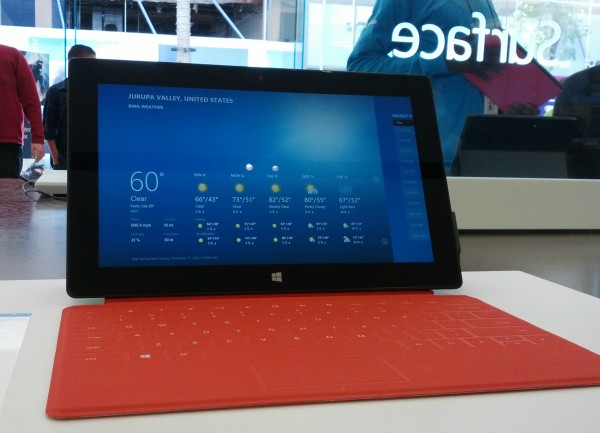
  • Promises, promises — more stores will sell Microsoft Surface

    The biggest problem with Microsoft Surface is you probably can’t buy it. The model running Windows RT is available in just 20 countries, and Pro even fewer (say, how do you like them Canada and United States). Today, Microsoft promised expansion into new geographies starting in late March, and, get this, taking several months. I can’t imagine why tell us all now, other than perhaps to remind everyone that Surface exists and to keep those wanting one hanging on instead of buying something else.

    Surface RT is currently available online or in stores: Australia, Austria, Belgium, Canada, China, Denmark, Finland, France, Germany, Hong Kong, Ireland, Italy, Luxembourg, the Netherlands, Norway, Portugal, Spain, Sweden and Switzerland, United Kingdom and United States. Microsoft added 13 on February 14. The months long expansion will bring the tablet to Japan, Mexico, New Zealand, Russia, Singapore and Taiwan.

    Microsoft also promises to offer Surface Pro more places, but be prepared to wait. In a blog statement: “We are focused on meeting demand in current markets for Surface Pro and are working super hard to get new inventory into retail but recognize demand exists in other countries as well. We are committed to working with our retail partners to ensure we are delivering a great experience in the above mentioned countries for our customers”.

    The software giant struggles to meet demand for Surface Pro 128GB, which is once again sold out at Microsoft Store. Best Buy has units, at least according to the online ordering section of the website.

    Microsoft promises: “We are happy to be able to tell you that Surface Pro will be heading to Australia, China, France, Germany, Hong Kong, New Zealand and the United Kingdom in the coming months. We will follow-up with another blog post with more details”.

    But — there’s too often a but — Surface RT and Pro are only available from brick-and-mortar stores in just a few countries, and that situation won’t change soon. In most countries, buyers will initially have Microsoft’s online store as their only option — so expansion is even slower than today’s declaration of intent suggests.

    I quite like Surface Pro and perhaps you would, too, if you could buy it. Please check out my review. Some readers express great satisfaction, if you’re wondering whether waiting for availability in your country is a good idea.

    Jesse Livermore:

    The surface pro is a wonderful device. I have been married to my beautiful iPad 4 but since I bought the Pro, it has become my new mistress. The Surface is, indeed, a very well built device. Its build quality is on par with the iPad. It feels like the proverbial bank vault.The surface Pro is unbelievably fast — faster than my HP laptop.

    It is also very fluid, unlike Android, and is rock steady reliable. It is so beautiful and powerful and since it is a full-blown computer, it has actually replaced my laptop. Unless I need a large screen, in which case I’ll use my new Dell One 27 Win 8 desktop, the Surface Pro has become my computer of choice. There is really not too much to complain about as I feel the Pro is nearly perfect. It would replace my iPad if it had a 4G connection. The Pro is a true computer replacement in the form of a stunning tablet.

    Reader rcadams “just got my new Surface Pro” two weeks ago, “and I’m totally in love. Talk about a usable tablet. BTW, I’ve had iPad, iPhone, android tablets. Probably upgrade way to often, but finally I’ve found something that is more then a toy. Something solid, has power. Battery isn’t an issue at all. Would I like more sure why not. But what I really wish they would have done is make a place for the pen to slide into. I can see me losing the pens”.

    Photo Credit: Joe Wilcox