Category: News

  • Vantage Lines Up 1 Megawatt Lease in Santa Clara

    The exterior of the' V2 data center on the Vantage Data Centers campus in Santa Clara, Calif. (Photo: Vantage)

    The exterior of the V2 data center on the Vantage Data Centers campus in Santa Clara, Calif. (Photo: Vantage)

    Vantage Data Centers has signed a new long-term customer lease for a 1 megawatt data hall on its campus in Santa Clara, California, the company said this week. The deal continues the busy pace of leasing in Santa Clara, the hub of data center activity in Silicon Valley.

    Vantage said construction is already underway on the new customer installation, with opening anticipated in the second quarter. The company also said it has completed commissioning of an additional 3 megawatts of critical power at its V1 facility, bringing the total power capacity at its Santa Clara campus to 23 megawatts.

    Vantage’s first building, a 6 megawatt retrofitted facility known as V3, is fully leased to four tenants, including Mozilla Corp. Vantage then leased its entire V2 data center to a single tenant in a 9-megawatt lease. Telx is the anchor tenant in V1, where Vantage is now building out the remainder of the building in phases.

    “Our growth continues in Santa Clara and we’re excited to see that our custom solution model continues to be effective in a very competitive marketplace,” said Vantage CEO Jim Trout. “As we continue to build new solutions to support our leasing back-log and lease new space, we remain convinced that the industry leading customers with whom we work continue to value corporate cultural alignment, demonstrated delivery capabilities and customization to support their business objectives.”

    Vantage says its 18-acre Santa Clara campus can support up to 47 megawatts of critical power demand, can can deploy up to 15 megawatts of space. That’s a point of interest in Santa Clara, the data center capital of Silicon Valley, where the supply of data center space has been closely watched.

    Santa Clara Market Dynamics

    Just a year ago many believed the Santa Clara market for wholesale data center space had too much supply, with DuPont Fabros, Vantage, Digital Realty and CoreSite all bringing new space online. But active leasing in the second half of the year – including two large leases by DuPont Fabros that brought its huge facility to 75 percent occupancy – has changed the market dynamics.

    Digital Realty, which has the largest data center footprint in Santa Clara, estimates that there were 23 megawatts of available wholesale data center space in Silicon Valley at the end of 2012. But the company’s data shows that the Silicon Valley market absorbed 33 megawatts of space last year and 36.2 megawatts in 2011, which suggests that at current demand levels, the existing space could be filled as soon as the third quarter of 2013.

    That view aligns with the assessment of DuPont Fabros. “We continue to see good demand and are optimistic about fully leasing the (SC1) property by mid-2013,” said President and CEO Hossein Fateh.

    But the ready inventory and competitive nature of the Santa Clara market has meant a slightly lower return. “When we delivered the property in the fourth quarter of 2011, our goal was an 18-month lease up and achieving a 12 percent unlevered return,” said Fateh. “With the most recent leasing in the fourth quarter, we’re now targeting a 10 percent unlevered return.”

  • Africa Is More Stable than You’ve Been Led to Think

    The recent political instability in Mali has cast a cloud of poor publicity over the economic and commercial rise of Africa, one of the few bright spots in the global economy. Press analysis has speculated whether political instability is endemic to Africa and likely to expand in the future. It’s an important point for the many companies, from GE to Unilever, that are turning to Africa for their next wave of growth.

    africacoups.gifAcross Africa, successful coups are rare and getting rarer. This Economist Intelligence Unit has tracked the trend since 1960, shortly after colonial withdrawal began. Given the preconceived impression of Africa as coup crazy, many lose sight of the decline of coups. While working in Kenya recently, I called a leading investor in Silicon Valley to discuss Africa’s emerging technology sector. He sent me a graphic he found in the British newspaper mapping all the secessionist movements in Africa, and what the map would look like if they all succeeded. That speculative, uninformed graphic did its readers a terrible disservice, as it would if it sounded alarms about the secessionist movements in Texas, California and New York City, all of which have threatened to leave the US.

    There are many drivers for why coups are playing a diminishing role in Africa. Prominent among them is that governments are getting more capable at governing. The generation that liberated Africa has been replaced by one that is better educated, more widely traveled, and with access to better technology and information. Deep governance challenges remain, but Idi Amin and his ilk are no longer running the continent.

    Africa’s governments aren’t just becoming more stable. They’re becoming more representative, albeit in an irregular pattern, as befits a continent with 54 countries. The Polity IV Project measures political regimes on a spectrum from fully institutionalized autocracies (low scores) to fully institutionalized democracies (high scores). As can be seen below, the trend since 1990, across all of Africa, has been towards more democracy.

    africademocratic.gif

    Whether representative government is good for business is a matter of long debate, and in any event depends on how much a business benefits from privileged access. Most of the CEOs I know leading competitive, productive businesses in Africa consider a more representative government good for Africa and good for them. Particularly in the wake of the Arab Spring and with social media spreading across Africa, a more responsive government is seen as assuring continuity of both policy and regimes.

    For CEOs in Africa and many frontier markets, more responsive government means better opportunities for them to engage meaningfully in the policy-making process. “Blue ribbon commissions” and the like may be a source of skepticism in the US, but bodies like the newly formed competitiveness council in Nigeria are the first real opportunity for businesses to improve how African governments manage the economy.
    Bad government and even failed governments will continue to appear in Africa. If history is a guide, their appearance will be magnified by the press. Don’t be fooled by that magnifying glass. Keep your eye on the long-term trend.

    Many thanks to Jonathan Kirschner (Stanford MBA ’12) for his help researching this post.

  • The Keystone Pipeline: America’s Contradictory Behavior

    Canada is our most trusted ally and neighbor to the north. And yet, when it comes to energy independence, we question whether we should build an oil pipeline from there that would carry additional oil imports into the United States …

  • Gartner: Public cloud services to hit $131B by 2017

    Trying to assess the size of any or all of the cloud computing market is like tacking Jello to the wall so thank God someone — Gartner — attempts it.

    gartnerlogoIn a new report, the big researcher estimates that the public cloud market overall will grow 18.5 percent, to $131 billion, in 2017 from $111 billion in 2012. Under this broad umbrella term for public cloud services, Gartner includes the usual suspects — Infrastructure as a Service (IaaS) a la Amazon and the growing crowd of OpenStack-based public cloud providers.

    The public cloud IaaS and file and storage represents the fastest growing part of public cloud services, growing 42.4 percent in 2012 alone to $6.1 billion. With growth accelerating to 47.3 percent, it’s expected to hit $9 billion in 2013. Gartner research director Ed Anderson said that’s happening as more companies go beyond the usual development and test scenarios to more for-real production deployments — a topic we’ll doubtless touch on at GigaOM’s Structure: Data event in New York March 20-21.

    Gartner also includes “cloud-based advertising services” as another hot sub-category. I assume this includes such offerings as Akamai’s new ad integration service plus, perhaps, SaaS based ad and marketing tools a la Salesforce.com. I’ve asked Gartner for some clarification on this so stay tuned. Update: Gartner defines Cloud advertising as “processes that support the selection, transaction, and delivery of advertising and ad-related data where content and price are determined at the time of end-user access, usually by an auction mechanism that matches bidders with impressions as they become available.” Relevant vendors include AOL, Apple, AppNexus, Baidu, Facebook, Google, Microsoft, OpenX and Yahoo.

    The report also shows geographic differences persisting. According to Anderson:

    “Although forecast growth is generally high across all regions, the adoption of cloud services varies significantly by country. Providers should not assume that a generic strategy applied to specific countries or regions of the world will produce the same outcome when applied to other countries, even countries with similar market characteristics … Local economic factors, regulatory issues, the local political climate, the diverse landscape of global and local providers, including noncloud providers, and other country-specific factors ensure a unique marketplace in each country and region.”

    North America is the most enthusiastic adopter of public cloud services, with Gartner expecting it to account for 59 percent of all new spending in the overall category from now until 2016. Despite local challenges, Western Europe is projected to remain number 2, with public cloud expected to account for 24 percent of spending in the category. But, as expected, the highest growth rates will be seen in emerging markets in Asia (especially in Indonesia and India), China and Latin America.

    So now comes the hard part: Remembering to come back and re-check this prediction in three or four years.

    This story was updated at 5:05 a.m. PDT to include Gartner’s definition of cloud-based advertising services.

    Related research and analysis from GigaOM Pro:
    Subscriber content. Sign up for a free trial.

  • Last chance — Windows 8 Pro $15 upgrade ends today

    If you purchased a Windows 7 computer between 2 June 2012 and 31 January 2013 you are eligible for an upgrade to Windows 8 Pro for only $14.99. In fact, even if you did not actually purchase a computer, you can still get the cheap upgrade.

    If you have not yet jumped on this offer then the clock is ticking down for you. Today is the last day to take the plunge. You will need to fill out some basic form information and then you’ll receive a code in your email. Use that code to make your purchase and the price will drop to $14.99.

    If you are still on the fence about switching to Windows 8, a move I recommend, then there is nothing to worry about — grabbing the cheap deal does not mean you need to actually install the operating system today. You simply need to make your purchase now. You can run the installation tomorrow or next year.

    It is unlikely that Microsoft will suddenly extend this offer, so today is the last opportunity to take advantage of a good deal. Tomorrow the same upgrade to Windows 8 Pro will run you just slightly more — $199.

  • Foursquare CEO Looks Beyond Mobile Handsets: Anywhere There’s A Screen, We Want To Be On It

    dens-mwc

    Google has yet to release the Mirror API that will open Google Glass as a platform, but developers of some of the more popular mobile apps today are gearing up for when wearable computing products, like Glass, will. Today, speaking at a keynote at the Mobile World Congress in Barcelona, Dennis Crowley, CEO of social location app Foursquare, highlighted Google’s new headgear as an example of how mobile screens are evolving, and later he told TechCrunch that Foursquare is looking at how it can evolve along with that.

    “Anywhere there’s a screen, we want to put our stuff on it, whether that’s on a phone, or a watch, or whatever,” he said. He also added that Foursquare hasn’t yet worked with Google Glass itself.

    This week at MWC, Google did not have a formal presence at the main exhibition, but it’s been here nevertheless. Apart from the many Android device makers here — with the biggest of all, Samsung, taking stand space in multiple halls and even the train station nearby — Google had its usual Android party and there have been Google Glass sightings both at the official event and elsewhere.

    Wearable computing devices like Google Glass, which make interacting with services ever more seamless, dovetail with how Foursquare is trying to make its services more automatic and easy to use, requiring less proactive input from consumers in order to function.

    Crowley said that Foursquare would like to launch a new feature that builds on this concept, enhancing the “contextual awareness” (his words) introduced by like Radar. (Introduced in 2011, Radar alerts users to when they are near places that they have flagged in their app.)

    “The best version of Foursquare is the one you don’t think about using,” he told TechCrunch on the sidelines of today’s keynote. “The relaunch of Radar is inevitable: it’s very important to us.”

    And while for Foursquare part of reaching that goal is to be on as many platforms as possible, it’s also about integrating with other applications, furthering its own position as a platform for location services. The company already works with 40,000 developers to power location services, including Path, Instagram and Evernote. “We’re slowly starting to become the location layer for the Internet,” Crowley said.

    In January, Google started to run its first hackathons, in San Francisco and New York, for developers interested in Google Glass and getting an early look at the Mirror API.

    More from TechCrunch’s longer conversation with Crowley coming soon.

  • T-Mobile continued tumble in Q4, income down 25% as 515,000 contract customers left

    T-Mobile Earnings Q4 2012
    The iPhone isn’t always the savior carriers hope it will be, but T-Mobile certainly needs something to help reverse its current course. As the carrier awaits the arrival of Apple (AAPL) devices and the imminent MetroPCS merger, customers continue to jump ship and performance it taking a serious hit as a result. T-Mobile on Thursday reported Q4 revenue that sank to $4.9 billion from $5.2 billion in the same quarter a year ago, while operating income tumbled 25% to $1 billion. 515,000 contact subscribers left T-Mobile during the holiday quarter, even worse than the 492,000 contract subs it shed in the same quarter in 2011. Parent company Deutsche Telecom said it expects the MetroPCS merger to be finalized as soon as April. T-Mobile’s full press release follows below.

    Continue reading…

  • HP, Dell Announce New Big Data Analytics Solutions

    Here’s a roundup of some of this week’s headlines from the Big Data sector:

    HP leverages Hadoop for providing context to big data.  HP (HPQ) announced new offerings to help organizations to gain security intelligence from large data sets to better detect and prevent threats. The security information and event management (SIEM) capabilities of HP ArcSight with the HP Autonomy IDOL content analytics engine automatically recognizes the context, concepts, sentiments and usage patterns related to how users interact with all forms of data. “Many organizations have not been able to access the critical information they need to combat potential threats,” said Art Gilliland, senior vice president and general manager, Enterprise Security Products, HP. “With the integration of cloud monitoring, content analytics and Big Data processing, HP provides clients with the context needed to effectively stop potential breaches.”

    Dell advances Kitenga Analytics.  Dell announced the latest release of its Kitenga Analytics solution, which allows  data scientists to analyze structured, semi-structured and unstructured data stored in Hadoop. Version 2.0 of the software adds new search, indexing and sentiment analysis functionality, has additional support for Predictive Modeling Markup Language (PMML) and combines search and analytics in a single, unified environment. “Dell is committed to building a complete analytical fabric of all data sources to reduce the cost, complexity and risk that companies face as they wade through Big Data to improve decision making,” said Darin Bartik, executive director, product management, Information Management at Dell Software. ”With Kitenga Analytics and Toad Business Intelligence Suite, Dell Software is creating a world-class solution set to transform how companies search, correlate and use information to solve their business problems and achieve a bigger competitive edge.”

    DataStax Enterprise 3.  DataStax announced the general availability of DataStax Enterprise 3 (DSE), its Apache Cassandra-based big data platform. The new release provides the most comprehensive security feature set of any NoSQL platform, while still delivering its core benefits of scalability, easy manageability and continuous availability. DSE 3 is a complete integrated big data platform that combines a production-certified version of Cassandra with Apache Solr and Apache Hadoop to deliver continuous availability support and performance across multiple data centers. “DSE is already running mission-critical apps but one hurdle to widespread adoption remains – security,” said Billy Bosworth, CEO, DataStax. “Now with DSE 3, not only do we meet the needs of app and database teams, but also those of the chief security officer.”

    ParStream and Colfax partner.  Data analytics provider ParStream and Colfax International announced a partnership aimed at creating a plug-and-play solution for big data analytics. With the ParStream technology pre-loaded on a customized Colfax server, deployment will be seamless and faster, since it will virtually eliminate any additional effort on part of the customer. This joint software-hardware solution will enable customers across several industries to seamlessly gain new insights from big data in real-time. “At ParStream, we are always on the lookout to make life simpler for our customers. We found a great partner in Colfax- they understood our goal and are working with us to achieve it,” said Michael Hummel, CEO, ParStream. “The servers are pre-qualified by ParStream for compatibility and performance. This ensures that the load on the CPU is reduced, paving the way for a less stressful I/O environment. We look at it as enabling Out-of-the-box Big Data Analytics.”

  • Internet of things Podcast – Almond+’s nutty idea: Making sensor connectivity a snap

    What do you need for the Internet of things? It’s not entirely clear yet, but what we do know is that right now there are several ways to connect devices to the home network but a consumer doesn’t really want to have to wonder how to connect a Zigbee thermostat to their home Wi-Fi network. That’s why router startup Securifi has produced the Almond+ router that aims to build a home network-capable router that will include Wi-Fi, Zigbee and Z-Wave controlled by a touch screen. The goal is to automatically connect sensors into your home network much like you can bring in a Wi-Fi capable device and have it just work when you bring it onto the network.

    (download)

    Subscribe to RSS

    iTunes

    Stitcher Radio

    Show notes:
    Host: Stacey Higginbotham

    • The problem of too many boxes with your connected devices
    • Why you need connected lights, but not a connected fridge
    • Why Nest is not the best case study for the Internet of things
    • Why Z-wave is the better standard for home sensor networks today and why ZigBee gets all the love

    SELECT PREVIOUS EPISODES:
    PlayStation snore? Google Pixel and Tesla earnings)

    Podcast: Why the internet of things is cool and how Mobiplug is helping make it happen

    Podcast: Ballmer’s in the Dell, do tweets ruin TV? And how ISPs are not like gas pumps

    Podcast Q&A: MotoACTV smartwatch now or wait? Lumia 822 in India? Best running apps?

    Podcast: Kabam founder on scaling globally and designing for different platforms

    Podcast: RoadMap Re-Run: Kickstarter’s Perry Chen on creativity and crowdsourcing

    Podcast: The Sporkful’s Dan Pashman on web and food culture (and how bacon is over)

    Related research and analysis from GigaOM Pro:
    Subscriber content. Sign up for a free trial.

  • New study could explain why some people get zits and others don’t

    The bacteria that cause acne live on everyone’s skin, yet one in five people is lucky enough to develop only an occasional pimple over a lifetime. What’s the secret?
     
    In a boon for teenagers everywhere, a UCLA study conducted with researchers at Washington University in St. Louis and the Los Angeles Biomedical Research Institute has discovered that acne bacteria contain “bad” strains associated with pimples and “good” strains that may protect the skin.
     
    The findings, published in the Feb. 28 edition of the Journal of Investigative Dermatology, could lead to a myriad of new therapies to prevent and treat the disfiguring skin disorder. 
     
    “We learned that not all acne bacteria trigger pimples — one strain may help keep skin healthy,” said principal investigator Huiying Li, an assistant professor of molecular and medical pharmacology at the David Geffen School of Medicine at UCLA. “We hope to apply our findings to develop new strategies that stop blemishes before they start, and enable dermatologists to customize treatment to each patient’s unique cocktail of skin bacteria.”
     
    The scientists looked at a tiny microbe with a big name: Propionibacterium acnes, bacteria that thrive in the oily depths of our pores. When the bacteria aggravate the immune system, they cause the swollen, red bumps associated with acne.
     
    Using over-the-counter pore-cleansing strips, LA BioMed and UCLA researchers lifted P. acnes bacteria from the noses of 49 pimply and 52 clear-skinned volunteers. After extracting the microbial DNA from the strips, Li’s laboratory tracked a genetic marker to identify the bacterial strains in each volunteer’s pores and recorded whether the person suffered from acne.
     
    Next, Li’s lab cultured the bacteria from the strips to isolate more than 1,000 strains. Washington University scientists sequenced the genomes of 66 of the P. acnes strains, enabling UCLA co-first author Shuta Tomida to zero in on genes unique to each strain.
     
    “We were interested to learn that the bacterial strains looked very different when taken from diseased skin, compared to healthy skin,” said co-author Dr. Noah Craft, a dermatologist and director of the Center for Immunotherapeutics Research at LA BioMed at Harbor–UCLA Medical Center. “Two unique strains of P. acnes appeared in one out of five volunteers with acne but rarely occurred in clear-skinned people.” 
     
    The biggest discovery was still to come.
     
    “We were extremely excited to uncover a third strain of P. acnes that’s common in healthy skin yet rarely found when acne is present,” said Li, who is also a member of UCLA’s Crump Institute for Molecular Imaging. “We suspect that this strain contains a natural defense mechanism that enables it to recognize attackers and destroy them before they infect the bacterial cell.” 
     
    Offering new hope to acne sufferers, the researchers believe that increasing the body’s friendly strain of P. acnes through the use of a simple cream or lotion may help calm spotty complexions.
     
    “This P. acnes strain may protect the skin, much like yogurt’s live bacteria help defend the gut from harmful bugs,” Li said. “Our next step will be to investigate whether a probiotic cream can block bad bacteria from invading the skin and prevent pimples before they start.” 
     
    Additional studies will focus on exploring new drugs that kill bad strains of P. acnes while preserving the good ones; the use of viruses to kill acne-related bacteria; and a simple skin test to predict whether a person will develop aggressive acne in the future. 
     
    “Our research underscores the importance of strain-level analysis of the world of human microbes to define the role of bacteria in health and disease,” said co-author George Weinstock, associate director of the Genome Institute and professor of genetics at Washington University in St. Louis. “This type of analysis has a much higher resolution than prior studies that relied on bacterial cultures or only made distinctions between bacterial species.”
     
    Acne affects 80 percent of Americans at some point in their lives, yet scientists know little about what causes the disorder and have made limited progress in developing new strategies for treating it. Dermatologists’ arsenal of anti-acne tools — benzoyl peroxide, antibiotics and Accutane (isotretinoin) — hasn’t expanded in decades. Most severe cases of acne don’t respond to antibiotics, and Accutane can produce serious side effects.
     
    The research was supported by a grant (UH2AR057503) from the National Institutes of Health’s Human Microbiome Project through the National Institute of Arthritis and Musculoskeletal and Skin Diseases. 
     
    Co-authors include co-first author Sorel Fitz-Gibbon, Bor-Han Chiu, Lin Nguyen, Christine Du, Dr. Minghsun Liu, David Elashoff, Dr. Jenny Kim, Anya Loncaric, Dr. Robert Modlin and Jeff F. Miller of UCLA; Erica Sodergren of Washington University; and Dr. Marie Erfe of LA BioMed.
     
    For more news, visit the UCLA Newsroom and follow us on Twitter.

  • Incline Equity Partners Appoints and Promotes

    Incline Equity Partners has appointed April Simile as director of business development. Lauren McKibben, previously director of business development, will transition to a new role as investment associate with the firm.

    PRESS RELEASE

    Incline Equity Partners (“Incline”) today announced the addition of April Simile as Director of Business Development. Lauren McKibben, previously Director of Business Development, will transition to a new role as Investment Associate with the firm.

    Ms. Simile will focus on deal origination; expanding Incline’s business with existing deal sources and developing new relationships with lower middle-market business owners and advisors.

    “We’re very excited about the addition of April Simile to the Incline team,” said Jack Glover, Partner of Incline Equity Partners. “April brings a wealth of strategic marketing and communications experience to the position and will play a key role in the continued growth and success of our firm.”

    Ms. Simile previously worked as a Senior Vice President at Allegheny Valley Bank, a Pittsburgh-based commercial financial institution. April held executive positions in the areas of commercial lending, corporate cash management, retail delivery, and marketing during her 12 year tenure. Ms. Simile received her B.S. in Finance, cum laude, from La Roche College.

    Ms. McKibben, who has held the position of Director of Business Development since May 2009, will move to Investment Associate effective April 1, 2013. She will be responsible for evaluating and analyzing investments made by the firm.

    About Incline Equity Partners
    Incline Equity Partners focuses on making private equity investments of $10 million to $25 million in support of leveraged buyouts, recapitalizations, and large minority financings of lower middle market growth companies with enterprise values between $25 million and $100 million across a variety of industry sectors including specialized light manufacturing, value-added distribution, and business and industrial services.

    The post Incline Equity Partners Appoints and Promotes appeared first on peHUB.

  • Oil and Gas Production Decline on Federal Lands . . . Again

    “I’m proud of the fact that under my administration, oil production is higher than it has been in a decade or more. President Obama, February 20, 2013

    When President Obama claims responsibility for the increase in oil and natural gas production in the United States, it is important to know that he is referencing the energy miracle that is occurring on private and state lands, where his Administration has little or no say over what happens.  In fact, the United States is the largest natural gas producer in the world, and last year, production of oil increased at the fastest annual rate since Abraham Lincoln was in the U.S. Senate.  From those lands that the President oversees, however, oil and natural gas production fell again last year.

    The Office of Natural Resources Revenue of the Department of Interior (ONRR) just released its sales volume data for fiscal year 2012 with the result that oil and natural gas production on federal lands dropped again in FY 2012.[i] Natural gas production on federal lands continues to fall and oil production on federal lands fell in both fiscal years 2011 and in 2012 ending two years of increase. Specifically:

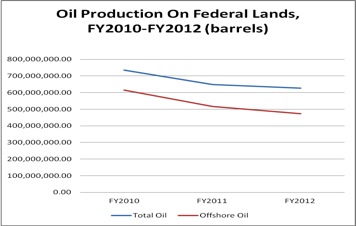
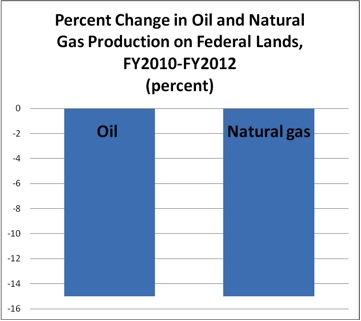
    • Crude oil production on federal  lands is 4 percent lower in fiscal year 2012 than in fiscal year 2011, (a smaller percentage than its reduction in fiscal year 2011 compared to fiscal year 2010 levels), with the total percentage reduction over the 2 years at 15 percent.
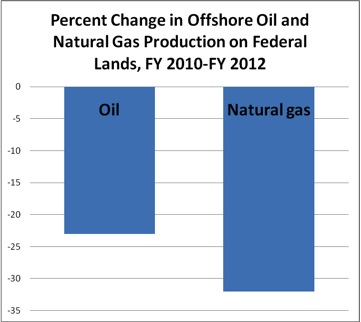
    • Offshore oil production in federal waters is 8 percent lower in fiscal year 2012 compared to fiscal year 2011 with the total percentage reduction over the past 2 years at 23 percent.
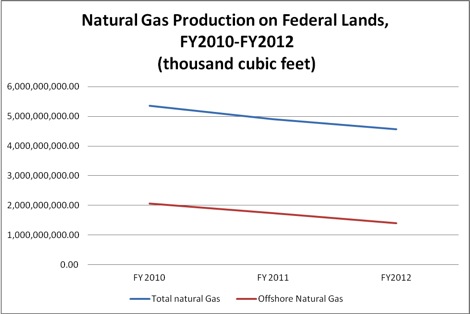
    • Natural gas production on federal lands is the lowest in the 11 years that data is available and is 7 percent lower in fiscal year 2012 than in fiscal year 2011 with a total percentage reduction over the past 2 years of 15 percent.
    • Offshore natural gas production in federal waters is 20 percent lower in fiscal year 2012 compared to fiscal year 2011 levels with a total percentage reduction over the past 2 years of 32 percent.

    Oil and Natural Gas Production on Federal Lands

    Crude oil production on federal lands decreased 15 percent over the past 2 years from 736 million barrels in fiscal year 2010 to 626 million barrels in fiscal year 2012. Production of crude oil on federal lands is dominated by offshore production, which fell by 23 percent in fiscal year 2012 from fiscal year 2010 levels, mostly notably due to government actions taken following the oil spill in the Gulf of Mexico in 2010. These actions include a moratorium on offshore drilling by the Obama Administration, followed by a permit moratorium, and withdrawal of President Bush’s 2010-2015 offshore lease plan, which would have opened additional areas to oil and gas production. These areas were made available when President Bush lifted the executive drilling moratorium and Speaker Pelosi and Majority Leader Harry Reid passed legislation lifting a 27 year old appropriations ban on such drilling in 2008. It was not until late in 2012 that the Obama administration released its draft 2012-2017 offshore lease plan that reduced the number of lease sale opportunities from prior plans and that removed areas that the Bush administration had made available to drilling (e.g. off the coasts of the Atlantic and Pacific oceans).

     Oil production on federal lands

    Source: Department of Interior, Office of Natural Resources Revenue, http://statistics.onrr.gov/

    Natural gas production on federal lands decreased every year since fiscal year 2003, the earliest fiscal year data available. In fiscal year 2012, natural gas production on federal lands was 4,566 billion cubic feet, 15 percent less than in fiscal year 2010 when it totaled 5.35 billion cubic feet. Offshore natural gas production volumes have been on a consistent downward trend for the last 11 years, and are 32 percent less in fiscal year 2012 than in fiscal year 2010.

    Natural Gas Prod on Fed Lands

    Source: Department of Interior, Office of Natural Resources Revenue, http://statistics.onrr.gov/

     Percent Change 1

    Source: Department of Interior, Office of Natural Resources Revenue, http://statistics.onrr.gov/

    Percent Change 2

    Source: Department of Interior, Office of Natural Resources Revenue, http://statistics.onrr.gov/

    Conclusion

    The big picture is clear that government policies undertaken by the Obama Administration have produced a significant decline in offshore oil production on federal lands over the past 2 years. If it were not for hydraulic fracturing and horizontal drilling on private and state lands where oil and gas drilling regulation performed by the states is much more efficient than that on federal lands, the United States would not be increasing its domestic oil and natural gas production. Americans can only wonder how much more oil we could have produced if federal policies did not get into the way and how much lower gasoline prices might be if positive actions were taken 4 years ago.


    [i] Department of Interior, Office of Natural Resources Revenue, http://statistics.onrr.gov/

  • What the Atlantic learned from Scientology: native advertising is harder for news brands

    You have to feel for the Atlantic. One poor decision has made it a case study in how not to embrace a popular advertising trend — even though many other publications could have gotten away with the same ad.

    At an ad industry event in New York on Wednesday, an Atlantic Digital executive explained what the company had learned from a January debacle involving the Church of Scientology. (In case you missed it, the Atlantic pushed the boundaries of so-called “native advertising” by publishing a feel-good “sponsored story” about the religion — or cult, if you prefer — that included only positive reader comments.)

    “The biggest mistake in retrospect was that it wasn’t harmonious to our site and it didn’t bring any value to our readers,” said VP and General Manager Kimberly Lau, at the event, which was hosted by native ad shop Sharethrough. “The second mistake was allowing the marketing team to moderate comments in a way that wasn’t transparent.”

    Lau’s comments echo the Atlantic’s earlier apologies for the incident which, by all appearances, was a one-off mistake. But her remarks stand out because of where she made them: on a panel with representatives from Gawker, Vice and College Humor — three publications that regularly mix advertising into their editorial process and that expressed sympathy for the Atlantic’s predicament.

    “There’s no other way to make money without doing this kind of advertising,” said Vice’s CCO Eddy Moretti, who added that Vice would have run the Scientology story. Meanwhile, Jason Del of Gawker (“a full-service content, event and video shop”) suggested that part of the blowback to the Scientology story came about because the sponsored format was novel to its readers.

    So is all this unfair to the Atlantic —  so-called native advertising is a lifeline for publishers, why can’t it cash in like everyone else? The problem, as Lau explained, is:

    “It goes back to the difference between entertainment and journalism,” she said. “There’s a higher bar for a brand like the Atlantic.”

    This goes to the crux of the matter — sites that cater to comedy, entertainment or celebrity news can inject sponsored fare into their streams with relative safety. Serious news and intellectual publications, however, must take extra care to preserve the integrity of their editorial content.

    In the bigger picture, this extra scrutiny of news brands may limit their ability to garner new online income. But the good news, for the Atlantic at least, is that the company has been profitable for several years and, according to Lau, 59 percent of its overall advertising revenue is digital.

    Speaking of native advertising, be sure to attend paidContent Live this April where Andrew Sullivan and other leading media figures will discuss their business strategies, including native advertising.

    (Image by Phuriphat via Shutterstock)

    Related research and analysis from GigaOM Pro:
    Subscriber content. Sign up for a free trial.

  • Amazon Cloud Player now available on iPad

    Amazon has launched Amazon Cloud Player 2.0 for iOS. The app, which lets users stream or download music from their Amazon Cloud collection, has been revamped to support the iPad and iPad mini for the first time, in addition to previous support for iPhone and iPod touch.

    Version 2.0 also debuts a revamped user interface and adds a new setting that allows users to configure the size of the offline cache used for storing streamed music for access while offline.

    Amazon Cloud Player, which is also available for other mobile devices, including Amazon MP3 2.8.0 for Android, lets users access both music stored in their Amazon Cloud account as well as locally on the device. Music stored in the cloud includes all MP3 and auto-rip CD purchases from the Amazon music store, plus existing music uploaded by the user. Up to 250 songs can be stored this way without charge — if users purchase an Amazon Cloud Premium subscription for $24.99 per year, this limit increases to 250,000.

    Unlike Amazon MP3 for Android, Amazon Cloud Player does not allow users to browse, search or purchase music through the Amazon store; the app is currently limited solely to playing or downloading music from songs already uploaded or purchased.

    Aside from adding support for iPad users, Amazon Cloud Player 2.0 adds one more feature in the form of an option under Settings for users to manually set the cache size for music previously streamed or downloaded. Music stored in the cache can be played offline, and a 500MB cache is set by default – users can now adjust this to a number of presets from 50MB to Unlimited (Amazon Cloud Player will always leave at least 10 per cent free space on the device), plus clear the cache with a single tap.

    Amazon Cloud Player 2.0 is available now as a free download for iPad, iPad mini, iPhone and iPod touch users running iOS 5.0 or later. Amazon MP3 2.8.0 for Android users is also available.

    Photo credit: Goodluz/Shutterstock

  • How to make space fans jealous — send the Google Nexus One into orbit

    Forget about the boring Apple iPhone 5 and Samsung Galaxy S III for a moment, because while they may be impressive in their own right, both handsets now pale in comparison to the HTC-built Google Nexus One. The three year-old smartphone is the first to reach outer space and is circling around the Earth right now — a feat that easily tops any other hardware or software feature.

    HTC claims the Nexus One is the “world’s first smartpho-naut” after the Android-powered device skyrocketed onto orbit from India, aboard the STRaND-1 nanosatellite. And that’s not the best part. The STRaND-1 features WARP DRiVE (Water Alcohol Resistojet Propulsion Deorbit Re-entry Velocity Experiment) and electric PPTs (Pulsed Plasma Thrusters). How cool does that sound?

    The Surrey Space Centre ground station at the University of Surrey commissions and operates the STRaND-1, which can also be tracked by amateur radio operators. Furthermore, the nanosatellite will switch from onboard systems to the Nexus One and adjacent apps, after the necessary testing has been carried out. Surrey Satellite Technology Limited informs us that the apps (“some serious and some just for fun”) were developed by winners of a Facebook competition that was held in 2012. Interesting, isn’t it?

    NASA’s (National Aeronautics and Space Administration) previous announcement about strapping the Nexus One onto a rocket in 2010 is really dull by comparison — it did not involve plasma thrusters nor a water-alcohol propulsion system. That said, the two projects share a similar concept — the Nexus One is used to take pictures or shoot videos, among other purposes.

    Thanks to the 360app, “gravity-bound folks” can “play big brother and request snapshots” immortalized with the smartphone. You can also follow up on the activity of STRaND-1 via 360app’s Facebook page or Surrey Nanosats’ Twitter account where both teams share new details every day.

  • VirtualDVD lets you mount any disc image as a virtual drive

    Download an ISO disc image onto a brand new PC and you probably won’t need any third-party software to handle it. Windows 8 makes it easy to mount the image as a virtual drive, so you can access the contents without needing to burn them to a physical disc.

    This option isn’t exactly configurable, though. It offers no support for the many other disc image formats out there. And it’s not much help if you don’t have Windows 8, either — which is why you might prefer to install VirtualDVD.

    The program is a simple free tool which can mount CD, DVD and Blu-ray images to a virtual drive. It’s a small download (under 3MB), and installs quickly with no adware to avoid.

    Once running, VirtualDVD can be accessed via its system tray icon. Right-click it, select Virtual Devices, choose the virtual drive, click Mount Image, and point the program at the image you need (B5T/ B6T, BIN, BWT, CCD, CDI, CUE, DVD, IMG, ISO, ISZ, LCD, MDS/ MDF, NRG and PDI formats are supported so you shouldn’t have any problems).

    The disc then becomes available in Explorer just as though it was a physical drive.

    This can be customized to a degree via the usual Windows tools (you can change its region, drive letter and so on).

    And you’re also able to add further virtual drives, if necessary. Right-click the system tray icon, select Preferences, and set “Count” to the number of devices you need (up to a maximum of 24).

    The program is a little on the basic side. It doesn’t have the configuration options you’ll get with some of the competition (or any significant settings at all, really). And there’s virtually no documentation, either. There’s nothing provided with the program itself, and the online help currently has a single page listing the supported image formats only.

    To be fair, though, VirtualDVD is extremely simple, and you’re most unlikely to need any assistance. So if you need easier access to disc images beyond just ISO files, the program could be worth a try.

  • Windows Azure Store is now available in 25 more markets

    On Wednesday, Microsoft announced a new update for Windows Azure, the company’s cloud platform. Windows Azure Store now comes with expanded availability within 25 new locations across all major regions. This brings the tally up to 36 markets, a significant increase over the previous 11 from little over two months ago when the software giant announced a similar update.

    The Windows Azure Store is designed to allow users to discover, purchase and manage services and data straight from the cloud platform’s management portal. The feature was previously only available in Canada, Denmark, France, Germany, Ireland, Italy, Japan, South Korea, Spain, United Kingdom and United States.

    The newest supported locations for Windows Azure Store include Australia, Belgium, Brazil, Chile, Colombia, Costa Rica, Czech Republic, Finland, Greece, Hong Kong SAR (SAR stands for Special Administrative Region), Hungary, Israel, Luxembourg, Malaysia, Mexico, Netherlands, New Zealand, Peru, Poland, Portugal, Romania, Singapore, Sweden, Switzerland, and Trinidad and Tobago. As you may observe, difference is night and day in terms of worldwide availability and reach for users of the cloud platform.

    Microsoft also touts four new add-ons to go along with the recent update. Bitline is designed for online image processing, Cloudinary promises delivery of images from the cloud to users, PubNub is a messaging system for the InterWebs and mobile apps and VS Anywhere allows Visual Studio users to take advantage of real-time collaboration.

    Photo Credit: nokhoog_buchachon/Shutterstock

  • Sony experiments with Firefox OS on the Xperia E

    Japanese device manufacturer Sony and global telecommunications company Telefonica have announced their support for Firefox OS, Mozilla’s endeavor in the mobile market. To show its commitment for the operating system, Sony has also released an experimental build of Firefox OS for the Xperia E smartphone, that provides a glimpse into the future.

    “At Sony Mobile, we continue to evaluate innovative technologies that can help deliver the premium user experiences that Sony’s consumers expect,” Bob Ishida, Deputy Chief Executive Officer and Head of Products Business Group at Sony Mobile Communications says. “Our engineers are now working with Firefox OS Mobile and HTML5, evolving technologies which show great potential”. Normally, the Xperia E is a low-end Android smartphone similar in specifications to Keon, the base development phone for Firefox OS made available by Geeksphone, but now it’s been given a shot at worldwide recognition among enthusiasts.

    Firefox OS on Xperia E comes with a few caveats, however, as it’s an experimental version of the operating system. Users cannot take advantage of radio connectivity, meaning both cellular calls and Wi-Fi are not available, the SD card functionality is unstable and the sensitivity of the touch interface is not precisely calibrated.

    Users will have to unlock the bootloader on the Xperia E, which Sony warns may be restricted by operators, download and install the flash tool for Xperia devices, then start the tool, connect the smartphone and install the experimental Firefox OS ROM. Sony also provides a stock Android firmware for users who wish to revert to the green robot afterwards.

    Sony demoed Firefox OS on the Xperia E through a video which shows the operating system running quite well on the smartphone, albeit with some glitches. The touchscreen needs a firm press as to power up an app, which is not surprising seeing as Sony mentioned the calibration issue. The camera software can be used to snap pics and zoom in to photos. Firefox OS comes with Nokia’s HERE Maps app preinstalled.

  • Morning Advantage: Have Mickey and Minnie Saved the Rain Forests?

    For years, environmental activists had been making little headway in their efforts to stop Asia Pulp and Paper from destroying the habitats of the orangutans and Sumatran tigers, reports the Christian Science Monitor. But that all changed when they switched tack and targeted, not the company itself but its customers. Kick-starting the effort in truly retro fashion, they hired actors to dress up as Minnie and Mickey Mouse, lock themselves to Walt Disney’s headquarters building, and fly a banner reading “Disney is destroying Indonesia’s rain forests.”

    Eighteen months of negotiations later, Disney issued new standards requiring that all paper the company, its suppliers, and its licensees use be sustainably sourced — a policy so far-reaching it had to be translated into 35 languages. Dozens of major paper-consuming firms followed suit, effectively freezing APP out of much of the European and U.S. markets. Suddenly APP announced it, too, is going green. “I think this will stand as one of the biggest market-based campaign successes that we’ve seen in a long time,” says Laurel Sutherlin of the Rainforest Action Network. “We’re still a little bit stunned.”

    YOU, TOO, CAN BE AN ACTION FIGURE

    The Manufacturing Disruption Arrives (Technology Review)

    Check out the video of this gadget that looks like a colored-glue gun and decide for yourself if it’s the gateway to the 3-D manufacturing revolution. It certainly has the hallmarks—not that good (yet) but cheap and really easy to use. For my money, though, the real disruption is coming from start-up Mancti, which, as NPR demonstrates here, has developed software that turns a Kinect video game controller and $2,000 scanner into a crazy-cheap personal 3-D copy machine. With it, you can scan and reproduce real objects — like, say, your favorite Star Wars figurine — in pretty much the same way you can now replicate music, magazine articles, and any other stream of digits. Will copyright law stand up to the coming onslaught? Stay tuned.

    COMIN’ BACK AT YA

    Is Fix-It the Next New Thing? (San Jose Mercury News)

    Starting last weekend in Palo Alto, a loose confederation of fix-it fanatics began holding a series of repair clinics to fix broken coffee makers, jewelry, toys, furniture – anything small enough to carry. The vanguard of a counterrevolution against planned obsolescence, these MIT- and Stanford-trained engineers and other skilled volunteers will stand at the ready in Albany in March, in Santa Cruz in May, and then across the nation to resuscitate your faithful household helpers. The clinic in Albany will open like an Alcoholics Anonymous meeting (“Hi, my name is Ted, and this is my toaster oven”) and then make available the tools, coaching and moral support needed to teach you how to save your stuff yourself.

    BONUS BITS:

    Really?

    Highlights from Guardian Readers’ Worst Jobs Ever (The Guardian)

    Automating Hard or Hardly Automating? George Jetson and the Manual Labor of Tomorrow (Smithsonian)

    Stop Requiring College Degrees (HBR)

  • Kaspersky PURE 3.0 Total Security protects virtual keyboards from keyloggers

    Kaspersky Labs has released Kaspersky PURE 3.0 Total Security, the latest edition of their extremely comprehensive security suite.

    And although you might have thought the package already included just about every security option you could possibly want, the company has found several ways to improve the new build.

    Safe Money detects when you browse to banks, payment providers and other sensitive sites, and offers to access them in a secure and isolated browser.

    A “secure keyboard input” layer combined with easier access to the virtual keyboard helps to keep you safe from keyloggers.

    The backup tool can now store your data online; it’s only to a Dropbox account, but that’s still a worthwhile improvement.

    Password Manager now maintains its database online, making it easier to synchronise credentials across all your Kaspersky PURE 3.0 installations.

    There’s a new exploit protection layer, easier installation, an enhanced interface, more accurate phishing detection, smaller updates, and more.

    And of course you still get all the previous features, like a strong antivirus engine, lots of browsing protection tools, capable parental controls, a spam filter, vulnerability scanner, encryption tool, ad-blocker, data shredder and more.

    All this functionality has a down side, of course. The suite comes in a chunky 179MB executable. It then downloaded another 80MB in the first update on our test PC. It adds plenty of extras to your PC, including for example five Firefox addons. And there are all kinds of configuration issues to confront in your first hour or two with the program.

    You’ll need to pay close attention to the small print, too, as there are some important issues to consider. Password Manager doesn’t work on 64-bit Windows, for instance. While Safe Money doesn’t run in the Metro version of IE10, or even the desktop version if IE’s “Enhanced Protected Mode” is turned on.

    And there are so many modules here that they can occasionally clash in unexpected ways. Here’s a genuine example of a warning in the Help file: “Safe Run for Websites cannot be run if the Enable Self-Defense check box is cleared in the Advanced Settings section, the Self-Defense subsection of the application settings window”. Which may not be so obvious to everyone.

    Still, while Kaspersky PURE 3.0 Total Security takes a while to set up and figure out, there’s still a vast amount of functionality here, and it’s still one of the most comprehensive security suites around.