Category: News

  • North Korea Real-Time Instagramming Made Possible After Visitors Get Mobile Internet Access

    Up until recently, visitors to the Democratic People’s Republic of Korea (North Korea) had to abandon their cellphones at the customs gates. When travelers were finally granted the access to carry their phones with them a little over a month ago, they still had the slight problem of not really being able to do much with them.

    Yep, no internet access (or local calls, for that matter). It wasn’t until just a few days ago that North Korea finally turned on some 3G for visitors (not the people of North Korea, mind you).

    What does that mean? Social media updates from tourists, of course. And the AP’s David Guttenfelder is providing some of the first-ever real-time photographs from the notoriously closed-off country

    “I feel I can help open a window into a place that would otherwise rarely be seen by outsiders,” he says. “As one of the few international photographers who has ever had regular access to the country, I feel a huge responsibility to share what I see and to show it as accurately as I can.”

    Instagram recently highlighted his photography in a blog post. Here are some incredible shots coming in from DPRK – ones that wouldn’t have been possible until very recently.

    North Korean commuters pass by propaganda posters in #Pyongyang.

    A North Korean guide uses a pointer at the start of a tour of an historic site. On Jan. 18, 2013, foreigners were allowed for the first time to bring mobile phones into North Korea. And this week the local service provider, Koryolink, is allowing foreigners to access the Internet on a data capable 3G connection on our mobile phones. In the past I could post geolocated phone photos to my Instagram feed by turning my online laptop into a hotspot to link my iPhone or iPod touch by wifi. But, today I’m posting this directly from my phone while riding in the back of a van in #Pyongyang. The window on to North Korea has opened another crack. Meanwhile, for Koreans here who will not have access to the same service, the window remains shut.

    North Korean babies rest in a row of cribs at the #Pyongyang Maternity Hospital.

    A North Korean doctor and a bank of video monitors inside a #Pyongyang hospital.

    For more real-time photos from the Democratic People’s Republic of Korea, make sure to follow David Guttenfelder (@dguttenfelder) on Instagram.

  • Dream!: The speakers in Session 5 at TED2013

    Session5_DreamBefore you can create a new world, you have to imagine new possibilities. The speakers in this session are the visionaries who propose that which couldn’t be seen before, and suggest new paths that not only haven’t been traveled yet — but haven’t been thought of.

    Here are the speakers in this session. Click their name to read a recap of their talk:

    The explosive creative direction and choreography of Rich + Tone Talauega has been featured in tours and music videos of pop icons like Michael Jackson, Madonna and Jennifer Lopez.

    Elon Musk is the CEO and product architect of Tesla Motors and the CEO/CTO of Space Exploration Technologies (SpaceX).

    Mary Lou Jepsen discovers astonishing ways to integrate digital screens into daily life.

    At 14, Taylor Wilson became the youngest person to achieve fusion — with a reactor made in his garage. Now he wants to save our seaports from nuclear terror.

    Violinist Ji-Hae Park shares the joy of music.

    Since the counterculture peak of the 1960s, Stewart Brand has been reframing our view. Now, with biotech accelerating four times faster than digital technology, Stewart Brand has a bold new plan to share.

  • The yo-yo master: BLACK at TED2013

    TED2013_0039495_D31_0877

    “When I was 14 years old, I had low self-esteem,” yo-yo champion BLACK begins his talk during session 4 of TED2013. “Then one day, I bought a yo-yo.” The first trick he tried — well, it didn’t work. But after a week of practice, he started to get somewhere. He remembers, “I thought, ‘The yo-yo is something for me to be good at. For the first time in my life, I found my passion.’”

    But practicing for hours a day and winning the World Yo-Yo Contest four years later in 2001 didn’t take him on the path he hoped. “I thought I’d become a hero! I will get many sponsors. Money. Many interviews! I will be on the TV,” says Black. But fame and fortune never came. Instead, BLACK went back to school and became a systems engineer.

    Eventually, though, he had to return to his passion. “I wanted to show how spectacular the yo-yo could be. I wanted to change the public image of the yo-yo,” says BLACK. “So I quit my company and started a career as a professional performer.” He won the World Yo-Yo Contest again in 2007, and even passed an audition for Cirque du Soleil.

    On the TED stage, BLACK gives a performance set to dramatic music, a yo-yo spinning quickly and maseterfully around him like a ribbon around a rhythmic gymnast. Soon, he picked up a second yo-yo, spinning them wildly, as if juggling. Bending backwards to the floor, he keeps the yo-yos orbiting just millimeters from his face. The performance is both graceful and thrilling.

    TED2013_0040215_D41_5934

    TED2013_0039869_D41_5588

    TED2013_0039449_D31_0831

    TED2013_0040058_D41_5777

    See BLACK in action for yourself, below.

  • Chrome For Android Gets A Substantial Update

    Android users who prefer to browse the Web using Google Chrome will be pleased to know that the browser has received a hefty update today. Chrome 25 for Android contains the following new features and enhancements:

  • Improved scrolling performance
  • Increased responsiveness to pinch-zooming on pages
  • Faster interactive pages thanks to the latest version of the V8 javascript engine
  • Audio now continues to play while Chrome is in the background
  • Expanded support for HTML5 features
  • Support for pausing audio in Chrome when phone is in use (note: this requires an additional permission)
  • Google notes that Chrome 25 for Android also includes “important stability and performance fixes” along with minor UI adjustments.

    For those who want to try out the future of Chrome, Google has also released a beta version of Chrome for Android. It can be run alongside the stable channel release for testing purposes, just like Firefox for Android.

    Unfortunately, there’s no word on when Chrome for iOS will be updated. The last update came on December 20 of last year. It shouldn’t be too long, however, until iOS users get to bask in the light of increased mobile browsing speeds.

  • Snapchat Sued by Guy Who Says He Helped Create the Ephemeral Messaging App

    A man is suing the creators of a popular social app, claiming that they took his idea and shut him out or what was eventually a “million-dollar-idea,” after they all worked together on it during college.

    No, this isn’t the Winklevii, and we’re not talking about Facebook. It’s South Carolina native Frank Reginald Brown IV, and we’re talking about Snapchat.

    Snapchat is the relatively new ephemeral messaging app that lets users create images or videos and send them to friends with a time limit attached. The ticking time bomb messages will then self destruct upon competition, and it will notify you if your recipient tried to make the image or video more permanent via screenshots. Much maligned at first as an app catering to sexting teens, Snapchat has grown beyond that narrow frame.

    Now, it and its creators Bobby Murphy and Evan Spiegel are being sued.

    According to the L.A. Times, Brown claims that he’s the one who came up with the concept of Snapchat. He then approached Spiegel who decided it was worth pursuing.

    Brown says that the three moved in together (all while attending Stanford) and worked on the app in the summer of 2011. Brown says that he came up with the app’s original named (Picaboo) and logo (the little ghost). Shortly after, they had a falling out and Brown alleges that Murphy and Spiegel locked him out of all their accounts and servers.

    Snapchat called the allegations “frivolous” in a statement:

    We are aware of the allegations, believe them to be utterly devoid of merit, and will vigorously defend ourselves against this frivolous suit. It would be inappropriate to comment further on this pending legal matter.

    Whether this is a legitimate complaint from Brown or simply a money grab is left to be seen. Let’s just hope that it doesn’t stretch out as long as things like this can stretch out.

    The lawsuit does contain this photo of the three, proving that they at least knew each other. Notice the Snapchat-like image on the cake (which could mean everything or nothing, depending on the context).

  • CRE Superbug Patients Could Remain Infected For Over One Year

    A new study has shown that patients infected with carbapenem-resistant Enterobacteriaceae (CRE) could take over one year to be rid of CRE bacteria.

    CRE, according to the U.S. Centers for Disease Control and Prevention (CDC) are potentially deadly infections that are highly resistant to antibiotics, making them difficult to treat. Though the bacteria is not normally found in healthy people, patients on ventilators, patients with catheters, or those on long courses of antibiotics are at risk for infection.

    The study, published in the American Journal of Infection Control, looked at 97 CRE-positive patients who were discharged from the Shaare Zedek medical Center from 2009 to 2010. It showed that patients who tested positive for CRE took an average of 387 days to clear the infection. Even after one year, 39% of the patients remained “positive” for CRE, meaning they could become re-infected or transmit the infection to other people.

    “Patients with multiple hospitalizations or those who were diagnosed with clinical CRE disease should be assumed to have a more extended duration of CRE coverage and should therefore be admitted under conditions of isolation and cohorting until proven to be CRE-negative,” said the study’s authors. “These measures will reduce the hospitalization of CRE-positive patients among the general patient population, potentially preventing the spread of CRE.”

    The study was also able to identify several risk factors that were related to long periods of infection, including long hospital stays, re-hospitalizations, and whether patients had an active infection or a “colonization” without symptoms.

  • BlackBerry Taps Star Power to Market BlackBerry 10

    BlackBerry has a odd tradition of tapping star power to sell cutting-edge technology. It’s a big challenge to explain the features and benefits of something complex to a consumer market made up of a young and a less technically inclined audience. This time BlackBerry has enlisted the help of some extremly talented people: Robert Rodriguez, Neil Gaiman, and Alicia Keys. They’ll be leading the charge in ushering BlackBerry into an era where smartphones are the primary tools of the creative and the successful.

    What I don’t get is that the famous sometimes make strange spokespeople because of their habit of dumbing down of the tech-sounding stuff into something more marketable to the masses. This often translates into a campaign that is quickly forgotten the moment it’s over. What was Will.I.Am’s message when he was doing a BlackBerry campaign a couple of years back? As a guest panelist under the title futurist he did more talking with his hands and buzzwords than saying anything meaningful. His endorsement of BlackBerry was meant to bring some sort of cool factor to the platform, while months later the “futurist” could be seen dropping his own line of pricey iPhone accessories.

    I think Alicia Keys is a great modern-day spokesperson who hits BlackBerry’s target demographic right in the bull’s eye. Her collaboration with BlackBerry will put fans’ pics on stage during a performance of her song Hallelujah. Her BlackBerry-weilding fans (who also attend her concert) will have the opportunity to be seen on screen in soulful slideshow.

    I’m sure that they’ve got other things planned for their new Global Creative Director. She certainly brings more credibility than Will.I.Am, who can be seen misusing tech in the worst of ways like printing his own head in a 3D printer in a music video featuring Britney.

    I think Alicia will showcase BlackBerry 10 in a clear way bringing a lot of old customers back to the platform. As a jet setting artist with an awful lot of talent, she can promote BlackBerry 10′s ability to share rich media and collaborate without smoke and mirrors. Her BlackBerry sponsored Set The World On Fire Tour is sure to showcase her using the new device as if it were a laptop when it kicks off on March 7th. If she does it right, an awful lot of people will view BlackBerry 10 phones as a tool belonging to the successful, the same mojo that BlackBerry had in it’s prime.

    Click here to check out the BlackBerry Keep Moving Hub, a place where you can follow the BlackBerry-driven projects of screenwriter film maker Robert Rodriguez, fantasy writer Neil Gaiman, and the multitalented Alicia Keys.

  • Californication Fans Can Hang Out With Cast Members On Google+

    Fans of Showtime’s Californication are in for some fun this evening, as cast members Pamela Adlon and Evan Handler (who Louie/Lucky Louie and Sex And The City Fans are also acquainted with) will be participating in a Google+ Hangout.

    Fans are encouraged to ask them “anything about this season’s scandalous moments”.

    The hangout takes place at 7PM Eastern at Google.com/+Showtime.

  • How to Be Mindful in an ‘Unmanageable’ World

    “I believe this is a very special moment in history, a kind of perfect storm. There is a growing recognition — to borrow language from AA — that our world has become unmanageable.” Those words have been reverberating in my head ever since Arianna Huffington, founder of the Huffington Post, said them over the weekend during the Wisdom 2.0 conference in San Francisco. She was introducing an iPhone app called “GPS for the Soul,” which is designed to measure heart rate variability as a window into your stress level at any given moment during the day.

    It seemed fitting to me that Arianna described the challenges so many of us face in our work — and in our lives more broadly — by using the language of addiction. Her words rang especially true because I happen in the midst of reading a book by Bryan Robinson titled “Chained to the Desk: A Guidebook for Workaholics.”

    The addiction of our times is digital connection, instant gratification, and the cheap adrenalin high of constant busyness. The heartening news is that more and more leaders in big companies are beginning to recognize the insidious costs of moving so relentlessly and at such high speeds.

    Wisdom 2.0 focused on technology — a primary driver of the increasing unmanageability of our lives. The conference was launched three years ago as a meeting between people from the meditation community and the tech world in Silicon Valley to discuss how to use technology more wisely.

    Paradoxically, the most important solution I heard is to use technology less frequently, and more intentionally. Or, as Sherry Turkle, a professor at MIT, put it in her talk: “There need to be places in our lives and in our organizations that are device-free zones.”

    Just below the surface of our shared compulsion to do ever more, ever faster, is a deep hunger to do less, more slowly. I saw proof of that a couple of weeks ago, when I wrote an article for The New York Times titled “Relax! You’ll Be More Productive.” It focused on the growing scientific evidence that when we build in more time for sleep, naps, breaks, and vacations, we become not just healthier and happier, but also more productive. The piece prompted an avalanche of response, much of it poignantly describing the sense of overwhelm people are feeling at work.

    The search to find ways to deal with these issues was evident at Wisdom 2.0. Padmasree Warrior, the chief technology and strategy officer at Cisco, described in compelling detail the behaviors she’s built into her life to take her out of rapid-fire analytical, “doing” mode. She meditates for 20 minutes every day. On the weekends, she paints and takes photographs. Even when she tweets, she often does so in haikus — as a way to put herself in a more creative mode.

    Jeff Weiner, the CEO of LinkedIn, talked about how compassion has become a centerpiece of his management style. More specifically, he described how compassion requires slowing down and taking the time to truly listen to others. It means understanding where they’re coming from, caring about the struggles they’re facing, and the baggage they’re carrying.

    Bill Ford, the executive chairman of Ford Motor Company, talked about the harrowing experience he went through when Ford nearly declared bankruptcy several years ago. Taking time to meditate each day was critical. “The practice of mindfulness kept me going during the darkest days,” he said. He also took time each morning to “set an intention” to deal with whatever arose that day with a sense of compassion and kindness.

    In my own life, I’ve found that both my productivity and my sense of well-being depend more than ever on building more time into the day to renew, reflect, and connect with others. Two such experiences at Wisdom 2.0 had to do with taking time to get away from the activity of the conference itself. The first was wandering over to a chill out room sponsored by Google, lying down on a mat next to several others doing the same thing, and taking a nap. When I got up 45 minutes later, I felt refreshed and able to fully reengage in the conference.

    My second revelatory experience was a lunch I shared with two new friends who were also attending the conference. We ended up spending more than two hours together, free of digital interruptions, just talking, reflecting, laughing, and hanging out. How often do most of us take the time to truly connect with work colleagues — much less friends — and how much richer are we for it when we do return to our work?

    Speed, distraction, and instant gratification are the enemies of nearly everything that matters most in our lives. Creating long-term value — for ourselves and for others — requires more authentic connection, reflection, and the courage to delay immediate gratification. That’s wisdom in action.

  • Roku is getting AirPlay-like wireless video mirroring with Miracast

    Roku has teamed up with Broadcom to bring Miracast video mirroring to its video streaming devices. The technology will allow consumers to stream video and mirror a device’s desktop directly from their laptop or mobile phone to a Roku device, much in the same way AirPlay allows the mirroring of content from iOS devices on an Apple TV.

    Broadcom first hinted at a cooperation with Roku at CES, and it highlighted the partnership at Mobile World Congress this week. Roku has been using Broadcom chips for some time, and in the past IT closely collaborated with the chip maker on the launch of its second-generation hardware, so it makes a lot of sense for Roku to add support for Broadcom’s Miracast as well.

    Check out the video below for a demo of Miracast:

    There is no official word yet on which devices are going to support Miracast. However, Roku’s recently introduced Streaming Stick already supports Wi-Fi Direct, the wireless networking standard at the core of Miracast’s technology that allows devices to directly communicate with each other.

    I noticed that this would enable wireless video streaming when Roku first demoed the stick back in September, and Roku Director of Product Management Lloyd Klarke confirmed at the time that the company was working on bringing video mirroring to its devices. One can assume that Miracast will be added to the Streaming Stick through a firmware update, perhaps when Roku is rolling out version 5.0 of its software.

    It’s unlikely that Miracast will work with Roku’s existing streaming boxes, but the company seems to be working on a hardware refresh already: Engadget spotted an FCC filing for a still-unanounced Roku 4200X player earlier this month, which likely supports Wi-Fi Direct as well.

    Roku didn’t immediately respond to a request for comment for this article. A Broadcom spokesperson confirmed that the hardware used for Roku’s Streaming Stick is Miracast-capable, but declined to comment on Roku’s plans for the technology.

    AirPlay-like wireless video streaming has emerged as a key strategy for connected device makers in recent months. In January, Netflix and YouTube launched a joint effort for an open second-screen protocol called DIAL, and just a few days ago, Samsung unveiled its very own media streaming device to mirror content from Samsung mobile devices on legacy TV sets.

    Broadcom’s Miracast has added a number of partners in recent months, including Intel a nd Google, which integrated the technology into Android 4.2. However, hardware support for Miracast video mirroring is still somewhat spotty. For example, Miracast is supported by the Nexus 4, but not by the Nexus 7 or 10.

    Related research and analysis from GigaOM Pro:
    Subscriber content. Sign up for a free trial.

  • NASA Visualizes Global Sea Surface Salinity

    NASA just released this new video looking at sea surface salinity around the globe. The visualization comes from NASA’s Aquarius instrument aboard the Aquarius/SAC-D spacecraft, from December 2011 through December 2012.

    NASA says Aquarius will provide the global view of salinity variability needed for climate studies.

  • Silverpoint Sold to finalsite

    Finalsite, which is backed by Spectrum Equity, has acquired Silverpoint. Financial terms were not announced. Baltimore, Md.-based Silverpoint provides websites and software to independent schools.

    PRESS RELEASE

    finalsite, a leading online learning and communications platform for the education industry, today announced that it has acquired Silverpoint, a provider of websites and software to independent schools.  The acquisition enhances finalsite’s global reach and scale and supports continuing innovation in bringing world-class design services and content management systems to customers.

    “finalsite’s acquisition of Silverpoint creates a phenomenal company that features vast experience in all components of web-based communications solutions, design and services.  Now with a presence in 54 countries around the world, our joint resources will enable us to offer schools a deeper and more comprehensive suite of software systems, multi-platform solutions and premium creative services,” said Jon Moser, finalsite’s founder and Chief Executive Officer.  “I look forward to working with Angelo Otterbein and the Silverpoint team to create the most dynamic content management system on the market while continuing to provide world-class service to our current and future independent school clients, as well as public schools and higher education institutions.”

    “We are thrilled to join finalsite, which has long been recognized as an innovative industry leader,” said Angelo Otterbein, President of Silverpoint, who will serve on the Board of Directors and as Chief Innovation Officer of the combined company.  “With our complementary strengths and focus on providing unmatched service to our clients, we are well-positioned to continue delivering compelling solutions across the globe, and we are committed to making the transition seamless for our customers.”

    Silverpoint today serves more than 300 clients in the K-12 and college markets delivering customized sites for external and internal communities.  In addition to providing web design, development and support services, Silverpoint’s proprietary software, SchoolSuite, provides content management, calendar, news, multimedia and mobile capabilities within an integrated platform.

    Following the acquisition of Silverpoint, finalsite will serve over 1,300 schools across the world.  finalsite delivers a SaaS-based, customized web platform to leading independent and public schools, colleges and organizations seeking to centralize and enhance their online learning and communications offerings.  finalsite is a portfolio company of Spectrum Equity, a growth equity firm focused on the information economy.

    About finalsite

    finalsite’s online learning and communications platform is utilized by over 1,000 schools and educational organizations across 48 countries and as many as 1 million unique users per day around the world. The platform facilitates the distribution of digital content across school communities and in classrooms via a proprietary, SaaS-based software suite accessed through desktops and mobile devices. In addition, finalsite’s software enables customers to engage dynamically with a wide range of third party data providers including student information systems, learning systems and social media applications. finalsite is based in East Hartford, CT. For more information, please visit http://www.finalsite.com.

    About Silverpoint
    Founded by Angelo Otterbein and Frank LeCates in 1996, Baltimore, MD-based Silverpoint has provided creative services, software and services to independent schools in the U.S. and internationally.  In addition to its award-winning web designs, Silverpoint recently released a customizable native mobile application to better serve its customers across platforms.  Silverpoint has additional offices in San Francisco, CA, and Hoboken, NJ. For more information, please visit http://www.silverpoint.net.

    The post Silverpoint Sold to finalsite appeared first on peHUB.

  • Professional Data Obfuscation Tool

    Hiding data in plain sight is not a difficult task these days, especially if you are familiar with digital steganography and the programs capable to mask information into a regular file.
    This sort of applications allows you to insert a file of any kind into an image or audio item. The structure of the original file is not affected in any way, so i… (read more)

  • Stardock DeskScapes 8 now supports Windows 8

    Plymouth, MI-based Stardock Software has released Stardock DeskScapes 8.0, a brand new version of its Windows desktop and screensaver animation tool. Version 8.0, which costs $9.99 after the intial 30-day trial expires, adds full Windows 8 compatibility to the tool’s roster, plus debuts a brand new user interface that’s designed to be easier to use.

    DeskScapes 8.0 allows users to customize existing desktop wallpapers with animations and over 40 special effects. Users can also apply, and create, specially animated desktops created using Stardock’s own proprietary Dream format. A number of examples are provided with the program, but dozens more are available to download via wincustomize.com. Stardock, which specialises in desktop customisation tools, is celebrating its 20th year.

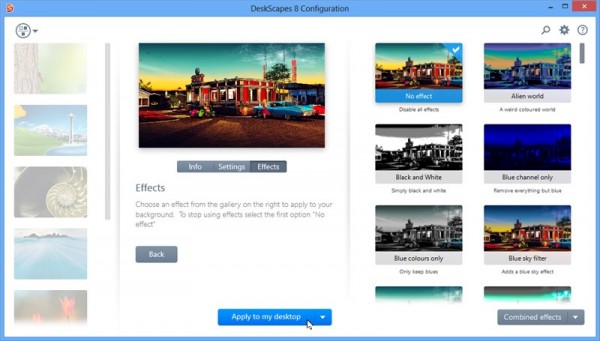
    The tool is incredibly easy to use. It can be accessed at any time via the desktop by right-clicking and choosing Configure DeskScapes. From here, it’s a basic three-step process: first, choose your target wallpaper – seven animated examples are provided in the program, with the other options made up of images from selected folders (users can choose other folders to include with the default selections too). There’s also a link to wincustomize.com, where users can download dozens of animated desktops created by other users.

    A small preview, plus description and three or four tabs will appear. Select these to configure the wallpaper further — select Effects to access one of 40 special effects, which include a range of filters including blur and colorization effects. Again, the preview updates when one is selected to give you an idea of how it will look.

    Users can also combine up to four special effects together for one striking effect — click the Combined effects button to get started — and then it’s a case of clicking Apply to my desktop to make it your desktop wallpaper, or clicking the down arrow next to the button to access an option to make it your screensaver instead.

    The tool also comes bundled with Stardock DreamMaker, a tool for creating your own desktops in the Dream format. It’s not particularly simple to use, but does at least give you the opportunity to indulge your creative side further.

    Stardock DeskScapes 8.0 can be downloaded for free as a 30-day trial, with the full version costing $9.99. DeskScapes 8.0 requires a PC running Windows 7 or 8.

  • Google Launches New Arrow Key Navigation In Gmail

    Google announced in a Google Groups thread that it has added arrow key navigation to Gmail.

    Google technical program manager Richard John Wu writes:

    Now, you can use the keyboard arrow keys to navigate your labels (the navigation panel on the left that includes the Inbox, Sent Mail, and Drafts links), and also to navigate the conversation threadlist (the message list panel on the right) in Gmail.

    When you navigate using these keys, the browser will focus on selected items, enabling screenreaders to read out what’s selected.

    Previously, using the arrow keys would have caused your browser to scroll up or down the webpage.

    In other semi-Gmail related news, Google just added Google Calendar to the Gmail Search Field Trial, and a Gmail Attachments feature has been spotted in Google Drive.

  • After investor drama, Apple shareholder meeting is anticlimactic

    Shareholder meetings are typically colossally boring affairs, and Apple’s annual meeting Wednesday morning in Cupertino, Calif. didn’t deviate from this truism of the business world.

    And this was despite fireworks over the weeks leading up the meeting: a federal judge issued an injunction on one of the company’s shareholder proposals after a hedge fund sued; the same firm, Greenlight Capital, publicly laid out a case for a new class of Apple stock, and another investor fanned rumors of a stock split.

    Instead, when all was said and done Wednesday, nothing of huge significance actually took place. But some things did happen.

    Related research and analysis from GigaOM Pro:
    Subscriber content. Sign up for a free trial.

  • Kindle for iOS is safe now, ah, we think

    How could I resist something like this? A bug in Amazon Kindle for iOS 3.6.1 de-registers the iPad or iPhone, deleting all content and settings from the device. Because of the iTunes Store review process, Amazon resorts to posting a warning that existing customers shouldn’t install the app. What’s wrong with this picture? That’s my question for you, oh faithful, snarky commenters (surely you have words for me, too — ouch).

    Amazon’s app note: “There is a known issue with this update. If you are an existing Kindle for iOS user, we recommend you do not install this update at this time”. That was hours and days ago. Today, Amazon bumped up the app to v3.6.2, which supposedly resolves the problem. I don’t have an iOS device, so would you mind checking for us all please — lab rat in the Kindle Store.

    For those folks panicking about deleted content, you can breathe easy. Amazon keeps everything in the cloud. Your books are just gone from the device, which can easily and quickly be registered and resynced.

    My colleague Alan Buckingham asked when I told him about the warning: “Do they also recommend buying a Kindle to fix the problem?” Hell, that’s good marketing advice.

  • The Angry Birds Visa Card Is Now A Reality

    Back in November, news came out that Rovio had partnered with Kaiku on Angry Birds prepaid Visa cards. Today, Kaiku announced the launch of the cards, which come in four designs.

    The cards are available in: Red Bird, Yellow Bird, Bomb Bird and Bad Piggies – the basic designs you would want.

    Angry Birds Credit Card

    “We’re excited to be working with Kaiku on this fun new way to bring Angry Birds into the physical world and fans’ everyday lives,” said Rovio CMO Peter Vesterbacka.

    Kaiku CEO Jon Round added, “Kaiku’s partnership with Rovio allows us to continue taking our prepaid Card to a broader audience by empowering consumers with differing needs to maximize their financial future. The collection of Kaiku Angry Birds Cards will not only resonate with the vast number of Angry Birds’ gaming fans, but also consumers who are looking for a smart and affordable financial option in a dynamic and colorful prepaid card.”

    I’m not sure at exactly what point Angry Birds became a true pop culture phenomenon. It was certainly quite some time ago, but between this and the upcoming cartoon series, it looks like it won’t be going away anytime soon. Oh yeah, there’s also a movie coming out.

  • Chart: Cisco owns the switching and routing world

    While Cisco may see long-term threats to its business from software-defined networking, VoIP and competing collaboration and video conferencing products, the networking giant is sitting pretty with 54 percent of the market share in the six networking categories shown below for 2012.

    Research from Synergy shows that Cisco has the lion’s share of the market in switches and routing, reaching roughly 65 percent and 70 percent respectively. In 2012 the six main segments within the enterprise networking market generated $45 billion in revenues for technology vendors, with Ethernet switches now accounting for almost half of all spending.

    ciscorulz

    So even as Cisco comes off a successful reorganization and faces existential threats to its networking business from the commodification of the router, it’s daunting to see what its fighting to keep. It will not go gently.

    Check out Cisco at our Structure Data conference in New York City March 20 and 21.

    Related research and analysis from GigaOM Pro:
    Subscriber content. Sign up for a free trial.

  • Google Adds Your Google Calendar Data To Search Results

    Google announced today that it has added Google Calendar data to the Gmail Search Field Trial. This is the feature that lets you search Google’s regular web search and get relevant content from your Gmail account right on the main search results page.

    I’ve been part of the field trial since the beginning, and personally, I find it to be one of the most useful things Google has done in quite some time. This notion was only amplified when Google added Drive content into the mix, and I would imagine that Calendar data would only enhance it further.

    With the update, you can search for your agenda, and find appointments saved to your Google Calendar.

    I should note that I’ve been experiencing some problems with the feature actually returning results for the past week or so. I reached out to Google about the issue, and have so far been unable to get an explanation, though I’m told nothing has changed, and it’s likely something specific to my own account.

    When the feature works though, it really is helpful on a daily basis.

    What other Google services would you like to see implemented in this feature?