Category: News

  • HP Pavilion DM1 gets reviewed: decent battery but cramped keyboard

    HP’s Pavilion DM1 is still yet to show up for pre-order on the company’s US site (though the support pages are full of information) but that hasn’t stopped Netbooked from grabbing one of the 11.6-inch ultraportables for review. They reckon the DM1 “fares decently” among its peers, though they’re not impressed by the amount of screen flex on show (you can press the trackpad buttons by pushing down on the edge of the lid when closed).
    hp pavilion entertainment dm1 review

    Similarly, the keyboard is more cramped than on other 11.6-inch machines, with Netbooked blaming the wasted space either side. That leaves you with smaller-than-normal function keys, while the trackpad is also cramped and lacks multitouch support.

    On the positive side, it runs at 1,366 x 768 resolution, can handle 1080p Full HD video playback and manages to squeeze in a 6-cell battery with no protrusions. That battery is good for around 4.5hrs normal use, too. What we still don’t know is how much HP USA will be charging for the Pavilion DM1; HP Japan are asking the equivalent of around $686.

    HP Pavilion Entertainment DM1 Review

    Source


  • GOLD $1,182

    Gold is on a tear this morning, just breaking $1,182.

    The dollar is losing serious ground against the Euro during early AM trading. Check out the Euro/Dollar spike in the second chart below.

    gld1

    de

    Join the conversation about this story »

    See Also:

  • Man Earns 900% Return Selling Zhu Zhu Pets

    ‘The Zhu Zhu pet is one of this year’s must-have gifts, so popular it’s almost impossible to find in stores.”

    “There is one place you can find them, online, but be ready to pay a premium.”

    “Chris Handy bought 15 the day he first heard about Zhu Zhu’s. His wallet is thicker today… ‘We got about ten times what they were worth’”

    Join the conversation about this story »

    See Also:

  • IKEA Conquers Facebook with Innovative Campaign

    Social media has grown tremendously this year pushed forward by the likes of Facebook and, to a lesser degree, Twitter. But despite having been around for years, businesses are still trying to get the hang of this new opportunity to bring in customers and, at the end of the day, make more money. One company which seems to get it, at least in this case, is Ikea which has put together a hugely successful campaign to promote a new store and did so at a significantly lower cost than if it had used traditional marketing methods.

    The idea was simple enough but it didn’t need to be any more complicated. IKEA made a Facebook profile for Gordon Gustavsson, the manager of the new store in Malmo, Sweden, and then uploaded several images from the Ikea showroom over the course of two weeks. Nothing groundbreaking so far, but the interesting part was that the first Facebook user to tag his or her name on one of the products in the picture won it.

    As you could expect, people got really into it and soon enough the story spread throughout Facebook from profile to profile as the people added Gustavsson as a friend or tagged one of the photos. Not only did the campaign got a lot of people to visit the profile and, more importantly, the actual showrooms most users lauded the company for the innovative approach.

    read more)

  • Assessing the economic impact of global warming

    Coastal systems: people actually flooded across Europe

    If the climate expected in the 2080s occurred today, the EU would face yearly GDP losses between €20 and €65 billion, depending on the temperature increase in Europe (2.5°C to 5.4°C). This is one of the forecasts of the final report of the PESETA study, published today by the JRC Institute for Prospective Technological Studies (IPTS). The PESETA study also looked at different regional impacts of climate change across the EU. Damages would occur mainly in Southern and Central Europe, while Northern Europe would be the sole region to benefit, in economic terms and for the aspects studied, from climate change.

  • House Prices Are Still Too High

    The modest recovery in house prices over the past four months caught almost everyone by surprise, including those who are now explaining it away as an obvious byproduct of artificially low interest rates and the home-buyer tax credit.

    The recovery’s momentum is slowing, however, and it seems likely that house prices will now resume their fall and drop another 10%-15%.

    Why?

    First, prices are still too high. 

    As these charts from Calculated Risk show, price-to-rent and price-to-income ratios have not yet reached their average levels from before the bubble.  Normally, after a bubble like this, ratios would be expected to fall through their long-term averages and trade below those levels for several years. 

    pricetorentratio112509.jpg

    pricetoincomeratio112509.jpg

    Calculated Risk has detailed observations about the current state of prices here >

    Second, two of the key forces that contributed to the bubble are continuing to unwind:

    • Lending standards are still being tightened
    • Consumers are reducing their debts

    Third, the unemployment rate is still shockingly high and will likely remain elevated for years.  This will likely shrink the amount of money that consumers have to spend on housing.

    Fourth, nearly a quarter of all households still have negative equity, which is a prime cause of foreclosures.  The more foreclosures that hit the market, the more housing supply there will be, and the more pressure this will put on prices.

    Fifth, inventories are still high, especially if you include the “shadow inventory” of foreclosured houses and impending foreclosures, which some people estimate to be as high as 7 million units (vs. the 3.5 million that are currently on sale).

    Sixth, rents are declining, as Americans take advantage of the tax credits and low interest rates to buy instead of rent.  This temporarily improves demand for existing houses, but it doesn’t eliminate the overhang of housing supply.  As rents fall, the price-to-rent ratio for houses rises, and renting becomes more attractive again.  House prices then need to fall to bring the ratios back in line.

    Seventh, the current “affordability” of houses will change fast if rates begin to rise.  Houses are very affordable right now–if you have a solid job, lots of savings, and aren’t deeply underwater on your old house.  If and when rates begin to rise, however, this will quickly make them less affordable.

    The good news is that, after what we’ve been through, another 10%-15% decline will feel like a walk in the park.  It does seem likely that the house price decline will resume in November and December, though.  If so, it will be interesting to see what impact that has on the stock market and the rest of the economy.

    See Also: The Most Important Housing Chart Shows Things Are Still Getting Worse

    Join the conversation about this story »

    See Also:

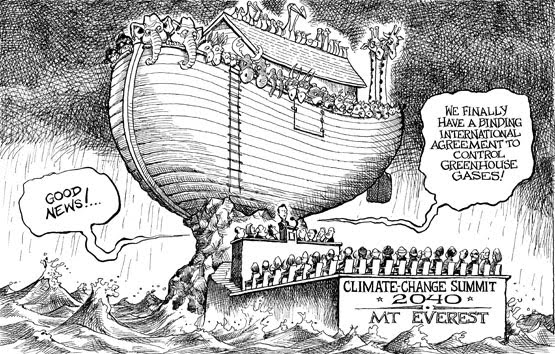
  • United Nations Climate Change Conference, Copenhagen, 7-18 December 2009

    The United Nations Climate Change Conference will take place in Copenhagen, Denmark, between December 7 and December 18, 2009. The conference includes the 15th Conference of the Parties (COP 15) to the United Nations Framework Convention on Climate Change, the 5th Meeting of the Parties (COP/MOP 5) to the Kyoto Protocol as well as meetings of other working groups and subsidiary bodies. COP 15 is the supreme body of the Convention. It currently meets once a year to review the Convention’s progress.

    The sessions (COP 15) of the United Nations Framework Convention on Climate Change are open to Parties of the Convention and Observer States (Governments), the United Nations System and observer organizations (IGOs and NGOs) duly admitted by the Conference of the Parties.

    UNFCCC’s Overview Schedule of COP15 could be found here and the link to the Side Events at COP15 could be found here.

    The European Union is working for an ambitious, comprehensive and legally binding global climate agreement that will prevent global warming reaching dangerous levels, that is, more than 2°C above pre-industrial temperatures, as researchers have projected for this century.

    The EU has independently committed itself to reducing its emissions by at least 20 per cent by 2020 compared with 1990 levels, and is now implementing this reduction with the help of a legislation package that entered into force earlier this year, along with a comprehensive programme for increased energy efficiency.

    What is expected to happen politically in Copenhagen?

    Parties agreed at Bali in 2007 to jointly step up international efforts to combat climate change and get to an agreed outcome in Copenhagen in 2009. Thus, an ambitious climate change deal will be clinched to follow on the first phase of the UN’s Kyoto Protocol, which expires in 2012. The Copenhagen agreed outcome need not resolve all details, but it must provide clarity on four key issues:

    –   Ambitious emission reduction targets for developed countries
    –   Nationally appropriate mitigation actions of developing countries
    –   Scaling up financial and technological support for both adaptation and mitigation
    –   An effective institutional framework with governance structures that address the needs of developing countries

    Copenhagen is to result both in a post-2012 outcome as well as important decisions and start-up finance to immediately kick-start action on climate change in 2010.

    You could find more information about the event and its background on the following websites: http://en.cop15.dk/ and http://unfccc.int/

  • Frutas Exóticas – Mangaba – Hancornia speciosa

    Ela vegeta esponteamente em regiões diversas do Brasil de onde é nativa, e pelos indios  é conhecida como tembiú-catu – “coisa boa de comer”. É também conhecida na França como Caoutcouc de Pernambuc. Conheci essa deliciosa frutinha ainda na minha infância, pois sendo a  preferida de minha mãe,  vez por outra meu pai a  trazia  de  suas muitas viagens à Recife. Foi assim que conheci a Mangaba.

    A mangabeira – Hancornia speciosa Muell – abunda nas regiões de cerrado brasileiro, que representava a 25% do nosso território, dando espaço agora aos famigerados pastos. Os estados da Paraiba, Bahia e Sergipe destacam-se como os maiores produtores. A planta alcança 5 a 6 metros de altura, e suas folhas são lanceoladas e suas flores – vão de setembro a novembro – são brancas  com cheiro suave. Do tronco , de casca rugosa e áspera,  e das folhas da mangabeira, extrai-se um látex usado na indústria. A madeira do tronco  é usada na fabricação de móveis e também para lenha.
    flor e fruto da Mangaba, foto de

    O fruto tem cêrca de 6 cm – são bagas colhidas ao chão  e ocorrem de setembro a março –  é muito viscoso quando verde, contendo um suco leitoso que quase embriaga e pode matar; a polpa é branca, fibrosa e recobre sementes cerca de 15 circulares. Quando maduro, o fruto tem casca amarelada com estrias vermelhas, é aromático, delicado, tem ótimo sabor mesmo sendo ainda um pouco viscoso. Sua polpa  é consumida ao natural ou é utilizada para o preparo de geléias, doces em calda, compotas, sorvetes, sucos, refrescos, picolés, licores, vinho e xaropes. É também preparada seca, como “passa” de mangaba.
    A Mangaba tem ação digestiva e laxante. É fonte de protéinas, cálcio, fósforo, ferro, e vitaminas A, B e C. Na medicina caseira, o suco leitoso é usado para tratamento de tuberculose e úlceras.                                                             

    A lenda da Mangaba

    Conta a lenda que um índio muito corajoso chamado Diaí , lutou inúmeras vezes para defender a natureza e protegeu principalmente a seringueira que os homens brancos estavam destruindo.Numa dessas lutas foi ferido e morreu, sendo abençoado pela Lua.

    Do seu coração brotou a mangabeira que se tornou uma árvore sagrada para os índios, dando frutos doces e polpudos, cujo leite se parece com o látex. Um dia uma jovem índia chamada Ytaciara estava desesperada para salvar Koara , seu grande amor, que estava para morrer. Uma velha índia ensinou Ytaciara a preparar um chá da folha da mangabeira para o seu amado.
    Ao tomar o chá, Koara sobreviveu e todos conheceram o poder de cura da planta.1

    Fontes: 1 – http://www.humaita-am.com; Seagri; foto de Fernando Tatagiba


  • AutoblogGreen for 11.25.09

    Quick Spin: Nissan Leaf the tip of mass market EV spear
    Ghosn’s plan of attack makes sense, especially when the first shot is this silver (blue) bullet.
    Volt battery life affected by hot weather, but 10 years means 10 years
    The most expensive part of the pack will last, says GM.

    REPORT: Electric Infiniti will be a performance-oriented ZEV
    Speaking of attack, here’s Round Two.
    Other news:

    AutoblogGreen for 11.25.09 originally appeared on Autoblog on Wed, 25 Nov 2009 05:58:00 EST. Please see our terms for use of feeds.

    Read | Permalink | Email this | Comments

  • Twitter and Facebook Are Increasingly Influential

    There are a lot of metrics for website traffic, unique visitors, user numbers, and the likes. Measuring a website’s “influence” is a harder proposition though, it’s not exactly something you can count. Some people beg to differ though and ://URLFAN aims to do just this, measure a website’s influence by counting the number of mentions it gets on blogs. It’s not the most objective metric out there, but it’s probably as good as it gets and it’s an interesting perspective.

    The ReadWriteWeb blog put together a list of the top sites on the service and their standings a year ago. At this moment, despite the growing number of people predicting its demise, Wikipedia sits at the top as the most influential site on the planet. It’s not much of a surprise this one, the crowd-sourced encyclopedia holds huge amounts of content and information which comes in handy when you’re trying to put something in perspective or provide more background information.

    Wikipedia is followed by YouTube and then Flickr, which have switched places since last year. Their presence is entirely expected, one being the most popular video site on the planet and the other being the most popular photo sharing site among bloggers, even if it’s not the biggest in its category. Things only get interesting on fourth place where Twitter… (read more)

  • Ring°Wall: World Largest Multi-Touch and Multi-User Wall

    world_largest_multi_touch_wall2.jpg
    The World’s Biggest / Largest / Longest Multi-Touch (and evidently Multi-User) Wall [sensory-minds.com, click Projects then choose 19.07.2009) seems to be installed in Nürburgring, a famous motorsport race track around the village of Nürburg, Germany The two-piece wall consists of a huge LED media facade (at the top), and a multitouch information-wall (at the bottom), and impresses by its physical size, as it totals a surface of about 425 square meters, equaling more than 6000 computer displays.

    The interactive interface emerges out of 34 million pixels generated by 15 high definition projectors, supported by sound produced by 30 directional speakers. The multitouch capturing itself is based on laser technology, also called Laser Light Plane Illumination (LLP). This means more than 80 users can simultaneously get informed about news and activities around the ringworld. Now imagine the sorts of sparklines this device could display…

    You can watch a documentary movie below.


  • Jimmy Kimmel Live – s7 | e146 – Tue, Nov 24, 2009

    Charlize Theron, Regis Philbin, DWTS castoff, Wolfmother

    Add this to your queue
    Added: Wed Nov 25 10:43:04 UTC 2009
    Air date: Tue Nov 24 00:00:00 UTC 2009
    Duration: 38:05

  • Credit Default Swaps Are So Huge That They Can’t Be Banned

    Despite regulatory threats on the horizon, the outlook for the credit default swaps (CDS) market remains bright. While the CDS market’s notional value of outstanding contracts fell 14% in 2009, it’s still at massive $36 trillion of notional value.

    Swaps brokers and clearinghouses don’t appear worried about its future according to DealBook.

    DealBook: …trading in swaps has so far survived the crisis and market reforms are on the way. Barring unexpectedly draconian regulatory changes, a comeback looks likely, Breakingviews says.

    it looks likely that reforms to improve the market’s workings will trump the idea of shutting it down. With that in mind, forecasting a return to robust market growth makes sense, according to Breakingviews. Central clearinghouses and electronic trading led the energy derivatives market to bloom in recent years. The return of credit risk-taking wouldn’t please everyone, Breakingviews concedes, but the credit-default swaps market could emerge bigger and stronger, too.

    Despite the regulatory risk, recent data supports this view that the credit default swaps market will continue to grow. For example interdealer broker ICAP’s recent interim results showed that the company’s credit-related trading revenue 37% year over year, despite all the scorn.

    dd

    Thus we’ll take DealBook’s view a step further — even draconian regulation won’t be able to stop this market’s expansion. What you might ban in the U.S. or Europe will simply move offshore.

    the end it isn’t crazy that bondholders might want to purchase insurance against default. Given the gigantic size of the global bond market and today’s technology, someone will find a way to meet this massive need. Thus less regulation would be better than more, since it would keep these markets onshore and under closer supervision.

    Join the conversation about this story »

    See Also:

  • Google's New 'In Your Face' Ads

    Perhaps a little reluctantly, Google has been slowly adding more rich content to its search engine. It’s still as spartan as it gets, but there’s certainly an evolution and now it’s making the same changes to the ads it serves on the search results page which now feature videos, images, and even maps.

    “To provide a better search ads experience, we’ve been developing and testing a variety of new ad formats. These formats are focused on giving you the information you need, while retaining what you love about Google advertising: that the ads are relevant and useful,” Susan Wojcicki, VP of product management at Google, wrote. “If you’re looking to buy your mom a new handbag for the holidays, for instance, you might want to see pictures, prices, the addresses of boutiques in your area and a map of how to get there — all within the ad.”

    Some of the new ad units have been in testing for a while now, but Google wanted to showcase them, perhaps because it’s ready to introduce them on a larger scale. The company is working on several new units, but the general theme is ‘bigger is better’. There’s a good reason for that, bigger ads equal more clicks therefore better revenue for the company, but this only works up to a point. Part of the reason why people chose Google to do their searches is the clean in… (read more)

  • Can Universities Make Sure That Drugs Based On Their Research Are Licensed Reasonably?

    Joseph Franklin has written about how a group of universities have agreed to some basic principles (pdf) about providing drugs to developing nations at reasonable costs (or even free) in the interest of better global healthcare. However, Franklin wonders how well this will work in practice, and why it should only apply to developing nations, and not domestically as well. It’s an interesting question, made more complicated by the fact that many drugs have their research started at universities — frequently backed by government money — but are later taken over by pharmaceutical companies who have no interest in such principles. I tend to think that such “principles” are nice to speak about, but are rarely effective in actually creating change. I would think that a much stronger argument is showing the economic benefits in keeping people alive. If you could rid some developing nations of certain diseases, you’d be able to open up vast new markets for other industries. Hell, imagine if you could get companies in other industries (food, clothing, transportation, etc.) to pay for drugs for the poor in developing nations, knowing that keeping them healthy will help those nations build their economy so they can start purchasing the same food, clothing and transportation…

    Permalink | Comments | Email This Story


  • Asset Shortage during Power Shortage

    Dear Energy Professionals, Dear Colleagues,

    In his December 2006 article on the Macroeconomics of Asset Shortages, Economist Ricardo J. Caballero says, “The world has a shortage of financial assets. Asset supply is having a hard time keeping up with the global demand for store of value and collateral by households, corporations, governments, insurance companies, and financial intermediaries more broadly. In equilibrium, the value of the (relatively) few existing assets must rise, which has important global macroeconomic implications. These shortages have been a perennial problem in emerging markets, where many of their economic perils and idiosyncrasies stem from this feature. But we are now seeing a shortage on a global scale. It probably began with the meltdown of a substantial share of Japanese assets in the early 1990s, it was exacerbated by European stagnation and the collective emerging market crises of the late 1990s, and it consolidated in the new millennium by the fast income growth of China and commodity countries, most of which have substantial asset demand needs but are not natural asset producers”.

    It is so sad to visualize that on one hand world assets cannot find proper investments, while on the other hand our local power plant investments cannot find money to get started. There is a great investment credibility problem in our local energy markets. We need to have a clear inspection of this major problem starting from the annual investment requirements of our local market, clear figures of electricity supply demand in the local market, the capacity we will need in the future, and what we face if we do not initiate such investments.

    In order to review the balance of electricity supply demand in Turkey, we look at the internet pages of a local Public Transmission company, and we come up with a Turkish Installed Capacity at 44,472.5 MWe as of November 2009.

    We can also visualize that, on a month-by-month basis, installed capacity is lower in 2009 than in 2008. In 2008, installed capacity was 41817 MWe, and Peak load was 30842 MWe. We understand that we had no such a big shortage problem in year 2008.

    In 2009, our Installed Capacity is 2600 MW higher, but our demand peak is 4% lower than it was in 2008. The hardest years for the Turkish system are the drought years since we have a high sensitivity due to the relatively high hydrocapacity.

    So we multiply the installed capacity by 4650 hours for higher scenarios and by 4500 for lower scenario; this is a rough approximation for capacity utilization. Do note that the system has the ability to achieve more than 5000 hours on average annually. If the resulting number is less than the expected demand, then it means the electricity generation system is under stress.

    44472.5 MW x 4500 hours (average per year overall availability) = 200 TW-hours
    44472.5 MW x 4650 hours = 206.8 TW-hours

    Expected demand for 2009 is 194 TW-hours.
    Expected demand for 2010 is 206.6 TW-hours.

    So without any adding any additional capacity, the existing installed capacity should be enough until the end of 2010.

    In summary, Turkey has almost 45,000 MWe installed capacity, though we did not exceed 36,000 MWe at peak hours in 2009.

    The remaining portion is NOT available since they are not reliable – sources such as wind, solar, hydro, all renewable – or they are out of service, as in case of many old thermal power plants.

    Apart from periods of economic crisis, Turkey needs approximately a 6-8 percent increase per year in electricity output in order to keep the desired growth rate.

    New investments require a project execution period of 2-4 years for natural gas-fired combined-cycle power plants, 1-2 years for wind, 5-7 years for hydro (ILISU?), and 7-20 years for nuclear. In this period, money is allocated, but revenues are not generated before completion.

    Every kw of power created costs approximately $1000 US Dollars on average. Combined-cycle plants cost a bit less, $500-$600 USD per kw, while thermal power plants cost around $2000 USD per kw. There is no average price per kw available for nuclear power plants.

    Now let us do some simple arithmetic with a low end of 6% annual electricity generation increase for an available power capacity of 36K MWe:

    36,000 Mw = 36,000,000 Kw
    Minimum 6 percent increase for each year x 1000 US Dollar investment per Kwe
    0.06 x 36mx 1000 = 2.16 billion US Dollars per year investment needed minimum

    So we feel that the figure of $1 billion USD per year upfront becomes too prudent for a higher expectation of the growth rate. So who will finance such a big investment package??

    Leading local financiers may say that it is easy for Turkish financial capability, but one should not be so sure about that.

    Furthermore, nuclear power plants are NOT a solution to power shortages, since we do not know the project execution period. It could take approximately 7 to 20 years to complete a nuclear power plant at this time for many reasons, including legal battles, technology restraints, fabrication difficulties, financing limitations, and regional and international politics.

    Blackouts in small regions are currently happening already in Turkey. Although people living in big cities like Istanbul, Ankara, etc. do not face these shortages, it is a reality of life in many towns.

    Many of them are classified as power disorders, but those power disorders wander from one area to another in Anatolia. A power failure in one area is repaired (!) and soon after that repair another new power interruption occurs in a neighboring region.

    There may be unexpected blackouts (like the one in Paris or New York, sometime in 2005) due to unforeseen technical problems. But according to optimistic public employees of our local Public Transmission Company, the local system has enough reserve capacity till the end of 2012 in their worst-case scenario.

    The best-case scenario is that we end the prevailing electricity comfort in 2014 or 2015. But capacity projections always have worst-case flexibility to predict a serious problem in 3-5 years in time. Hence, this projection likely reflects the delay between EMRA licensing and full electricity-producing operation. EMRA licenses, which are issued after March 2009 and are not included in the worst-case scenario, could be generating electricity in 5 years time and could delay the situation to 2015-2016.

    In our humble opinion, the ground for an electricity supply crisis has been forming gradually since the beginning of 2006. We may unexpectedly encounter a power shortage crisis, and we turn a blind eye to the facts, in fact the culprits, while searching for other reasons as the cause.

    Project financing is too difficult in Turkey, especially at this time of global financial turmoil. Public institutions have limited or almost no capability. Local investments are generally realized by “corporate finance” methods. Local investors risk their own property in order to get proper “corporate financing” at reasonable interest rates, and payment terms.

    In the past, we have realized energy power plant investments exceeding 4000 MW installed capacity. Those natural gas-firing cogeneration plants quickly pay for themselves and create more money for further investments in new plants.

    However, we do not have the investment environment for “non-recourse” project finance to secure “off taker” contracts. Therefore, it is too difficult to find the necessary project financing for mega projects such as nuclear plants and the plants in Afsin Elbistan. We have lost time in the past and continue to lose more and unable to recover fast in due time.

    Turkey will need more local private financing and local contracting, local engineering, if applied. Your writer sincerely feels that our local private investors deserve all our support to complete new power plant investments, provided that they create jobs for the local engineers and for the local qualified manpower.

    Please do note that above forecast is your writer’s humble calculation and does reflect the opinions of any public or private institution. Your comments are always welcome.


    Haluk Direskeneli, Ankara-based Energy Analyst

  • What Are The Best Board Games For Christmas?

    Christmas is the time of year for sitting on the floor and shouting ridiculous words at your family. Yes, it’s the dreaded board game. And if you’re puzzled by which ones you should be playing this year then help is at hand. Here’s a list of the very best for Christmas 2009:

    Bananagrams


    Yes, I know what you’re thinking. That looks like Scrabble without a board. And I have to say, I think I agree with you. It does look like Scrabble without a board. Except this is Bananagrams and there is no board. Each player takes a ‘bunch’ of letters, then races to form as many connecting words as possible. Then you must ‘peel’ which means taking some more letters from the ‘bunch’ and at some point shout ‘split’. I guess the loser is ‘yellow’ and the winner runs around shouting ‘nana-nanana’ extremely loudly and irritatingly.
    Ages 7 and up
    Price – $15

    Bop-It

    Bop-It is a colourful and noisy little game. It lights up and shouts out commands such as ‘spin’ and ‘pull’ and ‘twist’. Players must do exactly what Bop-It orders as quickly as possible. The higher the score the better the Bop-It. Kids can now download new commands and record their own voice with Bop-It download.
    Ages 8 and up
    Price: $25

    Cranium

    If you like your board games varied then Cranium really is the one for you. The sketching, sculpting, puzzling, acting, humming, quiz-based board game has pretty much everything for pretty much everyone in the family. The game lasts an hour, it’s very colourful and there’s plenty of fun for adults and kids alike. It’s been a huge hit and is sure to be played in thousands of houses on Christmas Day.
    Ages 3 and up
    Price: $25

    Funny Business

    Just as the free market is collapsing round our ankles a game pops up pleading with you to start believing in business all over again. And to laugh. Because business is fun. What you have to do is create hilarious and convincing names for a mall-full of new enterprises. So if a bakery merges with a barber shop, what name will you give it. Win votes from the other players and the business is yours.
    Ages 12 and up
    Price: $20

    Game of Life Extreme Reality Edition

    Life used to be so simple. You got born, went to school, got a job, had two kids, retired and then waved goodbye. But now life is more extreme. There are skydives, TV shows to be on, castles to live in, stunts to perform, sextuplets to give birth to. That’s life according to the Game of Life Extreme Reality Edition anyhow.
    Ages 9 and up
    Price: $30

    Guesstures

    There’s not much really very new in the board game world. Questions, answers, points… Oh and the miming one. Well this is the miming one. Based on charades Guesstures sees players act out four words against the clock. Fail and the cards get ‘munched’. Once the game’s over points are tallied to see who wins ‘Best Performance’. Trophy included!
    Ages 8 and up
    Price: $20

    Pictureka Flipper!

    Fancy spending Christmas Day with a penguin? Good, because in Pictureka Flipper! The penguin pretty much rules. I’m not sure if he, she or it has a name but Penguin flips cards onto the table and players must race to find the fun drawings which correspond with their ‘missions’. And all before Penguin quacks.
    Ages 6 and up
    Price: $20

    Totally Gross

    Kids aren’t interested in knowing who discovered penicillin or what the X stands for in X-ray, what they really want to know is what exactly is snot, who has the smelliest feet, and can mum or dad do the best impression of throwing up. Totally Gross is a science-based board game which will teach kids a bit about chemistry and biology whilst making them laugh until they spew. Eureka!
    Ages 8 and up
    Price: $20

    Trivial Pursuit Team

    The world is getting stupider. It’s a fact. And in accordance with this the brainy team at Trivial Pursuit have found a way of offering their extremely challenging quiz to an audience of complete dummies. Instead of the old strict rules: One question one answer right or wrong, in Trivial Pursuit Team you now have multiple choice options, points for nearly correct answers, closest answers and presumably lots of pats on the back. It’s still fun but it won’t make you feel clever.
    Ages 18 and up
    Price: $30

  • Hulu Sees Its Biggest Month Yet in October

    Watching online video may seem a very different experience to watching TV but, at least with some content, the trends are very similar. Hulu, the US online video outfit centered on TV content, saw a massive jump in viewership and audience in October in tune with the new TV season and the addition of ABC shows. AdAge, citing comScore numbers, reports that Hulu traffic jumped 47 percent from the previous month, the biggest rise this year.

    The online video joint-venture between News Corp., NBC Universal, and Disney has seen its best month yet with people viewing 856 million video in October up from 583 million the previous month. That’s still way below YouTube’s almost seven billion streams, though this number comes from Nielsen which only counted 632 million streams for Hulu in October. ComScore gets direct data from Hulu so its numbers are more accurate.

    In terms of unique visitors, Hulu is also doing much better growing by 10 percent to about 42.5 million viewers in the US. The audience numbers don’t follow the jump in streams. but this means that people were also watching more videos, something backed up by the numbers which show that the average user viewed 132 minutes worth of videos up from just 92 minutes in September.

    While the numbers bode well for the video site, they’re not directly rela… (read more)

  • The Linde Group and Algenol Biofuels cooperate in CO2 and O2 management for biofuel production from algae

    The Linde Group and the US company Algenol Biofuels LLC have agreed to collaborate in a joint development project in order to identify the optimum management of carbon dioxide and oxygen for Algenol’s unique algae and photobioreactor technology. This cooperation will see the companies join forces to develop cost-efficient technologies that capture, store, transport and supply CO2 for Algenol’s proprietary process for the production of third-generation biofuels out of CO2, salt water and algae, as well as remove oxygen from the photobioreactor.

    “Producing fuels or chemicals from algae is a promising way of reducing greenhouse gas emissions,” said Dr Aldo Belloni, member of the Executive Board of Linde AG. “A cost-efficient supply of CO2 is a key factor in this biofuel chain. As a pioneer and leading company in CO2 capture, transport and supply we are delighted to be a key player in major projects in the algae-to-biofuel area.”

    The research collaboration builds on a process developed by Algenol Biofuels and other partners. This method utilizes algae, CO2, salt water and sunlight to directly produce 3G bioethanol and other 3G biofuels or biochemicals in photobioreactors. This technology promises numerous benefits. The production facilities, for example, do not need to be built on land required for food or feed production. Furthermore, the procedure does not consume fresh water nor does it involve costly steps for processing or harvesting and storing biomass. A further key benefit is that the algae also consume CO2 from fossil fuel sources (e.g. combustion flue gases from coal-fired power plants).

    More information here

  • 10 new Mercedes-Benz Citaro FuelCELL-Hybrid in service in Hamburg in 2010.

    Daimler has announced that ten new fuel cell buses ( Mercedes-Benz Citaro FuelCELL-Hybrid) will enter service with the Hamburg transport authority, Hamburger Hochbahn, next year.  Hamburger Hochbahn will also receive 20 fuel cell passenger cars – the Mercedes-Benz B-Class F-CELL model – starting 2010.

    The Citaro FuelCELL-Hybrid is participating in large-scale fleet trials scheduled to take place in Hamburg and other European cities as a follow-up to the European Union’s CUTE and HyFLEET:CUTE projects (conducted between 2003 and 2009). Under the HyFLEET:CUTE project, 36 Citaro buses equipped with the second-generation fuel cell drive system have operated across 12 public transport agencies around the world, including Hamburger Hochbahn. The models have accumulated more than 140,000 hours of operation, during which they covered a total of more than 2.2 million km.

    “The new Citaro FuelCELL-Hybrid clearly demonstrates that electric mobility is already feasible today also with commercial vehicles,” says Hartmut Schick, head of Daimler Buses. “Besides, synergy potentials with our Mercedes-Benz passenger car development and Daimler research can be optimally used in particular with the fuel cell drive system.”

    The Citaro FuelCELL-Hybrid and the B-Class F-CELL share a range of common parts, including fuel cell stacks. Daimler claims that the latest Citaro FuelCELL-Hybrid consumes almost 50% less hydrogen compared to the preceding generation, due to improved fuel cell components and hybridisation with lithium-ion batteries. The operating range of the fuel cell bus is around 250km.

    More information here