Category: News

  • Infoaxe’s Search Engine: More Current Than Real Time

    Updated: Infoaxe is revealing to the world today its alter ego: a search engine. Unlike other real-time search engines such as OneRiot, Infoaxe doesn’t depend on Twitter streams and the like (Update: OneRiot emailed to note that it also uses a panel in addition to social sharing streams). Instead, it anonymously harvests data from its millions (low millions, for now) of people who use its personal search history plug-in.

    The idea is to observe every page an Infoaxe user visits, not just the ones they share on social web services. This aggregate attention data adds 7 million URLs per day to its index, as compared to some 300,000 URLs on Twitter and 10,000 on Digg. Of course, those other sites’ URLs are shared for a reason.

    “Even though Twitter and Facebook have exposed the chink in Google’s armor, we don’t think they are the cure,” Infoaxe founder Jonathan Siddharth said in a recent interview. He and co-founder Vijay Krishnan met while doing their computer science masters’ degrees at Stanford a couple years ago.

    Infoaxe’s results are fresh, but they don’t form an up-to-the-second real-time stream, which is a plus for relevancy. Rather Infoaxe puts an emphasis on pages where its users have stayed for a while or revisited often — so it’s good at discovering things like product deals and hosted web streams of TV and movies — the kinds of query for which another search engine might deliver an outdated pile of spammy SEO junk, or a more timeless link like an IMBD page, respectively.

    As Infoaxe tries to secure deals to incorporate its results into larger search engines, it’ll be important that it has a good sample of users. And to some extent, that will never happen, because the people who contribute to Infoaxe will only be those who are motivated to save and parse their own search histories. However Siddharth and Krishnan brag that their 2.1 million registered users are starting to break out of the early adopter mold, with more total IE plug-in downloads than Firefox, and an even balance of men and women.

    Sunnyvale, Calif.-based Infoaxe has five employees; it raised $900,000 from Draper Fisher Jurvetson, Labrador Ventures, Band of Angels and Amidzad Partners in 2008.


  • First Drive: 2010 Mitsubishi Outlander GT is a CUV we can live with

    Filed under: , , ,

    2010 Mitsubishi Outlander GT – Click above for high-res image gallery

    Mitsubishi presented its best and brightest rides for us to drive over the course of an eight-hour event in the parched desert oasis of Palm Springs, CA. Everything from a tuned, 290-hp Lancer Sportback Ralliart to an electric i MiEV. And drive them we did. We rocketed up winding mountain roads and down gravel-caked trails. If they brought it, we pounded on it. Fairly hard, too. Odd then that the focus of this particular review – and in many ways the star of the party – isn’t some carbon fiber body kit-enhanced EVO X, but rather the new 2010 Mitsubishi Outlander GT.

    Yup, an SUV. Actually, a CUV, albeit one with lots of ground clearance. Mitsubishi first introduced the second generation Outlander in 2006 (replacing the more wagon-esque first gen.), and 2010 marks a major refresh. In GT trim, almost everything has changed, from the exterior to the interior to the quantity and quality of gadgets to the engine output to the transmission and finally, most importantly, its all-wheel-drive system. The 2009 Outlander was a fine, competent, utilitarian machine – perfectly adequate for schlepping kids and groceries. But let’s be frank, it didn’t set hearts on fire. And while the new Outlander GT won’t necessarily do that either, it’s most definitely not just another sedan on stilts.

    Photos copyright (C)2009 Drew Phillips / Weblogs, Inc.

    Continue reading First Drive: 2010 Mitsubishi Outlander GT is a CUV we can live with

    First Drive: 2010 Mitsubishi Outlander GT is a CUV we can live with originally appeared on Autoblog on Fri, 20 Nov 2009 11:57:00 EST. Please see our terms for use of feeds.

    Permalink | Email this | Comments

  • Casey: National Guard essential to war efforts

    A transformed National Guard has been essential to America ‘s war effort, the
    Army’s chief of staff said here Nov. 19…

  • Mullen: Guard should not return to how things were before 2001

    The National Guard has changed dramatically since 2001, transforming itself from a
    strategic reserve to an operational force…

  • VA reaches out to Guard members with ‘seven touches’ program

    The Department of Veterans Affairs recently implemented many new initiatives and
    programs as a way to specifically engage National Guard and Reserve veterans who
    have been deployed, VA Secretary Eric K. Shinseki said Nov. 19…

  • College football rivals meet in Iraq

    For over 100 years, there has been a hotly contested rivalry that boils over to an
    all out war for three hours one fall Saturday afternoon in
    November…

  • Shinseki urges Guard leaders to spread VA message

    The National Guard can play an important role in helping to spread the news about
    the Veterans Affairs Department’s new programs to veterans in their communities,
    VA Secretary Eric K. Shinseki told a National Guard conference just outside the
    nation’s capital today…

  • Army Guard leaders key to maintaining ready and capable force, says director

    The quality and readiness of the Army Guard is in the hands of its senior
    leadership, the Army Guard’s top officer told more than 2,000 officers and senior
    NCOs here today….

  • Downloadable PC Full Version Freeware Real-Time Strategy (RTS) League of Legends – Installers

    Found out that there are two types of installers for the game — US and UK. I alerted the LoL developers with a query.

    I’ve also updated my previous post; I’ve added the download link for the US version.

    The download links (to the US and UK versions and a tutorial video) after the jump.

    >>>Click here for the download links.

  • Prof. Snead wins adult stem cell research grant

    carter snead faculty Notre Dame Associate Professor of Law O. Carter Snead, along with Professor Philip Sloan in Notre Dame’s Program of Liberal Studies and Graduate Program in History and Philosophy of Science, was awarded a $50,000 seed grant from the University’s Initiative in Adult Stem Cell Research and Ethics. The money will fund a project entitled “Theological, Scientific, Ethical, and Legal Aspects of Alternative Stem-Cell Research.” The project will culminate in an interdisciplinary workshop to be held next summer at Notre Dame, and is meant to be a precursor to a permanent interdisciplinary center focused on this topic.

    Snead was recently named to serve as an expert for the Initiative. Says Snead, “the Initiative takes a comprehensive approach to stem cell research, exploring not only the relevant scientific and engineering questions, but attending to the ethical and humanistic matters as well. The research aims at the common good, and is conducted in a manner that respects the equal dignity of all human lives from conception to natural death.”

    Adult stem cell research is actively pursued at Notre Dame. Adult stem cells are found in different tissues and organs throughout the bodies of animals, including the nervous system. The two most well known sources of adult/non-embryonic stem cells are bone marrow and umbilical cord blood. Notre Dame commits itself to never using embryonic stem cells in research to cure human disease. The University opposes the use and destruction of embryos on the grounds that it constitutes the unjust taking of innocent human life for the benefit of others.

    “The Notre Dame Adult Stem Cell Initiative is a tribute to the uniqueness of Notre Dame as the nation’s premier Catholic research university,” says Snead. “Notre Dame, like other elite schools, is committed to scholarly excellence, interdisciplinarity, and the pursuit of cutting edge research. At the same time, these aspirations are shaped by and grounded in the University’s mission. The Initiative reflects this synthesis.”

    A significant portion of Snead’s research and teaching centers around the ethical, legal, and social questions associated with stem cell research and related questions (such as human cloning). He has published numerous articles, both for scholarly and general audiences on these matters including: The Pedagogical Significance of the Bush Stem Cell Policy: A Window into the Nature of Bioethical Regulation in the U.S., 5 YALE J. HEALTH POL’Y, L. & ETHICS 491 (2005); Preparing the Groundwork for a Responsible Debate on Stem Cell Research and Cloning, 39 NEW ENG. L. REV. 701 (2005) (Keynote address for 2004 Symposium, “Bioethics: The Current Stem Cell Research Debate”); A Comparative Analysis of E.U. and U.S. Funding Policies for Embryonic Stem Cell Research: Details, Aims, and Effects, 4 QUADERNI COSTITUZIONALI 834 (2007); Bioethics and Self-Governance: The Lessons of the Universal Declaration on Bioethics and Human Rights, JOURNAL OF MEDICINE AND PHILOSOPHY, 34: 204-222, 2009 doi 10.1093/jmp/jhp024; Public Bioethics and the Bush Presidency, 32 HARV. J. OF L. & PUB. POL. 867 (2009); and Public Bioethics, Science, and the Problem of Integration, _ U.C. DAVIS LAW REVIEW _ (forthcoming 2010).

    Aside from teaching and research, Snead’s professional service has also focused heavily on the question of stem cell research. Prior to joining the faculty of Notre Dame, he served as General Counsel to the President’s Council on Bioethics (a White House advisory body), where he advised the Chairman and Members on the legal and public policy dimensions of stem cell research and human cloning. From 2004 to 2005, he led the U.S. government delegation to the United Nations Educational, Science, and Culture Organization (UNESCO) in the negotiation of the Universal Declaration on Bioethics and Human Rights (adopted in October 2005).

    Snead recently concluded his service as Permanent Observer for the U.S. government at the Council of Europe’s Steering Committee on Bioethics (CDBI), where he assisted in the development of international instruments and standards relating to stem cell research, among other things.

    Currently, Snead serves as a member of UNESCO’s International Bioethics Committee, a 36-member body of independent experts who advise member states on bioethical questions. It is the only bioethics committee in the world with a global mandate.

    Snead serves as Chairman for the Stem Cell Research/Bioethics Working Group of the New Federal Initiatives Project for the Federalist Society. Finally, he is a Fellow of the Ethics and Public Policy Center in Washington, DC.

    To learn more about Professor Snead, visit his webpage.

  • Murdoch’s The Times Accused Of Blatant Copying, Just As It Tells The World You Should Pay For News

    Just this week, James Harding, the editor of The Times (of London), a paper owned by Rupert Murdoch, tried to explain why the news is worth paying for, as the paper starts to put up a new business model to get consumers to pay for news. Unfortunately, Harding apparently didn’t get the message himself. As pointed out by Mathew Ingram, just days after making the case for paying for news, The Times has been accused of publishing an article that it copied without permission from a blog.

    You can’t make this stuff up.

    Yes, just as Rupert Murdoch is calling aggregators (sites that simply summarize and link to stories) parasites (even as he owns a bunch of aggregators himself), one of his papers didn’t aggregate, it flat out copied, without permission, a blog post that was written by Edgar Wright as a tribute to Edward Woodward, who recently passed away. The Times eventually put up a “clarification” online that had a link to the original site, but that hardly explains the original copying — especially during the very week that they’re trying to convince the world that news should be paid for….

    Permalink | Comments | Email This Story


  • Facebook Worth at Least $9.5 Billion

    Facebook is one of the biggest things in Silicon Valley at the moment and the social media giant is showing no signs of slowing down. It is being valued at several billion dollars, over 10, by previous transactions but since it’s a private company, no one can really tell what it’s worth. However, despite the fact that Facebook isn’t listed on any stock exchange, some shares end up on places like SecondMarket and SharesPost, which allow people who own Facebook common stock, mostly employees or former employees, to trade it. And prices for those shares have been going up over the past months to the point where Facebook’s common stock is now worth around $9.5 billion.

    That figure may be a bit misleading but it gives a rough estimate of what most people think the social network is worth. The $9.5 billion number is based on the price of shares currently being traded on SecondMarket, which has reached $21. The price has shot up 42 percent in the past four months, according to Bloomberg. This is just for the common stock though, as a chunk of the company is tied up in preferred stock, which is usually owned by venture capital investors so by this metric, Facebook may be worth more than $10 billion at the moment.

    The valuation does seem very high but it’s not the highest the social network has got; in fact, a couple o… (read more)

  • VIDEO: Disgruntled Volvo owner starts blog, crafts lament in her native Swedish tongue

    Filed under: , ,

    Click above to watch the video after the jump

    Freya Svensson feels like she’s getting screwed. According to her blog postings, she owns a still new-looking Volvo XC70 that has had more than its fair share of problems: a faulty transmission and an internal coolant leak that could have been caused by a cracked cylinder head or head gasket. To make matters worse, Svensson says the transmission, cylinder head and motor mounts (twice) have been replaced by Rusnak Volvo in Pasadena, California. Svensson further claims that when the transmission was replaced, she told Rusnak that it still didn’t feel right but the dealership allegedly wouldn’t take a look at it again. Now that the supposed defective tranny is out of warranty, the dealership wants to repair it. None of this tale is funny, odd, or different from some of the dealer/warranty horror stories that we hear about all the time. So why are we bothering to report on this one? As you might have guessed from the viking helmet and acoustic guitar show above, Svensson has no issue in pulling out all the stops in order to get her message across. She’s even got t-shirts. This amuses us.

    For starters, Svensson started up her own website, Rusmackedvolvo.com, which details her problems with Volvo North America and Rusnak Volvo. She took to Facebook to friend Volvo North America President Doug Speck, offering to help him add to his paltry friend total of 24 in exchange for free repairs to her Scandinavian lemon. To add a little flair, Svensson then took to YouTube to provide a video play by play of what is going on with her cursed wagon. The blonde haired, blue eyed Svensson plays up the Swedish connection by even singing an original composition, “O Rusnak Volvo” in her native tongue. Hit the jump to watch the clip, and don’t worry if you don’t speak Swedish – Svensson has been thoughtful enough to provide English subtitles.

    [Sources: Rusmackedvolvo.com; YouTube]

    Continue reading VIDEO: Disgruntled Volvo owner starts blog, crafts lament in her native Swedish tongue

    VIDEO: Disgruntled Volvo owner starts blog, crafts lament in her native Swedish tongue originally appeared on Autoblog on Fri, 20 Nov 2009 11:29:00 EST. Please see our terms for use of feeds.

    Read | Permalink | Email this | Comments

  • PSP Firmware Update 6.20 Introduces Extras, Digital Comic Support


    Sony has released a firmware update for the PSP family of gaming devices, which adds a new column in the XMB called “Extras.” Within this column you will now find the “Digital Comics” category, which will become fully functional in December when Sony starts offering digital comic books through the Playstation Store. Sony has also strengthened compatibility with Media Go software, allowing folks to enjoy their video and audio playlists that they created within Media Go.

    Extras

    • (Extras) has been added as a new category and (Digital Comics) has been added as an application under that category.

      With this application you can enjoy content such as comics and cartoon strips.>See details

    Other new or revised features in version 6.20

    Other

    • The XMB™ (XrossMediaBar) menu has been redesigned.

    music Photo

    • You can now import photo playlists that you created using the Media Go application and enjoy the playlists on your PSP® system. >See details

    video Video

    • You can now import video playlists that you created using the Media Go application and enjoy the playlists on your PSP® system. >See details
  • BlackBerry Pearl 9100 gets pawed

    BlackBerry 9100

    After RIM’s release of the BlackBerry Pearl 8220 flip-phone it was hard to tell what direction the former candy bar style handset was headed, and rumors of the models demise began to circulate around intertubes. However, the rumors of its death were greatly exaggerated as an updated 3G Pearl has been whispered for months, and it looks like RIM has gone back to the Pearl’s form-factor roots with its latest spin on the classic, the BlackBerry Pearl 9100 — code name Striker or Stratus. The 9100 prototype in question is a GSM device with RIM’s now standard optical trackball, SureType keyboard, 3G, Wi-Fi, and BlackBerry OS 5.0; it also incorporates many of the stylistic changes of the BlackBerry Bold 9700. We’ll stay on top of this one and provide you more details as they become available, but for now there is a short teaser video from salomondrin.net all queued up for you after the bounce.

    [Via CrackBerry]

    Read

  • Sony looks to finally open a single storefront for downloads

    By Tim Conneally, Betanews

    Sony yesterday discussed its plans to open a download shop similar to iTunes or Amazon Digital Downloads.

    Reportedly given the tentative name “Sony Online Service,” the online store would make the many different types of Sony digital content available in a single place. The company has a number of content portals already, but each is geared toward a related piece of hardware and run by a different business unit of the giant Sony conglomerate.

    For example, PlayStation 3 and PSP users can download new games, movies, and TV episodes from the PlayStation Network, but users of the Bravia Internet Link on Sony’s HDTVs get content directly from Sony Pictures services such as Crackle. Users of Sony’s e-Reader family can get content in The sBook Store from Sony, but users of Sony’s Walkman family of portable media players are encouraged to get their music from Sony MusicPass, which was launched to replace the defunct Connect music download shop that closed in 2008. There is also a substantial overlap in content with Sony’s mobile phone joint venture Sony Ericsson and itsPlayNow arena..

    Kazuo Hirai, Sony’s executive vice president for networked products and services, says the service will be modeled after the popular PlayStation Network, which now has more than 33 million registered users. Hirai however, expressed doubt to Businessweek that users of PlayStation Network would actually migrate over to a new service.

    Copyright Betanews, Inc. 2009


    Add to digg
    Add to Google
    Add to Slashdot
    Add to Twitter
    Add to del.icio.us
    Add to Facebook
    Add to Technorati


  • Freight Forwards Curve Warns Of Baltic Dry Index Collapse

    The Baltic Dry Index (BDI) has hit the highest point all year, staging a stunning rebound that is earning dry bulk shipping companies substantial amounts of profit for the time being. The latest BDI rally has been particularly spectacular given the massive amount of new vessel supply, which generally sinks rates all else equal, it has overcome.

    The sudden spike in new vessel supply this year is well by this chart from Johannes Moller at Danske Bank. Note the BDI rallied against this upward slope. This has been due to remarkably strong demand from China, plus some contribution from the grains trade which is seasonally strong right now.

    chart

    Yet while dry bulk stocks have rallied to some extent, they haven’t experienced the same strength as they have in the past when the BDI was at such high levels.

    For example, DryShips (DRYS), Eagle Bulk Shipping (EGLE), and Genco Shipping (GNK) are trading below their highs for this year, and dramatically lower to where they’ve been in the past when the BDI was above 4,600. The same is generally the case for dry bulk shipping companies in Asia. So what gives?

    While forecasting the BDI is a bit of fool’s game, the stocks haven’t run like in the past due to concerns that we may be set up for a massive BDI head-fake in 2010. This is because that supply chart you see above isn’t set to get any better. It is set to worsen.

    Danske Bank: We believe this [supply] trend should continue into 2010 when we believe quarterly deliveries are likely to be in the range of 15-20 m dwt, which is equal to an annualised fleet growth in the range of 13-18%.

    The dry bulk freight forwards curve confirms this. It is forecasting a decline in rates, especially around the second quarter of 2010:

    FFA

    BDI

    Join the conversation about this story »

    See Also:

  • Death and Texas

    Another week, another refusal by Texas to reconsider a death row case. Actually, make that two refusals.
    Robert Lee Thompson, 34, was executed last night in Huntsville, just an hour after Gov. Rick Perry had declined to commute his sentence to life. Perry was presented a rare commutation recommendation from the state’s Board of Pardons and Parole, which had voted 5-2 in favor of a life sentence for Thompson, who was convicted under the “law of parties” — meaning he participated in the crime but didn’t pull the trigger. Perry decided to ignore the board and authorize the execution.

    In another case, the Texas Court of Criminal Appeals yesterday rejected an appeal from Max Soffar (left), who has been on the state’s death row for 28 years for a crime he says he didn’t commit. Soffar, who is mentally ill, was convicted of killing four people in 1980 after giving what he and advocates say was a false confession.

    (more…)

  • REPORT: Ghosn still thinks Renault-Nissan should have partnered with GM in 2006

    Filed under: , ,

    With all the trials and tribulations General Motors has endured during the past year, we almost forgot that the Detroit, MI-based automaker nearly got itself tied up with Renault-Nissan. Back in 2006, the two companies discussed joining forces to become a singular global automotive juggernaut, but in the end, GM felt it was in its best interests to go it alone and face the quickly disintegrating global automotive market by themselves.

    While GM’s situation ultimately improved via bankruptcy and a $50 billion helping hand from the U.S. government, Renault-Nissan CEO Carlos Ghosn still thinks the partnership would have been “without a doubt” in everyone’s best interests. Ghosn reportedly made the comments during a meeting of the Council on Foreign Relations, adding that “there was a possibility to create something that would be extremely competitive.”

    Ghosn then went on to say that he wasn’t happy the two companies didn’t end up working together after GM nearly collapsed because “when you see the disaster and the waste of energy and skills and talent, nobody can be happy.” The charismatic CEO also said that Renault-Nissan was very concerned about GM’s precarious position earlier in the year due to the fact that his company uses many of the same suppliers. If GM had gone down, it would have probably taken more than a few suppliers with it, and Ghosn says that as a result, Nissan wouldn’t have been able to make a single vehicle in North America.

    While we can definitely understand why Ghosn would have preferred that the marriage of his company to GM was consecrated, we still don’t see how it would have helped The General in the long run. GM still would have been in a very uncompetitive cash situation, and Renault-Nissan doesn’t have much in the way of technology or platforms that the General doesn’t already the equivalents to.

    [Source: The Detroit News | Image: Raveendran/AFP/Getty]

    REPORT: Ghosn still thinks Renault-Nissan should have partnered with GM in 2006 originally appeared on Autoblog on Fri, 20 Nov 2009 11:02:00 EST. Please see our terms for use of feeds.

    Read | Permalink | Email this | Comments

  • FuelCon Fuel Cell Testing Equipment Could Lead to Quick Improvement

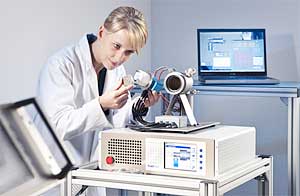
    Fuel Cell TestingOver the past few years it seems like I’ve talked about hydrogen fuel cells ad nauseam. I’ve spoken about fuel cells that are being developed with platinum nanowires, carbon, nitrogen, iron, doped nanotubes, mushroom enzymes, polymers, plastics, nickel, hydrazine hydrate and other enzymes.

    What I’ve neglected to talk about over time, however, is how researchers and manufacturers are supposed to test hydrogen fuel cells so that they may keep improving the size, weight, durability, life cycle and materials used.

    A company called FuelCon has developed an advanced testing system for the proton conductivity of fuel cells. According to FuelCon, “With the ‘TrueXessory-PCM Proton Conductivity Measurement’ market launch FuelCon provides a testing system for the development of more efficient fuel cell membranes. The new product allows highly reproducible in-plane measurements of the proton conductivity of PEM and DMFC membranes under defined humidification and temperatures up to 200°C. Designed as a tabletop system, complex hardware like a complete test station including gas supply is not required.”

    One of the problems that fuel cells for hydrogen cars have had in the past is a short life cycle. Some earlier prototype GM models had fuel cells that were only rated for around 50,000 miles. The U. S. Department of Energy (DOE) has stated that hydrogen fuel cells for cars will be ready for prime time when they have a durability of 5,000 hours (or roughly 150,000 miles).

    By having the tools to quickly test new methods and materials for creating fuel cells, the development time should be shortened considerably. Also, improved conductivity means more power and smaller fuel cells, which impact the weight of the vehicle and where the fuel cell system can be placed. Having the right tools to bench test hydrogen fuel cells is a positive step towards commercialization that should not be ignored.