I don’t want to grow up, but even if I did, I still would be a…can you hear it in your head now? Good. Toys R Us has released a few of their steals and deals for the fast approaching Black Friday, and some of them aren’t half bad. TRU will be offering a BOGOHO (buy one get one half off) sale on all PSP and DS games, The Beatles: Rock Band will be $49.99, and The Beatles: Rock Band “Special Value addition” will set you back $134.99. We’re not exactly sure what Toys R Us is trying to tell us with this next set of deals but all Xbox 360 and Wii hardware purchases will include a $15 gift card for Subway, Wendy’s, or Cold Stone Creamery — why not just include a free bottle of replacement bong water — also, “select games” will include a $25 iTunes gift card. The BOGOHO and Beatles offerings are good online or in-stores but the free gift cards are an in-store deal only. So what’s the verdict? Anyone going to head out to Toys R Us at 5am on the 27th to rub elbows with soccer mom’s trying to get a Tickle Me Elmo for these deals?
Google announced its open source Chrome OS last July and it has been a little more than a mystery to the wondering public since that time. Now, an official first look is mere hours away.
At 10:00 am PST (1:00 pm EST), Google will present a live webcast of Chrome OS, the search giant’s attempt to “rethink what operating systems should be.” Speakers this afternoon will include Sundar Pichai, Vice President of Product Management and Matthew Papakipos, Engineering Director for Google Chrome OS.
Besides finally getting to see just how Chrome will be laid out, we will get an overview of the underlying technology and find out about the operating system’s 2010 launch schedule.
What we know about Chrome OS already:
It will be free and open source
It is built on the Linux Kernel but has a totally new windowing system.
It will support both x86 and ARM architecture.
It will run Web apps as if they’re native desktop apps.
It is not a handset OS like Android, but there will be “overlap” in functionality
Acer, Adobe, ASUS, Freescale, Hewlett-Packard, Lenovo, Qualcomm, Texas Instruments, and Toshiba have all voiced support for Chrome OS.
Chrome OS Director Matthew Papakipos is director of the HTML 5 Open Web Platform efforts at Google.
The underlying security architecture of “standard” operating systems is being completely redesigned.
Until today, these facts have only raised more questions. Far too many to even list here. Hopefully, once the Webcast gets rolling, we’ll be able to finally put the most basic of these questions to rest.
11:23am PT: The Q&A session has ended, and now it’s time to go download the source code!
11:20am PT: It currently doesn’t support printing, but locally pluggable devices are recognized, and more are being added. (Nobody in the Q&A session is asking about local network presence/file sharing, etc…that’s disappointing.)
11:18am PT: “We’re trying to make the core boot operating system boot wicked fast…we’re really focused on making a lean and mean netbook that runs really fast.” –Matthew Papakipos
11:16am PT: Sergey Brin has joined the discussion.
11:13am PT: “If the cloud goes down, you’re going to be affected no matter what machine you’re on; Chrome OS or not.” -Sundar Pichai
11:13am PT: Though most of what is going on in Chrome OS can be accessed simply through any other browser…Verified Boot/malware prevention/fast boot/file system security are all benefits to the OS.
11:10am PT: “It’s very hard to build and ship an OS in a year, but that’s what we’re trying to do.” -Sundar Pichai
11:09am PT: Chrome Native Client will run on ARM chips eventually.
11:07am PT: To reiterate, the current plan is to ONLY SUPPORT WEB APPS in Chrome OS, period.
11:06am PT: Will Android Apps run on Chrome OS? Since they’re not Web apps…no.
11:05am PT: Media can be cached locally for offline access, and 802.11n is the focus wireless standard for connectivity.
11:03am PT: “We are working very, very, very hard to have a simple code stack.” -Sundar Pichai
11:02am PT: Chrome OS-based devices will be in the market by the middle of 2010.
11:00am PT: Working to support plugins. Asked if they’re working with Microsoft to develop a Chrome/OS Silverlight plugin, the answer was “no comment.”
10:58am PT: Everything that works in Chrome the browser, including Codecs, will also work in Chrome OS…Flash, Codec hardware acceleration, and Chrome native client.
10:57am PT: The archetypal Chrome OS device is going to be a companion device.
10:56am PT: Q: Will there be an application store?
A: There are hundreds of millions of web apps, so we’re working to solve the problem.
Q: What about driver certification?
A: Open source drivers whenever possible, but working closely with OEMs…
10:54am PT: With Web standards, many of those are still evolving, and the Device APIs are all still evolving too. Google is “working closely” with the big standards groups.
10:52am PT: Demo model running this build of Chrome OS is an “off the shelf Eee PC” (Asus)
10:51am PT: Q: What’s a Chrome OS netbook going to cost?
A: It will be up to the OEMs, and it’s too early to say.
10:49am PT: Google Chrome will ultimately be a “stateless computer”
10:47am PT: watching this video:
10:43am PT: How Chrome OS is going to go to market: Chrome OS image is being built against hardware profiles rather than generically. No support for HDDs, only Solid state drives. Wireless card support will be announced on a case by case basis. You won’t be able to just install Chrome. It’s pre-install only. (Kinda like OS X?)
10:40am PT: System is continuously auto-updated. Most of the system is in a writable partition, and that’s scary. System settings are stored separately, and user data is always encrypted. One benefit is safety of data; you can be assured that if some bad guy gets your machine with a screwdriver, he’ll have a hard time reading those bits.
10:38am PT: In the security model of the conventional application, apps run as you. (Impersonation). This is a big deal because it enables hackers to impersonate you. This makes it hard for users to make decisions.
Chrome OS applications are all Web apps, so you have a different security model. Apps are treated at the system level as fundamentally hostile by default. Web apps can’t change files on the hard disk, can’t change the power setting. (Evidently something does, but that’s not being discussed.)
All apps run in secure namespaces. “Every tab that you run in Chrome OS is run completely separate from other tabs in the OS — we’ve protected tabs from other tabs, apps from each other.”
10:35am PT: Talking now about the security model, and how the operating system will update itself continually. Components of the operating system must pass a cryptographic signature check before running. Malware protection enables the system to declare certain components of the operating system “wrong,” which apparently may be due to either malware or system updates. “We’re taking what used to be a painful imaging process, and we’ve made it transparent, saving your system settings.”
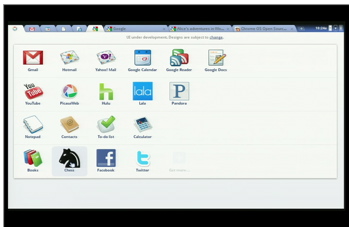
10:24am PT: Instead of browser tabs, they have become “application tabs,” and the far left tab is a menu of Web apps, there are also dedicated tabs for gmail, Google Docs, etc. “Panels” pop up from the bottom which can lay Web apps on top of one another.
10:21am PT: The UI is meant to feel like a browser, so it looks like the Chrome Browser. (as TechCrunch found out several weeks ago.) Bear in mind, this is a whole year ahead of release, so code is still being checked in right now.
10:19am PT: Chrome OS promises a 7 second cold boot. (though I counted 12 seconds in the demo…)
10:18am PT: Chrome OS is a “better model for personal computing,” focused on: speed (“we want it to be blazingly fast, like a TV”) simplicity (every application is a web application, nothing to maintain, all data is cloud data…sort of like a dumb terminal without the “dumbness”) and security (“we run completely within the browser security model”)
10:14am PT: Trends that Google is excited about: Growth of Netbooks, Growth of cloud usage, Convergence of phone and computer functionality.
The Massachusetts Senate yesterday passed a bill that would open the possibility of parole for prisoners convicted of nonviolent drug crimes. Many were sentenced under mandatory minimum laws and aren’t currently eligible for parole. Finally, amidst budget difficulties, another state is seeing the light.
On its website, Families Against Mandatory Minimums profiles Robert Anger, a Massachusetts prisoner who could potentially be eligible for parole if the bill becomes law. Anger, from Vermont, became addicted to OxyContin as a teenager and soon transitioned to heroin. He began selling cocaine to support his habit and was arrested in Massachusetts in 2004 buying cocaine worth $15,000. He was 22 when a judge sentenced him under mandatory statute to 15 years in prison, saying “I wish I had discretion” as he did it. His full story is here.
The MENC Legislative Memo is a new communication that aims to update MENC members and music educators on music education policy. The first edition was e-mailed to MENC leaders this week and also can be viewed online.
The first issue discusses how MENC worked to change draft rules for the new federal Race to the Top program. Visit the U.S Department of Education Web site to read the final application, major changes made to the rules based on comments from groups like MENC, as well as a Race to the Top application.
According to the Department of Education, the Race to the Top program will offer "achievable plans for implementing coherent, compelling, and comprehensive education reform. Race to the Top winners will help trail-blaze effective reforms and provide examples for States and local school districts throughout the country to follow as they too are hard at work on reforms that can transform our schools for decades to come."
The newsletter will post approximately every two weeks and will include links to a variety of advocacy materials including MENC’s SupportMusic "Make Your Case" database, as well as links to other legislative matters in which MENC and music educators have an interest.
The online music business has proven a tough nut to crack again and again. Pioneering free service iMeem is more or less dead in its current form and in the process of being acquired by MySpace. Countless others have failed to provide a free music streaming service that actually generates revenue and it looks like Europe’s music streaming darling Spotify won’t be able to deliver on the promise in the US either.
This has been known for a while, as the service has pushed back plans to launch in the US after concerns that it won’t be able to offer a free music streaming service like it does in Europe. And now the major music labels are “concerned” that the free model just doesn’t work and it would be unwise for Spotify to launch the same service in the US, as the Financial Times reports (subscription required).
They are right to be worried too, free music streaming services in the US have failed over and over again and the last bastions are closing down too. iMeem is about to be sold with its future uncertain and MySpace Music may stop offering free streaming not too far in the future.
There’s just one small glitch in the labels’ rhetoric though. While it’s true that free services have failed, the reason they have failed has entirely to do with the ridiculous … (read more)
Gen. Craig R. McKinley, the chief of the National Guard Bureau, announced today
the selection of a new senior enlisted leader for the National Guard
Bureau…
While admitting initial reservations, Defense Secretary Robert M. Gates told a
National Guard conference today he sees benefits of a new plan that allows
reserve-component servicemembers to conduct pre-deployment training before the
clock starts ticking on their 12-month mobilization cycles…
In the middle of a non-descript Middle Eastern village, 53rd Infantry Brigade
Combat Team Soldiers interact with the local inhabitants the same as they have
done day in and day out on routine patrols…
On Nov. 17, while visiting Camp Victory in Baghdad, Iraq, California Gov. Arnold
Schwarzenegger shared breakfast with Soldiers from the 49th Military Police
Brigade of the California Army National Guard…
‘Adding Value to America’ was the theme for more than 2,000 of the National
Guard’s senior Army and Air Force leaders from across the nation, who gathered
here at the National Harbor outside the nation’s capital this morning to kick
off their first Joint Senior Leadership Conference…
First Lady Michelle Obama today cited Army Staff Sgt. Amy Krueger, one of 13
killed during the shooting rampage at Fort Hood, Texas, as an example of the
determination and courage that has characterized women’s service to the military
throughout U.S. history…
The iPhone has not only changed the way people consume data on their mobile phones — thanks to its touchscreen, and the myriad of apps that make grabbing such info from the web on a small device easy — it’s changed assumptions as to which devices consume the most data on mobile networks. Bytemobile, a company that provides equipment for carriers to help deliver video and data to mobile devices using less bandwidth, issued a report today that shows the difference in data consumption by device among carriers that have the iPhone and carriers that don’t. It’s pretty significant.
Laptops are still consuming most of the data on carrier networks that don’t have iPhones on them, but once folks get a touch-based smartphone such as the iPhone (and right now it’s the most popular touch-based smartphone out there), the volume of data used by those devices far exceeds that of laptop usage. In other words, when it comes to the network and data consumption, the device does matter. The report also offers some self-serving data about video consumption on mobile devices that may help carriers save on bandwidth consumption. (GigaOM Pro, subscription required).
Cisco expects mobile data traffic to increase 63-fold over the next five years, driven in part by video. But while it’s clear that laptops and touch-based smartphones make video consumption easier, the rise may not be as steep as Cisco predicts. The report found that while the average video online is about 5 minutes in length, about half of the people only watch 60 seconds of a video, which means that sending the entire file to a user would be a waste of bytes and bandwidth. Only 31 percent of people watched all of a video, and 30 percent watched less than 10 percent. The rest of the viewers stopped watching somewhere in the middle. In addition to bandwidth consumption, such findings also could help determine where best to place ads. Although I for one hate getting pre-roll ads on my phone because that data consumed counts against my mobile bandwidth cap. But maybe I’m just super cheap.
Regardless, the problem with the iPhone is that it’s both a gateway drug for consumers, who’ve now tasted the mobile web and want more of it, as well as a canary in the coal mine, as it shows carriers what’s likely to happen as other touch-based smartphones become more popular on their own networks. Curtailing video, as suggested by the report, will solve some issues, but once you give folks a taste of broadband, they’re going to want more.
Java scalability specialist Terracotta has acquired the intellectual property associated with Quartz, a popular open-source job scheduler, part of Terracotta’s mission to integrate common open-source Java application components into its middleware solution. Terracotta has already integrated SQL-query service Hibernate, and it acquired popular distributed caching solution Ehcache in August. These integrations make Terracotta a more formidable competitor in the quest to manage data in cloud or scale-out infrastructures, where it battles relational databases, proprietary caching solutions like Oracle Coherence and, increasingly, flash-based solutions.
As more Java applications make their ways into large-scale environments and private clouds, Terracotta wants to make it easier for users to scale these critical components. The company bases its business model around the “scale continuum” – easing the transition from one node to several nodes to, ultimately, a virtualized cloud environment. Potentially important on this front is the fact that Quartz is embedded into application framework SpringSource, which VMware recently acquired. Terracotta and VMware have partnered on customer implementations in the past, and the synergies between these two vendors and their new assets should make running Java applications in the cloud easier than ever thought possible.
Despite the fact that Quartz is a job scheduler, the database market might see the biggest effects from this acquisition. Terracotta’s bread and butter is in-memory data management, and bringing Quartz’s large user base into the fold exposes Terracotta’s method to an even greater audience. Quartz has tens of thousands of deployments already, including within companies like Vodafone, Cisco (c csco) and Adobe, and it is embedded in popular open-source application frameworks such as JBoss and the aforementioned SpringSource.
We keep hearing from folks how the collections societies in the US for songwriters and composers, ASCAP, BMI and SESAC, are supposedly the “good guys” in that they actually give money to the actual musicians, and they aren’t like the RIAA at all. But the evidence continues to be lacking on that front. In fact, it increasingly looks like they’re doing a lot more harm to most musicians. Earlier this year, we noted that their aggressiveness in getting just about any small venue to pay up fees was killing off open mic nights and other sorts of venues that allowed musicians to play live. Mike points us to the news that many venues are simply giving up on live music. The problem? Well, ASCAP, BMI and SESAC are all demanding huge fees. Even the restaurants that don’t bring in cover bands are being told they need to pay up, just in case a musician happens to do a cover in the middle of a wholly original set. The licensing organizations don’t seem to care, they just want you to pay, just in case. When asked how they know that covered music is being played, they admit they don’t:
“Basically, we don’t know,” said Dave Ascher, the SESAC Music Licensing Consultant who sent the letters. “To make a long story short, there’s no way, logistically, for us to know whether on a day-to-day basis they’re playing SESAC music.”
But, just in case, you need to pay up. Of course, rather than doing that, the venues are just giving up on live music, providing fewer places for musicians to perform, hone their craft, and build up a following (and a business model).
As for the claim that these organizations help bring in money for those musicians, well, that’s not seen either. We’ve already seen how they only give money to big name artists in most cases, because that’s all they’re able to track. In fact, the article talks to one musician who’s upset about all the venues closing, but is still registering his songs with ASCAP. When asked if he’s received any royalty check at all, the answer was no. So, how do the collections organizations respond? They tell them to become more famous:
“I’m sorry to hear that, but what I would like to tell him is that he needs to write a hit song,” BMI’s Bailey said.
How nice. They funnel all the money to big name artists, force venues to close so new artists can’t become famous, and then when asked about giving money to those up-and-coming artists, they flippantly tell them to become more famous.
At some point, musicians and songwriters need to learn that these organizations are not doing things in their best interests at all. They’re simply bureaucracies to funnel money to big names, while limiting the competition.
Average power densities continue to rise in data centers, and are affecting the lifespan of existing data center facilities, according to new survey data from Emerson Network Power. A majority of data centers say they will run out of capacity within two years, suggesting a wave of expansions is in the pipeline.
Thirteen percent of the members of Emerson’s Data Center User Group (DCUG) said the average power density in their data centers was 12 kilowatts a cabinet or higher, with five participants reporting average power loads exceeding 20 kw a cabinet. Eleven percent reported average densities between 8 and 12 kw, while the largest group of users – 36 percent – cited loads of 4 to 8 kw per rack.
Short on Power, Not Space
The survey reinforces the prevailing wisdom that data centers are running out of power before they run out of physical space. Thirty four percent of respondents cited power as the primary factor limiting data center capacity, while just 14 percent cited floor space.
The results underscore the need for many data center operators to expand their data center operations to add additional capacity. Fifty six percent of DCUG members said they expect to run out of data center capacity by 2011, with another 18 percent projecting capacity constraints by 2013.
But decisions about how to expand are being shaped by the difficult economy and companies’ desire to conserve cash. This has boosted interest and colocation and wholesale “plug and play” data center space, while suppressing new data center construction.
Smaller and Smarter Emerson says capacity-strapped data center operators are likely to respond by building smaller and smarter, while using hardware refreshes to improve their power density and squeeze more capacity out of a smaller facility.
“Data center professionals are discovering the efficiency gains enabled by high-density environments,” Emerson notes in its analysis. “Sixty-three percent of the respondents to the fall 2009 DCUG survey indicated they plan to make their next data center new build or expansion a high-density (>10kW/rack) facility.”
Availability A Growing Concern
But energy efficiency isn’t the only motivator. Emerson also said that a series of high-profile data center outages in 2009 have heightened the focus on uptime, and are influencing decisions about tradeoffs between availability and energy efficiency.
Fifty six percent of the members of Emerson’s DCUG cited availability as their chief concern, up from 41 percent just six months ago, the company reports. Emerson attributes this to media coverage of data center outages in 2009.
“High availability is no longer considered an insurance policy,” said Chuck Spears, presidnet of Emerson’s Liebert product line in North America. “One significant outage can wipe out years of savings achieved through incremental efficiency improvements. As we look ahead to the next decade, data center design and management must enter a new stage of maturity where organizations can reduce costs and improve efficiency without potentially risking performance.”
In examining potential tradeoffs between availability and efficiency, Emerson highlighted differences in uninterruptible power supplies (UPS), noting the availability advantages of online double-conversion UPS configurations. This emphasis is not without its competitive considerations, as Emerson competitiors are highlighting higher efficiency UPS power efficiencies though the use of multiple operating modes.
Nature’s capacity to provide vital services and functions such as freshwater, benign climate and natural ecosystems for recreational activities is often cheaper to sustain than having to invest in technological solutions to compensate for lost functions. Protecting and restoring biodiversity is also an essential step in the transition to a more sustainable economy and protecting ecosystems can be a very cost effective measure to this purpose. This is confirmed by a report to policy makers presented by The Economics of Ecosystems and Biodiversity (TEEB) project, a major independent global study providing an economic angle to an environmental topic.
There are a lot of things happening at AOL as the once mighty Internet giant is going through some pretty tough restructuring. It’s about to get separated from Time Warner as an independent company listed in the stock market. It’s also trying to get rid off any business not crucial to its operation. And now it’s moving forward with the cost cutting plans, aka “massive firings,” which have been looming for months.
“Project Everest,” as the program has been cunningly named, involves getting rid of thousands of employees to help the company get back on track. The first sign came last week when about 100 employees were let go, but the company said it was only a matter of time until the second phase would begin. This second step would involve “voluntary” layoffs, a suggestion CEO Tim Armstrong got from the company’s employees during his mythical 100 days of corporate “soul searching” when he went to visit all of the company’s businesses and properties.
The suggestion seemed like a good idea so AOL is trying this first, asking for up to 2,500 employees to step down on their own accounts. The move was revealed in a regulatory SEC filing. The program will begin on December 4, just five days before spinning off from Time Warner and six days before the new AOL st… (read more)
I’ve had a rant building up for a few weeks. A rant about developer’s treatment at the hands of the App Store submission procedure. However unlike many rants on the topic, mine is not directed towards Apple. It is directed towards the iPhone developers who complain about the poor, unfair treatment they get, carrying their bleeding hearts in their palms while claiming Apple is bludgeoning the life out of them.
Two recent news headlines, seemingly separate, are intrinsically tied together and the synergy of them have made my eyes dislocated from the continued rolling they involuntarily perform.
The first headline, Facebook Developer Turns Back on iPhone relates how another high-profile developer has thrown their hands up in disgust over how Apple’s closed system runs against their principles. A direct quote from Joe Hewitt, developer of the popular Facebook application can be found on TechCrunch, and is most relevant. I will come back to this later:
I respect their right to manage their platform however they want, however I am philosophically opposed to the existence of their review process.
These two headlines are actually the same story, a fact that was made quite apparent by a popular direct iPhone-to-iPhone messaging App called Ping!. On Ping!’s Facebook Page, the developer announced that the much-anticipated version 1.2 of Ping! has been rejected by Apple:
Bad news is Ping! 1.2 has been rejected by Apple on Nov 14 due to a software library we used, developed by the Facebook company. This library is used by many apps including Ping! and the iPhone Facebook app itself. Unfortunately the most recent version of this library has violated some of Apple’s guidelines and has caused hundreds of apps to get rejected including Ping! 1.2.
So let’s get this straight. Ping! and hundreds of apps have been rejected because they used a popular development framework, a framework which used Private APIs. A framework, which was created by Joe Hewitt initially for use with the Facebook application and then made available to third-party developers.
Lets be clear about this; Joe Hewitt used Private APIs in his public framework, well-known to be against the rules of the App Store, and then acts all indigent when Apple slaps his framework down. Rather than disclosing his error, rather than saying “oops sorry about that,” he would rather ride the trendy wave of ‘blame Apple control policy’ and cite ‘philosophical differences.’ I rather wonder if these philosophical differences would still be present if his framework hadn’t been caught in this automated tool. If it were just other people’s frameworks that were caught, would he still have quit for ideological reasons?
Now I don’t mean to pick solely on Mr Hewitt, and maybe I’m being too harsh. But he is just the latest example in a blogosphere that increasingly seems to love taking the loud minority and say “Look! Here’s proof that the end is nigh!” Come on, the end isn’t nigh, it’s not even on the horizon. Out of the thousands of App Developers that exist, we’ve had a dozen, maybe two dozen make a public fuss and quit. Big deal! This is the real world; businesses start, some succeed and some can’t hack the brutal reality. Those just make excuses and quit. Just like everywhere else in the business world.
To summarize the full story that I see, it goes something like this:
Apple publishes the rules for making iPhone Apps, including publishing and documenting the specific APIs which developers are allowed to use.
Some developers ignore these rules and make use of Private APIs. Some Apps get through the cracks in the newly functioning App Store review procedures.
Apple starts to crack down on private API usage. Developers who get rejected due to Private API use cry foul “Why are WE rejected but THOSE apps are allowed?” This was a fair question.
In response Apple says “They shouldn’t have been allowed, we are working on a way to fill up the cracks in the system”
Apple then goes ahead and fill the cracks with an automated (and thus unbiased) system to test of private API usage.
Developers then cry foul, “It’s not fair, you’re a bully, it’s too hard.”
Cry me a river….
Before I get off my soap box, I’d like to add that there are times and places for Private API use. As a professional software developer working on proprietary custom embedded solutions on Windows Mobile devices for specific customers, I freely admit to using Private API calls at times. Sometimes its necessary to get a specific job done. The difference is scope and control. Our clients deploy the software under our care and guidance, with specific OS and hardware requirements. If they change devices or operating systems, we know about it well in advance and can prepare for it accordingly. Our clients don’t just upgrade the OS and expect everything to work.
The consumer market is a completely different kettle of fish, customers upgrade willy-nilly and expect things to just work, especially things related to Apple products. Private APIs are private for a reason, because they can not be relied upon to behave from one OS release to the next. This means that applications will break and the consumers, you and me, lose out.
In the brutal competition of any market place, and indeed the world in general, the strong will survive and the weak will perish. The App Store is no different and I’m constantly dumb-founded as to why some people expect it to be so.




 The Massachusetts Senate yesterday
  The online music business has proven a tough nut to crack again and again. Pioneering free service iMeem is more or less dead in its current form and in the process of being acquired by MySpace. Countless others have failed to provide a free music streaming service that actually generates revenue and it looks like Europe’s music streaming darling Spotify won’t be able to deliver on the promise in the US either.


 The iPhone has not only changed the way people consume data on their mobile phones — thanks to its touchscreen, and the myriad of apps that make grabbing such info from the web on a small device easy — it’s changed assumptions as to which devices consume the most data on mobile networks. Bytemobile, a company that provides equipment for carriers to help deliver video and data to mobile devices using less bandwidth, issued a report today that shows the difference in data consumption by device among carriers that have the iPhone and carriers that don’t. It’s pretty significant.


 Java scalability specialist


 There are a lot of things happening at AOL as the once mighty Internet giant is going through some pretty tough restructuring. It’s about to get separated from Time Warner as an independent company listed in the stock market. It’s also trying to get rid off any business not crucial to its operation. And now it’s moving forward with the cost cutting plans, aka “massive firings,” which have been looming for months.


