Category: News

  • EU’s Cookie Law Should Crumble

    A bunch of folks have been sending in versions of this story about new EU cookie rules that will require anyone placing cookies on your computer to first get consent. This is the sort of law that is passed by people who don’t understand the technology at all, and misinterpret “cookies” as automatically being malicious. This is the sort of thing that people who were first understanding the web got concerned about a decade ago, until they realized it was nothing to worry about. Except… it appears some people haven’t quite figured that out yet, and tragically, they make laws in the EU.

    Permalink | Comments | Email This Story


  • BrailleNote Apex makes it easier to take notes with Braille QWERTY keyboard

    braillenote

    This is the BrailleNote Apex. It’s a device that the blind/visually impaired (I’m not sure which term is the more acceptable one) can use to, as the name and photo implies, take notes. It runs Windows CE 6, which this type of device usually runs, and, is aimed at students and the like.

    Like so many netbooks, it’s powered by an Intel Atom processor, and comes with a bit of flash storage—8GB, to be exact. Of course, you can add extra storage with a handy SDHC card.

    An internal application suite, named Keysoft, can let users browse the Web, send and read e-mail, record audio notes, etc. There’s even an instant message client.

    Yes, this is something that I’d have to see in person to fully appreciate how it works, and how positive an impact it makes on people’s lives.

    via SlashGear


  • Tweeting Habits Parsed By Time, Day

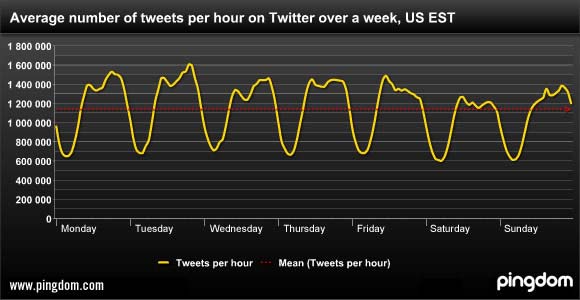
    A new report has shed some light on the habits of Twitter users.  The good people of Pingdom tracked the number of tweets sent over the course of three weeks, and today, released their statistics regarding what days and times folks most like to send messages in under 140 characters.

    Some broader facts may be in order first, though.  A Royal Pingdom blog post stated, "[T]he average number of tweets per day was over 27.3 million.  The average number of tweets per hour was 1,138,772."

    Also, "The highest number of tweets per hour we measured was 1,841,289," and "the lowest number of tweets measured during the period was 566,854 per hour . . ."

    Now, as for the specifics.  In one sense, there’s no surprise on the time front; people don’t tweet as much during traditional sleeping hours.  Otherwise, Pingdom recorded steady activity throughout the day.  Which could signal good things for Twitter, since individuals aren’t just playing around with it when they’re already stuck in front of a computer.

    Interestingly, users don’t exactly abandon it on weekends, either (although the number of tweets does decline a little).  And at the rate things are going, the Royal Pingdom blog post noted that it shouldn’t be long before Twitter is processing one billion tweets per month.

    Related Articles:

    > Twitter Puts Retweet Roll-Out On Hold

    > Compete Builds "Twitter Down" Case

    > Research Scientist Heads From Yahoo To Twitter

  • SPDY, El nuevo protocolo que aceleraría la web

    features_speed

    SPDY (speedy) es un proyecto de Google para hacer de Chrome mucho mas rápido. Lo haría reviendo las conexiones entre los servidores web y los navegadores.

    Desde siempre, HTTP (Hypertext Transfer Protocol) ha sido la norma que permite a los servidores web y navegadores comunicarse para la transformación de los bits y bytes servidos de un servidor Web en una página Web en su navegador. Según google, SPDY haría esto de una manera mucho mas rápida, con velocidades de hasta un 55% mayores respecto a HTTP.

    Actualmente los desarrolladores de SPDY creen que han llegado a la etapa en que su equipo podría beneficiase de la participación activa, la retroalimentación y la asistencia de la comunidad. Lo que nos hace pensar que esta bastante maduro y muy pronto podremos verlo en acción.

    Enlaces

    Documentación
    Codigo
    Fuente googleresearch – vía, cnet

  • Practical H1N1 Management Question

    pneumoniaLet’s imagine you’re seeing a case of pneumonia, and you suspect (as is quite reasonable these days) that it is precipitated by H1N1 influenza.

    What antibiotics do you choose for an outpatient?

    (If someone is sick enough to be admitted — especially to the ICU — I’m assuming the all-guns blazing approach will be adopted.)

    Even though some of these pneumonias have been only H1N1, bacterial superinfection can and does occur — most commonly with our old friend S. pneumoniae, somewhat less so with group A strep, S. aureus (including MRSA, of course), and H. influenza.

    But since we hardly ever know exactly what species of bacteria we’re dealing with, how can you leave even one of these out?  That MRSA one in particular?

    This past week I chose trimethoprim-sulfamethoxazole + high-dose levofloxacin — in addition to the oseltamavir.

    Overkill?  These guidelines from Canada would suggest so, but I’m not so sure.  After all, most people with H1N1 do not get pneumonia at all (and hence do not need antibiotics), and not surprisingly this was not a person with a normal immune system.

    Should be an interesting winter …

  • iTunes Lets You See Previews Without the Download

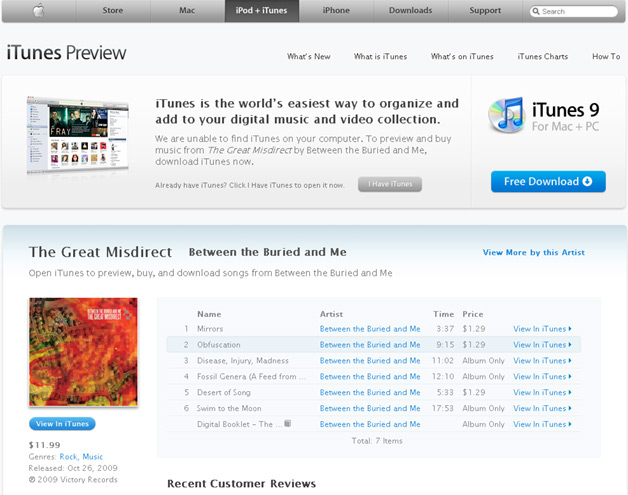
    Apple has launched iTunes Preview, which is a means of showing what music is available on iTunes right in the web browser. This seems like an incredibly obvious way to do it, and one that many have been waiting for way too long, but now if you want to look at the iTunes catalog, without having to install iTunes, you can do so.

    You can’t listen to song previews without installing iTunes, but at least you can see what they have. You do still have to download iTunes to purchase music.

    According to MacWorld, the feature only works for music, but could probably be applied to video at some point. The feature can be accessed at the iTunes Charts page or clicking on a link from the music store.

    Between the Buried and Me iTunes Preview Page

    When you go to a preview page, you can see information for the album like the track listing, the length, and the price. There are also reviews that you can read through.

    If you go to the Charts page, you can search for other artists and songs and get to preview pages for those results. However, if you click on the link on the search results page that says "view more results in iTunes," it will take you to the iTunes download page (assuming you don’t have it installed).

    Related Articles:

    >iTunes 9 Improves Sharing and Syncing

    >Sony To Offer eMusic Its Older Catalog

    >Yahoo Music Makes Peace with iTunes, Amazon, YouTube

  • Testing finds Windows XP better for netbook battery life than Windows 7

    win7winxp

    Somebody should tell Doug “netbook” Aamoth that Windows 7 seems to be a battery hog. The fine folks at Laptop magazine have put three different netbooks to the test, determining their respective battery life under both Windows XP and Windows 7. Looks like Windows XP is the winner.

    The netbooks test include the Toshiba mini NB205, ASUS Eee PC 1008HA, and HP Mini 311. They were all subjected to Laptop’s standardized test, which consist of Web browsing over Wi-Fi. You know, like you do in real life. Any and all “power-saving” features were turned off, so as not to give one netbook an unfair advantage over another.

    The winner? It seems Windows XP is more energy efficient than Windows 7, with the older operating system lasting, on average, 47 minutes longer than the new kid on the block.

    Of course, now you’d have to give up all the improvements that are present in Windows 7. Then again, you are using a netbook, so you’re already walking in with a loss.


  • Facebook Cufflinks Ask You To “F Me”

    There’s a certain type of man that wears cufflinks. Don Draper, for example, wears cufflinks. But he’s also a fictional character set in the 1960s. In the real world, these days, it’s usually the well-off that wear them. Basically, you need to have enough money to not care about spending hundreds of dollars on buttons.

    But CuffLinks.com appears to be going for a new crowd with its latest design. The “Facebook Me” cufflinks are $50 and feature yes, the Facebook logo on them. They are approximately 3/4″ by 3/4″, are “Rhodium plated” and feature a “Bullet back closure.” One cufflink features the Facebook “f,” the other reads “me.” Classy.


  • Dream Theater track to be included in God of War 3 soundtrack

    Do you want God of War 3? Do you like Dream Theater? If the answer to both of those questions is a resounding “Yes!” then you’re in luck.Dream Theater…

  • BlackBerry Will Remain Market Leader Through 2014: Analyst

    Google’s Android OS-based phones and Apple’s iPhone maybe get all the media love, but one analyst firm believes that it will be RIM’s BlackBerry that will be the smartphone king of the U.S. market in five years. Pyramid Research expects the device to be the biggest beneficiary of the move to smartphones.

    According to their research, smartphones represented 31 percent of the new handsets sold in the U.S. in 2009, more than double from 15 percent in 2007. They expect 60 percent of the new handsets to be sold in 2014 to be smartphones. The BlackBerry, which currently has 50 percent of the total U.S. smartphone market, will see that share decline to 37 percent, but the increase in terms of total smartphone sales is going to keep it ahead.

    091109.gif

  • WIPO Director General Against Draconian Anti-Piracy Punishment… But For The Wrong Reasons

    We were a bit surprised, recently, to hear at a WIPO (World Intellectual Property Organization) meeting that they actually appeared to be taking more of an evidence-based approach to copyright, rather than just assuming that “more is better.” And now, the Director General of WIPO, Francis Gurry, gave an interview where he explained why he thought that high fines and jailtime weren’t the answer to piracy. He’s exactly right, which is a bit surprising. But as you read the details, it sounds like he might be right for the wrong reasons — which isn’t all that surprising.

    It’s not that he thinks that the better approach is for companies and content creators to adjust their business models — but that he’s afraid the draconian punishment schemes are basically a PR nightmare for WIPO’s continuing fruitless effort to convince people that infringement is evil:


    “I don’t believe we are going to win this, (to) find the solution by putting teenagers in jail,” Gurry said in an interview on a visit to India. “I think that is not going to win public sympathy.”

    “Part of the battle here is to sensitise the public to the fact that there is a real issue involved. It is not simply a victimless crime….”

    Amusingly, the whole reason the RIAA kicked off its lawsuit strategy was based on similar thinking: that it was an “education” campaign that would convince people that there was “harm” done from file sharing. Of course, it didn’t work. At all. And no education campaign is going to work, because it’s just the basic nature of economics. If the technology has made the product infinite, it’s not a moral issue or a legal issue: it’s a business model issue. The answer is to change business models, not hope and pray that you can somehow convince people that it’s “bad” to do something that obviously can be done quite easily.

    So, yes, Gurry is correct that draconian punishment has created a massive PR backlash that has helped make things even worse, but an education campaign isn’t going to make a difference. Only a business model change can fix a business model situation — and we’re already seeing that happen just fine in many parts of the world. It’s not an education campaign that will help the content industry. It’s smarter business models.

    Permalink | Comments | Email This Story


  • WHERE helps us track DROID infestation, sales numbers

    Doird Where

    The folks over at uLocate, makers of the popular GPS-centric WHERE application, have come through with some stats in order to help us better track the DROID as it leaves store shelves…and there’s a map for that. Oh irony. When you download WHERE from the Android market, uLocate (like any good developer) can tell: what model of Android phone you are using and where, roughly, you are geographically located. The DROID after its opening weekend was estimated to have sold close to 110,000 handsets (Bloomberg), and according to uLocate, 10% of  those devices had downloaded WHERE (this number was based on 11,000 new WHERE DROID activations). Not bad. As of today, uLocate has tracked 21,000 new DROID activations, and is projecting that number to increase to 25,000 by tomorrow. What does this mean? WHERE typically has a 25% penetration rate on all Android handsets sold worldwide, and a 10% penetration rate on new Android devices during the first month of their release. If the 10% number holds true, which we are told historically it does, then there have been somewhere around 250,000 DROID units sold and in use since last Friday the 6th. That wouldn’t include any units that haven’t ended up in customers hands from telesales, or other sales channels. Again, this is just using past and present data from uLocate, but it should be realtively accurate if their download ratio stays the same. So where is the DROID dropping like it’s hot? New York currently has 12% of all DROIDs, LA has 6%, and DC has a respectable 5%. Check out the site for more info and other top cities.

    Read

  • The Boston Globe Launches Digital Newspaper

    The Boston Globe has launched a digital version of its newspaper called GlobeReader, which can be read online or offline.

    GlobeReader replaces the preview edition that launched over the summers and was available to subscribers for free. The GlobeReader is still available for free to Boston Globe’s seven-day newspaper subscribers.

    For non-subscribers the GlobeReader is offered for $4.98 per week. A bundle including home delivery of the Sunday Globe along with 7-day access to the Globe Reader is offered at the same price.

    The GlobeReader can be downloaded daily to a subscribers desktop, laptop or netbook in a style aimed at mirroring the look and feel of the print version of The Boston Globe.

    GlobeReader

    Improvements to the new version of the GlobeReader include the addition of comics, sports scores, weather and the daily crossword puzzle.

    Key features include:


    •     Articles are set in the same type font as the paper, and the page design is understated and clean.
    •     The navigation is easy and clear.
    •     Scanning for stories or photos is fast.
    •     Readability features include adjustable type size and screen size.

    "Reader response to the preview edition of the GlobeReader has been very encouraging. Now we’re pleased to offer GlobeReader to the public at large," said Chris Mayer, senior vice president, circulation and operations, The Boston Globe.

    "It is important for our business to offer Globe news and information on a variety of platforms that appeal to a variety of market segments."

    Related Articles:

    >Newspapers Not Effectively Using Social Media

    >Google News SEO Tips-Ranking In News Search

    >Newsday To Charge For Online Access


  • Shock: Men are loathe to read instruction manuals, women have no such qualms

    menwomen

    So I was browsing Pravda, as I do from time to time, when I stumbled upon this fascinating story. It seems that women are far more likely to read a gadget’s instruction manual than men. It’s the old, “men never ask for directions” bit, yes.

    Research shows that men are usually more confident in their ability to fix things, so why bother reading an instruction manual? Women, more likely to look for help, have no problem consulting an instruction manual.

    I think I’m somewhere in the middle: I don’t consult an instruction manual (or Google, as it were) unless I run into a serious situation. I don’t read a manual as soon as I open something, but I’m not going to pretend that I can fix something without reading up on the situation.

    The ironic thing is that because men tend to think that they can fix anything, they’re more likely to call tech support because they’ve totally borked the situation.

    Why am I reading Pravda? Because I’m bored, and am teaching myself to read Russian. Oh, if only I were joking.

    КРУНЧГИР! (Eh, close enough.)


  • Medicare Open Enrollment Starts Sunday, Premiums Will Rise 11 Percent On Average

    U.S. News & World Report/HealthDay News reports that seniors who participate in Medicare Part D’s will likely notice significant changes during this year’s open enrollment period, which begins Nov. 15. “Monthly premiums will rise 11 percent to $38.94, on average, according to an analysis published by the Henry J. Kaiser Family Foundation. That’s up 50 percent from 2006, the first year that Medicare Part D drug benefits were offered.” Seniors can enroll in a private prescription drug plans if they’re enrolled in traditional Medicare or if they have Medicare Advantage, they can get Part D benefits through that plan. “Seniors will get little relief, however, from cost-sharing requirements.” In addition, costs resulting from the Part D “donut hole” will increase, “starting after a beneficiary has incurred $2,830 in drug spending. Coverage resumes for drug costs above $6,440.” U.S. News also notes that “The House of Representatives on Nov. 7 passed a sweeping health reform bill that provides gap relief beginning in 2010 and eliminates the gap by 2019. However, the Senate must act before any health reform legislation is enacted” (Pallarito, 11/13). In a separate story, U.S. News & World Report reports on broader changes to the Medicare program (Moeller, 11/13).

  • The Apple Store: An Unsung Hero

    Apple previewed its Upper West Side store in New York yesterday. Besides welcoming the media into the company’s latest example of retail minimalism taken to its logical extreme, Apple Senior VP Ron Johnson talked retail.

    apple_store_upper_west_side_ny
    Glass and stone enclose 8,500 square feet of retail space on street level, topped with a glass ceiling 45 feet above, and with a glass spiral staircase leading to the floor below. According to Gothamist, which has some really nice photos, the street level enclosure could fit 11 of the glass cubes like the one in front of the 5th Avenue store.

    “We opened our first store in Manhattan seven years ago, and the response has been incredible,” said Johnson, and not just at New York stores. A look at the numbers shows just how successful the Apple Stores have been.

    apple_retail_stores

    Apple opened its first store in May 2001. At the time, it was a controversial decision, and not just because the store design looked like something out “2001: A Space Odyssey.” Rival PC retailer Gateway was cutting back on its stores, but Steve Jobs envisioned Apple Stores as a boon to both sales and marketing. One goal was to eventually put an Apple Store within driving distance of 85 percent of consumers in the U.S., a goal which must be nearing achievement. For 2009, Apple opened more international stores than domestic. The company now intends to open at least one Apple Store in one new country a year.

    Further, according to Gizmodo, the company plans on opening “more like 50″ stores in the current fiscal year, including more “significant” stores. The outlets, formerly known as “flagship stores,” will be built in multiple countries in Europe as well as Canada, and at least one in Shanghai, China. Also, in the future, stores will be larger in general, making room for more product tables, as well as a bigger Genius Bar. Anyone who has sought technical support at an Apple Store can see the need for that improvement. As for the number of stores being opened, 50 in 2010 would equal that of 2007, which is especially impressive considered the current difficult economic times.

    apple_store_revenue

    However, Apple and the Apple Stores appear immune to those economic troubles. More than 170 million people visited Apple Stores this year, and for the quarter just ending that meant $1.87 billion in revenue. Average sales per store is now $26 million, coming in behind competitor’s like Best Buy, but besting Best Buy by a factor of five in terms of sales per square footage, $4,300 to $872. Apple beats even Tiffany’s on a retail space-based comparison.

    Finally, there is the marketing factor. According to Apple, there are more than 100,000 applications on file for positions at Apple Stores. For the Upper West Side store alone, 10,000 applications were submitted, 2,500 applicants were interviewed and 200 were hired. While it’s something of a jibe to describe Apple as a cult, if you think of Apple Stores as metaphorical churches, or in the case of the Upper West Side, a cathedral, one role of Apple Store employees becomes clear:  making converts. Consider this: Half of those purchasing Macs at Apple Stores are new to the platform. That statistic that hasn’t changed since the first Apple Store opened more than eight years ago.

    While the Upper West Store stands out architecturally, it is Apple Retail that has arguably done as much for the company as OS X, the iPod and the iPhone.


  • Meeting Female Students in Abu Dhabi

    On Sunday, I joined a group of young Arab women at Zayed University in Abu Dhabi, United Arab Emirates (UAE) to discuss the importance of educational opportunities and the value of public service for women in countries around the world.

    I stressed the benefits to the security and development of every society that come from the advancement and equality of women around the globe. I told them that President Obama and the United States are committed to working with our international partners to help ensure that all women have opportunities in education, public service and the global economy — a big part of the reason why we formed the White House Council on Women and Girls.

    The students at Zayed University responded with questions about everything from U.S. foreign policy to the challenges and excitement of running for office. They were especially interested in what it was like to become the first female U.S. Secretary of Homeland Security. I told them it was an honor to serve alongside the numerous extraordinary women who serve the Obama administration in Cabinet-level positions.

    I also had a chance to learn from the students. They told me about the progress the UAE has made in advancing educational opportunities for women, encouraging public service and expanding the roles of women in society and government.  My hosts told me that, in recent years, the UAE has undertaken extensive education reform efforts in order to enhance the nation’s growing economy and culture and provide young Emiratis with a competitive option to complete their studies at home rather than abroad.

    After working to advance equal opportunities for women throughout my career, seeing the progress women have made in UAE firsthand was exciting. These young women are poised to become the world’s next generation of leaders, and their success — whether in economics, security, or public service — will benefit us all.

    Janet Napolitano is Secretary of the Department of Homeland Security

  • Adventures in The Broadband Initiatives Program (BIP), Broadband Technology Opportunities Program (BTOP), and Figuring Out Where to Start the Narrative

    Although this might not seem like it should be a problem, figuring out where to start the narrative section of a proposal can sometimes be difficult: do you write to the evaluation criteria, to something labeled “narrative,” or to a series of text boxes? Federal programs are particularly fond of hiding the salami, as anyone who has had the misfortune of sitting down with a freshly issued, complex RFP can attest.

    Novice grant writers often start writing to the wrong section, and Isaac described one example of this occurrence in Professional Grant Writer At Work: Don’t Try Writing A Transportation Electrification Proposal At Home. As he said, “The problem is that [review] criteria are invariably hidden somewhere in the bowels of the RFP and may or may not be referenced in the RFP completion instructions.”

    You can see a particularly pernicious example of this in the Broadband Initiatives Program, whose application guide is available at the link. Oh, and you can also read the NOFA that was included in the Federal Register.

    There are a few different areas within the NOFA and application guidance you could conceivably respond to. Check out page 16 of the NOFA, which says, “1. BIP Infrastructure Projects. a. General.” It has some point totals, which we usually write against when dealing with, say, YouthBuild. In the case of BIP, however, that would be logical, but wrong, because the application guide has more detailed instructions. If you look in it, you’ll be tempted by page 8 (though it’s labeled “7″ in the hard copy) because it has scoring criteria similar but not identical to what’s in the NOFA.

    Confused yet? Me too. But if you keep looking, you’ll find that the the place you actually want to start is page 14 (which is labeled 13) in the guidance, which says “Executive Summary.” As far as I know, however, no part of the NOFA or the application guidance actually come right and say, “write to the questions/criteria starting on page 14, which is actually labeled page 13 in the hard copy!” If you don’t take the time to study both the application guide and the NOFA, you could end up with an incomplete and totally wrong application on which you’ve spent dozens of work hours.

    There’s another amusing part of the BIP NOFA, which has implications for this and other programs. It says, “Describe the methodology, source of data, and analytical approaches used to determine whether the proposed funded service areas are classified as “unserved,” ”underserved,” or for BIP, at least 75% rural.” But the NOFA already describes what “unserved” and “underserved” mean on page 7:

    Specifically, a proposed funded service area may qualify as underserved for last mile projects if at least one of the following factors is met, though the presumption will be that more than one factor is present: 1. No more than 50 percent of the households in the proposed funded service area have access to facilities-based, terrestrial broadband service at greater than the minimum broadband transmission speed (set forth in the definition of broadband above); 2. No fixed or mobile broadband service provider advertises broadband transmission speeds of at least three megabits per second (‘‘mbps’’) downstream in the proposed funded service area […]

    And it goes on from there. The most obvious maneuver to answer this question is to copy the exact language from the NOFA and spit it back in the response. They’ve given you the answer: you just have to use it. This isn’t a college exam, where you get extra credit for creativity; you get extra credit for staying in the lines. Save your imaginative powers for writing novels or composing software—in many grant writing exercises, imaginative powers will be wasted and possibly harmful, because your job is often to stack one two by four on top of another two by four to build the application following the RFP blueprints. The only question is where you need to build your foundation, and that’s what I’ve tried to answer in this post; the foundation issue will have to wait for another.

    Oh, and the best part of all this: the narrative section for our client turned out to be around 30 pages long. The application guide is 72 pages long. I would propose a test of an RFP: if it takes longer to explain how to apply to a program than to describe what the applicant will actually do, the RFP writer has failed in some significant way.

  • XKCD on iPhone vs Droid

    It’s a rare day when we post a web comic on MobileCrunch. To my knowledge, we’ve only done it once before. But you know what? This one’s just too good — and too topical — to pass up.


  • The Qualcomm FLO TV is now available if anyone cares

    PTV_6780_HR
    The Qualcomm FLO TV is a nifty little device. It plays TV content on a 3.5-inch screen, which could be great for some. But you have it’s $8.99 a month for the service and pay the $249.99 initial cost. And it results in yet another mobile device for you to carry even though your smartphone can playback videos.

    Six months of the service is included with the purchase, and after that, you’re out $8.99 to continue watching TV on the go. But if you must have live TV and not pre-recorded content downloaded onto your smartphone, Amazon, Best Buy and Radio Shack will be pimping the FLO TV starting today.