Category: News

  • Google acquires Gizmo5, builds IP telephony portfolio

    By Tim Conneally, Betanews

    Google today officially announced that it had acquired IP telephony software company Gizmo5, a service many users have already tried to use in conjunction with their Google Voice accounts to make SIP calls.

    In the Google Voice blog, product managers Wesley Chan and Craig Walker said, “While we don’t have any specific features to announce right now, Gizmo5’s engineers will be joining the Google Voice team to continue improving the Google Voice and Gizmo5 experience. Current Gizmo5 users will still be able to use the service, though we will be suspending new signups for the time being, and existing users will no longer be able to sign up for a call-in number.”

    Since last summer, a number of Google Voice users have published methods of integrating a Gizmo5 account with a Google Voice account to enable free incoming and outgoing calls over SIP.

    The integration of Gizmo5’s technology has the potential to vastly grow Google Voice into the proverbial Skype killer.

    Copyright Betanews, Inc. 2009


    Add to digg
    Add to Google
    Add to Slashdot
    Add to Twitter
    Add to del.icio.us
    Add to Facebook
    Add to Technorati


  • Should Nintendo fear the Apple juggernaut?

    dragonwarrior
    These days, when people aren’t talking about the Apple Tablet, they’re talking about how Apple’s next target is the Big Three gaming companies. The iPhone will topple them! iPhone is a revolutionary gaming device! Well, certainly a little optimism is warranted; the iPhone has inarguably changed the landscape of mobile phones, personal media players, and to a lesser extent personal computers. Why shouldn’t Apple extend its holy sovereignty to gaming?

    It already has, in fact. But Apple has come kicking and screaming the whole way. The iPhone, you understand, was not meant to be a gaming device, and in Cupertino, Apple’s intentions are paramount. Apple could never accidentally create a platform for gaming; if it wasn’t meant for gaming (or enterprise, or medical use, or reading e-books, etc.) from the beginning, Apple doesn’t want it happening at all. Because if Apple didn’t intend it, it’s outside of the bounds they set into the platform (regardless of how well it works, much like tethering) — it breaks the mold and, ironically, that’s the last thing Apple wants.

    gatedIt’s no secret that the Apple ecosystem is a gilded cage. It’s a nice cage, and large, and yes indeed that gilding is very attractive by Jove, but all the doors are shut until Apple opens them. If you think otherwise, you’re probably already scrawling some crude flame in the comment section below. Thank you for your insight. Really, though: Macs are a carefully-tended walled garden of semi-delights (to mix several metaphors), and that’s part of why they’re so good at what they do. Attempts at expanding the garden have been made in fits by Apple, with varying success. Serious music production has never really caught on, nor scientific or medical applications, and any real expansions (personal media, mobile, and video primarily) have been engineered by Apple and not third parties. Why should it be any different for gaming? If Apple doesn’t do it, no one will. And Apple’s not going to do it.

    But this is all getting rather vague. There are more substantial objections to an Apple expansion into gaming than my half-baked theories on their corporate philosophy. I’ll just enumerate them here in list form. I’m using the iPhone as the basis for these, but the points apply to the tablet without serious modification.


    iphone_SMB

    Hardware
    The iPhone isn’t a gaming machine. It’s a smartphone. This produces limitations which are for some invigorating, and for some troublesome. For instance, you’ll never see a decent platformer on the iPhone. FPSes are awkward. RPGs take up too much space. You’re essentially limited to casual games and things like tilt-to-control racers. There are some notable exceptions; John Carmack loves the platform, for instance, and will probably be making some interesting stuff. The iPhone may be suitable for some games, but it wasn’t built for them, and that makes a difference for Apple.

    chargeBattery
    Part of the hardware objection, but worth noting on its own, is the fact that battery life would be off-the-charts bad. How long can you really play a high-quality title on the iPhone? An hour maybe, before you’re down to 25% battery? Remember this is also your lifeline to email, the web, and so on. Unlike a DS, you can’t afford to let it run down. A portable game system needs to be as efficient as it can, and the iPhone is already an energy hog. No one wants to be tethered to an outlet to play their favorite handheld. And the thing already explodes when you use it too hard.

    Developers
    A few developers are putting out real iPhone games, but where is your Valve, your CryTek, your Rockstar? These are the people who make AAA titles that sell millions and make billions. Ubisoft may outsource some company to make a little Assassin’s Creed 2 clone to cash in a bit on the mobile contingent, but it’ll just be a way to sell the real game. They’re not going to spend $50m to develop a truly amazing game for the iPhone. No one will. Hardly anyone does as it is for existing handhelds (Dragon Quest IX notwithstanding). Apple could align itself with developers, but my feeling is they wouldn’t mix well. Apple is pretty much oil to their partners’ water to begin with due to their iWay-or-the-highway (clever, no?) approach to “collaboration,” and I don’t think that the major game studios would take a shine to it either.

    Pricing
    Do you see people hitting that “purchase” button when a game costs more than $10? Neither do I. Real games cost upwards of $40-50 when they come out. That won’t fly in an App Store or iTunes environment, where the emphasis is on multiple small, easy-to-swallow buys.

    Brand
    Apple doesn’t do games. They don’t put out games, they don’t make it easy to play games, they don’t encourage developers to make games for their platform. This is the last time Apple and Mac users were excited about games:
    halofirst
    Seriously. Ever since the Great Halo Disappointment, nobody has considered Apple’s gaming enthusiasm as being anything other than a lark. Meanwhile, Nintendo is so completely identified with games that one implies the other in almost any context, Microsoft is hard at work building a gaming platform that dovetails with their entire ecosystem, and Sony is actually gathering steam with the PS3, as its lower price leads more people to find that it actually might be the most powerful and versatile system on the market. Apple struck at mobile phone makers when they were at their most complacent and vulnerable; gaming consoles and companies are stronger and more successful than they’ve ever been. It would be an insanely bad time to take a swat at them.

    Content
    Pop quiz: what game had the most lucrative launch of all time? If you answered Modern Warfare 2, an extremelyviolent and graphic game being accused of turning kids into terrorists, then you are correct! Apple is already choosy when it comes to what appears on its devices, and the kind of ultraviolence that sells games probably isn’t going to fly. Apple isn’t as positively warm and fuzzy as Nintendo usually is, but it would be a pretty major shift to start pushing games like MW2.

    applecashThey don’t want to
    Don’t you think that if Apple had any inclination to make the iPhone or Mac into a gaming platform, they’d have at least shown a little of that by now? Where’s the gamepad accessory for the iPhone? Why isn’t Apple courting the big developers to get some titles on Macs? There’s no indication that Apple is interested in games except as a class of apps to take a cut on. Almost all game development so far has been driven by the “there’s gold in them thar iPhones” mentality.

    They don’t need to

    This readership more than any other should be aware of Apple’s solvency in this worldwide financial crisis; indeed they have thrived mightily. The iPhone shows continual growth, they gain a tenth of a point of OS market share every month or two, and they’re making money hand over fist via iTunes and the App Store. Why the devil would they want to get into gaming, a market that would expose all the company’s weaknesses, bring their best hardware to its knees, and complicate their entire strategy — one which is working perfectly? I’m not saying that Apple doesn’t like to rock the boat, but they don’t do it when they stand a good chance of being thrown in the drink.


    There you have it. Of course, with my luck, Apple will probably announce a huge gaming initiative tomorrow.

    All that said, Apple does have an increasing presence in gaming. It owes this in no small part to Nintendo, which has popularized casual and mobile gaming to a huge extent with the Wii and DS. The iPhone may take a bite out of the more casual games coming out for the DS, but beyond that I don’t see a major effect. And as long as it’s enough for Apple to make a few bills, they’re not going to try too hard to change that.


  • A Closer Look at Business and Health Insurance Reform

    Today’s report from the Business Roundtable (pdf) – an association representing leading U.S. companies with more than 12 million employees – confirms that the health care spending path we’re on is unsustainable, and that the bills working their way through Congress are moving us toward cost containment and greater fiscal responsibility.  

    The Business Roundtable (BRT) report adds to a growing body of evidence that workers with employer-sponsored health insurance coverage will see lower cost growth and lower premiums from health insurance reform as supported by the President and as contained in the bills being considered in Congress. Health insurance reform not only contains cost growth for the government and so reduces the long-run budget deficit, it will also lower premiums and expenses in the private sector and throughout the health care system – for businesses, workers, and their families.

    As documented in the BRT report, rising health care costs are placing an ever-increasing burden on employers and on the millions of Americans with employer-sponsored health insurance. In the absence of reform, the BRT projects that rapidly rising health care spending will restrain job growth and reduce the growth of employee wages. Without reform, the report projects that average per-employee health care costs at large employers will triple over the next decade. The report estimates that health insurance reform as currently proposed in Congress, when fully implemented, would reduce the overall health care cost trend for employer-sponsored health insurance by 15 to 20 percent over the next ten years. This would reduce per-employee health insurance costs by $3,095 in 2019, relative to what they otherwise would have been.

    This is consistent with the findings of the Council of Economic Advisers report, "The Economic Case for Health Care Reform," which finds that reform could increase income for a typical family of four by $2,600 in 2020, and increase the nation’s real GDP by nearly 2 percent in 2020, and 8 percent in 2030.

    The BRT report estimates that the delivery system reforms that are included in current draft legislation have the potential to spread beyond Medicare and Medicaid to private insurance plans. In this way, they can substantially reduce the growth rate of overall health care spending, which eats into the take-home wages of workers with employer-sponsored coverage every year. The BRT report finds that delivery system reforms have the potential to make health care more efficient without compromising on quality.

    For example, the BRT report points out that the House and Senate reform proposals contain provisions to encourage Accountable Care Organizations (ACOs), which are groups of doctors working together through joint decision making to coordinate care for patients. The report  "find[s] that private-sector savings from initiatives such as these can be very positive."

    The report also describes how the House and Senate reform proposals encourage payment bundling for Medicare, where doctors and hospitals are paid for an episode of care, rather than individual treatments. Bundling payment gives providers incentives to provide quality care for an overall condition or hospital stay, improving efficiency and reducing costs over the long run.

    Finally, the report highlights many other reforms that improve efficiency and quality while reducing costs – such as paying providers based on their performance through Value-Based Purchasing, preventing hospital readmissions, and an independent commission to consider reforms to make Medicare spending sustainable and fiscally responsible over the long run. 

    Christina Romer is Chair of the Council of Economic Advisers 

  • BlackBerry Theme Studio v5.0 – Build your own BlackBerry Theme!

    BlackBerry Storm2
    If you’ve been a BlackBerry® smartphone user for awhile, you’ve likely come across BlackBerry themes.  BlackBerry themes change the way your BlackBerry smartphone home screen looks: from the background image to the icon and cursor style. Some BlackBerry themes also feature animations and a completely unique home screen experience.

    Did you know that you can make your own BlackBerry theme? What’s better, the newly released BlackBerry® Theme Studio 5.0 makes it pretty easy to customize your BlackBerry smartphone with a unique theme. All you need is a bit of creativity and some skills with graphics software like Adobe® Photoshop®, Adobe Illustrator®, Adobe After Effects® or BlackBerry® Composer.

    Today I’m going to walk you through the main interface of BlackBerry Theme Studio 5.0 and in a future post we’ll go step-by-step through the building process. Let’s get started!

    Where to get BlackBerry Theme Studio? 

    You can download BlackBerry Theme Studio for free from www.blackberry.com/themestudio. It’s an application for Windows – just  download it onto your computer and install.

    themestudio1.jpg
      
    You’ll notice that BlackBerry Theme Studio actually contains two products in the suite: Theme Builder, and Composer. 

    BlackBerry Theme Builder 

    themestudio2.jpg
    BlackBerry Theme Builder is the “theme design” tool of the suite. BlackBerry Theme Builder lets you change the images that get used for things like icons, background graphics and cursors. You can also adjust the fonts, change the position of many objects on the screen, decide which applications appear and change the color and properties of things like dialog boxes.

    The main interface of BlackBerry Theme Builder is divided into a few different parts:
    • The Preview Window
    • The Catalog Panel
    • The Inspector Panel
    • The Alignment Panel 
    The Preview Window – seeing how your theme will look

    themestudio3.jpg

    The Preview Window shows off your theme along with how it will look on the BlackBerry smartphone you’ve decided to make a theme for. The “preview” is – for the most part, just that … a preview.
     
    When using BlackBerry Theme Builder, you almost always change the properties of your theme in the Inspector (more on this in a second) and don’t manipulate anything on the Preview window itself unless you’ve selected a function in The Inspector which asks you to then change things in the preview window directly. 

    An example in this would be when you select “REPOSITION BANNER ITEMS” items in the Inspector. Selecting this option will make it possible for you to select any item in the banner shown in the preview and move them around the screen to your liking.
       
    themestudio4.jpg

    The Inspector Window  – where the work gets done

    The Inspector is where you do the bulk of your work in BlackBerry Theme Studio. The Inspector segments the elements of your Theme into organized parts. You’ll notice several buttons as you work your way down the inspector and pressing each one takes you into a different area that you can customize.

    themestudio5.jpg

    Banners:  Clicking on this button will let you change the properties of the banners that appear at the top of your home screen or in some of your applications. This includes the icons that appear (such as your battery life status), the position of icons and the fonts of the text.

    Home Screen: Clicking on this button will let you change the elements that appear on your home screen (the primary screen of your BlackBerry smartphone), including the background, the applications and the icons.
     
    Application List Screen:  Clicking on this button will let you change the properties of your application screen, including the icons of the applications, the order of the applications and the background image.

    Controls:  Here, you can have fun with the controls that appear on the BlackBerry smartphone.  Manipulate the appearance of the dialog boxes, the buttons that can be selected, menus, title bars and more. 

    Phone Screen:  Clicking on this particular button lets you change around the images that appear when a call comes in or is dialed out and you can now add your own ringtone.

    Lock Screen:  Clicking on this button gives you the option to edit the backgrounds, icons and fonts that appear on the screen when your BlackBerry smartphone is locked.

    Global Items:  Global items are a fancy way of referring to things that appear “globally” throughout the BlackBerry smartphone. Examples include things such as the progress bar that appears when an application is downloading, the key identifier that appears when a button is held down and the hourglass that appears when an application is installing or launching. 

    The Catalog – managing your theme images

    BlackBerry Theme Studio ships with a bunch of background images and sample graphics that you can use when creating your BlackBerry theme.

    themestudio6.jpg


    The Alignment Window – lining things up

    The alignment window helps you position objects correctly in the preview and works similarly to alignment tools in other graphics software.

    themestudio7.jpg

    How do I design those graphics? – Enter BlackBerry Composer (or just about any other design tool you prefer)

    themestudio8.jpg
    The second tool is BlackBerry Composer, a design and animation product that is great for helping you craft images, whether they’re static or animated. BlackBerry Composer has a full set of tools for designing built into it and it’s great for adding life to your images without having to buy other software.

    BlackBerry Theme Studio is also friendly with other design tools. If you want to design your graphics in something like Adobe Photoshop or Adobe Illustrator, that’s fine too. If you want to add animation, you’ll need to learn a bit more about BlackBerry Composer, but we’ll cover that another time.

    Next, we’ll cover the specific steps required to build a BlackBerry theme. Until then make sure to download BlackBerry Theme Studio 5.0.

  • Show your true colors with this crossbones decal

    apple-crossbones

    Arrrr, I be an Apple pirate. I download me OS X even though it only costs $29. Arrr [Gearfuse]


  • Say Hello to Devicescape Wi-Fi for Nokia, Android

    Devicescape is hoping to meet smartphone users’ increasing demand for Wi-Fi access by broadening support for its Easy Wi-Fi Network to include Nokia and Android-based handsets — beyond currently supported platforms such as iPhone OS, Windows Mobile, Windows and Mac OS X. Given Nokia’s impressive worldwide footprint and Android’s newfound momentum, the move, announced today, should help Devicescape build its customer base in a big way — which will be crucial as the company goes after hardware vendors.

    Devicescape said users can download an app from the Android Market or Nokia’s Ovi to access hundreds of thousands of free Wi-Fi hotspots; the app also includes a map view for locating Easy Wi-Fi locations. The San Bruno, Calif.-based startup, which launched its network last month, competes with service providers such as Boingo Wireless and iPass. Unlike its competition, though, the startup is hoping to cash in on the increasing demand for seamless connectivity by targeting the makers of smartphones, netbooks, digital readers and other connected devices.

  • Once Again: The Number Of Patents You Hold Does Not Equal How Much Innovation You’ve Done

    We’ve complained in the past when companies, the press and analysts try to use number of patents as a “proxy” for innovation. It’s quite misleading — and various studies have made that clear. You can have tremendous innovation without patents, and you can have tons of patents, without any real innovation. Yet, as reader Nick points out, a report looking at the alternative energy auto space dings Ford for “lagging” in “the alternative energy race” because it doesn’t have as many patents as others.

    This is a real shame, because we’ve discussed before how the massive patent thickets in the hybrid car space have been holding back innovation and development in that space. In fact, Ford had a big tussle with Toyota a few years back after Toyota sued Ford and the two companies wasted tons of money and time in court, until the court finally pointed out that Ford did not infringe. On top of that, Ford has been one of the earlier adopters of hybrid offerings and remains the third largest hybrid seller after Toyota and Honda. So, claiming that it’s somehow “lagging” because of fewer patents is quite misleading.

    Permalink | Comments | Email This Story


  • Part 2: CSA week 1

    So, I got busy and lazy (all at once?) and never posted part 2 of my CSA Week 1! Did everyone enjoy seeing the awesome farm? I love just thinking about going there next week for my second batch. I have a half-share, so I only go every other week, which is perfect since it is just me (and Mirza when he eats dinner here, which is a lot).

    What was in this week’s share? As mentioned in the previous posts, the farmers said this first harvest may be more of a “tasting” because of flooding, but there were still lot of greens to be had!

    Pamela, the “farmer’s wife” gave us a print out that listed what we received (if anyone wants a more specific name of each veggie, just comment):

    Turnip

    Radish- Easter egg and D’Avignon (haven’t tried them yet, kind of scared of radishes, need recipe ideas!)

    Choi-Joi Choi, Tatsoi, Komatsuna (totally new to me..)

    Greens: Arugula, Red Mustard (holy spicy!)

    Eggplant- Orient Express

    Herbs-Greek oregano, rosemary, garlic chives, basil (still in the pot for this one)

    I got everyone (like they’re human) home and prepared for STORAGE!

    Before I left, I printed out this guide for vegetable storage and placed the pages in plastic protection and into a binder:

    I know, I’m totally a geek, but it came in handy for figuring out how to best store everything.

    Some photos of the loot:

    The herbs smelt aaaamazing, hence the goofy face:


    I really loved the eggplant, he was so cute.


    Yep, I need help.

    Next post on how the heck I am using all of these delicious plants!!


  • Review: BFG Deimos

    DLF_9054Short Version: The Deimos is the latest addition to BFG’s new line of computers. Intended as specialist gaming machine, the Deimos is big, beautiful, and very fast. Heat, bulk, and short battery life are to be expected from a gaming laptop, and aside from those it provides an excellent experience.

    Pros:

    • Fast
    • Surprisingly light weight
    • nicely designed and set up

    Cons:

    • Short battery life
    • Large size
    • Runs hot

    Price as reviewed: $4,423

    While BFG is new to selling complete computer systems, they aren’t new to high performance gaming. BFG has been producing performance PC hardware for many years, and just this year got into building their own systems. The Deimos was launched at the end of October, and is intended to compete with other gaming laptop lines, such as Alienware’s M17x.

    Does it compete? In a word, yes. In some ways, the Deimos surpasses the M17x. For example, when I reviewed the M17x, I had some issues with the biometric security system. Using your laptop’s webcam as a security device is a clever concept — if only it worked consistently. On the Deimos, however, everything worked perfectly out of the box. Performance is comparable. Battery life is about the same. What’s gone is the obvious “I spent $4500 on this computer!” factor that you get with the little alien head on the lid.

    Let’s get down to it. Here are the specs on the system I reviewed:

    Monitor: 18.4 inch, 1920×1080 resolution
    Processor: Intel Core 2 Extreme QX9300 2.53GHz
    Memory: 2x 4GB PC3 8500 (1066 MHz) DDR3 (8GB total)
    Graphics: 2x GeForce GTX 280M 1GB (SLI)
    Optical Drive: Dual Layer Blu-Ray Disc Reader (BD-ROM, DVD/RW, CD-RW)
    HDD 1: Seagate Momentus 500GB 7200 RPM SATA II
    HDD 2: Seagate Momentus 500GB 7200 RPM SATA II
    LAN: Realtek RTL-WLAN 802.11 b/g
    Bluetooth: Internal Bluetooth v2.1
    Sound: Realtek ALC883 8-Channel Azalia HD Audio
    Video Camera: Bison built-in USB 2 MP Camera
    Operating System: Microsoft Windows 7 Home Premium – 64-bit Edition

    Performance: As you can expect from this configuration, the machine is fast. I ran some benchmarks using Far Cry 2, which averaged a framerate of 54.26 at 1920×1080, Direct3D 10, and Overall Quality set to “Ultra High.” 3DMark Vantage reported 11,799, which is a very close comparison to the M17x at 11,904. Of course, if you’ve read my reviews before, you’ll know I’m not huge on reporting numbers; I prefer to talk about the feel of the system. And basically, the Deimos is a great computer. I’m very much into the gaming, and that’s what’s important to me when I’m using a system. The Deimos is fast, plays games really really well (42 FPS in Dalaran, settings maxed, for you World of Warcraft people) and is surprisingly light for the amount of hardware that’s jammed in there. The system has DVI and HDMI out, and a total of four USB ports (two on the left, two on the right). The back is reserved for cooling vents and the power cord. One thing to be aware of: don’t expect to be able to overclock this machine using the BIOS. The BIOS on this system is functional, yet bare bones. There are no options for overclocking at all.

    DLF_9076Controls: The keyboard took some getting used to; the keys aren’t exactly a style that I’d normally prefer, coming from the netbook school rather then a standard keyboard. And the numeric keypad is a hot mess. It’s pretty much impossible to touch type using the number pad because everything is jammed together with the arrow keys and the standard keyboard. There’s more then enough room that they could have provided a little space between the two and made it a bit more user-friendly. There is also a series of “G-keys” down the left side. These are customizable macro keys are much like what is used on the Logitech G-Series keyboards. These too, work as intended, however they do take up quite a bit of real estate on the left side of the keyboard area.

    The trackpad (centered, and highlighted with LED light) works as expected, with no major issues. The left and right button (there’s only one, and you click on either side) responds well, and doesn’t feel mushy or too stiff. There is a fingerprint reader centered in the button, which provides biometric login options.

    wideshot-keyboard

    Appearance: Aesthetically, it’s a little bright. Where it’s nowhere near as gaudy as an Alienware system, it does have a touch sensitive strip across the top, and all the icons are lit from beneath with LEDs.The touch activated icons turn on the webcam, Wi-Fi, or Bluetooth hardware. You can also control the volume, or activate your web browser or media player. The LEDs in the case (shining out the front and back) and the lid can change color, however the process is less than intuitive. The case is also extremely shiny, and regrettably shows fingerprints incredibly well. BFG is aware of this, even to the point of including a large microfiber cloth for wiping it down. Overall, compared to the Alienware, the Deimos is almost tasteful.

    DLF_9078It is interesting to note that the Deimos is a re-branded Sager notebook. Further research showed that were you to go online and order a system with the same configuration, you’d save yourself $100. Despite this fact, I’d still purchase this computer from BFG, due to their excellent record on customer service. From a value standpoint, compared to the Alienware M17x, I’d still choose the BFG Deimos. For around the same price (the M17x, configured the same costs $4,399, $24 less), the Alienware laptop has a smaller screen, weighs twice as much, and a profile that screams “steal me!”. That’s not to say the Deimos is the ideal commuter laptop — it is quite large. But it lacks the ostentatious nature of the M17x.

    Final thoughts: I wholeheartedly recommend the BFG Deimos. It’s a fine machine, and doesn’t try to be more then that. I’ve found it to be more then sufficient as a desktop replacement, both for work and play. Yes, the price is high, but if you are buying a performance laptop, you have the budget for it and you probably don’t really care about how much it costs; you want the best. I will admit that I’m not a huge fan of the keyboard, but it was a simple thing to plug an external keyboard in when I was sitting at my desk. The keyboard was just fine for casual use, but perhaps it’s not for the business user.


  • ‘A pivot from war to peace:’ The AMD + Intel armistice, in their own words

    By Scott M. Fulton, III, Betanews

    For much of its history, AMD’s image in customers’ minds has been established, or at least reinforced, by its very public stance with regard to Intel. The company that AMD has tried to be, it has explained for years, begins with everything that Intel — at least from its perspective — is not.

    So it must have been a bewildering feeling for AMD executives to approach this morning, perhaps after not very much sleep last night, in an environment that can no longer be framed by the legal and intellectual property conflicts between it and its sole rival. The legal war is gone. Only the market competition remains, the sole differentiator between the last two producers of CPUs for PCs in the world. It was what AMD said it has always wanted.

    It’s no wonder then, that the first words this morning from AMD’s chief legal executive, Tom McCoy, were at times laced with poetic metaphors, and at other times flying loosely in the breeze, like this could still be a dream: “What’s important about the agreement, to us, is that it signals a new era. It’s a pivot from war to peace, and we’re trying to redefine not only the path to a fair and fierce competitive fight in the marketplace, but also one of tonality with Intel. We’re all trying to get this behind us and move forward in a very respectful way — a way that will make everybody proud of this industry in which we operate, that is so fundamental and vital to innovation, to productivity, and to great fun, using technology in the world.”

    What’s fair and what’s not

    The agreement between the two companies, as explained to the US Securities and Exchange Commission this morning, spells out a new set of guidelines for what both CPU producers can agree to be “fair competition.” With federal regulators worldwide having used AMD’s situation as a model case for a manufacturer treated unfairly by its dominant rival, the fact that AMD signed off on these new guidelines will make it difficult for them to continue pursuing their investigation of Intel the way they have been, although they will project the image of stubborn persistence for at least the next few months.

    “The key points are, for us, that Intel will not be able to condition doing business with them on not doing business with us,” McCoy explained this morning. “They can’t use inducements in order to force exclusive dealing, to delay customers from using our products, delaying or prohibiting companies from marketing or advertising our products or systems with our products, withholding benefits from OEMs in the event that they elect to use AMD processors. We’ve also agreed to certain technical practices…particularly in the compiler business, so that compilers will not unfairly, artificially impair the performance of our products. We’re never looking for any help; we’re just not looking to be unfairly hurt. Intel has no obligation to help us; they do have an obligation not to do things that are simply designed not to hurt us.”

    What it was obvious that Intel needed at this point was an addition to its cost-cutting program — a way to stop spending vital resources and capital on defending its image among lawmakers. It needed an exit strategy that enabled it to save face; and this morning, Intel CEO Paul Otellini stopped just short of saying exactly that:

    “In most lawsuits between businesses, there comes a time where both sides step back and look at whether spending all of that time and money makes sense. That’s what happened here. Intel and AMD took a step back. We look at the claims AMD was making, and they looked at our claims that they had breached their license rights to Intel’s patents. After a lengthy negotiation that began last spring, we found a way to put these matters behind us and move forward.

    “People can honestly disagree about business and marketing practices,” Otellini continued, as he pursued his metaphor of stepping back and moving forward simultaneously. “We continue to believe that our discounts are lawful and in the best interests of consumers and the marketplace, although we understand that others have a different perspective. At this point, the best path forward is to bring closure to all disputes between the companies.”

    How can Intel effectively agree to stop doing what it says it never did, and keep a straight face about it? That’s the essence of a question asked this morning by a Wall Street Journal reporter.

    As Intel Executive Vice President for Legal Affairs Andy Bryant responded, “They [AMD] believe we conduct business certain ways that we don’t believe we do. So it’s been a contention for a long time…one of the examples they gave was, if a customer doesn’t buy a certain amount from us, we punish that customer. We don’t do that. We understand they believe that. What made sense for us was to say, since we all agree it shouldn’t be done, let’s write it down and agree to it. And we’ll monitor it and have talks about it. So what we’ve really done is, taking where the two sides have a different conception, and codify what we will and won’t do — mostly what we won’t do — and hopefully, then, we can track that going forward, and everybody understands that competition has been fair and will be fair.”

    Under the terms of the settlement agreement, representatives from both companies will meet once every quarter to discuss possible points of dispute, perhaps in writing. This gives both sides the opportunity to propose solutions prior to any future litigation taking place.

    Why was AMD willing to grant Intel some lee-way on what appeared to have been, up until today, the central point of its dispute — for example, Intel’s ability to bargain for exclusivity? In response to this question, AMD’s Tom McCoy actually went so far as to state that certain elements of its case against Intel that seemed critical, really weren’t.

    “The key issue for us is the conditionality,” McCoy said, not being nearly as poetic as at the start. “That is, that structures or inducements, or the opposite of inducements, that are provided to customers, are conditional on whether, and to what extent, or how, customers can also deploy AMD technology. That is the key practice that, in our view, has constrained our access to the marketplace, whether it be at the computer manufacturer level or the channel level; and Intel has agreed to cease those practices, consistent with what are already several regulatory decisions.”

    But a so-called “narrow set of practices” (which aren’t so narrow after all; for instance, fairly bidding for exclusivity if an OEM offers it) remains permissible even under this agreement. As AMD’s McCoy explained, “As to these other, narrow set of practices, bear in mind that there is also a decision that exists against Intel from Brussels, and that Intel is undoubtedly going to try to comply in good faith with that decision. So we believe that we, through the actions of the regulators, already have significant protections against these practices, and that our customers therefore are going to enjoy freedom of action to deal with us.”

    Next: The cases against Intel going forward, or backward…

    The cases against Intel going forward, or backward

    The most recently developed picture in consumers’ and investors’ minds about Intel’s conduct during the early part of this decade came from the State of New York’s antitrust suit, filed against Intel last week. There, State Attorney General Andrew Cuomo cited multiple e-mails, some from then-COO Otellini, which appeared to indicate that Intel was not only eager to enter into exclusivity deals with Dell and Hewlett-Packard secretly and separately from AMD, but was aware of the leverage those deals had in influencing those manufacturers’ purchasing decisions and behavior.

    It’s clear this morning that Otellini remains personally disturbed by the New York A G’s allegations, which are by no means settled: “We strongly disagree with the New York Attorney General’s case, and believe the complaint is entirely without merit. Discounting and rebates are standard business practices, and perfectly legal, and it’s unfortunate that the New York Attorney General chose to distort the facts. We would have preferred to have engaged in a dialogue with the Attorney General.”

    When pressed for further “color” on the subject by another reporter, Otellini turned up the volume: “On some of the statements in there that were attributed to me, yeah, I wrote some of those, at least the ones I remember. On the other hand, many of those documents are taken broadly out of context. When the full nature of the e-mails is exposed, I think that you’ll see there’s another way to interpret some of these statements.”

    The cross-licensing agreement

    If AMD’s complaints against Intel have been clear, emotional, and the stuff about which producers make movies, Intel’s complaints about AMD are made up of the type of legal licensing language that keep attorneys in business. Under the terms of the two companies’ long-standing licensing agreement — the complete, non-redacted text of which has never been made public to this day — neither company was allowed to license the other’s intellectual property to other manufacturers. With AMD spinning off GlobalFoundries as part of its restructuring, that became another company that could do business with innovators other than AMD, putting Intel’s IP in jeopardy. As a safeguard, the existing agreement stipulated that any foundry that AMD should hire to produce its chips should be a majority-owned subsidiary of AMD at the very least.

    When the cross-licensing agreement was announced this morning as part of the two companies’ settlement, evidently some red flags went up as though they were entering into some mysterious, Microsoft + Novell-like covenant. (If disputes can’t be made more mysterious than they truly are, perhaps we can make hyperbole out of agreements).

    But as AMD’s Tom McCoy explained, the new cross-licensing agreement was essentially an extension of the existing one that’s been under our noses since 1976: “It is an important feature of our agreement with Intel that we have resolved all disputes that have divided the parties. On the intellectual property side, AMD and Intel have had patent peace with each other since 1976 — meaning that each company has had design freedom to innovate, respecting each other as great contributors to the intellectual property portfolio in the industry. And that continues unabated. So we have the continued design freedom, as do they, and we have now the flexibility…for full use of foundries. So now we can have 100% of our output produced in foundries that do not have to qualify as subsidiaries of AMD.”

    Copyright Betanews, Inc. 2009


    Add to digg
    Add to Google
    Add to Slashdot
    Add to Twitter
    Add to del.icio.us
    Add to Facebook
    Add to Technorati


  • Yahoo Hires Editor For Homepage News

    It looks like Yahoo is quite serious about using its homepage to display news that people actually want to see.  Rather than assign someone to tinker with algorithms, the company’s hired a 25-year veteran of the news industry to assemble a team of editors.

    Yahoo LogoAnthony Moor is currently working as the deputy managing editor for interactive news at the Dallas Morning News (he’ll stay on through Thanksgiving).  During his two years there, traffic to DallasNews.com has increased by 186 percent, and DallasNews.com was also given the Edward R. Murrow Award for best non-broadcast affiliated website in 2008.

    The man seems to know what he’s doing, then.

    As for what he’ll do at Yahoo, Moor is supposed to act as lead editor of Yahoo’s local news effort, according to a memo Joe Strupp obtained.  Moor also added in a tweet that he’s been asked to "build staff of editors around US who will improve the local news experience on frontpage."

    It’s hard to say when (or if) this project might pay off, but Yahoo definitely gets high marks for effort.  And taken together with the rest of Yahoo’s successful-so-far homepage overhaul, this could turn out quite well.

    Related Articles:

    > Yahoo Launches Spanish Version Of Mobile Home Page

    > Research Scientist Heads From Yahoo To Twitter

    > Yahoo Challenges YouTube On Music Video Front

  • BlackBerry Storm 2 Controlled Robot Challenge


    Check out the above video to watch the Storm2 robot shoot a BlackBerry Bold 9700 in the face!

    The BlackBerry Developer Conference is showing off an impressive use for the Storm2: a ball-shooting tank robot of destruction powered by the latest BlackBerry.

    The robot connects by Bluetooth and conference attendees are invited to race around an obstacle course and compete for the fastest time. First prize gets a Storm2 and the robot, and 2nd, 3rd, and 4th place all get a Storm2 as well.

    Did you try it? What was your time?


    © Kyle for BlackBerry Cool, 2009


  • The Majority Of Nonprofits Embrace Social Media

    The majority (88%) of nonprofit organizations are experimenting with social media to engage audiences, but 79 percent are not sure of its value for their organizations, according to a new survey by Weber Shandwick’s Social Impact team and KRC Research.

    "We know from our work with nonprofits that most realize the potential of social media and are experimenting with it, but many are not maximizing the full opportunity," said Paul Massey, Social Impact co-lead.

    "This survey validates that there is widespread experimentation, and suggests that, in the future, nonprofits that fully participate in the two-way conversations that make this medium so powerful will reap the greatest benefit."

    The majority of nonprofits believe their online presence helps raise awareness (92%), keeps audiences engaged (86%) and reduces costs compared to traditional media (77%). Social media is viewed as being successful in helping nonprofits reach broad audiences (67%). Sixty-one percent say the rewards outweigh the risks. For these reasons eighty-five percent plan to make greater use of social media in the next two years and (78%) most require more social media expertise to keep communicating and receiving support for their work.

    While social media is viewed positively among nonprofits, there are still a number of challenges. Sixty-seven percent of nonprofits feel that traditional media, including coverage in newspapers, magazine, television and radio are more effective at supporting fundraising efforts than social media (67% vs.22%).

    Executives in nonprofits are more skeptical about social media’s ability to help them with hard-to-reach audiences such as donors (45%), media (39%) and policy makers (31%).

    "While two-thirds of nonprofit executives believe social media has a positive impact on their communications with external audiences, they are less convinced about social media’s resonance with donors, journalists and policy makers," said Social Impact co-lead Stephanie Bluma.

    "What these results imply is that organizations need to develop more targeted and sustainable digital connections with these critical yet narrower audiences. In the months ahead, digital engagement strategies will need to show value on multiple fronts from brand-building to advocacy to fundraising."

    The one area where social media is widely believed to have more impact than traditional media is in mobilizing supporters (58%), an important audience for nonprofits.


    Related Articles:

    >Amazon Offers Payment Services For Charity Donations

    >Good Online Experience Leads To More Donations For Nonprofits

    >YouTube Nonprofit Partners Get New Features


  • Command & Conquer 4: Tiberian Twilight gets a launch date

    Forget Modern Warfare 2, the real action is coming out on March 16 when C&C 4 is released. Teasers and trailers have been slowly filtering out over the last few months but EA finally let released the launch date. I’m already making my construction paper chain to count down the days. Oh, and there’s good news if you’re going to pre-order the game.

    Those that are willing to pay for the game before it’s released will be invited to the multiplayer beta, and given a bonus mission and the game’s official soundtrack. How cool is that? I mean, you’re going to buy the game anyway so you may as well score some extras. All the details are here.


  • Systems for Research and Evaluation for Translating Genome-Based Discoveries for Health: Workshop Summary

    Cover imageWith the advent of genome-wide association studies, numerous associations between specific gene loci and complex diseases have been identified–for breast cancer, coronary artery disease, and asthma, for example. This rapidly advancing field of genomics has stirred great interest in “personalized” health care from both the public and private sectors. The hope is that using genomic information in clinical care will lead to reduced health care costs and improved health outcomes as therapies are tailored to the genetic susceptibilities of patients.

    A variety of genetically based health care innovations have already reached the marketplace, but information about the clinical use of these treatments and diagnostics is limited. Currently data do not provide information about how a genomic test impacts clinical care and patient health outcomes–other approaches are needed to garner such information.

    This volume summarizes a workshop to address central questions related to the development of systems to evaluate clinical use of health care innovations that stem from genome-based research:
    What are the practical realities of creating such systems?
    What different models could be used?
    What are the strengths and weaknesses of each model?
    How effectively can such systems address questions about health outcomes?

  • Evaluating Occupational Health and Safety Research Programs: Framework and Next Steps

    Cover imageEach year, approximately 5,000 fatal work-related injuries and 4 million non-fatal injuries and illnesses occur in the United States. This number represents both unnecessary human suffering and high economic costs. In order to assist in better evaluating workplace safety and create safer work environments, the Institute of Medicine conducted a series of evaluations of the National Institute for Occupational Safety and Health (NIOSH) research programs, assessing the relevance and impact of NIOSH’s work on improving worker safety and health.

  • The American Library Association declares this Saturday, Nov. 14, to be National Game Day

    vs

    Man alive, there’s been a lot of gaming news these past few days. Continuing the trend: this Saturday, November 14, is to be hereby referred to as National Gaming Day. Thus decided the American Library Association. The day has been created in order to promote the idea that video games can be used to sharpen one’s reading ability, and to promote critical thinking.

    The original Reuters report lists World War II video games as something that may be used to introduce young people to important historical subjects. Obviously, no one is saying that you should learn all about D-Day via Medal of Honor: Allied Assault, but that, if you find the subject matter interesting, maybe you look into it a little more academically?

    There’s plenty of games that I can think of that, in a way, promote literacy. Vagrant Story for the PS1 might as well have been a novel, and certainly requires a reading comprehension level that could translate to schoolwork. BioShock, while not filled with text boxes, actually manages to be a shooter with an interesting and well-executed storyline.

    Final Fantasy XII is another one, but I never really got into the battle system. Maybe I’ll give it another shot, one year after my previous attempt to play it.

    Devin says Legacy of Kain: Soul Reaver 2 is another such game to look out for.

    So there’s plenty of literary games out there for you to choose from. Not every game is mindless shoot everything that moves with no redeeming qualities behind it.

    via Kotaku


  • Netflix Is the iPod of Broadband

    Reed HastingsNetflix CEO Reed Hastings shed a little light on the actual costs of streaming, speaking at the NewTeeVee Live conference today in San Francisco, and put to lie the idea that ISPs are suffering from higher costs to deliver video to end users. When asked about his bandwidth costs and the price of delivering steaming media, he didn’t disclose the costs, but said they were falling thanks to the effect of Moore’s law. He pointed out that Amazon charges about 5 cents a gigabyte for bandwidth — or about a nickel a movie — as proof of the low costs.

    “What we’ve seen is bandwidth costs falling exponentially in the last five years. What’s funding the whole system is the users paying $40 to $60 a month,” Hastings said. He was referring to the monthly subscription fees charged by broadband service providers.

    Hastings also pointed out that Netflix may compete with cable and IPTV video providers on the video side, but that services like his streaming video offering are driving demand for cable’s high-speed Internet products. Calling it a halo effect, and comparing it to Apple’s ability to sell more Macs after folks snapped up iPods, Hastings said the primary reason for anyone to subscribe to 20Mbps service is to watch video, not send emails faster. This prompted Om to ask, “So, is Netflix the iPod of broadband?”

  • Flickr Partners With Snapfish To Offer Better Printing Options

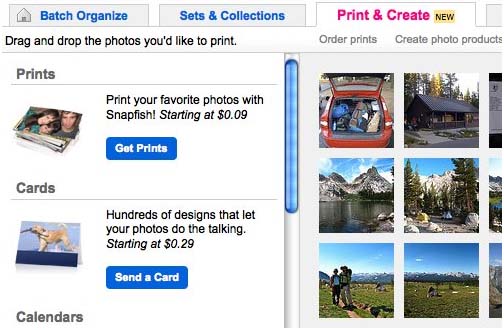
    Flickr, the Yahoo-owned photo-sharing site so many people love, announced an important deal today as it named HP’s Snapfish its preferred photo printing and gift creation partner.  Thanks to the arrangement, printing pictures is about to become a lot easier for some folks, and for others, this will even be the first time a certain printing option has been available at all.

    Flickr’s international members are set to get their first opportunity to print photos directly from photostreams due to this partnership.  That represents a significant step in making Flickr more user-friendly, and should pay off in terms of time spent on the site.  Perhaps, once word spreads a little, in terms of unique visitors, too.

    As for what else is going on, a formal statement outlined lots of perks.  "Flickr and Snapfish have worked closely to develop a fully integrated and intuitive experience, combining Snapfish’s printing capabilities with Flickr’s online photo organization features, such as Organizr, Sets and Photo Page," according to the release.

    Furthermore, "Flickr’s partnership with Snapfish will allow members more flexibility in shipping photos – not only can members print photos from anywhere in the world, they can also ship photos to anywhere in the world."  And "members in the U.S. can opt for local pick-up of their prints in-store at any of Snapfish’s retail partners, including Walmart, Walgreens, Staples, Duane Reade, and others."

    Flickr users have been pushing for something like this for quite a while – check out a 21-post discussion started in May of 2008 if you want evidence.  Count on more than a few people applauding Yahoo and HP for sealing the deal.

    Related Articles:

    > Flickr Delves Into People-Tagging

    > Flickr Receives Four Billionth Photo Upload

    > Flickr Added To The iPhone App Store

  • Will Murdoch Kill The One Smart Part Of The WSJ’s Paywall?

    With Rupert Murdoch’s recent talk about removing his sites from Google, some said that if you understood his comments in context, he was really talking more about copying the WSJ’s “leaky” paywall strategy — which lets users see full articles if they visit via Google. Of course, in that very interview, he appeared to not know how that leaky paywall works, claiming that it took people to a landing page with a couple of paragraphs rather than the full story. That’s not true. It does that if you’re linked from most other sites. But people who come via Google (or, I believe, Digg) get the full story automatically. The idea, from SEO experts, was to actually help Google drive more traffic.

    Of course, that was before Murdoch suddenly decided that all this free promotion was “parasiting” his works (despite the fact that many of his own properties do the same thing. However, it looks like News Corp. may actually be considering ending the “leaky” part of its paywall, with the company’s COO, Chase Carey, saying that the idea makes no sense:


    “I don’t think it makes sense… We don’t want people going though a backdoor, or other channels…”

    And now we learn how little the folks at News Corp. seem to understand the internet and the fundamental way that people want to interact with news these days. It’s not just about sitting and receiving the end product. It’s about being a part of the process — and that includes sharing and spreading the news — for free — to others. Mark Cuban thinks (incorrectly, in my opinion) that Murdoch understands the value of people passing around links, which is why he says he wants to opt-out of Google (because search traffic isn’t as valuable as traffic from Twitter or Facebook). But locking up all that content actually harms that viral-link value. People aren’t going to share or spread a link if they know others can’t use it. For years, for example, we’ve used those “backdoors” (i.e., Google News) which Carey bemoans to read stories in the WSJ that we post here. If they stop allowing that, then I won’t read the WSJ any more, and the community of readers and commenters here will never hear from the WSJ again. It’s difficult to see how that’s a better option.

    Amusingly, the first time that we ever wrote about this growing concept that people today want to “spread the news” and “share the news” more than they just want to receive the news was about five years ago — before the WSJ had put up its leaky paywall. The point of that post was to note just how far the WSJ had fallen out of the conversation on news media — since no one could send around a link to discuss things. Putting those “backdoors” into the paywall, at the very least, brought the WSJ somewhat back into the conversation. Blocking it now would make the Journal irrelevant again. It’s difficult to see how that’s a smart strategy at all.

    Permalink | Comments | Email This Story