Category: News

  • Don’t Forget About The Other Determinants of Health

    After months of discussion and debate, the House has passed its version of health care reform. But as many observers, including me, have already noted, health care reform has primarily become health insurance reform over the course of the year.

    The focus on health insurance reform, at least in part, reflects polling data that shows the public is much more responsive to issues like guaranteeing coverage to people without regard to pre-existing conditions or health status and providing subsidized insurance or access to Medicaid to people who need help. There is far less interest in slowing spending or controlling costs, especially in ways that could be viewed as making access to whatever health care patients or their physicians want more difficult. Not surprisingly, this lesser interest is reflected in the legislation just passed.

    To be fair, the House bill, as well as the bill voted out by the Senate Finance Committee, contains a variety of changes that focus on quality and health system performance improvements. These include proposals that encourage the development of more primary care providers as well as requirements to improve the coordination of care for people who are jointly on Medicare and Medicaid and other high users of services.

    There are also promising pilots that would bundle payments for post-acute care and that test incentive models that encourage accountable care organizations—groups of providers that are responsible for managing the cost and quality of care for a group of patients–and other payment and service delivery models. Based on past experience, however, the Secretary of Health and Human Services needs to be able to fully implement successful pilots without new authorizing legislation from the Congress. Otherwise the likelihood of even promising pilots becoming a part of Medicare is small.

    As we move to the endgame of what will at best be health care reform 1.0, it is also important to remember that if we want to improve health—presumably health care reform is a means to improving health—we need to focus on more than just health care and reform of the health care system.

    We probably all know that health care is only one means of improving health. It became especially clear to me after spending three years as a commissioner on the World Health Organization Commission on the Social Determinants of Health, which focused on the relationship of poverty, education, early childhood education, the treatment of women and individual empowerment to health and life expectancy. While the importance of clean water and sanitation to health is obvious for developing countries, focusing on the environment where people live and work is also important for developed countries—especially if we want to make progress reducing the disparities in health outcomes observed in minorities and disadvantaged populations.

    The rationale for considering the role of these social determinants of health is relevant for all age groups, but it is especially important for children. Improving the conditions surrounding a child’s early development will improve opportunities for better health throughout the child’s life span. Many of the biggest challenges the country now faces begin in childhood. Obesity, cardiovascular disease, cancer and mental health problems—conditions that account for more than 75% of health care spending today—all can have roots in the early years of life.

    Improving nutrition during gestation and delivery is critical to the health development of a child. It also plays a role in the likelihood of a child’s developing obesity, type 2 diabetes, high blood pressure and heart disease later in life. This means that making sure pregnant women with low incomes have stable access to nutritional food is thought of as an important strategy for improving future health.

    Making sure that pregnant women have access to substance abuse programs is another strategy that would markedly improve children’s health. As it is, too many children are born with serious medical challenges because their mothers had substance abuse problems. Not aggressively intervening to make sure such care is available and easily accessible imposes large financial burdens on the system and incalculable human costs on the children born to substance-abusing women.

    Similarly, investments in early childhood education, especially for the poor, should be regarded as an important tool for preventing disease, improving quality of life and increasing later productivity. Recognizing the social determinants of health means that programs like Head Start, Title I of the Education Act of 1965 that funded schools with high concentrations of poor children and is now part of No Child Left Behind, and ensuring that school lunches provide basic nutrition, including fresh fruits and vegetables, may be as important to improving health as any of the changes now under consideration even if they are not regarded as a traditional part of health care reform.

    The Congress and the country are finding reforming the health care system a major challenge—one that is likely to take many rounds of legislation. As we struggle through this first round of health care reform, it is important that we remember that the ultimate goal is to provide for a healthier America. Improving the conditions in which people are born and live, age and die may be at least as important as reforming health care in achieving this goal.

    Gail Wilensky is a Senior Fellow at Project HOPE, an international education foundation. She was the Administrator of the Health Care Financing Administration (now the Centers for Medicare and Medicaid Services) from 1990-1992 and the chair of the Medicare Payment Advisory Commission from 1997-2001.

  • Motorola Eyes $4.5 Billion Home/Networks Unit Sale

    NEW YORK (Reuters) – Motorola Inc (MOT.N) is in the early stages of looking into a potential sale of its $4.5 billion television set-top box and network equipment business, two sources said on Wednesday.

    Motorola is in the early stages of seeking buyers for the unit, whose suitors include private equity firms and other communications equipment makers, said one source familiar with the situation.

    Motorola may decide to keep the unit in the end, said the source, who was not authorized to speak with the media.

    J.P. Morgan Chase & Co and Goldman Sachs Group Inc are advising Motorola on the possible sale, the source said.

    J.P. Morgan and Goldman Sachs declined to comment.

    Motorola, which has been losing market share in its cellphone business for years, declined to comment, but said it was still focused on its previously stated plan to separate its handset business from the rest of the company.

    Analysts said there could be a lot of interest in the home and networks unit, particularly because Motorola has a strong market share in the set-top box segment, where it is bigger than Scientific Atlanta, owned by Cisco Systems Inc (CSCO.O).

    But RBC analyst Mark Sue said that a divestiture of any of Motorola’s other business units could hurt Motorola’s money- losing handset business.

    “The mobile devices business still needs the rest of the businesses to fund it operations. It hasn’t really recovered fully yet so it would be a little too early to cut off the lifeline,” Sue said.

    While growth in the mobile network equipment market has slowed dramatically in recent years, rival gear makers could see Motorola as a way to increase their market share, particularly in the United States.

    Avian Securities analyst Matthew Thornton said a $4.5 billion price tag would represent an 18 percent premium over his estimated valuation of $3.8 billion for the home and networks unit, based on operating earnings.

    Potential suitors could include Ericsson (ERICb.ST), Samsung Electronics Co Ltd (005930.KS), Alcatel Lucent SA (ALUA.PA) or Nokia Siemens, a venture of Nokia (NOK1V.HE) and Siemens AG (SIEGn.DE), analysts said.

    The Wall Street Journal cited China’s Huawei Technologies Co Ltd [HWT.UL] and UK based Pace Plc (PIC.L) as other potential buyers.

    Private equity firms, including TPG, also have taken a look at the unit, a source briefed on the process said. The source could not be identified by name because they were not authorized to speak to the media.

    The Wall Street Journal cited Silver Lake Partners as another potential bidder.

    TPG declined comment and Silver Lake Partners was not immediately available for comment.

    Motorola spokeswoman Jennifer Erickson said the company does not comment on rumor or speculation.

    “Separation into two independent, publicly traded companies (Mobile Devices and Broadband Mobility Solutions, which comprises Enterprise Mobility Solutions and Home and Networks Mobility Solutions) is the publicly stated long-term goal of Motorola,” Erickson said. “We remain committed to the separation goal and continue to believe that it is the right strategy to position Motorola for long-term success.”

    Motorola shares were down 15 cents, or 1.7 percent, at $8.70 in afternoon trading on New York Stock Exchange. (Reporting by Sinead Carew, Megan Davies and Jessica Hall in New York; editing by Andre Grenon and Tim Dobbyn)

    ShareThis


  • Review: idox Traveler Series iPod touch case

    idox - touch Platinum

    Short Version: As the owner of an iPod touch (2G), I was happy to give this case/stand a spin on my recent trip over to Ireland. Generally speaking, the case provided adequate protection of the touch (albeit leaving the top and bottom slightly exposed), was very handy for watching videos on the plane, and worked great for transforming the touch into a bedside alarm clock. With a MSRP of $34.95, I’d love to see the price come down a touch (zing!), but overall, the idox Traveler Series is a respectable case/stand combo choice.

    Longer Version: As anyone who regularly flies the not-so-friendly-skies knows, airplanes seem to be caught in some sort of infinite “shrinking” vortex. I swear. Every time I get to my assigned seat, it’s smaller than the last flight…

    Anyways, we’re here to talk about something more important than the failing flailing airline industry – a new iPod case from idox. Known as the Traveler Series, the case/stand is available for the iPhone (3G / 3GS – $34.95), iPod nano (4G – $24.95), and the iPod touch (2G / 3G – $34.95).

    Construction: Think of the case as a hard plastic portfolio, of sorts, for your iThing. The construction of the case/stand is very solid, providing more than adequate protection for the screen and device in general when traveling inside a pocket/briefcase/backpack/etc. The touch sorta snaps into place and stays there thanks to the embedded rubber design. When transformed into a stand, there are some nice rubber stoppers on the bottom to prevent the whole thing from sliding off your tray table (or other flat surface).

    Cons: The idox Traveler Series is definitely not perfect. For starters, the snug-fitting case is rather difficult to pry open. Yes, PRY. The lid snaps into place very securely, but is challenging to open without torquing the bottom (or top) corner. (In the grand scheme, this isn’t a deal breaker since it errs on the side of over protection.)

    idox - Touch Platinum closed

    Another downside is the exposed top and bottom of the iPod touch. The way the case is designed (above) allows for easy access to the iPod dock connector, headphone jack, and the top power switch. However, because of the nature of the design, the exposed areas could potentially be damaged.

    It is also important to note that the physical volume controls on the side of the Pod are rendered useless while in the case. Although, this is not that big a deal since there are onscreen touch volume controls, but still can be annoying in certain situations.

    Finally, it would be really nice if future generations could include multiple angle options for better and more adaptable stand use. While on the plane, when the guy in front of me put his seat back, I would have loved to be able to change the angle on the stand to compensate for my new viewing situation.

    Pros: With all that said, the idox Traveler Series does have some nice things going for it. For one thing, it is actually made pretty well. The case’s solid construction provides adequate protection for the screen, sides, and back of touch. Also, the touch stays securely in place once you “snap” it in.

    traveler-directions

    Although I complained about “the snug-fitting” case above, there is a definite plus side to this attribute as well – the touch inside the case fits in my jeans pocket with no trouble. And finally, the fact that it is an all-in-one case/stand, which offers both protection AND more comfortable video viewing, is clearly the biggest selling point here.

    Conclusion: After all is said and done, the Traveler Series case/stand definitely has its utility and some redeeming qualities. At $34.95 it’s definitely not priced very attractively, but I have to say, having any kind of stand for the iPod touch on a long flight really makes all the difference in the world. If it happens to protect the screen and still fit in my pocket as this idox case does, then that’s not such a bad thing either.

    idox - 3G Black

    iPhone case/stand

    idox - Nano Pink

    iPod nano case/stand


  • Verizon to Launch an iPhone Next Year?

    iphone3gThe mobile space has long buzzed with rumors of a Verizon Wireless version of the iPhone, and according to Northeast Securities, the device may finally arrive next year. Citing its supply-chain checks, the financial services firm said in a research note issued today that Apple will launch a WCDMA/CDMA2000-enabled version of the device — not an LTE version — through Verizon by the summer of 2010.

    Northeast Securities’ note jibes with a new report from OTR Global via AppleInsider, which claims that Apple plans to roll out a hybrid iPhone — enabling the Cupertino company to sell a single global handset “to all carriers” — by the third quarter of next year. Similar to Northeast Securities, OTR Global said the phone would use a new hybrid chip produced by Qualcomm that would allow the iPhone to support Verizon’s network in addition to retaining compatibility with UMTS 3G networks.

    As Sebastian noted last month, Apple could benefit greatly from loosening AT&T’s stranglehold on the iPhone in the U.S., and Verizon would surely love to kick out a key pillar of AT&T’s growth from the past year. While Verizon’s former lone-wolf strategy wouldn’t play well with Apple’s tightly controlled App Store, the nation’s largest carrier seems to have softened its go-it-alone stance as it embraces Google with its Droid initiative. A Verizon/Apple tie-up might have been unthinkable to many of us a year ago, but it’s looking more and more like an inevitability.

  • Rumor: Sony leaks PS3 Facebook integration, gamercard customization features

    PS3 users have had access to Facebook and other social networking sites like Twitter for a while now thanks to the console’s web browser. It looks lik…

  • Review: Comparison of Consultation-Liaison Services in the United States and Japan

    The paper reviewed here is  ’A Comparison of Psychiatric Consultation-Liaison Services Between Hospitals in the United States and Japan’ by Kishi and colleagues and freely available here. As the title suggest, the researchers make a comparison of consultation-liaison services in Japan and the United States and in the abstract there are a number of conclusions drawn. They begin with an introduction to their study. The researchers briefly describe some of their expectations of a comparison between the services in the two countries in this section.

    The researchers describe their method in the next section. The researchers selected hospitals in Minnesota, USA and Kanagawa, Japan for the study. They write that cultural differences between the two countries might be reflected by the patterns of referrals to liaison services. They also state that the period of study was related to a change in the reimbursement fees for consultations although I wasn’t sure of the temporal relationship between the study period and this change. The catchment area of the Minnesota hospital was 3 million and in the Kanagawa hospital was 1 million. The researchers describe the data that was recorded during the study period. The researchers justify their use of an adjusted Length of Stay (LOS) figure which incorporates the timing of the consultation.

    In the results section, there were significantly more men in the Minnesota sample (p=0.040), significantly more of the subjects were married in the Kanagawa sample – indeed almost twice as many proportionally (p<0.001) and significantly more employed in the latter sample (p=0.001). Surgical referrals seemed to be proportionally much higher in the Kanagawa sample than the Minnesota sample while the reverse was true for intensive care referrals although chi-squared and p-values weren’t displayed in the table for these figures. Interestingly almost twice as many referrals (proportionally) in the Minnesota sample had a past psychiatric history and this was highly significant (p<0.001). ‘Chemical dependency’ was the most common cause of referral in the Minnesota sample and ‘evaluation’ in the Kanagawa sample and both were significantly different from their counterpart values (i.e. in the other cities). Delirium was the most common diagnosis in the Kanagawa sample and depression in the Minnesota sample and again both proportions were significantly higher than those in the counterpart populations.

    In the discussion, the authors suggest that cultural factors might not play a role in the differences in prevalence of depression between East Asian countries and western countries (however an interesting study is reviewed here). They then suggest that in Japanese culture there is a focus on the collective rather than the individual and that this may influence interactions with mental health services. They also comment on referrals from physicians to psychiatrists for ‘psychosocial issues’ which was a frequent finding in referrals. In their discussion the authors note a number of limitations to the study including the lack of controls which would be helpful in better understanding the cultural differences. Additionally they note that the selected hospitals may not be representative of other teaching hospitals in the respective countries.

    As this was a comparison of retrospective data and they were interested in characteristics, the absence of primary outcome measures meant that in effect this was an exploratory analysis and adjustments may help to clarify which are the most interesting findings. It would be interesting to explore the findings with regards to referrers and diagnoses using a different paradigm e.g. case-controlled registry-based studies.

    Twitter

    You can follow ‘The Amazing World of Psychiatry’ Twitter by clicking on this link

    Podcast

    You can listen to this post on Odiogo by clicking on this link (there may be a small delay between publishing of the blog article and the availability of the podcast).

    Responses

    If you have any comments, you can leave them below or alternatively e-mail [email protected]

    Disclaimer

    The comments made here represent the opinions of the author and do not represent the profession or any body/organisation. The comments made here are not meant as a source of medical advice and those seeking medical advice are advised to consult with their own doctor. The author is not responsible for the contents of any external sites that are linked to in this blog.

  • Garmin Nuvifone to rock out with Windows Mobile 6.5

    nuvifone-m20

    You know your proprietary mobile OS isn’t all that great when we go ahead and say: thank heavens for Windows Mobile. Garmin/ASUS have announced that their M20 “GPS that can make phone calls” will now ship with Windows Mobile 6.5, and “all” current M20 owners are eligible for the free upgrade. Sweet. The two companies claim 6.5 will be available in Taiwan, Hong Kong, Thailand, Singapore, Malaysia, India, Russia, Ukraine, Poland, Czech, Turkey and elsewhere on the M20 by the close of 2009. No love for Western Europe and the US? Oh well. WinMo 6.5 for the M20 is nice and all, but what about all those fellas who purchased a G60?

    Read

  • FFXIII comes with a campaign code, not a beta access code for FFXIV

    When the Japanese gaming mag, Famitsu broke the news on a Final Fantasy XIV (PS3, PC) code coming with the purchase of Final Fantasy XIII (Xbox 360, P…

  • Universities reject Kindle DX as a textbook replacement

    By Tim Conneally, Betanews

    Amazon Kindle DXTwo universities running Kindle DX pilot programs have rejected the device as a potential textbook replacement, citing a poor feature set and the controversial accessibility issues. Primary among these is the text-to-speech capability.

    This capability came under fire shortly after the Kindle 2 debuted, as the Author’s Guild wanted writers to be compensated for the spoken “performance” of books, or otherwise have the text-to-speech function disabled.

    Meanwhile, equal rights groups like the American Council for the Blind, the International Dyslexia Association, and the National Center for Learning Disabilities wanted the feature to be kept free and available as an aid to the visually or cognitively impaired.

    The Author’s Guild ultimately won and the text to speech feature became optional, an issue for the authors to decide individually.

    Since the large screen Kindle DX debuted in the spring, a number of schools — secondary and beyond — ran pilot programs which tested the device’s viability as a textbook replacement.

    The University of Wisconsin-Madison and Syracuse University were two establishments running these pilot programs which recently decided not to adopt the device until its features are improved, including access to visually impaired students.

    “The big disappointment was learning that the Kindle DX is not accessible to the blind. Advancements in text-to-speech technology have created a market opportunity for an e-book reading device that is fully accessible for everyone,”
    Ken Frazier, the University of Wisconsin-Madison’s director of libraries said. “This version of the Kindle e-book reader missed the mark. It is relatively easy to envision an improved e-book reading device that meets the needs of the entire university community. Such a device would include universal design for accessibility, higher-quality graphics, and improved navigation and note-taking. I think that there will be a huge payoff for the company that creates a truly universal e-book reader.”

    The National Federation of the Blind considers this a victory.

    Dr. Marc Maurer, President of the National Federation of the Blind, said in a statement that the Federation “commends the University of Wisconsin-Madison and Syracuse University for rejecting broad deployment of the Kindle DX in its current form because it cannot be used by blind students and therefore denies the blind equal access to electronic textbooks. We do not oppose electronic textbooks; in fact, they hold great promise for blind students if they are accessible. But as long as the interface of the Kindle DX is inaccessible to the blind — denying blind students access to electronic textbooks or the advanced features available to read and annotate them — it is our position that no university should consider this device to be a viable e-book solution for its students.”

    This announcement comes just a day after Intel announced an e-reader designed especially for the visually impaired.

    Copyright Betanews, Inc. 2009


    Add to digg
    Add to Google
    Add to Slashdot
    Add to Twitter
    Add to del.icio.us
    Add to Facebook
    Add to Technorati


  • Reminder: You need to convert your World of Warcraft account to a Battle.net one today

    battlenet

    Just a friendly remind to all my fellow World of Warcraft players. You need to migrate your account to a Battle.net account by the end of the day today, lest you’re unable to login.

    Why is Blizzard doing this? Probably to make things easier on its end, but you’ll also see some benefits. One day, Battle.net will be, and I hate to use the phrase, a type of “social network” for Blizzard gamers. You’ll be able to message your friends across different games while in the game and all that jazz.

    For your troubles, Blizzard will send you an in-game pet, Mr. Chilly.

    I converted my account about a month ago and have had zero problems.


  • Blu-Ray App for iPhone Arrives Courtesy of Universal

    pocketbluUniversal Media announced awhile ago that it would be introducing iPhone control into some of its Blu-ray titles, starting with “Fast & Furious,” the Vin Diesel/Paul Walker romp that saw the lucrative car racing series return to its humble origins. Now, Universal is extending the iPhone/Blu-ray connection to a much wider swath of its library thanks to “pocket BLU,” a new app for Apple’s handheld devices.

    pocket BLU is a free download from the App Store that allows your iPhone to become a remote control for operating Blu-ray discs from Universal. It won’t work with just any movie, of course. Blu-ray discs need to be played using a Wi-Fi connected player, for one, and the title has to be specifically enabled to work with pocket BLU, something which will be indicated by a conspicuously placed logo.

    The app will allow you to control playback of the film, and jump backwards and forwards to any point in the movie using a visual time line. You’ll also have access to a pop-up keyboard for entering data, which will definitely make any typing you need to do with your Blu-ray movie much easier. Finally, some titles will offer the ability to stream special content from the disc to your iPhone, which can then be stored for later viewing.

    The app has promise, but limited as it is to one major distributor’s titles, it feels a little like yet another extraneous feature designed to add value to a format that’s failing to catch on with most consumers. Chances are, I’m never going to watch or care about the additional features included for pocket BLU users anyway, so why not just stick to playing back digital content on my Mac and using Rowmote or VLC Remote to control it? Take it from me, Universal, you’ll be far better off if you focus on delivering content to the iPhone platform, instead of just control mechanisms.


  • Hoyer: House Could Be In Session Until Late December

    Roll Call reports on the changing House calendar. “‘As action on health insurance reform legislation moves to the Senate, the House is updating its schedule for November and December to reflect that, and to ensure there is time to complete our work on other important issues,’ [House Majority Leader Steny] Hoyer said in a statement.” Meanwhile, Senate Majority Leader Harry Reid has kept open “the possibility of working on Saturday, Nov. 21, the weekend before the Thanksgiving recess. Both chambers are scheduled to be in recess the following week for the Thanksgiving holiday, observed Nov. 26” (Brady, 11/11).

    Politico: “The House will be in session for 21 more days in 2009, putting in a couple of five-day workweeks as Democrats rush to finish their heavy legislative agenda before the Christmas holiday.” And the Senate? Majority Leader Reid “has said he wants to get the bill to the president by the end of the year, but that would require working on Saturdays, something the body is hardly anxious to do” (Sherman, 11/11).

    Hoyer today said “he is prepared to extend the House healthcare schedule into late December in order to pass healthcare reform,” The Hill reports. “Hoyer’s move follows Senate Majority Leader Harry Reid’s (D-Nev.) decision late Tuesday night to file a motion that could allow the Senate to begin debate on healthcare next week.” The actions by both leaders are likely part of the effort to meet the White House’s year-end deadline for a health care bill.

    Reid is currently waiting for the Congressional Budget Office’s cost estimates of the bill, which are expected by the end of the week. But he has also signaled a willingness to begin the process before he has this analysis in hand. In terms of the procedural vote on the motion to bring the bill to the floor, success will require 60 votes, which will be an early test to Democratic unity. And “Senate GOP Leader Mitch McConnell (Ky.) and National Republican Senatorial Campaign Committee Chairman John Cornyn (Texas) have both warned Democrats that they will target any senators who support procedural votes on the bill, and McConnell has indicated he’ll do everything possible to slow the healthcare bill’s movement” (Fabian and Swanson, 11/11).

  • How would you rewrite Google’s ’10 Things?’

    By Joe Wilcox, Betanews

    More and more people are using the M word — that is “monopoly” — to describe Google. Certainly there is an argument that, globally, Google has a monopoly on search. According to combined analyst reports, Google’s worldwide search share is about 60 percent, even 70 or 80 percent in some geographies — and that’s just from the desktop or portable PC. Google also is rapidly gaining search share on mobile phones as well; 60 percent, or even more, in many countries.

    Google’s influence is a hot topic this week because of media mogul Rupert Murdoch’s threat to put most, if not all, his content behind a paywall and remove that content from crawling by Google search bots. Is Google doing evil to traditional media publishers like Murdoch, by making their content easily available for free? In August, over at my Oddly Together Website I tackled this topic in post: “Can You Charge for News? Ask Google.”

    As Google’s might increases, it’s reasonable to ask how the company’s business practices are changing and whether or not it can stick to corporate philosophy “Ten things we know to be true.” Perhaps the best known is No. 6: “You can make money without doing evil.” But can Google does this? That’s the question I pose to Betanews readers.

    I’ll go further and ask: How would you rewrite Google’s “10 Things” to more appropriately fit how the company conducts its business? I offer my list below but ask for your adaptations in comments. By the way, my revision is a bit hard-ass with a purpose: To generate discussion. The revised 10 Things don’t necessarily reflect how I personally feel about Google, which otherwise gets knocked around in my revised 10 Things.

    I got the idea to rewrite the 10 Things from a Twitter exchange, late yesterday. I tweeted: “Q: Does YouTube diminish if Bing Videos easily collects videos from many sources? If Microsoft taps in social sharing/networking?” Windows developer Mugunth Kumar responded: “I wish it would. Google videos is like too much inclined toward YouTube 🙁 “don’t be evil, no non-google videos for you”!” I shot back a revised No. 6, which you can read below. With that introdcution…

    Google’s 10 Things — As revised by Joe Wilcox

    1. “Focus on the user and all else will follow” should be: Focus on the algorithm and all else will follow.

    Google’s core business is really about ranking the relevance of Websites. If keywords are any indication, the focus is not on the user. Keyword search is hugely inexact, and it’s unnatural to how people look for things (e.g., they ask questions). But keywords are important to how Google makes money from search.

    2. “It’s best to do one thing really, really well” should be: Don’t put all your eggs in one basket.

    While cliché, the saying is appropriate to Google. In the early 2000s, Google did search “really, really well” — better than any competitor. But end users and even keyword customers could still easily switch to another search engine (just type a different URL into the browser’s address bar). Google extended its search technology and brand success by releasing many products with cross-integration benefits. Today, Google search is sticky, because of supporting products or services. Few of them are another thing done “really, really well,” however.

    3. “Fast is better than slow” should be: Slow is better than fast.

    With the exception of perhaps Chrome, most Google products or services stay in perpetual states of beta before release. The development process is anything but fast. Gmail spent five years in beta. Exactly what is fast about that? The slow process allows Google to get something to market, while it’s refined to reach a “good enough” threshold (see #10).

    4. “Democracy on the web works” should be: Monopoly on the Web works.

    Microsoft showed the power of monopoly when Internet Explorer tied to Windows ruled the Web. Contrary to democratic concepts about the Web, a minority of Websites account for the majority of traffic. Increasingly, the means for getting to these majors, and most of the minors, is search: Google search. And there’s nothing really democratic about one company, or its algorithm, controlling access to most information.

    5. “You don’t need to be at your desk to need an answer” should be: You don’t need another search engine to find the answer. Google is king of the search hill. Early on, this was because of its technology and keyword business practices. Google has extended its reach through its own services and by way of partnerships, such as being default search engine in every major Web browser but one — Internet Explorer.

    6. “You can make money without doing evil” should be: You can do evil without making money.

    Other than search, most Google services don’t directly make money. But they do take money from someone else — what other businesses might call “evil.” Google gives away for free something someone else charges for. For example, last month, shares of turn-by-turn mapping manufacturers plummeted after it was revealed that Google would include turn-by-turn mapping features with Android 2 for free.

    7. “There’s always more information out there” should be: There’s always more information that Google can cannibalize for free.

    The core dispute Robert Murdoch has with Google: He pays talented people to produce valuable content, which Google profits from through keyword search. Google doesn’t produce content, but like a human parasite leeches nourishment (e.g. revenue) from the host.

    8. “The need for information crosses all borders” should be: The need to index information crosses all boundaries.

    Google wants to catalog everything. The practice has generated some corporate — and even government — backlash about privacy and security. Google produces none of this information, owns none of it, but looks to profit from it.

    9. “You can be serious without a suit” should be: You can’t be taken seriously without a suit.

    Sure, regular Googlers dress however they want. But how does Google chairman and CEO Eric Schmidt dress? In a suit!

    10. “Great just isn’t good enough” should be: Good enough is good enough.

    Few Google products or services are great, nor does the company strive to make them so. The majority, especially those competing with something already available, strive to cross the “good enough” threshold. When something is good enough for less or free, people will adopt it and even give up some more valuable that costs more. Microsoft has repeatedly demonstrated the “good enough” principle with its products, such as Internet Explorer in the late 1990s.

    Copyright Betanews, Inc. 2009


    Add to digg
    Add to Google
    Add to Slashdot
    Add to Twitter
    Add to del.icio.us
    Add to Facebook
    Add to Technorati


  • Research Scientist Heads From Yahoo To Twitter

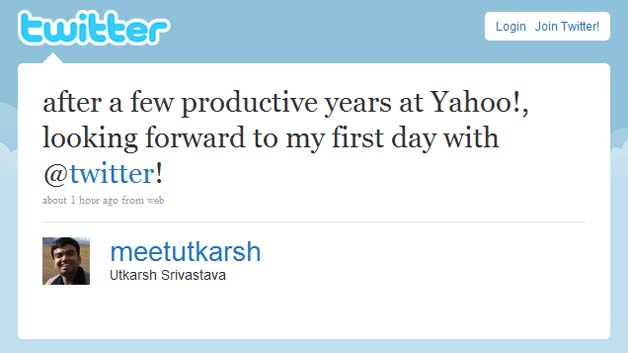
    Today, as is often the case, one tech company’s loss became another’s gain.  Utkarsh Srivastava has left Yahoo after spending more than three years as a senior research scientist there, and Srivastava confirmed (in well under 140 characters) that he’ll land at Twitter.

    Srivastava’s background is quite impressive.  On the educational front, he earned degrees from the Indian Institute of Technology and Stanford, and happened to receive the Stanford Graduate Fellowship, too.

    Around the same time, he acted as a research intern at Microsoft and then IBM, and was awarded the Microsoft Graduate Fellowship.  Not bad.

    Next, Srivastava headed to Yahoo, where according to his LinkedIn profile, he became "one of the original designers and developers of Pig, a high-level language for data processing over Hadoop.  Pig is open-sourced as a subproject of Hadoop, and is routinely used in production for large data processing both within, and outside of Yahoo!."

    Which more or less brings us back to the present day.  Louis Gray noticed that Srivastava had been added to a list of Twitter employees, and Srivastava confirmed it on Twitter a little later.

    Yahoo hasn’t named any sort of replacement or, as far as we can tell, chained its remaining employees to their desks.

    Related Articles:

    More Microsoft Layoffs On The Way

    > YouTube’s Director Of Content Partnerships To Leave

    Twitter Picks Up Former Facebook Platform Manager

  • Supreme Court expresses skepticism over merits of Bilski case

    The long-awaited case of Bilski and Warsaw v. Kappos, which could reshape the patent world, finally landed in the U.S. Supreme Court this week. During one-hour oral arguments, several justices — including the court’s newest member, Sonia M. Sotomayor — expressed skepticism about affording patent protection to business methods. The heralded case concerns a patent that had been denied to Bernard Bilski and Rand Warsaw for a process that could help utilities, factories, and schools have more predictable energy costs. Justices peppered J. Michael Jakes, a lawyer for Bilski and Warsaw, with hypothetical patents that they clearly found ludicrous. Justice Antonin Scalia suggested that under Jakes’ argument, a patent for “somebody who writes a book on how to win friends and influence people” might be allowed, while Sotomayor suggested a “method of speed dating.” Justice Stephen G. Breyer set off a ripple of laughter when he mentioned his “great, wonderful, really original method of teaching antitrust law” — one in which 80% of students actually stayed awake — and asked if that could be patented. Scalia also asked why, during the nation’s horse-based economy in the 1800s, there were no patents directed to methods of training horses, as this would certainly have been useful at the time.

    Nevertheless, the Justices seemed to struggle with framing an appropriate solution for Bilski and appeared mindful of the potential consequences of their ruling. Breyer asked whether the framers of the Constitution intended for every “new” method that helps a business owner conduct business to be patentable, intimating that Bilski’s proposed test could be too encompassing and asking for a more reasonable alternative, such as “useful arts.” Breyer indicated that the justices needed to consider four factors — two positive and two negative — in making their decision. On the plus side, a patent offers monopoly power to the inventor and disclosure to the public, he said. On the downside, a patent raises prices when the monopoly is in play and slows progress while users seek a license or permission to practice. Although, historically, patents have been used to protect the processes performed by machines, Breyer admitted that he was unsure whether providing patent protection to information “will do no harm or more harm than good.” Sotomayor also told Jakes that “a patent limits the free flow of information. It requires licensing fees and other steps — legal steps. So you can’t argue that your definition is improving the free flow of information.”

    The high-water mark for business method patents was a 1998 ruling by the U.S. Court of Appeals for the Federal Circuit in State Street Bank v. Signature Financial Group that a method of processing mutual fund data could be patented. The ramifications of that case were discussed during the oral arguments. Nearly 70 amicus briefs were filed in the Bilski case by parties ranging from Microsoft to the American Civil Liberties Union. “This case is the case of the century for patent law,” says John F. Duffy, a professor at the George Washington University Law School and co-author of a brief on behalf of several technology companies. “There’s a tremendous public benefit that could come from encouraging innovation in this space.” But Pamela Samuelson, a professor at the University of California, Berkeley, School of Law and author of a brief on behalf of the Electronic Frontier Foundation, says it’s time for the court to tap the brakes on business method patents. The State Street decision had the effect of “knocking patent law loose from its historical moorings and improperly injecting patents into business areas where they were neither needed nor wanted,” according to her brief. A decision is expected before the end of the Court’s current term in June 2010.

    Sources: The New York Times, Patently-O, and Patently-O


  • Feds Demand Over Half A Million Dollars To Fulfill A Freedom Of Information Act Request

    When President Obama took office, one of the very first things he did was declare that all government agencies should default towards openness in dealing with Freedom of Information Act (FOIA) requests. It looks like some are trying to sneak around that a bit. Wired has the story of an FOIA request where the government is demanding $522,886 in order to fulfill the request. This certainly gives off the appearances of pretending to be open while figuring out a nice way to toss up a huge roadblock. Oh, by the way, that single bill would just about equal the entire cost that the US gov’t charged for all FOIA responses in 2008. Why so expensive? That’s not particularly clear. Apparently, the guy filing the request even knows which file cabinets the information he needs is in, so it’s not like the gov’t has to go searching for it…

    Permalink | Comments | Email This Story


  • AUTM, six universities embrace global access initiative

    The Association of University Technology Managers (AUTM) and a consortium of six major U.S. research universities have endorsed a global health initiative designed to speed access to affordable medicines in the developing world. The group has signed onto a plan that will insist licensees to university-created therapies, such as pharma companies, agree to help make those therapies more widely available in developing countries. By inking the “Statement of Principles and Strategies for the Equitable Dissemination of Medical Technologies,” Harvard, Yale, Brown, Boston, and Oregon Health & Science Universities and the University of Pennsylvania, together with AUTM, committed to “implementing technology transfer strategies that promote the availability of health-related technologies in developing countries for essential medical care.” The initiative takes a major step beyond “Nine Points to Consider in Licensing University Technology,” a 2007 statement endorsed by nearly six dozen research and academic institutions, and includes a Global Health Toolkit created by AUTM members. The toolkit allows TTOs to share information on structuring licenses that promote innovation and product development while encouraging access to essential medicines. The toolkit includes sample clauses taken from signed license agreements that include global access language acceptable to the licensees. AUTM plans to update the toolkit as TTOs gain experience and provide feedback on it, according to Arundeep S. Pradhan, associate vice president, technology transfer and business development, at Oregon Health & Science University and president of AUTM.

    The effort to hasten the development and dissemination of technologies and medications to ease the global health crisis began last spring when Harvard and Yale hosted a gathering of TTOs from a dozen U.S. research institutions. The daylong meeting and months of follow-up conference calls provided the framework for the document. The student group Universities Allied for Essential Medicines (UAEM) also pushed for the effort. The consensus statement describes a number of strategies to facilitate generic production or below-market pricing and commits the universities to, among other things:

    • make “vigorous efforts to develop creative and effective licensing strategies that help to promote global access to health related technologies;”
    • ensure that IP “should not become a barrier to essential health-related technologies needed by patients in developing countries;”
    • exert control over patent rights in such a way as to foster the availability of life-saving products in the developing world; and
    • support the development of health-related technologies aimed at diseases that disproportionately burden individuals in the developing world — tuberculosis, AIDS, water-borne disease, tropical- and other region-specific ailments and parasitic infections — without regard for economic gain.

    Officials at AUTM and the six schools wanted to craft guidelines that encourage drug access for poor nations without dissuading companies from working with university scientists, according to Maryanne Fenerjian, Harvard’s director of technology transfer policy. Participating schools will use strategies such as decreasing royalty rates to persuade companies to charge less or allow low-cost generic production of new drugs for poor patients, she says. Harvard has already used techniques cited in the toolkit to help promote access to medicines. When the university licensed a tuberculosis vaccine technology in 2007 to Hong Kong-based Morningside Group, the company agreed to sell the vaccine at affordable prices in developing countries. “It’s important that our intellectual property doesn’t serve as a barrier — and in some cases should be used as leverage — to help ensure that drugs, vaccines, and other technologies reach the developing world,” Fenerjian says. “But there is no single solution. Every technology is different and every licensee’s capabilities and sensitivities are different.”

    The six universities expect other private and public universities to adopt the principles once they are broadly disseminated. “A number of institutions have been willing to be tough and creative on these issues,” Fenerjian says. “Until now, we haven’t had a statement that says this is what we see as our goal — this is what we see as our new norm.” Universities can endorse the statement of principles at http://www.autm.net/endorse.

    Sources: Yale University Office of Public Affairs and Bloomberg.com


  • Sunglasses with built-in camcorder and MP3 player

    otas_glasses

    Tokyo-based gadget maker OTAS is selling sunglasses [JP] that feature, for some reason, a built-in video camera and MP3 player. The so-called aigo glasses come with a 1.3 megapixel camera, a music player that supports MP3 and WMA files, 4 GB of internal memory, and a USB 2.0 port.

    OTAS says the internal memory is enough to store up to 10,000 songs. You can shoot pictures (in JPEG format) in 1,280×1,024 and videos (in AVI format) in 640×480 resolution and at 12fps. The sunglasses weigh 52 grams and support Windows XP/Vista/7.

    You can get them over at import specialist Geek Stuff 4 U for $220.78 plus shipping.


  • On Hill, Bipartisan Support Emerging For Commission To Control Health Costs

    Budget Committee Chairman Sen. Kent Conrad, D – N.D., is one of the authors of the plan to create a commission to help “bend the curve” of health care costs. Sen. Joseph Lieberman, I-Conn., supports such an idea. (Chip Somodevilla/Getty Images)

    The drive on Capitol Hill to create a bipartisan entitlement and tax reform commission to help “bend the cost curve” of health spending and address mounting deficits picked up momentum Tuesday, as Senate Minority Leader Mitch McConnell and a handful of moderate Democrats and Republicans voiced support for the effort.

    The commission would draft proposals to control the long-term costs of Medicare, Medicaid and Social Security, which together account for 40 percent of all federal spending other than interest on the debt. The recommendations would require a swift up or down vote by a supermajority of members of Congress, to assure bipartisan support for unpopular measures to cut sensitive spending programs or to raise taxes if necessary.

    The chief authors of the measure, Senate Budget Committee Chairman Kent Conrad, D-N.D., and Republican Sen. Judd Gregg of New Hampshire, say they will attempt to attach their plan to must-pass legislation raising the government’s debt ceiling in the coming weeks. Others, including independent Sen. Joseph Lieberman of Connecticut and Republican Sen. George V. Voinovich of Ohio, are circulating similar plans.

    Conrad held hearings Tuesday to drum up support for the approach. He was joined by a small group of lawmakers from both chambers warning that runaway government spending and a $1.4 trillion annual deficit were threatening to undermine the nation’s economy and the U.S. credit rating abroad. “It doesn’t take an economist to realize our course is unsustainable,” Voinovich said. “The federal government is the worst credit card abuser in the world and we’re putting everything on the tab of our children and grandchildren.”

    McConnell, R-Ky., said he would have to see the composition and mandate of a commission before signing on, to make sure Republicans were adequately represented. But his comments echoed those of Conrad and others who believe a commission may be the only way to force Congress to come to grips with unsustainable spending on entitlement programs, the major cost drivers in the federal budget.

    “I actually discussed that matter with the President back before he was sworn in and I indicated a willingness to discuss the appropriateness of having some kind of commission, and I’m willing to talk about that – particularly if the commission targets the real problem we have in the future which is the unfunded liabilities we have in Medicare, Medicaid and Social Security,” McConnell told reporters at a news conference.

    The government is on track to accumulate deficits totaling $9 trillion between now and 2019, according to the Treasury and the Office of Management and Budget. While the administration’s spending in response to the recession and financial meltdown helped drive up the fiscal 2009 deficit to a record $1.4 trillion, most of the future problem will be due to rapid rises in entitlement spending on Medicare and Social Security for seniors and Medicaid for the poor and disabled. Experts say that these problems are not being addressed as part of the health care overhaul bill passed by the House last weekend or the plans being considered in the Senate.

    The idea of threatening to hold up a measure allowing the government to raise the nation’s nearly $12 trillion debt limit to enable the Treasury Department to continue borrowing has attracted strong backing from Sens. Evan Bayh, D-Ind., 13 other Democrats and Lieberman. Bayh, who met late last week with Senate Majority Leader Harry Reid, D-Nev., to press his case for a commission, described the move as an “insurrection” by lawmakers fearful that the government was on an unsustainable spending path.

    Lieberman said that it is essential to link action on a new debt ceiling with a commission to address the nation’s long-term fiscal problems “to ensure that we do not put ourselves or the nation into a position where we continually have to increase the nation’s debt ceiling limit to accommodate perpetual deficits and ever-growing national debt.”

    Jim Manley, a spokesman for Reid, said the majority leader has been “actively talking with many of his colleagues and administration officials about this type of proposal,” but that no decision has been made. Manley emphasized, however, that “the process and policy needs to be a joint administration-House-Senate decision.” House Speaker Nancy Pelosi, D-Calif., opposes the approach, according to an aide, but House Majority Leader Steny Hoyer, D-Md., supports the concept.

    The White House has signaled interest in the Conrad-Gregg commission approach, according to Conrad, but remains non-committal. During Tuesday’s Senate Budget Committee hearing, William Galston, a Brookings Institution senior fellow, said he has heard the administration may include a proposal for a bipartisan commission in the fiscal 2011 budget proposal that will be submitted to Congress early next year. The Office of Management and Budget declined to confirm or deny the speculation.

    David Walker, the former Comptroller General of the United States, urged Congress to move swiftly next year to create a bipartisan commission to address the nation’s growing fiscal challenges.

    “Importantly, everything must be on the table for any commission to be credible and to have a real chance of success,” said Walker, who is now president and CEO of the Peter G. Peterson Foundation. “This includes acknowledging the need to modernize the current social insurance programs, constrain federal spending, including defense spending, and raise additional revenues.”

  • Video Industry to Gather Tomorrow for NewTeeVee Live

    NewTeeVee Live 09: I’ll be there, how about you? / San Francisco / November 12 It’s been an exciting week here at GigaOM HQ. We’ve been busy putting the final touches on the third edition of NewTeeVee Live, our annual online video industry conference that we’re holding in San Francisco tomorrow, Nov. 12th. I’ve been preparing for my conversations with Quincy Smith, the outgoing CEO of CBS Interactive, and Reed Hastings, CEO of Netflix. Adobe Systems’ CTO Kevin Lynch is going to chat with Sebastian Rupley, our editor in chief. Expect some fireworks during our conversations about the future of video and video delivery.

    Liz Gannes and Chris Albrecht, co-editors of NewTeeVee, have put together an all star line-up of speakers for what promises to be an information- and insight-packed event. They will be talking onstage with (see schedule) senior executives from Adobe Systems, Facebook and YouTube along with folks from Comcast, Microsoft’s XBox Live, CNN Interactive, Cisco, Boxee, Roku and Redbox.

    The focus of this year’s conference is on three major themes that will dominate the video industry over the next 12 months: TV Everywhere, Social TV and the Over-the-Top Video. The event will also include a thrilling series of vignettes that will feature products and startups that are building the Next Big Thing. Expect some interesting news to come out of these NBT vignettes.

    Lindsay Campbell, ex-host of WallStrip, is going to be our MC for the day. I hope you can join us for the event tomorrow — we still have about 12 tickets left for sale — hopefully you can grab them soon.

    We will be giving the attendees of NewTeeVee Live a free copy of our recently released GigaOM Pro research report, “TV Everywhere: Everything You Need To Know.” Others can access the report by subscribing to GigaOM Pro directly.