
Category: News
-
Google adds speech recognition API to latest version of Chrome
-
PNNL engineer receives New Faces of Engineering honor
Maria Vlachopoulou, an engineer at the Department of Energy’s Pacific Northwest National Laboratory, has been recognized as IEEE/IEEE-USA’s 2013 New Faces of Engineering honoree during National Engineer Week (Feb. 17-23, 2013).
The honor highlights the impact and contributions of engineers age 30 or younger. Vlachopoulou was one of 13 engineers recognized for this international honor and was featured in a full-page ad in USA Today on Feb. 18.
Moe Khaleel, director of PNNL’s Computational Sciences & Mathematics Division, says Vlachopoulou’s research in energy systems, statistical and mathematical modeling, optimization and software engineering is supporting the transition of the U.S. power grid to a more secure, efficient and robust system. “Maria’s work directly impacts two national priority areas — securing our long-term energy security and reliability while reducing our dependence on foreign sources of oil,” he said.
Vlachopoulou earned master’s degrees from Purdue University in 2010 in electrical and computer engineering, and in industrial engineering. She also has multiple publications related to her work on novel algorithms for energy forecasting — a vital component of power grid reliability.
The New Faces of Engineering honor also recognizes each recipient’s work within their communities. Vlachopoulou is the founding chair of the IEEE Women in Engineering group in Richland, Wash.; and in the Tri-Cities, Wash. community, she volunteers with local high school and middle school students to cultivate interest in careers in science, technology, engineering and mathematics, or STEM, areas.
All 2013 New Faces of Engineering honorees and their contributions are featured at the National Engineers Week Foundation website.
IEEE-USA advances the public good and promotes the careers and public policy interests of more than 205,000 engineering, computing and technology professionals who are U.S. members of IEEE.
-
What Is the Sequester?
p span.callout {
color: #036;
font-weight: bold;
}
p span.link {
color: #036;
font-weight: bold !important;
font-size: 12px;
text-transform: uppercase;
}In eight days, harmful automatic cuts — known as the sequester — take effect, threatening hundreds of thousands of jobs, and cutting vital services for children, seniors, people with mental illness and our men and women in uniform.
To prevent a costly, self-inflicted wound to our economy and middle class families, President Obama put forward a plan to avoid these cuts and reduce the deficit by cutting spending and closing tax loopholes. Now it's up to Congress to act. Learn more about President Obama's plan here.
Still have questions about what the sequester is, and why American famillies and our national economy face this threat? We've put together the explainer below using some helpful background information President Obama laid out in a statement on Tuesday. Check it out:
$2.5 Trillion in Deficit Reduction
 "Over the last few years, both parties have worked together to reduce our deficits by more than $2.5 trillion. More than two-thirds of that was through some pretty tough spending cuts. The rest of it was through raising taxes — tax rates on the wealthiest 1 percent of Americans. And together, when you take the spending cuts and the increased tax rates on the top 1 percent, it puts us more than halfway towards the goal of $4 trillion in deficit reduction that economists say we need tostabilize our finances."
So What's the Sequester? Why Now?

"Now, Congress, back in 2011, also passed a law saying that if both parties couldn’t agree on a plan to reach that $4 trillion goal, about a trillion dollars of additional, arbitrary budget cuts would start to take effect this year. And by the way, the whole design of these arbitrary cuts was to make them so unattractive and unappealing that Democrats and Republicans would actually get together and find a good compromise of sensible cuts as well as closing taxloopholes and so forth. And so this was all designed to say we can't do these bad cuts; let’s do something smarter. That was the whole point of this so-called sequestration."
"Unfortunately, Congress didn’t compromise. They haven't come together and done their jobs, and so as a consequence, we've got these automatic, brutal spending cuts that are poised to happen next Friday."
-
If you are running advertorial or sponsored content, Google is watching you
We’ve described a number of times at paidContent how publishers large and small are looking for alternative sources of revenue as traditional advertising declines in value, and how some sites — including The Atlantic, BuzzFeed and Gawker — are experimenting with new ad formats such as sponsored content or “native advertising,” as well as affiliate links. On Friday, Google engineer Matt Cutts reiterated a warning from the search giant that this kind of content has to be treated properly or Google will penalize the site that hosts it, in some cases severely.
In his post on the official Google blog, entitled “A reminder about selling links that pass PageRank,” the Google staffer notes that the company has repeatedly warned about the dangers of links — including those on advertorial pages — that are designed to pass some of the hosting site’s PageRank (in other words, its status in Google’s search index) to the company paying for the links:
“Please be wary if someone approaches you and wants to pay you for links or “advertorial” pages on your site that pass PageRank. Selling links (or entire advertorial pages with embedded links) that pass PageRank violates our quality guidelines, and Google does take action on such violations.”
Sites that host such content can be penalized
The penalties for doing this, Cutts says, including “losing trust in Google’s search results,” as well as a reduction of the site’s PageRank status, and lower rankings for the site in Google’s search results. The proper way to avoid this kind of penalty is to use what’s called a “nofollow” tag at the end of the URL for a paid link, which tells Google not to assign any PageRank to the page on the other side of that link.
According to Search Engine Land, the Google post may have been triggered in part by the behavior of a number of British local newspaper sites such as the The Worcester Standard and This Is Dorset, which were hosting advertorial content from an online flower-delivery service called Interflora. Even though the posts clearly say “ad features” and “advertisement,” the links to the company’s website and other related links don’t have the nofollow tag attached.
David Naylor, a consultant who specializes in search-engine optimization or SEO, described in a post of his own how the Interflora content had broken the rules, and how the company’s own PageRank had declined sharply as a result — and he also noted that the PageRank of the local news websites that posted the content hadn’t just declined, but had actually dropped to zero. According to Naylor, such a massive drop for a single infraction is unusual.

Sponsored content is growing in popularity
The Atlantic has been in the news recently for its experiments with sponsored content, including a large feature on the Church of Scientology that was widely criticized. The magazine later apologized for the piece and said it was amending its rules on sponsored content, but it’s not clear whether those rules include adding “nofollow” tags (the Scientology piece has been removed). A survey of some of the Atlantic’s recent sponsored content showed no links at all.
BuzzFeed is also known for its sponsored-content program — in fact, the site carries no traditional advertising whatsoever. The use of this kind of advertorial sparked a critical post from blogger Andrew Sullivan at his Daily Dish site, in which he suggested that blurring the line between editorial and advertising the way BuzzFeed does is unethical and disturbing (Note: We’ll be discussing alternative monetization methods with Justin Smith of the Atlantic, Jon Steinberg of BuzzFeed and Andrew Sullivan, among others, at paidContent Live in April).
All Google really seems to care about, however, are the links in this kind of content: in one of the sponsored posts that Sullivan criticized, about the launch of Sony’s PlayStation 4 console, a link to a contest Sony is running did not have a nofollow tag attached, but — like the Atlantic — many of the other sponsored posts we looked at on the BuzzFeed site contained no links at all.
In a post on Twitter, BuzzFeed founder Jonah Peretti said that all of the paid content that appears on the site goes through Google’s DART system (which is part of its Doubleclick advertising unit) and therefore doesn’t pass PageRank.

Post and thumbnail images courtesy of Shutterstock / Brian A Jackson and David Naylor
Upcoming: paidContent Live, Apr. 17, 2013, New York, Save $100, Register by 3/22 More upcoming conferences.

Related research and analysis from GigaOM Pro:
Subscriber content. Sign up for a free trial.


-
Forget the Surface Pro: Consumer Reports finds plenty of great low-cost Windows 8 laptops

-
Who are the next hot mobile networking startups? Bessemer aims to find them at MWC
When you think about the term “hot startup,” you generally don’t think of wireless infrastructure. In a world of Pinterests and Instagrams, companies specializing in byzantine telecom protocols and arcane mobile standards don’t really sound that exciting. But Bessemer Venture Partners has shown there is money to be made in the mobile networking world.
Last month, Cisco Systems scooped up Israeli self-optimizing network outfit Intucell, one of Bessemer’s key portfolio companies. The networking giant paid $475 million for the company just two years after Intucell raised its $6 million Series A round. But that wasn’t a fluke investment. Bessemer has made mobile infrastructure a significant pillar in its investment strategy.
 While Bessemer is perhaps best known for its investments in LinkedIn and Skype, its most spectacular exit in the mobile networking space was Flarion Technologies, a pioneer of the orthogonal frequency division multiplexing access (OFDMA) technology that is now at the heart of all 4G networks. In 2006, Qualcomm bought Flarion for $600 million.
Its current portfolio includes mobile data traffic shaper Vasona Networks, 4G chipmaker Altair Semiconductor and network API developer Twilio, but after the exits of Intucell last month and Traffix Systems last year (bought by F5 Networks), Bessemer is looking to reload. One of the places Bessemer hopes to find to find its next wireless darling is at the world’s largest mobile trade show, Mobile World Congress.
Next week in Barcelona, Bessemer’s lead wireless partner Bob Goodman is wading into a miasma of LTE-Advanced, HetNet, diameter signaling, envelope tracking and self-optimized networking. Before the show, I had a chanced to talk to Goodman about what exactly he’s looking for at MWC and about Bessemer’s wireless strategy in general.
Wireless has been a tough on the investor
Investment in telecom infrastructure startups has plummeted in recent years even as investment in services and applications has recovered since the last recession, according to Ovum. In the 12 months ending in June, new money going into networking companies was just $270 million, compared to $796 million two years before.
There’s a reason VCs are reluctant to invest in telecom, Goodman said: It’s such a stratified market. While there are hundreds of carriers around the world they tend to buy their equipment from just a handful of vendors such as Ericsson, Nokia Siemens Networks, Alcatel-Lucent, Huawei and Cisco. Small players have traditionally found it extremely difficult to get on a carrier’s radar unless you had a big vendor at your side.
After Flarion’s sale in 2005, Bessemer stopped investing in wireless players for several years. Not only were the economics difficult for small companies, but the mobile industry seemed to be going nowhere. 3G networks went up, but they were primarily used for voice. The mobile data revolution we had been promised simply didn’t happen.
 But a few years ago, Bessemer jumped back into the infrastructure space. According to Goodman, several trends converged to make the market much more attractive. First, there was the iPhone, which reinvigorated the smartphone and drove a deluge of mobile data traffic over carriers’ networks. Operators were looking not only for technologies to add capacity to those networks, but also technologies to manage and optimize that traffic flow.
While data usage was exploding, the big infrastructure incumbents were fighting a massive price war over international borders. “Huawei and ZTE drove costs down, which led the vendors to chop their investment in R&D,” Goodman explained. So just as carriers needed new innovation, their suppliers weren’t in a position to deliver it.
Finally and most recently, the old carrier-vendor ties began to break down. “The carriers have changed their tune,” Goodman said. “They used to want as few vendors as possible, but now that those vendors are all suffering, they have started looking beyond them.”
Intucell is a good example of how startups are taking advantage of that trend. Goodman and fellow Bessemer wireless specialist Adam Fisher introduced Intucell — then an eight-employee company — to AT&T in 2011. After working with the company’s technology for nine months, first in AT&T’s new Innovation Lab in Israel and then in live trials over AT&T’s 3G networks, Ma Bell committed to a system-wide deployment across its 3G and 4G footprints.
Goodman is convinced that much of the new innovation in mobile is going to be done by small startups in places like Tel Aviv and London, not in the big vendor labs in Stockholm or Helsinki. And now that carriers are willing to work directly with startups — AT&T, Verizon Wireless and Sprint have all opened innovation labs for just that purpose — there’s even more incentive for entrepreneurs to attack the mobile networking market.
What Bessemer is looking for in a startup
If anyone understands the dynamic between carriers and small infrastructure players, it’s Goodman; he’s played for both sides. Before joining Bessemer in 1998, Goodman founded Celcore, a distributed cellular networking company that was bought by Alcatel, and Boatphone, a mobile operator out of the Caribbean. That gives Goodman a perspective on what to look for among the thousands of companies and entrepreneurs converging next week in Barcelona.
I asked Goodman what criteria he was using to evaluate the companies he meets. (As you might expect, he wouldn’t reveal who he plans to talk to.) He boiled his approach down to three things:
- Software: While Goodman isn’t ruling out hardware companies, he still favors companies that write code versus companies that build boxes.
- No straw men: Goodman is looking for a company that has identified a very specific problem carriers face and has developed a very specific solution to address it.
- Speed to market: The telecom industry has tirelessly long development cycles with some technologies taking nearly a decade to make their way through the standards process and into commercial networks. Goodman wants technology that carriers could feasibly deploy as soon as it is developed.
“We want to find a carrier problem — an immediate problem — that a really talented group of people can identify and can solve relatively quickly,” he said. “We also want to be able to go directly to the carrier. You don’t want someone else standing between you and the customer.”
There’s evidence that Goodman is willing to bend some of those rules, though. You could argue Goodman’s most successful investment venture broke all of the rules. Flarion built a base station box, which ultimately didn’t sell because it emerged at a time when mobile data use was insipid. Ultimately its OFDMA technology wound up in Qualcomm’s LTE architecture, but only after a long process of standardization.
There are always going to be exceptions if a company is building something exceptional, Goodman said: “I would never rule anything out completely.”

Related research and analysis from GigaOM Pro:
Subscriber content. Sign up for a free trial.
-
Apple nearly catches up to Samsung in smart-connected device shipments

Analysts wouldn’t generate new business without something fresh to sell. So they create new categories to tabulate, or dream up strange labels to describe them. Few quarters back, IDC rolled up PCs, smartphones and tablets into the “smart-connected devices” segment. Four things counted separately became something new, which also give schmoes like me something else to write about.
Yesterday, while my heart nearly failed writing about Chromebook Pixel, IDC released numbers for the segment, claiming 28.3 percent growth for fourth quarter and 29.1 percent for all 2012. Samsung nudged ahead of Apple to top the category for the quarter, with slightly wider lead for the year. Considering that smartphones make up 60.1 percent of the segment, the top-five ranking makes sense: Lenovo, HP and Dell follow the leaders. The two bottom-feeders mostly sell PCs, which lost share year over year.
Samsung actually snatched the top spot from Apple, with share rising to 21.2 percent from 14.6 percent for the quarter and to 20.8 percent from 12.3 percent for the year. The fruit-logo company moved up to 20.3 percent share from 20.1 percent in Q4 and to 18.2 percent from 16.3 percent for all 2012. However, Apple’s quarterly nudge, which seemingly is nothing, hides more dramatic changes from earlier in the year.
“The fourth quarter market share numbers showed a fairly dramatic resurgence for Apple” Bob O’Donnell, IDC program vice president, explains. “After falling well behind Samsung early in 2012, Apple came roaring back in final quarter of the year thanks to its latest hits — the iPhone 5 and the iPad Mini — and reduced the market share gap to less than a single percentage point. The question moving forward will be whether or not Apple can maintain its hit parade against the juggernaut of Samsung”.
Both vendors largely benefited from smartphones and tablets — the latter accounted for 10.7 percent of smart-connected device shipments last year. Smartphone shipment rose 46.1 percent and tablets 78.4 percent year over year in 2012. Meanwhile, desktop PCs fell by 4.1 percent and laptops by 3.4 percent.
“Smartphones and tablets are growing at a pace that PCs can’t realistically keep up with because of device prices and to some extent disposability”, Ryan Reith, IDC program manager, says. “The average selling price for a tablet declined 15 percent in 2012 to $461, and we expect that trend to continue in 2013. However, smartphone APSs are still lower at $408. We expect smartphones to continue to carry a shorter life cycle than PCs for the years to come based on price, use case, and overall device size”.
In other words, phones will dominate the category for some time to come.
Photo Credit: CLIPAREA l Custom media/Shutterstock
-
Microsoft Azure storage ends the week with a bang — and not in a good way
That’s life, as Frank Sinatra once sang. Microsoft Azure Storage was named the world’s best public cloud storage service on Tuesday, then crashes and burns on Friday.
Here are a few of the posts to the Windows Azure status dashboard:
22-Feb-13 · 9:45 PM UTC
Access Control v2, Service Bus, WindowsAzure.com and WebSites services are impacted by Storage service degradation worldwide. We are actively validating the recovery steps to resolve it as soon as possible. Further updates will be published to keep you apprised of the situation. We apologize for any inconvenience this causes our customers.
22-Feb-13 · 8:44 PM UTC
We are experiencing an issue with Storage Worldwide and this is impacting all dependent services. We are actively investigating this issue and working to resolve it as soon as possible. Further updates will be published to keep you apprised of the situation. We apologize for any inconvenience this causes our customers.
 Folks on Twitter and elsewhere attributed the snafu to the lack of a new SSL certificate. If such a certificate does expire, users cannot authenticate against their various services: No authentication, no access.
I’ve asked Microsoft for comment and will update this when they do. Whatever the cause of the snafu, it’s been an up-and-down week for Windows Azure. On Tuesday, Nasuni, a company that manages cloud storage for business customers, said Windows Azure storage outperformed all four other cloud services — including Amazon S3 — in rigorous performance testing. Despite Azure’s performance, Nasuni said it would stick to S3 as its primary supplier, citing its maturity. Looks like that may habe been the right call.
Windows #Azure Blob Storage service is down due certificate issue. Check update at Windows Azure Service Dashboard:
windowsazure.com/en-us/support/…—
Avkash Chauhan (@avkashchauhan) February 22, 2013Well, as Sinatra sang: “Riding high in April, shot down in May.” Web time just accelerates the process.

Related research and analysis from GigaOM Pro:
Subscriber content. Sign up for a free trial.- AWS Storage Gateway jolts cloud-storage ecosystem
- A field guide to cloud computing: current trends, future opportunities
- Microsoft Azure: What It Is, What It Costs and Who Should Care

-
Fulfilling our Commitment to Open Government
Since taking office, President Obama has made clear that his Administration is committed to Open Government—that the Nation is made stronger by making the Federal Government accountable to citizens and by giving those citizens opportunities to participate in their government.
That’s why, in September 2011, President Obama, Brazilian President Dilma Rousseff, and the leaders of six other governments launched the global Open Government Partnership – a global effort to encourage transparent, effective, and accountable governance driven by citizens and civil society around the world. Demonstrating the Nation’s domestic commitment to the Partnership, President Obama launched the U.S. National Action Plan on Open Government that same day, saying:
“We pledge to be more transparent at every level — because more information on government activity should be open, timely, and freely available to the people. We pledge to engage more of our citizens in decision-making — because it makes government more effective and responsive. We pledge to implement the highest standards of integrity — because those in power must serve the people, not themselves. And we pledge to increase access to technology — because in this digital century, access to information is a right that is universal.”
In just over a year, the Administration has made significant progress toward implementing the National Action Plan, working closely and in partnership with American citizens and organizations.
For example, with the launch of the White House's "We the People" petition platform, citizens now have a more powerful voice in government. With the passage of the Whistleblower Protection Enhancement Act, and President Obama’s landmark directive extending whistleblower protections to the intelligence and national security communities for the first time, Federal workers who expose waste, fraud, and abuse of authority in government will receive the protection they deserve. And, through innovative, accessible platforms like data.gov, the government is unleashing more information than ever before to fuel innovation and entrepreneurship. But we’re not stopping there.
As part of our ongoing commitment to Open Government, the United States Government will publish a Self-Assessment Report this spring, that outlines our significant progress to date and highlights areas where there is more work to be done. And, in the true spirit of Open Government—we want you to participate in the process.
Many of the best ideas that helped shape the National Action Plan on Open Government were suggested from citizens and outside groups. Starting today, for the next two weeks, we want to hear from you, as we work to develop our Open Government self-assessment report.
Here’s how: You can share your ideas and feedback through Q&A site Quora, or through a web form on WhiteHouse.gov. Specifically, we’d like to hear from you about:
- What Open Government commitments need the most additional work in the near term?
- How can we be more responsive to your feedback?
- How can we work more closely with the public to enhance the Government’s effectiveness?
Your feedback will inform our upcoming Self-Assessment Report on Open Government and ensure that your voice is heard as we continue working together toward increased openness and transparency. We look forward to hearing from you.
Lisa Ellman is Chief Counselor for the Open Government Partnership and Senior Advisor to the Chief Technology Officer and Nick Sinai is Deputy Chief Technology Officer.
-
Fox takes aim at Dish once again with new bid to ban Hopper sales

-
Google Posts Multiscreen Brand Building Webinar
Google has released video from a recent webinar about brand building in a multiscreen world. The video is about a half hour long, and discusses ways to build brand awareness and influence consideration for your brand using YouTube, the Google Display Network, and the Google Mobile Network.
-
Xbox LIVE Game Sale Begins Next Week
Microsoft today revealed that a huge sale on Xbox LIVE Games on Demand titles will take place next week.
Over on his blog, Director of Programming for Xbox LIVE Larry “Major Nelson” Hyrb revealed that the “Xobx Ultimate Game Sale” will begin on February 26 and run until March 4. During the sale, games could be on sale for “up to” 75% or 80% off.
Different games will be on sale each day of the week, and Hyrb will be tweeting out each day’s sale games through his Twitter account. Hyrb listed 61 games that will be going on sale sometime next week, but suggested that they were not the only ones. The games confirmed to be going on sale include some of the biggest titles of 2012, including Call of Duty: Black Ops 2, Borderlands 2, and Halo 4.
What follows is the full list of titles already announced for the sale:
Assassins Creed, Assassins Creed 2, Batman Arkham Asylum, Batman Arkham City
Bioshock, Borderlands, Borderlands 2, Brotherhood (Assassin’s Creed Brotherhood), Call of Juarez, Call of Duty 2, Call of Duty 3, Call of Duty: Black Ops, Call of Duty: Black Ops 2, Call of Duty: Modern Warfare, Call of Duty: Modern Warfare 2, Call of Duty: Modern Warfare 3, Code Veronica, Dark Messiah of Might and Magic: Elements, Dead Island, Dirt 2, Dishonored, El Shaddai Ascension of the Metatron, Fable III, Fallout 3, Fallout 3 New Vegas, GRID, Halo 3, Halo 4, Halo Reach, Halo Wars, Kane & Lynch Dead Men, Left for Dead 2, Max Payne 3, Metal Gear Solid HD, Metal Gear Solid Peacewalker, Mortal Kombat, Mortal Kombat vs. DCU, Orange Box, Portal 2, Raccoon City, Rainbow Six Vegas, Rayman Raving Rabbids, Resident Evil 4, Resident Evil 5, Resident Evil 6 , Red Dead Redemption, Revelations (Assassin’s Creed Revelations), Sid Meier’s Civilization Revolution, Street Fighter IV, Street Fighter X Tekken, Super Streetfighter IV Arcade Edition, TC’s H.A.W.X., Tekken 6, Tekken Tag Tournament 2, The Darkness, The King of Fighters XIII, Tom Clancy’s Ghost Recon Advanced Warfighter, Tom Clancy’s Ghost Recon Advanced Warfighter 2, Tomb Raider Legend , Virtua Fighter 5 , and World at War (Call of Duty: World at War) -
Chris Hardwick: YouTube Comments Are The ‘Taint Of Humanity’
Chris Hardwick, who some may know from hosting MTV’s Singled Out or appearing in Rob Zombie’s House Of 1,000 Corpses, but is better known these days as the Nerdist guy, appeared on Conan O’Brien (which also featured Google Ass). He had this to say about YouTube comments:
-
Watch Aquaman Feed Cyborg To A Shark In Injustice: Gods Among Us
It’s Friday, and that means that the Injustice Battle Arena gets another two amazing match ups. The past few weeks have been incredibly exciting with match ups between the likes of Batman and Bane, and The Joker and Lex Luthor.
This week’s first match up is between Aquaman and Cyborg. The recently revealed King of Atlantis has quite a formidable move set. I might also mention that his special has him feeding Cyborg to a shark.
It should be noted that Injustice got Khary Payton, the voice of Cyborg in Teen Titans, to reprise his role in Injustice. Oh, and don’t worry, his trademark “Booyah” is still present.
The second match up is between Green Lantern and Solomon Grundy. Grundy puts up a terrific fight, and is even a little disgusting to boot. Hal Jordan came out victorious, however, after smashing Grundy with a fleet of buses and jet fighters summoned by the ring.
We’re almost at the end of the semifinal fights. After that, we can get on to the quarter finals. I can’t wait to see the match up of Batman and Wonder Woman.
-
Free calling moves from Messenger to main Facebook iOS app
Want to call up your friends, but don’t have their cell number? Now as long as you both have the updated Facebook app it won’t matter — you’ll be able to talk to each other through Facebook. The social network had previously been testing a feature that would let users place calls to their friends through its Messenger app, and on Friday it updated the main iOS app to support calling functionality.
 To access the calling feature, users can tap on the right-hand bar that supports messaging in the iOS app, select a person they want to call, and then check to see if that person has the “free call” feature listed under their profile (that can be found through the “i” information button next to their name).
Facebook’s support for placing calls over Wi-Fi is somewhat of a closed system since it’s limited to people who’ve downloaded the particular app, as my colleague Stacey Higgenbotham pointed out. But Facebook’s adoption of voice communication could have an impact on the current carriers if suddenly 1 billion users have a new way to talk to each other.
The company began testing the idea in Canada in January, and then added voice calling to Messenger in the United States a few weeks later.

Related research and analysis from GigaOM Pro:
Subscriber content. Sign up for a free trial.- Analyzing the wearable computing market
- Tablets wars: Apple is from Venus, Amazon is from Mars
- The future of mobile: a segment analysis by GigaOM Pro

-
The Dilemma Caused by Low Cost Natural Gas
Not too long ago, the United States generated roughly 50 percent of its electricity from coal, 20 percent each from nuclear and natural gas, and 10 percent mainly from hydroelectric power and other renewable energy sources. But the electric power energy mix has changed dramatically so that coal now represents less than 40 percent of our electricity production and natural gas represents around 30 percent. So, why is this change an issue?
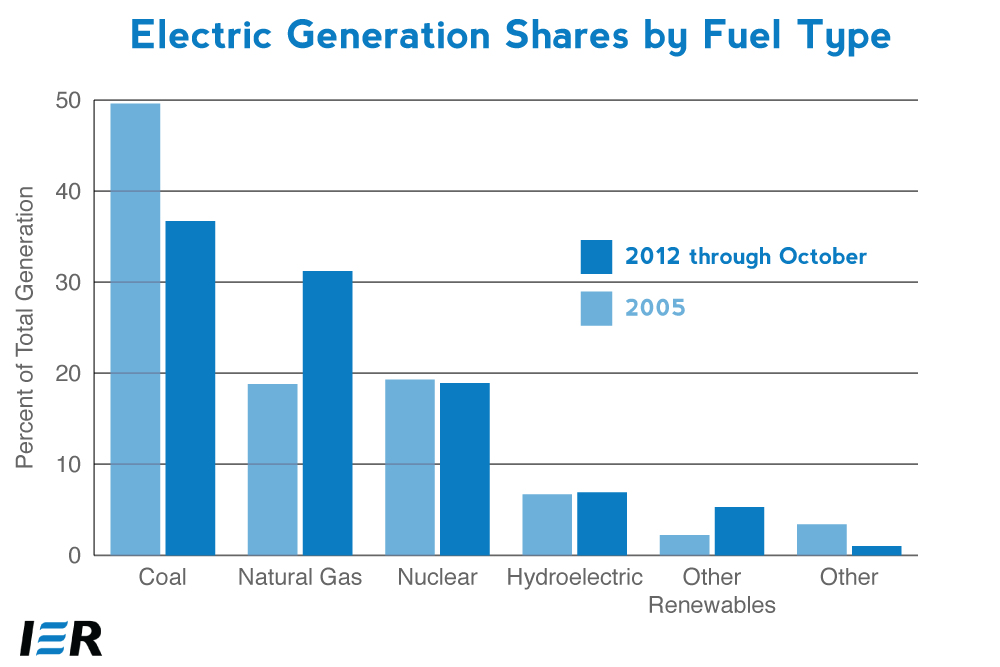
Source: Energy Information Administration, Monthly Energy Review, http://www.eia.gov/totalenergy/data/monthly/pdf/sec7_5.pdf
Coal is almost exclusively dedicated as a fuel for electricity generation while natural gas has numerous uses in the United States. As a result, over the last few weeks, New England saw electricity prices skyrocket, increasing four to eight times higher than normal, as the region’s reliance on natural gas for electricity and demand for heating fuel collided due to extremely cold temperatures. Many coal-fired plants in the region have been shuttered or mothballed and cannot be put into service quickly enough to meet spikes in demand. The huge increase in the demand for natural gas increased its price dramatically.
In 2012, natural gas provided 52 percent of New England’s electricity, and that share is expected to grow due to low natural gas costs (when supplies are not stretched due to insufficient pipeline capacity), the inability to build new coal-fired power plants over the last 10 years because of the northeast’s Regional Greenhouse Gas Initiative, and new federal regulations which make running coal-fired units more expensive. As a result, many coal-fired power plants have been shuttered. Lower natural gas fuel costs are also spurring the retirement of nuclear reactors in several parts of the country, including New England.
In a 2010 study, the American Public Power Association warned that natural gas demand is outpacing the delivery capacity of the gas infrastructure. Nearly half of the current delivery capacity was built after the previous peak natural gas demand of 22 trillion cubic feet achieved in 1972. Estimates of new pipeline capacity required range from $106 billion to $163 billion. Further, if all coal-fired generating capacity were to be replaced by natural gas capacity, the cost would be $348 billion.[i]
New England’s Reliance on Natural Gas
Due to New England’s large dependence on natural gas for electricity generation and gas’ constrained deliverability, during a cold spell last November, electricity prices rose to $103.20 per megawatt-hour (normally, $30 to $50 per megawatt-hour) and natural gas prices rose to $12.37 per MMBtu (normally, less than $4 per million Btu). Then, on January 24, when temperatures dropped 15 to 20 degrees below average, natural gas prices rose to $31.20 per MMBtu at Algoquin Citygate, an area near Boston where natural gas is traded, resulting in a megawatt-hour price of more than $200.[ii] According to the independent system operator of New England’s electricity market, early in February, a megawatt-hour cost about $150, while a year ago, it was $30—a five-fold increase.[iii] Luckily, New England has been able to import electricity from Indian Point, a nuclear plant on the Hudson River in New York. However, the State of New York is interested in closing the plant.[iv]
It is clear that gas pipeline capacity in New England is inadequate to keep prices steady in times of high home heating demand. Further, it seems that the natural gas market and the electric market mesh poorly because the natural gas generators have not been able to start up when needed in early morning hours. For example, during a storm early in February that knocked out transmission lines, the independent system operator asked some natural gas-fired generators to start-up, but found that they could not obtain the natural gas during the overnight hours.
Although about 30 percent of the generators in New England burn coal and oil, those generators produce less than 1 percent of the electricity because they are seldom run, requiring startup periods of 24 hours to be brought on line. And, a number of coal- and oil-fired plants have shut-down in New England in the last few years, including:
- AES Thames, a 214-megawatt, coal-fired unit near Uncasville, Connecticut, closed in 2011;
- Somerset Station, a 174-megawatt, coal-fired plant in Somerset, Massachusetts, closed in 2010;
- The Salem Harbor plant in Salem, Massachusetts with four coal and oil units and a capacity of 745 megawatts, closed 2 units and will probably close the other two next year, where the company is building a 630-megawatt natural gas-fired plant to replace it.
Natural Gas Impacting Nuclear Units
Fixed costs for nuclear plants run about $90,000 per megawatt compared to about $15,000 per megawatt for new natural gas plants and about $30,000 per megawatt for coal plants. Nuclear plants have high costs due to security and other safeguards, and because they handle radioactive material and operate at high temperatures, their equipment costs are higher than those for other kinds of generating plants. In many areas of the United States, nuclear and coal-fired power plants compete directly with natural-gas fired plants where deregulated markets exist. About 40 percent of nuclear reactors sell power in deregulated markets. Small nuclear plants are less able to compete against low-cost natural gas plants than bigger nuclear units because they make less electricity than the bigger nuclear plants make and thus have less output over which to spread their fixed costs.
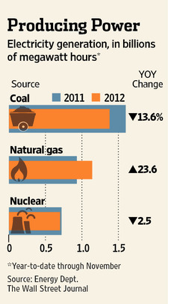
Nuclear generation is already showing some signs of weakness with a 2.5 percent decline in output in the first 11 months of 2012 compared with a year earlier. In comparison, generation from natural gas plants increased 24 percent.
Nuclear plants considered vulnerable include:
- Exelon Corporation’s 25-year-old Clinton plant in Illinois and its 43-year-old Ginna plant in New York
- Entergy Corporation’s 40-year-old Vermont Yankee plant in Vermont and 38-year-old FitzPatrick plant in New York.
- Edison International’ San Onofre plant in Southern California, which is idled
- Duke Energy Corporation’s Crystal River plant in Florida, which is idled
- Dominion Energy Resources Inc.’s Kewaunee nuclear plant in Wisconsin which will be retired in mid 2013 even though it still has 20 years left on its operating license
- Exelon Corporation’s Oyster Creek plant in New Jersey, which is planned to be shut down in 2019, 10 years before its license expires.
With the switch from coal-fired electricity to natural gas-fired electricity, the electric power industry has been able to reduce its carbon dioxide emissions since natural gas generation emits about half the emissions that coal generation emits. Since nuclear plants are the largest source of carbon-free electricity, closing them will make it harder for the electric power industry to continue to reduce its greenhouse gas emissions.
Conclusion
The six states that comprise New England are experiencing vulnerability due to their overreliance on natural gas with electricity prices 4 to 8 times higher when extreme cold or storms hit the region than under normal conditions. That vulnerability is heightened by a shortage of natural gas pipeline capacity that was identified in 2010. Other parts of the country, such as the Midwest, could face similar problems in the future. While increasing the natural gas pipeline infrastructure would help alleviate the problem, diversity of electric generating supply would also help. But, low natural gas prices and excessive regulations are causing the closure of coal-fired and nuclear power plants across the country. If these plants are closed and replaced with natural gas, the price of electricity will depend increasingly upon hydraulic fracturing, which is under attack from opponents of fossil fuels and under threat of increased regulation by the Obama Administration, despite strict regulation of its practices by those familiar with its application at the state level.
As Jay Apt, executive director of the Electricity Industry Center at the Carnegie Mellon University has stated, “It is certainly true that a region like New England that relies on a single fuel source like natural gas for the bulk of its power does leave itself open for more disruptions than a region with a more diverse fuel mix. It’s not a knock against natural gas; it’s a knock against a single fuel source.”
[i] American Public Power Association, Implications of Greater Natural Gas Reliance for Electricity Generation, July 2012, http://www.publicpower.org/files/PDFs/ImplicationsOfGreaterRelianceOnNGforElectricityGeneration.pdf
[ii] Constellation, Northeast Gas Market Experiences Price Spikes Due to Pipeline Constraints, January 25, 2013, http://blogs.constellation.com/energy4business/2013/01/25/northeast-gas-market-experiences-price-spikes-due-to-pipeline-constraints/
[iii] New York Times, In New England, A Natural Gas Trap, February 15, 2013, http://www.nytimes.com/2013/02/16/business/electricity-costs-up-in-gas-dependent-new-england.html?_r=3&
[iv] New York Times, Indian Point Nuclear Power Plant, October 12, 2012, http://topics.nytimes.com/top/reference/timestopics/subjects/i/indian_point_nuclear_power_plant_ny/index.html?inline=nyt-classifier
-
“Survivor” Engagement News: Country Singer To Wed
“Survivor” contestant and country singer Whitney Duncan is all set to marry Keith Tollefson, whom she met on the show.
Duncan was actually married when she appeared on the show, to KingBilly singer Donny Fallgatter; however, the two had allegedly kept their vows a secret, and when she met Tollefson and fell for him, it was the beginning of the end for her prior relationship. Their divorce was finalized at the end of 2011, freeing her up to marry Tollefson. The singer shared a picture of her engagement ring on Twitter recently and received well-wishes from fans and friends alike; she also spoke a bit about her relationship with Fallgatter.
Me & @keithtollefson are Engaged!!! instagr.am/p/VuV-bJCKbg/
— Whitney Duncan (@whitneyduncan) February 14, 2013
Thanks for all the nice messages today! I’m excited that I get to marry the love of my life! @keithtollefson countrymusicislove.com/2013/02/whitne…
— Whitney Duncan (@whitneyduncan) February 14, 2013
Thank u!! With the right one, yes;)RT @cindychalvo: congratulations to you and Keith! So excited for you two!! Marriage is bliss

— Whitney Duncan (@whitneyduncan) February 19, 2013
Hey kids, don’t ever elope w someone u hardly know. Not a good idea! U might meet your soulmate. & No one ever lets the past be the past.
— Whitney Duncan (@whitneyduncan) February 22, 2013
Duncan also acknowledged on Twitter the news that her cousin, Holly Bobo, has still not been found after reportedly being abducted by a man wearing camo; a witness said he saw her being led into the woods from her home in April of 2011 and the case is still open. Holly disappeared from Decatur County, Tennessee; a reward is being offered for her safe return. She is five foot, three inches tall and weighs 110 pounds, with blue eyes and shoulder-length blonde hair. She was last seen wearing a pink shirt, blue jeans and black flip flops.
I appreciate the Engagement articles, but how about talking about my missing cousin #HollyBobo instead of a stupid mistake in my past?
— Whitney Duncan (@whitneyduncan) February 22, 2013
Lead image: Wikimedia commons
Image: Twitter/Instagram

-
Pale Moon 19 is first major update since version 15

Moonchild Productions has launched Pale Moon 19.0 and Pale Moon x64 19.0 for Windows. Pale Moon is a customised build of popular web browser Firefox, with the developer making no attempt to keep pace with Mozilla’s six-weekly development cycle in favour of applying security updates and concentrating on delivering improved performance.
This release marks the first major update since Pale Moon 15.0 — based on Firefox 15 — was released last August, but while Pale Moon 19 utilizes the brand new Gecko 19 engine found in the latest version of Firefox, don’t expect to see all the functionality in Firefox 19 making an appearance here.
With the underlying Gecko update, Pale Moon 19.0’s HTML5 implementation is more complete than the previous build. Javascript performance has also been improved thanks to the shift to the IonMonkey engine, which first appeared in Firefox 18. Also improved in Gecko 19 are the layout and rendering engines, but one side-effect is that users may have to update both add-ons and themes to retain compatibility with Pale Moon 19.
While the overall layout of the browser hasn’t changed, there are subtle changes to the main browser controls and padlock icon.
Moonchild has – in accordance with its desire to produce a faster browser than Firefox – also applied specific tweaks to the rendering engine to improve performance, which it claims is noticeable both in general user and via certain unspecified benchmarks. These changes should help prevent browser stalls or high CPU usage on certain web pages.
Pale Moon 19.0 also abandons PGO (Profile Guided Optimization) in favour of global speed optimizations, which should give better smoothness regardless of which PC is using the browser.
As this is a custom build, don’t expect all of the functionality of Firefox 19 in this release. There are fewer developer tools, for example, while Moonchild has publicly stated the social API introduced in Firefox 17 won’t be appearing in Pale Moon.
The inline PDF viewer is also apparently missing in this release, but that’s because it’s been switched off by default. Switch it on by typing about:config into the browser Address bar, then search for pdfjs — verify that pdfjs.firstRun is set to true, then double-click pdfjs.disabled so it’s set to false. Once done, you’ll be prompted each time you click on a PDF whether or not you want to preview it in Pale Moon. To make it the default choice, open Pale Moon >Options > Applications tab and change the Portable Document Format (PDF) entry to Preview in Pale Moon. Job done.
Pale Moon 19.0 and Pale Moon x64 19.0 are both available as freeware downloads for PCs running Windows XP SP3 or later, as are portable builds Pale Moon 19.0 Portable and Pale Moon x64 19.0 Portable.
Photo Credit: Michal Ninger/Shutterstock
-
The end of unlimited BBM could erode BlackBerry’s standing in emerging markets

-
Scroogled Petition Has 79K Signatures, Many Seem To Be Signing The Wrong Thing
Microsoft keeps on keeping on with this Scroogled thing. We’ve been alerted that there’s now an infographic to go along with it.
The company says its Scroogled petition has reached 78,000 signatures (It’s actually at over 79K). It’s unclear how many of those signatures are actually related to the “issue” at hand. I don’t have time to browse through that many signatures, but it didn’t take long to find quite a few that seem to be completely off topic.
The last time I checked, this campaign was about Gmail’s ads and privacy. Many of those who have lent their signatures seem to think it has something to do with animals – specifically elephants. Here are a few of the signatures that had comments that we found in a brief scan:
I care we shall care, long live the ancient beatiful smart Elephants and wild life.
A truly abhorrent and despicable act by an evil, person not fit to breath the same air as this beautiful animal who was treated in this way. My heart goes out to those who shared their lives with whiskey. Animals were given the gift if life by god and as such have just as much right to life. My prayers are with you , rest in peace Whiskey xx
We are animal lovers and issues of this kind should happen and the law should change their ancient rules and make these people liable for their actions
Animals are spirits, just as you and I. We are animals as well but what makes us beast are acts like this, independent of justice or not. Justice being granted or not depicts as if you are a beast or not. As a spirit of life, respect one another and serve justice for the life taken.
This is disgraceful. All animals have as much right to live safely as humans. Stop this now.
I beg you! listen to me and to many people, which is against killing animals! We are all plačim for them and pray that this was not!
Please help to the elephant, its terrible her situacion…
Please, treat this elephan with dignitiy, take it to a sanctuary to a worth living place. Thank you.
Some also appear to think it’s about something even completely different than that. Here’s another one:
IF THERE IS SUCH A THING AS JUSTICE! FREE HIM…
Oh yeah, here’s that infographic:

Note that they actually went so far as to illustrate “the creepy line”.
They’ve also rehashed that Eric Schmidt quote that we debunked here again with a new shortened video focusing on that specifically:

