Category: News

  • Murdoch: We May Block Google

    Rupert Murdoch, founder and head honcho of News Corp., the largest media company in the world, wants to block access to his content and set up pay walls around it. News Corp. already does it at The Wall Street Journal.

    “The people who simply just pick up everything and run with it — steal our stories, we say they steal our stories — they just take them,” Murdoch says in an interview with David Speers of Sky News Australia, which is one-third owned by News Corp. “That’s Google, that’s Microsoft, that’s Ask.com, a whole lot of people…They shouldn’t have had it free all the time, and I think we’ve been asleep.”

    The move is aimed at Google, as outlined in this conversation:

  • Tagged.com Reaches Settlement With NY AG

    New York Attorney General Andrew Cuomo said Monday that his office has stopped social networking site Tagged.com from misappropriating the contacts lists and identities of its members and from sending out millions of deceptive and unsolicited emails.

    Through an agreement with Cuomo’s office, Tagged will pay $500,000 in penalties to the state and take measures regarding the access and use of its members’ personal information.

    "Unsuspecting users had no idea that Tagged had hijacked the email addresses of their colleagues, families and friends for the purpose of blasting them with spam," said Attorney General Cuomo.

    Andrew Cuomo
    Andrew Cuomo

    "This agreement holds the company accountable for its invasion of privacy and puts the proper safeguards in place to keep it from happening again."

    In June, Cuomo announced his intent to sue Tagged for deceptive acts after his office became aware that the company had sent more than 60 million misleading emails to people stating that Tagged members had posted private photos online for their friends to view.

    In reality, the photos did not exist and the email was not from their friends. When people tried to access the photos, they were required to become a new member of Tagged. The company would then gain access to their email contacts and send more fake invitations.

    As part of the settlement, Tagged will now provide clear disclosures when asking for access to a new user’s email contacts and will no longer access those contacts or send messages without the member’s permission.
     

    Related Articles:

    >Tagged.com Sued By NY AG

    >NY AG Hits Intel With Antitrust Suit

    >Dell Settles New York Fraud Case For $4 Million


  • RIM’s new loves: OpenGL ES, Java GUI Builder, Advertising and Push Services

    rim-logo1

    We’ve already talked about some of the news from the first day of the 2009 BlackBerry Developers Conference, but another blast of PR from RIM has hit out inboxes, and wow, are we ever excited. The biggest news of the day is that developers will finally be able to unlock the full potential of the latest generation of BlackBerry smartphones — OS 5.0 and hardware permitting, of course — with the latest beta of the Java SDK 5.0 thanks in part to its OpenGL ES support. Still, there’s a lot of things to cover and we don’t want to clutter up our newly redesigned site with a bunch of text, so join us after the jump.

    Previewed today but not expected to be available until the middle of 2010, the BlackBerry Java Plug-in for Eclipse will be updated with a new drag and drop WYSIWYG interface which will greatly reduce the amount of time it takes for a developer to put together all of the graphical elements in an app. More importantly, as BG is screaming up and down with excitement, this should allow BlackBerry applications to utilize a more streamlined and consistent user interface instead of, well, utter crap. More information about the new BlackBerry Theme Studio which replaces the Plazmic Content Developer’s Kit has also come out. Comprised of the Theme Builder and Composer, Theme Studio works for all devices running OS 4.2.2 and up and can not only directly import images from Adobe Photoshop but create a new generation of themes that are capable of zooming, sliding, wiping and fading while devices with OS 5.0 and up will have support for ringtones and screen transitions (oooooh, aaaaah). And now on to some slightly drier content (as far as consumers interests go.)

    One of the things RIM has focused very hard on since the launch of App World has been helping to create an environment in which developers can generate more revenue and heighten the app-friendliness of the OS. With this in mind, RIM has announced its very own advertising service, BlackBerry Advertising Service, which amongst other things will “include the ability to easily initiate a call from an ad, add a calendar entry or contact entry from an ad, and directly link to an application in BlackBerry App World from an ad” while providing deep analytics. Speaking of monetization, BlackBerry Payment, available in mid-2010, will open the flood gates to activities such as premium content, subscriptions and in-app purchases. GPS has been a strong point of any BlackBerry, but now developers will have the means to do crazy new-fangled things like use cell site geolocation, reverse geocode and figure out how many minutes it will take to arrive at ones destination. Mindblowing? Definitely not. Abso-positively-necessary for RIM to do? Yes.

    Read

  • Further collaboration with Adobe and BlackBerry Academic Program announced at Dev Con

    bb-devcon09

    With the 2009 BlackBerry Developer Conference kicking off today in San Francisco, RIM has doled out two press releases to get the ball rolling. As many of you may recall, it was back in August that we first broke the news that RIM was going to implement support for Adobe Flash in its browser for 2010. Two months later, this and more was confirmed by Adobe. Now RIM has come forward and announced a furthering of their partnership. Developers will be able to take advantage of Flash and Creative Suite 5 by directly exporting elements created within into various BlackBerry development tools. The goal of this is to quickly and efficiently create applications and widgets that are more multimedia rich and offer a far greater user experience than is currently possible. The same family of Adobe products will also be able to work in tandem with the new BlackBerry Theme Studio. Another thing announced today was the BlackBerry Academic Program. Having already been piloted by some 500 students over the past year, the Academic Program gives colleges and universities the knowledge, tools and curriculum it needs to offer students BlackBerry-specific courses in development, administration and support, a field which has been and still is experiencing tremendous growth. More details for both Adobe’s further collaboration with RIM and the BlackBerry Academic Program are available in the read links after the jump.

    Read – Adobe Collaboration Deepens

    Read – BlackBerry Academic Program

  • Last minute reminder: CrunchGear meetup in Columbus

    57057-1bk77v577u
    Don’t forget: John and I will be at the Surly Girl Saloon tonight around 6:30 PM. Look at the happy smiles on those faces! That could be you, this time! Feel free to tell us about the cool world-changing projects on which you’re working. We love to meet people working on amazing stuff.


  • Exchange Server 2010 goes live, will extend rights-managed e-mail to browsers

    By Scott M. Fulton, III, Betanews

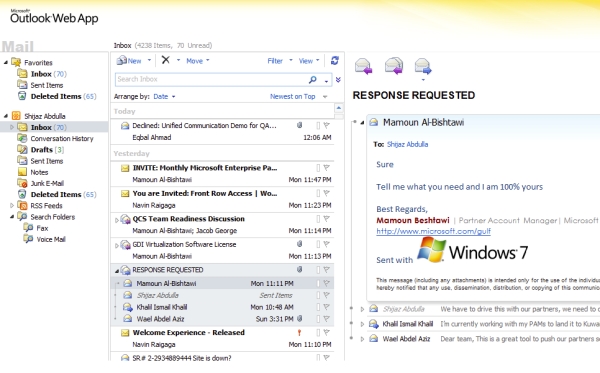
    Microsoft Exchange top story badgeOne of the more important features of Microsoft Exchange Server 2010 (or Exchange 2010, depending upon whom you’re talking to), officially launched for sale this morning during a TechEd conference in Berlin, is a system for mail administrators to implement policy-driven rights management that’s ensured not just for Outlook 2010 (Office) users, but also users of the Outlook Web App running through Web browsers, including Mozilla Firefox and Apple Safari.

    These rights management features, called Transport Protection Rules, will enable admins to generate extensive rules that restrict, where necessary, an e-mail recipient’s ability to make alternate uses of the content of e-mail, including simply copying and pasting its text elsewhere, if messages are deemed confidential. Corporate Vice President Stephen Elop and Exchange product manager Julie White demonstrated TPR to a TechEd crowd that appeared, at least from the live feed from Berlin, to be less-than-capacity, though which Microsoft described as a sellout crowd of 7,000.

    During this morning’s demo, White showed how OWA typically enables the e-mail client to prohibit unrestricted use of an e-mail’s content if the sender explicitly flags the mail as confidential. Transport Protection Rules, by contrast, enables the creation of a policy restriction template that may be applied whenever any content sent from a specified account meets the criteria. That criteria includes the inclusion of phrases within the content of the mail itself — White’s demo involved the phrase launch plans.

    Outlook Web App for Microsoft Exchange Server 2010

    A TPR can be designed, the demo showed, where a rule can search outgoing content for the specific phrase, and if that phrase is located, Exchange can apply the confidentiality rule that the original sender may have neglected to apply. The message becomes confidential because content is always being evaluated by Exchange. The restrictions, including inability to copy and paste text or to forward the message to other recipients, may be enforced on non-Microsoft browsers including Firefox.

    In fact, TechEd attendees this morning saw more of Firefox than Internet Explorer; and when Elop pointed this out, attendees offered the biggest round of applause of the day.

    “Integrated information rights management is now natively supported within Outlook Web App,” said White, “so that now users can create protected messages without needing an additional plug-in, or taking any extra steps. And that means fewer support desk calls for you [the admins].”

    TPR was perhaps one of the few Exchange features that was actually new to at least some of the admins in the audience today, as Microsoft execs would later acknowledge that the ES 2010 beta program was perhaps the largest in the company’s history — even larger than for Windows. The reason, stated Corporate Vice President Chris Capossela during a staged Q&A following the TechEd keynote, was that a multitude of colleges worldwide adopted Exchange during the beta program, and signed their students up. Over 10 million students worldwide effectively became users of Exchange Server, and many of those effectively of the new Outlook Web App.

    So some of the other features execs showed off today ended up being old news to many, including how Exchange and OWA implement conversation view — the ability to automatically categorize e-mails as threaded conversations based on their subject lines — and the “Ignore Conversation” feature, which lets the client skip future messages belonging to unwanted conversations. At one point, Elop prodded the audience for a response. “Some applause, something, anything?” he asked. “A little love, please?”

    Today’s Exchange rollout comes on the same day as Cisco announced its own Unified Communications System 8.0 platform update, which integrates a new collaboration toolkit and a hosted e-mail option, putting Cisco in direct competition with Microsoft Exchange and Lotus Notes.

    This morning, Capossela dismissed Cisco’s move by painting it as something less than unified, pushing Exchange as a product that has grown organically over the years “rather than stitching together acquired products and calling that the solution,” referring to Cisco’s propensity for acquisition. Cisco’s platform does include the secured instant messaging tool it now calls Unified Presence 8.0, but which came to prominence as Jabber prior to a Cisco acquisition in September 2008.

    Copyright Betanews, Inc. 2009


    Add to digg
    Add to Google
    Add to Slashdot
    Add to Twitter
    Add to del.icio.us
    Add to Facebook
    Add to Technorati


  • Skype Names SIP Guru as Chief Tech Strategist

    Skype has hired well-known VoIP expert Jonathan Rosenberg as its chief technology strategist, the company announced today. Rosenberg was highlighted as one of the Cisco executives Index Ventures’ Michael Volpi would bring over to Skype in order to help the company figure out a way around the JoltId stranglehold. As you might know, Skype and Joltid, the company that owns the technology used by Skype (and controlled by founders Niklas Zennstrom and Janus Friis), settled with the company last week.

    Rosenberg is well-regarded in SIP circles and his hiring means that Skype is making a stronger push into the enterprise. Rosenberg was a Cisco Fellow at Cisco Systems, where he directed technology strategy for its enterprise voice product portfolio. When I last spoke to Skype CEO Josh Silverman, he was pretty clear about his desire to turn Skype into a major enterprise voice and collaboration player. Rosenberg’s hiring is a smart step by Skype. (Related post: How Skype Plans to Dominate Business Telephony.)


  • MojaMix, a web service that lets you make your own cereal and granola

    moja 2_jpg
    Back in the olden days, long before the advent of electric light, our forefathers dreamt of a better place. They dreamt of running hot and cold water in their wash rooms, wireless telegraphy, and the rise of the horseless carriage. They dreamt of threshing machines that could tie down an acre of millet an hour and helioplanes that could transport humans from one place to another in comfort and style. But what was the dream that drove our forefathers to strive for better things, always? What dream sustained them through a Depression and two World Wars? What was the silent prayer they mumbled nightly to the heavens from their pinched and chapped lips? Friends, they dreamt of a website that lets you mix your own trail mix and cereal. And that dream is now a reality.

    Mojamix is an online granola manufacturing system. You select your base, then add dried fruit, seeds, and nuts. They package up your foodstuff and send it to your home via first class mail. The average 12-ounce bag costs about $12 and there is the possibility of adding chocolate-covered cashews to the mix. This last part is what clinched it for me.

    The company sent me two handmade concoctions GORP and cereal. It was packed on November 3 and arrived on November 7. The GORP was quite tasty with plenty of fruit yet, sadly, a small smattering of chocolate covered cashews. The cereal was also good with a good flake-to-fruit ratio, ensuring I wasn’t just eating flakes although, to be honest, I’d have preferred to have seen a fewer flakes.

    The company offers some Popular Mixes including the “Happy Camper” and “Runner’s Fuel,” and each of these mixes can be improved through the addition of chocolate covered cashews. You can also add flax seeds, but nothing good will come of that.

    Let it be known: 12 ounces of cereal is not enough for a family of four, especially since there aren’t enough chocolate covered cashews in there to go around. I’d recommend getting two bags at a time, a pricey proposition.

    Is Mojamix for you? I don’t even know what to tell you. If you’re too busy to head down to the health food store and really like goji berries, godspeed. The dried fruit was fresh and the granola was quite tasty so quality wise you’re going to get a better experience then you would back at the local food co-op where the granola is picked over by children and besmirched with hippie cooties.

    That said, Mojamix has decided to be nice to you and offer a contest and a coupon code. First, enter “crunchgear” in the coupon code for 10% off of your order. Second, Mojamix has agreed to give away bags of goodness to 10 random commenters. What’s in your Mojamix (besides chocolate covered cashews)? We’ll close the commenting on Weds and send emails to the winners.


  • DoD authorizes contiguous training for Army Guard

    Mobilizations for most Army National Guard units run for a total of 12 months,
    which includes training and deployment time…

  • Guardsman serves as fourth CSM for Ranger battalion

    CSM William Paul made history Oct. 29 when he became the first National Guard
    Soldier to serve as the 4th Ranger Training Battalion senior NCO…

  • National exercise gets underway at Muscatatuck

    It takes patience to set a car on fire…

  • Santa and Mrs. Claus arrive in Koyuk via C-130

    Santa and Mrs. Claus arrive in Koyuk via C-130 Dashing through the sky in an
    Alaska Air National Guard C-130 Hercules aircraft from the 176th Wing, Santa, Mrs.
    Claus and a team of elves landed in Koyuk on Nov. 3…

  • Wisconsin ground, air commanders meet in Iraq

    While more than 3,200 soldiers of the Wisconsin Army National Guard’s 32nd
    Infantry Brigade Combat Team have their boots on the ground in Iraq, some of their
    fellow Guardsmen from the state’s Air National Guard have their jets in the sky
    overhead…

  • Veterans Day message from Chief, National Guard Bureau

    This Wednesday, the Nation will celebrate Veterans Day. At the 11th hour, on the
    11th day of the 11th month, we’ll join our fellow Americans—neighbors, family,
    friends and employers—in recognition of the men and women who have worn the
    military uniform throughout history, whether in peace or in time of
    war…

  • Air Guard involved in new strategic basing process

    Senior Air Force officials have applied a new basing process to more than 200
    sites for training and operational basing of the F-35 Lightning II joint strike
    fighter aircraft…

  • Microsoft’s COFEE Computer Forensic Tools Leaked

    Last year, we wrote about Microsoft’s COFEE tools, which are a set of computer forensic and auditing tools that Microsoft puts on a USB key and gives to law enforcement to use in trying to extract info from a computer. There was some fear that it was a “back door,” but people insisted it was no such thing, but just a collection of basic tools. Still, the fact that the system was promoted as being useful for decrypting passwords and analyzing a computer’s data and internet activity seemed troubling. We noted that if Microsoft was giving it out to law enforcement, it seemed likely that others would have access to it as well.

    Well, late last week, reports started showing up noting that COFEE itself had been leaked to various file sharing sites. Apparently, the program had been quite sought after at private tracker What.cd — though, after it was leaked there, the admins actually removed the torrent.

    Still, you have to imagine that the software is very much out there. So, the question still remains, is this a big deal or not? When we did our original post, many people insisted that there was no big deal in Microsoft COFEE and it was just basic everyday auditing software. Yet, when even What.cd is removing the torrent, claiming they “didn’t like” what they saw when they examined the software, in terms of “the potential impact on the site and security of our users and staff,” it does raise certain questions that are similar to those we originally raised.

    So, once again, let’s get some feedback from the folks reading here. Is this really a big deal? Or is it just your ordinary tools?

    Permalink | Comments | Email This Story


  • Transcript: Health On The Hill – November 9, 2009

    As House Democratic leaders celebrate passage of health care legislation, Senate Majority Leader Harry Reid, D-Nev., continues to await a Congressional Budget Office analysis as he tries to craft a compromise package between bills passed by the Senate Finance and the Senate Health, Education, Labor and Pensions committees. President Obama has said that he wants a health care bill to his desk by Christmas but it is unclear if that timetable will be met. View the HOTH video or listen to the audio version (mp3).

    Transcript:

    JACKIE JUDD: Good day. I am Jackie Judd with Health on the Hill, a conversation about efforts to pass health care reform legislation. Joining me, Mary Agnes Carey of Kaiser Health News and Eric Pianin, also of Kaiser Health News. Welcome as always to you both. Those efforts moved ahead quite a bit over the weekend as we know. The House passed a Bill to vote margin, $1.1 trillion over ten years. The expectation is 36 million people currently uninsured will have coverage. What are the other big points in that Bill?

    MARY AGNES CAREY: Well, it has a public plan option based on negotiated rates versus tied to Medicare. It also would put an excise tax on high income wage earners here. We are talking about folks who make $500,000 a year as an individual or a couple who makes $1 million. It’s about a 5.4 percent surtax, not expected to be too popular in the Senate. It has an individual mandate, an employer mandate. Most individuals with some exceptions would have to have insurance or face a penalty, and for small employers, $500,000 or lower wouldn’t have to provide –

    JACKIE JUDD: In payroll.

    MARY AGNES CAREY: In payroll, thank you, would not have to provide health insurance but there is a penalty that begins to phase in up to a payroll of $750,000 and then beyond that they would be required to provide insurance or face the penalties. There are some Medicare changes in there. There is a big expansion for Medicaid, taking up to about 150 percent of the poverty level, so it’s quite a comprehensive –

    JACKIE JUDD: Where are the cost controls?

    MARY AGNES CAREY: Well, the cost controls include looking at how Medicare is paid for and trying to make some changes to that. One of these issues is how they pay private plans in Medicare, called the Medicare Advantage Plans. They want to bring those payment rates down to what they pay for beneficiaries in the private fee for service plans. Data now shows that in Medicare Advantage the government pays about 14 percent more per beneficiary. That is one of those it is pointed to. There are also steps taken over time to link payment in Medicare more to the quality of the care provided.

    JACKIE JUDD: Eric, you were on the Hill Saturday before the vote. What happened in terms of the abortion language compromise, which helped the Democrats get over the 218 vote threshold that they needed?

    ERIC PIANIN: That is right. For a long time, the public option seemed to be the hottest issue, most contentious, but in the last couple of days the whole question of whether there would be some restrictions on abortion spending as part of the health care reform package became the preeminent debate, really, and Congressman Bart Stupak from Michigan, a Democrat, representing as many as 40 Democrats, warned that they would oppose the Bill unless there was an extremely strict restriction placed in the legislation, concerning abortion spending.

    What is interesting in the end is that Nancy Pelosi basically went along with their demands and gave them a vote on an amendment that passed that really takes restrictions on federal involvement in abortion programs to new levels. There is absolutely no way any of the subsidies could be spent in the new exchanges or outside of the new exchanges for abortion related services. No program could be offered as part of the exchange to provide abortion services. So, this really enraged a lot of the liberal Democrats who are pro-choice and at first a lot of them threatened to pull out their support.
    In the end, though, Pelosi prevailed and they added a very tough abortion provision and the liberal Democrats in the end decided to go along with it because they felt that passing health care reform was more important than victory on abortion, but I just wanted to make one other –

    JACKIE JUDD: And with the expectation that in conference that language would change.

    ERIC PIANIN: Well that’s the hope, but once it gets over the Senate, there is no telling what form that abortion provision will take. It is also interesting, too, that to me at least it showed that Pelosi was prepared to do almost anything to get that Bill passed in the House. I mean, there is this basic sense that we just have to move the process along. The final Bill is not going to look anything like the House Bill, but still she showed that she was prepared to do almost anything to get a victory that night.

    JACKIE JUDD: And even by doing almost everything, there was only that two vote margin, which shows how hard this is and will continue to be. So, what are the next difficult steps? What are the big questions that the Senate will now have to face and then, presuming they pass something, the conferees?

    MARY AGNES CAREY: Well, first of all, the Senate has to come up with a Bill. Harry Reid, who is the majority leader, has sent several options off to the Congressional Budget Office. He is awaiting their analysis. He has to try to reconcile differences between Bills passed by two different committees and find something that can get 60 votes in the Senate. Differences include the public plan, for example.

    In the House, it is offered to everyone. In the Senate, it would allow states to opt out of the public plan. That is a big difference. Financing is a big difference. We talked earlier about this excise tax on the high wage, the high income earners.

    That in the Senate would be, is not there, and instead they would place a tax on some of the highest cost health insurance plans, which they feel is a great way to get cost at containment, the other issue that we just discussed. The individual mandate is not expected to be as severe or rigorous, rather, as what is in the House Bill, and also there is not expected to be a strong mandate on employers to offer coverage. There is, in the Finance Bill for example, if one of your workers received the subsidy, you would have to help offset the cost of that, but it’s nowhere near as tough as the provisions in the House Bill.

    JACKIE JUDD: So, as hard as it was for Democrats to cross the finish line in the House Saturday night, is the most difficult work still ahead?

    ERIC PIANIN: I think that’s true. And I think there is a lot of concern that the Senate has lost some of its momentum. When the Senate Finance Committee finished up its work, there was a feeling that things would move apace. Since then, Harry Reid, the majority leader, has decided to take the responsibility upon himself and a small number of other leaders to try to cobble together a Bill that would attract 60 votes in the Senate.

    Right now, they are still waiting a week later for the CBO to come back with some estimates of what their latest options, proposals would cost. They don’t even have a Bill yet. And Reid signaled recently, much to the consternation of the White House that he wasn’t going to be held to any deadlines, suggesting that this thing could spill over into next year.

    Rahm Emanuel immediately was dispatched to the Hill the next day to say you know we are really thinking in terms more like Christmas rather than New Years to get something out of the Senate and the President gave a similar message for the Rose Garden on Sunday. Now that the House has acted, it’s time for the Senate to pull up its socks and get moving.

    JACKIE JUDD: And now there is some hope that it actually could happen before Thanksgiving. Likely?

    MARY AGNES CAREY: I don’t think so. I mean if Senate debate began before Thanksgiving, that would be amazing progress and we are not even sure that is going to happen, but this is Congress. Anything can happen at any time.

    JACKIE JUDD: You know, beginning about five or six weeks ago there began to be a sense of inevitability that there would be a Health Care reform Bill passed by both Houses of Congress and signed by the President. Where are we at this moment?

    ERIC PIANIN: I don’t think we are feeling that sense of inevitability right now. I think that it was a big victory for Pelosi and the Democrats to get this thing through the House. It was a great accomplishment. It was a very interesting debate and clearly incredible division between the Republicans and the Democrats. Only one Republican, Cao of Louisiana, finally voted for it.
    But moving to the Senate, these things get more complicated because there aren’t the strict rules that the Democratic leadership imposed in the House to kind of march through it, set time limits for debate, schedule votes. This stuff is like the old saying, it’s like herding cats when you are trying to deal with the Senate, and Harry Reid does not have the same power that Nancy Pelosi does.
    So there is no telling when they can pull together something that is likely to get 60 votes. And now this abortion issue, it’s very problematic, and it is going to play out in the Senate just as it did in the House and in the end it might be very hard for liberal Democrats, who are pro-choice, to go along with any Bill that is so restrictive in terms of abortion.

    JACKIE JUDD: Okay, well thank you both very much, as always, Mary Agnes Carey and Eric Pianin. Thank you for joining us. I’m Jackie Judd.

  • Rupert Murdoch to Block Google = Smart = Twitter has changed it all.

    Rupert Murdoch has said that his Newscorp sites are going to block Google indexes.  Of course, all the netizens freak out when this happens. Which I love.

    I love to tweak all the internet information must be free bigots. They get so damn religious about information on the net that they lose what little objectivity and awareness of the real world they had in the first place.  First a little enlightenment for all of you that think Murdoch is making a mistake. This is not 1999, nor is it 2004, nor is it 2006, nor is it 2008.  The calendar is about to turn to 2010.  What worked and made sense 3,5 and 10 years ago, no longer does.

    What has changed  ? Quite a bit, but lets start with this.  TWITTER IS SURPASSING  GOOGLE as a destination for finding information on breaking and recent news  of all types. Whats more,   TWITTER POSSES NO THREAT to any destination news site. 140 characters does not a story make.  Find it on twitter, link to a story on say, FoxNews and everyone is happy. The same concept applies to Facebook Links. Twitter and Facebook are not news  destinations that can compete with traditional news sources.  Google is.   Rupert loves him some twitter. Google, not so much.

    Not only are Twitter and Facebook becoming strong competitors for referrals to news sources from topical searches, they both have one HUGE HUGE HUGE advantage for news outlets that Google does not:

    TWITTER AND FACEBOOK are platforms that allow the news sources, like newscorp to post breaking news and gain value from their brand. Google does not.  In other words, if I trust a newspaper, tv or any  brand, I can follow it on twitter and expect the news to come to me.  The concept  of “If the news is important, it will find me” works better by the day.  If it matters to me, chances are very good its in one of the twitter feeds I follow.

    Having to search for and find news in search engines is so 2008.

    Twitter and Facebook have become the ultimate real time programming guides.  Look at it like this. “Hear about bubble boy from a follow”. If: “its a news source, go to that news source” If not: “Look it up on twitter (or i use icerocket.com it shows tweeter authority) to see if there are any 1st hand accouts or check my FB wall to see what my friends have to say,  if anything”  “See tweets/posts to determine how I want to get more information:  from  TV ( stream, regular, phone), or from online written or audio source” if online: “go to that source from link in twitter or facebook”

    All of the above complements everything Rupert and Newscorp are doing.   Google is no where to be found in that equation.

    Thats not to say Twitter is perfect. Its not. It has  a HUGE and growing problem with spam (unlike Facebook updates and another reason why I pimp Icerocket.com). Nor am I saying that Google is toast and has no role. Non real time feed users will continue to source news through Google.  I just see that as a declining number in an era where much of our first crack at news is via our phone.  But, perfect or not, the bottom line is that in this new era of twitter, things have changed.

    News sites blocking Google ain’t what it used to be.  Rupert is right. Deal with it.

  • EyeTV on the iPhone: In-Depth

    EyeTViPhone

    Recently, Elgato released EyeTV for the iPhone (AppStore Link). At a cost of $4.99, its marketing blurb offers the following functionality:

    With the EyeTV app, you can watch, record, and enjoy live and recorded TV on your iPhone or iPod touch. At last, you don‘t have to leave all your great TV shows at home; the EyeTV app puts the power of award-winning EyeTV in the palm of your hand.

    The EyeTV app accesses EyeTV running on your Mac at home to deliver these great features to your iPhone:

    • Watch live TV and change channels anywhere (Wi-Fi connection required)
    • Watch your EyeTV recordings
    • Browse the comprehensive Program Guide
    • Start recordings back home on your Mac immediately or schedule them for later
    • View and edit your recording schedules

    How Does it Measure Up?

    Now that we know the promises, how does the functionality work in practise and does it live up to the hype? To set the picture accurately; my set up is a 2.0GHz Core 2 Duo Mac mini with 2GB of RAM and two Elgato Digital USB Tuner sticks. This is hooked up to an Airport Express, which extends my existing wireless connection from another room. Between myself and my wife, we have an iPhone 3G, iPhone 3GS and iPod touch 2nd Gen, so I will be testing EyeTV on all three looking for differences.

    Setting Up and Preparing

    After downloading the EyeTV app from iTunes and installing onto my three iDevices, I had to update EyeTV to version 3.2 on my Mac mini by simply checking for updates. Once updated, switching on iPhone streaming was a simple option in the preferences.

    EyeTV3.2.iP1

    There is also functionality for using Elgato’s servers to allow connecting to your EyeTV device from outside your wireless network called “My EyeTV.” This works in a similar manner to Apple’s “Back To My Mac” functionality of MobileMe and requires UPnP support between your EyeTV host and your router. Because I have an AirPort Express extended network, UPnP didn’t work — but I was able to manually configure a port forwarding rule in my router on port 2170 to make the service work.

    Advanced options allow you to require a passcode to connecting a device and the option to automatically convert recordings into a format suitable for streaming at a later time. While Live TV does not need to be prepared, recorded content does.

    EyeTV3.2.IP2

    You can however, also prepare recordings manually, on a case-by-case basis.

    EyeTV3.2iP3

    After starting the iPhone app and entering my “My EyeTV” details, I get the option of connecting via Wi-Fi (on the bottom) and via “My EyeTV” (on top). When connected to my local wireless, the “My EyeTV” connection did not work (of course you wouldn’t want to do this, but the software doesn’t detect this in any way).

    0EyeTVIpConnect

    Selecting the local Wi-Fi option connects quickly and presents the app’s main menu.

    1EyeTViPMainMenu
    Watching Live TV

    Selecting LiveTV gives a list of channels and what is currently showing.
    2EyeTViPLiveTV

    Clicking on the green icon on the right displays the upcoming programs on that channel.
    3EyeTViPLiveTV

    I can then select the current show to get a summary and an option to “Watch Now.”

    4EyeTViPLiveTV

    This process then takes about 20 seconds of processing and streaming before I get picture and sound, which is smooth and crisp and just as one would expect.

    5EyeTVIpLiveTV

    Tapping on the screen brings up the controls which allow pausing, rewinding 30 seconds (and jumping back to the live stream), a volume control and resizing between widescreen (just like in the iPod app).

    6EyeTVIpLiveTV

    Pressing the ‘gear’ icon displayed in the top right of the channel listing presents a bandwidth/quality settings screen to enable you to tweak the size of the stream. This worked well and allows you to find the right setting for your moment. The lowest setting is about equal to the early days of You Tube while the highest setting is flawless.
    EyeTViPQuality

    Watching Recordings

    Pressing the recordings menu gives you a sub menu to narrow down searching for an existing recording.

    7EyeTvIpRec

    Selecting an option (such as Library) gives a list of individual recordings.
    8EyeTVIpRec

    While there is no way to search directly for a recording, you can sort the list by a number of means.
    EyeTViPSort

    Unlike live TV, when watching a recording you get full track scrubbing navigation, not just ‘back 30 seconds.’
    9EyeTViPRec

    The quality of recordings is not configurable like LiveTV is, it depends on the quality options you selected for ‘preparing recordings’ on your Mac. Cellular quality is very low and like You Tube, but if you’re on wireless (or on a jailbroken phone with 3G Un-Restrictor) you get full quality.
    EyeTViP3.2Quality

    Schedules

    Schedules let you see what upcoming recordings you have scheduled.
    EyeTViPSchedules

    All you can do here is browse and remove an item from the schedule.

    EyeTViPHDontRecord

    Guide

    The Guide gives you access to the full electronic TV guide available in your Mac’s EyeTV software, this is exactly the same as when browsing the guide for Live TV, except instead of an option to “Watch Now,” the button is “Record,” which will add the show to your recording schedule.

    EyeTViPRecord

    The Verdict

    There is no noticeable speed differences with performance between the iPhone 3G, iPod touch 2nd Gen or the iPhone 3GS. The bottleneck here is available bandwidth and the speed of the host computer. Generally, the functionality works as advertised, however there are some limitations to be aware of, and some version 1.0 bugs that need to be squashed.

    • Live streaming does not work on 3G, requires Wi-Fi — thanks AT&T, for affecting my functionality in Australia. However, on a jailbroken phone, I was able to successfully use 3G Unrestrictor to fool EyeTV into thinking it was on Wi-Fi, thus allowing it to work. This worked at a much higher quality than I expected and was also very smooth. Well worth the $2.99 it costs for 3G Unrestrictor.
    • Streaming only supports one device at a time. Connecting with my iPhone and watching a live TV stream, then connecting with my iPod touch works, but when actually selecting a channel to view on the iPod touch, it drops the stream for the iPhone. This is probably fair enough as one stream is pretty CPU intensive as it is.
    • When both recording a show and streaming live TV, I had two instances of the host application crash, requiring a full EyeTV restart to allow connections again.
    • When testing across the Internet while on my work’s wireless, or on 3G, I found my iPhone’s EyeTV app constantly crashing whenever it tried to connect. This seemed to be an issue with the EyeConnect helper software on my Mac mini, which needed to be restarted by turning EyeTV sharing off and on again in my Mac mini.
    • When stopping a live or recorded stream, the CPU usage on the host computer often stays high for 5-10 minutes. It looks like its continuing to stream data out and didn’t get the ’stop’ message from the iPhone. This does seem to eventually time out and really isn’t a big problem unless the CPU usage causes you a problem.
    • It would be a nice option to be able to ‘prepare’ a recording for the iPhone remotely.

    Once Elgato gets a software update out for both ends of the solution (iPhone and OS X) to fix the crash bugs and bring stability to the software, this will be absolutely great. Until then, it’s a bit of hit and miss, it may work fine or it may need someone to be at your computer to restart software before it works, which defeats the purpose. Elgato is working hard on its forums to replicate user’s issues and make this stable, so its a bright future ahead.

  • PM commemorates fall of Berlin Wall

    The Prime Minister has travelled to Berlin to attend events commemorating the 20th anniversary of the fall of the Berlin Wall.

    He was joined by many other heads of state and government, including the President of France, Nicolas Sarkozy, the President of Russia, Dmitry Medvedev, and Hillary Clinton, the United States Secretary of State.

    Over 1,000 giant dominoes, erected along a section of the strip that once divided East and West Germany, were toppled to symbolise the fall of communist powers across Eastern Europe in 1989.

    Gordon Brown, who was accompanied by his wife Sarah, paid tribute to the spirit of the ordinary people whose actions brought down the wall.

    “This wall was torn down not by leaders, not from on high, not by military might; this wall was torn down by the greatest force of all, the unbreakable spirit of the men and women of Berlin.”

    Speeches and Transcripts: Speech commemorating fall of Berlin Wall