Category: News

  • A look at TED, from 1984 through the present

    JR-in-TED-lettersThe first TED was held in 1984, the year George Orwell imagined in his classic novel. The second was held in 1990. In 2006, TED Talks were offered online for the first time, free to anyone across the world who wanted to watch. In 2009, TED moved to its current home in Long Beach, California.

    As we prepare for TED2013 — the anticipation of this year’s crop of bold, inspiring talks tingling through our minds — it also feels like a great time to look back. Here, a stroll down TED memory lane with 16 classic talks, starting at the very beginning. Watch these talks to get in the spirit for TED2013: The Young. The Wise. The Undiscovered. — which kicks off Monday, February 25. We’ll be covering every moment of the conference here on the TED Blog, with posts on each speaker, plus photos, galleries and more.

    But before the new, the nostalgia …

    Nicholas Negroponte, in 1984, makes 5 predictionsNicholas Negroponte, in 1984, makes 5 predictions
    Nicholas Negroponte, in 1984, makes 5 predictions
    Nicholas Negroponte, the founder of MIT Media Lab, must have consulted a crystal ball when writing his talk for our very first TED conference in1984. Here, he predicts what’s next in tech with startling accuracy: CD-ROMs, web interfaces, service kiosks, the touchscreen interface of the iPhone and his own One Laptop per Child project.
    Frank Gehry as a young rebelFrank Gehry as a young rebel
    Frank Gehry as a young rebel
    Architect Frank Gehry is now a legend. But at TED2, in 1990, his work was just becoming known in the mainstream, two years after his first retrospective exhibit at New York’s Whitney Museum. In this talk, he walks us through his early work — from the American Center in Paris to his own house in Venice Beach.
    Danny Hillis: Back to the future (of 1994)Danny Hillis: Back to the future (of 1994)
    Danny Hillis: Back to the future
    Technology seems to be advancing at an increasingly rapid clip. In this talk, given at TED6 in 1994, Danny Hillis shares an intriguing theory as to why this appears to be the case — it may have something to do with evolution itself. Note: the pad and paper, as this was pre-PowerPoint.
    Paul MacCready on nature vs. humansPaul MacCready on nature vs. humans
    Paul MacCready on nature vs. humans
    At TED8, in 1998, Paul MacCready describes our world as one where humans have dominated nature. And so, he says, we have a responsibility to protect it for the next generation. In an early call for us to respect our planet, MacCready shares his contributions: the electric car, solar planes and efficient gliders.
    Eva Zeisel on the playful search for beautyEva Zeisel on the playful search for beauty
    Eva Zeisel on the playful search for beauty
    Ceramics designer Eva Zeisel has been working since 1926. At TED11, in 2001, she shared how a sense of play and a love of beauty has kept her work fresh for decades.
    Kary Mullis celebrates the experimentKary Mullis celebrates the experiment
    Kary Mullis celebrates the experiment
    The experiment is a beautiful thing, says biochemist Kary Mullis in this talk from TED2002. Here, he marvels at the fact that the experiment is only 350 years old and shares stories — some very old, some his own — about the wonder of scientific inquiry.
    Steven Johnson on the Web as a citySteven Johnson on the Web as a city
    Steven Johnson on the Web as a city
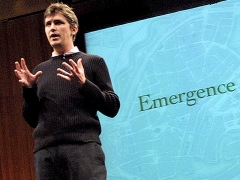
    At TED2003, Steven Johnson gives us a captivating analogy for understanding the internet. In this talk, he shows how both are built by many, yet controlled by no one, and that both are intricately interconnected while being an accumulation of independent parts. And notice that he’s the first person on this list to stand up?
    Sheila Patek clocks the fastest animalsSheila Patek clocks the fastest animals
    Sheila Patek clocks the fastest animals
    Who knew that mantis shrimp were so fast? At TED2004, biologist Sheila Patek shared her work studying incredibly fast animal movements and how her research on mantis-shrimp feeding requires a camera that records at 20,000 frames per second.
    Kevin Kelly: How technology evolvesKevin Kelly: How technology evolves
    Kevin Kelly: How technology evolves
    Kevin Kelly is the founding executive editor of Wired and the former publisher/editor of the Whole Earth Review. In this talk from TED2005, he asks an unusual question: What does technology want? Because its movement toward complexity reminds him of evolution.
    Tony Robbins: Why we do what we doTony Robbins: Why we do what we do
    Tony Robbins: Why we do what we do
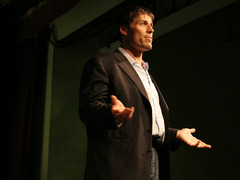
    For TED2006, Tony Robbins whittled down his 50-hour workshop to its essence — looking at the why behind the things we do. This talk is one of the first six posted on TED.com along with talks from Al Gore, David Pogue, Majora Carter, Ken Robinson and Hans Rosling.
    Ngozi Okonjo-Iweala: Want to help Africa? Do business hereNgozi Okonjo-Iweala: Want to help Africa? Do business here
    Ngozi Okonjo-Iweala: Want to help Africa? Do business here
    The first woman to hold the post of Finance Minister of Nigeria, Ngozi Okonjo-Iweala worries that people are only familiar with the Africa of malaria, HIV, deep poverty, government corruption and ethnic conflicts. In this talk from TED2007, she introduces us to the Africa that is changing and quickly becoming a place of opportunity.
    Jill Bolte Taylor's stroke of insightJill Bolte Taylor's stroke of insight
    Jill Bolte Taylor’s stroke of insight
    At TED2008, Jill Bolte Taylor brought the house down with this talk, the second most-viewed on TED.com. In this talk, Bolte Taylor shares the terrifying morning when she had a stroke, and was helpless as her brain function shut down. It’s an amazing story — one that will never let you take the human brain for granted again.
    Bill Gates: Mosquitos, malaria and educationBill Gates: Mosquitos, malaria and education
    Bill Gates: Mosquitos, malaria and education
    Bill Gates made TED2009 into instant news when he opened a jar of mosquitos in the theater. His point: that there are certain problems that do not get the attention they deserve because there is no market incentive to solve then. A passionate and funny talk that connects the dots between seemingly far-flung factors.
    Jane McGonigal: Gaming can make a better worldJane McGonigal: Gaming can make a better world
    Jane McGonigal: Gaming can make a better world
    Video game designer Jane McGonigal viscerally disagrees that video games are a distraction from solving the problems of the world. At TED2010, she outlines a bold plan  to tackle some of these problems through games with a social purpose.
    JR's TED Prize wish: Use art to turn the world inside outJR's TED Prize wish: Use art to turn the world inside out
    JR’s TED Prize wish: Use art to turn the world inside out
    Artist JR’s oversized posters have created dialogues in cities across the world, bringing attention to the faces of people who are too often forgotten. In this talk from TED2011, JR shares his wish — for people everywhere to join him in a global art project.
    Bryan Stevenson: We need to talk about an injusticeBryan Stevenson: We need to talk about an injustice
    Bryan Stevenson: We need to talk about an injustice
    The United States has the highest incarceration rate in the world. At TED2012, Bryan Stevenson looks at how this distorts sharply around race and socioeconomics, creating a sense of despair in minority communities. It’s a personal and moving talk — one that set TED2012 on fire.

    Stay tuned to the TED Blog for full coverage of TED2013 »

  • After Targeting Apple, Samsung Gunning for BlackBerry

    The mobile world saw no bigger story in 2012 than Samsung. After attempting to woo customers away from the iPhone with the first two iterations of its Galaxy S line, it finally succeeded with the Galaxy S III. The flagship device, combined with high-end offerings such as the Galaxy Note II in addition to myriad mid-tier and low-end offerings, provided a huge boost for Samsung. Their shipments of smart devices grew by nearly 120 percent in 2012, far outstripping Apple’s 44.3 percent growth.

    (As the All Things D article notes, Samsung’s numbers reflect shipments, while Apple’s reflect sales. That makes them a poor comparison on most levels, but growth rate should be on a similar scale.)

    Apple is anything but a vanquished foe, but Samsung needn’t chip away at its largest rival at this moment. It will have plenty of opportunities to do so when it reveals the Samsung Galaxy S IV, which is just around the corner. According to one rumor, Apple would have been ready to fight back with a large-scale smartphone of its own in June, but that project has been pushed back until 2014. The prevailing rumors have the next Apple device release in the fall, giving Samsung plenty of free shots at Apple in the interim.

    SamsungGalaxy

    With the Galaxy S IV marketing itself at this point, Samsung can turn its focus to other rivals. Yet it’s not HTC that Samsung targets. No, there is little chance that even the HTC One will make a dent in Samsung’s dominance. Instead the world’s largest smartphone manufacturer will turn its sights to a completely different market: enterprise. And that means putting its sights on BlackBerry.

    Late last month we saw the BlackBerry 10 announcement. In a vacuum it looks like a quality handset, with many modern features. In a market full of similar devices, it’s difficult to see how RIM will stand out. Had they released something like this two years ago perhaps they could have retained many of their enterprise customers that have since left for iPhone, and to a lesser degree, Android. It’s difficult to imagine these departments switching back; Android and iOS are perfectly workable mobile solutions.

    Even still, Android has had its security issues in the past. They’re trying to work on that, though, and in the process are horning in on BlackBerry’s bread and butter. Will Connors of The Wall Street Journal has a full report on the matter, including Samsung’s new SAFE program — Samsung For Enterprise. It includes software that is meant to make Android safer in secure corporate environments. At this point, it might be easier for them to convince companies to switch away from BlackBerry, than it is for BlackBerry to convince former customers to switch back.

    While Apple has become the dominant enterprise player, shipping 50 percent of corporate orders in 2012, Samsung did surpass BlackBerry. Of course BlackBerry still has a larger enterprise market share, and perhaps BlackBerry 10 will help them retain a good portion of those customers. After all, BlackBerry loyalists tout its email and messaging services, which are the primary functions of any corporate mobile experience. Of course, part of that compelling messaging service has taken a serious blow. BBM has long been one of BlackBerry’s greatest exclusive features, but it is only compelling when it has a critical mass of users. As people and companies have switched away, it has become less useful.

    Overall, though, Samsung certainly has an advantage. Its phones are simply more fun, and more versatile, than anything BlackBerry offers. At this point BlackBerry is still trying to convince people that their new phones measure up. Samsung has already gotten past that point — and it took them a good three years to do it. BlackBerry doesn’t have that kind of time. If Samsung wants to blow BlackBerry out of the water in enterprise, chances are they can pull it off. That can’t be good news for BlackBerry.

    The post After Targeting Apple, Samsung Gunning for BlackBerry appeared first on MobileMoo.

  • DayZ Developer Diary Shows Game Creator Doing Motion Capture

    The last month or so has been a bonanza for gamers following the DayZ standalone game project. The zombie survival game has received regular progress updates including a video presentation of several in-game systems and the announcement that

    Today’s update isn’t a huge info-dump, but fans of the game will be pleased to see that DayZ creator Dean “Rocket” Hall is putting himself into the game. Literally.

    A video was posted today to the DayZ development Tumblr blog that shows Rocket himself participating and creating animations in the Bohemia motion capture studio. He suits up and helps make some zombie animations for the game.

    The video also shows exactly what ideas the DayZ team has for zombies, which includes a “rage” state similar to the infected seen in 28 Days Later.

  • Analyst sees cheaper ‘iPhone mini’ as no-brainer following meeting with Apple CFO

    Apple iPhone Mini Analysis
    A lot of talk about Apple (AAPL) releasing a cheaper version of the iPhone has revolved around whether the company will be able to maintain its traditionally high margins and brand integrity while delving into the mid-tier device market. But per Business Insider, Morgan Stanley analyst Katy Huberty has issued a new note with some new insights following a one-on-one meeting she had recently with Apple CFO Peter Oppenheimer.

    Continue reading…

  • Jimmy Fallon Plays Killzone: Shadow Fall On The PS4

    Jimmy Fallon is in an enviable position. He’s gamer, and his show is popular among gamers. That means that he gets to play all the latest games and consoles before anybody else.

    In his latest gaming escapade, Fallon got his hands on the PS4 and the console’s most technically impressive title – Killzone: Shadow Fall. The live demo on Fallon’s show should hopefully convince everybody once and for all that Sony is done using fake footage to sell their games.

    The highlight of the video is finding that Fallon is not super great at first-person shooters. He’s also quite possibly the worst backseat gamer ever. Remind never to play games with the man if the chance ever presents itself.

  • ‘Facebook for things’ company Evrything teams up with ARM on internet of things

    Much of the talk around the “internet of things” is centered on sensors and the networking or connectivity part of the puzzle — the IP addresses that everyday objects will need to have, or the machine-to-machine (M2M) networks needed to connect all those sensors. But infrastructure isn’t the end of the story.

    There’s another element to this new wave of technology, namely the software ecosystem that will emerge on top of that infrastructure. And a fundamental building block for that will be identity management — not for the users’ identities, but for the things themselves.

    A company that’s thinking very hard about this element, Evrything, has just joined a U.K. industry group that was set up last year by mobile chip architecture giant ARM, white space radio pioneer Neul, next-generation street light firm EnLight, sensor data outfit AquaMW and home energy management company AlertMe. The Internet of Things Architecture Forum (IoTA Forum, not to be confused with a similarly named European Union project) aims to shape the internet of things, and Evrything’s contribution could make it easier for businesses to plug into that vision.

    “We think a missing piece for the internet of things is how the identities of things get managed,” co-founder Andy Hobsbawm told me today. “A lot of the talk is about connectivity, but our view is that connectivity is being solved. The question is how you create applications that are valuable, and you can’t do that without making individual things addressable.”

    Hobsbawm drew an analogy between Evrything’s platform and Facebook, only a Facebook that’s for inanimate objects rather than people. The idea is to give each item its own discoverable profile that may contain digital content, warranty information, or even an associated virtual object.

    The key to this approach is the smartphone, which the end user would use to interact with the tagged object — this could be through a technology such as NFC, rather than over the internet, so in a way it offers a bridge between the internet of things and things that aren’t necessarily always connected to the internet:

    “Using everything’s system means that if the thing itself doesn’t have embedded connectivity, it’s simply a smart tag, performing many of the same functions. Your Facebook profile is a digital representation of you, an active living thing on the internet — somebody could be writing on your wall, or a Farmville app could be updating. So when you connect with [an object] using your smartphone, you draw down the updated dynamic state of that information.

    “We would say it’s simply a case of defining connectivity as persistent or partial — it becomes connected when you provide connectivity with your smart mobile device.”

    This could mean neat new applications for consumers, but Evrything also supplies managed analytics and APIs for businesses that want to track individual items and add data to them as they pass through the distribution chain. One example: the firm boasts a case study with the beverages giant Diageo, where people buying their dad a bottle of whisky for his birthday could add a “personalized film tribute”.

    The company is also working with IBM and the World Wide Web Consortium (W3C) and, according to Evrything, the IoTA Forum is expanding to include device manufacturers and service providers. With links like that, it looks like this “Facebook for things” approach may just find traction.

    Related research and analysis from GigaOM Pro:
    Subscriber content. Sign up for a free trial.

  • Bathurst 12h 2013, Holden’s Race crash

    Bathurst 12h

    Watching the unfortunate crashes that recently took place at the 2013 Bathurst 12h was somewhat bittersweet. This series is reminder of what used to take place during the heyday of Trans Am racing here in the United States. Sadly, I supposed all we can look forward too now are the Monterrey historics that take place on one Sunday in August during the week of the Pebble Beach Concours d’Elegance at Mazda Laguna Seca raceway. Click through and watch as a few classic Holdens meet their demise during the race action.

    Source: Youtube.com

  • Here’s the one thing missing in Google’s ambitious Chromebook Pixel

    By now, you’ve likely heard about the Chromebook Pixel, Google’s first laptop. The Chrome OS device starts at $1,299 and appears to be an elegantly designed piece of hardware with the industry’s highest-resolution display in a notebook. And that screen is capable of touch, which Google is counting on to drive touch-optimized web apps in the future.

    I can’t pass judgement on the device yet since I haven’t actually touched one. Om has, however, and shared his thoughts. I have a loaner Chromebook Pixel en route later today, so I’ll be able to experience it for myself and form a true impression. But on paper, it’s easy to see why many around the web haven’t warmed up to the Pixel: The cost is a huge barrier for a device that can only use the web or web apps. Yes, the 1 TB of included Google Drive storage for two years essentially negates the price of the Pixel, but that’s a hard sell to mainstream consumers.

    Is touch for the web really all there is?

    The Chromebook Pixel is for “what’s next”, Google claims. Is it? That depends on what’s next, of course! If I had to make an educated guess on what that is, I’d go with support for Android applications on the Chromebook Pixel. We’ve heard Google talk about merging Android and Chrome in the future but it really hasn’t happened as I had expected it to. In my mind, it would bring the one aspect missing with the Pixel right now: support for a vast ecosystem of applications.

    Nexus devicesI think this for a few reasons. The first is the comment made at the product launch by Sundar Pinchai, senior vice president of Google Chrome: “Web hasn’t had touch and high-resolution screens before.” Sure it has. Pick up a current model Apple iPad or even Google’s own Nexus 10 tablet: With its 2560 x 1600 resolution touchscreen, the Nexus 10 has a higher pixel density than the new Chromebook Pixel. Clearly, the “touch-enabled web” isn’t what’s next, it’s what we have today on millions of devices.

    There’s more value for that touchscreen with Android apps

    There’s also the value proposition of a Chromebook that starts at $1,299 for the Wi-Fi model and $1,499 for one with integrated LTE radio. I surely expect better performance from the Intel Core i5 powered Pixel over Intel Pentium Chromebooks in the $200 to $450 range. And the high-resolution display will add to the experience as well. But is that really needed for web work and do these “extras” provide $1,000 or more in benefit? I’m not sure about that just yet, even with the free terabyte of Google Drive storage.

    android-this-weekWhat would be an added benefit is taking advantage of that touchscreen with applications. If Google were to add support for the Dalvik VM where Android apps run, the Pixel makes a little more sense to me as a product. Frankly, we don’t need touch on the web for a laptop form factor when multi-gesture trackpads replicate the experience more ergonomically. But if the touchscreen were leveraged for more use cases, that could add value.

    Who wins with better web apps vs. who wins with Android apps

    Another thought: Google pushing the Pixel as a means to propel web app development doesn’t just benefit Google. Any modern browser with the same support for HTML 5 and other web standards could take advantage of improved web apps. That doesn’t just apply to traditional computers running Mac OS X or Windows, but potentially even mobile devices. Including Android support on the Chromebook Pixel, however, feeds Google — and only Google — more information about users.

    Again, I’m not critiquing the Chromebook Pixel device itself here; I’ll do that once I get my hands on one. And I’ll be evaluating it as a current Chromebook user; I’ve tried all prior Chromebook models and bought my own last year.

    I want to know if it’s worth the upgrade to a Pixel as a dedicated Chromebook user. At the moment, I’m really trying to understand Google’s strategy with the Pixel because for much less money, I can do everything on my $450 Chromebook outside of touching the screen to interact with the web. Android application support, however, would enable more usage of that touchscreen while offering the ability to do more offline activity on the Pixel.

    Related research and analysis from GigaOM Pro:
    Subscriber content. Sign up for a free trial.

  • Are These Google’s Ranking Signals For Google News?

    Computerworld has a new report out about an old patent of Google’s that is drawing some attention, and perhaps with good reason. It looks at ways Google might be ranking content in Google News, which is not only helpful for all publications trying to gain eyeballs from the aggregator, but interesting in light of how Google is dealing with unhappy publishers around the world.

    Does Google News do a good job of ranking content as it should be ranked? Does it favor certain publications too much? Tell us what you think.

    As Computerworld notes, the application was filed a year ago, and published in July. So, it’s been around a while, but it’s not that old.

    The patent describes a number of metrics, listed as: the number of articles produced by the news source during a given time period, an average length of an article from the news source, the importance of coverage from the news source, a breaking news score, usage pattern, human opinion, circulation statistics, the size of the staff associated with the news source, the number of news bureaus associated with the news source, the number of original named entities the source news produces within a cluster of articles, the breath of coverage, international diversity, writing style, and the like.

    Now, it’s important to note that just because these are listed as such in the patent, it does not mean that this is the exact recipe to Google’s secret News sauce (which is separate from Google web search). Still, it does tell you some of the stuff Google might be thinking about when it comes to news stories. And of course, ranking in Google News can also put you in regular Google web results for hot news items, via Universal Search.

    It’s hard to say how much weight any one signal would be given, and that would likely fluctuate, anyway, based on the strength of the remaining signals, and an on article-by-article basis.

    The article length metric is painted as a valid one in the Computerworld article, but I wonder how much weight that really should be given. Certainly it depends on the content of any particular article. Additional length does not always make a story better. Sometimes it’s simply added fluff. More text from one source may not be as relevant as less text from the right source.

    Here’s what the patent says about that particular metric (labeled as the “second metric”):

    The average length may be measured, for example, in words or sentences. In one implementation consistent with the principles of the invention, the second metric may be determined by determining the average length of non-duplicate articles produced by the news source. For example, it may be determined that the average length of an article from CNN is 300 words, while the average article length from Amateur News Network is 150 words. Therefore, the value of the second metric for CNN may be 300 and for Amateur News Network may be 150.

    So, based on that description, it would seem that adding additional text to articles regularly, even when it is not needed, would help one better compete with CNN for rankings. Of course, even assuming Google’s secret sauce is comprised of these metrics alone (and remember, “and the like” is listed with the metrics, leading one to believe there are more things Google is looking at), there’s always the chance other signals will be used more strongly in some cases.

    Google does like stories to have substance though. If nothing else, the Panda update taught the web as much. Still, as I discussed with ChaCha CEO (and Panda victim) Scott Jones recently, sometimes a quick answer is really better for the user. It really just depends on the case.

    I wonder how valid the “number of articles produced by the news source during a given time period” metric is too. If given too much weight, one could see this signal easily burying an original source, which could come from anywhere. It wouldn’t serve the niche blog (which might have a great deal more authority on a subject than a big news outlet like CNN) very well when it covers something first (because it is focused on said niche), if the story is later picked up by said big news outlet.

    This could, however, be offset by the “importance of coverage from the news source” metric, which appears to basically be how many articles a publication produces on a particular subject. For example, a publication writing 500 articles on the crash of the Columbia Shuttle (example given in patent) should rank better for this particular metric than a publication who only put out 10 articles about it. Depending on the story, this could actually benefit the industry-focused niche blog. Again, it comes down to how Google is weighing these signals against one another.

    Google’s Matt Cutts recently put out a video discussing news stories – specifically whether it”s better to use one article or multiple articles for developing stories. I’m not sure you could call his take on the subject the definitive answer to such a question, but he seems to prefer the one-page route. Interestingly, this seems almost contrary to the signal described above. Of course, one could see how such a metric could be ripe for abuse, but that all depends on how Google is able to fight this kind of spam. I’d still recommend only writing relevant articles, and not just blasting out a bunch of useless stories about a subject.

    You can see further description of each of the metrics by reading the patent here. Scroll down to the “Exemplary Processing” section.

    Google recently launched a new News Keywords meta tag to give it an additional signal for ranking news content. This simply allows publications to include keywords they want their stories to be associated with, making the importance of having such keywords in a title a little less important. At least that’s how Google portrayed the addition.

    Do you think Google is currently doing a good job of getting the right stories in front of users? Do you often see examples of where Google is getting it wrong? Let us know in the comments.

  • Limbaugh “Ashamed” of the U.S. Over Sequestration

    This week conservative radio show host Rush Limbaugh embarked on a tirade during his show and ended up admitting that he is “ashamed” of the U.S. The host blasted the issue of sequestration, calling it a repeat of other “crises” such as the auto bailouts or the fiscal cliff, and stating that the budget cuts are a “joke.”

    “It is the same threats,” said Limbaugh. “It’s the same danger. It’s the same crisis. It’s identical. There’s nothing about it that changes, over and over. And everybody gets sucked into it.”

    Limbaugh stated that he believes the sequestration issue is a “big joke on the country” and an “embarrassing spectacle.”

    “Ladies and gentlemen, for the first time in my life, I am ashamed of my country,” said Limbaugh. “To be watching all of this, to be treated like this, to have our common sense and intelligence insulted the way it’s being insulted? It just makes me ashamed.”

    Limbaugh argued that there are actually no budget cuts being made, and that this year’s share of the planned $1.2 trillion cuts is only $44 billion. He states that the cuts are on funds that were scheduled to be spent, and do not actually scale back the U.S. budget.

    “We’re just not gonna spend as much as was projected,” said Limbaugh. “It’s all baseline budgeting. There is no real cut below a baseline of zero. There just isn’t.”

    Limbaugh went on to state that “we can’t afford any of this,” presumably referring to the U.S. budget deficit. He went on to excoriate the size of the U.S. government and the “dependency” that is being created.

    A rant by Limbaugh is no surprise, but his stance does demonstrate the feelings of many Republicans in the U.S. Even when budget cuts are being made, for some conservatives it will never be enough.

  • Lawmaker Wants Larry Page To Address Google Play Privacy Concerns

    Google Play, and subsequently Google Wallet, were subjected to scrutiny last week for its privacy policy. A developer found that the service sends him a customer’s personal information at the time of purchase. Some see it as a massive invasion of privacy, and one lawmaker wants answers.

    The Hill reports that Rep. Hank Jonhson sent a letter to Google CEO Larry Page this week demanding answers in regards to Google Play’s apparent privacy issues. You may remember Hank Johnson from last year’s AppRights movement that sought to regulate how much information apps could take from users.

    In the letter, Johnson says that Google’s sharing of consumers’ personal information with developers could have a number of negative consequences. Here’s the three he lists:

    First, sharing certain personal information like a physical address may harm consumers. In the past, unscrupulous sellers have used physical addresses to threaten consumers who posted negative reviews of products or services online. According to an article in the New York Times in 2010, an online vendor of physical items used consumer information to threaten women who complained about overcharges and abusive customer service. In one instance, the vendor sent a photograph of the woman’s apartment with an email that warned “I AM WATCHING YOU!” to discourage further complaints. Although that instance involved a clear and present threat, the mere knowledge that criticizing an app is potentially harmful is also a threat to free and unencumbered speech. The harms of this chilling effect go beyond consumers. Developers use criticism and comments to improve products, resolve disputes, and grow as a company as they tinker with apps to improve them.

    Second, sharing physical addresses may endanger the safety of children online. Many parents allow young children to use their parents’ mobile device for safety or financial reasons. It may concern or surprise these families to discover their child’s purchase of an app aimed to children also provides the child’s address. Beyond eclipsing parents’ expectations for children’s privacy on mobile device, these circumstances could also give rise to devastating harms.

    Finally, over-sharing personal data may pose security risks. A third party may use paid apps that are purchasable through Google Play to cull personal data – physical location or otherwise – for identity theft. Just as a consumer has notice when app uses their geolocation, they should also have notice when their address is shared.

    Now, Johnson doesn’t think developers are using consumers’ personal data in nefarious ways. He’s more or less curious as to why Google allows the sharing of this information in the first place. As such, he has posed a number of questions to Page in regards to the policy.

    (1) Unlike some competitors in the mobile app ecosystem, Google acts as a marketplace for developers to exchange goods and services with consumers.
    a. Please describe how an open marketplace benefits consumers.
    b. How does a consumer’s experience on Google Play via a mobile device compare with their experience purchasing goods in other marketplaces?

    (2) Please discuss the types of information shared with developers through Google Wallet.
    a. How is this information necessary for developers to process transactions?
    b. What other purposes does sharing this information serve?
    c. How is the breadth of information shared proportionate to Google’s need to share it?
    d. Have any harms or breaches of trust occurred because of this sharing?

    (3) The Google Wallet Privacy Policy states that it only shares information with third parties like developers as permitted until the Google Privacy Policy or as necessary for transactions.
    a. What is the process for the consumer to obtain notice in this statement or in the Google Privacy Policy?
    b. Is there a moment during purchasing an app where they learn that their address is disclosed as part of purchasing an app through Google Play?
    c. Was this also the policy for payment processing before Google Play?

    (4) The Google Wallet Privacy Policy states that Google is not responsible for how developers or other third parties choose to use or share consumer information.
    a. What precautions does Google take to avoid harmful uses of consumer’s data by third parties?
    b. Are there any mechanisms in place to mitigate the exploitation of data by third parties?

    Google has until February 28 to provide an answer. Knowing the company, it will probably address some of the questions posed by Johnson, but not all.

  • Google Glass Targeting End Of 2013 Consumer Release, With Price Tag Under $1,500

    glass-model-logo-google

    Google seems to be looking to bring its ambitious Google Glass wearable computer to market much faster than many likely anticipated, according to the Verge. Google told the site that it hopes to have a “fully-polished” version of Glass available for sale to ordinary consumers by the end of 2013. The cost will be under the $1,500 Google was asking for developer-targeted editions of the headsets put up for pre-order first at Google I/O, and then again earlier this week.

    This is the most clear Google has been yet about its public release schedule for the headset-mounted computing device. The company had previously been reported to be targeting a year-end 2013 consumer release, with a price point around that of current smartphones, according to a report from last February by the New York Times’ Nick Bilton. Then in June 2012, Google co-founder Sergey Brin suggested that a rough timeline for developer and consumer availability would put the device in the hands of the general public in 2014.

    This time, a Google official has said directly that the company is targeting an end-of-year release date, so there’s little room for different interpretations there, and the credibility of the source isn’t up for debate. Google’s recent release to a broader audience beyond just developers via an application process indicates things might be moving quicker than the company previously expected.

    The Verge also got some extended hands-on time with Glass, and notes that it is compatible with iPhone devices as well as Android handsets. They also came away convinced that this is something that Google will eventually be able to turn into a device with mass-market appeal, whether or not it’s quite at that stage by the time it hopefully hits shelves later this year.

  • TeamViewer – Access Computers Remotely or Host Meetings

    More often than not, being able to connect remotely to your work or home computer can get you out of trouble. TeamViewer is the application that makes the entire process as easy as it gets.

    TeamViewer is designed to meet two common necessities for people who work on the go: the possibility to offer assistance from a remote location and the tools to organize a conf… (read more)

  • A More Productive Way to Think About Opponents

    When scandals rock the business world, we all go scurrying to find big causes. Human greed. Structural economic pressures. Lax regulations. Psychological research, however, suggests that one cause may be as small as a metaphor in the mind.

    Contesting theory, which my colleagues and I pioneered helps explain the cognitive roots of poor decision-making in competitive situations. The key to this theory is recognizing that abstract human experiences are mentally processed through metaphors. Invariably and unconsciously, we understand the abstract through the concrete. For example, we often interpret organizations (an abstract idea) through use of an organizations-are-plants metaphor. So we talk about “branch” offices, “pruning” the workforce, and “growing” the bottom line. When a person in love says, “look how far we’ve come,” she is thinking of love through a journey metaphor.

    Metaphorical interpretation is an unconscious process, but it can have profound implications.

    For some, “contests” are mentally processed through a contest-is-partnership metaphor. This leads to genuine competition (the word competition literally means “to strive with”). Competition, so understood, pits people’s immediate interests in opposition, but it does so to serve a larger mutually-beneficial purpose. Sports competition, for example, allows people to experience the exhilaration and excitement that come from the sweet tension of the game. In business settings, competition in the marketplace can promote those values we all read about in our economic textbooks: excellence in efficiency, innovation, service, and production.

    Through intense competition, the whole of society benefits. Competition serves excellence.

    Still, contesting in sports can lead to recruitment scandals and aggression, and contesting in the marketplace can lead to insider trading, deceptive advertising, skirted regulations, and a host of other problems. But before an athlete or businessperson acts in a problematic way, a subtle shift has occurred. The partnership metaphor, which underlies genuine competition, is replaced by a metaphor of war. Once the war metaphor is unconsciously activated, our perceptions, decisions, and actions shift to fit the battling motif. Instead of being understood as a form of mutually beneficial partnership, our brains start telling us that we are in battle and we need to think and act like a soldier under fire.

    Since “striving with” is replaced by “striving against,” we call it decompetition. Decompetition invariably leads to problems both in terms of productivity and ethics.

    In abbreviated form, the chart below suggests a few of the key elements associated with competition and decompetition as manifest in a business context:

    competition14pt.gif

    So what does this mean practically? On a conceptual level, it is simple. To optimize performance and avoid ethical lapses, you just need to think in terms of the partnership metaphor whenever you’re in a competitive situation. In reality, however, this is far easier said than done, because the processes of metaphorical interpretation are nearly instantaneous and normally occur outside of our conscious awareness.

    To unlearn old mental habits and build new responses, you first need to learn to recognize and replace the triggers that pull you toward decompetition. These may include personal insecurities, desire for high reward, external pressures, perceptions of injustice, and so on. For example, when I’m debating a point with a friend, I become more combative — more interested in winning and less interested in truth — when I’m feeling insecure about my position.

    Cognitive reframing is the second step. You can learn to recognize when you are slipping into decompetition and deliberately ‘reframe’ the situation in a manner consonant with genuine competition. Learning to reframe takes effort and practice, but one strategy is to use a simple mental checklist. You need to frequently ask yourself the basic questions of work and life: What ultimate goals am I pursuing? What is really motivating me? How am I viewing my relationship with others? As trite as it may sound, we most often get off-track because we lose sight of what is really most important.

    But, you might say, the “bottom line” is called that because it is, after all, the bottom line. Aren’t we all in a battle for customers and profit? Yes, but focusing narrowly on “winning” rarely makes winning more likely, especially over the long-haul. In sports, for example, research shows that athletes perform better when they are fully absorbed in the challenge of the moment rather than distracted by score differentials. And in academic settings, those students who are more intrinsically motivated engage in deeper cognitive processing than do students who are focused on grades or other externals. Whether we are talking about athletes on playing fields, entrepreneurs in their workshops, workers in companies, or CEOs in their boardrooms, the best (and smartest) performance is facilitated by thinking that taps into the contest-is-partnership metaphor.

    Famously, Gandhi didn’t think of opponents as enemies; he thought of them as teachers, and this enabled him to remain open and creative. For similar reasons, the great basketball coach Phil Jackson talked of opponents as “partners in the dance.” The reality is that thinking of any contest as a battle or war tends to narrow focus, constrain creativity, elevate dysfunctional stress, and reduce appropriate risk-taking. In the end, such thinking can easily degenerate into an “anything goes” mentality that excuses unethical behavior if it appears to serve the short-term bottom line.

  • iPhone found to be 300% more reliable than Samsung smartphones

    iPhone Reliability Study
    Apple’s (AAPL) iPhone isn’t just the best-selling smartphone in the world, it’s also the most reliable. A new study conducted by the company behind the community based trouble-shooting resource FixYa on Friday issued its latest smartphone reliability study. The study used data from 722,558 combined problem reports combined with market share data from StatCounter to assign a reliability score to leading smartphone vendor. Apple was found to be the most reliable handset maker with a score of 3.47, nearly 300% better than smartphone shipment volume leader Samsung (005930), which got a score of 1.21.

    Continue reading…

  • Chocolate Bar Resume: Guy Gets Creative For Job

    If you look around the web on any given day, you’ll probably find several instances of people being creative. Everyone wants to do something that hasn’t been done before; as an artist, I can attest that it isn’t always easy to achieve. But one way to get the creativity flowing is to direct it someplace it usually isn’t found…like a resume.

    Rather than send out a boring, dry, plain old resume that looks like every other in a thick stack, some people are thinking outside the box to create something that will jump out at a potential employer. As more and more stories pour in through the wickedly slow economy of graduates being unable to land a job within their field, it’s especially important to stand out from the crowd.

    That’s where things like chocolate bars and web pages come in. A Reddit user posted a photo of his buddy’s resume, which happens to be printed on a candy wrapper, and it quickly went viral. Reportedly, he got the job.

    chocolate bar resume

    There’s also this guy, who created a resume that looks just like an Amazon product page.

  • France wants to invest $27B in high speed broadband

    France has unveiled a financing plan that would result in the government and private companies spending €20 billion ($27 billion) over the next 10 years bringing high speed broadband and fiber connectivity to the country. The news comes after the EU’s budget cut almost all of the $7 billion it planned to spend bringing broadband in Europe.

    Yet Europe still hopes to have 50 percent of the population at 100 Mbps speeds by 2020 with the rest of the population at 30 Mbps.

    France’s president Francois Hollande outline the plan in a speech earlier this week, according to a Reuters story. From the story:

    Three tranches of more than 6 billion euros each will fund the planned network rollout, Hollande said. One will come from network operators, one from a mix of operators and local government and the last from state and local-government money.

    The goal is for 50 percent of the country to have faster broadband — although those speeds weren’t specified — by 2017. France attempted this before, but it failed because operators didn’t want to invest in rural areas where the costs of deployments are higher. Under the new plan, operators will be able to pool their capital to fund those areas, which may or may not actually inspire them to invest. The details aren’t clear, but if operators could share rural networks and all provide service on them, it might be a model worth watching for future rural deployments.

    Related research and analysis from GigaOM Pro:
    Subscriber content. Sign up for a free trial.

  • And the Award Goes to…

    movie

    Image by fauxto_digit via flickr creative commons

    Movie fans, rejoice – this is a big weekend for you. With all eyes on the Hollywood film industry, where will you be tuning in on Sunday night to see who walks home with an award? (Topical: in case you missed it earlier this week, we talked about which BlackBerry apps we would turn into feature films!)

    If I could assign a trophy for “best gadget,” it would undoubtedly go to my new BlackBerry Z10. I’m having so much fun with it, and like a lot of you, I enjoy using my BlackBerry device to BBM, tweet and download apps while I’m watching TV. This Sunday will be no exception. With movies on the brain, I wanted to share great apps, wallpapers and music that play into the glamour of this annual event.

    I kicked off the award show weekend early by listening to the Academy Studio Orchestra soundtrack. It includes lots of songs from this year’s Best Picture contenders. Next, I downloaded the Popup for IMDb app for quick access to info on actors, directors and movies. Even a film buff like me gets rusty on her trivia! On Sunday afternoon, I’ll start checking out the trending topics on my Twitter app so I can start taking part in the conversation – from the red carpet to the after-parties.

    What will you be doing Sunday night? If you’re looking for new media, check out BlackBerry World before the big event. And don’t forget to leave us a comment to tell us what you found!

  • Leaked cases may reveal Galaxy S IV design

    Galaxy S IV Photos
    Samsung (005930) is expected to take the wraps off its next-generation flagship smartphone in less than three weeks, but details surrounding the upcoming Galaxy S IV continue to trickle out in the meantime. The latest leak came on Friday from MobileFun, which published photos of what it claims to be third-party protective cases built for the Galaxy S IV.

    Continue reading…

  • March of the Eagles Review (PC)

    Prussia against France is one of those classic 19th century military face-offs that I’ve been wanting to play since I was in the seventh grade and still learning about the complexities of European politics during the previous century.

    Many video games have simulated the conflict, using various levels of detail, but I was never skilled enough to pla… (read more)