Category: News

  • Microsoft Q1 2010 by the numbers: Windows license sales at record levels

    By Joe Wilcox, Betanews

    Microsoft may have quite a headache, but the economy finally isn’t whacking the company as hard. This morning, Microsoft announced fiscal 2010 first quarter results before Wall Street’s opening bell, beating analyst consensus expectations. Mixing metaphors, Microsoft’s results don’t stink as bad as they have for the last couple of quarters.

    Windows 7 is off to a resounding start. Microsoft launched the new operating system yesterday, but PC OEMs have been buying the software for months. During a conference call with financial analysts this morning, Bill Koefoed, general manager of Microsoft investor relations, said that Windows license sales were strongest ever for any single quarter.

    For fiscal 2010 first quarter, Microsoft reported revenue of $12.92 billion, for a 14 percent year-over-year decline. Operating income: $4.48 billion, down 25 percent. Net income: $3.57 billion, or 40 cents a share. Net income fell by 18 percent and earnings per share by 17 percent year over year.

    Results would have been higher if not for a one-time charge. Microsoft deferred $1.47 billion from fiscal first quarter to the second, because of technology guarantees for Windows 7. People buying Windows Vista PCs were eligible for free or discounted 7 upgrades starting July 1. Without the deferral, Microsoft would have reported $14.39 billion in revenue, for only a 4 percent year-over-year decline, and 52 cents earnings per share, up 8 percent from fiscal 2009 first quarter.

    Microsoft stopped offering guidance during fiscal 2009. So Wall Street consensus was solely based on analysts’ judgment. Consensus called for a 17.9 percent year-over-year revenue decline, to $12.37 billion. Earnings-per-share estimate was 32 cents, for a 33.3 percent consensus decline. So even without the deferral, Microsoft beat the Street.

    Chris Liddell, Microsoft’s CFO, described the quarterly results as “strong,” during the conference call. He attributed Microsoft’s start at revenue and earnings recovery to Windows and Xbox sales and to cost containment. Fiscal 2010 first quarter “might have been the bottom of the economic reset,” he said. He predicted real recovery to start in early calendar 2010.
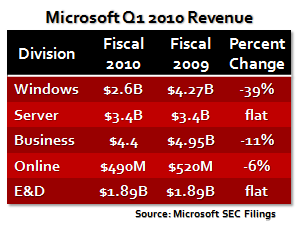
    Microsoft Q1 2010 Revenue

    Liddell still didn’t offer much guidance for fiscal second quarter, but still more than other quarters:

    • Windows & Windows Live: Revenue growth will be in line with the PC market, or slightly ahead. Liddell said Microsoft expects the “netbook mix to stabilize” over the fiscal year.
    • Server & Tools: Revenue growth will exceed server shipments.
    • Business: Revenue growth will lag the PC market, in part as businesses wait for Office 2010.
    • Online Services: Revenue growth will be equal to or better than the market.
    • Entertainment & Devices: Flat.

    Microsoft got a little boost by bad news not being worse. Last week, Gartner and IDC released better-than-expected preliminary third calendar quarter PC shipment data. Gartner had expected worldwide PC shipments to decline 5.6 percent, when they instead rose 0.5 percent to 80.9 million units. IDC put PC shipments up 2.3 percent following 6.8 percent and 2.4 percent declines in the first and second quarters, respectively. IDC estimated PC shipments to be 78.1 million units. By comparisons, Microsoft estimates that worldwid, year-over-year PC shipments were flat to 2 percent growth. Sequentially, sales were up in the mid-teens.
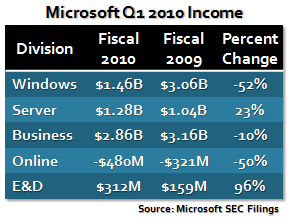
    Microsoft Q1 2010 Income

    But circumstances mitigated the benefits to Microsoft:

    • Netbooks continued their sales surge. Most of these portables shipped with Windows XP Home, for which Microsoft collects substantially smaller licensing fees than either Windows Vista or 7. However, Microsoft also shipped Windows 7 Starter Edition, which margins are better than XP Home.
    • Some regions sagged: PC shipments declined 8 percent year over year in EMEA (Europe, Middle East and Africa), offset by dramatic netbook and low-cost notebook sales, according to IDC.
    • Checks on component suppliers suggest that OEMs flooded the channel with inventory in anticipation of strong Windows 7 uplift. Microsoft could see Windows license sales decline in fiscal second quarter, particularly if PC sell-through is weaker than OEMs and retailers anticipate.

    Segment Results

    Windows & Windows Live. Microsoft has changed the name of what was the “Client” division to “Windows & Windows Live,” reflecting recent organizational changes. Revenue fell 39 percent year over year and income by 52 percent. The declines are not as severe as they seem, because of the $1.47 billion deferral. Windows & Windows Live revenue was $2.6 billion without the deferral but $3.8 billion with it. Microsoft expects to realize $1.7 billion total deferred revenue for the division in the coming quarter.

    The division derives 80 percent of its revenue from license sales to PC OEMs, which were up 6 percent year over year. However, OEM license revenues declined by 6 percent, reflecting the margin damage inflected by increasing netbook sales. Microsoft estimates that during the quarter, netbooks accounted for 12 percent of PC sales.

    Microsoft reported that Windows license sales were strong during the quarter, with sales during September being the strongest for any month ever, in line with the aforementioned record quarterly sales. Robust license sales reflect strong OEM demand for Windows 7. However, as mentioned earlier, the strong license sales could be viewed as OEMs flooding the channel with units that may or may not sell through. Liddell said that OEMs “are buying in anticipation of demand” rather than for “actual demand.” Therefore, robust Windows license sales are cautiously encouraging.

    Server & Tools. The division is most insulated against economic maladies, because 55 percent of revenues comes from contractual volume-licensing agreements. However, because of corporate layoffs, Microsoft is seeing customers renewing license contracts at lower levels. The division’s revenue was flat year over year, while income grew by 23 percent. Microsoft predicted that industry server hardware sales declined 20 percent year over year during the quarter.

    Business. Next to Windows, Microsoft’s other cash cow division reported revenue and income declines of 11 percent and 10 percent, respectively. Several factors accounted for growth declines, including aggressive back-to-school promotions for Office and declines in Business and Dynamics licensing — down 4 percent and 6 percent, respectively.

    Consumer revenue declined $390 million, or 34 percent, which is seemingly counter-intuitive to Microsoft offering deep discounts. Shouldn’t revenue increase then? The discounts were for Office Home and Student 2007, which comes with three licenses and sold for less than $90 from some retailers. Presumably, the heavily discounted three licenses-for-one product sapped sales from higher-priced, single-license Office SKUs.

    Online Services. Income plummeted by 50 percent. The division’s performance, with ad sales in decline, starkly contrasts with quarterly results from Google, which asserted the worst of the econolypse is over. The majority of the Online Services division’s sales come from advertising, which fell 3 percent year over year to $421 million.

    Entertainment & Devices. Microsoft sold 2.1 million Xbox consoles during the quarter, bringing the install base to about 35 million. Xbox Live revenue grew by 50 percent.

    Copyright Betanews, Inc. 2009


    Add to digg
    Add to Google
    Add to Slashdot
    Add to Twitter
    Add to del.icio.us
    Add to Facebook
    Add to Technorati


  • Google Launches Latest Version of AdWords API

    Google has launched the newest version of the AdWords API v2009 beta. That would be version 200909. Google cites the following as the highlights of the new API:

    Asynchronous calls – Asynchronous calls allow you to work with large sets of data faster and more easily. Instead of having to wait for our system to fully complete your request before you can make another one, you’re now able to make another call as soon as the API service confirms that it has received your previous call. No more waiting for the server to complete large requests. V200909 will continue to support Synchronous methods as well.

    Keyword and placement ideas – With the new TargetingIdeaService, you’ll be able to get keyword and placement ideas through the API, leveraging the functionality of the search-based keyword tool.

    Location Extensions preview – Limited location extensions functionality is now available as a preview of the full functionality in development.

    AdWordsThese are just the highlights. Google has a complete list of all of the new features in its release notes.

    The company says that over the next few months, it will continue to introduce new features and additional AdWords functionality. New features will include ReportService, AccountService and the ability to pre-check for errors.

    "Given that v2009 introduces new concepts and features, we have extended the sunset period for deprecated services to 6 months," Google says. "If you haven’t already begun migrating your systems to the v2009 API, we strongly encourage you to start right away."

    v13 services CampaignService, AdGroupService, CriterionService, AdService, InfoService, KeywordToolService, and SiteSuggestionService will sunset on April 22, 2010. Other v13 service sunset dates will be announced in due time.

  • Women, Mothers, Families and Reform

    We’ve discussed health insurance reform from a lot of different perspectives here at WhiteHouse.gov, from doctors to seniors to small business owners.  In a new video, First Lady Michelle Obama discusses it as a woman, and as a mom:

    Viewing this video requires Adobe Flash Player 8 or higher. Download the free player.

    download .mp4 (77 MB)

    iVillage is also taking questions on this video that HHS Secretary Kathleen Sebelius will answer next week, hop over to join in.

     
  • Hands On: Magic Mouse

    Our very own Olly Farshi dropped by his local Apple Store in Helsinki and was kind enough to hook us up with a quick hands on video looking at Apple’s new Magic Mouse. So, enjoy!


    As Q4 begins, online video is now mainstream. Read the, “Connected Consumer Q3 Wrap-up.”

  • FAIL: Windows 7 crashes during live TV demo


    There’s no need for a translation here. A fail this epic speaks for itself and brings back fond memories of the classic Windows 98 fail. Enjoy. The laughs from the TV hosts are the best part IMHO. [via MacDailyNews]


  • As House Lawmakers Near Vote On Health Bill, Controversies Linger

    As a vote on the House’s final health reform legislation appears near, the Democratic leadership has renewed its focus on the public plan, although other issues also remain on the table.

    Politico reports that “Speaker Nancy Pelosi counted votes Thursday night and determined she could not pass a ‘robust public option’ — the most aggressive of the three forms of a public option House Democrats have been considering as part of a national overhaul of health care. Pelosi’s decision—coupled with a significant turn of events yesterday during a private White House meeting—points to an increasingly likely compromise for a ‘trigger’ option for a government plan. … Administration officials have been telling POLITICO for weeks now that this the most likely compromise because it can probably satisfy liberals …. There has been a flurry of rumors that a robust government option remains viable. But top House Democrats privately concede that is wishful thinking that ignores the power of moderate Democrats in this debate” (Allen, 10/23).

    The Hill:  “The survey ordered by Pelosi turned up 46 Democrats who said they would vote against the so-called ‘robust’ public option, according to a Democratic lawmaker who spoke on the condition of anonymity.” That’s enough to block the legislation (Soraghan, 10/22).

    Pelosi said Democrats could be assured that a public option will be in the House bill, the New York Times reports. She also cautioned, however, that many have focused too much on the public option and overlooked other key provisions of the legislation. “So much attention has been paid to the public option and once we have a bill, which will be soon, then you can also pay attention to so many other good things that are in the bill,” she said (Herszenhorn, 10/22).

    The Washington Post reported earlier that  “House Speaker Nancy Pelosi (D-Calif.) and her top lieutenants said Thursday that they are close to corralling the 218 votes they need to move forward with comprehensive legislation” (Montgomery and Murray, 10/23).

    Meanwhile, CongressDaily reports, “A group of 36 House Democrats is threatening to derail healthcare reform legislation if CBO projections don’t show lower costs over the long term.” The group includes mainly Blue Dogs, but not all are members of that conservative coalition (Hunt and House, 10/23). 

    Roll Call: “Pelosi vowed Thursday during her weekly press conference that the House bill must reduce the deficit in the second decade, not just the first, but she does not yet have a conclusive CBO statement to that effect.” Hoyer and Pelosi both said they were confident that they could achieve goals both of paying for the bill now, and lowering the deficit in the future (Dennis and Newmyer, 10/22).

    CQ Politics: The House bill will include a federal antitrust exemption for health insurance companies, Pelosi said. “The House Judiciary Committee approved a bill Wednesday that would partially repeal the 60-year-old exemption from antitrust law for health insurers … (and) authorize the government to prosecute insurers for antitrust violations if they are found to be engaged in ‘price fixing, bid rigging or market allocations.’” The Senate is considering similar legislation (10/22).

    Associated Press/Boston Globe: Meanwhile, “House Democrats have reached a deal on Medicare payments that will secure critical support from heartland and Pacific Coast lawmakers for President Barack Obama’s goal of revamping health care.” The deal includes two studies that would identify recommendations for paying physicians based on quality, rather than volume, and address geographic differences in how much doctors are paid. The recommendations would be implemented unless Congress rejects them (Alonso-Zaldivar, 10/22).

    Associated Press/Boston Globe: “House Democrats are at an impasse over whether their remake of the nation’s health care system would effectively allow federal funding of abortion.” At least 24 anti-abortion Democrats are protesting measures they say could lead to taxpayer funding for the procedures (Werner, 10/23).

  • PSN video content update – more anime incoming

    With the Naruto movies hitting the Video Store early this month, the PlayStation Network continued its anime push with the addition of the more popu…

  • AT&T announces Q3 results, iPhone/data gains drive profits

    AT&T Logo

    Yesterday AT&T announced its third-quarter earnings, and while year-over-year revenue was down (along with the rest of the market) Ma’ Bell managed to beat analysts $0.50 earnings per share prediction by $0.04.  Not bad, AT&T. The earnings were largely due to AT&T’s wireless division — 2 million new lines of service and 4.3 million post-paid wireless activations (3.2 million of which were iPhones) — produced a 33.6% percent increase in wireless data revenues bringing this quarter’s total to $3.6 billion. Our fleet of iPhones can probably account for a couple million of that 3.6 number. We’re joking, relax. Hit the press release for all the dirty details.

    Read

  • Microsoft Beats the Street, But Windows 7 Is Its Bet Going Forward

    Microsoft’s week of positive news continued this morning as the company turned in earnings and revenues that beat analysts’ expectations, but it remains clear that the company’s prospects going forward will depend heavily on the reception of its Windows 7 operating system. Sales in the company’s fiscal first quarter fell 14 percent to $12.9 billion, down for the third quarter in a row, and earnings fell 18 percent to $3.6 billion. The Redmond giant has been battling razor-thin profit margins in the portable computing arena, though, and its results today were expected to be worse. Meanwhile, there are signs that the PC market may be improving, and Microsoft is indeed riding a positive tide surrounding Windows 7.

    Microsoft’s Windows sales were actually down 39 percent for the quarter as the company’s Windows Vista business stalled while it gave out upgrade coupons for Windows 7. Earlier this year, Microsoft announced its first-ever layoffs, which it attributed to a profit margin decline caused by netbooks. As it noted in its 10-Q earlier this year:

    “The decline in OEM revenue reflects an 11 percentage point decrease in the OEM premium mix to 64 percent, primarily driven by growth of licenses related to sales of netbook PCs, as well as changes in the geographic and product mixes.”

    Microsoft’s challenges when it comes to trying to make money in the portable computing market won’t go away anytime soon, but there are signs that cost-cutting at the company is working. And a very positive quarterly earnings report from Intel may also imply that better times lie ahead in the PC market. Above all, though, Microsoft’s fortunes are likely to improve because of the positive reaction to Windows 7. It has already set records for pre-orders, and has more momentum than any Microsoft operating system in years.


  • Experienced Criminals Find New Opportunities In Medical Fraud

    Gangsters are getting into the medical fraud business, CNN reports. “Experienced in running drug, prostitution and gambling rings, crime groups of various ethnicities and nationalities are learning it’s safer and potentially more profitable to file fraudulent claims with the federal Medicare program and state-run Medicaid plans.”

    One case in Los Angeles, a medical fraud hot spot, turned up suspects from Russian and Eurasian gangs, among other groups. “Recent cases include crime boss Konstantin Grigoryan, a former Soviet army colonel who pleaded guilty to taking $20 million from Medicare. Karapet ‘Doc’ Khacheryan, boss of a Eurasian crime gang, was recently convicted with five lieutenants of stealing doctor identities in a $2 million scam.”

    The crooks steal doctors’ billing information and patient’s identifiers in order to fake medical transactions. One doctor’s billing information was robbed during a fake job interview and used to bill for $800,000 worth of electric wheelchairs. When federal agents asked the doctor if he had prescribed those services, he recalls, “I said no. I am a psychiatrist” (Chernoff and Steffen, 10/22).

  • Senate Negotiators Wrestle With Employer Mandate, Unemployed Have Mixed Feelings On Health Bills

    News reports reflect how current reform plans are likely to affect employers as well as people who are unemployed.

    The Wall Street Journal reports on the status of the employer mandate. “Business groups won a big victory last week when a key Senate committee voted to place only modest penalties on employers that don’t offer health-insurance coverage. But they are almost certain to face stiffer penalties in the final Senate health-care overhaul bill.” The two Senate bills “have strikingly different penalties for employers who don’t offer health insurance,” and Senate Majority Leader Harry Reid called it “an issue we are concerned about.” He and other key negotiators spent “at least two nights this week” trying to hammer out a compromise.

    Both exempt the smallest businesses. “Overall, the Finance bill is expected to form the backbone of the final Senate bill aimed at fixing the nation’s health system. But its version of the employer mandate is coming under sharp attack from some leading Senate Democrats who say it lets businesses off too easy” (Adamy, 10/23).

    In other news, unemployed workers, who have a great deal to gain from an overhaul of the nation’s health system, disagree on Congressional health care proposals, The Baltimore Sun and the Milwaukee Journal-Sentinel report. “The steep jump in unemployment and the accompanying rise in people without insurance this year were expected to increase support for health care reform. And not surprisingly, many of the people who have found themselves suddenly uninsured support health care reform. Yet the proposals before Congress face opposition even from some people hit by the downturn, and that opposition shows how the issue has divided the country” (Boulton, 10/22).

  • Play with the BlackBerry Storm 2 emulator at VerizonWireless.com

    Retail stores are finally getting in their Storm 2 dummy phones but those won’t do you any good if you actually wanna use the phone’s software. VZW has you covered though with a just-posted BlackBerry Storm 2 emulator that lets you click your way through the OS.


  • Dear Lobbyists: When Crafting Astroturf Letters, Remember To Do A Search & Replace On XYZ Corp.

    We were just talking about how one of the worst tricks of DC lobbyists is to get various special interest groups to send letters on your behalf, even though those are really written by the lobbyists themselves. The quote in that original article that highlights the practice shows how it works:


    “You go down the Latino people, the deaf people, the farmers, and choose them…. You say, ‘I can’t use this one–I already used them last time…’ We had their letterhead. We’d just write the letter. We’d fax it to them and tell them, ‘You’re in favor of this.’”

    Indeed. Well, it looks like in the process of faxing and telling a senior citizen’s group what they were in favor of, AT&T’s anti-net neutrality lobbyists forgot to do a bit of searching and replacing. Karl Bode points us to a hilarious letter filed with the FCC about net neutrality (pdf), officially on behalf of the Arkansas Retired Seniors Coalition — the exact type of group often used in these astroturfing campaigns — which suggests that someone didn’t proofread the letter first:


    Right in the first paragraph, it looks like the Arkansas Retired Seniors (or perhaps the lobbyist directly) forgot to change out the boilerplate statement: “XYZ organization shares this concern.” XYZ organization, huh? Here’s an editing tip for AT&T’s lobbyists: when crafting such letters with boilerplate language that’s supposed to get changed at a later date before being sent off to the FCC, you should highlight that text in a different color. Saves embarrassing mistakes like this one.

    In researching this further, Karl also can’t find any other evidence that the Arkansas Retired Seniors exist. Separately, he found another mistake by the lobbyists when it sent a different anti-net neutrality letter from Grumman Shipbuilding (ship builders against neutrality?). This one wasn’t as egregious, but the lobbyists forgot to remove the header info that says “Governor/PUC Letters to FCC on Net Neutrality” with the neat little classification system the lobbyists use: “Letter 2: Specific to Investment and Employment.” Wonder what the original header for XYZ organization was?

    Permalink | Comments | Email This Story


  • Family Portrait

    Here’s the First Family portrait, released by the Photo Office this morning:

    First Family Official Portrait

    The Official Portrait of the First Family.

    View Full Size

  • Will Ads Stop Your Dangerous Texting Habit?

    vztextVerizon is showing off an advertisement today (that will run on TV starting Monday) aimed at stopping people from texting and driving, but it’s far too mild for me. I prefer something along the lines of this CTIA ad, which has some of the drama we’ve come to expect from public service announcements. However, the CTIA ad is aimed at teenagers rather than adults; given how many adults text or even just browse on their phones as they drive, perhaps they need an ad targeted at them, too. But will these ads, a bevy of upcoming laws and even the existence of sites like AKBadDriver’s tweet stream actually stop folks from texting (or reading emails) while driving? What about you? Take the poll below the fold.


  • GM Salaried Workers To Receive Only High-Deductible Plans

    “General Motors Co. will offer only high-deductible consumer-driven health care plans to its 24,000 salaried employees, effective Jan. 1,” Business Insurance reports. “GM salaried employees will choose from two plans, both linked to health savings accounts….In addition, GM will contribute $1,300 to employees’ HSAs. That contribution is intended to help employees pay for uncovered health care expenses and to help them accumulate funds to pay for health care expenses after they retire, a GM spokeswoman said. GM salaried employees hired after 1993 are not eligible for retiree health care coverage.”

    “The move to high-deductible CDHPs is a big change for a company once known for its lavish health care benefits program” (Giesel, 10/22).

  • Wellness And Prevention Mostly Absent In Health Reform Bills

    “Despite Americans’ poor lifestyle choices and the chronic problems they spawn, the health-care reform proposals being considered in Congress contain relatively little to promote wellness,” The Tennessean reports. While “more than one-fourth of all adults in the U.S. are obese,” the “word ‘obesity’ does not appear in the 1,000-plus page bill approved by the House Energy and Commerce Committee. A Senate health reform bill contains only two obesity provisions.” Among the wellness provisions in the Senate and House bills is one that “would allow companies to rebate up to 50 percent of an insurance premium for people who complete a wellness program.” (Theobald, 10/23).

  • Poll: Public Expects Big Changes Sooner Than Congress Plans

    “Democrats are promising significant changes in the health insurance market with the passage of their health care legislation, but they may not be able to deliver as quickly as most Americans would expect,” CBS News reports. “A new poll from the Kaiser Family Foundation shows that about half of Americans think that if Democrats pass their reform proposals, help for the uninsured and consumer protections in the insurance market would kick in within a year. In reality, most of the reform provisions” would not go into effect until 2013 (KHN is a program of the foundation) (Condon, 10/22).

    The New York Times: Asked in the Kaiser poll “if Congress passed a bill this year when they would expect people without insurance to begin getting help buying coverage, 49 percent of the respondents said this year or next. Twenty-five percent said three years from now, and 11 percent said ‘further in the future than that.’ Asked how soon they would expect health insurance companies would have to begin accepting customers with pre-existing conditions, 51 percent said this year or next. Twenty-three percent said three years from now, and 9 percent said further into the future” (Seelye, 10/22).

  • Mozilla Aims to Integrate Social Media and Email into One Inbox

    Mozilla has introduced a new inbox program called Raindrop. They refer to it as an "exploration in messaging innovation" to "explore new ways to use Open Web technologies to create useful, compelling messaging experiences." Sounds kind of like  what Google’s trying to do with Google Wave from that description doesn’t it? There is already talk that this may compete with it.

    Mozilla Raindrop "When a friend’s link from YouTube or Flickr arrives, your messaging client should be able to show the video or photos near or as part of the message, rather than rudely kicking you over to a separate browser tab," says Mozilla. "Notifications from computers and mailing lists should be organized for you, not clutter your Inbox or require tedious manual filter setup. It should be easy to smoothly integrate new web services into your conversation viewer entirely using open web technologies."

    Mozilla hopes to end this with Raindrop, which is aimed at spurring the development of applications that help users easily manage their conversations, notifications, and messages across a variety of online services. Right now, however, Raindrop is in a very early stage – version 0.1. Mozilla calls it a prototype, but one they hope will become both a customizable product and a platform for a variety of innovative messaging apps. Right now, it is not ready for everyday use.

    Raindrop Software Components from Mozilla Messaging on Vimeo.

    "In today’s world people use a combination of Twitter, IM, Skype, Facebook, Google Docs, Email, etc. to communicate," says the Raindrop development team. "For many of us this means that we have to keep an eye on an ever-growing number of places we might get new messages. As a result, we never know that we’ve actually processed all the important messages, because our email has been by noise which obscures the real messages from real people."

    "Raindrop is an effort that starts by trying to understand today’s web of conversations, and aims to design an interface that helps people get a handle on their digital world," the team adds.

    Mozilla has posted a set of guiding principles for Raindrop, which it says is an effort in promoting the values of the Mozilla Manifesto. These can be read here.

    Mozilla says one of its first priorities is to make downloadable installers or setup a hosted installation that anyone can use to try out Raindrop. This would make it easier for non-developers to check it out.

  • Political Cartoon: ‘It Only Hurts When…’

    Kaiser Health News provides a different perspective on health policy developments with Chip Bok’s “It Only Hurts When…”