Category: News

  • Look! It’s John Biggs! On CNN!


    John thinks he’s a major media figure on the Internet, but we all know that he’s just a dude that likes to review sex toys. Good thing CNN didn’t know that when they showed up at his front door with a camera and a list of Windows 7 questions. His spot starts at 1:38, btw.


  • Rumor: DSi Speak Channel in the works?

    It looks like “OBJECTION!” won’t be the only thing people shout into the DSi mic soon. A Nintendo error code spotted on the official Nintendo customer…

  • Final Fantasy XIII Famitsu scanfest reveals new character

    Japanese gaming mag Famitsu comes up big once again with a whole bunch of images from the scene’s hottest. Kotaku managed to get their hands on a wh…

  • Tokyo Sky Tree keeps growing to make sure it’ll be the world’s tallest building in 2012

    tokyo_sky_tree

    The Tokyo Sky Tree broadcast tower, currently under construction, has been announced as the tallest building in the world once it’s completed (which will most probably be the case in the spring of 2012). But now Japan obviously fears to lose this (future) title to a tower currently under construction in Guangzhou Province in China, which seems to achieve a height of 610m.

    The problem for Tokyo: This is the same height the city planned for Tokyo Sky Tree. And now Tobu Railway, the main company behind the building, plans to extend the height of the Sky Tree by 24m to 634 meters to really make it the tallest tower in the world.

    From the beginning, the Sky Tree was designed to support a height of 640 meters, which means it won’t pose a problem for Tobu to just make the base that supports the antenna a bit taller.

    The company says the new plan will neither delay the planned opening nor increase construction costs (which stand at $717 million).

    Via Asahi Shimbun


  • Borderlands PS3 co-op riddled with problems, Gearbox working on a fix

    If you picked up a copy of Borderlands for the PS3 hoping to get some co-op time with your friends, you may have to wait a while. Early purchasers hav…

  • Nanda’s Alarm Clock Not Only Runs Away From You, It Runs Away From eBay Too

    It looks like more tangible product companies are trying to pretend they can restrict what you do with legally purchased products post-sale (perhaps they’re jealous of content companies). Case in point: my brother received the Nanda Clocky as a gift awhile back — it’s a pretty novel alarm clock, when it goes off, its wheels turn on, and it jumps off your dresser, forcing you to climb out of bed to turn it off. Since he already had an alarm clock that worked for him, he decided to sell it on eBay. A few days before his auction was supposed to close, he got a notice that his listing was removed for a “Trademark Violation – Unauthorized Item.” Yes, for a legitimately owned product. The email stated:

    “Nanda Home Inc. is the owner of the intellectual property rights pertaining to these listings. By listing the ‘Clocky’ product you are in serious violation of the company’s rights. Additionally, Nanda Home does not permit the re-sale of any of their brand product on eBay. There are no authorized Nanda Home re-sellers on eBay. If you continue to list our items, further legal action may be taken.”

    Clearly, Nanda has a gross misunderstanding of the right of people to re-sell their own property. While it’s true that it is against the law to sell counterfeit copies of a product, re-selling your own goods and representing them as “real” is completely within the bounds of the law, and eBay policy. To make matters worse, the condescending tone of the email also suggests that:


    “You may need to take a tutorial. The next time you sell, you may be asked to take the tutorial, if it’s required. Once you’ve completed the tutorial successfully, please review your account status for any other possible concerns. If there are no other issues, you should be able to sell again.”

    Or, perhaps Nanda and eBay should take a tutorial on the right of first sale. In the aforementioned tutorial, eBay clearly understands the right to re-sell (in fact, a huge part of its business relies upon this fact). Yet, to make matters worse under eBay policy it’s still a laborious process to get the item relisted — even with the bogus takedown notice. As a seller of an incorrectly taken down Clocky listing, you have to contact Nanda and have them specifically authorize your product to be re-listed. Yes, even though it’s Nanda who issued the incorrect takedown in the first place. So much for frictionless commerce.

    The even bigger problem is in the process in which such listing takedowns are handled. Under the guise of rooting out counterfeit products, Nanda is able to unfairly reduce the number of its own secondhand goods in the marketplace. Other manufacturers have tried to do this in the past for everything from shampoo to radar detectors. And, much like the DMCA process, this “guilty until proven innocent” approach ultimately hurts the consumer, who now has unfairly reduced access to many products that were to be sold completely legally.

    That said, my brother followed the eBay process to get his Clocky relisted. They sent him an email apologizing for their error and authorizing him to relist, which he did. Guess what? In an effort to punctuate how ridiculous this policy is, one day later, he got an email, “Trademark Violation – Unauthorized Item.”

    Anyone want to buy a Clocky?

    Permalink | Comments | Email This Story


  • Google’s Panoramio Gets an iPhone App

    Google has released a new iPhone app for Panoramio, which lets users upload photos right from their iPhone.

    "Tens of millions of mobile users own a device with a good camera and GPS," said Fernando Delgado of Panoramio. "We realize that a lot of these users may want to share photos of places with the rest of the world via Google Maps and Google Earth."

    Panoramio for the iPhone

    "The philosophy behind the app is to keep it simple: sign in (only the first time), pick a photo from your device or take a new photo, and upload it straight to Panoramio," explains Delgado. "If available, the geoposition will be automatically set, and you can optionally add a title to the photo."

    This is the first time Panoramio has released a mobile app, but Google says it is working on an Android application to compliment it.

    Panoramio photos are used on Google Earth and Google Maps as photo layers, where people all over th world can see them. The service lets users tag their photos under categories like art, buildings, etc.

  • Google to Add Full-Song Streams, Not a Full Music Service

    googleUpdated to note Imeem: Google will soon launch a search product dubbed “OneBox” that will better organize results around music artists and provide music streams from Lala.com, MySpace-owned iLike.com and other services — including full-song streams, according to one of my sources who’s seen it firsthand. That would make it a modest innovation in user search experience, but not a game-changer that will upset iTunes or compete in the mobile sphere as some early reports have speculated. So modest, in fact, that it sounds a lot like what Yahoo has been doing since last fall with RealNetworks’ Rhapsody.

    We’ll know more when Google lifts the curtain next week, but for now color me doubtful that Google is interested in either selling downloadable songs or providing a large-scale free streaming service that would compete with Spotify’s. If Google were interested in selling content, it probably wouldn’t favor the incredible shrinking music business, and the economics of free streaming are apparently unsustainable. If anything, Google might buy rather than build, as it did with still-money-losing YouTube, but such a deal seems a long way off given the lack of anything close to a proven model in this arena. (Google, for example, wasn’t the one that bought iLike this summer — MySpace did.)

    More likely, Google’s new product will resemble one of its other enhanced search products, perhaps a sort of “Rich Snippets” with full-song streams from its partners. A Google search for a musician usually yields YouTube videos and photos from external providers, but often includes links to a Wikipedia entry or an official site that direct the user away from Google. A better product could keep users around a little longer — all the better to sell ads to them — and could include a rev-share agreement for the stream provider. (Google already has a relatively well-hidden music search product that could also use a rethink.)

    If Google has anything more earth-shattering than that to announce — such as a separate rumored Google Audio product that requires deeper licensing conversations with major labels and others — we’ll know soon enough. For now, though, this appears to be a relatively minor improvement on Google’s search presentation, a boon to Lala.com and iLike.com, and something of a blow to smaller streaming music providers. I’m expecting to hear more soon, and will update the post. Update: A source that asked not be named tells me that Imeem’s song streams will be integrated into the search results as well, although an Imeem spokesman would not confirm this. It remains unknown how many streaming music providers will appear in Google’s new search product.


  • House Committee Votes To Strip Health Insurance Industry Of Federal Antitrust Exemption

    The House Judiciary Committee Wednesday “voted to strip the health insurance industry of its exemption from federal antitrust laws as senators announced plans to take the same step,” The Associated Press reports. The committee voted “20 to 9 to repeal a 1940s law that exempted the health insurance industry from federal controls over certain antitrust violations including price-fixing.”

    The developments “signaled a growing determination by Democrats to punish the insurance industry for its criticism of President Barack Obama’s health care overhaul agenda. … In the Senate, Majority Leader Harry Reid announced plans to repeal the antitrust exemption as part of its health care legislation” (10/21).

    Dow Jones: “Democrats said the bill will improve competition in the insurance industry and expressed hope that the measure would be added to legislation to overhaul the health-care system. ‘We can open up our health insurance markets to real competition and make an important contribution to the health reform efforts underway in both houses of Congress,’ said Rep. John Conyers (D., Mich.) the chairman of the committee.

    Republican opponents said the bill could add a confusing new layer of federal regulation that would interfere with traditional state regulation of insurance. Rep. Bob Goodlatte (R., Va.) said the bill would harm small insurers and he accused Democrats of being motivated by a desire to score points against the insurance industry. ‘This bill is being brought up to weaken the insurance industry’s opposition … to the health care bill,’ he said” (Kendall, 10/21).

  • Steve Jobs Top Tech CEO: Survey

    Two nights ago I finished reading, Inside Steve’s Brain by Leander Kahney and last night started reading the updated version of The Little Kingdom: The Private Story of Apple Computer by uber VC, Michael Mortiz, who a long time ago was a fabulous writer/reporter. The two books have enough anecdotes to point to the fact that working for Apple’s Steve Jobs is nothing short of climbing a glass wall.

    Despite that, Apple employees think he is awesome. According to a survey by Glassdoor.com, a Sausalito, Calif.-based company that that tracks employee satisfaction, Jobs is the #1 CEO, ahead of Google’s Eric Schmidt, Adobe Systems’ (a ADBE) Shantanu Narayen and Netflix’s Reed Hastings. (Full list below the fold.)

    In sharp contrast to Jobs, Dell CEO Michael Dell was ranked 23 with 44 percent approval, while Steve Ballmer had 41 percent approval rating from his employees. eBay’s John Donahoe had an approval rating of 20 percent.

    Company CEO Approval Rating as of Oct. 09
    Apple Steve Jobs 90%
    Google Eric E. Schmidt 87%
    Adobe Shantanu Narayen 78%
    Netflix Reed Hastings 76%
    salesforce.com Marc Benioff 73%
    Citrix Systems Mark B. Templeton 72%
    Rackspace A. Lanham Napier 72%
    QUALCOMM Paul E. Jacobs 69%
    NVIDIA Jen-Hsun Huang 68%
    Intuit Brad D. Smith 68%
    Oracle Larry Ellison 62%
    Intel Corporation Paul S. Otellini 62%
    EMC Joe Tucci 60%
    SAP America Bill McDermott 58%
    Nokia Olli-Pekka Kallasvuo 56%
    Novell Ron Hovsepian 56%
    Texas Instruments Rich Templeton 54%
    Yahoo! Carol Bartz 54%

    Photo courtesy of Whatcounts via Flickr


  • Is Twitter Smart to Ditch the Suggested User List?

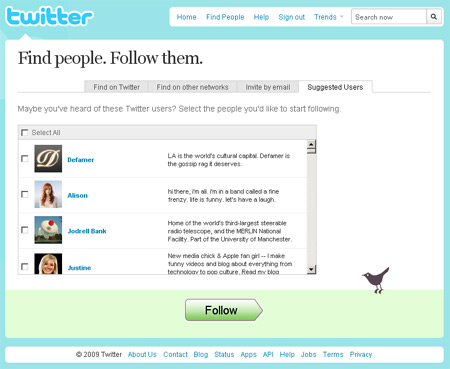
    Twitter CEO Evan Willams made some comments at the Web 2.0 Summit in San Francisco that have some Twitter enthusiasts in debate. He reportedly said that he wants to retire the Suggested User List (SUL) as the company prepares to launch its highly anticipated "Lists" feature.

    The Lists feature would let people create lists of Twitter accounts, or group together certain accounts that they follow. The feature is very overdue, and could go a long way in making Twitter more useful and reducing "noise."

    The SUL, is a feature that lists users, which Twitter thinks new users of the service may be interested in following. The idea has always been that it would be a good way to help new users understand what they could get out of Twitter. Earlier this year, Twitter co-founder Biz Stone wrote about it on the company blog.

    Twiter Suggestions

    At the Web 2.0 Summit, Williams said the feature was initially meant as a way to help new users, but it’s been controversial, and he wants to ditch it, or possibly "evolve" it. He says that whatever comes after the SUL, should be "Twittery and democratic."

    "This is a big deal for Twitter," says Patricio Robles with Econsultancy. "According to Nielsen, approximately 60% of new Twitter users quit within a month. And of those who stick around, a considerable numbers remain small-time consumers of content."

    "The implication for Twitter: giving people a reason to stick around is really, really important," adds Robles. "And, given the numbers, it’s clearly a challenge. So how to do this? Well, obviously the SUL isn’t going to perform miracles (it’s not working wonders now if Nielsen’s figures are to be believed) but it is one tool that Twitter has to help new users find the most interesting people to follow."

    Some have viewed the SUL as a possible moneymaker for the company as well. Earlier this year, Jason Calacanis tried to purchase a spot on it. He said that in five years the top 20 spots would be worth a million a year. Being on the list can do wonders for a Twitterer’s follower count.

  • Now we know why Disgaea is such a grindfest

    There’s nothing like coming out of the Item World holding a shiny new overpowered piece of equipment. Anyone who’s ever played Disgaea is well aware…

  • Now we know why the Disgaea is such a grindfest

    There’s nothing like coming out of the Item World holding a shiny new overpowered piece of equipment. Anyone who’s ever played Disgaea is well aware…

  • Montagu Agrees To Land Linpac To Lenders

    LONDON (Reuters) – British buyout house Montagu Private Equity signed a debt restructuring deal late on Tuesday that will see it walk away from British packaging company Linpac, two sources familiar with the process said.

    Lenders will take on the business as a going concern, reducing the company’s debt by 320 million pounds ($529.3 million) — 50 percent of its debt burden, the sources said.

    The debt for equity deal will close around the end of the year and will include a court-approved scheme of arrangement transaction, one of the sources said.

    “Things are moving but nothing is finalised until all parts of the deal are done,” the source said.

    The lenders plan to inject 65 million pounds into the company, the two sources said.

    Linpac, which makes plastic food packaging for retailers and food manufacturers, ran into trouble last year as a result of rising commodity costs, volatile raw material prices and the decline in sterling.

    The agreement will wipe out Montagu’s investment entirely but sees Linpac’s position strengthened as a result of the support from its lenders.

    The debt for equity swap has three components, with the first signed on Tuesday, a source with direct knowledge of the situation said.

    Montagu and Linpac both declined to comment.

    Montagu bought the company from its family owners in 2003 for 860 million pounds, backed by a loan arranged by Deutsche Bank (DBKGn.DE). The private equity firm recouped around 80 percent of its investment in 2007 through a recapitalisation in 2007, one source said.

    By Simon Meads and Tom Freke
    (Editing by Mike Nesbit) ($1=.6045 pounds)

    ShareThis


  • Why We Bar Lobbyists from Agency Advisory Boards and Commissions

    In the interest of transparency, we are posting a letter we received from lobbyists and others about the Administration’s move to bar federally-registered lobbyists from federal boards and commissions.  We are also publishing our response, which explains the reasoning behind this decision.
     
    It all started with a blog post where we announced the new steps the Administration was taking to reduce lobbyist influence on these important boards and commissions:
     
    The White House has informed executive agencies and departments that it is our aspiration that federally-registered lobbyists not be appointed to agency advisory boards and commissions. These appointees to boards and commissions, which are made by agencies and not the President, advise the federal government on a variety of policy areas. Keeping these advisory boards free of individuals who currently are registered federal lobbyists represents a dramatic change in the way business is done in Washington.
     
    On October 19, we received this letter from a group of lobbyists (pdf) and others who serve on industry boards and commissions, expressing concern about our decision.
     
    While we recognize the contributions some of those who will be affected have made to these committees, it is an indisputable fact that in recent years, lobbyists for major special interests have wielded extraordinary power in Washington DC, resulting in a national agenda too often skewed in favor of the interests that can afford their services.  It is that problem that the President has promised to change, and this is a major step in implementing that change.
     
    We make that point, along with others in our response (pdf).


    Norm Eisen is special counsel to the president for ethics and government reform


  • Condé Nast Brings Titles to iPhone, Keeps Eyes On the iTablet

    conde nast logo

    Newspapers and magazines — the entire news print industry to be honest — have been suffering a long and torturous decline for much of the last decade as more of us turn to the Internet and electronic devices to get (increasingly personalized) news and other content. While publishers have generally been slow to adapt to shifting delivery platforms, change is — finally — afoot. Publishing supergiant Condé Nast is now taking its first tentative steps to embracing the digital realm with a series of iPhone apps designed to deliver its most popular titles electronically.

    Adage reports that the first title will be GQ magazine, released this December in the app store and priced at $2.99 (the regular print edition of the magazine costs as much as $4.99).

    Adage’s Nat Ives writes:

    The new app platform could help the company squeeze circulation and real ad revenue from digital. Because the apps will include all the editorial and ads that the print editions do, the Audit Bureau of Circulations will consider the apps to be paid circulation just like newsstand sales and subscriber copies. That’s important because advertisers only want to pay for ad space in issues that the audit bureau defines as paid.

    So the digital edition of GQ will be identical to its dead-tree counterpart, but cost appreciably less. It might also offer compelling extra content and rich media at (and this is so very important to publishers) little-to-no extra cost. After all, an embedded video is an impossibility in a printed magazine, and a digital edition offers unlimited virtual column-inches for expanded editorial.

    Condé hasn’t completely abandoned its old methods for generating profits. Indeed, it’s relying on the fact its digital issues will be counted as paid editions because print ads command higher rates than online ads.

    Size Matters

    So, will you buy GQ on your iPhone? I suspect there won’t be too many people who do. Seasoned iPhone users are keenly aware that the device’s form factor makes for a dissatisfying reading experience of even modest duration. The iPhone is hardly the most comfortable platform for reading anything more than email. Sure, apps like Stanza and Instapaper make reading on the iPhone far more fluid and tolerable than, say, reading lengthy web pages in Safari. But they can’t change the fact that you’re still peering at tiny text on a 3.5 inch screen. Only the most dedicated of readers will suffer such eye-strain-inducing limitations, all the while dreaming of something just as light, just as thin, but much larger. Y’know… a tablet.

    This is something Condé Nast understands very well. Its upcoming app isn’t about bringing its various print publications to the iPhone — it’s about the timely positioning of its product to take advantage of the upcoming tablet.

    Says Sarah Chubb, President of Condé Nast Digital:

    This iPhone is just one platform. We plan to be, and generally try to be, anywhere our consumers are.

    We think that the minute Apple is ready, if they ever are, to announce that they’re going forward with a tablet, that we’ll be ahead of everybody.

    I can’t say I’m a GQ reader, but that’s not meant as a judgement against that particular title. I just don’t buy newspapers or magazines. Practically no one I know my age (or younger) does. It’s not hard to see why; these days, most people enjoy regular, inexpensive access to the Internet. Services like Twitter and RSS feeds ensure we get only the news and content we want to read, when we want to read it — and what’s more, it’s usually free.

    $2.99 is too much for a magazine that exists only as pixels on a (small) screen. 99 cents seems far more appealing and most likely would shift more (virtual) copies. It’s more appropriate, too, since the traditional resource, print and distribution costs associated with a dead-tree publication don’t apply in the digital realm. Perhaps when Condé Nast’s printed magazines have finally gone the way of the Dodo, its digital issues will hit that magic sub-dollar price.

    In the meantime, I’m excited Condé is doing this. No, not because I’m about to start buying GQ. I’m excited because I know it’s only a matter of time before other big print titles start appearing on digital devices. (And not just watered-down content portals like the New York Times.) It’s already happening, albeit quietly, behind closed doors. A few months ago word got out that Time was in talks with other publishers, collaborating on e-reader standards. Around the same time, it was reported Apple was negotiating content deals with several media companies “rooted in print.” And while we’re still waiting for Apple’s tablet to arrive, e-readers are cropping up all over the place, jostling for a position in what is sure to become a massive new market.

    Print is dead. But, at long last, Digital Print is here to replace it, and it’s just around the corner. That’s welcome news for an ailing publishing industry finally starting to take electronic platforms seriously.

    Tell us in the comments if the new age of digital publishing is going to get you reading newspapers, and whether you think Apple’s gonna object to some of GQ’s more, um, “adult” front covers!


    Growing mobile data use turned up heat on carriers in Q3. Read the, “Mobile Q3 Wrap-up.”

  • When two worlds collide, the Transformers Rubix cube emerges

    transformers
    Yeah, we get it. It’s a Rubix Cube that’s supposed to look like the AllSpark of Transformers’ lore. Clever. Hopefully those shinny stickers come off nice and easy so I can solve the damn thing. $13.99 and coming in November. [Entertainment Earth via Gearfuse]


  • RIM Hiring WebKit Developer, iPhone-like browser in the works

    The BlackBerry is no doubt a fierce email machine, but the browser still falls short when compared to webkit browsers found on the iPhone and Palm Pre. RIM is looking to hire a WebKit developer as per this listing on LinkedIn, so it certainly appears that a WebKit browser is in the works.

    rim_webkit_developer_job

    WebKit browsers tend to offer desktop-like experience on a mobile device, featuring fast and accurate rendering of web pages. If and when a WebKit browser gets released for the BlackBerry, it’s not clear if this will be available on current generation BlackBerry devices or a future, unreleased BlackBerry. In any event, this is certainly good news for those frustrated with the browsing experience on a BlackBerry.

    [via Ubergizmo]

  • Microsoft Inks Twitter, Facebook Data Mining Deal

    bingUpdated with detail from the Web 2.0 conference: Microsoft is set to announced this morning during the Web 2.0 Summit separate nonexclusive deals with Twitter and Facebook, deals that were first reported by Kara Swisher over at AllThingsD, which would enable Microsoft to serve real-time status updates from those two social sites within its Bing search engine. This news comes one day after Twitter CEO Evan Williams deferred a question about pending data mining deals with Microsoft and Google.

    Financial terms of the deals are unknown. And the implications will be different for Twitter than for Facebook. While most status updates on Twitter are publicly searchable, updates on Facebook are primarily kept private between users and their friends. Not all of Facebook’s status updates will be searchable in Bing’s real-time feed, according to Swisher.

    Update:
    Yusef Medhi, senior vice president of Microsoft’s online audience business, took the stage at the conference to demo a beta version of its Twitter real-time search feed, which is now live. Medhi identified Twitter as the leader in the real-time space and said its Facebook search feed will be rolled out later.

    In the Bing Twitter feed, you can choose to see either the most recent tweets about a search term or the most relevant tweets about that term. To render a list of the most relevant tweets, Bing takes into account the author of the tweet, the quality of the message and how often it’s been retweeted.

    Bing also provides a tag cloud of the most popular terms being discussed across the Twitter network and lets you see popular embedded links about a certain topic. For example, you can view a list of NY Yankees articles people are tweeting most about. Another plus is that Bing identifies the source of the article’s shortened URL, which prevents you from unknowingly clicking on a bad link.


  • Over 1,000 GreenGov Ideas and Counting!

    Earlier this week, we launched the GreenGov Challenge – a new way for federal employees and military personnel to help green our government. The response thus far has been tremendous, but I know there are many more of you that we still need to hear from.

    Energy efficiency is an issue I’m passionate about, and it is a major focus for the Department of Energy. For the next few decades, energy efficiency will be our most effective tool for reducing our carbon emissions, and the best way to reduce energy bills for America’s families. Specific ideas on how to save money and energy are especially welcome.

    I know many federal employees share my passion and have great ideas for how to help the government become greener. Many have shared great ideas already on my Facebook page.

    The GreenGov Challenge is a way for you to have your ideas heard. Ideas can be submitted through October 31st. We recognize that some of the best ideas on how to save energy may not be new, but they are simply not widely adopted. I want to hear from you what you think are the most cost-effective ways to save energy and money as well as new ideas. The top ideas will be evaluated and put into action shortly thereafter.

    I hope you will take a moment to think about the energy saving opportunities around you, to dream up new ways to solve them, and to be a part of making this effort a success. I look forward to reviewing your ideas and tackling this challenge with you.

    Steven Chu is Secretary of Energy