Category: News

  • Apple Patents A Volume-Based Solution To Shaky Smartphone Camera Syndrome

    Apple - iPhone 5-1

    A new patent filing uncovered by AppleInsider today shows that the company is still thinking about ways to upgrade the smartphone camera experience and deliver the best possible pictures you can get on a mobile phone. The invention would make it so that as soon as you open up the camera app on your iPhone, iPod touch or iPad, the device starts grabbing full-resolution pics and storing them to a memory buffer, meaning when you finally push the shutter you’ll have a wealth of different images to choose from.

    The design would use continuous image capture to try to improve quality, and to compensate for what are currently essential failings in the way mobile photography works. For instance, Apple’s patent describes how when taking a photo, the camera’s virtual “viewfinder” shows a partial resolution version of what’s being captured, and then when the shutter is pressed there’s a delay as it switches to full resolution mode to actually take the pic, which means what you see is not often what you get. If camera software begins immediately snapping high-res photos and storing them to a temporary cache, it should be able to match the proper frame with the moment a user intended to capture.

    Apple’s system would select from the buffer of photos based on timing, but also on quality. It would score images automatically based on factors like contrast, resolution, dynamic range, exposure time and more to try to logically derive which is the best, most in-focus shot. The device will then purge the memory buffer after a certain amount of time, or when it hits a pre-set threshold to clear room for future captures. In one of the embodiments, the user is given a full resolution preview to approve or deny immediately after the photo is taken, and then presumably presented with other options.

    It’s a technology that could easily be integrated into iOS without much outward change, but it would likely merit some fanfare from Apple if it were already in use, especially now that Android and other OEMs are beginning to compete more aggressively for consumer attention with advancements to onboard mobile camera tech. And others in the industry are already using similar technology to accomplish different things: BlackBerry 10′s face selection for Z10 camera pics is one example, and Nokia uses much the same technology in its own Windows Phone 8 devices, after it acquired the company that created the system in the first place.

    Picking the best of multiple exposures is one way to improve on mobile camera tech, but it’s not the only means. There are plenty of other improvements which could make considerable differences, including Lytro, which is clearly interested in licensing its selective focus tech to OEMs once it’s ready. But the camera is an area where iterating quickly can have a big impression on consumers with each successive hardware generation; improving things on either the hardware or software side is imperative if Apple wants to keep ahead of the game, and this patent (filed in October of 2012) indicates it’s actively working to make sure that happens.

  • Kish on our Vast Energy Resources

    IER’s Daniel Kish speaks on Cavuto about the vast energy resources and what it means for American taxpayers. In addition to 552,000 jobs annually over the next seven years, opening up Federal resources could increase economic activity by $14.4 trillion over the next thirty-seven years.

    Read the rest of the report here.


  • Why Valentine’s Day needs data centers

    It’s a happy Valentine’s Day if you’ve found a match on an online dating site. But it could be a tough day for IT people at Match, eHarmony, OKCupid and other sites, which might face traffic booms as antsy users scramble to find last-minute dates.

    There’s certainly plenty of demand for the services. In 2009, CIO reported that more than 40 million Americans had tried online dating. In September 2012, 1 in 10 internet users frequented an online dating site, according to a December 2012 report from comScore.

    Sites vary as to the times of year when traffic peaks. The number of unique visitors to eHarmony.com increases 45 percent on Valentine’s Day, and the boost continues until the end of the month, a spokeswoman wrote in an email.

    The biggest day of the year for Match.com registrations isn’t Feb. 14; it’s actually Jan. 2. “Then we get another big spike after the Valentine’s Day holiday, so this weekend will be another spike,” a spokeswoman said. And for Zoosk.com, the peak comes on Dec. 26, while traffic is consistently heaviest in January.

    How do engineers accommodate all the traffic and not sacrifice performance?

    For eHarmony, it was a matter of scaling out infrastructure. “The systems over the years have been expanded to absorb large spikes to all the main areas and events on the site, such as posting photos, communication requests and the interactions with the mobile apps,” the company spokeswoman wrote.

    Computerworld reported in 2009 that eHarmony had 4 terabytes of user information in storage for 20 million users. That comes from responses to the site’s Relationship Questionnaire. The spokeswoman did not immediately have current figures available.

    Match.com was storing 70 terabytes of user data for more than 1 million subscribers when Microsoft published a case study on the dating service last March. Until May 2010, Match.com was updating user information on 110 Microsoft SQL Server servers across two data centers in the United States. In order to keep profile updates timely — less than two seconds — the company began distributing the updates across the servers, rather than update the entire dataset at once.

    Valentine’s Day isn’t necessarily the high point of the year for Facebook. Jay Parikh, Facebook’s vice president of infrastructure engineering, cited Halloween as one of the highest times of year for photo uploading, as my colleague Stacey Higginbotham reported. When Facebook demand spikes, servers stocked with flash memory in the data center instead of hard disk drives and tapes ensure consistently high performance with a wide variety of data — and there’s plenty of room for storage, too. Facebook’s flash-only database servers, codenamed Dragonstone, feature 3.2 terabyte flash memory cards from Fusion-io. Flash memory might come in handy at dating sites’ data centers, too — the Dragonstone flash memory became part of the Open Compute Project last month.

    Feature image courtesy of Shutterstock user 3Dstock.

    Related research and analysis from GigaOM Pro:
    Subscriber content. Sign up for a free trial.

  • A Unique Approach to Marketing Coca-Cola in Hong Kong

    Plenty of advertising is already embedded in electronic games. The new wrinkle is that gaming can be embedded in ads — perhaps the only hope of engaging some people’s interest long enough to get a message across.

    Coca-Cola China’s TV ad for the Hong Kong market invited viewers to use their smartphones to “chok” bottle caps flying across their TV screens. A well-timed waggle of the phone would catch a cap on the phone’s screen, earning points (to be redeemed later for sweepstakes entries). This mobile integration was complicated: For instance, people had to download a special app to play, and the timing of the ads had to be announced in advance so that players would be ready. But it all came together and worked. The app was downloaded 380,000 times in its first month, and exposure to the ad (on TV, YouTube, and Weibo combined) exceeded 9 million views. Some background:

    Electronic games started out as all whizbang technology and no aesthetic appeal. (Pong, anyone?) Today’s gamers demand not only stunning visuals but also narrative and emotional depth. As advancing technology makes such integration more seamless, many marketers will build on this start. Some of them may be surprised at how rapidly creative talent comes back to the fore.

    This is the second in a series of posts from our March issue on the future of advertising. Stay tuned for more “Creative That Cracks the Code” over the coming weeks; topics include Variations on a Meme; Collaborating With the Crowd; Just Enough Humor; A New Social Movement; Ads That “Go Native”; Apps as the New Ads; Personalized Products; and Ads in the Public Sphere.

    We also want to know which ads campaigns strike you as innovative; tell us below and we could analyze your pick as part of this series.

  • With $11M, Quad Learning links community colleges and top universities for cheaper degrees

    In the last year or so, we’ve seen all kinds of online learning startups emerge, from those that focus on a specific set of skills to those that offer massive web classes for free to those that partner with top universities to provide quality degree programs online.

    On Thursday, Washington, D.C.-based Quad Learning launched with $11 million to bring yet another model into the mix. Founded by Phil Bronner, an education technology investor, and Chris Romer, a former state senator of Colorado, the startup partners with community colleges to offer a web-based platform and curriculum intended to help students more successfully transfer to a four-year college.

    With tuition rates and debt loads going up, the idea is that a student could complete two years at a community college and then, with Quad Learning’s “American Honors” program, transfer to a top-200 university to finish the last two years of a bachelor’s degree program.

    “The whole focus is around college affordability,” said Bronner. “We see it as the most cost-effective way to receive a bachelor’s degree.”

    The startup, which raised funding from New Atlantic Ventures, Swan and Legend Fund, NEA, Comcast Ventures and other institutional investors, says its program can provide the opportunity to earn a bachelor’s degree at 35 to 40 percent of the cost of a traditional four-year program.

    Quad Learning is currently running two pilot programs: at the Community College of Spokane and Ivy Tech Community College of Indiana. Students who are accepted to the program attend live classes at the community college but participate in smaller discussions with peers online, as well as receive other kinds of personalized and digital content through the web-based platform. The program, Bronner said, aims to provide a more rigorous, discussion-based experience, as well as offer guidance and support so students take the classes that meet their goals and will satisfy university requirements. So far, the company said, the program has attracted high-achieving students who have chosen community college for financial or family reasons.

    To participate in the program, students pay the community college a rate that’s more than the $2,500 to $5,000 typically charged by community colleges but less than the $8,000 to $14,000 charged by in-state public universities, Bronner said. The community colleges pay Quad Learning a fee for providing the platform.

    It’s still too early to gauge the program’s success in helping students bridge community college and four-year programs – we’ll have to wait until its first cohorts of students complete the program.  But, Bronner said the program is working to strengthen relationships between community colleges and state universities and provide clarity around the classes students need to take to be able to transfer. It’s also working on forging partnerships with universities willing to accept their transfer students.

    Related research and analysis from GigaOM Pro:
    Subscriber content. Sign up for a free trial.

  • Sponsored post: Zyrion Traverse: the hybrid cloud monitoring solution

    Large enterprises are using a combination of the resource flexibility of the public cloud and the security of their internal private cloud environments. Cloud provisioning platforms such as Cloudstack provided the interface needed by enterprises and MSPs to seamlessly deploy their distributed applications across a hybrid cloud infrastructure.

    However, deploying an application service across a hybrid cloud infrastructures has its share of management challenges. A user might log into a webserver farm on a public cloud, but the authentication server and databases for this service might be on an internal cloud platform. Trying to isolate the performance issues in this distributed application service would require unified correlated monitoring of the distributed components.

    The only way to reduce the time to resolution for such distributed application services running on a hybrid cloud is to get a unified monitoring platform, which can correlate the performance across all these components and highlight potential issues in this application’s performance.

    Zyrion Traverse is one such solution that was designed for distributed application monitoring using its unique Service Container technology. Not only does it provide correlation and analysis across the distributed components of a hybrid cloud environment but it also has a behavior learning analytical engine and integrated Netflow, which allows instant drill down into packet data for fault analysis.

    Enterprises and service providers need a monitoring platform, which can provide a service-centric view of their infrastructure. Zyrion is one of the few vendors addressing this need today and help in reducing operational expenses.

  • Harlem Shake Spreads to Facebook & Google HQ

    I’m not sure if two of the biggest internet companies in the world actively participating in the latest meme craze is a fun thing or a death-of-the-meme- type thing. Either way, it’s happening.

    Both Facebook and Google’s employees have decided to get in on the Harlem Shake craze

    Here’s what’s going on at Menlo Park:

    And now for the folks in Mountain View:

    Who did it better? Where’s Mark Zuckerberg in all of this? Where’s Sergey Brin? Why is nobody actually doing the Harlem Shake? WHAT IS THE MEANING OF THIS?

  • “Newborn” 13-Year Old: Pictures Go Viral

    A 13-year old boy who was adopted along with his sister has found sudden fame on the web after a “newborn” photo session garnered thousands of likes on Facebook.

    Latrell Higgins and his younger sister, Chanya, were adopted by a Florida family recently, and when the mom, Kelli–who was pregnant–talked to the family about how she was setting up a photo session for the baby’s arrival. When one of Kelli’s biological children–she and her husband already had five–suggested that they do the same for Latrell, Kelli jumped on the idea.

    “I thought it was funny and that it would be a good idea,” Mrs Higgins said. “I was very sad too because I didn’t have any photos of him. I think it’s really hard to have children and not know what they looked like when they were younger.”

    Mrs. Higgins said it’s rare for older children to be adopted, and that’s why she and her husband wanted to do it even though they were already expecting a sixth child of their own.

    “These children, once they get past a certain age, they don’t find homes and they age out of foster care,” she said. “They have to figure out the world on their own and there’s no one to go back to as an adult. Where do you go for Christmas? It’s just horrible, it’s heartbreaking.”

    The family says they’re hoping that now that they photos have gone viral, they’ll help raise awareness about older-child adoption. Indeed, Latrell and his family have garnered tons of support from people all over the world after the photos began making the rounds on the web.

    Image: Kelli Higgins Photography

  • Facebook Gets API Error Notifications

    In November of last year, Facebook introduced Developer Alerts to help developers know when something goes wrong with their app. The original alerts only covered breaking changes, app status changes and policy violations. Now Facebook is adding another important aspect of the development platform to it.

    Facebook announced today that Developer Alerts will now include API error notifications. When encountering an error, Facebook will alert you via email and Facebook notification. To keep spam down, it won’t be sending you an alert every time the API encounters an error. It will only do so if your app encounters an “abnormally high API error rate.”

    Here’s what you can expect to see:

    Facebook Gets API Error Notifications

    Facebook plans to roll out API error notifications starting today, and should be available to all apps in the coming weeks.

    Developers reported 295 bugs to Facebook this week, with 48 bugs being accepted for further review. The Facebook team also fixed 31 bugs this week. You can check out the full bugfix list at the blog post.

  • New iOS 6.1 Security Flaw Grants Limited Access To Phone App, Photos, Email, Messages, FaceTime

    ios-6-logo

    With just a few quick steps, it’s easy to open the phone app on any locked iPhone running iOS 6.1. From there a person has full access to the photo library, can edit contacts, send emails, text messages or even make a FaceTime call. It’s so easy that it’s downright silly.

    As shown in the video here, the process involves holding down the power button and aborting an emergency call. It worked for me although the timing is tricky.

    The flaw causes the phone to load the phone app, giving anyone full access to the dialer, contact list, voicemails, call history and photos by editing a contact. An email or text message can be sent by sharing a contact. FaceTime is accessible through the contacts as well.

    Update: Apple has reached out to TechCrunch with the following comment:

    Apple takes user security very seriously. We are aware of this issue, and will deliver a fix in a future software update.

    The exploit is fairly easy to access but the timing is tricky.

    • From a locked iPhone running iOS 6, load the emergency dial screen.
    • Press and hold the power button and then hit cancel.
    • Make a fake emergency call — I dialed 112 like in the video.
    • Hang up immediately.
    • Hit the power button to put the phone back in standby.
    • Hit the home button to bring up the lockscreen
    • Hold down the power button and at the three-second mark, hit the Emergency Call button.
    • Keep holding the power button until the Phone App comes up.
    • Hit the Home Button and release as if you’re taking a screen shot.

    The last bit is the hard part. The timing needs to be just right. It took me about 20 minutes to get the timing down.

    While new to iOS 6.1, this isn’t the first time a simple workaround has resulted in similar access. A comparable exploit was found in iOS 4.1. 

    Apple will likely address this exploit rather quickly. It’s a massive backdoor to some of the iPhone’s core functions.

  • Barnes & Noble warns investors to expect more bad Nook news

    It’s only been a couple months since Barnes & Noble downgraded guidance for its Nook business. Now the company is doing so again.

    In a press release sent out after the market closed Wednesday, Barnes & Noble said it ”expects its fiscal year 2013 Nook segment EBITDA loss to be greater than it was in fiscal 2012 and expects fiscal year 2013 Nook Media revenues to be less than $3 billion.” Previously, B&N had expected Nook Media’s FY 2013 revenues to be $3 billion, with EBITDA losses comparable to those in FY 2012.

    Barnes & Noble had also been set to announce its third-quarter earnings for fiscal year 2013 on February 22, but said Wednesday it will actually report them a week later, on February 28.

    Nook Media is supposed to be the profitable part of the company. Consisting of B&N’s Nook and college businesses, Barnes & Noble spun it off in 2012 with a $300 million investment from Microsoft and, as of late December 2012, an $89.5 million investment from Pearson. (Barnes & Noble holds 78.2 percent of Nook Media.) Instead, Nook is doing worse at the same time that Barnes & Noble’s other segments — retail stores and BN.com sales — are also doing badly. Over the holidays, Nook device sales, BN.com sales and in-store sales all fell compared to the previous year. And the company plans to close up to a third of its retail stores over the next decade.

    Related research and analysis from GigaOM Pro:
    Subscriber content. Sign up for a free trial.

  • A (costly) balancing act in Hungary

    A bond trader in London is still marvelling at the market’s willingness to snap up a Eurobond from Hungary, calling it a country with “a policy mix so unorthodox even Aunty Christine won’t lend to them”.  But Hungary’s probable glee at bypassing the IMF and “Aunty Christine”  with $3.25 billion in two bonds that were almost four times oversubscribed, is probably short-sighted.

    Hungary needs to raise the equivalent of $23.4 billion this year to repay maturing debt. The bond placement will enable Hungary to easily meet the hard currency component of this, and it has been enormously successful in luring buyers to domestic debt markets.  Such has been the demand for Hungarian bonds in recent months that foreigners’ holdings of forint-denominated government debt are at a record high of over 45 percent.

    The success does not necessarily represent a thumbs-up for Prime Minister Viktor Orban’s policies but is more likely due to the yield Hungary paid — well over 5 percent for five and 10-year cash. In dollar terms that is not to be sneezed at, especially at a time when liquidity is abundant and the yield on mainstream dollar assets is low. The same reason is behind the demand for forint bonds, where Hungary pays over 5 percent on one-year paper. An IMF loan would have been far cheaper. (The rate for a standby loan of the kind Hungary had is tied to the IMF’s Special Drawing Rights (SDR) interest rate. Very large loans carry a surcharge of 200 basis points)

    The dollar bond sale is forcing Budapest to pay lenders roughly double what it would have paid for an IMF standby loan, says William Jackson at Capital Economics:

    Of the Hungarian government’s 5.1 billion euro of maturing hard currency debt this year, 3.6 billion euro consists of IMF loan repayments, which carry a much lower interest rate than the Eurobonds. By rolling over these repayments with Eurobonds, debt servicing costs will rise. Note too that the new dollar bonds add to Hungary’s underlying FX debt problem.  Around half of government debt is hard currency-denominated (c. 36% of GDP). And Hungary’s economy has contracted in  dollar (and euro) terms over the past five years – increasing the burden of dollar (and euro) debt in local currency terms.

    According to Benoit Anne, chief EM strategist at Societe Generale:

    The absence of (an IMF) safety net may haunt them in future…The IMF was a cheap insurance policy but the government has decided to ride the global liquidity-fuelled emerging markets appetite wave.

    Cost was never likely an issue for Orban, who might view an IMF deal (entailing toeing stringent IMF terms) far costlier in political terms ahead of a 2014 election. The other, more widely voiced, concern is that with a successful Eurobond sale under its belt and an election looming, the government may feel more confident in pursuing its unorthodox growth agenda, Jackson says.

    Meanwhile, the IMF’s representative in Hungary Iryna Ivaschenko warned the golden days may not last for Budapest:

    Countries like Hungary which.. still have sizeable financing needs year after year are susceptible to sudden changes in investor sentiment which is inevitable.

  • DataSift open-sources its social media analysis tool

    DataSift is releasing an open-source version of its Query Builder service to work alongside enterprises’ existing business-intelligence software, allowing more employees to gain more insight from social media mentions.

    The open-source presentation of Query Builder, which permits existing DataSift customers’ developers to simplify the tool’s appearance and functionality, might seem like a matter of crossing big data with even more data. But it’s an important step in trying to prompt business decisions based on what companies can learn about users of Twitter, Facebook and other outlets, not just see what people are saying. Social media analysis becomes more actionable and worthwhile with this sort of functionality.

    Plenty of companies ask Twitter to filter out certain parts of its enormous data set. But DataSift is one of just two companies licensed to syndicate the firehose of all Twitter feeds. (The other is Gnip.) Its internet-based Query Builder service also allows customers to run natural-language processing off the entire Twitter firehose and adjust it on the fly in several ways. The processing requires a massive amount of storage, to the tune of 1.3 petabytes, said Nick Halstead, DataSift’s founder and chief technology officer. With the open-source versions, developers can add the Query Builder’s streams and processing to business-intelligence platforms, and users won’t even be able to tell it’s running in the background, Halstead said.

    With Query Builder, which was announced in August, users can also pull in Amazon forum messages, YouTube comments, bitly links, Topix posts, Facebook status updates and other social statements, in addition to tweets. The data streams and insight on them all cost subscribing customers $3,000 or more per month. Those users will be able to use open-source versions and get more employees on board.

    Related research and analysis from GigaOM Pro:
    Subscriber content. Sign up for a free trial.

  • The First Secret of Success Is Showing Up

    Being in the right place at the right time can make or break careers and companies.

    A classic old film comedy, Being There, stars the late Peter Sellers as dimwitted Chance the Gardener, who tended the grounds for a wealthy elderly gentleman. After the gentleman dies and Chance dons his clothes, Chance is swept into high VIP circles by a series of accidents. His name is misheard as “Chauncey Gardiner,” and his mumbled observations on gardens are taken as wise strategic metaphor. He is soon a major national advisor. And just because he is there, opportunities proliferate; he is chosen to head a significant company. The final scene shows him with one foot almost at a pond, umbrella held high, presumably about to walk on water.

    This is an argument for the proposition, also tongue-in-cheek, that 80 percent of success in life is just showing up. It’s hard to catch the opportunities without being there. That’s why showing up is the first key to successful leadership of change (of course, there are several more, as I indicated in a recent TEDx talk).

    For companies, being there means having a presence on the ground to deeply understand places that hold resources important for the future. Kodak might have been a different, much greater company now, dominating digital imaging the way it had dominated film-based photography, if the company had “been there” in Silicon Valley soaking up the sunshine of digital creativity, hiring a new Internet-savvy generation, and connecting with entrepreneurs inventing the future. Instead, the firm remained firmly in Rochester, New York, capital of an older technology era.

    In contrast, Reuters, an information-provider that was also threatened with Internet-caused obsolescence, reluctantly allowed a key staff member to move from London to California, where he showed up in the places that emerging talent hung out, including the Stanford student cafeteria. By being there, he was in preferred position to invest in many star start-ups (which could pick and choose their investors) and make friends with potential partners. He also brought in global executives to see it for themselves, which accelerated decisions about changes in the parent company. Two years later, connections solidified, he could return to London and make occasional return visits. Five years later, the CEO declared that Reuters had transformed into an Internet company.

    It’s an apparent paradox: The declining significance of place is associated with the rising significance of place. Technology helps us connect with anyone anywhere nearly instantaneously, crowdsource ideas, and work on virtual teams without ever being in the same place. But being in the same place at the right time means being able to make serendipitous connections, and even to get mistaken for someone important. That’s why executives trek up the snowy Swiss mountains to Davos, or why art dealers flock to Art Basel and Art Basel Miami. Furthermore, showing up and being there has an emotional appeal even when it lacks instrumental value. People pay a premium to attend live sports and entertainment that they could get free on TV or the Web.

    Showing up in a particular place is also critical to the new globalization, which increasingly means localization. Instead of inflicting one-size-fits-all standardized universal products on every market, companies realize the importance of adapting to local customs and tastes and learning from them. At Procter & Gamble Brazil, this is referred to as “tropicalizing” P&G products designed at Cincinnati headquarters. It is part of a new logic that has moved brand teams out of Cincinnati to many other locations.

    Some companies that seek to enter new international markets do the philanthropic equivalent of showing up. Even before establishing a commercial presence, they contribute to communities in ways that give them access to the people and their needs, not to mention goodwill with decision-makers.

    In addition to providing knowledge and relationships, showing up is a sign of caring. Coming in person is always more meaningful than doing a video or sending a note. When IBM’s former CEO announced the company’s ten-year innovation priorities by standing in Beijing, he signaled the importance IBM gave to China — even though most of those attending in person saw him on a screen anyway.

    How much on-the-ground presence is needed, and for what kinds of activities? This is still an open question, despite many technological wonders, such as the digital glove I saw years ago at the MIT Media Lab that transmitted a handshake or the wraparound 360-degree virtual tours on screens. That frontier will be explored by going to the places where people are inventing the tools.

    By all means, work remotely if you can. But never forget that chance plays a role in finding opportunities, just as it did for Chance the Gardener. It’s important to be in the right place, preferably at the right time. And it’s impossible to get started without first showing up.

  • Elon Musk Lays Out His Evidence That New York Times Tesla Model S Test Drive Was “Fake”

    teslamodels

    Tesla Motors CEO and founder Elon Musk definitely isn’t the best guy to try to pull a fast one on. The visionary entrepreneur set Twitter a titter when he claimed earlier this week that New York Times writer John Broder had fudged details about the Tesla Models S car’s range in cold weather, resulting in what he termed a “fake” article. Musk promised evidence, and now he has delivered, via the official Tesla blog.

    In keeping with his brief description of what was wrong with the review from his original tweet, Musk laid out how vehicle logs (standard practice after Tesla ran into issues with Top Gear, which dramatized a breakdown where none actually existed) showed that the car Broder was driving for his article was improperly charged, took an unscheduled side trip and essentially seemed to have been set up to fail.

    Musk breaks down what went wrong in a number of bullet points, but basically Broder’s car never ran out of juice completely; was charged to a level which he knew wouldn’t be enough to get to his destination at one point; actually exceeded its anticipated range; was driven past charging stations which could’ve helped it finish the journey; and was taken for a lengthy detour through Manhattan not included in the original trip plan.

    Other problems add to the reported deception, including climate control settings that run counter to Broder’s stated claims in the article about what he did with in-car heating (turned up the temp when he said he turned it down). The smaller details aren’t necessarily the most consequential, but the fact that Musk has record of even these smaller contradictions in his test vehicle’s logs helps to paint a picture of a writer who seems to have been blatantly gunning for Tesla from the start.

    Musk says that Broder altered details and the conditions of the test to help fit with his pre-existing opinion, which he arrives at thanks to a quote from Broder in an article published in 2012. Broder essentially attempts to deflate the sunny image of a future filled with electric cars, claiming that “the state of the electric car is dismal, the “victim of hyped expectations, technological flops, high costs and a hostile political climate.” To be fair, in that article Broder also goes on to give plenty of space to electric car supporters, too, and even gives the last word to Chris Paine, the documentary filmmaker behind Who Killed the Electric Car?, ending on Paine’s implied accusation that the oil and gas industry are behind stalling the electric future of car transport.

    But overall, Musk’s evidence is pretty damning, especially backed up as it is by solid data from the Model S itself. He ends by calling for the NYT to launch an investigation into the article and its writing, and after an attack like this, I’d guess the NYT would have to do just that in order to be able to come up with a satisfactory response.


  • InfoRapid KnowledgeBase Builder lets you create interactive mind maps

    When you’re having problems understanding an idea, or conveying it to someone else, then building a mind map can often help. Just the process of defining the core concepts and showing how they’re related will often make things very much clearer.

    If you’re familiar with the basics then creating a map doesn’t require very much, of course — a pen and paper will probably do. But if you’re a beginner to this kind of outlining approach then a little software-based assistance should help to make things clearer, and while it has some problems, InfoRapid KnowledgeBase Builder is an interesting place to get started.

    The program is a relatively small download (under 5MB), for instance. It’s free for personal use. And there’s no adware, no installation hassles, in fact no installation at all: just unzip the download somewhere and you’re ready to begin.

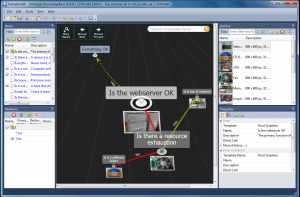
    KnowledgeBase Builder launches with a sample mind map covering the process of troubleshooting a web server. And at first this just looks like a more attractive flowchart, with questions like “Is it out of memory?” and “Is it a software failure?”, and yes/ no arrows leading from these to some other step. But actually this is just the start.

    The example map looks basic, yes, but this is only because the initial view is hiding its complexity from you. If you click one of the questions on the map — “Is it out of memory?”, say — then the program will zoom in on that point, display an extra question, and other issues which you might want to consider (“Is the CPU overloaded?”). Clicking new questions will do the same thing, and the whole map quickly becomes an interactive tool, leading you through the process to help figure out whatever you might need to do.

    Not every mind map requires this dynamic approach, of course, but if you’d prefer a more static view then that’s possible, too. Just keep clicking “More Details” at the top of the map pane and KnowledgeBase Builder will expand the map, showing more and more information, until it’s all visible (subject to your screen size, anyway).

    If the example map doesn’t interest you, however it’s displayed, then KnowledgeBase Builder has something else you can try. Click File > New, then Tools > Generate Site Map, point the program at www.google.com, and in a few seconds you’ll have a map showing the initial pages on the Google site. This can be excellent way to visualise site structure, especially as it’s so dynamic: you can click on a page, move to it, see all the pages available from that link, and more.

    And, of course, once you understand how this all works then you can begin to enter the objects and relationships necessary to build maps of your own. Although this may take quite some time; there are lots of options here, and vanishingly little help.

    One major issue with all of this is there’s no way to export your maps in a standard format that others can view them immediately (you can save the details in a CSV file, but that probably won’t help you very much).

    Still, you can show people a map on your own system. And as the KnowledgeBase Builder is just a single executable, you could always zip up your own database with a copy of the program if you need others to see it. Plus the maps look so good that even just printed copies may be useful. So, while there limitations here, if you’ve any interest in this kind of tool then InfoRapid KnowledgeBase Builder definitely deserves a closer look.

    Photo Credit: Creativa/Shutterstock

  • Google strikes back at BT with patent suit, but mediation looms

    Google has sued BT, the British telecoms giant, in both the U.S. and the U.K. over alleged patent infringement, but the facts behind this and other disagreements between the two firms remain murky.

    The patents in the U.S. suit (CNET has located a copy of the court documents) mostly originated from IBM – two cover the reservation of system resources for assuring quality of service, and one deals with assigning connection capacity in a multi-tiered data-processing network. A fourth patent, which was originally obtained by Fujitsu, also covers a “gateway for internet telephone”.

    All pretty broad and, according to Google, infringed by BT’s wholesale quality of service products and OneVoice unified communications system. Google is asking the U.S. courts to order BT to stop infringing and to pay Google damages.

    The British suit is somewhat more mysterious. While some reports overnight suggested that BT had not yet been served with that suit, the company told me this morning that this has indeed happened. Beyond that, it refused to comment on the specifics of the suit. It’s worth reminding ourselves here that the British patent system is quite different from that of the U.S. – it is far trickier there to patent “business methods” — so it would be a mistake to assume a direct correlation between the two cases.

    However, I did get some interesting information from a source within BT: firstly, that the company sees this as “predictable” retaliation for BT’s lawsuit against Google (filed more than a year ago), but also that that 2011 case is going to mediation this coming July. In my own analysis, this makes it possible that Google’s suit against BT is intended as leverage for that meeting.

    Google itself has said in a statement that it “always [sees] litigation as a last resort” and is defending itself against both the 2011 suit and BT’s “arming [of] patent trolls” – a clear reference to Steelhead’s January lawsuit against Google (and half the tech industry) using patents it had bought from BT.

    However, BT has always maintained that it has “no involvement” with the Steelhead suit, telling me last month that it sold all the rights to the relevant patents last year and would receive no share of Steelhead’s licensing income. Someone is misrepresenting the facts here, and it may be a while before we find out who that is – if indeed we ever do.

    Related research and analysis from GigaOM Pro:
    Subscriber content. Sign up for a free trial.

  • Entertainment Restaurant Chain Raises Financing

    A regional operator of family dining and entertainment centers (the company) has announced the successful refinancing of its existing senior and subordinated debt financing. The capital was structured as a one stop multi-tranche facility provided by a syndicate of lenders. FocalPoint Securities served as the company’s exclusive financial advisor.

    PRESS RELEASE

    A regional operator of family dining and entertainment centers (the “Company”) announced the successful refinancing of its existing senior and subordinated debt financing. The capital was structured as a one stop multi-tranche facility provided by a syndicate of lenders. FocalPoint Securities, LLC (“FocalPoint”) served as the Company’s exclusive financial advisor.

    The Company’s locations combine the excitement of large amusement parks with a multi-themed casual dining experience. Offering an assortment of quality food options at an affordable price point and more than 100 games and attractions, the Company has successfully established a footprint of 10 locations throughout the Western United States.

    As the Company’s senior debt facility approached maturity, they needed a new capital structure that not only provided additional financing for new location development but one that maximized cash flow after debt service to support the management team’s vision for growth. FocalPoint met the Company’s requirements by bringing together a group of mezzanine lenders to create a non-traditional uni-tranche structure. As part of the senior and subordinated debt refinance, the Company also secured a delayed draw term loan to support new location development.

    The CEO and founder of the Company stated, “We are very pleased to have closed this financing with a very supportive group of lenders. It was important for us to identify lenders that shared our vision to grow what we believe to be an appealing cost-effective dining and entertainment experience for families. Our growth strategy required a capital structure that provided financial flexibility and capital to support the continued expansion. FocalPoint was instrumental in delivering numerous alternatives and then created a capital structure that provided us with best option to fund our vision for growth and expansion”.

    Rajesh Sood, Managing Director at FocalPoint commented, “It was a pleasure to have worked with this management team. While the great recession had a significant impact on the restaurant industry, it is a testament to the skill and tenacity of this management team to have maintained their profitability in the face of such challenges. FocalPoint continues to be one of the most active advisors in the location based entertainment industry.”

    Rod Guinn, Restaurant Industry Coverage Leader at FocalPoint, added, “FocalPoint believes identifying the appropriate investor or lender for clients in the restaurant industry results from our ability to understand and communicate the client’s unique strengths, whether they be menu-centric, operational, strategic, or geographic; in this case, we were able to demonstrate how these unique systems bolstered the brand’s resilience and capacity for growth.”
    About the Company
    Founded in 1997, the Company is a leading operator of buffet-style family dining and entertainment locations. With an average facility size of over 45,000 square feet, it offers high quality food at an attractive price and a wide array of games and activities including: virtual games, laser tag, bumper cars, indoor miniature golf, amusement park rides and redemption games. The Company currently has 10 locations throughout the Western United States.

    About FocalPoint
    FocalPoint, with offices in Los Angeles and Chicago, is an independent investment bank specializing in mergers and acquisitions, private placements (both debt and equity), and financial restructurings/work-outs. The firm’s primary focus is on middle-market companies.

    Please contact Rajesh Sood at (310) 405-7050 or Rod Guinn at (505) 828-4662 at with any questions about this transaction.

    The post Entertainment Restaurant Chain Raises Financing appeared first on peHUB.

  • Zhongpin Enters Into Amended Merger Agreement with Golden Bridge

    Zhongpin, a meat and food processing company in the People’s Republic of China, has entered into an amended merger agreement with Golden Bridge. The merger will be financed through a combination of an equity commitment of $85 million by China Wealth Growth Fund I LP and a $320,000,000 term loan facility from China Development Bank Corporation Hong Kong Branch.

    PRESS RELEASE

    Zhongpin Inc. (HOGS) (“Zhongpin”, the “Company”, “we”, “us” and “our”), a leading meat and food processing company in the People’s Republic of China, today announced that the terms of the previously announced definitive agreement and plan of merger by and among Golden Bridge Holdings Limited, a Cayman Islands exempted company (“Parent”), Golden Bridge Merger Sub Limited, a Delaware corporation and wholly owned subsidiary of Parent (“Merger Sub”) and Mr. Xianfu Zhu, the Company’s Chairman and Chief Executive Officer, dated as of November 26, 2012 and amended on January 14, 2013, have been amended and restated.

    The amended and restated agreement and plan of merger (the “Amended Merger Agreement”) provides that each share of the Company’s common stock issued and outstanding immediately prior to the effective time of the merger will be converted into the right to receive $13.50 in cash without interest, except for shares owned by (i) Parent or Merger Sub, (ii) Mr. Xianfu Zhu, Mr. Baoke Ben, Mr. Chaoyang Liu, Mr. Qinghe Wang, Mr. Shuichi Si and Ms. Juanjuan Wang (collectively, the “Rollover Holders”), who are party to an equity contribution agreement pursuant to which they have agreed to contribute their shares of Company common stock to Parent immediately prior to the effective time of the merger, (iii) the Company or any direct or indirect wholly-owned subsidiary of the Company or (iv) stockholders who have properly exercised and perfected appraisal rights under Delaware law. The Amended Merger Agreement amends and restates the original agreement and plan of merger to, among other things: (i) remove the provisions allowing the Company to initiate, solicit and encourage, whether publicly or otherwise, any alternative transaction proposals from third parties (i.e., the “go-shop” provision); (ii) remove the right of the Company to terminate the merger agreement at any time for any reason (and without payment of any termination fees) on or prior to February 8, 2013; and (iii) reduce the amount of the termination fee payable by the Company in specified circumstances.

    Parent and Merger Sub intend to finance the merger through a combination of an equity commitment of $85 million by China Wealth Growth Fund I L.P. and a $320,000,000 term loan facility from China Development Bank Corporation Hong Kong Branch.

    The Company’s Board of Directors, acting upon the unanimous recommendation of the Special Committee formed by the Board of Directors, approved the Amended Merger Agreement and resolved to recommend that the Company’s stockholders vote to adopt the Amended Merger Agreement. The Special Committee, which is composed solely of independent directors unrelated to any of Parent, Merger Sub or any of the management members of the Company, negotiated the terms of the Amended Merger Agreement.

    The merger, which is currently expected to close in the second quarter of 2013, is subject to the adoption of the Amended Merger Agreement by an affirmative vote of (i) stockholders holding at least a majority of the outstanding shares of Company common stock and (ii) stockholders holdings at least a majority of the outstanding shares of the Company’s common stock other than shares owned by Parent, Merger Sub, the Rollover Holders or any of their respective affiliates at a special meeting of the Company’s stockholders which will be convened to consider the adoption of the Amended Merger Agreement, as well as certain other customary closing conditions. The Amended Merger Agreement may be terminated under certain circumstances, including, among others, termination by mutual agreement of the parties or by either party if the merger is not consummated on or before November 26, 2013. Mr. Xianfu Zhu and the other Rollover Holders have agreed under a voting agreement to vote all of the shares of Company common stock owned by them (which, as of the date of the Amended Merger Agreement, comprises an aggregate of approximately 26% of the outstanding shares of the Company’s common stock) in favor of the adoption of the Amended Merger Agreement. If completed, the merger will, under Delaware law, result in the Company becoming a privately-held company, wholly-owned by Parent. Following the merger, the Company’s common stock will no longer be listed on the NASDAQ Global Select Market.

    Cowen and Company (Asia) Limited and Duff & Phelps Securities, LLC are serving as independent financial advisors to the Special Committee. Akin Gump Strauss Hauer & Feld LLP is serving as United States legal advisor to the Special Committee and O’Melveny & Myers LLP is serving as United States legal advisor to the Company. Skadden, Arps, Slate, Meagher & Flom LLP is serving as United States legal advisor to the buyer group. Credit Suisse is serving as financial advisor to the buyer group. Paul Hastings Janofsky Walker is serving as legal advisor to Cowen and Company (Asia) Limited and Winston Strawn LLP is serving as legal advisor to Duff & Phelps Securities, LLC.

    Additional Information about the Merger
    The Company will furnish to the Securities and Exchange Commission (the “SEC”) a report on Form 8-K regarding the proposed merger, which will include the Amended Merger Agreement. All parties desiring details regarding the proposed merger are urged to review these documents, which will be available at the SEC’s website (http://www.sec.gov).

    The Company and certain of its directors, executive officers and other members of management and employees may, under SEC rules, be deemed to be “participants” in the solicitation of proxies from our stockholders with respect to the proposed merger. Information regarding the persons who may be considered “participants” in the solicitation of proxies will be set forth in the proxy statement and Schedule 13E-3 transaction statement relating to the proposed merger when it is filed with the SEC. Additional information regarding the interests of such potential participants will be included in the proxy statement and Schedule 13E-3 transaction statement and the other relevant documents filed with the SEC when they become available.
    This announcement is neither a solicitation of proxy, an offer to purchase nor a solicitation of an offer to sell any securities and it is not a substitute for any proxy statement or other filings that may be made with the SEC should the proposed merger proceed.

    About Zhongpin
    Zhongpin Inc. is a leading meat and food processing company that specializes in pork and pork products, vegetables, and fruits in China. Its distribution network in China covers 20 provinces plus Beijing, Shanghai, Tianjin, and Chongqing and includes 3,447 retail outlets as of September 30, 2012. Zhongpin’s export markets include Europe, Hong Kong, and other countries in Asia.

    The post Zhongpin Enters Into Amended Merger Agreement with Golden Bridge appeared first on peHUB.


  • Morning Advantage: Heavy Metal Management

    It was only a matter of time before someone would wonder: Can rock music be a metaphor for business? That time came in 2010, reports The Guardian, when two aging Swedish financiers attended Freak Guitar summer camp in bucolic Härsjösand outside Gothenburg. The result, Heavy Metal Management, was Sweden’s best-selling book this past Christmas season, racking up 10,000 electronic downloads in the first two weeks of January alone.

    As often happens with extended metaphors, many of the insights seem vaguely prosaic (like the main one, its “pentagram of six” — “Be epic. Be a master. Be instinctive. Be sensory. Be forever. Be total.”). Still, its message — that intense passion and connecting to your audience (and backers) via storytelling will carry you further than a focus on shareholder value creation — has (dare we say it) struck a chord among the Swedish start-up community. But why take their word for it? The English translation will be out in March.

    POWER TO THE PEOPLE

    Four Ideas to Moderninze the Labor Movement (WBUR Cognoscenti)

    Union membership fell in 2012 to its lowest level since 1916, even in the wake of 30 years of wage stagnation, growing income inequality, and cutbacks in pensions and insurance coverage. Thomas Kochan offers unions four suggestions for restoring their relevance: 1) Develop a national on-line survey that workers can use to rate workplaces, and publish the results widely on a smart phone app. 2) Offer lifetime union membership, so workers who move from job to job and industry to industry can get access to union-sponsored education and retraining. 3) Expose employers who exploit low-wage workers using social media. 4) Focus more on collaborative models of labor-management relations aimed at increasing employee engagement.

    THERE GOES THAT EXCUSE

    What Really Happens When You Miss that Earnings Mark (McKinsey Quarterly)

    Leaders of public companies often cite the pressure to meet or beat consensus earnings estimates as justification for a focus on the short term. But McKinsey’s analysis of hundreds of large U.S. companies over the last seven years shows those fears are unfounded. “In the near term, falling short of consensus-earnings estimates is seldom catastrophic,” McKinsey says, pointing out that more than 40% of the companies did at some time generate earnings below consensus estimates. But missing by 1% led to an average share price decrease of only 0.2% in the ensuing five days. Nor is consistently beating estimates rewarded. In fact, 40% of companies saw their share price move the opposite way they missed their estimates. The only thing that did matter was when a company consistently missed estimates all year in at least four of the seven years.

    BONUS BITS:

    It’s Not Too Late

    Ten Valentine’s Day Gifts for Awkward Love Stages (Your Tango)
    Do Siri and Google Now Mean the End of the App? (Technology Review)
    Why and How Silicon Valley Thrives — From One of its Founding Fathers (Stanford Business)