Category: News

  • Reuters- University Endowments Down in FY2012

    U.S. college and university endowments posted an average loss of 0.3 percent for fiscal 2012, a sharp reversal from a gain of 19.2 percent a year earlier, pressured by volatile international equity markets, according to a study released on Friday. Institutions with the biggest endowments reported the highest returns, according to a study by Commonfund Institute and the National Association of College and University Business Officers, Reuters wrote. For the fiscal year ended June 30, 2012, endowments of more than $1 billion had the best returns, with a gain of 0.8 percent. The lowest rate of return was for endowments with assets between $51 million and $100 million, at a loss of 1.0 percent, the study showed.

    (Reuters) – U.S. college and university endowments posted an average loss of 0.3 percent for fiscal 2012, a sharp reversal from a gain of 19.2 percent a year earlier, pressured by volatile international equity markets, according to a study released on Friday.

    Institutions with the biggest endowments reported the highest returns, according to a study by Commonfund Institute and the National Association of College and University Business Officers (NACUBO).

    For the fiscal year ended June 30, 2012, endowments of more than $1 billion had the best returns, with a gain of 0.8 percent. The lowest rate of return was for endowments with assets between $51 million and $100 million, at a loss of 1.0 percent, the study showed.

    “It was a very bad year for international equities; you had China slowing down, euro zone problems, so it had a very negative impact on equities outside the United States, that was a big drag on those portfolios exposed,” Verne Sedlacek, president and chief executive of Commonfund, told a press conference.

    The study was based on data from 831 U.S. institutions with endowment market assets totaling $406.1 billion.

    Over the last 10 years, endowments generated average annualized returns of 6.2 percent, out-performing the 5.5 percent gain posted by Standard & Poor Index for the same period, Sedlacek said. Those returns, however, still trail institutions’ average long-term target rate of 7.4 percent.

    “The 6.2 percent sounds pretty good, but actually over the last 10 years, with the financial crisis, with the recession, universities have lost ground when you adjust for inflation,” Sedlacek added.

    Longer-dated fixed-income investments generated the highest return with an average of 6.8 percent, while international equities produced a loss of 11.8 percent.

    While endowments with assets over $1 billion reported the smallest fixed income allocation, at 9 percent, they realized the highest return from this asset class, an average of 9.1 percent, the report showed. Endowments with assets under $25 million benefited from the largest fixed income allocation, at 29 percent, despite reporting the lowest return, an average of 6.1 percent.

    International equity markets were the biggest drag on all the institutions, large and small. All groups, from those with assets under $25 million to those with over $1 billion reported losses ranging from 13.2 percent to minus 10.5 percent in their international equity allocations.

    In alternative strategies, which returned just 0.5 percent, private equity showed the largest return, at 5.1 percent, compared with 18.7 percent in the previous fiscal year.

    Marketable alternatives, also known as hedge funds, showed a loss of 1.2 percent compared with a 9.4 percent return the previous fiscal year. Commodities also disappointed.

    “You would think that in a year with a relatively flat stock market that hedge funds should do pretty well relative to the U.S. market, and that was not the case in fiscal 2012,” Sedlacek said, adding that hedge funds are active stock pickers and they did poorly relative to a passive approach.

    The effective spending rate, or the percentage of an endowment’s value at the beginning of the year allocated for operating expenses, was 4.2 percent for the 2012 fiscal year, compared with 4.6 percent the previous period, while decreases in gifts and donations to endowments have been a cause for concern in the aftermath of the 2008-09 financial crisis.

    The post Reuters- University Endowments Down in FY2012 appeared first on peHUB.

  • Free up disk space by uninstalling unwanted software with Should I Remove It?

    When you’re looking to improve your PC’s speed and stability then there are plenty of actions you might take, but one of the most effective is often just to uninstall any applications, add-ons and extras which you don’t really need. You’ll free up plenty of system resources, and that alone could help to deliver a real performance boost.
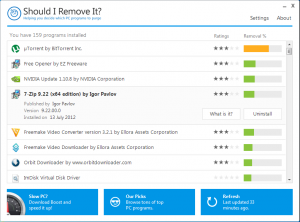
    You’ll have to figure out exactly which programs you need to keep, though, and which can be safely uninstalled, and that can be a challenge if you’ve hundreds of apps to explore. Don’t worry, though, because Should I Remove It? is here to help: just download the program, the authors say, “and within seconds we will help you purge your PC”.

    As Should I Remove It? is all about reducing clutter, it was good to see the program come in the form of a very small download (1.16MB), which doesn’t include any adware itself. Installation is quick and easy, and within a moment or two we were looking at a list of our installed applications.

    The program displays software in the order in which it’s removed by other program users, with the most-often-dumped at the top. Presumably the theory here is that if everyone else is uninstalling it, then perhaps you should consider doing so, too — but we’re not sure this logic really holds, especially when we looked at the list on our test PC. Was uTorrent really the program most worthy of uninstalling on our system, for instance? Does it really make sense that a program as useful as 7-Zip should appear in 4th place, or that Freemake Video Converter and Downloader would follow immediately afterwards?

    If we scrolled to the bottom of the list, then, to find the programs most rarely removed, would that tell us anything more helpful? No, not really — the app with the lowest removal rating on our system was the “Microsoft All-In-One Code Framework Sample Browser”. And we’d hazard a guess that’s just because hardly anyone else has ever installed it.

    The opening program list doesn’t tell you much useful, then, but fortunately Should I Remove It? has another useful trick. When you scroll through your applications you may find some you don’t recognize, or otherwise decide you’d like more information about them. And if you click that app, and select “What is it?”, Should I Remove It? will open a web page which tells you more.

    Launch the page for Orbit Downloader, say, and you’ll see a basic description of the program’s functionality, and a link to the developer. There are key program details, including the installation folder, uninstaller location, and files installed by the program, as well as their purpose (so for example you’ll read that “orbitnet.exe” is the Orbit P2P service).

    The “Behaviors exhibited” information then explains more about what the program does on your system. Which in Orbit’s case means installing a couple of IE extensions (listed here with the file names and ClassID), as well as adding a couple of Windows Firewall exceptions.

    And there’s even more, including the Windows versions it runs on, the rating given to the program by other users, the PC manufacturers who install it, and the list goes on.

    Should I Remove It? can’t immediately tell you which programs to keep, and which to uninstall, then. But it can help you in your own research by providing a great deal of useful information about your installed applications. And because it’s so small and hassle-free itself, the program will probably make a good addition to most PCs.

    Photo Credit: Pavel Ignatov/Shutterstock

  • Google Gets Its Act Together: New Nexus 4 Orders Reaching Customers In As Little As 48 Hours

    n4-product-hero

    Google is apparently doing a good job of improving its supply stream issues and making good on promised delivery times for customers for new Nexus 4 orders – better than good, in fact. UK customers are reporting this morning (via CNET) that the Nexus 4 devices they ordered when Google released its latest crop of phones this past Wednesday are already arriving at their doorsteps, less than 48 hours later.

    Google had predicted that phones would take 1 to 2 weeks to arrive at the homes of those placing new orders when the phones went on sale, but it clearly seems to have done something right, either on its end or in terms of getting LG to deliver more consistently. A 48 hour turnaround not only blows that out of the water, but also represents a 180-degree change in direction from the lengthy six-, seven- and eight-hour waits customers were running into just before the new year.

    U.S. orders also went live again earlier this week, but no word on whether or not those devices are being shipped out yet. Let us know if you’re receiving or have received your new Nexus, but from the looks of what’s happening in Britain, Google has learned a few lessons about being the purveyor of an in-demand piece of hardware, and looks to actually be able to manage supply. Which isn’t to say it’s able to meet demand yet; in fact, we’re probably still fairly far off from that, given how quickly the Nexus 4 sold out and how stock continues to be a bit of a mixed bag internationally, I doubt that Google has reached supply equilibrium quite yet.

  • The Future of Talent Is in Clusters

    An effective team is a powerful thing. Many of us have participated on teams where the members complement each other, trust each other and find ways of working that are not only effective, but also enjoyable. For teams like this, performance is typically much higher than might be expected of the sum of individuals.

    And yet while teams often are where the real work gets done, most businesses don’t value or manage them well. Many businesses aren’t skilled in talent management or team nurturing. Team management, in particular, is often a scarcely recognized activity.

    What’s more, most employees don’t work in high-performing teams for long periods — team members move on, projects finish, and other pressing needs come to the fore. While it’s part of the normal course for organizations, disbanding well-functioning teams is actually a value-destroying activity, eradicating the “team capital” built and stored in the team. Because businesses don’t fundamentally recognize such teams as entities beyond the activity they are performing, this value destruction seems inevitable.

    But what if there was another way? One in which organizations capitalize on the inherent value of a well-functioning team? One where the organization evolves its management style to let teams self-manage to preserve their culture and value?

    A New Kind of Team: Clusters

    Clusters are a radical alternative to our traditional notion of teams. They are formed outside a company context, but are hired and paid by companies as a unit, as a permanent part of the company. They manage, govern and develop themselves; define their own working practices and tools; and share out remuneration. Technology trends and tools like the cloud, and collaboration suites, are evolving to make this more and more workable.

    The business or agency treats the cluster as an atomic unit of resource and it hires, fires and positions the cluster as a unit. Likewise, each cluster appears as such a unit in the business’s organization chart. Clusters plug together like Lego bricks to achieve the business’s goals.

    A cluster is not the same as a consulting model. The main difference is that clusters will typically be hired permanently by a business with a mutual intention to commit for the long term. As such, a cluster can be considered a real asset of the business, just as high-performing staff members are today. Also, the cluster model puts extreme emphasis on teams that learn how to work well together and determine their own tools and work practices. This is not always true of consultancies. An individual can be in different clusters over time, and possibly in multiple clusters at once, similar to a conventional part-time work model. Similar approaches can and should be applied to consultancy models.

    Clusters Manage Themselves

    A cluster typically consists of five to eight people, is hired by a business with a clear scope of work, and remunerated based on outcomes. Clusters have already established shared values, work practices, tools, and roles, such as who is good at what. Balancing team roles can be particularly important to avoid the Apollo effect, where every team member needs his or her idea to dominate and the team is unable to come to a consensus. Clusters actively seek the variety of skills, talents, and personalities necessary to create a high performing team (see the Belbin model for a good example of nine discrete team roles.)

    While there are close equivalents of clusters in a few corners of the working world (elite military teams, medical units, and TV and film crews), this model could and should pervade much further into the working world, possibly and ultimately for all operational and project work, and sometimes even for leadership teams. I would project that by 2020, 30% of work will be performed by permanently employed, self-managed clusters.

    The cluster manages itself by finding, hiring and firing members; governing itself and resolving conflicts; creating and sustaining work practices and tools; and managing its engagement with other clusters, teams, people and organizations in order to fulfill its direct business goals and to nurture itself.

    In short, a cluster is an extreme version of a self-managed team. It is extreme because the enterprise only has a formal legal and financial relationship with the cluster, not its members. Note that while a cluster is self-managed, it is not typically a self-directed team. Self-directed teams define their own goals, whereas clusters agree on outcomes with the businesses for which they work.

    Clusters Create More Value

    Clusters offer four main benefits:

    Higher levels of business performance through higher motivation. The cluster model, when executed well, addresses known performance drivers such as purpose, autonomy, and mastery (see Daniel Pink’s book Drive for more on these).

    Higher levels of business performance through a custom work environment. Clusters can create and sustain leading-edge electronic work environments since they are less burdened by bureaucratic decision-making and the need to serve the diverse needs of many types of teams and individuals.

    Talent management in the right place. The cluster model removes the burden of team and individual performance management from the business — where it typically sits uncomfortably and ineffectually today — to the cluster. The cluster knows its own members, contributions and development needs much better.

    Higher levels of personal happiness. Clusters are sufficiently small for members to genuinely know and care about each other, and they are stable and autonomous enough for members to support each other’s long-term personal development.

    Clusters Have Risks, But They Are Manageable

    For the cluster model to work well, with businesses hiring, firing, positioning and remunerating clusters as atomic units, considerable changes are needed in the macro work environment, to HR and payroll, recruitment agencies, legal, financial, and real estate. Even if these macro changes are made, there are two main real and perceived risks with the cluster model: the formation of mini silos, and the inability to retain clusters or their loyalty. The key to success is to ensure that the cluster’s agreed-on scope of work includes appropriate levels of commitment to, and multiple interfaces with, broader corporate goals and initiatives.

    Eventually, wherever the cluster model is adopted, businesses will need to work hard at managing and leading them well, just as they have always done for their emerging talent assets — ensuring that the best are motivated to stay, the worst are inclined to go, and those in the middle are motivated to improve.

  • Reuters – Clearwire Continues Review of Dish offer, Recommends Sprint Deal

    Clearwire Corp. said on Friday that it was still evaluating an offer from Dish Network Corp to buy the company for $3.30 per share even as it recommended that shareholders vote for a rival offer from Sprint Nextel Corp. Clearwire, which agreed in December to a $2.97-per-share buyout by Sprint, also said it would not draw on a $80 million offer of financing from Sprint Nextel in February because it is still evaluating the Dish offer, Reuters reported.

    (Reuters) – Clearwire Corp said on Friday that it was still evaluating an offer from Dish Network Corp to buy the company for $3.30 per share even as it recommended that shareholders vote for a rival offer from Sprint Nextel Corp.

    Clearwire, which agreed in December to a $2.97-per-share buyout by Sprint, also said it would not draw on a $80 million offer of financing from Sprint Nextel in February because it is still evaluating the Dish offer.

    The post Reuters – Clearwire Continues Review of Dish offer, Recommends Sprint Deal appeared first on peHUB.

  • Clarion Partners Promotes Four

    Real estate investment manager Clarion Partners has promoted four to directors at the firm. Gary Rufrano focuses on acquisition and development opportunities in the Northeast, Midwest and Texas, and joined the firm in 2001. Richard Schaupp is a Portfolio Manager, and also supports investment activities in Brazil. Schaupp joined Clarion Partners in 2000. Tim Wang is head of the Clarion Partners Investment Research Group, and joined Clarion in 2006. Douglas Wolski is the assistant portfolio manager of a $6.8 billion portfolio invested in 147 assets across the United States. He joined the firm in 2006.


    PRESS RELEASE

    Clarion Partners, LLC, a leading real estate investment manager, announced today that it has named four of its senior professionals as Directors of the firm.
    Gary E. Rufrano is a member of the Clarion Partners Acquisition Group, with responsibilities for acquisition and development opportunities in the Northeast, Midwest and Texas. He joined Clarion Partners in 2001.
    Richard H. Schaupp is a Portfolio Manager, with a focus on value-added and opportunistic investment activities at the firm. He also supports Clarion Partners’ investment activities in Brazil. Schaupp, who leads the firm’s Sustainability program, joined Clarion Partners in 2000.
    Tim Wang, Ph.D., is head of the Clarion Partners Investment Research Group, responsible for advising on investment strategy utilizing proprietary analytics and econometric forecasting. He oversees the research function at Clarion Partners and is also a member of the firm’s Investment Committee. Wang joined Clarion in 2006.
    Douglas F. Wolski is the Assistant Portfolio Manager of a $6.8 billion portfolio invested in 147 assets across the United States. He joined the firm in 2006.
    “We believe strongly in recognizing the contributions of the accomplished professionals at Clarion,” said Stephen J. Furnary, Chairman and CEO of Clarion Partners. “These individuals have consistently demonstrated superior performance, outstanding leadership, and exceptional initiative. We are pleased to welcome them to our senior management team.”

    Press Contact: Mike MacMillan/Chris Sullivan
    MacMillan Communications (212) 473-­‐4442, [email protected]

    About Clarion Partners LLC
    Clarion Partners has been a leading U.S. real estate investment manager for over 30 years. Headquartered in New York, the firm has offices in major markets throughout the U.S., in S͠ ão Paulo, Brazil and London, England as well as a presence in Mexico. With more than $25 billion in total assets under management, Clarion Partners offers a broad range of real estate strategies across the risk/return spectrum to its more than 200 domestic and international institutional investors.
    More information about the firm is available at www.clarionpartners.com.
    Disclaimer
    Some information contained herein is derived from selected third party sources believed by Clarion Partners to be reliable, but no representation or warranty is made regarding its accuracy or completeness. Opinions and forecasts expressed reflect the current judgment of Clarion Partners’ Investment Research Group and may change without notice. Nothing herein constitutes an offer or solicitation of any product or service to any person or in any jurisdiction where such offer or solicitation is not authorized or is prohibited by law. Past performance is not necessarily indicative of future results.

    The post Clarion Partners Promotes Four appeared first on peHUB.

  • Reuters – Dell Nears Buyout Deal

    Dell Inc. is nearing an agreement to sell itself to a buyout consortium led by its founder and Chief Executive Michael Dell and private equity firm Silver Lake Partners, possibly announcing a deal as soon as Monday, Reuters reported, citing two people familiar with the matter. Michael Dell is expected to take majority ownership of the world’s third-largest personal computer maker, which currently has a market value of $23 billion, while Silver Lake and Microsoft Corp. would become minority investors, a third person familiar with the matter said. The final price the group is expected to pay Dell shareholders could not be immediately learned. The deal would mark the largest leveraged buyout since the global financial crisis.

    (Reuters) – Dell Inc is nearing an agreement to sell itself to a buyout consortium led by its founder and Chief Executive Michael Dell and private equity firm Silver Lake Partners, possibly announcing a deal as soon as Monday, according to two people familiar with the matter.

    Michael Dell is expected to take majority ownership of the world’s third-largest personal computer maker, which currently has a market value of $23 billion, while Silver Lake and Microsoft Corp would become minority investors, a third person familiar with the matter said.

    The final price the group is expected to pay Dell shareholders could not be immediately learned. The deal would mark the largest leveraged buyout since the global financial crisis.

    The transaction is set to be finalized over the weekend but the buyout consortium is working on last-minute details and the timetable could still slip, the people cautioned, asking not to be named because the matter is not public.

    The investment group, which held negotiations with Dell’s camp in New York on Thursday, has secured up to $15 billion of debt financing to take Dell private from four investment banks — Barclays, Bank of America Merrill Lynch, Credit Suisse and RBC Capital, people familiar with the matter said.

    Barclays is also advising Silver Lake on the transaction, along with Perella Weinberg Partners, said two of the people. JPMorgan Chase & Co is advising Dell.

    Representatives for Dell, Microsoft and Barclays declined to comment. Silver Lake and Perella Weinberg could not be immediately reached for comment.

    As part of the transaction, Michael Dell will contribute his existing stake of almost 16 percent in the company toward gaining majority ownership, sources close to the matter have said.

    Going private would allow Dell, which has been trying to become a one-stop shop for corporate technology needs as the PC market shrinks, to conduct that difficult makeover away from public scrutiny.

    Dell has formed a special committee of its independent directors and hired Evercore Partners Inc to assess whether the company is getting the best deal for shareholders and not one that is just in the best interest of Michael Dell, several people familiar with the matter have told Reuters previously.

    (Additional reporting by Poornima Gupta in San Francisco and Bill Rigby in Seattle; Editing by Edwina Gibbs)

    The post Reuters – Dell Nears Buyout Deal appeared first on peHUB.

  • Crosslink Capital Adds David Courtney

    Crosslink Capital has added David Courtney as general partner and chief operating officer. He will be based in San Francisco. Previously, he served as Chief Executive Officer of JiWire Inc.

    PRESS RELEASE
    Crosslink Capital, a leading venture capital and growth equity firm, today announced that David Courtney has joined the firm as General Partner and Chief Operating Officer. His responsibilities include direct oversight of Operations, Finance, Compliance and Human Resources. He reports to Michael Stark, Founder and General Partner of Crosslink Capital, and is based in the firm’s San Francisco headquarters.

    “The Chief Operating Officer is an important component of our leadership team at Crosslink,” said Mr. Stark. “We have known David for many years. He has exceptional operational and leadership skills, as well as a strong background in compliance that will further strengthen the team we have in place today.”

    Prior to joining Crosslink Capital, Mr. Courtney served in several executive roles in the technology and digital media industry. Most recently, he served as Chief Executive Officer of JiWire, Inc., where he led the company through a period of rapid growth and oversaw its entry into new markets. Prior to JiWire, Mr. Courtney served as President and COO of Adify Corp. and as CFO and Board Member of TiVo TIVO +6.63% . In both of those roles, he had responsibility for operations, accounting and reporting, finance and planning, investor relations, human resources, as well as all legal activities. In addition to his role with the TiVo Board of Directors, he has previously served on the Boards of numerous public and private technology companies, often as the head of the audit committee.

    Mr. Courtney is also a veteran of the financial services industry. Most recently, he served as an Executive-in-Residence at Venrock, assisting the venture capital firm with its portfolio companies and assessing needs for both people and funding. He also has over 15 years of experience in investment banking at JP Morgan and Goldman Sachs.

    Mr. Courtney holds a B.A. degree from Dartmouth College, and an M.B.A. from Stanford University.

    “I first met Crosslink Capital when the firm became a value added investor in TiVo about 10 years ago,” noted Mr. Courtney. “I have always had great respect for their process and integrity. I am excited to join their team and help them address the operational needs of a growing investment firm. I am particularly excited to be able to do this for one that invests in both public and private companies, as the needs can vary.”

    About Crosslink Capital

    Crosslink Capital is a leading stage-independent venture capital and growth equity firm with over $1.6 billion in assets. Crosslink, which traces its roots back to 1989, was among the first and largest investment firms in the U.S. to integrate public and private growth/technology investing in three families of funds: venture capital funds, long/short hedge funds and a unique hybrid crossover fund. This strategy allows Crosslink to partner with its portfolio companies on a long-term basis. With more than 20 years behind it, Crosslink Capital has invested in over 100 private equity portfolio companies, at the early, mid, and late stages including Pandora P +0.52% , Ancestry.com , Omniture (acquired by Adobe Systems), Equinix EQIX +0.49% , Carbonite CARB +0.73% , SeaMicro (acquired by Advanced Micro Devices), Intematix, DataStax and Bleacher Report (acquired by Time Warner, Inc.). For more information on Crosslink, visit http://www.crosslinkcapital.com

    The post Crosslink Capital Adds David Courtney appeared first on peHUB.

  • Huawei finds favor at CERN: researchers sign up for more UDS cloud storage

    China’s Huawei may find business tough in the U.S. due to suspicions over its motives, but its cloud efforts are clearly appreciated elsewhere. A year after it started working with CERN on cloud storage – something of a priority for a research organization that generates more than 25 petabytes of physics data each year – Huawei has become an official CERN openlab partner, with at least three more years’ collaboration now assured.

    The new arrangement was announced on Thursday, along with confirmation of Russia’s Yandex becoming an openlab associate in the field of data processing. Huawei’s involvement is a bigger deal than that, as it puts the Chinese firm on a par with Intel, HP, Oracle and Siemens, all of which work particularly closely with CERN to see how their technologies can help with the Large Hadron Collider experiments.

    Huawei UDS cloud storageIn Huawei’s case, the company is contributing its self-healing UDS cloud storage system for use and validation. UDS is targeting the upcoming exascale (an exabyte is roughly a million terabytes) era with a mass object-based storage infrastructure that uses ARM’s energy-efficient processor architecture alongside cheap SATA disks. It also offers Amazon S3 API compatibility and claims eleven-nines (99.999999999 percent) reliability, so users theoretically don’t need to back up data stored in a UDS-toting cloud.

    UDS provides a bit of insight into how openlab works. Huawei first delivered a 384-node version of UDS to CERN in early 2012, after which the researchers played around with it for three months. In September of that year, Huawei released UDS to the general enterprise market (in more normal eight-node configurations). The benefits for both sides of this partnership are clear: CERN has to push technological limits in order to handle the very big data generated by the LHC, and Huawei gets both valuable feedback from the researchers and a glowing report card to show off to the wider world.

    As for the next steps in this partnership, CERN has now hired two computer scientists to work with Huawei on its implementation there, and more UDS storage systems will be deployed at the Swiss facility in the next few months.

    Related research and analysis from GigaOM Pro:
    Subscriber content. Sign up for a free trial.

  • With 18M iPhones sold during Q4, Apple outsells Samsung in U.S.

    For the first time ever, the iPhone was the most popular phone in the U.S. during the fourth quarter of 2012. Apple sold 17.7 million smartphones during the quarter, just barely edging out Samsung, which sold 16.8 million mobile phones during the same quarter, according to Strategy Analytics’ Wireless Device Strategy report published Friday. All told, 52 million phones were sold in the U.S. between October and December, and Apple and Samsung dominated the competition: together they sold two out of every three phones.

    The iPhone’s distinction as most popular phone during the quarter comes on Apple’s strength: holiday sales. However, for all of 2012 Samsung still bested all others including Apple — for the fifth year in a row — selling 53 million handsets, and maintaining a 32 percent share. Apple’s full year share of sales was 26.2 percent.

    Strategy Analytics smartphones Q4 12

    You’ll note that this chart is, somewhat unusually, only comparing three vendors: Apple, Samsung, LG and then “others.” But that essentially sums up the state of the U.S. smartphone market: Apple versus Samsung, and that’s about it.

    Apple’s 34 percent share of U.S. smartphones — all Apple phones are considered smartphones — sales during the fourth quarter is not likely to be a pattern we’ll see repeated outside non-holiday quarters: Samsung puts out many different models of phones throughout the year, compared to Apple’s single annual refresh, and barring something catastrophic happening at Samsung, it’s is likely to continue as the biggest mobile phone vendor in the U.S. for 2013.

    What could boost Apple’s chances of overtaking Samsung outside of holiday sales is if Apple started releasing multiple models of iPhones to reach many more new customers, either through more price options, new subscription options, as T-Mobile is planning, or more screen size choice — as some estimate could start as soon as this year.

    Related research and analysis from GigaOM Pro:
    Subscriber content. Sign up for a free trial.

  • Kim Dotcom offers a $13,500 bounty to anyone who can break Mega’s encryption

    Mega has come in for some criticism since it launched, with the likes of Ars Technica, among others, questioning exactly how secure Kim Dotcom’s new file storage and sharing service actually is. Cryptography researcher Steve Thomas even created a tool designed to reveal passwords stored in confirmation emails.

    But despite all this, Mega has so far proven to be a sturdy ship. Although it has had a few (quickly plugged) leaky holes, which is to be expected considering it’s still very new, nothing’s come along so far to sink it. And Kim Dotcom is so sure Mega’s security is uncrackable, he’s prepared to put his money where his mouth is.

    The brash entrepreneur announced his intentions in a tweet earlier, stating: “#Mega’s open source encryption remains unbroken! We’ll offer 10,000 EURO to anyone who can break it.”

    10,000 euros/$13,500 is a decent amount of cash up for grabs, and will likely appeal to hard up hackers looking to line their pockets and make a name for themselves (the first person to crack the high profile site will no doubt gain a lot of press attention). But I can’t help thinking that if Dotcom is truly convinced his site is uncrackable, the bounty would be much higher. Maybe it will increase the longer the site’s encryption goes unbroken.

    Things have certainly been busy behind the scenes at the new file locker. The service, which now lets you change or reset your password is, according to Dotcom, currently hosting around 50 million files. And the unofficial Mega search engine which popped up was quickly blocked after less than 24 hours.

  • Morning Advantage: Your Ergonomic Desk May Be Trying to Hurt You

    Sitting at your desk all day isn’t healthy. This is why some of us try to mix it up a bit. Take standing desks. A bunch of my colleagues use them, and I totally get the appeal. But if this piece at MarketWatch is any indication, the ergonomic fad — treadmill desks, anyone? — has reached the point of satire.

    People are falling. People are spraining knees. Even stability balls aren’t safe. A data-scientist, who’s quoted in the piece, says he hasn’t fallen off his orb at work per se, but he’s come really close. Be careful out there.

    But don’t worry. Management has it under control. When workers at the University of Kentucky requested treadmill desks, their bosses “brought in specialists from different departments — occupational health and safety, risk management, workers’ compensation and legal — to devise rules for the equipment’s use.” Take note: (1) don’t wear high heels and (2) walk slower than 2 miles per hour.

    A RIVER OF PENNIES

    As Music Streaming Grows, Royalties Slow to a Trickle (New York Times)

    For consumers, streaming sites such as Spotify and Pandora are great services. For musicians? Not so much. As Ben Sisario explains, musicians receive only a fraction of a penny every time a song is played. That’s right: a fraction of a penny. Sure, these services are a step up from Napster, but the question is whether “these micropayments can add up to anything.” So far the answer seems to be no — or at least not much. Take Zoe Keating, a cellist, whose music was played 131,000 times last year on Spotify. Her net? $541.71.

    ARE YOU NOT ENTERTAINED?

    The Right Way to Create a Superbowl Ad (HBS Working Knowledge)

    The cost of a 30-second spot during the Super Bowl on Sunday is $3.7 million. The advertising game plan: catch our attention in an entertaining fashion, and then hit us with the brand message. Makes sense, right? Well, according to new research by Thales S. Teixeira, advertisers should do the reverse: “If you want to persuade consumers as do Pepsi, Skittles, and Coke, it’s about getting people to associate your brand with fun… But you have to show the brand and then entertain. That’s when the conditioning occurs. The other way around — entertain then brand — doesn’t work as well.”

    BONUS BITS:

    Cases in Point?

    20 Most Effective Super Bowl Ads (Daily Beast)
    Love, Analytics and the Biology of You at Work (Sloan Management Review)
    NYC Wants Health Start-Ups to Shake Things Up (Inc.)

  • Podcast: Blackberry’s in a jam, no Facebook phone and Netflix’s excellent adventure

    It’s a special edition of the GigaOM Podcast this week as we welcome our very first non-GigaOM guest! After we talk with Kevin Tofel about RIM Blackberry’s Hail Mary event and Eliza Kern about Facebook’s move into mobile, we talk with Prof. Bob Sutton, author of the books Good Boss, Bad Boss and The No Asshole Rule about the enduring appeal of the Netflix culture deck.

    Subscribe to the RSS Feed

    iTunes

    Stitcher Radio

    SHOW NOTES:
    Hosts: Chris Albrecht and Erica Ogg
    Guests: Kevin Tofel, Eliza Kern and Prof. Bob Sutton

    00:00 – Intro and Blackberry’s new phones
    11:58 – Eliza Kern rounds up Facebook earnings and its mobile-first moves
    22:26 – Bob Sutton on the Netflix culture deck and scaling excellence in companies

    SELECT PREVIOUS GIGAOM PODCAST EPISODES:
    Call-in Show: 128 GB iPad? Straight Talk v. AT&T and Windows RT or Windows 8

    RoadMap Re-Run: Perry Chen on Creativity and Crowdsourcing)

    Gov’t grabs for Google data, Facebook search facepalms, Apple earnings insanity

    Podcast: Q&A, Google Voice on Windows Phone? Chromebook on iMac? AirPlay v. Bluetooth?

    Facebook’s Graph-ic Search, Open Compute is Kinda Cool, Netflix vs. TWC

    Why Big Data Will Be Even Bigger in 2013

    Related research and analysis from GigaOM Pro:
    Subscriber content. Sign up for a free trial.

  • Microsoft rolls out Bing apps for Office

    There are already Bing-powered apps for Windows 8, Windows Phone, and Xbox, and now Microsoft’s search platform has made some free apps for the software giant’s new Office 365 Home Premium suite (what, you thought Office 2013 was going to get some Bing love?)

    At the moment there are five apps on offer — Bing News Search for Office, Bing Finance (Beta) for Office, Bing Dictionary (English) for Office, Bing Maps for Office, and Bing Image Search for Office.

    According to Microsoft, “Our goal is to make Bing available in convenient and intuitive ways that take advantage of knowledge Bing has assembled for search… With Bing Apps for Office we are introducing ways for you to be more productive without having to leave the applications”.

    So what do the apps actually do? Well as you’d probably expect, Bing News Search for Office lets you search for news and related videos from within a Word document and paste in any stories.

    Bing Finance (Beta) for Office lets you build a finance portfolio table in Excel and input stock symbols, while Bing Dictionary (English) for Office provides spellings and definitions, and if you’re not at all sure how to spell a word, type it in as it sounds and Bing will attempt to identify it for you.

    With Bing Maps for Office people can plot location details on a map and the app also has a data visualization tool for Excel. As an example of what this could be used for, Microsoft says “imagine overlaying census data on a state map”. So go ahead and do that.

    Finally, Bing Image Search for Office lets you search for images on the web from within a Word document. Handy if you want a picture to illustrate your document or flier.

    The apps are all available to download now. Provided you have a copy of Office 365 Home Premium, of course.

    So what do you think about adding Bing apps to Office? Is it something you’d be likely to do? I have a two monitor setup at home, so use one screen for Office and the other for research, email and so on. But I can see these coming in handy on a laptop or tablet.

  • West Wing Week: 02/01/13 or “The Dude from Stillwater”

    This week, the President announced his choice for his new Chief of Staff, pushed for comprehensive immigration reform, and invited the Boys and Girls Club Youth of the Year, Presidential Innovation Fellows, law enforcement officials, 60 minutes, and the Miami Heat to the White House.

    read more

  • Apple can’t escape market realities

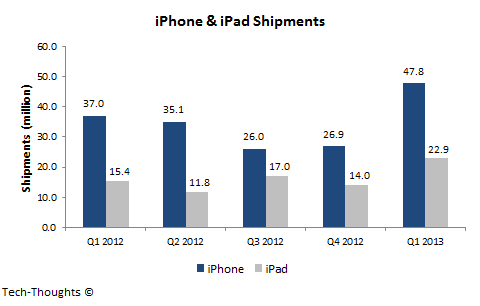
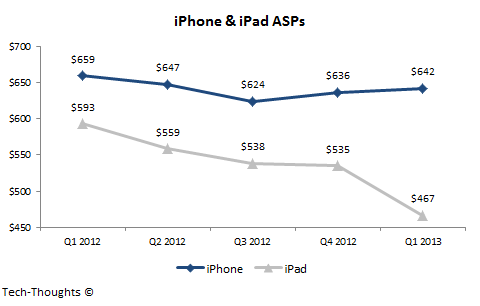
    Apple’s stock price tanked more than 12 percent the day after announcing fiscal 2013 first quarter earnings. Nine days later, shares are still down about 10 percent, in part because Q2 guidance came in below analyst consensus. The guidance, in particular, seems to have spooked investors as Apple announced its intentions to provide a realistic guidance, as compared to the usual “sandbagging”. The company also warned of lower margins — between 37.5 percent and 38.5 percent. In that context, let’s look at the average selling price movement chart and benchmark our previous iPad Mini cannibalization estimate.

    The shipment chart above clearly shows that iPhone growth has slowed during the current product cycle, thanks to market saturation. This should give Apple even more incentive to launch a cheaper iPhone. In contrast, the iPad has seen reasonably strong growth, but as I predicted, iPad Mini cannibalization seems to have pushed Q1 shipments below market expectations.

    The iPhone’s ASP has remained remarkably stable in Q1, given Apple’s move to exclude accessory revenue (~$10-$15 per device) from product categories. On the other hand, the iPad’s ASP took a nosedive because of the iPad Mini, especially compared to my ASP estimate of around $500 – the removal of accessory revenue doesn’t explain this fall, but it is directly related to cannibalization:

    Benchmarking iPad Mini Cannibalization

    My iPad sales estimate ranged from 24.5-26.2 million units, with iPad Mini cannibalization in the 50-percent to 70-percent range. At this point, I’m virtually certain that the higher end of my iPad Mini cannibalization estimate was accurate, but I seem to have missed something. In light of the limited iPad Mini supply, I had applied my cannibalization estimate on just iPad Mini sales and not iPad Mini demand, i.e. I inherently assumed that the iPad brand would cause the potential “cannibalized” iPad Mini buyer, to buy an iPad 2/iPad 4 in case of short supply. In hindsight, that seems to have been a silly assumption.

    It looks like those particular iPad Mini buyers either delayed their purchase or purchased a competing product (most likely a comparable & cheaper android tablet). Given my previous analysis, this is the only explanation I can think of for iPad sales coming in at 22.9 million.

    Market share figures for this quarter and iPad shipments over the next quarter should shed more light on purchasing decisions. If a majority of potential iPad Mini buyers delayed their purchases, we should expect the iPad to hold a 50-percent to 55-percent market share and iPad sales should remain strong or post a modest decline in Apple’s fiscal Q2. Today, IDC released tablet shipment estimates for calendar fourth quarter. Apple share fell to 43.6 percent, indicating a good many buyers chose not to wait for iPad mini. Combined share for ASUS and Samsung, which grew by several hundred present rose from 7.9 percent to 20.9 percent.

    Reprinted with permission from Tech-Thoughts

    Sameer Singh is an M&A professional and business strategy consultant focusing on the mobile technology sector. He is founder and editor of Tech-Thoughts.

  • HBO Go on Apple TV? It could arrive this year

    Two years after arriving in iOS devices, HBO may be coming to Apple TV. Apple is said to be in talks with Time Warner to bring its HBO Go app to its set-top box, according to a report from Bloomberg on Thursday. It could arrive by sometime around the middle of this year.

    HBO Go, which requires a subscription, is only available to users who get HBO from their cable provider, so it’s not a solution for cord cutters to simply pay for a la carte HBO programming separate from cable or satellite. But it’s a boon for HBO subscribers that who want to access the provider’s backlog of content: HBO Go makes every episode of every season of every HBO show available to subscribers.

    Apple has been reportedly in discussion with U.S. cable companies, including Time Warner, for many months about ways to bring cable content to its set-top box. The news that HBO Go could arrive by mid-2013 is the most significant sign that the two are making headway in the negotiations yet.

    This would not be the first time Time Warner has made HBO Go available on a set-top: it’s already on Roku set-top boxes and on Microsoft’s Xbox 360 console. Neither is it a first for Apple customers. HBO Go has been available as an app on the iOS App Store since 2011.

    But it would be a possible selling point for Apple as it continues to figure out what it wants to do with its television strategy. Though it sold 2 million set-top boxes during the final quarter of 2012, the company’s leadership won’t commit publicly to what the future holds for the device. CEO Tim Cook has moved from calling Apple TV a hobby to “an area of intense interest.”

    Related research and analysis from GigaOM Pro:
    Subscriber content. Sign up for a free trial.

  • Watch the Crunchies live stream here

    If you want to watch the Crunchies tonight, you’re going to have to tune in, as tickets have sold out for the annual awards show co-hosted by GigaOM, Techcrunch, and Venturebeat.

    The livestream below should kick off around 7pm, and the event starts at 730pm at Davies Symphony Hall in San Francisco. Most of our San Francisco-based crew will be in attendance, probably just to get a chance to hear comedian John Oliver of Daily Show fame host the show.

    A list of nominees follows below.

    Free desktop streaming application by Ustream

    Best Technology Achievement
    Baumgartner Jump
    Google Glass
    Mars Curiosity
    SpaceX docks with International Space Station
    Tesla Supercharger Network

    Best Collaborative Consumption Service
    Airbnb
    Get It Now/Postmates
    Lyft
    TaskRabbit
    Uber

    Best E-Commerce Application
    Fab
    Hotel Tonight
    Karma/Facebook Gifts
    Warby Parker
    Zulily

    Best Mobile Application
    Evernote
    Google Maps
    Grindr
    Instagram
    Square

    Fastest Rising Startup
    Exec
    Lyft
    Pinterest
    Snapchat
    Stripe

    Best Content Discovery Application
    Flipboard
    Instapaper
    Pinterest
    Prismatic
    Tumblr

    Best Design
    Facebook Timeline
    Medium
    Paper by FiftyThree
    Square
    Svbtle

    Best Bootstrapped Startup
    FreshBooks
    Instapaper
    Nimbus
    Techmeme
    Upverter

    Sexiest Enterprise Startup
    Asana
    Box
    Cloudera
    Plexxi
    Zendesk

    Best International Startup
    Hailo
    Rovio
    Soundcloud
    Spotify
    Xiaomi

    Best Education Startup
    Codecademy
    Coursera
    Edmodo
    Khan Academy
    Udacity

    Best Hardware Startup
    Lit Motors
    Lockitron
    Makerbot
    Nest
    Raspberry Pi

    Best Time Sink
    Angry Birds Star Wars
    Buzzfeed
    Letterpress
    Pinterest
    WhatsApp

    Biggest Social Impact
    Donors Choose
    Indiegogo
    Kickstarter
    Kiva
    Reddit

    Angel of the Year
    Michael Arrington
    Chris Dixon
    Paul Graham
    David Lee
    Chris Sacca

    VC of the Year
    Marc Andreessen and Ben Horowitz
    Matt Cohler
    Jim Goetz
    Michael Moritz
    Peter Thiel

    Founder of the Year
    Nathan Blecharczyk, Brian Chesky, Joe Gebbia (Airbnb)
    Kevin and Julia Hartz (Eventbrite)
    Elon Musk (SpaceX, Tesla)
    Kevin Systrom (Instagram)
    Nir Zuk (Palo Alto Networks)

    CEO of the Year
    Dick Costolo (Twitter)
    Phil Libin (Evernote)
    Marissa Mayer (Yahoo!)
    Larry Page (Google)
    Mark Zuckerberg (Facebook)

    Best New Startup of 2012
    Coursera
    Crowdtilt
    Lyft
    Snapchat
    Waze

    Best Overall Startup of 2012
    Fab
    Github
    Instagram
    Palantir
    Square

    Related research and analysis from GigaOM Pro:
    Subscriber content. Sign up for a free trial.

  • Which borough has the fastest 4G in NYC? Sorry Manhattan, it’s the Bronx

    Manhattan may have the most high-powered corporations in the world, but it doesn’t even have the most powerful mobile data networks in New York City. That distinction goes to the borough on the other side of the Harlem River.

    A recent round of speed and performance tests in New York from RootMetrics revealed that data speeds from mobile broadband networks averaged 13.5 Mbps, nearly 2 Mbps faster than any in any of the other four boroughs. The home of the Yankees also clocked the best upload speeds in the city, averaging 5.8 Mbps.

    RootMetrics NYC test

    Manhattan actually had the lowest download speeds of the five, though it sat right in the middle in terms of upload. It’s doubtful that the big four operators are neglecting Manhattan. Rather, its lower performance is probably a reflection of its much greater density of people and smartphones along with the difficulty of finding tower space in the overbuilt borough.

    When broken down by carrier, things get interesting. In all five boroughs, Root recorded the fastest average speeds on AT&T’s LTE networks. Verizon’s LTE came in second in all five cases, while T-Mobile and Sprint were a distant third and fourth respectively (neither carrier has LTE in NYC yet). But in Root’s overall testing of the NYC metro region – which by Root’s definition spans northern New Jersey, bits of southern New York and most of Long Island — Verizon came away with the speed prize, averaging 13.4 Mbps to AT&T’s 10.3 Mbps. While AT&T has built LTE over ever inch of NYC, that coverage seems to fall off when you leave the city.

    Related research and analysis from GigaOM Pro:
    Subscriber content. Sign up for a free trial.

  • HBO Go Could Come To Apple TV By Mid-2013

    hbo-go

    Apple might not need to make a TV set to make a big splash in the television market: a brand new report from Bloomberg claims that the company is negotiating with Time Warner Inc. to bring HBO Go to Apple TV by the middle of this year, citing two people familiar with the plans. That would still mean that the ability to watch HBO shows on Apple’s set-top box would be limited to people who already subscribe to the network in cable and satellite packages, but it’s a promising step.

    HBO Go currently provides mobile access to HBO shows and content, which would mean that Apple TV users who are also subscribers would have access to the more than 600 hours of video currently available on the service, which includes hit shows like Game of Thrones and True Blood. The move wouldn’t be unprecedented, as Apple already currently offers Hulu Plus and Netflix access on the platform, and HBO Go is already on Roku and Xbox.

    And in the end, it would still mean that customers are shackled to traditional cable and satellite distribution methods, even if the delivery mechanism for their HBO content is actually Apple’s standalone streaming video player. But turning the Apple TV into a platform with access to a broader content library is a key step in making it a better value proposition for consumers: AirPlay is a good selling point, but content options are more plentiful on other devices, even given the fact that the iTunes library is among the largest for digital video.

    Many have wondered also whether Apple would open up the Apple TV to third-party apps in a way similar to how it’s running on the iPad and iPhone. This sounds like just another hand-selected partner, however, so it’s unlikely we’ll see an opening up of the platform anytime soon.