Category: News

  • A brief guide to tech lobbyists in Europe

    In the last few years, lobbying by web giants like Google and Facebook has increased dramatically on both sides of the Atlantic. As noted by the Financial Times, Facebook’s spending in Washington trebled in 2012 — and similar expansion has also been seen in Europe. That’s no surprise, perhaps: with COO Sheryl Sandberg intimately familiar with the way power works, both from her time with the Department of the Treasury and then at Google.

    There’s an obvious reason they’re concentrating their energies, too. Technology companies are incredibly powerful, which draws a lot of attention, and a lot of anger in many cases. Unfriendly administrations can be powerful enemies: from Microsoft’s drawn-out conflict with European officials — effectively running for 20 years — to the vast fines levied on companies like Intel who break competition rules, conflict with governments can be costly and distracting. So what better way to try and smooth the path than try to head off that conflict earlier in the process?

    But lobbying is furtive, and tends to happen behind closed doors: only dragged into the open when big issues emerge, such as the recent furore over American tech companies paying little or no tax in the U.K.. The European Commission does run a transparency register that companies are meant to report for, but the truth is that many — including, for example, Apple — have not signed up. Shouldn’t the extent of lobbying be more visible?

    What follows is a short overview to some of the power players working to influence Brussels, or other governments in Europe, on behalf of the world’s big internet and hi-tech companies. It’s not meant to be comprehensive — there are lots of companies missing, and lots of individuals not named. But consider it more of a starting place: If you know more lobbyists, and their roles, then please leave them in the comments. Eventually, maybe, we can produce a map of their activities.

    Google

    Google has one of the most complex European lobbying operations among Internet companies. It operates a significant team in Brussels, but also has staff in most other major European capitals — including Berlin, where it opened a new office housing seven lobbyists. Their job? To try and influence the German government over issues like privacy and copyright, where it is far stricter than most other nations.

    Key players:

    Antoine Aubert, head of Google’s Brussels policy team, is listed in the transparency register as the liaison between EU and Mountain View. He is a policy wonk who previously spent three years working for the Commission itself.

    Simon Hampton, GoogleSimon Hampton, the company’s director of public policy in Europe, is a former AOL and Time Warner policy chief. He took up the role with Google four years ago, which he describes on his LinkedIn profile like this: “His team of 45 evangelise the economic and social potential of the Internet, and work on the regulatory agenda to help Europe tap the full opportunities of the Internet.” The transparency register claims seven people working at European level.

    Annette Kroeber-Riel, European policy counsel, heads up the German lobbying effort, which has built a network of operations, including think tanks and a research institute. Her background includes VeriSign and Jamba! (the company behind Crazy Frog, which was notorious Samwer brothers).

    Peter Fleischer, global privacy counsel based in Paris, is a long-time hand at the company who works on international policy efforts around data and privacy. Largely operating behind the scenes, Fleischer’s profile was raised when he was one of those named, tried and convicted in an Italian court over a YouTube video of a boy being bullied. (The ruling was overturned just before Christmas.)

    Sarah Hunter, head of UK public policy, was a senior policy adviser to former British Prime Minister Tony Blair.

    Facebook

    Erika Mann, FacebookFacebook’s rocket-like trajectory in the last few years has rapidly increased its interaction with governments — rarely positive — and it is staffing up its lobbying efforts to reflect that. It seems keen to pick those with inside knowledge of the system gained from active political positions, rather than from the academic or bureaucratic side like most of its peers.

    Key players:
    Erika Mann, managing director of public policy (pictured) has helped build Facebook’s Belgian lobbying engine since joining in 2011, but knows Europe very well: the German was a Member of the European Parliament for 15 years.

    Richard Allan, the director of policy in Europe, also has political ties. He spent eight years as a Member of Parliament in Britain (and then acted as campaign manager for Nick Clegg, the current Deputy Prime Minister) and sits in the House of Lords after being made a Baron in 2010. Before moving to Facebook in 2009, he worked as a lobbyist for Cisco.

    Apple

    Jaymeen Patel, AppleApple is one of those companies which has no presence in the transparency register, but clearly has a lobbying operation in Brussels. Steve Jobs himself was known to join meetings with European officials, and EC documents show he took part to get regulatory approval of Europe-wide pricing for iTunes. Still, its lobby effort does seem underpowered compared to rivals like Google.

    Key players:

    Claire Thwaites, director of Apple’s EMEIA government affairs previously helped lead Vodafone lobbying in Brussels and Washington.

    Jaymeen Patel, senior government affairs manager (pictured), is another telecoms veteran, with five years at Telefonica.

    Amazon

    Andrew Cecil, AmazonAmazon is one of a number of American technology companies that is lobbying Brussels in order to weaken restrictions on data collection. It is not listed in the joint transparency register. And yet it does have a Brussels presence to help try and secure itself a good deal across the single market.

    Key players:

    Andrew Cecil (pictured) has been Amazon’s director of public policy in Brussels since 2009, after he jumped from the same role at Yahoo!. Became temporarily notorious for refusing to answer a range of questions when when giving evidence to British MPs over Amazon’s tax avoidance strategies.

    Saskia Horsch, the company’s senior public policy manager, previously worked for the European Casino Association.

    Microsoft

    Unsurprisingly, Microsoft has put a vast amount of effort into Europe over the years. according to the transparency register, it currently has 17 lobbyists working in Brussels, spending at least €4.5 million ($6 million) last year — though experts suggest that few companies accurately report their true lobbying spend.

    At a national level, it operates governmental lobbying of various kinds — such as warning the British government over the adoption of open standards. And it has also funneled some of its lobbying effort through Burston Marsteller, the PR consultancy: opposing the purchase of DoubleClick by Google in 2007, for example.

    John Vassalo, MicrosoftJohn Vassallo, a former Maltese ambassador to Europe, has been vice president of EU Affairs for more than four years. He also worked in a similar position for General Electric.

    Stephen Collins, the head of EU policy, recently gave evidence to British parliament over plans for a new communications bill.

  • Nokia unveils Music+ premium service

    In a move that aims to consolidate the company’s branded app selection on Lumia Windows Phones, Nokia has unveiled a new, subscription-based premium service dubbed Nokia Music+, that builds atop of the established Nokia Music platform. A “+” sign can make quite the difference.

    Music+ is not designed to replace currently available free services such as Mix Radio, but rather to offer Lumia owners the paid option for “unlimited music discovery”. The Finnish manufacturer says that Music+ is aimed at “people who care enough about music to pay something for more quality and choice” and, depending on the user’s location, will run for around EUR3.99 or $3.99 per month. But what are the advantages?

    Music+ allows users to take advantage of unlimited skips, perform unlimited downloads from the maximum four Mixes available with the free service, play music in higher quality with downloads at eight times the existing quality, and view lyrics. Music+ also provides access to the service straight from a web-app, without having to use a Lumia device.

    Nokia has yet to provide an exact release date, only stating that Music+ will be available “in the next few weeks”. There is also no word on whether the service will come to other Windows Phone devices.

  • Morning Advantage: A World Without Work

    In this three-part series from The Associated Press (featured here on the The Washington Post website), experts warn that if you add up all the jobs that technology (like robots) can take, the world is going to see unemployment on a scale that we haven’t begun to imagine. The article quotes software entrepreneur and author Martin Ford, who foresees a computer-dominated economy with 75 percent unemployment before the end of this century, and questions whether human beings will have anything left to do as robot and computers get smarter.

    According to former U.S. Treasury Secretary Lawrence Summers, also quoted in the article, the world is moving in that direction. In a speech last year, he declared that the biggest economic issue of the future would not be the federal debt or competition from China but “the dramatic transformations that technology is bringing about.”

    TAKE OFF, EH?

    Want to Start a Startup? Move to Canada. (Big Think)

    The Canadian government recently announced that on April 1, it will launch a Start-Up Visa program to “link international entrepreneurs with private sector organizations…that have experience working with startups to provide essential resources.” People who qualify for the program will get permanent resident status and may eventually qualify for immigration. Canadian government minister Jason Kenney says that the program “underscores our commitment to supporting innovation and entrepreneurship in the Canadian labour market.” The criteria for qualifying for the program will be published sometime this spring.

    ‘FOUNDER’ IS A STATE OF MIND

    What to Do If Your Startup Needs a Pro CEO Who Has a Founder Mentality (Quartz)

    The current conventional thinking about internet companies is that they’re different from other types of startups, because they need to generate lots of new and exciting ideas to stay alive. Thus, the old wisdom about how founders should give way to “professional” CEOs is often said not to apply. But Reid Hoffman, cofounder of LinkedIn, realized a few years ago that being CEO wasn’t for him. He didn’t like running weekly staff meetings. He wanted to use his time solving intellectual challenges, not conducting debates about which employees should be promoted. His solution was to bring in a CEO who could function as a co-founder, “not as an adult supervisor.” For companies like LinkedIn, the professional CEO also has to have the knowledge, moral authority, and commitment of a founder, he says. — Andy O’Connell

    BONUS BITS:

    Think Again

    If You Think You’re Good at Multi-Tasking, You Probably Aren’t (NPR)
    11 Body Parts Defense Researchers Will Use to Track You (Wired)
    Subway Apologizes for Failing to “Fully Deliver” on Footlong Promise (Gawker)

  • Apple allows a MAME emulator into the App Store — it just doesn’t know it

    Gridlee for iOS is a fairly arcade average game, certainly nothing to get excited about. You wouldn’t want to play it more than once, and, to be honest, you probably wouldn’t want to download it in the first place, even though it’s free. Except there’s more to Gridlee than meets the eye.

    The game, which was developed by Videa Inc. in 1982, isn’t a remake for iOS. It’s the actual original ROM image running on an up-to-date full version of the MAME4iOS Reloaded Project by Seleuco, an excellent arcade emulator banned by Apple. And if you know how, you can use Gridlee to play a wealth of classic arcade games on your iOS device for free. No jailbreak required.

    Apple has a long standing policy of not allowing emulators on its devices (with a few high profile exceptions, such as Atari and Capcom), and pulled iMAME from the App Store in December 2011. Gridlee gives users a chance to use the emulator than powered that app.

    To make the most of its capabilities, you’ll need iFunBox, a free program which can tunnel into iOS’ file system. Navigate to iFunBox Classic> Connected Devices> [your device]> User Applications> Gridlee> Documents> roms and drag a collection of zipped MAME ROM images to it (you can find games to play with a little Googling). When you next run Gridlee you’ll be able to choose the game you actually want to play.

    The knowing App Store reviews for Gridlee are quite fun. DominusSeph says: “This game has a lot of….potential! Just need to look a little under the surface”, while Boberttiswas adds: “At first glance, this game might seem quite underwhelming, but stick with it and you’ll find a number of features under the bland exterior that make this game so fun, it’s almost as if you’re playing a whole load of completely different games”.

    Gridlee’s chances of surviving for very long in the App Store are slim, so if it appeals be sure to grab a copy now.

    Photo Credit: Radoman Durkovic/Shutterstock

  • My Damn Channel seeks original comedies for its new online video network

    Comedy video site My Damn Channel is expanding its online programming with the launch of My Damn Channel Comedy Network, which will aim to offer “hundreds” of new series this year. The network is looking for content creators to submit ideas for original series, and accepted videos will be distributed on MyDamnChannel.com and on the company’s YouTube channels.

    My Damn Channel has appointed Eric Mortensen, who was previously Blip’s senior director of content and network programming, as its director of programming and acquisitions, a new role. ”We’re investing in the team and the infrastructure to make the My Damn Channel Comedy Network the first choice for fans and the right choice for content,” said founder and CEO Rob Barnett in a statement.

    In 2012, My Damn Channel launched a live daily comedy show on YouTube. The company says it saw a 91 percent increase in total video views across all its sites in 2012 compared to the previous year.

    My Damn Channel’s search for more original content comes at a time when other companies are looking for the same thing. Amazon Studios recently announced its first six comedy pilots, including offerings from The Onion and “Doonesbury” author Garry Trudeau. And Yahoo launched its first original comedies last March. Barnett told me he’s “encouraged” to see other companies “beginning to fund great original content and we are working with some of them.” My Damn Channel Comedy Network stands out, he says, because it is aimed at creators “looking for a network partner who specializes in comedy series.”

  • 70 percent of Americans track their health, but most go low-tech

    It may just be early adopter tech types who log every step they take or calorie they burn using Fitbits, Nike Fuelbands, and other devices, but that hardly means they’re the only ones who track their health.

    About 7 in 10 American adults told the Pew Internet & American Life Project that they track a health indicator like weight, diet, exercise or a symptom. But despite growing buzz around the “quantified self” movement and the explosion of gadgets and apps that help people measure and analyze everything from their activity and sleep patterns to blood glucose levels and other vital signs, just a small slice of health trackers rely on high tech devices.

    Indeed, according to the study released Monday, which was conducted via telephone and included 3,014 adults, nearly half of the trackers don’t use any kind of external tool at all.

    Pew reports that 49 percent of the trackers said they track their progress “in their heads,” while 34 percent said they record the data on paper (for example, in a notebook or journal) and just 21 percent said they use some form of technology to track their health data. Respondents were allowed to provide more than one response, which is why the total is greater than 100 percent.  But Pew said it considers 50 percent of respondents to be “formal trackers” who log their data in an organized way with notebooks or apps and 44 percent to be “informal trackers” who only record progress in their heads.

    A benchmark for the future

    A Pew study from 2011 looked at the health tracking behaviors of U.S. Internet users, finding that a quarter of them track their health online. But Susannah Fox, Pew’s associate director of digital strategy, said this is the first national survey measuring health data tracking among the general population. As digital tools for monitoring health data continue to proliferate, this survey can provide a benchmark against which future progress can be measured.

    “We’ve got this massive potential of a market and yet we still have relatively low uptake,” Fox said. “We don’t have the answers in terms of what will change their minds or entice them to change their habits. What we do know now is how many people are doing it and already what impact that is having. Maybe in the future, if people can be seduced to upgrade to fancier technology that will actually move the needle on their heath outcome.”

    Implications for digital health companies

    For companies pushing health-monitoring technology, Pew’s study could strengthen their case, as it shows that tracking can make a difference. For example:

    • 46 percent of trackers said it changed their approach to maintaining their own health or the health of someone for whom they provide care.
    • 49 percent said it led them to ask a doctor a new question or seek a second opinion.
    • 34 percent it affected a decision about how to treat an illness or condition.

    The report also indicates that there are several markets within health tracking that are ripe for the tapping.  Potential consumers span from casual health trackers interested in losing weight and improving their diet to those with chronic conditions to caretakers.

    But the considerable number of people who seem content with taking the low-tech route means that digital health companies need to provide options that can compete with the convenience and familiarity of a notebook or the ease of just remembering information in your head. Developers and device makers are increasingly offering sophisticated health tracking and analysis technology. But, given that plenty of health apps are little more than digitized notebooks with minimal functionality, you can’t blame people who’d rather just scribble in a journal.

    “The competition for mind share is not between different health apps,” said Fox. “It’s between health apps and a notebook and health apps and just your scale at home.”

    You can check out the full report on Pew’s website, but here are some other interesting findings:

    • The majority of respondents – 60 percent – say they track their weight, diet or exercise, with older Americans reporting that they’re more likely to track these metrics than younger Americans. About a third track health indicators like blood pressure, blood sugar, headaches or sleep patterns, and 12 percent say they track health indicators for a loved one.
    • Those with no chronic conditions are least likely to say that they track health indicators (19 percent), while 40 percent of adults with one condition are trackers and 62 percent with 2+ conditions are trackers.
    • Younger adults are more likely to keep track of their data in their heads (55 percent of 18-29 year-olds vs. 44 percent of those 65-year-olds and older), as are men (54 percent of men compared with 44 percent of women).

    Image by daniaphoto via Shutterstock.

  • Lyatiss isn’t French for IT’s holy grail, but maybe it should be

    Lyatiss, a startup that came out of a French research consortium wants to create a new communication layer designed for the cloud and the upcoming world of federated apps. The idea is to use software installed on servers in different clouds — Amazon Web Services to start with — to monitor and then remediate problems associated with network traffic flows.

    Lyatiss has raised $4 million in Series A funding from Idinvest Partners and others. It has headquarters in Santa Clara, Calif. and a research office in Lyon France, where the company originally began as a spin out from Inria, the French National Computer Science Research Institute.

    Lyatiss combines the ideas associated with software-defined networking –such as monitoring flow-level data and treating the networking layer as an abstraction — and applies them to business and performance rules associated with applications. In short, Lyatiss says it can do what many of the people who are excited about SDN really want — a way for the network to react and deliver what the application needs.

    Pascale Vicat-Blanc, CEO of Lyatiss

    Pascale Vicat-Blanc, CEO of Lyatiss

    Pascale Vicat-Blanc, the CEO and a co-founder of the company, likens it to creating a version of TCP for the cloud. The company calls this application-defined networking, but it’s probably safer to think of it a means to tie the application to the performance of the underlying hardware despite the increasing layers of virtualization in the way. For example, customers using Lyatiss’ CloudWeaver software (delivered as a service, of course) have been able to track their network flows to see where CPU usage was heating up and where network bottlenecks were occurring, thus letting the customers reallocate or size up their virtual machines as needed.

    The service differs from a cloud-based networking monitoring program product such as Boundary’s, which tracks individual packets at the network level in that it tracks the entire flow — which includes where the packet is going and what might be stopping it or slowing it down along the way as opposed to just noticing that it has slowed down or stopped. This level of information, which can include details like the performance of the CPU and how that affects the network, is far more detailed.

    This brings us back to TCP. This protocol helps define how devices talk to the web, ensuring that all packets sent around the web join up with their buddies at your end device. The protocol helps divide and track the packets that comprise an email, a movie or a digital photograph. In much the same way CloudWeaver’s application-defined networking hopes to use flow information to track how an application performs across multiple virtual machines, web services and eventually clouds.

    It has started with an Amazon-based service, and promises to monitor and then let developers tweak their AWS settings when something is running a bit too hot or slowly. Developers could use this to see an outage before it occurs and then take swift action using the same software.

    Eventually the plan is for such things to happen automatically if the developer sets it up that way. For those working in the cloud where scale is essential, the ability to monitor such flows and then have the hardware react to the needs of the application is somewhat of a holy grail. Lyatiss hasn’t managed to achieve this yet, but that’s where it is heading.

  • Getting an MBA? Should you bother?

    New research by the Financial Times indicates that the value of an advanced business degree is eroding — at least as measured by the rate of pay increases for recipients. Bottom line is that graduates of the top US programs in the mid 1990s tripled their salaries in five years on average, but grads from the same schools saw half that increase in 2008 and 2009.

    That can’t feel good — though I’d wager those salaries are still pretty robust to begin with. But there is growing skepticism about whether a masters degree in business administration pays off the way it once did. This decline in pay hikes comes at a time when students pay 7 percent more per year for their degrees. In 2012, the fees for MBA programs were up 44 percent in real terms compared to 2005.

    Whether an MBA is worth the effort and expense is a recurring debate especially among startups that value technology expertise above all else and many of which are led by geeks that didn’t stick around for their undergraduate diploma, let alone a graduate degree. The topic cropped up several times at the Harvard Business School’s Cyberposium 2012, in November where several startup panelists were asked whether they were hiring MBAs. (One exec with a big data startup said no, he preferred tech skills instead. That went over like a lead balloon.)

    Harvard Business School was the priciest school — costing $126,000 over two years — but its graduates command the highest pay three years after finishing at about $190,000 per year. Stanford University’s Graduate School of Business was number two. The London Business School was tops in Europe and fourth overall while the Hong Kong University of Science and Technology came in first among Asian schools.

    The top ten schools are below but check out the full FT Global MBA survey.

    mbasalary

  • My Apple boycott is over

    Suddenly, I feel sorry for the folks over at Apple. Chicken Little bloggers and Wall Street analysts run round crying “The sky is falling!” Strangely, they are believed. Apple shares are down 38 percent from September’s all-time high. On Friday, the company’s market cap fell below Exxon’s. Suddenly, the world’s most valuable company isn’t. I just don’t feel right kicking fruit as it falls down, so as a gesture of goodwill my boycott ends today.

    That’s not to say I have plans to buy any Apple products. I’m more than satisfied with Chromebook and my three Nexus devices. That said, as an act of solidarity, I let Apple auto-charge my credit card for iTunes Match renewal today. I don’t own a single device that supports the service, but, hey, what’s $24.95 between friends? I was a loyal OS X and iOS user until my boycott started in June 2012, protesting aggressive patent lawsuits — unaffectionately called innovation by litigation.

    The reasons for my boycott are unchanged. Apple is still a patent bully that also intimidates others. But following my boycott, Apple made a series of missteps that sent stock and brand perceptions steeply downward. Siri still sucks. iPhone 5 underwhelms. Releasing Apple Maps makes the exec team look petty (dropping Google’s product in process) and incompetent. iPad mini costs too much. Court-ordered apology to Samsung misleads and lies.

    From that perspective, my concern: Should sympathy swell around Apple’s state, boycotters could cause even more. Arrogant, highest market cap, cash-hording (mainly overseas) Apple is easy for people to hate. But fallen Apple is sympathetic. So I have another reason for backing off the boycott, which shouldn’t be reason for anyone to feel even sorrier for the company.

    Not that there is any real reason for sympathy. During calendar 2012, Apple generated $164.7 billion revenue, which is considerably more than Microsoft ($73.2 billion) and Google ($50.18 billion) combined. Net profit reached $39.58 billion, or more than twice Microsoft (when including a goodwill charge). Even fallen, Apple is a mighty fruit.

    Sour Apple

    I wouldn’t worry that anyone working there will go hungry. Cofounder Steve Jobs left behind a money machine, unlike anything seen since Microsoft, which, no coincidence, led the last computing era. Apple may be contender to lead the cloud-connected device era, but cracks in the facade are everywhere.

    1. Rising negative perceptions. For years, Apple was a perception stock, largely buoyed by smart marketing and Jobs’ ability to cast the so-called “Reality Distortion Field”, while generating cult-leader like adoration. Perceptions that lifted the stock high, now lay it low. How ironic, the people writing obsessively about Apple before continue to do so, but with more negative tone and concern as the bottom drops out of stock and brand.

    2. “Where’s the innovation? It’s a common question among the Apple-obsessive. As 2013 started, analyst, blogger, reporter and social commentator puppy-love adoration gave way to persistent angst-questions about what’s next and why the stock, which soared in September, soured through most of fourth quarter. Everyone pines for Jobs’ “One More Thing” — that category creating or redefining new product and didn’t get it. Apple isn’t delivering.

    3. iPhone’s uncertain future. iPhone is a monstrous money machine. Revenue rose to $30.67 billion in fourth quarter from $16.25 billion three months earlier. That’s 56 percent of total revenue, up from 45 percent in Q3. But shipments missed Wall Street consensus by more than 2 million units.

    Meanwhile, iPhone 4 and huge iPhone 5 launch in China lifted fourth quarter — yes, iPhone 4, which Cook says was supply constrained for all three months, and that during iPhone 5’s first full quarter of sales. Carriers use subsidies to insulate buyers, offering iPhone 4 for free and 4S for $99. Those prices also determine iPhone’s perceived value to consumers, which for many is zero — they are unwilling to pay anything. Higher sales of lower-cost models mean thinner margins for Apple.

    Then there is Android, which continues to widen its lead over iPhone, in large part thanks to Samsung. In fourth quarter 2011, Apple shipped more smartphones than Samsung — 23 million and 22.5 million, respectively, according to IDC. A year later, Samsung shipments rose 76 percent, with 63.7 million smartphones to Apple’s 47.8 million.

    4. Concerns about iPad mini. The tablet costs either too much or too little. For the too-much crowd, iPad costs between $329 and $659, but based on BetaNews polls and analyst data, the sweet spot in the 7-7.9-inch tablet category is $199. If consumers continue to flock to lower-cost tablets, Apple loses. Meanwhile, the too-little crowd has a point. Every iPad mini sold helps to preserve Apple’s tablet market share but saps margins.

    By my math, in fourth quarter, iPad category average selling prices fell 12.3 percent sequentially — from $535 to $467. But there’s more! Year over year, iPad ASPs are down $101, Apple’s CFO admits. Only the company’s inability to manufacture enough minis to meet demand during fourth quarter kept matters from being worse.

    Contrasting Leadership

    If I was anti-Apple, and I am not, all this trouble would be welcome. Something to really cheer about. But I like Apple, which is major reason for the boycott in the first place. I expect more from the company, and look sadly on greatness shaken from the trees as frost bites the crop.

    Apple must learn from a bitter rival. Google innovates in all the ways, and more, Apple is perceived to. Name a day when there isn’t something new coming from the double-oh company — innovation at truly Internet speed. Meanwhile, at Apple, for all the talk about capitalizing on the so-called post-PC era, development goes at the old pace. Hell, the patent lawsuits move faster than Apple innovation. Last week I offered some pointers on how the company can get its mojo back. Perception, and reality, can with commitment.

    But I wonder, observing the stark contrast of leadership. During the same week, Apple CEO Tim Cook and Google Executive Chairman Eric Schmidt made major trips to Asia — to China and North Korea, respectively. Cook culled relationships and deals in what he calls Apple’s most important country. Not North America, baby. His trip was really about money. Meanwhile Schmidt’s trip was more a goodwill mission. He and his daughter offer fascinating reflections, you should read. From the perspective of shareholders, Cook’s priority is right. But, personally, as a non-investor, I like Schmidt’s priority more.

    Wrapping up, I’m still unhappy with Apple corporate behavior; now that perception, brand and stock sink, many more people are dissatisfied, too. I’m just one person, but every burden lifted must mean something. I’m off the boycott bandwagon, as you should be.

    Photo Credit: Joe Wilcox

  • YouTubers hit the big screen for documentary Please Subscribe‘s theatrical release

    On the surface, you wouldn’t think of YouTubers as being the most reserved of people, but talking into a webcam doesn’t necessarily reveal all your secrets. Which is why the documentary Please Subscribe, directed by Dan Dodi, aims to illuminate the realities of what it’s like to create content for the YouTube community: chasing viewer numbers, aiming for ad dollars and dealing with the basic loneliness of the job.

    But while Please Subscribe‘s target audience is the digital community, the film will first be seen someplace relatively unexpected: movie theaters.

    For one night only, Please Subscribe will be distributed theatrically, specifically, Tuesday February 5th at 7:30 PM. “Anytime you make a movie, your number one goal is to make it into theaters. So [this] is pretty cool and pretty important,” Dodi said via phone.

    “We wanted it to be more of an event,” Dodi said about the decision to go one night only.

    According to David Wengrod of Screenvision, which is handling the theatrical distribution, Please Subscribe will be available in 217 theaters nation-wide, including San Francisco and New York. You can even see it in Hawaii.

    “We have a pretty good national footprint,” Wengrod said via phone. “If we’re getting people who don’t normally go to see a movie on Tuesdays — people who normally experience stuff through their computers — then we’re a success.”

    Following the theatrical premiere, Please Subscribe will be released via Chill Direct on March 22 — Screenvision requested a 45-day window. The film will cost $7.99 for a DRM-free file — but it’s currently available for pre-order at $6.20, 20 percent off.

    Grace Helbig of Daily Grace, one of the eight YouTubers profiled in the film, got involved because it was an opportunity to expose those who might not be familiar with the YouTube community to what. “It’s important because it’s a such huge industry and it’s growing so fast — so it’s important for people to understand what’s happening,” she said via phone.

    “It’s a deeper and more personal perspective on what it means to be a YouTuber,” Helbig added.

  • Beyond the hype: 5 ways that big companies are using gamification

    For sure, gamification – or the use of game mechanics in non-entertainment contexts – is one of the most overhyped and misunderstood subjects in enterprise today.

    Yet from humble beginnings in 2010, M2 Research projects that companies will spend upwards of $2 billion on gamification services by 2015. By that same point, Gartner Group’s Brian Burke forecasts that 70 percent of the Global 2000 will employ gamification techniques, but that 80 percent of those projects will fail unless they’re designed thoughtfully. To meet these needs, we believe U.S. companies will need 5,000 certified gamification designers over the next three years to infuse every aspect of their operations with the science of engagement.

    For my forthcoming book, “The Gamification Revolution” and through our GSummit conference , we looked at hundreds of leading companies that have successfully leveraged gamification in the enterprise to see how they found success. Here are the top five areas where companies are using gamification to find efficiencies and gain a competitive advantage:

    Recruitment and hiring

    Companies have used games to recruit for some time, but with social and game technologies it’s become more effective. Most famously, Google posted a billboard in Silicon Valley with a tough math question that led users through a series of game-like challenges, and eventually to a special job application queue; those who could solve the puzzle were “pre-screened” in a fun way.

    Companies like Quixey have adapted Google’s approach (sans billboard) and recruit using a reality TV-style game that yields qualified engineering candidates for under $4,000/each – compared to $20,000-plus using traditional recruiters. The U.S. Army-developed America’s Army game has brought millions of potential recruits to the attention of the armed forces and has become its most cost-effective recruitment strategy (and one of the world’s most popular games on the way).

    On a larger scale, Domino’s Pizza developed a game called Pizza Hero where you can pretend to be a pizzaiolo and make pies the way you like. The app lets you order pizza for delivery based on your design and apply for a job at your local Domino’s – if you’re good enough.

    Employee training and development

    Like Domino’s, Marriott needs to hire upwards of 50,000 people per year to fill positions in its hospitality division – and those employees also need training. So the company developed a game called My Marriott Hotel that lets you play various hotel roles, develop a basic understanding of how they work and apply for a job. The simplicity of My Marriott Hotel led to over 25,000 players joining in the first week, and is part of a major growth cycle of similar training games that are as easy to play as Angry Birds.

    Several other major multinationals are finding success too:  Siemens use its online game Plantville to train plant operators; GE Healthcare’s Patient Shuffle game teaches health care workers how hospitals work; and Sun Microsystems built an adventure game to replace its stuffy new-hire onboarding training. For many companies, gamified training has lowered costs and raised engagement by over 50 percent.

    Employee feedback

    The lack of adaptability of employee feedback has led many leading organizations to question the structure of the annual review. Enter gamification-based recognition systems like Work.com (formerly Rypple), DueProps and PropstoYou. They use gamified approaches to persuade employees to provide feedback instantly on their mobile device. This peer recognition is turned into social achievements (like badges and leaderboards) that are shared throughout the organization, and typically replace direct cash bonuses or “spiffs.”

    Companies like LivingSocial, Spotify and Facebook have embraced the approach, replacing annual reviews in many cases. The fun, instantaneous feedback loops have driven employee engagement to over 95 percent on an opt-in basis at many installations. Early successes led Salesforce.com to buy Toronto-based Rypple for a reported $65 million after just two years in operation, rebranding it as Work.com late last year.

    Health and wellness

    One critical approach to increasing employee performance is by helping to improve their health and wellness. Besides having the effect of improving cognition, it also results in reduced absenteeism (and thus health insurance costs, too). NextJump, a New York-based employee-incentive startup, has gotten international attention for its gamified approach to encouraging employee fitness.

    Using team-based competition and peer support, over 80 percent of the company’s employees currently go to the gym two-plus times a week without a mandate. Similarly, to help others gamify workplace health, startups like Keas deliver “wellness as a service” (WaaS?) to customers like Pfizer and Reed Elsevier.

    Creating new profit centers

    As gamification’s power to change the enterprise has grown, it has also become a profit center for early adopter organizations. IBM developed a game-based BPM (Business Process Management) simulator called Innov8 that has spawned several B2B products, including a game called City Manager aimed at municipal executives.

    Today, the Innov8 platform is used by over 1,000 institutions to teach BPM, and has become the company’s number-one lead generator. Similarly, global consulting giant NTTData has built a platform called GO! that enables its 60,000 worldwide employees to gamify BPM and professional development, helping the company close and retain clients.

    Gabe Zicherman is editor of gamification.co and chair of the Gamification Summit. His book, The Gamification Revolution: How Leaders Leverage Game Mechanics to Crush the Competition (McGraw Hill) is due out April 5. Follow him on Twitter @gzicherm.

  • The perfect murder: How Facebook will kill the phone as we know it

    As the founder of a startup, I am probably the last person you’d expect to tell you that scale matters. And to be sure, there’s plenty of innovation coming from small, nimble companies that nonetheless are able to disrupt huge markets.

    However, with Facebook’s recent addition of voice calling to its Messenger app, the company is poised to demonstrate to the mobile industry the benefits – and power – of scale, first hand. And in what can only be described as the perfect murder, Facebook is now in a position to effectively kill the traditional telephone, starting with the phone number.

    How it could work

    The implementation of Facebook’s voice features are straightforward yet unique: You make a call by tapping a name, not a number, a username, or any other type of identifier. You’re calling a social connection. That in itself is not shocking, but Facebook can go even further. Its database already contains the phone number of tens of millions of people. (For fun, just type a friend’s phone number in the Facebook search bar, and you’ll likely see their profile pop up instantly.)

    This means it could offer streamlined interoperability with existing phone networks in a way that a company like Skype, Viber, Whatsapp — or smaller voice calling startups — can’t so easily manage. Further, all the pages you “like” on Facebook have numbers connected to them, so calling a business is just as simple and at-hand as calling a friend. In the near future then, you will call a business via Facebook on the basis of a friend’s request or a like. No more unwanted calls. No more Yellow Pages. No more looking up a phone number you can’t remember. Just a connection.

    What of the gatekeepers?

    The real question is how existing gatekeepers of the mobile industry – namely phone carriers and manufacturers – will respond to this apparent threat to their apparent core business. The first, familiar route is to stick to their guns. Put up a blockade, offer low-level crippled integration, or just try to ignore it and hope it just goes away.

    Or, they could embrace the disruption with open arms. Carriers need to realize that as the unlimited plan dies, there’s huge opportunity in sending more and more communication over a pay-per-use data line. (They just need to bill their customers in a transparent way.)

    This second option would also include supporting Facebook’s interoperability with normal phone numbers. That means you’d be able to call grandma via Facebook whether or not she even has a Facebook account (or even knows what it is) – her old landline will ring just as easily. And when grandma calls you, your Facebook app picks up the call, using number forwarding that’s comparable to Google Voice.

    Manufacturers could offer Facebook deeper integration as well. Currently VoIP calls on your iPhone don’t feel like a normal phone call, but they could if Apple were to allow Facebook to control or mimic the iPhone’s Phone app. (While that might sound impossible, don’t forget that Facebook is already integrated in the Contacts app – it is already on the iOS platform in a major way.) And Android is already giving Skype and other VoIP apps ways to generate an incoming call on a phone without sending an often overlooked push notification. Apple can go this route as well.

    And now, the future

    It’s safe to assume that Facebook is deep in talks already with operators and manufacturers to create a partnership that benefits all of them. To date though, even major VoIP companies like Skype have been unsuccessful in pulling this off. Facebook has a scale that even Skype needed at one point to reach enough people for VoIP calling to become ubiquitous. It won’t stop with this recent addition to the Messenger app. There’s too much for the company to win. (Yes, that includes blocking competitors.)

    That Facebook phone you keep hearing about? I believe it’s an app. Sure, it could pull a Google Chrome and try and completely replace a broken platform with its own, but it doesn’t need to – its scale forces partners to listen. Facebook can kill the phone as we know it simply by rebuilding it as an app. It can completely replace Messenger, and it won’t have the voice call option as hidden as it is right now.

    It will allow you to communicate through text, voice, and ultimately even video chat. It will use data, lots of it, and carriers might even learn to enjoy billing you for that on a pay-per-use basis. It will work over Wi-Fi too, which will come in handy as 4G LTE networks become more widespread. It will improve the quality of your call in the same way the CD improved the quality of your record collection.

    And, by using a huge database of phone numbers, it will even let you call keep in touch with anyone stuck using that dated technology. “Grandma? This is Robert! I’m calling you on Facebook. No, it’s not a phone… .”

    Disclosure: One of Karma’s minority investors is currently employed by Facebook, as a designer for products unrelated to this story.

    Robert Gaal is co-founder of mobile data startup Karma. Follow him on Twitter @robertgaal

    Photo courtesy of bluefish/Shutterstock.com.

  • Devops, complexity and anti-fragility in IT: Stability and resilience

    What is the “stability-resiliency tradeoff,” and does it really exist? This — the third post in my series on devops, complex systems, anti-fragility and cloud computing — will focus on that question, the one that prompted Phil Jaenke to write the blog post that inspired this series.

    Phil is a friend and he has an extensive background in systems and data center administration. His history is one of surviving the IT operations battles of the last decade or so. He cringes every time I mention concepts like continuous deployment, devops and — especially — the stability-resiliency tradeoff.

    What is the stability-resiliency tradeoff?

    The best description of the stability-resiliency tradeoff I can find is from C.S. Holling in a 1996 paper entitled “Command and Control and the Pathology of Natural Resource Management”:

    “We call the result ‘the pathology of natural resource management’ (Holling 1986; Holling 1995), a simple but far-reaching observation defined here as follows: when the range of natural variation in a system is reduced, the system loses resilience. That is, a system in which natural levels of variation have been reduced through command-and-control activities will be less resilient than an unaltered system when subsequently faced with external perturbations, either of a natural (storms, fires, floods) or human-induced (social or institutional) origin. We believe this principle applies beyond ecosystems and is particularly relevant at the intersection of ecological, social, and economic systems.”

    In other words, the more you try to control — or stabilize — a system by reducing variance in the system, the less resilient you make the system to unexpected events. Command-and-control, top-down approaches to complex systems operations actually make those systems more fragile in those cases.

    Now, to be sure, for this principle to apply you must be talking about a complex system made up of many independent agents. Distributed applications are good examples of this. In fact, the more instances make up a distributed application, the more the principle applies.

    And, of course, the entire portfolio of business and operational applications in a typical enterprise tends to create a higher-level complex system: Every agent (e.g., application, service or device) is connected to every other agent by just a few degrees of separation. (Just sharing a data center provides one common point of dependency for disparate software applications, for instance.)

    Is there really a tradeoff?

    Now, back to Phil. For him, stability is specific concept, and he thinks many have lost their way trying to repudiate it:

    [It’s not an] AND versus OR argument. There’s a lot of folks who have gone completely overboard with this idea that if you don’t do continuous deployment, you’re doing it wrong. And the simple fact of the matter is that they’re wrong. IT is not a zero sum game, nor is it strictly OR operations. Most organizations don’t want or need continuous deployment. And many organizations (e.g. Google who likes to break their infrastructure at the expense of paying customers and products) are doing it completely wrong.

    Phil goes on to explore the definitions of “stable” and “resilient,” and to argue that what you want is stability and resiliency, as they are critical to running a business. He argues that these new models are detrimental to achieving both.

    Read the post, and think about what he says.

    Stability and resiliency in different contexts

    If you have read the other posts in the series, especially the last one, you know that I disagree with Phil on his stances that “most organizations don’t want or need continuous deployment.” But as I read Phil’s post a second time, I began to see a distinction that I hadn’t considered before.

    The stability being described in Holling’s paper is command-and-control approaches to squeezing variability out of a system. We see this in traditional approaches to architecture, ship building and other disciplines, where the belief that absolute control over all design parameters of a complex structure is both possible and mandatory for safety.

    The stability that Phil introduces is also about “efforts to reduce the number of shocks the process or system is subjected to,” but he’s looking at it from the perspective of ending up with something that works after a failure. Which is also what resilience is all about, right?

    So why would Phil argue so adamantly that stability and resiliency are interrelated? Perhaps because, from a hardware perspective, it’s obvious they are. At some level, stability is required for a CPU or — at the very least — a transistor. Higher-order systems may build resiliency around many such stable (e.g., unchanging) components, but some level of stability is desirable at some level within every complex system.

    It’s just that trying to arbitrarily limit variance in the complex system is detrimental to the system. The system becomes less resilient as a result.

    How should IT consider stability and resiliency?

    Ultimately, perhaps the design decision is as simple as:

    • If the system being designed is best operated as a complex adaptive system, with highly independent agents and a dynamic structure, then the focus should be on resiliency and variance. The various teams that own the agents, the relationships between agents and the goals the business has for that system should drive this.
    • If the system is instead fairly static and/or made of few agents, choose a more prescriptive, static design approach. Limit what agents can participate in the system, and hardwire the relationships between agents so change is less dynamic (or not dynamic at all).
    • Since complex adaptive systems can be made of static components, the IT organization should be prepared for the full range of approaches needed to operate everything in the system.

    (Keep in mind that the IT portfolio, if large enough, is itself a complex system, so resiliency and variance should dominate at that scale.)

    While I disagree with Phil about the validity of continuous integration and continuous delivery approaches for enterprise software projects, I do agree that IT itself doesn’t have a stability/resiliency tradeoff. The tradeoff exists solely for each system structure, and not necessarily for the agents of those systems themselves.

    My next post will turn its attention to practical matters, exploring sources of information to explore these topics further, and suggesting a few steps that enterprises can consider today with respect to devops adoption, resiliency and anti-fragility.

    Thoughts? Comment below or find me on Twitter at @jamesurquhart.

    James Urquhart is vice president of products at enStratus and a regular GigaOM contributor.

    Feature image courtesy of Shutterstock user Olivier Le Moal.

  • Million-Dollar Paint Job: Inside Koenigsegg

    Koenigsegg

    Inside Koenigsegg provides a look behind the scenes at Koenigsegg and examines how innovation within the highest echelon of sports car manufacturers will affect the broader automotive world. In this episode, company founder and principal, Christian Von Koenigsegg explains the methodology of the 200+ hour paint process that is unique to the Koenigsegg line.

    Source: Youtube.com/DRIVE

  • MobileTechRoundup podcast 288: Acer’s Windows 8 slate and unlocked cellphones

    MoTR 288 is 57 minutes long and is a 34.5 MB file in MP3 format.

    CLICK HERE to download the file and listen directly.


    HOSTS: Matthew Miller (Seattle) and Kevin C. Tofel (Philadelphia)

    TOPICS:

    • First thoughts of the Acer W510 Windows 8 tablet / dock. Build quality, specs, performance, usage.
    • Unlocking your phone is now illegal, although a carrier can still do it for you. Good, bad or just silly?
    • Galaxy Note 8.0: looks legit and interesting; particularly because of the speaker at the top. A small tablet with voice, perhaps.
    • Nokia Drive+ comes to other Windows Phones. Does this help Microsoft or Nokia?
    • Nokia announces Nokia Music+ subscription service for Lumia owners
    • Vine for iOS, Twitter video service
    CONTACT US: Email us or leave us a voicemail on our SkypeLine!

    SUBSCRIBE: Use this RSS feed with your favorite podcatcher or click this link to add us to iTunes

  • This week in cloud: VMware-EMC shuffle and Cisco-Netapp tighten ties

    Moving and shaking at VMware, EMC, Pivotal Initiative

    vmware-logoThere’s some personnel shuffling going on over at the EMC-VMware-Pivotal Initiative axis. As reported here on Friday, star engineer Mark Lucovsky is now back at VMware, having handed the Cloud Foundry PaaS over to the Pivotal Initiative spin off. At VMware, he is working on an unspecified  ”mega” cloud project according to a now-defunct Twitter profile. Since then we learned that Scott Lowe,  virtualization expert at EMC is now part of the Nicira virtual networking team at VMware working with Martin Casado.

    A lot of folks are watching who goes where from VMware, EMC since the two companies offloaded cloud-related IP and people to the Pivotal Initiative, more details of which will be disclosed this quarter. There has also been a flow of high-level VMware people leaving the fold — most recently CTO Steve Herrod is moving to VC firm General Catalyst.

    NetApp and Cisco cinch ties

    netapplogoCisco and NetApp are working on more FlexPod converged hardware designs for use in branch offices and in the public cloud settings, both companies said last week.  FlexPods incorporate Cisco servers and networking and NetApp storage. The companies are also working to incorporate fast flash storage into FlexPod designs.

    Since Cisco is also part of the 3-year-old VCE alliance that combines its networking and server hardware with EMC storage and VMware virtualization into converged hardware, people watch developments on the Cisco-NetApp side carefully.  VMware’s purchase of Nicira and its software-defined networking prowess last summer, has further stressed a relationship that many say was already strained.

    Here are some other quick hits from the week.

    Beware 7 sins of cloud computing.

    What happens if your PaaS  passes?  

    Big data super powers: IBM, Cloudera, General Electric??

    Big data and cloud computing take human jobs

    Citing Superstorm Sandy, Xand adds disaster recovery space

    IBM claims huge cloud growth off of unknown base

    Cisco’s private cloud: pain and profit

    Joyent fires up Hadoop as a Service

  • Why a maturing Apple freaks us out, and why it shouldn’t

    Change — rapid, visceral change — is one of the most exciting things about the technology industry; when hard work and incredible foresight combine in a product or service that changes the world in just a few years and makes a lot of people rich in the process. Maybe that’s why when we see a company responsible for such profound change start to mature, we get a little uneasy.

    It has been a little over six years — an eternity in tech — since the late Steve Jobs stood onstage at San Francisco’s Moscone West convention center to announce that “today, Apple is going to reinvent the phone.” Already in good shape thanks to the success of the iPod, the iPhone (and later iPad) turned Apple into something Silicon Valley and Wall Street had never really seen: a big, profitable consumer tech company growing at a surreal pace.

    That party isn’t exactly over, but those who just stopped in for some quick fun are looking for their coats; at least based on Apple’s quarterly results this past week and the reaction from investors and supporters to a steep drop in Apple’s stock price over the last several weeks and months.

    Apple is maturing, and that’s starting to sink in among those looking to play the market for a quick buck, those with genuine respect and admiration for what Apple has accomplished, and those in the media who have built audiences around the intense interest in Apple during that period. Apple’s surge in profits, market share and market capitalization over the last 10 years was unlike anything most of us have seen, and the prospect that such an incredible growth story might be coming to an end is disappointing; not to mention a little scary for those whose job it is to find those growth stories.

    We won. Now what?

    The mobile revolution ushered in by the 2007 introduction of the iPhone is old news, in a way. Worldwide smartphone sales are still growing at a healthy 36 percent clip, according to IDC, but that growth has slowed as more and more people embrace smartphones over basic mobile phones. There’s still a ton of growth ahead for tablets, which are clearly having an effect on the PC market, but it doesn’t look like tablets will be as profitable for manufacturers (including Apple) because of how smartphone prices are distorted by carrier subsidies.

    AAPL Chart

    AAPL data by YCharts

    As with many things involving Apple, these trends tend to be used for partisan purposes.

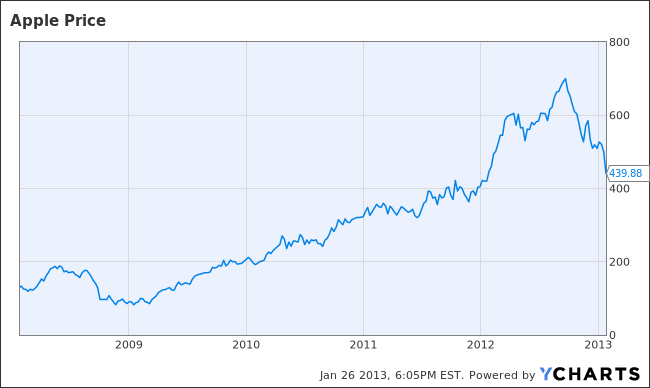
    Investors who only care about growth — and not necessarily technology — seem to have decided to go find the next big growth stock somewhere else. As they sell off their holdings, the slumping stock (which still closed Friday 228 percent higher than it was in January 2008) triggers a bunch of Wall Street-oriented stories wondering, “What’s wrong with Apple?” That in turn leads to a very predictable and usually heated backlash from Apple’s army of supporters who mock Wall Street types for assuming Apple is doomed despite record revenue, profits and mobile sales. And then those who have been desperately trying to write the “Apple has peaked and is headed down” story in order to look prescient in the future are licking their chops. Page views for everybody.

    Nothing is wrong with Apple. And no one is suggesting (with a straight face, anyway) that Apple is doomed. Instead, we’re seeing a different type of Apple emerge, one that is still growing very strongly but that is no longer attached to a rocket ship.

    Settling down

    This realization is hard to accept for both financial and tech types alike. Investors who hunger for exponential growth now have to figure out what to do next, and it’s no surprise that some of those pushing Apple to release a mind-blowing television are financial types hungry for the same type of growth that was provided by the iPhone. (Should that actually come to pass, maybe Apple still has some rocket fuel left.)

    Apple’s supporters (and detractors) must come to terms with the fact that we’re now well into a different era in Apple’s history. The iPhone caught the mobile industry flat-footed in 2007. Six years later, major competitors have righted themselves and beautiful hardware and software is battling for prominence with compelling services delivered onto those handsets and tablets.

    The queue outside Philadelphia's Walnute Street Apple Store for the iPhone 5 launch.

    The queue outside Philadelphia’s Walnut Street Apple Store for the iPhone 5 launch.

    I feel like the mobile world in early 2013 is a little like the PC market of the mid 1990s, say the period around when Windows 95 had arrived. PCs were not a novelty then, but nor were they in every house in the land. And there was still a ton of growth and innovation ahead as desktops grew more powerful, laptops grew more capable, and the browser connected it all. That mature-but-still-growing market continued for about a decade before the mobile computer became the new darling of the industry.

    Today, even though the iPhone is a household name, smartphones in general still make up less than half of all the mobile phones sold worldwide. And the tablet market has huge potential. The days of 70 percent growth in these markets are probably over, but there are still a lot of years of strong growth ahead.

    By 2018, who knows how this crazy industry will have changed again. But Apple will either lead the pack or be a strong contender for those mobile customers over the next several years. And at some point, Apple’s stock will come into balance with its new identity.

  • What the future holds for international development

    A cold start to 2013. Picture: Neil Squires

    I couldn’t resist posting this picture of the snow that is currently covering the UK, marking a cold start to what promises to be an exciting year.

    2013 is the year in which the UK will achieve its commitment to spend 0.7% of the UK’s Gross National Income on development aid. There has been a huge amount of work going on in DFID over the last year, identifying areas where careful use of development aid can make the biggest difference to poor people’s lives. The discipline of developing business cases, which consider different options for spending and assess the relative value for money of these options, has driven much of this work. There is a huge commitment within DFID to ensure we get maximum value from UK aid. The work on gathering the evidence for effective investment and monitoring the impact of programmes will continue this year as we track progress and demonstrate how UK aid is translating into real results for poor people.

    2013 is also a year in which there will be a major focus on what should follow on from the Millennium Development Goals, the targets that are set to reduce poverty by 2015. A High Level Panel will be assessing progress and discussing what comes next. I mentioned in a previous blog, some of the inputs that will inform these discussions, and other DFID bloggers have also posted on the ongoing process.

    Clearly there will still be a need to continue to invest in many of the areas that were prioritised by the Millennium Development Goals. Poverty and gender inequity remain major challenges, people the world over want better education for their children and this needs to make sure that girls have the same access to an education as boys. Whilst there has been progress in reducing maternal death and improving child health, there is still an unacceptable toll of infant, child and maternal mortality, with continuing high levels of under nutrition contributing to the burden. Poor people in many countries still need better sanitation, improved hygiene and access to water and the threat of climate change and resulting severe climate events needs to be managed.

    Some of the things I am hoping to focus on this year will feed into this agenda. My first big meeting this year will be to discuss the new funding mechanism of the Global Fund to Fight HIV/AIDS, TB and Malaria. The large investments made through the Global Fund have had significant health impacts. One of the key challenges going forward will be to make sure that continued investment to combat these three diseases also helps to build more accessible health services that are better able to meet the health needs of all people, rather than just those with specific diseases. The article posted here, highlights some of the health system challenges of achieving the Millennium Development Goals around health.

    I hope to be reviewing a number of UK aid programmes throughout 2013, and to be able to highlight some of the innovative work that is being supported by DFID Health Advisers around the world. I will also be meeting with a number of the researchers and research programmes that DFID has been supporting. The new knowledge being generated by this research and reviews can help make sure we invest in the right things. Systematic reviews of key areas of health policy have been helping to identify what the evidence base is for many of the investments we make, challenging existing practices as well as identifying key gaps in our knowledge and highlighting evidence which can inform new ways of working.

    The snow will be gone in a few days, leaving just a memory of the additional struggles of getting into work. The Millennium Development Goals highlighted a long term challenge that will not disappear so readily. Our efforts and investment will need to be sustained to 2015 and beyond in support of some of the most hard pressed governments who are struggling in the face of limited resources and fragile or weak systems to improve the wellbeing of their populations. A key challenge that will extend beyond 2015 will be to make sure that the benefits of development and economic growth reach the poorest, and help narrow the health gap that exists in many countries between rich and poor.

  • Driverless cars could be the big thing that vaults Google over Apple

    Google Driverless Car
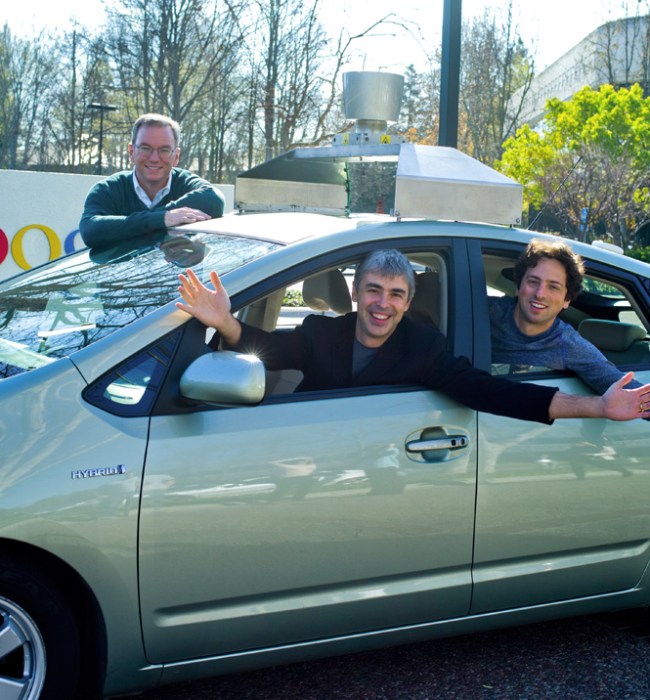
    Apple (AAPL) may not be the most valuable over company in the world anymore, but it’s still by far the most valuable tech company, as its market cap of around $416 billion easily tops Google’s (GOOG) $248 billion valuation and Microsoft’s (MSFT) $233 billion valuation. Over at Forbes, Chunka Mui makes an interesting case that Google’s investment in driverless car technology will be an absolute goldmine for the company in the coming years that could even vault it past its rivals in Cupertino.

    Continue reading…

  • New playlists: “Close up and personal,” “The global power shift” and “Climate change: Oh, it’s real.”

    up_close_and_personal

    TED playlists are collections of talks around a topic, built for you in a thoughtful sequence to illuminate ideas in context. This weekend, three new playlists are available: “Close up and personal,” “The global power shift” and “Climate change: Oh, it’s real.”

    Close up and personal
    Talks from seven photographers, with stunning images from the world’s dark and marginalized corners.

    Climate change: Oh, it’s real.
    We still have a lot to learn about climate change’s causes and implications. But make no doubt about it: It’s real, alright. Stay informed with these eight talks on this essential topic that affects us all.

    The global power shift
    Economic power is shifting across the world, and we’re moving away from a mono-polar model to a multi-polar one. These 9 talks from economists, politicians and activists look at the big picture.