
Category: News
-
Xbox One vs. PlayStation 4: PS4 wins on specs
-
Kindle Worlds Will Pay You To Write Fan Fiction
Fan Fiction is awesome, right? It’s a way for fans to better engage with their favorite brands, and some franchises actually gain new fans thanks to fan fiction. Amazon wants to capitalize on it while paying authors for their trouble.
Amazon announced Kindle Worlds today – a new publishing platform that licenses popular series and then allows amateur authors to publish fan fiction based on those series. Right out of the gate, Amazon has secured the rights to Gossip Girl, Pretty Little Liars and Vampire Diaries. I can already see the latter inspiring plenty of fan fiction.
“At Kindle, we’re not only inventing on the hardware and software side of the business, we’re inventing new ways to create books,” said Philip Patrick, Director, Business Development and Publisher of Kindle Worlds. “Our goal with Kindle Worlds is to create a home for authors to build on the Worlds we license, and give readers more stories from the Worlds they enjoy. We look forward to announcing additional World licensing deals in the coming weeks.”
So, how will the payment system work? Here’s how Amazon describes it:
Amazon Publishing will pay royalties to both the rights holders of the Worlds and the author. The standard author’s royalty rate (for works of at least 10,000 words) will be 35% of net revenue. As with all titles from Amazon Publishing, Kindle Worlds will base net revenue off of sales price—rather than the lower, industry standard of wholesale price—and royalties will be paid monthly.
In addition, with the launch of Kindle Worlds, Amazon Publishing will pilot an experimental new program for particularly short works—between 5,000 and 10,000 words. For these short stories—typically priced under one dollar—Amazon will pay the royalties for the World’s rights holder and pay authors a digital royalty of 20%.
It’s not a bad deal for something that people generally write while expecting no monetary return. It might even be a great platform for an aspiring author to launch their own career. There’s numerous stories out there of fan fiction authors getting their big break after somebody discovered their work.
Kindle Worlds will officially launch in June with over 50 commissioned works from famous authors. After that, anybody can submit their fan fictions to the Kindle Worlds publishing portal. To get a head start, head over to the official site to learn more.
-
UpOut Raises $850,000 in Seed Funding from Sand Hill Angels and Others
UpOut, a San Francisco-based online guide that provides users with personalized recommendations to places and events, has closed $850,000 in seed funding from Sand Hill Angels and TEEC Angels, among others. Before receiving its new round of financing, UpOut had participated in Tandem Entrepreneurs, a Burlington, Calif.-based accelerator that targets mobile applications, providing the teams that create them with six months of support and guidance, along with an initial investment.
PRESS RELEASE:
UpOut, a guide that provides personalized recommendations to offbeat and interesting events, announced today it closed $850,000 in seed funding from leading Silicon Valley angels including the Sand Hill Angels and TEEC Angels. Previously, UpOut participated in Tandem’s accelerator program.
UpOut helps locals discover the most interesting events in San Francisco. The technology behind UpOut aggregates thousands of local events and ranks them based on accuracy and preferences, giving users event suggestions that fit their needs. As a companion to the website, UpOut released an iPhone app last year that helps people discover what’s going on around them now. Since the launch of their service, UpOut has grown to influence the going out decision for tens of thousands of Bay Area locals.
The company started out as a weekend project in the dorm rooms of Babson College by twenty-one-year old Martin Shen and nineteen-year-old Will King, entrepreneurs who have worked together for five years at their own web design firm and previous startup. Mr. Shen started his first business in high school and has over five years of UX design experience working with enterprises to rappers. Mr. King is a full stack developer that started coding at age seven.
“We thank our seed round investors for believing in our vision,” said Mr. Shen, CEO of UpOut. “After the positive feedback of our beta service, we’re excited to bring UpOut to all the locals itching to find something interesting to do. In addition to helping locals find things to do, we’re helping local business owners drive traffic to their awesome events.”
Tandem Entrepreneurs is a leading mobile industry accelerator based in Burlingame, CA that provides companies with six months of full support, guidance and an initial investment. “UpOut has been an early hit with both consumers and merchants,” says Doug Renert, Managing Entrepreneur at Tandem. “Martin and Will have the right vision and skills to scale the business and bring UpOut to every city.”
Sand Hill Angels, a group of successful Silicon Valley executives that are passionate about entrepreneurialism and disruptive technology, led UpOut’s seed funding round. “People have a need to discover their city and have a good time. UpOut is helping people satisfy this fundamental need,” said David Koehn, member of Sand Hill Angels. “Their tech is impressive, the timing is good and the team’s approach to product design is great. I’m really excited for what UpOut can bring to users and merchants.”
About UpOut
UpOut is a discriminating guide to fun and interesting events in your city. The startup uses social signals to help you find out what you’re doing tonight. The company was founded in August 2011, is backed by angel investors and is currently based in San Francisco. For more information, visit http://UpOut.com
The post UpOut Raises $850,000 in Seed Funding from Sand Hill Angels and Others appeared first on peHUB.
-
BullGuard launches Premium Protection 2013 — guards the person as well as the PC
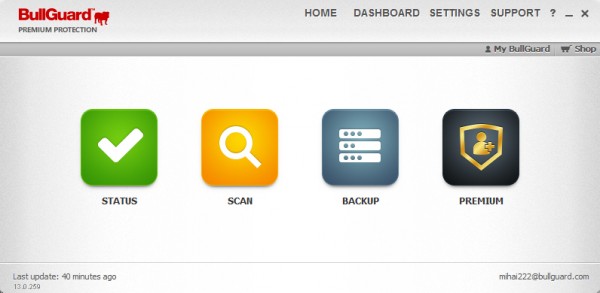
Any old security suite can protect your PC with a firewall and an antivirus product so the big players are increasingly looking for new angles to try to get us to buy their products. BullGuard’s flagship offering already has parental controls, spam filtering and PC tuning tools, so the latest release — out today — goes for the personal protection approach.
No, it doesn’t come with a goon in a dark suit and sunglasses to follow you around. It offers safeguards against identity theft and data leaks, plus it has social media protection. As an added bonus the amount of online backup space included with the package is increased to 25GB.
The ID protection module provides an extra layer of defense, running in the background to alert you via email or text if personal information has been compromised. Social media protection allows parents to monitor their children’s Facebook profiles. It also has an app for the kids themselves to help them avoid risky behavior.
It scans the protected profile and alerts both parents and offspring to signs of bullying, “sexting”, links to inappropriate content and more. The service works across tablets and smartphones as well as PCs.
BullGuard’s Head of Product Management, Alex Balan says,
The changing face of threats and the changing habits of users in the modern computing age means that consumers face an uphill battle when trying to stay one step ahead of malicious third parties. Our intention when developing Premium Protection was to address these concerns and recognize that it’s just as important to protect the person, as it is the PC. We’ve placed a strong focus on identity and social media protection, incorporating tools that can help guard against new threats alongside all of the ‘traditional’ protection required to help keep you (and your children) safe online.
The software comes as a 3-PC license for $99.95 (£69.95 in the UK) and you can download a 30-day trial from the BullGuard website. Existing BullGuard Internet Security users will be able to upgrade to the new suite.
-
TEDxSydney sets up at the Opera House: A timelapse
On May 4, a TEDx event took place in one of the most architecturally recognizable sites in the world — the Sydney Opera House. Here, with the help of The MilkBar, the organizers of TEDxSydney captured the event from dawn to dusk and compressed it all into 78 seconds. Watch above as the sun rises over the beautiful building and as attendees arrive, fill the auditorium, enjoy speakers and head home again as the sun sets. Watch talks from the event »
And now for some slow-motion from TEDxSydney: A very cute video created for the event by Saatchi & Saatchi Sydney and Heckler called “The First Taste.” It shows young kids reacting to their first bites of foods of like anchovy, Vegemite and olives.

-
The Rise of Virtual Brick-and-Mortars

Ever since Amazon’s Price App appeared on the retail scene some 18 months ago, pundits have prophesized the demise of big-box retailers. There’s no question that Amazon’s innovation went right for the jugular of any volume- and price-focused retailer selling commodity goods like consumer electronics and household wares. Indeed, retailers from Best Buy and Target to Bed Bath & Beyond, PetSmart, and Toys R Us are in danger of becoming mere showrooms for Amazon and its ilk. But innovative retailers are responding to this threat by turning “showrooming” to their own advantage.
One obvious strategic response has been to fight back with in-store experiences and proprietary merchandize that Amazon cannot match. The quintessential example is the quirky local book store, which sells antiques, unusual knick-knacks, offers free Wi-Fi, and hosts a café — an eclectic mix of experiences enriched by products, services, and community that trump online retailing. But this approach has many limitations, chief among them is that it’s hard to scale.
A less obvious response that’s accelerating in the global marketplace is to accept that stores are showrooms — and design them accordingly. Samsung showcased an array of the company’s products from around the world that consumers could examine, play with, and admire. They just couldn’t buy them. Its retail clerks pointed consumers to nearby locations where Samsung products were for sale. It was an actual showroom. Having helped establish Samsung as a consumer electronics megabrand, the showroom served its purpose and has recently closed. By contrast, Miele, which makes and markets everything from kitchen equipment to household wares, runs 10 “Centers” in the United States. They host cooking presentations, master classes, and wine tastings, but, other than obvious accessories, they don’t sell the company’s products. They just showcase them. As Samsung demonstrated, sometimes a showroom is just a showroom.
By contrast, the UK-based retailer, Tesco, has launched an array of “virtual” stores designed to sell products with no merchandise. The world’s first virtual store was a Tesco Homeplus opened in the Seoul Subway in August 2011. This wasn’t really a store: it was a wall that displayed over 500 of the chain’s most popular products, each with an associated barcode that users could scan to populate a shopping basket that Homeplus would deliver to their homes the same day. Since launch, the Homeplus Smartphone App has become the number one shopping app in Korea, with over a million downloads to date. Homeplus has extended this concept to bus stops. The goal? Says one Homeplus executive: “Make the shopping experience easier and more convenient for our customers.” Homeplus is now the market share leader in South Korea.
UK-based Ocado, a pure-play online grocery retailer, has taken the Tesco innovation one step further. It’s opened physical stores — actual “high street” locations — where consumers can roam a branded space, browse products, scan barcodes, and complete their shopping task by ordering online from a physical location. One major draw: you don’t have to carry those heavy groceries home. Ocado’s first actual store, in a London mall, was a hit. (Like Homeplus, to access the service, consumers have to download a proprietary shopping app, called Ocado “On The Go.”)
The strategy is a striking success. Nearly one in four orders at Ocado is now placed using mobile devices. According to shop2mobi, a Dutch Internet start-up that works with retailers to launch QR-code based virtual stores, over 300 virtual brick-and-mortar stores were “published” worldwide in 2012. The firm claims that 2,000 are already planned to open in 2013.
All of which brings us back to the dilemma facing traditional retailers. Many big-box retailers are fighting back by accepting that their stores are showrooms as well as points of sale. They are using the techniques of virtual stores in their physical locations to make it easy to shop online while in store. These include Wal-Mart, Best Buy, and even Tesco itself. Offering a combination of shopping apps and QR codes, these retailers are replicating the convenience Amazon promises (many with a price-match guarantee) by enabling shoppers to use the stores to showroom their own goods — and then buy directly from them. The message is clear: in-store experience matters. The more compelling and unique — think REI with its climbing walls — the better. But the overlay of attributes associated with online shopping is also essential to survival. Otherwise, the Big Boxes that dot our retail landscape will, indeed, become an artifact of the past. (Circuit City, anyone?)
The lesson for marketers is fundamental. Don’t count on bringing customers to your brand. Bring your brand to your customers. Place your offerings squarely in the context of your customers’ lives. Otherwise, they’ll likely take the path of least resistance — and that could mean they don’t buy from you.
Innovations in Digital and Mobile Marketing
An HBR Insight Center
-
Twitter tool lets brands sign up customers inside a tweet
Even as Twitter has grown into a media and marketing giant, not everyone is persuaded that the social media site is useful for selling things. As one marketer recently lamented to me, the platform’s effectiveness is hard to measure — and justify to clients — because “no one’s going to buy a car off Twitter.”
The perception, then, is that Twitter is useful for what the ad types call “top of the funnel” marketing — building brand awareness and so on — but that it has yet to deliver paying customers in the way that Google Adwords can. Today, though, it appears Twitter has responded with a new ad product that will make it easier for brands to assess what they get for their marketing bucks.
The product, called a “Lead Generation Card,” lets marketers post expanded tweets that invite users to sign up for stuff right inside Twitter. The company showed what this might look in a blog post describing the product:

According to a spokesman, the idea reduces friction in the marketing process because Twitter already has users’ email and other contact information — meaning that it takes just one click for a user to connect with the brand.
The move comes as Twitter continues to expand its ad products, including its self-serve platform, ahead of a rumored IPO later this year.

Related research and analysis from GigaOM Pro:
Subscriber content. Sign up for a free trial.- Social media in Q1: commerce and discovery dominated
- NewNet Q4: Platform mania and social commerce shakeout
- Players and Strategies for Real-Time In-Stream Advertising


-
Qualcomm previews next-gen 2,560 by 1,440 Mirasol display

With the kick-off of SID Display Week 2013 in Vancouver came some pretty neat new concepts from Qualcomm. The company demoed a 1.5-inch panel embedded on the top of an “always-on” smartphone and on the face of a smartwatch.
Perhaps the most interesting display was a 5.1-inch panel with a spectacular 2,560 by 1,440 (577 ppi) resolution. While up close, the images seem much more crisp than on the current top-of-the-line displays, the colors don’t quite pop like they do on other handsets. But there’s more to it than meets the eye. The screen has a 6x power advantage over current LED and OLED displays. This means that your phone could go days without charging. But don’t get over excited, because Qualcomm says that this technology is still a few years from mass-production. For now, we’ll just have to wait and see what else the future brings for smartphone technology.
Source: Engadget
Come comment on this article: Qualcomm previews next-gen 2,560 by 1,440 Mirasol display
Visit TalkAndroid for Android news, Android guides, and much more! -
Retina overload: Mirasol smartphone display has 77% more pixels per inch than iPhone
The race for screen clarity continues. Apple started it with a 326 pixel per inch Retina display on its iPhone. Now the latest flagship phones from Samsung, HTC and LG have full high-definition displays: These devices cram a 1920 x 1080 resolution into their screens with around 400 pixels per inch. Too bad all of these just got spanked by the competition, even if it is just a prototype.
At the SID Display Week event currently in progress, Qualcomm is showing off its latest smartphone screen tech that tops and eye-popping 577 pixels per inch.
Engadget is on site at the show and captured some video of the 5.1-inch display and its 2560 x 1440 resolution:
The screen uses Qualcomm’s Mirasol technology, which we’ve been covering for the past four years. Sadly, no major product hits have used a Mirasol panel in all that time and Qualcomm says that the smartphone screen is just a prototype; it could be another few years before such a pixel-packing screen is ready for mass production.
Higher resolution isn’t the only benefit here, however. Mirasol uses reflective light and microscopic MEMS (Microelectromechanical systems) to create small airgaps in the display; as the airgap size changes, the light color passing through it is manipulated. As a result, the screens are very power efficient, up to six times more than today’s LCD and OLED screens.
Aside from the time to market then, is there a downside? Because the displays primarily use reflective light — although they can be front-lit — colors often appear washed out as compared to traditional screens. I’m not sure if there’s a solution for that challenge, but my money is on Qualcomm to find one if it exists.

Related research and analysis from GigaOM Pro:
Subscriber content. Sign up for a free trial.- Analyzing the wearable computing market
- Tablet market to hit over 377 million units by 2016
- CES 2012: a recap and analysis

-
Penguin agrees to $75 million class action settlement in ebook pricing lawsuit
Book publisher Penguin has agreed to a $75 million settlement with consumers and states in the ebook pricing lawsuit, several months after it settled with the Department of Justice. The other publishers in the case — HarperCollins, Simon & Schuster, Hachette and Macmillan — had already settled with both the states and the DOJ. Penguin’s settlement is by far the largest that any of the publishers have reached.
The news comes just a couple of weeks before Apple is set to face the DOJ in court. In the trial, beginning June 3, the DOJ will argue that Apple conspired with book publishers to fix ebook prices. Apple argues that it offers agency pricing to all retailers in iTunes and that the launch of iBookstore created competition in the marketplace.
Under the proposed settlement, announced Wednesday morning, Penguin would pay $75 million to consumers represented by 33 states’ attorneys general and by Hagens Berman, the Seattle-based law firm that filed the class action suit against Apple and publishers in 2011. The settlement still has to be approved by the courts, in a hearing set to take place later this summer.
Penguin’s settlement with the consumers and states is the largest that any publisher has agreed to. HarperCollins, Hachette and Simon & Schuster settled together for a combined $69 million, while Macmillan agreed to a $20 million payout.
The settlement also clears the way for the Penguin-Random House merger to move forward in the second half of this year. Penguin’s parent company Pearson said in a statement, “In anticipation of reaching this agreement, Pearson had made a $40m provision for settlement in its 2012 accounts. An incremental charge will be expensed in Pearson’s 2013 statutory accounts as part of the accounting for the Penguin Random House joint-venture.

Related research and analysis from GigaOM Pro:
Subscriber content. Sign up for a free trial.
-
Tesla could pay off the rest of the DOE loan today, says CEO
Tesla’s CEO Elon Musk said a couple months ago that Tesla planned to pay off the rest of Department of Energy loan in five years, instead of the allotted ten. Now, according to a tweet from Musk, Tesla could pay off the entire loan today, nine years early. Musk tweeted:
Given govt loan repayment this week (prob Wed), Supercharger update will be next week. Work continuing independent of announcement.
In order to pay off the loan, Tesla is holding an equity and debt offering, and could raise a billion dollars (boosted from the initial $830 million) from selling shares and convertible senior notes. Musk says he’ll buy $100 million worth of common stock in the offering.
 If Tesla pays back the entire loan today — or sometime soon — it will be a remarkable feat. Tesla raised a $465 million loan from the Department of Energy’s controversial Advanced Technology Vehicle Manufacturing program back in the Summer of 2009. The funds helped the company build its factory in Fremont and transition from a small scale manufacturer of its first-gen Roadster electric sports car into a larger scale manufacturer of its Model S electric sedan.
Tesla was one of only five companies to receive the loans, and one of three startups. Two of the other startups that raised funds from that program, Fisker Automotive and The Vehicle Group, are struggling. Fisker, which makes the electric hybrid sports car the Karma, is near bankruptcy and The Vehicle Production Group, which makes a natural gas-powered van for disabled passengers, has shut down.
Tesla can also afford to pay off the loan early because it’s just come off of its first profitable quarter in the company’s 10-year history. Tesla also generated a record amount of revenue ($561.8 million) in the quarter, and raised its annual guidance of the amount of cars shipped by 1,000 to 21,000 this year.
Tesla stock has been on a tear this month, and is was trading at $89.24 this morning.

Related research and analysis from GigaOM Pro:
Subscriber content. Sign up for a free trial.- Ups and downs for cleantech in Q1
- Waiting for the EV market to materialize
- The fourth quarter of 2012 in cleantech

-
Video: Samsung shows how the Galaxy S4 is the perfect gadget for stalkers

-
Splinter.me wants to replace your resume and offer career guidance
There are plenty of startups out there trying to revolutionize the job-seeking or hiring process, from TalentBin and Path.to to Silp, Somewhere and of course, in its own way, LinkedIn. But there may still be space for more.
Splinter.me will certainly be hoping so. Currently in beta, the Egyptian-Romanian-Belgian startup (welcome to the EMEA region) is trying its own data-centric spin on the subject. Splinter.me essentially wants to replace the resume with information automatically pulled in from the job-seeker’s social networks and any other platforms where information about them may reside.
 So far, so Silp, but Splinter.me wants to then mix up this functionality with not only automated job matchmaking, but also career advice. “We can tell a recruiter, ‘This candidate might fit your job,’ but can also give career advice to the user. We can tell them, ‘Others score higher because they have this skill that you’re missing,’” co-founder Adelina Peltea told me.
Splinter.me will only launch in full this coming September, but it added a raft of new features this week. One particularly handy feature called Common Connections does what it says on the tin: it tells two “splinters” (users) which connections they have in common. What’s interesting here is that it can find those common connections across third-party platforms such as Facebook and LinkedIn, even if those people are not themselves, er, splinters (I can’t quite shake the memories of Teenage Mutant Ninja Turtles whenever I hear that term).
What’s more, the company has also added a feature called Splinter Lookup that allows for natural language searching. Echoing Facebook Graph Search to a degree, this function allows users to search for, by way of example, “splinters who use PHP, live in Boston and know Bob Jones”.
Another new feature, Hubs, provides a repository of information to help job-seekers brush up particular skills, such as web development and gamification.
It is very early days for this company – it has just 1,200 beta users and so far it only has angel backing. But on the other hand, it does have certain things in its favor beyond the aforementioned features, in particular its (intended) lack of tech-industry exclusivity and the fact that it’s pushing hard in markets such as North Africa and Europe.
Many of Splinter.me’s key rivals in this space, such as Path.to, are highly U.S.-focused and deal mostly if not entirely with programmers and the like. Which is fine – the U.S. tech scene is a big market – but it does leave other markets to conquer. After that September launch, let’s see if Splinter.me can fill some of those gaps.

Related research and analysis from GigaOM Pro:
Subscriber content. Sign up for a free trial.- Social 2013: The enterprise strikes back
- Is LinkedIn trying to become WordPress for the business executive set?
- The quantified self: hacking the body for better health

-
OpenStack cloud builder Cloudscaling nets $10M from Juniper, Seagate and friends
Cloudscaling, a company that’s made its name actually building OpenStack clouds for real customers including Korea Telecom, just closed a $10 million Series B round including money from new backers Juniper Networks’ Junos Innovation Fund and Seagate. Trinity Ventures, an early investor, also participated.
The San Francisco-based company targets new applications that run on its technology but can also run in Amazon and Google public clouds as needed. Juniper is already partnering with Cloudscaling which is using Juniper’s Virtual Network Control in a Virtual Private Cloud (VPC) feature that maps to virtual private clouds in Amazon Web Services.
The funding, “affirms that customers want more than OpenStack. They want an on-premise, OpenStack-based private or public cloud turnkey system solution that delivers architectural and behavioral fidelity with major public clouds like Amazon Web Services,” Cloudscaling CEO Michael Grant said in a statement.ing
It’s been a sort of rocky week for OpenStack. On Monday, Dell surprised the ecosystem by deep-sixing plans to roll out an OpenStack-based public cloud.
Cloudscaling closed a $4 million Series A round in September 2011. Company CTO Randy Bias, pictured above right, is an OpenStack Foundation board member, and will talk about issues and benefits of cloud adoption at GigaOM’s Structure Europe in September.

Related research and analysis from GigaOM Pro:
Subscriber content. Sign up for a free trial.- Cloud computing infrastructure: 2012 and beyond
- Cloud computing 2013: how to navigate without a map
- Amazon Web Services, by the numbers

-
Apple’s Tim Cook Tells Congress The Tax Code Is Outdated
You may recall that Apple was on tap to testify at a Senate Permanent Subcommittee on Investigations hearing yesterday regarding accusations that it dodges taxes. As expected, Apple CEO Tim Cook denied the accusations. He did offer up his idea for tax reform while he was there though.
During the hearing, Cook slammed the current U.S. tax code for not keeping up with the “digital age.” He also said that the “tax system handicaps American corporations in relation to our foreign competitors who don’t have such constraints on the free flow of capital.”
So, what does Cook suggest the U.S. do about it? He says that the corporate tax rate needs to be slashed. His suggestion calls for a drop from a 35 percent tax rate to a mid-20s tax rate. He also encourages Congress to lower the tax rate on foreign earnings being brought into the U.S.
The result of the above, Cook says, would encourage more investment in the United States and create more jobs. He even explicitly said that Apple will not bring billions in cash back to the U.S. unless Congress lowers the tax rate.
There are many congressman who no doubt agree with Apple on this issue, but one vocally came out in defense of the company yesterday. The Hill reports that Sen. Rand Paul said the subcommittee’s hearing on Apple’s alleged tax avoidance was offensive. He called upon the subcommittee to immediately apologize to the company.
Even after all of this, Apple isn’t quite done defending itself against accusations of tax avoidance. Reuters is reporting that major European leaders will be meeting to discuss what it sees as tax dodging from major tech corporations like Google, Apple and Amazon. Investigations have found that governments within the EU miss out on over €1 trillion, or $1.3 trillion USD, in tax revenue.
[h/t: The Hill] [Image: lemagit/flickr]
-
KiSSFLOW adds quick action workflow buttons to Google Apps
 Last week at Google’s annual I/O conference in San Francisco the web giant launched a new feature called quick actions for Gmail which recognizes certain types of messages and lets you take immediate action on them directly from the inbox — RSVP to an invitation, or quickly see flight info for example.
Third-party developers are able to add their own actions, and OrangeScape announces it is doing exactly that with its self-service workflow builder, KiSSFLOW.
KiSSFLOW lets users build business workflows that flow through various departments like Finance, HR, Marketing and Administration. Adding the quick action functionality will allow workflow users of Google Apps to respond to notifications, and complete tasks like “Approve”, by clicking the button displayed in the message’s subject line.
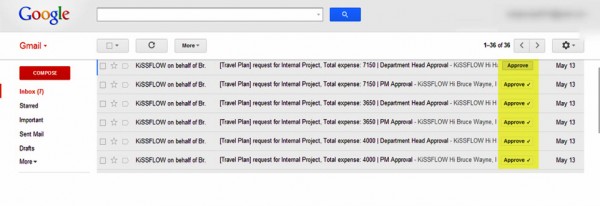 “Working with its ecosystem of partners, Google continually adds exciting, user-centric new capabilities that take the maturity of the Google Apps platform to new levels,” said Dinesh Varadharajan, head of KiSSFLOW at OrangeScape. “With this release of new quick actions, KiSSFLOW is thrilled to work closely with Google to provide simple yet powerful self-service workflow for Google Apps customers. Unlike some of the other products that have a portion of their users on Gmail, KiSSFLOW users are 100 percent Gmail users — our entire user base is going to love this new capability”.
KiSSFLOW is priced at $3.00 per user, per month and is available in the Google Enterprise Marketplace.
Photo Credit: Dmitriy Shironosov/Shutterstock
-
2-Way Mirror In Nightclub Bathroom Gets Police Attention
A nightclub in Glasgow, Scotland is under investigation after the Scottish Express released an article claiming some of their staffers had seen photos of men posing in front of a two-way mirror while women used the bathroom behind them. The club owners reportedly rent out two rooms on the other side of the mirror where groups of people can sit and watch.
A woman who has attended The Shimmy Club said, “I was completely shocked to discover that the mirror in the ladies’ bathroom is a two-way mirror facing out onto the club. I find it absolutely outrageous that a club can get away with this, it is a complete invasion of privacy of the unsuspecting girls. Nowhere is it made clear that this is the case so when visiting the bathroom for the first time, there are women bending over the sink, pouting into the mirror to redo their lipstick, adjusting themselves whilst unknowingly being watched by people on the other side.”
Indeed, the owners say they just installed the mirror for a bit of fun, and that signage was posted informing anyone using the restrooms that they were being watched; however, they have updated the signage to make it clearer. The club posted to their Facebook page:
The Shimmy Club’s two-way mirror is a design feature created as a bit of fun, an interactive feature which we hoped would act as a talking point for people visiting The Shimmy. The vast majority of people who have visited the club have taken it as such. Its clear that those who are negatively commenting on line may not have been lucky enough to get past the door staff yet and viewed the area as they would have seen that the sight line is very limited and allows for glimpses into the wash up area only of the ladies loos (there is also a separate mirror area which is completely out of view of the club). Interestingly, you can see into a similar area of both the ladies and gents from the street at Corinthian Club and no-one has ever said a word. There has always been signage in the toilets which no-one has mentioned thus far but as a result of the media feedback clearer signage has been put in place to inform our female customers.
Overall our customers seem to enjoy this unique idea, loads of you have used the opportunity as it was intended and knowingly had pictures taken acting up to the camera individually or in a group of friends. However we are committed to listening to you guys who are our core customer base and hugely appreciate your loyalty so if your feedback (and not that of the media) is that you want the mirror area to change then we will listen to that and make changes.
God help us when they find out that we have buried vibrators into sections of the dancefloor……………
The Glasgow police have now launched an investigation into the matter.
Image: Twitter
-
Anthony Weiner Announces Mayoral Run with YouTube Video
Last month, as rumors swirled of a possible run for New York City mayor, former congressman Anthony Weiner rejoined Twitter – the service the led to his downfall back in 2011. He began tweeting out links to a 20-page roadmap for NYC called “Keys to the city,” and it sure looked like the actions of a man gearing up for a comeback.
Today, Weiner officially entered the mayoral race with a YouTube video.
“…The classic New York story: you work hard, you make it into the middle class, and you make life a little bit better for your kids. That’s how this city was built,” says Weiner.
“But it’s getting harder and harder every day – some of the highest rents in the country…goog jobs with benefits disappearing, our schools aren’t what they should be, and we need to keep this city safe.”
Weiner doesn’t shy away from his past indiscretions:
“Look, I made some big mistakes, and I know I let a lot of people down. But I’ve also learned some tough lessons. I’m running for mayor because I’ve been fighting for the middle class and those struggling to make it my entire life. And I hope I get a second chance to work for you.”
According to recent polling, Weiner trails Democratic frontrunner Christine Quinn by a margin of 15% to 25%. That same poll indicated that 49% of people felt the Weiner shouldn’t run for mayor.
Check out his announcement below:
-
Xbox One game sales and used game policies: What we know

-
ESPN Layoffs Confirmed, Details Emerging
Yesterday, rumors began to surface that sports TV news station ESPN will soon be laying off some of its employees. Now, the company, which is owned mainly by The Walt Disney Company, has confirmed that layoffs are incoming. ESPN has released a short statement on the matter:
We are implementing changes across the company to enhance our continued growth while smartly managing costs. While difficult, we are confident that it will make us more competitive, innovative and productive.
Though the layoffs have been confirmed, the announcement still hasn’t made it clear how major the cuts will be. It is also not yet known where the cuts will be made within the company.
According to a Deadspin report, the number of layoffs is rumored to be “in the hundreds,” with 400 employees seeming to be the over/under. The report cites unnamed sources as stating a majority of the layoffs so far have come from “technology” positions. Disney has reportedly put pressure on ESPN to meet its profit margin, encouraging all divisons at the station to cut back on costs. ESPN’s profit margins have reportedly lowered recently due to the station buying the rights to several major live sporting events, including NFL games.
