Blog

  • UT, ARAMARK Partner to Reduce Waste During DI Global Finals

    The University of Tennessee, Knoxville, and ARAMARK, the university’s food service provider, are taking steps to reduce the amount of waste that is produced during the Destination ImagiNation Global Finals event on campus this week. ARAMARK plans to serve about 111,000 meals to over 5,400 guests on campus attending the event.

    Destination ImagiNation, Inc. is a non-profit organization that provides two educational programs for students to learn and experience creativity, teamwork and problem solving. Global Finals is the culminating event of every Destination ImagiNation season. Each year, hundreds of teams gather at the Global Finals to showcase their Challenge solutions, and the atmosphere is always electric. More than 16,000 people attended Global Finals 2009, which took place in late May at UT.

    Waste reduction efforts next week include:

    • Trayless Dining – Serving approximately 72,800 trayless meals will save approximately 109,200 gallons of water.

    • Reusable Dishware and Compostable Dish and Silverware – Using reusable dishware instead of Styrofoam dishware, which was used last year, will divert 23,000 non-compostable pounds of waste from our landfills. For the outside dining events, ARAMARK will be using a cornstarch based compostable dishware and silverware.

    • Reusable Condiment Containers will be used saving 1 metric cube of landfill space this week.

    • Composting Coffee Grounds – UT Facilities Services and ARAMARK will compost the used coffee grounds from the Starbucks locations on campus.

    • UT Biodiesel Production – Vegetable oil is collected from the Volunteer Dining locations on campus and turned into biodiesel fuel by students for use in UT diesel vehicles. The recycled biodiesel reduces harmful emissions, reduces the use of foreign oil and doesn’t waste the cooking oil.

    • Aluminum and Plastic – Facilities Services will be assisting with the recycling of aluminum and plastics used during the event in addition to the compostable products.

    For more information, contact UT Facilities Services at 974-7780 or ARAMARK at 974-4111.

  • Freitag – F23 iPad Sleeves

    Freitag will release their new F23 iPad sleeve around August this year. The renowned bag manufacturers will be putting out sleeves in different colors and as some of you might already know, Freitag uses truck tarps to craft their special items. As for the iPad, it will get the same treatment, but will come with a velvety lining to protect your iPad from prints or scratches. It also comes with a strap system to secure and allow you to access your pad with ease. Email [email protected] to be put on the Preferred Pad list, and you will get notified when and where to get one as soon as the drop happens.


  • Repost: Quantum Interrogation | Cosmic Variance

    Sorry for the radio silence around here of late. I don’t know about anyone else, but I’ve been traveling like a mad person. The good news is that I just got back from UC Davis, where I had the chance to meet John Conway for the first time in person.

    The bad news is: no time for blogging. But I recently received an email pointing out that some links have died in an old post, which I proceeded to update. And that gave me the idea of stooping to a classic blogospheric move in times of sparse content: reposting old stuff! So here is the post in question, from several years ago. If people don’t complain too loudly, maybe we’ll dig up some more ancient blogging and bring it back to the surface.

    ————

    Quantum mechanics, as we all know, is weird. It’s weird enough in its own right, but when some determined experimenters do tricks that really bring out the weirdness in all its glory, and the results are conveyed to us by well-intentioned but occasionally murky vulgarizations in the popular press, it can seem even weirder than usual.

    Last week was a classic example: the computer that could figure out the answer without actually doing a calculation! (See Uncertain Principles, Crooked Timber, 3 Quarks Daily.) The articles refer to an experiment performed by Onur Hosten and collaborators in Paul Kwiat’s group at Urbana-Champaign, involving an ingenious series of quantum-mechanical miracles. On the surface, these results seem nearly impossible to make sense of. (Indeed, Brad DeLong has nearly given up hope.) How can you get an answer without doing a calculation? Half of the problem is that imprecise language makes the experiment seem even more fantastical than it really is — the other half is that it really is quite astonishing.

    Let me make a stab at explaining, perhaps not the entire exercise in quantum computation, but at least the most surprising part of the whole story — how you can detect something without actually looking at it. The substance of everything that I will say is simply a translation of the nice explanation of quantum interrogation at Kwiat’s page, with the exception that I will forgo the typically violent metaphors of blowing up bombs and killing cats in favor of a discussion of cute little puppies.

    Puppy in a box So here is our problem: a large box lies before us, and we would like to know whether there is a sleeping puppy inside. Except that, sensitive souls that we are, it’s really important that we don’t wake up the puppy. Furthermore, due to circumstances too complicated to get into right now, we only have one technique at our disposal: the ability to pass an item of food into a small flap in the box. If the food is something uninteresting to puppies, like a salad, we will get no reaction — the puppy will just keep slumbering peacefully, oblivious to the food. But if the food is something delicious (from the canine point of view), like a nice juicy steak, the aromas will awaken the puppy, which will begin to bark like mad.

    It would seem that we are stuck. If we stick a salad into the box, we don’t learn anything, as from the outside we can’t tell the difference between a sleeping puppy and no puppy at all. If we stick a steak into the box, we will definitely learn whether there is a puppy in there, but only because it will wake up and start barking if it’s there, and that would break our over-sensitive hearts. Puppies need their sleep, after all.

    Fortunately, we are not only very considerate, we are also excellent experimental physicists with a keen grasp of quantum mechanics. Quantum mechanics, according to the conventional interpretations that are good enough for our purposes here, says three crucial and amazing things.

    • First, objects can exist in “superpositions” of the characteristics we can measure about them. For example, if we have an item of food, according to old-fashioned classical mechanics it could perhaps be “salad” or “steak.” But according to quantum mechanics, the true state of the food could be a combination, known as a wavefunction, which takes the form (food) = a(salad) + b(steak), where a and b are some numerical coefficients. That is not to say (as you might get the impression) that we are not sure whether the food is salad or steak; rather, it really is a simultaneous superposition of both possibilities.
    • The second amazing thing is that we can never observe the food to be in such a superposition; whenever we (or sleeping puppies) observe the food, we always find that it appears to be either salad or steak. (Eigenstates of the food operator, for you experts.) The numerical coefficients a and b tell us the probability of measuring either alternative; the chance we will observe salad is a2, while the chance we will observe steak is b2. (Obviously, then, we must have a2 + b2 = 1, since the total probability must add up to one [at least, in a world in which the only kinds of food are salad and steak, which we are assuming for simplicity].)
    • Third and finally, the act of observing the food changes its state once and for all, to be purely whatever we have observed it to be. If we look and it’s salad, the state of the food item is henceforth (food) = (salad), while if we saw that it was steak we would have (food) = (steak). That’s the “collapse of the wavefunction.”

    You can read all that again, it’s okay. It contains everything important you need to know about quantum mechanics; the rest is just some equations to make it look like science.

    Now let’s put it to work to find some puppies without waking them up. Imagine we have our morsel of food, and that we are able to manipulate its wavefunction; that is, we can do various operations on the state described by (food) = a(salad) + b(steak). In particular, imagine that we can rotate that wavefunction, without actually observing it. In using this language, we are thinking of the state of the food as a vector in a two-dimensional space, whose axes are labeled (salad) and (steak). The components of the vector are just (a, b). And then “rotate” just means what it sounds like: rotate that vector in its two-dimensional space. A rotation by ninety degrees, for example, turns (salad) into (steak), and (steak) into -(salad); that minus sign is really there, but doesn’t affect the probabilities, since they are given by the square of the coefficients. This operation of rotating the food vector without observing it is perfectly legitimate, since, if we didn’t know the state beforehand, we still don’t know it afterwards.

    So what happens? Start with some food in the (salad) state. Stick it into the box; whether there is a puppy inside or not, no barking ensues, as puppies wouldn’t be interested in salad anyway. Now rotate the state by ninety degrees, converting it into the (steak) state. We stick it into the box again; the puppy, unfortunately, observes the steak (by smelling it, most likely) and starts barking. Okay, that didn’t do us much good.

    But now imagine starting with the food in the (salad) state, and rotating it by 45 degrees instead of ninety degrees. We are then in an equal superposition, (food) = a(salad) + a(steak), with a given by one over the square root of two (about 0.71). If we were to observe it (which we won’t), there would be a 50% chance (i.e., [one over the square root of two]2) that we would see salad, and a 50% chance that we would see steak. Now stick it into the box — what happens? If there is no puppy in there, nothing happens. If there is a puppy, we have a 50% chance that the puppy thinks it’s salad and stays asleep, and a 50% chance that the puppy thinks it’s steak and starts barking. Either way, the puppy has observed the food, and collapsed the wavefunction into either purely (salad) or purely (steak). So, if we don’t hear any barking, either there’s no puppy and the state is still in a 45-degree superposition, or there is a puppy in there and the food is in the pure (salad) state.

    Let’s assume that we didn’t hear any barking. Next, carefully, without observing the food ourselves, take it out of the box and rotate the state by another 45 degrees. If there were no puppy in the box, all that we’ve done is two consecutive rotations by 45 degrees, which is simply a single rotation by 90 degrees; we’ve turned a pure (salad) state into a pure (steak) state. But if there is a puppy in there, and we didn’t hear it bark, the state that emerged from the box was not a superposition, but a pure (salad) state. Our rotation therefore turns it back into the state (food) = 0.71(salad) + 0.71(steak). And now we observe it ourselves. If there were no puppy in the box, after all that manipulation we have a pure (steak) state, and we observe the food to be steak with probability one. But if there is a puppy inside, even in the case that we didn’t hear it bark, our final observation has a (0.71)2 = 0.5 chance of finding that the food is salad! So, if we happen to go through all that work and measure the food to be salad at the end of our procedure, we can be sure there is a puppy inside the box, even though we didn’t disturb it! The existence of the puppy affected the state, even though we didn’t (in this branch of the wavefunction, where the puppy didn’t start barking) actually interact with the puppy at all. That’s “non-destructive quantum measurement,” and it’s the truly amazing part of this whole story.

    But it gets better. Note that, if there were a puppy in the box in the above story, there was a 50% chance that it would start barking, despite our wishes not to disturb it. Is there any way to detect the puppy, without worrying that we might wake it up? You know there is. Start with the food again in the (salad) state. Now rotate it by just one degree, rather than by 45 degrees. That leaves the food in a state (food) = 0.999(salad) + 0.017(steak). [Because cos(1 degree) = 0.999 and sin(1 degree) = 0.017, if you must know.] Stick the food into the box. The chance that the puppy smells steak and starts barking is 0.0172 = 0.0003, a tiny number indeed. Now pull the food out, and rotate the state by another 1 degree without observing it. Stick back into the box, and repeat 90 times. If there is no puppy in there, we’ve just done a rotation by 90 degrees, and the food ends up in the purely (steak) state. If there is a puppy in there, we must accept that there is some chance of waking it up — but it’s only 90*0.0003, which is less than three percent! Meanwhile, if there is a puppy in there and it doesn’t bark, when we observe the final state there is a better than 97% chance that we will measure it to be (salad) — a sure sign there is a puppy inside! Thus, we have about a 95% chance of knowing for sure that there is a puppy in there, without waking it up. It’s obvious enough that this procedure can, in principle, be improved as much as we like, by rotating the state by arbitrarily tiny intervals and sticking the food into the box a correspondingly large number of times. This is the “quantum Zeno effect,” named after a Greek philosopher who had little idea the trouble he was causing.

    So, through the miracle of quantum mechanics, we can detect whether there is a puppy in the box, even though we never disturb its state. Of course there is always some probability that we do wake it up, but by being careful we can make that probability as small as we like. We’ve taken profound advantage of the most mysterious features of quantum mechanics — superposition and collapse of the wavefunction. In a real sense, quantum mechanics allows us to arrange a system in which the existence of some feature — in our case, the puppy in the box — affects the evolution of the wavefunction, even if we don’t directly access (or disturb) that feature.

    Now we simply replace “there is a puppy in the box” with “the result of the desired calculation is x.” In other words, we arrange an experiment so that the final quantum state will look a certain way if the calculation has a certain answer, even if we don’t technically “do” the calculation. That’s all there is to it, really — if I may blithely pass over the heroic efforts of some extremely talented experimenters.

    Quantum mechanics is the coolest thing ever invented, ever.

    Update: Be sure not to miss Paul Kwiat’s clarification of some of these issues.


  • The future of print online is in a 500MB download? (We don’t think so)

    Sports Illustrated

    Wired on the iPadOne of the pictures you see here represents the online future of print journalism in a sleek, easy-to-access open Google web app format. The other comes in a 500-megabyte (that’s half a gigabyte, people) download on a tightly locked-down device.

    Above is Sports Illustrated editor Terry McDonell at Google I/O, showing us the new HTML5-optimized version of last week’s issue. And we expressed our excitement for it at the time. And we’re even more excited about it now that we’ve seen Wired magazine come out with its gianormous 500MB file size for its first iPad issue.

    Judging from the screen shots at TiPB (we haven’t gotten a chance to actually use the app yet), the Wired app indeed looks like a beautifully designed translation from print to online (an endeavor I know a thing or two about). But the mere act of having to download the app (Will each update be the full 500MB? We hope not.) doesn’t sound so futuristic to us. No, Google’s SI web app beats the pants off this one.

    Don’t believe us? Check out McDonell’s segment from Google I/O after the break. Just like the Wired app, there’s no Flash. (Erm, except for the YouTube video on our site, but that’s changing.) And there’s noo 500MB download. Just pure web goodness.

    This is a post by Android Central. It is sponsored by the Android Central Accessories Store

  • 3 Days Only: BBSync Store’s Top 10 Selling BlackBerry Games at 50% off!

    It’s that time again! The BBSync Store in partnership with Mobihand is holding a three day Mobile Heist sale, which offers 10 of the top selling BlackBerry games at 50% off. The sale starts today (May 26th) and runs for three days ending May 28th. With this sale you will get a chance to grab awesome games like Druglord Wars, Pac, Addictive Tower Defense, Labyrinth, Aces Texas Hold’em, and others… All at 50% off! All you have to do is follow the link below to see all the great deals available. Enjoy!

    Visit the BBSync Mobile Heist Sale Today!

    You’re reading a story which originated at BlackBerrySync.com, Where you find BlackBerry News You Can Sync With…

    This story is sponsored by the new BlackBerry Sync Mobile App Store. Grab your free copy today at www.GetAppStore.com from your BlackBerry.

    3 Days Only: BBSync Store’s Top 10 Selling BlackBerry Games at 50% off!

    Related posts:

    1. Top 10 BlackBerry Games at 50% off until Jan. 30th If you’ve been on the hunt for some good…
    2. 50% off 10 Top Selling BlackBerry Apps! It’s a Mobile Heist in the BBSync Store Cyber Monday is shaping up to be pretty sweet…
    3. Happy Holidays from BlackBerrySync.com – Take 15% off Apps from BBSync Store! I just wanted to drop a quick post to wish…
  • The Venom Evil street legal quad

    The Venom Evil road legal quad from QuadBike Ltd

    The “ultimate in road legal quad biking” is how the makers of the Venom Evil describe their creation. If its exclusive designer styling and the splash of shiny chrome on the front crash bars and speedos don’t manage to turn heads, then perhaps the water-cooled 250cc engine, twin exhaust and sporty alloy wheels will. ..
    Continue Reading The Venom Evil street legal quad

    Tags: ,
    ,

    Related Articles:


  • Pretty Kitty Potty

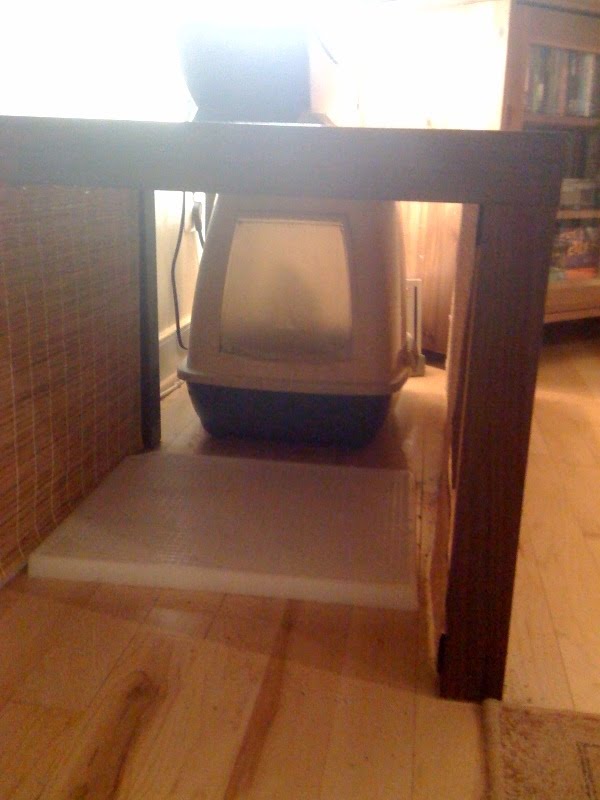
    Materials: Lack and Anno Stra screens

    Description: I was looking for a way to provide kitty potty privacy and also take away from the “look, this is where my cat poops” decor of the living room of our condo.

    So, I took two Lack tables, and one roll of Anno Stra window screens, as well as some sticky backed velcro.

    1)Assemble the tables
    2)Measure the screens to fit between two legs of the table and adhere with sticky velcro. I used velcro in case there was damage to the screens. (Who knows what kitties will like to scratch!)
    3) Repeat to cover 3 or 4 frames, creating a tunnel beneath the tables for for the kitty litterbox and the mat that wipes their paws.

    Easy as that! The cats, I believe, appreciate the privacy and it creates a new surface for coffee table books, our Aerogarden, or couch throw blankets.

    If you litterbox doesn’t fit I thought about adding casters also to make it easier to pull in/out to clean the litter.

    Enjoy!

    ~ Fraser, Bethesda, MD


  • T-Mobile Garminfone coming June 9 for $199 after rebate

    T-Mobile Garminfone

    The good news, for those of you hankering for Garmin’s special blend of navigation software, is that the Garminfone will be available June 9 on T-Mobile. What we’re still scratching our heads over, however, is the $200 price tag — and that’s after the $50 mail-in rebate card that you won’t get for a month or so after you sign away two years of your smartphone life. Anyhoo, you’ll get the same level of Android 1.6 coolness that we saw back with the Nuvifone A50 at Mobile World Congress, so check out our video of that if you’re still on the fence. [T-Mobile]

    This is a post by Android Central. It is sponsored by the Android Central Accessories Store

  • Oil Guru Matthew Simmons: It Could Be 24 Years Before The Deepwater Gusher Ends (BP)

    By far the most pessimistic take on the oil spill comes from oil guru Matthew Simmons, who was on The Dylan Ratigan Show this afternoon. His warning: There may be no way to stop the leak, and it could take 9000 days (over 24 years) for the gusher to end, while we wait for the well to simply run out. Simmons comes in around the 7 minute mark.

    And check out: sickening pictures of oil entering the marshes >

    Visit msnbc.com for breaking news, world news, and news about the economy

    Join the conversation about this story »

  • Facebook’s New Privacy Improvements Are a Positive Step, But There’s Still More Work to Be Done

    In response to a firestorm of criticism from EFF and others ([1][2][3]), and after much internal debate, Facebook today announced a series of privacy changes to the social networking site as Facebook CEO Mark Zuckerberg promised on Monday.

    We will be publishing instructions on how to best take advantage of the new settings shortly. For now, though, we wanted to quickly share our first impression:

    The changes are pretty good, though more is needed.

    All of the new settings are positive steps toward giving Facebook users more control over the privacy of their data, directly responding to several of EFF’s criticisms and reversing some of the worst of Facebook’s privacy missteps. However, we still have some fundamental concerns about the amount of user information being shared with third-party Facebook applications and web sites. So we hope that this is only Facebook’s first step in a more privacy-conscious direction, rather than its last. Ultimately, Facebook must respect its own principles and users’ privacy rights by giving users full control over how all their information is shared. (See EFF’s Bill of Privacy Rights for social network users.)

    To summarize, Facebook is announcing three big changes today:

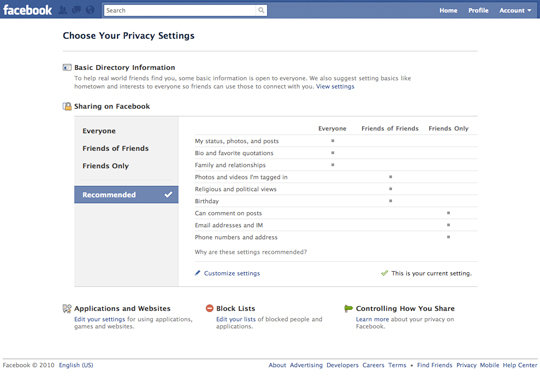
    • Facebook will provide a new basic privacy settings page. It allows users to easily set a “default privacy level,” which will apply across their individual privacy settings. That level can be one of the old options — Friends Only, Friends of Friends, etc — or a mix of privacy levels. Facebook has some recommended settings, but EFF recommends that users adopt stronger privacy settings than those recommended by Facebook.
    • Reversing one of the most controversial privacy changes it made in April, Facebook will restore true privacy controls for information about Facebook “Connections” that indicate your likes, interests, education, work history, hometown and current city, rather than requiring that all of your Connections be made public. However, your name, profile picture, gender and networks remain “public information,” and “Your friend list is always available to applications.”
    • Reversing one of the most controversial privacy changes it made last December, Facebook will restore users’ ability to completely opt out of the sharing of their personal information with Facebook applications and connected web sites over the Facebook Platform, while also making it easier to opt out of information sharing with web sites participating in Facebook’s Instant Personalization program. However, Instant Personalization was not made opt in.

    A New Basic Privacy Settings Page

    The first change is definitely a positive step, giving users an easy way to adjust many of their privacy settings with one click while still giving users the option to customize their individual privacy settings. This strikes a good balance between simplicity and granular control. These global settings will be “sticky” — that is, if you choose one of the global settings rather than customizing your individual settings, those settings will not be changed when Facebook rolls out new features. This is a substantive improvement, since it allows users to rein in sharing by future features. These new global settings will also apply retroactively to content you’ve already published on Facebook, so that if you previously published status messages or photos to Everybody but now choose to restrict that content to Friends Only, the new setting will control the visibility of your old content on the site. However, to the extent that content previously set to Everyone was already shared over the Facebook Platform with third-party apps or web sites, these new settings won’t reverse that. Additionally, if you do customize, the default for new features will be the setting recommended by Facebook, which will vary from feature to feature.

    We do have one warning about the new global privacy settings page, the same warning we gave in December: EFF does not recommend using Facebook’s “recommended” set of settings, which would share a substantial amount of your information with Everyone. We think the much safer option for most users would be to set your general privacy default to a more restrictive level, like Friends Only, and then use the per-post privacy option introduced in September to publish to Everyone only those particular things that you’re sure you want to share with the world.

    Restoring True Privacy Settings for “Connections” Information

    Last month, Facebook forced its users through a transition that we at EFF strongly criticized, requiring users to convert their likes and interests, their work and education history, and their hometowns and current cities into public “Connections” to other pages on Facebook. If users chose not to make that information public, it was simply deleted. And although “visibility” settings for that information remained, those settings only restricted who could see your Connections on your Facebook profile page, while they remained “public information” for other purposes. Thus, the settings did not prevent you from being identified on the pages you had “connected” to, and third-party apps and Facebook-connected web sites that you or your friends installed or interacted with were given access to all of your now-public “Connections” data.

    Today, Facebook reversed course and restored true privacy settings for these categories of information, settings that not only restrict what’s shown on your profile page but also restrict what information is shown on the pages you’ve connected to and what information is shared with third-party apps and web sites. Now, for example, if you set the privacy level for your interests or your activities to Friends Only, only your friends will see that information on your profile page or the connected page, and apps will have to ask for your permission before accessing it.

    We still think that April’s Connections transition was a bad turn for users, many of whom we expect made their information public out of confusion or because they simply didn’t want to see it deleted. The restoration of privacy control over that data should help reverse much of the privacy damage for those users who revise their privacy settings. However, many users may not. We’re disappointed that Facebook is not promoting these new privacy controls through the Facebook site as aggressively as it promoted the previous anti-privacy transition. Facebook should be giving users’ a pop-up message explaining the new privacy option and asking users whether they want to take advantage of it, just like they forced users through a pop-up interface in April when it first took that option away.

    Facebook is a site that many people joined because it was a more private alternative to sites like MySpace and Twitter. To keep in line with user expectations, no information should be required to be publicly available. Although we’re pleased that Facebook has now narrowed the categories of information that are required to be public to your name, profile picture, gender, friend list, and the networks you’ve joined, we think that Facebook should follow its own stated principles and comply with EFF’s Bill of Privacy Rights for Social Network Users by providing real privacy controls for all user information.

    Restoring the Ability to Opt-Out of Information Sharing With Facebook Applications and Connected Web Sites

    One of our biggest complaints about Facebook’s privacy changes in December was the removal of users’ ability to completely opt out of the sharing of their information with third-party applications and Facebook-connected web sites. Having this option was important because even if you choose not to use any Facebook applications or interact with connected web sites, any information that Facebook considers publicly available and anything you’ve published to Everyone is shared with any application or site that any of your friends use. Our friends at ACLU aptly named this privacy problem “the app gap” and did a great job publicizing it with their own Facebook quiz about Facebook quizzes.

    Facebook has heard our complaints and has responded, giving back the ability to easily block all sharing of your information over the Facebook Platform with apps and web sites, including web sites participating in Facebook’s Instant Personalization program.

    However, the complete opt-out does not address the fundamental problem that has persisted for years: users should not have to forego using any and all apps in order to limit the distribution of their information to only the few apps and sites that they want to use. Many users will find at least one app that appeals to them, and the all or nothing opt-out may only be useful to the most privacy sensitive users.

    Just because you may want to play the Scrabble app or or build a Farmville farm, or may be interested in an instantly personalized experience on Pandora but are worried about the recent security problems at Yelp, doesn’t mean that you want to share your information with any of the other tens of thousands of apps and web sites that your friends might use. Facebook should give users true control through a Platform opt-in list. An opt-in list would allow users to block information sharing with all apps and websites except for the ones with whom the user has affirmatively chosen to share. We will continue to push Facebook in this direction.

    In Conclusion…

    We appreciate that Facebook has taken the time to listen and respond to the public outcry over its latest privacy changes, and although today’s changes don’t address all of our concerns, they are a great first step in what will hopefully be a more privacy-driven direction for Facebook. We look forward to a continuing dialogue with Facebook on how to improve privacy on the site. In the meantime, stay tuned for more information from EFF on how to use these new options to maximize your privacy when you choose to share information with your friends and family on Facebook.

  • CrunchGear’s maker bar at TechCrunch Disrupt: assembling MP3 players from scratch


    The time: Day 3 of TechCrunch Disrupt. The place: CrunchGear’s Maker Bar. Given all the attention focused on Chinese factory conditions lately, we thought it would be interesting to have conference attendees (and sponsors and startup guys) assemble some basic MP3 players from the components an assembly line worker in China is likely to use. No soldering, though, we used ready PCBs (to the disgust of some). I managed to put one together in just under two minutes — it’s harder than it looks. Sorry about the noise in the background, that would be the compressed-air-powered stabber-bot nearby. Why I picked a place like that to shoot a video is a mystery to you and me.


  • Facebook CEO: ‘We are removing the connections privacy model’

    By Scott M. Fulton, III, Betanews

    In a move that may end up drastically scaling back what Facebook had hoped last month would be a redefinition of the Web itself, the social service will soon begin rolling out simplified privacy controls, according to a blog post today from CEO Mark Zuckerberg. The new controls may make it easier for Facebook users to limit the extent to which the system shares their personal information with others, especially including other Web sites.

    Continuing to deflect criticism, the CEO said that Facebook had always offered a multiplicity of privacy controls, but “if you find them too hard to use then you won’t feel like you have control. Unless you feel in control, then you won’t be comfortable sharing and our service will be less useful for you. We agree we need to improve this.

    “We’ve reduced the amount of basic information that must be visible to everyone and we are removing the connections privacy model,” Zuckerberg announced. “Now we’ll be giving you the ability to control who can see your friends and pages. These fields will no longer have to be public.”

    Although Zuckerberg describes the new privacy control as a “single” switch, an examination of the screen shot he provided for the new controls reveals that one of the settings causing users the most headaches appears to be compartmentalized behind a subheading, “Applications and Websites.” As Facebook originally planned for its Open Graph API — a.k.a., “Like” — other Web sites can share information about content that their users have “favorited,” or voted up, with Facebook. That way, Facebook can assemble new links to its own content that has the same or similar subject matter.

    But that system would require an implied open sharing status between Facebook and those other sites, one which many users might not readily trust if its presence were plainly explained to them.

    A preview of Facebook's re-revised privacy controls reveals some simplification, but also some selective compartmentalization.

    A check of Facebook’s updated privacy page does show, however, that the service did make one switch out of several: If a user turns off Facebook’s ability to receive shared “Like” data from other Web sites, she also shuts off her ability to use Facebook applications. (No more lunchtime harvesting, in other words.) This process is referred to by Facebook as “turning off platform.” As an alternative, the user may opt to turn off individual applications’ and Web sites’ access to Facebook data on a per-app basis, which is the more “granular” option that already existed, and that Zuckerberg said he had thought users would have preferred.

    The new Applications and Websites panel, reads the new privacy page, “controls what information is shared with websites and applications, including search engines (applications and websites you and your friends use already have access to your name, profile picture, gender, networks, friend list, user ID, and any other information you share with everyone). You can view your applications, remove any you don’t want to use, or turn off platform completely. Turning off platform means you won’t be able to use any platform applications or websites and we won’t share your information with them.”

    Users will still see “recommended” privacy settings, however, which may still guide novice users into making relaxed, less stringent choices — a fact which may not extract Facebook from the hot water it finds itself in today.

    In an op-ed piece for the Washington Post last weekend, Zuckerberg showed reluctant acceptance for the notion that some people simply must have their privacy, even if they’re joining a social network. Today, he went a step further, literally but politely telling users that this is the last privacy upgrade they’ll be getting for a long while, so they’d better be happy with this one.

    “Finally and perhaps most importantly, I am pleased to say that with these changes the overhaul of Facebook’s privacy model is complete. If you find these changes helpful, then we plan to keep this privacy framework for a long time. That means you won’t need to worry about changes,” the CEO wrote. And if you had any doubt that he was biting his tongue a bit when he wrote that, he then added, “(Believe me, we’re probably happier about this than you are.)”

    At the time of this writing, the new privacy settings were not yet made available to those Facebook accounts to which we have access.

    Copyright Betanews, Inc. 2010


    Add to digg
    Add to Google
    Add to Slashdot
    Add to Twitter
    Add to del.icio.us
    Add to Facebook
    Add to Technorati


    FacebookMark ZuckerbergSocial networkPrivacyprivacy settings

  • 2011 Mercedes-Benz CL-class and S-class Get New Twin-Turbo V-8s, AMG 65 Engine Sees Power Bump

    As we’ve reported earlier, Mercedes is busy overhauling its engine lineup, and we now have information about which engines are ending up where in 2011 models.

    The CL550 moves to one of Mercedes’ new V-8 powerplants, a 4.6-liter twin-turbo unit making 429 hp and 516 lb-ft of torque. That’s versus 382 hp and 391 lb-ft from the outgoing 5.5-liter V-8. All 2011 CLs get a face lift with new front and rear styling; they will retain their names instead of switching to S-class coupe nomenclature as had been previously rumored.

    The CL63 and S63 AMG receive another new Mercedes engine, a twin-turbo 5.5-liter V-8. Output ratings are 536 hp ad 590 lb-ft, increases of 18 hp and 45 lb-ft over the old naturally aspirated 6.2-liter V-8. Both models also get an engine stop/start feature and M-B’s multi-clutch automatic transmission (MCT), which uses a clutch in place of the traditional torque converter.

    Finally, the V-12–powered CL65 and S65 keep their engine but score an additional 17 hp, for a total of 621.

    Related posts:

    1. 2009 Mercedes-Benz C-class / C300 / C350 / C63 AMG – Review
    2. 2010 Mercedes-Benz S63 AMG / S65 AMG Revealed – Car News
    3. 2009 Mercedes-Benz G550 / G55 AMG / G-Wagen / G-Class Get a Facelift and the 382-hp V-8 – Car News
  • Measles comes back, McCarthy’s revisionist history | Bad Astronomy

    Two things vacciney:

    1) While it’s not due to antivaxxers, it’s still important: measles is making a comeback across the world. According to the article, the lack of funding is making vaccines hard to come by in Africa, Asia, and Europe, and measles is very opportunistic. With the antivaxxers still spreading their lies in America, Australia, and elsewhere, it’s all too easy for this awful disease to spread wildly anywhere it gets a toehold.

    2) It’s a delicate task, talking about someone’s kid when it comes to autism and vaccinations. It’s a social minefield; you’re dealing with an innocent kid, but you’re also dealing with a parent who may be gravely misinformed and doing a lot of harm by spreading misinformation. Jenny McCarthy, though, put her son Evan front and center in the nonsense she spouts about autism, and is doing considerable harm to the public health. Skeptico has taken on her claims, and shows that her version of events seems to shape-shift according to her needs.

    Tip o’ the syringe to my brother, Sid for the measles link.


  • Is Product Placement Better When It’s About Gadgets? [Humor]

    Alan Wake (fantastically entertaining game) is one of the more conspicuous about in-game advertising. Hell, they even work products into the gameplay itself. Penny Arcade’s take on this is only slightly exaggerated, if you can believe it. More »


    GameArcade gameVideo gameCoin-OpAlan Wake

  • Michelle Obama gives pep talk to Detroit. Transcript

    THE WHITE HOUSE

    Office of the First Lady
    ___________________________________________________________
    For Immediate Release May 26, 2010

    REMARKS BY THE FIRST LADY
    AT STUDENT FORM IN DETROIT

    Wayne State University
    Detroit, Michigan

    11:19 A.M. EDT

    MRS. OBAMA: Wow! (Applause.) Detroit! (Applause.) This is pretty amazing. Oh, my goodness. Thank you so much. Thank you, everybody. It is so good to be here at Wayne State University! (Applause.) Thank you to the Wayne State family for hosting me on this remarkable campus in the heart of this proud city. I’m just so honored. I want to thank Cherry for that kind and amazing introduction. Let’s give her a round of applause. (Applause.)

    And I also have to thank a few other people, too. I want to thank Governor Granholm — (applause), Representative Kilpatrick — (applause), Mayor Bing — (applause.) I want to thank Dr. Jay Noren, who’s the President of Wayne State. (Applause.) He made all this possible. I also have to thank the Marching Crusaders from MLK Senior High School — (applause) — and of course one of my favorite entertainers, singers — she’s powerful, she reminds you of what singing really is, Kimberly Locke. Let’s give them all a wonderful hand. Thank you for their performances. (Applause.) And we also have to thank all of the amazing mentors who showed up, who flew in from all over the country to be here. Let’s give them another round of applause for our mentors. (Applause.)

    And I also want to acknowledge everyone who’s joined us from Selfridge Air National Guard Base. I want to thank you all for your service to our country. We are, as always, so grateful and proud of the work that you do.

    And last but not least, I want to thank all the students, all the students for coming here, for being here — (applause) — for being out in the heat, for standing, for sweating. Some of you, I know you’re fainting a little bit. Get some water, but we’re here together. It is beautiful.

    I am thrilled to be here. I’ve wanted to come here from day one, and I am honored to be with all of you. The remarkable men and women that you just saw up here a few moments ago that served on the panel who were mentoring, they’ve all flown here today, and we’re all here because we care so deeply about your futures. Listen up. We care about your future and the future that we all share. That’s why we’re here.

    And I know that focusing on the future can be hard when times are tough. And in Detroit, in the state of Michigan, it goes without saying that times here have been tough. For the past several years, it has been tough everywhere in the country. But this city in particular has known its share of hard times. In recent years, you’ve seen jobs disappear, neighborhoods divide, schools deteriorate more than in any other city in America. And even more recently, you’ve experienced more grieving than any one city should have to bear.

    So let me tell you something, the last thing any of you need is someone to come here and tick off statistics; to tell you what you already know is going on in your own lives; or to have somebody write another story about what’s wrong with Detroit.

    And let me say that is not why I’m here. I am here because I know something that I want everyone in America to know — and that there is a brighter, better future ahead for Detroit, for Michigan, for America. (Applause.)

    And let me tell you why I know this — because I’m looking at our future right now. It is all of you. I’m looking at it. And it is a beautiful sight. I wanted to come here for the same reason that folks always call and will call this city home, because if you ask anyone here why they stay, even times are tough, they’ll say, look around, look at all we’re doing to move Detroit forward to reinvent and redefine what it means to live in this great city. They’ll tell you that the true worth of a community isn’t just in what you see when you drive around — it’s in the goodness of its people.

    And there are so many good people here. (Applause.) Everyday there are heroes who wake up early, they kiss their kids goodbye, and they catch the first bus to work. Everywhere there are young people who are working hard, and they’re getting good grades, and they’re helping their families. Everywhere there are neighbors who are rolling up their sleeves and taking care of their neighborhoods in their spare time. There are students everywhere here who stay up late just to earn their degrees. Thousands and thousands of good people who love this city, who are proud of their community, and believe there is no action too small or too simple to make a difference.

    So despite what some may think they know about this city, what I know is there is plenty of hope here. There’s plenty of hope — (applause) — because what you all have to know is despite everything that’s changed here, this is still the city where men clocked in to factories every day and built from scratch the greatest middle class the world has ever known. (Applause.)

    This is still the city where women rolled up their sleeves and clocked in, too, and they helped build an arsenal of democracy that led this world to freedom.

    And this is still a city of brave, bold, and determined Americans; a city where clever and courageous people come up with fresh new ideas to re-imagine and revitalize life here each and every day.

    So our next chapter — Detroit’s next chapter, Michigan’s next chapter, America’s next chapter — is waiting to be written. And it will be written by each and every one of you, because your future, your city’s future, this country’s future will look exactly like what each of you wants it to look like.

    And that’s what I believe. And that’s why I am here. Young people, I am asking you to embrace that responsibility to be our future.

    Now, let me tell you, I know that is a lot to ask, given all that many of you have been through. After all, the truth is, young folks, you didn’t do anything to get our economy in the state it’s been in. You all didn’t make the decisions that brought us to this point. I know that. So you have every right to say in your mind, “It’s not my fault. What can I do? I’ve got enough to worry about.”

    No one would blame you for feeling like no one’s listening, like you’ve been given up on. No one would blame you for choosing just to look out for yourselves. I get that. We all get that, right?

    But I hope of all hopes that you don’t feel that way, because there is a real truth out there, and that is there are a lot of people listening. I am listening. My husband is listening. (Applause.) The folks who are joining me here today, we are all listening. There are so many people who haven’t given up on you. There are so many people here who will always believe that you can do this. And there are so many people here who are counting on you all.

    So I hope we’re here because we want you to feel energized. We need you all to feel energized. And I hope you all recognize the possibilities that are out there waiting for you. I hope you realize how much potential you have, and how capable you are of living up to that potential.

    But the thing I want to tell you is that the simplest and surest way for you to live up to that potential is to do just one thing — and that’s keep focusing on your education. (Applause.) That’s right, that’s it: Keep focusing on your education. That is your job. Not playing video games, not shooting hoops, not dropping beats, not talking about how you’re going to make it big. See, there’s a time and place for all that. There really is.

    But, if you’re looking for the secret of success — do you want to know the secret? (Applause.) You’ve got to realize that there is no secret. It is your education, plain and simple. It’s mastering math and science. It’s learning to write well. It is learning to think for yourself and coming up with your own ideas and your arguments, and learning how to express that.

    That is what has made the difference for me. That’s what the — made the difference for my husband. That’s what’s made the difference for so many successful people. The folks who were on this stage, we are only where we are today because of the education we received. That’s the secret.

    My husband wasn’t born a President. He didn’t grow up with a lot of money. He didn’t even grow up knowing his father. He was no more talented or gifted than any one of you here. His life could have taken any turn. But what he did have was someone who believed in him and pushed him to work hard and do his best.

    See, when Barack was young, he and his mother lived overseas for a time, and she didn’t have a lot of money to send him to fancy schools where the other American kids were going. She didn’t let that stop her from giving him everything she could to succeed.

    So you know what she did? She woke Barack Obama up at 4:30 every morning, five days a week, just to go over his lessons with him before he went to school, and before she went to work. So yeah, he’d complain, he didn’t like it, he tried to find an excuse to keep sleeping — sleep is good — but she wouldn’t let him. Barack’s mother wouldn’t give in. She’d just say, “You know, this is no picnic for me either, buddy.” (Laughter.)

    And it’s because she made sure he was getting what he needed for his education; it’s because she sacrificed, day after day, week after week; that he had every chance — every shot — to someday become the President of the United States of America. (Applause.) Look, folks, it’s education.

    My upbringing was a little bit different from his. I grew up in the Midwest, like you. Grew up on the South Side of Chicago, in a community just like many of yours. It was a community where people often struggled to make ends meet. But folks worked hard, they looked out for each another, and they always rallied around their kids.

    I was blessed to have two parents who worked to give me and my brother everything they never had. My father, all his life, was a shift worker at the water plant. My mother stayed at home and helped raise me and my brother. And it’s because they did what they did that we were the first in our immediate family to go to college. And that made all the difference in the world.

    And I’m sure, looking out at all of you, that many of you have similar stories as mine — stories of parents and grandparents who wanted something more for you, so they saved and they sacrificed so that you could have opportunities they never could have imagined for themselves.

    I imagine that right now there are some of you here at Wayne State who are the first in your families to make it to college. Am I right? (Applause.) And I’m sure there are some high school students here who are going to be the first from their families to attend college, right? (Applause.)

    Look, and I know what a big responsibility that is to shoulder. I know it’s tough to think about finishing school when the odds say you won’t. I know it’s tough not to feel guilty about earning your education and moving on when maybe your family might have larger issues at home. I know it’s tough to try and live up to the potential you know you have inside when there is always something to undercut you; or someone who’s ready to underestimate you.

    But the simple fact that you are all here shows that you’re already beating those odds. You are already making a way out of no way. You’ve got to know that. All of you are already succeeding.

    So I’m just here to tell you to keep going. And let me tell you something, if you’re not doing everything you could be doing to succeed in school today, then you all have to push yourselves. You have to. You have to take responsibility for your education and for your future. And let me just say this, it’s not always going to be easy. You won’t always get credit for what you do.

    And I know that can be frustrating, especially when your generation has grown up in a popular culture that doesn’t exactly value all your hard work and commitment, but instead it glorifies easy answers, and instant gratification, and quick celebrity. It’s a culture that tells us that our lives should be easy, that we can have everything we want right now without a lot of effort; that struggle and sacrifice aren’t necessary for success.

    But that’s not how life really works. And you all know that. You know that businesses don’t really succeed without hard work and serious investments to produce quality products. We know that our economy doesn’t really prosper when folks focus on easy credit, and get-rich-quick schemes, or promises that living beyond our means is okay. And we know that our leaders don’t really become leaders without running into obstacles and setbacks along the way. My husband has certainly had his share.

    The truth is few things worth achieving happen in an instant. And the greatest value is found in the greatest effort. Embracing our challenges, and not shrinking from them, is the surest way to succeed — and it is the only way to become what we’re truly meant to be.

    So students, I want you to keep that in mind. Your education is the surest way to your success. But even though you’ve got teachers and principals and families now who believe in you, you won’t always have someone to push you. So that means you’ve got to push yourselves and you’ve got to push each other, even when it’s hard.

    Some of you may be in schools that aren’t the best shape — but that can’t stop you from hitting the books when you get home. That’s on you. (Applause.)

    Some of you may not have many role models to look up to — but that shouldn’t keep you from being a role model for somebody else. That’s on you.

    Some of you may feel weighed down by other people’s low expectations for you. But that cannot stop you from breaking free; from setting high expectations for yourselves; from exceeding those expectations and proving people wrong. That’s on you.

    Look, young folks, there is so much in life that you can’t control. But these are the things you can. So please don’t ever let anyone tell you your destiny is already decided for you. Don’t do that. You tell them that your destiny is for you to decide. Don’t ever let anybody tell you that you can’t do something. You tell them what? “Yes we can.” That’s what you tell them. (Applause.)

    And as you take responsibility for yourselves, I also want you to think about taking responsibility for others and for your own community.

    So yeah, pay attention in class, throw yourselves into getting your education. But nudge your buddy, that friend, you know? Make sure that he or she is focused, too. Help them through, as well.

    Yeah, I want you all to take that trip to Eastern Market, get healthy, fresh, food if you’ve got a car. But offer to get some for somebody who doesn’t, for an elderly neighbor who can’t get there. That’s what I want you to do. (Applause.)

    Yeah, take some pride in keeping your block as clean, as safe as you can. But help your friends take care of their blocks, too.

    Fight for every inch of your future. But take a little time each week to lift up the families, and neighbors, and schools that need your help today.

    And one other thing. As you push forward with your education, both inside and outside of the classroom, I want you all to consider this. Consider the wider world out there, too. We live in a world. And think about how you can engage broadly with other people and other cultures around the world, embracing your place as part of a big, powerful, young, global generation.

    Now, that may sound strange when there’s so much to do right here at home. But if the opportunity ever arises for any of you to participate in exchange programs, a study abroad program, maybe even travel abroad, volunteer for a short time — that is my one regret that I didn’t do when I was young — I would urge you to try to do that.

    It’ll advance your education; it will expand your sense of possibilities; and it will make you more competitive for the jobs of the future.

    But more importantly it will also show you just how much we all have in common — no matter where we live in the world.

    And as First Lady, I’ve made it a point to spend time with young people your age when I visit other countries.
    I make it a point to do that. And what is so remarkable is that no matter where I go, or who they are, they’re so much like you.

    Young people around the world, they share similar worries, similar frustrations. But you all share similar hopes and dreams. And what’s most amazing is you are all so eager and willing to make a difference. And that is what gives me hope. If we hope to solve the most pressing challenges in the world, we’re going to have to adopt the perspective of young people, a perspective that reminds us all that we have more in common than we think, because in times of tension, it’s easy for us to slip into focusing only on what makes us different — things like color and class — when all that does is deepen mistrust and keep us from working together.

    But we are all in this together. That’s the truth. Young, old; black, white; Hispanic, Asian, Arab-American; city, suburb; both sides of 8 Mile — (applause) — none of us can fully succeed without one another.

    And it’s times like these that require us to put our differences aside, and focus on what we have in common — things like pride in where we live.

    So we’re looking to you. We’re looking to your idealism, your optimism, your willingness to look at things in a new and fresh way. We need you to rebuild those bridges, to restore that understanding, to renew that trust — not just here in America but around the world.

    So one last thing before I go. Here’s what I want you all to remember: In life, there are two kinds of people: those who give up, and those who don’t. And it’s the folks who don’t who make all the difference. And I believe in my heart, which is why I’m here, that you all are those special people. You are the ones really that we’ve been waiting for.

    So apply yourselves, young people. Listen to me. Apply yourselves. Show us how it’s done. You all have to study hard. Can you do that? Can you dream big? (Applause.) Can you hope deeply? Never give up, because we will never give up on you. We have got your backs. We’re rooting for you, and sometimes you need to hear that. Sometimes you just need to know that big, important people out there are rooting for you. We believe in you all, and we will keep working for you as long as you keep working for us.
    So thank you so much. You all take care. Be strong. (Applause.)

    END 11:42 A.M. EDT

  • Border Troops Won’t Do Much, Say Residents

    While Washington wrings its hands over immigration, Arizona border residents say political dithering is making things worse.

    “Every time our president talks to the Mexican president, or every time the word amnesty comes over the Mexican news, there is a flood of people,” said one resident who wanted to remain anonymous for fear of retaliation.

    She and her neighbors say unarmed National Guard won’t deter drug smugglers or anyone else.

    “There’s guys out here with no guns and they’re our troops. The Mexicans think we’re nuts,” says the resident.

    But it is not just Mexicans. In 2009 Customs and Border Protection arrested 52,000 illegal entrants from countries other than Mexico, known as “OTM’s,” including from Afghanistan, Pakistan, Iran, Nigeria, Somalia and Yemen.

    U.S. representative Rob Bishop (R-UT) says the crossings are a concern.

    ”It’s the illegal drug human smuggling and yes, the potential for terrorism.”

    In spite of the Border Patrol’s best efforts, thousands of people are getting through, on federal land like Indian reservations and national parks that cover almost half of the Arizona-Mexico border.  In many places, agents can’t pursue criminals in their vehicles for fear of damaging the environment.

    Rancher Fred Eddington says he is frustrated.

    “Border Patrol needs to go where they can go to do their job. And nobody else plays by the rules, so why should they?”

    The recently retired head of the Tucson Border Patrol puts it plainly: “The border is porous. We don’t have the resources that we need. Somebody who wants to do us harm can get into the United States.”

  • CrunchGear hits the big time: Our “Getting things built” panel at #tcdisrupt


    If you haven’t been watching Disrupt today, you’ve missed out. The best panel ever? Ours.

    I talked to Liam Casey, Adam Hocherman, Chris Hawker, and Bre Pettis about open source hardware, manufacturing, and entrepreneurship in the manufacturing space. I won’t spoil anything for you, but I recommend you watch it.

    If you take anything away from the panel, I think it will be “dick hammer.”


  • Stunning NOAA map of Tennessee’s 1000-year deluge – 15 sites had rainfall exceeding maximum associated with Hurricane Katrina landfall

    What is a 100 year flood? A 100 year flood is an event that statistically has a 1% chance of occurring in any given year. A 500 year flood has a .2% chance of occurring and a 1000 year flood has a .1% chance of occurring. The map below relates [the] amount of rainfall that fell to the chances of that amount of rain actually occurring.

    Nashville1 5-10

    Climate Progress has been documenting the woefully underreported Tennessee deluge of 2010 aka Nashville’s ‘Katrina’. It was an off-the-charts extreme weather event that human-caused global warming set the table for and almost certainly made more intense, as a leading climate scientist explained to me (interview to be posted next week).

    But I didn’t understand just how unprecedented this superstorm was until I saw the above map from the Office of Hydrological Development at NOAA/NWS.  I have never seen a map like this before, but then that may be because there simply aren’t many events to rival this one.  Look at the red streak, which is the area hit by a greater than 1000-year deluge.  And look at how much of western Tennessee was slammed with a greater than 500 year downpour.  This is the “high water” of Hell and High Water.

    The NWS has more maps that put the deluge in perspective, including how it compared to Hurricane Katrina’s rainfall:

    May 1 and 2, 2010 Tennessee Rainfall Totals

    Here are some amazing factoids:

    • Fifteen (15) observation sites had rainfall measurements exceeding the maximum observed rainfall associated with Hurricane Katrina landfall.
    • The two day rainfall of 13.57 inches at Nashville International Airport shattered the monthly rainfall record for May which was 11.04 inches.
    • The rainiest month in Nashville is 13.92 inches in January 1950.
    • Nashville International Airport experienced its 1st and 3rd rainiest days on back to back days.
    • The heaviest rainfall occurred in a swath across Davidson, Williamson, Dickson, Hickman, Benton, Perry, and Humphreys Counties.  An average of 14 to 15 inches of rain fell equivalent to 420 billion gallons of water in just two days.

    And here is what Katrina did:

    Hurricane Katrina Rainfall Totals

    So yes, this superstorm deserve to be called Nashville’s Katrina.  It is all the more stunning for having generated so much rain without actually being associated with a hurricane, similar to the Georgia superstorm from September (see Weather Channel expert Stu Ostro’s discussion of Georgia’s record-smashing global-warming-type deluge).

    I suppose people can stick their head in the sand water if they want, but CP readers understand that this is the shape of things to come for many of the world’s great cities if we stay anywhere near our current greenhouse gas emissions path.  More on the way.

    Related Posts:

  • Foxconn Asks Employees to Sign Promise Not to Commit Suicide or Sue The Company If They Do [Foxconn]

    Shanghaiist got ahold of this memo being sent out to Foxconn employees, trying to help them deal with whatever working conditions is leading toward this recent string of suicides. It starts off good, then, well, gets not so good. More »


    FoxconnSuicideAppleDeathChina