Blog

  • Google’s tips for becoming a top app

    Google Apps - tips for developers

    Guest writer Amit Kulkarni, Co-Founder and CEO of Manymoon, took to the Google Code blog recently with a very interesting article that gives four important tips to would-be app developers.  While this is geared more to the Google apps space and enterprise solutions, it’s also a must read for anyone thinking about developing applications for the Android Market.  Google’s cloud computing scales down very well to our phones, and potential tie-ins between Google apps and Android applications is still a largely untouched field.  Whether you’re an app developer, or just curious, take a look to get a little inside view from a very popular developer. [Google code blog]

    This is a post by Android Central. It is sponsored by the Android Central Accessories Store

  • In the News ~ May 26

    Below are links to news stories of interest from newspapers that came up during a search today.  These links were active at the time of this e-mail, but should you want to save a story, printing it or cutting and pasting the entire article and saving it to your computer is recommended.    

    State News 

    One sick child, two teachers and a selfless act  LINCOLN — Tuesday was Tim Chavosky’s last full day as a science teacher at Lincoln High School. In February, the ax fell on nine LHS teachers who were laid off because of budget constraints. Chavosky was one of the teachers cut. But Chavosky’s situation is different from the other eight. He volunteered to go. Why he volunteered might end up being the best lesson he ever taught the students at Lincoln High. 

    Decatur School District, teachers union at odds over ‘Race to the Top’ memo
    Decatur Herald – DECATUR – The second deadline for Race to the Top is fast approaching, and Decatur’s application lacks the signature of the Decatur Education Association. Bobbi Williams, director of special programs, gave a report on the federal program to address low-performing schools to the school board Tuesday.   

    Dist. 205 and Teachers Join Race to the Top
    WIFR (CBS) 23 Rockford – a more than four billion dollar jackpot. And representatives for both the teachers union and the administration say it’s too big a prize to miss out on. Rockford Education Association president Molly Phalen says the teacher’s union is joining the district in signing the state’s application for round two of the federal “Race to the Top” contest.   

    REA puts frustrations aside for Race to the Top collaboration
    WREX (NBC) 13 Rockford – The Rockford Education Association puts clashes with Superintendent Dr. LaVonne Sheffield on the back burner and pledges collaboration. Both sides signed a memorandum of understanding to work together   

    Somonauk teachers agree to salary freeze, cut programs reinstated
    Ottawa Daily Times – union also approved the changes to the contract, voting “overwhelmingly in favor of freezing our salaries and stipends at the exact salary paid for the 2009-2010 school year,” said Somonauk Education Association President Lois Whalen. “Teachers, and especially Somonauk teachers, are committed to our students we work with every day,” she added.   

    D204 support staff OKs hourly pay freeze
    Fox Valley Villages Sun –  a 2 percent “step” raise for existing employees. Currently, starting secretaries earn $13.49 per hour and other IPCA members, including deans assistants, health assistants, and teacher assistants start at $11.01 per hour. Carol Schaible, president of IPCA, said 78 percent of the union’s members are also District 204 residents, something that was kept in mind   

    Teachers say union OK of U46 pact likely
    Elgin Courier News – teachers would not receive a pay increase, so it “won’t dramatically increase the number of teachers we can recall.” Nor would more U46 staff necessarily be recalled, Sanders said, even if Gov. Pat Quinn signs legislation to fix the district’s funding process and give the district $22 million more general state aid for the 2010-11 school year. That’s because the state is so far behind

    Unit 5 may start an hour later on up to 16 days next year
    Bloomington Pantagraph – Superintendent Gary Niehaus emphasized the board won’t decide tonight whether to introduce the late starts, but it could direct him to discuss the idea further with union officials with the Unit Five Education Association. In a work session set for 5 p.m. the school board is expected to discuss how the still-uncertain state budget will affect the district’s 2010-11 budget.   

    The Southern: Cut fat from state budget, not meat of public education  Editorial – Some lawmakers in Springfield apparently realize the state of Illinois is pursuing a path of financial ruin. That sounds good, but serious state budget deliberations were needed months ago, at the opening of the regular session of the State General Assembly.   

    Our Opinion: Disappointing decisions by U of I board
    Springfield State Journal Register –  There is no doubt a university presidency is a difficult, 24/7 job. But the fact that new U of I President Michael Hogan’s salary of $620,000 is more than the $177,412 that Gov. Pat Quinn earns and President Barack Obama’s $400,000 salary shows how university administrator salaries have gotten out of hand. THE U OF I BOARD approved Hogan’s salary   

    News-Gazette: Who says how much is enough?  The (Champaign) News-Gazette – When Michael Hogan starts his new job as president of the University of Illinois in July, he’ll be earning an annual salary of $620,000 a year, and that has a lot of people upset. The anger or resentment or whatever one chooses to call it is no big surprise. Big salaries bring out the envy in many people. But the envy is accompanied by anger this time, and not without reason.   

    Illinois turns away 27,000 for financial aid
    Sterling Sauk Valley News – Thousands of Illinois college students who were hoping for financial aid from the state may be out of luck: The agency that distributes the payments says an increase in demand has forced it to turn down almost 27,000 students, and that figure could grow to 200,000 by fall. The Illinois Student Assistance Commission says it expects to have about $400 million to spend 

    Political News

    Illinois House approves budget; Senate to meet today  Chicago Public Radio – Illinois is closer to a new budget. The state Senate this afternoon is scheduled to discuss a $13 billion deficit. The House yesterday approved a spending plan that relies heavily on borrowing and putting off paying state bills. Democratic Representative Pat Verschoore says the House budget plan is not a good solution but it’s the best given the options.  

    House OKs borrowing to cover state pensions  Pension borrowing — a major (and controversial) component of a state budget plan — finally won approval in the Illinois House on Tuesday after a series of rejections. The scene now shifts to the Senate, which returns to Springfield today.   

    House passes pension borrowing plan on 2nd try  The Illinois House approved, on its second try on Tuesday, a bill that borrows $3.7 billion so the state can make its pension payment. The vote was 71-44, with two members voting ‘present.’ Two Republicans crossed party lines to vote in favor of the bill.  

    Borrowing has huge role in proposed spending plan
    Chicago Tribune –  For the second consecutive year, lawmakers are favoring taking out a loan to cover the required contribution to pensions for retired state workers, judges, elected officials and teachers outside Chicago. Democrats argued that spending $1 billion on interest payments to cover the pension borrowing plan would be less expensive to taxpayers than simply refusing to make the pens   

    Illinois Lawmakers Adopt Plan to Borrow To Pay For Pensions
    Chicago WFLD (Fox) 32 – One measure would borrow $3.7 billion to make the state’s annual contribution to government pension systems. Another would give Gov. Pat Quinn broad power to decide where to cut spending. Quinn would also be allowed to borrow from special government funds. A third measure cuts administrative spending by 5 percent.   

    NEW: Illinois House slashes $200 million in Medicaid, rejects other cuts   Alton Telegraph – A day after a coalition of Democratic lawmakers proposed $1.3 billion in cuts in an effort to dig the state out of a $13 … 

    Democrats reject Black motion on 63 Republican bills
    Champaign News Gazette – A motion by state Rep. Bill Black, R-Danville, to discharge 63 separate pieces of Republican legislation aimed at cutting government costs and improving Illinois’ economy was blocked Tuesday night by House Democrats. “I think part of the frustration I feel is that we’re not allowed to participate. We’re not asked. We’re not invited. 

    Curtailing use of state planes not on lawmakers’ list of cuts Chicago Tribune –  Lawmakers are proposing a wide variety of ways to cut the woefully out-of-balance budget,

    Quinn won’t sign bill to let colleges borrow The Associated Press – Gov. Pat Quinn says he will not sign a bill that would allow Illinois’ public universities to borrow money to make up for millions of dollars in overdue state funding.   

    White House Sending Campaign Help for Giannoulias
    NBC Chicago – Alexi Giannoulias’ campaign said today that Secretary of education Arne Duncan and White House Deputy Chief of Staff Jim Messina would be coming to Chicago in June to campaign for the senate candidate. “Should be a good time,” said spokesperson Matt McGrath   

    Pantagraph: A few reasons why public sees need for cuts  The (Bloomington) Pantagraph – If state lawmakers wonder why the public doesn’t believe those who say there’s no fat to trim in the budget, let us explain.   

    During his first year, Quinn stayed at Executive Mansion 55 nights  Gov. Pat Quinn had been in office only a few hours last year when he vowed to do something his impeached predecessor did not – live in the Executive Mansion in Springfield. But a Tribune analysis of his official travel schedule shows that Quinn stays at the ornate, taxpayer-funded house only sporadically. He didn’t spend more than three consecutive nights in the executive mansion.  

    Our Opinion: Spare state retirees dose of ‘tough love’  STATE REP. KAREN MAY, D-Highland Park, said the legislature might have to show state retirees some “tough love,” and start imposing premiums upon them for their health insurance as part of a plan to balance the state budget.  

    Gubernatorial candidate Whitney pedals throughout state for his green platform
    Decatur Herald and Review – SPRINGFIELD – Traveling by public transit, Green Party gubernatorial candidate Rich Whitney visited Central Illinois on Tuesday to call for the state to phase out its reliance on fossil fuels and nuclear power. The Carbondale attorney has been relying on his bike and mass transit to travel the state during a nine-day, 650-mile trip that will cover 19 cities when it’s completed in the coming   

    National News

    Neither side happy with jobs bill being pushed through Congress Washington Post – Some conservatives say people who are out of work shouldn’t be able to collect jobless benefits for almost two years. Liberals, meanwhile, want Congress to pay for a New Deal-style program in which the federal government would send  

    School is in session: Governor announces deal to eliminate Hawaii’s public school furloughs
    CLTV-Chicago –  The governor will release $57.2 million to the state school system, out of a total of $67 million the Legislature allocated from a special state hurricane relief fund; and teachers will hold classes on six of the 11 non-instructional days their labor contract previously required. “We are gratified that the agreement we worked hard to reach with the Board 

    Teacher in trouble after students don Klan robes ATLANTA (AP) — A North Georgia teacher is on administrative leave and could lose her job after she allowed four students to don mock Ku Klux Klan –  in Klan-like outfits upset some black students at the school and led at least one parent to complain. Catherine Ariemma, who teaches the advanced placement course combining U.S. history with film education, could face punishment ranging from suspension to termination, Lumpkin County School Superintendent Dewey Moye said Monday 

    TIME.com Today’s Top Stories 

    Politics and Gangsters: Behind the War on Jamaica’s Streets

    In Jamaica, the same government trying to arrest an indicted gang leader had previously tried to shield him from extradition. Can Prime Minister Bruce Golding survive the showdown? 

    BP’s Oil: Fouling the White House Along with the Gulf

    One day, the gusher in the Gulf will stop. Then what?

     Is the Housing Market on the Rebound?

    For the first time in years, it appears, now is actually a good time to buy a house

     In Death-Penalty Cases, Innocence Has to Matter

    The case of Hank Skinner gives the Supreme Court a chance to confront the fact that the legal system does not always seem to care whether the people it executes are actually guilty

     Chinese Factory Under Scrutiny as Suicides Mount

    The massive Foxconn factory in Shenzhen, China, is known for assembling electronic goods like Apple’s iPhone and iPad. But in recent months it has gained a darker image, as a place where workers regularly throw themselves to their deaths

    Nations go own way on global financial reform
    LONDON — The global campaign to harmonize rules for financial firms is swerving off course, threatening efforts to curb the risky bets that rocked the world economy two years ago.
    (By Anthony Faiola and Brady Dennis, The Washington Post)

    North Korea severs all ties with South
    SEOUL — North Korea announced Tuesday that it is severing all relations with South Korea, heightening the risk of armed conflict and creating perhaps the most serious crisis on the Korean Peninsula in more than two decades.
    (By Blaine Harden, The Washington Post)

    BP readies mud and robots to try to plug oil well
    The most critical moment in the oil spill crisis in the Gulf of Mexico is at hand, as BP engineers armed with 50,000 barrels of dense mud and a fleet of robotic submarines are poised to attempt a “top kill” maneuver to plug the gushing well a mile below the surface.
    (By Joel Achenbach and Steven Mufson, The Washington Post)

    BP presents: One slick horror film
    For all the gunk on television, it’s hard to think of a more depressing show these days than the “spillcam,” the live, continuous underwater footage of the broken BP pipe that has been gushing away deep, deep down in the Gulf of Mexico for more than a month now.
    (By Hank Stuever, The Washington Post)

    Obama beefs up border security
    President Obama will deploy 1,200 National Guard troops and request an extra $500 million to secure the Mexican border, his administration said Tuesday, a move dismissed by Republicans as insufficient to win their cooperation on an overhaul of the nation’s immigration system.
    (By Michael D. Shear and Spencer S. Hsu, The Washington Post)

    Word of the Day for Wednesday, May 26, 2010

    regnant \REG-nuhnt\, adjective:

    1. Prevalent; widespread.
    2. Reigning; ruling (usually used following the noun it modifies): a queen regnant.
    3. Exercising authority, rule, or influence.

  • 2010 BMW 320d EfficientDynamics travels 1,013 miles on a single tank of gas

    2010 BMW 320d EfficientDynamics

    BMW announced that its most fuel-efficient and greenest 3-Series ever completed a record-breaking journey from the UK to Munich and back on one tank of gas. Fueled up and ready to go at the Channel Tunnel, the new 2010 BMW 320d EfficientDynamics sedan made it to Munich and back – a total of 1,013 miles on a single tank of fuel.

    Tom Ford

    The BMW 320d EfficientDynamics was piloted by Tom Ford (of Fifth Gear) who averaged a combined figure of 57 mpg and CO2 emissions of only 109g/km. On his way to Munich, Tom was achieving a 63 mpg and said that he didn’t hit below 54 mpg the entire trip.

    Click here to get prices on the 2011 BMW 335d.

    “I was prepared for this car to fail in the real world, I was wrong,” Tom said. “Although I did try and be careful and drive in a feather-footed manner, I did cruise at a reasonable 65ish mph on the autoroutes and autobahns, so faster than the usual economy run pace.”

    The 2010 BMW 320d EfficientDynamics is powered by a 2.0L 4-cylinder turbocharged diesel making 163-hp with a maximum torque of 265 lb-ft. Mated to a 6-speed manual, the BMW 320d EfficientDynamics can go from 0-62 mph in 8.2 seconds with a top speed of 140 mph.

    2010 BMW 320d EfficientDynamics:

    2010 BMW 320d EfficientDynamics Edition 2010 BMW 320d EfficientDynamics Edition 2010 BMW 320d EfficientDynamics Edition

    – By: Omar Rana


  • It Adds Up: Google’s “Pac-Man” Homepage” Cost Society $120mm in Lost Wages

    google-pacab

    It’s all just a game until society forfeits the gross domestic product of Haiti.  As much fun as the Pac-Man game was (not all that fun), it sure did come at a price.  The embedded game caused web surfers to spend 44 seconds on Google.com, rather than the more standard 11.  Multiply that by the number of people (lots) and their wage (about $25/hour) and you’ve got a very expensive timesuck on your hands.

    I’m guessing that Lost message boards cost the economy more money, but I think NASA would need to get involved in the tabulation of that one.

    Related posts:

    1. Watches That Are More Confusing Than “Lost”
    2. Starbucks Adds Booze to Menu
    3. Google Makes Some Odd Suggestions

  • Apple market capitalization tops Microsoft

    By Joe Wilcox, Betanews

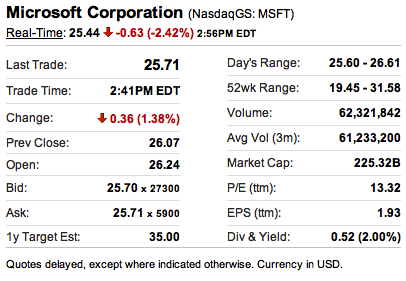
    For weeks, pundits predicted what happened today: Apple’s value exceeded Microsoft’s. While writing post “The Windows era is over” early this afternoon, Apple’s market capitalization was $227.95 billion and Microsoft’s $228.47 billion, or just $520 million separating them. By the time I posted, at 2:56 pm, Apple’s market cap was $225.98 billion and Microsoft’s was $225.32 billion.

    In the 20 minutes after, the two companies went on a roller coaster ride of sorts, with Microsoft failing to near $221 billion and Apple rising above $228 billion.

    For Apple, there has been dramatic change since stock markets collapsed in autumn 2008. Apple’s market cap was $88.68 billion on Oct. 2, 2008 and Microsoft’s was $228.35 billion on Sept. 29, 2008. Mmmm, do you see a difference? Microsoft hasn’t much changed, while Apple, boasted by surging share price, has rapidly gone up. About six weeks before the crash, on Aug. 13, 2008, Apple’s market cap was $158.84 billion compared to $254.83 billion for Microsoft.

    From one perspective, market valuation doesn’t mean much. It’s mitigated by several factors, including the number of shares publicly traded. But its symbolic significance cannot be understated, particularly considering the long rivalry between Apple and Microsoft and Apple’s near-death experience during the mid 1990s.

    Apple market cap

    Something else: Apple and Microsoft were founded about the same time and both companies played important roles launching the mainstream PC industry in the 1980s. But since 2000, Microsoft’s stock has been moribund. Apple shares started a slow surge around 2003, which the September 2008 financial collapse reversed. But throughout 2009, Apple shares rose and rose and rose. Apple shares closed at $100.10 on Oct. 28, 2008. As I write, Apple is trading at $248.15.

    A more meaningful comparison of the companies — at least as rivals — is revenue and profit. During first calendar quarter, Apple closed the revenue and profit gap with Microsoft to just $1 billion dollars. A year earlier, Apple revenue trailed Microsoft by $4.57 billion and net income by $1.36 billion. In the same quarter in 2005, the difference between the two: $7.01 billion by revenue and $3.6 billion by net income.

    Microsoft market cap

    Update after 4 pm market close: In the closing half hour of trading, volumes for Apple and Microsoft were unusually high. Apple closed at $244.11 a share, down $1.11 from the previous close. The stock opened at $250.20 today. Microsoft closed at $25.01 a share, down $1.06 from the previous close. Microsoft opened at $26.24 a share. Despite the roller coaster trading, Apple ended trading with a market cap above Microsoft: $222.12 billion to $219.18 billion. But with market caps so close, Microsoft easily could top Apple in another day’s trading.

    Copyright Betanews, Inc. 2010


    Add to digg
    Add to Google
    Add to Slashdot
    Add to Twitter
    Add to del.icio.us
    Add to Facebook
    Add to Technorati


    MicrosoftAppleMarket capitalizationStock marketBusiness

  • T-Mobile announces Garminfone, available June 9th

    Garminfone

    T-Mobile sent out a press release today announcing the pricing and availability of the Android-powered Garminfone.  The device will be available online and at select T-Mobile stores and authorized dealers on June 9th for $199.99 after a $50 mail-in rebate.  Of course, you’ll have to sign up for a two year contract and qualifying voice and data plans to receive that price.

    If you aren’t in contract and still want a Garminfone, then T-Mobile has a contest for you.  Titled the “T-Mobile Garminfone Navigate Your Life Sweepstakes,” customers can follow T-Mobile’s twitter account (@TMobile_USA) and tweet at the company about a time in their life when they got lost without a GPS.  Interestingly, customers must also include the hashtag #needgarminfone, leaving only 111 characters for the customer’s story, which could lead to some strange tales.  So are any of you planning on picking up a Garminfone? Tell us below!


  • “Top Kill” Operation Is Under Way in Attempt to Stop Gulf Oil Leak | 80beats

    Live feedIt’s on.

    Today the U.S. Coast Guard gave its approval to BP’s “top kill” plan to finally cap the oil spill, and at 2 p.m. Eastern time, the company got started. BP leaders warned that it may take a couple of days before they know for sure if it worked, but now say they will maintain the live video feed during the top kill attempt.

    A successful capping of the leaking well could finally begin to mend the company’s brittle image after weeks of failed efforts, and perhaps limit the damage to wildlife and marine life from reaching catastrophic levels. A failure could mean several months more of leaking oil, devastating economic and environmental impacts across the gulf region, and mounting financial liabilities for the company. BP has already spent an estimated $760 million in fighting the spill, and two relief wells it is drilling as a last resort to seal the well may not be completed until August [The New York Times].

    This procedure is no sure bet, because a top kill hasn’t been attempted 5,000 feet down in the sea before. BP’s CEO Tony Hayward estimates the percentage chance of success in the 60s.

    The procedure requires an elaborate and precise orchestration among five vessels at the surface, whose duties range from housing pumping equipment to storing a total of 50,000 barrels of drilling mud, and several remote-controlled undersea robots. If all goes as planned, the dense mud will be pumped through a single 6-5/8-inch-diameter drill pipe from one vessel, which will then enter two 3-inch-diameter hoses. Those hoses will deliver the material to the sea floor, where they will intersect with the choke and kill lines of the damaged blowout preventer, which sits atop the well [Christian Science Monitor].

    Whether this works may depend on whether the weight of the mud is enough to push the oil back into the well, which isn’t certain. If it fails, the junk shot option—trying to plug up the leak with tires and golf balls and other trash—is still on the table.

    Recent posts on the BP oil spill:
    80beats: Oil Spill Now on 65 Miles of Shoreline; BP Will Try a “Top Kill” to Stop the Leak
    80beats: BP To Switch Dispersants; Will Kevin Costner Save Us All?
    80beats: Scientists Say Gulf Spill Is Way Worse Than Estimated. How’d We Get It So Wrong?
    80beats: Testimony Highlights 3 Major Failures That Caused Gulf Spill
    80beats: 5 Offshore Oil Hotspots Beyond the Gulf That Could Boom—Or Go Boom

    Image: BP


  • Two Reasons Why The Euro Is Getting Hammered Again

    Once again, the euro is getting smashed, as it’s below $1.22

    There are two stories roiling markets.

    1) There’s the report that Greece may already be trying to renege on the austerity measures it agreed to as part of the big three-year bailout.. That’s a bad sign.

    2) There’s an FT report about China possibly reviewing its Euro bond holdings. Frankly we’re skeptical on that last one. The last thing China needs is for the Euro to weaken more, and put its Europe-dependent exporters at a further disadvantage.

    chart

    Join the conversation about this story »

  • Are Millennials Private, or Just Savvy?

    BusinessWeek looks at a Pew study on privacy and social media trends and finds many Millennials, long thought to be laissez-faire toward their privacy, are actively guarding their personal information:

    Seventy-one percent of social networking users aged 18 to 29 said
    they’d adjusted privacy settings on social networks in order to make
    some information private, according to the survey. Among members of
    generation X, aged 30 to 49, 62 percent said they’d made such changes.
    And 55 percent of baby boomers aged 50 to 64 said they’d changed from
    the default privacy settings on a social network. “Contrary to common
    assumptions, young people are in many ways the most active managers of
    online identities,”
    says Mary Madden, senior research specialist with Pew and co-author of the study.

    Two things to say about this. First, as Facebook entered the mainstream and became a professional Yellow Pages rather than a streaming college yearbook, kids took notice and blocked more of their information from acquaintances they didn’t know well — or did know well, but professionally, and in a way that is unreceptive to 21st birthday pics.

    Second, this isn’t necessarily about Millennial privacy. It’s about Millennial technological savvy. At the risk of ageism and gross generalization, twentysomethings tend to understand the minutiae of technology better than fifty- and sixtysomethings because they grew up with it. As a result, they know how to block photos from their work acquaintances and keep their list of friends off the Google results page.

    It should be said, however, that if Millennials understood how privacy control worked even better than they do, they might not have made such a huff about Facebook’s recent changes. In a way, we’re all catching up to the technology.


    Email this Article
    Add to digg
    Add to Reddit
    Add to Twitter
    Add to del.icio.us
    Add to StumbleUpon
    Add to Facebook


    FacebookPrivacySocial networkGoogleSecurity

  • Bassike – Spring/Summer 2010 Collection

    Australian based label Bassike shows us their Spring/Summer 2010 Collection from Australian Fashion Week. The brand’s soft yet angular construction complements their pattern choices of stripes and various bird prints. The suits are well constructed with a slightly oversized form bringing the collection to a high point. Definitely a label to look out from the land down under.

    Continue reading for more images.


    Source: SlamXHype


  • Apple’s Stock Trades Higher To Become The Largest Tech Company


    Apple Headquarters

    Apple (NSDQ: AAPL) almost went out of business 14 years ago, and today, it became the largest tech company in the world by market capitalization.

    The gains may only be brief, but for at least a portion of the day, Apple’s stock rose, increasing its market cap to above $227 billion. Meanwhile, Microsoft’s stock fell, dragging its market cap down to $225 billion. Reuters reports that Apple today became the second-largest company on the S&P 500 index after leap-frogging Microsoft (NSDQ: MSFT). The top spot is held by Exxon Mobil.

    It’s definitely only coincidence, but with size comes scrutiny. Reports today also revealed that the Justice Department is examining whether Apple it is using its dominance in digital music to keep other Internet music companies from securing exclusive releases. In the U.S., Apple is by far the largest seller of online music, and was the third-largest smartphone maker in the first quarter, according to the NPD Group.


  • A Look At How The Fashion Industry Thrives Without Copyright

    We’ve discussed how the fashion industry is an excellent example of how a creative industry can thrive and be highly competitive and innovative without copyright many times before. In fact, way back in 2003, we noted that there was much that the entertainment industry could learn from the fashion industry. Since then, we’ve seen academic research highlighting how much of the success in the industry was due to the lack of copyright, because it helped spur continuous innovation, rather than letting someone rest on their laurels. On top of that, it also helped segment the market, speed diffusion, build out trends and actually increase the reputation of top designers.

    Given all that, we could never understand why some top designers (though, certainly certainly not all) are so desperate to get a special copyright on fashion, despite the suggestions it would actually stifle the market quite a bit. They’ve been relying on highly questionable research from a lawyer, which doesn’t stand up to the most basic economic analysis.

    However, there are folks who are pointing out how important the lack of copyright protection is in the fashion industry. Peter Tanham points us to a recently posted TED talk by Johanna Blakely about how the fashion industry thrives without copyright:


    It’s definitely a good introduction to the topic, and also has a good response to the claims that copyrights on designs work in other parts of the world (Blakely shows that’s not really true, and that problems with the way the laws are implemented elsewhere shows that they’re almost never used).

    The thing that disappointed me about the presentation, frankly, is that while it’s titled: “Lessons from fashion’s free culture” Blakely never really gets that deeply into the lessons. She does talk about a few other areas of creative endeavors where copyright is not allowed for the most part (recipes, cars, furniture, etc.) and has an amusing slide that compares the revenue generated in industries with copyright and those not protected by copyright (the “not protected by copyright” part vastly outweighs the “protected by copyright” side). I’d like to see that slide in a bit more detail, because, while amusing, it threatens to fall into the same trap as the recent Chamber of Commerce report that tries to claim the exact opposite. It says that copyright protected industries contribute a lot more to the economy than non-covered industries. In both cases, though, I fear that there’s some cherry-picking of data and questionable classifications.

    I do think that there’s a ton to learn from industries like the fashion industry — including suggestions on ways those lessons can be applied to industries like music and movies. Hopefully we’ll start seeing a deeper analysis on that soon.

    Permalink | Comments | Email This Story


  • When Kane & Lynch play Cops and Robbers

    Ever played Cops and Robbers when you were little? No? You totally missed out. Fortunately, modern gaming permits that what your childhood lacked, they’ll deliver in fancy coded thingamajigs called video games. For Kane & Lynch 2:

  • Spy Shots: 2011 Volkswagen Jetta ready for its closeup

    Filed under: , , , ,

    The clearest images yet of the 2011 Volkswagen Jetta have turned up ahead of the compact sedan’s launch this fall. Like the latest MK VI Golf, the Jetta is expected to be built on an updated version of the MK V platform, although the sedan is believed to be slightly longer and wider. This will allow it to be more competitive against the Chevrolet Cruze and next generation Ford Focus.

    Under the hood, the 2.0-liter TDI diesel will carry over, but the unloved 2.5-liter inline-five will probably be replaced by a 1.4-liter TSI inline-four. The TSI is a direct injected and turbocharged gasoline engine already available in Europe with several versions from 120 to 180 horsepower being offered.

    A hybrid version of the Jetta will join the lineup in 2012 with a full electric version rumored in 2013. The current Jetta Sportwagen, sold as the Golf Variant in Europe, will continue unchanged for at least several more years after getting the MK VI Golf nose and interior for 2010.

    [Source: AutoExpress]

    Spy Shots: 2011 Volkswagen Jetta ready for its closeup originally appeared on Autoblog on Wed, 26 May 2010 14:04:00 EST. Please see our terms for use of feeds.

    Permalink | Email this | Comments

  • Graphene as quantum dots

    Nanoelectronics is a major — and important — field right now, and graphene and its cousin graphane are very important materials research components. Both of the nanomaterials are getting a lot of  hype, particularly graphene, but there’s far too much smoke for there not to be at least a little fire. It’s exciting to keep watch on the news to see the breakthroughs as they happen, and eventually cover real-world, market-ready uses for graphene and graphane.

    The release:

    Graphane yields new potential

    Rice physicists dig theoretical wells to mine quantum dots

    Graphane is the material of choice for physicists on the cutting edge of materials science, and Rice University researchers are right there with the pack – and perhaps a little ahead.

    Researchers mentored by Boris Yakobson, a Rice professor of mechanical engineering and materials science and of chemistry, have discovered the strategic extraction of hydrogen atoms from a two-dimensional sheet of graphane naturally opens up spaces of pure graphene that look – and act – like quantum dots.

    That opens up a new world of possibilities for an ever-shrinking class of nanoelectronics that depend on the highly controllable semiconducting properties of quantum dots, particularly in the realm of advanced optics.

    The theoretical work by Abhishek Singh and Evgeni Penev, both postdoctoral researchers in co-author Yakobson’s group, was published online last week in the journal ACS Nano and will be on the cover of the print version in June. Rice was recently named the world’s No. 1 institution for materials science research by a United Kingdom publication.

    Graphene has become the Flat Stanley of materials. The one-atom-thick, honeycomb-like form of carbon may be two-dimensional, but it seems to be everywhere, touted as a solution to stepping beyond the limits of Moore’s Law.

    Graphane is simply graphene modified by hydrogen atoms added to both sides of the matrix, which makes it an insulator. While it’s still technically only a single atom thick, graphane offers great possibilities for the manipulation of the material’s semiconducting properties.

    Quantum dots are crystalline molecules from a few to many atoms in size that interact with light and magnetic fields in unique ways. The size of a dot determines its band gap – the amount of energy needed to close the circuit – and makes it tunable to a precise degree. The frequencies of light and energy released by activated dots make them particularly useful for chemical sensors, solar cells, medical imaging and nanoscale circuitry.

    Singh and Penev calculated that removing islands of hydrogen from both sides of a graphane matrix leaves a well with all the properties of quantum dots, which may also be useful in creating arrays of dots for many applications.

    “We arrived at these ideas from an entirely different study of energy storage in a form of hydrogen adsorption on graphene,” Yakobson said. “Abhishek and Evgeni realized that this phase transformation (from graphene to graphane), accompanied by the change from metal to insulator, offers a novel palette for nanoengineering.”

    Their work revealed several interesting characteristics. They found that when chunks of the hydrogen sublattice are removed, the area left behind is always hexagonal, with a sharp interface between the graphene and graphane. This is important, they said, because it means each dot is highly contained; calculations show very little leakage of charge into the graphane host material. (How, precisely, to remove hydrogen atoms from the lattice remains a question for materials scientists, who are working on it, they said.)

    “You have an atom-like spectra embedded within a media, and then you can play with the band gap by changing the size of the dot,” Singh said. “You can essentially tune the optical properties.”

    Along with optical applications, the dots may be useful in single-molecule sensing and could lead to very tiny transistors or semiconductor lasers, he said.

    Challenges remain in figuring out how to make arrays of quantum dots in a sheet of graphane, but neither Singh nor Penev sees the obstacles as insurmountable.

    “We think the major conclusions in the paper are enough to excite experimentalists,” said Singh, who will soon leave Rice to become an assistant professor at the Indian Institute of Science in Bangalore. “Some are already working in the directions we explored.”

    “Their work is actually supporting what we’re suggesting, that you can do this patterning in a controlled way,” Penev said.

    When might their calculations bear commercial fruit? “That’s a tough question,” Singh said. “It won’t be that far, probably — but there are challenges. I don’t know that we can give it a time frame, but it could happen soon.”

    ###

    Funding from the Office of Naval Research supported the work. Computations were performed at the Department of Defense Supercomputing Resource Center at the Air Force Research Laboratory.

  • Science Wednesday: Sustainability on Steroids

    Each week we write about the science behind environmental protection. Previous Science Wednesdays.

    Have you heard about geoengineering? It has been around as a concept for over a decade, but has come into the forefront recently because of a Royal Society report last fall and a new book. It is offered as a solution to global climate change, one of the biggest sustainability issues.

    The idea behind geoengineering is that planet earth came to its present state because humans engineered natural systems on a large scale. For example, humans changed the flow of rivers. We straightened them, dammed them, diverted them, reversed them. Humans changed the landscape: cut down forests, plowed the soil, blew up hills and mountains. Humans changed the atmosphere. We sent toxic wastes skyward, spewed out CO2 from combustion, filled the skies with particles.

    In short, we engineered the planet on a very large scale.

    Unfortunately, these projects had unintended consequences such as poor water quality or decreased quantity, land erosion and loss of nutrients in the soil, global climate change. So, a kind of large-scale reverse engineering might be in order to fix these problems.

    In particular, geoengineering has been offered as a possible way to reverse the effects of climate change. For example, geoengineers have suggested :

    • fertilizing the ocean to increase the growth of algae which take up CO2 and give off oxygen as they photosynthesize
    • putting huge mirrors into orbit to reflect back some of the warming sunlight
    • seeding the clouds so it would rain when and where wanted
    • pumping CO2 deep into the earth or ocean

    All this sounds like science fiction, but it is proposed by perfectly objective scientists/engineers. The concern is that someone will come along and say let’s “just do it.” There may or may not be dire consequences from “just doing it.” This is where science comes in.

    Barbara KarnBecause of the importance and scale of these issues, we need to gather the knowledge to make intelligent decisions. Ignorance is not bliss and must be erased in the light of facts.
    In the case of geoengineering, we must neither avoid research in this area just because it seems like a science fiction solution to our climate problem, nor should we embrace it as a quick fix and neglect the long term action of lowering and controlling emissions. Just like steroids’ quick fix, these solutions may have dire consequences.

    About the Author: Dr. Barbara Karn is a scientist in EPA’s National Center for Environmental Research and a regular Science Wednesday contributor.

  • Will BP take responsibility, or squeeze profits from Gulf spill?

    by Daniel J. Weiss.

    This post is co-authored by Susan Lyon.

    ExxonMobil will convene its annual shareholders meeting in Dallas this morning as the magnitude of the ongoing BP oil disaster grows. This is a reminder that oil companies need to be held accountable for their actions—both while the oil gushes from the ocean floor and 20 years after the spill. The Exxon Valdez oil accident that slimed Prince William Sound in Alaska in 1989 is a chilling reminder of the need for government oversight and corporate accountability.

    Exxon and BP’s broken record

    Many would assume that BP—the company responsible for the Gulf Coast disaster—will cover the entire cost of cleanup. But we learned from the Exxon Valdez spill that the reality is very different:

    The Exxon Valdez tanker spilled more than 11 million gallons of crude oil into Alaska’s Prince William Sound, which eventually contaminated approximately 1,300 miles of shoreline. The total costs of Exxon Valdez, including both cleanup and also “fines, penalties and claims settlements,” ran as much as $7 billion. Cleanup of the affected region alone cost at least $2.5 billion, and much oil remains.

    Yet Exxon made high profits even in the aftermath of the most expensive oil spill in history. They made $3.8 billion profit in 1989 and $5 billion in 1990. And this occurred while Exxon disputed cleanup costs nearly every step of the way.

    Exxon fought paying damages and appealed court decisions multiple times, and they have still not paid in full. Years of fighting and court appeals on Exxon’s part finally concluded with a U.S. Supreme Court decision in 2008 that found that Exxon only had to pay $507.5 million of the original 1994 court decree for $5 billion in punitive damages. And as of 2009, Exxon had paid only $383 million of this $507.5 million to those who sued, stalling on the rest and fighting the $500 million in interest owed to fishermen and other small businesses from more than 12 years of litigation.

    Twenty years later, some of the original plaintiffs are no longer alive to receive, or continue fighting for, their damages. An estimated 8,000 of the original Exxon Valdez plaintiffs have died since the spill while waiting for their compensation as Exxon fought them in court.

    Coastal regions and coastlines of the Prince William Sound are still contaminated. The Exxon Valdez Oil Spill Trustee Council’s 2009 status report finds that as much as 16,000 gallons of oil remains in the sound’s intertidal zones today. A 2001 National Oceanic and Atmospheric Administration study surveyed 96 sites along 8,000 miles of coastline and found that “a total area of approximately 20 acres of shoreline in Prince William Sound is still contaminated with oil. Oil was found at 58 percent of the 91 sites assessed and is estimated to have the linear equivalent of 5.8 km of contaminated shoreline.”

    Animals and ecosystems suffered immediately after the spill and still do today. Scientific American reported that, “some 2,000 sea otters, 302 harbor seals and about 250,000 seabirds died in the days immediately following the spill.” The researchers estimate that long term, “shoreline habitats such as mussel beds affected by the spill will take up to 30 years to recover fully.”

    Most of the oil cannot be mopped up. In fact, only about 8 percent was ever recovered. Dr. Jeffrey Short of Oceana testified at a hearing on the 20th anniversary of Exxon Valdez that, “Despite heroic efforts involving more than 11,000 people, $2 billion, and aggressive application of the most advanced technology available, only about 8 percent of the oil was ever recovered. This recovery rate is fairly typical rate for a large oil spill. About 20 percent evaporated, 50 percent contaminated beaches, and the rest floated out to the North Pacific Ocean, where it formed tar balls that eventually stranded elsewhere or sank to the seafloor.”

    Exxon fought the courts, while BP botched the cleanup

    Exxon didn’t fail in its response efforts 20 years ago alone. BP actually joined Exxon in its response efforts—officially BP PLC, the same firm working to stop the gusher in the Gulf of Mexico now.

    The Associated Press reports: “BP owned a controlling interest in the Alaska oil industry consortium that was required to write a cleanup plan and respond to the spill two decades ago … investigations that followed the Valdez disaster blamed both Exxon and Alyeska for a response that was bungled on many levels.”

    The same lack of preparation persists today, as BP workers and trained local employees and officials scramble to contain the gushing oil.

    BP profits while disaster unfolds

    BP has made huge profits over the last 10 years. In fact, during the early days of the Gulf of Mexico disaster, BP was making “enough profit in four days to cover the costs of the spill cleanup” so far.

    BP made $163 billion in profits from 2001 to 2009 and $5.6 billion in the first quarter of 2010. And The Washington Post found that, “BP said it spent $350 million in the first 20 days of the spill response, about $17.5 million a day. It has paid 295 of the 4,700 claims received, for a total of $3.5 million. By contrast, in the first quarter of the year, the London-based oil giant’s profits averaged $93 million a day.”

    Meanwhile, contamination in the gulf continues to worsen. BP CEO Tony Hayward bet there would be a “very, very modest” environmental impact on the region, but the gulf’s fisheries and shorelines will likely follow in the tragic path of the aftermath of the Exxon Valdez oil spill—ruined for decades after. Add thousands of gallons of chemical dispersants used for cleanup to this mix, along with their unknown but potentially toxic effects, and this only compounds the damage to public health, tourism, and the region’s greater economy.

    NOAA has already shut down “nearly 20 percent of the commercial and recreational fisheries in the area because of the spill.” And U.S. Commerce Secretary Gary Locke declared a fishery disaster in the Gulf of Mexico on Monday; the affected area includes Louisiana, Mississippi, and Alabama.

    There is only more devastation to come to the communities in the region as their local populations and tourism industries suffer a blow not easily nursed back to health.

    Holding BP accountable for the aftermath

    BP cannot be let off the hook like Exxon was. No matter what anyone does, most of the gushing oil cannot be recovered; this is why BP must be responsible for regional restoration and cleanup—as well as plugging the hole.

    BP needs to be held accountable for stopping the oil gusher and for shouldering the safety, health, restoration, and cleanup costs for years to come. President Obama created an independent commission to investigate causes and cleanup options for the disaster, and Congress is attempting to raise oil spill liability caps. But more steps need to be taken to hold BP fully accountable for the aftermath of the disaster.

    BP should be required to place its 2010 first quarter profit of $5.6 billion in an escrow account to provide compensation to the fishermen, those in the tourist industry, and others whose livelihoods are threatened. These funds should also be used for cleaning up the soon to be blighted shores.

    We are reminded as one of the largest environmental disasters in history continues to unfold in the gulf that we are putting our economy, national security, and environment at greater risk every day that the Senate fails to pass comprehensive clean energy and climate legislation. Yet ExxonMobil and BP both bragged that 2009 was a year of safety and environmental improvements for them; BP even claimed that, “2009 was an outstanding year” for their exploration and production efforts.

    The BP Gulf Coast disaster reminds us that the offshore oil industry as a whole carries extreme risks that the American people cannot bear. We must act now to dramatically reduce our oil use, and President Obama and leaders in both parties of Congress must provide the leadership necessary to develop a clean energy and climate solution that becomes law this year.

    Related Links:

    Cousteau dives into ‘nightmare’ U.S. oil slick [VIDEO]

    Oil rig workers missed ‘very large abnormality’ before explosion

    What if the oil spill just can’t be fixed?


  • Apple investigated for abuse of power in the online music market

    Apple investigated for abuse of power in the online music marketU.S. authorities investigating whether the tactics used by Apple to remain a world leader in Internet music sales involved any abuse of its dominant position, reports today, “The New York Times.”

    The New York daily added that the Department of Justice U.S. investigates Apple to know whether he tried to prevent certain exclusive agreements of Amazon, its largest competitor in this sector.

    The investigation,  is in a preliminary stage and might stay there, has led the Justice Department staff to ask several record companies to clarify whether Apple has used practices that could violate the rules of free competition.

    Specifically, it investigates whether Apple pressured record companies not to participate in the campaign of Amazon MP3 Daily Deal” with the company that distributes a day before its official release certain songs, and if threatened to criminalize the distribution of their products in their online store, iTunes.

    The iTunes store, was established in 2003, and became the largest U.S. online music store, with a market share of almost 70% and more than 10,000 million songs sold, thanks largely to its popular iPod, and iPhone iTouch, from which users can buy directly from iTunes.

    Amazon is the second largest online music store in this country but only has a market share of 8%, giving Apple a dominant position which could be abused, the newspaper said, without citing its sources. Worldwide, iTunes, which also sells applications, movies, television programs and even electronic books, also is the largest online music store, with a market share of 26.7%, according to the NPD Group audit.

    Related posts:

    1. Apple to Shut Down Lala: No More Lala Online Music Service!
    2. HP Hopes Smartphones Will Sell Better Than Palm Brand
    3. Amazon Developed Free Kindle App For iPad, iPhone and Mac Users

  • The Worst Fashion Trends of 2010 (So Far)

    skinny-jeans

    Our friends at Bloke Buddy have compiled a list of ridiculous fashion trends that have come about recently.  It’s hard not to agree with them, as it seems that many of the people I see in LA look like the just raided an Urban Outfitters of a children’s clothing store when they got dressed in the morning.

    It warrants mentioning that this site is not based in the US, so the fashion crimes you witness may differ substantially from the ones listed here.  That notwithstanding, the items they list here are pretty damn irritating, even if they may have sprung up a year or two ago stateside.

    Related posts:

    1. H&M Reveals The Men’s Fashion Trend for 2010: Kilts
    2. The People of Walmart Are Fashion Freaks
    3. The 10 Worst Bachelor Party Cities

  • Revitalizing Sleep Formula

    -Helps you get to sleep faster. -Allows you to maintain a healthy sleep cycle so you wake up energized. -Helps your body, especially your muscles, recuperate while you sleep so you experience less fatigue. -No sleep hangover the next day.This unique formula helps you fall asleep faster, plus maintain a healthy sleep cycle so you wake up energized in the morning. It also helps you rejuvenate your system while you sleep, so you experience less fatigue the following day.* Picture may be of different size or flavor

    View Revitalizing Sleep Formula Details