Blog

  • Nightmare! What The UK’s New Austerity Budget Would Look Like In The U.S.

    Ghost

    The UK has announced its public spending cuts for the year 2010, and they take aim at a bloated budget and rising deficit.

    The cuts target a broad range of government activities, including child services and ministerial benefits.

    We’ve taken those cuts and applied them to the U.S. government budget in a nightmare scenario of what U.S. austerity cuts would look like.

    A $596 million cut in U.S. department of education spending.

    A $596 million cut in U.S. department of education spending.

    UK Cut: A 1.2% cut to UK Department of Education spending.

    This includes a 10,000 person cut in spots in UK universities for incoming students.

    Source: The Guardian and their spending cuts spreadsheet

    Cuts to U.S. Department of Transportation spending of $4 billion.

    Cuts to U.S. Department of Transportation spending of $4 billion.

    UK Cut: A 5.1% cut to the UK Department for Transport’s spending.

    Source: The Guardian and their spending cuts spreadsheet

    Cuts to the Department of the Interior’s spending of $42 million.

    Cuts to the Department of the Interior's spending of $42 million.

    UK Cut: Reduction in Home Office spending of 3.5%.

    Source: The Guardian and their spending cuts spreadsheet

    A $473 million cut to the Department of Justice’s funding.

    A $473 million cut to the Department of Justice's funding.

    UK Cut: Cuts to the Ministry of Justice’s spending of 3.4%.

    Source: The Guardian and their spending cuts spreadsheet

    A $1.42 billion cut to State Department spending.

    A $1.42 billion cut to State Department spending.

    UK Cut: Cuts to the Foreign and Commonwealth Office of 2.5%.

    Source: The Guardian and their spending cuts spreadsheet

    Cuts worth $767 million to the Department of Energy.

    Cuts worth $767 million to the Department of Energy.

    UK Cut: Cuts to the Department of Energy and Climate Change of 2.7%.

    Source: The Guardian and their spending cuts spreadsheet

    Cuts to the EPA worth $560 million.

    Cuts to the EPA worth $560 million.

    UK Cut: Cuts to the Department for Environment, Food, and Rural Affairs of 5.6%.

    Source: The Guardian and their spending cuts spreadsheet

    Cuts to the U.S. Department of Labor worth $798 million.

    Cuts to the U.S. Department of Labor worth $798 million.

    UK Cut: Cuts to the Department of Work and Pensions of 5.7%.

    Source: The Guardian and their spending cuts spreadsheet

    A $543 million cut to the Department of the Treasury.

    A $543 million cut to the Department of the Treasury.

    Image: AP

    UK Cut: Cuts to the Chancellor’s departments of 3.9%.

    Source: The Guardian and their spending cuts spreadsheet

    Cuts to executive branch spending worth 3.3% of the Obama administration’s budget.

    Cuts to executive branch spending worth 3.3% of the Obama administration's budget.

    Image: The White HOuse

    UK Cut: Cuts to the Cabinet Office of 3.3%.

    Source: The Guardian and their spending cuts spreadsheet

    A $99 billion cut to the overall U.S. government budget.

    A $99 billion cut to the overall U.S. government budget.

    Image: AP

    UK Cut: A 2.6% cut in overall government spending.

    Source: The Guardian and their spending cuts spreadsheet

    Think the UK budget cuts are a nightmare, check out what the U.S. would look like under the Spanish austerity plan.

    Think the UK budget cuts are a nightmare, check out what the U.S. would look like under the Spanish austerity plan.

    This ain’t pretty either >

    Join the conversation about this story »

  • Air Display: Use Your iPad as a Second Monitor, Without the Pain [IPad Apps]

    The first app to pull this admittedly excellent trick was called iDisplay, but it was slow and buggy. Thankfully, Air Display takes the pain and frustration—and most importantly, the lag—out of using the iPad as a spare monitor. More »


    IPadAppleiDisplayUnited StatesLinux

  • U2 cancels North American stage of 360 Tour due to Bono’s operation

    U2 cancels North American stage of 360 Tour due to Bono's operationU2 singer Bono left the hospital on Tuesday in Munich (Germany) after undergoing emergency surgery on his back, but the injury forced the Irish band to postpone the entire North American stage of his 360 Tour. This implies that the band will not perform in Glastonbury, one of the biggest live music events of the annual pop calendar.

    Bono must follow a recovery process at least eight weeks and the band’s manager, Paul McGuinness, told Reuters the 50 years old singer “feels very badly” by the changes in the tour, which will affect more than one million followers.

    “It is obviously a serious injury and the recovery time of Bono is a big problem for the U2 360 Tour 2010, and unfortunately has demanded the postponement of 16 shows” in the U.S. and Canada, said.”These shows are divided between the 3 June in Salt Lake City and July 19 at the Meadowlands stadium, in New Jersey.

    The earliest possible date for the return of Bono, according to the website of the band, it would be August 6 in Turin, Italy. Thus, the remaining appointments would continue as planned, if there are no further setbacks.

    Joerg Tonn, a neurosurgeon who has treated Bono, the singer described the situation as a “sudden-onset disease, which caused a temporary partial paralysis.” The injury occurred while the singer was training in preparation for the tour.

    “The surgery was the only treatment option for complete recovery and to prevent further paralysis. Bono is now much better with full recovery of mobility.”

    The development of the tour in 2009 allowed the band to win $ 109,000,000, according to the music publication Billboard.

    Related posts:

    1. U2’s Lead Singer Undergoes Emergency Back Surgery
    2. Bono undergone emergency neurosurgery
    3. Chaz Bono: Cher’s daughter is now a man! No More Chastity Bono

  • Glacier gumshoe seeks secrets of climate change in ice

    by Seth Shulman

    It takes a certain kind of person to gather ice cores from remote glaciers, cart them back to a
    lab, and unlock the clues they contain about the climate record. Such a person needs to be
    hardy and skilled enough in the field to lead expeditions loaded with equipment
    into some of the world’s most rugged-and frigid-mountain terrain. Back at the lab,
    this person needs technical acumen and a meticulous attention to detail in order to measure the cores’ trace chemicals down to the parts-per-trillion level. To be a glacial
    detective, in other words, a person needs to be a little Stephen Hawking and a little
    Indiana Jones, which pretty much describes Cameron Wake, a daring climate geek
    from the University of New Hampshire.

    Wake fell in love
    with mountains at age 14, while he was in a rigorous climbing program in the Canadian
    Rockies. Straight out of college with a degree in geology, he got a job monitoring
    a glacier’s movement. “Once I was paid to work on a glacier, it was all over,”
    he says with a chuckle. “My career path was set.”

    At 23, Wake landed
    a job with a scientific expedition studying glacier hydrology in the Karakoram Mountains of northern Pakistan.
    Because of his mountaineering and skiing skills, the team trusted him to gather
    data in the most remote regions of the glacier. “I was hooked,” says Wake, who spent four consecutive summers in
    Pakistan’s mountains.

    After completing his master’s degree in geography, he went on to the
    University of New Hampshire for a PhD in earth sciences. His specialty? The climatic and
    environmental evidence locked inside the icy interior of glaciers. Since earning
    his PhD, Wake has led or collaborated in expeditions that have collected and
    analyzed glacial ice cores from Antarctica to Kyrgyzstan. He has coauthored
    dozens of peer-reviewed scientific papers analyzing the data from those cores.

    “Glaciers present
    a superb archive of how humans have dramatically changed the Earth’s atmosphere,”
    Wake says. “If you put out a call for engineers to design a system that stored
    pristine samples of the atmosphere for hundreds of thousands of years, I doubt
    they could design a better system than glaciers.”  

    Before Wake can study glacial cores, he has to
    get them, and that requires drilling them out. Even under the best circumstances the job is a logistical
    nightmare; sometimes, it’s damn near impossible. In the Himalayas, says Wake,
    the terrain was so treacherous and the elevations so high that his team couldn’t
    land a helicopter—even if the local authorities had allowed them to use one. Instead,
    expedition members had to carry virtually all the equipment and the frozen
    cores.

    For the job, Wake’s team developed a whole range of
    lightweight, flexible gear. The centerpiece of the effort, the so-called Eclipse
    drill, which can bore hundreds of meters into the ice, could be broken down
    into parts small and light enough to be carried. This ingenious workhorse, powered
    by solar panels, removes ice cores one meter at a time. The Eclipse performs with
    remarkable efficiency, but boring down hundreds of meters is long, painstaking
    work, and anything can happen. The core barrel, for example, can get stuck, and
    the drill might need to have its teeth sharpened. “Let’s put it this way,” Wake
    quips: “you’re happy when the boring is boring.”

    Once the core samples arrive back at the University
    of New Hampshire, they are temporarily housed in a freezer the size of a small
    house. Wake thinly slices the cores in clean-room conditions, and using elaborate
    procedures melts out their centers while avoiding any possibility of
    contamination. Then the high-tech analysis begins.

    “Basically,” Wake says, “we’re looking at very
    specific kinds of impurities in the snowflakes that have fallen and in the atmospheric
    dust that has settled to create the glacier’s historical record.”

    A large number of chemical compounds trapped in the
    ice can provide a chronicle of both local and global changes in the atmosphere at a given
    time. Wake and his colleagues can detect the unmistakable buildup of greenhouse
    gases, such as carbon dioxide, that are causing the planet to warm. The seasonal fluctuations of sea salt and stable isotopes of carbon trapped in the ice are like tree rings. By reading them, Wake’s
    team dates the samples precisely. In an ice core from Antarctica,
    for instance, scientists counted back through 80,000 years of seasonal
    fluctuations. Levels of an isotope of oxygen and hydrogen in the samples were good indicators of changes in temperature at different periods in the past.

    Wake and his colleagues read other chemical traces as though they were scouring a stack of old newspapers. The sudden appearance of radioactive cesium, for instance,
    marks the advent of aboveground nuclear tests by the United States and the Soviet Union prior to the 1963 test-ban treaty. And even
    in the planet’s most remote glaciers, Wake detects the
    surge in lead that heralds the rise of the automobile. The changes are
    unmistakable, “like a baseball bat hitting you on the head,” he says. The evidence of global warming that is buried in glacial ice, he says, has been clear for decades. But finding it is not enough. Glacier
    scientists like Wake want to describe not just how the climate has changed but why.

    “It is a lot like cancer research,” Wake says. “There
    is much more work to be done to understand exactly how cancers are triggered
    and how they develop. But we still know more than enough to deal with and treat
    individuals with cancer, sometimes with remarkable success. The same is true with
    climate change research. The planet’s climate is an exceedingly complex system,
    and there is still a lot to learn about exactly how it operates. Nonetheless, we
    know more than enough to act, and the treatment for the planet is clear: as
    quickly as we possibly can, we need to reduce the levels of greenhouse gases we
    are emitting and make the transition to a more sustainable future that includes
    greener energy technologies.”


    This
    is the third installment of America’s
    Climate Scientists: A series from the Union of
    Concerned Scientists
    . Click here to read all the climate scientist profiles.

    Related Links:

    Biochar – probably not going to save the world after all

    Underground Green Economy Employing Millions

    Battle of the carbon titans


  • Via to flood the US market with five sub-$150 Android tablets by year’s end

    2010 was called the year of the tablet and Via might make that come true. The chip maker plans on releasing five tablets by the end of the year. The kicker is that these five models will cost between $100 and $150 — or so says a Bloomberg report. These tablets are said to run Android and will be available in the states in the second half of the 2010.

    Via’s upcoming tablets are of course in response to the iPad and is a classic CE move. Instead of producing a quality product, a company, in this case Via, is outing a whole range of low-cost (and likely cheap) alternatives.

    This move hopefully won’t earn 2010 the title of year of the tablet alone. In fact there’s a chance that it could harm the consumer’s interest in the slate form factor. The iPad isn’t perfect by any means, but it is showing the entire consumer electronic market that they want and need a tablet computer with its slick user experience. However, it’s still an elite-type device with the $500+ price tag and obviously a low-cost Via model will capture some sales of those looking to be part of the cool crowd. However if these tablets fail to provide a good experience, it might turn off an entire market segment to tablets in general.


  • T-Mobile Garminfone: Noah’s Quick Take

    In case you don’t have the time or desire to read or watch full-length reviews, I’ve summarized my take on the recent wave of smartphones for you. 


    Click here for the index of my latest smartphone Quick Takes.


    Garmin Garminfone (T-Mobile) – $199, Available Now

    Smartphone aficionados may dismiss the reinvented Garminfone as a mid-range smartphone running an outdated version of Android (1.6). But for those wanting a high-end personal navigation device and a smartphone in the same package, Garminfone actually delivers. Sleeker and smoother than the awful first round of Garmin nav/phones, this Garminfone offers a pretty decent Android experience that’s dressed up with a very user-friendly custom UI and pinch-to-zoom Web browsing. Add to that Garmin’s high-end navigation apps and GPS tracking that easily outperformed “regular” smartphones in my testing, and you’ve got a nice PND/smartphone hybrid. The device comes packaged with a full car kit, including mount and charger, to sweeten the deal.


    {Widget type=”youtube” id=”guIJfpIKlnA”}


  • Munster galaxy | Bad Astronomy

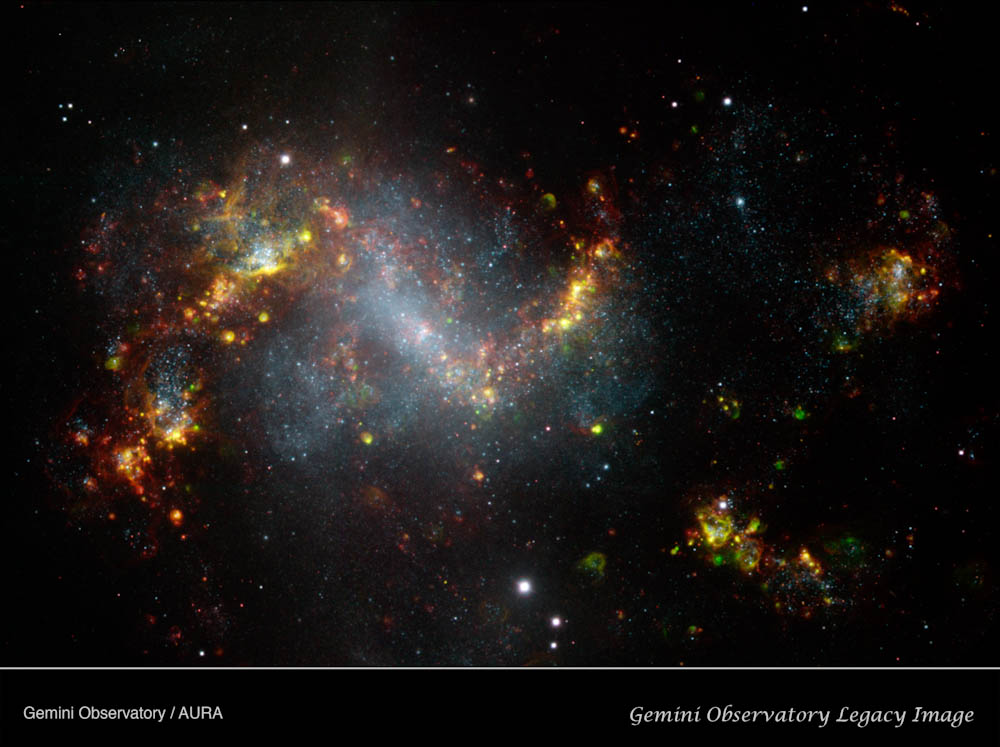
    No, that title is not a typo. Here’s the galaxy:

    gemini_ngc1313

    This is an irregular galaxy about 15 million light years away that’s undergoing a “starburst” — a massive wave of star formation. I won’t go into details like I usually do (the press release for the image is pretty good, so go read that)… but I just wanted to make the joke.

    The name of the galaxy? NGC 1313.


    Image credit: my buddy, Travis Rector of the University of Alaska, Anchorage


  • Entrevistas varias

    Tres enlaces a entrevistas donde volvemos sobre los temas habituales: la web y lo social, los blogs en esta nueva etapa, los negocios online y hacia donde vamos con tanta tecnología.

    • En Bloguismo conversando con el amigo Milleiro sobre el “estado de la blogosfera”.
    • En 123 People mucho de WeblogsSL y el inevitable Facebook.
    • En La Opinión de Málaga sobre temas locales y alguna cuestión… bueno, “pintoresca”.

  • World Cup 2010 mascot not as offensive as some past offerings

    2010-fifa-world-cup-mascot-final

    The best mascot the U.S. could come up with for the 1994 World Cup was a generic-looking brown dog with one foot on a soccer ball and his mind on chasing cars, taking naps and, well, anything except playing soccer. Because, you know, we don’t care about soccer here. But at least it wasn’t an ethnic stereotype or offensive representation of the host country, which is more the norm, judging by an illuminating Fast Company slideshow. (There have also been some vaguely creepy characters in the mix.) Take a look at some of the World Cup mascots of yore: an Argentine cowboy with a whip in his hand; British World Cup Willie, the first mascot, from 1966, who’s inexplicably sporting an ’80s rocker hairdo; and Pique, a jalapeno pepper wearing a giant sombrero, baggy clothes and huge ‘stache that Fast Company finds "just a hair behind Speedy Gonzalez" in the gross-cultural-stereotype department. This year’s mascot is kind of a head-scratcher, if you could find his noggin in that big bouffant. Zakumi, a leopard who’ll preside over the tournament starting June 11, represents "the people, geography and spirit of South Africa," according to a FIFA statement. But there’s still no explanation for that hair.

    —Posted by T.L. Stanley

  • Patents Now Getting In The Way Of Important Brain Research

    Slashdot points us to yet another in a very long line of stories about patents holding back key, potentially life-saving, research. This story involves a biotech firm, StemCells, that is making a legal threat to a hospital doing research on brain diseases in children. Because of the threats, the research has been shut down for three years:


    With his research stymied, “all the money has shifted from the lab to the lawyers,” said Schwartz, who said he believes the cells may hold deep secrets to such devastating conditions as autism, brain cancer and neurological disease.

    What’s really annoying here is that the doctor doing this research at the hospital had developed the technique himself with some others at the Salk Institute, but they chose not to patent it (perhaps following in the footsteps of Jonas Salk himself, who when asked about patenting the polio vaccine replied: “There is no patent. Could you patent the sun?”). Of course, StemCells jumped in and patented the technique themselves, and then went after the doctor in the midst of his research.

    Apparently, “promoting the progress” doesn’t include saving kids from deadly brain diseases.

    Permalink | Comments | Email This Story


  • Foxconn’s HR Website Hacked With Snarky Suicide Message [Foxconn]

    Shanghaiist discovered that a sneaky hacker (or maybe a Foxconn employee) snuck in this page onto the Foxconn servers. There’s no way this is official. More »


    SuicideDeathFoxconnAppleChina

  • Walmart Slashes iPhone 3GS to $97

    If there’s even been a more sure sign that new iPhones are coming in the immediate future, it’s the fact that Walmart slashed the price of Apple’s iPhone to $97, representing a savings of $100 if you’d purchased it from them last week.

    Is this a result of new iPhones around the corner? Does Walmart still have a significant inventory of iPhones to sell off? Looking back a few years ago, Walmart was one of the first third-party distributors outside of Apple and AT&T to offer the coveted iPhone for sale.

    With such a huge savings, one can’t help but speculate that a new iPhone is coming in the next few weeks and Walmart plans to have plenty of room to sell it.

    The 16GB iPhone 3GS still carries the requirement of activation and a two-year service contract with AT&T. Couple this with AT&T’s recent increase in its early termination fee means that while this phone is a great value, it’s still going to be a while before you can upgrade to whatever Apple announces at WWDC in a couple of weeks.

    Still, this could be a good value for some who may not wish to upgrade, who are dissatisfied with AT&T or who may not see any appeal in the rumored fourth generation iPhone. AT&T certainly hasn’t brought tethering to its customers and if the new iPhone does sport a front-facing camera, I get a sneaky vibe that the cost of the unlimited data plan is going to go up.

    Walmart’s price for the 32GB iPhone remains unchanged at $297. Historically speaking, larger capacity devices tend to be the best sellers. Undoubtedly, the lower price on the 16GB iPhone 3GS will cannibalize sales of the larger iPhone, so it’s likely that Walmart’s stock of the smaller iPhones is very plentiful, compared to the 32GB version.

    Adding to this news are rumors of a new iPhone around the corner is that Apple has slowed or stopped shipments of iPhones to its third-party vendors. Steve has something up his sleeve for week after next and Walmart intends to be ready.

    Can you hang on two more weeks to see the new iPhone? Or is it time to upgrade your original phone to an iPhone 3GS for less than $100?


    Atimi: Software Development, On Time. Learn more about Atimi »

  • Bret Michaels Heart Surgery This Fall

    Bret Michaels is set to undergo surgery this fall to repair a hole found in Michaels’ heart earlier this month.

    “I don’t have any other options except to think that it’s gonna be great, it’s gonna be a smooth operation and I’m gonna feel awesome,” says Michaels, who was crowned the winner of Celebrity Apprentice over the weekend.

    Michaels’ health problems began last month when he was rushed to the hospital for an emergency appendectomy. He suffered a subarachnoid brain hemorrhage just a week later. During his recovery from the hemorrhage, Michaels, 47, had a mild stroke and doctors found the hole in his heart. Despite battling a litany of medical aliments, Bret flew to New York City to face Holly Robinson-Peete for the hotly-anticipated Apprentice finale.


  • More Wind Farms Mean Cheaper Energy


    Just as we Americans are finally really and truly internalizing the real cost of sticking with fossil fuels, due to the Gulf sea floor gusher, a timely NREL study finds wind power makes electricity that’s not just cleaner, but it’s also much cheaper.

    If the Western US generated 30% of its electricity with wind power, costs would drop 40%, the NREL reveals in The Western Wind and Solar Integration Study. Under various integration scenarios exhaustively considered in great detail in a “what-if” and “how-to” analysis for the WestConnect group of utilities, there would also be a reduction  in carbon dioxide emissions of at least 25% and as much as 45%.

    The study comes at a welcome time, because this is the year that electric cars are finally poised to appear on the US market, creating a real alternative to the oil-powered commute, since EVs could be charged with clean energy like solar and wind power, and the gulf disaster shows us clearly what the alternative is.
    (more…)

  • Carnosine & beta-Alanine Update

    Thanks to a reader, Ron, who referred me to an abstract showing that vegetarians had lower muscle levels of carnosine, I have updated the VeganHealth page on carnosine and beta-alanine to suggest that vegetarians may very well be able to improve their athletic performance by supplementing with beta-alanine. Link.

  • Velour – Reece Long Sleeve Checked Shirt

    Velour’s Spring/Summer 2010 collection is an impressive one with items such as the Reece Long Sleeve Checked Shirt. It comes in an opal green color and is made from organic cotton. It’s a classic fitting shirt that features locker loop detail to the back of the yolk. As pictured above, it’s a perfect base shirt for ties and bowties this summer. Available at Bespoke Boutique.


  • Tell Your Lawmakers: “Anti-Counterfeiting” Treaty Is a Sham!

    Senate Finance Committee House Ways and Means
    Trade Subcommittee
    • Max Baucus, Montana
    • Jay Rockefeller, West Virginia
    • Kent Conrad, North Dakota
    • Jeff Bingaman, New Mexico
    • John Kerry, Massachusetts
    • Blanche Lincoln, Arkansas
    • Ron Wyden, Oregon
    • Charles Schumer, New York
    • Debbie Stabenow, Michigan
    • Maria Cantwell, Washington
    • Bill Nelson, Florida
    • Robert Menendez, New Jersey
    • Thomas Carper, Delaware
    • Chuck Grassley, Iowa
    • Orrin Hatch, Utah
    • Olympia Snowe, Maine
    • Jon Kyl, Arizona
    • Jim Bunning, Kentucky
    • Mike Crapo, Idaho
    • Pat Roberts, Kansas
    • John Ensign, Nevada
    • Mike Enzi, Wyoming
    • John Cornyn, Texas
    • John S. Tanner, 8th Tennessee
    • Sander M. Levin, 12th Michigan
    • Chris Van Hollen, 8th Maryland
    • Jim McDermott, 7th Washington
    • Richard E. Neal, 2nd Massachusetts
    • Lloyd Doggett, 25th Texas
    • Earl Pomeroy, 1st North Dakota
    • Bob Etheridge, 2nd North Carolina
    • Linda T. Sanchez, 39th California
    • Kevin Brady, 8th Texas
    • Geoff Davis, 4th Kentucky
    • Dave G. Reichert, 8th Washington
    • Wally Herger, 2nd California
    • Devin Nunes, 21st California

    We can’t sit back and let this fake “anti-counterfeiting” agreement become law! If your legislator is listed above as a member of a committee with oversight over the U.S. Trade Representative, tell your lawmaker not to be fooled by this chicanery and demand that ACTA be limited to addressing international counterfeiting.

  • Adam Carolla explains why he’s not doing Top Gear USA

    Filed under: ,

    Ah yes,Top Gear USA. We had nearly given up hope for the American version of the hit British television series until friend-of-Autoblog Adam Carolla let slip details of the series’ subsequent resuscitation on The History Channel during a taping of one of his CarCast episodes. At the time, it was thought that Carolla would be the only one of the original three cast members from the pilot to make the reborn series. As it turns out, that was not the case. What gives?

    Apparently, Carolla has a pilot sitcom that he’s currently taping for NBC, and the Peacock wouldn’t let the funny man away long enough to join History’s Top Gear USA. Sad for all, as reports from those who attended the taping of the NBC pilot almost universally praised Carolla’s performance on the show.

    Perhaps the most disappointed of all is Carolla himself, who openly dishes on the May 17 edition of his CarCast that he hopes his NBC sitcom is canceled so he can rejoin Top Gear. Click here to listen to the entire episode, but know that there’s some foul language.

    [Source: AdamCarolla.com via MotoBullet.com]

    Adam Carolla explains why he’s not doing Top Gear USA originally appeared on Autoblog on Tue, 25 May 2010 14:01:00 EST. Please see our terms for use of feeds.

    Permalink | Email this | Comments

  • BMW 320d EfficientDynamics Gets 1013 Miles on a Single Tank

    BMW EfficientDynamics isn’t a mere categorical name to impress the economy craving consumers and it does manage to attain a very high fuel economy with very low emission numbers as reported by famous UK motoring journo Tom Ford.

    BMW 320d EfficientDynamics 1

    Tom drove a 320d on a full tank from UK to Munich and back and he managed to travel a whopping 1013 miles. Calculate those numbers a little better and you get 68.9 mpg and do not miss out on the fact that Tom also reported CO2 emissions of only 109g/km. Tom did drive carefully but he mentioned that he wasn’t conscious of the economy run factor and there were times when he even bagged 75.9mpg. He was thoroughly impressed by the 320d as he mentioned that the dubbing EfficientDynamics isn’t merely efficient by its name, only.