Blog

  • Clip Of Ben Popken On NPR Talking About Mail-In Gold

    If you didn’t catch Consumerist on NPR last Friday, here’s the clip of me on All Things Considered chatting about mail-in gold buyers:

    Did you know that if you melted all the gold that’s been mined in the world you would just barely fill up two Olympic swimming pools? Maybe the rarity is part of why it drives people to do crazy things, like mail off your jewelry in a plastic bag to a stranger half a country away and trust that you’ll get a good deal.

    Since people historically flock to buy gold in times of economic uncertainty, I think this is a story we’ll keep hearing about for some time to come.

    Solid Gold: Demand Leads To Record Prices [NPR]

  • Epicurious Brings Recipe App to Android

    Award-winning food website, Epicurious.com has dropped their first application into the Android Market today.  The freely available Epicurious’ Recipes & Shopping List: On the Go and In the Kitchen provides users with the ability to browse and search the Epicurious.com database of over 28,000 editor-created and tested recipes.  Further, the app provides step-by-step instructions, a shopping list, and recipe sharing. Oh, there’s also a great little widget that provides the recipe of the day! 

    Features found in Epicurious’ Recipes & Shopping List: On the Go and In the Kitchen:

    • Proven recipes: Over 28,000 professionally tested recipes to ensure a delicious meal. Sources include two of the most respected brands in the business, Gourmet and Bon Appétit, plus web-exclusive recipes from renowned chefs and cookbook authors.
    • Voice Recognition Search: Speak the name of an ingredient or recipe into the phone and instantly receive recipes.
    • Homepage widget: Click here to find out what Epicurious.com’s delicious recipe of the day is.
    • Browse functionality: Browse popular recipe collections, from Weeknight Dinners to Cool Cocktails. Select a recipe collection from the Home screen, then swipe to flip from recipe to recipe.
    • A robust search engine: Swipe through cool icons on the search screen to filter by what’s in your fridge, what’s healthy, what’s in season, and more. Find inspiration browsing by type of dish, main ingredient, cuisine, dietary consideration, dish type, and season or occasion. Or, search recipes by keyword.
    • Saving and sending functionality: Save recipes to your Favorites by tapping the plus sign on any recipe image. E-mail any recipe to yourself or to a friend.
    • Shopping List: Shop on the go by saving recipes to your Shopping List (just tap the plus sign on any recipe image). At the store, check off items as you shop.
    • Cookbook mode: Tap “view recipe” to see the recipe in step-by-step view for easy-to-follow instructions in the kitchen.

    This marks not only the first Epicurious app created for Android but also the first Condé Nast Digital selection as well.  You can find this in the Android Market for all version of Android starting with 1.5 and higher.


    Might We Suggest…

    • “Google Shopper” Hits the Market
      Google Shopper, a new app from Google Labs, hit the market tonight. This new app should cause the developers of ShopSavvy and other barcode reading shopping apps sweat a little bit.

      With Shopper, y…


  • BP had central role in the Exxon Valdez disaster

    The AP drops this bombshell today about the 1989 Exxon Valdez disaster:

    the leader of botched containment efforts  in the critical hours after the tanker ran aground wasn’t Exxon Mobil Corp. It was BP PLC, the same firm now fighting to plug the Gulf leak.

    Pretty scary, when you consider that BP’s undersea volcano of oil is spewing some 2 Exxon Valdezes a week or more.  That said, it bears repeating what 20-year veteran of the Coast Guard Dr. Robert Brulle has written:  “With a spill of this magnitude and complexity, there is no such thing as an effective response.”

    Here’s more from AP:

    BP owned a controlling interest in the Alaska oil industry consortium that was required to write a cleanup plan and respond to the spill two decades ago. It also supplied the top executive of the consortium, Alyeska Pipeline Service Co. Lawsuits and investigations that followed the Valdez disaster blamed both Exxon and Alyeska for a response that was bungled on many levels.

    People who had a front row seat to the Alaska spill tell The Associated Press that BP’s actions in the Gulf suggest it hasn’t changed much at all.

    The Gulf leak has grown to at least 6 million gallons since an oil rig exploded April 20, killing 11, and is almost certain to overtake Valdez as the nation’s worst oil spill.

    “Gallons” is an AP correction from barrels but it is an uber-lowball number (see Expert: Based on video, BP undersea volcano spewing 3 million gallons a day — two Exxon Valdezes a week)

    Watching the current crisis is like reliving the Valdez disaster for an attorney who headed the legal team for the state-appointed Alaska Oil Spill Commission that investigated the 1989 spill.

    “I feel this horrible, sickening feeling,” said Zygmunt Plater, who now teaches law at Boston College.

    The Alaska spill occurred just after midnight on March 24, 1989, when the Exxon Valdez tanker carrying more than 50 million gallons of crude hit a reef after deviating from shipping lanes at the Valdez oil terminal. Years of cost cutting and poor planning led to staggering delays in response over the next five hours, according to the state commission’s report.

    What could have been an oil spill covering a few acres became one that stretched 1,100 miles, said Walter Parker, the commission’s chairman.

    “They were not prepared to respond at all,” Parker said, referring to Alyeska. “They did not have a trained team … The equipment was buried under several feet of snow.”

    The commission’s report dedicated an entire chapter to failures by Alyeska, which was formed by the oil companies to run a pipeline stretching from the Arctic Ocean to the Valdez terminal. BP had the biggest stake in the consortium and essentially ran the first days of containment efforts in Prince William Sound an inlet on the south coast of Alaska.

    “What happened in Alaska was determined by decisions coming from (BP in) Houston,” Plater said.

    Alyeska officials were notified within minutes of the Valdez spill, but it took seven hours for the consortium to get its first helicopter in the air with a Coast Guard investigator. A barge that was supposed to be carrying containment equipment had to be reloaded and did not arrive on the scene until 12 hours after the spill.

    During the spill, Alyeska only had enough booms to surround a single tanker. The few skimmers it had to scoop up oil were out of commission once they filled up because no tank barge was available to handle recovered oil.

    “Exxon quickly realized Alyeska was not responding, so 24 hours into the spill Exxon without consultation said, ‘We’re taking it over,’” said Dennis Kelso, former commissioner of the Alaska Department of Environmental Conservation. “That was not necessarily a bad thing.”

    BP’s role in the Valdez spill has been far less publicized than Exxon’s, in part because the state commission wanted to stay focused and avoid fingerpointing by saying who ran Alyeska in its report. Plater said he now regrets that approach.

    “In retrospect, it could’ve focused attention on BP and created transparency which would’ve changed the internal culture,” he said. “As we see the internal culture appears not to have changed with tragic results.”

    According to Alyeska, BP owned a controlling 50.01 percent share in the consortium in 1989, while a half-dozen other oil companies had smaller stakes. Since then, BP’s share in Alyeska has dropped to 46.9 percent, with the next highest owner Conoco-Phillips Inc. at 28.3 percent. The consortium works like a corporation with owners voting based on their percentage shares.

    Alyeska’s chief executive officer was in 1989, and is currently, a BP employee who’s on the company payroll, said Alyeska spokeswoman Michelle Egan.

    BP spokesman Robert Wine declined by e-mail to comment on the company’s role in the Valdez spill, saying the incident was already examined thoroughly.

    “We can’t add to something that has been so thoroughly and publicly investigated in the past, and the results of which have been so robustly and effectively implemented,” he said.

    Many who observed both disasters say there are striking parallels.

    For example, during BP’s permit process for the Deepwater Horizon, the company apparently predicted a catastrophic spill was unlikely and if it were to happen, the company had the best technology available. Prior to the 1989 spill, Alyeska made a similar case, arguing that such a spill was unlikely and would be “further reduced because the majority of the tankers … are of American registry and all of these are piloted by licensed masters or pilots.”

    Critics say the tools in both spills have been largely the same, as has BP’s lack of preparedness. Then as now, the cleanup tools used across the industry are booms, skimmers and dispersants.

    David Pettit, who helped represent Exxon after the Alaska spill, said he knew BP was the “main player in Alyeska” even though everyone at the time was more focused on Exxon’s role.

    “This is the same company that was drilling in 5,000 feet of water in 2010 knowing that what they had promised … was no more likely to do any good now than it did in 1989,” said Pettit, now a senior attorney at the Natural Resources Defense Council. “It’s the same cleanup techniques.”

    For the Gulf spill, a 100-ton containment box had to be built from scratch and wasn’t deployed until two weeks after the spill, leading some to question why such emergency measures weren’t ready to begin with.

    “If you’ve told the government there’s not a serious risk of a major spill, why should you spend shareholder money building a 100-ton steel box you’ve publicly claimed you don’t think you’ll ever use?” said Pettit.

    Precisely (see BP calls blowout disaster ‘inconceivable,’ ‘unprecedented,’ and unforeseeable).

  • Blog under construction

    We’re in the midst of the big transition to a new look for Cosmic Log, so if you see some strangeness today, remember the classic words of wisdom from Douglas Adams’ “The Hitchhiker’s Guide to the Galaxy”:
    DON’T PANIC!
    Also, you might want to hold off on submitting comments at this point, because they will not automatically be transferred over to the new-look blog. Stay tuned for the Cosmic Log relaunch in a couple of hours.
    P.S.: Happy Towel Day!…(read more)

  • First Drive: 2010 Ford SVT Raptor 6.2 is born to fly

    Filed under: , , ,

    2010 Ford SVT Raptor 6.2 – Click above for high-res image gallery

    Unless you’re a died-in-the-burlap save-the-planet kind of person, you probably think the 2010 Ford SVT Raptor is freakin’ cool. There’s not a factory truck on the planet that can wing across the desert floor with equal ease, grace and unmitigated speed.

    The 2010 Raptor genuinely has no competition In the world of production trucks, but that doesn’t mean it can’t be improved. If you bent the ear of the right Ford engineer, he would admit that the 2010 SVT Raptor was supposed to launch with the 6.2-liter SOHC V8 we’re testing today. The aging 310-horsepower 5.4-liter Triton mill included at launch was never the perfect fit for the radical Raptor. Too tame.

    From the truck’s introduction last Fall, everyone knew the all-new iron-block/aluminum-head 6.2-liter engine would be better. But no one knew how much better until now. Read about our wild test drive (and brief flight) after the ummm… jump.

    Photos by Rex Roy / Copyright (C)2010 Weblogs, Inc. and Ford Motor Company

    Continue reading First Drive: 2010 Ford SVT Raptor 6.2 is born to fly

    First Drive: 2010 Ford SVT Raptor 6.2 is born to fly originally appeared on Autoblog on Tue, 25 May 2010 11:57:00 EST. Please see our terms for use of feeds.

    Permalink | Email this | Comments

  • ‘Lost’ finale now the most downloaded TV show in history!

    The mania surrounding “Lost” continues. It has emerged that the series finale now holds the record of being the most downloaded TV show in the history of TV. The final two episodes, within 20 hours of appearing online, were downloaded some 900,000 times. Quite a bit, yes.

    Many of the downloads came from overseas, and that makes sense: episodes of the show typically don’t air in local markets for some time. Why wait until the local TV network gets around to showing the episodes when you can hop on BitTorrent and watch it just a few hours after ABC in the U.S.?

    The show’s producers did anticipate this, and tried to have the finale air quickly after its U.S. debut. That would explain this little stat: a full 15 percent of downloads come from Australia, where the finale doesn’t air until tonight. Or maybe it already has; I don’t understand time zones. The point is: Australians would rather download the show than wait around till the local TV network decides to air it.

    A staggered release may have worked in the past, but in this day and age, when 720p rips of every TV show are available online within minutes of their U.S. debut, there’s no way you can convince people to wait around.

    Done and done!


  • Making College a Three-Year Experience

    Maybe we should start to call it the best three years of your life. Today we’ve got a spat of articles arguing that some colleges should shrink the bachelors degree requirement by a year, either by adding summer classes or requiring fewer courses. The upsides are fairly straightforward: More students get a chance to go to school, each one pays less tuition, and we shave off some of that infamous debt burden.

    The whip-smart Dylan Matthews over at the Washington Post raises an objection: less time in school means less time to think about your career, which might force even more students to fall into the i-bank/consultant cesspool:

    Tucker’s proposal would speed this process up considerably. Instead of
    having three years to find work they love, or to spend studying
    something they love without concern about its marketability, students
    will have only two. These second-year students will probably have less
    idea of what they want to do, panic more, and be more susceptible to
    the streamlined banking/consulting/recruiting process.

    That’s an interesting concern that I wouldn’t have thought of. I’m not sure I find it all that concerning.

    First, there’s nothing special about the number four (for either high school or college). It’s become a Western norm based on ancient Christian church curricula, and all sorts of college customs have grown up inside the four-year mold, from freshman writing seminars, to fall semesters abroad, to sophomore deadlines for declaring your major. Some of those hallmarks might have to change. But if we’re starting with a clean slate and thinking about efficiently educating young guys and gals for 21st century jobs, we should think about whether it makes sense to start with a four-year bachelors degree as a baseline.

    Second, a truncated college experience wouldn’t necessarily make students “more susceptible to
    the streamlined banking/consulting/recruiting process” because it wouldn’t change much on the recruiting supply side. Investment banks and consultant groups hold a lot of sway over
    college graduates not only because students are feeling wayward, but also
    because they offer awesome salaries, plush benefit packages, a truckload of perks and a clear vertical trajectory in your career. It doesn’t matter if college is one year or seven years. Bain consulting will still proffer a higher salary than a local teacher or reporter. Moreover (disclosure: I have three close high school friends at Bain & Company in Boston) I’m not convinced that a consulting job is a bad first gig out of college. It’s not karmic social work exactly, but it’s challenging, collaborative problem-solving (and some of it is even pro bono!). It’s not a monster.

    The more important question here is about college access and affordability. Relative to everyone else, college graduates have never done better than they are doing right now, as David Leonhardt writes (with graphs!) in the New York Times. And yet many of the jobs with the highest growth capacity in the next decade — like some in health care, education and construction — don’t necessitate the debt burden of four years at a university. We’re due for a major rethink in the education sector, and three-year bachelor degrees deserve a place in the conversation.


    Email this Article
    Add to digg
    Add to Reddit
    Add to Twitter
    Add to del.icio.us
    Add to StumbleUpon
    Add to Facebook


  • Adobe Reader faces its first genuine competition from a free alternative

    By Scott M. Fulton, III, Betanews


    Download Nitro PDF Reader 1.1.1.13 from Fileforum now.
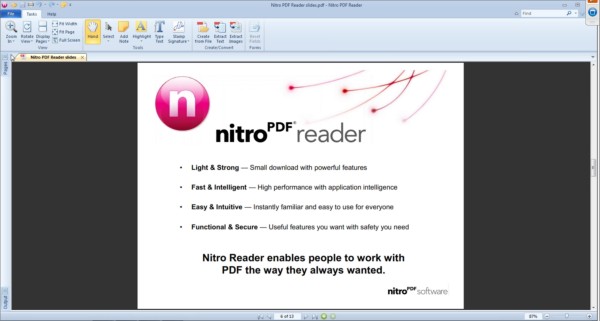

    The new, free Nitro PDF Reader

    Even today, we tend to use the phrase “Adobe PDF” when referring to the Portable Document Format, despite the fact that Adobe released its ownership of the standard into the open community in 2008. The typical opinion has been that releasing PDF as ISO/IEC 32000-1 was more of a symbolic gesture, but that Acrobat would always remain the principal application for creating PDF files.

    But it isn’t a monopoly that users particularly like anymore. A security study last February by security software provider Webroot of its own SMB customers revealed that nearly a quarter believe they are susceptible to cyber-attacks on account of insecure plug-ins including Adobe Reader. That feeling is compounded by raw data from Mozilla providing evidence that as many as half of all Firefox browser crashes are triggered by either Adobe Flash or Adobe Reader — a fact which compelled Mozilla’s engineers to redesign the entire plug-in model for Firefox 3.6.4.

    Today, the makers of what started out as a set of Acrobat plug-ins and later became a commercial alternative to Acrobat itself, are making their first real bid to unseat Adobe as the de facto software provider for PDF. The way Nitro PDF Software is doing this is by releasing today a free alternative to Adobe Reader that replaces the Reader plug-in entirely.

    The replacement will be an application that not only lets users edit the PDF files they download, but type new text at any point into those files, and create new PDF files as well.

    “PDF is all that we do. We live and breathe it. So the next logical step for us was to introduce a free PDF reader, but one that is revolutionary and that the world has been waiting for,” pronounced Gina O’Reilly, Nitro PDF’s senior vice president of marketing, in an interview with Betanews.

    “With Adobe Reader, I’m sure you’re familiar with the typical complaints: It’s bloated, it’s vulnerable to security attacks, but more importantly, it’s simply lacking in functionality. All it is, is a viewer and a printer; and unless you have paid a premium to do anything else, that’s all it does,” O’Reilly continued. “A lot of other options in the market come with some sort of compromise. So in the case of Adobe Reader, that might be a large footprint and annoying reminder updates, [along with] restricted functionality, in the fact that there is none.”
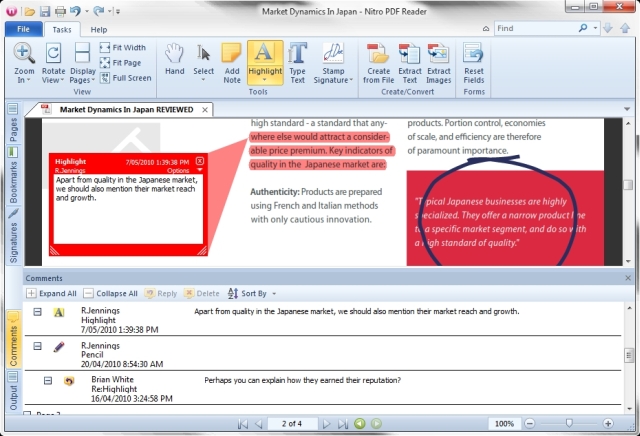
    Multiple collaborators can comment on edits to a PDF document in Nitro PDF Reader.

    Multiple collaborators can comment on edits to a PDF document in Nitro PDF Reader.


    Nitro PDF Reader is a stand-alone application that uses the Ribbon UI functionality made popular by Microsoft Office. If it has any drawbacks over Adobe Reader at all, it’s the fact that it doesn’t view PDF files inside the browser context. Instead, you download PDFs through whatever your browser happens to be, and they appear in the separate Nitro application context.
    But in that context, the application will offer some features that will compete with Acrobat, Adobe’s commercial PDF producer application line, the most obvious being the ability to create and save PDF files from scratch.

    Nitro PDF’s chief product officer Lonn Lorenz — a veteran product manager from Adobe — gave Betanews a demonstration: “Let’s say that I have a file that I want to send around for comment and review. If I zoom in on this page and I want to create a Post-It note…As I put a note in place, it keeps track of who put the note down, what time and date that they added it, and I can add my note to that.

    In Nitro PDF Reader, a user adds a comment to an existing passage, as part of its fully-featured review system.

    “When I send this out to people to get comments back on,” Lorenz continued, “I can just go to the File menu and e-mail this PDF, and it’ll automatically launch your e-mail client, attach this PDF, and you can send it off for review. Once you open this file and see this comment, you could add your own reply. With your reply to this comment, you could start a thread of conversation around this review. You could also use the text highlight tools, where you can highlight, cross out, or underline text…I can actually start to make use of my PDF files. Where the Adobe Reader and other readers are limited in this regard is, I can actually save my file! How simple is that? All the basic functionality in a free product.”

    One feature that I found truly inspiring — something I would literally use every day — is a simple button that lets you stamp a PDF form with a scan of your signature. Many legal firms have gotten into the habit of printing out the final page of a PDF contract, then signing the contract, scanning it back in, and appending it to the PDF, just so the final page can bear a signature. With this feature, Nitro PDF keeps scans of multiple signatures on hand, and you can stamp one and resize it to fit any location on a page.
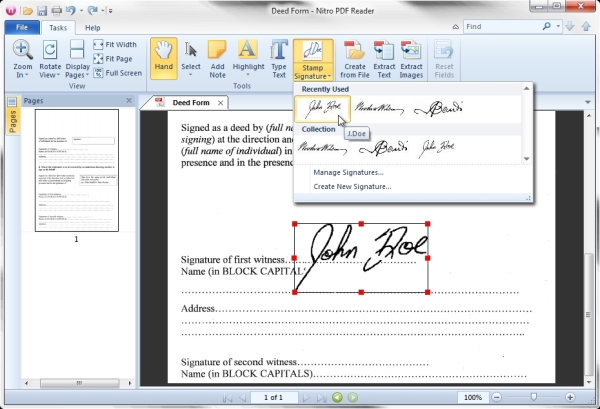
    Nitro PDF Reader enables a fairly simple, though tremendously useful, quick feature: a way to sign any form using a scan of your signature.

    Though it’s too early to declare that Nitro PDF “thought of everything,” it’s clear that during its beta process, its engineers did think ahead. The free Nitro PDF Reader does include the ability to protect files with a simple password, and to embed fonts where necessary (the company’s commercial edition has more extensive options). And to help deter situations where certain PDFs can be maliciously re-engineered, users can selectively block their PDFs from having the ability to make embedded calls to Web sites, with selected exceptions — a kind of localized firewall. Lorenz also told us users will have the ability to turn off JavaScript execution ability and leave it off.

    “What Adobe has potentially made a very grave mistake in doing is not being more proactive in responding to attacks, and not really addressing them in any meaningful way,” argued Nitro PDF’s Gina O’Reilly. “So when we conceptualized Nitro PDF Reader…one of our main goals was to ensure that our product is secure, and that we are responsive. We’re currently working with a third party to get validation for Nitro PDF Reader, so that we can stand up and say…the product stands up, and in the areas that we might not stand up, we will be addressing. We’ve kind of turned the security issue on its head, in that rather than expecting things to happen and then addressing them, we’re trying to get on the forefront with this. It’s very important that our users feel safe and secure when using the product.”

    Copyright Betanews, Inc. 2010


    Add to digg
    Add to Google
    Add to Slashdot
    Add to Twitter
    Add to del.icio.us
    Add to Facebook
    Add to Technorati


  • CHART OF THE DAY: Hey New York Homeowners, Look Out Below

    The latest Case-Shiller 20-city average showed fresh signs of a possible double dip in housing, but of course it’s a mixed bag. Some markets are on rebounding a little, and some are still slipping.

    In the New York area, prices are still falling, while beleaguered San Diego is back on the rise. This makes sense, as the two markets have experienced the housing bust on a different schedule, but if New York is going to meet the other markets at the mean, then homeowners could be in for a further ride (down).

    chart of the day, S&P/Case-Shiller Home Price Indices: NY, LV, Comp-20, 2006-2010

    Join the conversation about this story »

  • Epicurious, the Recipe App, Finally Makes the Jump to Android [Android Apps]

    Epicurious is a must-download on any platform its available for, and a sore exclusion on any platform it’s not. Today, finally, Epicurious, and its thousands of recipes, is available for free on Android. More »


  • BofA’s Lu Yeung Top Analyst For Alternative Energy In WSJ Ranking

    Lu Yeung, a Hong Kong-based analyst covering solar power companies at Bank of America Merrill Lynch, made two crucial calls last year that helped land him the top spot  as the best equity analyst covering alternative energy stocks in the Wall Street Journal’s latest ranking, out today.


    At the depth of the financial crisis, when credit had all but evaporated and project developers and banks were hunkering down, Yeung issued a “light at the end of the tunnel” report. It was actually titled “It’s Always Darkest Before Dawn,” and it predicted that an avalanche of government stimulus money would make-up for the lack of credit and fuel global demand for solar panels.

    Also, Yeung’s decision to upgrade PV panel maker Trina Solar from “hold” to “buy” and maintain a “buy” rating on Yingli Green Energy were “spot on”, writes the Wall Street Journal. By the end of the year Trina returned 600 percent to its investors and the share price of Yingli more than doubled, mission accomplished for Yeung.

    Now, will Trina and Yingli outperform their 2009 performance? The Chinese alternative energy sector is facing some challenges, including a fairly thin intellectual property portfolio. The price advantage that’s allowed them flood foreign markets with discounted PVs is also eroding. Yeung points out that over the long-term wining solar PV companies won’t win on price alone and will also have to develop technologies that will make panels more efficient in turning sun energy into electricity. Chinese PV makers are definitely wining the price war but they’re lagging behind when it comes to developing homegrown technologies.

    Runner-ups to Yeung are Canaccord Adams’s Jonathan Dorsheimer and Daniel Ries at Collins Stewart, see here for the full ranking.

  • Sexual Experience Is Overrated

    For women, that is. Men can never have too much sexual experience.

    The following conversation I had with Silverback in the City Zeets will explain why.

    ~~~

    Zeets: I’m pretty sure she’s only been with one other guy her whole life.

    Me: Is she a virgin?

    Zeets: Not a virgin… technically. But emotionally she may as well be. She has almost no experience with men.

    Me: Hard to believe there are women like her outside of rural areas still in existence.

    Zeets: She’s a foreigner from [a less developed European country].

    Me: Bingo.

    Zeets: The first time, she didn’t know what she was doing. It’s like I was back in high school. I tried to maneuver for the kill shot, but she kept her legs shut tight. I had to physically pry them apart. As I’m inching in, she’s squeaking like a mouse. “Ow ow ow”, she’s saying. I’m like, “Uh, ok, you’ve gotta relax here, otherwise this isn’t going to work.”

    Me: Then what?

    Zeets: Then she’s telling me to close all the blinds and blow out the candles. She likes the room pitch black. I guess it was because she was uncomfortable with me seeing her naked body in the lights. She’s got the bedsheets pulled right up to her chin.

    Me: But she has a nice body. Doesn’t she know that?

    Zeets: I know, tell me about it, but remember this girl is like a teenager fumbling around in the back seat of a car. She’s self-conscious. She doesn’t know what the fuck she’s doing. Eventually, we did do it, but it wasn’t good. She was too uptight, barely moved at all, and the endless foreplay pooped me out.

    Me: That was over a month ago. You’re still with her.

    Zeets: Yeah, we’ve done it a few more times since then. I was worried that she might have a weird psychological hangup about sex… maybe a religious thing?… but then it started getting better. She listened to my instructions, and followed orders well. Sex got better. She really loosened up.

    Me: She got comfortable with you.

    Zeets: Now she’s presenting like a red-assed chimp. She is truly loving in bed, totally getting into it. Sex has gotten even better with her than with some other women who knew what they were doing on the first date. Still need to work on proper blowjob technique, though.

    ~~~

    Sluts may know what they’re doing the first time without much prompting from you, but sexually inexperienced girls who have been allowed to blossom into full, exuberant womanhood under your caring tutelage and by your steady temperament are the true prize, the holy grail.

    It is a myth that sexually inexperienced girls are sexually repressed girls. Some are, but most of them are simply choosier than their sluttier sisters. It is more fulfilling to have a girl release with you, than to have her come pre-released by a battalion of men before you.

    Filed under: Girls, Sluts, The Pleasure Principle

  • Boost Mobile’s pre-paid, Android-powered Motorola i1 to cost $349.99

    When we dug up some evidence yesterday that Boost Mobile would be getting the US’s first pre-paid Android phone in the form of Motorola’s crazy-tough, push-to-talk i1, there was one bit we were missing: the price.

    Fortunately, that didn’t stay a secret for very long.

    MobileCrunch reader Tyrel found the item lurking around on the depths of Best Buy’s own site. As of right this second, this pre-paid, no-contract handset is set to cost you $349.99 out the door.

    Alas, still no word on a launch date.


  • Dell launches Tablet PC, Streak with Android

    Dell launches Tablet PC with Android StreakThe sales success of Apple’s iPad has not gone unnoticed by other manufacturers, Dell announced the launch of its Tablet PC called Streak which will be available in the UK market from June at O2 stores, and in the U.S. from late summer.


    The tablet prepared by the U.S. computer manufacturer Dell will have a 5-inch screen, 2 GB storage, connection to the Internet trough Wi-Fi and 3G networks, operating on the system developed by Google Android and a ARM-based Qualcomm’s Snapdragon 1GHz processor. Among other benefits Streak will have Bluetooth connectivity, five-megapixel camera with dual LED flash, and a Micro-SD slot which can read cards up to 32 GB.

    The Streak, which measures 12.5 inches diagonally compared to 24.25 cm of IPAD, “hits the sweet spot between traditional smartphones and larger-screen tablets,” said Ron Garriques. The price of the unit was not announced yet.

    Related posts:

    1. Android-based Dell Streak Tablet Soon
    2. Dell Streak Software Review
    3. Dell to marker Latitude XT2 tablet PC

  • Montreal Buses To Be Completely Electric By 2025

    It is really such a shame that it has taken so long for city and state governments to catch on to the whole electric vehicle craze. We should have had electric buses and taxis in droves by now, mostly because it makes economic sense. Less upkeep and lower fuel costs will eventually offset the higher upfront cost, especially since many municipalities put hundreds of thousands of miles on their vehicles.

    Looking to take a lead in clean public transportation, the Société de transport de Montréal, Montreals public transportation department, says it intends to replace its fleet of 1,300 buses with all-electric models by 2025.

    (more…)

  • Entertainment and Devices Division reshuffled after all, Robbie Bach out

    It seems the “sources familiar with the situation” were correct after all, and a broad reshuffle of Microsoft’s Entertainment and Devices Division has taken place after all.

    Steve Ballmer’s letter is below.

    From: Steve Ballmer
    Sent: Tuesday, May 25, 2010 11:01 AM
    To: Microsoft – All Employees (QBDG)

    Subject: Executive Leadership Transitions

    After almost 22 years with the company, Robbie Bach has decided to retire from Microsoft. I have worked with Robbie during his entire tenure at Microsoft, and count him as both a friend and a great business partner and leader. Robbie has always had great timing, and is going out on a high note – this has been a phenomenal year for E&D overall, and with the coming launches of both Windows Phone 7 and "Project Natal," the rest of the year looks stupendous as well. While we are announcing Robbie’s retirement today, he will remain here through the fall, ensuring we have a smooth transition.

    Concurrent with Robbie’s retirement, I am making several organization changes to ensure we have the right leaders in the right positions as we set ourselves up for the next big wave of products and services. Effective July 1, Don Mattrick, who leads our interactive entertainment business, and Andy Lees, who leads our mobile communications business, will report directly to me. Don and Andy have built out strong leadership teams and product pipelines, and are well-positioned for the years ahead.

    Independent of Robbie’s decision, J Allard (currently serving as senior vice president of Design and Development for E&D), will also be leaving Microsoft. Given his ongoing passion and commitment to Microsoft, he will remain as an advisor to me, helping incubation efforts, looking at design and UI, and providing a cross-company perspective on these and similar topics. With J’s change in role, corporate vice president David Treadwell will join IEB to lead the core technology organization, reporting to Don. David has a great set of accomplishments at Microsoft, most recently working on the Windows Live Platform Services team. Over the next several months, Robbie and I will work together to finalize reporting and structure for the rest of his org.

    Now that Office 2010 has been launched to business customers, Antoine Leblond, senior vice president in the Office Productivity Applications Group, will take a new role as senior vice president for the Windows Web Services team. This team brings together the integral Windows services that today deliver updates, solutions, community and depth information for the Windows consumer. Kurt DelBene, senior vice president in the Office Business Productivity Group, will take on all of the engineering responsibilities for the Office business.

    Transitions are always hard. Robbie has been an instrumental part of so many key moments in Microsoft history – from the evolution of Office to the decision to create the first Xbox to pushing the company hard in entertainment overall. J as well has had a great impact in the market and on our culture, providing leadership in design, and in creating a passionate and involved Xbox community, and earlier being at the center of our work seizing the importance of the Web for the company. But most important, both have been great team builders with a strong record of attracting, coaching and growing talent. As a result, their teams are primed to continue to step up and deliver great products, great services and great results for the company. Don has led the Interactive Entertainment Business since July 2007, where he’s significantly grown our entertainment footprint as well as our profitability. He can count as successes the evolution of Xbox Live, the launch of blockbusters like "Halo 3" and the much-anticipated "Project Natal." Previously, Don was president of Electronic Arts Worldwide Studios. Andy has led the Mobile Communications Business since February, 2008, and has been instrumental in reinvigorating our mobility efforts, bringing in new business and development talent and overseeing the creation of both KIN and Windows Phone 7.

    As we finalize and ship so many of our key products ("Project Natal," Windows Phone 7, Office 2010, Windows Live Wave 4 and others) it is a natural time for us to look ahead and make sure we have the right talent in the right roles to fuel our next set of offerings. I am confident that the changes above will set us up well for the months and years ahead.

    I want to close by thanking Robbie for the incalculable contributions he has made to Microsoft over the years. He will be greatly missed when he retires this fall, and I am glad that I’ll have the opportunity to continue working closely with him between now and then. And as J makes a similar transition, I look forward to working with him in a new way.

    Steve

    Via Engadget.com


  • Bleach Episode 272 Review: Watch Bleach Episode 272- Ichigo vs Ulquiorra!

    Bleach Episode 272 is here! Read Bleach Episode 272 reviews and watch Bleach episode 272 as the battle between Ichigo and Ulquiorra gets more exciting and more thrilling. For a short review and synopsis of Bleach episode 272, let’s take a short glimpse:

    Ichigo was beaten so badly due to the transformation of the second Ulquiorra. Ichigo was about to die but survived with an aid from their hollow powers. Ichigo has reached his second form hollow to gain strength and speed. The challenge with the transformation is the difficulty of transforming one’s self.

    To continue with the Bleach episode 272: Ichigo became stronger than Ulquiorra. As they battle, Ulquiorra was the one who took the beating. Find out what will happen next on Bleach Episode 272…

    Related posts:

    1. Watch Naruto Shippuden Episode 157 Live Stream Online – Latest Episode
    2. Tiger Woods at Quail Hollow Championship: After Masters 2010
    3. Hip-Hop Guru Passes Away

  • Fighting About Money Frequently Increases Risk Of Divorce

    You already know that it’s not healthy to fight about money all the time, but it might be a bigger risk factor for divorce than you think. A 2009 University of Virginia study found that couples who argue about finances every a week are 30% more likely to divorce than those who argue less frequently. In addition, a couple that marries with no assets are 70% more likely to divorce in three years than a couple bringing $10k in assets into the union.

    “15 Ways to Predict Divorce” [Daily Beast]

  • Xcom Global Offers Flat Rate MiFi for International Travelers

    Traveling outside the U.S. can be expensive when it comes to roaming data plans. Each country has different requirements and different pricing, and roaming charges are often exorbitant. Xcom Global is now offering the daily rental of a Novatel MiFi 2372, and the rate includes unlimited data in 21 countries. The daily rental is $17.95, and the unlimited data can be shared among 5 devices over the Wi-Fi connection to the MiFi.

    XCom also offers a cheaper USB modem plan for $14.95, but that connectivity is limited to the one device with the modem. These plans are not cheap, but not bad for unlimited data in all of these countries. This is a good fit for the business traveler who is visiting several countries and needs full data connectivity to get work done. This is also a good fit for keeping in touch back home via Skype. Hopefully this MiFi 2372 is not one of the ones affected by the recalls.

    Related research on GigaOM Pro (sub. req’d): Are You Empowering Your Mobile Work Force?


    Atimi: Software Development, On Time. Learn more about Atimi »

  • Freight Trains Double Fuel Efficiency Since 1980

    Trains used to be the primary mode of transportation in America. That all changed after World War II, with the rise of the automobile. When once America was home to the ten fastest trains in the world, now it has just a single train that could be called “high speed.” But while our passenger trains have long been neglected, freight trains have improved by leaps and bounds.

    The Association of American Railroads issued a press release stating that in 2009, freight trains across the country average 480 ton-miles per gallon. Since 1980, freight train fuel efficiency has increased by 104%. (more…)