Blog

  • KBB names coolest cars under $18k… do you agree?

    Filed under: , , , , , , , , ,

    Kelley Blue Book Top 10 Cars for under $18k – Click above for high-res image gallery

    Being in the market for a cheap new car used to mean resigning yourself to time bombs like the Chevrolet Citation or windups like the Geo Metro or Ford Aspire, but the times, they are a-changin’, and the good folk at Kelley Blue Book have worked up their very own top 10 list of cool cars for under $18,000.

    Not surprisingly, the 2011 Ford Fiesta nabbed a mention thanks to its 28 mpg city, 40 mpg highway EPA rating and mile-long standard feature list. Likewise, the new 2010 Hyundai Elantra Touring received a spot on the list. The Korean automaker’s new long roof manages 23 city and 30 mph highway thanks to its 2.0-liter four-cylinder engine.

    The base Mitsubishi Lancer also made the cut – another 2.0-liter bruiser, the baby brother of the Evolution nabs 22 mpg city and 31 mpg highway. Suzuki also got some love on the KBB list with its SX4. When optioned with the five-speed gearbox, the car walks away with 23 mpg city and 33 mpg highway. Rounding out the list is the ever lovable 2010 Honda Fit. Just like the Suzuki, if you want a few more miles per tank, you’ll need to opt for the manual transmission. Thusly equipped, the little Honda can 28 mpg city and up to 35 mpg highway.

    Want to see what else made the list? Hit the jump or visit KBB for the whole list.

    [Source: Kelley Blue Book]

    Continue reading KBB names coolest cars under $18k… do you agree?

    KBB names coolest cars under $18k… do you agree? originally appeared on Autoblog on Mon, 24 May 2010 18:58:00 EST. Please see our terms for use of feeds.

    Permalink | Email this | Comments

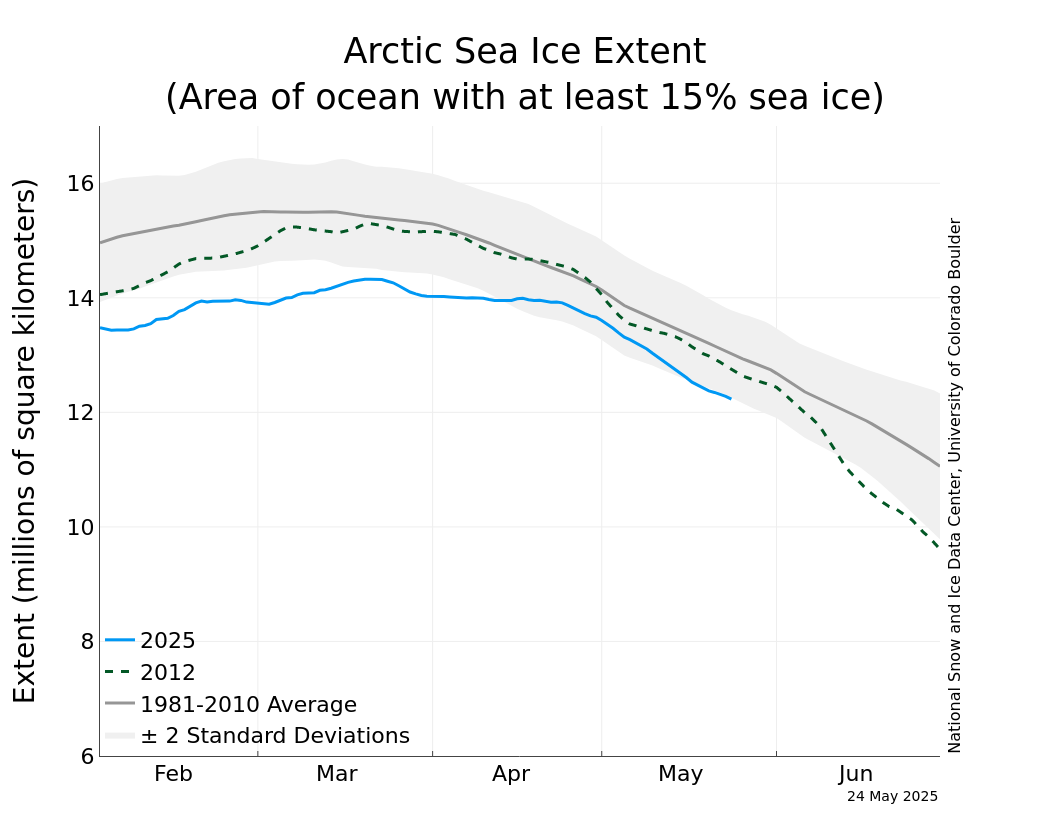
  • As Arctic sea ice shrinks faster than 2007, NSIDC director Serreze says, “I think it’s quite possible” we could “break another record this year.” – Watts and Goddard seem in denial: “We are still about six weeks away from anything interesting happening in the Arctic.”

    The big climate news up north is the Arctic double stunner:  Sea ice extent (area) is now below 2007 levels, while the even more important metric of ice volume appears to have hit a record low for March.

    Data from both the Japan Aerospace Exploration Agency (JAXA) and National Snow and Ice Data Center (NSIDC) show Arctic sea ice extent shrinking below the level of 2007 at a rapid pace:

    JAXA

    Canada’s Globe and Mail headlines their story, “Arctic sea ice heading for new record low,”

    The latest satellite information shows ice coverage is equal to what it was in 2007, the lowest year on record, and is declining faster than it did that year.

    “Could we break another record this year? I think it’s quite possible,” said Mark Serreze of the National Snow and Ice Data Center in Boulder, Colo.

    “We are going to lose the summer sea-ice cover. We can’t go back.”

    … Dr. Serreze said winds, cloud cover or other weather conditions could slow the melt, but he points out that the decline is likely to speed up even more in June and July.

    And “one of Canada’s top sea-ice experts suggests things might even be worse than Dr. Serreze thinks” (see New study by Barber et al. supports finding that “the amount of [multi-year] sea ice in the northern hemisphere was the lowest on record in 2009″).

    His data could be underestimating the collapse of summer ice cover, said David Barber of the University of Manitoba. Researchers can’t learn anything from satellite data about the state or thickness of the ice.

    “What we think is thick multiyear ice late in the summer is in fact not,” he said. “It’s heavily decayed first-year ice. When that stuff starts to reform in the fall, we think it’s multiyear ice, but it’s not.”

    Arctic explorers and scientific expeditions are finding more open water and untrustworthy ice ever, Prof. Barber said.

    He pointed out the Arctic continued to lose multiyear ice even in 2008 and 2009, when total ice coverage rebounded somewhat.

    True multiyear ice – the thick, hard stuff that stops ships – now comprises about 18 per cent of the Arctic ice pack. In 1981, when Prof. Barber first went north, that figure was 90 per cent.

    “This is all just part of a trajectory moving toward a seasonally ice-free Arctic,” he said. “That’s happening more quickly than we thought it would happen.”

    The article notes:

    In April, the centre published data showing that sea ice had almost recovered to the 20-year average. That ignited a flurry of interest on climate change  skeptic blogs.

    But the most widely read of those blogs, WattsUpWithThat, seems oblivious to what’s happening, even though it keeps issuing regular “news” updates for its readers!  In Sunday’s, “WUWT Arctic Sea Ice News #6,” Watts posted a piece by Steve Goddard that opens:

    The Arctic is still running well below freezing, and as a result there just isn’t much happening….

    Huh.

    Yet just a month ago, Goddard saw fit to “inform” his readers that:

    Arctic ice extent is normal….

    The Arctic Oscillation remains negative, so circulation is clockwise – as seen below in the buoy drift map. This pattern is keeping older, thicker ice from the Canadian side inside the Arctic Basin, and bodes well for another summer of increased ice thickness and extent – relative to the record melt of 2007….

    People counting on bad news from the Arctic to keep their agenda alive are staring at a long, (rhetorically) cold summer……. The good news is that they can keep raising the red flags about Montana glaciers, if the Arctic refuses to melt.

    So it’s okay to disinform readers with the “news” about how sea ice thickness had supposedly rebounded, when in fact March 2009 had seen record low volume.

    But when the reality sets in — the supposed multi-year ice was in fact very thin and melted away rapidly — well, dear WUWT readers, it’s time to move on, there’s nothing to see here.

    Related Posts:

  • Mega-Earthquake is Coming and Oregon is Preparing

    Scientists have estimated that there is a one-in-three chance that a mega-earthquake will hit the Pacific Northwest in the next 50 years.

    However residents of the small town of Cannon Beach on the Oregon coast are well aware they’re in the firing line of an earthquake and the ensuing tsunami, and they’re preparing. Wokring together with experts from Oregon State University, the Oregon Department of Geology and Mineral Industry and local residents, the small town is looking to create a town hall that will act as a tsunami proof building.

    “In all but the most catastrophic scenarios, it’s been estimated that the water level from an incoming tsunami at the site we propose to build the new city hall could be up to 15 feet,” said Jay Raskin, a local architect and one of the community leaders working to create the new structure. “We think this building could shelter at least 1,500 people. It will cost more, but so far there has been a pretty positive public reaction to the idea.” (more…)

  • Greenpeace finds use for spilled BP oil

    From Green Right Now Reports

    Many environmental groups responded to the BP oil disaster in the Gulf of Mexico by calling not just for the clean up at hand, but also for the U.S. revoke its recent approval of offshore drilling in certain arctic regions.

    The gulf calamity raised the spectre of what could be an even worse outcome in the pristine arctic where rescue crews and supplies could be thousands of miles away when/if a spill occurred.

    Greenpeace raises a question about arctic drilling using spilled oil (Photo: Greenpeace)

    Greenpeace raises a question about arctic drilling using spilled oil (Photo: Greenpeace)

    Today, Greenpeace provided a visual for this so-far unanswered plea. Using oil collected from the BP spill, activists painted “Arctic Next?” on a Shell Oil vessel docked in Houston. The drilling supply ship is scheduled to go to Alaska this summer as part of Shell’s exploratory drilling operations there.

    This environmental moment may have been too renegade for some tastes. But Greenpeace is just one of many environmental organizations raising this question. Mainstream groups such as the Natural Resources Defense Council and the World Wildlife Fund, also oppose offshore arctic oil drilling and protested when the Obama Administration opened certain areas for drilling earlier this year. Drilling in remote waters in the fragile arctic region is folly, they say, because rescue and clean up operations would be extremely difficult in that harsh climate.

    A spill in arctic waters would not just add insult to injury to animals already bearing the brunt of climate change as their habitats melt, it could harm seafood supplies that help feed the world.

    “More than half of the fish caught in the United States each year come from the Bering Sea. And nearby, in Russia, the Kamchatka Peninsula’s river systems host the greatest diversity and concentration of salmonoid fish on Earth and produce up to one-quarter of all wild Pacific salmon,” according to the World Wildlife Fund.

    After the BP blowout in the gulf, WWF called on President Obama to reconsider its decision to allow exploratory drilling off Alaska’s North Slope.

    “We’re asking President Obama and Interior Secretary Salazar to affirm that there will be no new drill bits sunk into U.S. waters until we understand what went wrong in the gulf, and can be certain it won’t happen in the Arctic,” said Tom Dillon, WWF’s senior vice president for field programs in a May 4 statement.

    “The Gulf of Mexico has every technology available to cope with an oil spill that is now threatening to cripple the economic and ecological health of the entire gulf region. By comparison, there is no adequate plan and even less equipment for responding to a blowout in the Arctic Ocean. It would be dangerously irresponsible to allow new drilling until we understand what went wrong in the gulf and have safeguards in place to protect the Arctic.”

    Why worry? The Alaskan offshore sites are some 140 miles off the coast in areas that experience gale force winds, moving sea ice, and  protracted darkness — all of which make both drilling and rescue operations riskier.

    “A spill in the Gulf of Mexico is a bit like having a heart attack in New York City where you have every known resource to try and fix it,” said William Eichbaum, WWF’s vice president of marine and arctic policy. “A spill in the Arctic is like having a heart attack at the North Pole. Unless Santa Claus shows up, you’re not going to get help anytime soon.”

  • Motorola Considers San Diego, Other Cities, for Mobile Spin Off Headquarters

    MotorolaLogo
    Bruce V. Bigelow wrote:

    Motorola (NYSE: MOT), the mobile communications technology giant based in Schaumburg, IL, is scouting sites in Chicago, Dallas, and California for the headquarters of its cell phone spinoff set for next year, according to Crain’s Chicago Business. San Diego is among the California cities under consideration, according to an interview with Motorola co-chief executive (and former Qualcomm COO) Sanjay Jha that was published yesterday in the San Diego Union-Tribune.

    Motorola recruited Jha in 2008 as its turnaround man, naming him co-CEO and head of its mobile phone and cable set-top box businesses. The company initially planned a spin off in late 2008, a split that got postponed until 2011. Motorola’s core infrastructure business (which makes wireless network gear and police radios) will remain in Schaumburg.

    Jha also has suggested Silicon Valley as a possible headquarters for the new company, citing the deep pool of high-tech talent during an interview three months ago. In Sunday’s Union-Tribune interview, Jha says a key factor in deciding where the mobile and spinoff should be located depends on how much business it does in China.

    “In San Diego, we already have a very big facility,” Jha told the Union-Tribune. “As you know, I have the mobile business as well as the set-top box business. The set-top box business has very deep roots in San Diego. I think my links to San Diego, if anything, deepened as a result of having that business.

    “But I don’t know that we have made that decision. Is San Diego a possibility? When we get engaged with it, we’ll definitely consider San Diego. My family, you know, still lives there. I have a special place for San Diego in heart.”

    I sent queries to several Motorola public relations staffers by e-mail earlier today, but they didn’t immediately respond. The company did issue a statement today in its home media market, which was picked up by the website Chicago Breaking Business, which is affiliated with the Chicago Tribune and WGN.

    “If Mobile Devices and Home make the decision to relocate its headquarters, this would affect less than 200 people and would not occur in 2010,” the company said in a statement. Motorola has more than 10,000 employees in the Chicago area. The company’s mobile devices division is currently based near Chicago, in Libertyville, IL.

    UNDERWRITERS AND PARTNERS


  • MotoGP 2010: Action continues at LeMans, no letup in sight [spoilers]

    Filed under: , , ,

    As the action continues relentlessly in the premier venue of motorcycle racing, round three took us to the land of champagne and baguette, as the French race lent the first glimpse of clarity into how the championship fight might turn out.

    Straight out of the chutes, Fiat-Yamaha rider and international superstar Valentino Rossi converted a great start into an early lead, while Dani Pedrosa and points leader Jorge Lorenzo brought on the chase. The Yamahas were quickly one-two as Lorenzo passed Pedrosa and began to close the gap on Rossi. By lap seven, the points leader made his move for the front, only to see Rossi respond almost immediately to reclaim the lead. After ten loops, Lorenzo put a pass on that would stick, and was able to hold a convincing five-second lead as he passed the checkers, extending his overall points margin to nine ahead of Rossi, who repeated his second place finish from Spain. This also marked a third straight top finish for a Yamaha pilot in as many rounds, a feat that has not been repeated since 1980.

    Behind the leaders, the battle to round out the top five was an intense one, using up the entire race to play out. During a dramatic final lap we saw Pedrosa surrender two positions in another battle of teammates, allowing Andrea Dovizioso to squeak by followed by the hard-charging Ducati topped by Nicky Hayden, who again carried the red team’s results. Casey Stoner struggled and was put out of the race early due to a turn-six crash that he would be unable to return from, begging the question of whether his mind has already departed for Japan? Next stop: June 6th for all things Italian at Mugello and a chance for dethronement of the Yamahas. We can hardly wait!

    [Source: MotoGP.com | Image: AP Photo/David Vincent]

    MotoGP 2010: Action continues at LeMans, no letup in sight [spoilers] originally appeared on Autoblog on Mon, 24 May 2010 18:39:00 EST. Please see our terms for use of feeds.

    Permalink | Email this | Comments

  • Company Sues MPEG-LA, Claiming Antitrust Violations Over Patents

    It’s no secret (though certain copyright and patent system defenders insist otherwise) that copyrights and patents are monopoly privileges, granted by the government. In fact, some of our elected officials have made the argument that antitrust law should be used against the worst abuses of intellectual property law. While it’s unclear how successfully that will play in courts, we may soon have a bit of a test case. Slashdot points us to the news that German company Nero AG is suing MPEG-LA, claiming abuse of monopoly power with its patent pools for licensing digital video codecs.

    As you may recall, MPEG-LA acts as a patent pool for many important patents related to digital video — to the point that the organization appears to believe it is not possible to do digital video without infringing on those patents. Recently, the company has been getting more aggressive, first starting up a separate patent trolling subsidiary, and also threatening Google and others for trying to set up a new open video standard.

    In this particular case, the details are important. OS News notes that MPEG-LA had approached the Justice Department back in the 90s to get an “all clear” against any antitrust problems, which the DoJ gave with some conditions. Nero suggests those conditions have not been met:


    First, the MPEG-LA would engage with independent experts to ensure only essential patents would be placed in the MPEG-2 pool. They told the DOJ that the MPEG-2 pool constituted of 53 essential patents. Second, independent experts would “weed out nonessential patents” from the pool. Third, licensing terms would be “fair, reasonable, and nondiscriminatory”.

    Nero claims none of these safeguards were honoured, and here’s where it gets juicy; “absolute power has corrupted the MPEG-LA absolutely”, according to Nero. First of all, the so-called independent expert was anything but independent. The expert helped form the MPEG-LA, helped in drafting the first MPEG-LA licensing agreements, answers questions from licensees on behalf of the MPEG-LA, has attended business settlement meetings on behalf of the MPEG-LA, and has testified before US congress on behalf of the MPEG-LA. Heck, he is listed on the MPEG-LA website as “MPEG-LA’s US patent counsel”.

    Nero also claims that the MPEG-LA has unlawfully extended its patent pools by adding non-essential patents to the MPEG-2 patent pool. Even though the MPEG-LA told the DOJ there were only 53 essential MPEG-2 patents, the non-independent expert added round and about 800 more patents to the pool, extending the duration of the patent pool, since the old, 53 essential patents expired….

    Nero further claims that the MPEG-LA has “formulated and imposed licensing terms that are unfair, unreasonable, and discriminatory”, by charging different royalty rates from licensees for the same MPEG-2 license and by not making any downward adjustment in line with the “rapid and dramatic” decrease in costs of implementing the MPEG-2 standard. In addition, the MPEG-LA collects royalties for the same device multiple times (internal hardware, software, monitor, etc.), and the licensing body has failed to “communicate its policies equally to all licensees”.

    MPEG-LA has responded to the lawsuit by basically accusing Nero of being an infringer with sour grapes. Now let’s see what the courts think…

    Permalink | Comments | Email This Story


  • Earthwatch expeditions – 40 years of ‘citizen science’

    Earthwatch's 'Climate Change in Tropical Rainforests' expedition (Photo: Zoe Gamble)

    It can be extremely frustrating, watching the destruction of our environment and not being able to do a thing about it. Sure, you can give money, write letters and take part in rallies, but… wouldn’t you rather be out there on the front lines, where you could physically help save the threatened habitats, animals and cultures? Well, you can. In fact, you’ve been able to for the past 39 years. Next year, the US-based Earthwatch Institute will celebrate 40 years of giving people the chance to volunteer on environmental research projects all over the world…
    Continue Reading Earthwatch expeditions – 40 years of ‘citizen science’

    Tags: ,
    ,
    ,

    Related Articles:


  • Watch England Mexico Friendly Match World Cup 2010 Highlights

    The England team won 3-1 to Mexico in the first friendly meeting in preparation for the World Cup 2010 in South Africa, and gave good signs of being one of the contenders for the title.

    It was the first defeat of Mexico in the year and the first meeting in Europe, en route to Johannesburg, where they will play in the opening match of the World Cup against the hosts of South Africa on 11 June.

    In the first part, left Mexico to go at least three scoring chances in the first 15 minutes. And at 17th minute, Ledley King opened the scoring in 17th minute with a headed goal.

    At 34 minutes English nailed the second goal by Peter Crouch’s header, while the Mexicans squandered several opportunities.


    Shortly before the break, Guillermo Franco scored a deserved goal for Mexico. But again the group led by Fabio Capello gained advantage to 3-1 by Glen Johnson. The Mexicans, under the orders of Javier Aguirre could not reverse this result.

    Highlights

    Related posts:

    1. FIFA Is Still Elusive For Mexico
    2. Englands won over Mexico, FIFA South Africa 2010
    3. Hockey World Cup 2010 Updates!

  • Regulators wince as video gambling bill advances

    Posted by David Kidwell and Ray Long at 6:31 p.m.

    A video gambling bill strongly opposed by state regulators advanced in a House committee today and now awaits a vote that could send it to the governor.

    The state’s top gambling regulator predicted House lawmakers would pass the legislation, which he said would give amnesty to operators who have illegally operated video poker machines in bars for years.

    “It’s a disaster,” said Aaron Jaffe, chairman of the Illinois Gaming Board. “I have no idea all the power plays that are going on down there (Springfield) right now, but I can tell you that they are all listening to the wrong people.”

    House Bill 4927, which passed quietly through the Senate earlier this month, would require a felony conviction on gambling charges before the gaming board could deny a license to operate video gambling machines in Illinois. Until last year gambling for money on the machines was illegal, but critics say few people were ever convicted of felony gambling charges for operating them.

    Jaffe’s board adopted a new rule in January to require applicants to attest under oath that they never operated such a machine illegally in the past. The measure’s House sponsor said today Jaffe’s rule goes too far.

    “It’s not the Gaming Board’s province to go back in time and find out who those people are, especially the way they drafted the rule. So because the rule was vague,” said state. Rep Lou Lang, D-Skokie, “we decided there needed to be some definition in the rule. Otherwise, who would go out and invest in these machines.”

    The House Executive Committee voted 9-2 to send the bill to the full House.

    The bill is being shepherded by the same lobbyists for the Illinois Coin Machine Operators Association who last year persuaded lawmakers to legalize the machines. Among them is Joe Berrios, who is the chairman of the Cook County Democratic Party and a candidate to become Cook County assessor.

  • The BBC hits another milestone

    Late last night, The Buckeye Battle Cry reached a big milestone, and we’d like to take a moment to celebrate it.

    A few minutes after Midnight, when most of us were coming down off our “Lost” high, tBBC was visited by our 500,000th Buckeye fan*.

    Half a million visits may not be a big number for our amazing friends at 11 Warriors and Bucknuts, but we’re all raising a glass at this corner of the world.

    You know the story of this site.  Less than four years ago, it was just a tiny little place for one guy to spout an opinion and make videos.  Now it’s home to some of the best damn writers in Ohio (and beyond….see MaliBuckeye), and clearly it’s home to a lot of you scarlet and gray fans.

    While the credit goes to you, the loyal fans of tBBC, I will again state that this website would not be at all relevant without Jim, Eric, Rob Harley and the aforementioned Californian.  Nearly half of our total hits came since we expanded the staff 10 months ago.

    They’ll be running the show throughout football season this year, since Fox Sports Ohio hired this site’s fifth-best writer. I know that my baby will continue to grow and prosper, and your visits are the proof.

    Thank you VERY much, Buckeye fans!  I propose a toast to all of you!  Grab a drink and take a swig of it.  It’s on me.  Let’s drink to old Ohio til we wobble in our shoes!

    * – It was probably Ian who pushed us over half a million.  He’s all over the Buckeye Blogosphere.  You have school in the morning, young man!  Get some sleep!

  • Rumormill: Audi A2 could be electric only, or not

    Filed under: , , ,

    Audi A1 e-tron concept – Click above for high-res image gallery

    The original, all-aluminum Audi A2 was a unique beast, which Heinrich Timm, Audi’s head of lightweight design, maintains was ahead of its time. However, the rumored 2012 A2 is likely to utilize a steel unibody platform, and the latest reports indicate that Audi’s mini-lux will have a new reason for being special.

    Autocar quotes anonymous sources who say the next A2 could be Audi’s first electric-only vehicle. While the UK rag doesn’t go into detail, Audi has dropped hints that a variant of the A2 could utilize the extended-range EV hardware under the hood of the A1 e-tron concept shown at the Geneva Motor Show. The e-tron utilized a 60 horsepower electric motor paired to a 330-pound lithium ion battery pack. The “extended range” part of the A1 e-tron concept comes courtesy of a small, powerful rotary engine that would work as a generator whenever the battery pack was depleted. Audi quotes the EV range of the A1 e-tron concept at about 33 miles per charge.

    Do we think the A2 will be electric-only? Our magic eight-ball says “ask again later,” so we’re thinking the earliest we’ll know anything is this September at the Paris Motor Show.

    [Source: Autocar]

    Rumormill: Audi A2 could be electric only, or not originally appeared on Autoblog on Mon, 24 May 2010 18:31:00 EST. Please see our terms for use of feeds.

    Read | Permalink | Email this | Comments

  • Android Has Won — Time for Chrome OS to Move Along?

    Google with its annual developer conference, Google I/O, dominated the technology conversation last week. Whether it was taking jabs at Apple, launching a competitor to H.264 video technology or simply offering its own version of Amazon S3, the Big G didn’t disappoint its fans (though some remain skeptical of certain initiatives, such as Google TV).

    All that hoopla aside, the focus of the conference was Google’s Android OS and the mobile ecosystem it’s spawned. Add Google TV to the mix and it’s safe to say that Google devoted nearly a quarter of its stage and talk time to Android. CEO Eric Schmidt, VP of Engineering Vic Gundotra and the co-founder of the Android movement himself, Andy Rubin — all waxed eloquent about the OS. Chrome, meanwhile, appeared to have become little more than an afterthought for the company.

    Android’s Adaptability

    Yes Google held a press conference where co-founders Larry Page and Sergey Brin talked up the Chrome Web Store, but that was pretty much it. That’s because while Chrome is still waiting for its day in the sun, Android has taken on a life of its own. By the time the Chrome OS becomes available via devices on store shelves, who knows where Android will be.

    Just look at some of the most recent Android-specific stats:

    • 100,000 Android-based phones are activated every day.
    • It’s on 60 devices from 21 OEM makers on 59 carriers in 48 countries.
    • There are 50,000 apps in the Android Market Place.
    • In the first quarter of the year, it was the second-best selling smartphone OS after RIM’s BlackBerry.

    “I am delighted to see Android in places I didn’t expect to see it in,” Rubin said at Google I/O. A good example is Google TV — which is comprised of Android running off an Intel x86 processor with a browser on top of it. Indeed, as I wrote at the time of Android’s launch, what makes Android special is its adaptability. From e-readers to set-top boxes to cars to even refrigerators, the OS has shown tremendous adaptability. By offering it for free (with some strings attached), Google has made it possible for all sorts of hardware makers to tinker with it.

    And as such it makes perfect sense for Google to marshal all its resources behind Android the way Apple has done with the iPhone OS. But what of Chrome?

    Chrome’s Tablet Future?

    “Android has evolved over the past four years and Chrome OS hasn’t launched just yet, so it’s an unfair comparison,” Rubin said in response to a question at last week’s conference in which he was asked to do just that. I took his comment to mean that Google was purposefully following a dual strategy, and when I asked why, Gundotra candidly admitted it’s a strategy the company may adjust down the road — specifically, that there may be a way for the two technologies to converge.

    Now that would make sense in a touch-centric, tablet-based world. Imagine Android running the Chrome browser in order to offer a panoply of web apps via the web-based app store that co-founder Sergey Brin described at Google I/O. Though when veteran scribe Dan Gillmor asked about an Android Tablet, both Rubin and Gundotra dodged the question.

    Our own Kevin Tofel thinks one of the reasons Chrome OS is taking a back seat to Android may be hardware-related. After all, Chrome OS was initially introduced as a platform for the netbook form factor, but if the market is shifting to tablets, Google will have to make some significant changes to it in order to make it finger-friendly.

    Folks in the know tell me that Google bought Canadian user interface innovator BumpTop so that it can build a unique user interface on top of Android for Google’s GPad, which could offered to hardware makers as reference design. That could be just what Android needs in order to compete with Apple and its iPad in the tablet space.

    I’ve long been wary of Chrome OS because I think it would suffer from Google-itis in that its underpinning would be the company’s identification system and would always prefer Google web apps. And given that Google doesn’t have a presence in the social web, it would lack social sense and sensibility.

    For comparison, look at the JoliCloud OS, which is completely socially aware and uses Facebook Connect as a way to bridge various components with a user’s social graph. That’s what a modern OS for cloud clients should look like.

    Now don’t get me wrong — I don’t want to hate on Chrome OS. I just think Google needs to pick a winning horse. And the winner here is clearly Android.


    Atimi: Software Development, On Time. Learn more about Atimi »

  • Pano Logic’s minimalist business networking solution

    All the software available to the user is generated from a virtual desktop on the server(s...

    Instead of looking to upgrade a network of computers with the familiar PC-server setup, Pano Logic offers a solution where users still benefit from a Windows-like experience but the desktop PC is gone. The PC is replaced by the Pano Device, a small silver or black box which connects to a virtual computer hosted at a data center. It’s said to require little or no maintenance thanks to there being “no processor, no operating system, no memory, no drivers, no software and no moving parts.”..
    Continue Reading Pano Logic’s minimalist business networking solution

    Tags: ,
    ,
    ,
    ,

    Related Articles:


  • Other bathtubs – capital

    China is rapidly eliminating old coal generating capacity, according to Technology Review.

    Draining Bathtub

    Coal still meets 70 percent of China’s energy needs, but the country claims to have shut down 60 gigawatts’ worth of inefficient coal-fired plants since 2005. Among them is the one shown above, which was demolished in Henan province last year. China is also poised to take the lead in deploying carbon capture and storage (CCS) technology on a large scale. The gasifiers that China uses to turn coal into chemicals and fuel emit a pure stream of carbon dioxide that is cheap to capture, providing “an excellent opportunity to move CCS forward globally,” says Sarah Forbes of the World Resources Institute in Washington, DC.

    That’s laudable. However, the inflow of new coal capacity must be even greater. Here’s the latest on China’s coal output:

    ChinaCoalOutput

    China Statistical Yearbook 2009 & 2009 main statistical data update

    That’s just a hair short of 3 billion tons in 2009, with 8%/yr growth from ‘07-’09, in spite of the recession. On a per capita basis, US output and consumption is still higher, but at those staggering growth rates, it won’t take China long to catch up.

    A simple model of capital turnover involves two parallel bathtubs, a “coflow” in SD lingo:

    CapitalTurnover

    Every time you build some capital, you also commit to the energy needed to run it (unless you don’t run it, in which case why build it?). If you get fancy, you can consider 3rd order vintaging and retrofits, as here:

    Capital Turnover 3o

    To get fancier still, see the structure in John Sterman’s thesis, which provides for limited retrofit potential (that Gremlin just isn’t going to be a Prius, no matter what you do to the carburetor).

    The basic challenge is that, while it helps to retire old dirty capital quickly (increasing the outflow from the energy requirements bathtub), energy requirements will go up as long as the inflow of new requirements is larger, which is likely when capital itself is growing and the energy intensity of new capital is well above zero. In addition, when capital is growing rapidly, there just isn’t much old stuff around (proportionally) to throw away, because the age structure of capital will be biased toward new vintages.

    Hat tip: Travis Franck

  • Motorola Milestone ready for overclocking

    Before today, overclocking a Motorola Milestone was mostly just a dream, because of the way the boot partition is locked up. But no more. Thanks to some pure genius (something we’re getting used to when talking Android), you can now rev up your RPMs (erm, or clock cycles) on the Milestone, and all you need is to make sure your phone is rooted. Additionally, you’ll be able to overclock the Milestone to 1.2GHz, just like the Droid, which should provide a significant speed boost. This method works by actually changing the structures in the kernel’s memory runtime via an injected kernel module, which means you could turn up your CPU before playing a game, or turn it down to save battery life; all without having to reboot the system. Be sure to check out the in-depth instructions. [Milestone Overclock code page via XDA Developers] Thanks, Tiago!

    This is a post by Android Central. It is sponsored by the Android Central Accessories Store

  • Interact With 12 Scientific Game Changers [Science]

    Scientific American put together an interactive piece on 12 events that could drastically change the world, from nuclear exchange to cold fusion to the discovery of other dimensions. Pretty much all the stuff Lost totally prepared us for. More »


  • Joe Jonas Dumped Demi Lovato Over Phone!

    Some people use their cellphones to keep in touch for friends and family — Joe Jonas uses his to ditch dead weight. The Jonas Brothers singer, who split from Taylor Swift in a 37-second phonecall two years ago, reportedly used the same method to end his romance with Demi Lovato just days ago.

    Despite an early report claiming Jonas called it quits with Lovato in a face-to-face confrontation over her media-friendly chats about their relationship, Us Weekly tattles claim Joe actually ditched Demi via mobile because he “didn’t have the heart to do it in person.”

    “He thought it wasn’t a good idea for them to be dating and working together all time and was afraid it was ruining the friendship.”

    Jonas, 20, and Lovato, 17, met in 2007 while filming The Disney Channel Original Movie Camp Rock. They confirmed their romance in a radio interview with Ryan Seacrest in March.

    Neither Jonas nor Lovato has commented. The pair is set to tour together this summer.

    A little food for thought: If you’re not mature enough to sever ties with someone respectfully — and face-to-face — perhaps you’re not mature enough to be dating at all.


  • Discover Your Inner Godwit | The Loom

    scottOn March 29, 1912, Robert Scott and two fellow explorers huddled in a tent during a fierce Antarctic blizzard. They had landed on the edge of Antarctica five months earlier, hoping to be the first people in history to reach the South Pole. They succeeded in reaching the Pole, but it was a bitter success. They discovered that another team, led by Roald Amundsen, had gotten there first. So Scott and his team turned back and began the 800-mile journey back to the sea. They hauled sledges themselves, without the help of dogs. The plunging temperatures increased the friction of the snow, so that they had to put in as much effort as they would to haul the sledges through sand. On February 4, Edgar Evans dropped dead. On March 16, Laurence Oates, barely able to walk, simply left the camp and never came back. A blizzard on March 20 left them unable to leave their tent.

    “I do not think we can hope for any better things now,” Scott wrote in his diary nine days later. “We shall stick it out to the end, but we are getting weaker, of course, and the end cannot be far.” And indeed he likely died that day. Scott and his crew were finally discovered eight months later.

    Scott may not have been the first person to reach the South Pole, but he did earn a different kind of distinction: “the greatest human performances of sustained physical endurance of all time,” in the words of University of Cape Town sports scientist Timothy Noakes. All told, Scott probably burned about million calories. Each day he and his fellow explorers burned around 7,000 calories, about four times the rate of a man at rest.

    Scott’s accomplishment was exceptional not just for a human, but for any animal. Animals rarely push their metabolism beyond about four times their resting rate for any length of time. A cheetah may explode into a sixty-mile-an-hour sprint, but for only a few seconds. Most animals that push themselves hard–birds racing around to find food for their chicks for days on end, for example–only push themselves about four times above their resting metabolic rate.

    godwit440In 2007, however, a small bird left Scott in the dust. Scientists discovered that bar-tailed godwits could fly from Alaska to New Zealand, non-stop. Their metabolism, scientists found, rose to about eight times their resting rate. And it stayed there, 24 hours a day, for nine days. And while Scott could refuel on his journey by eating horse meat and pemmican, the bar-tailed godwits fasted for their entire 7,000 miles journey.

    As I report in the lead story of the Science Times in tomorrow’s New York Times, research now shows that the bar-tailed godwit has some company. Using sophisticated new location-tracking devices, scientists have discovered other species several travel several thousand miles without a break.

    I also write about the deeper significance of these new results. How do these birds achieve these awesome treks. And why? In a new paper, the Swedish biologist Anders Hederstrom argues that birds like bar-tailed godwits aren’t all that unusual. Lots of birds that go on much shorter migrations have many of the same adaptations as the champions–the ability to store up fat, an ability to navigate long distances, an efficient body shape, and so on.

    Theunis Piersma, a Dutch biologist, offered up a provocative idea for the evolution of ultramarathoning birds. Their migrations may be able to shift quickly from short to long. Birds have a huge potential to work hard, without the need for long-term physical evolutionary changes coming first. All they need is a change in behavior, and their bodies will meet the challenge. Once they shift their behavior, natural selection may well favor physical changes that help them go long distances. (Piersma will write about this at length in his upcoming book, The Flexible Phenotype.)

    For Piersma, what’s really interesting is why godwits and some other birds push so hard, while most other animals don’t. Piersma thinks that laziness is, for the most part, adaptive. If animals push themselves beyond about four times their resting metabolic rate, they usually have to pay dearly. They become vulnerable to predators and disease, for example. When scientists have added extra chicks to the nests of kestrel hawks, for example, the parents have to work harder to feed them. As a result, the scientists found, the parents became more likely to die. When scientists add little weights to bees that are buzzing around gathering nectar, the bees are also more likely to die. And Scott himself is a grisly illustration of Piersma’s tradeoff. His foot became infected so badly, he wrote, that “amputation is the best I can hope for.”

    Flying over open seas, however, may allow some birds to escape this trade-off. Predators and parasites can’t catch them when they’re hundreds of miles from the nearest land. When bar-tailed godwits land after flying 7,000 miles, they can just take a long nap without worrying about being eaten. The very things that might make exhaustion more dangerous are missing from their migration.

    For more, check out my story.

    Update: And be sure to check out the great interactive maps.

    [Images: Scott, Wikipedia/Godwits, Robert E. Gill]


  • Social Bits: The Physical Visualization of Urban Social Data

    social_bits.jpg
    Social Bits [socialbits.org] is a research design project focused on putting digital information in a physical context. A collection of small interventions located at Istanbul aim to explore the physical display of urban data.

    “Collective Data Maps” allow visitors to pinpoint the most liked and most disliked locations of İstanbul. “Fluid Data” is a spatial projection that shows real-time Twitter posts from İstanbul by highlighting and flowing past architectural elements in a fluid way. “kazamidori” is an interactive object resembling a weather vane to indicate the direction of where visitors in a website are coming from in real-time. “News Leak” is a physical printer located in the city which instantly prints a summary of the latest news and culture from around the world. “Urban Mood” visualizes the real-time mood of the citizens of İstanbul through a simple keyword projection and sound installation. Lastly “Urbansphere Wearables” is a collection of beautiful T-shirts that reflect the daily keywords of the city by utilizing the data streams of social networks as a source of fashion design.

    See also Newsknitter.