Blog

  • Anti-immigration, white flight topic of talk

    Published May 24, 2010
    By the Tri-City Herald staff

    Author Rich Benjamin will discuss anti-immigration, white flight and segregation during two June 7 lectures at Columbia Basin College in Pasco.

    Benjamin is the author of Searching for Whitopia: An Improbable Journey to the Heart of White America.

    The author will discuss current racial issues at 12:30 p.m. in the Hawk Union Building Congress Room. He will discuss the social and political divides threatening the United States in a 6:30 p.m. lecture at the Hawk Union Building’s main stage.

    Both lectures are free and open to the public.

    The lectures are sponsored by CBC’s Office of Diversity, CBC Associated Student Body and the Department of Energy Office of EEO and Diversity.

    Additional news stories can be accessed online at the Tri-City Herald.

  • CBC nuclear program gets $120,000 grant

    Published May 23, 2010
    By the Tri-City Herald staff

    The nuclear technology program at Columbia Basin College in Pasco has been awarded a $120,000 grant to provide scholarships.

    The grant is from the Nuclear Regulatory Commission. CBC received the same amount last year. The money will pay for 23 scholarships, said CBC officials.

    The program started last fall. CBC partnered with Energy Northwest, Washington River Protection Solutions, CH2M-Hill Plateau Remediation Co. and Mission Support Alliance to make it happen because there was no state money for the program.

    Students who complete the two-year program earn an associate’s degree in nuclear technology with an instrumentation and control option.

    Additional news stories can be accessed online at the Tri-City Herald.

  • Lamborghini Recalls Murciélago for Possible Fuel Leak

    Lamborghini is recalling 428 Murciélago coupes and roadsters built between 2007 and 2008 because they could leak fuel and start a fire. According to NHTSA, supports for the Lambos’ fuel pumps could break, which could allow fuel to spill from the tank. And as we all know, spilled gasoline plus an ignition source (a hot exhaust, for instance) can start a fire.

    Given that Lambo has built just over 4000 Murciélagos ever, that means about ten percent are subject to the recall.

    We’ve seen many pictures of flame-engulfed Murciélagos on the internet over the past few years and can’t help but wonder if this recall explains at least some of the fires. We love both fire and Lamborghinis, but definitely not when they inhabit the same space at the same time.

    Related posts:

    1. Heffner Twin-Turbo Lamborghini Murciélago Makes 1100 whp
    2. 2012 Lamborghini Murciélago Replacement – Spied
    3. 2010 Lamborghini Murciélago LP670-4 SV SuperVeloce – Auto Shows
  • Report: Minivan segment making a comeback

    2011 Toyota Sienna

    Chrysler, Toyota, Honda and Nissan are all planning to bring new-generations of their minivans to the market this year and in early 2011. According to some, the segment may be on its way to making a comeback.

    Automotive site Edmunds.com said that there is an increase in Web traffic searching for minivans on its website. In recent months, Edmunds has seen 2 to 3 percent of consumers checking out minivans.

    “There is definitely a peak in interest,” said Ivan Drury, an Edmunds.com analyst. “Our assumption is that there has been some talk in public about new minivans coming, and consumers want to read about them.”

    Click here to get prices on the 2011 Toyota Sienna.

    LeasTrader.com is also seeing a jump in the demand for minivans on its website. The site reported a 23 percent increase in visitors searching for minivans in April.

    The minivan segment in the U.S. passed the million-year mark in 1993 before peaking in 200 at 1,371,234. In 2008, automakers sold just over 600,000 units and last year the number came in at 450,000.

    2011 Toyota Sienna:

    2011 Toyota Sienna 2011 Toyota Sienna 2011 Toyota Sienna 2011 Toyota Sienna

    – By: Stephen Calogera

    Source: Automotive News (Subscription Required)


  • Student Sues School For Privacy Invasion After School Found Nude Photos On Her Phone

    You may recall the news story from last year about some teenaged girls in Pennsylvania who were being threatened with child porn charges, after taking “nude and semi-nude” photos of themselves on a mobile phone during a party, and sending them to others. The judge halted the potential lawsuit, noting that the nude photos didn’t appear to depict any sexual acts (as per the law), but the local prosecutor still wanted to file charges. As more and more details came out, the whole thing got increasingly ridiculous. Apparently, the girls in question were given a choice to either take a “re-education” class, or face charges.

    And now, reader Pickle Monger points out that one of the girls, along with the ACLU, is suing the school district itself, claiming that it violated the girl’s privacy. Apparently, the way the school found out about the photos was that it had confiscated her mobile phone, after she was caught making a phone call on school grounds, against school rules. There’s no problem with confiscating the phone, of course, but then the school searched through the phone and found those photos. It’s the search that the ACLU and the student are questioning. The school had no reason to search through the phone, or to look at the photos stored on the phone after it had confiscated it.

    Permalink | Comments | Email This Story


  • Generic Surplus Shoes for Ace Hotel

    The Generic Surplus Ace Shoe is a collaborative effort between Arkitip, the Ace Hotel, and of course Generic Surplus. The sneakers feature cotton mesh upper with canvas liner. Details also include a Vulcanized white rubber sole and comes with the Ace Tote Bag made out of this same cotton mesh material with rolled canvas handles and Project logo printed on one side. All in all, the shoes were created with the appeal of Palm Sprins, California in mind.

    Continue reading for more images.


  • And The Market Selloff Continues After Hours

    Apparently the final several minutes of the day wasn’t a long enough period to get in all the selling folks wanted to do.

    As you can see, the new bear market continues after hours.

    For a wrapup of what happened during the US trading day, see here.

    chart

    Join the conversation about this story »

  • New Video: Kagan Heaps Praise on Kennedy

    A newly released videotape of Supreme Court nominee Elena Kagan and Justice Anthony Kennedy offers an interesting insight into a relationship that some hope will evolve into a liberal leaning legal partnership on the high court.

    Much of the discussion about Kagan’s nomination, announced by President Obama on May 10, has been on her reputation as someone who is skilled at reaching consensus with colleagues. This talent is considered critical in securing Kennedy’s vote which is often necessary to attain a majority in sharply-divided cases.

    In the videotape, Kagan discounts the often used phrase describing Kennedy as the Court’s “swing vote,” saying that depiction fails to properly illuminate the public on Kennedy’s contributions. “Far from swinging between positions that are defined by others, Justice Kennedy consistently charts his own course,” Kagan said in an introduction to a Harvard Law School class in 2008.

    Kagan went on to call Kennedy, “a deeply intelligent and reflective man who has emerged as one of our nation’s most admirable and greatest jurists.” Kagan, as dean of the law school, was hosting the justice, himself a Harvard Law School graduate, in honor of his first two decades of service on the Supreme Court.

    In announcing his selection to replace retiring Justice John Paul Stevens, Obama praised Kagan’s legal skills and intellect but also stressed her temperament and what he called “her openness to a broad array of viewpoints; her habit, to borrow a phrase from Justice Stevens, ‘of understanding before disagreeing’; her fair-mindedness and skill as a consensus-builder.”

    That skill will undoubtedly be tested if Kagan is confirmed to the high court. Even Stevens, who is all but deified by many liberals, has often been unable to persuade Kennedy to join him in cases where one vote–often Kennedy’s–makes the difference between majority and dissent. It may be asking too much of Kagan, in an institution where personal affections can only go so far when there is genuine disagreement on matters of legal substance, to work some sort of mystic charm on Kennedy when Stevens could not.

    Whether in genuine admiration or simply bestowing kind words on her guest, Kagan in 2008 certainly laid down the ground work necessary to foster a good relationship with Kennedy. In explaining his influence on the court, Kagan pointed to Kennedy’s independence, integrity and what she called his “unique and evolving vision of law.”

    Kennedy for his part welcomed Kagan’s gracious introduction and spoke approvingly of her work in adjusting the curriculum at the law school. Interestingly, Kennedy who called himself an “old duffer,” after a few minutes of speaking said he wanted his comments to be off the record and not reportable. His request didn’t appear to be directed to anyone in particular and was made out of an interest that his words not “go out on the cosmic web or something.”

    It’s not clear if Kennedy was aware of the video camera in the back of the room recording the class which lasted 55 minutes.

    Kennedy reflected on some of the significant cases of the past 20 years including those focused on abortion and flag burning. He also talked about the mechanics of the Court including the thousands of petitions the justices get each year to hear cases. “Every great job has some drudgery to it,” Kennedy said. “In our business it is [these] petitions.”

    He also described the scene in the closed-door conference when the justices meet after hearing oral arguments. It is here where the justices vote and decide who will write the opinions. “There’s a moment of quiet–a moment of awe, as you recognize that someone is going to have to write a decision in a case that may be quite controversial as a public matter. And you know that in announcing the opinion–especially if it is controversial–you are going to make a withdrawal from a deposit of capital or reservoir of trust.”

  • Richard Blumenthal’s Vietnam Comments on “Meet The Press” As National Fallout Continues

    The national fallout continues as Connecticut Attorney General Richard Blumenthal became a topic of conversation Sunday on “Meet The Press” in a nearly week-long string of widespread attention over comments he has made about serving in Vietnam.

    The story broke last week on The New York Times web site, including a video of Blumenthal saying in 2008 in Norwalk that he served in Vietnam. He apologized for the remarks Sunday night in an e-mail to The Hartford Courant.

    On NBC’s “Meet The Press,” Blumenthal was defended by Senator Robert Menendez of New Jersey, the chairman of the Democratic Senatorial Campaign Committee. He noted that some veterans rallied around Blumenthal at his press conference last week in the same way “as he’s had their back” in the past on various issues.

    Menendez also criticized Republican convention nominee Linda McMahon, whose campaign researched Blumenthal’s background in the Vietnam era. Menendez said that professional wrestling is “a dirty business,” and that the excesses of wrestling are done “all for the purposes of making money.” 

    But Sen. John Cornyn of Texas, Menendez’s counterpart for the Republicans, said Blumenthal “has damaged his reputation … by misrepresenting his record.”

    “Meet The Press” is one of many national shows that have focused attention on Blumenthal over the past week.

    McMahon was interviewed on the Fox News Channel by conservative host Sean Hannity, who seemed to be out of the loop by suggesting that the McMahon campaign had absolutely nothing to do with the New York Times report on Blumenthal.

    “And you had no role whatsover in The New York Times breaking the story?” Hannity asked.

    “No,” McMahon responded, noting that her campaign had a role in the story. “We contributed some research, you know, to the story for the New York Times, but they initiated. They did the research. They did all the verification for it.”

    Earlier, Hannity asked, “How do we characterize this? Chronic liar? What’s the word you are using to describe his behavior? … This was not one time. This was multiple times.”

    “He’s just not leveling with the people of Connecticut, and they sense it,” McMahon said.

  • J.Crew – Indigo Deck Jacket

    Terry fleece is just the right fabric for the summer nights. J.Crew has theirs dip-dyed in indigo and washed for a great soft feel and vintage effect. It features a shawl collar, lobster clip closures, and front and inside pockets. J.Crew boasts that the sweater is made by a special weaving technique, giving you the best in comfortableness and style. Available now at J.Crew.


  • Lamborghini recalling 2007-2008 Murciélago models over possible fire risk

    Filed under: , , , , ,


    Lamborghini Murciélago – Click above for high-res image gallery

    We’ve seen a rash of recalls in the past few months, but none of the cars and trucks under the spotlight of the National Highway Traffic Safety Administration have quite the cache of the Lamborghini Murciélago.

    The Raging Bull is recalling 428 of its 2007 and 2008 model year Murcielago coupes and roadsters for a potentially serious problem that could result in a fuel leak and possibly a fire. The problem apparently lies with the welds holding the fuel pump support inside the fuel tank. If the welds fail to hold, the tank could detach – and nobody wants a $350,000 exotic with a detached fuel tank.

    Owners of the potentially defective Murciélagos can take their supercar to the nearest Lambo dealer for a free repair. Hit the jump to read over the official NHTSA press release.

    [Source: NHTSA]

    Continue reading Lamborghini recalling 2007-2008 Murciélago models over possible fire risk

    Lamborghini recalling 2007-2008 Murciélago models over possible fire risk originally appeared on Autoblog on Mon, 24 May 2010 16:30:00 EST. Please see our terms for use of feeds.

    Permalink | Email this | Comments

  • iLuv has three new speaker systems for your enjoyment

    There clearly isn’t enough computer speaker options available and so iLuv has three new solutions coming out. There’s a speaker bar, cube speakers, and even a mini clip speaker that features a clip for you know, clipping.

    • iSP130: Mini Clip Speaker – The perfect speaker companion for any laptop, the USB powered iSP130 includes a built-in hanging clip for mounting
    • iSP150: Portable Speaker Bar – Ideal for iPad, iPhone, iPod, laptops and other portable audio devices with a 3.5mm jack, this powerful speaker bar is perfect for travel and features a built-in power switch, volume control and  2 power source options – USB or 4 AAA batteries
    • iSP170: Cube Speakers – A small cubed designed, USB powered speaker solution perfect for laptop users, the iSP170 is only 2.8” x 2.8” x 2.8” in size, features loud and clear sound, built-in volume control

    The new speakers are now available at i-luv’s site for $19.99, $34.99 and $39.99, respectfully.


  • Lady Gaga: “I Love The Rumor That I Have A Penis!”

    Lady Gaga loves a good Lady Gaga rumor — even a gender-bending one that calls her womanhood into question.

    “I love the rumor that I have a penis. I’m fascinated by it. In fact, it makes me love my fans even more that this rumor is in the world because 17,000 of them come to an arena every night and they don’t care if I’m a man, a woman, a hermaphrodite, gay, straight, transgender, or transsexual. They don’t care! They are there for the music and the freedom,” Gaga remarked in an interview with French entertainment show Sept a Huit over the weekend. “This has been the greatest accomplishment of my life, to get young people to throw away what society has taught them is wrong. Gay culture is at the very essence of who I am and I will fight for women and for the gay community until I die.”

    And there you have it.


  • Heart of Dryness: Reversing the Politics of Water Scarcity from the Kalahari to Suburbia

    The final installment of our seven-part series of excerpts from James G. Workman’s Heart of Dryness examines how we define water rights for the Bushmen in Botswana as well as suburbanites in the U.S. Workman stresses that the Bushmen’s incredible survival is a warning call for other populations that have yet to endure such water-scarce conditions. As water becomes more scarce, and consequently more political, Workman asks us to question how we’ve “surrendered both our right and our responsibility to water to state-run or-regulated institutions.”
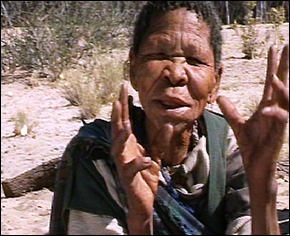
    Botswana Bushmen

    Photo by James G. Workman
    In this final excerpt from Workman’s Heart of Dryness, the author weaves several segments together to understand the political battles that often accompany water scarcity, and the problem of complacency when water is in abundance.

    By James G. Workman
    Special to Circle of Blue

    The dark side of drought and water scarcity isn’t economic stagnation; it is political implosion.[1] Scarce water fragmented society and curtailed liberty. It eroded trust. When drought-struck, the local governments from Atlanta to Los Angeles rationed individual water consumption to one-tenth of what people normally consume each day. [2] It cracked down on private well pumps, claimed and regulated waters for public consumption.

    Outside the Kalahari, these political responses are almost universal. Conflict is inevitable, as most recently witnessed in Boston supermarkets as families brawled over the last bottled water. “Other hazards tend to pull people together,” said Michael Hayes, director of the National Drought Mitigation Center, speaking of water’s power. “With a drought, because it’s a limited resource, it tends to drive people apart.” [3]

    Divide us it did. Southeastern states have sued one another for remnant water, and even Maryland challenged Virginia over control of Potomac River currents for the first time since the Civil War. [4] As citizens appealed to government, governors appealed to God. In July 2007 Alabama Governor Bob Riley declared a week in July “Days of Prayer for Rain.” In November, Georgia Governor Sonny Perdue gathered people together on the capitol steps, bowed his head, and appealed to a higher power for relief. “We’ve come together here simply for one reason and one reason only,” he told the gathering, “to very reverently and respectfully pray up a storm.”[5]

    Irreversibly rising heat, migrating jet stream, booming industry, thirsty populations, helpless leaders driven to their knees: The Perfect Drought.

    “El Nino anomalies aside, it doesn’t appear on the horizon to be getting any cooler or damper; both the World Meteorological Organisation and the British Meteorological Office confirm that last decade was the hottest on record, and reputable observers maintain that our current mega-droughts represent the overture of what will follow for centuries.”

    El Nino anomalies aside, it doesn’t appear on the horizon to be getting any cooler or damper; both the World Meteorological Organisation and the British Meteorological Office confirm that last decade was the hottest on record,[6] and reputable observers maintain that our current mega-droughts represent the overture of what will follow for centuries. Based on new evidence that the Global Warming Era was dawning sooner than expected, even Nobel laureate Al Gore changed his mind: prevention alone was not enough, and too late. Now, he said, we must rapidly learn to adapt to less water.

    If that’s the case, who will teach us?

    For the last seven years as the U.S. broke records for high temperatures and low reservoirs and prepared for what could become the worst hot Dry Age in 30,000 years, the remnants of the world’s oldest civilization—the only people with the survival savvy, strategies, tactics, and values to guide us through the extremes of our once and future drought—were embattled in the heart of the Kalahari Desert, surrounded by armed men who were urging these last free Bushmen to surrender their way of life forever…

    For more than a decade even the wildest drylands in Africa no longer held autonomous bands who might share their self-sufficient experience. Then Botswana’s convoy destroyed the last government water supplies and deliveries inside the Reserve, triggering their crisis—and my opportunity.

    I saw America’s fate inextricably linked to the predicament of a thousand indigenous people suddenly forced to submit, die or adapt once again to The Great Thirstland. The survivors had to tap into the deep reservoir of indigenous wisdom, and I hoped to grasp the essence of their unwritten code. For centuries Bushmen had been shot and infected, poked and prodded, and now, facing the onset of permanent droughts, I set out to exploit them one last time.

    The ‘Last of the First’ welcomed me to their fire. I listened to what often seemed serious debate but was later translated as spectacularly lewd banter. During a lull one evening, as it grew cooler, I moved with tape recorder and camera from one Bushmen to the next until coming to an unspoken matriarch. In exchange for smuggling contraband water and other supplies, I sought to extract from her and others a few Important Answers to Big Questions, namely, “What will you do without government supplied water?”

    She kept scooping flesh out of a tsama melon, trading gossip with another.

    “How are you going to manage water during the drought?”

    The old woman shrugged without looking up and shifted back on her heels. Next to her a small fire burned. It was more smoke than flame, but never seemed to go out.

    I persisted. “Do you think you could manage enough water for your family and your band to last until the rainy season?”

    “Back then, her caginess didn’t make sense. Years later it began to. It wasn’t that Bushmen didn’t want to answer; they just couldn’t.”

    Like others before her, she grew evasive. Repeating the question through my translator met with awkward silence. Back then, her caginess didn’t make sense. Years later it began to. It wasn’t that Bushmen didn’t want to answer; they just couldn’t. As an ‘international water expert’ my grilling Qoroxloo about how humans must manage water was like a Vatican cleric interrogating Galileo about how the sun must orbit the earth.

    To be sure, we will not soon abandon eBay or Wal-Mart to hunt and gather in foraging bands. Nor should we feel the need to. Yet the Bushmen code of conduct may help us escape a Hobbesian or neo-Malthusian nightmare. Prepared for extreme deprivation, Kalahari Bushmen chose the hard responsibility of a dry reality over a government-dependent fantasy of water abundance. Outside of their Reserve the so-called civilized world found that for all our military might and internet bandwidth, certain things still lie beyond our grasp. We discover we cannot ‘regulate’ barren rivers and depleted aquifers any more than we can ‘regulate’ our climate, clouds, or rain. Out here, while elected leaders kneel and ask us all to pray for a thundershower that will provide temporary relief, the increasingly dry hot wind whistles through the thorn trees in the central Kalahari and whispers the ancient secret those last defiant Bushmen never forgot.

    “We don’t govern water.

    Water governs us.”

    We don’t govern water.

    Water governs us.

    If our competitive demand for scarce water drives us apart and escalates political tensions, this same finite supply of freshwater is also itself what ultimately drags us back and binds us together. We may not like the rule of increasingly scarce water, but at the same time we cannot escape it. And Qoroxloo’s band demonstrated how to embrace that reality. Her fundamental rule of adaptation was not to organize and mobilize physical resources to meet expanding human wants, but rather to organize human behavior and society around constraints imposed by diminishing physical resources.

    Whether it pulses between a competing heart and brain, sinks down in the shared aquifer beneath our fenced-off private property, or flows in the common currents that runs along or across our walled-off borders, water is quite literally the connective tissue that links and rules our fates. Only this magical glue makes us collaborate to endure scarcity. If we are to prevent dehydration, domestic strife, or degeneration into the ruthless Hobbesian/Darwinian scenario and if we are to avoid testing the nightmare hypothesis of a trans-national water war, then we need to derive a system like that which for millennia sustained people in the Kalahari.

    Given the scale and complexity of our current political economy, what might this system look like? How do we obey water’s rule? If Qoroxloo’s band ran America’s waterworks: what would Bushmen do?

    Based on my reading of the evidence, they’d organize us politically around the measurable contours of the hydrological unit where we live: water known to exist within an aquifer or river basin. Then, within that unit their code would secure the fundamental and minimal amount of fresh water required to keep each human healthy and alive. Some researchers peg this quantity at thirteen potable gallons per day, for drinking, cooking, and basic hygiene; others ratchet the amount up to one hundred gallons per person per day. Let’s conservatively assume the upper limit, which still lies below America’s comfortable average, and secure it as a fundamental human right, the kind Bushmen owned, recognized and respected in others. The flip side of this individual right is that it demands we also own water as an individual responsibility.

    Human nature takes over from there. Confronted with finite limits imposed by drought and siege, the Bushmen code of conduct allows people to negotiate informally over the water resources they required, reaching out to partners with whom to exchange if and when they need more or less. People increased supply by efficiently reducing demands, and the benevolent result of their integrated informal right to water brought Bushmen into a relative state of social abundance.

    This informal right may seem on the surface like what liberals vehemently demand from the UN, in which under a binding convention governments collectively hold federal water on behalf of the public, safe from the clutches of commerce.[7] If anything, Bushmen sought the opposite. It was not trade itself they feared, but the lack of secure access to the water resources they needed to trade in the first place. Government’s primary role would then be to uphold their individual or band’s right to access water—water that they already inherently owned and traded in reciprocal, lateral, and mutually beneficial exchanges. Defense of this kind of individually defined and divestible water right is a far cry from the enlightened paternalistic eco-socialism espoused by the so-called global water movement. It more accurately reinforces Justice Unity’s Dow’s assertion that water does not belong to the government: It belongs to each of us.

    Or it would if we had not already given it away. All of us growing up in cities and suburbs have surrendered both our right and our responsibility to water to state-run or -regulated institutions. Many of these command-and-control structures are now teetering on the brink of physical failure or institutional collapse. The left wants trillions borrowed and invested to improve all creaky public waterworks. The right wants to privatize them.

    Yet ideology aside, it matters little whether our taps and pipes and sewers can be traced back to a government utility or a corporate venture if both operate as absolute top-down centralized monopolies that impose involuntary and uncompetitive rates and quality with which we cannot, by definition, negotiate. Public or private utilities are neither good nor evil; but right now they still remove all real incentives and accountability to conserve water efficiently, while making us dependent on aging infrastructure, political fecklessness, wasteful approaches, and unreliable supply in a radically changing climate.

    “In an era of permanent droughts, that is not a desirable place to be.”

    In an era of permanent droughts, that is not a desirable place to be.

    Like Qoroxloo’s band, however, we can use our will and our cunning to reclaim what has always been rightfully ours. Government must ensure equitable delivery of water, but it need not be the institution that delivers it. In a free democratic society we can demand that water agencies restore and protect our inherent human right to water—say, the first one hundred gallons per day, owned by each of us—in return for our once again taking responsibility for using it wisely, free to truck, barter and exchange any surplus water within that right that we manage each day to conserve.

    In the spirit of Bushmen, we could demand water exchanges within aridity’s authoritarian rule, in other words: unlimited markets within natural monopolies.[8]

    Rather than pressure politicians to keep water rates low, build more dams, drain more wetlands, pump more deltas, expand storm drains and sewers, and plunder more aquifers, we would all be pulled in the opposite direction. We would nudge governments to raise rates higher and across the board, to reward our efficiency, make the water we conserved worth more, drive us to more efficient exchanges, and restore substantially more leftover wild water back to all those endangered aquatic species.[9]

    However small, local, and interpersonal in its origins, this translation of the Bushmen code of conduct could be replicated and scaled from the bottom up, from urban utilities to irrigation districts to international transboundary waters. By redefining water as an owned and tradable right that turns costly conflict into symbiotic cooperation, security analysts suggest that exchanges like those among Bushmen could alleviate national security tensions over border-crossing aquifers and streams from the Rio Grande and Colorado to the Great Lakes and Columbia, perhaps even in the Middle East.[10] In other words, landlocked Botswana could learn from the Bushmen living within its dry heart how to break the siege imposed by rival neighboring African states.

    My interpretation may or may not accurately convey what the late Qoroxloo would have outlined, either for her resilient and humble band or for our far more rigid and profligate civilizations growing thirsty outside the Kalahari. Then again, even while living she never was one to lay down rules or dictate advice to friends and family, let alone foreign strangers like us. She didn’t write a code of conduct. She lived it. As drought dragged on, she danced against the armed and unthinking political forces closing in on her, until finally, and on her own terms, she broke free.

    When I think of the permanent drought we face in the years ahead, I like to picture her as last seen by her band of foragers: calm, defiant and aware, striding purposefully across the hot dry Kalahari sands while singing an ancient song quietly to herself…and to anyone else who might care to listen.

    Read more of Workman’s Heart of Dryness on Circle of Blue.
    ________
    * Footnotes

    [1] Michael Dudley, “Cities Abandoned? Mass Migrations? The Questions No One is Asking about Drought.” World Environment, PlanetCitizen.com, November 18, 2007.

    [2] Leonard Doyle, “The big thirst: The great American water crisis; the US drought is now so acute that, in some southern communities, the water supply is cut off for 21 hours a day,” The (UK) Independent, November 15, 2007.

    [3] Lynn Waddell and Arian Campo-Flores, “Dry—And Getting Drier: The severe drought has Georgians praying for rain—and battling with their neighbors,” Newsweek, Nov 16, 2007.

    [4] Linda Greenhouse, “Justices Consider Dispute on Use of Potomac River,” New York Times, October 8, 2003.

    [5] Jenny Jarvie, “Gov. to God: Send Rain!” Los Angeles Times, November 14, 2007.

    [6] Matthew Jones, “All 11 hottest years were in last 13: UK Met Office,” Reuters,
    December 14, 2007.

    [7] See Maude Barlow’s Blue Covenant: The Global Water Crisis and the Coming Battle for the Right to Water. As a tireless activist leader Barlow deserves credit for putting the right to water on the global radar screen, but her anti-privatization ideology blinds her to the practical fallacy of what she seeks. An inalienable right to water, held as a public trust by the government, which no one can trade, is the equivalent of a right to vote, held in trust by the state, which no one can cast. It confines individual liberty and diminishes social opportunity. Barlow seeks to disenfranchise in the name of empowerment.

    [8] As Saltzman, in Thirst: A Short History of Drinking Water observed, there is ample precedent for this combination: A rights-based water management regime is clearly not a new idea. The Right to Thirst in Jewish and Islamic Law, sharing norms in Africa and India, and the “always ask” custom among aborigines all depend on a universal norm of access to drinking water by right in times of need. The Aqua Nomine Caesar practice in ancient Rome of free water was rights-based, as well – a right of provision guaranteed by the Emperor. Treating drinking water supply as a priced resource is by no means a new idea, either. The vectigal, a tax on the private consumption of water, funded operation of the Roman water system for centuries. Private water vendors underpinned much of New York and London’s water supply through the 19th century, and now supplies London once more. Nor, finally, are these two identities mutually exclusive.

    [9] The Bushmen survival strategies have also shown why we might be suspicious of the current top-down environmental flow regimes, requirements and regulations. Experts have their place, and I by no means consider myself anti-intellectual or anti-elitist. But anyone who has tried to set aside a certain amount of water “for nature” faces the same lack of political clout as another who tries to set aside water “for extractive industries” or “for agriculture.” Each indirectly represents a vague constituency; my particular special interests may or may not diverge from your own, but in any case we each seek bigger slices from what we assume to be an expanding pie. We want it all.

    [10] Franklin Fisher and Annette Huber-Lee, “Liquid Assets: An economic approach for water management and conflict resolution in the Middle East and beyond,” Resources for the Future, 2005.

  • Cells Can Be Controlled Electronically

    It is now possible to control cells through electronic intervention. This is a breakthrough achieved with help from researchers at Karolinska Institute, Sweden, and Linkoping University.

    Similarities between plastic – having an ion-selective membrane; and silicon – a semiconductor – were explored to produce what is called “diodes.” The diodes were joined into an ion transistor, which is then connected to cultivated nerve cells. It controlled the supply of acetylcholine to the cells. It showed that charged bimolecules can be passed on. This development paves the way for controlling chemical signals.
    Soon enough, ion transistors can be integrated with other materials and eventually contribute in regulating the delivery of drugs, said Berggren, professor of organic electronics.

    The study is included in the scientific journal Proceedings of the National Academy of Sciences. Key contributors are Karin Larsson and Agnets Richter-Dahlfors, Karolinska Institute; and Klas Tybrant and Magnus Berggren, Linkoping University. Foundation for Strategic Research funded the research center OBOE (organic bioelectronics).

    Related posts:

    1. Stem Cell Research Provides Hope for Deafness
    2. Algae Reduces Water Pollutants
    3. President Barack Obama pushes for artificial DNA

  • INSIGHT: It’s a lot easier for a small company to

    It’s a lot easier for a small company to happily grow into a large one than a large one happily downsizing to a small one. When you’re small you have options – you can stay small or go middle or go big. But once you’re big, getting smaller is almost always out of the question unless you’re forced in that direction. This is the problem when companies grow too fast – they skip right over their options and set themselves up for big or bust.

  • Paul McCartney to be honored by Obama, Michelle at White House

    below, from the White House…..

    THE WHITE HOUSE
    Office of the Press Secretary

    FOR IMMEDIATE RELEASE
    May 24, 2010

    PRESIDENT AND FIRST LADY TO HOST CONCERT HONORING PAUL MCCARTNEY IN THE EAST ROOM

    On Wednesday, June 2nd, the President and First Lady will host a concert in the East Room honoring Paul McCartney, who will be awarded the 3rd Gershwin Prize for Popular Song from the Library of Congress. President Obama will present the award as he did last year when the Library of Congress honored Stevie Wonder. The concert will be broadcast on PBS stations nationwide on Wednesday, July 28, 2010 at 8:00 PM EDT (check local listings) as “In Performance at the White House Celebrating the Music of Paul McCartney: The Library of Congress Gershwin Prize.”

    The prize commemorates George and Ira Gershwin, the legendary American songwriting team whose extensive manuscript collections reside in the Library of Congress. The prize is awarded to musicians whose lifetime contributions in the field of popular song exemplify the standard of excellence associated with the Gershwins.

    The President’s remarks at the ceremony will be pooled press.
    ###

  • General Odierno Nominated for New Job

    Washington D.C. — The military announced Monday that President Obama has nominated General Raymond T. Odierno to head Joint Forces Command (JFCOM). Odierno is a four-star general who serves now as the head of US Forces – Iraq.

    If confirmed by the senate, Odierno will replace Marine Corps General James Mattis, and will be responsible for overseeing more than 1.16 million men and women. Unlike other combatant commands that focus on specific areas like the Middle East or Europe, JFCOM reaches all military services and commands.

    Headquartered in Norfolk, Virginia, JFCOM’s real purpose is to train U.S. military services around the the world to work in tandem. It ensures equipment is sent to the right places and provides military to military coordination with other countries.

    It’s unclear when Odierno will leave his post as top general in Iraq, although officials in the Pentagon are speculating it could happen around the Fall of 2010. General Llyod Austin was nominated last week to replace Odierno in Iraq.

    General Odierno served as second in command under General David Petraeus during the Iraq surge in 2007 and took command of those forces in September of 2008 when Petraeus left to lead Central Command.

    Odierno is a highly decorated general with multiple service and achievement medals, including the State Department highest award, the Secretary of State Distinguished Service Medal.

    Odierno met with the Secretary Gates Monday in the Pentagon.

    Fox News has reported on several occasions that the next biggest test for U.S. Forces – Iraq will be to meet President Obama’s deadline of reducing to 50,000 troops by September 1, 2010. With 94,000 troops in Iraq now, the U.S. will have to remove 44,000 of them in less than 15 weeks.

  • Android Screenshots: No Root Required with EVO

    We’re not sure if this is a bug that will get fixed, an easter egg, or what, but when we heard reports of unrooted EVO users being able to use the screen capture app ShootMe, we had to test it out ourselves. And it worked! You’re looking at the results of our test on the left.

    Previously, getting screenshots from an unrooted Android device required hooking it up to a P.C. that has the Android SDK installed. Applications in the Market that take screenshots, including ShootMe, all note requiring a rooted phone to work.

    We tested this on a stock HTC EVO 4G distributed at Google I/O. Let us know in the comments if other screen capture apps work on your unrooted EVO, or if you’ve come across other methods of getting screen captures on unrooted devices.

    Might We Suggest…


  • Froyo Feature: Bluetooth voice dialing

    Froyo bluetooth voice dialing

    One of the biggest thorns in Android’s side so far has been lack of Bluetooth voice dialing.  (These are phones, after all.)  For those of you on-the-go who need to safely use the phone features without touching it you now have the option in Android 2.2.

    Once your device is paired and connected, a press of the action key brings up what you see above.  You’re greeted by a female robotic voice who also repeats your instructions.  Seems fairly accurate (as accurate as my Blackberry or Pre), and worked well with both a Motorola MOTOROKR S305 set and a Jawbone Icon in my testing.  Shout out Froyo-ers — does your headset work, and how’s your Bluetooth experience on 2.2?

    This is a post by Android Central. It is sponsored by the Android Central Accessories Store