Blog

  • Dannel Malloy and Ned Lamont Already Clashing in Democratic Primary Race; Still Had Not Talked Early Sunday

    Former Stamford Mayor Dannel Malloy and Greenwich cable TV entrepreneur Ned Lamont still had not talked as of Sunday morning regarding their upcoming primary contest.

    One of the questions that Malloy was asked Saturday after winning the Democratic Party’s gubernatorial convention nomination at the Expo Center in Hartford was if he had talked to Lamont yet. He had not.

    Within minutes of his acceptance speech, Malloy was sharply criticizing Lamont regarding his views on campaign finance reform as Malloy is accepting public financing in the race and Lamont is not. Malloy also criticized Lamont on paid sick leave – an issue that Malloy supports that failed again this year to be approved by the state legislature. The issue did not get a vote in either the House or the Senate, which are both controlled by the Democrats with veto-proof majorities.

    On a television program on Sunday morning on Channel 3 at the studios in Rocky Hill, Malloy was asked again if he had spoken yet to Lamont.

    “I think he left the hall while I was speaking,” Malloy responded.

    As reported by The Hartford Courant on Saturday and Sunday, Lamont was actually speaking to a group of reporters as Malloy was making his acceptance speech. Lamont had walked to the press area near the back of the hall, diverting the attention of many reporters as Malloy was still speaking on stage.

    Lamont remained in the hall throughout the balloting in the lieutenant governor’s race between his running mate, Simsbury First Selectman Mary Glassman, and Malloy’s running mate, state Comptroller Nancy Wyman. Wyman defeated Glassman with almost exactly the same number of votes that Malloy surpassed Lamont – by more than a 2 to 1 ratio.

    The next major stop for all four candidates is the August 10 primary – which is surely to be a hotly contested matchup.

    Lamont has been the leader in the Democratic primary in the past three Quinnipiac University polls over the past several months. He had initially been behind Secretary of the State Susan Bysiewicz, but she dropped out of the governor’s race in January and will not be on the ballot this year.

  • How town hall snoopers are watching you: Councils use anti-terror laws to spy on charity shops and dog-walkers

    Via Prison Planet.com » Prison Planet

    James Slack
    UK Daily Mail
    Monday, May 24th, 2010

    Council snoopers have used a controversial Big Brother anti-terror law to spy on people making unwanted donations to charity shops.

    Covert cameras were placed inside shop windows to film anyone who left bags of books, clothes or CDs outside a branch with a view to prosecuting them for ‘fly-tipping’.

    The extraordinary operation was among 8,575 instances of town halls using covert surveillance rights granted under the Regulation of Investigatory Powers Act against the public in the past two years.

    It is the equivalent of 11 secret missions being carried out by bureaucrats every day.

    They range from undercover patrols for dog walkers whose animals are suspected of breaking dog-fouling rules to spying on their own staff and on smokers believed to be flouting the nationwide ban.

    Full article here

    How town hall snoopers are watching you: Councils use anti terror laws to spy on charity shops and dog walkers  150410banner7

  • ‘Shame on you, democracy,’ Vanunu yells as he returns to prison

    Via Prison Planet.com » World News

    Nir Hasson
    Haaretz
    Monday, May 24th, 2010

    After having served 18 years for leaking Israeli nuclear secrets, Mordechai Vanunu begins serving additional 3 months for violating terms of his parole.

    Nuclear whistleblower Mordechai Vanunu, released in 2004 after 18 years in prison for leaking Israeli nuclear secrets, began serving an additional 3-month sentence on Sunday for refusing to carry out court-mandated community service.

    “I survived 18 years – I could survive another six,” Vanunu called out outside the Jerusalem District Court. “Are you trying to discipline me? You cannot take my freedom of expression away”

    “Freedom is freedom. You won’t get from me in three months what you didn’t get in 18 years,” he added.

    Full article here

    Shame on you, democracy, Vanunu yells as he returns to prison 150410banner1

  • Italian Soccer: A Matter Of Life And Death?

    Italians are essentially crazy about three things: food, fashion and football. Football, of course, being what Americans call soccer.

    People don’t normally kill each other over food and fashion, but in Europe, at least, they do over football, and it happened this weekend in Italy.

    The Champions League final was played in Madrid between the Milan-based Internazionale and Bayern Munich. Internazionale won the game 2-0 with two beautiful goals by the Argentine striker Diego Milito.

    A lot of people in Italy hate Internazionale, also known as Inter, especially fans of cross-town rival A.C. Milan and  the one-time powerhouse Juventus, based in Turin.

    For two grown men watching the game at a bar in Turin, the tension was just too much. One was an Inter fan; the other a passionate follower of Juventus, which just finished a horrendous season, not winning a thing.

    Inter had just sewn up its third title of the year with the Champions League victory, so when the Juve supporter said that Inter wasn’t really an Italian team, since its coach and almost all of its starting line-up were foreigners, that was just too much for the Interista.

    After some pushing and shoving, the Interista took out a knife and stabbed the other man. A 63-year-old was dead, and a 60-year-old hauled off to jail.

    It brought back to mind a quote attributed to former Liverpool coach Bill Shankly: “Some people believe football is a matter of life and death. I am very disappointed with that attitude. I can assure you it is much, much more important than that.”

  • France debates age of retirement

    Via Prison Planet.com » World News

    Peggy Hollinger
    Financial Times
    Monday, May 24th, 2010

    Expectations are growing that France is set to remove the right to retire at 60, as it embarks on a contentious reform of its debt-laden pension system and brings public finances back into line.

    Christian Estrosi, industry minister, yesterday said the government was “leaning towards an increase in the [retirement] age” in its talks with unions and employers’ federations, despite denials from cabinet ministers over the weekend of a decision being taken.

    Although there has been much speculation that France’s legal retirement age of 60 – one of the lowest in Europe – would be abandoned, Mr Estrosi’s comments on national radio are the clearest statement yet of government intentions.

    His comments are likely to give ammunition to unions planning a national strike on Thursday to protest against spending cuts and pension reforms.

    Full article here

    France debates age of retirement  150410banner1

  • Tammy Lynn Michaels Lashes Out At Melissa Etheridge In Wake Of Split

    When Exes Attack — Melissa Etheridge Edition: Actress Tammy Lynn Michaels lashed out at ex Melissa Etheridge in a poem posted to her blog last Thursday. The couple split in April and Michaels has grown fed-up with the Grammy-winning singer’s insistence that the breakup was “mutual.”

    The former couple wed with a commitment ceremony in 2003, welcoming twins Johnnie Rose and Miller three years later, but love between the pair began to unravel in recent years.

    “Thank you for telling an interviewer that you WON’T censor me on my blog. I did not go anywhere, honey. And you and I both know it. Please stop telling the press it was mutual,” Tammy wrote. “Things can be a long time coming to one and smash the hell out of another,” she added.

    “I’d rather hear 10,000 fans screaming my name in worship than hear my wife harp on meabout my family intimacy issues too, you know? You evolved, you needed to be happy- but really… you withdrew your hands from family and intimacy to pluck those [guitar] strings more.”

    In conclusion, Michaels wrote: “I still love that damn woman so much, I’m still trying to stop. I had a dream last where honey and I were fighting and going to get a divorce, and I woke up sobbing…. then I realized. Oh. It’s true.”


  • 5 Things You Can Eat With Beets

    Farmersmarket_beets

    Beets for many people do not rank as a favorite vegetable and I get it because when I was younger I didn’t care for beets that much because it tasted like grass to me.

    But, as I’ve gotten older and tried beet dishes made by some really good cooks, I’ve come to love the beet in both red and yellow. Last week, I made this awesome and simple, “Soft Golden Beets With Shaved Manchego and Toasted Pecans.”

    Growing up, most of the beets I ate came from a can. When you have fresh beets, there is a huge difference in the flavor and texture…at least to me. I avoid eating canned and frozen veggies as much as possible simply because fresh tastes so much better to me.

    So, with the help of some tasty food bloggers, here are some ideas for things you can eat with beets:

    • Beet salad with Blood orange, Mineolas, Clementines, Kumquates, and mixed greens [Cheeky Chili]
    • Asparagus and Pasta cooked with beets and red wine. The color of the pasta shells is amazing [Peas Love Carrots]
    • Oven Roasted Yukon Gold Potatoes with Beets in Garlic-Lemon-Thyme
      Dressing [Gourmeted]
    • Warm citrus beet salad with goat cheese, grilled onions, and country ham [Zested]

    There you have just a few ideas. What is one of your favorite beet dishes?


  • 60 Minutes Transcript on the Inferno


    For those who missed the broadcast, this is a transcript of the 60 minutes report on the deepwater Horizon a few weeks back.  What is reported bodes rather ill for the chain of command established by BP.  The Blow out preventer was clearly damaged and this was not sufficient to initiate extreme caution.   A first step would have been to set the final plug to seal of the risk of a blow out and then to even replace the BOP.
    There are always times when projects do not behave and the time must be spent to do it right.  The signals reported here were obvious.  Why did the managers choose to not heed them?  Did the managers even know about the BOP?
    An unreported accident could have lulled BP management into thinking that the fast approach was safe.
    I suspect that this will be a very expensive accident for BP before it is all over, and it is not as if BP cannot be made to pay.  It has huge holdings in the USA including a huge stake in Alaska.
    ’60 Minutes’ Investigates:
    BLOWOUT: THE DEEPWATER HORIZON DISASTER

    A SURVIVOR RECALLS HIS HARROWING ESCAPE; PLUS, A FORMER BP INSIDER WARNS OF ANOTHER POTENTIAL DISASTER! –  60 Minutes, Monday, May 16, 2010


    The gusher unleashed in the Gulf of Mexico continues to spew crude oil. There are no reliable estimates of how much oil is pouring into the gulf. But it comes to many millions of gallons since the catastrophic blowout. Eleven men were killed in the explosions that sank one of the most sophisticated drilling rigs in the world, the “Deepwater Horizon.”

    This week Congress continues its investigation, but Capitol Hill has not heard from the man “60 Minutes” correspondent Scott Pelley met: Mike Williams, one of the last crewmembers to escape the inferno.

    He says the destruction of the Deepwater Horizon had been building for weeks in a series of mishaps. The night of the disaster, he was in his workshop when he heard the rig’s engines suddenly run wild. That was the moment that explosive gas was shooting across the decks, being sucked into the engines that powered the rig’s generators.

    “I hear the engines revving. The lights are glowing. I’m hearing the alarms. I mean, they’re at a constant state now. It’s just, ‘Beep, beep, beep, beep, beep.’ It doesn’t stop. But even that’s starting to get drowned out by the sound of the engine increasing in speed. And my lights get so incredibly bright that they physically explode. I’m pushing my way back from the desk when my computer monitor exploded,” Williams told Pelley.

    The rig was destroyed on the night of April 20. Ironically, the end was coming only months after the rig’s greatest achievement. Mike Williams was the chief electronics technician in charge of the rig’s computers and electrical systems. And seven months before, he had helped the crew drill the deepest oil well in history, 35,000 feet.

    “It was special. There’s no way around it. Everyone was talking about it. The congratulations that were flowing around, it made you feel proud to work there,” he remembered. Williams worked for the owner, Transocean, the largest offshore drilling company. Like its sister rigs, the Deepwater Horizon cost $350 million, rose 378 feet from bottom to top. Both advanced and safe, none of her 126 crew had been seriously injured in seven years.

    The safety record was remarkable, because offshore drilling today pushes technology with challenges matched only by the space program. Deepwater Horizon was in 5,000 feet of water and would drill another 13,000 feet, a total of three miles. The oil and gas down there are under enormous pressure. And the key to keeping that pressure under control is this fluid that drillers call “mud.”

    “Mud” is a manmade drilling fluid that’s pumped down the well and back up the sides in continuous circulation. The sheer weight of this fluid keeps the oil and gas down and the well under control. The tension in every drilling operation is between doing things safely and doing them fast; time is money and this job was costing BP a million dollars a day. But Williams says there was trouble from the start — getting to the oil was taking too long.

    Williams said they were told it would take 21 days; according to him, it actually took six weeks. With the schedule slipping, Williams says a BP manager ordered a faster pace. 

    “And he requested to the driller, ‘Hey, let’s bump it up. Let’s bump it up.’ And what he was talking about there is he’s bumping up the rate of penetration. How fast the drill bit is going down,” Williams said. Williams says going faster caused the bottom of the well to split open, swallowing tools and that drilling fluid called “mud.”

    “We actually got stuck. And we got stuck so bad we had to send tools down into the drill pipe and sever the pipe,” Williams explained. That well was abandoned and Deepwater Horizon had to drill a new route to the oil. It cost BP more than two weeks and millions of dollars.

    “We were informed of this during one of the safety meetings, that somewhere in the neighborhood of $25 million was lost in bottom hole assembly and ‘mud.’ And you always kind of knew that in the back of your mind when they start throwing these big numbers around that there was gonna be a push coming, you know? A push to pick up production and pick up the pace,” Williams said. 

    Asked if there was pressure on the crew after this happened, Williams told Pelley, “There’s always pressure, but yes, the pressure was increased.” But the trouble was just beginning: when drilling resumed, Williams says there was an accident on the rig that has not been reported before. He says, four weeks before the explosion, the rig’s most vital piece of safety equipment was damaged.

    Down near the seabed is the blowout preventer, or BOP. It’s used to seal the well shut in order to test the pressure and integrity of the well, and, in case of a blowout, it’s the crew’s only hope. A key component is a rubber gasket at the top called an “annular,” which can close tightly around the drill pipe. Williams says, during a test, they closed the gasket. 

    But while it was shut tight, a crewman on deck accidentally nudged a joystick, applying hundreds of thousands of pounds of force, and moving 15 feet of drill pipe through the closed blowout preventer. Later, a man monitoring drilling fluid rising to the top made a troubling find.

    “He discovered chunks of rubber in the drilling fluid. He thought it was important enough to gather this double handful of chunks of rubber and bring them into the driller shack. I recall asking the supervisor if this was out of the ordinary. And he says, ‘Oh, it’s no big deal.’ And I thought, ‘How can it be not a big deal? There’s chunks of our seal is now missing,’” Williams told Pelley.

    And, Williams says, he knew about another problem with the blowout preventer. The BOP is operated from the surface by wires connected to two control pods; one is a back-up. Williams says one pod lost some of its function weeks before. Transocean tells us the BOP was tested by remote control after these incidents and passed. But nearly a mile below, there was no way to know how much damage there was or whether the pod was unreliable.

    In the hours before the disaster, Deepwater Horizon’s work was nearly done. All that was left was to seal the well closed. The oil would be pumped out by another rig later. Williams says, that during a safety meeting, the manager for the rig owner, Transocean, was explaining how they were going to close the well when the manager from BP interrupted.

    “I had the BP company man sitting directly beside me. And he literally perked up and said ‘Well my process is different. And I think we’re gonna do it this way.’ And they kind of lined out how he thought it should go that day. So there was short of a chest-bumping kind of deal. The communication seemed to break down as to who was ultimately in charge,” Williams said.


    On the day of the accident, several BP managers were on the Deepwater Horizon for a ceremony to congratulate the crew for seven years without an injury. While they where there, a surge of explosive gas came flying up the well from three miles below. The rig’s diesel engines which power its electric generators sucked in the gas and began to run wild.

    “I’m hearing hissing. Engines are over-revving. And then all of a sudden, all the lights in my shop just started getting brighter and brighter and brighter. And I knew then something bad was getting ready to happen,” Williams told Pelley.

    It was almost 10 at night. And directly under the Deepwater Horizon there were four men in a fishing boat, Albert Andry, Dustin King, Ryan Chaisson and Westley Bourg. 

    “When I heard the gas comin’ out, I knew exactly what it was almost immediately, ” Bourg recalled. 

    “When the gas cloud was descending on you, what was that like?” Pelley asked. 

    “It was scary. And when I looked at it, it burned my eyes. And I knew we had to get out of there,” Andry recalled. Andry said he knew the gas was methane. On the rig, Mike Williams was reaching for a door to investigate the engine noise. 

    “These are three inch thick, steel, fire-rated doors with six stainless steel hinges supporting ’em on the frame. As I reach for the handle, I heard this awful hissing noise, this whoosh. And at the height of the hiss, a huge explosion. The explosion literally rips the door from the hinges, hits, impacts me and takes me to the other side of the shop. And I’m up against a wall, when I finally come around, with a door on top of me. And I remember thinking to myself, ‘You know, this, this is it. I’m gonna die right here,’” Williams remembered.

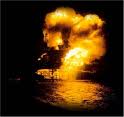
    Meanwhile, the men on the fishing boat had a camera, capturing the flames on the water. 

    “I began to crawl across the floor. As I got to the next door, it exploded. And took me, the door, and slid me about 35 feet backwards again. And planted me up against another wall. At that point, I actually got angry. I was mad at the doors. I was mad that these fire doors that are supposed to protect me are hurting me. 

    And at that point, I made a decision. ‘I’m going to get outside. I may die out there, but I’m gonna get outside.’ So I crawl across the grid work of the floor and make my way to that opening, where I see the light. I made it out the door and I thought to myself, ‘I’ve accomplished what I set out to accomplish. I made it outside. At least now I can breathe. I may die out here, but I can breathe,’” Williams said. Williams couldn’t see; something was pouring into his eyes and nm that’s when he noticed a gash in his forehead.

    “I didn’t know if it was blood. I didn’t know if it was brains. I didn’t know if it was flesh. I didn’t know what it was. I just knew there was, I was, I was in trouble. At that point I grabbed a lifejacket, I was on the aft lifeboat deck there were two functioning lifeboats at my disposal right there. But I knew I couldn’t board them. I had responsibilities, ” he remembered. 

    His responsibility was to report to the bridge, the rig’s command center. “I’m hearing alarms. I’m hearing radio chatter, ‘May day! May day! We’ve lost propulsion! We’ve lost power! We have a fire! Man overboard on the starboard forward deck,’” Williams remembered.

    Williams says that, on the bridge, he watched them try to activate emergency systems. “The BOP that was supposed to protect us and keep us from the blowout obviously had failed. And now, the emergency disconnect to get us away from this fuel source has failed. We have no communications to the BOP,” he explained.

    “And I see one of the lifeboats in the water, and it’s motoring away from the vessel. I looked at the captain and asked him. I said, ‘What’s going on?’ He said, ‘I’ve given the order to abandon ship,’” Williams said. Every Sunday they had practiced lifeboat drills and the procedure for making sure everyone was accounted for. But in the panic all that went to hell. The lifeboats were leaving.

    “They’re leaving without you?” Pelley asked.

    “They have left, without the captain and without knowing that they had everyone that had survived all this onboard. I’ve been left now by two lifeboats. And I look at the captain and I said, ‘What do we do now? By now, the fire is not only on the derrick, it’s starting to spread to the deck. At that point, there were several more explosions, large, intense explosions,” Williams said. 

    Asked what they felt and sounded like, Williams said, “It’s just take-your-breath- away type explosions, shake your body to the core explosions. Take your vision away from the percussion of the explosions.” About eight survivors were left on the rig. They dropped an inflatable raft from a crane, but with only a few survivors on the raft, it was launched, leaving Williams, another man, and a crewwoman named Andrea.

    “I remember looking at Andrea and seeing that look in her eyes. She had quit. She had given up. I remember her saying, ‘I’m scared.’ And I said, ‘It’s OK to be scared. I’m scared too.’ She said, ‘What are we gonna do?’ I said, ‘We’re gonna burn up. Or we’re gonna jump,’” Williams remembered. Williams estimates it was a 90-100 foot jump down. In the middle of the night, with blood in his eyes, fire at his back and the sea ten stories below, Williams made his choice.

    “I remember closing my eyes and sayin’ a prayer, and asking God to tell my wife and my little girl that Daddy did everything he could and if, if I survive this, it’s for a reason. I made those three steps, and I pushed off the end of the rig. And I fell for what seemed like forever. A lotta things go through your mind,” he remembered.

    With a lifejacket, Williams jumped feet first off the deck and away from the inferno. He had witnessed key events before the disaster. But if he was going to tell anyone, he would have to survive a ten-story drop into the sea. 

    “I went down way, way below the surface, obviously. And when I popped back up, I felt like, ‘OK, I’ve made it.’ But I feel this God-awful burning all over me. And I’m thinking, ‘Am I on fire?’ You know, I just don’t know. So I start doin’ the only thing I know to do, swim. I gotta start swimmin’, I gotta get away from this thing. I could tell I was floatin’ in oil and grease and, and diesel fuel. I mean, it’s just the smell and the feel of it,” Williams remembered.

    “And I remember lookin’ under the rig and seein’ the water on fire. And I thought, ‘What have you done? You were dry, and you weren’t covered in oil up there, now you’ve jumped and you’ve made this, and you’ve landed in oil. The fire’s gonna come across the water, and you’re gonna burn up.’ And I thought, ‘You just gotta swim harder.’ So I swam, and I kicked and I swam and I kicked and I swam as hard as I could until I remember not feelin’ any more pain, and I didn’t hear anything. 

    “And I thought, ‘Well, I must have burned up, ’cause I don’t feel anything, I don’t hear anything, I don’t smell anything. I must be dead.’ And I remember a real faint voice of, ‘Over here, over here.’ I thought, ‘What in the world is that?’ And the next thing I know, he grabbed my lifejacket and flipped me over into this small open bow boat. I didn’t know who he was, I didn’t know where he’d come from, I didn’t care. I was now out of the water,” he added.

    Williams’ survival may be critical to the investigation. We took his story to Dr. Bob Bea, a professor of engineering at the University of California, Berkeley.

    Last week, the White House asked Bea to help analyze the Deepwater Horizon accident. Bea investigated the Columbia Space Shuttle disaster for NASA and the Hurricane Katrina disaster for the National Science Foundation. Bea’s voice never completely recovered from the weeks he spent in the flood in New Orleans. But as the White House found, he’s among the nation’s best, having investigated more than 20 offshore rig disasters.

    “Mr. Williams comes forward with these very detailed elements from his viewpoint on a rig. That’s a brave and intelligent man,” Bea told Pelley. “What he’s saying is very important to this investigation, you believe?” Pelley asked. 

    “It is,” the professor replied.

    What strikes Bea is Williams’ description of the blowout preventer. Williams says in a drilling accident four weeks before the explosion, the critical rubber gasket, called an “annular,” was damaged and pieces of it started coming out of the well.

    “According to Williams, when parts of the annular start coming up on the deck someone from Transocean says, ŒLook, don’t worry about it.’ What does that tell you?” Pelley asked.

    “Houston we have a problem,” Bea replied.

    Here’s why that’s so important: the annular is used to seal the well for pressure tests. And those tests determine whether dangerous gas is seeping in. 

    “So if the annular is damaged, if I understand you correctly, you can’t do the pressure tests in a reliable way?” Pelley asked.

    “That’s correct. You may get pressure test recordings, but because you’re leaking pressure, they are not reliable,” Bea explained. Williams also told us that a backup control system to the blowout preventer called a pod had lost some of its functions.

    “What is the standard operating procedure if you lose one of the control pods?” Pelley asked.

    “Reestablish it, fix it. It’s like losing one of your legs,” Bea said.

    “The morning of the disaster, according to Williams, there was an argument in front of all the men on the ship between the Transocean manager and the BP manager. Do you know what that argument is about?” Pelley asked.

    Bea replied, “Yes,” telling Pelley the argument was about who was the boss. In finishing the well, the plan was to have a subcontractor, Halliburton, place three concrete plugs, like corks, in the column. 

    The Transocean manager wanted to do this with the column full of heavy drilling fluid — what drillers call “mud” — to keep the pressure down below contained. But the BP manager wanted to begin to remove the “mud” before the last plug was set. That would reduce the pressure controlling the well before the plugs were finished. 

    Asked why BP would do that, Bea told Pelley, “It expedites the subsequent steps.” 

    “It’s a matter of going faster,” Pelley remarked.

    “Faster, sure,” Bea replied.

    Bea said BP had won that argument. “If the ‘mud’ had been left in the column, would there have been a blowout?” Pelley asked. 

    “It doesn’t look like it,” Bea replied.

    To do it BP’s way, they had to be absolutely certain that the first two plugs were keeping the pressure down. That life or death test was done using the blowout preventer which Mike Williams says had a damaged gasket. Investigators have also found the BOP had a hydraulic leak and a weak battery. 

    “Weeks before the disaster they know they are drilling in a dangerous formation, the formation has told them that,” Pelley remarked. “Correct,” Bea replied.

    “And has cost them millions of dollars. And the blowout preventer is broken in a number of ways,” Pelley remarked.

    “Correct,” Bea replied.

    Asked what would be the right thing to do at that point, Bea said, “I express it to my students this way, ‘Stop, think, don’t do something stupid.’” 

    They didn’t stop. As the drilling fluid was removed, downward pressure was relieved; the bottom plug failed. The blowout preventer didn’t work. And 11 men were incinerated; 115 crewmembers survived. And two days later, the Deepwater Horizon sank to the bottom.

    This was just the latest disaster for a company that is the largest oil producer in the United States. BP, once known as British Petroleum, was found willfully negligent in a 2005 Texas refinery explosion that killed of its 15 workers. BP was hit with $108 million in fines — the highest workplace safety fines in U.S. history.

    Now, there is new concern about another BP facility in the Gulf: a former BP insider tells us the platform “Atlantis” is a greater threat than the Deepwater Horizon.  Ken Abbott has worked for Shell and GE. And in 2008 he was hired by BP to manage thousands of engineering drawings for the Atlantis platform. “They serve as blueprints and also as a operator manual, if you will, on how to make this work, and more importantly how to shut it down in an emergency,” Abbott explained.

    But he says he found that 89%of those critical drawings had not been inspected and approved by BP engineers. Even worse, he says 95% of the underwater welding plans had never been approved either.

    “Are these welding procedures supposed to be approved in the paperwork before the welds are done?” Pelley asked.  


     “Absolutely. Yeah,” Abbott replied. “They¹re critical.”

    Abbott’s charges are backed up by BP internal e-mails. In 2008, BP manager Barry Duff wrote that the lack of approved drawings could result in “catastrophic operator errors,” and “currently there are hundreds if not thousands of Subsea documents that have never been finalized.”

    Duff called the practice “fundamentally wrong.”

    “I’ve never seen this kind of attitude, where safety doesn’t seem to matter and when you complain of a problem like Barry did and like I did and try to fix it, you’re just criticized and pushed aside,” Abbott said.

    Abbott was laid off. He took his concerns to a consumer advocacy group called Food & Water Watch. They’re asking Congress to investigate. And he is filing suit in an attempt to force the federal government to shut down Atlantis. 

    “The Atlantis is still pumping away out there, 200,000 barrels a day, and it will be four times that in a year or two when they put in all 16 wells. If something happens there, it will make the Deepwater Horizon look like a bubble in the water by comparison,” Abbott said. In an e-mail, BP told us the Atlantis crew has all the documents it needs to run the platform safely. We also wanted BP’s perspective on the Deepwater Horizon disaster.


    The company scheduled an interview with its CEO, Tony Hayward. Then, they cancelled, saying no one at BP could sit down with “60 Minutes” for this report.  In other interviews, Hayward says this about Transocean, the owner of the Deepwater Horizon: “The responsibility for safety on the drilling rig is with Transocean. It is their rig, their equipment, their people, their systems, their safety processes.”

    “When BP’s chief executive Tony Hayward says, ‘This is Transocean?s accident,’ what do you say?” Pelley asked Professor Bea.

    “I get sick. This kind of division in the industry is a killer. The industry is comprised of many organizations. And they all share the responsibility for successful operations. And to start placing, we’ll call it these barriers, and pointing fingers at each other, is totally destructive, ” he replied. 

    Asked who is responsible for the Deepwater Horizon accident, Bea said, “BP.”

    We went out on the Gulf and found mats of thick floating oil. No one has a fix on how much oil is shooting out of the well. But some of the best estimates suggest it’s the equivalent of the Exxon Valdez spill everyfour to seven days. Scientists are now reporting vast plumes of oil up to 10 miles long under the surface. The spill has cost BP about $500 million so far. But consider, in just the first three months this year, BP made profits of $6 billion.

    There are plenty of accusations to go around that BP pressed for speed, Halliburton’ s cement plugs failed, and Transocean damaged the blowout preventer.  Through all the red flags, they pressed ahead. It was, after all, the Deepwater Horizon, the world record holder, celebrated as among the safest in the fleet. 

    “Men lost their lives,” survivor Mike Williams told Pelley. “I don’t know how else to say it. All the things that they told us could never happen happened.”


    ———— ——— ——— ——— —

    Copyright © 2010 CBS News ’60 Minutes’
  • British Scriptwriter Simon Monjack Found Dead

    Simon MonjackThe British Scriptwriter Simon Monjack died of a heart attack at age 39 at his home in Los Angeles after her wife Brittany Murphy died just five months ago because of pneumonia complicated by anemia.

    Monjack was found unconscious last night (9:24 PM) in his bedroom by his mother, Sharon Kathleen Murphy. Unfortunately for his mother, Murphy was announced dead at the scene when emergency services arrived.


    Monjack was the director, producer and writer of the B-movie Two Days, Nine Lives in 2000. He also received credits for the biopic Factory Girl about the actress and model Edie Sedgwick. “Monjack had nothing to do with the ‘Factory Girl’”, Director George Hickenlooper said. The director claims that Monjack somewhat stolen his script.

    Alongside career troubles, Monjack also have Legal troubles as well: Warrants were issued for him in Virginia in 2005 for credit card fraud, Coutts sued Monjack for evicting them from four homes, Monjack spent 9 days in prison in February 2007 for staying in the United States with an expired visa.

    Related posts:

    1. Charlotte Lewis Sexually Abused by Polanski
    2. Lindsay Lohan in court after returning to Los Angeles
    3. Delonte West–Gloria James Affair Confirmed!Calvin Murphy Proved “LeBron James’ Mom’s Affair”

  • OK Go Perform Underwater With Fish Bowls and Snorkels at Maker Faire [Music]

    We love OK Go in these quarters, not least because of their stage antics. The band took to the Maker Faire arena over the weekend, and actually played two songs underwater; snorkeled-heads stuck in fish bowls. More »


    Maker FaireRecreationOutdoorsCraftScuba Diving

  • Hungry Pigeon Festival Fun in Manchester

    Not long to go now until the fabulous Hungry Pigeon Festival hits Manchester for an amazing bank holiday weekend of music – and I for one can’t wait! All this sunny weather is perfect for festivals!

    They have a cracking line up for this year – Athlete will headline the mainstage in Piccadilly Gardens along with The Jessie Rose Trip, Misty’s Big Adventure, Beggar Joe, Manchester Samba School, Propaganda DJs and the hotly tipped All The Damn Kids from Sheffield.


    The great news is that our lovely Outreach team will be heading down this Saturday (29th) to raise awareness about the Robin Hood Tax, as well as enjoying the fantastic line up!

    Do you have just two hours free on Saturday to come and get involved? We want you to come along and enjoy this chance of some free festival fun with Oxfam – no experience necessary and you will get full briefing and costume on the day :) Contact Diane = [email protected] to get your place! See you Saturday!

  • Desert CO2 Cycle

    This is a far more detailed report on an item I posted on in 2008 when first published.  It is worth a revisit.
    The absorption of CO2 by the desert remains poorly understood.  We even need to know the basics as is obvious in the last paragraphs.   Is the process one way?
    Another aspect of these soils is that the soil is in a continuous process of breakdown causing the available surface area to constantly increase.  This is not well understood because the process is slow. Yet a simple cycle of freezing and thawing cracks rock along many crystal faces.  Such rotting of the rock will penetrate many feet into the soils or whatever the till is.
    Knowing that makes the CO2 uptake quite creditable.
    Have Desert Researchers Discovered a Hidden Loop in the
    Carbon Cycle?
    Science 13 June 2008:
    Vol. 320. no. 5882, pp. 1409 – 1410
    DOI: 10.1126/science.320.5882.1409
    Richard Stone
    URUMQI, CHINA–When Li Yan began measuring carbon dioxide (CO2) in western China’s Gubantonggut Desert in 2005, he thought his equipment had malfunctioned. Li, plant ecophysiologist with the Chinese Academy of Sciences’Xinjiang Institute of Ecology and Geography in Urumqi, discovered that his plot was soaking up CO2 at night. His team ruled out the sparse vegetation as the CO2 sink. Li came to a surprising conclusion:
    The alkaline soil of Gubantonggut is socking away large quantities of CO2 in an inorganic form. A CO2-gulping desert in a remote corner of China may not be an isolated phenomenon. Halfway around the world, researchers have found that Nevada‘s Mojave Desert, square meter for square meter, absorbs about the same amount of CO2 as some temperate forests. The two sets of findings suggest that deserts are unsung players in the global carbon cycle. “Deserts are a larger sink for carbon dioxide than had previously been assumed,” says Lynn Fenstermaker, a remote sensing ecologist at the Desert Research Institute (DRI) in Las Vegas, Nevada, and a coauthor of a paper on the Mojave findings published online last April in Global Change Biology.
    The effect could be huge: About 35% of Earth’s land surface, or 5.2 billion hectares, is desert and semiarid ecosystems. If the Mojave readings represent an average CO2 uptake, then deserts and semiarid regions may be absorbing up to 5.2 billion tons of carbon a year–roughly half the amount emitted globally by burning fossil fuels, says John “Jay” Arnone, an ecologist in DRI’s Reno lab and a co-author of the Mojave paper.
    But others point out that CO2 fluxes are notoriously difficult to measure and that it is necessary to take readings in other arid and semiarid regions to determine whether the Mojave and Gubantonggut findings are representative or anomalous.
    For now, some experts doubt that the world’s most barren ecosystems are the long sought missing carbon sink. “I’d be hugely surprised if this were the missing sink. If deserts are taking up a lot of carbon, it ought to be obvious,” says William Schlesinger, a biogeochemist at the Cary Institute of Ecosystem Studies in Millbrook, New York, who in the 1980s was among the first to examine carbon flux in deserts. Nevertheless, he says, both sets of findings are intriguing and “must be followed up.”
    Scientists have long struggled to balance Earth’s carbon books. While atmospheric CO2 levels are rising rapidly, our planet absorbs more CO2 than can be accounted for.
    Researchers have searched high and low for this missing sink. It doesn’t appear to be the oceans or forests–although the capacity of boreal forests to absorb CO2 was long underestimated. Deserts might be the least likely candidate. “You would think that seemingly lifeless places must be carbon neutral, or carbon sources,” says Mojave coauthor Georg Wohlfahrt, an ecologist at the University of Innsbruck in Austria.
    About 20 kilometers north of Urumqi, clusters of shanties are huddled next to fields of hops, cotton, and grapes. Soon after the Communist victory over the Nationalists in 1949,
    soldiers released from active duty were dispatched across rural China, including vast Xinjiang Province, to farm the land. At the edge of the sprawling “222” soldier farm, which is home to hundreds of families, oasis fields end where the Gubantonggut begins.
    The Fukang Station of Desert Ecology, which Li directs, is situated at this transition between ecosystems.
    In recent years, average precipitation has increased in the Gubantonggut, and the dominant Tamarix shrubs are thriving. Li set out to measure the difference in CO2 absorption between oasis and desert soil. An automated flux chamber measured CO2 depletion a few centimeters above the soil in 24-hour intervals on select days in the growing season (from May to October) in 2005 and in 2006. The desert readings ranged from 62 to 622 grams of carbon per square meter per year. Li assumed that Tamarix and a biotic crust of lichen, moss, and cyanobacteria up to 5 centimeters thick are responsible for part of the uptake. To rule out an organic process in the soil, Li’s team put several kilograms in a pressure steam chamber to kill off any life forms and enzymes. CO2 absorption held steady, according to their report, posted online earlier this year in Environmental Geology.
    “The sterilization treatment was impressive,” says biogeochemist Pieter Tans, a climate change expert with the U.S. National Oceanic and Atmospheric Administration in Boulder, Colorado. “They may have found a significant effect, previously neglected, but I would like to see more evidence.” Indeed, the high end of the Urumqi CO2 flux estimates are off the charts. “That’s more carbon uptake than our fastest growing southern forests.
    It’s a huge number. I find it extremely hard to believe,” says Schlesinger, who nonetheless says the Chinese team’s methodology looks sound.
    At first, Li was flummoxed. Then, he says, he realized that deserts are “like a dry ocean.”
    The pH of oceans is falling gradually as they absorb CO2, forming carbonic acid. “I thought, ‘Why wouldn’t this also happen in the soil?’ ” Whereas the ocean has a single surface for gas exchange, Li says, soil is a porous medium with a huge reactive surface area. One question, Tans notes, is why the desert soils would remain alkaline as they absorb CO2. Li suggests that ongoing salinization drives pH in the opposite direction, allowing for continual CO2 absorption. But where the carbon goes–whether it is stowed largely as calcium carbonate or other salts–is unknown, Li says. Schlesinger too is stumped: “It takes a long time for carbonate to build up in the soil,” he says. At the apparent rate of absorption in China, he says, “we’d be up to our ankles in carbon.”
    One possibility, DRI soil chemist Giles Marion speculates, is that at night, CO2 reacts with moisture in the soil and perhaps with dew to form carbonic acid, which dissolves calcium carbonate–a reaction that warmer temperatures would drive in reverse, releasing the CO2 again during the day. (Unlike most minerals, carbonates become more soluble at lower temperatures.) In that case, Marion says, Li’s nighttime absorption would tell only half the story: “I would expect that over a year, there would be no significant increase in soil storage due to this process,” he says, as the dynamic of carbon sequestration in the soil would vary from season to season. Li agrees that this scenario is plausible but notes that his daytime measurements of CO2 flux did not negate the nighttime uptake.
    In any case, other researchers say, absorption alone cannot explain the substantial uptake in the Mojave. Wohlfahrt and his colleagues measured CO2 flux above the loamy sands of the Nevada Test Site, where the United States once tested its nuclear arsenal.
    From March 2005 to February 2007, the desert biome absorbed on average roughly 100 grams of carbon per square meter per year–comparable to temperate forests and grassland ecosystems–the team reported in its Global Change Biology paper.
    Three processes are probably involved in CO2 absorption, Wohlfahrt says: biotic crusts, alkaline soils, and expanded shrub cover due to increased average precipitation. “We currently do not have the data to say where exactly the carbon is going,” he says. Like the Urumqi team, Wohlfahrt and his colleagues observed CO2 absorption at night that cannot be attributed to photosynthesis. “I hope we can corroborate the Chinese findings in the Mojave,” he says. Arnone and others, however, believe that carbon storage in soil is minimal.
    Wohlfahrt suspects biotic crusts play a key role. “People have almost completely neglected what’s going on with the crusts,” he says. Others are not so sure. “I’m mystified by the Mojave work. There is no way that all the CO2 absorption observed in these studies is due to biological crusts, as there are not enough of them active long enough to account for such a large sink,” says Jayne Belnap of the U.S. Geological Survey’s Canyonlands Research Station in Moab, Utah. She and her colleagues have studied carbon uptake in the southern Utah desert, which has similar crust species. “We do not see any such results,” she says.
  • Bijoué: Audio Technica’s diamond-shaped speakers


    Audio-Technica today in Japan announced [JP] diamond-shaped portable speakers, dubbed Bijoué/AT-SPF30, which are especially geared towards female users. Technically, the speakers aren’t special: you’ll get 600mW/φ28mm full range speakers running on two AAA batteries for 33 hours continuously.

    Weighing just 105g, the Bijoué speakers is sized at 78×74×37mm. Audio-Technica doesn’t try to attract geeky female buyers just with the design and size but with a functional hook as well: when opening up the diamond speaker, users will find a small mirror behind the lid.

    In Japan, Audio-Technica plans to sell the Bijoué/AT-SPF30 on June 16 in six different colors: black, brown, white, silver, golden and the inevitable pink (price: $30). If you’re interested but live outside Japan, I suggest contacting import/export specialists Geek Stuff 4 U.


  • Naked Truth on Default Swaps

    In the end we have another round of sophistry hiding the fact that it is all about third parties taking bets on a horse.
    Markets work well as a rule based game.  They fail miserably when rules are constantly changed out by the legal profession to satisfy the financial whims and greed of a client.  This is the creation of non reserve insurance and the losses have been horrific. 
    Obviously a no interest bet opens the door wide to outright insurance fraud because there is no downside.  After all, the perp is hidden offshore.  It would have taken the criminals exactly one sales pitch to figure this one out.
    Naked short selling, now naked insurance all have one thing in common.  The gambler can win if he is able to destroy the victim.  True stock manipulation begins with short selling and its ilk.  Gamblers are proactive in this regard however they cloud their actions.
    The choicest irony was watching Lehman bros scream about the practice as they went down.
    It is completely possible to reform the security trading industry but no one ever would let someone who had a clue near the game.  The victims continue to be citizens and the US economy in general because a huge amount of capital is simply diverted away from its intended destination.
    If a thousand investors decide to support a new energy source with ten million dollars and this money is diverted into a short selling syndicates account and the company is then starved into a profoundly disadvantageous financing that provides only a fraction of the money, while the balance is appropriated by the syndicate, then by most natural measures, a fraud has taken place.
    This is not clearly blocked by the SEC who only squawks once in a while.
    Naked Truth on Default Swaps
    nytimes
    On Thursday May 20, 2010,
    Should people be able to bet on your death? How about your financial failure?
    In the United States Senate, Wall Street won one this week when the Senate voted down a proposal to bar the so-called naked buying of credit-default swaps. If that were the law, you could not use swaps to bet a company would fail. The exception would be if you already had a stake in the company succeeding, such as owning a bond issued by the company.
    On the other side of the Atlantic, Germany announced new rules to bar just such betting — but only if the creditors were euro area governments.
    None of this argument would be taking place if regulators had done their jobs years ago and classified credit-default swaps as insurance.
    As it happened, however, clever people on Wall Street followed the prescription laid down by Humpty Dumpty in Lewis Carroll’s “Through the Looking Glass:”
    “When I use a word,” Humpty Dumpty said, in rather a scornful tone, “it means just what I choose it to mean — neither more nor less.”
    When Alice protested, Humpty Dumpty replied that the issue was “which is to be master — that’s all.”
    The word here is “swap.” It used to mean, well, a swap. In a currency swap, one party will win if one currency rises against another and lose if the opposite happens.
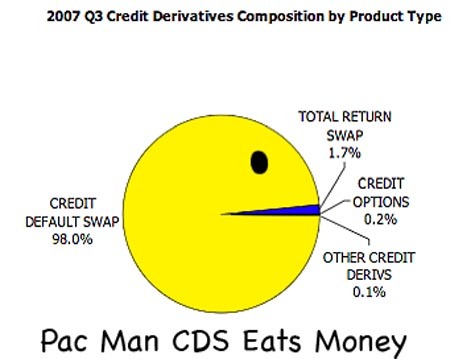
    Credit-default swaps are, in reality, insurance. The buyer of the insurance gets paid if the subject of the swap cannot meet its obligations. The seller of the swap gets a continuing payment from the buyer until the insurance expires. Sort of like an insurance premium, you might say.
    But the people who dreamed up credit-default swaps did not like the word insurance. It smacked of regulation and of reserves that insurance companies must set aside in case there were claims. So they called the new thing a swap.
    In the antiregulatory atmosphere of the times, they got away with it. As Humpty would have understood, Wall Street was master. Because swaps were unregulated, calling insurance a swap meant those who traded in them could make whatever decisions they wished.
    That decision, perhaps more than anything else, enabled the American International Group to go broke — or, more precisely, to fail into the hands of the American government. Had it been forced to set aside reserves, A.I.G. would have stopped selling swaps a lot sooner than it did.
    The decision that swaps were not insurance meant that anyone could buy or sell them — or at least anyone who could find a counterparty.
    Had credit-default swaps been classified as insurance, the concept of “insurable interest” might have been applied. That concept says that you cannot buy insurance on my life, or on my house, unless you have an insurable interest.
    Gary Gensler, the chairman of the Commodities Future Trading Commission, recently laid out the history of that concept. It did not exist until the 18th century, when many people — not just owners of ships or cargos — began buying insurance against ships sinking.
    More ships began sinking, and insurers cried foul.
    The British Parliament outlawed such sales of ship insurance in 1746. Ever since, to buy that insurance you had to have an interest in the ship or its cargo. But it was another 28 years before Parliament extended the idea to life insurance.
    So should it be illegal for me to buy credit-default swaps on companies even if I have no other interest in the company? And if I have an interest, should I be limited to buying only enough insurance to cover my exposure? That is, if I own $100 million in XYZ Corporation bonds, should I be able to buy $1 billion in insurance against an XYZ default?
    To most on Wall Street, the answer is obvious: let markets function. My buying that insurance will probably drive up the price, and serve as a market indication that people are worried about the credit, which is good because it gives a warning to others.
    In any case, it is legal to sell stocks short. That, too, is a way to bet that a company will fail. So what’s the difference?
    One difference is that many people short stocks because they deem them overvalued, not because they think the company will go broke. They can profit even if the company does well, so long as the stock does turn out to have been overvalued.
    Many who despise credit-default swaps argue that they can be used to force companies to fail. The swap market is thin, and even a relatively small purchase can drive up prices. That very movement may make lenders nervous, cause liquidity to dry up and bring on unnecessary bankruptcies.
    There is another, little noticed, possible impact of credit-default swaps. They can undermine bankruptcy laws.
    Normally, a creditor wants to keep a company out of bankruptcy if there is a decent chance it can survive. If it does go broke, the creditor wants to maximize the value of the company anyway, so that more will be available to pay creditors.
    But what happens if a major creditor, who might even control one class of bonds, has a much larger position in credit-default swaps?
    Will he not have interests directly at odds with those of other creditors, since he will do better if the company ends up with less to pay its creditors? Might that creditor seek to, and perhaps be able to, sabotage the company’s best hopes for revival?
    At a minimum, such things should be disclosed, but that gets tricky when one part of a megabank (the one with the bonds) claims it is run independently from the other (the one with the swaps).
    I don’t know whether it is necessary to treat credit-default swaps like insurance and require someone to have an insurable interest before swaps can be purchased.
    The financial reform bill now being debated in the Senate has provisions intended to assure that many of the previous swap abuses are not repeated.
    But I do think Germany’s decision was ill considered. First, it may have little effect if other countries do not join in. Buying a swap in New York or London, rather than Frankfurt, will not be difficult.
    But the more important issue is one of limiting the targets of credit-default swap purchases. If Germany had simply required buyers of credit-default swaps to have an insurable interest, it would have been standing up for a principle.
    By limiting the scope to swaps on debt of euro area governments, the German government sends two signals: it is acting in self-interest, and it is still worried that it may have to finance more bailouts.
    Top of Form
  • Purple Pokeberries Coat Solar


    I am not sure that I believe in the likely efficiency of this protocol.  It sounds like a great story.  The ‘cans’ work best the smaller that they are and that means likely colorants will clog rather than coat.   Of course, this article likely is telling us little or nothing about the practical aspects of this protocol.  Just those pokeberries can provide a convenient dye.
    Red dyes normally deteriorate quickly in the sun so that becomes another issue.
    In short, I can not see how this would work at all.  We will have to wait for more information on this one. 
    Tiny cans acting as quantum wells have been played with and are a promising avenue for solar power.  They would be sealed behind a transparent layer though.  This is not what they seem to be talking about.
    Purple Pokeberries Hold Secret To Affordable Solar Power Worldwide
    by Staff Writers

    Winston-Salem NC (SPX) May 03, 2010

    Pokeberries – the weeds that children smash to stain their cheeks purple-red and that Civil War soldiers used to write letters home – could be the key to spreading solar power across the globe, according to researchers at Wake Forest University’s Center for Nanotechnology and Molecular Materials.

    Nanotech Center scientists have used the red dye made from pokeberries to coat their efficient and inexpensive fiber-based solar cells. The dye acts as an absorber, helping the cell’s tiny fibers trap more sunlight to convert into power.

    Pokeberries proliferate even during drought and in rocky, infertile soil. That means residents of rural Africa, for instance, could raise the plants for pennies. Then they could make the dye absorber for the extremely efficient fiber cells and provide energy where power lines don’t run, said David Carroll, Ph.D., the center’s director.

    “They’re weeds,” Carroll said. “They grow on every continent but Antarctica.”

    Wake Forest University holds the first patent for fiber-based photovoltaic, or solar, cells, granted by the European Patent Office in November. A spinoff company called FiberCell Inc. has received the license to develop manufacturing methods for the new solar cell.

    The fiber cells can produce as much as twice the power that current flat-cell technology can produce. That’s because they are composed of millions of tiny, plastic “cans” that trap light until most of it is absorbed. Since the fibers create much more surface area, the fiber solar cells can collect light at any angle – from the time the sun rises until it sets.

    To make the cells, the plastic fibers are stamped onto plastic sheets, with the same technology used to attach the tops of soft-drink cans. The absorber – either a polymer or a less-expensive dye – is sprayed on. The plastic makes the cells lightweight and flexible, so a manufacturer could roll them up and ship them cheaply to developing countries – to power a medical clinic, for instance.

    Once the primary manufacturer ships the cells, workers at local plants would spray them with the dye and prepare them for installation. Carroll estimates it would cost about $5 million to set up a finishing plant – about $15 million less than it could cost to set up a similar plant for flat cells.

    “We could provide the substrate,” he said. “If Africa grows the pokeberries, they could take it home.
    “It’s a low-cost solar cell that can be made to work with local, low-cost agricultural crops like pokeberries and with a means of production that emerging economies can afford.”
  • On Shelves This Week: May 23 – 29, 2010

    It’s not every month that we get a haul like this one, but here you are, the best pickings of the season sitting in one basket, and in different flavors, too. RPGs, strategy games, racers, adventures, puzzles

  • 2010 Cosworth Subaru Impreza STI CS400 revealed

    2010 Cosworth Subaru Impreza STI CS400Cosworth officially revealed today the Subaru Impreza STI CS400 and announced that the car will go on sale in June. What is so special about this new model?

    Well, the new car delivers an impressive 400 PS (395 bhp) @ 5,750 rpm and is capable to hit 100 km/h (62 mph) in just 3.7 seconds (the standard version of the car carries 300 PS/ 296 bhp @ 6,000 rpm and hits 100 km/h in 5.2 seconds). The new Cosworth Subaru Impreza STI CS400 will include a new brake package with six-pot callipers and 355mm discs at the front, which was developed in cooperation with AP Racing. AP Racing is known as the company producing the brakes for the Bugatti Veyron but is also known as the leading supplier of brake and clutch components to teams in the Formula One but also from the World Rally Championship!

    2010 Cosworth Subaru Impreza STI CS4002010 Cosworth Subaru Impreza STI CS4002010 Cosworth Subaru Impreza STI CS4002010 Cosworth Subaru Impreza STI CS4002010 Cosworth Subaru Impreza STI CS400

    [via evo]

    Source: Car news, Car reviews, Spy shots

  • Simon Monjack Brittany Murphy Husband Dead

    The widower of Brittany Murphy, the actress who died of pneumonia last December, has been found dead in his Hollywood Hills home.

    The Los Angeles Fire Department was called to the property in the Hollywood hills shortly after 9PM on Sunday night, to respond to “an unspecified medical aid request,” according to reports.

    Murphy’s mom Sharon called emergency services after finding the screenwriter unconscious in the master bedroom of the Hollywood Hills property where the Clueless star died in December. He is believed to have suffered a cardiac arrest, although Police Sergeant Louie Lozano tells The Los Angeles Times that the cause of death is still unknown.

    “We have detectives at scene. They are conducting their investigation. Once we have further information, we will provide it.”

    Monjack’s death comes just five months after his wife, 32, died in Monjack’s arms after collapsing in the shower last Dec. 20.

    Monjack spoke of health problems in an interview earlier this year, saying he was taking a lot of medication. “Most of the drugs are mine. I suffer from seizures. I had a heart attack coming back from Puerto Rico last year,” he told The Daily Mirror.

    Monjack — a British-born producer — married actress Brittany Murphy in May 2007 during a private Jewish ceremony in Los Angeles.


  • Teachers Seek $23b- Lifeline or Bailout?

    Education Secretary Arne Duncan is asking lawmakers to put aside “politics and ideology” as they consider a request for $23 billion in “emergency” funding for public schools – a measure Republicans reject as a massive federal bailout for the teachers’ unions.

    The Obama administration is supporting the bill, formally titled the Keep Our Educators Working Act and sponsored by Rep. George Miller (D-CA) and Sen. Tom Harkin (D-IA).  In a letter to House Speaker Nancy Pelosi (D-CA) and Senate Majority Leader Harry Reid (D-NV) dated May 13, Duncan warned that if the bill is not enacted, “millions” of school children will be adversely affected and the ensuing damage will “undermine the groundbreaking reform efforts underway in states and districts all across the country.”

    Find out how much this program costs you by using Fox News’ Taxpayer Calculator.

    “This is a bipartisan issue — politics and ideology, around education, we have to put to the side,” Duncan said during an appearance on “Fox and Friends” on May 21.  “I’m very worried, very worried about anywhere between 100,000 and 300,000 teachers being laid off this year.  We have school districts — due to the horrendous budget times, conditions they’re facing — looking to eliminate summer school this summer, eliminating after-school and extracurricular activities, going to four-day weeks, not five-day school weeks…None of this is good for children.  None of this is good for education.  None of this is good for the economy.  So we are urging Congress to move with a real sense of urgency to pass this legislation.”

    Many Republicans oppose the measure, citing previous federal outlays for education, the size of the federal deficit, and the fact that the bill forces no spending cuts elsewhere in order to pay for itself.

    “Fundamentally, what you’re seeing is the failure of the stimulus,” Rep. Thaddeus McCotter (R-MI), chairman of the Republican House Policy Committee, told Fox News.  “What we’re looking at here in Michigan is 14 percent unemployment; nationally, we’re looking at 9.9 percent.  We’ve seen a spike in jobless claims — all of which was supposed to have been prevented by the trillion dollars this administration already spent to ‘create or save’ jobs.

    “When you look at the overall economy, that is really what undergirds the financing of education in the United States, both at the local level and at the state level.  So as Washington continues to try to go toward emergency measures, three things become patently obvious: One, the stimulus has failed.  Two, they’re delaying the real necessary restructuring of government that is required to have a sustainable tax base that is growing, for educators to be employed.  And third,” McCotter added with a flash of deadpan humor, “given the Democrats’ record number of deficits, debt and spending, there does auger an argument for more math teachers.”

    Education analyst Lindsey Burke of the Heritage Foundation, a conservative think tank in Washington, D.C., said roughly one-third of the $100 billion the Department of Education received in last year’s stimulus bill remains unspent.  She also questions the wisdom of funneling federal taxpayer funds, in any amount, to the public school system as it is presently structured.

    “More federal funding is not going to solve states’ fiscal problems and could in fact exacerbate those problems, by really preventing states from making the difficult budgetary decisions necessary to reduce costs and effect long-term systemic education reform,” Burke told Fox News.  “The real problem within the public education sector has been more and more non-teaching staff positions.  These positions continue to grow and really put a strain on state budgets.  Roughly half of those people employed by the public education sector are in non-teaching positions, and at the same time we see ever-decreasing class sizes.  In the 1960s, class size was about 27:1 student-teacher ratios.  Today those ratios are closer to 15:1….There are things that states could do to reduce costs, and they dont need another bailout from Washington for public education.”

    The Keep Our Educators Working Act has garnered support from some predictable quarters – and opposition from some surprising ones.  Interviewed in Minneapolis during a nationwide tour of beleaguered local school districts, many of which are already laying off teachers and closing down vital programs, Randi Weingarten, herself a former teacher and now president of the 1.4 million-member American Federation of Teachers, told Fox News the $23 billion is urgently needed to avert further “draconian” measures.

    “Nobody is asking for it on an ongoing basis.  We’re asking for it because we see on the ground, in school after school, the consequences of devastating cuts,” Weingarten told Fox News.  “In the ’70s, I watched what happened in New York City when…we lost a generation of kids….You don’t get to ‘do it over’ if you’re five years old.  You’re only five once — and therefore, that’s part of the urgency here.”

    Asked about the $34 million in stimulus funds that the Education Department has purportedly left unspent, Weingarten said that all of the funding that the stimulus intended for public school systems was, in fact, doled out – and done on an “equity basis,” with the most cash-starved school districts first to receive the funding.  “The monies that actually went to avert the direct effects of the greatest recession since the Great Depression were about 50-some-odd billion, of which some went to also ensure that we hired and maintained cops and other civil servants,” Weingarten said.  “The money that was allocated last year was allocated on an equity basis to various different states.  So ultimately we have encouraged states to spend those funds.  But what I am talking about is that the states that have spent it do not have the funds this year to go forward.  And we’re seeing that in state after state in their budget crises.”

    But the Washington Post editorial board urged lawmakers to reject the measure.  In an editorial published May 14 under the headline, “Red Ink in the Classroom,” the Post lamented that last year’s stimulus bill had created among educators “an unfortunate expectation of yet more federal dollars to bail out the states.”  “Should the federal government spend money it doesn’t have to let school systems operate beyond their means?” the editorial asked.  “We might have had a different view of this measure if its sponsors had figured out a way, as they promised with their adoption of pay-go guidelines, to pay for it rather than simply add to the nation’s fast-growing national debt.”

    President Obama has already indicated his support for the Miller-Harkin measure.  Addressing educators at the White House during the annual Teacher of the Year ceremony on April 29, the president claimed the stimulus bill had saved the jobs of 400,000 teachers – a figure higher than Weingarten used, in her interview with Fox News – and said: “I believe these efforts must continue, as states face severe budget shortfalls that put hundreds of thousands of jobs at risk.  We need, and our children need, our teachers in the classroom.”

  • Consumer Groups Praise Financial Reform – But Cautiously

    Sen. Chris Dodd (D-Conn.) (EPA/ZUMApress.com)

    Last week, the Senate passed a sweeping overhaul of the regulation of banks and financial institutions. The bill, authored by Sen. Chris Dodd (D-Conn.), does not just focus on Wall Street firms, changing leverage limits and capital requirements. It focuses on Main Street banks and lenders as well. The bill empowers a new oversight council to create and enforce rules specifically on behalf of regular consumers: the Consumer Financial Protection Agency, housed in the Federal Reserve in the Senate bill and an independent federal agency in the House bill, which now need to be merged.

    Image by: Matt Mahurin

    Image by: Matt Mahurin

    By and large, consumer watchdogs — some of the bill’s fiercest critics and biggest supporters — were happy with the final Dodd legislation. “We are pleased the Senate has passed this momentous bill that will rein in big banks’ reckless behavior and bring transparency to our financial system and protect consumers,” Heather Booth, the consumer advocate and director of the Americans for Financial Reform, said in a statement. “[This bill] ensures the financial system operates to support needs of working families, promotes business growth and economic mobility rather than the interests of the speculators who view the economy as a huge casino.”

    But as the Dodd bill heads to conference committee — where members of Congress will reconcile the Senate financial regulatory reform proposal with the House’s bill, passed last year — consumer advocates have identified loopholes and weak points where a merged bill could be watered down, leaving American workers and families overpaying for financial services or otherwise vulnerable. Consumer advocates primarily cite the purview of the CFPA — the companies it will be able to regulate, and the extent to which it will be able to enforce rules — as the primary yardstick of real reform.

    Travis Plunkett, the legislative director of the Consumer Federation of America, points to investor protections as the “big hole” remaining in the bill. “The House legislation is stronger on making sure that financial professionals are responsible for the advice they give,” he says. But the CFA is also focusing on ensuring a strong, independent CFPA comes from the conference committee process. He named a loophole in the Senate bill regarding the CFPA’s ability to monitor small non-bank lenders, like payday lenders, as problematic. “We’d like to see the House language triumph there,” he said, noting that the difference would amount to millions for low-income Americans.

    The Center for Responsible Lending, a nonpartisan research group, cites whether auto lenders are under the CFPA’s oversight as an issue to watch. The Center estimates that consumers spend $20 billion more a year on their car loans because they borrow through dealerships — whose contracts can be usurious and difficult to understand — rather than banks or credit unions. Kathleen Day, a spokesperson for the organization, notes that the House bill exempts auto lenders from CFPA regulation and that car companies are lobbying hard to keep it that way in the final legislation.

    Sen. Sam Brownback (R-Kans.) attempted to push the same exemption into the Senate bill, but the Senate ultimately did not vote on his amendment. Today, the Senate plans to take a nonbinding “sense of Congress” vote on the measure. “It isn’t binding, but these things are taken into account in conference committee,” Day says. “Currently, the Senate bill is better than the House bill on that, so we don’t want to see a shift there.” Plus, it is a point of hard lobbying. Last year, Ford Motor Company alone made more than $1 billion through its financing arm.

    Day also says the CRL hopes Congress removes a Senate provision allowing small non-bank companies to preview and comment on CFPA rules “before they see the light of day.” “That’s behind the scenes, and would lead to the kind of cozy relationships between regulated companies and regulators that led to this crisis in the first place.”

    Consumer watchdogs also cite preemption — the ability of the federal government to quash strong local rules — as a major issue to watch as the bills are merged. “It [is] really in the weeds,” Day says, “and a hard one to tamper with, but important.”

    Mike Konczal, a fellow at the Roosevelt Institute and specialist in banking regulation, explains that reformers want states to retain the ability to create and enforce strong consumer-protection standards within their borders — and had to fight for the provision in both the House and Senate. “The New Democrats [in the House] could have probably killed the CFPA or at least turned it into a toothless panel,” he says. “But they let it go and then pushed hard [against] pre-emption, which would allow the Office of the Comptroller of Currency” — a primary government banking regulator — “to break state consumer protection laws.”
    Therefore, preserving the ability to police consumer protection at the local level remains a priority for advocacy groups in Washington.