Blog

  • AT&T Palm Pre Plus $49 on Amazon

    att palm pre plus deal amazon
    Palm’s new AT&T Palm Pre Plus has not even been on the market for more than a week, and its already seeing large discounts via the usual online channels.

    Amazon.com is now selling the AT&T flavored version of the Pre Plus for $49.99 after the usual 2 year service agreements and discounts. This represents a $100 discount from AT&T’s current sticker price and $49.98 more than the going rate on its domestic CDMA brethren.


  • UW Tech Transfer renamed UW Center for Commercialization

    The University of Washington’s Office of Technology Transfer has a new name: The University of Washington Center for Commercialization (UWC4C). “A name can imply a lot about a mission,” says Linden Rhoads, vice provost of UW Tech Transfer. “We hope the transition to the UW Center for Commercialization conveys a proactive, full-service group of commercialization experts committed to long-term relationships with UW researchers.” The UWC4C will strive “to help researchers engage with industry early — perhaps long before any intellectual property has been developed,” adds Fiona Wills, director of technology licensing, who leads the Center’s group of 15 technology managers. “We want to help researchers understand industry needs in their field of research.”

    Over the course of 2009, UW Tech Transfer launched a number of new programs, creating a broad set of services to support the migration of technology from research labs to commercial endeavors. An entrepreneur-in-residence (EIR) program brought its first class of business executives to campus to provide faculty and researchers with expertise in assessing opportunities and applications for innovations. The Office also partnered with the Technology Alliance to launch an innovation showcase, which promoted technologies ready for commercialization to the angel and venture investment communities. A gap funding program already has helped two UW start-ups to win Small Business Innovation Research grants and other researchers to win commercialization grants. In addition, Rhoads created an IP management group, led by a former patent attorney, and hired patent agents so the office could work with researchers proactively to map out the IP landscape around their research.

    LaunchPad Services, the department that had been led by Janis Machala, a long-time “mentor capitalist” in the region, also is changing its name to the UWC4C’s New Venture Group. The UWC4C is recruiting directors for the New Ventures Group who have expertise in starting biotech and IT/clean tech companies.

    Source: University of Washington

  • Recording Interrogations is a Public Safety Imperative

    By John F. Terzano

    Last month, Frank Sterling was exonerated by DNA evidence after being incarcerated 18 years for a crime he did not commit. Sterling was wrongfully convicted of murdering an elderly woman in Rochester, New York in 1988. His conviction was based entirely on a false confession. In the meantime the actual killer remained free, and six years later he murdered four-year-old Kali Poulton. This tragedy leaves no question that addressing the flaws in our criminal justice system that lead to wrongful convictions is a public safety imperative.

    Sterling confessed to the murder after a twelve-hour interrogation that followed his 36-hour truck driving shift. Almost immediately, he recanted his confession. Police focused on Sterling from the outset because of his brother’s troubled relationship with the victim years earlier. In doing so, they disregarded evidence that implicated another man, Mark Christie. Sterling had no prior criminal record; however, once the case was brought to trial the confession sealed a conviction. DNA testing later revealed that Christie was the true perpetrator.

    While many find it hard to fathom, false confessions are a well-documented reality. Approximately 25 percent of the first 200 individuals exonerated by DNA evidence falsely confessed to crimes they did not commit. A confession can be the most powerful evidence at trial, and can overwhelm evidence pointing to the defendant’s innocence. Electronically recording interrogations provides access to a reviewable record that helps judges and jurors clearly evaluate a suspect’s statements and gives them the information they need to intelligently assess voluntariness and reliability.

    Many police and prosecutors who work in jurisdictions that record interrogations have recognized that recording helps to both develop the strongest evidence and convict the guilty while protecting against false or coerced confessions which can lead investigators away from the true perpetrator. The Justice Project details the best practices for recording interrogations, and provides a comprehensive rationale for changes in procedure in the policy review Electronic Recording of Custodial Interrogations.

    Hundreds of police departments around the country electronically record interrogations. Additionally, a growing list of states, including Alaska, Minnesota, New Jersey, North Carolina, New Mexico, Maine, Wisconsin and Illinois, have mandated electronic recording in order to strengthen the quality of evidence available for criminal prosecutions. Other states must join this growing list to help prevent wrongful convictions like Frank Sterling’s. Modernizing police work with readily available recording technology is the best way to ensure that a false confession will not shut down a police investigation while the true perpetrator remains at large.

  • Smart pill sends message when medication is swallowed

    Researchers at the University of Florida (UF) think they might have a solution to the seemingly intractable problem of monitoring prescription adherence: a “tattletale pill” that can alert physicians when it’s been swallowed. The system attaches a microchip and digestible antenna to a standard-size capsule. When the pill is swallowed, it communicates with a small electronic device carried by the patient. In turn, that device signals a cell phone or laptop, informing doctors or family members. The researchers say such a system could make clinical trials more efficient by alleviating the need to have researchers watch every participant take every pill. If trial subjects are noncompliant, “you can’t correlate the outcome of the study with the efficacy of the drug itself. So that requires additional time, excess patients, and tens of millions of dollars,” says Rizwan Bashirullah, PhD, UF assistant professor of electrical and computer engineering, who helped develop the device. “If you can use this technology and improve compliance by a little bit, even a few percentage points, it could have an impact which eventually gets translated to the consumer and insurers.” The device also could be used in clinical practice to provide an accurate read on whether prescriptions are being filled and used — for example, by elderly patients or individuals with mental health conditions.

    The researchers developed a way to print nontoxic, conductive silver lines on the outside of a capsule to serve as an antenna for the microchip embedded inside. Once swallowed, the microchip, via the antenna, sends its message that the pill has been taken. After breaking down, it leaves only a small byproduct of silver — less than what is present in tap water, according to Bashirullah. The pill has tested successfully on artificial models and cadavers, and UF has created a spinoff that hopes to take the device to market. Bashirullah expects the technology to be priced similar to that of radio frequency identification technology (RFID) tags, which can be purchased for as little as 25 cents. Bashirullah expects the system to go to market in about two years.

    Source:  American Medical News

  • Alfa Romeo Spyder Concept

    2010 marks Pininfarina’s 80th anniversary, and to celebrate, the design firm plans on building a special Alfa Romeo concept car for the 2010 Geneva motor show.

    Given Pininfarina wants this concept to celebrate its past, present, and future, an Alfa Spider seems to be a natural choice.

    Pininfarina has a long-standing relationship with Alfa Romeo, and was responsible for designing the firm’s legendary 1966 “Duetto” Spider.

    Development of the two-seat spider was supervised by Lowie Vermeersch, also responsible for the Rolls-Royce Hyperion. Vermeersch, 35, started with the company in 1997 as an intern, rising to Design Director just ten years later.

    Revealing the further design cues and body style of the Pininfarina’s Alfa Romeo spider, the designer views the new concept as the modern interpretation of the most famous car it produced for Alfa Romeo, the 1966 Duetto spider. It carries the original Duetto layout that includes front longitudinal engine and rear drive and is most likely to share its platform with the stunning 8C Spider. The design has been kept simple with thin front and rear lamps.

    Photo source: carscoop.blogspot.com

    Although Alfa Romeo has a new executive team now, Vermeersch is aware of Alfa’s history and the Duetto’s legacy.

    A new Alfa Romeo Duetto would be a fantastic example to celebrate both company’s anniversaries.

    Photo source: insideline.com

  • Panera Bread Testing The ‘Pay What You Want’ Model

    AMEX AcceptPay
    This post is part of the Entrepreneurship series – sponsored by AcceptPay from American Express, a new online solution that lets you electronically invoice customers and accept online payments-all in one place. Offer more payment options, manage your cash flow and get paid faster with AcceptPay. Learn more here.
    Of course, the content of this post consists entirely of the thoughts and opinions of the author.

    Popular restaurant chain Panera Bread has long been interested in experimenting with smart new business models. It was one of the first restaurants out there to push free WiFi in all its locations — at a time when many thought fee-based WiFi was the future — noting how much it helped bring in more business for the food. A bunch of folks are now submitting the news that Panera is testing out a pay what you want model in one of its new restaurants. There are “recommended” prices — but you can pay more or less than those numbers. This seems to be a take on the trend that became popular last year of restaurants offering certain days or nights where you could get free meals, which some restaurants found actually resulted in much more revenue (along with more loyal customers).

    While I’m intrigued with how this will work out, I’m not convinced it’s going to be a success (though I’d be pleasantly surprised to find out I’m wrong). The whole thing is actually set up separate from Panera, via a non-profit foundation, which Panera is supporting. The restaurant won’t use the Panera name, but St. Louis Bread Co. Cares, which apparently was the company’s original name. I would guess that many people will feel guilty enough to pay the list price, though some will obviously pay less. I doubt very many (if any) people will really pay much extra, which puts the operation in a tricky position. Since we’re talking about food and salaries, there are real scarcities to deal with in terms of expenses, so a “pay what you want” model seems like it would have difficulty scaling.

    Still, as business models go, it’s one worth watching.

    Permalink | Comments | Email This Story


  • Braid, Cloning Clyde and 3 on 3 NHL Arcade prices reduced

    We’ve permanently lowered the prices on a few Xbox Arcade games.

    Each one has a free demo, why not give ‘em a try?


    Braid is now 800 points (was 1200)

    Cloning Clyde is now 400 points (was 800)

    3 on 3 NHL Arcade is now 400 points (was 800)


  • O2 UK Getting Plus Models Soon

    Palm, Inc. today announced that the Palm Pre Plus and Palm Pixi Plus phones will be available in the UK on O2 from 28 May. They will be available from free, depending on tariff, in all O2 stores and online at www.o2.co.uk.


  • PayPal launches In-App Payment library for Android

    For developers, being able to make a bit of cash from your app after the user has downloaded it is wondrous — especially if the initial app download was free. Nothing like being able to, you know, pay rent, or eat.
    While the iPhone has supported the idea of In-App purchase for a bit over a year now, Android has yet to adopt it.

    A few third-parties have manually integrated their own payment system into their apps — but everyone reinventing the wheel for their own use is a bad idea. Not only is it a ton of leg work, but it puts the responsibility of handling the customer’s sensitive financial data in the laps of developers.

    Enter Paypal.

    Today, Paypal is announcing Mobile Payments Library for Android — which is exactly what it sounds like: a library for Android developers to use to integrate Paypal payments into their app. Customers get to make transactions without ever leaving the app, while developers get to accept payments without having to handle credit card info. And of course, Paypal gets their customary cut. Everyone wins.

    Is it the best possible solution? Not really; it’s another third-party brought into the mix, requiring customers to have yet another account. With that said, it’s about as good as it gets until Google gets around to bringing proper In-App purchase support to the platform

    You can find more information about the new library at Paypal’s freakishly-short-URL’d X.com


  • 10 Things We Like about the American Power Act

    1. The American Power Act will help us research and develop innovative renewable energy sources here in America.

    • The bill will unleash billions of dollars of private-sector investment in clean energy jobs and projects here in America. Jeff Immelt, Chairman and CEO of General Electric puts it best: “National policy – including an effective price on carbon and a strong, nationwide clean energy standard – is needed to drive increased investment, which in turn creates new technologies and jobs.”

    2. The American Power Act was crafted with the intention of rising above partisan politics. This bill is not about choosing sides or playing favorites, is it about finding real solutions to our climate and energy problems and laying the foundation for an international climate treaty.

    3. The American Power Act will help America become the world leader in clean energy investment and technology, a title currently held by China.

    • According to Information Technology and Innovation Foundation “Asia’s rising “clean technology tigers” – China, Japan, and South Korea – have already passed the United States in the production of virtually all clean energy technologies, and over the next five years, the governments of these nations will out-invest the United States three-to-one in these sectors."

    4. The American Power Act is good for American manufacturers. The balanced energy strategy that includes development of alternative energy such as wind and solar as well as investment in new domestic energy sources will create jobs in clean technology manufacturing.

    • The bill includes a $5 billion expansion of the clean energy manufacturing tax credit.

    5. The America Power Act will create jobs, at least twice as many as an energy-only bill.

    6. The American Power Act will cut carbon pollution 17% by 2020 and 80% by 2050.

    7. The American Power Act will cut our dependence on foreign oil and help us break the cycle of sending a billion dollars a day to countries that hate us.

    • Included in the bill are significant tax incentives for conversion of trucks to natural gas vehicles.
    • There is $7 billion annually earmarked for improving transportation efficiencies and mass transit systems.

    8. The American Power Act is good for business. It will create predictability in the market, spurring clean energy investment and job creation.

    • The APA sets a hard price collar of $12 to $25 for carbon. The tight $13 range is a vast improvement over the $18 range suggested in the House bill. A smaller range limits wild price fluctuations and leads to higher investor confidence levels.

    9. The American Power Act will protect Americans, especially low-income Americans, by ensuring that energy costs stay under control and that revenues collected from utilities under a carbon cap will be rebated to consumers.

    10. The American Power Act will help domestic agriculture and forestry by providing farmers, ranchers and forest owners with opportunities for new revenue streams in the off-set market.

    • USDA will have authority over the domestic offset program which will ensure wide-spread participation and that benefits are shared across the industry.

  • Twitter for iPhone (Tweetie 3.0) now available

    Twitter iPhone Tweetie 3.0

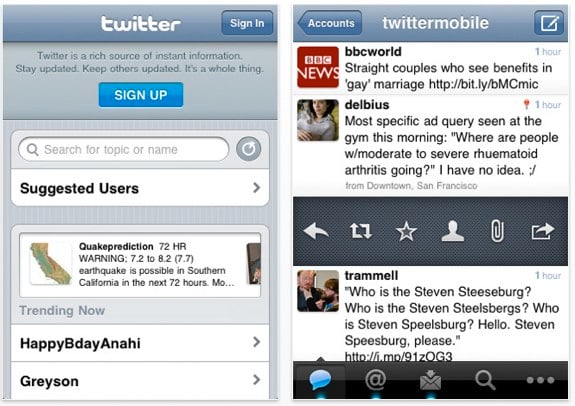
    Tweetie has been pretty much universally recognized as the best iPhone Twitter client since it launched, and Tweetie 2.0 took it to the next level. In fact, it was so good, that Twitter decided to buy the app outright, rather than building their own iPhone app. News soon came that Tweetie would become “Twitter for iPhone” and would be made free (Tweetie sold for $2.99) to anyone who wanted it. Well, today is that day, as Tweetie 3.0 has been released with new features (we’ve got a list of them after the break) and is now simply known as Twitter. It’s full-featured, it’s the official Twitter app for the iPhone, and therefore it will have access to more Twitter resources than any other Twitter app out there. We recommend it highly, and you can download it now.


    Tags:
    ,
    ,
    ,
    ,
    ,
    ,
    ,

    Twitter for iPhone (Tweetie 3.0) now available originally appeared on AppTapper on Wed, May 19, 2010 – 10:18:34


  • Google announces open app store for ‘Installable Web apps’

    By Tim Conneally, Betanews

    Installable Web Apps

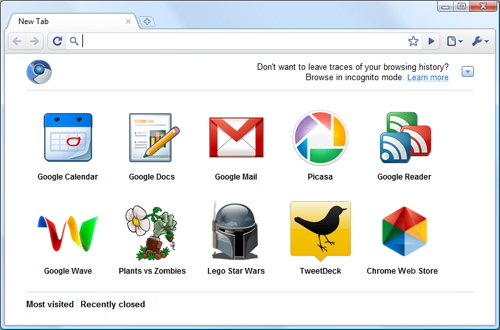
    Google has announced the upcoming availability of the Chrome Web Store, an open marketplace similar to the Android Market or iTunes App Store that deals exclusively in Web Apps.

    Chrome Web Store Icon
    This store doesn’t exist yet, but will open both to developers and to users “later this year.”

    The store will deal in the “installable Web apps,” that are expected to populate both the Google Chrome browser and the forthcoming Chrome OS. They can be run currently, but require a Windows Dev channel release of Google Chrome with a special command line flag.

    According to their Google Code listing, “An installed web app could be separated visually from other tabs, could integrate better with the OS, and could be granted increased permissions. This special handling of web apps is exactly what we’re working on in Google Chrome…Installing a web app in Google Chrome is easy and quick, with no restart required. At its simplest, installing a web app is like creating a super-bookmark to it.”

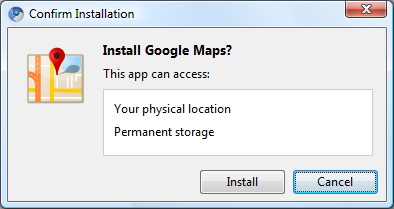
    Installable Web App for Google Maps

    Interested developers can check out the preliminary documentation and join the discussion in the Google Group for Chromium Apps.

    Copyright Betanews, Inc. 2010


    Add to digg
    Add to Google
    Add to Slashdot
    Add to Twitter
    Add to del.icio.us
    Add to Facebook
    Add to Technorati


  • Robert Redford and green groups tell Obama to step up on Gulf oil leak

    by Jonathan Hiskes

    Whither Obama? There’s a
    growing chorus calling for the president to show leadership on the BP oil disaster
    by connecting it to America’s fossil-fuel dependence and the potential
    of clean-energy investment.

    “The silence from the
    White House is deafening,” a Clinton-era White House aide told
    ClimateWire
    . “Clearly without a White House push there does not seem
    to be adequate political momentum” to pass a Senate clean-energy bill.

    Today Thomas Friedman calls the Gulf leak Obama’s 9/11—the biggest opportunity of his presidency to ask
    Americans to invest in nation-building clean-energy infrastructure, an opportunity he is so far squandering. I’ve
    been
    making
    the same
    case
    .

    Yesterday, the Natural Resources Defense Council, League of Conservation
    Voters, and Blue Green Alliance (a labor-enviro partnership) held a press
    event calling for Obama to put clean energy in the national spotlight.

    And actor Robert
    Redford released a cable TV ad with NRDC echoing the same message: “The Gulf
    disaster is more than a terrible oil spill. It’s the product of a failed energy
    policy—one that puts oil-company profits ahead of people and the environment. America needs safe,
    clean and renewable energy—not more oil spills … Tell President Obama to
    lead America toward a clean-energy future.”

    Redford’s accompanying post spells out the situation even
    more:

    The American Power Act,
    drafted by Senators Kerry and Lieberman, is not perfect—but it is a
    significant step toward cutting our dependence on fossil fuels, limiting carbon
    pollution, and encouraging businesses to shift to clean energy sources.

    Unfortunately, the full Senate continues to stall—weighed down by too much infighting and too many special interests. That’s why
    we need the president to assert his voice and leadership by letting the Senate—and the American people—know that he is serious about getting clean
    energy and climate legislation passed this year.

    Quite a spokesman, Mr.
    Redford. Here’s the eye-catching ad:

    Related Links:

    Obama admin overhauls MMS, the agency in charge of offshore drilling

    Rand Paul’s Copenhagen rant and other election notes

    Friedman nails Obama for his timid response to the “environmental 9/11”


  • Finance Jobs Weathering the Storm Better Than Most?

    A rather shocking graphic from Mike Mandel seems to indicated that finance isn’t suffering much during this recession:

    financialjobs.png
    At closer examination, though, I’m not sure how much that means. It’s not very surprising that commercial banking has lost very few jobs; it wasn’t the kind of boomtown that, say structured finance was.  And the “Finance and insurance” category includes Goldman Sachs–but also the millions who labor as claims adjusters and call center operators and actuaries in the insurance industry.  Insurance, unlike structured finance, is labor intensive:  it pays a lot of people a little money, instead of a few people a lot.  And it’s a highly regulated business without the wild swings in either demand or profitability that you see in Wall Street business lines.  Given those facts, the bulk of that “finance and insurance” line probably consists of mostly the latter.

    That isn’t to say that financial workers aren’t surviving surprisingly well, given the carnage some of its employees managed–just that it’s hard to say one way or another using that data.

    Update:  I see Felix Salmon had similar thoughts

    So what’s my theory? If you look at the chart, it turns out that the
    job losses in finance are put into two buckets. There’s “commercial
    banking”, on the one hand, which has had very small job losses: people
    have just as many checking accounts and bank loans as they always did.
    And then there’s “finance and insurance”, which is what we generally
    think of as Wall Street, but which also includes the enormous number of
    employees in the insurance industry. And just like commercial banking,
    the insurance industry is pretty steady, and is going to have seen very
    few job losses indeed. What’s more, it’s probably bigger, in
    terms of total headcount, than the investment-banking industry.

    So assume that insurance has seen even fewer job losses than
    commercial banking, and that it accounts for most of the jobs in
    “finance and insurance” — in that case, the job losses on Wall Street
    alone could be very large indeed to get to that final 7.3% figure.

    Before reading too much into these numbers, then, I’d like to see a
    bit more disaggregation. It might be true that Wall Street hasn’t seen
    condign punishment in terms of job losses. But on the other hand, it
    might not.


    Email this Article
    Add to digg
    Add to Reddit
    Add to Twitter
    Add to del.icio.us
    Add to StumbleUpon
    Add to Facebook


  • Best Buy: Let Us Install The PS3 Version Of Red Dead Redemption

    Reader IfThenElvis has submitted, for your approval, this photo of Best Buy asking you to let them install a PS3 game.

    Discuss.

    5-19-2010 1-47-24 PM.jpg

  • FDA Announces Widespread Investigation Of McNeil After Tylenol Recalls

    Remember the recalled liquid Tylenol and other children’s medicines last month? Or the stinky drugs that were recalled back in January? Or the children’s Tylenol that was recalled last September? The FDA remembers, which is probably why it’s “conducting a company-wide investigation of McNeil Consumer Healthcare’s drug manufacturing practices to determine whether similar problems exist throughout the company.” Also, a date has now been set (May 27) for the House Committee hearing where the CEO and chairman of parent company Johnson & Johnson are expected to testify.

    This is one case where the company has been asking for trouble (meaning government intervention) for a while now–all three recalls in the past nine months have been related to quality control issues at production facilities. ABC News said the FDA met with representatives of McNeil and Johnson & Johnson back in February to “express its concerns about their production practices.” The company reps promised they were taking care of the problem, but two months later McNeil announced its recall of children’s drugs that were potentially contaminated, and a subsequent plant inspection revealed a dirty facility with poor quality-control.

    “FDA ‘actively pursuing’ McNeil Consumer Healthcare” [Drugs Store News]
    FDA Media Update re. McNeil Invesgiation (PDF) [FDA]

  • Blumenthal and Vietnam, the director’s cut

    If a video clip of Richard Blumenthal stating at a 2008 Norwalk event that he served in Vietnam is a smoking gun, the attorney general’s supporters are hoping that the full video might put some of the fire out.

    Early in his speech, Blumenthal clearly states that he served “during the Vietnam era,” although a few minutes later, he makes a reference to “the days that I served in Vietnam.”

    The full clip, first reported by the Associated Press today, is being widely circulated by the Blumenthal campaign, which is clearly relishing this glimmer of positive news. 

    “It shows exactly what he said yesterday,” said Blumenthal spokeswoman Maura Downes, referring to Blumenthal’s admission that he “misspoke” about his record on “a few occasions.”

    “In that same speech, he very clearly stated what his service was,” Downes said.

    And where did the complete, 5 minute, 45 second clip turn up? On Linda McMahon’s YouTube channel. (And not on the New York Times website. The Times broke the story about Blumenthal’s misrepresentation of his military record and gave prominent play to the brief clip but as of 2:34 p.m., the longer version did not appear to be posted on the newspaper’s website.)

    UPDATE: When asked whether the Times intends to post the full video on its website, Spokeswoman Diane C. McNulty said in an email that it is the paper’s policy not to discuss “what will or will not be published in future editions of The New York Times.”

    On larger questions about the paper’s Blumenthal reporting, McNulty said the following:

    “The New York Times in its reporting uncovered Mr. Blumenthal’s long and well established pattern of misleading his constituents about his Vietnam War service, which he acknowledged in an interview with The Times.  Mr. Blumenthal needs to be candid with his constituents about whether he went to Vietnam or not, since his official military records clearly indicate he did not.

    The video doesn’t change our story. Saying that he served ‘during Vietnam’ doesn’t negate his later statement.  It doesn’t indicate one way or the other whether he went to Vietnam.”


  • Roadmap: Integrating Social Technologies with your Corporate Website (Slides)

    A few years ago, I wrote a controversial post suggesting corporate websites were irrelevant.  Why?  Decisions were being made off-domain by customers and peers.  Secondly, many marketers were trying to get customers to go to their corporate website versus joining where they already are, “Fish where the fish are.”

    Today, I’m pleased to see that the thinking –and technology, has emerged, where we’re finding a variety of companies that are integrating social technologies right into the corporate website, bringing the trusted discussions closer to the corporate site.  In fact, I’m kicking off the Gilbane CMS conference in SF as the keynote, and will be sharing this deck live on stage.


    Although the highest state of nirvana (seamless integration) doesn’t yet exist, we should expect there to be very little difference between social technologies and corporate websites as content will assemble on the fly.  I predict URLs won’t matter, as content will be dynamically assembled around the buyer and their context in a variety of devices.  Sure, that’s far out thinking now, but that’s why we have several other stage gates that companies must first go through.

    In fact, use this presentation (loosely modeled after a post of the same topic) as a roadmap for brands, web strategists, and the vendors that serve them.  Feel free to use these slides with attribution.

    Thanks to our head of Research, Christine Tran for her assistance.

    Related Resources

  • SageTV 7 Arrives Tomorrow – New UI, Plugin Manager, and More

    GeekTonic has big news about popular Home Theater PC software, SageTV.  The next version of SageTV – SageTV7 should be available as a public beta sometime tomorrow!
    EPG
    Since CES, we knew a new SageTV version was coming and that it would include a new UI.  I have had the opportunity to preview this new version and thought I’d run through the more significant new features, changes and improvements.

    More Info after the Jump…


    • New User Interface (UI)  – See below for a couple of screen-shots as well as more description on this.
    • Online Plugin Manager – This is really a big improvement over the past method of importing plugins, changing settings files etc.  Think of this as a simple way of viewing what plugins are available, what plugins you have installed, which plugins have updates available etc – all from the UI.  This takes what was a fairly onerous process of installing and setting up a plugin and makes it simple.

    Plugin Manager

    • XBMC Skin (xml) import support – Do you covet one of the beautiful XBMC skins?  SageTV 7 has created a way to automatically import those skins into SageTV 7 and use them as your UI.  It’s not an entirely automatic process and requires some modification, but it makes importing & using the XBMC skins possible without much coding.  The first imported skins should arrive in the near future.
    • Live TV seamless transition between shows – If you’re a SageTV user already you know about this one.  In the past say you were watching a sporting event and it ran past the scheduled end time.  SageTV used to pause playback for a few seconds while it transitioned into the next show causing an annoying irritant to users.  That problem is gone now and you’ll have seamless transitions.
    • BDMV (Blu-ray) folder playback – Blu-ray playback already exists with SageTV 6, but SageTV 7 adds Windows playback improvements (decoders required to be installed)
    • Support for playback of ISO DVD and Blu-ray files on all platforms that support non-ISO playback (requires Virtual Clone Drive (free) to be installed for Windows)
    • Windows Placeshifter uses DirectX 3D rendering instead of OpenGL
    • SageTV recordings now have their full metadata embedded into the video file instead of requiring a separate file to hold that metadata
    • Increased stability of Hauppauge HD-PVR – Enhancements to workaround Hauppauge HDPVR instabilities on Windows
    • DirectShow demux filter for handling MKV, MP4 and FLV media types
    • New ‘Effects’ rendering system with support for more advanced and easier to use animations (layers are no longer needed)
    • Background image loading system allows for faster loading of thumbnails and other image resources w/out interfering with UI responsiveness
    • New Pan/Zoom style slideshow transition effects
    • Automatic conversion of Favorite recordings
    • Removed the need for formatting disks with 64k clusters in order to get optimal disk performance on Windows
    • Significant performance increases for HD200 – you will notice this especially when navigating the UI.  And this allows for more animations in the UI as well.  NOTE: It was pointed out to me by a HD100 user of SageTV 7 that improvements were made that enhance the HD100 performance as well.  He stated that the HD100 is now as fast as the HD200 was with SageTV 6!
    • Support for DVB radio channels
    • Windows 7 compatibility – SageTV worked with Windows 7 already, but now installation on Windows 7 is more seamless.
    • Lots of new API calls and Widget options in the SageTV Studio
    • Various other optimizations and bug fixes  – the complete change log will be included in the official announcement tomorrow.

    New User Interface – Probably on the most-requested list for SageTV developers is a re-write of the user interface.  The SageTV user interface that comes installed in SageTV by default has made many changes over the years, but cosmetically it’s looked and worked about the same.  The SageTV team has made some significant changes in the UI that they hope will please those that liked the old UI the way it was as well as those looking for a more attractive appearance. 
    For comparison, below is the old, default SageTV6 UI:
    Old SageTV 6 Main Menu
    Obviously pretty plain and that’s one reason many SageTV users flocked to the 3rd Party UI, SageMC.
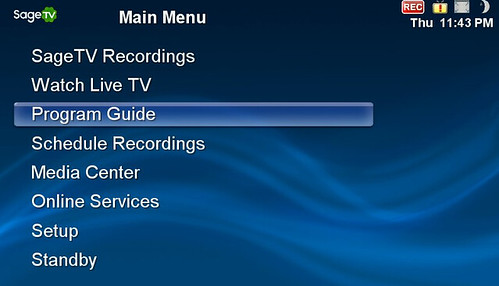
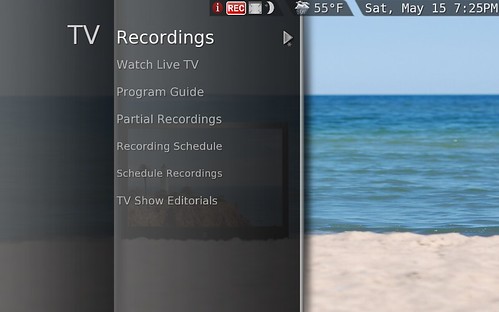
    The screenshot below shows the main menu in it’s pure form.  Included are new animations, improvements to the extender (HD200) firmware to allow for these animations.  I’ll be posting a demo video to show the UI in action later this week as it’s difficult to get the feel for it all with static photos.  Note that this UI is skinnable and background images can easily be changed.  The screen-shots I’m including here are from the current, beta version.
    Main Menu TV
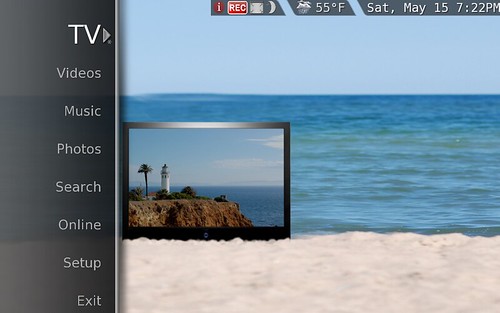
    You can either press select with your remote control to initiate a given function (such as TV) or as you move your cursor (remote control) right, a sub-menu slides open showing additional settings.
    Main Menu TV Submenu
    The entire UI works in a similar, unified way.  You’ll find the menu items and submenu items better organized and easier to navigate compared to the old, UI.  More on the UI later.
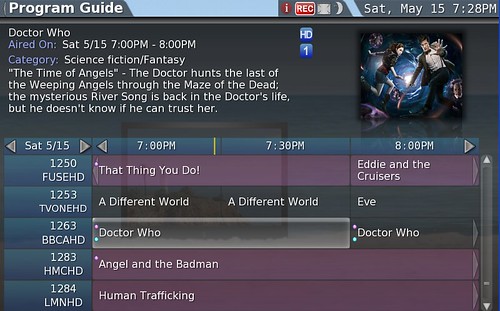
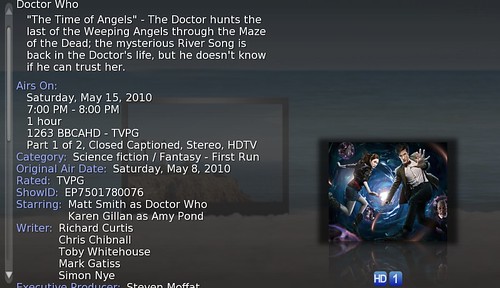
    EPG Program Details

    Many Important Changes “Under-the-hood”

    Many will focus on the new UI, transitions and effects and think that’s the biggest change here – and it is from a purely look & appearance perspective.  But for me it’s also the more subtle, under-the-hood changes that make this version a huge leap forward.  The new plugin manager makes installing and updating add-ons incredibly easy – I can’t stress enough how much of an improvement this is to those that use SageTV.  The changes the SageTV team has made the learning curve so much easier.
    Other non-UI items that are on the list of things I’m really appreciating here include the improved HD-PVR performance, improved HD200 performance (it handles navigation very fast), no more “pause” between shows when watching LiveTV like I used to experience when watching sports, improved Blu-ray functionality, the embedded metadata in the recorded TV file – those sorts of things will be appreciated by those familiar with SageTV 6.
    The other thing you might not notice at first with SageTV7 is the coordination and support that went on behind the scenes between SageTV developers and the third-party add-on developers.  There are three or four significant projects underway that will offer even more functionality and UI choices for SageTV users.  Projects underway include:

    • Project Ortus – A combination UI system and feature-set add-on being developed by a team of developers for SageTV.
    • Project Phoenix – Yet another combination UI system and feature-set add-on being developed by a team of developers for SageTV.  This one includes developers of the well-loved SageMC add-on.
    • SageTV MyMovies – Ever heard of MyMovies?  This add-on will be another port of MyMovies and looks to be very exciting.

    Each of the projects mentioned above have plans to make it to public beta sometime later this year or early next year depending on their progress.  I hope to provide previews of each of these add-ons in the near future on GeekTonic.
    Another important thing to note – the version you will see tomorrow will still be in beta albeit public beta.  This means there will be more changes before it’s completely finished – we know from past experience that SageTV improves and updates on a very frequent schedule.  There will be more good things to come for SageTV users…
    I noticed that there isn’t a new Mac client so far so this new SageTV 7 version is only for Windows and Linux users thus far.

    Upgrade Policy

    • All windows SageTV6 and SageTV6 upgrade licenses purchased on or after 12/1/2009 will be valid for SageTV 7.
    • All prior linux and mac and client and placeshifter and extender licenses will be valid for SageTV7 
    • The trial is reset on the SageTV7 beta. Upgrade licenses on windows are $39.95, and any prior Windows Version of SageTV license qualifies for an upgrade license.

    So everyone who would like to try out SageTV7 on Windows should get the opportunity with the 21-day trial.
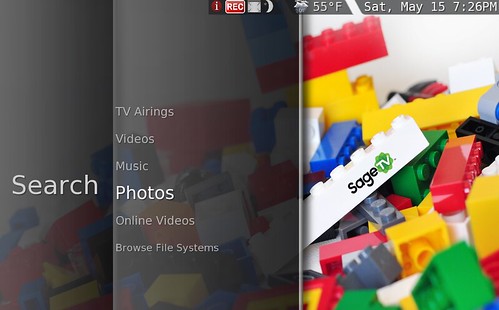
    Main Menu Search Submenu
    If you want to be first in line to download the new public beta, subscribe to this thread in the SageTV forums and you’ll get an e-mail.  Of course I’ll have a post up here at GeekTonic letting you know it’s available as well.  I also plan to have a couple of more detailed walk-through’s of the new features and UI for those that are curious so stay tuned!

    Thanks to the guys at SageTV for the special preview for GeekTonic


  • Stamford’s Shapiro Isn’t Running For Re-election

    House Speaker Christopher Donovan, D-Meriden, said he learned that Rep. Jim Shapiro, the co-chairman of the general law committee, is not running for re-election Monday.

    Shapiro, a Democrat from Stamford, is finishing his third term as a state representative. In addition to the general law committee, he serves on the higher education and public safety and security committees.

    He is a corporate attorney and was a former director of legal affairs for Barnes & Noble Inc.

    Before becoming a state lawmaker, Shapiro served on Stamford’s board of representatives for the 11th District. 

    Although he did not say why he is not running again, Shapiro said in a prepared statement that it will be hard for him to leave public service.

    “The satisfaction of doing the right thing and helping so many people is difficult to duplicate in other areas of life,” Shapiro said. “I wouldn’t be surprised if public service lured me back in some capacity sooner or later. However, for right now, this is the best decision for me and my family…”

    Shapiro is one of at least five committee chairmen not running for re-election.

    Rep. Cameron Staples, D-New Haven, co-chairman of the finance, revenue and bonding committee, is not looking to keep his seat. Neither is Rep. Ryan Barry, D-Manchester, co-chairman of the banks committee, and Sen. Mary Ann Handley, D-Manchester, co-chairwoman of the higher education and employment advancement committee. Sen. Jonathan Harris, D-West Hartford, co-chairman of the public health committee, is hoping to secure the Democratic endorsement for secretary of the state this year.

    In addition, the legislature will lose House Majority Leader Denise Merrill, D-Storrs. Merrill also wants the Democratic endorsement for secretary of the state.