Blog

  • First Look: New Volkswagen Sedan For India

    New Volkswagen Sedan IndiaToday Volkswagen released the first sketch of its new Sedan that is slated to hit the Indian roads later this year.

    It has been specifically designed for India and will be manufactured in Volkswagen’s state of the art plant at Chakan, Pune.

    It will no doubt carry the Volkswagen DNA of German Engineering which is innovative technology, safety, stability sturdiness and tailored to the requirements of the Indian consumer.

    Its authentic and elegant design coupled with its innovative features and driving dynamics will set benchmarks in its class and will act as a key brand pillar for Volkswagen to stimulate its growth in the country.

    This new Sedan will be in addition to Volkswagen’s already existing product line which includes the Passat, Jetta, Touareg, New Beetle, Phaeton and the very recently and successfully launched New Polo.

    Volkswagen, the largest carmaker in Europe sells its broad model range from the Fox to the Phaeton in more than 150 countries worldwide. Volkswagen currently offers the Volkswagen Jetta and Passat, assembled in Aurangabad for the Indian consumers. Also available on sale now is the iconic New Beetle, the powerful SUV Touareg, Phaeton and the New Volkswagen Polo.

    Source: Volkswagen India

    Source: Auto News India

  • Philippe Starck’s Light Photon Lamp Is Made From OLEDs and Unicorns’ Eye-Teeth [OLEDs]

    This rather bizarre-looking creation isn’t a solar panel that’s normally found on a roof—oh no, it’s the latest work from Philippe Starck, and is made from OLEDs and stainless steel. It’s a light. A very, very pricey light. More »


    Organic LEDBusinessPhilippe StarckEnergyMetals

  • 2010 Vorsteiner Mercedes-Benz E63 AMG V6E Aero Package

    2010 Vorsteiner Mercedes-Benz E63 AMG V6E Aero Package - Front Side View

    Vorsteiner has unveiled their new V6E Aero Package for the Mercedes Benz E63 AMG. The Vorsteiner Mercedes-Benz E63 AMG V6E Aero Package components are as follows: V6E Carbon Fiber Add-On Front Spoiler, V6E Carbon Fiber Deck Lid Spoiler, V6E Carbon Fiber Rear Diffuser, Vorsteiner 3-Piece Forged Wheels.

    Vorsteiner Mercedes-Benz E63 AMG V6E Aero Package 2010 - Front Angle View 2010 Vorsteiner Mercedes-Benz E63 AMG V6E Aero Package - Rear Angle View Vorsteiner V6E Aero Package Mercedes-Benz E63 AMG 2010 - Side View

    Up front the V6E Carbon Fiber Add-On Front Spoiler features an elegant yet bold design, featuring two inlets joined by a center spoke. It gives the front fascia of the E63 AMG a prominent foundation as well as prominent performance by increasing downforce and aiding in ventilation for the undercarriage of the vehicle.

    The V6E Carbon Fiber Add-On Deck Lid Spoiler contours flawlessly to theangles and edges of the deck lid while increasing downforce to the rear end of the vehicle, increasing performance, especially at high speeds.

    Working in tandem with the Front Add-On Spoiler, the V6E Carbon Fiber Rear Diffuser completes the sporty yet elegant character of the vehicle with 3 integrated diffuser fins that sits between the sporty quad exhaust tips.

    Completing the package are the Vorsteiner V-308 3-Piece Concave Forged wheels wrapped in Michelin Pilot Sport PS2 tires (wheels shown in Fine Textured Black finish). The V-308 is the most concave wheel available on the market, serving a highly customizable array of widths and offsets for any wheel application.

    Mercedes-Benz E63 AMG Vorsteiner V6E Aero Package 2010 - Rear Side View

    Source: Lincah.Com – New Car and Used Car Pictures

  • Lady Luck On Wizards For Winning NBA Lottery

    Season 2009-2010 has hit Washington Wizards with one blow after another so franchise representative Irene Pollin must have heard angels singing when No. 1 draft choice is drawn out for Wizards.

    Losing is not something new for any team but Wizards left last season in 26-56 with some spiky highlights.

    Their key player Gilbert Arenas is placed under suspension for breaking NBA’s zero tolerance policy on firearms. That’s for using his locker in the Verizon Center as the safe for his guns.

    Abe Pollin, head owner of Wizards who also made the move to drop the controversial name Washington Bullets, passed away in November 2009. It certainly is a tough moment of letting go but it seems not to be the end of the rough season as they needed to also trade Jamison and Butler for trimming down salary expenses.

    Pollin family’s legacy with Washington Wizards will be handed over to new owner Ted Leonsis and the deal will probably get the seal by June. With the upper hand in enjoining either John Wall or Evan Turner, lottery may not be the only thing where this team can win. But then luck is not a reliable force that 2011 NBA championship would need.

    Related posts:

    1. Texas Rangers’ Manager, Admits Using Cocaine
    2. Jeremy Tyler: Experiment Gone Wrong, Out From Maccabi Haifa
    3. Minnesota Twins Extends Contract of Joe Mauer

  • D.C. bank fee battle and the price of beer

    Picture 001 PITTSBURGH — You probably swipe a credit or debit card through a magnetic stripe reader dozens of times each month.  It's a simple act, but it's it at the core of a battle between titans with billions of dollars at stake. On one side are big banks, which take a cut every time a card is swiped. On the other are retailers like Mike McArdle, who are tired of paying Visa, MasterCard and their member banks $1 or $2 every time a customer makes a purchase.

    McArdle runs McArdle's Pub on Pittsburgh’s South Side, the very definition of a family business. It opened in 1939, and the sign above the front door doesn’t look like it’s been changed since.  It once held a prime spot near two of the Steel City's largest steel plants.  Both of them have long since been converted to shopping malls, but McArdle's plugs away, thanks to its position just off the main entertainment strip in Pittsburgh's hippest neighborhood. 

    For years, banks have held the upper hand in the fight with the McArdles of the world, but no more. Last week, the U.S. Senate approved legislation that could drastically change the way banks are compensated for card swipes, and that could impact what happens every time you pull out your wallet. In fact, the legislation could provide incentives — that means money — for Americans to leave the plastic in their wallet and pull out old-fashioned cash instead. 

    As part of its omnibus financial reform bill, Congress is taking on what are called interchange fees — the price that merchants pay for banks to process their credit card transactions.  Formulas vary, but generally stores pay a flat 50 cents or $1 per transaction fee, plus 1 to 2 percent of the purchase price.  Retailers have screamed for years that the fees are too high and that the card associations impose anti-competitive restrictions on them – given the limited choices among standards like Visa, MasterCard, American Express, and Discover.

    Tz-StopGettingRipped-200x200[1] Last week, in a surprisingly bipartisan vote, the Senate agreed to an amendment that would instruct the Federal Reserve Board to limit the fees card processers can charge merchants. It also included two practical changes that would have an immediate impact on shoppers:

    *Current contracts between merchants and banks forbid stores from requiring a minimum purchase amount before customers can use cards — a provision that is sometimes ignored. Merchants hate this rule, as a $1.50 card purchase can become almost worthless to a store owner after minimum interchange fees are paid.  The Senate bill would prevent banks from forbidding minimum payment requirements.

    *The bill also would make it easier for merchants to encourage consumers to use cash by preventing banks from limiting a store owner’s ability to offers discounts to cash-paying customers, according to its supporters.

    As you might imagine, banks and merchants view the bill quite differently.

    "Swipe fees have spiraled out of control in recent years, and this amendment is necessary to rein in these excessive fees and ensure that Main Street receives a fair shake," said the Merchants Payment Association, which represents retailers. "These fees are harmful across the board – from large businesses to small retailers to American consumers.”

    But Trish Wexler, a spokeswoman for the Electronic Payments Coalition, which represents banks and card companies, said the law would hurt consumers by raising their credit costs and gutting reward programs.

     “Consumers will end up paying in the form of higher rates for their cards, reduced or eliminated debit card rewards programs, or a restriction on the amount of debit cards that are issued," she said. "Call this a win for retail, because that’s what it is."

    Bernie Rafferty, behind the bar, thinks minimum charges are a good idea

    Picture 015-800w At its core, the question is simple:  if stores are paying 1 or 2 percent less in bank fees, who will keep the money — the retailers or the consumers?  Wexler is convinced that big stores like Walmart would simply pocket the extra cash and not pass along savings to shoppers.

    There is a third possibility, however: Stores could split the difference.  If the total card fee is 2 percent, they could offer shoppers a 1 percent discount for paying cash.

    "OK, so you buy something for $50 and you get a $1. I don't see consumers getting too excited about that," Wexler said.

    Back in Pittsburgh, McArdle partly agreed. A 3-cent discount on a $2.50 draft beer (yes, draft beers only cost $2.50 at McArdle’s) probably wouldn't entice many drinkers to pay in cash. On the other hand, the minimum payment provision made sense to bartender Bernie Rafferty.

    "Last weekend we had a guy in here who wouldn't keep a tab open,” he said. “He paid six separate times for two beers with his credit card. Those initial 50 cent fees really add up.”

    While the legislation would forbid card firms from restricting discounts for cash payments, the Electronic Payments Coalition says that merchant contracts — and Visa and MasterCard policies — already allow that.  Rather, they say, current contracts only forbid the reverse: adding a surcharge for credit card transactions. To consumers, that distinction is semantics, but the banks and retailers, it could mean millions of dollars.

    Some gas stations offer cash discounts, but few other retailers do. Most, like McArdle, would have a tough time changing their systems to create an entirely parallel price system.  On the other hand, discounts could encourage more consumers to pay in cash and provide an incentive to avoid hefty credit bills.

    Would you pay in cash to save a few nickels or dimes on every transaction? Even if you would, don’t start hoarding bills just yet.  The amendment still must pass the House of Representatives and survive the sausage-making process that will produce the final financial reform legislation.

    To read more about the swipe fee battle, see "Retailers, card industry escalate fee fight."

     Follow the Hidden Fee Tour of America by becoming a Red Tape Chronicles Facebook fan or follow me at http://twitter.com/RedTapeChron

  • Two faces of a grand galaxy


    M. Gieles / ESO

    The spiral galaxy Messier 83 is a delicate wisp in infrared wavelengths, as seen at
    left by the HAWK-I instrument on the European Southern Observatory’s Very Large
    Telescope. But it looks like a fiery pinwheel in the visible-light image at right,
    captured by the MPG/ESO telescope. Click on the picture for a larger view.


    The spiral galaxy Messier 83, also known as the Pinwheel Galaxy, is a spectacular fireworks show when it’s seen through a big telescope in visible light. But when the European Southern Observatory looked at the pinwheel in infrared wavelengths, the result was a much more delicate, no less beautiful picture of the galaxy’s hottest young stars with the surrounding gas stripped away.

    …(read more)

  • Haiti: Celebration in Saint Michel

    For the people of Saint Michel, it has been a long four months since the January’s earthquake destroyed so much of Haiti’s capital. Coco McCabe experiences the chance to forget – just for one day – all the sorrow and hardship.

    Boys climb a tree to watch a soccer game during a festival in the rural Haitian town of Saint Michel. Photo: Ami Vitale/Oxfam America

    Boys climb a tree to watch a soccer game during a festival in the rural Haitian town of Saint Michel. Photo: Ami Vitale/Oxfam America

    I missed the voodoo rara the first time it wound through the narrow streets of Saint Michel de l’Attalaye. It was a Friday and we were stuck in the early evening traffic that jammed the square. Before I could climb out of the car, the women in their bright pink dresses and men in blue suits had passed, their sax player and a man with maraccas pacing the paraders as they sang and swayed.

    But we ran into them again, a few blocks away, and this time I jumped out, squeezing into the line of marchers, feeling myself swept along by exhilaration and anticipation as the streets darkened on the eve of Saint Michel’s feast, the annual celebration of the town’s patron saint.

    For the people of Saint Michel, it has been a long four months since the January earthquake destroyed so much of Haiti’s capital. Now the chance had come to forget – just for one day – all the sorrow and hardship.  Even out here, in this rural community a four hour drive from Port-au-Prince, the quake has taken a heavy toll.

    Many families here, where Oxfam has been working on longer-term development programs, lost relatives in the disaster. About 158 of Saint Michel’s own died – many of them students sent to the capital to study because schools in this area of Artibonite Department are not often very good. And in the days following the quake, about 11,000 survivors made their way to Saint Michel Commune. They descended on friends and relatives, many already pinched, needing food and shelter, and many have stayed. One family, the Perards, already nine strong, now have 17 relatives sharing their home, doubling up in beds and sleeping on the floor when night comes.

    The day before the feast, we could feel the excitement building. Behind the home of Mayor Michele Lisette Casimir, women prepared giant bowls of food. Band members, hunched in a circle, held a quick meeting in her front yard. And visitors streamed through her gate, hoping for a few minutes of her time before the big day.

    Casimir had her fingers crossed that the night of the festival she would be able to flick a switch and finally bring electricity to Saint Michel – even as she worried whether the community could afford to keep the lights on. Since the late 1980s, this sugarcane-growing town has been without a municipal source of electricity. Casimir has been working with the national government to get a 635 kilowatt generator hooked up – enough to electrify the main part of town. The only concern is the fuel it will consume: 25 gallons of diesel an hour.

    “That’s the problem in a poor country,” said Casimir. “You take and you figure out how to manage later.”

    A bandstand was going up board by board in the square. Banners strung across the streets announced the festival. And those who were smart made sure they got their tickets in advance for Tropicana D’Haiti, an adored big band scheduled to play the night of the feast.

    Down one street, the transformation was complete: residents had stripped their beds of sheets and draped them, dazzling in the tropical sun, over the rickety fences separating their homes from the road. The effect of that simple gesture was magical – from dusty way to heavenly lane, festooned, occasionally, by curled red ribbons.

    But my favorite vision was this: A swarm of boys, all ages, perched high – so high, on ever thinner limbs – in a row of trees overlooking the tall wall of the local soccer field. Feast day also happened to be the day of the final match between Saint Michel and Gonaives, a contest no one wanted to miss, including a flock of boys too poor to buy tickets to the game.

    But in that creative way that necessity inspires, the boys had found their own solution.

    “The tree is free!” said my Haitian colleague, as our car bounced by beneath the branches.  And a grin, as bright as the sheets dancing down that nearby street, stretched across his face.

    Where we work: Haiti

    Originall posted on the Oxfam America blog

  • Facebook and Zynga End Hostilities, Sign Five-Year Deal

    Social gaming is one of the fastest growing segments online and is becoming one of the most profitable. Zynga, the biggest name in social gaming, has risen from nothing to become a company worth billions of dollars and with revenues in the hundreds of millions of dollars due to the success of its games on social networks, Facebook on partic… (read more)

  • Roubini: Japan Could Easily Be Next

    Nouriel Roubini

    While Europe receives an inordinate amount of attention for its current financial problems, and the U.S. has long been a pariah, we feel that recently markets and investors may have forgotten about Japan.

    Sydney Morning Herald:

    “What’s happening in Greece is just the tip of an iceberg of a broader range of sovereign debt issues, of deficit, in many advanced economies,” said Roubini, one of the few experts who predicted the financial crisis.

    The new crisis could occur “not just in the eurozone but UK, US, or Japan,” he said.

    Roubini, speaking at a London School of Economics conference, said there was an “economic recovery, but in many ways countries have not answered the real problem.

    Is Japan better off than the Eurozone? Financially? Demographically? We doubt it.

    More: How Japanese hyperinflation could unfold >

    Join the conversation about this story »

    See Also:

  • Piers Corbyn Power Point at the European Coal Outlook Conference, 19 May

    Article Tags: Piers Corbyn

    article image

    Slide 1 summarizes the 4 points I have to make and the other 15 slides (some just background and also for elsewhere) back-up the 4 points. I have not developed point 2 in slide 4 because it is hard and full of pitfalls but the argument of slide 4 holds.

    Please – anyone – show/report the predictions (SERIOUS STUFF) – slide 11.

    Piers

    Click to see Coal Outlook Conference Brochure

    Click to see Piers Corbyn Power Point at the European Coal Outlook Conference

    Read in full with comments »   


  • Katla Warms Up


    If I were living in Europe I would buy some insurance in the form a few large sacks of rice.  Not great, but it will let you get by when food runs out.  Other options exist, but rice serves wonderfully in a real emergency.
    If nothing happens, I have a never ending supply.  Of course plenty of other things can be acquired that you will consume over time anyway.  however, you do not want to be caught out with an empty cupboard and a collapsed distribution system.
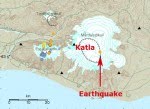
    I have already posted on Katla and today we have the first disturbance registered that I am aware of.  These things will build up over time before we reach the eruption stage.  Or at least I hope so.  A massive explosion causing a huge tsunami along the European coast would ruin our day.  Hekla did just that in 1159BCE and ended the European Bronze Age and the Atlantean culture.
    Fortunately Katla just likes to spew lots of ash as far as we know and that will be a handful enough.  If we are lucky, this will brew until we are past harvest.  A blast during the winter will be a lot more recoverable, if only because we can plant cold weather crops if we have to.  I hope you like barley and potatoes and oats.
    Respect what you are seeing folks.  This sucker is running to form and that means it will begin erupting within the next few months.  It will erupt with an ash output ten time worse than the present eruption. 
    This first quake is essentially on schedule.
    Katla Earthquake May Presage Next Volcanic Explosion
    Published: May 18, 2010
    Just to add to the ink needs of European central banks, the Iceland met office reports that it has recorded a small earthquake at the Katla volcano. With Europe already pretty much bankrupt, and the only reason why Europe is still quoted being due to ECB, IMF and Fed backstops, the last thing needed by the troubled continent is the next major volcanic explosion to terminate airline travel indefinitely. As earthquakes tend to not be an indicator of volcanic stability, the most anticipated volcanic explosion in human history may finally be a fact quite soon. We are confident the HFT lobby will somehow determine that volcanic ash clouds add liquidity to the market. Stay tuned.
    On May 17, 2010 08:32 UTC, The Iceland Met office indicates that a small earthquake has occurred at the Katla location. In what could be an early indication of the event that is expected to occur (an eruption of Katla), a small earthquake is reported at the site. Although a single earthquake is not a precursor of an eminent eruption, it could be the first ’sigh’ of the awakening powerful giant.
    Historically, Katla has erupted after the eruption of it’s close neighbor, Eyjafjallajokull, which first erupted on April 14, 2010 and is ongoing at this moment. Magma channels beneath to the two volcanoes are thought to be interconnected. A Katla eruption would likely be about ten times as powerful at the Eyjafjallajokull eruption and could cause worldwide disruption while expelling huge volumes of volcanic ash into the stratosphere which would circle the globe potentially for years, depending upon the magnitude of the eruption.
    Not to be alarmist, but have you started? your food storage plan? Basic survival preparedness is a personal responsibility that was simply a way of life of our ancestors. Let’s not forget how.
  • Black Swan Time


    This item is from Richard Russell who has spent his career tracing the markets and trying to stay ahead.  He is clearly scared.  I certainly am uncomfortable.  I am uncomfortable that he is uncomfortable.  I know all the trends and expectations are grinding down the general liquidity of the market.  It is presently vulnerable to a black swan event when something hits out of the blue that triggers a market washout.
    I experienced this in the weeks prior to the 1987 abrupt market collapse and traded into a defensive position to protect my book.
    I also sensed the vulnerability in the week just prior to 9/11.  Something about the markets triggered my internal red flags.
    There were many other instances over the years and it is curious how often markets seem to sense a pending shift.
    One of my better upside calls was to bid Canada 9.5% at 61 in June 1982 and also predict a market boom beginning September of that year.  I was not noted for ever throwing caution to the wind.
    The markets are locked and cocked for a major general decline.  Without a trigger event, it will simply grind out over the next few months.  A trigger event will make it swift.
    What I will try to do now is construct a list of potential black swan events able to produce massive global disruption and a grossly collapsed market.  This list are possibilities whose probability is non zero.
    A         Gross Geology. 
    Katla blows and Europe does without a crop this year.  A massive collapse of the already weakened euro zone economies takes place.  The rest of the globe struggles to move food supplies to save tens of millions from eminent starvation.  The Volcano continues to spew indefinitely.
    No other prospect is presently showing activity but this is quite enough to put Europe out of action for two years at least.
    B         Terrorist Nuclear Bomb
    Nuclear war at the State level is not going to happen simply because it will not be survived by the initiator and this is well understood.
    It is quite plausible for a Pakistani cabal to spirit a nuclear bomb out of the Pakistani nuclear program, or alternatively another such cabal is able to access a former Russian bomb.  It is too soon for the Iranians to do so.
    It is then no trick at all to put such a device into a shipping container and to load it onto a container ship under control of a suicide bomber.  The most damaging target is New York.  However this can also reach Washington, Los Angeles, San Francisco, Hong Kong, Shanghai, Tokyo, Mumbai, Seoul, London, and Rotterdam.
    This fortunately takes real resources to do.  That gives me little comfort because money will not be a problem and neither will personnel. The terrorists have shown that they can overcome all that.  These are real pending threats that are slowly developing.
    The result of such an event could be the Third World War in which the Islamic world would be fully occupied by armies from every other country and where Islam would be forthwith banned with a full reeducation program implemented.  Many millions would die and many more millions would be displaced.
    C         Human Folly
    We are watching the progress of Europe in unwinding its banking difficulties.  I think they can print their way out of the worst and impose discipline on the members.  It is just messy and the declining Euro is helping to focus attention.
    The real bad news is who is going to bail out California?  That is a black swan that can arrive as a bolt of lightening and it has been ignored by Washington to date.  The damage to the banking sector will be once again severe.
    What happens if this triggers a collapse of the pension industry?
    My point is that a lot of very big chickens are coming home to roost and no one has a plan.  I simply do not believe that the problems can work themselves out.  The housing collapse has not been addressed at all.  That I showed how to turn around but no such thing has been done. In short, financial deterioration is continuing and the dead cat bounce has run out of free cash.  There may be no more room to fix any of it.
    Next year we could have millions on the streets as social systems collapse.  That is what happened during the depression.
    My present point is that these are the black swans that I can imagine.  Have a good night’s sleep and recall that no one imagined 9/11 except the perps.
    Dow Theorist Richard Russell: Sell Everything Liquid, You Won’t Recognize America By The End Of The Year
      |
    Joe Weisenthal | May. 18, 2010, 8:57 AM | 66,483 | comment 101
    Richard Russell, the famous writer of the Dow Theory Letters, has a chilling line in today’s note:
    Do your friends a favor. Tell them to “batten down the hatches” because there’s a HARD RAIN coming. Tell them to get out of debt and sell anything they can sell (and don’t need) in order to get liquid. Tell them that Richard Russell says that by the end of this year they won’t recognize the country. They’ll retort, “How the dickens does Russell know — who told him?” Tell them the stock market told him.
    That’s pretty intense!
    Update: By popular demand, here’s more on what he sees in the market. The gist is that the markets recent gyrations are telling him that the economy is in trouble:
    And I ask myself, “Am I seeing things? The April 26 high for the Dow was 11205.03. The Dow is selling as write at 10557 down 648 points from its April high. If business is even better than expected, then why is the Dow down over 600 points? And why, if there were 674 new highs on the NYSE on April 26, were there only 20 new highs on Friday, May 14? And if my PTI was 6133 on April 26, why is it down 17 points since its April high?

    The fact is that I’ve been seeing deterioration in the stock market ever since early-April, and this in the face of improving business news. The D-J Industrial Average is composed of 30 internationally known top-quality blue-chip stocks. These are 30 of “America‘s biggest companies.” If Barron’s is so bullish on the future of America‘s biggest companies, then why isn’t the Dow advancing to new highs?

    Clearly something is wrong. But what could it be? Much as I love Barron’s, I trust the stock market more. If I read the stock market correctly, it’s telling me that there is a surprise ahead. And that surprise will be a reversal to the downside for the economy, plus a collection of other troubles ahead.


    About Dow Theory — First, we saw the recent April highs in the Averages. Then we saw a plunge in both Averages to their May 7 lows — Industrials to 10380.43, Transports to 4298.12, next a short rally. If ahead, the two Averages turn down and violate their May 7 lows, that would be the clincher. Such action would signal the certain resumption of the primary bear market.

    Just as for years I asked, cajoled, insisted, threatened, demanded, that my subscribers buy gold, I am now insisting, demanding, begging my subscribers to get OUT of stocks (including C and BYD, but not including golds) and get into cash or gold (bullion if possible). If the two Averages violate their May 7 lows, I see a major crash as the outcome. Pul – leeze, get out of stocks now, and I don’t give a damn whether you have paper losses or paper profits!

    Read more: http://www.businessinsider.com/dow-theorist-richard-russell-sell-everything-liquid-you-wont-recognize-america-by-the-end-of-the-year-2010-5#ixzz0oKPKTPEO

  • Florida Pythons Hunted


    Somehow, I think that the population of pythons will be outrunning the interest of hunters and whoever.  I do not think thousands of pythons were released.
    In the meantime the everglades have become a dumping ground for far too many pets.  The only solution is going to be the introduction of effective predators.  Perhaps we need the mongoose in particular.  That may intercept the bulk of the snake population while still young.
    The coyote population will surely prosper hunting other pets.  And human hunters can work on the big stuff.
    The unacknowledged problem is that these populations need to be controlled and actively suppressed.  The action always attracts political noise from fools.  That a two year old was strangled is a rather good hint as to why it is necessary to be aggressive.
    How would you like to have a population of pythons as ubiquitous as that of the Canada goose?  I remind folks that that is the type of population some swamps in the Amazon have of boa constrictors.
    These snakes will be attracted to homes and cellars for dens and will not just be a danger but a serious nuisance.
    Pythons in Florida Stalked by Hunters and Tourists Alike
    Published: May 7, 2010
    FLORIDA CITY, Fla. — Thousands of Burmese pythons, the offspring of former pets, have invaded the Everglades, eating birds, bunnies, even alligators. It has gotten so bad that Congress is considering an outright ban on buying or selling nine kinds of giant snakes.
    But an odd thing has happened here in the swamp: the pythons have become celebrities. The snakes are fast becoming an element of Florida lore, attracting “oohs” and “ahhs” from tourists, along with groans from biologists and even python hunters like Bob Freer.
    “It’s a little frustrating and very strange,” said Mr. Freer, who figures that his 40 captured pythons — most of which he has euthanized — make him the state’s top private hunter. “They’re asking about pythons that don’t even belong here, instead of alligators.”
    Trouble is, the newfound fascination obscures what biologists and Mr. Freer describe as a serious problem. In their view, python proliferation — still significant despite a cold winter that might have killed half the population — is simply the sexiest example of widespread disrespect for pets and the wilderness.
    “People need to view exotic species invasions as pollution — biopollution,” said David E. Hallac, chief of biological resources for Everglades and Dry Tortugas National Parks. “In some cases, this form of biopollution can be even more difficult to remedy than chemical pollution, mainly because in most cases, we have no way of cleaning up exotic species from our natural environments.”
    Nowhere is the problem more visible than in the open expanse of southwestern Dade County, where tract housing gives way to sawgrass and airboat engines. Mr. Freer, a grandfather who cuts the sleeves off his T-shirts, has lived here for a decade, giving animal presentations to tourists and running a wildlife refuge that doubles as his home.
    He grew up in rural New York on a dairy farm with a pet alligator, and he used to live north of Miami with another gator (named Lazy) until his neighbors complained. Now Mr. Freer and his third wife are free to mix with whatever animals they like, and there are plenty.
    Near the back of their five-acre property, for instance, sits Rocky, a tiger once owned by a stripper. Buc, an arthritic grizzly bear, lies in a cage next door near the hyenas, Chewy the camel, birds the color of daiquiris, and a Kenyan lemur whose previous owner pulled out its teeth, so that all its food must now be mashed.
    In nearly every case, pet owners gave the animals up or had them taken away by county officials. Pythons, Mr. Freer said, have been part of the mix since the mid-1980s.
    “It was very exciting then to think about these giant snakes and being able to find them here in Florida,” he said. “I never really thought there would come a time when you would actually go out and hunt pythons.”
    State officials say they had no choice — especially after last July, when an eight-foot python sneaked out of its cage north of Orlando and strangled a 2-year-old. It led to a six-week hunting season to reduce the python population.
    “We really wanted the help, and still need it, to get rid of these things,” said Tony Young, a spokesman for the Florida Fish and Wildlife Conservation Commission.
    With all the attention, the snakes became bigger stars. Reporters have interviewed officials at Everglades National Park around 300 times. Mr. Freer, meanwhile, has turned up on Animal Planet and the History Channel’s “Monster Quest,” after an episode about the Hillbilly Beast of backwoods Kentucky.
    He said that he initially understood the alarm. Pythons are what biologists call “apex predators” that eat nearly everything, including endangered species. And there were financial benefits, too: a group of Canadian snake enthusiasts paid him to help find pythons.
    But on a hunting trip in the Southern Glades, a 30,000-acre tract that abuts Everglades National Park, Mr. Freer struggled to shake a sense of melancholy.
    The area has become a dumping ground littered with both human ruin — a shuttered fish farm, a closed juvenile detention camp and a former rocket test site — and abandoned animals. In addition to the pythons, Mr. Freer said he had come across cobras and black mambas, emus and ostriches. Since the recession started, he said, he has seen more horses that owners can apparently no longer afford to feed.
    The python craze, he said, only illustrated a problem far larger than most people recognize. Mr. Hallac, at Everglades National Park, agreed.
    “We have well over a dozen exotic fish that have invaded the park and may pose a threat to our native aquatic organisms,” Mr. Hallac said. “But being that they’re underwater, and not particularly scary to humans, their stories are rarely told.”
    At Everglades Alligator Farm, an adventure park where Mr. Freer manages the animals and puts on shows for visitors, python presentations are still a hit. Rangers at the national park are regularly asked about how to avoid or see the famous pythons.
    Mr. Freer said he now looked forward to a day when pythons were scrubbed from his routine. “People will be asking me about alligators again,” he said, “And that’ll make me happier.”
  • Stretching Artificial Skin


    Not only is this a good working artificial skin, it also displaces the use of live animals in lab work.  Since the latter aspect is an ongoing public relations disaster decades old, it could not be more welcome.
    Otherwise, this should provide a framework for completely healing damaged skin back to close to original state.
    I do not know how long before this is available but it should be rather quick.  It is very good news and should also facilitate improvements in cosmetic surgery.
    Scientists create artificial skin that stretches like the real thing
    16:27 April 28, 2010
    The University of Grenada’s fibrin-agarose artificial skin
    Scientists at Spain’s University of Granada have created artificial skin with the resistance, firmness and elasticity of real skin. It is the first time artificial skin has been created from fibrin-agarose biomaterial. Fibrin is a protein involved in the clotting of the blood, while agarose is a sugar obtained from seaweed, commonly used to create gels in laboratories. The new material could be used in the treatment of skin problems, and could also replace test animals in dermatological labs.
    The researchers started by obtaining plasma samples from human donors, and separating out the fibrin. They then added calcium chloride, to precipitate coagulation, tranexamic acid, to keep the coagulate from breaking down, and 0.1% agarose. The resultant material was grafted onto the backs of hairless mice, where its bio-compatibility with living organisms could be observed.
    The mice showed no signs of rejection or infection, and healing of the grafted area began within six days – within 20 days, the wounds were fully healed.
    Previously, artificial skin has been made from biomaterials such as collagen, polyglycolic acid, and chitosan. The fibrin-agarose skin, however, looks particularly promising. Prof. Jiménez Rodríguez, one of the researchers, stated “Definitively, we have created a more stable skin with similar functionality to normal human skin.”
  • CeRecomand.ro cauta redactori

    Dupa cum spune si titlu post-ului, site-ul CeRecomand.ro (pe care scriu si eu) cauta redactori noi.
    Ce trebuie sa stiti :

    – nu veti fi platit pentru munca prestata ; e posibil sa aveti beneficii de genul : sa primiti carti gratis cu conditia sa scrieti o recenzie despre fiecare, sa primiti un produs pentru un review/recenzie (pe care puteti sa il pastrati) , publicitate in cazul in care aveti un blog/site pentru ca numele acestuia va fi mentionat langa numele autorului …
    – aveti oportunitatea sa cunoasteti oameni noi, sa intrati intr-un mediu serios si sa aveti parte de multe oportunitati
    – pentru inceput trebuie sa scrieti 1-2 articole de proba (inainte de a intra in echipa)

    Mai multe detalii gasiti : AICI .

    Intre timp puteti citi articolele scrise de mine :
    Cinefocus
    The Mentalist
    Remi Online
    Inotul
    Doctor House
    O suta de flotari
    Detalii despre parasutism
    Parasutism
    Paradisul Acvatic

    Trimite si prietenilor:


    Related posts:

    1. Concurs pe CeRecomand.ro
    2. CeRecomand.ro
    3. Remi
    4. Astrologie
  • France Rejects Germany’s Naked Short-Selling Ban, Finance Minister Lagarde Slams Unilateral Move

    christine lagarde

    The fallout from the German naked short-selling ban is having fascinating ripple effects already, beyond just the market.

    According to CNBC, France’s finance minister Christine Lagarde has come out in rejection of the move, saying the country will not consider similar regulations, and that she “regrets” Germany’s unilateral move on this front.

    Suddenly you have one of Europe’s two most important players actively denouncing the other one’s dumb behavior.

    Right now, all of Europe could probably find a reason to be angry at Germany. It was their intransigence that caused the Greek crisis to go on so long, and it’s Germany that’s making waves at a time when the market could use calm.

    More proof that German leaders have taken political incompetence to an art form.

    Join the conversation about this story »

    See Also:

  • Blog Post:Using LED Lights for Data Transmission

    I’m what you call a voracious reader. I read about a wide range of topics. I prefer to read about gadgets and advances in technology but keep an eye on pretty much everything — I’ve even been known to read my husband’s Triathlete’s World magazine (not that there is ever a danger of me wanting to do a tri … I just like knowing what’s going around me in the world). Anyway, last week I heard about a new advancement in LED technology. It seems that the good folks at Boston University and the Chinese Academy of Sciences have been very busy developing technology that lets you use LED lights to transfer data. I know what you’re thinking … we already have wireless devices and Bluetooth which seem to do the job just fine. But then we’d be missing the point. Think about it: you need to illuminate office spaces anyway so why not use the same device to network PCs and print documents? It’s a great green initiative if you ask me.

    TERALED® offers combined thermal and radiometric/photometric characterization of high-power LEDs, either as a stand-alone optical measurement system or as an add-on to T3Ster.

    TERALED® offers combined thermal and radiometric/photometric characterization of high-power LEDs, either as a stand-alone optical measurement system or as an add-on to T3Ster.

    LED lights use a lot less energy than their conventional counterparts. They last longer (the useful life for white LEDs can range from 6,000 hours to more than 50,000 hours) and they are cheaper to run. So the cost to the environment and to the pocketbook is a lot less. The only issue with them is heat. LED lights give off 91% of the energy they consume as heat and excess heat directly affects bulb output/useful life. Therefore, thermal management should be a critical factor during the design stage. We have already touched upon several resources for the design engineer working on LEDs covering simulation and LEDs, namely a whitepaper named Solving the System-Level Thermal Management Challenges of LEDs and an on-demand presentation titled: Design for Longevity in Your Power LED Products. But what we haven’t talked about is physical testing of LEDs.  Physical testing of LEDs can be very helpful because simulation results are only as good as the data used. So accessing accurate measurements to use as source input for simulation is extremely valuable.

    If you are interested in physical testing of LEDs, then it might want to read When Designing with Power LEDs, Consider Their Real Thermal Resistance. The whitepaper briefly shows why the recommendations of JEDEC JESD51 and CIE 127-2007 should be combined to obtain more accurate results. I’m sure you’ll find it helpful. I should also point out that we’ll be adding a few educational sessions on hardware testing soon so if you’re interested in the topic, please check with our events page on a regular basis.

    Until next time,
    Nazita

  • Scripps Chemistry Idea “Clicks” With Big Pharma, Seattle’s Integrated Diagnostics

    scripps
    Luke Timmerman wrote:

    One of the Nobel Prize winners at The Scripps Research Institute in San Diego has been saying for a decade that chemists would be better off doing the simple thing instead of the hard thing. Now quite a few of the world’s top academic scientists and Big Pharma companies are starting to adopt K. Barry Sharpless‘ philosophy of “click chemistry.”

    This is the concept that Sharpless has been advocating a long time, along with a couple like-minded faculty members at Scripps, MG Finn and Valery Fokin. I met with Sharpless, Finn and Scripps’ tech transfer leader, Scott Forrest, a few weeks ago to talk about the boom they are seeing in scientific publications, patents, and some new technology licenses that are taking advantage of “click chemistry” principles.

    What’s the big idea? It’s about using small chemical building blocks that you put in water or some other solvent, until they naturally “click” together. Sort of like a plastic buckle on a backpack, these molecules join together in the easiest, cheapest, most reliable, and most durable reactions possible, according to the laws of Mother Nature. These are fundamental reactions that tightly bind molecules together and could be useful as oral pills, industrial adhesives, stable coatings for implantable medical devices, or any number of valuable products. It sounds simple, and Sharpless and Finn say it is. What’s surprising is how strange it might appear to the modern lab with its state-of-the-art tools and its efforts to constantly strive for the leading edge and peer approval that goes with it.

    Sharpless has been applying this idea for about 20 years, but he says he was really inspired by Kevin Kelly’s 1995 book “Out of Control.” Kelly, the founding editor of Wired, wrote that scientists should recognize they’re playing “God games.” In the case of a chemist, he or she is trying to do things that are more complicated any human can fully understand, so they should listen carefully to what Mother Nature says. It’s a more humble approach than what you often see in pharmaland.

    “We are going toward an unknown target. Even if we think we know the target, we say we know what’s best. That was big-scale hubris. It’s like Cinderella and her sisters, with a shoehorn. Our intellect is saying we can shoehorn what we say works into the shoe. It’s not close to the truth,” Sharpless says. “If you want to be God, you have to allow your objects to have free will. You have to relinquish control.”

    Barry Sharpless

    Barry Sharpless

    Instead of trying to do things the way nature wants, chemistry and other fields of science are really more of a game of “hey, can you top this?” to hear Finn and Sharpless describe it. The click philosophy, they say, strikes a lot of peers as mundane.

    “We are trained as most experts to do the hardest things and do them well. That’s how you get praise and learn,” Finn says. “You want to do the hardest chemical reactions and make them work. It’s weird to say ‘We’re not going to do the hardest reactions.’ We’re going to find or create the easiest reactions.’ But if you think about it, it’s a lot harder to invent a process that works all the time, than it is to make the process that’s really difficult work a few times.”

    Yet more and more scientists and companies are seeking to apply the click philosophy. One example is Seattle-based Integrated Diagnostics, a company co-founded by Leroy Hood of the Institute for Systems Biology and Caltech’s Jim Heath. Their idea is to create a diagnostic tool that can perform binding reactions cheaply and reliably enough to usher in an era in which physicians will be able to spot proteins that are early warning signs of cancer or neurodegenerative diseases in a pinprick of blood.

    Hood loves to tell the story about how the prototype, and the tight binding reactions it performs inside, were rugged enough to produce reliable results even when Heath left the machine in the truck of his car near Caltech in Pasadena, CA.

    That’s just one example. Carlsbad, CA-based Life Technologies (NASDAQ: LIFE) markets a kit that performs a click reaction to take quantitative measures of DNA in cells, Finn says. Tampa, FL-based Intezyne, whom Finn advises, is using the click principles to attach polymers to drug candidates in a cheap, strong, consistent way to make chemotherapies active only inside tumors, not other tissues where they cause side effects. Hundreds of drug candidates that use the principle are now working their way …Next Page »

    UNDERWRITERS AND PARTNERS


  • Skoda Yeti Imaginarium

    Skoda_Yeti_Imaginarium

    Skoda se ha unido con Imaginarium, la marca española dedicada a la educación y juego de los niños, para el crear el Yeti Imaginarium, un vehículo con el que Skoda pretende ofrecer un equipamiento destinado a los más pequeños de la familia.

    Este kit de viaje Imaginarium incluye de serie una pequeña maleta con DVD portátil, un retrovisor baby mirror que permite vigilar a los niños que vayan sentados atrás, una pulsera anti mareo, una linterna o incluso diversos juegos de viaje para un mayor entretenimiento de los más pequeños.

    Skoda_Yeti_Imaginarium

    El Skoda Yeti Imaginarium incluye en su exterior un logo de imaginarium en el portón trasero y en ambos laterales. Mientras que también lo podemos encontrar en el interior, por ejemplo, en el salpicadero o en klas taloneras de las puertas. En cuanto a la motorización estará disponible unicamente el gasolina 1.2 TSI de 105 CV y el 2.0 TDI common rail de 110 CV, ambos con caja de cambios manual de 5 velocidades y tracción delantera

    Fuente | Skoda


  • Hituri

    Le-am descoperit de curand. Imi plac foarte mult !

    Trimite si prietenilor:


    No related posts.