Blog

  • Fallbrook Details Risk Factors in Amended IPO Filing

    Fallbrook Technologies logo
    Bruce V. Bigelow wrote:

    San Diego’s Fallbrook Technologies amended its IPO filing with securities regulators Friday—providing additional details about the company’s risk factors, including its lack of profitability and need to raise more capital to stay afloat.

    As we reported, Fallbrook filed for its initial public offering in February. The cleantech company, which has 56 employees, has been developing a continuously variable transmission as a more energy-efficient design for bicycles, wind power turbines, electric vehicles, and other uses.

    Fallbrook Technologies' continuously variable transmission designThe company says it has received 168 domestic and foreign patents protecting its technology, and has submitted another 209 patents here and abroad. To finance its technology development over the past decade, Fallbrook has raised a total of $55 million from angel investors and in recent years, from NGEN Capital Partners, Robeco, a subsidiary of Rabobank Group, and other venture investors.

    Among other things, the revised filing shows:

    —Fallbrook lost $2.97 million in the three months ended March 31. The company said its net losses increased to $17.2 million last year from $10.56 million in 2008, and it expects to incur a loss in 2010 as well. Increased investment in commercializing its technology, along with escalating salaries and related expenses, “will make it harder for us to achieve and maintain future profitability,” the company says.

    —Fallbrook says it has been expensive to raise private capital. In its amended filing, the company says: “If we are unable to raise capital from this public offering, in order to continue to expand our operations and invest in our products and manufacturing facilities, we believe we would need to raise approximately $18 million within the next twelve months through a private equity offering. We would also draw on any remaining amounts available under our existing revolving line of credit.” The company says it does not currently have other abilities to borrow.

    —The company’s estimated cash burn rate is about $1.5 million a month. At the end of March, Fallbrook says it had about $5.4 million in available cash, with another $1 million left on a $3 million line of credit.

    — Fallbrook said it signed a non-binding memorandum of understanding with Chengdu Bus Co. of Chengdu, China, last month, and the company could eventually sign a deal that would provide Fallbrook’s transmission technology for the accessory drives of Chengdu buses.

    UNDERWRITERS AND PARTNERS


  • Massey Miners Tell of Neglect at Doomed Upper Big Branch Mine

    NPR’s Howard Berkes and Frank Langfitt have spent weeks on the ground in southern West Virginia, the site of last month’s deadly blast at Massey’s Upper Big Branch mine. And today they’re reporting that “most” of the 10 UBB miners they’ve interviewed over that span noted “continuing problems” with the ventilation system inside the mine — problems that Massey higher-ups allegedly knew about, but didn’t fix.

    “They wouldn’t fix the ventilation problems,” a former supervisor and a member of mine management said. “I told them I needed more air. They threatened to fire me if I didn’t run enough coal.”

    Another miner said “there was constant confusion” in the management of the air flow system.

    A third miner described mine managers this way: “They don’t have a clue how to ventilate this place.”

    This isn’t exactly news. The inspector notes, released last month by the Mine Safety and Health Administration, told a similar tale. And a number of former Massey miners have also come forward — even appearing on Capitol Hill — to testify about similar experiences in other Massey mines.

    Still, to hear those comments from guys who were working at the UBB mine when the disaster occurred provides another layer altogether — one that both federal investigators and Massey shareholders will surely want to learn more about.

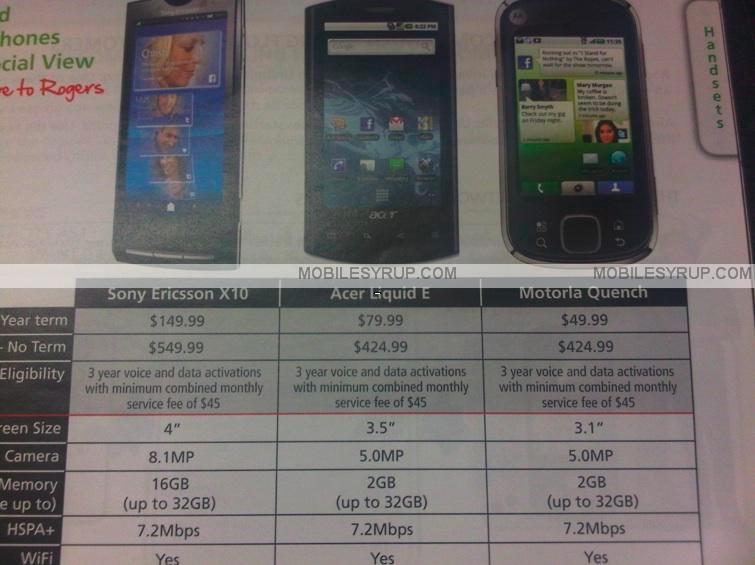
  • Rogers Wireless Prices Acer Liquid E and Motorola QUENCH

    Acer Liquid e and Motorola QUENCH screenshot from MobileSyrup.com

    A recent screenshot of Rogers webpage taken by MobileSyrup.com shows us the prices of the Acer Liquid E and the Motorola Quench with and without a new 3 year plan.  The Liquid E features a Snapdragon processor underclocked to 768 MHz and will ship with Android 2.1.  It will set you back just $79.99 with a new contract.  Not too bad.  The Quench has a MSM7200A running at 528 MHz and is stuck back on Android 1.5 with Motoblur. The Quench is a bit cheaper at only $49.99 with a new contract.  I think there is no question about it,  the Liquid E is a better deal here.  Good to see though that we have a price.

    Source: Mobile Syrup

    Might We Suggest…


  • In Praise of the HTC Sense & Why the Nexus One Failed for Me

    As many of you might have noticed, I have been largely absent from the blog over the past few weeks. Thanks to a flu gone wild, I was forced to take a break from the Interwebs, and frankly in the process missed a lot of good stuff on which to pontificate. Oh well! Such is the nature of the beast; there will be something new to riff on soon enough.

    During my time off, I had another setback: My T-Mobile BlackBerry Bold 9700 died. It went into an endless loop of booting and re-booting, forcing me to use Google’s Nexus One phone, the online store for which is being put to rest. When the device first launched, I was among those most impressed by it.

    I especially liked its screen, its fast processor and the fact that it worked well with Google apps and after using it for just 10 days, I called it the best Android phone yet. What a fool I was to jump to that conclusion. Over past few weeks I had to use it as my primary phone, and let’s just say that topping my list of things to do now that I’m feeling better is to get a new BlackBerry.

    On the Nexus One, some of the most basic tasks — such as sending instant messages or typing out email — feel tedious and not at all smooth. And imagine my angst when I missed an important call because the Google calendar pop-ups prevented me from switching to the phone feature. On a case-by-case basis, these are minor things but encounter them often enough, and it’s easy to get annoyed. In fact I got so annoyed that I dug up an old T-Mobile Motorola RAZR and for the past couple of days have been using that to call folks. (How I wish and pray that Apple would sell the iPhone on a network not called AT&T.)

    #alttext#At the same time, I also had a chance to use the HTC Incredible, also an Android-based phone. And compared to the Nexus One, using the HTC Incredible (despite it’s overtly grandiose name) is bliss.

    First of all, as a phone it’s just a rock-solid device and thanks to a great network (Verizon), is able to perform web tasks admirably. It is fast, thin and light. It has a great camera. It has a wonderful screen and it works much more smoothly than the Nexus One. And did I mention it runs on a really good wireless network, from Verizon? I wish they made one of these for T-Mobile — considering that I am a T-Mobile customer.

    Nevertheless, the point of this post was to point out how much HTC has done for the Android ecosystem. With the HTC Sense, it has not only made the Android experience infinitely more appealing, it has shown the possibilities of where Google’s OS can go. (Related post: How HTC Because a Smartphone Hero.)

    Although HTC’s Sense UI originated on Microsoft’s Windows Mobile to help make the OS look pretty and be finger-friendly, Microsoft reportedly won’t allow alternative user interfaces on its next-generation Windows Phone 7 devices due out later this year. Which leaves HTC to focus on making the utilitarian Android interface more attractive to customers.

    I, for one, enjoyed the messaging applications, the social integration efforts and most of all, how uncluttered HTC has left this Android device. In a recent post, Kevin highlighted some of the ways some of the ways he improved his Nexus One by layering the HTC Sense UI on top of it:

    #alttext#

    Android focuses more on utility while the iPhone OS is more polished and refined. Simply put: the Sense UI levels the playing field when it comes to “fit and finish.” Both the HTC apps and widgets are extremely well designed. I’m generally not a fan of most Android widgets, but HTC takes it to another level. Tapping the Home button from the main screen zooms out and shows all seven, making it quick and easy to navigate. I also love the fact that I can cut and paste text from the web far easier than the stock Android method.

    Android by itself allows decent customization, but the Sense UI takes it to an entirely new level. There are six pre-loaded “scenes,” each of which is like a theme, complete with wallpaper, widgets and shortcuts relevant to the theme. Social, for example, adds more of the messaging, communications and social networking widgets like HTC’s own FriendStream for Facebook.

    Kevin suggests that I should upgrade my Nexus One to HTC Sense UI, but frankly I don’t want to waste any more time on this device.

    And regardless, it’s great to be back in the saddle again.


    Alcatel-Lucent NextGen Communications Spotlight — Learn More »

  • NOAA: Hottest April and hottest Jan-April on record – Masters: Record Atlantic sea surface temps in hurricane development region, “The three past seasons with record warm April SST anomalies all had abnormally high numbers of intense hurricanes”

    Temperature Anomalies April 2010.

    NOAA’s National Climatic Data Center has published its monthly “State of the Climate Report.”  It pretty much matches the NASA data.

    An emeritus physics professor writes me cautioning against the use of the word ‘anomaly’ since, “In many people’s mind, the word ‘anomaly’ means something unusual that is a temporary phenomenon.”  He suggests “change,” which is probably better.

    Certainly for those who are communicating to the general public, like NOAA and NASA, ‘anomaly’ is a confusing word as used in these charts.  And that is especially true because the recent temperature trend is anything but an anomaly — it is in fact a prediction of basic climate science.

    Indeed, besides the record April and record Jan-April, NOAA itself explain:

    This was also the 34th consecutive April with global land and ocean temperatures above the 20th century average.

    So, yes, that isn’t really an anomaly any more — unless of course you are in the anti-science crowd, in which case the whole thing is one big mysterious deviation from the norm.

    As for the oceans, NOAA points out:

    The worldwide ocean surface temperature was 0.57°C (1.03°F) above the 20th century average of 16.0°C (60.9°F) and the warmest April on record. The warmth was most pronounced in the equatorial portions of the major oceans, especially the Atlantic.

    Meteorologist Jeff Masters discusses the implications in his WunderBlog:

    Sea Surface Temperatures (SSTs) in the Atlantic’s Main Development Region for hurricanes had their warmest April on record….  The area between 10°N and 20°N, between the coast of Africa and Central America (20°W – 80°W), is called the Main Development Region (MDR) because virtually all African waves originate in this region. These African waves account for 85% of all Atlantic major hurricanes and 60% of all named storms.

    When SSTs in the MDR are much above average during hurricane season, a very active season typically results (if there is no El Niño event present.) SSTs in the Main Development Region (10°N to 20°N and 20°W to 85°W) were an eye-opening 1.46°C above average during April. This is the third straight record warm month, and the warmest anomaly measured for any month–by a remarkable 0.2°C. The previous record warmest anomalies for the Atlantic MDR were set in June 2005 and March 2010, at 1.26°C.

    As of now, the El Niño has in fact faded and that trend is projected to continue.

    Figure. The departure of sea surface temperature (SST) from average for May 13, 2010. Image credit: NOAA/NESDIS.

    What is the cause of the high SSTs in the MDR?

    During December – February, we had the most negative AO/NAO since records began in 1950, and this caused trade winds between Africa and the Lesser Antilles Islands in the hurricane Main Development Region to slow to 1 – 2 m/s (2.2 – 4.5 mph) below average. Slower trade winds mean less mixing of the surface waters with cooler waters down deep, plus less evaporational cooling of the surface water. As a result, the ocean heated up significantly, relative to normal, over the winter. Negative AO/NAO conditions have been dominant much of this spring as well, resulting in further anomalous heating of the MDR waters.

    This heating is superimposed on the very warm global SSTs we’ve been seeing over the past few decades due to global warming. Global and Northern Hemisphere SSTs were the 2nd warmest on record this past December, January, and February, the warmest on record in March, and will likely be classified as the warmest or second warmest on record for April, since NASA just classified April as the warmest April on record for the globe. We are also in the warm phase of a decades-long natural oscillation in Atlantic ocean temperatures called the Atlantic Multi-decadal Oscillation (AMO). This warm phase began in 1995, and has been partially responsible for the high levels of hurricane activity we’ve seen since 1995.

    What does this mean for the 2010 hurricane season?

    The high April SST anomaly does not bode well for the coming hurricane season. The three past seasons with record warm April SST anomalies all had abnormally high numbers of intense hurricanes. Past hurricane seasons that had high March SST anomalies include 1969 (0.90°C anomaly), 2005 (1.19°C anomaly), and 1958 (0.97°C anomaly). These three years had 5, 7, and 5 intense hurricanes, respectively. Just two intense hurricanes occur in an average year. The total averaged activity for the three seasons was 15 named storms, 11 hurricanes, and 6 intense hurricanes (an average hurricane season has 10, 6, and 2.) Both 1958 and 2005 saw neutral El Niño conditions, while 1969 had a weak El Niño.

    The SSTs are already as warm as we normally see in July between Africa and the Caribbean, and we have a very July-like tropical wave approaching the Lesser Antilles Islands this weekend. However, wind shear is still seasonably high, and the tropical waves coming off of Africa are still too far south to have much of a chance of developing. The GFS model is indicating that shear will start to drop over the Caribbean the last week of May, so we may have to be on the watch for tropical storms forming in the Caribbean then.

    The anti-science crowd have been cheering the death of El Niño, but in fact it it quite bad news for those in hurricane alley, including the long-suffering Gulf Coast.

  • The Secret Of The Spider Web

    Protein is the key and is stored in a gland in the spider’s body, says researchers at the Swedish University of Agricultural Sciences. It is divided into three parts, the first of which is identified as NT that makes it maintain the liquid state under neutral pH. The protein passes through a canal where the substance becomes more acidic (ph 6). NT facilitates the spider to convert and rapidly spin threads of silk.

    “We have seen how the first part of the spider silk protein has a very special and important function. It quite simply controls when the protein is to be converted into gossamer,” explained My Hedhammar.

    Researchers have been attempting to artificially replicate spider silk, one of the strongest elastic materials. It offers great potential in medical technology.

    This development can be read in the journal Nature with authors Glareh Askarieh, My Hedhammar, Kerstin Nordling, Anna Rising, Jan Johansson, and Stefan D. Knight.

    No related posts.

  • Verizon Android tablets from Motorola, Samsung and LG in Q4

    We already knew Verizon was working on Android tablets, but we had no idea of the manufactures or release dates until today. According to Verizon Wireless CEO Lowell McAdam, customers should expect that the first tablets will be Android devices from contenders including Motorola, Samsung and LG. These Android tablets will go head to head with Apple’s iPad and Verizon expects to sell many of these gadgets in the forth quarter.

    No specs have been revealed, but look for manufacturers to utilize next-generation processors running Android 2.2 or greater. Most tablets will feature ARM-based cores, like the NVIDIA Tegra 2, but keep an eye out for some Intel-powered devices as well.

    In addition to tablets, Verizon also revealed they will have up to five 4G LTE handsets by May 2011. McAdam said the front-runners to provide LTE handsets included Motorola, HTC, LG and RIM. Verizon has been testing their LTE network and expects to cover 30 markets with 100 million people in 2010.

  • Rima Fakih Swimsuit! Sizzling Miss USA 2010 Winner Swimsuit!

    Rima Fakih swimsuit attire has been the talk of the town. Swimsuit, swimsuit, and swimsuit… that made Rima Fakih more gorgeous and leading to be the crowned Miss USA 2010 winner. What made Rima Fakih swimsuit more gorgeous? Lets see how the Miss USA 2010 winner made herself more popular through that swimsuit thing. Internet search engines have been filled by searches for Rima Fakih Swimsuit or Miss USA 2010 winner swimsuit. One of the possible reasons could be Rima Fakih being a Lebanese-American, and also her family is known as a Shiite Muslim. Muslim women are being forbidden from making poses such as wearing swimsuit which are deemed to be haram to Islam.

    However, Miss USA 2010 winner-Rima Fakih says though they are Shiite Muslims her family celebrates elements of both the Muslim and Christian faiths. So Rima Fakih Swimsuit attire or shall we say the Miss USA 2010 winner’s swimsuit attire should not be a big deal.

    Miss USA 2010 winner-Rimah Fakih swimsuit attire looks perhaps the reasons why she deserves to be crowned as the fairest of the 49 contenders from 49 states of the United States.

    No related posts.

  • Is Taking A Photo Of An iPhone A ‘Copy’?

    There are still some serious questions about the legality of the police’s decision to search the home of Gizmodo reporter Jason Chen and to seize his computers as part of their investigation of the iPhone prototype story. However, with the unsealing of the search warrant, some are noticing some oddities. Reader johnjac highlights that the police defense of the need for the search warrant claims that Jason “created copies of the iPhone prototype in the form of digital images and video.” While it may just be either a misstatement or an awkward use of the word, it does seem like a strange description of what happened, designed to make the judge think that the “risk” was much greater than it actually was. If there were actual “copies” of the device being made, that might be an issue. But photographing or videotaping a device is hardly making copies. But, of course, in an age where many in the world are trying to falsely equate “copies” with “theft,” suddenly the idea that Jason was able to “copy” the iPhone prototype via the magic of a camera makes his actions seem that much more nefarious than they really were.

    Permalink | Comments | Email This Story


  • Greenwich’s Tom Foley: No Running Mate At Saturday’s Convention; “Let The Republican Primary Voters Decide”

    Tom Foley of Greenwich – who is leading the Republican race for governor in the polls – announced Monday that he will be arriving at Saturday’s state party convention without a running mate.

    Instead, he said he would serve with Danbury Mayor Mark Boughton or whomever wins the Republican primary for lieutenant governor on August 10.

    “Let the Republican primary voters decide,” Foley said in an interview Monday. “I don’t want to be cutting deals and short-circuiting the process. … Let the primary voters decide and not the gubernatorial candidate.”

    Boughton was introduced Monday as Lt. Gov. Michael Fedele’s running mate as they pledged their support to each other. Foley, though, said he would serve with the 46-year-old Boughton if they both win their respective primary races this summer.

    “Mark Boughton is well qualified to be lieutenant governor,” Foley said.

    If he wins the primary and eventually runs with Boughton in the general election in the fall, Foley said, “I don’t want it to look like he wasn’t my choice.”

    Foley said he would also serve with Lisa Wilson-Foley of Simsbury if she wins the lieutenant governor’s primary – even though “I don’t know a whole lot about her.”

    After establishing a detailed vetting process six weeks ago, Foley’s campaign contacted a number of Republicans recently and asked them if they would be interested in becoming lieutenant governor. But Foley emphasized that none of them had been offered the job. He eventually decided that the primary voters should decide.

    Foley said there is a major difference between being asked if you are interested in a particular position and then actually being offered the job.

    Two of those reportedly on Foley’s list – state Rep. Pam Z. Sawyer of Bolton and state Rep. Penny Bacchiochi of Somers – both showed up Monday at the state Capitol press conference where Fedele introduced Boughton as his running mate.

    “I endorsed Fedele before Foley got into the campaign,” Sawyer told Capitol Watch. “I’m sure he’s picking someone else.”

    Having a running mate can prove awkward because votes are cast separately for each office. In the 2006 Democratic primary, for example, Stamford Mayor Dannel Malloy lost in the governor’s primary, but his running mate, Mary Glassman of Simsbury, won her race for lieutenant governor with 57 percent of the vote over West Hartford’s Scott Slifka. Glassman then joined forces in the general election with New Haven Mayor John DeStefano, who had defeated Malloy.

    Some insiders were stunned by Foley’s announcement about going solo.

    “It’s pretty remarkable that a guy with $4 million cannot get a running mate going into the convention,” one longtime insider said. “I can’t figure out a reason why he would go to the convention without a running mate – strategically.” 
     

  • Neurons: I Have An Idea

    It is a complex process how we think, understand, and solve problems day by day, although it seems everything happens in a blink of an eye. We figure out what we do everyday and there are ways we choose to do them differently than what we are accustomed to do. New ideas surface and more often they are achieved by trial and error.

    These sudden insights intrigued scientists Dr. Jeremy K. Seamans from the University of British Columbia and Dr. Daniel Durstewitz from the Central Institute of Mental Health as to its origin in the brain, where and how do they start – the so called neural dynamics from familiarity to novelty. Familiarity suggests what we commonly do; novelty applies to new strategies in doing things.

    Neurons located in the medial frontal cortex were found to be responsible for the “a-ha moments” in the brain. They form networks corresponding to familiar and novel rules. They abruptly set new patterns which translate to a shift in behavior.

    No related posts.

  • BMW wins the 2010 Nurburgring 24-hours race

    BMW M3 GT2

    Team BMW Motorsport took victory at the 2010 24-hour race at the Nurburgring-Nordschleife on Sunday, five years since the manufacturer’s last victory.

    The no. 25 BMW M3 GT2 claimed BMW’s 19th victory at the endurance classic, which was piloted by with Jorg Muller (DE), Augusto Farfus (BR), Uwe Alzen (DE) and Pedro Lamy (PT) at the wheel. All three helped the M3 GT2 cross the finish line first after 154 laps.

    “During my last stint we lost fourth gear,” said Muller. “The problem gradually got worse. The main priority was to be careful and keep the car in the race. Everything worked out superbly in the end. The entire team has worked extremely hard over the last few months. This victory belongs to them. We drove consistent laps over the entire distance. If you can achieve that at a 24-hour race, you normally find yourself up at the front. For us today, it was even enough to finish first.”

    At first it seemed like the race would be won by the Porsche 911 GT3 Hybrid after it led the race through the night. However, the vehicle faced technical problem a few hours from the end.

    The Aston Martin Rapide race car finished second in its class.

    – By: Omar Rana


  • Kind of cute: transparent “photo paddles” add shades, mustaches, etc to subjects


    Can’t wait until you get home to add some novelty effects to your photographs? Have I got a product for you! These Photo Paddles are essentially just bits of transparent plastic with props mounted in them — lips, sunglasses, a nice big mustache, that sort of thing. Cheesy, yes, but possibly entertaining.

    http://www.photopaddles.com/index.php

    They’ve actually been around for quite a while (they were created for a design show last year) but they’re now available for purchase more easily than by . $6 each seems a bit steep (you could probably make your own for far less), and I can’t figure out how to get any of the sunglasses ones (“Howdy”?), but hey. It’s art, it’s not supposed to make sense.

    Keep in mind these won’t work if you have any depth of field at all. The creator instructs you to use them with your camera phone, which seems like sound advice, though if you have a fancy autofocus camera phone, you might have trouble.

    [via Notcot and CNET]


  • Just kidding: Acer not bringing Chrome OS to Computex

    In the May 13 issue of this newspaper, it was printed that Acer was planning to debut a Chrome OS-based device in Taipei during June of this year. Acer now states that it has “no short term plans” regarding Chrome OS, despite having previously said that it would be the first to market with a Chrome OS device. We regret the error.


  • NCBI ROFL: Gentlemen prefer blonde hitchhikers. | Discoblog

    Hitchhiking women’s hair color. “To test the effect of women’s hair color on the frequency of offering help, male (n = 1,508) and female (n = 892) French motorists were tested in a hitchhiking situation. Five 20- to 22- yr.-old female confederates wore a wig with blonde, brown, or black hair. Each confederate was instructed to stand by the side of a road frequented by hitchhikers and hold out her thumb to catch a ride. Blonde hair, compared with brown hair or black hair, was associated with a small but significantly larger number of male drivers who stopped to offer a ride (18 vs 14%). No difference was found for those with brown and black hair (14 and 13%, respectively). No effect of hair color was found for female drivers who stopped. The greater attractiveness associated with blonde hair for women appears to explain these data.” Photo: Wikimedia commons/Roger McLassus Related content:
    Discoblog: NCBI ROFL: Bust size and hitchhiking: a field study.
    Discoblog: NCBI ROFL: Women’s bust size and men’s courtship solicitation.
    Discoblog: NCBI ROFL: Eye Tracking of Men’s Preferences for Female Breast Size and Areola Pigmentation. WTF is NCBI ROFL? Read our FAQ!


  • Your Grandmother Would Love This Crystal iPhone Stand [Bad Ideas]

    Sure, with prices ranging from $199 to $349, these are pretty expensive iPhone stands. But what else would go so well with her elephant figurine collection? [CalypsoCrystal via CrunchGear] More »


  • Verizon CEO says LTE Android tablets will debut next year

    Verizon

    What’s better than one Android tablet on Verizon? How about tablet(s). Big Red CEO Lowell McAdam said as much over the weekend at the Reuters Global Technology Summit in New York. But before we get to that, let’s talk LTE — Verizon’s 4G network that it expects to have ready to rock in the first half of next year. McAdam said three to five LTE-capable phones will be ready by May 2011 (at least one of those has to be Android, right?), with Motorola, HTC, LG and RIM among the manufacturers.

    Then there are the tablets. Yes, McAdam said "Android tablets," as in more than one, and Motorola, LG and Samsung were named as the birthers, which would launch late this year as 3G devices but would be upgradeable to LTE later on, most likely. [Reuters] Thanks to everyone who sent this in.

  • Verizon CEO Talks Android Tablets and LTE Phones

    Verizon CEO Lowell McAdam is doing his part to rally excitement for Android phones and tablets. Big Red’s boss was recently at the Reuters Global Technology Summit where he divulged a few goodies. What kind of goodies? How about Motorola, Samsung Electronics and LG Electronics working on tablets that run off of Android?  Tablets due as early as the second half of this year.

    He also went on to say that LTE-capable handsets from Motorola, HTC, and LG will be arriving between now and this time next year. The carrier expects to cover 25-30 markets later this year when they turn on the their LTE network.

    These forthcoming phones and tablets will run on Verizon’s current CDMA network for the time being. Down the road, customers will be able to upgrade them so that they are compatible with the LTE network.

    Fun fact: McAdam says the new network will be fast enough to download full HD movies in under a minute.

    Might We Suggest…

    • Battle of the Network Stars

      When purchasing a new phone many of us are being faced with not only a question of a handset but a prospective betrothed wireless carrier for at least a two year term (this is/was the genius of th…


  • Snore-No-More Pillow 1 Ea.

    The #1 selling snore reduction pillow in America. Designed by a doctor, the snore pillow gently lifts your chin off your chest and opens the airways thus reducing or eliminating snoring while encouraging healthier & more efficient breathing. In addition, the Snore No More will also encourage better sleeping posture. Includes zip off cover. Fits into any standard pillow case.

    View Snore-No-More Pillow 1 Ea. Details

  • Dalai Lama: Look at the Positive Side

    Albert Einstein: Science without religion is lame; religion without science is blind. And the two met halfway.
     
    Buddhist monk Dalai Lama challenged Richard Davidson, a neuroscientist at the University of Wisconsin-Madison to explore man’s capacity for good and happiness, and the latter obliged.
     
    Davidson has been studying how Buddhism practices affect mental health and a center dedicated for such endeavor has been established at the said university – the Center for Investigating Healthy Minds, cites the Associated Press. It was found out that meditation triggers feelings of compassion, kindness, and empathy. He will be joining Dalai Lama in his quest for the causes of positive qualities in people the Buddhist way and incorporating it with western science.
     
    This scientific venture may have been a breakthrough in bridging the gap between faith and science; however, both Davidson and Dalai Lama met criticism from fellow researchers. Nevertheless, it appears that both of them esteemed each other and the research will push through.
     

    No related posts.