Blog

  • 10 Tips For an Effective LinkedIn Profile

    With the job market tight and qualified graduates continuing to pour from colleges and universities, making use of networking sites such as LinkedIn may mean the difference between finding a job and being unemployed. But how can you make the most of such a site and really make your LinkedIn profile shine? If you’re looking for some ways to improve your LinkedIn profile, here are ten tips you might find useful.

    1. Proofread

    Proofreading probably sounds like common sense, right? However, reviewing the information you place on your LinkedIn profile before you make it public can make a world of difference when it comes to presenting your profile information in a professional manner.
    10 Tips For an Effective LinkedIn Profile
    2. Have Someone Else Review Your Profile

    Proofreading isn‚Äôt always enough to ensure your profile is up to par and ready to be seen by the world. Therefore, before putting yourself out there, consider having someone else review the information – preferably an objective third party, not your mother, a spouse or significant other who may be looking to prop up your ego.

    3. Structure

    There’s another thing to consider before stepping back and resting on the laurels of the good work you’ve done on your profile. While you may have cut and pasted or copied information that you knew beforehand was proofread and polished from a resume or some other source, this doesn’t mean it made the transition to LinkedIn as you assumed it would. Once you’ve placed your information on LinkedIn, you should ensure it is presented as you want it to appear.

    4. A Proper Balance

    Okay, so you have your profile up and running with plenty of great information about yourself – now what? There is a fine line when creating your LinkedIn profile between blatant self-promotion and eating a little too much humble pie. Certainly you want to sing your praises, but you to much “me, me, me” can sound egotistical and be a turn off to those viewing your profile.

    5. Websites

    The “Website” portion of your LinkedIn profile can be a useful tool or a dangerous enemy. As a tool, you can use this section to guide people to other sites that might contain relevant information about you and your work. However, placing links to certain social networking or non-subject related sites could give away a little too much information about you and your personal life or distract those who are viewing your profile from more relevant information.

    6. Twitter

    Adding a link to your Twitter account on LinkedIn, could be a great way let people know you are up on latest social networking trends and give them easier access to information about you. Just remember, if you put it out there, the information it reveals becomes a part of how prospective employers might view you, your work ethic, and personality.

    7. A Professional Picture

    You probably won’t want your profile picture to be one of you hanging with your friends at a bar, doing body shots, or you in some sort of compromising or unprofessional pose. Even a picture with a child or significant other could be a detractor to some. You never know what messages even seemingly innocent images may send. A good headshot is typically the safest route to go.

    8. Staying Updated

    By check and updating your profile with regularly and when changes occur in your personal and work history, you can better avoid falling behind the curve when it comes to staying ahead of the competition. While a history of past work experience is important, most employers will likely want to know what you’ve been up to lately when it comes to keeping you and your resume current.

    9. Utilize Recommendations

    Getting recommendations from others on LinkedIn can be a useful tool in providing evidence of real world experience as well as work ethic and education.

    10. Specialties

    By listing areas and applications in which you are qualified or have certain experience, you may be able to set yourself apart from the competition. Be careful not to over-embellish though, as doing so can leave you looking bad if or when it comes to an interview and you are asked to explain or describe your supposed qualifications.

    This guest article was written by James Adams who works for Cartridge Save where he writes reviews of various products such as the HP 336 ink cartridge and helps manage their blog.

    Related posts:

    1. Marketing with LinkedIn LinkedIn is an excellent resource for marketers looking to target…
    2. What is Social Media Optimization and why is it an important strategy? Most people involved in website design, web development and online…
    3. 12 Facebook Marketing Tips & Tools Marketing today is increasingly relational in all media. When it…


  • Meredith Whitney: European Banks MUCH Worse Off Than American Banks, Second Half For Stock Market Is Bleak

    You’ve got hundreds of billions of recapitalization’s needed in Europe, says Meredith Whitney, who is speaking on CNBC this afternoon.

    And the fact that Europe is worse than the US is saying something, she says, since she’s definitely still not positive on US banks.

    Other than that, her interview appears to be a rehash of her op-ed arguing that financial reform will kill jobs.

    “It could be very bad.”

    As for specific aspects of financial reform that concern her: pre-emption (rules that would allow banks to move to different states and take advantage of lower interest rates in some markets) and interchange fees regulation.

    Specifically, she expects that interchange regulations will cream smaller banks to the benefit of the larger banks, hampering merchants’ access to capital.

    As for the stock market: The second half will be “bleak.”

    Why?

    No end demand from consumers, and a double dip in housing.

    Update: Here’s the video.

    Join the conversation about this story »

  • Scientists link ADHD in kids to routine pesticide exposure

    by Tom Laskawy

    Writing in The Omnivore’s Dilemma, Michael Pollan detailed how, following World War II, nerve-gas factories were converted en masse into synthetic pesticide factories. These weapons reborn as pesticides are organophosphates, as are both Sarin and VX gases. For farmers, they work by, as Wikipedia tastefully puts it, “irreversibly inactivating” an essential neurotransmitter within insects—just as they worked for military generals by irreversibly inactivating the same equally essential neurotransmitter within soldiers.

    The dangers of organophosphates are thus nothing new, though industrial agriculture continues to drop tens of millions of pounds of them on fields across the country every year. The argument in favor of their use has always been that, whatever their devastating effects at high doses, general exposure through the environment was far too low to do any harm.

    The BPA fiasco has, of course, taught us that low-level exposure to supposedly “nontoxic” doses can indeed be a problem. And now researchers from Harvard and the University of Montreal report in the Journal of Pediatrics that low-level exposure to organophosphates may significantly increase the risk of attention-deficit hyperactivity disorder (ADHD) in children. “The findings are based on data from the
    general U.S. population, meaning that exposure to the pesticides could
    be harmful even at levels commonly found in children’s environment,” says Reuters.

    The sample included
    1,139 children 8 to 15 years old, of which about one in ten met the
    criteria for ADHD, matching estimates for the general
    population. Researchers then measured the level of organophosphate “metabolites,” i.e. the chemicals that these pesticides break down into within the body, in these children’s urine. What they found was that as exposure increased, ADHD risk increased; a tenfold increase in exposure was associated with a 50% increase in risk of ADHD, which is considered very large. Again, the children in this study are not the children of farmworkers or residents of agricultural areas—they are “representative of the general US population.”

    The Reuters article included an appropriately lame response from pesticide maker Dow:

    Garry Hamlin of Dow AgroSciences, which
    manufactures an organophosphate known as chlorpyrifos, said he had not
    had time to read the report closely. But, he added, “the results
    reported in the paper don’t establish any association specific to our
    product chlorpyrifos.”

    Researchers were, as I said, only looking at the metabolites of these pesticides. I’m not chemist enough to know if Hamlin is touting the fact that chlorpyrifos’ metabolites weren’t found or if he’s trying pull a logical fast one by touting the fact that chlorpyrifos itself wasn’t found. Either way, to argue that a study implicating an entire class of chemical, of which your product is a member, somehow doesn’t apply to you is the height of shamelessness.

    To summarize:

    1) Some of the most common pesticides on the planet may very well cause ADHD in children whose only exposure comes from their use on food and in household products (although further study is needed to establish a causal link)

    2) Some exposure to these chemicals can be avoided by buying organically grown fruits and vegetables

    3) If you must buy conventionally grown fruit and vegetables, wash them well. A cheap and easy way to make your own vegetable wash involves filling a spray bottle with water and adding a dollop of 100% natural dish soap along with a tablespoon of distilled white vinegar.

    Related Links:

    What the Kerry-Lieberman climate bill means for farmers

    Ask Umbra’s Book Club: Time to take action

    Grass That’s Truly Greener


  • Brabus Launches 789-hp SL65 AMG Black Series T65 RS

    Even the most powerful Mercedes-Benz, the SL65 AMG Black Series, can’t escape the hands of German tuner Brabus. Feeling that the stock car’s outputs of 661 hp and 738 lb-ft of torque were merely a good starting point, Brabus upped the ante to 789 hp and 811 lb-ft on this T65 RS.

    To make the power, Brabus bolts more powerful turbochargers and new exhaust manifolds to the Black Series’s 6.0-liter V-12 engine. There are four intercoolers, which require the addition of a carbon-fiber hood scoop to fit under the hood and allow them breathe properly. A reprogrammed engine computer and stainless-steel exhaust system round out the changes. Oh, and the modified engine still passes Euro IV emissions standards.

    Performance? Brabus predicts a 0–62 mph run of 3.6 seconds, identical to our 0–60 run in a stock Black Series. Top speed is capped at 200 mph, although the company says an unrestricted model could run north of 206 mph.

    The car seen here is unique and was special-ordered by a longtime Brabus customer. It’s customized with matte-black paint and a mix of red-stitched leather and Alcantara on the inside. If you like what you see, Brabus will sell you all the parts to turn your own Black Series into a T65 RS.

    Related posts:

    1. 2010 Mercedes-Benz SL65 AMG Black Series – Second Drive
    2. 2010 Mercedes-Benz SL65 AMG Black Series – First Drive Review
    3. 2009 Mercedes-Benz SL65 AMG Black Series – Official Photos and Info
  • Launch: Job Board redesign

    We just launched a redesign of the 37signals Job Board. From start to finish we spent 10 days on the project. Jamie Dihiansan designed it and Josh Peek programmed it. We love how it turned out.

    We had a few goals for the redesign:

    1. A fresh coat of paint. We didn’t want to add or remove any key functionality, but we wanted to redesign the look and feel to freshen it up. Modernized, cleaner, and clearer. We also experimented with Typekit for the first time.
    2. Remove distractions and make our Job Board customers the stars. With our product logos, a big black footer, and our standard header, the old design was too much about us and not enough about the companies listing their jobs on the Job Board.
    3. A better purchasing process. We wanted to make the purchasing flow friendlier and easier to use – especially the preview step.
    4. WYSIWYG. We wanted to add WYSIWYG editing to the job description field. This gives people the tools to make their ads — especially ads with bullet lists — look nicer.
    5. A proper thank you. The old Job Board dropped people back on the home page after they posted their job. The thank you only came in the form of an email. The new design thanks them properly and gives them some helpful information and tools to promote their position.

    Job listings BEFORE the redesign:

    Job listings AFTER the redesign:

    More…

  • 2009-vintage Re-Remics Downgraded to Junk

    Well this is embarrassing. Remember last year when we learned that the investment banks were using their toxic real estate assets to create fancy securitization products called re-remics? Turns out the new bonds aren’t any better than the poisonous ones. Rating agency S&P is downgrading many of them, as some have deteriorated to junk.

    In case you forget how re-remics work, here’s a diagram from that post back in October, via the WSJ:

    Re-Remic WSJ - 2.gif

    308 classes of re-remics created from 2005 through 2009 were downgraded, according to Bloomberg. Some were issued as recently as last July. You might have thought S&P learned from its mistakes, but apparently not.

    This is a pretty awful result for the advocates of real estate securitization. In theory, it should be possible to design a well-performing bond backed by a pool of mortgages that sustains significant losses. It’s just unclear why the rating agencies can’t get it right. It’s one thing to get it wrong during the housing boom. But once they realized their mistakes, how did S&P miss again, so soon? Clearly, its assumptions still aren’t conservative enough.

    But this news shouldn’t be taken as a verdict that condemns securitization. Certainly, there’s some amount of credit enhancement — excess cushion for mortgage losses — that could prevent senior bonds from taking a hit. Rating agencies just can’t seem to get the numbers right. As a result, investors should do their own work to determine more reasonable assumptions.

    This news could further delay the return of the mortgage securitization market. Now that the Federal Reserve is done buying mortgage securities, it needs private investors to re-enter the market. Although there were some rumblings last month that the private mortgage-backed-securities were coming back, S&P’s continued bumbling could keep investors away. Without their funding, however, mortgage availability will suffer and mortgage interest rates will rise.

    (h/t: Felix Salmon)


    Email this Article
    Add to digg
    Add to Reddit
    Add to Twitter
    Add to del.icio.us
    Add to StumbleUpon
    Add to Facebook


  • 2010 Wörthersee Car Tour Festival: Audi R8 GT & Golf GTI Excessive

    The Wörthersee Tour in Reifnitz, Austria is the largest gathering of VAG enthusiasts in the world.

    For more than two decades, this charming lakeside village has hosted millions of enthusiasts, who come to appreciate the most innovative and trendsetting VWs and Audis in Europe.

    Wörthersee, as this event is most commonly known, derives its name from the beautiful lake that dominates this popular vacation area.

    Wörthersee Festival brings together cars and fans of these beloved marques in a truly authentic European atmosphere.

    Latest news from Wörthersee

    This year, Volkswagen is presenting fans in Reifnitz with the Golf GTI Excessive. This concept car illustrates the great design potential of the Golf GTI and how it might develop in the future.

    The Golf GTI Excessive is painted in the same fire-red “Firespark Metallic” as the Golf GTI Wörthersee 09. However, this time fire-red is not the only colour

    Check some photo gallery from Wörthersee

    Photo by Autowereld

    The Audi R8 GT may be making its first official public appearance at the Wörthersee Tour 2010 this week, but the big push for Audi is unarguably the new A1.

    Of the 19 cars that Audi is showing, nine are the new A1 mini-car. Seven of those have been customized with special wraps and interior treatments running the gamut from an Austrian police car to an airport guide vehicle.

    Of special note is the white-walled, flame-sprouting low-rider riding on black steelies. With this display, it’s clear that Audi wants to go after the same audience that has been applying personalized finishes to modern Minis for the past decade.

    To help that effort, Audi will be offering a variety of “competition kits” of interior and exterior bits that will be available when the A1 goes on sale later this year.

  • Shutting off a single gene could improve fertility by activating dormant egg-producing cells | Not Exactly Rocket Science

    FollicleRight from the moment of birth, women face a ticking clock, counting down to the end of their life’s fertile phase. In their fourth month in the womb, their immature ovaries begin to develop primordial follicles, the structures that will eventually give rise to egg cells. At birth, each ovary has around 400,000 follicles and won’t make any more. During each menstrual cycle, around a thousand of these cells become activated per ovary. By the time a woman goes through menopause, she has less than a thousand left and her chances of being a biological mother are slim to none.

    Follicles stay in a dormant phase that can last for months or even years, until they are gradually activated. Now, a team of Chinese, Japanese and American scientists, led by Jing Li from Stanford University, have found a way to activate these dormant cells at will. It’s a step that could help infertile women, or those who freeze their ovaries before cancer treatments, to eventually have their own children.

    Li’s work shows that despite their ability to slumber for decades, follicles only need a gentle nudge to awaken. She managed to activate dormant follicles in the ovaries of newborn mice using chemicals that shut off a single gene called PTEN. When she transplanted these clusters into mice whose ovaries had been removed, they developed into mature follicles. From these came eggs that could ultimately be fertilised and develop into healthy pups.

    As with most such discoveries, Li’s work hinges on a lot of previous research. In particular, two years ago, Pradeep Reddy from Umea Universit showed that PTEN controls the steady activation of follicles. If mice lack the gene entirely, all of their dormant follicles become activated at once and their entire supply is exhausted in early adulthood. This dramatic switch means that their ovaries fail prematurely. Li wanted to see if she could achieve the same ends in a more controlled way.

    Rather than knocking out the PTEN gene altogether, she temporarily blocked it by soaking ovaries from newborn mice in a chemical called bpV(pic). PTEN works by holding back another gene called PI3K, so Li also tried a chemical called 740Y-P, which activates PI3K. In normal ovaries, the unleashed PI3K targets a protein called Foxo3, which is then removed from the nucleus of follicle cells. This is the trigger that activates them, and that’s exactly what Li saw in her chemically treated ovaries. Foxo3 left the building and the follicles matured, particularly if they were transplanted into a living host.

    None of the cells ever developed into a tumour, which is a real concern since one of PTEN’s role is to keep cancer at bay. Instead, the activated follicles eventually produced oocytes, the precursors of egg cells, which seemed normal in every important respect. They showed the standard patterns of methylation – chemical ‘Post-it’ notes that add onto genes and affect how, when and where they are activated. When fertilised, the oocytes grew into healthy embryos and eventually into 20 healthy pups. And best of all, these pups were themselves able to bear live young of their own.

    Li showed that the same trick might work in humans too, but with more technical challenges. During operations on women with ovarian cancer, she managed to get pieces of ovary containing primodial follicles. She treated the tissues with the same chemicals as before and transplanted them into mice. The result: mature follicles and oocytes. These weren’t fertilised for obvious ethical concerns, but they seemed to show some problems with their nuclei – that will need to be checked in studies using other primates before this technique could ever be used safely in people.

    Reference: PNAS http://dx.doi.org/10.1073/pnas.1001198107

    More on fertility:

  • Roger Ebert Memoir

    Groundbreaking cinema critic Roger Ebert will revisit his greatest trials and triumphs in a new –still-untitled — memoir expected to debut on the Grand Central Publishing imprint next year.

    Rog is expected to revisit the cancer death of friend and partner Gene Siskel in 1999 and his own battle with the disease — which robbed him of his famous voice.

    Four years ago, the noted film critic lost the ability to speak due to thyroid cancer — resulting in numerous surgeries that left Ebert without most of his jaw. In recent months, new software, which uses audio recordings of his previously taped voice, was used to create a synthetic voice, which is very similar to Roger’s natural voice. Using this technology, he has got back the ability to speak and converse.

    Ebert, who still critiques fils for The Chicago Sun-Times, made a rare television appearance back in February, when he was a guest on The Oprah Winfrey Show. While appearing on the show, he debuted his new synthesized voice which uses computer technology.


  • Video: Driver dives to escape burning Exige at N-Ring 24HR

    Filed under: , , , , , ,

    Roger Green bails from the number 114 Lotus Exige – Click above to watch video after the jump

    Looks like EVO‘s Roger Green won’t be struggling to find an angle for his coverage of this year’s 24 Hours of Nurburgring. The guy was one of three racers piloting the number 114 Lotus Exige during the race, and while it’s true that there’s no better seat on a race track than the one behind the wheel, Green ran into a bit of trouble on the start of his second session in the car. No one’s exactly sure what happened with the engine, but the little Lotus erupted into a proper fireball as Green pulled off of the GP circuit and onto the Nordschleife.

    Before too long, the brakes were shot and the writer/driver was rolling along in his own unstoppable inferno. Green steered the car toward the barrier and did his best tuck and roll to escape the flames while everything was still in motion. As near as anyone can tell, a piece of debris from the track flew up and severed the rear brake lines. From there, it didn’t take much to set everything alight. Green amazingly escaped the blaze without injury. You can check the video after the jump.

    [Source: YouTube]

    Continue reading Video: Driver dives to escape burning Exige at N-Ring 24HR

    Video: Driver dives to escape burning Exige at N-Ring 24HR originally appeared on Autoblog on Mon, 17 May 2010 14:00:00 EST. Please see our terms for use of feeds.

    Permalink | Email this | Comments

  • Should you believe anything BP says? – As gigantic oil plumes form under Gulf, BP recklessly ignores scientists’ pleas: “We’re not going to take any extra efforts now to calculate flow there at this point. It’s not relevant to the response effort, and it might even detract from the response effort.”

    If you had any lingering doubts about who was to blame for the disastrous undersea volcano of oil in the Gulf, last night’s 60 Minutes utterly dispels them:


    This makes clear that BP’s cost- and corner-cutting caused this disaster.  Equally shocking is the story of BP’s willful  and “fundamentally wrong” approach to safety on another well, the Atlantis.  Part 1 is well worth watching too.  A full transcript is here.

    The 60 Minutes story is consistent with other reporting (see The three causes of BP’s Titanic oil disaster: Recklessness, Arrogance, and Hubris and Stupak stunner: Oil well’s blowout preventer had leaks, dead battery, design flaws, “How can a device that has 260 failure modes be considered fail-safe?”).

    Bottom line:  BP is responsible, as Bea says.  And Bea “investigated the Columbia Space Shuttle disaster for NASA and the Hurricane Katrina disaster for the National Science Foundation” and “Last week, the White House asked Bea to help analyze the Deepwater Horizon accident.”

    BP’s response to the disaster is as outrageous as its pre-disaster corner-cutting.

    The NY Times reported Sunday:

    Scientists are finding enormous oil plumes in the deep waters of the Gulf of Mexico, including one as large as 10 miles long, 3 miles wide and 300 feet thick in spots. The discovery is fresh evidence that the leak from the broken undersea well could be substantially worse than estimates that the government and BP have given.

    There’s a shocking amount of oil in the deep water, relative to what you see in the surface water,” said Samantha Joye, a researcher at the University of Georgia who is involved in one of the first scientific missions to gather details about what is happening in the gulf. “There’s a tremendous amount of oil in multiple layers, three or four or five layers deep in the water column.”

    But what is even more shocking than this fairly predictable observation is BP’s Goldman-Sachs-like hubris and lies.  We’ve seen that expert analysis of BP’s video by Purdue Prof. Steve Wereley and others concluded the oil giant’s undersea volcano is spewing 3 million gallons a day — two Exxon Valdezes a week.

    Scientists studying video of the gushing oil well have tentatively calculated that it could be flowing at a rate of 25,000 to 80,000 barrels of oil a day. The latter figure would be 3.4 million gallons a day. But the government, working from satellite images of the ocean surface, has calculated a flow rate of only 5,000 barrels a day.

    BP has resisted entreaties from scientists that they be allowed to use sophisticated instruments at the ocean floor that would give a far more accurate picture of how much oil is really gushing from the well.

    “The answer is no to that,” a BP spokesman, Tom Mueller, said on Saturday. “We’re not going to take any extra efforts now to calculate flow there at this point. It’s not relevant to the response effort, and it might even detract from the response effort.”

    This is an unconscionable falsehood.

    AFP reported this morning:

    BP’s Chief Operating Officer Doug Suttles told CNN that about 1,000 barrels of oil per day is being suctioned up by the tube, out of about 5,000 barrels that the company believes is gushing out daily.

    “I’m really pleased we’ve had success now. We’ve actually had what we call this rise insertion tube working more than 24 hours now,” he told CNN.

    “This morning we were producing over 1,000 barrels of oil into the drill ship. So it’s good progress.”

    Suttles acknowledged that most of the oil continues to spill into the open Gulf waters, but said he hoped to be able over time to increase the ratio of captured oil….

    Uhh, the fact that BP is asserting it it knows what fraction of oil it is collecting is prima facie proof that the flow rate is incredibly relevant to the response — as if that weren’t obvious from the fact that you can’t possibly know what the toxicological risk is if you don’t know the full volume of toxic fluid you’ve put into the ocean.

    On ABC’s Good Morning America today, Prof. Wereley made this on-air statement:

    I am very skeptical it could collect most of the oil and gas because the connection will be leaky under the tremendous pressure that will be inside the pipe.

    The Obama administration needs to insist that BP make available all of its videos of underwater gusher and that independent scientists be allowed to analyze the data.

    BP’s falsehoods are apparently going to have very serious consequences for public health.

    Marine toxicologist and Exxon Valdez survivor Riki Ott has a shocking piece on HuffPost, which opens:

    Venice, Louisiana — Local fishermen hired to work on BP’s uncontrolled oil leak in the Gulf of Mexico are scared and confused. Fishermen here and in other small communities dotting the southern marshes and swamplands of Barataria Bay are getting sick from the working on the cleanup, yet BP is assuring them they don’t need respirators or other special protection from the crude oil, strong hydrocarbon vapors, or chemical dispersants being sprayed in massive quantities on the oil slick.

    Fishermen have never seen the results from the air-quality monitoring patches some of them wear on their rain gear when they are out booming and skimming the giant oil slick. However, more and more fishermen are suffering from bad headaches, burning eyes, persistent coughs, sore throats, stuffy sinuses, nausea, and dizziness. They are starting to suspect that BP is not telling them the truth.

    And based on air monitoring conducted by the Environmental Protection Agency (EPA) in a Louisiana coastal community, those workers seem to be correct. The EPA findings show that airborne levels of toxic chemicals like hydrogen sulfide, and volatile organic compounds like benzene, for instance, now far exceed safety standards for human exposure.

    The answer to the headline question is an unequivocal “no.”

    BP is clearly guilty of gross negligence and outright falsehoods.  They must be held accountable.

    Related Posts:

  • Court Sets Bail for Mountaintop Mining Protestors at $100,000

    Two young activists arrested this morning for protesting mountaintop removal coal mining in Appalachia will have to come up with $100,000 in bail if they want to leave jail any time soon, a West Virginia court ruled today. The Associated Press reports:

    Chief Sheriff’s Deputy Chad Barker says 18-year-old EmmaKate Martin and 23-year-old Ben Bryant were charged with trespassing, conspiracy, obstruction and littering.

    He says they left garbage near their platform over the road in Julian.

    The irony of the last charge certainly won’t be lost on Appalachian environmentalists and community groups, who’ve been screaming for decades about the polluting effects of mountaintop removal, mostly to deaf ears.

  • LifeSource UA-100 Home Aneroid Blood Pressure Monitor

    This professional accuracy Aneroid Blood Pressure Kit provides consumers with reliable monitoring product in a home setting. This aneroid blood pressure kit can assist in the management of hypertension, improve patient compliance to treatment of high blood pressure, and be used as a tool in a preventative health management program. Comes with attached stethoscope and D-ring cuff. Nylon cuff for superior durability and appearance. Latex bulb with standard air release valve. Includes zippered nylon storage case and calibration screwdriver.

    View LifeSource UA-100 Home Aneroid Blood Pressure Monitor Details

  • Report: Top Offshore Drilling Official to Step Down

    The Washington Post’s Juliet Elperin has the scoop that the federal official in charge of offshore drilling will soon be resigning:

    Chris Oynes, the top Interior Department official who oversees offshore oil and gas drilling for the Minerals Management Service, announced Monday that he will retire on May 31.

    Oynes has been in charge of Gulf drilling since 1998, the Post reports.

    No surprises here. The MMS has long had a reputation for being too chubby with the industry it’s supposed to be supervising. But the scrutiny has reached new heights in the wake of last month’s Gulf oil spill, and someone’s head had to roll.

    The question now is: Will Oynes be the only one?

    h/t: POGO.

  • Noah’s Kin Two review

    Overview

    What’s Good: Multitouch-aware capacitive display; Good QWERTY board; Zune Pass compatibility; Kin Studio provides automated Web-based backup

    What’s Bad: Featurephone features at smartphone price; No calendar, games or downloadable apps; Limited syncing options; Poor ergonomics for camera use

    Introduction

    Note: Kin One and Kin Two are basically identical in terms of software and general performance, including the 600MHz NVIDIA Tegra processor that they both employ. As such, appropriate portions of this review are shared with my Kin One review.

    A few years ago Microsoft bought Danger, inventors of the Sidekick family of messaging devices. Time passed and little was known about what, if anything, the Danger group was working on inside of Microsoft HQ, save a few leaks about “Project Pink.” Pink was rumored to be Microsoft’s self-branded foray into the messaging phone category, and said to consist of two launch phones codenamed “Pure” and “Turtle.”

    Then Microsoft killed off Windows Mobile and announced Windows Phone 7 (Series) and everyone kind of forgot about Project Pink. For a few weeks, anyway.

    Fast forward to a rainy Monday morning in April, and “Pure, Pink and Turtle” became “Kin One and Two,” as Microsoft officially launched their new devices for “Generation Upload” at a nightclub in San Francisco. Complete with a new mobile OS and heavily visual user interface, an online component called “Kin Studio,” and Verizon as launch partner, Kin showed the world that the Danger group had in fact been hard at work since being folded into the MSFT’s world.

    Question is, are Kin One and Two actually any good? Sorta, but they’re so overpriced (think monthly plan costs, not up-front sticker shock) that it’s impossible to see them only for what they are. Instead I keep comparing them next to the Android and webOS phones in Verizon’s lineup and seeing the Kins for all the things they’re not.

    Design & Features

    Kin Two is the higher end of the two Kin phones. A horizontal slider with a touchscreen and full QWERTY thumbboard, Kin Two measures up at 4.25 x 2.5 x 0.75″ and weighs 4.7 ounces. The phone is done up in what its maker calls “Carbon”: a textured gray/black soft-grip finish on the bottom half of the phone is complimented by a glossy, semi-translucent plastic bezel around the display portion of the device. Kin Two is pretty nice looking, with its grey-on-grey color scheme and rounded corners that bring Palm’s Pre and Pixi phones to mind.

    The display is a 3.4″, capacitive touch affair with 320 x 480 pixels worth of resolution. Text, graphics, images – it all looks pretty good on Kin Two, even if the display is on the low end of current size and resolution specs for smartphones. Kin Two supports multitouch input including single and two-finger taps, double taps, swipes, and pinch-to-zoom. There’s one hardware button on the front of the phone, mounted dead center directly below the display. A single press of the button takes you back one screen in the user interface, while a press-and-hold will bring you back to The Loop (home screen).

    Take a look around Kin Two and you’ll find 3.5mm audio and microUSB ports, and hardware buttons for the Camera, Volume Up/Down (rocker switch), and Power/Screen Lock. There’s an 8MP camera on the back of the phone that’s flanked by an LED flash, features auto-focus and anti-shake technology, and shoots 720p HD video. Photos, video, and music is stored on 8 GB of internal, non-removable flash memory; there is no microSD expansion slot.

    One big design flaw has to do with the placement and operation of the camera button. Mounted on a curved surface near the upper right of the device (as you hold it in landscape orientation), the camera button is easily accessible via your right index finger. That’s a good thing. Problem is, between the weird angle that the button is mounted on and the heavy action involved in pressing the thing, the camera button is both uncomfortable to use and winds up leading to hand shake during image capture … which leads to blurry photos. Or at least it did for me. Repeatedly.

    The QWERTY board, on the other hand, is pretty good. With a fairly standard four-row design marked by extra short, but usable, keys on the bottom row (Space, function, etc), the keyboard is bolstered by an offset layout and nice chiclet action on the circular buttons. I am annoyed that typing a comma is a two-button affair – Function + Period – but for all I know periods aren’t cool on Facebook and mySpace, so I might be the only Kin user to ever complain about using the thing to punctuate sentences.

    Usability & Performance

    Before you read on, bear in mind that I’m a 30-something year old guy who’s tied to computers and smartphones all day for work, tweets his head off but rarely uses Facebook for personal reasons. So I’m not Microsoft’s target audience for Kin. That doesn’t mean I don’t have worthy opinions about Kin One, but it does mean that a 22 year old single woman with a super active nightlife and close ties to her social networking friends may feel a bit differently about the Kin experience than I did. That said …

     What’s Confusing: The Loop and The Spot

    Kin is crazy. There’s support for four different social networks but no Calendar app or games. Contacts are automatically synced with your various social networking accounts, but there’s no way to auto-sync to address books, either on your local machine or on the servers of popular services like, y’know, GMail. Every photo you take, every video you shoot, every message and call you send or receive are automatically backed up to servers fronted by a timeline-based Web browser called Kin Studio.

    And then there’s The Loop and The Spot. The Loop is your home screen. Your home screen is a giant mosaic of photos and text headlines that represent updates from your social networks and news feeds. Concepts like wallpapers, app icons and widgets don’t apply here: Kin is The Loop is the loop is your social network and you change the look and functionality of it by adding/removing feeds and friends. From The Loop you swipe one way to get to your apps menu and swipe the other way to dive into your contacts.

    The Spot is this little dot at the bottom of most screens throughout Kin’s UI. When you want to share something with your peeps, you drag it to The Spot. The idea is that you can share most anything – photos, URLs, snippets of text, things posted to your Loop – with as many of your contacts as you like via The Spot. All you do is drag, in any order, some stuff and some peeps into The Spot, then open The Spot up and choose your method of sharing (SMS/MMS, Email, Post to Social Network) and that’s it. Easy. In theory.

    In practice The Loop and The Spot are equal parts cool and frustrating. What’s cool is the unique, highly visual approach Microsoft took to Lifecasting and giving those always-connected Gen Upload kids a way to stay in touch. What’s frustrating are the limitations of the systems in place. To wit:

    – Loop updates aren’t pushed to you in real time, they’re pulled on roughly 15-minute intervals. There’s no changing that schedule.

    – There’s no Twitter client on Kin. The Loop is your Twitter client. That’s too bad because The Loop doesn’t support DMs, viewing @ replies or even just looking at your personal stream in one fell swoop. For any of that, you’ll have to visit twitter.com.

    – The Loop is fun to look at first. And if you only have a dozen or two contacts it’s pretty fun to use. But if you’ve got upwards of forty or fifty friends across Facebook, mySpace and Twitter – let alone if you, like most members of Gen Upload have a network numbering in the hundreds – The Loop quickly becomes frustrating to use as a tool of any practical sort. At least it did for me. Scrolling through dozens upon dozens of differently-sized tiles chock full of photos and status updates and tweets and RSS headlines got to be laborious after a short time. Maybe I’m old and crusty, but I wanted some separation and I wanted a boring old list UI that was easy to scan for important information.

    Microsoft programmed the loop to push updates from your favorites to the top of your list at any given time. They, like HTC and others before them, conducted some research that shows that people tend to communicate with a small percentage of their contacts a large percentage of the time. So The Loop has that going for it. But it’s still not customizable enough for my tastes. Motorola’s MotoBLUR may also be a somewhat overwhelming way of viewing social networks and feeds, but at least it lets me separate updates from other updates from RSS headlines to a greater extent.
     
    What’s Great: Kin Studio and Zune Pass

     Kin Studio is great. Except that it only runs on Silverlight-enabled Web browsers. In a nutshell, Kin Studio is an automated backup of every photo, video, message and phone log entry that’s wirelessly beamed from your Kin to Microsoft’s servers without your needing to do anything to enable it. When you visit your password-protected Kin Studio page, you can view your Kin life by way of a nifty timeline. Photos, videos, etc etc – it’s all there in chronological order for your perusal. Your contacts and feeds are also accessible via Kin Studio. You can also share things via The Spot from Kin Studio, including full-resolution copies of photos and HD videos shot with Kin Two.

    Zune on Kin is also great. Kin One and Two are basically the mythological “Zune Phones” finally made real. Kin Two features 8GB of onboard memory for storage of photos, music, videos and everything else. While that doesn’t sound like much memory for a multimedia phone, remember two things: First, full-resolution photos are automatically backed up to Kin Studio and replaced with much smaller versions optimized for viewing on Kin Two’s 320 x 480 display, a clever trick that should preserve plenty of room in K2’s flash memory. Second, Zune Pass.

    If you’re going to get a Kin Two and you listen to a lot of music, you really should consider a Zune Pass. I have a pretty sizable music collection and generally get my music on a purchase-to-own basis, but whenever I listen to satellite radio (usually in a rental car) or get a chance to demo something like Zune Pass or Rhapsody, I’m inevitably tempted to change my ways. Kin Two comes with a 14-day free trial of Zune Pass, and after that it’s $14.99/month for unlimited streaming to your phone (and Zune HD and Web browser) and 10 songs you can download and keep. Yeah, it’s renting music and not owning it, but it’s a pretty good deal. Especially considering the size of the Zune catalog. The only issue with Zune Pass on Kin Two comes when you’re out of cellular and WiFi coverage – no data means no music, except for what you’ve downloaded or sideloaded into memory.

    Kin Two supports audio-out via an integrated 3.5mm headphone jack and stereo Bluetooth. Plugged into good earphones or powered speakers, high-quality audio tracks coming forth from K2 sounded quite good.

    And Oh Yeah

    I could go on and on here, but real quick:

    The phone functionality on Kin Two is fine but not great. Call quality ranged from decent to pretty good, but you’re not going to mistake voice calling on Kin for voice calling on a Nexus One or Motorola phone with high-end noise reduction technology. I had issues getting an automated conference call system to recognize touch tone input from the phone, though apparently it’s a known issue having to do with calling into such systems while in speakerphone mode.

    Kin Two’s 8MP camera disappointed me a little bit, mainly because of those ergonomic issues related to the button placement that I mentioned earlier. When I was able to take shake-free photos, they came out okay but a little bit blown-out, color and saturation-wise. To be fair, however, you can bypass the hard button and use the onscreen shutter control, instead. 720p Hi-Def video came out a bit better, but not on par with a standalone camcorder.

    Web browsing on Kin Two is okay. The browser supports pinch-to-zoom, which is great, but it’s built on Internet Explorer, which isn’t great. You’ll have a better time on the Web via Kin Two than most dumbphones, but Android or iPhone it’s not.

    Email isn’t great. Kin Two struggled with HTML formatted Emails. But, hey, Gen Upload posts and tweets, they don’t Email.

    There’s no IM client. None. *Scratches head*

    Conclusion

    Microsoft and Verizon are taking something of a chance with their new Kin duo of phones, what with their arrestingly different user interfaces, curious omission of features like calendars and IM clients, and smartphone-level monthly data pricing. Me? If I had to choose one Kin or the other I’d take Kin Two – I prefer its horizontal slider layout and two-thumb friendly keyboard, not to mention the extra memory and HD video capture not found on its little sister, Kin One.

    But if I had the choice between a Kin Two and an Android or webOS smartphone also on Verizon? I’d take the smartphone, no question. Kin Two is neat – it has a neat-looking UI and neat features like Kin Studio and Zune Pass. Problem is, the neatness wore off for me as soon as I found out I couldn’t easily sync contacts from Google or read HTML emails on the thing. And the lack of a decent Twitter option just made things worse. Then again, I’m not quite as interested in lifecasting as some other potential Kin buyers might be. So take my review with a grain of salt, Generation Upload. Kin Two’s okay at what it does, but maybe you’re better suited to judge the value of what it does than I am.


  • iGO My way™ released for Windows Mobile

    iGO My way™  is a new GPS Navigation application for Windows Mobile™.

    The software claims:

    Stunning 3D visualization
    iGO My way™ offers stunning 3D visualization. Complex junctions are displayed in 3D to provide a rapid understanding of your next maneuver while true-to-life 3D models of famous landmarks and display of the terrain around you – such as valleys, hills and mountains.

    Lane assistance and realistic signposts
    iGO My way™ makes navigation easy even in complex situations. Lane guidance and realistic signposts assist in choosing the right lane well before the upcoming maneuvres.

    Sophisticated route calculation
    iGO My way™ calculates not only fast, short, and economical route variants, but also easy-to-follow routes, which include fewer and simpler maneuvers, using main roads where possible.

    Precise voice guidance in numerous language
    iGO My way™ supports numerous languages. Please check out the description of the individual packages for the list of the languages included.

    Optimized in-car use
    Extra large buttons, simple icons, and a truly intuitive interface with streamlined workflow ensure optimized in-car use and maximum attention to the road.

    Current version supports 800×480 resolution phones with touch screen and GPS capability and is compatible devices are Samsung Omnia II, HTC HD2 and other WVGA devices.

    New devices and resolutions will be added continuously, please check back later.

    Read more here.

    This post was submitted by expsvetly.


  • Paddy Hirsch Explains How Devastating European Counterparty Risk Could Spread To Japan And Then To The US

    Marketplace Senior Editor Paddy Hirsch is back at the Whiteboard with a brilliant new video that explains counterparty risk with regard to the ongoing European problems.

    It’s an excellent example of what could happen should European banks start backing away from each other to reduce risks.


    Counterparty risk from Marketplace on Vimeo.

    Join the conversation about this story »

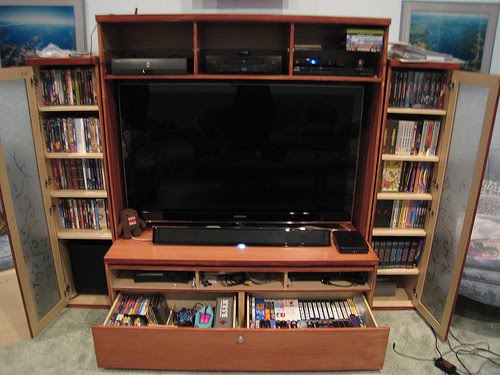
  • Big-Screen Bonde

    Materials: Bonde TV Bench with hutch and 3 bookshelves with 2 doors, saw, drill, palm sander, stain, polyurethane, fabric from Jo-Ann, double-stick crafing tape, window film from Home Depot

    Description: I recently upgraded from an old small television to a new huge one, and I needed a new entertainment center to put it in. I finally settled on a Bonde system on IKEA, in large part because it was inexpensive on clearance. The base system was the birch color, which I wasn’t thrilled with for my decor, and the hutch was wide enough but not quite tall enough for the new TV, so I thought I could hack it to make it taller. I bought the TV bench, hutch, and two side bookshelves with doors to store my DVD collection. On the way out I found another bookshelf without doors in the as-is section and nabbed it (at half off the clearance price!) to provide extra pieces for the hutch extension.

    First, I dismantled the sacrificial as-is bookshelf. The top became a stain-test piece, the shelves were set aside to use in the final bookshelves, eight-inch pieces were cut off the sides to extend the height of the sides of the TV hutch, and an eight-inch strip of the backerboard was also cut off for the hutch. The holes in the hutch sides were moved up to accommodate the new mounting location of the shelves at the top of the hutch, and extra holes were drilled in the new extensions to match the hole spacing for the glass shelves in the hutch.

    Next, I spread all the pieces out on cardboard on my garage floor. Cam pegs, dowel pegs, and random plasticware from my cupboard helped hold pieces off the ground as necessary for edge and double-side staining. A light sanding of all the surfaces with 220 grit helped prepare the very thin birch veneer for stain, but it was easy to oversand. After wiping down all the dust, I applied two coats of Minwax stain in Red Chestnut color, though getting the color smooth was finicky work due to that thin thin veneer. I followed that up with two coats of satin polyurethane to protect the stain. It turned out that the recommendation to sand between coats was a bad one for this project due to the thin layer of stain, but luckily most of the parts I discovered that on aren’t very visible. I left all the surfaces that would be inside closed spaces the original birch color to save work and make the inside surfaces brighter. The doors ended up taking the stain differently than the rest of the pieces, but I did my best to even them out.

    After everything had dried really well, I assembled everything. The hutch side extensions were fastened to the top of the hutch sides with glue and dowel pegs. In retrospect, I should have done that before staining to ensure even colors, but live and learn. The fact that the extension joint lines up with the top of the bookshelves helps camouflage it. The backerboard extension was nailed onto the back of the hutch above the thick TV-mount backerboards and below the shelves, wehre it’s pretty well hidden by the TV.

    Finally, I applied a translucent window film with a vine pattern (available at Home Depot and other vendors) to the bookshelf door windows, and on the backside of the doors I used double-stick crafting tape to attach pieces of midnight blue organza fabric with little gold nubbins scattered across it like stars in the night sky (found at Jo-Ann Fabric and Craft around Christmas).

    DVDs and the subwoofer are stored discreetly in the bookshelves; the TiVo, VCR, and DVD player are mounted in the TV hutch for easy remote control; the big drawer in the TV unit has videotapes on one side and video games and oversize DVD sets on the other; and the door area of the TV hutch hides video game consoles, a UPS, and video and network switching equipment.

    See more here.

    ~ Amy, Houston, Texas, US


  • AT&T Getting the Hero? Ummm… What?

    We know that AT&T is planning to release a plethora of Android devices this year. What we don’t know is which ones they are. Rumors have it that a Touch Pro 2 like device will be on the menu. But what’s AT&T got planned for the touch-screen-only crowd?

    AndroidGuys has been sent a chat transcript from our buddy Jim C. In it, an AT&T customer support representative has claimed that AT&T will begin carrying the HTC Hero this summer, along with another device, which is still under wraps.

    Ingrid: Welcome to AT&T online Sales support.  How may I assist you with placing your order today?
    Jim: Do you carry the HTC Pure new anymore? All I see is refurbished, there isn’t even a page for the new device.
    Ingrid: I will be happy to assist.
    Ingrid: HTC is coming out with new phones pretty soon.
    Jim: Will they be similar to the Pure?
    Ingrid: Better since they will have Android technology.
    Jim: Wow, that sounds great. Do you know if they will be touchscreen like the Pure, or have a keyboard?
    Ingrid: Touch screen.
    Jim: When might I expect to be able to get one? I’m looking to buy soon, but I could wait a few weeks
    Ingrid: Anytime now or summer.
    Jim: Sounds great. Thanks for the heads up. I just did a quick web search, would this happen to be one of the devices? http://pocketnow.com/tech-news/att-htc-pc70110-is-the-android-touch-pro2
    Ingrid: The Hero is one of them the second one we do not have official word yet.
    Jim: Would it possibly be the Legend or the Desire? I’m a little confused about the Hero, since that’s an older device, the Legend is basically the successor to it. So might they be the Legend and Desire?
    Ingrid: Maybe if you type upcoming phones to AT&T you may get additional information.
    Jim: So you cannot confirm if either the Legend or Desire are one of these devices?
    Ingrid: Not yet since we do not have official Information, we are getting a new iPhone by June.
    Jim: Just wondering do you know the date on that?
    Ingrid: By the end of June.
    Jim: Thanks
    Jim: Have a great day

    While it seems highly unlikely that AT&T would adopt a year old phone, stranger things have happened. There’s always the possibility that the representative was, in fact, referring to the HTC Legend, but was just misinformed. At least now we know to expect two devices in the coming months. That’s good news for AT&T subscribers… Or is it? Should these new devices be locked down and Yahoo-ified like the Backflip, you can bet your bottom that Android fans aren’t gonna be happy.

    Might We Suggest…

    • HTC Legend is AT&T bound, so says the FCC
      Engadget has just posted a picture of FCC origin (see below) showing the HTC Legend sporting AT&T’s 850 and 1900MHz WCDMA bands. The label is the same as the one found inside the unibody case of t…