
Blog
-
Microsoft uses Google CEO’s own words against him in YouTube app battle
-
Google’s Unlocked Galaxy S4 Shows Lacking Value in Unlocked Phones
Anyone paying attention to the internet knows that Google announced a while bunch of goodies yesterday. On the mobile front, Google Play Music All Access looks stupendous. It’s like Spotify integrated into your Google Play Music library, rendering Spotify and other music apps redundant for Android users. While that announcement garnered plenty of attention, Google did announce another mobile development. They will sell the Galaxy S4, unlocked, for $649.
Reportedly the announcement drew boos from the Google I/O crowd due to the price tag. It defies our expectations for what a phone costs, by a significant sum, so the reaction isn’t surprising. Yet expectations aren’t the only issue at play here. The way the system works in the US, consumers have little incentive to use unlocked, unsubsidized phones.
(And another reason why we shouldn’t be restricted in unlocking our phones in the first place.)
A customer with an upgrade can walk into an AT&T store and purchase a Galaxy S4 for $199.99, and then pay $90 per month for cellular service. To bring an unlocked Google Galaxy S4 to AT&T would incur the same $90 per month charge, but would cost the consumer an additional $450. Therefore, it only really benefits consumers who want the S4 but do not have an upgrade — although they could simply pay the full price at AT&T. At $640, a consumer would save $10 that way.

The only advantage of owning a locked phone in the US is the ability to eventually take the phone to T-Mobile. Previously you’d have encountered the same issue there, paying the same price as someone who is repaying a subsidy. The way T-Mobile works now you can pay $70 per month for unlimited everything. If you were to buy a Google unlocked Galaxy S4, it could work if you activated it with T-Mobile.
Of course, T-Mobile itself sells the Galaxy S4. You can walk out of a store with it for $150, and then $20 per month for 24 months. That brings the total device cost to $630, not only $20 cheaper than Google but also spread over two years. Since the value of money diminishes with time, you make out much better paying the $150 up front and the $20 per month. If you just want it outright, you can pay the $630 up front if you wish and still save that $20.
There might be some cases where buying the unlocked version does make sense. But for the average consumer, purchasing the phone through AT&T or T-Mobile still makes sense. Maybe if you could bring a phone to more than one other carrier, and if you weren’t paying a monthly fee that takes into account a subsidy, an unlocked Galaxy S4 would make sense. But the way the carriers currently run the business it doesn’t add much value.
The post Google’s Unlocked Galaxy S4 Shows Lacking Value in Unlocked Phones appeared first on MobileMoo.
-
Mellanox To Acquire Kotura in Photonics Deal
Mellanox (MLNX) announced its intent to acquire privately held Kotura, a leading innovator and developer of advanced silicon photonics optical interconnect technology for high-speed networking applications.
The approximately $82 million deal will boost Mellanox’s ability to deliver high-speed networks with next generation optical connectivity. Kotura holds over 120 granted or pending patents in CMOS photonics and packaging design. When combined with Kotura technology, the Mellanox interconnect products will reach 100Gb/s and beyond, and have longer reach optical connectivity at a lower cost, allowing users to further reduce their capital and operating expenses.
“We believe that silicon photonics is an important component in the development of 100 Gigabit InfiniBand and Ethernet solutions, and that owning and controlling the technology will allow us to develop the best, most reliable solution for our customers,” said Eyal Waldman, president, CEO and chairman of Mellanox Technologies. “We expect that the proposed acquisition of Kotura’s technology and the additional development team will better position us to produce 100Gb/s and faster interconnect solutions with higher-density optical connectivity at a lower cost. We welcome the great talent from Kotura and look forward to their contribution to Mellanox’s continued growth.”
Kotura launched its low-power 100 gigabits per second (Gb/s) optical engine to support the interconnect fabric at the OFC/NFOEC conference last year. Mellanox expects to establish its first R&D center in the United States at Kotura’s Monterey Park, California location, and retain Kotura’s existing product lines to ensure continuity for customers and partners. It also believes the proposed acquisition will enhance its competiveness and its position as a leading provider of high-performance, end-to-end interconnect solutions for servers and storage systems.
“This acquisition is important for both companies to enable interconnect innovation for data centers that require solutions that move data faster and more efficiently. Together, we can execute faster and deliver better solutions based on Kotura’s silicon photonics platform that delivers the demands of 100Gb/s interconnects and beyond,” said Jean-Louis Malinge, president and CEO of Kotura, Inc. “We are delighted to join the Mellanox team and look forward to working together to propel the combined company’s further growth.”
-
Weekly Radar: Draghi returns to London
ECB chief Mario Draghi returns to London next week almost 10 months on from his seminal “whatever it takes” speech to the global financial community in The City – a speech that not only drew a line under the euro financial crisis by flagging the ECB’s sovereign debt backstop OMT but one that framed the determination of the G4 central banks at large to reflate their economies via extraordinary monetary easing. Since then we’ve seen the Fed effectively commit to buying an addition trillion dollars of bonds this year to get the U.S. jobless rate down toward 6.5%, followed by the ‘shock-and-awe’ tactics of the new Japanese government and Bank of Japan to end decades.
And as Draghi returns 10 months on, there’s little doubt that he and his U.S. and Japanese peers have succeeded in convincing financial investors of central bank doggedness at least. Don’t fight the Fed and all that – or more pertinently, Don’t fight the Fed/BoJ/ECB/BoE/SNB etc… G4 stock markets are surging ever higher through the Spring of 2013 even as global economic data bumbles along disappointingly through its by now annual ‘soft patch’. Looking at the number tallies, total returns for Spanish and Greek equities and euro zone bank stocks are up between 40 and 50% since Draghi’s showstopper last July . Italian, French and German equities and Spanish and Irish 10-year government bonds have all returned about 30% or more. And you can add 7% on to all that if you happened to be a Boston-based investor due to a windfall from the net jump in the euro/dollar exchange rate. What’s more all of those have outperformed the 25% gains in Wall St’s S&P 500 since then, even though the latter is powering to uncharted record highs. And of course all pale in comparison with the eye-popping 75% rise in Japan’s Nikkei 225 in just six months!! Gold, metals and oil are all net losers and this is significant in a money-printing story where no one seems to see higher inflation anymore.
But with both Fed and BoJ pushes getting some traction on underlying growth and the euro zone economy registering it’s 6th straight quarter of contraction in the first three months of 2013, maybe Draghi’s big task now is to convince people the ECB will do whatever it takes to support the 17-nation economy too and not only the single currency per se. Last year’s pledge may have been a necessary start to stabilise things but it has not yet been sufficient to solve the economic problems bequethed by the credit crisis.
Coincidence or not, Draghi speech on Thursday is flanked by keynotes from his monetary allies. Fed chief Bernanke speaks on Saturday and then to testifies to the congressional Joint Economic Committee on Wednesday, BoJ head Kuroda holds a press conference after the bank’s policymaking meeting ends on Thursday and outgoing BoE governor King speaks Friday. G20 sherpas meet in Russia this weekend, while EU leaders meet in Brussels on Wednesday. The big economic data set-piece of the week will be critical flash global PMI readings for May – is business finally pulling out of the early year funk or is confidence still evaporating?
Main economic events and data releases for next week:
G20 sherpas meeting in St Petersburg Sat/Sun
Fed’s Bernanke speech on long-run economic prospects Sat
Italy March Industry orders Mon
Irish PM Kenny in Boston Mon
Japan 40-yr JGB auction Tues
UK April inflation Tues
Japan April trade Weds
BOJ news conference after latest policy meeting Weds
BoE minutes Weds
EU summit Weds
German 10-yr bund auction Weds
US April existing home sales Weds
Fed’s Bernanke testifies to Joint Economic Committee of Congress Weds
FOMC minutes Weds
Global May flash PMIs Thurs
Spain govt bond auction Thurs
UK April retail sales/Q1 GDP revision Thurs
ECB’s Draghi speaks in London Thurs
EZ May consumer confidence Thurs
US April new homes sales/March house prices Thurs
SAfrica rate decision Thurs
German May Ifo sentiment Fri
French May business climate Fri
Italy May consumer confidence Fri
US April durable goods orders Fri
BoE’s King speaks in Helsinki Fri
-
Just How Useless Is the Asset-Management Industry?

Writing under a pseudonym in the Financial Analysts Journal in 1960, mutual fund executive Jack Bogle made “The Case for Mutual Fund Management.” Bogle took the track records of four leading mutual funds going back to 1930 and compared them to the performance of the Dow Jones Industrials. Not only had the four beaten the Dow, handily, but during the period from 1950 through 1956, for which the brokerage Arthur Wiesenberger & Co. (the Lipper/Morningstar of its day) had calculated mutual fund volatility, all but one of them had fluctuated less than the Dow.
“[M]utual funds in general have met the test of time, and performed in keeping with their stated policies and goals,” Bogle concluded.
As tests go, Bogle’s had its flaws. The fact that four funds (they’re not named in the article, but Bogle once told me they were Massachusetts Investors Trust, Investors Incorporated — now Putnam Investors — State Street, and Wellington) that had survived since 1930 had performed well didn’t say anything about the performance of the many funds that didn’t survive, or the new ones that popped up in the 1950s. But it’s quite possible he was right that the tiny mutual fund industry of the 1930s, 1940s, and early 1950s had served its investors admirably.
By 1960, though, the mutual fund business was booming, and selling investors on high-cost, high-risk products called “performance funds.” Within a few years, researchers armed with more statistical skills (and these new things called computers) were examining the industry’s performance and finding it wanting. “[W]e find no evidence to support the belief that mutual fund managers can outguess the market,” Jack Treynor and Kay Mazuy of the consulting firm Arthur D. Little reported in the July-August 1966 HBR (sadly, we don’t have the article online). Multiple academic studies soon backed up that conclusion.
They’ve continued to back it up ever since. After costs, actively managed mutual funds trail the market. Yet while passively managed, much-lower-cost index funds have been available since 1976, when Bogle — who had a change of heart and, perhaps more to the point, had been ousted from his job running Wellington Management — launched the Vanguard 500 Index Fund, most investors still put most of their money in the hands of active managers.
Why they do this a long-running puzzle. In the new issue of The Journal of Economic Perspectives, economist and long-time Vanguard board member Burton G. Malkiel poses it for the umpteenth time, and adds to it the observation that expense ratios on actively managed funds have over the past three decades risen substantially, even though economies of scale would seem to dictate that today’s much larger funds ought to have lower expenses as a percentage of assets (domestic equity funds in the U.S. had $3.5 trillion in assets in 2010, up from $25.8 billion in in 1980). And while it seems essential that we have at least some active managers in order to set security prices (if everybody put all their money in index funds, there would presumably be no link between stock price and value), Malkiel says that there’s no evidence that stocks were less efficiently priced decades ago than they are now. He concludes:
The major inefficiency in financial markets today involves the market for investment advice, and poses the question of why investors continue to pay fees for asset management services that are so high. It is hard to think of any other service that is priced at such a high proportion of value.
It’s a pretty harsh indictment. Malkiel is basically saying that the asset-management industry has no economic justification for being as big and rich as it is. He’s probably right about that, although I wouldn’t say his evidence is conclusive. The way he purports to show that markets haven’t become more efficient through the years is simply that mutual funds found it just as hard to beat the indexes in 1980 as they do now. And the troves of performance and expense data available for mutual funds allow us to subject them to scrutiny not really possible for most industries. I’d definitely be a little scared to learn what the true economic value added over the years by management advice has been, for example.
One other thing that Malkiel fails to mention (although it’s clear from his data and even clearer in a recent report from the Investment Company Institute, the mutual fund trade group), is that the expense trend shifted a little over a decade ago. After rising sharply in the 1980s and modestly in the 1990s, mutual fund expense ratios actually dropped (from 0.84% to 0.69%) from 2000 to 2010. Part of that is the result of a continuing shift into index funds, which accounted for almost 30% of all equity mutual fund and ETFs in 2010 (up from 0.3% in 1980). But expense ratios on actively managed funds have also been falling, from 0.94% to 0.91% now in 2010.
It’s possible that, thanks to the rise of index funds, investors have finally wised up to the role of costs in investment returns, and we’re entering a glorious new era of declining investment fees. It’s also possible that this is a cyclical phenomenon. During a bull market, investors don’t pay much attention to fees (or to the size of executive paychecks). When markets struggle, they do. So all it will take to get the asset-management industry down to an economically appropriate size and level of profitability is another decade or two of sideways stock markets. That should be fun.
-
Toyota Tundra Headlight Modifications – Headlight Revolution
There are a new series of Youtube videos covering making headlight modifications on your Toyota Tundra. They are by a company called Headlight Revolution and we have included the first few on this post. You should check them out for some interesting modification ideas. Logo projectors anyone?
Click here to view the embedded video.
Not quite sure how useful these logo projectors would be besides creating a cool effect when the doors open at night. However, if you are really into modding your truck, we can certainly see all sorts of cool applications for them.
If these aren’t your thing, how about different reverse lights?
Click here to view the embedded video.
And the last one, we found deals with upgrading your fog lights. This is an interesting yet useful idea for drivers in certain driving situations.
Click here to view the embedded video.
They have created a Youtube channel and you can follow them for all their headlight modifications. The company, Headlight Revolution, seems to carry a large assortment of different headlights and modification information, check out their website.
What do you think, anything catch your eye?
The post Toyota Tundra Headlight Modifications – Headlight Revolution appeared first on Tundra Headquarters Blog.
-
Producer of The Ring and Mulholland Drive releases new horror movie as an iOS app
Plenty of people watch movies on their iPads, but Neal Edelstein, producer of hit films The Ring and Mulholland Drive, wanted to go farther. His new movie, Haunting Melissa, is a ghost story told directly through an iOS app.
Not that Edelstein would exactly describe Haunting Melissa — the story of a teenage girl who believes her dead mother is haunting her, and then suddenly disappears — as a movie. “I didn’t want to take a movie and stuff it in an app,” he told me. Rather, the goal was to use technology “to push a story out to people in bits and pieces.”
 Edelstein’s production company, Hooked Digital Media — which includes investor Jason Washington as cofounder and MySpace cofounder Aber Whitcomb as advisor — built an iOS platform that pushes content out to viewers over time. Haunting Melissa doesn’t have a predetermined length: Edelstein shot thousands of hours of video, and it will be pushed out to viewers in “chapters,” or segments, on a timeline that can be tweaked on the back end. For example, if a user hasn’t entered the app for a while, he or she might receive a push notification that a new chapter is available.
In addition, the actual video content can be adjusted through the app’s content management system, so new content can be inserted into a chapter after a user has already watched it. The idea is to keep users coming back to the app, checking for new content and seeing what has changed.
The Haunting Melissa iOS app, available in the iTunes Store today, is free, as is the first chapter. If a user shares that chapter on Facebook, he or she gets the second chapter for free. Users can buy a “season pass” for $6.99 (standard definition or $14.99 (HD); if purchased individually, chapters are $0.99 for standard definition and $1.99 for HD.
“We are gambling on the notion that this is going to fit in the diet of people who watch and consume a lot of stuff,” Edelstein said. “This isn’t sitting down to watch X hours of House of Cards. It’s one piece of what you’re going to consume over the course of time.” He imagines that users will dip in and out of the app as new content becomes available — but he isn’t sure, because Hooked Digital Media hasn’t tested how viewers use the app. “We just have to go for it and see how people watch and react,” Edelstein said. “My experience in testing movies is that it’s a total clusterf*ck. Unless you have a sample size that’s over thousands of people, you can’t get an accurate measure of content consumption.”
So the company is waiting to see what viewers do and how they share Haunting Melissa on social media. Edelstein describes the creation of Haunting Melissa as “low-budget independent film making.” He tapped industry connections who wanted to work on a different kind of project and got to test new skills — like iPad color correction — for Haunting Melissa. “Because of that excitement level,” Edelstein said, “I was able to work with people I’d worked with before.” He is now working on a sequel.

Related research and analysis from GigaOM Pro:
Subscriber content. Sign up for a free trial.


-
California: Energy Death Valley
California is rich in both conventional and renewable energy resources. It is the country’s most populous state and has the second largest energy consumption in the nation, second only to Texas. California has large energy resources, but also one of …
-
Box is Beefing Up its Network for the Enterprise

Box is one of those Cinderella technology stories. The cloud file-sharing and storage company started with just a couple of guys and now has grown to serving over 150,000 businesses, including 92 percent of the Fortune 500. Its vision: to let you share and manage and access your content from anywhere.
With half of activity coming outside of the U.S. and 40% coming from mobile devices, its customers have tested that mission statement. The company has been boosting Accelerator, its global data transfer network, as well as adding several key certifications in a bid to make its global enterprise customer base happy. Further infrastructure expansion lies ahead.
“We really think we’re solving a problem for an end user,” said Jeff Quesser, VP of Technical Operations for Box. “But we’re also solving an IT concern; they can get all the auditing, compliance they need. This can be run in a very safe way.”
Engineering for the Enterprise User
The company is still seeing triple digit growth year over year, with over 150 percent growth last year. That has prompted the company to tailor its service in the best ways possible to serve the enterprise crowd, which requires fast uploads and often has geographically dispersed workloads and workforces.
An astounding 50 percent of Box activity is happening outside of the US, either from international firms or U.S. enterprises with a global presence.
“It’s a tipping point where it became a first class problem,” said Queisser. “Speed is absolutely critical. If you have sites all around the world, you need blazing fast download speeds.”
Accelerator: Infrastructure Plus Intelligent Routing
This enterprise customer need was the impetus behind Box Accelerator. The company has established upload endpoints in key global data center hubs featuring end-to-end encryption. The company has built patent-pending intelligent routing and optimization technology that delivers uploads 2.5 times faster on average. It has built a network that helps you get data into Box as fast as possible.
“(With) most consumer operating systems, networking stacks are not optimized,” said Queisser. ”There’s the bandwidth delay problem. TCP is an amazing protocol, but wasn’t made for these types of distances and this kind of bandwidth. It’s a testament to how amazing the protocol is that it’s done what it’s done.
“What we’ve done is unique in that it’s optimizing inbound data,” Queisser added. “How do you ingest 100MB rather than send it out? The other piece is that we built these nodes, and a routing feedback loop technology. It determines the fastest way to get to Box. Sometimes it’s an accelerator node, but there are times when direct is the fastest path.”
Neustar conducted a performance analysis test and found that “Box had the lowest average upload time across all locations, about 66% faster than the closest competitor.”
More Cloud-Based End Points, and an API in Box’s Future
Accelerator started off as nine new points of infrastructure, but has been growing. It’s a small footprint that provides a big performance boost. The ultimate goal is to have cloud-based endpoints in all regions.
The locations of the Box accelerators are also telling in that these are the areas where the company is seeing the most growth, and/or anticipating the most growth. If you see an endpoint pop up, it means a combination of latency mapping and customer growth gave birth to it. For example, one of the latest endpoints not yet on the official map is Dublin, an area that has seen its fair share of Internet infrastructure growth as a key European market.
The future for the company is more Accelerator locations, and an upcoming API that will allow developers to leverage the work that Box has done for its own apps.
API on the Way
“We will have a beta for an API that lets any developer in the world use what we’ve built,” said Quiesser. “If you’re trying to build something that’s as fast as possible, you don’t want to have to do all we had to do. Instead you get all of that with an API call.”
The company is also planning to apply this technology to file downloads. Accelerator has added speed to enterprise uploads, but the company says it is looking to speed up downloads in similar fashion. “We need to do that in a way where it’s encrypted and it isn’t cached,” said Quiesser.
It in terms of certifications, it just added ISO 27001 this week, and announced support for HIPAA last quarter. ISO 27001 is the international standard for information security management systems (ISMS) and demonstrates how the policies and controls put in place at Box protect user data. In short, the standard prescribes requirements and best practices for systematically building, deploying, verifying and managing information, content and data. It also has SOC-1/SSAE16 Type II, SOC-2 Type II reports.
-
Smartphone survey shows the ‘Apple/Samsung duopoly has strengthened’

-
Nokia Lumia 928 goes on sale at Verizon
 Verizon customers, it’s time to stop feeling envious of folks on AT&T who can get the Lumia 920. Today, Nokia’s new Windows Phone flagship, the Lumia 928, is available exclusively at the big red’s online and brick and mortar stores.
Verizon’s pricing for the Lumia 928 may lead to sales cannibalization of HTC’s Windows Phone 8X. The latter finds itself in a difficult spot as it has to compete with a newer smartphone that is available for roughly the same money and with similar, if not better, hardware specifications.
After a $50 mail-in rebate, on a two-year contract the Lumia 928, in either white or black, runs for $99.99 which is on par with the Windows Phone 8X for the same type of carrier agreement.
The big red’s customers can also grab the Lumia 928 for $499.99 with a month to month service, which is $50 lower compared to the Windows Phone 8X that is available for $549.99 in the same scenario.
The highlights of the Lumia 928 include 4.5-inch OLED display with a resolution of 768 by 1280; 1.5 GHz dual-core Qualcomm Snapdragon S4 processor; 1 GB of RAM; 32 GB of internal storage; 8.7 MP PureView back-facing camera with OIS (Optical Image Stabilization) and xenon flash; 2000 mAh battery; wireless charging; 4G LTE; NFC and Bluetooth 3.0. The Lumia 928 comes in at 5.4 x 2.71 x 0.4 inches and 5.75 oz.
By contrast the Windows Phone 8X comes with a 4.3-inch Super LCD2 display with a resolution of 720 by 1280; 1.5 GHz dual-core Qualcomm Snapdragon S4 processor; 1 GB of RAM; 16 GB of internal storage; 8 MP back-facing camera with LED flash; 1800 mAh battery; wireless charging; 4G LTE; NFC and Bluetooth 3.1. The Windows Phone 8X comes in at 5.21 x 2.61 x 0.4 inches and 4.66 oz.
-
ForceDel lets you delete any file — even locked ones
 Deleting files on a PC is normally very easy. But sometimes, just occasionally, Windows will tell you that it can’t help because the file is “in use”. And that can quickly become very frustrating, especially if you can’t see why the file is open, or it’s something you really need to delete (a malware component, say).
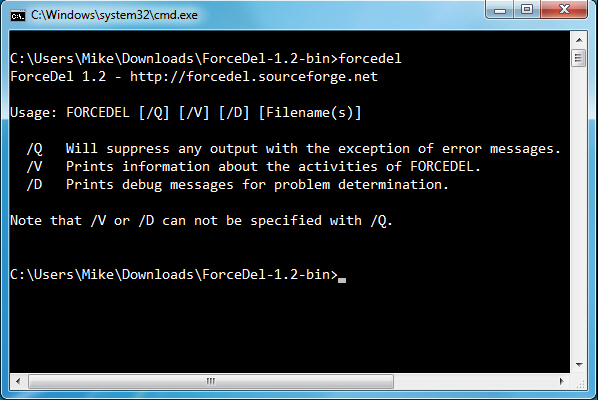
To resolve this you should try closing all running applications, rebooting, perhaps try to delete the file from Safe Mode. But if this doesn’t work then you could always turn to ForceDel, a tiny command line tool which can forcibly delete files, even if they’re open in another application.
Don’t be put off by its command line nature — ForceDel is extremely simple to use. There are a few command line switches (run ForceDel on its own to see them), but essentially all you have to do is give the program the name of the file you’d like to delete — ForceDel “c:\users\MyName\Desktop\Annoying.zip” — and it’ll try to close any open handles, before eliminating the file for you.
And if you want to keep things really simple, there’s not really any need to use the command line at all. Just drag and drop the file you want to delete onto ForceDel, and the program will remove it right away.
Or, if course, you could use one of the GUI competitors, most notably Unlocker. This allows you to unlock files from their right-click menu, and provides some useful extras (it can show you which process has locked a file, for instance, which may tell you a great deal in itself).
 But whatever you’re doing, it’s worth keeping in mind that this is a very risky business. If an application thinks it has a file open, but you’ve just erased it, then there’s no way to tell what might happen next. Crashes, lockups, file corruption, maybe nothing — it all depends on your individual setup, and how that program reacts.
As a general rule, then, ForceDel should be used only when absolutely necessary. Save any currently open files before you start unlocking. And restart your system as soon as you can safely do so, after the target files have been deleted, to eliminate the chance of any problems cropping up later.
Photo credit: megainarmy/shutterstock
-
Google Play Music All Access is a game changer and iTunes killer

Music Piracy is now dead. Apple iTunes is now obsolete. Spotify, Pandora, Slacker — yesterday’s news. This is all because of Google Play Music All Access. It will change the way you listen to music. It will change your life. You will subscribe. Resistance is futile. This is the future of music.
The idea of a music streaming service is not new. However, a music streaming service by the most important and influential tech company is. On May 15, 2013, Google unveiled its new music streaming service, named Google Play Music All Access. Other than the ridiculously long name (I will just call it All Access for the rest of the article), the service is near-perfect.
Details
Here are some facts about the service:
- Unlimited streaming of millions of songs
- Available in the USA only (for now)
- It costs $9.99 a month ($7.99 if you subscribe before June 30)
- Offers a radio feature so users can discover new music
- Available as an app for Android, plus all modern web browsers
Selection
The most important aspect of a streaming service is content. Availability of millions of songs is great but if the music you like is not included, it is worthless. With that in mind, I decided to put it through the paces. I wrote down a random and eclectic list of 10 albums I wanted to find:
 Neil Young — Rust Never Sleeps
- Kendrick Lamar — good kid, m.A.A.d city
- Beck — Sea Change
- The Rentals — Return of
- The Velvet Underground & Nico — The Velvet Underground & Nico
- De La Soul — Stakes is High
- Cru — Da Dirty 30
- Radiohead — OK Computer
- Roc Marciano — Marcberg
- Cam’Ron — Purple Haze
Amazingly, of these 10 albums I picked, nine of them were available. Sadly, it was De La Soul’s album that was not available. In fact, none of De La Soul’s albums were available. This was a huge disappointment, but not a deal breaker as I already own these albums and can upload them later. However, it shows that the service is not perfect yet and Google has work to do. I scrolled through many other selections and was amazed by the amount of music available for a paltry $7.99/ month.
However, the fun does not stop there. Much like Pandora, All Access gives you virtual radio stations based on the music you like. This gives you the opportunity to explore and discover new music. I have already discovered some new hip-hop songs after creating a radio station based on one of my favorite groups, Ugly Duckling. However, unlike Pandora, you have unlimited music skips. So, you are never stuck listening to a song you don’t like. You can even click on the album name from which the song is from and immediately begin to listen to the entire album. You can even click on the artist’s name to be presented with their discography.
At the start of the article, I mentioned that music piracy is dead. This selection and price point is the reason why. While there will always be stubborn people who just refuse to pay for media, with this price and level of convenience, piracy just isn’t worth the hassle.
Buying songs in iTunes, storing them and synching them is just a waste of time, space, energy and money.
Quality
Besides selection, the next most important aspect is sound quality. Before I discuss quality, I should tell you what I am using to listen:
- Windows 8 x64
- Google Chrome Browser
- FiiO E10 USB DAC
- Audio-Technica ATH-M50 Headphones
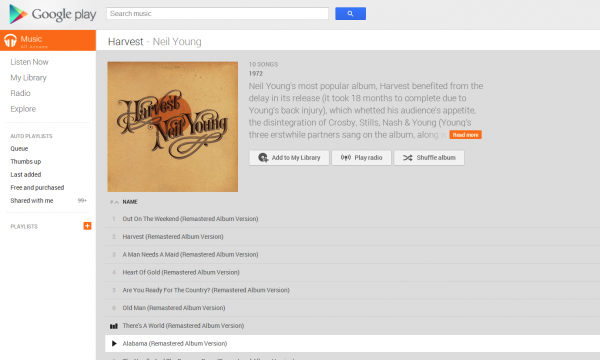
I was dubious of having good sound quality with a streaming service. However, I am happy to report that sound quality does not disappoint. I fired up There’s A World by Neil Young and was blown away at the quality and clarity. I actually own this on CD. Comparing the same song on CD (played through Foobar 2000) with the All Access streaming version, yielded no difference. I tried countless other songs such as Skrillex Breakin’ a Sweat and was blown away by the quality.

Conclusion
Do I really think Google Play Music All Access renders iTunes, Spotify, Pandora and Slacker as obsolete? Absolutely. I defy you to find a better deal in entertainment. With a price point of $7.99 or $9.99, you have pretty much any song available to you whenever and wherever you want. That is cheaper than a single movie theater ticket! The selection is amazing and the quality must be heard to be believed. But don’t take just my word for it; Google is offering a 30-day free trial.
Give it a try and tell me if you agree in the comments below.
-
HostingCon 2013 Gears Up for Austin

The Austin Convention Center which is the conference site of HostingCon 2013.
HostingCon, which will be held June 17 – 19, is an industry event designed to serve the professional interests of the web hosting and cloud services community. Participants will discuss the challenges of the present and think broadly about the future of the cloud computing and web hosting industry.
This year’s event will be located in one of North America’s top technology hubs, Austin, Texas, at the Austin Convention Center.
Thought leaders, subject matter experts and professionals convene at HostingCon for three days, with the intention of networking, making connections and furthering their business interests. The exhibit hall space will host more than 150 vendors.
According to organizers, the mission of HostingCon is to provide essential industry knowledge and intelligence in an unbiased platform. It is the only North American event that is seeks to comprehensively meet the needs of the web hosting and cloud community.
Attendees who purchase the full conference pass get access to HostingCon Connect, which allows attendees to link to the people they most desire to connect with before and during the conference. Send messages to up to 30 people and search the HostingCon attendee database by name, company and title to find the right decision makers to connect with.
More information and registration is available on HostingCon’s website. Early bird registration rate ends today, May 16, at midnight. For DCK readers, use this coupon code when registering: DCK2013 to receive a discount on the registration fee.
-
Podcast: The history of the internet of things includes a Swedish hockey team and LEGOs
Thirteen years ago Adam Dunkels was trying to hook up a hockey team in Lulea, Sweden with sensors and cameras so coaches and fans could track helmet cams and players’ vital signs. It was an academic project but it was also an early example of the internet of things. The project was doomed to fail for a variety of reasons, but out of that experience came a lightweight code for connecting devices called Lightweight IP.
A later version of that code became the base for LEGO Mindstorms and a variety of other connected projects. But Dunkels realized that to truly build a platform for connected devices he needed even lighter weight code. So he built Contiki, an operating system of sorts of the internet of things. And now he’s commercializing all that he’s learned in a startup called ThingSquare. In the podcast we discuss the history of the internet of things and when we reached the tipping point that made the internet of things inevitable.
Show notes:
Host: Stacey Higginbotham
Guest: Adam Dunkels, chairman, co-founder and chief architect of ThingSquare- How connecting a hockey team in 2000 helped him learn what the internet of things needed.
- Why he build LWIP, microIP and later Contiki as an OS for the internet of things.
- The factors that led to a tipping point for the internet of things.
- Dunkels tells me to stop looking at the future and to pay attention to the present. Because the internet of things is here today.
PREVIOUS IoT PODCASTS:
IoT Podcast: Where self-milking cows graze fields of data gold
Podcast: Power to the people — and all their connected devices
What you really need to know before buying connected devicesHow the internet of things may make parents less worried but more neurotic
Shark Week for the internet of thingsWhat the Internet of Things can learn from Minecraft and Lemmings
Podcast: How IBM uses chaos theory, data and the internet of things to fix traffic
Electric Imp aims to make the Internet of Things devilishly simple
When devices can talk, will they conspire against you?

Related research and analysis from GigaOM Pro:
Subscriber content. Sign up for a free trial.- Analyzing the wearable computing market
- Siri: Say hello to the coming “invisible interface”
- The connected planet: Smartphones aren’t the only player

-
UK’s 3i Seeks Investment Partners in Recovery Plan
British buy-out firm 3i has agreed to work closely with major investment partners to buy into companies together, sidestepping the need to raise new funding in the short term, Reuters is reporting.
(Reuters) – British buy-out firm 3i has agreed to work closely with major investment partners to buy into companies together, sidestepping the need to raise new funding in the short term.
3i, which owns fashion retailer Hobbs and Tommee Tippee baby bottle maker Mayborn, has been on a drive to reboot its flagging fortunes after shareholder frustration at weak results from its buyout business, together with a poor share price performance, forced a change in chief executive last year.
Announcing 3i had far exceeded its cost-savings goal for the year, Chief Executive Simon Borrows said the company had agreements with both a large sovereign wealth fund and a major UK institution.
“They are in place and there may be more to add to that. Those people will be at the front of the queue in terms of co-investing with us,” Borrows told reporters. “They will have the right to say whether they want to be in a particular deal.”
Borrows, a former investment banker who was previously 3i’s investment head, replaced Michael Queen a year ago, charged with turning around a business hit by a series of poor deals in recession-hit European markets.
The CEO also has activist investor Edward Bramson’s Sherborne Investors to contend with. Sherborne recently revealed it had raised its stake in 3i to 4.9 percent and described it as a “target company”.
Since the financial crisis, big institutional investors have been putting less money into private equity and becoming pickier about the firms they back. Many private equity firms have had to scale back fundraising plans, in contrast to the pre-crisis boom years when they easily beat their targets.
Private equity funds in Europe raised nearly $52 billion in 2012 compared with an annual average of more than $100 billion during the 2006-2008 boom.
3i last raised a pan-European fund in 2006.
COST SAVINGS
Reporting its results for the year to March 31, 3i said it had exceeded its 40 million pound cost savings target by 28 percent and would now increase that target to 60 million pounds by the end of March next year.
It has also already met its target of reducing gross debt below 1 billion pounds by June.Over the last year it has cut 168 staff, or 39 percent of total headcount, and closed six offices around the world.
Its recent woes stem from its having invested heavily in companies during the peak of the buy-out market in the mid 2000s in mature regions or declining western European markets such as Britain and Spain.
3i, which was set up after World War Two to help with the reconstruction of British industry, has moved away from just private equity, aiming to balance this better with its infrastructure and debt-management businesses.
Shares in the company, which have doubled since Borrows took over a year ago, were down 5.6 percent at 343 pence by 1025 GMT.JP Morgan analyst Christopher Brown said Bramson was the big unknown in 3i’s future. “It remains unclear whether it will take its considerable profits and move on or whether it will aim to appoint its representatives to the board,” he said in a note.
“Given the progress made since Simon Borrows took over, the strong share price performance and the additional cost savings, profit-taking by Sherborne is looking increasingly likely.”
Borrows said 3i had not had any communication with Bramson.
“We are clueless as to what he is up to,” he said.
3i’s diluted net asset value per share, a key measure for valuing its portfolio, was up 11.5 percent on the year at 311p.
The company has made a series of disposals, including of plastic equipment maker Mold Masters. These private equity exits generated proceeds of 575 million pounds over the year, down from 770 million a year earlier.
The post UK’s 3i Seeks Investment Partners in Recovery Plan appeared first on peHUB.
-
Bain in the Lead as Yankee Candle Sale Fizzles – Sources
Bain Capital LLC has emerged as the last party standing in the race for Yankee Candle Co Inc, three people familiar with the matter said, making it likely that the largest scented candle maker in the United States will stay in private equity hands, Reuters reported.
(Reuters) – Bain Capital LLC has emerged as the last party standing in the race for Yankee Candle Co Inc, three people familiar with the matter said, making it likely that the largest scented candle maker in the United States will stay in private equity hands.
Final bids for Yankee Candle, currently owned by Madison Dearborn Partners LLC, are due this week and the people said on Wednesday that other buyout firms that had made first-round offers for the company, including Advent International Corp, CVC Capital Partners Ltd, Clayton, Dubilier & Rice LLC and Ares Management LLC, had lost interest.
As a result, Yankee Candle would be unlikely to fetch more than $2 billion, said the people, who spoke on condition of anonymity because the process is confidential. Madison Dearborn may decide not to sell the company for now, they added.
Yankee Candle declined to comment while representatives of the private equity firms did not immediately respond to requests for comment.
Founded in 1969, Yankee Candle sells items including scented candles, home fragrance products, car fresheners and candle accessories. Its candles are sold in North America through a wholesale network of about 35,000 store locations and 558 stores of its own, as well as online and through its catalog.
The South Deerfield, Massachusetts-based company generated net income of $56.3 million for fiscal 2012, up from $54.5 million in the prior year. It had long-term debt of $846 million and just $40 million in cash as of the end of 2012.
Yankee Candle’s modest earnings growth was cited by the people familiar with the matter as one of the reasons for the auction fizzling out. The candle manufacturer may be worth 10 times its earnings before interest, tax, depreciation and amortization of around $200 million, sources previously told Reuters.
Chicago-based Madison Dearborn acquired Yankee Candle in 2006 for $1.6 billion. In its talks with Yankee Candle, Bain Capital is now dealing with an old acquaintance.
Yankee Candle’s chief executive, Harlan Kent, who last year appeared on the U.S. reality TV show ‘Undercover Boss’ as a Yankee Candle employee in disguise, began his career in the mid-1980s at Bain & Co, the consulting firm whose partners, including former U.S. presidential candidate Mitt Romney, founded private equity firm Bain Capital in 1984.
Kent later worked for Bain Capital from 1997 to 2001 as senior vice president of global wholesale for umbrella maker Totes Isotoner Corp, which at the time was a Bain Capital portfolio company. He joined Yankee Candle in 2001 as senior vice president of the wholesale division and rose through the ranks to become CEO in 2009.
Madison Dearborn hired Barclays Capital (BARC.L: Quote, Profile, Research, Stock Buzz) and Bank of America Merrill Lynch (BAC.N: Quote, Profile, Research, Stock Buzz) to explore a sale of Yankee Candle, people familiar with the matter told Reuters in March.
The post Bain in the Lead as Yankee Candle Sale Fizzles – Sources appeared first on peHUB.
-
UK apprenticeship scheme seeks to attract the young to cyber security
 Along with a number of major employers, e-skills UK — an organization dedicated to inspiring future talent in IT — is developing a new apprenticeship scheme to build cyber security skills.
The scheme highlights the need to attract a new generation of talent into an industry where at the moment only 7 percent of security professionals are aged under 29. It will give youngsters an opportunity to start a career and earn a wage whilst working towards an internationally recognized qualification.
A number of major companies including IBM, BT and defense supplier QinetiQ are backing the scheme, with the first apprentices due to start later this year. Karen Price, the CEO of e-skills UK, says, “I am delighted that e-skills UK is working with a consortium of key employers to create the routes for young people to enter the exciting world of Cyber Security. These new apprenticeships will help tackle the skills shortage faced by this sector, including attracting more women, who are currently under-represented”.
Bob Nowill, Director of Cyber and Assurance at BT, adds, “There are currently few structured routes for young people to enter the cyber security work sector and we are pleased to be contributing to this opportunity to proactively grow new talent which is directly aligned to the needs of industry”.
The scheme will be supported by taxpayer funding via the UK Commission for Employment and Skills. It’s coordinated by the National Skills Academy for IT in order to ensure that it meets the required high standards.
Will this be enough to tempt teenage hackers to go legit and become the next generation of security professionals? Only time will tell.
Photo Credit: Lasse Kristensen/Shutterstock
-
Pamplona Capital Management Creates CSC ServiceWorks
Pamplona Capital Management has acquired Coinmach Service Corp, a multi-family laundry service provider, and AIR-serv Group, a provider of pay air services for automobile tire inflation in North America. The acquisitions, with a transaction value of $1.4 billion, creates a new company, CSC ServiceWorks, Inc.
PRESS RELEASE
Coinmach is the largest supplier of outsourced laundry equipment services for multi-family housing properties in the United States. The company services approximately seven million individual housing units in 45 states. AIR-serv, which provides pay air services to gas stations and convenience stores, will become a wholly owned subsidiary of CSC and maintain the brand name AIR-serv in select markets.
CSC will have a workforce of over 2,250 dedicated professionals, and will service nearly 1 million air and laundry systems throughout North America and Europe.
Robert M. Doyle, Chief Executive Officer of CSC, will lead the new company along with the existing management team from AIR-serv. The transaction was financed by a $795 million first lien term loan, as well as a $325 million second lien term loan that was fully underwritten by Pamplona.
“Pamplona is excited to partner with Bob Doyle and his world-class team. With the combined company’s new and flexible capital structure, we look forward to supporting the company’s growth strategy, including future acquisitions, in both the laundry and air service lines” said Robert Warden, partner at Pamplona Capital Management.
“We are thrilled to partner with Pamplona in launching CSC ServiceWorks,” said Robert M. Doyle, CEO. “Through this partnership, and with the addition of AIR-serv, we are able to accelerate our vision of building a world-class, diversified, route based service organization. We are excited to offer our customers a single, fully integrated platform combining the resources of two respected industry leaders with distinct yet complementary attributes.”The post Pamplona Capital Management Creates CSC ServiceWorks appeared first on peHUB.
-
Looking for an alternative to Google Maps for Android? Try Skobbler’s new app
As yesterday’s announcements made clear, there is no doubt that Google is working very actively on its Maps apps, both on the desktop and on mobile. Although the desktop version of the new Google Maps is currently invite-only and the mobile version a little further off still, we do now know that the service will be far more tightly integrated with the rest of Google’s portfolio and a range of other data sources, too.
It remains to be seen whether Google really manages to pull this off in an uncluttered way, particularly on smartphones, but the changes do look promising. However, Google’s mobile maps do present one problem, particularly for those travelling in foreign climes, and that doesn’t look set to change anytime soon: they only offer limited offline functionality. Maps for specific places can be easily pre-cached for offline use, but you won’t get search or routing functionality without a data connection.
Enter Skobbler with its new Android app, GPS Navigation & Maps. A couple of weeks ago, the Berlin-based startup heavily revamped its iOS ForeverMap app to bring it in line with the more advanced Android version of the same, and now it’s moved the Android app on significantly – so significantly that it’s even renamed it.
All in one
To be precise, Skobbler’s new Android app combines two previous apps, one of which was for maps (ForeverMap 2, whose users will get this upgrade for free) and the other (Skobbler Navigation, shut down a year back) for turn-by-turn navigation. The company claims, rightly I believe, that the result is the only Android app to combine both these functionalities for both online and offline use. What’s more, open-stuff fans can revel in the fact that GPS Navigation & Maps is based on the crowdsourced and highly accurate OpenStreetMap project.
The fact that the app is priced at just £1 ($1.52) shouldn’t hurt either, although buyers should be aware that this comes with only one free downloadable country for offline use. Beyond that, cities will cost £0.77, states £1.11, countries £2.22, continents £4.44 and the whole world £7.77 – not only is this way cheaper than the likes of TomTom Navigation or CoPilot Live, but it also provides the opportunity to download specific areas rather than entire countries or continents: a useful option if you’re concerned about storage.
A separate free version gives you full online maps for the world, along with a 14-day trial of the turn-by-turn, voice-aided navigation functionality.
Skobbler’s iOS maps app allows you to download any country for offline use for free, but turn-by-turn functionality comes in a separate app on that platform. Like that app, though, GPS Navigation & Maps acts as a showcase for Skobbler’s zippy NGx map engine – the company is keen on selling its technology to partners, particularly those in the automotive industry.
Anti-Google opportunity?
Skobbler’s app has clear appeal for those travelling abroad – data roaming charges are still eye-bleedingly high in most cases – but what about customers who are just looking to use it locally?
There, the company may find a willing audience in the shape of the anti-Google resistance. One peculiarity of Android is that, being Linux-based and ubiquitous, it’s the platform of choice for the open-source crowd while also providing a growing privacy threat, of the kind that horrifies the same people.
The mapping updates that Google announced on Wednesday are clearly designed to make Google Maps more of a personalized interface for everyday movements. This should manifest itself in a particularly tightly integrated way on Android, as the lines blur between Maps and Now and everything else Google is baking into the same pie. A lot of people won’t like that.
It’s unlikely that anyone will completely replace Google Maps for Android with a service such as Skobbler’s, as Google’s in-house location infrastructure is probably too baked-in these days to avoid. But, in terms of consciously firing up a mapping app to negotiate the world around them, some people may find value in choosing a non-Google option, so that their often highly personal location searches don’t get fed into the Great Google Data Stew. For those people, GPS Navigation & Maps could provide a tantalizing alternative.

Related research and analysis from GigaOM Pro:
Subscriber content. Sign up for a free trial.- Google and the Ghost of Silicon Valley Past
- The fourth quarter of 2012 in mobile
- A look back at mobile in the third quarter


