Blog

  • Oklahoma To Implement Strict Abortion Measures After Governor’s Veto Get Overridden

    Oklahoma to implement strict abortion measures after governor's veto get overriddenJust a few days after Oklahoma Governor Brad Henry vetoed two restrictive abortion measures, calling them "unconstitutional intrusions into citizens’ private lives and decisions," the state senate voted to override the vetoes, meaning the bills will become laws without the Democratic governor’s support.

    One of the measures forces pregnant women to undergo an ultrasound and receive a detailed description of the fetus just an hour before deciding whether or not to have an abortion, the Washington Post reports. The second bill prohibits expectant women from seeking damages in court if their physician withholds information regarding their pregnancy.

    The second measure, which was overwhelmingly supported in both the state House and Senate, is designed to prevent women from discriminating against fetuses with disabilities.

    "State policymakers should never mandate that a citizen be forced to undergo any medical procedure against his or her will, especially when such a procedure could cause physical or mental trauma," Henry said. "To do so amounts to an unconstitutional invasion of privacy."

    The Oklahoma governor, who vetoed similar legislation in 2008, also criticized the bills for not allowing exemptions for victims of rape and incest.
    ADNFCR-1961-ID-19746263-ADNFCR

  • Economic Experts Says True Inflation Is Three Times Higher

    Economic experts says true inflation is three times higher Despite the Federal Reserve’s pronouncements that inflation is under control and holding steady at just above 2 percent, some experts believe the true figure is much higher than that.

    According to Jeffrey Nichols—senior economic advisor to Rosland Capital, a California-based precious metal asset firm—the consumer price index , which is the government’s main inflation indicator, is flawed and causes the actual inflation to be significantly underreported.

    In his view, the true level of general price increases is between 6 percent and 7 percent.

    "Recent statistics paint a rosy picture of the United States economy emerging from recession with inflation subdued," Nichols said.

    However, he added that "anyone who does grocery shopping, pays the utility bills, writes a tuition check for their child’s education, uses public transportation or flies across the country knows the truth about inflation."

    Nichols also said that although the price of gold fell last week after the news that the investment bank Goldman Sachs had been charged with securities fraud by the Securities and Exchange Commission, "prices in the $1,130 to $1,140 range are certainly attractive entry points for long-term investors."ADNFCR-1961-ID-19744904-ADNFCR

  • Oral Chelation With EDTA

    Chelation therapy is an artery cleanout alternative to bypass heart surgery. Since bypass surgery is the most profitable income to hospitals, a big propaganda effort by orthodox medicine against chelation therapy is ongoing and has been for many years.

    Medical doctors who practice intravenous (I.V.) chelation keep a low profile because of pressure and harassment from the medical establishment.

    Oral chelation is a safe and noninvasive way to boost circulation and reduce plaque and toxins in your circulatory system. It can work miracles over time. It is usually taken by mouth in capsule form. The basis of oral chelation is most often a simple acid ethylene-diamine-tetraacetic acid (EDTA).

    Chelation was originally created to remove heavy metals that accumulate in the arteries from the industrial use of paints and other materials. It was discovered that workers who had heart trouble got much better while taking EDTA (chelation therapy) to remove heavy metals. The chelation therapy would bind to organic molecules and purge the arteries clean naturally, renewing the artery system. The long history of efficacy is proven and the benefits well-known, but often controversial with the conventional medical establishment.

    (Article continues below…)

    Free Report Reveals How You Can Sweep Arteries Clear!

    I.V. and oral chelation, even with medical blackout, have become strong alternatives to surgery over the past 60 years. Chelation is inexpensive and noninvasive and works all over your body.

    Clogged arteries seem to come with aging. Oral chelation has been the answer for improved circulation for millions of people.

    Enhanced Oral Chelation™ from Health Resources™ is a product I’ve used personally for many years. This powerful nutritional formula helps support cardiovascular health and promote healthy circulation by supplying much-needed nutrients to your circulatory system. So Enhanced Oral Chelation™ is a powerful source for heart nutrition. There is no history of risk.

    The American Medical Association has approved I.V. EDTA chelation for the removal of toxic metals. But we have the history to prove that chelation helps promote peripheral circulation which is basic to life, health and longevity.

    The American College of Advancement of Medicine (ACAM) estimates that at least a
    million patients have received more than 10 million I.V. chelation treatments without a single fatality.

    The record for oral chelation is even more exciting since it is safe, inexpensive, easy and something you can do in your own home without needles or doctors.

  • Vitamin D Intake Linked To Better Physical Function In Seniors

    Vitamin D intake linked to better physical function in seniorsAccording to a recent study presented at the 2010 Experimental Biology meeting in Anaheim, Calif., a high intake of vitamin D may help preserve physical function in older adults.

    For the study, Denise Houston and her colleagues from the Sticht Center on Aging at Wake Forest University assessed the relationship between nutrient intake, long-term health conditions and mobility in seniors.

    Over a four-year period the researchers monitored 2,788 healthy seniors with a median age of 75. At the beginning and end of the study they analyzed each participant’s blood level of vitamin D and examined their physical function using a variety of strength and endurance tests.

    At the conclusion of the research the investigators found that while physical function declined with every respondent, those with consistently high levels of the nutrient experienced a more gradual deterioration in strength and endurance.

    "Those with adequate or optimal vitamin D status [the highest group] had approximately 5 percent higher physical performance scores and 5 percent faster walk speed on the 400-meter walk compared to those with insufficient vitamin D status at the four-year follow up," Houston told WebMD.
    ADNFCR-1961-ID-19743385-ADNFCR

  • Obama’s Opportunity

    The pending retirement of Supreme Court Justice John Paul Stevens gives President Barack Obama an opportunity to shape court decisions for many years to come. Let’s hope he makes a wise decision.

    Unfortunately, his radical leftist views that the United States Constitution is a “charter of negative liberties” and his prior choice of Sonya Sotamayor—who as an appellate judge ruled that the New Haven fire department’s promotion test was discriminatory because no minorities scored well enough for promotion—to the Supreme Court don’t augur well for liberty.

    Liberals like to say the Constitution is a “living, breathing document,” because that allows activist judges to create “rights” out of thin air in order to advance an agenda. But what is needed are strict constructionist justices who are willing to go back and see what the Founding Fathers intended when they wrote the document.

    “On every question of construction,” wrote Thomas Jefferson, “carry ourselves back to the time when the Constitution was adopted, recollect the spirit manifested in the debates and instead of trying what meaning may be squeezed out of the text or invented against it, conform to the probable one which was passed.”

    The Founders understood that government could easily become the enemy of the people. So they wrote a Constitution that put restraints on the government.

    If we are to remain free we need to watch closely the people Obama nominates for the courts—the Supreme Court most importantly. They must be people who recognize the role of government. They must understand that the Constitution was written to protect the citizens from its government, not the government from its citizens. They must recognize that all men are created equal, and that no group or class is more equal than another. If not, we must do all we can to block them.

    Because, as Samuel Adams said, “[W]ithout liberty and equality [under the law], there cannot exist that tranquility of mind, which results from the assurance of this to every citizen, that his own personal safety and rights are secure … it is the end and design of all free and lawful Governments.”

  • Phoenix Mayor: Immigration Bill Is ‘Unconstitutional’ And ’Unenforceable’

    Phoenix mayor: Immigration bill is 'unconstitutional' and 'unenforceable'Just a few days after Arizona Governor Jan Brewer signed into law a historically aggressive immigration bill, Phoenix Mayor Phil Gordon indicated that the city may soon file a lawsuit challenging the legislation on constitutional grounds.

    Gordon told Fox News the bill is not only unconstitutional, but also makes the state less safe, as police would be forced to spend an exorbitant amount of time focusing on this "unenforceable" law.

    "It tramples civil rights," Gordon told the news source. "Now everyone has to show and prove that they’re a legal resident or citizen." He also warned that the new law may create "a division within the state that could lead to violence."

    The Phoenix mayor also attacked the author of the bill, state Senator Russell Pearce, by comparing him to late Alabama Governor George Wallace, a well-known segregationist leader in the 1960s, KTAR.com reports. He said that Pearce is more concerned with making headlines than battling the real problems that face Arizona, such as violent crime and the drug trade.

    Gordon indicated that he will ask the Phoenix City Council later this week to join him in his fight against the law.
    ADNFCR-1961-ID-19743383-ADNFCR

  • Unions Reject Gov. Rell’s Plans For Early Retirement For State Employees; Reject Union View That Stormed Out

    The state budget process just got more difficult.

    On Wednesday night, the state employee unions rejected the Rell administration’s offer to help balance the state budget by offering an early retirement incentive program to as many as 8,000 state employees.

    The two sides had different versions of what happened at the contentious meeting. The unions said that Rell’s representatives “stormed out” of the meeting, but Rell’s supporters said that the administration’s budget director, Robert Genuario, has built a reputation over the years for being a mild-mannered negotiator who has never been known for storming out or even raising his voice.

    “The governor is extremely disappointed that SEBAC – the coalition of state employee unions – tonight summarily rejected any consideration of an early retirement plan to save $65 million in state budget costs,” the administration said in a statement shortly before 10 p.m. “She is also disappointed that SEBAC would not allow the administration to put alternative cost-saving measures on the table. Governor Rell believes it is a time for renewed respect and cooperation, not intractability and hyperbole.”

    Thirteen minutes before Rell issued her statement, the union coalition issued an e-mail that said that Rell’s agents had stormed out “after failing to produce” an analysis of the costs to the state pension plan of the early retirement incentive plan, known as an ERIP. Republicans have said that an estimated 8,000 state employees would be eligible, and an estimated 2,000 employees would take the offer. A projected 1,000 positions would be re-filled, and the state would thus eliminate 1,000 positions at an annual savings of $65 million.

    A Capitol insider said the union leaders made it clear that they would not talk about anything but the ERIP, even though Rell’s negotiators wanted to breach other ideas. After a while, Rell’s negotiators said it was clearly obvious that nothing was going to be accomplished at the meeting.

    The next move remained unclear late Wednesday night. House Republican leader Lawrence Cafero of Norwalk said recently that the state does not need approval from the unions to move ahead with the ERIP because the program is not a concession. He added that case law has allowed the practice. Rell, however, said recently that the easiest way to enact the ERIP was with union agreement.

    Through spokesman Matt O’Connor, SEBAC issued statements from various union presidents in the coalition.

    “We’re terribly understaffed already,” said Carmen Boudier, president of New England Healthcare Employees Union, District 1199/SEIU. “We have healthcare workers and corrections officers struggling through mandatory double shifts, and the state trooper force is below its statutory minimum. When bridges are found to need repairs, we don’t even have enough maintenance professionals to repair them,” she said.

    Dave Walsh, president of the American Association of University Professors – CCSU, said in a statement: “College students are struggling to find courses they need to graduate, and we have backups and waiting lists for workers needing job services, and for businesses needing permits to create jobs. Why would the governor want to make a bad situation worse?”

    The unions have details on their budget positions at www.InThisTogetherCT.org


  • Palm/HP is still dead

    A few weeks ago I said Farewell Palm. Now HP has paid $1.2 billion in cash to acquire Palm ($5.70 a share).

    It’s good news for those who bought Palm stock in the past few weeks, but it’s no reason to consider buying a PalmOS device. Whatever Palm was yesterday, it’s now being digested by a very average large publicly traded company. Palm is now HP.

    An average PTC like HP can compete effectively against other clumsy but powerful PTCs like IBM, Dell, RIM, and Microsoft. HP is capable of turning out devices that are every bit as good as Windows Mobile phones of 2008.

    Except it’s not 2008, and the competition is not RIM or Microsoft or Dell. The competition is Google and Apple.

    Google and Apple are also publicly traded companies. They are not typical however. They are very deviant. Google has an underestimated two tier ownership structure that gives great power to its founders. Apple has Steve Jobs, who in addition to being an insane genius with mind-control powers is also Apple’s founder and has cult like authority over the company and its shareholders. Both Google and Apple behave like privately held companies with public money.

    Palm is still dead. I don’t know why HP did this deal. Maybe it was all IP, but they paid a lot for IP. I think they hope to stay in the only game in town. It won’t work; there’s no room for them at the table.

    This is about Google and Apple. Microsoft will take 3rd place. RIM will fall by the wayside within three years. HP won’t last a year. They can’t compete.

  • IFPI’s Latest Report On Music Sales Shows Growth In Some Markets

    The IFPI has put out its latest report on the state of the music business (sent in first by Nastybutler77). There aren’t too many surprises. Some of the data in the report (such as the growth in the UK and elsewhere) were already covered a few weeks ago in a presentation by Will Page, the chief economist for PRS in the UK. But there were some interesting points in the report that suggest the industry is still in quite a bit of denial. Thirteen markets saw “a return to growth” in music sales — though, amusingly, the IFPI chooses to highlight two of them — South Korea and Sweden — both of which passed ridiculously draconian anti-piracy laws, mostly due to pressure from folks like the IFPI.

    Not surprisingly, the IFPI credits the “improving legal environments” in those countries for the increasing sales. Similarly, it notes that sales declines happened in Spain and Canada — two of the countries most regularly singled out by the entertainment industry for having consumer friendly copyright laws. Of course, that’s not how the industry describes it. They talk about how those countries’ laws are “out of touch” or not in line with “international standards.”

    Of course, what the IFPI totally ignores (not surprisingly, since they only represent record labels) is that while the sales of music directly may have declined in some markets, the overall market for music grew tremendously. In other words, the decline in sales of recorded music has not done harm to the music industry, but just to a few record labels. This new report is really just an attempt to pretend (yet again) that the “music industry” is really “the recording industry.” And, of course, what this report doesn’t come close to acknowledging, is that in putting in place these “legal environments” in places like Sweden and South Korea, it has cut off many more efficient and effective ways for musicians to create, promote and distribute their works.

    That’s what this report really shows. It shows that the IFPI wants to be the gatekeeper to make sure that more of the money going through the music ecosystem goes to its labels, rather than to others. It doesn’t care if the overall market for music is smaller, just as long as more of the money goes to its members.

    Permalink | Comments | Email This Story


  • Elevation Partners to eke out a $25 million profit after sale of Palm

    Elevation Partners

    While we won’t expect Elevation Partners to say anything about it until the sale is complete, it looks like they’re about to walk away from Palm with a small profit. This flies in the face of sensationalist claims of partner Bono (yes, of U2 fame) being “the world’s worst investor,” though we imagine he, Roger McNamee, and the rest of Elevation Partners had hoped to make a bit more off the deal. Just how much is Elevation set to get when all is said and done? $485 million, according to Venture Beat.

    That amounts to 40% of the $1.2 billion that HP is set to lay down to snap up Palm. The story of how Elevation’s getting more than their 30% share of Palm is an interesting one. Elevation’s initial investment in Palm in 2007 was to the tune of $325 million, which wrapped up 25% of the smartphone maker under Elevation’s control. Elevation has twice in the intervening years invested in Palm stock, upping their total investment to $460 million.

    So luckily for Elevation Partners and all their investors, they didn’t lose money on this deal. Of course, if they’d sold their shares late last year when Palm stock was trading over $18, they could have brought in close to $1.5 billion. Yes, you’re reading that right, a third of Palm used to be worth more than what HP is paying today. That’s what happens when expectations are tempered by reality.

  • “StarView Themes Presents: Fallout Theme” Released

    image If you live in the United States of Mexico(Okay, America,) you should know about a fun game for Xbox that includes the coolest droid ever. Well we can have the great looking Fallow out theme on our WVGA devices. Created by horrorview, its a new theme that’s capable with CHT Mod, and comes with many icons for you to get the full experience.

    We have made several different packages for the theme, making it totally customizable!

    [StarView] Fallout Theme.cab
    This is the entire theme WITHOUT Icons and Wallpapers. (Run as any install, but you’ll need to manually install Wallpapers and Icons as detailed below)

    [StarView] Fallout Icon Pack.rar
    70 icons for the theme covering most of the widely used apps and base programs! Use your favorite icon editor to set them.(we recommend JWMD)

    [StarView] Fallout Wallpapers
    Three different wallpapers – Home, Lockscreen, and Landscape home. We have decided to give you them as the raw jpg’s so you can set them in whichever way you prefer, be it HDWall, Voldeus Transparent Mod, BG4All or just as normal.

    This is a FIRST release, so, while Star and myself haven’t experienced any major bugs, we must warn you that you install this at your own risk, we’re not responsible for any explosions or deaths that may occur as a result, and, please, for the love of god, don’t take the brown acid.

    (Compatible With CHT)

    You can Download this new Theme over at XDA


  • Trevor Hoffman in timeout after back-to-back blown saves

    http://a323.yahoofs.com/ymg/ept_sports_fantasy_experts__27/ept_sports_fantasy_experts-13656266-1272507253.jpg?ym19nDDDpyUtspcQHere’s the nicest thing we can say about Trevor Hoffman’s(notes) blown save on Wednesday: This time, Ryan Doumit’s(notes) homer didn’t travel quite as far.

    Tuesday’s grand slam was an absolute bomb, but Wednesday’s game-tying blast traveled only the necessary distance down the right-field line.

    Unfortunately for Hoffman, his manager doesn’t seem to consider shorter home runs to be a sign of progress. This from MLB.com’s Adam McCalvy:

    Ken Macha suggested that his struggling closer was due at least a
    one-day break.

    "That’s two days in a row for him," Macha said. "[On Thursday], if we
    have a chance to win it, perhaps it will be somebody else at the end of
    the game."

    Just to be clear, this is not an official loss-of-job event. Macha was only discussing his Thursday plans. McCalvy expects LaTroy Hawkins(notes) to get the save chance if an opportunity arises. Hawkins has been a bit unsteady this year as well, but he’s pitched clean innings in three of his last four appearances.

    Meanwhile, Hoffman has blown saves on consecutive days, and he’s already up to four this month. He’s allowed six home runs in just nine innings, which cannot be attributed to mere bad luck. Take action tonight if you want tomorrow’s save. 

    A pitcher with Hoffman’s credentials clearly gets a long leash, but it’s worth noting that Macha has been meeting with anyone who might have any insight. It feels like a plan is coming together:

    After Tuesday’s loss, Macha had chats with pitching coach Rick
    Peterson and general manager Doug Melvin about the struggling closer.
    On Wednesday morning, Macha spoke with assistant GM Gord Ash, who thinks
    the problem is mostly location, and head athletic trainer Roger
    Caplinger, who assured that Hoffman is in top physical shape, as usual.

    Then Macha met with Hoffman himself, behind a closed door in the
    manager’s office about an hour before the Brewers-Pirates series finale.

    …and then Doumit got him again. And tomorrow, Hoffman sits.

    Photo via AP Images

  • Flash On Mac Just Got More Tolerable [Flash]

    Adobe may have stopped bothering with iPhones, but they certainly didn’t hesitate to finally give us a tolerable Flash experience on Macs by incorporating Apple’s new video acceleration API in a Flash Player preview release dubbed “Gala.” More »


  • Fear Is Cheap

    Fear gives intelligence to fools, says an old proverb. Turning it around a bit, we might say that lack of fear makes fools of wise men.

    In the market, fear – or lack of same – finds expression in many forms. The Volatility Index, or VIX, is one of them. Known as the “fear gauge,” the VIX bounces up and down based on what people are paying for options on the S&P 500.

    For example, if people are fearful, they tend to buy put options. Put options are like insurance against a fall in price. They pay off if the market falls. When investors pile into put options, they make the price of such options rise, and that pushes the VIX up, too.

    Conversely, when people are not worried, they sell those options – or at least they don’t buy them. So the price falls, and so does the VIX. There has been a lot of that going on in the last year. The VIX recently hit its lowest point in 30 months, as shown by the nearby chart.

    VIX Spikes Above 20

    Fear looks cheap. Given all that is going on in the world, it is remarkable to find investors so complacent. The financial system is still a rather creaky affair. Leverage is still high. Banks remain undercapitalized. The credit cycle has not yet run its full course, as there are still significant credit losses hiding in the cupboards of banks.

    Then there are the governments of the world. The US has awful credit metrics. It is bleeding money and owes huge debts. Most of the 50 states are also bleeding money and have large debts, including giant gaps in unfunded pension liabilities. They are perhaps worse off, because unlike the US government, the states cannot print their own money. Then there is the EU. And Japan.

    There are only a few ways to cure such ills, and none are painless. One thing is for sure: These ills can’t go on forever.

    In the context of all this, fear looks cheap.

    Conveniently, Wall Street has made fear a tradable commodity. One way to play it is through the iPath S&P 500 VIX Short-Term Futures fund. Though a mouthful, it simply aims to mimic the VIX. It trades under the ticker VXX, and started trading only this year. It’s done horribly, as you would expect given the fall in the VIX.

    Yet it could be a nice play should we have another spike in the VIX. If fear should rear its head again, as it undoubtedly will, the VXX ought to prove nice insurance. More than just insurance, it could return three or four times your money, depending on the spike.

    Fear is cheap. Buy some before the price goes up.

    Chris Mayer
    for The Daily Reckoning Australia

    Similar Posts:

  • Mohammad El-Erian And Paul Krugman Both Wildly Gloomy About Spiraling Crisis In Greece

    mohamed el-erian pimco

    The market has been in full-on panic about Greece for awhile now — hence the parabolic spike in short-term rates — and now it seems the wise men of the market are fully on board.

    Felix Salmon points to new pieces from both Mohammad El-Erian and Paul Krugman, both of whom see nothing but bad news right now.

    El-Erian, in so many words, says Greece will default. Krugman is talking about the real possibility of unwinding the euro and ends his piece with: “I think I’ll go hide under the table now.”

    That’s some seriously gloomy language from arguably the most influential public economist in America.

    What’s amazing is that we seem to have a full-on financial crisis in Europe. Yes, Greece itself is small, but Portugal, Spain, and Italy are not small at all. And the the interconnected European banking system isn’t small, and yet for the most part, domestic markets in the US don’t seem all the concerned, which is pretty astounding.

    Meanwhile, the New York Times has a good piece on the political pressures mounting on Angela Merkel. The world wants her to act, but big elections are coming up nex wil month that could upset her coalition, and a Greece bailout will prove toxic.

    Join the conversation about this story »

    See Also:

  • Learning From A Communist

    “Panel will tackle national debt,” says a headline in this week’s Washington Post.

    Would anyone like to bet?

    Who writes these headlines? What are they thinking? Are they thinking at all?

    While the bi-partisan group of bumblers may do something; tackling the national debt – or even slowing it down – is not one of them. It would be going against the tide of modern financial history, which rolls debt into bigger and bigger piles and turns small problems into huge ones.

    Let us look back. What has been the major trend of the entire past 50 or so years? Government has played a larger and larger role in the US and most western democracies. Only in the formerly (and for many, still) communist countries has government been rolled back.

    The communists learned their lessons. They proved that government spending does not make people rich. But now…what’s this…? The US and other countries are greatly increasing the percentage of GDP spent by the government.

    The communists proved that central planning didn’t work. But again, the US and others are now planning their economies more than ever – managing interest rates, directing capital to one industry while denying it to others, raising taxes on this…subsidizing that…regulating everything that moves…

    The communists also proved that state ownership of industry was a bad idea. But the US and others now own banks, insurance companies, almost the entire mortgage business, and one of the world’s largest automakers.

    Perhaps most importantly, almost all the ‘old’ democracies – notably the US – are taking on much more debt. Bankers do stupid things – the feds take over the debt. Homeowners do stupid things – the feds give them more low-cost credit. Politicians do stupid things – and the feds run up even more debt.

    And it’s killing them. They can’t raise enough money through taxation to fund their spending plans, so they have to borrow. And borrowing exposes them to big risks.

    In a few days, America’s first time house buyers’ tax credit program expires. It’s been a great success, say supporters.

    Let’s see, how did it work? According to the news reports, the government gave away $12.6 billion in tax credits. Of course, some people would have bought a house anyway…and could have afforded one without the tax credit.

    Wait…that means that the only additional sales came from people who 1) didn’t really want to buy a house or 2) couldn’t really afford one. According to economists’ estimates, each one of these people cost the feds $30,000 worth of tax credits.

    And according to the results of an audit, $139 million was paid out to people who hadn’t bought a house at all. And one of the people who got the credit was only 4 years old.

    A perfect federal program – it accomplished nothing at great expense…

    And it adds to the debt!

    Yesterday, the Dow sold off 213 points. Gold rose $8. In the aftermarket it soared even more.

    What’s bugging the markets? Debt. Specifically, the debts of Greece…and Portugal…and Spain…

    Last Thursday was “Black Thursday” for Greece. News reports told the world that Greece’s budget problems were bigger than people had thought. Traders dumped Greek bonds.

    Greece’s debt is now ‘junk’…the rating agencies say that if the country is forced to reschedule creditors could get back only 30% of their money. Naturally, lenders are nervous. And investors fear that Greece’s problems are not limited to the Hellenes. Sovereign debt problems are as ‘contagious’ as HIV. All it takes is a little hanky panky of the wrong sort…and you’ve got it!

    Greece’s budget deficit is 8.7% of GDP.

    Portugal’s deficit is the same.

    Spain’s is higher – at 10.4%.

    Where’s the US deficit? Last time we looked it was projected to be as high as 12% of GDP.

    By many measures, the US is actually in WORSE shape than Greece. And the rating agencies have already warned about a possible downgrade of US debt too.

    And by all measures, the US has the biggest pile of debt in the world… Just wait until the sparks hit it. You’ll see the world’s biggest blow-up!

    And more thoughts…

    “Ask me how insurance works.”

    “All right, how does insurance work?”

    “Well, okay, you give me your money…”

    “Is that all there is to it?”

    “Yes.”

    “Is that a joke?”

    “Not exactly…”

    Fire insurance works by sharing out the risk of a fire among hundreds of homeowners. In effect, if one house burns down, the others have already put aside enough money to rebuild it.

    It’s a kind of voluntary socialism…freely collectivizing the risk of a house fire.

    But just because you have fire insurance doesn’t mean you will leave a can of gasoline on the kitchen stove. You know it would be a big pain to replace the house and its contents – even if you were made whole financially. That’s why it works, because it doesn’t change human behavior. So, actuaries can calculate the odds of a fire fairly accurately.

    But suppose you could insure against losses in the stock market? Or suppose you were guaranteed health care…or a comfortable retirement…no matter what you did? Wouldn’t you at least be tempted to live a little? To take chances? To spend a bit more?

    And wouldn’t the whole economy change as a result?

    For the last 50 years – or more – we have been taking part in a vast experiment. What will happen as more and more risks and costs are socialized?

    We already saw what happened in the mortgage market. Bankers used to take their risks one by one… If they thought a man was a good credit risk, they lent him money. Sometimes they were right. Sometimes they were wrong. Being wrong from time to time was just a cost of doing business.

    But then the financial industry collectivized the risk. The banker lent, earned a fee, and then sold the mortgage on to Wall Street, where it was securitized, packaged and resold. What was the consequence? Well, mortgage lenders stopped worrying about individual risks. They changed their behavior and stopped using their own judgment. All they wanted was to close the folder, collect their fees, and move the paper on. Soon, they were lending without asking questions – using low-doc, IO mortgages. House buyers changed their behavior too. Easy mortgage credit pushed up demand…which pushed up prices. Pretty soon, the whole town was on fire.

    But then the feds stepped in and collectivize the risk even further. Now, Fannie Mae and Freddie Mac are arms of the US Federal Government. And now we’re all partners in the insurance company! Now, when houses burn down WE ALL have to pay.

    We’ve seen what happened when government collectivized other parts of the financial system too. You can collect Social Security whether you saved for your retirement or not. And you could get unemployment compensation whether you saved for a rainy day or not. And you can get food stamps whether you tried to find a job or not.

    And now, if you’re a major Wall Street bank, you can get a bailout from Washington whether you deserve it or not.

    How about that? The feds have spread the risk around so much that everybody pays for everybody else’s mistakes.

    Is that a good system, or what? Government insures everybody against everything. Only the government doesn’t have any more money…

    ..So, then you give your money to government…

    ..and that’s all there is to it.

    Regards,

    Bill Bonner
    for The Daily Reckoning Australia

    Similar Posts:

  • H. Stewart Parker Joins WBBA

    Luke Timmerman wrote:

    H. Stewart Parker, the founder and longtime CEO of Seattle-based Targeted Genetics, has agreed to join the Washington Biotechnology & Biomedical Association as a part-time commercialization adviser to local life sciences researchers and entrepreneurs. Parker, who has inspired and mentored a generation of biotech professionals in Seattle, resigned from Targeted Genetics in November 2008 after the company suffered a number of setbacks. In a December interview, she said she was itching to return to biotech. “We are thrilled to have Stewart join us,” said WBBA president Chris Rivera, in a statement.

    UNDERWRITERS AND PARTNERS


  • More Extend and Pretend

    “Euro debt crisis deepens as ‘contagion’ spreads from Greece to Spain,” lead today’s Independent. And now you get the feeling that policy makers only have a couple of bullets left in their gun to prevent a bigger panic in the market. Of course, maybe it just feels that way because of the drumbeat of coverage in the media. But what is the likelihood of the Greek debt crisis becoming a “contagion” across Europe and beyond?

    Well the simple matter is that many nations have been living beyond their means and investors are beginning to doubt governments are good credit risks. That’s saying something, when governments can simply confiscate from the public the money needed to pay bond holders. But debt-to-GDP levels are now so high across the Western world that bond investors (and ratings agencies) are having serious doubts.

    The credits ratings analysts at Standard and Poor’s have been busy. A day after downgrading Greek and Portuguese debt, the analysts downgraded Spanish debt too. And now words like “viral” and “contagion” are…uh…spreading like…a disease.

    “The contagion from a Greek default could also spread to much larger economies where the public finances are also fragile, including the U.K. and, perhaps the biggest risk of all, Japan,”said Julian Jessop, chief international economist at Capital Economics. Jessop somehow left out the U.S, which is astonishing given that the U.S. Treasury Department will auction US$129 billion in new debt this week. Yields on 2-year, 10-year and 30-year U.S. debt all rose (and prices fell).

    But now the metaphors get complicated. You’re going to start hearing a lot of commentators say that this is a crisis of confidence. But when is the last time you stopped a cold with a strong sense of self belief?

    To say the sovereign debt crisis is just a crisis of confidence is to ignore Europe’s (and Japan’s, and the U.K.’s, and America’s) failing fiscal welfare state model. This model is not surviving its first contact with the inevitable math of demography, where you have more pensioners and rising health care costs and fewer tax receipts.

    That’s why it’s not a question of confidence. It’s a question of debt default. Who’s going to go first?

    The alternative being contemplated is a kind of firebreak engineered by the IMF and the European Central Bank. These organisations would draw “a line in the sand” and provide a large line of credit or loan guarantees to all the troubled nations of Europe. And how much would THAT cost?

    According to the good people at Goldman Sachs and JP Morgan, about €600, or A$857 billion. That seems like a lot of money. And that seems like a big gamble. You try and restore confidence by putting a trillion dollars on the table and saying, “Look at THAT!”

    But that looks more like bravado than real self-confidence. So it looks like we’ll see how durable the common currency project is. And in the meantime, that ought to mean more U.S. dollar and gold strength. In fact, with so many governments in so many places printing so much money, it shouldn’t surprise you to see a whole basket of commodities benefit…for now.

    However this just pushes out into time and amplifies in size the next phase of the crisis. It’s all, at heart, a debt crisis. And before it’s over we reckon there will be both collapsing asset values AND hyperinflation. But we’ve been over that ground before so we won’t rehash it here.

    And as bad as the problems in Europe and America and Japan could get, the biggest threat to Australia – by far – is the deflation of China’s credit bubble. It’s the proverbial elephant in the room. It’s the one most important assumption about Australia’s fiscal and economic forecasts that is not seriously examined or rigorously questioned…mostly because what might result if China runs off the rails is too scary to think about.

    But it IS worth thinking about. And planning for. Because whether you like it or not, it is coming anyway. China’s story is inextricably linked with the great credit bubble of the last twenty years. Investment has given way to speculation and credit growth has fuelled a construction boom, all of which has been very good for Australian resource stocks. But for how much longer?

    Dan Denning
    for The Daily Reckoning Australia

    Similar Posts:

  • A gentle hands-on with Mozilla’s first browser for Android

    By Tim Conneally, Betanews

    Fennec for Android homescreen iconAndroid apps crash. There’s no other way to say it. If you spend a lot of time installing and testing new apps on Android devices, you know it.
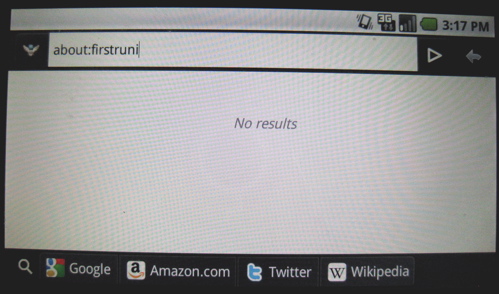
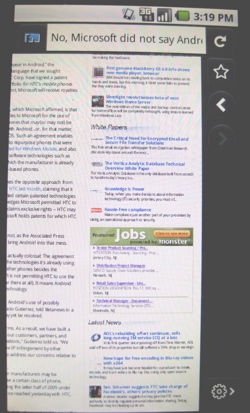
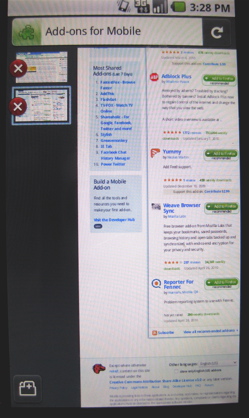
    So when Mozilla officially rolled out its first public version of the Fennec mobile browser for Android with various warnings that it is a very early “pre-alpha,” with experimental features that could require hard resets, I thought I knew what I was in for.

    Despite those warnings, Mozilla has actually created a version of Fennec for Android 2.0+ that is relatively stable for something so new. I used it all day today and it never crashed.

    Now, we’ve tested Fennec since it was only an Alpha release on Maemo in late 2008; and the first beta of that version launched just over one year ago, so Fennec is not exactly a brand spanking new concept here. But according to Mozilla’s Vladimir Vukicevic, “About three months ago we had nothing working or even building on Android.”

    The problem is that it’s stable like a tank…meaning it’s also big and slow.

    “Memory usage of this build isn’t great — in many ways it’s a debug build, and we haven’t really done a lot of optimization yet,” Vukicevic said yesterday. “This could cause some problems with large pages, especially on low memory devices like the Droid.”

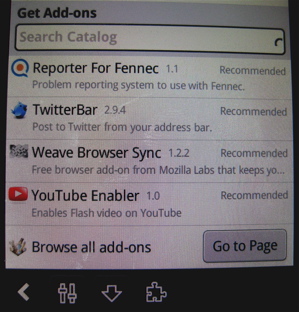
    Fennec for Android suggested add-ons

    This alpha build consumes a giant 31.67 MB of space, where the Opera 5 Mini Beta takes up only 1.8 MB. With Mozilla’s trademark add-ons, Fennec can grow to even greater size. And yes, it is quite slow.

    That said, there are a few major things to note about Fennec for Android 2.0.

    Design

    Blank home screen, landscape, with add-ons, Fennec Alpha on Android

    When you open Fennec, all you get is the multi-purpose address bar across the top which has the Wyld Stallyns-esque title of “Awesome Bar.” It can be a search field, address bar, or even a status update field with the proper add-ons.

    The navigation and favorites bar runs down the far right side of the browser.

    To access either browser tabs or the navigation buttons, you have to scroll to the far left or far right of the screen. When you first load a page, it’s zoomed out to fit the browser so these controls are just out of view and accessible with a slight drag of the finger. But when you zoom in, it takes a bit more pulling to get to the sides. Zooming is quite unreliable at this point and it is so far only accessible by erratically double-tapping. On the Motorola Droid, the “back” and “menu” buttons have no effect on the browser at all, and the Alt key does not change the text over to the secondary keyboard. There is no soft key support on the Droid. Nexus One users can expect the virtual keyboard, however.

    Browser tabs run down the left side of the screen on Fennec for Android

    Weave Sync

    This browser add-on for Firefox is essentially the same as Opera Link. It takes your bookmarks, saved passwords, open tabs, and browsing history and keeps them synched and encrypted between your desktop and your mobile device. With the Fennec Alpha, this is enabled, but as an experimental feature.

    Fennec Alpha for Android Settings

    Though Weave Sync is problematic and perhaps the number one complaint about the alpha thus far, it can be made to work.

    HTML 5

    I spent a good deal of time on HTML5demos this afternoon with Fennec, and found that it supports the following HTML 5 tags: geolocation, canvas, offline, events, and postMessage (both same domain and cross-domain) like Android’s native browser.

    An SQL database query repeatedly hangs, where Android’s native browser loads it up quite quickly.

    Interestingly, though, Fennec supports the contentEditable tag which enables rich in-browser text editing. This was heretofore unsupported by any of Android’s available browsers.

    It’s Android or Nothing

    Now that Maemo has morphed into Meego, and development on Firefox for Windows Mobile has been halted, the only mobile platform that Mozilla is actively supporting with Fennec is Android. Tristan Nitot, president of Mozilla Europe, said versions for iPhone and BlackBerry are not likely to ever come to fruition, and development on Symbian platforms is uncertain at present.

    Fennec for Android alpha download link

    To download Mozilla’s Fennec alpha directly onto your Android 2.0+ device, simply scan the QR code above. Custom ROM images are not supported with the present build and only a few Android devices have been thoroughly tested, so compatibility still varies.

    Copyright Betanews, Inc. 2010


    Add to digg
    Add to Google
    Add to Slashdot
    Add to Twitter
    Add to del.icio.us
    Add to Facebook
    Add to Technorati


  • Google’s good news: Microsoft cannibalizes Yahoo search share

    By Joe Wilcox, Betanews

    Microsoft sure is gaining search share fast. Too bad it’s cannibalizing Yahoo rather than gaining on Google.

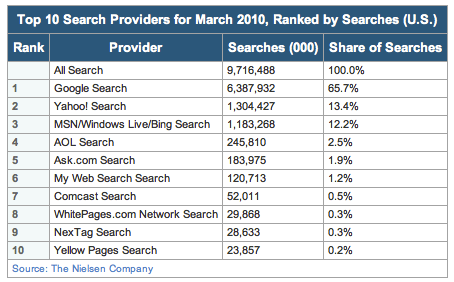
    Today, Nielsen released March 2010 US search share numbers, and, whoa, are they good news-bad news for Microsoft. The good news: Microsoft search share is 12.2 percent. The bad news: Microsoft closed the gap on Yahoo to within 1.2 percent. Yahoo’s search share is 13.4 percent.

    A year ago, these gains would have been great cheering within the hallowed halls of Microsoft’s campus. But Yahoo is Microsoft’s new search partner. The two companies announced the deal, which will eventually hand over responsibility for Yahoo search to Microsoft, in July 2009. Cannibalization is not good for Yahoo, either. How can Yahoo make gobs of money from its Microsoft-powered search deal if Microsoft gobbles up search share?

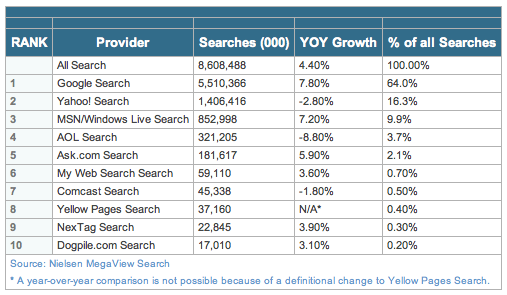
    How much Pac-Man-like gobbling is that? According to Nielsen, in April 2009, Yahoo’s US search share was a healthier 16.3 percent, while Microsoft had 9.9 percent share. Microsoft’s month-on-month search share increases — cannibalization of Yahoo share — are much stronger in 2010 than December 2009. More problematic, Microsoft gains are taking nothing from Google. In April 2009, Microsoft and Yahoo had combined search share of 26.2 percent. March 2010: 25.6 percent. Google: 64 percent in April 2009 and 65.7 percent in March 2010. But the gains aren’t all cannibalization. Microsoft also appears to be nipping search share from some smaller search engines.

    For more perspective, Nielsen also released number of searches. Americans conducted 9.72 billion searches last month. Microsoft-Yahoo combined, for March 2010: About 2.5 billion searches. Google: 6.5 billion. Microsoft-Yahoo combined April 2009: 2.26 billion searches. Google: 5.5 billion searches. So searches at Microhoo were lower 11 months earlier, but search share higher.

    March 2010 US Search Share

    Oh, yeah, Bing advertising is helping Microsoft to convert search users. Too bad, most are coming from Microsoft’s new search partner and not its arch rival. In July 2009 post “Microsoft-Yahoo deal is Google’s Christmas-in-July present,” I warned that the search agreement would likely lead to search cannibalization. But even before the deal is complete, Microsoft is gobble, gobble, gobbling share because of its marketing, branding and search service success with Bing.

    Cannibalization already could be seen when the companies announced the search agreement. I wrote in July 2009:

    Further cannibalization is inevitable, and there is likely to be heaps of it. Matters would have been worse had Microsoft bought Yahoo and consolidated all search under a single brand. My prediction: Combined Microsoft-Yahoo share will be less than 20 percent within 12 months of the deal’s closing — and that’s my being somewhat generous so that I don’t get totally flamed in comments.

    Microsoft already is reaping benefits from its newfound search share. During fiscal 2010 third quarter, online advertising revenue rose 19 percent, or by $81 million, to $502 million. The company attributed most of the advertising sales increases to search share gains.

    April 2009 Search Share

    Increasing search cannibalization creates quandaries for both Microsoft and Yahoo. Microsoft is in process of logistically assuming responsibility for Yahoo search, with end of calendar year the target for US completion. But at the rate Yahoo is bleeding search share to its partner, will Microsoft end up paying too much to integrate with Yahoo search and for TAC (traffic acquisition costs)? Then there is Yahoo’s responsibility for premium search advertising for both services to consider.

    Then there is the larger question of whether Microsoft should have cut a deal with Yahoo at all. Perhaps the money would have been better spent improving Bing and buying more advertising. After all, Microsoft has made remarkable gains organically.

    More number crunching is warranted. This post is late-day posting. I want to go through the numbers fresh and also ask for analyst comments about the overall value or cost to either Microsoft or Yahoo.

    Copyright Betanews, Inc. 2010


    Add to digg
    Add to Google
    Add to Slashdot
    Add to Twitter
    Add to del.icio.us
    Add to Facebook
    Add to Technorati