Blog

  • Peter Boockvar: Greece Crisis Marks The Unwind Of The Largest Monetary Easing In History

    cash dollars money

    Even if the Greece crisis doesn’t turn into a major crisis for all of Europe and its banks, the economic implications are still signifianct, as Miller Tabak’s Peter Boockvar nicely spells out in a morning note:

    Most European bond markets remain under pressure again. Whatever happens with
    Greece now, the cost of capital is going up for most of the Euro region and that
    has implications for companies and consumers that borrow in these markets.

    Death, taxes and easy money, the only certainties in life. Actually the last one
    is not always the case but REAL interest rates have been negative for 5 of the
    last 8 years and the FOMC will tell us today that they will remain that way for
    an ‘extended period.’ They will tell us that inflation is benign, even as the
    Journal of Commerce index is up 9% from the last meeting at the highest level
    since Aug ’08 and just 7% from a record high. There will be some coffee talk on
    selling their large pile of MBS at some point. Unwinding the largest monetary
    easing in the history of the world will not be easy and the longer the Fed
    waits, the more rough it will be due to the misallocation of capital they have
    created, again
    . II: Bulls 54 v 53.3, highest since Dec ’07, Bears 18 v 17.4

    Join the conversation about this story »

  • Indonesian Taps Volcano Power


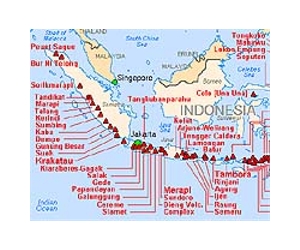
    Sometimes one needs to be reminded of the obvious.  Indonesia not only has a massive geothermal energy resource it is also within easy reach of over half the world’s population by the new super conducting power lines we are soon to build.
    One internal line simply following the islands of Sumatra and Java taps the resource and a single short sub sea link to Thailand connects it to a future land line system.  That could be built through Burma to access India and China both.  It does not have to follow valleys.
    While building a system in the USA is necessary to develop a future electric car economy it is hugely more important in this region of the world were power access is far from been universal     They have ten times the population not nearly the opportunities in hydro and are forced to otherwise rely on coal and nuclear.
    Present plans are ambitious not need to be even more ambitious.  Coal plants are cheap and easy if you are in a hurry, but geothermal is a permanent solution that is good forever.
    Also it would provide Indonesia an additional source of foreign exchange beside its depleting oil.
    Indonesia aims to tap volcano power
    by Staff Writers

    Kamojang, Indonesia (AFP) April 24, 2010

    Indonesia has launched an ambitious plan to tap the vast power of its volcanoes and become a world leader in geothermal energy, while trimming greenhouse gas emissions.

    The sprawling archipelago of 17,000 islands stretching from the Indian to the Pacific Oceans contains hundreds of volcanoes, estimated to hold around 40 percent of the world’s geothermal energy potential.

    But so far only a tiny fraction of that potential has been unlocked, so the government is seeking help from private investors, the World Bank and partners like Japan and the United States to exploit the power hidden deep underground.

    “The government’s aim to add 4,000 megawatts of geothermal capacity from the existing 1,189 megawatts by 2014 is truly challenging,” Indonesian Geothermal Association chief Surya Darma said.

    One of the biggest obstacles is the cost. Indonesia currently relies on dirty coal-fired power plants using locally produced coal. A geothermal plant costs about twice as much, and can take many more years in research and development to get online.

    But once established, geothermal plants like the one built in Kamojang, Java, in 1982 can convert the endless free supplies of volcanic heat into electricity with much lower overheads — and less pollution — than coal.
    This is the pay-off the government is hoping to sell at the fourth World Geothermal Congress opening Sunday on the Indonesian resort island of Bali. The six-day event will attract some 2,000 people from more than 80 countries.

    “An investment of 12 billion dollars is needed to add 4,000 MW capacity,” energy analyst Herman Darnel Ibrahim said, putting into context the recent announcement of 400 million dollars in financing from lenders including the World Bank and the Asian Development Bank (ADB).

    “Field exploration can take from three to five years, suitability studies for funding takes a year, while building the plant itself takes three years,” he added.

    If there is any country in the world where geothermal makes sense it is Indonesia. Yet despite its natural advantages, it lags behind the United States and the Philippines in geothermal energy production.

    Southeast Asia‘s largest economy and the world’s third biggest greenhouse gas emitter exploits only seven geothermal fields out of more than 250 it could be developing.

    The case for geothermal has become stronger with the rapid growth of Indonesia‘s economy and the corresponding strain on its creaking power infrastructure.

    The archipelago of 234 million people is one of the fastest growing economies in the Group of 20 but currently only 65 percent of Indonesians have access to electricity.

    The goal is to reach 90 percent of the population by the end of the decade, through a two-stage plan to “fast-track” the provision of an extra 10,000 MW by 2012, mostly through coal, and another 10,000 MW from clean sources like volcanoes by 2014.

    President Susilo Bambang Yudhoyono’s pledge to slash greenhouse gas emissions by 26 percent against 2005 levels by 2020 has also spurred the push to geothermal.

    Many of the best geothermal sources lie in protected forests, so the government aims to allow the drilling of wells inside conservation areas while insisting that the power plants themselves be outside.
    Geothermal fans welcomed the recent completion of negotiations between a consortium of US, Japanese and Indonesian companies and the state electricity company, Perusahaan Listrik Negara, over a 340 MW project on Sumatra island.

    The Sarulla project will be Indonesia‘s second biggest geothermal plant, after the Wayang Windu facility in West Java.

    “The Sarulla project is a perfect example of how Indonesia can realise its clean energy and energy security goals by partnering with international firms,” US Ambassador Cameron Hume wrote in a local newspaper.

    Several firms such as Tata and Chevron have submitted bids to build another geothermal plant in North Sumatra, with potential for 200 MW.
  • Canada parliament can demand uncensored detainee documents from government

    [JURIST] Canadian House of Commons Speaker Peter Milliken ruled Tuesday that members of Parliament have the right to seek uncensored Afghan detainee documents from the government of Prime Minister Stephen Harper. The historic ruling is a significant victory for opposition parties over Harper’s minority Conservative government. In his ruling, Milliken said:
    The Chair must conclude that it is within the powers of the House of Commons to ask for the documents sought in the December 10 order it adopted. Now, it seems to me, that the issue before us is this: is it possible to put into place a mechanism by which these documents could be made available to the House without compromising the security and confidentiality of the information they contain? In other words, is it possible for the two sides, working together in the best interest of the Canadians they serve, to devise a means where both their concerns are met? Surely that is not too much to hope for.Milliken gave both sides two weeks to reach a compromise. If no agreement can be reached, members of Harper’s cabinet, including the ministers of defense, foreign affairs, and justice, could be held in contempt of Parliament. Although the Harper government has indicated its general willingness to comply with the Speaker’s ruling, it might yet pass the general issue of executive versus legislative authority on to the Supreme Court of Canada as a constitutional reference question for its formal determination. The release of the detainee documents has been highly controversial. Last month, Canadian Justice Minister Rob Nicholson announced that former Supreme Court justice Frank Iacobucci would review documents detailing Canadian forces’ handing of Afghan detainees and the terms of their transfer to Afghan authorities before the documents would be released to Parliament. Nicholson indicated that Iacobucci would report back to Nicholson, who would determine the conditions of disclosure. In December, Parliament passed an order to compel Harper to release the unredacted documents after the Canadian government released more than 40 redacted e-mails sent by Canadian diplomat Richard Colvin to then-foreign minister Peter MacKay raising concerns about the torture of transferred detainees. The release of the e-mails came after Colvin testified before a Commons committee in November that all enemy combatants captured in 2006 and 2007 by Canadian forces were likely tortured upon their transfer to Afghan authorities.

  • A focus on Houston as GE’s annual meeting kicks off

    GE’s 2010 annual shareholders meeting is getting underway this morning at 11 a.m. ET in Houston, Texas, which is home to an array of GE’s energy businesses. The theme of the meeting is “Renewal,” and it’s an opportunity for Chairman and CEO Jeff Immelt to underscore that the business environment for GE continues to improve and that the 2010 framework outlined for the company remains achievable with upside potential. It’s also a chance for GE’s leadership and board members to hear directly from shareowners and get direct feedback about the company’s direction, business performance, and opportunities for growth. Click here to see a live webcast of the remarks made by Jeff and Keith Sherin, Vice Chairman and CFO. A rebroadcast will also be available later in the day.


    Feeling energized: GE has nearly doubled its size in Houston in recent years through the acquisitions of PII Pipeline Solutions in 2002 (which moved to Houston); VetcoGray in 2007, and Hydril Pressure Control in 2008 (both based in Houston originally). More than one-third of the world’s electricity is generated by GE technology. The photo above shows a large generator stator, which is the stationary part of a rotor, being checked. A turbine supplies the mechanical energy that feeds the generator.

    With Houston in the spotlight this week, GE’s presence in the region’s energy sector is on display for the 700 shareholders expected to attend the meeting. GE currently employs more than 4,100 in the greater Houston area in eight businesses: Aeroderivative Gas Turbines, Jenbacher Gas Engines, Gasification, Oil & Gas, Water, Optimization and Control, Power Services, and Consumer and Industrial. As Jeff wrote in this year’s annual report, the continuous research underway in new technologies in these businesses is one of the key drivers of GE’s current, and future, success. “In 2010, we will spend about 5 percent of our industrial revenue on R&D,” he wrote. “We have filed 20,000 patents this decade. We have nearly 40,000 engineers and scientists around the world.” That R&D focus can be seen in areas such as wind power, where a $1 billion investment has led to $29 billion in orders.


    Healthy Houston: The grant will “allow us to increase access and improve our services for the more than 33,000 patients and almost 130,000 visits we have annually,” said Legacy Community Health Services executive Katy Caldwell, pictured above with Jeff Immelt at the press conference.

    Building on GE’s long presence in the city, the GE Foundation — which is the philanthropic organization of GE — and the GE Corporate Diversity Council yesterday announced the award of $1.25 million in total to five Houston community health centers toward the goal of increasing access to primary care for uninsured and underserved populations across the city.

    The grants are part of the GE Developing Health Program’s nationwide, 10-city healthcare effort that will provide $25 million in grants over three years. The grant announced yesterday in Houston is the largest grant to date for the Developing Health Program and follows similar ones made in New York City and Milwaukee.

    Each of the five health centers will receive $250,000 — and GE employees from the area will also volunteer their time. The unique approach ensures that the health centers also benefit from GE’s expertise in areas such as process improvement and business management. “This program and the volunteers supporting it are a living example of GE’s healthymagination strategy to help change the world’s approach to healthcare by touching more lives and improving quality of care,” said Mike Barber, VP, GE healthymagination.

    In the video below, we’ve combined eight clips featuring the GE team and leaders of the clinics receiving the grants:


    * Read “Twenty thousand patents this decade, and counting… “ on GE Reports
    * Read the Developing Health grant announcement
    * Learn more about Developing Health
    * Learn more about the sister program, Developing Health Globally
    * Visit GE’s Annual Report website
    * Read Energy stories on GE Reports
    * Read “Milwaukee clinics upping access with new grants” on GE Reports
    * Watch a video: “Developing Health: A clinic grows in Brooklyn” on GE Reports

  • Apple Worldwide Developers Conference 2010 Starts On June 7 [Apple]

    The Apple Worldwide Developers Conference 2010 will start on June 7 in San Francisco. Five days of endless code orgies and hands-on sessions for iPhone OS 4 and Mac OS X. No word on any possible Steve Jobs’ keynote yet. More »


  • A Week Ahead Of Election, UK PM Gordon Brown Makes Horrible Gaffe Caught On Camera

    Gordon Brown Head In Hands

    A week before the election, UK PM Gordon Brown has made a horrible, career-ruining gaffe caught on camera.

    Basically, after doing a little street-level chit-chat with an old lady, he gets into his limo and calls the woman bigoted, not realizing his mic was still on. Here’s the video. The bigoted line comes at the very end.

    Photo from Tim Montgomerie, editor ConservativeHome.com

    Join the conversation about this story »

  • First Solar Buys Solar Developer NextLight Renewable Power

    Thin-film PV maker First Solar has acquired NextLight Renewable Power, a developer of utility-scale power project for $285 million.  This latest acquisition  significantly bolsters First Solar’s project pipeline, adding some 1,100 megawatts of  solar projects that are at various stages of development.

    NextLight is backed by Energy Capital Partners, a clean energy-focused private equity fund based in Short Hills, N.J., founded by former Goldman Sachs energy banker Doug Kimmelman.

    The Acquisition grows First Solar U.S. exposure at a time when European markets, in particular Germany and Spain, which account for a majority of First Solar’s revenues, are tightening key subsidies. Germany is set to cut its solar power feed-in tariffs by some 10 percent and the Spanish government is considering scaling back its own subsidy program by as much as 40 percent.

    NextLight, based in San Francisco, has about 570 megawatts of solar power under development that are backed by singed, long-term power purchase agreements (PPA). Including Agua Caliente, a 290 megawatts facility located in Arizona’s Yuma County, which signed a PPA with Pacific Gas and Electric (PG&E) last fall.  More recently NextLight’s Silver State solar project, located on Bureau of Land Management land in Nevada, signed a 25-year PPA with NV Energy. The Silver State project is slated to begin operating in May of 2011.

    NextLight also has 530 megawatts of additional PV  power projects in various stages of development, according to the press release announcing the deal.

    In January  First Solar acquired a project pipeline comprised of utility-scale  solar power projects to be developed in California and across the U.S. Southwest from the Edison Mission Group (EMG), a unit of Edison International.  And a little more than a year ago it bought project developer OptiSolar in an all stock transaction worth $400 million.

    The acquisition will allow First Solar to monetize its PV panel production by securing sales contracts with  NextLight Projects.  First Solar, which has repeatedly shown that it does not want to be a plant operator, will likely flip the Nextlight plants when they near completion.

    Over the past year First Solar sold a 21-megawatt solar project — backed by a long-term PPA with Southern California Edison in Blythe, Calif., to NRG Energy. It also sold a 20-megawatt solar farm in Ontario to natural gas pipeline operator Enbridge for about C$100 million ($93.14 million). The project is backed by a 20-year PPA with the Ontario Power Authority.

    For this year Tempe, Ariz. First Solar says it expects to generate revenues ranging between $2.7 billion – $2.9 billion in 2010, which is ahead of analysts’ estimate of $2.4 billion.

  • GPS to Revolutionize Aviation…Finally

    “Internet to show me where. GPS to get me there.

    Everywhere there’s satellites. Oh, I live the simple life.”

    — lyrics from A Simple Life

    When a song by country/bluegrass singer, Ricky Skaggs includes a reference to GPS, it seems pretty clear that this amazing satellite technology, developed initially for the military, has become a part of our every day lives.

    GPS technology has been in cars for years — now most advanced cell phones are GPS capable, but you might be surprised to know that the nation’s air traffic control system is only now starting to use GPS in a sophisticated way.

    Later today, I will board a plane at the FAA’s William J. Hughes Technical Center near Atlantic City, New Jersey to witness first hand new technology that will revolutionize aviation — making the skies safer — while making travel more efficient and less time consuming. It should save airlines fuel over time, thereby reducing the carbon footprint of large commercial jets.

    The FAA calls this ADS-B (that stands for Automatic Dependent Surveillance Broadcast). It’s the underlying core technology of the FAA’s Next Generation Air Transportation System. Once tested, the air traffic controller will be able to reduce aircraft separation from five miles to three. Planes equipped with ADS-B technology will be able to know their location within three meters — and, perhaps more importantly, see exactly where other planes are. I wonder if the ADS-B systems has one of those pleasant female voices like the GPS system in my car? I call her Maggie.

    Ground systems should be installed around the country by 2013 and the FAA is proposing that all airplanes be equipped with ADS-B avionics by 2020. Some airlines have already started installing the gear. According to FAA administrator, Randy Babbitt, this new technology “is a tremendous leap forward in transforming the current air traffic control system.”

    It’s already up and running in Philadelphia, which sits smack dab in the middle of some of the most congested airspace in the country.

    This plane I’ll be flying on is the FAA’s ADS-B testbed . I’m told it is equipped with a mock cockpit and video screens. Being the techno-geek I am, I’m certain I’ll be all agog by the time I land. It doesn’t take much to make me all agog, however.

    Be sure to watch for my reports Wednesday afternoon on Fox News Channel.  Also check back to this blog for updates!

  • Poynt turns your BlackBerry into a social tool

    When we released our top BlackBerry apps list a few weeks ago, we named a number of applications that we haven’t gotten to featuring on the site. That’s going to happen with a list that prolific. One of those applications, Poynt, just got an upgrade, so it seems like as good a time as any to feature it. Poynt is an excellent tool for any BlackBerry user. It taps the power of location, using GPS or cell tower data to search local businesses, restaurants, and more. It takes this a few steps further, too.

    (more…)

  • Emoticon Stamp Handles 99.9% of Interpersonal Communication Just Fine [Culture]

    Staring ruefully at the stamp, Joe realized, even the 2,000 emoticons couldn’t ask her the simplest question, “Will you marry me?” Instead, she took his ink-stained hand into hers, like coffee into a porcelain cup. She knew. [JapanTrendShop /OhGizmo!] More »


  • SportyPal Indoor Now on the Web

    SportyPal Android App now has SportyPal Indoor available on the Web, allowing you to track your sport life in one place.

    SportyPal Indoor is a new web application that allows you to track all your indoor sports activities like gym workouts, basketball, football etc. with the possibility to add your own type of exercises. Now you can combine our SportyPal outdoor and SportyPal indoor web applications to track all of your sport activities at one place.

    Key Features include:

    • Privacy control. Share your workouts with everyone, only your friends or keep them for yourself.
    • Flexible Auto Calories Suggestion. SportyPal indoor calculates and suggests the burned calories for you (For SportyPal defined exercises).
    • Easy and fast setup of your custom exercises. Easy to create and define your own exercises.

    For those who like to stay fit going to the gym, you can track workouts via the Android App. Then view results at home via SportyPal Indoor!

    Algadon Free Online RPG. Fully Mobile Friendly.

  • Vw in talks with several battery manufacturers for its upcoming electric car

    Vw Up ConceptAs Volkswagen AG searches for companies to supply it with electric-car batteries, it is reportedly in talks with a Robert Bosch GmbH and Samsung SDI Co. joint venture and LG Chem Ltd.

    In an interview, Ulrich Hackenberg, head of Volkswagen brand development, said that the company is keeping its options open and is expected to study the development of various battery systems. However, Hackenberg didn’t say when the deal with SB LiMotive Co. and LG Chem, the largest South Korean chemical maker, will be signed. Hackenberg added that mass-produced battery cells aren’t likely to start delivery until one or two years from now. The list of companies that VW is said to have been cooperating with include makers of rechargeable batteries: BYD Co., the Chinese carmaker supported by billionaire Warren Buffett; Sanyo Electric Co.; and Toshiba Corp. Hackenberg admitted though that Japanese suppliers “are still a step ahead” of BYD. VW intends to begin manufacturing battery-powered cars in China as early as 2013. VW also said that it wants to add 1.6 billion euros ($2.1 billion) to its investment to create more models and two new facilities in China, raising total investments in China to 6 billion euros.

    [via autonews – sub. required]

    Source: Car news, Car reviews, Spy shots

  • US Cellular Tease HTC Desire Details And Release Window

    DesirableOn their Facebook page today, US Cellular today teased an “around July” release for the HTC Desire (previously known as the Bravo).

    The device, in case you didn’t know, is basically a Nexus One in Sheep’s (or HTC’s) Clothing (which includes Sense UI), but with a few differences.

    There is a little more RAM on the Desire (presumably to fit in the extra bits of Sense UI), and no docking ports, or second-mic-noise-cancelling-tech.

    The buttons on the desire are also “physical” (as opposed to capacitive), and there is an optical trackpad, rather than a trackball (which is good, because, like old mice balls of yore, the trackball on my Hero is already wearing out. Or getting gunked up. I don’t really know. But it’s not working so great anymore… aaaanywhooooo).

    The original announcement is included below:

    Hungry for more Android info? How about a peek at some specs for the gorgeous HTC Desire including a 3.7″ AMOLED touchscreen display, 5 MP camera with LED flash, Wi-Fi, GPS, Android Market and an 8 GB microSD card. How about news of a launch date around July? We’ll need to make sure our rigorous testing is complete before you can get your hands on this sweet phone. Stay tuned here for more exclusive Android updates!

    [via Phone News]


  • Home Sensor Startup Snapped Up

    Technology Review has an article on Belkin’s purchase of Zensi, a maker of sensors to track domestic energy and water usage (which would be a useful supplement to the data gathered by smart meters, allowing more fine grained understanding and tuning of household power consumption) – Home Sensor Startup Snapped Up.

    If you knew how much electricity your plasma television used or how much water your dishwasher drank at different times of day, would you change your habits to conserve more and spend less on utilities? Researchers at the University of Washington, Duke University, and Georgia Tech believe that you might. Several years ago they invented sensors that could track the electricity consumption and water usage throughout an entire building via a single point on each system. In 2008, the researchers founded a company called Zensi to commercialize the technology, and last week, they sold that company to Belkin, an electronics hardware manufacturer.

    A line of easy-to-install sensors for homes could be commercially available within the next year, says Shwetak Patel, professor of computer science and engineering at the University of Washington, and co-inventor of Zensi’s sensors. Data from such sensors could lead to itemized utility bills–and customers who are more aware of the energy sinks in their homes, he says.

    Right now it’s impossible for a consumer to get an accurate gauge of energy use without deploying numerous expensive sensors. But cost reductions in key technologies have made the concept of watching every device in a home more feasible, says Ivo Steklac, executive vice president of sales and strategy at Tendril, a Boulder, CO-based, energy-monitoring startup. The key technologies are high-speed analog-to-digital conversion devices, digital signal processing algorithms, low-power communications, and ubiquitous Internet access and connectivity, Steklac says.

    The concept behind Zensi’s technology is simple: a single sensor is plugged into a wall outlet, where it “listens” to the high-frequency electrical noise produced in the wiring when different devices are turned on. Each electrical device has a signature that is unique to the kind of device it is, its brand, and its location within a house. This information, in turn, reveals its energy consumption. MIT professor Fred Schweppe, and others tested a similar idea more than a decade ago. In the case of plumbing, a sensor is connected to the hose spigot on the side of a house. When a toilet is flushed or a sink is turned on, the sensor detects the characteristic change in pressure.

    Data from the electricity and water sensors is sent via the Internet to a base station for analysis. The algorithms differentiate between different devices and calculate electricity and water usage.


  • Dividend growth prospects favour U.S. banks over Canada

    With dividend yields on Canadian banks stocks in the 3.2% to 4.3% range, they are roughly three times greater than selected U.S. peers. That puts Canada in a very favourable position given that long-term historical levels have dividends on both sides of the border at similar levels.

    All other things being equal, the situation dramatically favours Canadian bank valuations, according to Brad Smith, analyst at Stonecap Securities. Of course, all other things are not equal.

    He explains that the bulk of the yield differential that has developed in the past few years is a direct result of a collapse in earnings among U.S. banks. This has forced them to recapitalize and dramatically cut dividend payout rates. In fact, from a long-run average of almost 45%, payout ratios at U.S. banks has plunged to just over 20%. During the same period, payout ratios for Canadian bank stocks have risen from the 30% range to approximately 50% these days.

    “While the maintenance of payout ratios by domestic banks reflects the well documented capital and credit profile strength from which they entered the recent period of global credit stress, it also dictates that future dividend growth will to a large extent be tied to earnings growth,” Mr. Smith told clients.

    Assuming that U.S. banks can grow their earnings at comparable rates to their Canadian counterparts, which is somewhat conservative given the potential for the U.S. economy to recovery from a much deeper recession, and assuming that banks on both sides of the border see a return to historically normalized payout ratios, the analyst expects Canadian bank dividends will grow at a compound rate of just under 3%. Meanwhile, U.S. bank dividends could grow at a compound rate of just over 20%.

    So while current yields favour Canadian bank valuation, the potential for rapid dividend growth amid a North American economic recovery strongly favours forward returns for U.S. banks.

    “This view intensifies if the one believes that a recovery will be accompanied by a general increase in interest rates,” Mr. Smith said.

    Jonathan Ratner

  • Sandra Bullock Divorce Underway; Adopting Baby Boy Louis Bardo [PEOPLE Magazine Interview]

    Well — this is big news.

    In this week’s new issue of PEOPLE Magazine — on newsstands everywhere Friday — Oscar-winning actress Sandra Bullock confirms her plans to divorce husband Jesse James in the wake of a headline-grabbing cheating scandal and introduces the world to the new love of her life – her adopted son Louis Bardo.

    (She selected that name because she heard Louis Armstrong’s song “What A Wonderful World” playing in her head when she first saw him.)

    Visit msnbc.com for breaking news, world news, and news about the economy

    Sandra — who won an Oscar for her portrayal of an adoptive mom in the inspirational hit The Blind Side –reveals that she and her estranged husband adopted the baby boy in January and that, in the wake of allegations of James’ infidelity, she has filed for divorce and plans to raise the 3 1/2-month old child as a single mother.

    Sandra and Jesse began the adoption process four years ago and brought Louis home at the beginning of th year but decided to keep the news to themselves until after the Oscars, where Sandra won the Best Actress gong for her performance in The Blind Side.

    Their family, including Jesse’s children Sunny, 6, Jesse Jr., 12, and Chandler, 15 were instrumental in keeping the adoption news under wraps until now.


  • Eyeless in Gaza

    TomDispatch has an article by Noam Chomsky which makes an interesting link between the Israeli naval blockade of Gaza and the extraction of gas offshore (and also gives one time Australian foreign minister Gareth “Biggles” Evans a serve while he is at it) – Eyeless in Gaza.

    It cannot be too often stressed that Israel had no credible pretext for its 2008–9 attack on Gaza, with full U.S. support and illegally using U.S. weapons. Near-universal opinion asserts the contrary, claiming that Israel was acting in self-defense. That is utterly unsustainable, in light of Israel’s flat rejection of peaceful means that were readily available, as Israel and its U.S. partner in crime knew very well. That aside, Israel’s siege of Gaza is itself an act of war, as Israel of all countries certainly recognizes, having repeatedly justified launching major wars on grounds of partial restrictions on its access to the outside world, though nothing remotely like what it has long imposed on Gaza.

    One crucial element of Israel’s criminal siege, little reported, is the naval blockade. Peter Beaumont reports from Gaza that, “on its coastal littoral, Gaza’s limitations are marked by a different fence where the bars are Israeli gunboats with their huge wakes, scurrying beyond the Palestinian fishing boats and preventing them from going outside a zone imposed by the warships.” According to reports from the scene, the naval siege has been tightened steadily since 2000. Fishing boats have been driven steadily out of Gaza’s territorial waters and toward the shore by Israeli gunboats, often violently without warning and with many casualties. As a result of these naval actions, Gaza’s fishing industry has virtually collapsed; fishing is impossible near shore because of the contamination caused by Israel’s regular attacks, including the destruction of power plants and sewage facilities.

    These Israeli naval attacks began shortly after the discovery by the BG (British Gas) Group of what appear to be quite sizeable natural gas fields in Gaza’s territorial waters. Industry journals report that Israel is already appropriating these Gazan resources for its own use, part of its commitment to shift its economy to natural gas. The standard industry source reports:

    “Israel’s finance ministry has given the Israel Electric Corp. (IEC) approval to purchase larger quantities of natural gas from BG than originally agreed upon, according to Israeli government sources [which] said the state-owned utility would be able to negotiate for as much as 1.5 billion cubic meters of natural gas from the Marine field located off the Mediterranean coast of the Palestinian controlled Gaza Strip.

    “Last year the Israeli government approved the purchase of 800 million cubic meters of gas from the field by the IEC…. Recently the Israeli government changed its policy and decided the state-owned utility could buy the entire quantity of gas from the Gaza Marine field. Previously the government had said the IEC could buy half the total amount and the remainder would be bought by private power producers.”

    The pillage of what could become a major source of income for Gaza is surely known to U.S. authorities. It is only reasonable to suppose that the intention to appropriate these limited resources, either by Israel alone or together with the collaborationist Palestinian Authority, is the motive for preventing Gazan fishing boats from entering Gaza’s territorial waters.

    There are some instructive precedents. In 1989, Australian foreign minister Gareth Evans signed a treaty with his Indonesian counterpart Ali Alatas granting Australia rights to the substantial oil reserves in “the Indonesian Province of East Timor.” The Indonesia-Australia Timor Gap Treaty, which offered not a crumb to the people whose oil was being stolen, “is the only legal agreement anywhere in the world that effectively recognises Indonesia’s right to rule East Timor,” the Australian press reported.

    Asked about his willingness to recognize the Indonesian conquest and to rob the sole resource of the conquered territory, which had been subjected to near-genocidal slaughter by the Indonesian invader with the strong support of Australia (along with the U.S., the U.K., and some others), Evans explained that “there is no binding legal obligation not to recognise the acquisition of territory that was acquired by force,” adding that “the world is a pretty unfair place, littered with examples of acquisition by force.”

    It should, then, be unproblematic for Israel to follow suit in Gaza.

    A few years later, Evans became the leading figure in the campaign to introduce the concept “responsibility to protect” — known as R2P — into international law. R2P is intended to establish an international obligation to protect populations from grave crimes. Evans is the author of a major book on the subject and was co-chair of the International Commission on Intervention and State Sovereignty, which issued what is considered the basic document on R2P.

    In an article devoted to this “idealistic effort to establish a new humanitarian principle,” the London Economist featured Evans and his “bold but passionate claim on behalf of a three-word expression which (in quite large part thanks to his efforts) now belongs to the language of diplomacy: the ‘responsibility to protect.’” The article is accompanied by a picture of Evans with the caption “Evans: a lifelong passion to protect.” His hand is pressed to his forehead in despair over the difficulties faced by his idealistic effort. The journal chose not to run a different photo that circulates in Australia, depicting Evans and Alatas exuberantly clasping their hands together as they toast the Timor Gap Treaty that they had just signed.


  • “Anonymous Speech” @ High Court Wednesday

    A free speech fight that was part of a recent battle in Washington State over a controversial civil union law will be heard by the Supreme Court Wednesday in a case that examines the breadth of “anonymous speech” protection.

    The high court has often ruled that the sweeping reach of the First Amendment’s speech protection also covers the rights of people to speak under the cloak of anonymity..

    Wednesday’s case presents the justices with the unique question of whether people who sign a petition forcing a state-wide referendum are entitled to keep their identities under wraps.

    Last May, lawmakers in Olympia passed a law expanding the rights of same-sex partners. In response, a group called Protect Marriage Washington circulated a petition forcing the issue onto the November ballot. Washington, similar to other states, allows voters to overturn state laws by referendum.

    The state requires a sufficient number of names on the referendum petition to place the matter before the voters. Protect Marriage Washington submitted more than 138,500 names to the Secretary of State who verified the petition and placed the issue on that November’s ballot.

    During the petition gathering process, several groups supportive of the civil union measure announced their intentions to use a state open records law to obtain the petition list and publish those names on the internet. Referendum supporters expressed concern that the people who signed the petition could be subject to retributive attacks. They pointed to violence associated with the contentious fight over California’s Proposition 8 and went to court to stop the names from becoming public.

    A trial court judge initially enjoined the state from releasing the names but the Ninth Circuit U.S Court of Appeals ruled the names should be made public. The lower courts disagreed over the level of First Amendment protection petition signers are entitled.

    Referendum supporters argue an abridgement of their ability to remain anonymous violates “core political speech.” The groups seeking access to the names argue “there is no right, fundamental or otherwise, to secrecy in the legislative process.”

    15 years ago the Supreme Court sided with an Ohio woman who anonymously distributed leaflets opposing a tax hike. In writing for the majority, Justice John Paul Stevens said, “when a law burdens core political speech, we apply ‘exacting scrutiny,’ and we uphold the restriction only if it is narrowly tailored to serve an overriding state interest.”

    The most famous example of anonymous political speech in American speech is the collection of essays now known as the Federalist Papers. Many of those writings were published anonymously by Alexander Hamilton, James Madison and John Jay.

    Coincidently, Wednesday’s case is the last one the justices have scheduled for its current term, thus making it likely that it will be the last one heard by Justice Stevens, who earlier this month announced his retirement effective when the Court begins its summer recess.

    In taking the case, the high court stayed the Ninth Circuit’s disclosure order pending its ruling which is expected in a couple of months. As for the November referendum, Washington voters with a 53% majority decided to uphold the civil union law.

  • Taiwanese solution to soaring house prices: don’t have kids

    The Age has an interesting article on house prices and population growth – Taiwanese solution to soaring house prices: don’t have kids.

    In Taipei the other day, a crane drove up to the front of the Parliament building. It lowered a man sitting in a plastic container shaped like a house, and suspended him in the air in a protest against the high price of real estate. Through a microphone, he urged onlookers to rise up against high housing prices, declaring: ”People without homes, slaves to property, stand up!” …

    This matters because housing is not just an asset like shares or bonds. It is where we live. It’s natural for investors to prefer the security of bricks and mortar. But as governments throughout the region are discovering, it is also natural for people to want to own a home – and to turn against governments that allow prices to soar out of their reach. In Taiwan, the costs have become particularly serious, as we shall see. Their would-be home buyers – ”snails without shells” as they call themselves – have reacted by scrapping the other big expense facing young couples: children.

    At home, the Rudd government last week reversed its 2008 liberalisation of foreign investment rules on real estate, and set up a unit to ensure the rules are obeyed. It also set up a joint working party with the states to ask why housing prices have soared out of reach. But that will work only if it tackles the single biggest cause: the tax-driven growth of rental investors, whose borrowing has grown 30-fold in 20 years, squeezing out home owners. …

    Taiwan has become rich very fast, largely by inching its way into a central role in global IT and communications manufacturing. This year, the International Monetary Fund estimates, its GDP per head will overtake that of its one-time colonial master, Japan. Its economy is almost as big as Australia’s, and growing twice as fast. Yet its new wealth shows only fleetingly amid the grimy, cramped apartments built in earlier, poorer times.

    Taiwan is in the grip of a housing crisis worse than ours. It is a rich country, but wages and most prices are roughly half the levels here – because the government, like China’s, holds down the exchange rate to keep its manufacturing globally competitive. …

    Why can’t they build more apartments? Because ownership of those grimy old apartment blocks is fragmented among dozens of occupants and investors. To demolish, even to upgrade, a developer must buy them all out, which is prohibitively expensive in time and money. There are classy new apartments on the urban fringe, on greenfields sites, but too few to meet the demand from occupiers and investors. So prices have soared.

    So the snails save hard to buy a shell, and do without other things. That means, above all, they do without children, or with just one child. By 2008, Taiwan’s fertility rate was the lowest in the world. Its women bear on average just 1.05 children over their lifetimes. The cost of housing is not the only reason, but analysts say it is the main one.

    But not having children creates even bigger costs ahead. Right now, Taiwan has 6.8 people of working age for every retiree. But preschools are already closing for lack of children, and the population is set to shrink dramatically. By 2032, demographers project, Taiwan will have just 2.5 potential workers for every retiree – and by 2056, just 1.4. If nothing changes, Taiwan – like China, Japan and Korea – will slowly become economically unviable.

    So far, that hasn’t happened here. But if governments keep subsidising investors to outbid first home buyers and low income earners, it will. Snails want shells. Taiwan – and soon, possibly China – are showing us what else can go wrong when the price of shells soars out of the snails’ reach.


  • Here’s What Germany Did To Make The Greece Crisis Even Worse

    The Greeks are mainly responsible for their current predicament. But the German government has made the country’s situation worse with its lectures and reluctance to provide assistance. Chancellor Angela Merkel is mainly to blame for the fact that German taxpayers now have to suffer.

    “Anything that can go wrong will go wrong.” This piece of wisdom, known as Murphy’s Law, currently applies extraordinarily well to economic policy in the euro zone.

    On the one side there are the Greeks, who clearly still do not have their financial statistics under control and who produce one false report after another about the country’s budget deficit. On the other side are the Germans, who delight in hindering a rapid and unambiguous European response to the Greek crisis — in the process driving the cost of a solution through the roof.

    Continue reading at Der Spiegel >>

    Join the conversation about this story »