Blog

  • Walmart Manager Hates It When You Donate Loss Leaders To Homeless Shelter

    At Walmart, no good deed goes unpunished. Lisa said she tried to buy up a bunch of health and beauty supplies at Walmart to donate to local homeless shelters, and instead got a lecture in economics from the shift supervisor.

    Lisa writes,

    At the beginning of the month I picked up some great deals at Wal-Mart using coupons for my own family. I decided to buy more for the area homeless shelters. Not wanting to “clear the shelf” and inconvenience other shoppers, I special ordered some Crest toothpaste with the manager of health and beauty. I picked it up and about a week later and special ordered some Reach Cinnamon floss,Tide detergent and more Crest. The associates in health and beauty were very friendly and helpful.

    Saturday I was there and a man introduced himself as Paul the shift supervisor. He started going on how I should not be special ordering cost items and using coupons to turn over a profit. I was pretty confused about the profit, special ordering and coupons, as I am very careful to follow all of the coupon rules and had picked up my special orders. I had no idea what a “cost” item was. I asked him about making a profit and he thought I was reselling them. I told him I was not reselling them but donating them.

    He started going on about how the manufacturer does not make a profit when people use coupons and how the store does not make a profit on cost items. I had no idea what a cost item was. He said they were items that were sold at cost and below cost so people will come into the store and to get what they need and then go on to buy other items that they make a profit on. I asked him what items were cost items? He said health and beauty and household good like paper products.

    I am sickened by the greed!!!!

    How absurd. Sounds like something worth reporting to Walmart corporate, and then take you buyin’-n-donating’ business elsewhere.

  • Spy Shots: Audi A7 slinks onto the ‘Ring

    Filed under: , , , ,

    2011 Audi A7 spy shots – click above for high-res image gallery

    Brace yourselves for another round of swoopy coupe time boys and girls. Er, let’s make that swoopy four-door coupe, which is, of course, a contradiction in terms, albeit an increasingly popular one. Of course no one wants to drive the Audi Oxymoron, which is why the brand with the four linked rings is calling their hyper-styled new offering the A7. And here’s some shots of it mushing around Germany’s famed Nürburgring.

    Our impressions? It looks pretty good on the track of all tracks, with just a bit more body lean than you might expect. However, this is probably not the RS7 (or whatever they’re going to call the high performance variant). That said, why would the base model have a pop-up, downforce-generating rear spoiler? We love the fact that zee Germans seem to be creating new automotive niches out of thin air. Anyhow, the upcoming A7 seems to be carving out an entirely new space.

    We know that the original push behind the A7 was to compete with the Mercedes-Benz CLS, the O.G. four-door coupe. But what’s with the Audi’s hatch? Yes, the roof seems to slope off at a precipitous angle, but there’s quite clearly a hatch – just like the Porsche Panamera. But unlike the biggest on-road Porker, the A7 rides not on a bespoke chassis but instead on a version of Audi’s modular aluminum chassis that currently underpins the new A8 and will support the upcoming A6.

    Curiously, and perhaps wisely, Audi didn’t go down the BMW rabbit hole of creating a high-riding station wagon (like the 5 Series Gran Turismo), either. Best we can figure, the A7 will be just like a Jaguar XF – only with a fifth door. Why, then, would one be compelled to purchase the A7 over, say an A6 Avant? The A7 will probably be a bit larger than the A6 (perhaps just marginally bigger, but bigger nonetheless) and to some, size still matters. Besides, lots of folks simply don’t want a two-box wagon form, preferring the added flash of a more streamlined form. And if you’re Audi, you’ll probably get bigger margins out of something like this than an estate, too – especially when the A7 is rumored to be priced just under the A8.

    [Source: CarPix]

    Spy Shots: Audi A7 slinks onto the ‘Ring originally appeared on Autoblog on Tue, 27 Apr 2010 14:58:00 EST. Please see our terms for use of feeds.

    Permalink | Email this | Comments

  • Lotus Engineering produces 2020 Toyota Venza concept to demonstrate weight-reduction

    2020 Toyota Venz Concept by Lotus Engineering

    Being associated with Toyota these days isn’t something to be very proud of; however, if you’re Toyota, than being associated Lotus Engineering probably works out in your benefit. The Lotus Engineering team conducted a study to develop a commercially viable weight reduction strategy for mainstream passenger cars.

    The concept focuses around the current Toyota Venza crossover and reduces vehicle mass (excluding powertrain) by 38 percent.

    Lotus said that the weight-reduction is possible with engineering techniques and technologies that can be made available by 2020. Lotus’ 2020 vehicle architecture uses a mix of stronger and lighter weight materials, a high degree of component integration and advanced joining and assembly methodologies.

    “Based on U.S. Department of Energy estimates, a total vehicle mass reduction of 33% including powertrain, as demonstrated on the 2020 passenger car model, results in a 23% reduction in fuel consumption,” Lotus said in a statement. “This study highlights how automotive manufacturers can adopt the Lotus philosophy of performance through light weight.”

    Hit the jump for the press release for more details.

    2020 Toyota Venz Concept by Lotus Engineering:

    Press Release:

    -Study by Lotus Engineering concludes that a vehicle mass improvement of 38% versus a conventional mainstream vehicle can be achieved at only 3% cost.
    – Efficient design and lightweight materials significantly reduce CO2 emissions.

    Lotus Engineering has conducted a study to develop a commercially viable mass reduction strategy for mainstream passenger vehicles. This study, released by the International Council on Clean Transportation, focused on the use of lightweight materials and efficient design and demonstrated substantial mass savings. When compared with a benchmark Toyota Venza crossover utility vehicle, a 38% reduction in vehicle mass, excluding powertrain, can be achieved for only a 3% increase in component costs using engineering techniques and technologies viable for mainstream production programmes by 2020. The 2020 vehicle architecture utilises a mix of stronger and lighter weight materials, a high degree of component integration and advanced joining and assembly methodologies.

    Based on U.S. Department of Energy estimates, a total vehicle mass reduction of 33% including powertrain, as demonstrated on the 2020 passenger car model, results in a 23% reduction in fuel consumption. This study highlights how automotive manufacturers can adopt the Lotus philosophy of performance through light weight.

    Dr Robert Hentschel, Director of Lotus Engineering said: “Lighter vehicles are cleaner and more efficient. That philosophy has always been core to Lotus’ approach to vehicle engineering and is now more relevant than ever. Lightweight Architectures and Efficient Performance are just two of our core competencies and we are delighted to have completed this study with input from the National Highway Traffic Safety Administration and the U.S. Environmental Protection Agency to provide direction for future CO2 reductions. We believe that this approach will be commonplace in the industry for the future design of vehicles.”

    The study investigated scenarios for two distinct vehicle architectures appropriate for production in 2017 and 2020. The near-term scenario is based on applying industry leading mass reducing technologies, improved materials and component integration and would be assembled using existing facilities. The mass reduction for this nearer term vehicle, excluding powertrain, is 21% with an estimated cost saving of 2%.

    A benchmark Toyota Venza was disassembled, analysed and weighed to develop a bill of materials and understand component masses. In developing the two low mass concepts, Lotus Engineering employed a total vehicle mass reduction strategy utilising efficient design, component integration, materials selection, manufacturing and assembly. All key interior and exterior dimensions and volumes were retained for both models and the vehicles were packaged to accommodate key safety and structural dimensional and quality targets. The new vehicles retain the vision, sight line, comfort and occupant package of the benchmarked Toyota Venza.

    Darren Somerset, Chief Executive Officer of Lotus Engineering Incorporated, Lotus’ North American engineering division which led the study, said “A highly efficient total vehicle system level architecture was achieved by developing well integrated sub-systems and components, innovative use of materials and process and the application of advanced analytical techniques. Lotus Engineering is at the forefront of the automotive industry’s drive for the reduction in CO2 and other greenhouse gas emissions and this study showcases Lotus Engineering’s expertise and outlines a clear roadmap to cost effective mass efficient vehicle technologies.”

    Mass and Cost Summary

    Base Toyota Venza
    excluding powertrain Lotus Engineering Design
    System Weight
    (kg) 2020 Venza 2017 Venza
    % Mass Reduction % Cost Factor % Mass Reduction % Cost Factor
    Body 383 42% 135% 15% 98%
    Closures/Fenders 143 41% 76% 25% 102%
    Bumpers 18.0 11% 103% 11% 103%
    Thermal 9.25 0% 100% 0% 100%
    Electrical 23.6 36% 96% 29% 95%
    Interior 252 39% 96% 27% 97%
    Lighting 9.90 0% 100% 0% 100%
    Suspension/Chassis 379 43% 95% 26% 100%
    Glazing 43.7 0% 100% 0% 100%
    Misc. 30.1 24% 99% 24% 99%
    Totals 1290 38% 103% 21% 98%

    The full report, entitled ‘An Assessment of Mass Reduction Opportunities for a 2017 – 2020 Model Year Vehicle Program’ can be found at the following link:

    http://www.theicct.org/documents/0000/1430/Mass_reduction_final_2010.pdf

    ENDS

    The 2020 Passenger Car Technical Detail

    Body
    The body includes the floor and underbody, dash panel assembly, front structure, body sides and roof assembly. The baseline Toyota Venza body-in-white contained over 400 parts and the revised 2020 model reduced that part count to 211. The body-in-white materials used in the baseline Venza were 100% steel, while the 2020 model used 37% aluminium, 30% magnesium, 21% composites and 7% high strength steel. This reduces the structure mass by 42% from 382 kg to 221 kg.

    The low mass 2020 body-in-white would be constructed using a low energy joining process proven on high speed trains; this process is already used on some low volume automotive applications. This low energy, low heat friction stir welding process would be used in combination with adhesive bonding, a technique already proven on Lotus production sports cars. In this instance, the robotically controlled welding and adhesive bonding process would be combined with programmable robotic fixturing, a versatile process which can be used to construct small and large vehicles using the same equipment.

    Closures/Fenders
    The closures include all hinged exterior elements, for example, the front and rear doors and the rear liftgate. One alternative approach included fixing the primary boot section to improve the structure, reduce masses and limit exposure to high voltage systems. A lightweight access door was provided for checking and replacing fluids.

    The closures on the baseline Toyota Venza were made up of 100% steel. The low mass Venza closures/fenders would be made up of 33% magnesium, 21% plastic, 18% steel, 6% aluminium with the other 22% consisting of multiple materials. The mass savings are 41%, a reduction from 143 kg to 84 kg.

    Interior
    The interior systems consist of the instrument panel, seats, soft and hard trim, carpeting, climate control hardware, audio, navigation and communication electronics, vehicle control elements and restraint systems. There is a high level of component integration and electronic interfaces replace mechanical controls on the low mass model. For the 2020 model the instrument panel is eliminated replaced by driver and passenger side modules containing all key functional and safety hardware. A low mass trim panel made from a high quality aerated plastic closes out the two modules. The air conditioning module is incorporated into the console eliminating the need for close out trim panels; heated and cooled cupholders are integrated into the HVA/C module. The audio/HVA/C/Navigation touch screen contains the shifter and parking brake functions and interfaces with small electric solenoids. This eliminates conventional steel parking brake and shifter controls and cables as well as freeing up interior space.

    The front seats mount to the structural sill and tunnel structure eliminating conventional seat mounting brackets (10 kg) and the need to locally reinforce the floorpan. The composite front seat structure utilises proven foam technology; the seat mass is reduced by up to 50%. The rear seat support structure is moulded into the composite floorpan eliminating the need for a separate steel support structure. The front and rear seats use a knit to shape fabric that eliminates material scrap and offers customers the opportunity to order their favourite patterns for their new vehicle. Four removable carpet modules replace the traditional full floor carpeting; this reduces mass and allows cost effective upgrading of the carpet quality. The floorpan is grained in all visible areas. The 2017 production interior mass was reduced from 250 kg to 182 kg with projected cost savings of 3%. The 2020 production interior mass was 153 kg with projected cost savings of 4%.

    Chassis/Suspension
    The chassis and suspension system was composed of suspension support cradles, control links, springs, shock absorbers, bushings, stabilizer bars and links, steering knuckles, brakes, steering gearbox, bearings, hydraulic systems, wheels, tires, jack and steering column.

    The chassis and suspension components were downsized based on the revised vehicle curb weight, maintaining the baseline carrying capacity and incorporating the mass of the hybrid drive system.

    The total vehicle curb weight reduction for the 2020 vehicle was 38%, excluding the powertrain. Based on the gross vehicle weight, which includes retaining the baseline cargo capacity of 549 kg and utilising a hybrid powertrain, the chassis and the suspension components were reduced in mass by 43%, with projected cost savings of 5%.

    Front and Rear Bumpers
    The materials used on the front and rear bumpers were very similar to the existing model to maintain the current level of performance. One change was to replace the front steel beam with an aluminium beam which reduced mass by 11%. The use of a magnesium beam was analysed but at the current time exceeded the allowable price factor.

    Heating, Ventilation and Air Conditioning
    The air conditioning system was integrated into a passenger compartment system and an engine compartment system. This section addressed the under hood components which included the compressor, condenser and related plumbing. The under hood components were investigated for technologies and mass.

    The study showed a relatively small mass difference for the underhood air conditioning components based on both vehicle mass and interior volume. Because of the highly evolved nature of these components, the requirements for equivalent air conditioning performance and the lack of a clear consensus for a future automotive refrigerant, the mass and cost of the Toyota Venza compressor, condenser and associated plumbing were left unchanged for both the 2017 and 2020 models.

    Glazing
    The glazing of the baseline vehicle was classified into two groups: fixed and moving. The fixed glass is bonded into position using industry standard adhesives and was classified into two sub groups: wiped and non wiped.

    Factors involved in making decisions about glazing materials include the level of abrasion it is likely to see during the vehicle life, the legislative requirements for light transmissibility, the legislative requirements for passenger retention and the contribution it will make to interior noise abatement.

    The specific gravity of glass is 2.6 and the thickness of a windshield is usually between 4.5 mm and 5 mm, therefore the mass per square metre of 5 mm glass is approximately 13 kgs. The high mass of glass provides a strong incentive to reduce the glazed area of the body, reduce the thickness of the glass and find a suitable substitute that is lighter. Fixed glass on the side of the vehicle offers the best opportunity for mass reduction.

    The mass of the baseline glazing was retained for both the 2017 and 2020 models; this was a conservative approach. It is possible that coated polycarbonate materials may become mainstream in the 2017 – 2020 timeframe for fixed applications.

    Electrical/Lighting
    The estimated mass savings for using thinwall cladding and copper clad aluminium wiring, as used on the 2017 model was 36% versus the baseline model. The lighting technologies section reviewed included diodes, xenon and halogen. The study also reviewed a variety of wireless technologies under development for non-transportation applications that could be used in this time period pending successful development for mobile applications.

    – By: Omar Rana


  • Beta-Testers Wanted

    Inspired by the breath of Zeus himself, we’ve made a widget. It’s for telling you which one of your profile pictures makes you look your best. You upload a few photos to the thing, and, voilà, you get a detailed report about your pictures: who liked them, which one got the most votes, and so […]

  • Dow Off Over 210 With Five Minutes To Go

    Hold on folks. This is getting really ugly.

    Hurry up bell, ring!

    Oh, and the euro is just totally vomiting.

    From FinViz:

    chart

    Join the conversation about this story »

  • Small Scale Dairy Farming: Research confirms named cows produce more milk

    small dairy farmingMICRO FARMING HOW-TO: Those involved in small-scale dairy farming may have known all along that cows in natural conditions without the stress of fearing the humans who regularly handle them produce better milk yields. The Ig Nobel prizes are awards given to legitimate scientific research that can’t help but make one laugh at first, but then make one really think after the laugh is over.

    (See our small scale dairy profile where the successful dairy farm owners name all of their cows.)

    Such an award was given to scientists at Newcastle University in a study that involved 516 dairy farmers in the UK which found that cows with owners who named them yielded more pints of milk. Some dairy farmers who were part of the study were noted as agreeing with the findings, with comments such as that when cows are treated as individuals, their milk production increases. It can’t help make one laugh, but the owners of family cows and small scale dairy farming of long ago must have been following some smart instincts when they went out to milk Petunia, Daisy, Bossy, Maribelle, Buttercup, and Ruby. Small dairy farming has many advantages over mega dairy factories, but here’s yet another one. — www.MicroEcoFarming.com

  • Does the Global Imbalance Matter Yet? Did Ken Fisher Just Ring the Bell?

    (This is a guest post from the author’s blog.)

    With the Obama administration and most of mainstream media singing the praises of a recovery that is really nothing more than governments around the globe throwing unsustainable amounts of “stimulus” money at various problems, I am wondering when the global imbalances finally start to matter.

    Was today the day?

    Here are some charts to consider.

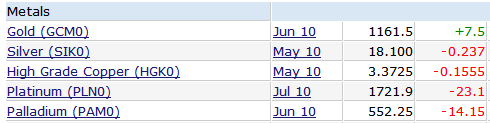
    Gold Up, Silver and Nonprecious Metals Down

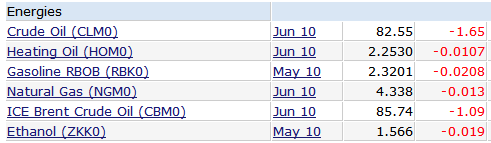
    Energy Sector Down

    Financials Up


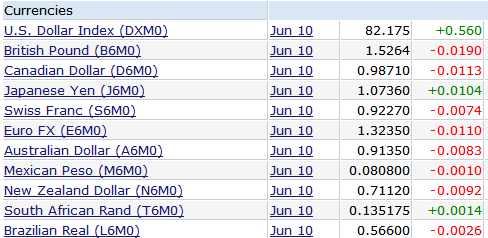
    US Dollar, Yen Rally

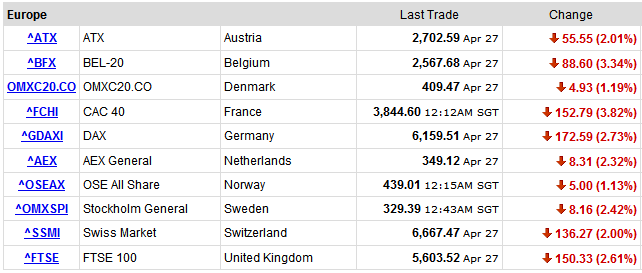
    European Equities Hammered

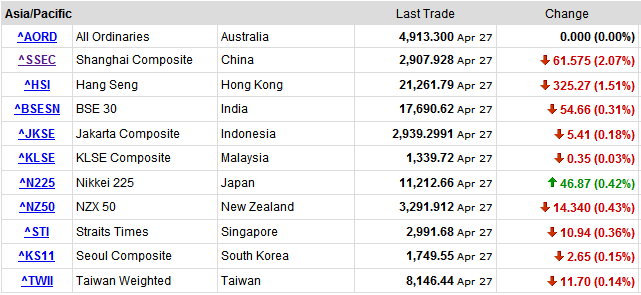
    Asian Equities Down, China Leads the Way

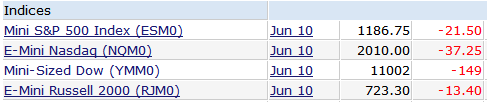
    US Equities Down

    Analysis

    Today’s action is certainly a flight to safety phenomenon with gold, US treasuries, and the US dollar all rallying strongly with nearly everything else selling off.

    Silver is primarily an industrial metal, while gold is best viewed as money or a currency. Moreover the entire energy complex took a hit.

    Another One Day Wonder?

    Inquiring minds are no doubt asking if this is another one day wonder, buy the dip decline, or the start of something far more serious.

    I do not know nor does anyone else. What I do know is risk is high, risk-reward is skewed to the downside, and if this recovery was real it would show in housing, jobs, and termination of global stimulus plans.

    Instead housing is in the dumps, the official unemployment rate is near 10%, and in spite of massive property bubbles in China, the China Business Newspaper says Another $586 billion “Stimulus” Coming to China.

    Meanwhile, Ken Fisher is a huge fan of emerging markets and tells the bears to “Get In Before It’s Too Late“.

    Get in before it’s too late?!

    Flashback: December 13, 2005: It’s Too Late

    I think it’s too late.
    In fact I know it’s too late.
    How do I know?
    The following Email I received tonight should explain it nicely.
    When you see stuff like this, not only is it too late, it’s way too late.

    Did Ken Fisher just ring the bell?
    Time will tell.

    Join the conversation about this story »

  • It’s Official: Adobe Flash support will be built into Android 2.2

    10 months. That’s how long its been since Adobe first demonstrated Flash on Android — and that’s pretty much a lifetime in the mobile world. And yet, official Flash support for Android is still nowhere to be seen*. Do these people not understand that I have virtual fish to feed and e-crops to tend?

    While we still don’t have an exact date, we do know which version of Android it’ll be coming in: the next one.

    In an interview with the New York Times, Chief Android Architect Andy Rubin made it official: Android 2.2, otherwise known as the “Froyo” build (with the latest device-ready build being 2.1, otherwise known as “Eclair”), will have Flash support built in. This goes hand-in-hand with Adobe’s previous indications that Flash for Android would be available sometime in the second half of this year.

    Alas, it’s still not clear which already existing devices will be upgradable to 2.2, nor whether or not all upgradable devices will play friendly with Flash.

    *HTC has snuck Flash support into a few of their Sense-enabled devices — but it’s not exactly.. optimal. With video playback rates at around 2-3 frames per second and an overall feel of chunky crashiness, I certainly hope the official Google/Adobe implementation is quite a bit better.


  • Defending Canada and Parliamentary Democracy

    Today is an important day. From CBC,

    “The House of Commons has a right to order the government to produce uncensored documents related to the treatment of Afghan detainees, Speaker Peter Milliken has ruled.”

    More info from this Liveblog from CBC.

    Filed under: Canada, Democracy, politics

  • It’s All Greek To Me

    By Norman Levine

    Equity markets in North America (and many other parts of the developed world) continued their march upward during the first quarter. Around the world, though, results were very much mixed. Emerging Asian markets such as China, Taiwan, Korea, and Singapore were negative. Main European markets were positive, some substantially. However, their gains were overshadowed by those European markets whose government finances are highly questionable.

    Portugal, Ireland, Italy, Greece, and Spain all have runaway budget deficits and massive amounts of debts. Of the group, only Ireland’s stock market was able to show positive returns for the quarter. Greece and Spain declined substantially. They are all members of the European Union.

    Unfortunately, the European Union works better in principal than in reality. It is more of a currency union than an economic union as, while it operates under a common currency, each country is responsible for their own economies as long as they operate under Union guidelines. The great advantage of the Union is that there are no tariffs on goods or services between members. This was a great inducement for countries to join. The great disadvantage is the lack of wiggle room for a country in economic trouble.

    It doesn’t matter whether you are economically strong like Germany and France or weak like Greece and Spain. Your currency is the euro. In pre-Euro Europe, if a country got overextended it simply devalued its currency. This had the effect of helping the country inflate and export its way out of trouble. With the advent of the Euro, however, all countries use the same currency regardless of its economic strength. This is a huge problem for the economically weak.

    Greece had no business joining the European Union. It has a long history of fiscal promiscuity. According to economists Carmen Reinhart and Kenneth Rogoff, Greece has spent 92 of the past 184 years in default on its sovereign debt. When it joined the Union, its debt was 12 times as much as it disclosed in its statements and its citizens and companies have a very poor history when it comes to paying taxes.

    The recent recession has caused all of Greece’s warts to be put on full display and now it is crying out for help from its fellow Eurozone partners. Unfortunately, as Dennis Gartman is quick to point out, Germany, the strongest country in the Union, is loathe to help as its citizens have just emerged from the painful and very expensive experience of merging East and West Germany together. They were family. Greece is not.

    Germans pay their taxes, work harder, get fewer vacations and retire later than the Greeks. They are in no mood to help their slothful neighbours. Besides, if Greece is rescued by the Union, then Portugal, Ireland, Spain, and possibly Italy will demand equal treatment. Even the United Kingdom could be in line for help.

    Things are likely to get uglier in Europe before getting better. We are not in a position to guess as to how things will work out or how long it will take. However, we are being constantly vigilant as to how events will affect us as Canadian investors.

    Currency changes are one thing that are working favourably for Canadian investors. People still ask our opinion about the weak US dollar but we have to ask, “Weak against whom?” Despite its many problems, the US dollar is showing great strength against European currencies (be it the Euro, Pound, Kroner or Franc) as well as the Japanese Yen. Its turnaround has gone largely unnoticed in Canada as our dollar has been even stronger, being a beneficiary of the problems in Europe and the US as well as being viewed by the world as a commodity currency. This led to the Canadian dollar being the second strongest major currency in the world during the past quarter, behind only the Mexican Peso (who knew?!).

    While headline writers fret about the many perceived negatives of a strong Canadian dollar, we look upon a strong currency as a gift. Not only does it help mute inflation, keep interest rates lower, and make imports and foreign travel cheaper, it also forces our manufacturers to become more productive. Most important to us, though, is it makes foreign investment very attractive. Currencies move up and down constantly and the best time to invest outside your home country is when your currency is strong as you are able to buy more assets for the same amount of money.

    We have no idea how high the Canadian dollar will rise or for how long it will remain strong. We do know though that it will not stay strong forever.  We are a commodity currency. Live by the sword and die by the sword. Commodities do not just go up. Commodity prices peaked in January and yet our dollar continues to strengthen. Either commodities resume their upward trend (much more difficult now with a strengthening US dollar) or our dollar becomes vulnerable.

    A Greek tragedy is unfolding. For a Canadian investor, it is causing European assets to go on sale. The financial crisis in the United States has caused their assets to go on sale relative to ours. Japan’s coming demographic catastrophe will have the same effect on its assets. Companies are not countries. Strong companies (especially international ones) can reside in weak countries. We have always been big believers in international investing. We will be emphasizing it even more in coming months.

    Norman Levine is managing director of Portfolio Management Corp.

    Photo: US Treasury Secretary Timothy Geithner (L) meets with Greek Finance Minister Giorgos Papakonstantinou on April 24, 2010 at the International Monetary Fund in Washington, DC. (TIM SLOAN/AFP/Getty Images)

  • GM Developing Direct-Injection Aluminum Small-Block V-8s

    GM has announced it will invest $890 million into various powertrain facilities that will produce a new generation of small-block V-8 engines. The engines will feature aluminum blocks, direct injection, and a new combustion system design (about which we’ve been given no details). It will mark the first time that direct injection has been used on GM V-8 engines. Many of the company’s V-8s have already switched to aluminum, with only a handful of truck, van, and SUV engines still employing cast-iron blocks.

    The company claims the new generation of engines will offer “unprecedented” increases in fuel economy and will be E85-capable. Displacement, power, and fuel economy figures aren’t yet available.

    We’re told the engines won’t actually debut for some time, but when they do, we can expect to see them in the same vehicles that employ the current generation of small-block V-8s. Our educated guess is that variants of the new engines will be offered across GM’s lineup: full-size trucks and SUVs as well as performance cars like the Corvette, Camaro, and CTS-V.

    Related posts:

    1. Skidpads, Hydroforming, Yaw Control, and Direct-Injection Ticking Noise
    2. Hyundai Unveils New 2.4-Liter Direct-Injection Four-Cylinder (Updated With U.S. Specs)
    3. Infiniti Readies Direct Injection for M37 and G37, Unsure About New Q – Car News
  • More vaccination news, some good, some not so good | Bad Astronomy

    Some vaccine news I missed in the past few days…

    1) A pertussis outbreak in California has already killed two infants. This event resonates with what happened in Australia a year ago; vaccination rates are low, and the victims are too young to be vaccinated themselves. With herd immunities compromised, the littlest and most defenseless reap the effects. This is not necessarily caused by the antivaxxers, but it’s worth noting.

    2) There is apparently a small outbreak of polio in Tajikistan. Vaccinations are critical, but so is sanitation.

    3) PBS airs a documentary called “The Vaccine Wars” tonight. It’s about what you think it’s about. Check your local listings.

    4) H1N1 is still out there, and still hurting and killing kids.

    5) A bunch of kids got pretty sick after vaccinations in Australia. It’s unclear what happened, and officials are investigating it.

    6) The good news? At least for Finland, it’s good: 97% of kids there are vaccinated. For everything. Amazing.

    Tip o’ the needle to Antti Säämänen, Doug Troy, William Mount, and Greg Stitz.


  • Geocities-izer Transports Websites To the Halcyon Days of 1996 [Retromodo]

    Geocities might be dead, but its spirit lives on. The Geocities-izer does you the enormous favor of transforming your favorite (or least) website into not just a Geocities page, but a really bad Geocities page. And my god, the music! More »


  • 5 Insider Secrets from the Soap Opera World

    Sometimes you’ve got to get dirty before you can get clean. The soap world may be a daily part of millions of lives around the world, but behind the gripping plot lines and much loved characters, lies a secret world of off-screen politics, competitive courting, cliquey casts and cynical producers. Ahead of a new book dishing the dirt on this cutthroat world from one of soap’s biggest stars, Victoria Rowell, we thought we’d tease you with a few tasty secrets about the soap world. Be warned these secrets come straight from the inside and will shock and surprise in equal measure…

    5) Sleeping with the Costume Designer

    We’ve all heard tales of colleagues who slept with their bosses to get that promotion, and rightly or wrongly, we usually decide to dismiss them as hearsay. Well, it seems that in the soap world competitive courting is not only a reality, but goes as far as the costume designers on set.

    Victoria Rowell assures us that on one show she worked on (which shall remain mysteriously unnamed) competitive courting of the costume designer, presumably to secure the best costumes on set, was actively engaged in by up to 30 cast members at a time. It may come as a surprise, but costume designers – responsible for the presentation of actors and actresses – are part of an off-screen crew that wields an enormous amount of power behind the scenes. Exact figures for how many successfully closed their advances are not known – but what is obvious is that the world of soap can be a seedy place, where doing the nasty with the right person is sometimes what it takes to clamber up that greasy pole.

    4) African American Storylines Come Out in Summertime

    There are various powerful and surprising forces at work behind the scenes of your favorite soaps, some of which might just make you double-take. One of the less well known secrets outside the industry is that storylines involving African American characters come to the fore, or get ‘pumped up’, during the summer months. Seems weird, so why is this?

    To cut a long story short, it seems a few producers and scriptwriters appear to still be taking the tired and downright offensive notion that only African Americans are at home during the summer as true. Believing everyone except African Americans would have jetted off on holiday, or be out at their holiday home boating, these producers attempt to cynically target those who they feel will be their core viewers during this period. The whole idea is rubbish, of course, but it shows an uglier side of the ratings war and hints at some deep lying problems at the heart of the soap world.

    3) Shhh… Don’t Tell Anyone: Soaps are Dying

    Hush, hush… don’t tell anyone – especially your mom. Soaps are, apparently ‘dying’. Yes, you heard it here first, courtesy of Victoria Rowell. Well maybe not first, but it is a commonly accepted fact in the soap world, and a little known one outside it.

    Once upon a time there was real life, and then there was ‘reel’ life. People who lived in real life liked watching people who lived on ‘reel’ life, because it seemed much more interesting and rewarding. They could live out their dreams vicariously, or experience their worst fears without bearing the consequences: essentially they could emotionally invest in soaps in a way they couldn’t in real life.

    Today soaps are falling like flies and there are a variety of reasons. Writers have sacrificed the successful formula of a heightened version of real life, for endless headline grabbing plots of murder, incest, divorce and violence – effectively numbing their viewers into submission. As a result soaps have become more costly to make, with less viewers, making them an unattractive production. People have turned to other forms of pop entertainment: blogging and online gossip pages have stolen people’s attention, and in many ways, Facebook and Twitter have helped turn our own social lives into something closer to soap operas. The bottom line is: why watch soaps when your own life can be one?

    2) Black Writers Are Held Back

    The vast majority of the viewers for the ever-popular The Young and the Restless are African American, a fact that is only supported by the show’s massive popularity in the Caribbean. Many of its most prominent actors and actresses, as well as storylines, involve African Americans – yet there has, however, never been a black writer. Victoria Rowell feels this is indicative of a secret conspiracy that lies behind the soap world and the writers and producers who control it, something that mirrors the dark social reality at the heart of America.

    Victoria Rowell was herself asked to write for the show briefly, but declined, turning down the chance to become the first ever African American writer for the show. She feels that whereas the soap establishment is happy to have black actors and run storylines around African American communities, the real power and controlling influence is held by whites behind the scenes, just like political reality in America. It seems that the secret heart of the soap world resembles real life in a darker, more disturbing way than we might ever have imagined.

    1) Victoria Rowell is Blackballed

    Victoria Rowell is one of the nation’s most loved stars, famed for playing the vivacious Drucilla Winters in The Young and the Restless, and Dr. Amanda Bentley in the cult TV show Diagnosis: Murder. But a little known secret is that she is being held back from garnering the applause she deserves by soap colleagues who resent her and constantly shut her out from the all important pre-nomination list for the Emmy awards.

    Victoria says this is symptomatic of the cutthroat, boot-licking world that soap really is behind the scenes, and puts it down to the fact she doesn’t fraternize with the right people. Backstage politics, cliquey casts and a crew who hold an enormous amount of power – from costumes, to filming – all play a huge part in deciding exactly who gets put up for what nomination. And although it might shock and upset you to realize that all too often acting prowess and artistic ability take a backstage to off-screen politics, yet again we see how closely soap mirrors real life: both on-stage and off-screen, and in a way we might find highly uncomfortable.

    For more tasty secrets from Victoria, check out her new book Secrets of a Soap Opera Diva.


  • WMWifiRouter 2.00 released

    phone-running-wmwifirouter We have posted before that, with HTC’s release of WIFI Internet sharing, WMWifiRouter was obsolete. When faced with such a challenge a company can either fold or raise its game to a new level.

    Today Morose Media opted for the second option, releasing version 2.00 of its award-winning WMWifiRouter software.

    The new version bring many improvements, including:

    • All languages have been updated, and we’ve added support for Dutch, French and Spanish
    • The multilingual version now loads much faster
    • Massive amounts of code were added to ensure Wi-Fi stability on those devices with “sensitive” Wi-Fi drivers
    • On most of the devices WMWifiRouter is able to use Bluetooth with, multiple simultaneous Bluetooth clients are now supported
    • New Wi-Fi connections now pop up a notification with the details of the device that connected
    • Power management has been improved, and an option has been added to allow the screen to turn off without manually using the power (or end call) button, for both PocketPC (professional, touchscreen) and SmartPhone (standard, non-touchscreen) platforms. .
    • Command line options have been added for the power users
    • Some features that are not supported on your device will be automatically hidden
    • Many other features

    The software is available for download immediately through the WMWifiRouter.com website, Windows Marketplace for Mobile, and select resellers, and is a a completely FREE upgrade for all registered users.

    For everyone else, whether the improvements are worth € 14.99 remains to be seen.

    Read more and find the download links at MoroseMedia here.

    Via WindowsPhoneThoughts.com


  • Study: Depressed People Eat 50% More Chocolate

    Having a bit of chocolate when you’re down is something just about everyone has done at some point in their life. But a new study shows that those people who demonstrate signs of depression tend to eat 50% more chocolate than those who don’t.

    The study published in the Archives of Internal Medicine looked at 931 men and women, none of whom were taking antidepressants. Researchers asked them how much chocolate they consumed on a regular basis and also measured their level of depression.

    What they found was that the subjects who were diagnosed with depression were eating an average of 8.4 servings of chocolate each month, while those who were not depressed at only 5.4 servings per month. And those demonstrating the highest levels of depression consumed around 11.8 servings of chocolate per month.

    The researchers also tested depressed subjects who were on antidepressants at the time and found that they ate the same amount as those who were not on medication.

    In spite of the stereotype of the sad woman who craves chocolate, the study found that gender was not an issue.

    Also, of the foods included in the study — fish, coffee, caffeine, fruits and vegetables — researchers only saw a difference between depressed and non-depressed subjects when it came to chocolate consumption.

    Researchers say more study is needed to pinpoint the reason for the link between chocolate in depression, saying it could be anything from a form of self-medicating to an actual cause of depression.

    One expert who wasn’t part of the study, Dr. Lorrin Loran of Stanford University, has this to say:

    It is available, cheap, does not lose its pleasure-inducing quality with repeated use, does not require relating to other people and is culturally approved as a source of legitimate pleasure, he said.

    ‘I strongly doubt that chocolate either induces depression or interferes with recovery from depression,’ Koran said. ‘If either idea were true, this would long ago have become obvious given the ubiquitous use of the substance over the last 500 years.’

    Chocolate a Sweet Pick-Me-Up for the Depressed [U.S. News & World Report]

  • Euro Freakout Continues Deep Into The Night, Dow Bleeding Again

    Typically the closing of normal business hours in Europe is kind of bullish for the currency and for US stocks, as all the fears over Greece and the PIIGS are put to rest for the night.

    But not tonight.

    The euro, as you can see, is making brand new lows. Meanwhile the Dow — which had bounced off its lows — is down over 160.

    From Finviz.com:

    chart

    Join the conversation about this story »

  • McKinstry Buys Itron Software Group

    Gregory T. Huang wrote:

    Seattle-based McKinstry, the construction and energy efficiency firm, said today it has acquired the Enterprise Energy Management software group from longtime partner Itron, the Spokane, WA-based utility technology and smart grid company (NASDAQ GS: ITRI). Financial terms of the deal were not released. Itron’s Web-based software will help McKinstry manage and monitor energy and water consumption in its customers’ buildings.

    UNDERWRITERS AND PARTNERS


  • The upside of the Senate climate bill’s troubles

    by John Passacantando

    There is a silver lining to the turmoil over the Senate climate bill.Photo: Pranav Singh via FlickrOver the weekend we got the news that three grim-faced men weren’t going to be able to help on global warming.  The only Republican supporter of the not-yet-unveiled-but-widely-described Senate climate bill, Lindsey Graham, had a new demand.  Not only did he insist that the bill subsidize the building of nuclear power plants and open up our coasts to oil drilling—conditions since met by the White House—he wanted the Democrats to hold off immigration reform so it wouldn’t hurt some Republicans running for Senate.  It’s rumored that he also wanted Caps tickets for the final game on Wednesday evening and a guarantee from the White House that they would beat the Canadiens.

    Weird. But I felt happy.  Which is weirder still. I’ve worked for almost 20 years to stop global warming, and I feel joy when the Senate global warming bill begins to unravel.  How did we get here?

    The bill that Sens. John Kerry (D-Mass.), Lindsey Graham (R-S.C.), and Joe Lieberman (I-Conn.)—aka KGL—keep threatening to introduce is reputed to be more of a polluters’ bill than an environmental bill. Massive new subsidies for the coal, oil, and gas industries, a new trading scheme for Wall Street (this time in derivatives of carbon pollution instead of mortgages), promised CO2 emissions reductions primarily from ungovernable “offsets” in the developing world, and preemption over state efforts to stop global warming or even the EPA’s recently Supreme Court–granted right to do the same.

    There are smart people who say that we need a bill on global warming, any bill, and the rest of the world will start moving too.  But it seems to me that if we pass a fake bill, it won’t be a little first step but rather the last step.  And the Chinese, Indians, and Brazilians are unlikely to be so ignorant as to watch the Senate pass a fake bill and turn around and make real emissions reductions in their own economies.

    But figuring this out isn’t my job. I didn’t join the environmental movement to try and become a master dealmaker. Let’s leave that to the politicians and their staffs. I’m more interested in the people building a powerful swell of public support that politicians eventually have to follow.  Democracy done right means politicians listen to the people, not the coal companies or the oil companies or Goldman Sachs.

    I come from the American tradition that liberated itself from a corrupt king and that now has to liberate itself from corrupt corporate oligarchs.  To do that, we’ll have to organize in every corner of this fair land and peel the grip of the polluters off the levers of power.  But there is one thing we must do first.  The original role of the environmental community is to tell the truth.  Our role is not to design ever more complex legislative schemes that enrich the oligarchs and confuse the public.  The truth is that global warming is bearing down on us and we are not a step closer to solving it than we were 40 years ago.

    And yet there is something that I find hopeful, an alternative bill, though the media pretends it isn’t there.

    The media has been focused on the three men who have been talking about a bill for months while ignoring two women, Sens. Maria Cantwell (D-Wash.) and Susan Collins (R-Maine), who have actually introduced a bill, the CLEAR Act (Carbon Limits and Energy for America’s Renewal Act). With simple, elegant architecture, it auctions the right to pollute to the importers, drillers, and miners of carbon-based fuels that come into the economy.  These costs get passed along to you and me, working like a tax and increasing the price of carbon-based energy so we use less. That’s a good thing. And then it takes most of that revenue and gives a cash payment, every year, to everyone with a Social Security number.

    Top Republican pollster Glen Bolger from Public Opinion Strategies recently polled 1,000 likely voters in five politically moderate to conservative states about their views on climate legislation. According to Bolger, “The CLEAR Act from Cantwell and Collins has the best chance of getting more votes over party lines because people like the concept of less government involvement [and a] tax-cuts-style refund back to the people.” Maybe this bill is a better way to get Republican support than to start giving companies the right to drill off our beaches.

    Related Links:

    Senate Dem leader vows action on both climate and immigration

    Can good climate legislation pass via reconciliation? [WITH TEACUP PIGS]

    Kerry says climate bill is not dead


  • First drop in motorcycle related deaths in a decade, are we really any safer?

    Filed under: , ,

    In a preliminary report, the Governors Highway Safety Association recently indicated a 10% drop in motorcycle related fatalities around the U.S. in 2009. This decline marks the first such improvement in over a decade as deaths have been on the rise consistently from 1997 onward.

    Are we really seeing improvement in motorcycle safety, equipment and riding ability? Likely not. As the old saying goes, numbers don’t lie, and the drop in fatal injury’s comes on the heels of the most extreme decline in motorcycle sales in recent history, which no doubt helped put the brakes on the awful upward trend.

    The report goes on to attribute everything from the economy and aging baby boomers to increased training efforts from the Motorcycle Safety Foundation from coast-to-coast. Oh yeah, and we almost forgot the bad weather! Although it may seem that the GHSA can’t seem to pick a clear cut reason for the drop, we can only hope history will not repeat itself in this instance, allowing this positive trend to continue. To see the full report and suggestions for increased safety, hit the jump for the release.

    [Source: Hell For Leather]

    Continue reading First drop in motorcycle related deaths in a decade, are we really any safer?

    First drop in motorcycle related deaths in a decade, are we really any safer? originally appeared on Autoblog on Tue, 27 Apr 2010 14:33:00 EST. Please see our terms for use of feeds.

    Permalink | Email this | Comments