Blog

  • Bootup Labs Founder: “I Made Mistakes. I Was Wrong”

    Danny Sullivan Robinson, the co-founder of venture fund and startup incubator Bootup Labs, has apologized publicly for the failure of the company’s Y Combinator-style startup camp, which fell apart last week after the fund failed to raise enough money to back all of the startups it had accepted into the program. The story came to light when one of the entrepreneurs who had sold his belongings and moved across the country to join the Bootup Labs project in Vancouver, British Columbia was told his company could not be funded, and wrote a blog post calling out the venture fund for making promises to entrepreneurs that it couldn’t keep.

    In a blog post of his own, Sullivan Robinson admits that would-be startup founder Jamie Martin was right, that Bootup Labs didn’t have the money to fund his and several other companies when they were accepted into the program. “This was my gravest of errors and seems pretty obvious now,” he writes. “I sincerely apologize to the founders who were affected by this. It will not happen again.” He also admits that he and the rest of the Bootup Labs team made some serious mistakes, including:

    • Getting defensive: “I should have done a better job responding to Jamie’s concerns on this blog. At the time, I felt everything we have worked for was being questioned, and I got defensive and it made things worse. Jamie didn’t do anything wrong, and I apologize to him in particular.”
    • Failure to disclose: “I should have announced the downsizing of the cohort as soon as it happened. We actually tried to hide it, hoping that people wouldn’t notice and it would just go away. That was a big mistake that I should have known wouldn’t work.”
    • Leaving startups hanging: “I should have done a better job listening to the personal concerns of the founders who were cut. If I had thought more about that, I would have worked harder to help them in other ways.”

    The Bootup Labs co-founder adds that he feels a “stronger and better Bootup Labs 2.0 is emerging” from the wreckage of the entrepreneurship program, and that to help prevent any further such incidents, “new controls have already been instated at the board level with addition of [venture investor] Boris Wertz, and more announcements are coming soon.” He says he hopes that the startup community will give him the chance to “work hard to earn your trust and respect back.” Wertz’s addition and financing from venture fund Growthworks were announced shortly after last week’s blowup.

    Some of the comments from users on Hacker News, where the link to his post was shared, show just how far he and the Vancouver venture fund have to go in order to do that. One asks: “Why is this guy any more trustworthy today after issuing an artfully written apology, that was clearly crafted by a PR professional skilled in crisis management communications? Startups, do yourself a big favour and steer clear of this underfunded, unprofessional slow motion train wreck.” Another writes: “Bootup Lab’s reputation has still been badly damaged. An entrepreneur’s commitment and sacrifice to their business is very serious and they took a very nonchalant approach to handling this situation.”


    Post and thumbnail photos courtesy of Flickr user Autumn Bliss

  • Ferrari lançará seis novos modelos até 2013

    Segundo revelação da Fiat feita essa semana, a companhia pretende apresentar mais seis novas Ferraris no mercado nos próximos três anos, como parte dos planos de negócios da companhia até 201a. Os novos modelos da Ferrari começarão a aparecer a partir de 2011, com a Ferrari 458 Spider e novos modelos Enzo e 458 que estão em desenvolvimento.

    Depois de lançarem a 458 Spider em 2011, também será apresentado a nova versão do 612 Scaglietti. Esse projeto tem o codinome F151 e terá um motor V12 e provavelmente será o primeiro carro híbrido da Ferrari a ser apresetado no salão de Genebra.

    Para 2012, além dos anúncios de fim do mundo modelos citados anteriormente, um sucessor da Ferrari Enzo vai ser mostrada, e também um sucessor da 599 GTB Fiorano. A sequência de apresentações terminará em 2013, se o mundo ainda existir até lá com a apresentação da versão Scuderia da 458 Itália, que por sinal foi lançada no Brasil recentemente.

    Via | Piston Heads


  • Commercial whaling could get green light for first time in nearly 25 years

    A proposal announced today by the International Whaling Commission (IWC) would, for the first time in almost 25 years, endorse the killing of whales in one of their most critical feeding grounds – the Southern Ocean.

    In an effort to bring Japan, Norway and Iceland’s continued whaling under the IWC’s control, the Chair of the IWC has proposed giving these countries official commercial whaling quotas for the next 10 years.

    “The proposed quotas are not set using the IWC’s own scientific methods, but are a result of political bargaining which has little if anything to do with the whales themselves,” said Rob Nicoll, WWF-Australia’s Antarctic and Southern Oceans Initiative Manager.

    If adopted the new proposal would legitimise commercial whaling in the Southern Ocean Whale Sanctuary, despite the IWC’s absolute ban on commercial whaling in this area since 1994. The Southern Ocean is the main feeding ground of many whale species such as blue whales, humpback whales and fin whales.

    “Some whales feed exclusively in the Southern Ocean – not eating at all during the winter months when they travel up to tropical waters,” added Nicoll.

    “If there is one place on earth where whales should have full protection, it is the Southern Ocean. Allowing commercial whaling in an area where whales are so vulnerable goes against all logic.”

    The new proposal would allow for the killing of 400 minke and 10 fin whales each year in the waters around Antarctica. 725,000 fin whales were killed in the Southern Hemisphere in the twentieth century.

    “Fin whale numbers were depleted to severely low levels by previous whaling that spun out of control, and remain endangered as a result. Allowing new commercial whaling on this species when they have yet to recover from previous whaling is management madness,” said Nicoll.

    The members of the IWC will decide whether to adopt the proposal at its next annual meeting in Agadair, Morocco, June 21st – 25th.

    WWF-Australia is calling on all members of the IWC to support the Australian government’s alternative proposal to break the IWC deadlock, put forward in February.

    “If accepted, the Australian Government’s proposal would uphold the current moratorium and ensure that existing internationally recognised sanctuaries are indeed sanctuaries where no whales will be killed,” said Mr Nicoll.

    More information

    Jonathon Larkin, Senior Media Officer, 0410 221 410, [email protected]

  • Former Governor Pataki Launches Anti-healthcare Reform Drive In Boston

    Former Governor Pataki launches anti-healthcare reform drive in Boston Former New York Governor George Pataki was in Boston on April 18 to launch a petition that proposes to repeal the Obama administration’s healthcare overhaul.

    He was leading a rally staged by Revere America, an organization working to advance public policies rooted in freedom and free markets. The petition-signing event kicked off its national campaign to gather the signatures of one million Americans who want to repeal and replace "ObamaCare."

    The event coincided with the 235th anniversary of Paul Revere’s famous ride for freedom.

    "Just as 235 years ago our freedoms were in danger, they are now as well," the former governor said at the rally, quoted by NECN.com, a news website.

    "We can’t wait until 2012 to take back this country. We have to do it in 2010, and every single day this year counts," he added.

    The next day, Pataki was continuing his campaign for signatures in Iowa, where he explained why he decided to return to the national stage.

    "I was happy as a private citizen," he said, quoted by Radio Iowa, "but when I see what is happening in Washington over the course of the last year and a half, like most Americans I believe we are seeing a government that is dramatically headed in the wrong direction."

    Pataki is chairman of Revere America and served as the 53rd Governor of New York from 1995 to 2006. ADNFCR-1961-ID-19735026-ADNFCR

  • Audit Quality and Auditor Reputation: Evidence from Japan

    Published: April 22, 2010
    Paper Released: March 2010
    Authors: Douglas J. Skinner and Suraj Srinivasan

    Executive Summary:

    High-quality external auditing is a central component of sound corporate governance, yet what determines audit quality? Douglas J. Skinner, of the University of Chicago Booth School of Business, and Suraj Srinivasan, of Harvard Business School, study the Japanese audit market, where recent events provide a powerful setting for investigating the effect of auditor reputation on audit quality absent litigation effects. Specifically, Skinner and Srinivasan analyze events surrounding the collapse of ChuoAoyama, the PricewaterhouseCoopers affiliate in Japan that was implicated in a massive accounting fraud at Kanebo, a large Japanese cosmetics company. Taken as a whole, the researchers’ evidence provides support for the view that auditor reputation is important in an economy where the legal system does not provide incentives for auditors to deliver quality. Key concepts include:

    • Auditors’ reputation for delivering quality is extremely important. A substantial number of clients dropped ChuoAoyama as the extent of its audit quality problems became apparent, but before it became clear that the firm would be forced out of business.
    • The events at ChuoAoyama and particularly the decision by the Japanese Financial Services Agency (FSA) to suspend the firm’s operations can be seen as a watershed event in Japanese audit practice. The FSA used these events to send a message to the Japanese auditing community that the old ways of doing business would no longer be tolerated, and that it was serious about reforming audit practice.

    Abstract

    We study events surrounding ChuoAoyama’s failed audit of Kanebo, a large Japanese cosmetics company whose management engaged in a massive accounting fraud. ChuoAoyama was PwC’s Japanese affiliate and one of Japan’s “Big Four” audit firms. In May 2006, the Japanese Financial Services Agency (FSA) suspended ChuoAoyama’s operations for two months as punishment for its role in the accounting fraud at Kanebo. This action was unprecedented, and followed a sequence of events that seriously damaged ChuoAoyama’s reputation for audit quality. We use these events to provide evidence on the importance of auditors’ reputation for audit quality in a setting where litigation plays essentially no role. We find that ChuoAoyama’s audit clients switched away from the firm as questions about its audit quality became more pronounced but before it was clear that the firm would be wound up, consistent with the importance of auditors’ reputation for delivering quality.
    58 pages.

    Paper Information

  • Speeding Tickets Now Coming From Outer Space [Cops]

    As though cameras on top of every traffic light weren’t bad enough already: there’s now a trial run of satellites that will catch you speeding, over a several-block range, from hundreds of miles up. Hope for clouds, I guess? More »


  • Europe Finds Clean Energy in Trash, but U.S. Lags

    The NYT has an article on generating power by incinerating waste – Europe Finds Clean Energy in Trash, but U.S. Lags.

    The lawyers and engineers who dwell in an elegant enclave here are at peace with the hulking neighbor just over the back fence: a vast energy plant that burns thousands of tons of household garbage and industrial waste, round the clock.

    Far cleaner than conventional incinerators, this new type of plant converts local trash into heat and electricity. Dozens of filters catch pollutants, from mercury to dioxin, that would have emerged from its smokestack only a decade ago.

    In that time, such plants have become both the mainstay of garbage disposal and a crucial fuel source across Denmark, from wealthy exurbs like Horsholm to Copenhagen’s downtown area. Their use has not only reduced the country’s energy costs and reliance on oil and gas, but also benefited the environment, diminishing the use of landfills and cutting carbon dioxide emissions. The plants run so cleanly that many times more dioxin is now released from home fireplaces and backyard barbecues than from incineration.

    With all these innovations, Denmark now regards garbage as a clean alternative fuel rather than a smelly, unsightly problem. And the incinerators, known as waste-to-energy plants, have acquired considerable cachet as communities like Horsholm vie to have them built.

    Denmark now has 29 such plants, serving 98 municipalities in a country of 5.5 million people, and 10 more are planned or under construction. Across Europe, there are about 400 plants, with Denmark, Germany and the Netherlands leading the pack in expanding them and building new ones.

    By contrast, no new waste-to-energy plants are being planned or built in the United States, the Environmental Protection Agency says — even though the federal government and 24 states now classify waste that is burned this way for energy as a renewable fuel, in many cases eligible for subsidies. There are only 87 trash-burning power plants in the United States, a country of more than 300 million people, and almost all were built at least 15 years ago. …

    Yet powerful environmental groups have fought the concept passionately. “Incinerators are really the devil,” said Laura Haight, a senior environmental associate with the New York Public Interest Research Group.

    Investing in garbage as a green resource is simply perverse when governments should be mandating recycling, she said. “Once you build a waste-to-energy plant, you then have to feed it. Our priority is pushing for zero waste.”


  • Video: Dateline describes Detroit as Sarajevo from the air

    Filed under:

    Click above to watch the video after the jump

    There’s a reason Detroit is called the Motor City. The U.S. Auto industry was born there in a swath of southeast Michigan no larger than the state of Vermont. And when the industry was booming, the area was the epicenter for all things automotive. But times have changed for the domestic auto industry, and no region of the United States has felt the pain more than Detroit.

    Dateline traveled to Detroit to show just how far the Motor City has fallen, and the moving pictures shows an urban area that looks more like a war zone than a sprawling metropolis. The city of about 800,000 residents has only eight budget grocery stores, yet there are 400 liquor stores. Some 40 square miles of property is either vacant or abandoned – roughly the same land mass as the city of Buffalo. Detroit Mayor Dave Bing has even gone as far as to suggest that the city shrinks its boarders in an effort to survive. Hit the jump to see video that is sure to depress.

    [Source: Gawker TV]

    Continue reading Video: Dateline describes Detroit as Sarajevo from the air

    Video: Dateline describes Detroit as Sarajevo from the air originally appeared on Autoblog on Thu, 22 Apr 2010 08:58:00 EST. Please see our terms for use of feeds.

    Permalink | Email this | Comments

  • If Flat-Rate Mobile Data Plans Are So Bad, Why Do Operators Keep Launching New Ones?

    On its quarterly conference call, AT&T’s CFO once again talked up how the company needed to
    move away from flat-rate mobile data plans because its networks are being overwhelmed by traffic from a small percentage of its users. This rhetoric — which is really just trying to warm up the market for future price increases — comes despite figures showing that AT&T’s data revenues are increasing, while its network investment is decreasing. On some level, if an operator like AT&T wants to try to force through higher prices by increased flat rates or usage-based pricing, go right ahead; we’ll see just how the market reacts. But all of their talk about their poor overwhelmed networks would go down a little bit better if they wouldn’t decry flat-rate plans in situations like this, while they launch cheap flat-rate unlimited plans at the same time, as AT&T has done for the iPad 3G. If AT&T’s network is already taxed and cheap data plans are to blame, why launch another one on a device that’s built to consume data?

    Permalink | Comments | Email This Story


  • Duke Energy will expand solar program to 10 new sites

    Ten new customer sites across North Carolina will have solar panels installed on their building or grounds as part of Duke Energy’s distributed solar generation program, the company announced today. The Environmental Protection Agency’s facility in Durham is among the sites that will have solar equipment added.

    Duke launched the program in October 2009, when roof space was leased from four large manufacturing and commercial facilities for placement of solar panels. The company said the 10 new sites will generate approximately 4.1 megawatts of emission-free direct current electricity by 2011, enough to power approximately 525 average-sized homes. The new locations are:

    • Lincoln Charter School, Denver, N.C.
    • Gaston County Schools, Lowell, N.C.
    • Environmental Protection Agency, Durham, N.C.
    • Maple View Farm, Hillsborough,  N.C.
    • City of Charlotte Department of Transportation Facility, Charlotte, N.C.
    • Liberty Hardware/Johnson Development, Winston Salem, N.C.
    • Childress Klein Properties, Charlotte, N.C.
    • Carrier Centers, LLC, Charlotte, N.C.
    • Siemens, Winston Salem, N.C.
    • Daimler Trucks North America, Cleveland, N.C.

    When the distributed solar generation program is complete, Duke Energy will have invested approximately $50 million to construct and own a total of 10 megawatts of solar energy capacity in the state, capable of providing electricity to approximately 1,300 homes.

    “Partnering with sites visible to our customers helps build knowledge and understanding of solar energy,” Brett Carter, president of Duke Energy Carolinas, said in a statement. “This innovative program brings more solar energy to our customers, and helps us meet the state’s renewable energy portfolio standard in a way that balances costs to customers.”

    Duke said the sites were selected based on the organization’s interest in solar energy, ready access to the electrical grid and solar potential, in addition to other essential lease agreement criteria. Installations are under way on a few of the sites, and construction is expected to be complete by fall 2010.

    North Carolina’s renewable energy standard requires each public electric utility to meet at least 12.5 percent of its North Carolina retail customers’ electricity needs through new renewable energy sources or energy efficiency measures by 2021.

  • Dell’s product roadmap hits the internet – Pt. 1

    Last year the interwebs were abuzz when HTC’s 2010 roadmap managed to get itself leaked.  The images and specs from the pamphlets were viewed on just about every tech publication in existence, and were referenced for several months to follow.  Whether or not it was leaked intentionally is inconsequential, as the hype it created for the HTC brand was something no advertising dollars could have bought.

    Today, the atmosphere feels quite the same as Engadget has uncovered what appears to be Dell’s roadmap for upcoming devices.  But unlike the HTC version, which was blurry with low quality renditions of the devices, Dell brings us crisp images, clear details, and a better picture of how they intend to approach the market – with the boundless power that nature commands and the grace most men only dream of.  Not to mention, it answers most of the “regular” questions (carrier, specs, etc.), with the exception of launch date and pricing.

    The roadmap packs in four phones and two tablets, most of which will be running Android OS.  Don’t think for a minute, though, that Dell plans on sitting on the sidelines and watching the Windows Phone 7 (still used to saying “series”) craze pass them by this holiday season, because it looks as if they have a WP7 phone planned as well.  In an effort to provide you, our beloved readers, with the valuable information you seek in one seamless package, we have compiled pertinent information about each device below under the appropriate headings.  Stay tuned for part two, which will cover “Flash,” “Smoke,” and the company’s tablets!

    Dell Lightning

    Lightning

    The lightning is the only device on the roadmap designed specifically to meet the requirements of the new Windows Phone 7 operating system (notice on the spec sheet they call it Windows Mobile 7).  It boasts a 4.1-inch WVGA OLED capacitive touchscreen,  1GHz QSD 8250 Snapdragon processor, full QWERTY physical slider keyboard, 5 megapixel camera, 1GB Flash ROM, 512MB DDR SDRAM, GPS, Bluetooth, and WiFi.  From the looks of it, the device is set up to work on both AT&T and T-Mobile’s 3G networks.  The Lightning is targeting business professionals or ‘Life Maximizers’ if you will (remember Miles and Anna?) who desire “multi-purpose, always connected functionality.” Engadget has the release date “pegged at Q4” of this year and also note that there is some indication that the Lightning will get an upgrade to LTE at the end of 2011.

    For more information and pictures on the Lightning, go here.

    Dell Thunder

    Thunder

    The Thunder is the only device on the roadmap that doesn’t come with a detailed spec sheet.  But fear not, we still have plenty of information to send your way.  As you can see above, the thunder is an impressive looking device which, like its WP7 brother, is sporting a 4.1 WVGA OLED display backed up by Android 2.1 (perhaps Froyo by launch?).  The device comes loaded with all your social networking and media needs such as Facebook, Twitter, YouTube and Hulu, to name a few.  But don’t get too confused because Dell wants you to know that the Thunder is “not all looks & play.”  It also comes ready to handle “a full complement of email services, including ActiveSync, so you can take care of business on the move.”  “Lightning fast 7.2Mbps HSPDA” and “integrated WiFi” are other features listed to compliment your on-the-go, high-speed business needs. 

    The Thunder’s target audience, according to Dell, is “creative explorers and affluent professionals (sounds kind of like Apple to me, just a thought).  Though the spec sheet for this device seems to be missing, Engadget is speculating that it also comes equipped with the now standard 1GHz Snapdragon processor.  There’s also mention of an 8MP camera and “on-device image editing” software.  The Thunder is expected to be sold via AT&T sometime in the Q4 timeframe of this year, with an LTE model coming in 2011. 

    For more information and pictures on the Thunder, go here.

    Via Engadget


  • iSight: What’s Happening?

    In June 2003 at WWDC, Apple released the FireWire iSight webcam. Steve Jobs and Phil Schiller took the stage to show off the new iSight which everyone applauded and subsequently purchased. The $129 webcam allowed you to broadcast video to friends via iChat AV (in beta at the time) at 640×480 resolution. iChat AV received full 1.0 status that year with the release of Mac OS X Panther.

    Soon, the iSight made its way into Apple’s entire line-up of notebooks and iMacs; even the 24” LED display Apple sells has a built-in webcam. Now, the only Apple computers that don’t have an iSight are the Mac Pro and Mac mini, for obvious reasons.

    In Apple’s press release for the iMac G5, which was the first machine to have an iSight built-in, Steve Jobs was quoted, “Plus, the built-in iSight video camera delivers out-of-the-box video conferencing with friends and family, as well as hours of fun with our new Photo Booth application.”

    So, what happened to the iSight? It certainly wasn’t Apple’s fault that iSight didn’t get the adoption that it needed. These days, iSight has gone the way of MySpace-using teens that upload Photo Booth snaps while at the Apple Store and Skype conversations between grandparents. iSight is accessible via Apple’s Development APIs so developing for it is a cinch. There may be hope for iSight and the long-forgotten “AV” features of iChat. With the rumors of a forward facing camera in Apple’s next generation iPhone, we may see Apple’s seven-year investment into tiny cameras and easy to use chat software make its way to those away from their desk, without ever having to open a notebook and find a Wi-Fi network. But first, let’s discuss my thoughts behind where iSight has failed so far.

    Where iSight Has Failed

    I think it’s a philosophical reason that the iSight use never picked up, and maybe Apple will prove us wrong by making video conversations as easy as grabbing our cell phone. Technically, Apple was able to fit a video camera into the ultra-thin MacBook Air but I think Apple knew that video conversations on the go just wasn’t going to be used by consumers if it wasn’t easy.

    I’d argue that Apple did it best. Sure, this is an Apple-centric blog but after years of working in IT, I’ve used video solutions from Microsoft, Logitech and Cisco and each of these had their own quirks, device compatibility and performance issues. Any Mac sold has iChat AV built-in along with its camera. The video icon appears if someone has the same functionality, click and you see them within seconds. The problem is that it doesn’t travel. Apple’s notebooks don’t have built-in 3G and Wi-Fi isn’t always available. The iPad was my bet for truly making video conferencing mobile but that didn’t happen, at least in the first generation device. The holy grail for bringing video chat to everyone is to make it fit in your pocket, with the basic requirement being a data connection.

    How it Could Work

    Didn’t other handsets have video chatting software built-in? Sure. Nokia included these front facing cameras in many of its smartphones. The issue was compatibility where two handsets have the video camera and software and they frequently had to be on the same carrier, plus this was only being used in Europe and Asia. Yes, those are huge markets but it wasn’t “universal” across devices and carriers. From what I hear, the connections were too slow and the software too buggy to take over voice or texting as a preferred method of communicating with peers on the go. If the next iPhone gets this functionality, there are huge advantages that Apple has.

    • iPhones are available globally
    • Data speeds to mobile phones is much faster in 2010 compared to 2006
    • iChat on Mac OS X

    I could sit at home and video chat with someone on the go in Chicago, London or Tokyo. This is what it will take for video conferencing to truly take off and receive mass adoption.

    Then Again…

    Then again, there are cultural and behavioral observations that show video as a direct communications tool just doesn’t sync up with how we engage these days. In theory, video seems like a great way to go. Instead of a long email that takes 15 minutes to type, we’d rather phone a friend or video chat with them, but it just doesn’t happen. The video chat isn’t distributable to the team. The video chat can’t be searched or indexed and storage is still pricey if you’re doing a lot of video conversations. Not to mention, multitasking goes out the window; instead of plowing through 25 emails, I’m getting 25 iChat or Skype video calls every 10 minutes. It’s just not going to scale very well.

    So what does the future hold for iSight? That’s a tough one. The video camera is cheap for Apple to include, but is it useful to use R&D resources to include iSight in future devices? Will iSight appear in more consumer Apple devices? Will Apple take more risks by pushing this on us only to realize that we still won’t video chat despite having instant access to the service on our iPhones, laptops and desktops? If the new iPhone does get iChat AV w/ a forward-facing camera, we’ll see if the population uses it as much as we would hope…or maybe video conferencing goes the way of ExpressCard slots on Apple notebooks only used by a small percentage of the user base. Would you use iChat more if your iPhone or iPod touch had it built-in?

  • The latest on Obama and the VAT

    OK, here is what President Obama said on CNBC to reporter John Harwood about a value-added tax:

    HARWOOD: If reducing consumption is a good idea, could you see the potential for a value-added tax in this country?

    OBAMA: You know, I know that there has been a lot of talk around town lately about the value-added tax. That is something that has worked for some countries. It’s something that would be novel for the United States. And before I start saying that this makes sense or that makes sense, I want a better picture of what our options are. And my first priority is to figure out how can we reduce wasteful spending so that, you know, we have a baseline of the core services that we need and the government should provide, and then we decide how do we pay for that. As opposed to figuring out how much money can we raise and then not have to make some tough choices on the spending side.

    Me: Well,  I certainly agree with the general principle that we should optimize government and then see how much money we need.  But the important thing here is that a) despite Ways & Means Chair Sander Levin badmouthing the idea and b) 85 Senate votes against the idea, c) the White House won’t rule the idea out. Not all.   I also noticed that  the NYTimes has yet to run a correction on Hardwood’s piece that the WH has run the numbers on how much they think a 5 percent VAT would raise (nearly $300 billion a year). That, despite the WH saying they have not done so. It should also be noted that Obama seems to be qualifying his pledge to not raise middle-class taxes as applying only to income taxes.

  • Joe Jackson Unhappy With Planned MJ-Themed Cirque du Soleil Show

    Eternal killjoy Joe Jackson doesn’t sound very pleased about his late son’s life being turned into a circus.

    The penny-pinching stage parent – whose pop legend son Michael died from acute Propofol intoxication last June – says he doesn’t understand why world-renowned Canadian performance troupe Cirque du Soleil want to travel the world with a show about the “Thriller” star.

    “That’s something else, isn’t it? I won’t see it,” the Jackson patriarch replied dryly when probbed for his thoughts about the Cirque show by reporters this week.

    On Tuesday, the circus group struck a deal with the Jackson estate, which will see the production become a residency in Las Vegas from 2012 and will feature expansive acrobatics and dance routines set to the late King of Pop’s songs.

    While Joe is unhappy with the show, his estranged wife Katherine Jackson is delighted about the show, which will provide Michael’s estate with 50 percent of all profits.

    “Our family is thrilled that Cirque du Soleil will pay tribute to my son in such an important way,” Mrs. Jackson remarked.


  • Los Altos Academy of Engineering HS Students Create HICE Vehicle

    It’s Earth Day … Again. Sometimes I feel like Bill Murray in the movie “Groundhog Dog”  (since the other Earth Day was celebrated on March 20 this year). Well, get up all you woodchuck chuckers and celebrate the environment and take one small step today in making this world a greener place.

    This week I had the pleasure of communicating with John Weng, the project manager for a California student-run high school project led by the Los Altos Academy of Engineering (LAAE).

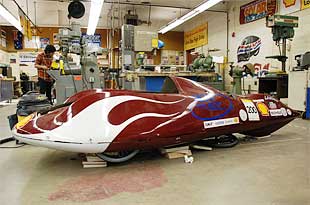
    Students in Hacienda Heights, CA have created a hydrogen-powered internal combustion engine car they are calling HICE. The term HICE (and sometimes H2ICE on this website) is an acronym for Hydrogen Internal Combustion Engine.

    The students have decided to forgo the popular hydrogen fuel cell car in favor of a high mileage vehicle using a four-stroke engine that will compete in next year’s U. S. Shell Eco Marathon.

    According to Mr. Weng, “Mike Keirns was the instructor who started the idea back in the 2007-2008 school year. From there, it became our flagship vehicle. We originally planned on competing in the Shell Eco-marathon and we were actually the first high school to create a hydrogen fuel cell vehicle as well back in 2007, winning first place. We intend to enter HICE next year for the Shell Eco-marathon. HICE is different from your published vehicle in that it does not require any gasoline whatsoever and runs on a student modified engine.”

    LAAE will be showing off their HICE vehicle (pictured) at their open house, May 8, 2010. Several political figures (such as Congresswoman Grace Napolitano) and other  VIP attendees are expected to join in the festivities.

    It’s important for the scientists, researchers and engineers of tomorrow to get a head start today in hydrogen fuel technology. LAAE continues to be a leader in such technology preparing students for high tech job markets that will pay good wages for years to come.

    And with any luck, they will not be forced to listen to repeated choruses of  “Babe, I got you Babe”. Happy Earth Day everyone … again!

  • Descent Of Man

    A couple of years ago two neuroscientists wrote a book about a supposedly little-studied extinct group of humans whose bones were found in South Africa. A very large skull with child-like facial features was discovered, and the skeleton was dubbed “Boskop Man”.

    The scientific community of South Africa was small, and before long the skull came to the attention of S. H. Haughton, one of the country’s few formally trained paleontologists. He reported his findings at a 1915 meeting of the Royal Society of South Africa. “The cranial capacity must have been very large,” he said, and “calculation by the method of Broca gives a minimum figure of 1,832 cc [cubic centimeters] .” The Boskop skull, it would seem, housed a brain perhaps 25 percent or more larger than our own.

    […]

    Might the very large Boskop skull be an aberration? Might it have been caused by hydrocephalus or some other disease? These questions were quickly preempted by new discoveries of more of these skulls.

    As if the Boskop story were not already strange enough, the accumulation of additional remains revealed another bizarre feature: These people had small, childlike faces. Physical anthropologists use the term pedomorphosis to describe the retention of juvenile features into adulthood. This phenomenon is sometimes used to explain rapid evolutionary changes. For example, certain amphibians retain fishlike gills even when fully mature and past their water-inhabiting period. Humans are said by some to be pedomorphic compared with other primates.Our facial structure bears some resemblance to that of an immature ape. Boskop’s appearance may be described in terms of this trait. A typical current European adult, for instance, has a face that takes up roughly one-third of his overall cranium size. Boskop has a face that takes up only about one-fifth of his cranium size, closer to the proportions of a child. Examination of individual bones confirmed that the nose, cheeks, and jaw were all childlike.

    An extinct race of humans much smarter than us? Possibly killed off by their less evolved, savage human neighbors? Curious, I did a web search on the Boskops and found a debunking of sorts of the book by John Hawks.

    That is pretty much where matters have stood ever since. “Boskopoid” is used only in this historical sense; it is has not been an active unit of analysis since the 1950’s. By 1963, Brothwell could claim that Boskop itself was nothing more than a large skull of Khoisan type, leaving the concept of a “Boskop race” far behind.

    Today, skeletal remains from South African LSA are generally believed to be ancestral to historic peoples in the region, including the Khoikhoi and San. The ancient people did not mysteriously disappear: they are still with us! The artistic legacy of the ancient peoples, clearly evidenced in rock art, is impressive but no more so than that of the European Upper Paleolithic or that of indigenous Australians.

    And their brains were not all that big. Boskop itself is a large skull, but it is a clear standout in the sample of ancient South African crania; other males range from 1350 to 1600 ml (these are documented by Henneberg and Steyn 1993). That is around the same as Upper Paleolithic Europeans and pre-Neolithic Chinese. LSA South Africans fit in with their contemporaries around the world.

    To be sure, there has been a reduction in the average brain size in South Africa during the last 10,000 years, and there have been parallel reductions in Europe and China — pretty much everywhere we have decent samples of skeletons, it looks like brains have been shrinking. This is something I’ve done quite a bit of research on, and will continue to do so, because it’s interesting. But it is hardly a sign that ancient humans had mysterious mental powers — it is probably a matter of energetic efficiency (brains are expensive), developmental time (brains take a long time to mature) and diet (brains require high protein and fat consumption, less and less available to Holocene populations).

    OK, so Boskop Man is not a separate human lineage. But at least one sample did have a very big skull. (According to the authors of the book, numerous other skeletons with oversized skulls were found in the dig area.) Was it then possible that a small tribe of very smart ancients in South Africa once existed? Did they suffer from a disease? Or were they just exceptional individuals on the upper end of skull sizes for their time?

    Hawks mentions the fact that brains have been shrinking over time across the world. I have also read that Neandertals had larger brain volumes than modern humans. These leads to all sorts of depressing conjecture. Is it possible we are getting stupider? Our cultural achievements would suggest otherwise, but maybe Neandertals would have accomplished even greater intellectual feats than modern humans had they been born during a time with a supportive industrial infrastructure.

    And is there an upper limit on just how smart humans can get? As brain volumes grow, women’s pelvises must grow wider in proportion, otherwise more big-brained infants die during childbirth. But very wide-hipped women would have trouble walking or running, not to mention they would look sexually grotesque to men searching for a mate. Northeast Asians and Ashkenazi Jews are known to have the highest average IQs in the world. Do their women have correspondingly greater than average hip widths to accommodate all those big brained babies?

    Because of this inherent pelvic width limitation, there may be (anti)evolutionary forces at work that select against smarter babies. The direction of evolution is not necessarily one of progress; it is, instead, in the direction of survival and replication. Which is not synonymous with ever-expanding intelligence. A sobering thought that we could just as easily devolve backward to a more aggressive distant ancestor archetype than evolve forward into bulbous headed little grey men. Not to say that there couldn’t be ways around the pelvic trap. If the selection forces for smarts are strong enough (and in a cognitively demanding society like ours the evidence for smarts selection has disappeared under the lower fertility rate of educated women), then perhaps Darwinian expedience will jerry-rig a system to ensure our brains can continue growing larger. Maybe by moving most of the skull and brain growth post-natally, or rewiring the neurons to become more efficient.

    Anyhow, it’s amusing to wonder if there was an ancient human population much smarter than our own who were killed off by the envious and aggressive idiocrats in their midst at the time. Is that what happened to the Neandertals?

    Filed under: Hope and Change

  • Cheney Makes Endorsement in FL Senate Race

    Former Vice President Dick Cheney Thursday morning endorsed Florida Senate GOP candidate Marco Rubio and  unleashed some scathing views of Rubio’s GOP opponent, Florida Governor Charlie Crist.

    “Washington is broken and Congress is already overflowing with politicians who need pollsters to tell them what to think. It certainly doesn’t need another one. Now more than ever America needs leaders with the strength of conviction. That is why I am proud to endorse Marco Rubio,” Cheney said in a statement.

    “Charlie Crist has shown time and again that he cannot be trusted in Washington to take on the Obama agenda because on issue after issue he actually supports that agenda,” Cheney said.

    Rubio was once trailing Crist in polls, but now Rubio has taken the lead — also clinching the endorsement of other big name Republicans including former New York Mayor Rudy Giuliani and former 2008 presidential candidate and Massachusetts Governor Mitt Romney. 

    There’s also a swirl of rumors if Crist should or will run as an independent, although Crist so far has stayed course as a GOP candidate.  He has until April 30 to decide.

    “Lately it seems Charlie Crist cannot be trusted even to remain a Republican. I strongly urge him to either stay in the Republican Primary or drop out of the race. The only winners from an independent bid by Crist would be Barack Obama and Harry Reid,” Cheney added.

    The Florida GOP is also ensnared in controversy over whether or not it misused funds.  The IRS is reportedly looking into the tax records of former state party Chairman Jim Greer and former Executive Director Delmar Johnson and if they used party credit cards for personal use.  The inquiry though also ties in Crist & Rubio.  Greer was a close confidant of Rubio and  the investigation will look into the more than $100,000 Rubio spent on the GOP American Express card. 

    As of now, there are no plans for a joint appearance with Cheney and Rubio.

  • What to look for in the bipartisan climate and clean energy jobs bill

    by Joseph Romm

    On Monday, Sens. Lindsay Graham (R-S.C.), John Kerry (D-Mass.), and Joe Lieberman (I-Conn.) will launch their bipartisan climate and clean energy jobs bill.  I’m quite certain there will be something in it to dissatisfy everyone.

    On the other hand, has Congress ever passed a significant bill that didn’t dissatisfy everyone, particularly on the environment?  We haven’t had a major piece of clean-air legislation for almost exactly two decades now.  The Clean Air Act Amendments of 1990 (EPA history here), which ultimately passed by large margins, put in place a cap-and-trade system for acid rain pollution, but didn’t end the grandfathering of old coal plants.  And so they burn on.

    No bill that could pass Congress right now or in the immediate future would be sufficient to put us on the path to stabilizing the world at 2°C. We simply aren’t sufficiently desperate to do what is needed, which is nonstop deployment of a staggering amount of low-carbon energy, including efficiency, for the rest of the century.

    And so my criteria for judging the bill focuses on whether it will create the conditions that will allow more desperate policy makers in the not-too-distant future to have a realistic chance of getting on the necessary path.  My new book Straight Up includes one essay on the House’s astonishing yet dissatisfying achievement in passing the Waxman-Markey bill.  It explains that when we are that desperate, probably in the 2020s, we’ll want to already have:

    substantially dropped below the business-as-usual emissions path
    started every major business planning for much deeper reductions
    goosed the cleantech venture and financing community
    put in place the entire framework for U.S. climate regulations
    accelerated many tens of gigawatts of different types of low-carbon energy into the marketplace
    put billions into developing advanced low-carbon technology
    started building out the smart, green grid of the 21st century
    trained and created millions of clean energy jobs
    negotiated a working international climate regime
    brought China into the process

    Waxman-Markey, had it become the law of the land, would have achieved all of those vital goals.  And that’s why I strongly supported it, even though its 2020 target and use of offsets meant that it was, from a purely scientific perspective, unsatisfactory.

    The Senate bill will no doubt be weaker than the House bill, but my criteria remain the same.  There is one other criterion that many people, including me, feel is important:  Does the bill finally start shutting down the grandfathered coal plants—the dirtiest of the dirty? The answer to that question for the House bill was “Hell yes.”  What will it be for the Senate bill? 

    Related Links:

    Federal climate policy should preempt state and regional initiatives

    Astute climate bill analysis from DJ Biz Markie

    Raiding rainforest funds in climate legislation will turn cost projections into fantasy


  • Samsung Reality to Verizon

    Carrier: Verizon Wireless
    Retail Price: $129.99
    Phone Price: $79.99 or via Lets Talk
    Hot Features: 3.2MP camera, touchscreen, full QWERTY


  • Germany prosecutors charge ex-Red Army Faction member with murder

    [JURIST] German federal prosecutors said Wednesday that they have charged former Red Army Faction (RAF) member Verena Beckman for the 1977 murders of federal prosecutor Siegfried Buback and two other men. Beckman was originally arrested two months after Buback’s assassination and served 12 years of a life sentence for her role in other killings before she was pardoned and freed in 1989 by former president Richard von Weizsaecker. Prosecutors reopened the case in light of new DNA evidence linking Beckman to the high-profile murder. The RAF, commonly known as the Baader-Meinhof Gang, was a leftist group that targeted political and financial institutions and personnel, killing 34 people between 1968 and 1998.
    Some reports allege that, in the aftermath of the RAF’s terrorist attacks, German officials tortured RAF prisoners and compromised their trials. In 2008, a German court granted parole for RAF leader Christian Klar after he served 26 years in prison on nine counts of murder and 11 counts of attempted murder. The court found no grounds on which continue to detain him, and he was released last year. Before being granted parole, Klar had called for the defeat of capitalism and lost an appeal for clemency. Other prominent RAF members, including Brigitte Mohnhaupt and Eve Haule, have also been paroled in recent years.