Blog

  • Can an SEC ruling reverse climate change?

    by Mary Bruno

    .series-head{background:url(http://www.grist.org/i/assets/climate_desk/header.gif) no-repeat; height:68px; text-indent:-9999px;} h3.subscribe-head{padding-left:5px;background-color:black;color:#ff8400;} dl.series-nav{margin-top:-15px;}

    Mary: Hello and
    welcome to Grist Talks, our regular series of conversations with really smart
    people about really interesting topics. I’m Mary Bruno your really smart and interesting host. And I’m joined today by really smart and really
    interesting panelists. But before I bring them into the conversation, let me
    first introduce today’s topic.

    On January 27th, commissioners at the U.S.
    Securities and Exchange Commission decided in a close 3-2 vote that publicly
    traded companies really ought to disclose any climate change-related risks and
    opportunities that might affect their bottom line. So for example, do ski
    resorts have a plan for dealing with warmer, dryer winters? Have insurance
    companies calculated the budget impacts of more severe weather or a rise in sea
    level? Has the healthcare industry prepared for an expansion of certain viruses
    and bacteria? Inquiring, responsible investors needed to know, hence the SEC’s
    vote, and I quote “to prove public companies with interpretive guidance on
    existing SEC disclosure requirements as the apply to business or legal
    developments relating to the issue of climate change.”

    So what does it all
    mean? That’s why we’re here today.

    We’re going to be talking about impact
    of this “interpretive guidance” on day-to-day corporate practices and on the
    U.S. economy in general. But we’ll also be looking at the impact of the SEC
    decision on climate change itself. Could it, for instance, mark a turning point
    in the struggle to arrest climate change? Could these new SEC guidelines give
    corporate America, and maybe the rest of us too, a little nudge, maybe a shove,
    to start thinking and planning for the long term? If so, it would be an
    immense, an important cultural shift. Because let’s face it,  the ability to think ahead—way, way, way,
    ahead—is an obvious first step in tackling a problem as complex and
    multi-generational as climate change.

    So with that, I am very pleased to welcome our three
    panelists:

    Investor, Julie Gorte, Senior Vice President for Sustainable Investing
    at New Hampshire based Pax World Management Corporation, which, if you don’t
    know, was the first socially responsible investment firm in the U.S.; 

    Economist, Kristen Sheeran, Executive
    Director of the Economics for Equity and the Environmental, or E3 Network, in
    Portland, Ore., and co-author of the book, Saving Kyoto;

    And futurist, Sara
    Robinson, a fellow at both the Campaign for America’s Future and The
    Commonwill Institute, which are located in Washington D.C. and San Francisco,
    respectively. 

    It’s a great pleasure to
    have you all with us today. Julie Gorte, let’s start with you. 

    Investors have been pushing  the SEC for some kind of leadership or
    direction on corporate disclosure of climate-related risks, for 10 years,
    right? So why is this issue so important to investors? Why, if it is so
    important to investors, has it taken so long to get some action? And while you’re
    answering those questions, can you also describe for us who and how the
    investment community has been lobbying all this time?

    Julie:  The most proximate answer to that
    who and how question is that there were 22 of us that petitioned the SEC
    in September of 2007 to issue this guidance. And those petitioners included the treasurers, controllers, or financial officials
    representing California, Florida, Kentucky, Maine, Maryland, New Jersey, New
    York, North Carolina, Oregon, Rhode Island, and Vermont. There were also two
    asset managers, including my firm Pax, and three nonprofits that joined in this
    petition.

    This was not the first time that the SEC had heard that
    we wanted some more interpretive
    guidance or action on climate change. We’d been saying so for quite some time.
    The Investor Network on Climate Risk, which includes all of the above mentioned
    entities as well as many more asset managers and asset owners, was formed in
    2001. Part of our platform right from the start was that we
    needed some public sector action, including guidance or action on the reporting of
    climate change risks and opportunities. If I go back a
    decade, there were very few
    in the investment community that paid attention to it accept in the socially
    responsible investment world. In the years since 2001, the investment community has become much more interested in and aware of climate change.

    There was a
    report in the early 2000s from the Association of British Insurers noting that
    the damages, or losses—insured losses—from severe weather had doubled and
    tripled over the previous two-to-three year period, and that they were expected
    to continue to rise on a rather dramatic scale as a result of climate
    change. So when the insurers get concerned, because that absolutely is their bottom line, a lot of other investors started
    paying attention.

    Now we’re seeing reports from all the mainstream analysts that provide research to everybody else
    in the financial community—you know, Citigroup, Goldman Sachs, HSBC, Societe
    General—covering climate
    change, originally just with respect to the big emitters like utilities and
    energy companies, but then sort of branching out and saying “well, here’s how
    it could effect this sector or that sector.” And pretty soon it got to the
    point where we recognized that there are no sectors, really, that don’t have to think about climate change.

    You mentioned health
    care companies and the expanding landscape of morbidity and mortality. You’ve got Bell South with I don’t know how many thousands of
    wires strung all over the hurricane alley down in the South. So, what we’re
    really seeing in investment is that the consciousness of climate change as a
    financial issue has increased, and is still increasing, and I think that was part
    of the critical mass that led to the SEC issuing this guideline.

    Mary: So no
    sector left behind-I like that. Publicly-traded companies are already required to report anything considered “material”
    to their investors. So, why did
    it take so long? Why was it so difficult to convince the SEC on climate-change
    related risks and benefits? Were there certain stumbling blocks? And what or
    who finally made the SEC take action?

    Julie: Well, the
    SEC is kind of like a super-tanker: it doesn’t turn on a dime, and it probably
    shouldn’t. I think it does wait for issues to reach the level of concern or
    consciousness among a significant number of financial institutions before it acts.
    And that’s true of a lot of public policy. There was also an election, if you remember, a couple years ago that changed
    the makeup of all the executive [branch of government], including the SEC. So, we did have sort of a political
    change in America, as well as a rising tide of investor concern and sentiment
    regarding the materiality of climate change.

    Mary: So, there has been this growing awareness on the part of the investment community that
    climate change was an issue that was material to the success
    of the businesses they were thinking of investing in. Has that awareness
    and urgency, before the SEC ruling at least, spilled out at all into the
    corporate community? Or is it just investors that are on board with this?

    Julie: Oh, no.
    [Awareness and urgency] has been growing in the corporate community as well. The financial
    community is just kind of a mirror of the rest of society in many ways. So, if go back, for example, to 1997 to the third conference of the parties
    in Kyoto that resulted in the Kyoto Protocol, you could probably have used one
    hand to count the number of companies that actually reported anything with
    respect to climate change publicly. That would have included B.P. and Shell and a couple of other leaders, not
    too many. Since then, we’ve seen the insurance and reinsurance industries
    really start to run the bases on this issue, partly
    because they have to; they have long-term liability with respect to storms and fires
    and floods and droughts. A lot of the companies that were
    big emitters were aware, even back in 2000, that at
    some point, and certainly in 2005 when the Kyoto Protocol entered into force, [that they’d have to take account of climate change]. The awareness among U.S.
    companies was, “well, we may not have a law right now but there probably will
    be one someday and we should probably get ready to see what our liabilities
    are.”

    Mary: Kristen, do
    you have anything to add to that?

    Kristen: Sure. There’s this misperception amongst many that corporate America is
    opposed to actions that would deal with the climate change problem head on, and
    it’s simply just not the case. With the exception of the fossil-fuel industry
    and a few others who have very vocally opposed any pro-active measures in the
    U.S. to deal with climate change threats, most of corporate America realizes
    that the greatest risks of climate change come from its physical impact rather than
    from regulations per se. Whether you’re talking about big companies like
    Microsoft, Nike, Coca-Cola, Starbucks, these are just a few examples of
    businesses that have come out and openly supported immediate and aggressive
    actions to prevent climate change and have lobbied Congress in that regard.
    What business hates most is uncertainty. Business in America has been
    asking our elected leaders for clear and consistent rules, and clear and
    consistent pricing over carbon so they can plan ahead effectively.

    Mary: Clarity-it’s
    what we all need right?

    Kristen: Clarity
    and certainty.

    Mary: Julie, let
    me get back to you for a couple of quick questions. So the SEC action isn’t a
    law, right?

    Julie: That is
    correct.

    Mary: So, will it
    be enforced? How does it get enforced? Can companies just choose to ignore it
    if they want to?

    Julie: They can [choose to ignore it],
    yes. The law says that companies must report material actions to their
    investors. You ask any corporate lawyer what materiality means and
    they’ll say, “well, I can give you a long definition, but the short one is
    nailing jelly to a wall.” There’s always some doubt as to what materiality is,
    or what an investor would consider material, and the SEC has always resisted
    setting a numeric threshold: it’s not 5% of your earnings or your assets or
    something, although that’s often used as a rule of thumb.

    The SEC has been
    issuing guidance on the reporting of environmental liability for over thirty
    years now, so they’ve done this before. You know, if you have big Superfund
    cleanup liabilities, or asbestos liabilities, or something like that, you’re expected to
    say so to your investors. So what this SEC guidance does, is basically signals that the SEC sees climate change as something that could
    have a material impact on a sufficiently large number of publicly-traded
    companies that it’s worth considering in its own right. How would it be enforced? It would be
    enforced pretty much after the fact. If, for example, we had a coal company
    that decided that climate change wasn’t material, and then we got a law that
    significantly limited emissions and established a carbon-trading regime and the
    stocks of the coal company fell 25%, that company’s investors could come back and lodge
    a securities fraud lawsuit and say ‘you should have told us about this and you
    didn’t.’

    Mary: Let me move
    to you Kristen. Were economists also out there lobbying or arguing for some
    sort of regulatory change? Do economists lobby?

    Kristen: Economists, in general, tend to be very apolitical. But economists, especially
    those involved in the E3 network, have become increasingly vocal in warning
    that the economic damages from climate change will be significant, and that
    immediate and significant investments in things like reductions in energy
    efficiency and renewables will make good economic sense, especially when you
    compare those actions to the potential costs of inaction. There’s something that Julie
    just said that I really want to underscore. This ruling really demonstrates
    that the SEC, and the private sector more generally perhaps, is a lot further
    ahead than our own government at this point in really coming to terms
    with both the risks and opportunities present in the climate crisis. From
    an economics perspective, getting businesses to recognize and systematically
    account for the implications of climate change is important. But what
    economists more generally are lobbying for is a more broad-based and consistent policy
    framework that could help provide the right incentives to these businesses to
    make those changes.

    Mary: Is there consensus about
    what impact the SEC ruling will actually have on day-to-day corporate business
    practices and operations? Is it just going to mean longer annual reports? What’s
    going to happen?

    Kristen: It’s
    hard to say what impact this specific ruling will have. But I think it’s safe
    to say that there’s no doubt that climate change, and the realities of
    grappling with climate change, are going to change business as usual in
    America. Planning for climate change, by definition, means planning for the
    long term. It means having different attitudes and practices with regards to
    risk and the environment. One thing we’ll see coming out of this is that firms
    will no longer be able to relegate the environment to an afterthought.
    Sustainability, it’s clear, is no longer about marketing green products to your
    high-end consumer, or making sure that your workplace is more
    resource-efficient, or being civic-minded; it’s about being smart and strategic
    over the long-term. What we’re starting to see with this SEC decision is
    the elevating of long-term environmental concerns to the same realm as things like
    labor and capital to decision-making. This shift has been a long time in the
    making because long-term environmental concerns have been relegated to the back
    burner for quite some time.

    Mary: Julie, how
    do think this SEC action is going to affect investment decisions at Pax’s World
    and other, maybe, more or less “enlightened” firms? And do you want to
    speculate quickly about what impact you think it might have on the corporate
    community and the economy in general.

    Julie: One of the things that the financial market is not at all short on is
    ego. There are a lot of people in finance who are basically born on third base
    and go through life thinking they hit a triple. And if they don’t know
    something, it is, by definition, not important. And what they know is what
    companies report to them. If you give them information on a lot of companies, they will find a way to do really interesting things with it. What this will do is increase the trend of raised awareness toward climate
    change. Once that awareness is raised, investors start to act on that
    information. They say, ‘if you’re in this sector and aren’t aware of climate change, we
    don’t think you’re a terribly well-managed company.’ So you’re a little less
    willing to pay more for their earnings. The great secret about financial
    markets is that, in some sense they [create] a self-fulfilling prophesy. If we all, as
    investors, think that companies that are environmentally well-managed are going to perform better, we’ll pay more for them
    and they will trade at a premium. They will be worth more
    because of their environmental management. It’ll take a while. But giving people this information,
    giving them another way to distinguish well-managed companies from the hoi
    polloi is going to lead to that outcome. 

    Mary: So it could
    unleash a cascade of sustainability.

    Julie: Yes.

    Mary: Kristen, when it comes to the SEC ruling and then, longer term, from
    climate change itself, some businesses are going to be winners and some are
    going to be losers, right? The impact, of course, will vary based on the
    type and the size of the business in question. But given that, can you predict who the winners and losers will be, both short- and
    long-term?

    Kristen: There are two kinds of climate-related risks
    that this SEC ruling is basically taking into account. On the one hand there’s
    the risks that stem from the physical impacts of climate change. And on the
    other hand, there are the risks that are embodied in the impacts of regulating
    carbon and how that [regulation] is going to affect a firm’s operating costs and its
    competitiveness.

    The industries that are most vulnerable to the
    physical impacts of climate change, we’ve talked about some of them already, include industries like agriculture, forestry and paper products, tourism,
    real state, offshore energy development, and, of course, insurance. But
    companies that use fossil fuels intensely in their production, like the
    electric utilities that invest in high-emission power plants, or companies that
    produce carbon-intensive products, like car companies that continue to produce
    gas-guzzling SUVs rather than more efficient hybrids or diesel engines
    are also examples of companies that are going to find themselves at a competitive
    disadvantage in the future because of regulations on carbon and the resulting
    decrease in demand for carbon-intensive technologies and products.

    At
    the same time, companies that demonstrate that they can meet this new demand
    for low-emissions technology are gong to be at a competitive advantage.
    And these are the companies I think we’ll see emerge as winners in the new green
    economy. One of the
    most beneficial things that might come out of this ruling is that it’s going to
    help people begin to envision exactly which companies will or will not succeed
    in a carbon-constrained world over the next 25-to-50 years. We talk
    to people about how business-as-usual has to change, about how the economic
    system has to be transformed in order to really meet the climate challenge. You
    run up against the limits of people’s imaginations and their ability to think long-term about what that would look like? ‘What
    kind of car am I going to be driving?’ ‘Where am I going to live?’ ‘What kind of
    industries are my kids going to be working in?’ This is the first step in
    systematically beginning to identify that these are the industries that are
    poised to advance and these are the industries that are going to struggle in a
    carbon-constrained world.

    Mary: Sara, let
    me loop you into the conversation here. We’ve been talking, thus far, about
    the impact of this one, specific SEC decision’s effects on corporations and
    investors and the economy in general. 
    But as a futurist, what is it going to mean to the rest of us? For the regular people, like  the college student who’s pulling
    coffee at Starbucks, or the single mom who’s stocking shelves at Wal-Mart, or the unemployed auto worker, public school teacher—you name
    it. Is my life, or my habits, or my community going to change at all in the
    next year, or 10 years, or 20 years? Can you look into the crystal
    ball and tell us how?

    Sara: This [ruling] is part of a very important inflection point. After 20 years of talking and educating each other about
    climate change, we’re finally reaching the point where the doing is happening. Julie talked about turning supertankers. Changing our minds,
    changing our attitudes, our beliefs about things is comparatively low-cost
    compared to changing the entire financial and physical infrastructure of our
    society, which is really what this is about. And so we’re at that point. When
    the SEC makes guidances like this, it helps change the entire way money flows.
    And that in turn will change the structures we live by. So, yes, within five
    years I think investments will be flowing differently. Governments and
    businesses will be making big decisions, high-stakes decisions that they
    haven’t been willing to make on this kind of scale until this point. This does open the door. Changes will begin to happen more quickly because these [corporate] institutions
    are big; they control a lot of our resources. Individuals residences are only about 15% of the carbon problem; business is 85%. When
    business begins to change, that’s when the problem begins to get solved. I’m
    very excited about the prospects here.

    Mary: Kristen,
    you pointed at one point, earlier in the conversation, that an accounting for environmental risks has been largely absent from long-term corporate planning. But isn’t long-term planning central to corporate
    success? Does corporate America just not take climate change seriously? Have
    the captains of industries just been sticking their heads in the sand on this
    one? Or is corporate culture just not really designed at the moment to think
    more than two or three quarters out?

    Kristen: Long-term environmental risks have largely been absent from the forefront of
    business priorities and decision-making, and they’ve been absent, largely, from
    economics that then models those business decisions. In part, it’s
    because all of us have had this default assumption,
    whether we made it explicit or not, that we didn’t have to worry about
    long-term environmental problems because between technological change and
    economic growth would be able to negate
    most, if not all, negative environmental feedbacks. And here we are talking
    about an environmental crisis where the impacts are largely irreversible, at
    least within a human time frame. It forces us to realize that we can’t wait for
    technology to save us; we can’t just assume that being richer in the future
    will insulate us from these feedbacks. We need to take proactive actions in the
    present.

    We could, of course, also point to all sorts of other things that
    encourage institutional short-term decision-making. The current system of pay and rewards for corporate leaders, for example.
    When a CEO’s pay depends largely upon stock options and dividends, it’s no
    surprise that she’s going to make decisions based on short-term profitability
    rather than long-term considerations. The SEC ruling really won’t change that, but at
    least it’s going to give investors the information they need to determine which
    firms are going to remain profitable over the long-term.

    Mary: Julie, what’s
    your view on that? On that kind of short-term thinking that has come to
    dominate Wall Street, and American businesses, and certain investors, probably,
    for at least the last couple of decades? Why do you think it’s become so
    entrenched?

    Julie: It’s really embedded in our society. We have
    fast food, continuous polling in Congress. It’s all stuff
    that tends to focus you on the right here, right now. What I call the wolf at
    the door problem. If the most important thing in your life right now is that you
    don’t have a job, you’re not going to be very worried about climate change. Climate
    tends to be more of the termite in the basement problem. Termites will eat your house just as surely as the wolf will blow it down. But
    you can’t wait until the termites have eaten the parlor floor until you act,
    because by then it’s too late. We have greenhouse gases that persist in
    the atmosphere for up to a century in many cases. It’s
    something we have to start on now and get the payoff later. That is not
    terribly in step with our current society.

    Mary: Sara, let
    me get back to you. When I think about our ability to think long-term as a
    species, the Mayans built these huge temples, the Egyptians built pyramids, the
    Europeans built cathedrals. All projects that took generations to
    complete. The person who launched these projects—the pharoah, the archbishop—had to know that they certainly wouldn’t be alive to see their completion, nor
    would their grandchildren, or their great-grandchildren. So
    humans obviously possess the capacity for very long-term thinking. Are
    there more contemporary examples of long-term planning that you could provide that would give us some hope in that regard? Or has that ability to plan for the long term somehow atrophied? If it has atrophied, why did it happen and how can we get it back?

    Sara: First of
    all, Americans are world-class planners; we are in league with those [temple, pyramid, cathedral] people. We
    tend to do it on a very fast basis. We’re acute responders. We do it in the
    E.R. What we don’t do in the long-range, we can do a lot, and very quickly, in the
    short-range. We know how to organize and prioritize in a way that nobody in the
    world has been able to do. We proved this in World War II: we were arming the
    world and fighting a two-front war and we had these logistical tools. We had
    this magical ability to plan that on a scale that nobody else really
    could. It’s a gift that we have and we
    take it very much for granted.

    I think it’s going to come back to the fore. In
    terms of longer-term thinking, the societies that you described were all monarchies
    of one kind of another and in a democracy it’s harder to hold a vision for the
    longer term. You need to assign the role of vision holding to the institutions
    of your societies rather than to an individual like a king or a series of
    kings. The way you do that is you embed it in your educational system and in
    your religion. There are institutions that are foundational, that carry forward
    our values and priorities from generation to generation. And as long as these institutions keep teaching
    new generations you can hold the vision. Our education system, our
    media, and to a very large extent our religious institutions, have a big role
    to play here in holding that vision for as long as it’s going to take, which is
    the rest of this century.   


    Mary: Let me
    stick with this topic for a second. On the question of how does broad cultural
    change usually happen, Sara, who and what are the reliable agents for this kind
    of change? You mentioned religious and educational institutions. Is it ever business? In this SEC instance, could the corporate
    community actually be a leader in this cultural shift toward a more strategic
    long-term approach?

    Sara: They’re not
    a leader, but they’re an important follower. Change usually happens on a lot of
    levels at once, but it always starts with a fundamental shift in our assumptions
    and our visions about how the world should work. So the first thing, you have
    to change the world, change the story. Most of us are aware that our
    foundational assumptions about economics don’t work anymore, and
    we’re actively looking for new paradigms. So, for the last 20 years, our documented
    storytellers in religion, media and education, have been telling us that we
    need to change our views around this, meaning our priorities around climate
    change. And this is why 70% of us now get it; most of us are on board. But
    that’s the talking stage; doing is harder, and doing only really happens when
    you get business and government involved in actively taking these new values
    and basing their decisionmaking process on them. I think that’s what we’re
    seeing now. It’is that inflection point where business and government begin to get
    on the side of change and that’s when we really start to see those changes
    taking place on the ground.

    Mary: Kristen,
    let’s say that in the wake of this SEC ruling, American corporations stand up
    and embrace climate-change related planning in a big way. What can we expect
    the U.S. to look like in say, 30 or 50 years? What businesses will
    dominate? Which will decline or disappear? Can you read the tea leaves a little
    on that?

    Kristen: Well,
    it’s hard to say for sure. One of the challenges all along in thinking about
    the post-fossil fuel economy is that fossil fuels provided such a quick and
    easy and cheap energy source and there’s likely not going to be a single silver
    bullet that comes along and replaces that. So we’re going to have an energy
    system based on massive advances in energy-efficiency, as well as
    different renewables—geothermal, solar, wind, etc. So
    we’re likely to see a mixed of different energy sources and we may see a more
    decentralized, more community-based energy production.

    When you think about what’s actually going to have to happen in the U.S.
    economy, say by the year 2050, to really get us on track for making a dent in
    the climate problem, for doing what the scientists say we have to do to
    minimize the worst risks from climate change, we’re looking at some pretty
    significant transformations. By 2050, we need a minimum of 80% reduction in our
    greenhouse gasses, and to achieve that we’re either going to have to convert
    most of our energy system over to a mix of different renewables, or make some
    really quick advances in carbon capture and storage by the midpoint of the next
    century. We’re going to be investing in reforestation and prevention of deforestation.
    Our companies are going to have to take a leadership role in both developing
    the new technologies, but then also exporting and sharing the technologies for
    renewable energy production with the developing world. These are huge changes
    that have to take place in a relatively short period of time. But the good news
    on the climate front is that it’s economically and technically
    possible. What we really need is the political will and the public will to do
    it at this point.

    Sara: And if I
    could add something here, one of the great things here about this ruling is
    that it should, in the long-run, make our businesses stronger and more
    innovative. Whenever we step outside of our usual assumptions to look for new
    risks and threats, we also very often notice the new opportunities that we
    would have never seen if we hadn’t been pushed out there. So by forcing
    businesses to get real about their risk exposure, we’re also pushing them to where they’ll be able to see and position themselves for new opportunities
    as well. So this is a competitiveness issue and investors hopefully reward
    that.

    Mary: Sara, when
    you talked before about how we’ve done this before when America geared up for World
    War II, for instance, with phenomenal results. Did that experience in World War II translate into
    a planning culture, post-World War II? And again, how did we lose that ability?

    Sara: We’d always been good at planning, but
    World War II forced us to get good, fast. And what you found was, throughout
    the military, from the highest general down to the supply clerk, everybody had
    to learn to think strategically, three-steps ahead. ‘What am I gong to need
    down the road?’ All of America went through this process, and when the boys
    came home, these same skills got applied into creating post-war America. You
    saw this in the way wives ran their households, and in the way bureaucrats ran city
    governments. Suddenly, you had these planning departments, at the county
    level mostly, that were planning out 10, 20 years. What schools are we
    going to need? Where are we going to get our water? What kind of roads are we
    going to need? People were thinking ahead.

    The G.I. generation was amazing at
    that. It’s what enabled them to put a man on the moon. Just sticking it out there, as
    JFK did in 1960, and saying ‘we’re going to do this in ten years,’ with
    technologies that didn’t even exist at the time. He said, ‘we’re going to put a marker out
    and in 10  years we’re going to do this.’ And there was a tremendous confidence
    in their own ability to hit that mark.

    That was our parents and grandparents. It’s still in us. It’s still there in our culture. We’ve gotten away from it because we’ve been living
    off the fat of the prosperity that all that planning created. So we’ve had a wide
    margin for error. If we get something wrong, it’s not that big a deal; the
    consequences aren’t that severe.

    Buit we’re at a point now where Gallup is
    telling us the number one concern of American families is paying off debt and
    saving for the future. Families are starting to hunker down and come back
    together and get serious because we don’t have that margin for error anymore.
    The consequences for failure are high and getting higher. We have proven in
    the past that we can focus wonderfully well under those circumstances, and I
    have faith that we can do it again.

    Mary: We only
    have a few minutes left, so I’d quickly like to hear from all of you on this
    last question. When
    historians look back, in, let’s say, 50 years on how significant this January
    SEC ruling is in terms of addressing climate change and sustainability, are
    they going to say it was “no big deal” or that as Sarah pointed out,
    it was “an inflection point?” Kristen?

    Kristen: History books will look at this period of time
    in our history as one of momentous social change. And with most social change,
    when you’re in the middle of it, it’s sometimes hard to see how much of it is
    actually going on around you. But I think when we look back 50 years from now
    we’ll see this as the period of time when we finally
    righted the ship.

    Mary: Julie?

    Julie: Fifty years from now, we’re either going to have 600 parts per million
    carbon in the atmosphere or we’re going to have 300 ppm or so. If we’re in the
    latter condition, that is, if we do manage to curtail our emissions and curb this
    problem, then yes, I do think we’ll look back on [the SEC ruling] as one of the things that
    caused the inflection point. This was the decade during which investors,
    governments, citizens really started getting it, and really started
    changing their behavior as a result. If [that doesn;t occur], then we’re going to look back
    on this period of time and say “oh shit”—or add the epithet of your choice—we should have
    seen it coming, we should have done something, this wasn’t enough.”

    Mary: Sarah, as the futurist I’ll give you the last word. The SEC’s ruling in January: big deal or tiny blip on the radar screen?

    Sarah: The SEC ruling is one piece of a larger shift that’s happening. As I said, it’s an inflection
    point where we’re moving from talking to doing, and the doing is starting to
    happen very quickly. I think over the next 10-20 years, as the money flow
    shifts, and the way we think about it really begins to shift in terms of policy
    and the larger decisions we make as a culture, we’re going to be
    surprised at how much progress finally gets made. It seems so slow until now. But we’re really hitting that point. It’s really going to move.
    And Julie is absolutely right. Looking back 50 years there are really only
    two scenarios: one is that we responded correctly and got it right. The other is that we didn’t
    and the results will be really quite awful.

    Mary: And we’ll have to leave it
    at that. Thank you to our panelists: Julie Gorte, Kristen Sheeran, and Sara
    Robinson. Thanks also to our listeners for tuning in. This program was produced in conjunction with The Climate Desk, a journalistic collaboration dedicated to exploring the impact of a changing climate.

    Related Links:

    Will an SEC ruling convert short-term greed into long-term sustainability? [UPDATED WITH TRANSCRIPT]

    How Dirty Are We Willing to Get?

    Can federal courts help tackle global warming?


  • Sony Ericsson Satio Selling Unlocked On SonyStyle USA For $650


    The Sony Ericsson Satio, announced last May, is can now be purchased at SonyStyle USA for $650. If you don’t remember, the Satio is a S60 5th edition Symbian OS cell phone with 12.1 megapixel camera (and xenon flash), and has full 3G and Wi-Fi support. The touchscreen on the phone is a 3.5 inch, 16:9 display that has 16.9 million colors, which is nothing short of wonderful. We also loved how the phone comes with a 8GB MicroSD card, and has thoughtful features such as FM radio, GPS, A2DP stereo Bluetooth, and a Webkit browser.

    The Satio has been moderately successful since its debut and is available on several carriers around the world on a subsidized plan for quite a while now. Sadly, this is yet another highly advanced handset from SE that is arriving in the USA far after it was announced, and at a heavy price as its unlocked. It’s pretty crazy how the XPERIA X1, XPERIA X2, Aino and now the Satio have all sold here in the US without being available in a low cost, packaged plan from a major wireless carrier.

    The Satio faired pretty well in our “Sony Ericsson “Satio” vs. Apple “iPhone 3G S” Specs Comparison” post.

  • A Skype Wedding For a Volcano-Stranded Couple [Skype]

    Sean Murtagh and Natalie Mead had planned on a London wedding when they returned from a trip to Dubai. But after Eyjafjallajokull’s enormous cloud of ash, they spent their nuptials stuck in a Middle East airport. Fortunately, there was Skype. More »


  • Foreign Policy mag spotlights ‘peak phosphorous’

    by Tom Philpott

    Where your food comes from: a phosphate mine in Florida run by the fertilizer giant Mosaic. Mosaic is two-thirds owned by Cargill, the globe’s largest agribusiness company, with interests in meat, feed, biofuels, and more. Photo: Susan Dracket, via FlickrAs Grist’s recent special series showed, our reliance on synthetic nitrogen fertilizer has serious ecological, geopolitical, public-health, and agricultural consequences.

    Yet N isn’t our only fertilizer problem. To grow robustly, plants need sufficient access to three key macronutrients: N,P, and K, or nitrogen, phosphorous, and potassium.

    In non-industrial and organic farming systems, recycling these nutrients is a paramount task. Think compost, which harvests the nutrients in plant waste and returns them to the soil—along with a nice dash of soil-building organic matter. In industrial ag, the idea is to introduce huge new amounts of isolated NPK every growing season.

    One main problem with N, of course, is that isolating it in a form plants can use is incredibly energy intensive. Here in the United States, the globe’s most voracious per-capita user of N, we rely on natural gas as our main fuel for N production—even though natural gas is increasingly scarce and harvesting it is increasingly ecologically devastating. (In China, the world’s largest overall user of N, they rely mainly on coal for N production: a chilling fact to consider.)

    While N production consumes massive amounts of fossil energy, the other two main fertilizer elements, phosphorous and potassium, are literally mined. Thus, like our transportation system, our food system depends on finite resources.

    Think about that next time you hear someone call ethanol made from industrial corn—far and away our biggest gulper of N, P, and K—a “renewable fuel.” It’s also worth remembering when some industry hack or USDA chieftain insists that industrial agriculture is the only way to “feed the world.” “Oh, yeah?” you should reply; “for how long?”

    From what I can tell, potassium—known as potash in its fertilizer form—isn’t in short supply. (It should be noted, however, that when fertilizer prices spiked in 2008, industrial-ag powerhouse Brazil was considering cutting through “environmental red tape” to mine potassium under the Amazon rainforest.)

    Unfortunately, though, phosphorous is in short supply, as recent articles in Foreign Policy and Der Spiegel make clear.

    Here’s Foreign Policy:

    By 2008, industrial farmers were applying an annual 17 million metric tons of mined phosphorus on their fields. Demand is expanding at around 3 percent a year—a rate that is likely to accelerate due to rising prosperity in the developing world (richer people consume more meat) and the burgeoning bioenergy sector, which also requires phosphorus to support crop-based biofuels.

    But there’s a problem….

    Our supply of mined phosphorus is running out. Many mines used to meet this growing demand are degrading, as they are increasingly forced to access deeper layers and extract a lower quality of phosphate-bearing rock (phosphate is the chemical form in which nearly all phosphorus is found). Some initial analyses from scientists with the Global Phosphorus Research Initiative estimate that there will not be sufficient phosphorus supplies from mining to meet agricultural demand within 30 to 40 years.

    Moreover, like oil, mine-friendly phosphate rock is geographically concentrated—indeed, even more so than petroleum.

    Nearly 90 percent of the world’s estimated phosphorus reserves are found in five countries: Morocco, China, South Africa, Jordan, and the United States. In comparison, the 12 countries that make up the OPEC cartel control only 75 percent of the world’s oil reserves.

    Already, geopolitical tensions are rising. Morocco is the site of 37 percent of the globe’s known phosphate rock reserves. Not a great situation, FP observes:

    Many of Morocco’s phosphate mines are in Western Sahara, a disputed independent territory that is occupied by Morocco and the site of growing international human rights concerns. Reflecting these concerns, U.N.-sanctioned export restrictions on phosphate and other resources are now in place, though the efficacy of the bans is incomplete.

    During the global food crisis in 2008, China—which also has large phosphate reserves—banned exports of the key fertilizer ingredient. As phosphorous prices rise and supplies tighten, you can expect nations with reserves to impose high prices—or even, as China did, hoard supplies.

    One additional problem that neither Foreign Policy or Der Spiegel mention: phosphorous mining, at least in Florida, is an ecologically devastating process that leaves behind, um …  radioactive waste. I wrote a post  on this very topic back in 2008. Get this:

    For every ton of raw fertilizer produced, the industry generates five tons of phosphogypsum, a radioactive material the U.S. Environmental Agency considers hazardous waste. With limited options available, the phosphate industry is storing more than a billion tons of phosphogypsum in stacks that tower up to 200 feet high—a problem that grows by 30 million tons every year.

    You really should read that post. It’s all about the environmental nightmare of phosphate mining; and the EPA’s sad inability to enforce even its own lax standards around it. There’s some good ol’ fashioned political cronyism in there, too. And a huge Cargill angle!

    So what to do? Of course, I would call for a shift to organic farming—organized efforts to conserve and recycle nutrients through composting programs. Subsidies could be reconfigured to reward farmers for reducing fertilizer use (they are now rewarded for gross output—giving them incentive to overapply fertilizer to maximize yields); municipalities and regions could ramp up composting programs and find efficient ways to get that compost back to farms.

    And potentially, the toxicity problems with human waste could be resolved; and the vast amount of valuable nutrients now flushed into sewers could be returned to fields. Right now, our phosphorous- and nitrogen-rich waste is mixed with all manner of industrial effluent and turned into a vile substance called “sludge” (or, to use the industry’s preferred phrase, “biosolids”). But if it could be kept separate from industrial waste and composted in a way that truly takes care of pathogens and other nasties, it could become an excellent resource. As the 19th century French novelist Victor Hugo memorably put it (lifted from the Der Spiegel piece), “There is no guano comparable in fertility to the detritus of a capital.”

    Well, I don’t make policy—I just comment on it. Policymakers have of course not grappled much with the fertilizer problem. Der Spiegel points to a pilot project in Austria, operating on the site of an underused fertilizer plant near a now-depleted phosphorous mine. (Europe, it should be noted, imports nearly 100 percent of its phosphorous. Thus the rigors of “peak phosphorous” already haunt the Continent.) Someone has had the idea of refining sewage sludge from Vienna to extract its phosphorous.

    When it is delivered to the pilot plant, the sewage sludge ash is unfit for use as a fertilizer, because it contains excessively high levels of heavy metals like cadmium. As gears groan and conveyor belts squeak, the ash, combined with chemical additives, is moved into a rotary kiln, where a hissing natural gas flame heats it to 1,000 degrees Celsius (1,832 degrees Fahrenheit). After half an hour in the rotary kiln, the ash, which has now passed through two purification steps, has a phosphate content of about 16 percent. It is then enriched with other plant nutrients, like potassium and nitrogen, to yield the final product: urban fertilizer. [Emphasis mine.]

    Ah, another fossil-fuel (and chemical-) intensive process. Moving toward a food system that recycles nutrients—honoring what the organic-farming pioneer Sir Albert Howard called the “law of return”—will be difficult. But finding industrial means that truly solve our fertilizer problem may prove more vexing still.


    Related Links:

    EPA intern offends sensitive meat-industry souls

    Michigan woman faces down meat industry, wins [VIDEO]

    Ask Umbra interviews Dirt! The Movie director Bill Benenson


  • What Yahoo! is doing for Earth Day

    image name

    (Photo: Getty Images)

    Earth Day gets a bad rap.  Some people
    complain that one day isn’t enough to help this precious planet that sustains
    all of our lives.  Other people are
    annoyed that we get flooded with tips on how we should be green, leaving us
    guilty and overwhelmed. 

    I
    for one say “no” to a guilt-ridden, obligation-filled Earth Day.  Instead, let’s have some fun! 

    That’s what we’re striving for with our
    Yahoo! Earth Day program. On our Earth Day microsite and Yahoo! Search, we’re highlighting some of
    Earth’s biggest puzzles.

    Ever
    wondered why ladybugs have spots? Or what’s the world’s only immortal animal?  You can find the answers to these questions and more using
    Yahoo! Search or by visiting earth.yahoo.com.

    We’re
    also featuring common things people search for such as how to turn your old electronics
    into cash
    and global
    warming myths and facts
    . And just to balance out all the noise about
    what we should do, we’re highlighting what NOT
    to do
    for Earth Day.  Bet you
    didn’t know that organics aren’t always best.  

    The
    Earth doesn’t really care about national borders, so we’re excited that 22
    countries around the world are helping raise awareness of Earth Day by changing
    their Yahoo! front page logos and linking to relevant Earth Day information.  Our employees are getting into the
    spirit of fun, too.  17 offices
    around the globe are holding celebrations.

    For instance, in our Sunnyvale headquarters, we’re holding a
    Search Off where employees will challenge each other to find answers to green
    trivia questions using Yahoo! Search. 
    The first one to find the answer wins an eco-friendly prize.  Everyone at the celebration gets free
    gelato — green tea, pistachio, or mint-chip (because they’re all green!).

    And
    here at Yahoo!, we agree that Earth Day shouldn’t be just one day. That’s why we’re proud to run the #1
    environmental destination on the Internet: Yahoo! Green.  Every day of the year, you can find ways
    to improve your life and the world.

    We also have a vibrant Twitter
    and Facebook community so you
    can keep up with the buzz every minute of the day. We even held a lively Twitter party earlier this
    week where people could ask and answer questions about being green.

    Now
    I’m off to find out if earthquakes are really on the rise or if it just seems
    like they are. I hope you’ll join
    me at http://earth.yahoo.com.    

    *Ranking of green sites
    based on Comscore, March 2010 data.

  • Texas Oil Companies Double Spending to Make California Voters Kill Their Climate Bill


    This November, Texas oil companies hope to dupe California voters into repealing their own clean energy bill; AB32. The oil companies’ ballot measure had $966,000 in funding up through the end of March. Now they have doubled that, bringing the total to $1.9 million – supposedly to save California jobs.

    Among the most recent additions, one mysterious conservative front group from Missouri – with only $30,000 in funding – somehow mustered $498,000 to save California from itself. But an in-state oil company, LA-based Occidental Petroleum openly added its own $300,000 on Friday.

    As of the end of March, 89% of the funding has come from the oil industry, with nearly three quarters of that just from Texas oil companies. The petition gathering is being handled through The Tea Party, another (perhaps unwitting) front group for the fossil energy industry, as a subsidiary of Freedomworks, the Dick Army (mostly energy) lobbying group.

    It is sure to increase voter turnout this November.

    (more…)

  • Samsung Omnia II Update to WM 6.5.3

    imageThe Samsung Omnia II was released late last year with an awesome spec sheet, and buggy software(from my experience.)  Well Samsung is working on an update and it will include Windows Mobile’s finest software… Windows Mobile 6.5.3. This comes from Samsung Hub, who reports that Samsung Sweden has confirmed the WM 6.5.3 update for the Omnia II, which I am sure many O2 Owners are happy to hear.

    The update is rumored to be released the second half of May. That means you have to wait merely months before you can do the update to a better, stable, faster world of finger friendly touchability. This update is not WP7S or anything close, but its something that I am sure many Samsung Omnia II owners would find important, and maybe will fixes those issues that I experienced when I had the device for testing.

    Via: unwiredviews


  • Android 2.2 (Froyo) in internal testing phase?

    Android FroYo

    There has been much talk about fragmentation across the Android platform over the past several months.  A few weeks ago, we published an article discussing two ways in which Google might put an end to the problem – one of which was slowing down the release of OS updates (which should become less necessary as the platform approaches stability).

    To briefly recap the release schedule to date, version 1.5 was released toward the end of April 2009, followed by 1.6 the following September (4.5 months later).  Just over a month later, version 2.0 was released in October of 2009 followed closely by 2.0.1 in December and 2.1 in early January of 2010.  No doubt it’s been a fast journey for Android, and difficult for many to keep up at such a quick pace of development.

    That being said, we get to the crux of the article: Android 2.2.  There have been rumors of an OTA update for the Nexus One coming down the pike.  Similar rumors suggest that this update could be an upgrade from Eclair to Froyo (Android 2.2).  To add fuel to the fire, AndroidandMe is reporting that they have seen analytics reports suggesting that “Google has already begun testing on their next firmware – Android 2.2.”  AndroidandMe is quick to admit that this type of data can easily be faked, but that upon further research (read: speaking to the infamous “people familiar with the matter”) sources have confirmed that the next iteration of Android OS is being tested.

    Some suspect that we will see 2.2 on or about May 19, which by no coincidence at all is the date of the Google I/O developer conference – the perfect time to release a new SDK.  Here are some of the rumored features for the update (thanks to AndroidandMe):

    • JIT compiler
    • Free additional RAM
    • OpenGL ES 2.0 enhancements
    • Flash 10.1 support
    • Fixed problem with “crazy screen” / Resolution of cross multitouch
    • Activation of Color Trackball
    • Enable FM radio

    It’s only been about three months since the release of OS 2.1, and just after rumors of the end of fragmentation approaching, we are starting to hear rumors of the next iteration of Android (a potential cause for added fragmentation).  I’m not sure what the implications of OS 2.2 coming out in May would be, I just hope that it doesn’t add to the problem and further alienate consumers debating the switch.  Feel free to leave your thoughts in the comments.

    Via AndroidandMe


  • With Microsoft’s and Google’s help, Facebook assembles, like, a platform

    By Scott M. Fulton, III, Betanews

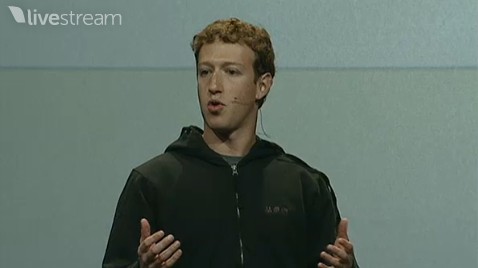
    At its f8 developers’ conference in San Francisco this morning, Facebook CEO Mark Zuckerberg presented his vision of a cross-site social platform whose developmental state may already be quite far along. Essentially, he sees a kind of online social sphere wherein anything one communicates that he likes, gets channeled to Facebook, where that like becomes a public fact.

    Facebook CEO Mark Zuckerberg speaks to the f8 developers' conference in San Francisco April 21, 2010.“Today, the Web exists mostly as a series of unstructured links between pages. And this has been a powerful model, but it’s really just the start,” said Zuckerberg. “The Open Graph puts people at the center of the Web. It means that the Web can become a set of personally and semantically meaningful connections between people and things. I am friends with you. I am attending this event. I like this band. These connections aren’t just happening on Facebook, they’re happening all over the Web. And today, with the Open Graph, we’re going to bring all of these together.”
    The model Zuckerberg is discussing is essentially a published API for users of any service to associate themselves with something — not just something they like, as he said at first, but also something they’re working on, including documents. Those associations then become facts of the Facebook database.

    On Monday, Betanews reported on ‘Connections,’ the types of associations that a Facebook user may establish between himself and something or someone he wishes to be associated with. As demonstrated at the time, Facebook now enables individuals to create Facebook pages that represent things or perhaps celebrities that they and others may like — not a page by those celebrities as much as about them, similar to what Wikipedia provides now.

    As independent Facebook developers were introduced to, for the first time today, existing Web pages outside Facebook can also be enabled to become the center of those associations, by adopting the company’s new Open Graph Protocol. The protocol involves the use of special properties in the <META> elements of Web pages, whose collective purpose is to classify those pages for Facebook. In an extremely hypothetical example, a fan site for the movie Manos: The Hands of Fate might include the tags <meta property="og:type" content="movie" />, followed by <meta property="og:title" content="Manos: The Hands of Fate" />.

    Surprisingly, a check of the accepted object types for things users may like shows that Open Graph will enable sites to declare themselves the centers of attention for video games, movies, TV shows, and albums (collections of songs gathered together onto a disc, originally reproduced using an analog needle apparatus), software or “apps” is not listed, and neither is “device” such as “iPad” (although it could conceivably be classified as product). If Betanews wanted to be a Facebook “like” site for beta software (I know, it’s a stretch, but bear with me), it might be a difficult concept to explain using the current set of Open Graph tags.

    “The Open Graph protocol…is currently designed for Web pages representing profiles of real-world things — things like movies, sports teams, celebrities, and restaurants,” reads Facebook’s official explanation today. “Once your pages become objects in the graph, users can establish connections to your pages as they do with Facebook Pages. Based on the structured data you provide via the Open Graph protocol, your pages show up richly across Facebook: in user profiles, within search results and in News Feed.”

    Visibility in Facebook pages about the declared subject is one benefit to the Web site master. Another is the ability to communicate with users, via Facebook, who have declared they like the site’s subject matter; and to receive analytics and statistics about how Facebook users are interacting with your pages.

    If you think about it, it sounds like a sensible solution to the problem Yahoo faced two decades ago: cataloging commercially-oriented Web sites by subject. This system invites the masters of those pages to do the cataloging, with the payoff being a direct connection to the Internet’s center of social activity.

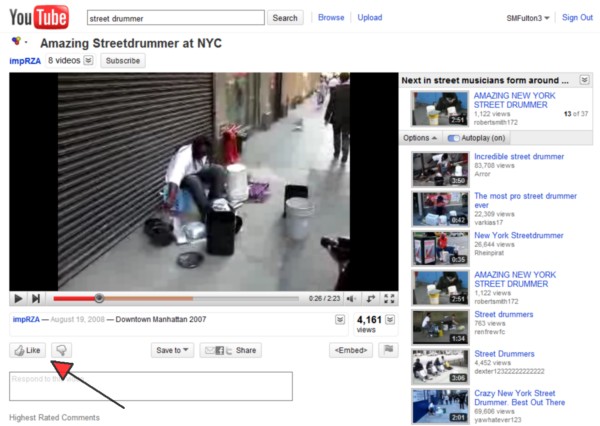
    The 'Like' button on YouTube is more than just a Favorites list -- it can publish your likes to Facebook.

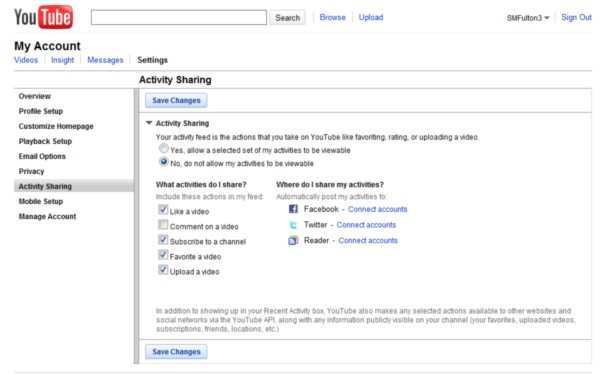
    Google’s YouTube is already part of the process, with its latest round of changes to its front-end controls. Where the “Favorites” button used to be is now something called “Like” (shown above), which does more than just submit a video you like to your YouTube favorites list. As the settings screen now shows (as depicted below), your likes may be communicated with Facebook (if you have an account there).

    Buried in YouTube's personal profile settings (which many never actually use) is the option for whether to share elsewhere or not -- and it's turned on by default.

    That may not happen by default, however, or by accident. First, the user must establish a Google Account (the necessary item for him to join Google Buzz), and then explicitly tie that account to Facebook (Twitter is another option, as shown above). If the user has already established a Google Buzz account, then those associations may already be made, and the videos a user likes may be fused with the Open Graph and tweeted to everyone around the world.

    Also joining the service’s new Open Graph today is Microsoft, which today launched a basic form of its Office Web Apps for use in creating Word, Excel, and PowerPoint documents that can serve as centers of attention, and that reside not in Microsoft’s cloud but in users’ Facebook news feeds.

    “The fact that we’ve been able to adapt the Office 2010 Web Apps technology to work directly within our Facebook app truly speaks to the flexibility and power not just of the Facebook platform, but also of the Office system’s rich ‘contextual collaboration’ capabilities,” reads an actual Facebook-compliant document in Word format, published this afternoon by the leader of Microsoft’s FUSE Labs development team, Lili Cheng. “And we’d never have been able to achieve our critical ‘simplicity’ goals had it not been for our ability to use a new test feature from Facebook that allows us to build an instantly personalized and seamless document authorization & sharing experience directly from our site.”

    FUSE Labs’ Facebook apps are functional versions of the real Office Web Apps, running in the context of Facebook’s platform…but on Microsoft’s site. Conceivably, they can be created either online using the Web Apps themselves, or uploaded into the Web Apps using Office 2010 applications (which consumers will be able to begin using in earnest on May 12).

    As Zuckerberg explained today in a blog post, his goal is to incite all Web users with impetus to share content, including Office docs and Pandora music (another charter Facebook partner), using Facebook as the conduit.

    “This next version of Facebook Platform puts people at the center of the Web,” he wrote. “It lets you shape your experiences online and make them more social. For example, if you like a band on Pandora, that information can become part of the graph so that later if you visit a concert site, the site can tell you when the band you like is coming to your area. The power of the open graph is that it helps to create a smarter, personalized Web that gets better with every action taken.”

    Copyright Betanews, Inc. 2010


    Add to digg
    Add to Google
    Add to Slashdot
    Add to Twitter
    Add to del.icio.us
    Add to Facebook
    Add to Technorati


  • Ferrari Will Release 458 Italia Spider, New Supercar in Next Two Years; Maserati to Launch Entry-Level Model

    In his unveiling of a five-year plan for Fiat and its myriad brands, group CEO Sergio Marchionne today revealed details of Ferrari’s future model lineup. It was somewhat of a surprise, as hearing concrete information about future Ferraris is as rare as getting all the details on, say, a new Apple product; it’s usually a loose tongue or detective work that spills the beans, not the CEO himself. But thanks to Marchionne, we now have concrete information on what will gallop out of the Scuderia over the next few years.

    For 2011, we can expect a replacement for the 612 Scaglietti plus the 458 Italia Spider. We love the 458 Italia coupe, and the Spider is sure to be just as fabulous. A year later, in 2012, Ferrari will launch a new 599GTB and an all-new, Enzo supercar. A face-lifted California will arrive in 2013, as will a 458 Italia Scuderia. As to the latter, look to the 430 Scuderia for what to expect: a lighter, meaner take on the Ferrari’s volume mid-engine sports car.

    Sibling brand Maserati will release a redesigned Quattroporte in the near future, according to Marchionne. It will also launch an all-new entry-level model priced just above $50,000. Let’s just hope the entry Maser doesn’t dip too deeply into the Chrysler parts bin to make its price target—remember the Chrysler TC by Maserati?

    Related posts:

    1. Ferrari Releases New Photos of the 458 Italia
    2. A Guide to the New Ferrari 458 Italia’s Roots – Feature
    3. 2010 Ferrari 458 Italia – Quick Spin
  • Tell Us What Camaro Or Mustang This Is And Win a T-Shirt! (Round Two)

    As we celebrate Mustang vs. Camaro Week and in anticipation of our upcoming comparison tests of the latest V-8 and V-6 versions, we dove into our archives and plucked out pictures of Mustangs and Camaros past. Then we zoomed in and cropped the photos to make identification a bit of a challenge. Here’s where the fun begins: Take a look at this picture and tell us what you see.

    Guessing the model is the easy part—say either Mustang or Camaro and you’ve got a 50-percent chance of getting it right. Year and trim level are where it gets tough, so let’s see what you’ve got. If you get it exactly right—year, model, and trim—you might win a C/D T-shirt, but only if you read these rules first. Post your answers in the comments below. And remember: We can’t contact you to tell you you’ve won unless your commenting persona was registered with a legitimate e-mail address. So make sure yours was.

    Related posts:

    1. Tell Us What Camaro Or Mustang This Is And Win a T-Shirt!
    2. 1968: Tunnel Port Ford Mustang vs. Chevrolet Camaro Z/28 – Archived Comparison
    3. 2010 Lingenfelter Chevrolet Camaro SS vs. 2010 Roush Ford Mustang Stage 3 – Comparison Tests
  • Green Hornet will go supersonic on biofuel

    green-hornet

    As you may recall, last August the Navy put out a call to biofuel companies for 40,000 gallons of fuel to start testing in their F/A-18 Super Hornet jet.  Sustainable Oils ultimately won the contract to develop biofuel for the military branch and now the Navy is prepared to take the Hornet on a supersonic flight using a blend of 50 percent jet fuel and 50 percent camelina-based oil.

    Tomorrow, at the Air Station at Patuxent River, Maryland, the so-called “Green Hornet” will fly over the Chesapeake Bay, hopefully proving that biofuels can perform well in a full range of flight operations, including traveling faster than the speed of sound.  The Super Hornet was picked as a test craft for biofuels because it’s the Navy’s largest aviation fuel-consumer.

    Camelina biofuel has shown itself to be a great choice for jet fuel blends because it can work as a drop-in replacement for jet fuel.  All aircraft systems — fuel gauge, etc. — operate the same as if it were straight petroleum.  Also, a recent study found that the use of camelina jet fuel could reduce carbon emissions by 84 percent compared to regular jet fuel.

    The Hornet won’t be the only naval craft to get a makeover though.  The Navy has committed to getting half of their energy from renewable sources by 2020, which will include cleaning up ships, aircraft and all of their power systems.  The U.S. military is the world’s greatest consumer of petroleum, so their commitment to reducing that consumption is an important one.

    National Geographic News

  • Evening Crunch Crumbs: Kate Gosselin Hasn’t Had Sex In A Year; Seth Rogen Is The Hardest-Working Actor In Hollywood; Drake’s Got Gigs For Childhood Pals

    True Blood’s Alexander Skarsgard was snapped by Inez van Lamsweerde and Vinoodh Matadin for a spread featured in “The Scandinavian Issue” of VMAN Summer 2010….

    -Facebook now has more than 400 million users — and shows no signs of slowing down…..

    Life & Style Weekly claims Kate Gosselin hasn’t had a good roll in the hay since Jan. 2009. I’m still not sure why we needed to know this information, but it sure explains a lot!

    -Drake’s create his own Economic Stimulus Package for a group of his closet childhood friends.

    -Kim Kardashian escaped an abusive marriage!

    -Seth Rogen tops Forbes’ 2010 list of Hollywood’s Hardest-Working Actors….

    -Rihanna’s trip to a Swiss hospital has been explained: The star was treated for an injured rib….

    -It’s getting Real Dirty Down South. In the biggest batch of messness to hit The Real Housewives of Atlanta since Sheree coined the phrase “Who’s Gon’ Check Me, Boo!,” NeNe Leakes and Kim Zolciak are accused of going upside the head of resident gay Dwight Eubanks. He should have been smacked up for the jacked up nose job ages ago…..

    -Here are “15 Movies Posters Re-Imagined with the Stars Originally Cast….”

    -CNN’s countsdown the 10 Top-Paying Jobs for Women……

    -Very sad: American adoptive parents prefer girls over boys, and non-black children over African-Americans, according to a new study carried out by a group of economists……

    Britain’s Got Talent judge Amanda Holden will reportedly fill in for Early Show co-host Maggie Rodriguez — who goes on maternity leave next month….


  • Climate Change Increasing Poverty and Vulnerability in Ethiopia

    Small-scale farmers and pastoralists in Ethiopia are likely to bear the brunt of the negative impacts of climate change in the region, which will include increased poverty, water scarcity, and food insecurity, according to a new Oxfam report released today.

    The international development agency’s report, “The Rain Doesn’t Come on Time Anymore:  Poverty, Vulnerability, and Climate Variability in Ethiopia”, was launched at a special Earth Day celebration organised by the Climate Change Forum-Ethiopia in collaboration with other environmental organisations.   While Ethiopia has always suffered from great climatic variability, including droughts that have contributed to hunger and even famine in the past, the report details how climate change is set to make the lives of the poorest even harder.

    “People who are already poor and marginalised are struggling to cope with the added burden of increasingly unpredictable weather,” said Abera Tola, Oxfam’s Horn of Africa regional director. “It is getting harder and harder for families and communities to bounce back from ever-changing, inconsistent weather affecting their livelihoods, and many have been forced to sell livestock or remove children from school – coping mechanisms that only increase the cycle of vulnerability.”

    Ethiopia is one of the poorest countries in the world and eighty-five percent of the population depends on agriculture for their livelihood. The agricultural sector is especially vulnerable to the adversities of weather and climate since it is rain fed, done using relatively basic technologies, and on tiny plots of land.

    “From the Rift Valley to Tigray, farmers and pastoralists around the country have shared with us the toll that the changing weather is having on their communities, from ruined crops to dying cattle,” said Tola. “Even relatively small shifts in the growing season, can spell disaster for the poorest farmers and pastoralists who are already struggling in poverty.”

    Women and girls in particular are disproportionately affected by climate variability. In times of crisis, women tend to stay home with their children, while men move away to look for alternative means of survival. Women also have fewer options to find other ways of making a living, especially since women’s literacy rate is not even half of that of men. Women are also not given a say in household decisions and are frequently without cash savings or assets to sell to buy food and other basic items.

    “The rain doesn’t come on time anymore. After we plant, the rain stops just as our crops start to grow. And it begins to rain after the crops have already been ruined,” Sefya Funge, a farmer in Adamitullu Jiddo Kombolcha district in Ethiopia told Oxfam. “Because of a lack of feed and water, most of my cattle have died. The few that survived had to be sold so that we could buy food to live on. As I no longer have the means to support my family, only three of my eight kids are still with me. Losing our assets was bad, but the fact that our family is separated is devastating.”

    With some assistance from non-governmental organisations and the government, small-scale farmers and pastoralists are adopting a variety of coping mechanisms, according to the report. In the farming areas, many are shifting to more drought tolerant crops and varieties, improved forest management practices, diversified energy sources, and alternative means of income from off-farm activities. Pastoralists have also divided pasture into wet and dry season grazing areas to better manage risk, while others have changed the composition of their heard from cattle to camels and goats, which can better tolerate dry, hot weather.

    Poverty, limited resources, little alternative sources of income and livelihoods, lack of knowledge and expertise, and the absence of appropriate public policies and financing, increase vulnerability and decrease people’s capacity to cope.

    Oxfam has made several recommendations – at the national, regional and community level – for the development of a holistic approach to increase resilience, so communities can bounce back from climatic shocks quicker.

    Recommendations at the national level include:

    • Prepare and implement a national framework for guiding climate change adaptation and mitigation, . building on the National Adaptation Program of Action (NAPA) and integrated with the Plan for Accelerated and Sustained Development to End Poverty (PASDEP)
    • Investing in agricultural research on the use of new crop varieties and livestock species that are more tolerant to drought.
    • Ensuring civil society and community participation, especially women’s groups, both in formulating climate change policies and in integrating climate change into development priorities.
    • Ensuring priorities and investments address the gendered impact of climate change.
    • Strengthen cooperation among policymakers, nongovernmental organisations, research institutions, and the media.

    Recommendations at the community level include:

    • Investing in livelihood opportunities and risk management strategies for poor farmers and pastoralists, particularly women.
    • Investing and improving agriculture extension services
    • Preparing long-term adaptation plans based on the sharing of best practices through community participation, civil society engagement, and the participation of academic and research institutions, with regular monitoring to identify promising practices for scaling up.
    • Building on what farmers and pastoralists are already doing to adapt to climate variability and change. Investigate these practices further for their sustainability and impact on poverty and inequality, and potential for replication or enhancement.
    • Investing in new forestation programs, reforestation, and sustainable management of the remaining forests. Ensure that management systems guarantee a return to the communities that manage the resource-the only way to ensure genuinely sustainable use of forests and woodland.
    • Investing in community environmental and drought monitoring systems and improve community disaster risk reduction capacity.
    • Increasing use of renewable energy such as solar energy and promoting photovoltaic technology.

    Oxfam has also asserted that developed countries have the responsibility to not only reduce emissions that cause climate change, but also help Ethiopia adapt to climate change impacts that will still affect the poorest, no matter how fast we reduce emissions.

    “Climate change is impacting the poorest first, despite the fact that they didn’t contribute to the crisis,” said Tola. “As global climate change negotiations continue, world leaders must not forget the fact that poor people are dealing with the negative impacts of a changing climate every day.”

    /ENDS

  • Google’s ‘Store View’ project looks like it’s a go

    Google Store view

    Back in February we reported about a new feature that may be coming soon to Google — Store View, as part of Google Place.  Well it looks like the project is being launched and Google has sent out a troop of photographers to take some snaps in select cities worldwide.

    Interested business owners can sign up for the service here — http://maps.google.com/businessphotos.  Of course, Google can’t visit every store that signs up, so there’s already talk of allowing store owners to upload their own photographs to their Place page at Google
    Places
    .

    I see lots of potential for this project, both good and bad.  My wife can do some virtual shopping for purses on 5th Avenue, but so can unsavory types who may be interested in what’s inside a store for all the wrong reasons.  What do you think?  Good?  Bad?  Ridiculous?  Shout out in the comments! [via Google LatLong Blog ]

  • NCBI ROFL: Bad news: you have a tumor. Good news: it’s really cute! | Discoblog

    i1543-2165-128-9-1054-f01.jpeg
    Pathologists must get bored staring at tumors all day, so they start imagining little friends in their samples. There are numerous papers in PubMed highlighting their “discoveries” (or perhaps the results of self-imposed Rorschach tests?). Here are five of our favorites:

    “A 46-year-old woman had an excisional breast biopsy that revealed nonproliferative fibrocystic changes as the only histopathologic abnormality. Although it was not Easter at the time of diagnosis, an Easter bunny was found hiding in one of the dilated ducts, which also contained amorphous eosinophilic secretions. A benign diagnosis in a breast biopsy (or any other biopsy) is good news for the patient at any time of the year, but even more special when accompanied by this little fellow.”

    Images in pathology. Invasive squamous cell carcinoma of vulva that wanted to be a puppy.

    “Squamous cell carcinomas of the vulva are usually well differentiated. Foci of invasion may be well circumscribed and show maturation (the head of the puppy). For such foci located close to the epidermis, diagnosis of invasion may pose a challenge. Careful examination and deeper levels may disclose clear cut foci of invasion. How many such foci can you find here? For answer see below.”

    335

    “Answer:
    At least 3:
    Below the hind foot
    In front of the neck
    Above the tail”

    Images in pathology. Even the bone smiles!

    “Figure 1 shows an unusual bone finding from a 56-year-old woman’s biopsy. We encountered a “smiling” osseous trabecula; we do not know why it is so happy; nevertheless we want to share it with all fellow pathologists because a beautiful smile is always a beautiful smile!”

    smiling_bone

    Images in pathology: parotid bunny eating carrot.

    364

    Just look at that cute fluffy little tail!

    Images in pathology: Snoopy in flight gear.

    “Electron microscopy of a mesangial region from a glomerulus demonstrating an
    interesting artifact.”

    snoopy_flightgear

    Related content:
    Discoblog: NCBI ROFL: Two Cute: Research that would make grad school snugglier
    Discoblog: NCBI ROFL: Viewing cute images increases behavioral carefulness
    Discoblog: NCBI ROFL: Does pizza cause cancer?

    WTF is NCBI ROFL? Read our FAQ!


  • How good is the Dual LED flash on the HTC HD2? Pretty great!

    dualflash DavidK over at FuzeMobility seems to have retired his Fuze for a HTC HD2 and appears to be pretty impressed with one of its features, the dual LED flash.  He took some pictures in a completely dark room to see what the useful range of the flash is, and his results are pretty surprising.

    Regarding the set up of his test he says:

    Nighttime with all lights off and no substantial ambient light (just what makes it through the windows and into a kitchen). A regular camera (DSLR, pocket camera, etc) will not detect any light and the image is just black. So, how does the HD2 fare in this setting? Take a look for yourself.

    FYI all the photos are treated the same way. The background is blurred except for a bag of Animal Crackers which I zoomed into and set in detail so you can see the actual photo size relative to the inset.

    David has a whole collection of pictures, but I will only reproduce the ones at 5 feet and 20 feet.

    See the pictures after the break.

     5feetedited

    5 feet 

    20feetedited

    20 feet

    He concludes:

    The light on the Fuze is good and it’s a great flashlight but it can’t hold a candle to the HD2’s dual LED flash. If you have any concerns about going out at night and missing the shot because of a poor cell phone camera (maybe you even have a phone without a flash at all) if you’re carrying the HD2 you won’t have anything to be nervous about…except blinding your friends:)

    See the rest of the pictures at Fuzemobility here.


  • Facebook Opens Up to the Web — Is That Good or Bad?

    There has been plenty of talk about what Facebook would announce at the f8 conference this week, but the full magnitude of what the company has in mind didn’t really hit home until after the keynote by CEO Mark Zuckerberg and a related presentation by Chief Technology Officer Bret Taylor (Liz has a great overview of the issues here).

    Both carried a single, unmistakable message: Facebook wants to own your activity on the Internet. Zuckerberg did his best to portray this as a great thing for users, but the corollary is inescapable: Facebook will be everywhere you are, watching what you do, keeping track of that data, and talking about what you’re doing to your friends and companies you “like.” A quick survey of the web shows that some seem to see this as a great idea (“Hey, I can show lots of cool stuff to my friends!”) and some are less enthusiastic (“Facebook is going to be following me and tracking my every movement!”).

    The reaction from some observers on Twitter was positive. The LA Times said that it would “make sharing easier,” while Deborah Schultz of the Altimeter Group said, “A world that is more open and connected — always a good thing (despite some snarky comments); thanks FB for pushing open!!!” Her fellow Altimeter analyst Jeremiah Owyang was less enthused, however, describing it as Facebook’s “crusade of colonization.” The New York Times’s response was somewhat more tempered, calling it “Facebook to Go.”

    Silicon Alley Insider called it a plan to “infiltrate the web,” and Silicon Beat said Facebook wants to “conquer the world.” Kevin Marks of BT, a former engineer with Technorati, said that “Facebook wants to replace links between sites with a database stored on their servers that they control access to,” and Eric Marcoullier (co-founder of Gnip and MyBlogLog) quipped: “Coldplay’s ‘when I ruled the world’ playing at F8. Interesting, if appropriate, choice.” Dan Gillmor of the Knight Center for Media Entrepreneurship summed it up by saying that “Facebook wants to be the Internet,” while Chris Dixon, co-founder of Hunch, said “we might look back at the 00’s as the golden age of the web, when we were ruled by Google, a benign dictator.”

    As Liz has pointed out, the key to what Facebook wants to do is to control the hooks and tools that allow it to understand and participate in the social web, the “people-centered” web. By watching and indexing your “likes” and the likes of millions of others — Zuckerberg said that within 24 hours of his keynote, there would a billion “Like” buttons and plugins around the web — the company can create an incredibly powerful map of the relationships between people and their friends, and between people and the things they like, whether they are movies or bands or dishwashing detergent.

    That’s a tremendous power to have, and the youthful CEO of Facebook makes it seem friendly and appealing. Why wouldn’t you want to share with your friends? But to use a popular phrase from Spider-Man, with great power comes great responsibility. Let’s hope Zuckerberg chooses to use his powers for good instead of evil.

    Post and thumbnail photos courtesy of Flickr user Andrew Feinberg

  • Alfa Romeo return to U.S. confirmed with big ambition, Chrysler will provide pair of CUVs

    Filed under: , , , , , , , , , ,

    Alfa Romeo 2uettottanta concept by Pininfarina – Click above for high-res image gallery

    Italiophiles rejoice! Though the move isn’t unexpected, Fiat’s Sergio Marchionne has officially confirmed that the Alfa Romeo brand will make a return appearance to the United States starting in 2012.

    The first vehicles that should hit American dealerships (of course, we don’t yet know where the cars will be sold, but Chrysler‘s woefully underutilized dealer network would be a good bet…) will be the midsize Giulia, which will come in both sedan and wagon variants, along with a compact SUV built in the States using European Giullietta hatchback underpinnings.

    One year later, Alfa plans to begin offering a five-door version of the beautiful MiTo hatchback in the States, which will be joined by a new Alfa Romeo Spider. Could it look something like the 2uettottanta concept from Geneva? Someone get Dustin Hoffman on the phone pronto.

    Moving on to the 2014 model year, Alfa will redesign its compact Giullietta hatchback and send it to America. A second, larger SUV will show up in the same year and will be built in America using architecture borrowed from the next-gen Jeep Liberty.

    There was plenty more news coming from the Fiat camp today. Stay tuned for a much more comprehensive breakdown of the Italian automaker’s far-reaching plans for the next several years.

    [Source: Fiat]

    Alfa Romeo return to U.S. confirmed with big ambition, Chrysler will provide pair of CUVs originally appeared on Autoblog on Wed, 21 Apr 2010 17:58:00 EST. Please see our terms for use of feeds.

    Permalink | Email this | Comments

  • Facebook Makes Itself a Central Point of Failure for the Web

    Facebook, with its open graph announcements at the f8 conference today, is digging itself deep into the infrastructure of the web. Outside developers and existing sites will now be able to hook into Facebook users’ data and activities directly and persistently, keeping logs well beyond the previous limit of 24 hours.

    Organizing the world’s information by powering it is clearly a direct affront to Google. Where Google observes links and relationships between web sites from a distance, Facebook aims to be the glue that connects the web itself. The implications are thrilling, but also scary — what if Facebook goes down?

    The benefits of using a Facebook authentication system were already strong. Bret Taylor, Facebook’s director of product, at today’s keynote explained just how strong when speaking of his own struggle to grow FriendFeed, the real-time social company Facebook eventually acquired. Users who signed up for FriendFeed with Facebook Connect were four times more likely to become active than any other form of sign-up, said Taylor.

    But now, beyond fostering better participation by inviting users to connect their real identities and their real relationships, web services will be able to use Facebook to explode user engagement and relationships. They can use Facebook’s social plugins to expose personalized friend activity and recommendations. And Facebook will establish persistent, dynamic links to users’ participation on connected sites around the web through its “like” buttons.

    Users now have the ability to express their interests not only by saying what they like — say, a local restaurant — but by saying what web site represents it — say, a Yelp review page, instead of the official restaurant site. Web services would be silly not to participate.

    As a user, having your social self represent you around the web will at first be creepy but ultimately be useful. As one Facebook engineer put it to me today, “Imagine if you had one login for the whole web. That would be so sweet.”

    In preparation for f8, a few Facebook employees hacked together examples of what outside developers could do given the new open graph tools. For instance, Facebook.me would allow users to use Facebook as a CMS. Say you’re one of those crazy MySpace devotees who wants blinking disco lights on your profile. Great. Make a web page, host it at whatever URL you want, uglify it to your heart’s content, and port in data that dynamically connects to Facebook. You can imagine brands and small businesses might want to use this in lieu of a traditional web page.

    Another demo, KlugePress, gives the ability to use a nice template and port in Facebook event information. Only users who are invited to the event on Facebook would be able to load a KlugePress invite (this is tricky, and wasn’t really figured out yet for the demo). If users are logged in to Facebook and have permitted access, they can RSVP, comment and see details as they would on the bland Facebook event page. The data itself is sent right back to Facebook. (Pictured above is a KlugePress skin on an older event from my own profile.)

    By inviting developers to integrate with it so tightly, Facebook is enabling new opportunities — but also asking for an awful lot of trust.

    Please see the disclosure about Facebook in my bio.