Blog

  • Skip Pesky Trailers And Ads On DVDs With Not-So-Secret Codes

    Sometimes the ads and trailers at the beginning of a DVD give you interesting information about upcoming releases you otherwise wouldn’t have heard of. Most of the time, though, they’re just annoying as all heck. Here are some not-so-secret remote control codes that can help you skip the ads and get right to the movie.

    These should get you started:

    Trick One – For DVD Players

    When the first trailer on the DVD starts playing on your screen, press the STOP button of your DVD remote twice followed by the PLAY button. That’s STOP -> STOP -> PLAY and it should take you directly to the movie skipping all the trailers and ads.

    Trick Two – For DVD Players

    If the above trick doesn’t work for your DVD, try this sequence suggested by Richard Rider. Instead of pressing the STOP button on your DVD remote twice, press it three times followed by PLAY and it should skip all the trailers and previews. To repeat, the sequence becomes STOP -> STOP -> STOP -> PLAY.

    These won’t work 100% of the time, but will keep you slightly more entertained while the computer beams ads at you.

    Skip the DVD Trailers & Go Straight to the Movie [Digital Inspiration] (via Lifehacker)

  • Nexus One + Centrifuge = Geeky Fun

    An enterprising soul wanted to know if a Lava lamp would function on Jupiter given it’s different gravity, so he created a homemade centrifuge using a Nexus One as a g-force meter.  Check out the video to see a mildly entertaining science experiment. Lava lamp lovers can rejoice, it seems that they indeed will work in Jupiter’s atmosphere.

    Click here to view the embedded video.

    The maker of the video does point out that the accelerometer in the N1 are badly calibrated as they gave false readings the faster the unit went.  This seems to be a documented bug, but I don’t think the fix is coming quickly since using the phone at those speeds is not a typical application.

    Either way, now we know that we can take our hot pink Lava lamps with us on our next trip to Jupiter!

    Might We Suggest…

    • Nexus One Dock Details Emerge
      We just received an email from one of our readers who had a chance to play with the forthcoming Nexus One docks.  Based on his description, we’re in for a pretty nifty little device.  We’d previousl…


  • Zagato Alfa Romeo TZ3 Corsa Racer Teaser Image

    Zagato has been a premium name, famous for building coaches for Alfa Romeo. But believe it or not, Zagato unveils one-off or limited edition models from time to time. The next offering from the Zagato atelier is a racer dubbed the Alfa Romeo TZ3 Corsa — check out the teaser image below.

    Zagato Alfa Romeo TZ3 Corsa race car

    The upcoming racer draws its inspiration from Alfa Romeo TZ and TZ2 and this particular model was commissioned by a German racer whose identity hasn’t been disclosed. The racer is directly based on the 8C Competizione and its tubular chassis is a mono shell carved out of carbon fiber and later grazed with aluminum. Concorso d’Eleganza Villa d’Este in Italy will be the event where the TZ3 will be unveiled for the first time.

    Looks sooo sleek, don’t you think?

  • I know what you’re thinking Doctor…

    I just found a completely charming study from 1977 that tested whether psychiatric patients with mind-reading delusions were really telepathic.

    Telepathy in mental illness: deluge or delusion?

    J Nerv Ment Dis. 1977 Sep;165(3):184-200.

    Greyson B.

    The belief that one can read others’ minds has long been considered a symptom of psychosis, despite reports in the parapsychological literature of veridical telepathy. All patients admitted to an inpatient psychiatric unit were screened for paranormal beliefs, and those claiming telepathic abilities were tested in a free-response ESP task. Eighteen per cent of the inpatient population claimed telepathic abilities; of the nine patients who completed the task, none performed above chance expectations. Higher frequencies of paranormal experiences than those reported previously in the psychiatric literature were attributed to the context of the study. Schneider’s first rank symptoms and a belief in telepathy discriminated schizophrenics more reliably than other paranormal experiences. Possible psychodynamics of delusions of telepathy were discussed in view of the predominance of women and younger men reporting them, as were the possible effects of such research on patients’ delusions.

    Link to PubMed entry for study.

  • Want to create amazing UI on Windows Mobile? Check out SlideUI .NET CF Mobile Controls

    slidenetMobile application development differs significantly from desktop development. Specialized developer tools are required to create a successful and professional looking application. With usability as a crucial factor, each control in the SlideUI Mobile Controls library has been developed specifically for the user to be able to easily operate each control via touch without a stylus.

    Product Features:

    All Controls Available in Design-time
    Simply drop a SlideUI control to your form and set its properties. Please note that design-time appearance of the control will be simplier for some controls (such as button, progress bar or textbox).

    Optimized for Fingers
    SlideUI comes with UICanvas control which adds animated sliding to your forms and lists. The control supports accelerated fallback and both vertical / horizontal scrolling. In addition to this each control is easy to click without stylus.

    Perfectly Designed With Color Themes In Mind
    SlideUI Mobile Controls supports 5 basic color themes for all controls which would let you adjust them to color scheme of your application.

    Designed to Work in Any Screen Resolution
    SlideUI Controls designed to work in all screen resolutions (QVGA, QWVGA, VGA & WVGA).

    .NET Compact Framework 2.0 & 3.5
    SlideUI Mobile Controls can be used in projects which utilizes .NET Compact Framework 2.0 and 3.5 so that you can be sure your application won’t require any additional software to be installed on user’s device starting from WM 6.0.

    A single developer license and one year of software support starts at $499.00.

    Checkout the DEMO or Buy this from the developers website: www.devslide.com/products/slideui

    This post was submitted by devslide.


  • Chrysler posts financial results, loses $197 million in first quarter

    Filed under: ,

    Chrysler just released its first financial report since emerging from bankruptcy last year. The company announced that while it’s still operating at a net loss of around $197 million, it somehow managed to create $1.5 billion in cash during the first three months of 2010. That cash, along with an additional $7.4 billion from past cash reserves, went toward putting a dent in the company’s remaining debt.

    The smallest of the Big Three also managed to increase its market share one percent compared to the last three months of 2009. What’s more, it produced a whopping 56 percent more vehicles in North America from January to March than it did during the same period last year, despite seeing sales decline by 5.3 percent. That bump in production is largely thanks to the fact that Chrysler idled many of its plants through 2009.

    The company says that despite the loss, it’s still on track to meet its goals and return to profitability by the end of this year. That’s due to the fact that revenue increased by around $300 million from the fourth quarter of 2009 to the first quarter of 2010 and that the company is continuing to reduce its debt. At the same time, a rash of new models, including the long awaited 2011 Jeep Grand Cherokee will be hitting the market soon. Follow the jump for the official word.

    [Source: Chrysler via Freep | Image: Bill Pugliano/Getty]

    Continue reading Chrysler posts financial results, loses $197 million in first quarter

    Chrysler posts financial results, loses $197 million in first quarter originally appeared on Autoblog on Wed, 21 Apr 2010 13:00:00 EST. Please see our terms for use of feeds.

    Permalink | Email this | Comments

  • No Surprise: MPAA Wouldn’t Reveal Data On How It Came Up With Bogus ‘Piracy’ Numbers

    Starting last year, I started receiving reports from folks at the GAO that they were getting massive resistance from the entertainment industry when it came to their attempt to look more deeply into the actual economic impact of unauthorized file sharing. Some even told me that industry pressure had resulted in the GAO never releasing a particular report. However, last week, as everyone knows, the GAO came out with its extremely damning report, showing that industry figures on the impact of unauthorized file trading were totally bunk. The numbers — which were regularly used by politicians in pushing for entertainment industry-supported legislation — had little basis in fact, greatly overstated the issue and totally ignored the benefits of file sharing.

    As people dig deeper into the report, more and more details are coming out — including the fact that the MPAA wouldn’t provide the data on how it came up with some of its more questionable “piracy” claims. Of particular concern was a report from 2005, which the MPAA used to push for regulations requiring universities to set up filters. The MPAA used its own research to claim that 44% of unauthorized file sharing came from universities — and the MPAA’s main lawyer made the statement that the primary purpose of internet access on campus was for students to share unauthorized materials. Congress never bothered to question these stats — though, after all the debate, the MPAA finally admitted that it had made a math error that showed the “real” number (according to itself) was 15%, rather than 44%.

    The GAO was apparently interested in digging into this report to understand where these numbers came from, but the MPAA decided it would rather not share:


    The GAO never got all of the information it requested from the Motion Picture Association of America, according to GAO administrators, including Loren Yager, the author of the summary report that ensued and director of the GAO’s International Affairs and Trade efforts. The agency said as much in the report: “It is difficult based on the information provided in the study to determine how the authors handled key assumptions.” Without the materials, government analysts couldn’t properly evaluate the MPAA’s 2005 survey…

    At this point, I think it’s fair to ask why the gov’t should ever be allowed to rely on the stats put forth by the entertainment industry in passing legislation again.

    Permalink | Comments | Email This Story


  • White Sox Manager Ozzie Guillen: Comcast Sucks

    For anyone who has ever thought that they were being singled out by Comcast’s cruddy customer service, or that wealthy and famous people somehow managed to get non-cruddy service from the Kabletown folks, World Series-winning manager of the Chicago White Sox wants you to know that just isn’t so.

    According to his Tweets, the outspoken baseballer spent all day waiting for a Comcast tech to show up at his house.

    “Waiting for comcast people to show up in my house godddddd please take a little longer is not free,” he Tweeted this morning, followed by, “Its amazing to me how u have to wait for cable. As if I was getting it for free. 8 am they said wow.”

    Unfortunately, Ozzie’s wait ended in a way that will seem familiar to many Comcast subscribers:
    “Comcast is now saying they came to my house. They suck. Its not free they r not the only cable company.”

    Guess we know who Ozzie will be voting for in tomorrow’s Worst Company In America showdown.

    Ozzie Guillen’s Official Twitter

    Thanks to Coe-Stanza for the tip!

  • Recap: PhoneDog’s Noah Kravitz talks iPad on CNBC and at event

    Yesterday was a busy day for PhoneDog’s Noah Kravitz!  Between CNBC and the event at PariSoMa Innovations Loft, the talk of the town was the Apple iPad.  In case you missed it, the two video clips are below:

    In an appearance on CNBC, Noah talks about the iPad getting expelled from universities across the United States due to security concerns.

    Later that evening, Kravitz hosted “iPads, Tablets, and Mobile Computing: What it Means to You” at PariSoMa Innovations Loft in San Francisco.  Complete with a panel, the discussion centered around the future of the iPad, and on a larger scale, computing and internet advertising as a whole.

    Check out the videos, and be sure to send some love to Noah via Twitter!  (I hear he’s giving away some prizes due to reaching 10,000 followers.  Might want to get in on that!)


  • iPad Etching Contest Results Will Be Up on Friday [Announcements]

    Sorry for the delay, everyone. If you didn’t notice, we’ve been a bit busy. But the results are close, and you’ll get em all on Friday, scout’s honor. More »


  • This oughta be interesting

    There’s a panel discussion in New York today entitled The State of Gadget Media. Panelists include the dudes from Gakwer/Gizmodo behind the iPhone 4 stories earlier this week, a Senior Editor from one of the big media outlets that those Gawker/Giz guys claim get unfair access, and the head of PR for Samsung Mobile. Amongst others.

    Originally slated to be on the panel but no longer attending is the Editor-in-Chief of Engadget, who also published photos of the lost iPhone but apparently turned down an opportunity to buy the actual device.

    This will either wind up being an incredibly lame, frustrating, tight-lipped “discussion,” or a VERY interesting peek into what the heck is actually going on in this business. What constitutes “Technology Journalism” these days, anyway?

    Check out the event page. I really wish I was in NYC today. 

    Meantime, any thoughts on the whole iPhone 4 “outing”? Sound off … 


  • Resolved: Democrats, Republicans Both Take Huge Donations from Wall St

    Republicans accuse Democrats of being neck deep in the pockets of Wall Street. Democrats accuse Republicans of being neck deep in the pockets of Wall Street. Who’s right? Everybody.

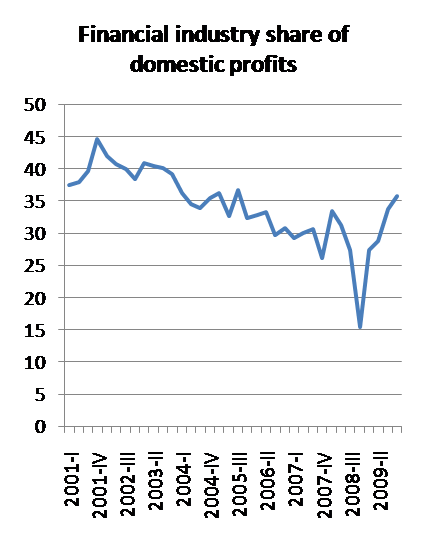
    Politicians often do this thing where they take a lot of money from people with a lot of money, and bankers do have a lot of money.* A cynic might call this practice “endemic.” It would seem more with the times to call it “bipartisan.” Let’s agree to drop the issue of who’s deeper in Wall Street’s pockets by clicking the graph below and moving on with the merits of reform.


    secinvestdonations.jpg

    (graph via Klein)

    ______

    *Financial industry profits, via Krugman:

    :
    DESCRIPTION


    Email this Article
    Add to digg
    Add to Reddit
    Add to Twitter
    Add to del.icio.us
    Add to StumbleUpon
    Add to Facebook


  • Chase Charges $5 To Use Non-Chase ATMs Outside The U.S.?

    Chase says this about using non-Chase ATMs: “$2 each for any non-Chase ATM withdrawal, balance inquiry or transfer. $3 per ATM withdrawal outside the U.S.” You might think that means it costs $2 in the U.S., and $3 outside. You’d be wrong.

    Leila writes,

    I bank with both Chase and Citibank, using Citibank for my international transactions, namely wire transfers as they have a good Global Wire transfer program. Sometimes I withdraw money from the Citibank ATM using my Chase Bank Card, to deposit money into the Citibank Account. Each time I use the Citibank ATM I am charged a 3.00 ATM fee, which is outrageous.

    Upon looking at my recent Chase Banking Statements, it came to my attention that in ADDITION to the 3.00 Non Chase ATM Fee’s that I am charged directly during the withdrawal, Chase ALSO administers a 2.00 NON CHASE ATM FEE usually within 24 hours of outside ATM withdrawals, which actually makes ALL NON CHASE ATM WITHDRAWEL FEE’s $5.00 per transaction, NOT 3.00.

    I called Chase to discuss this and was given the standard “We can mail you our disclosure notice”. I repeatedly asked why I am charged at the point of transaction AND after for a total of 5.00 per transaction and was given absolutely no adequate answer.

    Most people seem to believe they are paying 2.00 OR 3.00 for Non Chase ATM Fee’s, but the actual fee as of April 20, 2010 is a whopping $5.00 per transaction.

    Update: Several readers have suggested that the $5 is typical for international ATM access. One reader says it doesn’t cost $5 to use Chase ATMs in Mexico.

  • 10 Things We Learned From Jim Chanos

    jimmy_chanosA few weeks ago, we interviewed famed hedge funder Jim Chanos at his office in Midtown Manhattan.

    We spoke for around an hour, touching on topics that ranged from his time shorting companies like Tyco and Enron to what kind of girl scout cookies he likes. Chanos spoke at length on more modern topics as well, such as Greece and how he’s shorting China.

    The whole conversation was education, but we thought we’d boil down….

    10 particularly interesting things we learned >

    Be sure to check out our interview with Jim Chanos:

    Part I: Greece Is A Prelude

    Part II: China’s High-Rise Property House Of Cards

    Part III: Inside The Fall Of Enron

    The CDS market was invented to hedge non-marketable instrument risk

    The CDS market was invented to hedge non-marketable instrument risk

    But what people forget is that the CDS market was created exactly for that. Because if you are a creditor of that government with a non-marketable instrument, say Greece owes you money, say Greece has promised to fund your projects. You don’t own a Greek bond. You can’t market that IOU, but you have economic risk. Your project may be imperiled if Greece cannot fund it as promised. The only way you can hedge that off is through the CDS market.

    So that’s exactly why the CDS market was invented. Not just to hedge sovereign debt instruments, because you can simply sell those instruments if you’re bearish! It’s actually to hedge off non-marketable instrument risk. We saw the same thing during the banking crisis when people started saying “Oh there’s been an explosion of buying CDSes on banks, and short-selling the shares of banks in the Spring and Fall of ’08.

    Read the interview ->

    His investigation into Enron started with a phone call

    His investigation into Enron started with a phone call

    A catalyst for our involvement was simply a phone call I got from a friend in Dallas who ran a hedge fund who asked if I had seen Jonathan Weil of the Texas Wall Street Journal’s Heard On The Street column if I had heard the accounting of the energy merchant banks. And I had not seen it.

    So he faxed it to me – email was still not ubiquitous at that point – and it was a really interesting column about how the energy merchant banks had lobbied the SEC successfully for getting mark-to-model and mark-to-market accounting for their long term investing in energy derivatives. To take the present value of all the future profits that were written into the derivatives were sold as opposed to adjusting it pro-rata over the life of the contract. And they were celebrating.

    The article if I can recall went on to say that there were a number of academics and accountants who were worried about this practice. That anytime you could front-load profits you’d really suspect that company of corporate abuse. We had experience with this in a number of areas in the first subprime fiasco in the mid-90s and then way way back going back to the annuity issuers – Baldwin United and others – back in the early-80s. They were selling insurance policies and cooking up all their future assumed income up front.

    Read the interview ->

    Enron was really just a giant leveraged hedge fund

    Enron was really just a giant leveraged hedge fund

    The next thing that caught our eye was even with what looked to be some pretty aggressive accounting, we calculated the company’s pre-tax return on capital including their derivatives book to be somewhere a little north of 6% but below 7%. And based on what Enron bonds were trading at and the equity risk premium, we realize this company wasn’t earning its cost of capital.

    So it was a giant leveraged hedge fund as my partner Doug Mellon said at the time that was earning 6% a year if you would, on a leveraged balance sheet and you were gonna pay six to ten times book for it. It made no sense.

    Then finally, there were the more interesting secondary issues like the insider selling through 2000. A lot of executive departures in 2000. So all these things for us were enough for us to start initiating a position in November of 2000.

    Read the interview ->

    Skilling triggered the position

    Skilling triggered the position

    The “A-Ha!” moment for me that I suddenly knew that something was not in the grey area but the black area was when Skilling resigned. That’s when I knew.

    When Skilling resigned abruptly at that point I knew that something was very very wrong that we couldn’t see. And what we couldn’t see of course was the gua ranted payments that they had made to the offshore entities should they sell them assets were suddenly loss-making.  So in order to get these toxic assets off their books, they agreed to issue Enron shares as a “make-good” to the offshore entities. And they didn’t disclose that.

    That was the hidden troll, in terms of an equity analyst.

    Read the interview ->

    Condos in China are nothing but empty shells

    Condos in China are nothing but empty shells

    The Chinese bubble has its own interesting set of anecdotes and circumstances and one of the more interesting ones from our perspective as a westerner is that when people were buying 2 and 3 condos in Miami for example, they would rent the 2nd or 3rd condo to try and get some rental income. In China, that’s not the case.

    They’re empty shells. When you buy a condo, you’re getting an empty shell and nothing more. By and large most of the developments are 1100 square foot boxes. And they [the owners] don’t rent them because people want to keep them basically as pristine as possible for when they flip them because new is better than old. So ironically, you have people that are buying multiple condos here to speculate who are carrying themselves – there’s no rental income.

    Read the interview ->

    A mortgage for a Chinese condo sucks up 60 to 100% of your pretax income

    A mortgage for a Chinese condo sucks up 60 to 100% of your pretax income

    Keep in mind that the average median income in China, and it’s only slightly higher in the cities, is something like $3500 per person. Typical second-tier city real-estate prices have now gone above $100 a square foot. So a typical 100 square meter condo is probably going to cost you after all your expenses (if you build it out to live) $120,000 to $140,000 US. Well say you’re a dual income couple and you make $7000 to $10,000 a year total. OK? Even if you put down the 20% down that everyone’s pointing to, that’s 20% on your purchase price. You’re still paying mortgage interest of probably … 60 to 100% of your income, pretax.

    Read the interview ->

    China’s housing market is completely high-end

    China's housing market is completely high-end

    The other interesting thing about the boom here is that it is completely high end. When people talk to me about China’s “migration of people” into the cities and the population and blah blah blah, and the growth of the economy, I said “That’s all and good but they’re putting up the equivalent of New York City highrises at almost New York City prices for a populous that is 1/10th of that per-capita income.” So this building boom is aimed at: A) the corporate market, corporate highrises and office buildings or B) very high end of the residential market. It’s not the masses – it’s for people speculating.

    Read the interview ->

    Mark-to-market accounting is fine…if there’s a liquid market

    Mark-to-market accounting is fine...if there's a liquid market

    Yes, there’s nothing wrong with mark-to-market accounting if there’s a liquid market in instruments. The problem really for Enron, and then as we found out later for the banking industry in the latest financial crisis, was really mark-to-model accounting. Mark-to-market for lots of derivatives is really, for the vast majority of them, looks towards something that’s liquidly traded, say something like a Treasury bond or IBM stock. And if it’s an option on IBM stock, or say it;s a simple mortgage-backed bond that trades off of Treasuries, it’s fairly easy to get a reasonable set of assumptions as  to what your derivative  might be worth by looking at the price of the “underlying” as they say.

    Read the interview ->

    He likes girl scout cookies

    He likes girl scout cookies

    When Chanos walked into the conference room, he brought with him a fresh box of Girl Scout Cookies. Thin Mints, to be precise. The man has good taste!

    Dubai was a property bubble

    Dubai was a property bubble

    Dubai’s exclusive Palm Jumeirah development

    Image: AP

    Dubai was a property bubble. Plain and simple. Go to Dubai and see what happened. It was…what I call it the “Edifice complex” – it’s just, we can grow by putting up lots and lots of buildings and trying to attract people to come here, stay here, and put up offices here and sooner or later, you put up too many. And whether it’s the Palm Island project or the indoor ski resort or, you know, take your pick because everyone has lots of Dubai stories. At first it seemed plausible and economic and by the end of the boom, they were putting on drawing boards all kinds of crazy projects. So it didn’t take a rocket scientist to see the excesses. They were pretty visible to the naked eye.

    Read the interview ->

    Want to learn about other men like Chanos?

    Want to learn about other men like Chanos?

    Check out The Greatest Trades of All Time ->

    Join the conversation about this story »

  • The Nicest iPad Twitter App You Haven’t Heard Of [IPad Apps]

    Twitterific is probably the best Twitter app on the iPad. But you’ve heard all about it. The nicest to actually look at? One you haven’t, a little app called TweetFlow. More »


  • Goldman: Markets Have Completely Missed The Consumer Rebound Happening In The Real Economy

    A chart caught our eye from Goldman’s Noah Weisberger — Goldman’s basket of consumer stocks, the ‘Wavefront US Consumer Growth Basket’ appears to have fallen behind the sharp rebound in U.S. consumer data as of late.

    Goldman:

    However, as we look at how consumer bits of the US equity market stack up against the economic data, it still seems that the market response has been quite restrained (see Exhibit 2 and 3). And even though we see the near term risks as about balanced, we still see plenty of “macro” value in consumer stocks, be it via our Wavefront Basket, via the broader consumer discretionary sector (say the XLY), or even via some more narrowly focused retail baskets (like the RTH, with the MVRX the clear exception to this). Moreover, we continue to have a fairly constructive outlook in terms of the near-term balance between better growth news, still moderating US inflation, and the resulting monetary policy response (or lack of one).

    Chart

    For those without access to Goldman’s basket, the Consumer Discretionary Select Sector SPDR (XLY) ETF, mentioned in the excerpt above, might be a proxy. Another idea is to look at strong consumer-driven companies that may have underperformed the overall market, such as Best Buy or Walmart. If Goldman’s Consumer basket rises with the rebound in consumer data shown above, most consumer names will probably be rising as well.

    Chart

    Chart

    (Via Goldman Sachs, Tradewinds: Flat tactical equity risk, Noah Weisberger, 20 April 2010)

    Note: The author does not personally own Walmart (WMT), Best Buy (BBY), or XLY shares, but investors he speaks with may. Everyone should perform their own complete due diligence with any stock mentioned.

    Join the conversation about this story »

  • GM Pays Back All Its Government Debt?

    Troubled U.S. automaker giant General Motors paid back the remainder of the debt it owed the government. In an announcement today, the U.S. Treasury said that it repaid the final $4.7 billion it owed out of the original $6.7 billion the government had lent the company. GM was expected to pay back its debt early, but not this soon. Does that mean taxpayers are off the hook? Hardly.

    The Treasury still retains a great deal of GM’s equity. It owns $2.1 billion in preferred shares and 60.8% of common stock. So taxpayers still own GM, they just aren’t owed any debt from the firm. Until the Treasury gets rid of its stake in the company, the bailout could still result in a loss if it fails to recover. If you include equity, the GM received about $50 billion. Taxpayers have a ways to go before they can stop worrying about the automaker.

    And there’s still reason for skepticism regarding GM’s ability to survive. The company lost $4.3 billion in the second half of 2009. It forecasts a profit for 2010, but it certainly isn’t minting money yet.

    The company also paid back its debt to the Canadian government. Where did GM get the billions to pay all this back? It has been doing better lately and likely utilized a great deal of its revenue to make these payments. This was a priority for the company, as it would have trouble convincing private investors to buy into a new public equity offering with debt to governments still outstanding.

    One big fear is that GM rushed this repayment. If the company runs into trouble again, having a few billion dollars in free cash lying around would certainly be helpful. Lower interest payments going forward are a plus, however. The repayment should make for lower net income in the short run, but higher profits in the long run. That is, if the automaker can manage to control its costs and recapture the consumer demand that it has lost over the past few years to bring back sales.

    (NAV Image Credit: Mike Licht, NotionsCapital.com/flickr)


    Email this Article
    Add to digg
    Add to Reddit
    Add to Twitter
    Add to del.icio.us
    Add to StumbleUpon
    Add to Facebook


  • The $7,865.84 Verizon Bill

    Yowza! David’s eyes popped out his head when he saw his $7,865.84 bill from Verizon.

    The charges stemmed from a recent trip to Tel Aviv where he used 350,000 kb of data on his Mifi connection. As we’ve extensively documented, Verizon charges 2 cents per kilobyte. Before leaving the states, a Verizon rep told him how much it would cost. Not used to thinking in kilobytes, David asked what his normal data usage was. His response was that David was on the unlimited plan so he was not charged by kilobyte. While a truthful statement, it didn’t exactly answer David’s question.

    David is going to pay his bill, which Verizon offered to go hafsies on. He writes that he accepts full responsibility for not doing the math and for not taking advantage of the VZ Manager software that pops up when you tether your phone that can track your kb usage. David just wishes Verizon had been less obtuse in its explanation, and/or had told him about the VZ Manager tool.

    I can connect up to 5 of my employees to my Mifi; if I had traveled with a team to Tel Aviv and used my full 5 GB of a lotted monthly usage I would have come to a $100,000 bill- something that usually costs me $50. The thought of that even “accidentally” being allowed to happen makes my head spin.

    Word to the wise, don’t use your American cellphone overseas to track your Farmville operation, or really, do anything with it.

    Verizon Data Roaming Nightmare [David Snyder’s Snydey Sense]

  • Mo’Nique Unhappy With Brother’s Molestation Confession On “Oprah”

    Mo’Nique’s fractured relationship with her estranged parents and the brother that molested her for several years during her turbulent childhood is more damaged than ever after The Imes Family appeared on The Oprah Winfrey Show on Monday. Alhough the Oscar winner originally gave Oprah her blessing to interview her brother Gerald, snoops close to the Precious star say Mo’Nique is “not happy” with the direction the interview took, and even charges that her “unsympathetic” brother lied about many of details surrounding the abuse that began when the comedienne was just 7 and Gerald was 13.

    Here’s what one tattle told RadarOnline.com: “Oprah and Mo’Nique were never the best of friends… Mo’Nique was less than impressed with how the interview played out as she felt that her brother lied and that it was not sympathetic enough towards her. She was particularly upset that Gerald lied to Oprah that he molested her while she was sleeping because she was wide awake and scared of him.”

    The tipster adds: “Also, she is angry that he did not get any help or enter a rehab and she does not trust him around children. Oprah asked her to appear on her show again for another interview but at this point she has declined the invitation. If anything it has made the situation worse between Mo’Nique and her family and she doesn’t know if she will ever speak to them again now.”

    Mo’Nique received the supporting actress Academy Award in March for her role in Precious: Based on the Novel ‘Push’ by Sapphire. The Baltimore-born mother of three has said that she channeled the rage she felt toward her older brother for her role as monster mom Mary Jones.