Capcom’s fighting games aren’t the only ones that savored the spotlight back at the Captivate 2010 event in Hawaii. The publisher also announced Bionic Commando Rearmed 2, which comes with redesigns, re-engineering, and you better believe it
Blog
-
Can federal courts help tackle global warming?
by Doug Kendall
.series-head{background:url(http://www.grist.org/i/assets/climate_desk/header.gif) no-repeat; height:68px; text-indent:-9999px;} h3.subscribe-head{padding-left:5px;background-color:black;color:#ff8400;} dl.series-nav{margin-top:-15px;}
If Congress and the president fail to tackle global warming, can courts
step in? Can federal judges allow people struggling with the losses of
global warming to sue polluters directly?The idea may at first seem crazy. In a legal world obsessed with claims
of judicial activism, the image of a judge taking on a global problem
like climate change seems like the punch line to a bad joke at an Exxon
board meeting. But it turns out there is a long and proud history of
judges addressing pollution in the absence of environmental regulation.
For much of the last century—long before Congress acted—federal courts
allowed plaintiffs to seek injunctions to stop all kinds of pollution.
Successful suits prevented an ore smelter from releasing deadly
atmospheric arsenic over the homes and families of Utah, the City of
Chicago from draining its sewage into St. Louis’ drinking supply, and
New York City from dumping its garbage into the Atlantic, where it
washed up on the beaches of the New Jersey Shore. Today, states and
environmentalists are turning to these and other historic precedents to
make the case that climate change, too, belongs in the courts—when the
other branches of government refuse to act.The current battle began in 2004, the midpoint of the Bush presidency.
A coalition of states and private land trusts, led by the State of
Connecticut, that were frustrated with Washington’s failure to
introduce legislation or regulations limiting greenhouse gas emissions
sued several of the nation’s largest electric utilities in Connecticut v. American Electric Power.
The coalition alleged that the companies’ greenhouse-gas emissions
amounted to a “public nuisance” in the form of global warming. Under
the nuisance principle—one of the oldest in English common law—a
property owner may ask the court to stop a defendant who is interfering
with the owner’s enjoyment of his own property, and, in some
circumstances, to pay damages. In the Connecticut case, the plaintiffs
thus sought to persuade the court to order the utility companies to
reduce their greenhouse-gas emissions by showing how such gases cause
global warming, which in turn was creating increased temperatures,
alternating drought and floods, destruction of natural habitats, and
corresponding decreases in property values and human health and
welfare.Though the cause-and-effect aspect of this argument might seem hard
to prove in court, global-warming victims in other corners of the
country started filing similar lawsuits. In Comer v. Murphy Oil,
residents of Mississippi’s Gulf Coast sued nearby oil refineries for
damages they suffered during Hurricane Katrina, alleging that the
refineries’ greenhouse-gas emissions contributed to the force of the
storm. In 2008, in Native Village of Kivalina v. Exxon,
residents of a small village on a barrier island off the Alaskan coast,
whose homes are being steadily submerged by rising sea levels, filed
suit against two dozen energy companies for their contribution to
climate change. The villagers, who are native Inupiat, seek more than
$400 million in damages to cover the cost of relocating their homes,
again using the doctrine of nuisance law.Each of these cases was
dismissed at the trial court level. The judges said that the suits
raised a “political question” not fit for the judicial branch to rule
on-a tool that allows judges to punt tricky cases they don’t want to
decide. Two of the lower courts also said that the parties lacked legal
standing to bring the lawsuits, because they could not show their
injuries were sufficiently traceable to the defendants’ conduct.
However, the plaintiffs appealed these dismissals to federal courts of
appeals, arguing that they do have standing and that the “political question” doctrine does not apply.Then, to the shock of the legal community and even some environmentalists,
two federal appeals courts reversed these rulings. Last September,
after more than three years of deliberating, a two-judge panel on the
U.S. Court of Appeals for the 2nd Circuit overturned the dismissal of Connecticut v. AEP in a sweeping 139-page opinion. A few days later, a three-judge panel of the U.S. Court of Appeals for the 5th Circuit released a similar opinion reinstating the Katrina victims’
lawsuit. The five judges responsible for these rulings-three of whom
were appointed by Republican presidents-found that the plaintiffs had
standing and that the evidence of the relationship between greenhouse
gases and climate change was sufficient for the cases to go forward.
The courts did not punt because of the “political question”
doctrine, pointing out that federal courts have successfully handled
public nuisance claims involving environmental damage for more than a
century.Here the 2nd Circuit relied heavily on a little-known, century-old Supreme Court case called Georgia v. Tennessee Copper Co.
The suit began in the early 1900s, when the State of Georgia sued two
copper companies in Tennessee for emitting noxious emissions that
destroyed plants and crops in Georgia. No less a figure than Justice
Oliver Wendell Holmes found the copper companies liable for the
nuisance of air pollution and ordered the companies to reduce their
emissions. When the companies failed to fully comply, the court set
emissions limits, with monitoring requirements and costs divided
between the defendants. In other words, the court established the same
sort of regulatory regime Congress would introduce 50 years later with
the 1970 Clean Air Act.Today, federal courts dealing with global-warming lawsuits are faced with the same dilemma as the Supreme Court was in Tennessee Copper,
only on a much larger scale. Air pollution from one state is causing
harm to other states (indeed, to the whole world). Despite the
encouraging rulings from the courts of appeals, however, today’s
global-warming nuisance suits face an uncertain future. Last month, the 5th Circuit announced a rehearing en banc for the
Katrina victims’ lawsuit, meaning that all of the court’s judges will
sit and rehear the case. The Alaskan villagers, who lost before the
district court, now move to the 9th Circuit Court of Appeals. One or more of these plaintiffs may well wind up before the Supreme Court.And there a conservative majority may be more sympathetic to the
fossil-fuel industry, which argues that the courts should butt out
because Washington is doing plenty about global warming. The industry’s
Exhibit A is in fact another court case: The Supreme Court’s 2007
ruling in Massachusetts v. EPA, which held that greenhouse
gases are air pollutants within the meaning of the Clean Air Act,
allowing the EPA to regulate the gases directly.But the 2nd Circuit in September rejected the argument that this displaced the nuisance suits, noting that the EPA had not yet used the Clean Air Act to regulate greenhouse gases. The court
acknowledged that this could change if and when the Obama
administration gets moving.Judge Peter Hall, the author of the 2nd Circuit’s opinion, conceded the same point in a recent speech at
Georgetown Law School. The courts would happily get out of the business
of hearing nuisance suits about climate change, he said, if the EPA
does its job in restricting these emissions-or better yet, if Congress
passes a comprehensive climate bill. In the meantime, however, Judge
Hall added that judges have the responsibility to take seriously
nuisance lawsuits brought by property owners facing strengthening
hurricanes and rising sea levels. These lawsuits, he said, probably
provide a backstop and “some small impetus” to stonewalling lawmakers.
It’s a trade-off: Polluters can either get out of the way of Congress
or face the, well, nuisance of lawsuits for decades to come.Related Links:
The Best Way to Celebrate Earth Day
-
iPhone OS 4 beta 2 now available

I’ve been running OS 4 beta 1 for the past few days, and for the most part, I’ve been happy. I love the “Folders” feature, multitasking is great, and the universal inbox is awesome (given the number of e-mails I receive, it was a welcome addition). That being said, it has been a bit buggier than I would have liked. Between my music randomly being placed on shuffle mode (no, iPhone – I wanted to listen to Lionel Richie, not Paula Abdul), occasional e-mail problems, random reboots, and the quick battery drain, it’s enough to be frustrating after a few days of experiencing it.
Apple today made OS 4 beta 2 available to developers, and while it’s still a beta (and a young one at that), I’m hoping that some of the kinks are worked out. I’ll be sure to keep you updated – in the meantime, let us know if you’re running OS 4 beta 2!
Via Engadget
-
Video: Ken Block teases Gymkhana THREE with Ford Fiesta

Ken Block today released a little hint of what’s to come from his all new Gymkhana THREE with his new 2011 Ford Fiesta. The footage taken at top secret testing facility.
Block tells us that the Gymkhana THREE Fiesta will be revealed at later today in San Fransisco.
Click here to get prices on the 2011 Ford Fiesta.
Ken Block’s 2011 Monster World Rally Team Ford Fiesta:


Ken Block’s 2011 Monster World Rally Team Ford Fiesta:
– By: Omar Rana
-
Sen. Edward Meyer Vs. Rep. J. Brendan Sharkey; Two-Page Letter Details Clashes Over Two Environmental Bills
Sen. Edward Meyer, a Guilford Democrat, is publicly clashing with Rep. J. Brendan Sharkey, a Hamden Democrat who co-chairs the legislature’s planning and development committee.
In an unusual letter that was distributed around the state Capitol among environmental advocates and others, Meyer writes in detail about Sharkey’s actions concerning two bills that were killed at the committee level.
Hartford Courant columnist Kevin Rennie has the details and the two-page letter at http://www.dailyructions.com/oh-the-sharkey-has-pretty-teeth-dear/
-
Goldman Fiasco Renews Call to Ban "Useless" Securities
At the heart of the SEC’s lawsuit against Goldman Sachs is the creation of a synthetic collateralized debt obligation (CDO). This type of security is one of the most complex out there. A hybrid of a derivative and asset-backed security, its consists of bonds that are paid cash flows based on the performance of other bonds, loans or securities that they reference, but are not directly backed by. For anyone who hasn’t worked in the securities industry, that’s probably confusing. Some who work in finance even find them strange. They don’t serve any funding purpose, but act more to allow investors to bet for or against some asset or market. Without any clear social purpose, should they be banned?
First, it’s important to understand what drove banks to create these complex securities in the first place. The Goldman fiasco is a perfect example. In that case, a hedge fund manager named John Paulson wanted to short — bet against — the subprime mortgage market in early 2007. Yet it isn’t that easy to short the mortgage market. Mortgage-backed securities aren’t like stocks, where there’s a large supply of put options that allow buying a short interest in a company. So he asked Goldman Sachs to arrange a synthetic CDO. Other investors who wanted to bet on the subprime mortgage market would purchase the long interest and Paulson would buy the short. So the synthetic CDO created an opportunity for some investors to bet on the subprime mortgage market and others to bet against it — without anyone actually investing in a single mortgage.
In his New York Times column today, Andrew Ross Sorkin renews the call to ban seemingly socially useless derivatives like synthetic CDOs. He says:
Why was Goldman, or any regulated bank, allowed to create and sell a product like the synthetic collateralized debt obligation at the center of this case? What purpose does a synthetic C.D.O., which contains no actual mortgage bonds, serve for the capital markets, and for society?
The blaring Goldman Sachs headlines of the last few days have given the public a crash course in synthetic C.D.O.’s. Many more people now know that synthetic C.D.O.’s are a simple wager.
And he quotes a former securities lawyer:
“With a synthetic C.D.O., it’s a pure bet,” said Erik F. Gerding, a former securities lawyer at Cleary Gottlieb Steen & Hamilton who is now a law professor at the University of New Mexico. “It is hard to see what the social value is — it’s hard to see why you’d want to encourage these bets.”
Does the Government Ban Socially Useless Things?
But it’s also hard to see why it matters how socially useful a financial product is. Since when does something have to make the world a better place for people to legally buy or sell it? It isn’t hard to think of a vast number of products out there that have no social value. Remember the Koosh ball? That hardly earned its inventor the Nobel Peace Prize. Some may like the way breast implants look, but surely such purely elective cosmetic surgery serves no tangible benefit to society at large. Even fast sports cars like Ferraris are completely unnecessary to society. Indeed, on almost all roads in the U.S. the speed limit will preclude a Ferrari’s owner from enjoying the vehicle’s full potential.
The government response to a socially useless product isn’t generally to ban it. It’s to make sure it doesn’t result in social harm. Speed limits serve this purpose for the Ferrari, for example. The same could be done with securities that are seen as being speculative and risky. If there’s a significant potential for loss, then require investors to put up significant portion of cash to cover the downside.
Useful After All?
In the case of synthetic CDOs there may even be some socially useful purpose of keeping them around after all.
A Smaller Real Estate Bubble
Some have suggested that the existence of the synthetic CDO market prevented investors from overheating the mortgage market even more. My colleague Megan McArdle brought up this argument earlier while discussing this topic. By investors purchasing the synthetic CDOs instead of MBS, that took funding away from the real estate market, which would have inflated the bubble even further.
Economic Efficiency
And on the other side of the coin, the short interests in synthetic CDOs also helped prevent the bubble from continuing to grow even larger. As the short positions built up, the mortgage market corrected itself more quickly, since investors began to realize their error sooner than they might have otherwise, had shorting been impossible.
So synthetic CDOs may have some positive social benefit after all. But even if they don’t, there doesn’t appear to be a precedent for the government to ban them just because they don’t make the world a better place. Instead, precautions could be taking to ensure they don’t get banks and investors in too much trouble.


-
Rendered Speculation: Will a new Roadster spearhead MG’s return to America?
Filed under: Convertible, Performance, China, UK, Rumormill
 Inside Line has a rendering of that still-in-the-works successor to the MG TF. It isn’t exactly a shock, as it looks much like a slightly evolved version of the current and soon-to-be-dead MG TF. The real revolution will be what the body rests on and what powers it – Chinese owner SAIC is reportedly still playing around with platform possibilities, but it doesn’t look like the company is any closer than before to finding a partner for that aspect of the project.
The roadster’s motivation will be thanks to an engine in front turning the wheels in back, just as God intended. Powerplant options are said to be a small General Motors diesel, a conventional V6 and an in-house hybrid. The natural question posed is: where is the four-cylinder? Who knows, maybe SAIC plans to skip that step and pwn the Mazda MX-5 Miata with its revelatory handling chops. No matter which they choose, if the body in the illustration can be trusted, it will be handsome enough to make the attempt. No hurries on a decision – we still have three years before it goes into production, and we’ve heard promises of MG’s revival in the States before, so we’re not holding our breath.
[Source: Inside Line]
Rendered Speculation: Will a new Roadster spearhead MG’s return to America? originally appeared on Autoblog on Tue, 20 Apr 2010 14:29:00 EST. Please see our terms for use of feeds.
Read | Permalink | Email this | Comments
-
Blue Ant Q1 BT headset review


A few weeks ago, the editor-in-chief of AndroidGuys elected me to test and review a brand new Q1 headset. First, because I am his favorite writer (yeah right) and secondly because I have the Motorola Droid that has version 2.0 and above, I suspect that’s the real reason.
In any event, while I was excited about reviewing the unit, I have to confess that I do not use BT headsets very often – only when driving. But this one is a beaut. From the moment I received the package I could tell that BlueAnt put some nice design elements into it. To me, it looks a lot like a Jawbone minus the external rough texture. Out of the box it had enough charge to last half the day since I determined to put it through its paces. And it is by far, the easiest BT device I have ever had the pleasure to pair. One thing I noticed is the lack of volume, which to me is never a good thing. I feel like I can always turn something down if it is too loud but too soft is bad and it has almost no bass, so callers sound very tinny and thin. And since it’s not in stereo the “not loud enough” problem is compounded by hearing ambient noises in your free ear which drowns out the Q1 even more.
However, the speech recognition is near pitch perfect as it recognized most of my commands in a convertible barreling down the interstate and all of them indoors or in my wife’s car. So anything from to quiet to normal, you should be in good shape in using this headset.

The best feature is that a corresponding Android application can be downloaded out of the Market but other than the Android compatibility the application is nice but lacking in features. It reads aloud new text messages that come in but that’s about it. No Gmail, e-mail, contacts, or anything else will be read. The main use for the app is to control the Settings and for Voice Control. I could see this app being fairly intuitive and powerful in the near future but right now it’s pretty bare bones but still impressive for Android.
The Good:
- Great looking headset and well designed
- Nice modular charger with rigid USB cable
- Speech recognition is top drawer and of course it has a complimentary Android app
The Bad:
- Very low volume even at the highest level
- Android app is not feature rich….yet.
Might We Suggest…
-
Youths Intercept Two Trucks Of Prepaid Metres In Ile-Ife
 TWO loads of trailer with prepaid meters were intercepted by some inquisitive youths in Ile-Ife last Tuesday.
According to OSUN DEFENDER investigation, it was gathered that the two trucks loaded with the Power Holding Company of Nigeria’s (PHCN) prepaid metres took off from a branch office of PHCN’s office located at Mayfair area of the ancient town late in the night on Tuesday, but some motorcyclists popularly known as Okada reportedly suspected a foul play informed the security agents about the movement of the two lorries which led to their interception.
Some of the commercial motorcyclists, who informed the State Security Service (SSS), in a chat with the medium said that the two trailers had earlier parked at a distance not too far from the PHCN’s branch office as early as 4p.m, but the loading of the pre-paid metres into the vehicles did not commence until 9p.m which aroused their suspicion of a possible foul play.
A senior source at the SSS office confirmed the incident to the medium, while also affirming that the PHCN branch manager where the pre-paid metres were loaded into the trailers had been interrogated by the security operatives.
 Further findings by the medium also revealed that the prepaid metres were supplied by a company known as ENL Ltd, to the PHCN in Ile-Ife, but the company later decided to transfer the goods to a location in Ikolaba area in Ibadan.
Investigation also revealed that some electricity consumers in Ile-Ife, who had earlier applied for the pre-paid metres from the PHCN, had been denied the metres, alleging that the prepaid metres that were intercepted but later released by security agents were indeed meant for Ile-Ife customers, but were hoarded by the PHCN officials.
A staff of the PHCN who spoke with the medium under anonymity informed the medium that the decision to transfer the pre-paid metres to Ibadan was the sole decision of ENL Company, which was saddled with the responsibility of distributing the metres to the PHCN’s offices nationwide.
By SOLA JACOBS

Other Related Stories
-
Hip-Hop Legend Guru Dies; A Civil Rights Icon Silenced; Vera Farmiga Pregnant; & More Midday Crunch Crumbs
-The Hip-Hop World is mourning the loss of a legend: Gang Starr icon Guru — one of rap’s most prolific lyricist — lost his battle against cancer on Monday. He was 43. When it comes to classic Gang Starr tunes, I have a few favorites, but this one remains in the top slot. R.I.P. Guru….
-Oscar-nominated actress Vera Farmiga and former Deadsy rocker Renn Hawkey are reportedly expecting their second child….
-Laurence Fishburne is on board for another year of CSI….
-Betty White unveils a hot dog named after her in Los Angeles….
-Ryan Phillippe’s down with “The Swirl?” The Cruel Intentions hunk is reportedly dating Sports Illustrated model Jessica White….
-Fantasia’s coming back for another season of foolery on VH1….
-Octuplets mother Nadya Suleman appeared on Oprah today, where she cried that being known as “Octomom” makes her feel like a “carnival attraction.” Boo-hoo….
-Civil rights legend Dorothy Height has died…..
-Melissa Joan Hart is leaving audiences in stitches in the Off-Broadway production Love, Loss, and What I Wore…..
–The Early Show spoke with comedienne Sarah Silverman about her new book on her funny father, childhood stories, and comedic career…..
-Oh look, it’s Lauryn Hill! And she isn’t dressed like a bag lady!
-Demi Lovato reminds us to remember the poor….
–Jon Stewart and Stephen Colbert are sticking with Comedy Central. Stewart’s contract extension will keep him at the helm of The Daily Show through June 2013, while Colbert will stay with the channel through the end of 2012…..
–Age-appropriate dresses for prom…..
-The Web’s still buzzing about former Cheetah Ho Kiely Williams and his (Please don’t correct me for writing “his” instead “her” — I know what I’m doing here….) Drunken Slut theme song “Spectacular.” In case you missed it, here’s a video of Kiely’s very pissed off big sis, Tse, lighting into critics who ripped the ex-Disney starlet’s date rape anthem. Looks like the apple don’t fall too far from the heifer. Tse’s central argument? “Everyone Else Behaves Like Tramps These Days, So Why Can’t My Sister?” Girl, Good Day. Tse also takes pot shots at Perez Hilton, Kim Kardashian, Lil Wayne, Kiely’s former partner in whoring Adrienne Bailon, and even Jersey Shore’s Snooki! You leave Snookster and Weezy out of this!
-
Want To Get An Accurate Apple Earnings Estimate? Find The Analysts Who Aren’t Getting Sandbagged By Steve Jobs
(This guest post previously appeared at the author’s blog)
I always marvel at the quarterly earnings at Apple Corporation. Not necessarily because of the impressive fundamentals, but because of the game being played. Corporate earnings are a game. The best managements know how the game works and they play the analysts for fools by consistently managing expectations. No one does this better than Apple. Every quarter they beat and every quarter they sandbag earnings. Like clockwork, the analysts peg their estimates near Apple’s “projections”. And Apple blows them out of the water. This quarter should be no different.
Today, I was particularly intrigued to see CNN’s list of quarterly estimates. They are broken down by analyst, but also show a few “unaffiliated” estimates. What’s interesting to note here is how much higher the “unaffiliated” estimates are. The average “unaffiliated” estimate calls for revenues of $12.6B while the consensus analyst estimate is for just $12.15B – a full $450MM difference. The average “unaffiliated” EPS estimate is for $2.75 while the consensus Wall Street estimate is for $2.48 – a full $0.27 difference. We’re not talking about a small difference here. This is night and day. It makes me wonder just how these two parties could both be considered reasonable sources, yet so far apart in terms of their estimates?
While we’re at it I’ll go ahead and throw my own hat in the ring. My estimates are calling for $2.81 EPS on $12.65B in revenues, 7.3MM iPhones, 10.1MM iPods, 2.95MM MACs, 41% GM so I expect Apple to beat handily. But this all raises an interesting question we’ve been discussing of late. It’s clear that these analysts are highly impacted by management’s communications with them (yes, they get phone calls from the companies if their estimates drift too high). But it’s also clear that management is sandbagging them to high heaven. Knowing all of this, we have to ask ourselves – why do investors even pay attention to these analysts? They’re not “analyzing” anything. They’re just copying the right numbers down after management gives them a nudge in the right direction. Nonetheless, Apple’s stock is likely to soar or tank after the earnings are compared to these phony estimates. That’s what is so frightening here. These men and women can add or remove billions in market cap based on this “analysis”.
In sum, Apple is going to report another superb quarter (particularly when compared to Wall Street’s estimates). But the quality of those earnings really depends on who you listen to. It will be interesting to see which set of “analysts” is closer to the actual figures. I have no doubt the “unaffiliated” set will prove far more prescient and give investors a much better idea of how well Apple really performed this quarter.

Chart via Philip Elmer-DeWitt at Apple2.0 >
Get more market commentary at The Pragmatic Capitalist >
Join the conversation about this story »
-
Samsung Restore hitting Sprint just in time for Earth Day

Beating Earth Day to the punch by two days (it’s this Thursday, April 22nd), Sprint has announced the Samsung Restore, a QWERTY-equipped featurephone with a 2.0-megapixel camera, MP3 player, stereo Bluetooth, microSD card slot (with support for up to 32 GB), Sprint TV, and Sprint Navigation. The device is 84 percent recyclable, with the outer casing containing 27 percent post-consumer recycled plastic. What’s more, the packaging is 100 percent recyclable, and Sprint has replaced the paper manual with an online version in order to cut down on paper consumption.
Featuring two colors (“midnight” and “limeade”), the device will be available this summer for $49.99 (after a $50 mail-in rebate) with a new two-year customer agreement. The Restore is a feature-rich device, and it’s environmentally friendly to boot. A win-win in my book!
-
Coupon: 2nd DQ Blizzard For $.25

DQ something the same: get a second DQ Blizzard for $.25 when you buy one with this printable official coupon (PDF). Be a pal or be a glutton, the choice is yours. [via Ben’s Bargains]
-
Microsoft Speeds Up Its Data Center With Light and Mirrors
 Microsoft Research is the first commercial customer of a new optical equipment module made by a seven-year-old startup that hopes its gear will enable servers to send and receive information faster. Lightfleet, based in Camas, Wash. sold an alpha version of its Direct Broadcast Optical Interconnect system, which uses broadcast light to connect computing nodes, to Microsoft’s eXtreme Computing Group, as part of a project to explore faster communication between servers in its cloud computing deployments.
Lightfleet’s gear looks pretty cool, and would help eliminate the bottleneck that occurs as information is sent inside servers and from server to server in dense computing environments. The company’s DBOI system uses light and mirrors to send bits from all compute nodes inside a server to all other nodes at one time, rather than sending it via cables and a switch. So far, Lightfleet has raised $30 million in funding from angel investors and has 22 employees.
Other companies are addressing this bottleneck in a variety of ways that include using fiber in the data center, specialized gear or virtualizing the network fabric ( GigaOM Pro sub. req’d). Intel is proposing a similarly named optical cable technology called Light Peak for computer peripherals.
While Microsoft may have an industrial-scale strategy around its data center operations that seems antithetical to buying gear from startups, its research arm shows that Redmond isn’t totally oblivious to new technologies to address the challenges of running hundreds of thousands of servers. Last week, I wrote about how Microsoft was looking for someone to work with solid state drives and ARM-based servers in its online services division.
Microsoft’s willingness to see the “light” when it comes to networking is just another example of how the shift to webscale computing may be opening opportunities for hardware and software startups, as the current generation of “commodity” x86 gear hits the wall. I will be leading a panel discussing the prospects for hardware startups in a webscale world at our Structure 2010 conference in June, so we can see if this is the future or wishful thinking.

-
Miracle elixir, that’s wot did the trick, sir
Do not go gentle into that good night. Rage against the dying of the light with a well-mixed martini in your hand.
 In a recent post about a Vox spoken-poetry performance, Art Scatter mentioned in passing “the magician’s drone of listening to the likes of W.H. Auden reciting his own work.” That phrase caught the attention of playwright, novelist and filmmaker Charles Deemer, who passed along the following memory of the great gimlet-eyed poet. (And, yes, we know it was Dylan Thomas who advised against going gentle into that good night. Thomas was known to pack away a brew or two, himself.)
Since you mention Auden …” Deemer writes, “his magical readings were more magical than meets the eye.
 In 1963 I had the honor of hosting Auden, who was giving a reading at a community college I attended at the time. There was a dinner and reception before the reading, during which he drank, by my own nervous count, a dozen martinis! And seemed drunk. We didn’t know what to do, and when approached he assured us all was fine, no, he didn’t want any coffee …. so off we went to the reading, nervous as hell. He still seemed drunk to me when he went to the podium. Then somehow he didn’t. He gave a brilliant, flawless reading. Then he stepped away, seemed drunk again, and wanted to know when he could have a drink.
Remembering Auden’s feat got Deemer going, and he passed along another couple of encounters.
Deemer continues:
My other favorite “famous writer” story happened in the mid 70s.
 At a university dinner party in Maryland I was seated next to the visiting and very old Katherine Anne Porter. She was a remarkable woman, telling me story after story about Paris in the 20s. Anyway, dinner ended, the drinking began (it was an English Dept party known for its drinking), but we stayed at the table, she talking, me listening. After an hour or so, some faculty member with too much to drink stumbled and knocked down a lamp behind us. Porter grabbed my arm, leaned close, and said, “Why are people throwing things?” I’ll never forget it!
So I might as well add my Ken Kesey story and conclude the deal.
 In the 80s (aha, a famous writer story for each decade!) I was performing my Woody Guthrie one-man show at a camp ground on the coast at night. Some asshole was singing along out of key. He intro’d himself after the show, yep, Ken Kesey, looking the part dressed like a logger, boots, plaid shirt and suspenders etc. He invited me for a drink, we drove down the coast in his convertible and stopped at a bar. In which Ken Kesey drank … MAI TAIs! The picture of this rugged logger guy drinking these dainty drinks with little umbrellas in them … another unforgettable moment.
That got me thinking about my own college-days encounter with Kurt Vonnegut, Jr., who was something of a reluctant god in university circles in the late 1960s. He made the circuit, got paid a lot of money for giving 20-minute readings, and of course was obligated to show up at cocktail parties littered with the needy souls of those few and lonely locals who could truly appreciate the genius of the literary man of the moment.
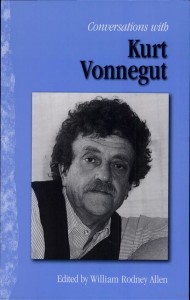 The party took place in a swaybacked Craftsman-style flat gone to pot in more ways than one, and Vonnegut, Einstein hair crackling under the bare light bulb, clearly wasn’t in a party mood. He kept edging into corners, which were mostly stacked with yellowed copies of the New York Review of Books, and one particularly eager faculty member kept edging in on him, like a yawping poodle, begging for attention. The closer he got the farther Vonnegut retreated, but the space was narrowing. Then the faculty member tripped — and spilled his red wine all over the front of Vonnegut’s rumpled corduroy sport jacket. Vonnegut and the poodle froze, one in anger, the other in acute embarrassment. I happened to be standing nearby, and Vonnegut looked at me. “Do you have a car?” he asked coolly. Yes, I said, I did. “I have a headache,” Vonnegut said. “Would you mind delivering me to my hotel?” So I did. The great man was ruthlessly quiet on the drive. “Thank you,” he said when we reached the hotel. He opened the door and got out, and that was the last time I saw Kurt Vonnegut, Jr. I returned to the party, which had thinned out considerably. The academic literati who remained seemed thoroughly depressed. The potheads didn’t seem to notice. They just kept partying on.
Maybe you have your own stories about great figures behaving badly, or just humanly. Let’s gather them here. Hit that comment button.
*
ILLUSTRATIONS, from top:
– W.H. Auden, Library of Congress/Wikimedia Commons
– Dirty little martini/Wikimedia Commons
– United States postage stamp, Katherine Anne Porter and the ship of fools
– Statue of Ken Kesey in Eugene, Oregon. Photo: Cacophany/2007, Wikimedia Commons
– The book “Conversations with Kurt Vonnegut.” Evidently, some lasted longer than Mr. Scatter’s.
-
Knowing what we don’t know
Michael Giberson
In the WSJ, Numbers Guy columnist Carl Bialik explains, “What We Don’t Know About the Economy,” a column about the making of economics statistics and the limits of the process.
Of this column John Whitehead commented, “This is required reading for all those who think that economists should have a crystal ball that allows predictions of the macroeconomic future that are accurate enough to avoid ‘great’ (or even good) recessions. We aren’t even sure what has happened in the past until significant effort has been focused on the historical data.”

-
Only 46% of Americans Support Regulating Large Banks?
Gallup asked some people whether they supported new laws to regulate “large banks and major financial institutions.” Less than 46% said they were in favor. Then they changed the object of regulation to “Wall Street.” The result? A four-percentage point increase.

Matt Yglesias and the FT Alphaville are impressed by the framing effect opening the spread by 11 percentage points. OK, 11 points is nothing to scoff at. But this chart is more surprising.
Three observations…
1. Democrats’ support for banking regulation actually falls (barely, and bizarrely) when pollsters change “large banks/financial institutions” to “Wall Street.” Still at two-thirds support, it’s awfully high either way.
2. Republicans really seem to bite on the financial institutions/Wall Street framing effect, with the spread shrinking from 48 to 18 percentage points. Still, they don’t support regulation no matter what you call the financial industry.
3. Independents swing from roughly even to supporting by a healthy margin when the object changes.
One big question looms: This poll was conducted in days after the SEC announced its fraud suit against Goldman Sachs. That should represent one of the high water marks of public distrust of big banks and support for their regulation. Instead pollsters can’t even find 51% support for regulating Wall Street. How is that possible?
-
The Future of Corporate-NGO Partnerships: Insights from the Fortune 500
Last week, we hosted an intimate lunch at the Fortune Brainstorm Green conference in Laguna Niguel to get the perspective of Fortune 500 firms on the future of Corporate-NGO Partnerships.
Our Vice President of Corporate Partnerships, Gwen Ruta, kicked off the lunchtime conversation with an interesting insight: “20 years ago [when we partnered with McDonald’s], it was heresy t
 hat an NGO would partner with a company. Nowadays, nearly every large business has an NGO engagement strategy. Could it be that tomorrow’s heresy is that companies share environmental innovations and best practices with each other to solve environmental problems?”
This probing question elicited some really astute ideas from the lunch attendees, and was too rich to include every detail here, but here’s a snapshot of some great comments that emerged on ways that Environmental Defense Fund might scale its impact:
- “The key is to determine which areas of sustainability are truly competitive and which can be shared openly amongst companies. For example, if key green technologies are expensive, it’s to the benefit of all companies to work together to bring down those costs.”
- “EDF can play a role in helping business-to-business collaborations (different from trade associations) set high level environmental goals.”
- “Could EDF create an employee swap program where companies and NGOs trade employees for a year to embed sustainability thinking?”
- “EDF needs to focus efforts on asking companies to do things that are really radical” (noting that at the time, asking McDonalds to phase out polystyrene containers was radical).
- It was noted that Google’s employees may spend 20% of their time pursuing projects not directly related to their core job. “Could we replicate this at other companies and have that time directed to solving sustainability challenges?”
As EDF evaluates its successes from the last two decades and makes plans for the future, we’ll be taking many of these ideas and thoughts to heart – and to the table for implementation.
As one company noted, the central question is “When EDF looks back 10 years from now, what will it wish it had done?” What do you think the answer will be?
<!–[if !mso]> <! st1\:*{behavior:url(#ieooui) } –>Last week, we hosted an intimate lunch at the Fortune Brainstorm Green Conference in Laguna Niguel to get the perspective of Fortune 500 firms on the future of Corporate-NGO Partnerships.
Our VP of Corporate Partnerships, Gwen Ruta, kicked off the lunchtime conversation with an interesting insight: “20 years ago [when we partnered with McDonald’s], it was heresy that an NGO would partner with a company. Nowadays, nearly every large business has an NGO engagement strategy. Could it be that tomorrow’s heresy is that companies share environmental innovations and best practices with each other to solve environmental problems?”
This probing question elicited some really astute ideas from the lunch attendees, and was too rich to include every detail here, but here’s a snapshot of some great comments that emerged on ways that EDF might scale its impact:
· “The key is to determine which areas of sustainability are truly competitive and which can be shared openly amongst companies. For example, if key green technologies are expensive, it’s to the benefit of all companies to work together to bring down those costs.”
· “EDF can play a role in helping business-to-business collaborations (different from trade associations) set high level environmental goals.”
· “Could EDF create an employee swap program where companies and NGOs trade employees for a year to embed sustainability thinking?”
· “EDF needs to focus efforts on asking companies to do things that are really radical” (noting that at the time, asking McDonalds to phase out polystyrene containers was radical).
· It was noted that Google’s employees may spend 20% of their time pursuing projects not directly related to their core job. “Could we replicate this at other companies and have that time directed to solving sustainability challenges?”
As EDF evaluates its successes from the last two decades and makes plans for the future, we’ll be taking many of these ideas and thoughts to heart – and to the table for implementation.
As one company noted, the central question is “When EDF looks back 10 years from now, what will it wish it had done?” What do you think the answer will be?
-
Goldman in the Eye of the Beholder
So the vote on the SEC to bring charges against Goldman broke down by party lines. Liberals, understandably, view this as evidence of malfeasance. But of course, there’s an alternative interpretation also consistent with these facts: that Democrats brought a weak charge that won’t stand up in court because they thought it would help them push through their bank reform.
One piece of evidence in favor of this: none of the people I know who are familiar with securities law think that the government has a strong case; the opinions range from “seriously pushing the envelope” to “give me a break.” And no, these aren’t my fat cat friends on Wall Street; they’re folks like Economics of Contempt, who has had more than a few harsh words about Republican efforts to stall reform. It is, of course, entirely possible that I’m missing a lot of top-notch securities lawyers who think the government has a slam dunk. But there’s a plausible argument that the government simply demanded too high a settlement, either because it wanted a political coup, or because it just miscalculated. Particularly since I think Economics of Contempt is right that Goldman would have been better off settling. On the other hand, now that the lawsuit’s been filed, I’m not sure that’s still so. I’m sure they want to avoid another embarrassment like the Fab Tourre email. But if they settle now, they’re guilty. If the government loses, it looks bad, and is less tempted to throw its weight around. If they’re willing to endure the bad publicity, they might be better off seeing it through.
To return to the broader political question, I confess, I’m baffled by the Republican opposition to financial reform; it seems politically stupid, and I’m having a hard time seeing the ideological principals that are motivating it. I mean, I understand the fundraising advantages, but what’s the good of having a bunch of money if everyone thinks you’re in the pocket of the banks . . . which is, after all, possibly your most effective weapon against Obama? So there’s an argument to be made that even if this indictment is a political stunt, it’s necessary in the face of intransigent opposition.
But on balance, I do not find that argument convincing. Regulatory agencies should not be in the practice of helping serve the political ends of the party in power, no matter how worthy those ends. In practice, of course, they often do . . . think district attorneys around election time. But we shouldn’t encourage it. To the extent that we want to have anything like a working technocracy, we need those institutions to be as independent from politics as possible.
-
Gorgeous nightscape timelapse | Bad Astronomy
Tom Lowe has done it again: another jaw-dropping astronomy timelapse.
Timescapes: “Death is the Road to Awe” from Tom Lowe @ Timescapes on Vimeo.
Wow, that’s simply stunning. The music is beautiful and driving, too; it’s from “The Fountain”, a movie I quite enjoyed.
My favorite was the cactus with the Pleiades, Orion, and Sirius behind it. But the whole thing is devastatingly beautiful. You should watch the other short films he’s made, too!


