Blog

  • Here’s Why Simply Increasing Demand Through Government Spending Can’t Fix The Unemployment Problem

    Tyler Cowen looks at Christina Romer’s take on the current unemployment problem, and comes away unimpressed.  It relies too heavily on aggregate demand shocks.  Yet job creation has been especially low, and it’s hard to get there from a purely AD shock.  He says

    Yet the nominal wages on those jobs-to-be are not constrained by previous contracts or agreements.  Tell stories as you may, but it’s hard for me to see that as exclusively an AD problem.

    I wonder what is the behavioral postulate for how long all these unemployed workers are all staring jobs in the face yet persistently stubborn about their appropriate nominal wage.  I’m all for behavioral economics, but I don’t buy the necessary story here.

    I’m not sure you need this to get stickiness. Employers might be reluctant to hire new people at dramatically lower wages than their current employees; such differentials rarely go undiscovered, and they tend to produce big headaches for management.

    Still, I broadly concur with Tyler and Arnold Kling:  I don’t think you can explain this all by falling aggregate demand.  Consider that, as Romer notes, unemployment is about 1.7 percentage points higher than can normally be explained by the change in GDP.  That doesn’t sound like so much.  But it’s really quite a lot.  If you assume that the natural rate of unemployment is probably somewhere around 5.3%, that means the total shift has only been 4.4 percentage points.  In other words, almost 40% of our currently elevated unemployment rate comes from something other than the decline in GDP.

    Moreover, we know that there are large sectors that require structural readjustment:  autos and construction.  Those workers are geographically and skill-constrained.  To think that the current level of unemployment is all about aggregate demand, you have to think that there are lots of jobs into which those displaced workers could easily transition.  But if you own a house in the Detroit era, or have a spouse who still has a job, this is just clearly not the case.

    Join the conversation about this story »

  • “Iron Man 2″ World Premiere Cancelled Due To Volcanic Ash

    The world premiere of Iron Man 2, set to take place in London next Monday night, has been cancelled due to the far-reaching travel disruptions caused by hazardous ash from this weekend’s volcano eruption in Iceland.

    The cloud has forced huge portions of European airspace to be closed amid fears that microscopic particles of highly abrasive ash could endanger passengers by causing aircraft engines to fail.

    The star-studdeded event was scheduled to be the first event at London’s spankin’-new Westfield retail and entertainment complex, Sky News says. The cancellation came as a blow to Paramount, who planned the event for months. Studio bosses were frustrated to learn that they would be unable to fly the cast to the UK for tonight’s event.

    The red carpet premiere is now being rescheduled for next week in Los Angeles.

    Iron Man 2 — which features Robert Downey Jr., Mickey Rourke, Scarlett Johansson, Don Cheadle, and Gwyneth Paltrow — opens in theaters next month.


  • Microsoft fixes Windows: Automated troubleshooter encourages assistance

    By Scott M. Fulton, III, Betanews

    At about this time last year, we received some skeptical comments from folks who questioned whether it was wise for Betanews to declare Windows 7’s automated troubleshooting system one of the new operating system’s Top 10 features — #8, to be specific. Saying a software publisher has improved its product by making it easier to find out what’s wrong with it, is in one sense a bit ironic, and in another the sort of thing that typically smacks of the kind of messages brought to readers directly from the vendor without any filtering whatsoever.

    The reason I declared what Microsoft is now calling its “Fix-It Center” (now with its own Support page) #8 is the same reason I declared Action Center #1: It has the potential for refashioning users’ impressions of Windows, so that they come to understand that troubleshooting one’s computer is as much a part of life as repairing little things in one’s home.

    The automated portion of Windows’ new troubleshooting feature premiered over the weekend. Although Fix-It Center is being described as a Web site that’s accessible from Vista-based browsers as well, more importantly from my vantage point, it’s accessible from something more important than a Web browser: from the Windows 7 Control Panel. That fact removes one critical step from the process of identifying something wrong with the system, and attempting a legitimate remedy.

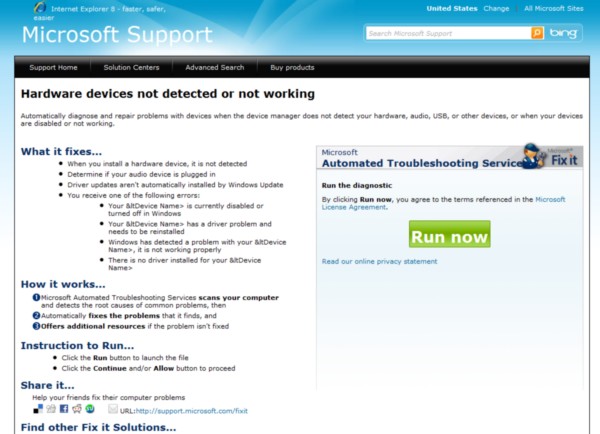
    Microsoft's Support Web site now contains links to Fix-It Center scripts.

    I know it’s a bit early in the week to remind folks of painful times in history, but if you’ll recall just briefly for a moment the era of Windows Me, with its stockpile of irritating grievances that Microsoft addressed with pat answers ranging from “Thank you for your feedback…” to the jaw-dropping, “This behavior is by design.” At the darkest moment of the Windows Me era, a hero emerged in the form of Annoyances.org — at the time, the best single independent source for suggestions from the outside world.

    The first thing I noted about Annoyances.org once it became prominent is that many of the steps that advisors suggested users follow, often became the same steps. Wouldn’t it be nice, I said, if the service were capable of detecting what the user was typing, and respond with, “Stop right there — If I read you right, you’re having trouble getting Windows to recognize your modem…” The second thing I suggested at that horrible time was, wouldn’t it be wonderful if Annoyances.org became a control panel applet in itself.

    It ended up being Microsoft that took my suggestions to heart, although Fix-It Center doesn’t have to parse your problems as you type them. As company engineer-in-residence Mark Russinovich has pointed out on numerous occasions since Windows 7 was first made public, the system is getting smarter about recording its own telemetry, and making it easier for not only administrators but automated scripts to determine the symptoms that users are seeing, find the patterns in those symptoms, and make possible changes that can be undone if they’re the wrong ones.

    What converts incidental problems into annoyances is the time that accumulates between their discovery and their remedy. Having direct access to a potential solution minimizes the chances that annoyances can fester. And enabling others to post troubleshooting scripts (written with PowerShell) that may address problems Microsoft hasn’t discovered yet, or that may affect only a small number of Windows users, helps users to feel that trying Microsoft’s solution might not be futile.

    How a Fix-It Center script begins execution.

    That said, I tried Fix-It Center today with a problem I had ascertained beforehand might be futile to try to solve: I have a voice modem for which no driver has ever been written for Vista, let alone Windows 7. It works fine with Windows XP, though. (I know what you’re thinking — He has a voice modem? Show me a better device for recording phone interviews, and I’ll use it.)

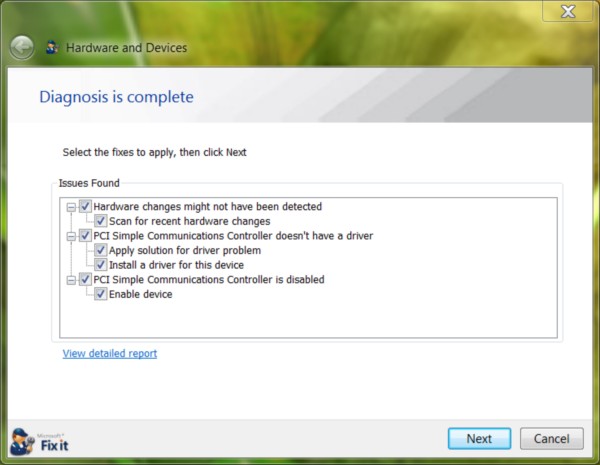
    The interactive nature of Fix-It Center’s scripts should comfort users who will be put off by the very idea of a robotic repairman. The script I ran this morning did not gallop uncontrollably from step to step before giving me an opportunity to cancel. Instead, it gave me a full checklist of active changes the script could possibly make, enabling me to disable those I wasn’t certain about before proceeding.

    A detailed rundown of the steps Fix-It Center is about to take, before it takes them.

    The script did notice my “PCI Simple Communications Controller” (a generic ID for a voice modem) was disabled. In trying to enable it, the script noticed then that there was no device driver for it. Now, it could have made that determination in advance, but then it would have had to try enabling the device without asking me permission first. From a security standpoint, that would have been bad — nothing automated in your system should attempt any substantive changes to your operating system without notifying the user (or, in the case of an enterprise, the admin).

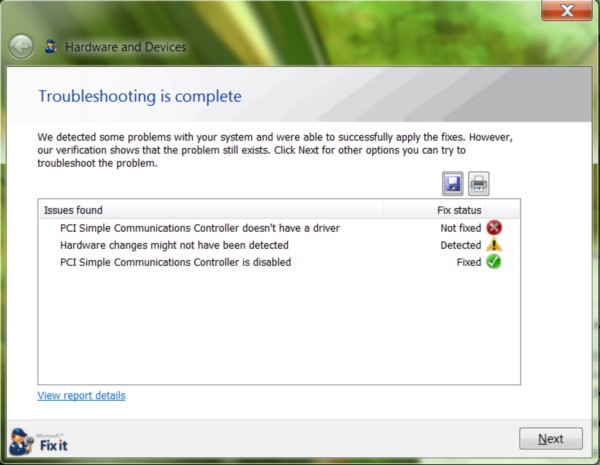
    There was a hint of a possibility that Fix-It Center could find a compatible driver for me online, but I was fairly confident that no such beast exists. What I was interested in was, what happens when the automated script runs out of options? As it reported: “We detected some problems with your system and were able to successfully apply the fixes. However, our verification shows that the problem still exists.” This isn’t exactly right: The script re-installed a generic driver for “PCI Simple Communications Controller,” and guess what, it doesn’t work.

    Okay, so the remedy didn't work, but is this an accurate report from Fix-It Center?

    Now, don’t get me wrong: I’m not complaining about this script not being able to solve an unsolvable problem (the manufacturer of this modem would have to resurrect itself from the dead). What I’m concerned about is how problems are made to become annoyances, and one way of doing that is by fluffing them up with euphemistic language. The final report rendered by this particular script is only half-right.

    It also missed one more step: Perhaps there’s someplace I could have gone, or been sent, to download a driver or at least search for one. Microsoft itself does have such a service online, and linking directly to it should not have been a problem.

    The good news here is, since third parties are just as capable of writing and publishing support scripts to Fix-It Center as Microsoft, some enterprising person who can improve upon the way Microsoft responded to this issue, can actually do so without just sitting back and remaining annoyed. I’m actually very pleased by the release of this service, although now is the time for everyone who used to capitalize on annoyance to start investing in solutions.

    Copyright Betanews, Inc. 2010


    Add to digg
    Add to Google
    Add to Slashdot
    Add to Twitter
    Add to del.icio.us
    Add to Facebook
    Add to Technorati


  • Palm Adds A Retention Program For Key Employees, As SVP Abbott Quits


    Palm HQ Logo

    As if Palm (NSDQ: PALM) needed any more problems … Michael Abbott, its SVP of software and services, has resigned. Abbott had led the “application platform and services development” for Palm’s webOS and was one of nine members of Palm’s management team.

    Retention has to be a major concern for Palm, considering that company has seen its new smartphones fail to take off and has reportedly put itself up for sale. And, indeed, in an SEC filing Friday, Palm said it was starting “a retention program for certain key employees” which will provide them equity and cash over two years—as long as they don’t leave.

    Related


  • Detienen la producción del Honda Civic Type R de cuatro puertas

    honda-civic-type-r-japon.jpg

    Mientras Mugen seguirá ofreciendo el Civic Type R versión dos puertas en Europa y la misma versión en Japón por otro año más, Honda ha decidido cancelar la producción de la berlina del Type R, cuyo último modelo saldrá de producción a fines de agosto próximo.

    El modelo de cuatro puertas seguirá siendo producido en la planta de Suzuka, luego de haber pasado por la planta británica de Swindon en el pasado. Honda no da más información sobre porqué saca a esta variante del Civic de producción, probablemente porque las ventas no son lo esperado en su mercado de origen. Quizás el paso previo a esto fue fabricar el modelo en casa, para tratar de ganar más rentabilidad, a seguir importándolo desde Inglaterra.

    Los fanáticos de Honda pierden un modelo que contaba con potencia adicional al modelo hatchback: con 225 caballos, contra 200 del dos puertas. El resto de la mecánica es similar a su hermano más pequeño. Las cifras económicas mandan y Honda sólo seguirá importando a Japón el hatchback, aunque parece ser que sólo por este año.

    Vía | Autoevolution


  • Permitting Specialist

    Minneapolis, RES Americas Inc

    Responsibilities:
    1. Selecting and overseeing consultants preparing environmental impact reports, avian studies, archaeological surveys, and etc…
    2. Coordinating input of outside permitting legal counsel.
    3. Establishing and maintaining relationships with public agencies involved in the permitting of renewable energy projects.
    4. Liaising with local communities in proximity to renewable energy projects under development.
    5. Preparing, submitting, and presenting permit applications.
    6. Representing RES Americas in public processes aimed at developing permitting guidelines, environmental study protocols, and etc related to renewable energy projects.
    7. Point of contact for the community and/or governmental agencies. May be involved in managing zoning regulations.
    8. Negotiating permit conditions and mitigation measures.
    9. Facilitating RES America Construction’s compliance with such permit conditions and mitigation measures.
    10. Strong oral, written, and interpersonal communication skills.
    11. Familiarity with and ability to stay current regarding changing regulatory requirements.
    12. Represents the company to meet contractual requirements.
    13. Understanding of contract terms and ability to recognize discrepancies.
    14. Stay current with professional and industrial best practices.
    15. Must be able to work professionally with clients, vendors, employees, managers and supervisors.
    16. Regular attendance is an essential requirement of the job.

    Requirements:
    1. Minimum 5-10 yrs of proven permitting experience that includes a proven track record of managing large capital-industrial construction projects.
    2. Renewable Energy or Environmental background preferred.
    3. Needs expertise and the necessary skills to interface with the Client and will be instrumental in delivering on time cost effective projects.
    4. ABILITY TO TRAVEL.
    5. Skilled in MS Project, MSOffice and Outlook.
    6. Employees must be physically capable of operating a vehicle safely, possess an appropriate valid driver’s license, possess personal insurance coverage, and have an acceptable driving record.
    7. NEPA or CEQA experience or siting experience

    Education:
    Degree in Planning, Environmental Studies or Wildlife biology preferred


  • Teaching Economics with Children’s Literature: The Berenstain Bears’ Trouble With Money

     9780394859170.jpg

    Introduction and Summary

    In Trouble With Money, by Stan and Jan Berenstain, Brother and Sister Bear are very good at spending money.  Any time they receive money from a grandparent or from a neighbor, they run to the Country Mall and spend it all.  One day their mother decides they should start receiving an allowance  so that they may learn the value of money.  Their father says that they should instead earn their money so Brother and Sister Bear decide to start doing odd jobs to make money.  They begin to make a lot of money.  When their father finds out that they start to sell the family’s secret location of the best honey trees he gets very upset.  At the end of the story the little bears give their father all of their hard earned money so that he won’t have any worries about money.  The cubs have learned a lesson!  Finally they get to go to the bank to put the money into a savings account to earn interest.  A great story for any child that is learning about the value of saving money.

    Curriculum Connections

    Trouble With Money could be a useful resource for first grade students that are learning about the value of money and about saving and spending.  Students could have this book read to them or try to read it themselves.  Then they could write a short passage about what they would do if they were given an allowance, save it or spend it.  Students should be encouraged to think about money in a postive way. (VA SOL’s 1.7, 1.8, 1.9)

    Additional Resources

    • Planet Orange – Virtual lessons on saving and spending money for kids.

    General Information

    Book:  The Berenstain Bears’ Trouble With Money
    Author:  Stan and Jan Berenstain
    Illustrator:  Stain and Jan Berenstain
    Publisher: Random House Inc.
    Publication Date: 1983
    Pages: 30
    Grade Range: K-2
    ISBN: 0-394-85917-0

  • Goldman’s Defense

    The FT’s Francesco Guerrera reports on Goldman’s defense against the SEC’s fraud charge. It was all a matter of buyer beware, says the bank in submissions to the regulator. And there was nothing underhand.

    In Goldman’s view, it “defies credulity” that ACA, the independent manager of the CDO that also invested in the security, would have taken Paulson’s suggestions on the loans if it had any concerns…

    “There was nothing unusual or remarkable about the transaction or the portfolio of assets it referenced,” Goldman writes. “There is no basis to suggest that the portfolio would have performed any differently or that the economic outcome for the participants would have changed in the least had Paulson’s role and interest been more transparent.”

    Here are the documents in question.

    Look out, Wall Street, the lawyers are coming, says Frank Partnoy in an excellent column. The implications of the case are far-reaching. Litigators can go where regulators fear to tread.

    [T]he case demonstrates a more effective way to police bankers, because Wall Street cannot outrun a judge. That simple point has been part of Anglo-American common law jurisprudence for centuries. The US judge Oliver Wendell Holmes advised that the law was a prediction about what a judge would do. If bankers consider only whether they are complying with specific legal rules, they will create “alegal” transactions – deals that fit the letter of the law but violate its spirit. But they cannot be certain about how a judge might assess their conduct. That worry, not a rule, is what will make bankers tell clients about the presence of a fox.


    Email this Article
    Add to digg
    Add to Reddit
    Add to Twitter
    Add to del.icio.us
    Add to StumbleUpon
    Add to Facebook


  • New iPhone is Found — Literally

    A phone that is reported to be the next iPhone has appeared on the web and has the techerati buzzing. It was first reported to be a prototype that was found, yes found in the wild as someone supposedly left it somewhere. It doesn’t work according to everyone who has gotten their hands on it, and that crowd is getting larger every day.

    Engadget has the first look at the new iPhone, and Gizmodo now has a look at it. Kind of a second look, if you will. What can we tell about this phone, if it is indeed the new iPhone? It’s flat, for one thing. Gone is the curved back of the current iPhone. It’s plastic, black plastic to be specific. It’s heavier than the current model, which perhaps is due to the bigger battery that is in this prototype. It might have a higher resolution display, which would make it more of an “iPad lite” I suppose. It’s attractive, no question, but it sure looks thick to me.

    Related content on GigaOM Pro (subscription required):

    Hot Topic: Apple’s iPad

  • iPhone OS 4.0 to have Facebook Contact and Event Integration?

    Amid the flurry of news surrounding the next-gen iPhone revelations, another little tidbit of information about iPhone OS 4.0 has made it’s way out: it seems that Facebook contact and event integration may be a new system feature.

    While this may not be a new concept for the Android and WebOS devout among us, it is one that the iPhone could really benefit from.

    Having contacts linked to Facebook means that your phonebook is automatically updated whenever your contacts update any of their numbers. As long as your contact keeps their Facebook details up-to-date, you never have to worry about losing that number again, Rikki. Or Milli, for that matter.

    Calendar Integration with Facebook events will also be a boon for the socialites, as Facebook Events are becoming an ever more popular way to organise, promote, and prepare for keg parties.

    Apple Insider last week noted the existence of a “linked contacts” feature in iPhone OS 4.0, which ties in nicely with the newly discovered Facebook integration, but it seems that it was a nail gun safety blog entitled Gunning For Safety that broke the news of the system-level integration with Facebook. They have the evidence and reasoning behind it on their website, as well as some statistics on nail gun related injuries. So, whaddaya waiting for?

    [via Engadget]


  • Pop the climate question!

    In the next fortnight, two political debates that could decide the future of this country will be at the

    Tristan is rearing to Ask the Climate Question!

    Tristan is rearing to Ask the Climate Question!

    centre of media attention in the North West. There will be arguments aplenty, more than one candidate will claim victory but they won’t take place in Birmingham or London and they definitely won’t be a spin alley. On the 21st April Oxfam hosts the ‘Ask the Climate Question’ hustings in the South Ribble Banqueting Hall. It’s followed a week later on the 28th by another one, this time in Bury North at the Fusilier Museum in Bury. They will challenge parliamentary candidates in two of the countries closest constituencies to explain where they stand on the issue of Climate Change and could potentially prove crucial come May 5th.

    As a self-confessed politics geek with a passion for tackling climate change it’s been a joy to be charged with helping organise these events. In fact all we need is the addition of Eric Cantona as chair and this is about as close to my perfect job as I can imagine. Geekiness and footballing legends aside though, the real reason these debates are so important to me is because climate change is so crucial an issue. Just as the injustice of apartheid led so many good people to act in the late 80s and early 90s, so too the threat of climate change requires positive action now.  With people suffering day in day out because of it, it’s surely our generation’s great cause and the one that we will come to be judged on. After all it’s not about rolling back the comforts of the modern age but taking the small steps that could make such a massive difference. That’s why I think it’s not just an election issue but also THE election issue. So come Wednesday I’ll be there climate change question at hand and ears wide open.


    In a week in which the second historic leadership tv debate takes place, it could be easy to think there was only one event that mattered. That’s not the case. So if you live in South Ribble or Bury North, why not take part in your own piece of history by coming to your local hustings and asking the climate question.

  • Five barriers to energy efficiency savings – and how smart companies can overcome them

    Here’s a business conundrum for you: energy efficiency saves serious money, cuts carbon pollution, requires low tech solutions, and is a known quotient, having been around since the 1970s. So why are so many companies still not taking the necessary steps to identify and eliminate these inefficiencies?

    “What we learned in Econ 101 doesn’t hold true when it comes to energy efficiency – the notion of perfect markets, where information flows freely and people are maximizing their value,” notes Environmental Defense Fund’s Gwen Ruta. “Instead, it’s as if companies across the globe are walking around with a hole in their pocket with coins dribbling out nonstop.”

    How is it that smart companies who are vigilant about monitoring the bottom line, stock price, customer satisfaction and much more let this wasteful “dribbling” occur? This question launched a robust discussion at a Fortune Brainstorm Green session last week titled “A Trillion Dollar Opportunity: The Hunt for Energy Efficiency.” Gwen Ruta was joined on the panel by Gretchen Hancock, Project Manager for Corporate Environmental Programs at GE; Bill Weihl, Google’s Green Energy Czar and Beth Trask, Deputy Director of EDF’s Innovation Exchange. GE and Google have made huge strides around energy efficiencies in past years, with still more work to do on the horizon and still some barriers of their own to break down.

    So what are the main barriers to energy efficiency and how can companies try to overcome them?

    Barrier #1: Information overload and lack of focus. There’s a ton of information out there about energy efficiency – and what companies should do to reap the savings – but it’s diffuse and challenging to wade through. Companies need help focusing in on the right tools and content and prioritizing where and how to begin. GE conducts through regular energy “treasure hunts” inside a given company where selected employees come together for a jam-packed three-day working session to identify energy efficiency savings at a chosen manufacturing site. The results are impressive – each treasure hunt typically identifies opportunities to reduce energy spent by 20% – and proves that when people have the information, data and focused time to spend on this challenge, huge savings can be found.

    Barrier #2: Structural limitations. This is a big one. Companies of all sizes suffer from a siloed approach to business, where business units and operational departments are managed by separate budgets, performance timelines, product cycles and more. Finding energy efficiency savings requires employees throughout the company to share information and make trade offs in order to achieve strong results. For example, there may be an increase in cost to the R&D budget around energy efficiency efforts, but balanced by a result in savings that will show up in the facilities management budget. Most likely, these two divisions communicate rarely and have little in common – including different bosses who may not communicate well among themselves, either. Why would one take on a cost for the other to reap the savings? Google takes a “total cost approach” that is geared to precisely avoid this problem. And GE’s treasure hunts bring cross-functional teams together over the three-day activity which by definition helps break down silos. According to Gretchen Hancock, the more people from different departments are involved, the better the results of these treasure hunts are.

    Barrier #3: The solutions are small and diffuse, not few and mighty. There is no single “gee whiz” step that companies can take to ensure they are reaping all the benefits of energy efficiency for their organizations. It takes time for companies to unearth where and how they can save both cash and carbon through energy efficiency. Some employees may be attracted by bigger, more appealing sustainability projects or cost savings efforts that are being considered or launched by their company. To avoid this problem, the hunt for energy efficiency savings should be institutionalized throughout companies as a continuous process, not one-off events. Energy efficiency savings should be one of the metrics that business units are evaluated on, and therefore, regularly measured and reported on.

    Barrier #4: Cultural resistance within companies. As Gretchen Hancock noted, some companies hear the phrase energy efficiency and think, “Didn’t we tackle this problem in the 1970s?” In companies where innovation and excellence is the expectation and the norm, executives may believe that the “low hanging fruit” of energy efficiency is either too low-tech to consider or has been dealt with decades ago. But the fact is that energy efficiencies exist where even super bright executives might not expect to find them. Aging equipment can cause inefficiencies, new technology enables new savings and employees need to be trained and retrained on efficiency issues and practices.

    Barrier #5: Those super-short ROI expectations. We all know how Wall Street expects speedy ROI for corporations across the board. As a result, public companies have a strong disincentive to invest in processes, products or technologies where recouping the costs may take anywhere from 1 to 5 years. This short-term thinking leads to short-term strategies, and serious money being left on the table

    There are other ways companies can encourage energy efficiency savings. One way is to engage the supply chain and provide incentives to find the energy cuts in various ways. Another potentially powerful strategy is to use social influence and competition to ensure results – having different office locations “race” to find the biggest savings, engage local schools to help with the hunt for energy efficiency in their communities, among other things. Once we see how quickly those coins can add up, we’re all likely to join in the race.

    What other powerful ideas can companies consider as they embark on the hunt for energy efficiency?

  • Palm Buyer Doubts Concern Analysts

    Tech Trader Daily has a round up piece out this morning on the latest analyst scuttlebutt on Palm Inc. Concerns that the company may not find a buyer have so far sent shares down ~10% in trading today.

    TTD’s article sums up the comments from three long time Palm analysts, all of whom are rather pessimistic on the stock. UBS analyst Maynard Um thinks last Friday’s SVP departure and executive bonuses are a sign that a deal is not pending and he reckons that interest in the firm may be tepid. Morgan Keegan analyst Tavis McCourt reflects similar sentiments, but goes even further stating “Palm’s ability to execute a turnaround internally remains difficult.”


  • Quick Spin: 2011 Chevrolet Cruze ain’t no Cadavelier

    Filed under: , , , ,

    2011 Chevrolet Cruze – Click above for high-res image gallery

    Chevrolet’s mainstream, high-volume compact car was derisively referred to as the Cadavelier not so many years ago. It was considered one of the most uninspired entries from any automaker in the segment. The Cobalt was a major step forward, but still wasn’t near the top of its class. In the words of soon-to-retire General Motors vice-chairman Bob Lutz, the Cobalt was developed under the old philosophy of making cars “good enough.”

    Under Lutz’s tutelage, GM’s product development team has shifted to a philosophy of making its products “Best in Class.” Transitions like this don’t happen overnight, though – especially in the car business with its long lead times. While some would argue about whether GM’s newest offerings are segment leaders, there is no doubt that almost every recent GM introduction has made tremendous progress.

    GM will launch a replacement for its one-and-done Cobalt later this year in the shape of the new Chevrolet Cruze. We were invited to the GM Milford Proving Ground to learn more about the Cruze and get a first drive on the track. Read on to find out if it indeed has a shot at being best in class.

    Continue reading Quick Spin: 2011 Chevrolet Cruze ain’t no Cadavelier

    Quick Spin: 2011 Chevrolet Cruze ain’t no Cadavelier originally appeared on Autoblog on Mon, 19 Apr 2010 12:28:00 EST. Please see our terms for use of feeds.

    Permalink | Email this | Comments

  • U.S. Urban Residents Cut Water Usage; Utilities are Forced to Raise Prices

    As municipal water consumption declines, cities raise rates and civic ire.

    Las Vegas, Nevada

    By Brett Walton
    Circle of Blue

    Last week the Metropolitan Water District of Southern California, one of the nation’s largest municipal water suppliers, announced that along with requiring its customers to use less water under mandatory conservation measures it also would hike up the price for water by 15 percent over the next two years.

    The board of the Los Angeles-based water district, which supplies drinking water to nearly 19 million people in parts of Ventura, Los Angeles, Orange, San Diego, Riverside and San Bernardino counties, anticipates a public push back.

    Indeed as water sales have declined because of the recession and conservation, water utility boards all across the country have raised rates, prompting civic dismay. A growing number of raucous council meetings, street protests and petition drives in opposition to higher water prices have occurred in cities large and small–Detroit; San Diego; Joplin, Mo.; Prairie Township, Ohio.

    In effect, in too many American cities to count, water consumers are dramatically reducing the amount they use only to be hit with higher water rates. Existing designs for deciding water rates are the culprits. A handful of cities are restructuring their billing systems to benefit conservation-minded consumers who deserve to be rewarded rather than penalized.

    “With a deductive reasoning applicable only to a public service monopoly, the answer is to punish the consumers’ conservation efforts with a rate increase”
    –Kevin Bakley

    The trend favors even more water conservation. A recent report from the Denver-based Water Research Foundation found that the recession has bottled up water demand in many areas of the country-–particularly in regions hard hit by unemployment and foreclosures. And since the mid-1990s, federal law has required new fixtures to be low-flow, meaning they use less water. Showerheads, for instance, are limited to a flow of 2.5 gallons per minute. And toilets can only use 1.6 gallons per flush, down from the 3.5 gallons that were standard in the 1980s.

    The unintended consequence of using less in most cities is that ratepayers pay more. The Cleveland region has increased water rates 45 percent to 80 percent since 2007. Cleveland Water Commissioner Chris Nielson explained to the The Plain Dealer last week that “revenue was $25 million below projections last year because of a decrease in consumption.”

    “With a deductive reasoning applicable only to a public service monopoly, the answer is to punish the consumers’ conservation efforts with a rate increase,” said Kevin Bakley, a resident and water customer from Strongsville, in a letter to the editor. “At least the return of spring will allow completion of road repairs for the continual, unimpeded egress of corporations and citizens leaving Northeast Ohio.”

    Water consumption in St. Charles, Illinois dropped to 1.5 billion gallons last year from 1.68 billion gallons in 2008. John Lamb, the director of the city water department, is preparing a recommendation to the St. Charles City Council to raise rates 4 percent. It would be the third increase in as many years.

    “It’s funny, in the sense that it’s a double-edged sword,” Lamb told the Kane County Chronicle. “We tell people all the time to conserve water, conserve water. But then we, as the municipality providing the water, suffer because there’s less money coming in to maintain that system.”

    Well, it’s not so funny to thousands of water customers. Ratepayer protests are erupting, many of them in California, a state entering the fourth year of drought. Residents of San Diego submitted 14,000 written protests to the city clerk’s office in November 2009 opposing a new rate–the sixth since 2007–that would have increased the average monthly bill by $4.73.

    To a large extent, say some authorities, water conservation should not necessarily translate into higher prices. Rather the system for deciding water rates needs to be redesigned to reward customers who conserve, not lash them.

    “There’s no reason why municipalities who implement conservation programs should have to raise their rates,” said Peter Gleick, president of the Pacific Institute. “If that happens it’s a failure of rate design.”

    Conservative Conservation and the Death Spiral

    Las Vegas Rate Structure

    Graphic by Trevor Seela.
    An example of a water rates implemented by the Las Vegas Utility.

    Las Vegas water officials call the tradeoff between saving water and raising rates the conservation death spiral. Water utilities are natural monopolies–the cost of delivering water is lowest when there is just one supplier. In the U.S. water utilities are generally publicly–owned and the rules governing each utility differ by city, with most not allowed to make a profit. Any rate increase, even for investor-owned water companies, usually has to be approved by a public service commission. The interjection of public policy and politics is ostensibly to keep the water supplier from gouging the customer, but it has the consequence of affecting a utility’s business incentives.

    “Water agencies in the past have tried to keep rates low, in part because of political pressure,” said Heather Cooley, a researcher at the Pacific Institute’s water program. “Members of the board are often elected. It does create problems in the long term, namely failure to adequately invest in infrastructure. Part of the reason utilities are not making those investments is the pressure to keep rates low.”

    As a result, cities are often playing catch-up with rates, burning through cash reserves and ignoring system improvements until a rate increase becomes absolutely necessary. Historically, to keep revenue stable, public utilities charged a flat fee for water regardless of how much was used. With the introduction of water meters in the early 20th century, some cities began charging based on the volume of water used, sometimes $2.00 per 1,000 gallons.

    The use of meters, however, varied widely around the country. By 1927, 100 percent of the water connections in Portland, Ore. were metered, but this isn’t the case for all cities. To date, Sacramento still has meters in only 25 percent of its houses.

    A big shift in pricing occurred in the arid Southwest in the late 1970s. Because of rising use and declining water supply, Tucson, Ariz. instituted an increasing block tariff to encourage conservation. Under an increasing block tariff the cost for a unit of water gets more expensive the more a customer uses. For example, the first eight 1,000 gallon-units might cost $2.00 each, but every 1,000 gallons over that limit would cost $5.00 each, with potentially more tiers added to the rate, depending on the price agenda of the utility.
    Fernando Molina, conservation manager at Tucson Water, the city’s utility, explained the circumstances prompting the rate changes in Tucson.

    “The 1970s is when the strong conservation movement emerged,” Molina told Circle of Blue. “Back then infrastructure had not kept up with growth. During peak times in summer the utility had trouble meeting demand, especially in the higher elevations in the city. There was a lack of distribution lines and reservoir capacity. When the block rate was introduced it caused a lot of controversy.”

    Businesses accused the council of being anti-growth while residents gathered signatures to recall the council. At a special election that fall, every council member who voted for the price increase was voted out of office.

    The political fallout in Tucson did not stop the inevitable spread of block tariffs. Cities in which water was scarce had kept the price of water too low and needed to cut rampant use. In areas with limited water supply, block tariffs encouraged conservation by raising the price of consumption for high-volume users. Certain municipalities dealt with the peak demand problems by ordering seasonal rates, which are higher in dry seasons. Though tiered pricing was slow to take hold and poorly implemented where it did, the shift in rates was clear–prices were now a tool to steer conservation.

    This is often when death spirals, which are products of utilities allocating costs, occur. Mention conservation and water rates to water managers using a block tariff and they will give you a similar version of the story told by Doug Bennett, conservation manager for the Southern Nevada Water Authority:

    “Water agencies have a disincentive to conservation because if customers cut use, it cuts sales.”

    “You say [to the customer] we want you to conserve. No rate changes, just a call for conservation. If people react more strongly than you thought they would, then suddenly there’s a revenue shortfall. Now we have to increase rates to recover that. Sometimes we raise rates in upper tiers, but that just increases conservation. The wise thing to do is put it in a service charge or lower tiers, but that sours the relationship with the public.”

    Utilities face two major categories of cost: fixed and variable. Fixed costs do not change regardless of whether the utility sells any water or not, such as system maintenance and staff salaries. Variable costs–energy, purchased water, chemicals for treatment–change depending on demand.

    Most utilities charge all customers a fixed monthly service fee in order to pay for fixed costs, but most utilities have a serious imbalance in assigning revenues to costs. While 72 percent of the Las Vegas Valley Water District’s costs are fixed, the utility’s fixed fee covers only 18 percent of its fixed costs. The balance is covered by charges on consumption, so if water use goes down too rapidly the utility gets into financial trouble.

    “Water agencies have a disincentive to conservation because if customers cut use, it cuts sales,” Cooley told Circle of Blue.

    In essence, water utilities make money selling water. And since selling less water decreases revenue, utilities develop a perverse incentive that welcomes dry periods because people will use more water on their lawns and generate more income for the utility.

    Interactive Graphic: Water Data by Selected Cities

    Graphic by Trevor Seela.

    “Rising conservation has contributed to revenue volatility,” said Rusty Cobern, budget and finance manager for the Austin Water Utility. “We would have expected a revenue windfall during the [recent] drought. Aggressive conservation pricing model can eliminate windfall opportunities.”

    Phoenix is contemplating the same problem. Price increases and education programs have kept water usage stable for the past decade despite a 28 percent increase in population. But now the utility wonders how much conservation is too much.

    “How low can we go?” asks Steve Rossi, the principal water resources planner for Phoenix. “From a revenue standpoint, our capital obligations are pretty substantial. Assumptions were made in the past made about revenue flows. We are looking at how things balance down the road if you reduce demand.”

    Because publicly-owned utilities are often barred from making a profit, they go through detailed budgeting when setting rates so that they can cover their costs while keeping rates low. Included in these budgets are estimates for how much the customers will conserve. The Marin Municipal Water District in California based its 2009 budget on a projected three-percent decline in sales due to conservation, said Libby Pischel, the district’s public information officer.

    As it turned out, customers responded too well to conservation requests, cutting back water use by eight percent, leaving the utility short of cash and forcing an unwelcomed rate increase.

    Utilities could avoid the problem by shifting some of their revenue from consumption to fixed charges, but that increases the cost for low-volume customers.

    Conservation Instinct Still Strong

    Despite the perils of the death spiral, the argument for conservation is strong. Developing new sources of water is expensive, especially as the distance to untapped rivers and reservoirs increases. In Seattle conservation methods has led water managers to predict that the two water supply reservoirs the utility operates will meet the city’s demands until well after 2060.

    Conservation can also prevent supply problems during dry periods.

    “Long-term conservation improves the supply reliability of system,” said Drew Beckwith, a water specialist with Western Resources Advocates. “If you conserve now, when there’s a drought there will be water in the reservoirs.”

    “When I was young I always wanted a rate increase, an aggressive rate structure,” added Bennett in an interview with Circle of Blue. “I wasn’t aware of what the finance people do. It’s really a fine art. What is terrifying to finance people is to throw out rate structure completely and try something new. It’s like cooking — you turn up or turn down the burner. If you throw something big in there it can turn ugly fast.”

    “There’s not a lot of benefit to achieving conservation goals ahead of schedule,” he said.

    The Irvine Model
    Several water utilities have figured out how to resolve the conflict between conservation and revenue.

    Irvine Ranch Water District in Orange County, Calif. pioneered a new model when it instituted an allocation-based rate structure in 1991.

    “Water agencies should be communicating to customers that yes, rates went up in the short term, but it is far less than if we had to build new facilities for a new water source. I don’t think agencies have been good in communicating.”

    Every household is given an allocation based on personal use needs of 55 gallons per person per day and lawn needs based on efficient watering. Customers can apply for an adjustment if there are more people in the house than the utility assumes. A base price is set for the allocation. If a household exceeds its allocated use, it is penalized with rates up to eight times higher than the base rate. On the other hand, if a household is water-frugal it receives a discounted rate.

    “Our water rates are the second lowest in our county,” said Fiona Sanchez, IRWD’s conservation manager. “Customers who use water efficiently are rewarded with low rates.”

    Not only are rates low, but use is low too. The average customer served by Irvine Ranch uses 52 percent less water per day than the average person served by other Orange County utilities. Efficient use helps to keep prices low by reducing the need to buy water imported from the Colorado River.

    IRWD’s success stems from a prudent division of costs and allocation of revenues.

    “The key to revenue stability is that we separated fixed and volumetric charges,” Sanchez told Circle of Blue. “We know what our operating costs are and that’s distributed across all customers. If our volumetric sales go down, we’ve got our fixed costs covered.”

    IRWD also separated its capital costs from its operations costs. Capital projects to build or maintain water infrastructure are paid for by property taxes and one-time connection fees charged to new users in the system. This keeps water bills in check, but transfers the costs of expansion and repair to a resident’s tax bill.

    IRWD customers seemed to be pleased with the system. The utility earns extremely high customer satisfaction scores, and its board members get re-elected, Sanchez said.

    Irvine Ranch has conservation, lower prices and customer satisfaction. A handful of utilities in California, because of drought and pumping restrictions, have shifted to allocation-based pricing in the last year and a few others are considering it, Sanchez said.

    So why aren’t more following this model?

    Data needs are one problem, Sanchez said. The utility needs information about each household’s irrigated acreage. Allocations for lawns are based on micro-climates within the service area and the water requirements from plant use and evaporation.

    Another problem is antiquated billing systems, which are often expensive to upgrade.

    While there are certainly technical issues to be sorted out, utilities can avoid the backlash from rate increases by improving communication with their customers, the Pacific Institute’s Cooley said.

    “Water agencies should be communicating to customers that yes, rates went up in the short term, but it is far less than if we had to build new facilities for a new water source. I don’t think agencies have been good in communicating.”

    “I think it’s a failure across the board to engage people,” she added. “It’s a missed opportunity. Most people don’t understand what it takes to provide a clean water supply. When you explain it to them, the utility is able to better maintain a functioning system.”

    Residents are looking for leadership from their utilities. At the water rate hearing in Marin County, Calif., board members were urged to make the case for why rate increases were necessary.

    “Stop penalizing homeowners who conserve and start rewarding them,” said one resident, the Marin Independent Journal reported.

    Brett Walton is a reporter for Circle of Blue. Read the part one of his investigation on U.S. urban water rates here. Reach Walton at [email protected]. All graphics were created by Trevor Seela. Reach Seela at [email protected].

  • Oklahoma City, 15 Years After the Bombing

    It is a beautiful Spring day here in Oklahoma City, not unlike the day fifteen years ago when the city was forever changed. Timothy McVeigh parked a truck loaded with explosives in front of the Alfred P. Murrah Federal Building and at 9:02 am, the truck exploded, killing 168 people, including 19 children. Today survivors, rescuers and relatives of the victims gathered to remember those who died. They began a memorial service with 168 seconds of silence, one for each victim. Oklahoma City Mayor Mick Cornett talked about the choices made after the bombing, saying “We have chosen strength. We have chose optimism. We have chosen freedom.”

    Former Governor Frank Keating, current Governor Brad Henry and Department of Homeland Security Secretary Janet Napolitano spoke. The ceremony ended with survivors and relatives of victims reading each name of the 168 who died.

    After the ceremony, people stayed, giving one another hugs and crying. They also visited the individual chairs, each representing a victim who died in the bombing. The chairs are placed near where each person was found.

    For us, we may not think about the Oklahoma City bombing until anniversaries like this one. But for those who lost loved ones fifteen years ago and for those who still wear its scars, the bombing is never far from their minds.

  • McCain, Kyl Announce a 10-Point Border Security Plan

    During a press conference this morning, Sens. John McCain and Jon Kyl, both Republicans from Arizona, announced a 10-point border security plan for Arizona they say will fight illegal immigration, drug and immigrant smuggling and violence along the U.S.-Mexico border. Their plan, which comes on the same day that the Arizona Senate will decide on a controversial immigration bill, calls for the deploying 3,000 National Guard troops to the southern Arizona border, the implementation of Operation Streamline, a program that has created a backlog of immigration cases and a rising number of immigrant detainees, and the completion of an unpopular border fence, among other measures.

    During the conference, McCain said immigration reform is a top priority, but border security should come first. The Hill reports:

    ‘The lesson is clear: First we have to secure the border,’ McCain said in a press conference. ‘If you want to enact some other reforms, how can that be effective when you have a porous border?…So we have to secure the border first,’ he added.

    Here’s the entire plan, from a press release:

    1. Immediately deploy 3,000 National Guard Troops along the Arizona/Mexico border, along with appropriate surveillance platforms, which shall remain in place until the Governor of Arizona certifies, after consulting with state, local and tribal law enforcement, that the Federal Government has achieved operational control of the border. Permanently add 3,000 Custom and Border Protection Agents to the Arizona/Mexico border by 2015.

    2. Fully fund and support Operation Streamline in Arizona’s two Border Patrol Sectors to, at a minimum, ensure that repeat illegal border crossers go to jail for 15 to 60 days. Where Operation Streamline has been implemented, the number of illegal crossings has decreased significantly. Require the Obama Administration to complete a required report detailing the justice and enforcement resources needed to fully fund this program. Fully reimburse localities for any related detention costs.

    3. Provide $100M, an increase of $40M, for Operation Stonegarden, a program that provides grants and reimbursement to Arizona’s border law enforcement for additional personnel, overtime, travel and other related costs related to illegal immigration and drug smuggling along the border.

    4. Offer Hardship Duty Pay to Border Patrol Agents assigned to rural, high-trafficked areas, such as the CBP Willcox and Douglas Stations in the Tucson Sector.

    5. Complete the 700 miles of fencing along the border with Mexico and construct double- and triple- layer fencing at appropriate locations along the Arizona-Mexico border.

    6. Substantially increase the 25 mobile surveillance systems and three Predator B Unmanned Aerial Vehicles (UAVs) in place today along the Arizona/Mexico border and ensure the border patrol has the resources necessary to operate the UAVs 24 hours a day seven days a week. Send additional fixed-wing aircraft and helicopters to the Arizona-Mexico Border.

    7. Increase funding for vital radio communications and interoperability between CBP and state, local, and tribal law enforcement to assist in apprehensions along the border.

    8. Provide funding for additional Border Patrol stations in the Tucson Sector and explore the possibility of an additional Border Patrol sector for Arizona. Create six additional permanent Border Patrol Forward Operating Bases, and provide funding to upgrade the existing bases to include modular buildings, electricity and potable water. Complete construction of the planned permanent checkpoint in Arizona. Deploy additional temporary roving checkpoints and increase horse patrols throughout the Tucson Sector.

    9. Require the Federal government to fully reimburse state and local governments for the costs of incarcerating criminal aliens. Start by at least funding the State Criminal Alien Assistance Program (SCAAP) at its authorized level of $950 million.

    10. Place one full-time Federal Magistrate in Cochise County and provide full funding for and authorization of the Southwest Border Prosecution Initiative to reimburse state, county, tribal, and municipal governments for costs associated with the prosecution and pre-trial detention of federally-initiated criminal cases declined by local offices of the United States Attorneys.

  • First Drive: 2011 Chevrolet Volt pre-production charges toward production

    On January 7, 2007, at the Detroit Auto Show, General Motors issued a press release entitled ‘GM’s Concept Electric Vehicle – Could Nearly Eliminate Trips to the Gas Station,’ marking the debut of the Chevrolet Volt Concept. Just over three years later, we had the opportunity to drive one of the very first Chevrolet Volt pre-production models before they hits the streets this November.

    GM is insistent that the Chevrolet Volt not be called a hybrid, a plug-in hybrid, or even an electric vehicle. So then, what to refer to the Volt as? An electric-vehicle with extended-range capability without range anxiety. That the very foundation upon which the Volt was first conceptualized and later developed. When it was first announced three years ago, GM’s charismatic executive Bob Lutz said that the Volt would be GM’s ‘benchmark in battery technology.’

    “Even so, electric vehicles, in general, had limitations. They had limited range, limited room for passengers or luggage, couldn’t climb a hill or run the air conditioning without depleting the battery, and had no device to get you home when the battery’s charge ran low,” Lutz said. “The Chevrolet Volt is a new type of electric vehicle. It addresses the range problem and has room for passengers and their stuff. You can climb a hill or turn on the air conditioning and not worry about it.”

    So how does it drive? We will get to that shortly, but first lets get the technical stuff out of the way.

    Click through to read more and to view the high-res image gallery (at the bottom of the post).

    First Drive: 2011 Chevrolet Volt:

    All Photos Copyright © 2010 Omar Rana – egmCarTech.

    The backbone of the Chevrolet Volt is the Voltec propulsion system. That consists of a 16-kWh, “T”-shaped lithium-ion battery that powers the electric drive unit, which is capable of meeting full vehicle speed and acceleration performance while driving the car on electric power for up to 40 miles without using a drop of gasoline. According to GM’s preliminary specs, the system puts out 150-hp and a maximum torque of 273 lb-ft, bringing the Volt from 0-60 mph in about 9 seconds, and hitting a top speed of 100 mph. The battery can be re-charged by plugging into a household outlet and takes less than 3 hours to recharge on 240 volts, and about 8 hours on a standard 120-volt outlet.

    That does not mean that after 40 miles of driving your Volt will be rendered useless; enter extended range capability without range anxiety. The Volt carries a 1.4L 4-cylinder engine that allows the five-door, FWD sedan to travel additional miles until you’ve found an outlet to plug in to. In range-extended form, the Chevrolet Volt will average 50 mpg, which is comparable to the Toyota Prius. A fully charged battery and full tank of gas will take the Volt over 300 miles.

    So how does the car drive? Like a completely normal vehicle. This is not a sport car, nor does it provide the feel of a naturally aspirated engine, but compared to cars like the Toyota Prius and the Honda Insight, the Volt definitely has a much more solid feel to it. Even in electric-mode, the car takes off (with an added Sport Mode), takes corners as you would expect a car of this caliber to, and takes stop-and-go driving like a charm. What we’re trying to say is that driving the Volt, you’ll feel completely normal and won’t experience anything totally unexpected; however, once you take your attention away from the street (and stop day dreaming about how you’re saving the world by driving a “green vehicle”) and look at the interior cabin, you’ll realize you’re driving something totally futuristic and innovative.

    Inside, the Volt offers modern controls and attractive quality materials, two informational displays, and a touch-sensitive infotainment center with integrated shifter (which we thought was a bit bulky and odd) which all serve to distinguish the Volt from other vehicles on the market. It’s almost as if a designer from Apple Computers Inc. came to help GM out in designing the interior.

    Some interior features of the Volt include driver-configurable, liquid crystal instrument display, standard 7-inch touch screen vehicle information display, touchscreen-style climate and infotainment controls, standard Bluetooth connectivity, and optional navigation system with onboard hard-drive for maps and music storage and rearview camera.

    Our only real gripe with the interior was that the rear-seat area becomes very cramped with a tall individual occupying the front driver and passenger seat.

    The outside of the Volt is akin to every other fuel-efficient vehicle on the market, an oddly shaped cheese-wedge like body. However, GM has focused all of their attention on the exterior towards maximizing efficiency. Every detail was carefully attended to minimize aero-drag and maximize battery range as air flows easily around the car. The rounded flush front fascia with closed grille hits the eyes in an odd way, but this too serves a purpose; just like the aerodynamic side mirror, sharp rear edges, and rear spoiler – too make the car move effortlessly through the air before it as it attaches itself at the front and quickly detaches at the rear to reduce drag.

    So, should you sit on the edge of your seat waiting to buy this car? Only if you want something technologically advanced and want to cash out in the mid $30k range and if you can recoup your investment. For example, if your daily commute consists of 40 miles a day, you’ll never have to pay for gas. The only cost you’ll have is maintaining your Volt and the electricity cost for charging the vehicle, which is estimated at $0.80 per day for a full charge delivering 40 miles.

    Also, keep in mind that come November, General Motors will only offer the Chevrolet Volt in California, Washington D.C., and Michigan; GM will not be offering the Volt nationwide until 2011.

    First Drive: 2011 Chevrolet Volt:

    All Photos Copyright © 2010 Omar Rana – egmCarTech.

    – By: Omar Rana